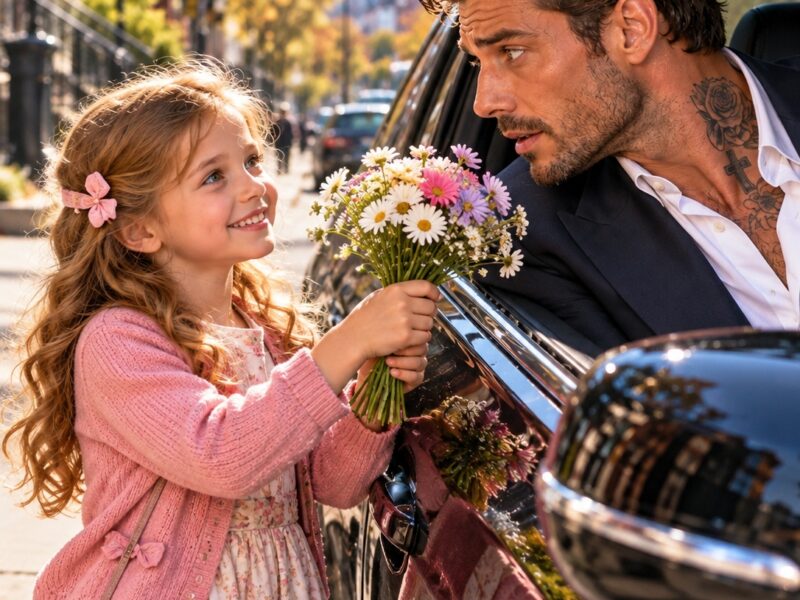
A Poor Little Girl Offered the Mafia Boss a Two-Dollar Flower—Then One Question Made Him Stop the Project That Was About to Erase Her Entire Neighborhood
“Mister, buy this flower for two dollars. It might make you happy.”
Dante Moretti had not truly smiled since his mother died, and he certainly had not expected a six-year-old with crooked daisies to be the first person in Boston to notice.
Then he looked past her at the block his own company planned to demolish—and realized the little girl might be standing on top of a secret someone had paid millions to bury.
The voice came through the thick glass of Dante Moretti’s black Mercedes like a pebble breaking the surface of still water.
“Mister.”
He looked up from the blueprints spread across his lap.
“Mister, buy this flower.”
A little girl stood outside the rear passenger window.
She could not have been older than six.
Dark hair tangled by the wind.
Gray sweater two sizes too large.
Brown boots with one lace replaced by white string.
In both hands, she held a crooked bouquet of yellow daisies wrapped in newspaper.
Dante stared.
The girl tapped the glass with one small knuckle.
“Two dollars.”
Marco Bellini shifted in the driver’s seat.
He had driven for the Moretti family since Dante was seventeen.
His right hand moved automatically toward the door handle.
“Boss, I’ll move her along.”
Dante raised one finger.
Marco stopped.
The little girl pressed closer to the tinted glass.
Her nose nearly touched it.
Dante glanced down at the plans.
Fourteen blocks.
Two hundred forty million dollars.
A new logistics corridor connecting warehouse space near the harbor to a freight interchange.
One hundred twenty-eight households scheduled for relocation.
Everything had been reviewed.
Approved.
Negotiated.
On paper.
Dante had seen the district from helicopters, renderings, drone maps, and legal exhibits.
He had never sat at curb level long enough to notice a child selling flowers.
The girl knocked again.
“Very fresh.”
Dante pressed the window button.
Cold Boston air rushed into the car.
The girl smiled as though lowering the window proved something.
Up close, Dante noticed dirt smudged across her left cheek and one yellow petal stuck beneath her chin.
“Two dollars,” she repeated.
“That is a very specific price.”
She nodded gravely.
“Two dollars buys one flower or a hot dog.”
“Which is better?”
“My flower.”
“Why?”
“The hot dog is gone after you eat it.”
Dante almost smiled.
Almost.
“And the flower?”
She looked down at the bouquet.
“It stays longer.”
Dante reached inside his coat.
Marco watched through the mirror.
Dante pulled out a twenty.
The girl frowned.
“That is too much.”
“Then I’ll take ten.”
“I only have one bunch.”
“Then you owe me nine.”
She studied him.
For several seconds, she looked exactly like a tiny accountant deciding whether he was financially reckless.
Then she pushed the entire bouquet through the window.
“Deal.”
Dante took it.
The stems were cold and damp through his leather glove.
The newspaper around them was part of yesterday’s sports section.
“What’s your name?”
“Sophie.”
“Sophie what?”
She considered.
“Sophie Who Sells Flowers.”
Dante’s mouth moved.
This time, the smile happened.
Barely.
But Marco saw it.
So did Sophie.
“See?” she said.
Dante’s eyes narrowed.
“See what?”
“It worked.”
“What worked?”
“The flower.”
She stepped backward.
“You look a little happier.”
Before he could answer, she turned and ran down Harrow Street, her oversized sweater fluttering around her legs.
Six seconds later, she disappeared behind a boarded laundromat.
Dante sat motionless.
Marco cleared his throat.
“Do you want me to send someone after her?”
“No.”
“Her family may object to a stranger giving her twenty dollars.”
“Then they can object.”
Dante looked at the daisies.
One already bent toward his wrist.
He placed the bouquet carefully on the leather seat beside the demolition plans.
Marco eased the car into traffic.
Dante said nothing for four blocks.
Then:
“Slow down.”
Marco glanced into the mirror.
“Sir?”
“Here.”
They were passing Monroe Street.
An elderly man sat in a wheelchair outside a triple-decker.
A woman carried laundry across the sidewalk.
Two boys kicked a half-flat basketball toward a chain-link fence.
A Dominican grocery occupied the corner under a faded green awning.
Nothing in the architectural rendering had shown any of this.
Dante looked back at the plans.
The new access road cut straight through the neighborhood.
Perfect line.
Efficient.
Expensive.
Clean.
On paper.
He looked again at the daisies.
“Marco.”
“Yes, sir?”
“What is actually on Harrow Street?”
Marco did not answer immediately.
“That depends on what you mean by actually.”
Dante’s expression hardened slightly.
Marco knew that look.
“I’ll get you a full neighborhood report.”
“No.”
Dante folded the blueprints.
“I don’t want a report.”
“What do you want?”
Dante stared through the rear window until Harrow Street disappeared.
“I want to know what we missed.”
At the Beacon Hill estate, Dante placed the daisies in the nearest thing resembling a vase.
A crystal whiskey glass.
He poured out the last inch of water, rinsed it, then filled it from the carafe.
The bouquet looked ridiculous on his desk.
That was why he left it there.
The Moretti study occupied the third floor of a nineteenth-century townhouse his grandfather bought before Beacon Hill real estate became impossible.
Dark wood.
Tall windows.
Leather.
Books nobody touched.
The kind of room designed to make visitors sit straighter.
On Dante’s desk waited three folders.
The first contained the Dorchester redevelopment approvals.
The second listed contracts tied to demolition.
The third held the evening schedule.
Councilman Riley.
Two union representatives.
Dinner at the Harbor Club.
A possible meeting with Victor Romano afterward.
Dante looked at the flowers.
Then called Marco.
“Bring me the relocation files.”
“Tonight?”
“Now.”
An hour later, seven boxes covered the conference table.
Dante opened the first.
Parcel addresses.
Compensation amounts.
Signatures.
Settlement acknowledgments.
Legal.
Complete.
But one page bothered him.
91 Harrow Street.
Four-story apartment building.
Owner listed as Harrow Residential Partners LLC.
Twenty-four units.
Relocation status: finalized.
Resident outreach: complete.
Dante flipped to the attached acknowledgment sheet.
Twenty-one signatures.
Three units marked vacant.
He looked at the date.
All signatures collected within four days.
Too efficient.
“Who handled resident outreach?”
Marco checked.
“Benson Urban Strategies.”
“Who hired them?”
“Our planning counsel.”
“Who owns Benson?”
Marco frowned.
“I’ll find out.”
Dante looked at the daisies.
A drop of water had formed on the glass.
The next morning, Anna Carter unlocked apartment 4C at six-fifteen.
She had already been awake twenty-three hours.
The diner on Columbia Road had been short a dishwasher.
Then the overnight babysitting job ran late because one of the babies developed a fever.
After that, Anna spent forty-five minutes at a newspaper depot stacking bundles because the supervisor owed her a favor and paid cash.
Now she wanted exactly three things.
Hot shower.
Coffee.
Two hours of sleep before Sophie woke.
Instead, she opened the door and found Sophie standing on a kitchen chair.
Both hands above her head.
A twenty-dollar bill held like a trophy.
Anna stopped.
Her handbag slid from her shoulder.
“Where did you get that?”
Sophie beamed.
“I sold flowers.”
Anna’s exhaustion vanished.
“What flowers?”
“The yellow ones.”
“From Mrs. Petrov’s window box?”
Sophie’s smile faltered.
“She said I could take some.”
“Who bought them?”
“A man.”
Anna crossed the kitchen.
“What man?”
“A nice one.”
“That is not an answer.”
Sophie climbed down.
Anna knelt so they were eye level.
“What did he look like?”
“Tall.”
“Hair?”
“Dark.”
“Car?”
“Very shiny.”
“What color?”
“Black.”
Anna’s stomach tightened.
“Driver?”
Sophie nodded.
“He had gray hair by his ears.”
“Was the man wearing gloves?”
“Yes.”
The color left Anna’s face.
Sophie noticed.
“Auntie?”
“How much did you ask?”
“Two dollars.”
“And he gave you twenty.”
“Yes.”
“Did he say his name?”
“No.”
Anna sat back on her heels.
Two years earlier, she had seen photographs in newspapers.
Not celebrity photographs.
Business coverage.
Court stories.
Investigative pieces that used phrases such as alleged organized-crime ties and no charges filed.
Dante Moretti.
Black hair.
Blue-gray eyes.
Always dark coats.
Always men near him.
She had learned the face because his name had been used to destroy hers.
“Sophie.”
The child’s smile disappeared.
“If you see that car again, you do not go near it.”
“But—”
“No.”
Anna gripped her shoulders too tightly, then immediately loosened her hands.
“I’m sorry.”
“Did I do something bad?”
“No.”
That was the last thing Anna wanted her to believe.
“You did something kind.”
“Then why are you mad?”
“I’m not mad at you.”
Anna swallowed.
“I’m scared.”
“Of the man?”
“Yes.”
“Why?”
Because two years ago, after Anna reported counterfeit insulin at St. Catherine Hospital, surveillance footage appeared showing her stealing controlled medication.
Because police escorted her out of the building in handcuffs.
Because a newspaper article suggested she had connections to the Moretti organization.
Because administrators implied she had helped move stolen drugs.
Because her nursing license was suspended.
Because she spent every dollar she had fighting a case she could not afford.
Because three weeks later her younger sister Rachel died after taking a counterfeit pill laced with fentanyl.
Because someone used the Moretti name in both stories.
Anna could not tell a six-year-old all of that.
So she said:
“He is connected to people who hurt us.”
Sophie looked at the twenty.
“He was nice.”
Anna closed her eyes.
“Sometimes dangerous people are.”
She folded the twenty and placed it in a jar above the refrigerator.
“Flower money.”
Sophie smiled weakly.
“Can we buy more flowers?”
“Maybe.”
Anna pulled her into a hug.
“But if you see him again, you come straight home.”
Sophie nodded against her shoulder.
Anna held her longer than necessary.
Across Boston, Dante Moretti was asking why twenty-one families had supposedly agreed to leave Harrow Street in four days.
By noon, Marco had an answer.
“Benson Urban Strategies subcontracted resident outreach.”
“To whom?”
“Northshore Municipal Services.”
Dante looked up.
“Never heard of them.”
“You weren’t supposed to.”
Marco placed a folder down.
“Company formed eleven months ago.”
“Owners?”
“Nominee structure.”
“Keep going.”
“One listed manager. Paul Wexler.”
“Background?”
“Former city permitting officer.”
“Anything useful?”
“Three years ago he worked under Councilman Riley.”
Dante’s eyes narrowed.
Councilman Riley had championed the redevelopment project.
Had called it a generational investment.
Had insisted the city’s relocation procedures were exemplary.
Marco opened another page.
“Also, six signatures in the relocation file appear to have the same witness.”
“Who?”
“Richard Coleman.”
Dante frowned.
“Hospital Coleman?”
“Administrator at St. Catherine.”
“What is he doing witnessing relocation agreements?”
“No obvious reason.”
Dante looked at the daisies.
Their petals had already begun curling inward.
“Find one resident.”
“Which?”
Dante looked at 91 Harrow.
“Anyone whose signature is in here.”
Marco pointed to one.
“Unit 4C. Anna Carter.”
Dante did not know the name yet.
Three days later, he drove to Dorchester alone.
No Mercedes.
No Marco.
He borrowed a gray sedan from the estate manager.
Parked two blocks away.
Walked.
That was the first time Dante Moretti experienced the neighborhood at human speed.
The sidewalks were cracked.
Trash collected behind a shuttered dry cleaner.
A church basement advertised free tax preparation.
A mural covered one brick wall.
Three children had added handprints near the bottom.
He passed 91 Harrow.
An old woman watered basil on a fire escape.
A teenager carried groceries upstairs for the man in the wheelchair.
At the corner, the grocery owner argued in Spanish with a produce delivery driver.
The place was poorer than Beacon Hill.
It was not empty.
That distinction mattered.
Then he heard:
“Mister.”
Dante turned.
Sophie ran toward him.
Same gray sweater.
Fresh bouquet.
Purple asters.
“Did it work?”
“What?”
“The flower.”
Dante thought of the yellow daisies on his desk.
“I am still deciding.”
She accepted that.
“You need to meet the cat.”
“The cat.”
“Yes.”
“What cat?”
“The black one.”
She took his hand.
Dante looked down.
Nobody had taken his hand without permission in years.
Sophie apparently considered permission optional.
“Come on.”
He allowed it.
She led him into an alley behind a bakery.
Under a wooden staircase lived a black cat with one torn ear.
Sophie crouched.
Dante crouched beside her.
The cat hissed.
Sophie frowned.
“He likes me better.”
“Clearly.”
“He is friendly on Thursdays.”
“It is Thursday.”
“He might not know.”
Dante laughed.
Short.
Unexpected.
Then:
“Sophie!”
The voice cracked through the alley.
A woman ran toward them.
Faded blue coat over a diner apron.
Dark hair tied back.
Exhausted face.
She grabbed Sophie and pulled her behind her.
Then looked at Dante.
Recognition hit instantly.
Her expression hardened.
“Get away from her.”
Dante stood.
“I was only—”
“I know who you are.”
Three neighbors had appeared at the mouth of the alley.
Dante noticed.
She did not care.
“Anna Carter?”
Her face changed.
“You looked me up.”
“No.”
“That makes it worse.”
“I found your name in relocation files.”
She laughed once.
Bitter.
“Of course you did.”
Dante frowned.
“You signed—”
“I signed nothing.”
There.
Something inside him sharpened.
Anna pointed at his chest.
“You stay away from Sophie.”
Dante did not move.
“You used my name.”
Her eyes burned.
“You destroyed my career.”
“I don’t know what you’re talking about.”
“Of course.”
“I’m serious.”
“St. Catherine.”
That stopped him.
Anna saw it.
“Two years ago.”
“I was not involved.”
“The papers said Moretti.”
“The papers were wrong.”
“You expect me to believe that?”
“No.”
He looked at Sophie.
“Not yet.”
Anna pulled the child closer.
“You do not speak to her.”
Sophie peeked around Anna.
“But Auntie—”
“No.”
Dante opened his mouth.
Anna had already turned away.
Sophie looked over her shoulder.
A single purple aster slipped from the bouquet.
It landed on the bricks.
Dante looked down.
Then Marco’s black sedan appeared at the curb.
Marco got out.
“Sir.”
Dante remained focused on the flower.
“Find out everything about Anna Carter.”
Marco nodded.
“And St. Catherine Hospital.”
That night, rain hit the Beacon Hill windows.
Marco placed two folders on Dante’s desk.
“Anna Carter.”
Dante did not touch them.
“Summarize.”
“Twenty-nine.”
“Nursing degree?”
“Boston College.”
“Employment?”
“St. Catherine ER. Charge nurse by twenty-six.”
Dante looked up.
“Fast.”
“Excellent record.”
“Then?”
Marco paused.
“Two years ago, she reported a suspected counterfeit insulin shipment.”
Dante’s expression changed.
“Patients?”
“Three died.”
Silence.
“She reported the lot numbers to hospital administrator Richard Coleman.”
Dante leaned back.
“Same Coleman.”
“Yes.”
“Then what?”
“Three days later, hospital security produced video showing Anna entering the narcotics cabinet overnight.”
“Was she scheduled?”
“No.”
“Still charged?”
“Yes.”
“Footage?”
“Enough for the hospital.”
“Enough for police?”
“Case weakened later.”
“Why?”
“Metadata issues.”
Dante’s jaw tightened.
“But her license?”
“Suspended.”
“Civil claim?”
“She settled.”
“Why?”
“No money left.”
Dante looked at the daisies.
Brown at the edges now.
“What about my name?”
Marco slid a newspaper clipping forward.
A highlighted line referred to possible Moretti ties.
“Who gave that to reporters?”
“Unknown.”
“Our lawyers?”
“No.”
“Our people?”
“No record.”
“Did we have any contract with St. Catherine?”
Marco hesitated.
“One.”
Dante’s eyes sharpened.
“Which?”
“Medical supply transportation.”
“Through whom?”
“Subcontractor.”
“Name.”
Marco checked.
“Blue Harbor Freight.”
Dante became still.
He knew Blue Harbor.
It appeared in several development invoices tied to Dorchester.
“Who controls it?”
“Nominee companies.”
Dante leaned forward.
“Trace them.”
Marco nodded.
“One more thing.”
“What?”
“Anna’s sister died a month after the hospital case.”
Dante looked up.
“Cause?”
“Overdose.”
“Confirmed?”
“Fentanyl in a counterfeit pill.”
The study became quiet.
Three dead diabetic patients.
Counterfeit medication.
Anna framed.
Her sister dead.
Moretti name planted in the press.
Blue Harbor connected to both the hospital supply chain and the redevelopment project.
Dante looked at the flowers.
“What are we demolishing on Monroe Street?”
Marco frowned.
“Mostly light industrial.”
“Specifically.”
“I’ll pull the parcel map.”
Dante picked up the newspaper clipping.
“Someone used my name to scare a nurse into silence.”
“Yes.”
“And now my company is paying to bulldoze the same neighborhood.”
Marco said nothing.
Dante’s voice lowered.
“I want to know whether that is coincidence.”
Across the city, Richard Coleman stood in his twenty-second-floor office at St. Catherine.
The harbor glittered behind him.
Victor Romano sat opposite.
Forty-seven.
Lean.
Patient.
Six years spent trying to weaken the Moretti organization without creating a war he could not win.
Coleman poured scotch.
“The project moves in six weeks.”
Victor looked at the glass.
“And the warehouse?”
“Gone with everything else.”
“Records?”
“Inside.”
“Product?”
“Inside.”
“Cameras?”
“Removed.”
Victor’s mouth curved.
“You used Moretti’s redevelopment.”
Coleman smiled.
“Best demolition contractor in Boston.”
Victor did not smile back.
“Dante is not stupid.”
“No.”
“He is distracted.”
“By what?”
“Grief.”
Coleman looked surprised.
Victor continued.
“His mother died in a county hospital.”
“So?”
“Men like him pretend grief is weakness.”
Victor lifted the glass.
“It usually becomes curiosity eventually.”
Coleman waved a hand.
“He has never set foot in Dorchester.”
Victor stared at him.
“You are very certain for a man who needed me to frame one nurse.”
Coleman’s face tightened.
“She was going to expose everything.”
“And now?”
“She washes dishes.”
“What about the evidence?”
“She hid it.”
“You never found it.”
“No.”
Victor looked toward the window.
“Then hope Moretti keeps signing papers.”
At 7:12 the next evening, Dante knocked on apartment 4C.
Anna opened the door on its chain.
Saw him.
Started closing it.
“Thirty seconds.”
“No.”
“Someone used my name.”
Her eyes flashed.
“I know.”
“I didn’t.”
“Wonderful.”
“Anna.”
“You do not get to use my first name.”
Fair.
“Ms. Carter.”
She paused.
“The hospital shipment and my redevelopment project connect through the same company.”
Anna’s hand froze.
“Which?”
“Blue Harbor.”
Her face changed.
“You know it.”
She did not answer.
“Please.”
“Get your hand off my door.”
Dante realized his palm was resting against the wood.
He removed it immediately.
That mattered.
Anna noticed.
“What do you want?”
“Truth.”
“You people always say that when what you mean is control.”
Dante almost smiled.
“Probably.”
She frowned.
“I am not asking for trust.”
“Good.”
“I’m asking for information.”
“Why?”
“Because if Blue Harbor is part of what happened to you, then my project may be part of whatever they are hiding.”
Anna stared.
“What project?”
“Dorchester redevelopment.”
Her expression changed completely.
“You.”
“What?”
“You’re demolishing Monroe Street.”
“Yes.”
“Forty-seven Monroe?”
Dante’s pulse shifted.
“You know it?”
Anna went silent.
Then a small voice came from behind her.
“Two dollars.”
Sophie squeezed under Anna’s arm holding one wilted carnation.
Dante looked at her.
Sophie pushed it through the six-inch gap.
“For you.”
Anna closed her eyes.
“Sophie.”
“He needs another one.”
Dante accepted it.
“Why?”
“The first one took too long.”
Anna stared at him.
Then at Sophie.
Then unlatched the chain.
“Thirty minutes.”
Dante stepped inside.
The apartment was four hundred square feet.
One bedroom.
Sagging couch.
Old radiator.
Chicken broth simmering.
Dante sat at the tiny table.
Anna placed weak tea in front of him.
Did not ask whether he wanted sugar.
Sophie colored on the couch.
Anna sat opposite.
“Three patients.”
Dante listened.
“All diabetic.”
She named them.
Marlene Doyle.
James Kowalski.
Theo Ramirez.
Nineteen years old.
“New insulin shipment arrived September third.”
Anna’s fingers tightened around her mug.
“All stable before.”
“What happened?”
“Same pattern.”
“Hypoglycemic crashes?”
“Yes.”
“Unexpected?”
“Yes.”
“Lot number?”
She looked at him.
“You understand insulin.”
“My mother was diabetic.”
That changed something.
Only slightly.
Anna continued.
She photographed labels.
Batch numbers.
Invoices.
The shipping stamp.
Reported everything to Coleman.
Three days later, fabricated footage appeared.
Then medication was found in her locker.
“What did the shipping stamp say?”
“Allegheny Medical Supply.”
Dante frowned.
“New Jersey?”
“Yes.”
“Blue Harbor moved it?”
Anna stared.
“Yes.”
There.
Connection.
Dante leaned back.
“Where are the photographs?”
Anna became still.
“I’m not giving them to you.”
“I didn’t ask you to.”
“You were about to.”
“No.”
She watched him carefully.
“Then why come?”
“Because if your evidence still exists, you may need somewhere lawful to take it.”
Anna laughed quietly.
“Lawful.”
“Yes.”
“From you.”
“Yes.”
“That is almost funny.”
Dante did not react.
“Then don’t take it to me.”
She stopped.
“Take it to federal regulators.”
Her expression changed.
“You’d allow that.”
“They are not mine to allow.”
That was the first thing he said she believed.
Not fully.
Enough.
“Forty-seven Monroe.”
She looked down.
“I saw that address once.”
“Where?”
“On a receiving log.”
“Hospital?”
“Yes.”
“Storage?”
“Temporary overflow.”
Dante’s skin went cold.
His demolition route crossed directly over a building tied to the counterfeit drug supply.
He stood.
Anna stiffened.
“Where are you going?”
“To stop a bulldozer.”
“Now?”
“Tomorrow morning.”
“Why not tonight?”
“Because if I stop it quietly tonight, whoever hid something there starts moving it.”
Anna stared at him.
That answer made sense.
She hated that it did.
Before leaving, Dante placed his phone number on the table.
“For emergencies.”
Anna did not touch it.
Sophie did.
She picked up the paper.
“Can I call if I have more flowers?”
Dante looked at Anna.
Anna glared.
“No.”
Dante nodded.
“Only emergencies.”
Sophie frowned.
“Flowers can be emergencies.”
Dante left before he laughed.
At four in the morning, he and Marco spread the old and new redevelopment maps across his desk.
The original road route missed 47 Monroe by forty meters.
The revised route cut directly through it.
Change approved eight months earlier.
Dante signed the final package.
But the engineering amendment had been prepared by a consultant connected to Councilman Riley.
“Who owns forty-seven Monroe?”
Marco traced the deed through three Delaware entities.
Then a dead attorney in Providence.
Dante stared.
“Dead owner.”
“Four years.”
“Convenient.”
They drove to the warehouse at eleven.
Dante did not break in.
That mattered.
He had his attorney contact the property receiver listed in public records, discovered delinquent taxes, and arranged lawful emergency access through the redevelopment authority that already held inspection rights.
Two city inspectors came.
A photographer documented entry.
Inside:
Boxes.
St. Catherine Pharmacy Records.
Five pallets of medical vials.
Some legitimate.
Some not.
Cut camera cables.
Shipping manifests.
Blue Harbor.
Dante stood in the dust.
One inspector looked pale.
“This is evidence.”
“Yes.”
“We need police.”
“Yes.”
Marco looked at Dante.
“Boss.”
Dante’s eyes remained on the stacked boxes.
“They planned for my company to destroy this.”
Marco nodded.
Dante took out his phone.
Called Rachel Sloane, outside counsel.
“Freeze every demolition contract.”
“Why?”
“Potential federal evidence.”
Silence.
“Dante.”
“Yes?”
“Do not touch anything.”
“I’m standing still.”
“Good.”
Then:
“And call the FBI.”
That afternoon, Dante made the most expensive public statement of his career.
Boston City Hall.
Cameras.
Reporters.
No prepared speech beyond three pages Rachel insisted he carry.
“My name is Dante Moretti.”
He paused.
“Effective immediately, the Dorchester Industrial Redevelopment Project is suspended.”
Questions erupted.
He raised one hand.
“There are credible concerns regarding relocation procedures, engineering revisions, and records associated with properties included in the demolition corridor.”
A reporter shouted:
“Are you admitting your project was corrupt?”
“I am admitting I signed documents I should have examined more closely.”
That sentence made every lawyer behind him uncomfortable.
Good.
“I will not displace a family or demolish a building under a process I cannot personally defend.”
“Is this related to organized crime allegations?”
“No comment.”
“Is the mayor involved?”
“No comment.”
“Will the project resume?”
“Only after independent review.”
He stepped away.
Marco followed.
Three miles away, Victor Romano watched from a restaurant.
He called Coleman.
“Burn the warehouse.”
Coleman panicked.
“Federal investigators are already—”
“Then move faster.”
“And Anna?”
Victor’s voice became cold.
“She has had two years to disappear.”
The threat arrived that evening.
Anna finished her diner shift at five-forty.
Her phone buzzed.
Unknown number.
Your niece sells pretty flowers.
Would be a shame.
Anna stopped in the middle of the sidewalk.
Then ran.
Four blocks.
Up four flights.
“Mrs. Petrov!”
The old neighbor looked up from knitting.
“Where is Sophie?”
“She went to sell flowers.”
Anna’s vision blurred.
“What?”
“She said before dark.”
Anna ran back downstairs.
Hands shaking.
She pulled Dante’s number from her wallet.
Called.
Second ring.
“Anna?”
“They know.”
Dante stood immediately.
“What?”
“They texted me about Sophie.”
“Where is she?”
“I don’t know.”
“Stay on Harrow.”
“I’m looking.”
“I’m two minutes away.”
He was actually four.
He made it in three.
Marco called every security contact within six blocks, but Dante gave one rule.
“No approaching children with force. No black SUVs.”
They searched.
Bodega.
Bakery.
Church.
Laundry.
The alley with the cat.
Nothing.
Anna’s breathing turned ragged.
Dante kept her moving.
Not comforting.
Useful.
“Where does she go when she’s upset?”
“Church steps.”
“Which?”
“St. Anthony.”
Marco’s voice crackled.
“Found her.”
Anna stopped.
“Sophie?”
“Safe. Church steps. Talking to Sister Agnes.”
Anna’s knees nearly gave.
Dante caught her.
For ten seconds, she gripped his coat.
No romance.
No elegance.
Pure relief.
Then she stepped away.
“Take me.”
Sophie sat on the steps with a bouquet beside her.
When Anna reached her, she dropped to her knees and held her so tightly Sophie complained she could not breathe.
Dante stood twenty feet away.
Sister Agnes looked at him.
“You’re the man with the car.”
He raised an eyebrow.
“She talks.”
“She likes you.”
“That seems reckless.”
The nun smiled.
“Children are often reckless about people adults already decided to hate.”
Dante looked toward Anna.
“That works both ways.”
That night, federal agents secured 47 Monroe.
At 11:56, two men approached the rear alley.
Fire accelerant.
Masks.
A patrol unit spotted them before they reached the side entrance.
One ran.
One was arrested.
The first plan failed.
The second came through paperwork.
Coleman tried to destroy internal server logs.
IT backups existed.
He tried flying to the Cayman Islands.
Federal agents intercepted him at Logan.
Victor disappeared.
That should have been the end.
It wasn’t.
Because the deeper investigation exposed something worse.
Blue Harbor was not solely Romano.
It was partly financed through a Moretti-controlled investment fund.
Dante found out during an emergency meeting.
Rachel put the ownership chart on a screen.
“Twenty-two percent economic interest.”
Dante stared.
“Mine?”
“Moretti Capital Fund II.”
“Who approved it?”
“You did.”
He looked at the signature.
His.
Four years earlier.
Broad acquisition package.
Blue Harbor buried among fifty-seven portfolio companies.
Marco looked uncomfortable.
Dante sat back.
Anna’s accusation returned.
You destroyed my life.
He had not ordered it.
Had not known.
But his money had helped build the machine.
That distinction mattered legally.
Less morally.
Dante told Rachel:
“Full disclosure.”
She frowned.
“To investigators?”
“To Anna first.”
“Counsel would prefer—”
“I know.”
Anna met him outside St. Anthony’s.
Sophie was inside art class.
Dante handed her the ownership chart.
“What is this?”
“My money.”
Anna read.
Her face changed.
“You said you weren’t involved.”
“I said I didn’t know.”
“You funded Blue Harbor.”
“Indirectly.”
She looked up.
“That word is doing a lot of work.”
“Yes.”
“Did your money pay for the shipment?”
“I don’t know.”
“Did your money pay Coleman?”
“I don’t know.”
“Did your name scare the hospital into believing nobody would investigate?”
He could not answer.
Anna folded the page.
“So maybe they didn’t steal your name.”
Dante’s jaw tightened.
“They used it without authorization.”
“But they knew it worked.”
There.
The truth.
She stepped closer.
“Your reputation was useful to them.”
“Yes.”
“They could frame me because everyone thought no one survives crossing Moretti.”
“Yes.”
“And you want credit because you didn’t personally sign the order?”
“No.”
Anna stopped.
Dante continued.
“I want responsibility.”
“For what?”
“Finding out what my money did.”
“That does not give me my license back.”
“No.”
“Doesn’t give Theo his life.”
“No.”
“My sister.”
“No.”
His voice broke slightly.
“Nothing I do gives any of that back.”
Anna looked away.
For the first time, Dante saw grief beneath anger.
Not softer.
Older.
“I need you to leave.”
He nodded.
“Okay.”
No argument.
No order.
He walked away.
That night, he removed himself as sole decision-maker from Moretti Capital.
Independent compliance review.
Outside auditor.
Frozen investments.
Marco stood in his office.
“You understand what this does.”
“Yes.”
“Half the old board will revolt.”
“Yes.”
“You could lose control.”
Dante looked at the dying daisies, still somehow on his desk after all these days.
“Then maybe control is overpriced.”
The investigation expanded.
Anna’s nursing case reopened.
Metadata proved the surveillance footage had been altered.
Hospital access logs placed another employee at the medication cabinet.
Coleman’s emails showed direct instructions to “contain Carter.”
Her license was reinstated provisionally.
Then fully.
But returning to nursing was harder than paperwork.
On her first day back at a clinic, Anna stood outside the supply room and could not enter.
The locked cabinet looked too much like the one in the video.
She left.
Called in sick.
Dante heard from no one.
Because this was not his scene.
That mattered too.
Three days later, Anna returned herself.
No rescue.
No man holding her hand.
She entered the room.
Opened the cabinet.
Checked every lot number twice.
Then finished her shift.
Her ally was Rachel Kim, a nurse practitioner at the community health center who believed Anna when she said fear did not disappear because a board stamped APPROVED.
“You don’t need to prove you’re healed,” Rachel told her.
“I need to work.”
“Then work scared.”
Anna did.
Meanwhile, Sophie kept selling flowers.
Anna tried to stop her.
Failed.
They compromised.
Only outside the church.
Only with Sister Agnes nearby.
No approaching cars.
Sophie considered this excessive regulation.
Dante bought one flower every Thursday.
Always exactly two dollars now.
No more twenties.
The first time, Sophie looked disappointed.
“You owe me nine.”
Dante looked at her.
“I overpaid.”
“That was your mistake.”
Fair.
He bought nine flowers over nine Thursdays.
One at a time.
Anna watched from across the street.
Slow trust.
No romance yet.
Then one rainy afternoon, Sophie vanished for seven minutes.
Anna panicked.
Found her in the clinic waiting room helping an elderly woman pick up dropped papers.
Dante arrived because Marco had heard Anna shouting.
Anna saw him at the door.
“You came.”
“You sounded afraid.”
“I didn’t call you.”
“Marco did.”
She almost snapped.
Then stopped.
“Thank you.”
Small.
Real.
Their first sincere scene happened that evening at a diner.
Anna drank coffee.
Dante had tea.
“You hate tea.”
“How do you know?”
“You made a face at my apartment.”
“I was trying to be polite.”
“You failed.”
He smiled.
“Why do you keep coming here?”
“Dorchester?”
“Yes.”
He looked through the window.
“Because I signed papers without seeing people.”
“That sounds like guilt.”
“It is.”
“Guilt wears out.”
“Then I’ll need something else.”
“What?”
He thought.
“Responsibility.”
Anna nodded slowly.
“That might last.”
The second scene happened when Dante’s mother’s medical records surfaced.
Lucia Moretti had died after receiving a medication from the same counterfeit supply chain.
Not directly proven as cause.
But the batch appeared in hospital records.
Dante sat alone in his study.
Marco found him.
Later, Anna learned.
She went to Beacon Hill for the first time.
No Sophie.
No agenda.
She brought soup.
Dante opened the door himself.
“You cook?”
“No.”
He looked at the container.
“Then?”
“Mrs. Petrov.”
“Safer.”
They sat in the kitchen.
Not the study.
Dante told her about his mother.
County hospital.
Complications.
How he blamed poverty, bureaucracy, bad luck.
Never imagined his own investments might have touched the supply chain.
Anna listened.
Then:
“You did not kill your mother.”
Dante looked up.
“That is not absolution.”
“No.”
She met his eyes.
“It is accuracy.”
He exhaled.
That was the first time she touched him.
One hand over his.
Brief.
No romance declared.
The third close scene came during a neighborhood meeting.
Residents demanded answers about redevelopment.
Angry.
Rightfully.
Dante attended without private security inside.
One man shouted:
“You people buy blocks, then come back pretending to listen after the checks clear.”
Dante did not defend himself.
Anna watched.
A woman asked:
“Are you still demolishing us?”
Dante answered:
“Not under the current plan.”
“Then what?”
“We start over.”
“Who decides?”
Dante looked around.
“You do first.”
That answer caused more suspicion, not less.
Good.
Trust should not arrive on cue.
The neighborhood formed a resident advisory board.
Five members.
Anna declined at first.
Then accepted because somebody needed to read the contracts.
Dante hated being outvoted.
They discovered this at meeting three.
Parking access.
He wanted wider truck routes.
Residents wanted less commercial traffic.
Anna sided against him.
“You’re wrong.”
Dante stared.
“I’m not used to hearing that in meetings.”
“Then your meetings are dangerous.”
He laughed.
Everyone else froze.
Then relaxed.
Eventually, the redevelopment changed completely.
Fewer demolitions.
Rehabilitation grants.
Mixed-use buildings.
Protected leases.
A community clinic on the site of the burned warehouse.
Not because Dante donated everything.
Because the economics were restructured.
City grants.
Low-interest housing financing.
Moretti land contribution.
Public oversight.
Slower returns.
Still profitable.
Just not predatory.
Victor Romano remained missing.
Then midpoint twist.
The FBI arrested one of his financial intermediaries.
Records showed Victor had not created the counterfeit drug scheme.
He inherited it.
Original source:
Salvatore Moretti.
Dante’s father.
Dante read the report twice.
No.
Marco stood silently.
Documents showed Salvatore had financed an import network years earlier to move counterfeit pharmaceuticals through legitimate freight routes.
Victor later stole portions.
Coleman protected hospital distribution.
After Salvatore died, Dante unknowingly inherited passive investments.
The rot predated him.
His father built part of the empire on it.
That changed everything.
Dante’s entire identity rested on one belief:
His father had been ruthless but disciplined.
Criminal, yes.
Not reckless with civilians.
The documents proved otherwise.
Dante disappeared for two days.
Not literally.
He stayed at Beacon Hill.
Ignored calls.
Canceled meetings.
Anna came on the second evening.
Marco let her in.
Dante stood in the study.
His father’s photograph face down.
“You knew?”
“No.”
“Do you believe it?”
“I don’t want to.”
“That wasn’t my question.”
He looked at her.
“Yes.”
Anna nodded.
“Then what?”
Dante laughed without humor.
“You tell me.”
“No.”
“What?”
“I’m not your conscience.”
He stared.
“You don’t get to make me responsible for what you become after learning the truth.”
He looked down.
She continued.
“You decide.”
There.
Agency returned to him.
Dante ordered full historical audit.
Even knowing it could destroy Moretti holdings.
Several businesses collapsed under scrutiny.
Two executives resigned.
A port-services subsidiary faced federal charges unrelated to Dante personally.
Revenue fell thirty percent.
Old allies turned hostile.
Councilman Riley publicly blamed “reckless self-investigation.”
Then Riley’s own payments appeared.
He had approved rezoning in exchange for consulting money routed through Blue Harbor.
Indicted.
Coleman pleaded guilty to fraud and obstruction.
Victor Romano resurfaced through an attorney.
Offered cooperation.
He wanted immunity.
The government refused full immunity.
He began providing documents anyway.
One document named Anna’s sister.
Rachel Carter.
She had not died accidentally.
Not exactly.
Rachel had been working as an assistant at a pharmaceutical distributor.
She found invoice irregularities.
Told Anna nothing because she wanted proof first.
Then she confronted a supervisor.
Three days later, she took a counterfeit pill from the same distribution chain, believing it was a legitimate anti-anxiety medication.
Fentanyl killed her.
Was it intentionally supplied?
Investigators could not prove.
But Victor’s messages included one line:
Carter’s sister is asking questions. Make sure she stops.
Anna read it in Rachel Kim’s office.
Then vomited.
For weeks, she believed her sister had died because of addiction.
She had carried shame she never needed.
The truth was not cleaner.
Only different.
That was the lowest point.
Anna stopped working again.
Stopped attending advisory meetings.
Sophie asked why Auntie cried in the bathroom.
Anna could not explain.
Dante stayed away.
Not because he did not care.
Because Anna had not asked for him.
Three days later, Sophie appeared at Beacon Hill.
With Sister Agnes.
Dante stared.
The nun said:
“She insisted.”
Sophie held one yellow daisy.
“Two dollars.”
Dante crouched.
“What is it for?”
“Auntie.”
“Why are you selling me a flower for her?”
“She is sad.”
Dante looked at the child.
“What do you want me to do?”
“Nothing.”
That surprised him.
Sophie held the flower closer.
“She says people always try to fix sad.”
Dante took it.
“So?”
“Just don’t disappear.”
That sentence broke something open.
Dante paid two dollars.
Then did exactly what Sophie asked.
He did not fix Anna.
He showed up at the community meeting.
Sat in the back.
Said nothing.
The next week, he brought the audit documents she requested.
Left them with Rachel.
No note.
The week after that, Anna returned.
She looked tired.
Dante stood when she entered.
She sat across from him.
“You didn’t call.”
“No.”
“You wanted to.”
“Yes.”
“Why didn’t you?”
“You said once that control can look like help.”
Anna looked at him.
“And?”
“I’m trying to learn the difference.”
Silence.
Then:
“Sit.”
He did.
They worked through evidence together.
Not romantic.
Useful.
Anna found the final connection.
One supplier invoice listed a warehouse transit date matching the week of the counterfeit insulin shipment.
The approval signature:
Salvatore Moretti.
But beneath it:
A handwritten amendment redirecting the load to St. Catherine.
Initials V.R.
Victor Romano.
Dante’s father built the channel.
Victor weaponized it.
Coleman distributed through hospitals.
Responsibility layered.
No single monster.
Several greedy men choosing convenience over lives.
That truth was stronger.
The climax came not through a gunfight.
Through testimony.
Federal court.
Boston.
Anna testified first.
Clear voice.
Dates.
Lot numbers.
Patients.
Fabricated footage.
Career loss.
Her sister.
She refused to dramatize.
That made it more powerful.
Victor’s attorneys tried to suggest she had financial motivation because Moretti-funded legal support helped reopen her nursing case.
Anna answered:
“Mr. Moretti paid none of my legal bills.”
True.
Community legal aid did.
Then:
“Did he help your neighborhood?”
“Yes.”
“Could that bias you?”
Anna looked at Victor.
“I hated Dante Moretti before I met him.”
The courtroom went silent.
“I blamed him for two years.”
She continued.
“When evidence changed, my opinion changed.”
Then:
“That is what evidence is supposed to do.”
Rachel Kim nearly smiled.
Dante testified later.
His lawyers advised against it.
He did anyway.
He admitted negligence.
Signed investment approvals.
Failure to audit.
Inherited structures.
He separated what he knew from what he did not.
No self-exoneration.
The prosecutor asked:
“Why cooperate if it damages your companies?”
Dante looked toward Anna.
Not at Sophie.
Sophie was not in court.
Then answered:
“Because people died while my name made everyone afraid to ask questions.”
That became the line reporters used.
Victor was convicted on conspiracy, fraud, obstruction, and related charges.
Coleman received a federal sentence under his plea.
Councilman Riley resigned before pleading guilty to corruption charges.
Several civil settlements followed.
St. Catherine entered oversight agreements.
Anna’s record was fully cleared.
Her license reinstated without restriction.
Moretti Holdings paid civil penalties tied to inadequate compliance and divested companies linked to the scheme.
Dante remained wealthy.
But smaller.
Less feared.
More visible.
Months later, the St. Lucia Community Clinic opened at Harrow and Monroe.
Anna objected to the name.
“Your mother did not live here.”
“No.”
“Why name it after her?”
“Because she died in a system that failed people like her.”
Anna frowned.
“She was rich.”
“Not when I was young.”
That surprised her.
Dante’s father made money later.
Lucia spent years using public clinics.
Anna accepted.
On one condition.
The clinic board would be majority community-controlled.
Dante agreed.
Sophie cut the ribbon.
Badly.
She needed three attempts.
Everyone laughed.
Afterward, Dante and Anna sat on concrete steps.
Coffee.
Paper cups.
Silence.
Anna said:
“Thank you.”
First time she used his first name without anger.
He looked at her.
“For what?”
“Not disappearing.”
He understood the reference.
“Sophie told me not to.”
“She runs my life too.”
“Obviously.”
They sat.
Then Anna asked:
“What happens now?”
“With the project?”
“No.”
He turned.
She looked straight ahead.
“With you.”
Dante’s heart did something stupid.
“I don’t know.”
“Good.”
He laughed.
“What?”
“I don’t trust men who always know.”
That was the beginning.
Not a kiss.
Not a promise.
A beginning.
They dated slowly.
Painfully slowly, according to Marco.
First dinner at the diner.
Dante tipped normally because Anna threatened him.
Second at a Red Sox game because Sophie insisted baseball was educational.
Third at Beacon Hill where Anna discovered Dante could not cook pasta.
“How can an Italian man be this bad?”
“My grandmother would rise from the grave if she knew.”
“You should be afraid.”
“I am.”
They laughed.
Romance developed through ordinary things.
Dante attended Sophie’s school science fair.
Anna met with Moretti compliance officers and criticized half their community plan.
Dante got sick with the flu.
Anna left soup at the door, then refused to stay because she had a shift.
He found that strangely attractive.
Six months after the clinic opened, Dante kissed her.
Not unexpectedly.
He asked.
“Can I?”
Anna looked at him.
“You are thirty-six years old.”
“That is not an answer.”
She smiled.
“Yes.”
Short kiss.
Then:
“That was nervous.”
Dante frowned.
“I was not nervous.”
“You absolutely were.”
He kissed her again.
Better.
They did not discuss marriage for a year.
Sophie did.
Constantly.
“Auntie, if you marry Mr. Moretti, do we get his house?”
“No.”
“What about the pool?”
“No.”
“What about Marco?”
“Marco is a person.”
Sophie considered.
“So maybe?”
Marco found this hilarious.
Then the final twist arrived quietly.
A sealed letter from Lucia Moretti’s estate.
Found during archive review.
Addressed to Dante.
Never delivered because Salvatore’s attorney had withheld it.
Dante opened it with Anna beside him.
Lucia wrote that she knew portions of Salvatore’s medical import business were dirty.
She had begged him to stop.
She suspected hospital patients were being harmed.
She tried to build a charity clinic network.
Salvatore refused.
Then:
If Dante ever inherits this, tell him fear is not the same as respect. Our family has confused them for too long.
Dante stopped reading.
Anna took the letter.
Finished silently.
Lucia had left instructions for a modest trust.
Not huge.
Enough to seed community clinics.
Salvatore redirected the funds after her death.
That hurt more than the criminal records.
His mother had tried.
Failed.
But tried.
Dante reopened the trust through legal settlement.
Money recovered from seized assets and civil claims expanded it.
Anna refused to let him name every clinic after Lucia.
“One is enough.”
“Two?”
“No.”
“Negotiation.”
“No.”
He smiled.
Eventually they built three clinics under neutral community names.
One remained St. Lucia.
Good.
Three years after Sophie first knocked on the Mercedes window, Harrow Street looked different.
Not erased.
Improved.
Some buildings renovated.
Some rebuilt.
Original tenants received protected return rights.
The corner grocery expanded.
The old wheelchair user had a ramp.
The laundromat had new machines and the same terrible sign.
The black cat behind the bakery remained hostile.
Sophie still insisted Thursdays were different.
Anna became director of nursing at St. Lucia.
Not because Dante appointed her.
The independent board did.
She almost refused because she feared people would assume favoritism.
Rachel Kim told her:
“You were qualified before you knew him.”
That ended the argument.
Dante visited twice a week.
Usually in the gray sedan.
No convoy.
Marco sometimes drove.
Sometimes Dante did.
People still knew who he was.
Fear did not vanish.
Reputation does not reset like a computer.
But now residents also knew his face.
That complicated things.
Good.
One October afternoon, Sophie ran down the clinic steps.
Yellow ribbon.
Sweater that fit.
Miniature sunflowers wrapped in brown paper.
“Mister.”
Dante stopped.
“Again?”
“Two dollars.”
“I thought inflation would have reached you.”
She frowned.
“What is inflation?”
“Never mind.”
She held up the flowers.
“These might make you happy.”
Dante reached into his wallet.
Two crisp dollar bills.
Exactly.
Sophie accepted.
Then narrowed her eyes.
“You still owe me one.”
“I paid all nine.”
“No.”
“You’re running a scam.”
“What is scam?”
Anna appeared in the clinic doorway.
“Do not teach her new business models.”
Dante looked toward her.
Navy scrubs.
Stethoscope.
Hair pulled back.
She was smiling.
Not the exhausted woman from the alley.
Not completely different either.
Scars remain.
That was fine.
Dante lifted the flowers in her direction.
Anna walked down the steps.
Sophie ran ahead toward Sister Agnes.
Dante and Anna remained on the sidewalk.
“You remember the first one?” he asked.
“The yellow daisies?”
“Yes.”
“Of course.”
“They were terrible.”
“Sophie stole them from Mrs. Petrov.”
“I know.”
“I kept them for ten days.”
Anna looked at him.
“That is disgusting.”
“They died.”
“Flowers do that.”
“I didn’t know what to do with them.”
“So you let them rot.”
“Yes.”
“Very symbolic.”
“Thank you.”
She laughed.
Then grew quieter.
“What did you think when she said it might make you happy?”
Dante looked toward Harrow Street.
Children walking home from school.
Bus brakes sighing.
Bakery door opening.
Ordinary life.
“I thought she was selling me a flower.”
“And?”
He looked at Anna.
“She was selling me attention.”
Anna smiled.
“That sounds too poetic for you.”
“I’m getting old.”
“Thirty-eight.”
“Ancient.”
She took his free hand.
Years earlier, Dante would have looked around first.
Who is watching?
Who can use this?
Now he simply held hers.
“I have a question,” he said.
Anna groaned.
“That tone is expensive.”
“No ring.”
She stopped.
“What?”
“No ring.”
Dante looked nervous.
Actually nervous.
“I don’t want a public thing.”
“Good.”
“I don’t want to surprise you.”
“Better.”
“I don’t want you to answer because Sophie is nearby.”
“Excellent.”
He breathed.
“I want to know whether someday you might want to marry me.”
Anna stared.
Dante continued quickly.
“Not today.”
“Good.”
“Not this year if you don’t want.”
“Good.”
“I just—”
“Dante.”
He stopped.
Anna smiled.
“Someday.”
He exhaled.
“That is not a no.”
“No.”
“Is it a yes?”
“It is someday.”
He looked offended.
“You are enjoying this.”
“Yes.”
They married eleven months later.
Not in Beacon Hill.
Not at a hotel.
In the courtyard behind St. Lucia.
Fifty guests.
Sophie carried flowers.
Marco cried and denied it.
Rachel Kim signed as witness.
Sister Agnes ate two slices of cake and blamed Sophie.
Anna wore simple ivory.
Dante wore navy.
No mafia spectacle.
No alliance.
No political guests except one city councilwoman who genuinely knew Anna.
Dante’s legitimate holdings had by then undergone complete restructuring.
The old shadow network had mostly collapsed under investigations, retirements, and divestitures.
Some people called him weaker.
He no longer cared.
His freight company made less money.
It also passed audits.
That mattered more.
After the ceremony, Sophie approached with one yellow daisy.
“Two dollars.”
Dante stared.
“At my wedding?”
“Special price.”
“That is not special.”
“You’re rich.”
Anna laughed.
Dante paid.
Sophie handed him the flower.
Then whispered:
“It worked.”
Dante looked at Anna.
“Eventually.”
Years later, people still told the story wrong.
They said a poor little girl sold a mafia boss a flower and softened his heart.
That was simple.
People prefer simple.
The truth was harder.
Sophie did not transform Dante with innocence.
She interrupted him.
She made him look through a window at a place he had reduced to lines on paper.
Then Anna forced him to keep looking.
At money.
At signatures.
At his father.
At himself.
A two-dollar flower did not erase what Dante Moretti had been.
It only created one small moment in which he could choose to become something else.
And then another.
And another.
That was how real change happened.
Not all at once.
Repeated decisions.
The same way neighborhoods survived.
The same way trust returned.
The same way Anna learned that loving Dante did not require pretending he was innocent.
And the same way Dante learned that love did not mean rescuing Anna from problems she could solve herself.
On the fifth anniversary of the clinic, Sophie stood behind a small folding table near the entrance.
Age eleven now.
Hair braided.
Homework beside her.
Flowers arranged in recycled jars.
A handwritten sign:
$2 EACH — STILL WORKS.
Dante arrived late.
Anna beside him.
Sophie looked up.
“You need one.”
“I’m married.”
“So?”
“I’m happy.”
Sophie shrugged.
“You can be more happy.”
Dante laughed.
Anna pulled two dollars from her purse.
“No.”
Dante stopped her.
“This one is mine.”
He paid.
Sophie selected a yellow daisy.
Crooked stem.
Slightly bruised petal.
Almost exactly like the first.
Dante took it.
For one moment, he saw the tinted Mercedes window.
Blueprints.
A gray sweater.
A six-year-old face.
Then Harrow Street around him returned.
Alive.
No bulldozers.
No erased block.
Clinic doors opening.
Children running.
People arguing.
Cars honking.
Flowers being sold for prices that had somehow resisted five years of inflation.
Anna touched his arm.
“You okay?”
Dante looked at the daisy.
Then at Sophie.
Then at the woman who once believed his name had destroyed her life and later taught him that responsibility mattered more than innocence.
“Yes.”
Sophie folded her arms.
“Happy?”
Dante smiled.
Fully this time.
“Very.”
And for once, two dollars was exactly enough.









