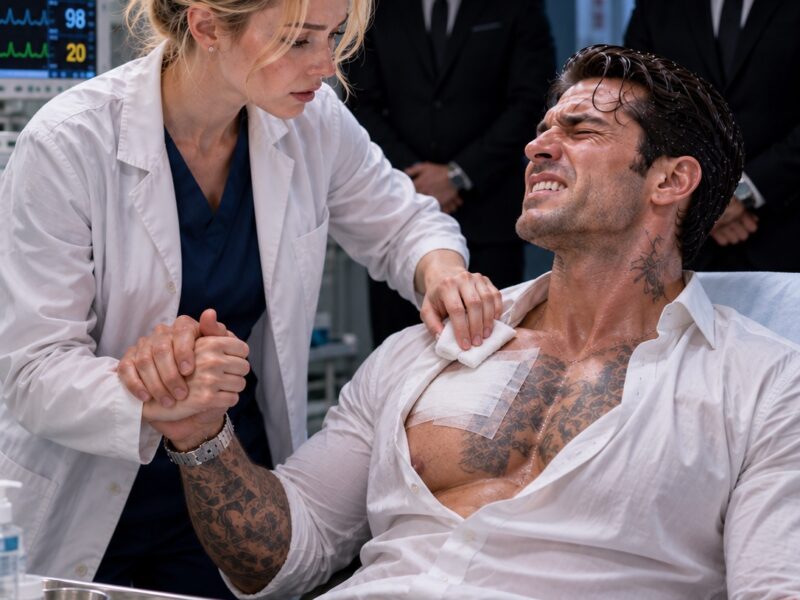
After She Treated the Mafia Boss’s Injuries, 200 Men Surrounded Her House
At 1:47 in the morning, the first headlights appeared between the trees.
Meline Hayes stood barefoot behind the living-room curtains of her secluded house in Milton, Massachusetts, holding a shotgun she had not fired in twelve years.
One black SUV rolled slowly up the long gravel driveway.
Then another.
Then three more.
Within thirty seconds, headlights flooded the woods.
Within two minutes, vehicles were lining both sides of the road outside her property—SUVs, sedans, heavy trucks, all black, all moving with deliberate precision.
Meline stopped counting at thirty-seven.
Her throat closed.
Men began getting out.
Not five.
Not twenty.
Hundreds.
Dark coats.
Earpieces.
Weapons carried low at their sides.
Some moved toward her house.
Most faced outward toward the surrounding woods, spreading into a perimeter that swallowed the entire property.
Meline tightened both hands around the shotgun.
A week earlier she had been a disgraced surgeon operating from a basement clinic nobody respectable knew existed.
Then she had pulled a bullet from the chest of the most feared man in Boston.
Now roughly two hundred armed men had surrounded her home.
The engines stopped almost simultaneously.
Silence rushed into the woods.
Meline could hear her own breathing.
Then boots began crunching across the gravel.
Heavy footsteps climbed her porch.
She raised the shotgun.
Three knocks sounded against the front door.
Slow.
Controlled.
Nothing like the men who had kicked through her clinic door seven nights earlier.
“Dr. Hayes.”
Meline froze.
She knew the voice.
Deep.
Roughened slightly by injury.
Calm enough to make fear feel childish.
“Meline.”
Her grip tightened.
“Open the door.”
She moved closer but did not lower the gun.
“Why?”
A pause.
Then—
“Because the men outside are not here to kill you.”
She looked through the narrow window beside the door.
A tall man stood beneath the porch light in a midnight-blue overcoat.
Victor Rossi.
Alive.
Upright.
Almost elegant.
Only the stiffness of his left shoulder hinted that seven nights earlier he had been bleeding to death across her clinic floor.
Behind him stood Mateo Bianchi, Victor’s broad-shouldered lieutenant, and several armed men scanning the darkness.
Meline stared.
Victor looked directly through the glass.
“They’re here because somebody else is coming.”
The cold moved deeper into her body.
“What?”
Victor glanced toward the woods.
“You have about twenty minutes before the people who want you dead reach this house.”
Seven nights earlier, Meline had been alone in a windowless basement clinic in Dorchester when somebody tried to kick the door off its hinges.
It was 2:14 a.m.
November rain hammered the street-level windows above her.
Meline sat behind a dented metal desk rubbing the space between her eyebrows while an ancient coffeemaker burned its final half inch of coffee into something resembling tar.
She had just finished suturing a kitchen worker’s palm.
Her last patient had gone.
Her twenty-four-year-old assistant, Liam Bennett, had finally listened to her and gone home before midnight.
Meline should have locked the clinic and left.
Instead, she was reviewing antibiotic inventory because expired medication was expensive and illegal medication was worse.
Two years earlier, she had been on track to become one of Boston’s youngest attending trauma surgeons.
Then Senator Robert Keller died on an operating table.
Dr. Everett Kane, the senior surgeon running the case, had arrived after a private dinner smelling faintly of bourbon.
Meline had noticed.
She had also noticed his delayed reactions.
The tremor in his left hand.
The mistake.
One wrong clamp placed during uncontrolled hemorrhage.
Thirty seconds of confusion.
Then catastrophe.
Meline had corrected what she could.
It had not been enough.
Senator Keller died before sunrise.
By noon, hospital lawyers were interviewing everyone separately.
By evening, Everett Kane had changed the story.
Meline became the inexperienced surgeon who acted outside instruction.
Kane became the respected department chief who tried heroically to correct her error.
His blood alcohol test vanished.
A medication record changed.
A scrub nurse who had seen everything suddenly remembered less.
The state medical board suspended Meline.
Then revoked her license after the hospital reached a confidential settlement with Keller’s family.
Kane kept operating.
Meline stopped sleeping.
For six months she fought.
Then the legal bills became larger than her savings.
Her lawyer advised settlement.
Her friends advised moving.
Her father, before his death years earlier, had taught her never to accept a lie merely because a powerful person repeated it.
But her father had never met a hospital board with eight lawyers.
Eventually Meline disappeared.
Not completely.
People still got hurt.
People who could not walk into emergency rooms without police questions, immigration concerns, warrants, or bills they could never pay.
Meline began treating them in a basement clinic financed through donations nobody documented carefully.
It was illegal.
She knew that.
It was also the only place she still felt like herself.
At 2:14 that rainy morning, the steel door exploded inward.
Meline shot to her feet.
Three men entered.
Two were walking.
The third was barely conscious between them.
“Clear the table.”
The tallest man shouted it like an order given on a battlefield.
Meline instinctively reached for the stainless-steel instrument tray.
“You need an emergency department.”
The bleeding man’s shoes left red marks across the linoleum.
“No hospital,” the tall man said.
“Then call an ambulance and lie about where you found him.”
The second man slammed the door behind them.
The tall one opened his coat.
A handgun appeared.
He pointed it directly at Meline.
“You fix him.”
Meline looked at the gun.
Then at the patient.
“If you keep pointing that at me, you increase the chance he dies.”
The tall man stared.
“My hands shake, he dies.”
Silence.
Meline nodded toward the center table.
“Put him down.”
The wounded man’s head lifted.
Gray eyes found hers.
Lucid.
Focused.
No panic.
“Mateo.”
The voice was weak but unmistakably authoritative.
“Put it away.”
The gun disappeared.
Meline moved.
Medical instinct took over before fear could argue.
She cut through the ruined suit jacket.
Then the shirt.
The wound sat high beneath the left collarbone.
Bad placement.
Too much blood.
She pressed two fingers beside it.
The patient’s body went rigid.
“Bullet still inside.”
“Can you remove it?” Mateo asked.
“Maybe.”
“Maybe?”
Meline looked up.
“Do you want optimism or accuracy?”
Mateo stopped talking.
She attached the patient to her old monitor.
Rapid pulse.
Falling pressure.
His skin had begun turning cold.
Meline’s fear sharpened into concentration.
“You’re bleeding around a major vessel.”
The wounded man watched her.
“How long?”
“If I can control it, you live.”
“And if you can’t?”
“You won’t need to worry about aftercare.”
One corner of his mouth almost moved.
Mateo stared at her as though humor were inappropriate in the presence of dying criminals.
Meline pulled open a cabinet.
“You need sedation.”
“No.”
She looked back.
“What?”
“No general anesthesia.”
“That was not a suggestion.”
The wounded man reached out and caught her wrist.
His grip was surprisingly strong.
“No sleep.”
Meline stared at him.
“You’ve lost enough blood that your opinion is medically irritating.”
“Local.”
“I may have to explore the wound.”
“Local.”
“You could go into shock.”
His eyes held hers.
“Then keep me alive.”
For one second, Meline forgot the gunmen.
Forgot the basement.
Forgot everything except the stubborn patient refusing to close his eyes.
She pulled her wrist free.
“Fine.”
Then she looked at Mateo.
“If he moves, that is your problem.”
Mateo nodded.
“What do you need?”
“Clean hands and the ability to follow instructions.”
His expression suggested the second requirement offended him.
Meline ignored it.
For the next thirty minutes, the world narrowed.
Blood.
Metal.
Suction.
Pressure.
The rhythmic panic of the monitor.
Victor Rossi—though Meline did not yet know his name—refused to scream.
His muscles locked whenever she worked deeper.
Sweat ran through his hair.
His breathing came through clenched teeth.
Once his fingers closed around the edge of the table hard enough for his knuckles to whiten.
Meline found the damaged vessel.
Her hands became perfectly still.
That was the part of herself she had missed most.
Not praise.
Not hospital titles.
This.
The impossible few minutes when another human being’s life existed between her hands and the only useful emotion was precision.
“Found it.”
Mateo leaned forward.
“What?”
“The bleeding.”
Meline repaired the injury with the limited tools available.
Then she found the deformed bullet.
It dropped into a metal dish with a sharp clink.
Victor closed his eyes for exactly three seconds.
Meline checked the monitor.
“Stay with me.”
His eyes opened again.
“You sound worried, doctor.”
“I’m worried about cleaning your blood out of my floor.”
A weak laugh escaped him.
Mateo looked astonished.
Meline finished closing the wound.
By 3:03 a.m., Victor’s blood pressure began stabilizing.
By 3:20, color had returned slightly to his face.
Meline peeled off her gloves.
Her scrubs were ruined.
Her arms were spotted with blood.
“He needs antibiotics, fluids, monitoring, and actual postoperative care.”
Mateo looked at Victor.
“We have a physician.”
“Then why did you come here?”
Silence.
Meline looked between them.
Nobody answered.
That bothered her.
She walked to the sink.
“Who are you?”
Mateo’s eyes hardened.
Victor answered first.
“Victor.”
“Victor what?”
“Rossi.”
Meline’s hands stopped beneath the running water.
She knew the name.
Everybody in Boston knew some version of it.
Publicly, Victor Rossi owned shipping companies, construction interests, restaurants, warehouses, and a private security group.
Privately, rumors connected his family to half the criminal commerce moving between Boston Harbor and Providence.
Meline turned slowly.
Mateo watched recognition appear.
Victor did not.
“You’re Victor Rossi.”
“Yes.”
Meline looked at the bullet in the dish.
Then at the men.
“You need to leave.”
Mateo frowned.
“You just found out who he is.”
“That changed nothing about his wound.”
“You’re not afraid?”
Meline looked at him.
“I’m extremely afraid.”
Mateo seemed confused.
“Then—”
“But fear doesn’t make you medically interesting.”
Victor watched her.
Something almost like approval entered his eyes.
“What is your name?”
“It doesn’t matter.”
“I asked.”
Meline turned off the faucet.
“You are never coming back here.”
“Your name.”
His voice remained quiet.
Not threatening.
Persistent.
Meline dried her hands.
“Meline.”
Victor repeated it once.
“Meline.”
She hated how differently it sounded in his voice.
Before dawn, they left.
No police.
No ambulance.
No questions.
Only blood on her table and a heavy leather duffel bag on her desk.
Meline stared at it for almost ten minutes before opening it.
Cash.
Stacks of hundred-dollar bills.
Far too many.
Beside the money sat a black card embossed with a single silver phone number.
Nothing else.
No thank-you.
No name.
Meline closed the bag.
“Incredible.”
She locked it inside the floor safe.
Not because she intended to keep it.
Because dropping half a million dollars at a police station while operating an illegal clinic seemed strategically poor.
For the next week, she tried to pretend Victor Rossi had been a fever dream caused by bad coffee.
The city refused to cooperate.
Three days later, Victor appeared on local television leaving a North End restaurant.
Perfect suit.
Private security.
Slight stiffness in his shoulder.
Alive.
Meline switched off the screen.
Then the strange things began.
A black SUV parked across from her clinic every night.
It never approached.
Never followed patients.
Only remained until Meline locked the clinic, then left.
Her medical supplier arrived Thursday carrying boxes of equipment she had never ordered.
Portable ultrasound.
New surgical instruments.
High-quality sutures.
Sterile kits.
Meline stared.
“I didn’t buy these.”
The supplier refused to meet her eyes.
“Account’s cleared.”
“What account?”
“All of it.”
“By whom?”
“I don’t know.”
“You’re lying.”
“Doctor.”
He lowered his voice.
“I truly suggest you accept the delivery.”
Meline refused.
The equipment remained anyway.
Friday morning, she found a wooden case outside her Milton home.
Inside was a custom surgical set with polished dark handles.
No card.
Only a small silver V engraved inside the lid.
Meline swore loudly enough to frighten a bird from the porch railing.
That afternoon, she called the number on Victor’s black card.
He answered himself.
“You waited longer than I expected.”
Meline gripped the phone.
“Stop.”
Silence.
“The SUV. The equipment. The surgical kit. Stop.”
“I owed you.”
“You paid me.”
“You did not take the money.”
“How do you know?”
“Because you are angry.”
“That is not an answer.”
“It is the answer you’re getting.”
Meline closed her eyes.
“You do not get to quietly invade my life because I treated you.”
“I’m protecting you.”
“From what?”
Pause.
Victor’s voice changed slightly.
“The man who shot me.”
Meline’s anger cooled.
“Who?”
“You don’t need the name.”
“You just told me I need protection.”
“Yes.”
“Then I need information.”
Silence.
Victor finally said, “Declan O’Connor.”
Meline knew that name too.
South Boston.
Irish organization.
Nightclubs.
Smuggling.
Street crews.
Months of whispered tension between O’Connor and Rossi interests near the port.
“You think he knows about me?”
“No.”
“Then why the surveillance?”
“To make sure that remains true.”
Meline looked toward the clinic entrance.
“You should have asked.”
Victor said nothing.
“If you want somebody guarded, you tell them they’re in danger.”
“I am telling you now.”
“After you posted a vehicle outside my workplace for five nights.”
“I’m not practiced at asking permission.”
“Learn.”
Another silence.
Then, unexpectedly—
“All right.”
Meline blinked.
“That easy?”
“No.”
His voice almost contained amusement.
“I simply recognize when continued argument will not improve my position.”
“Call off the SUV.”
“I’ll move it farther away.”
“Victor.”
“Compromise.”
Meline hung up.
She hated that she almost smiled.
Tuesday evening, Liam rushed into the clinic and locked the deadbolt behind him.
His face was white.
“Meline.”
She looked up from a tray of antibiotics.
“What?”
“We have a problem.”
“You say that every time the refrigerator makes noise.”
“This is not the refrigerator.”
She stopped.
Liam came closer.
“I was at O’Malley’s.”
“That was your first mistake.”
“Declan O’Connor’s people were there.”
Meline’s fingers tightened.
“They’re looking for a doctor.”
The clinic seemed suddenly smaller.
“What kind of doctor?”
“A street doctor. Somebody who treated a gunshot last week.”
Meline kept her expression flat.
Liam knew her too well.
“Oh, God.”
“Quiet.”
“You did?”
“Liam.”
“You treated Rossi?”
“Lower your voice.”
He looked physically ill.
“They thought he was dead.”
“I gathered.”
“He showed up at a sit-down yesterday.”
Meline looked away.
Liam ran both hands through his hair.
“They know he never went to a hospital.”
“Do they know my name?”
“No.”
“Clinic?”
“No.”
“They’re asking around Dorchester.”
Meline turned toward the computer.
“How aggressively?”
Liam hesitated.
“Meline.”
“How?”
“Breaking fingers aggressively.”
She closed her eyes once.
Panic was useless.
“Pack the narcotics.”
“What?”
“Controlled medication first. Destroy patient identifiers. Encrypt and remove the drives.”
“You’re closing?”
“For a month.”
“Where are you going?”
“Home.”
“Milton?”
“Nobody knows that property.”
Liam stared.
“Victor Rossi probably does.”
Meline stopped.
He had sent the surgical kit there.
Of course he knew.
That realization irritated her almost as much as it frightened her.
“I’ll deal with Rossi.”
“Meline—”
“Pack.”
By midnight, the clinic was dark.
Meline drove to the house her parents had left her in Milton.
Mid-century cedar siding.
Large windows.
Old oaks surrounding nearly three acres.
Private road.
Too isolated, suddenly.
She checked every lock.
Loaded her father’s old shotgun.
Placed it beside the couch.
At one in the morning, she sat near the cold fireplace with coffee in both hands.
She told herself she had saved a life.
Nothing more.
Doctors did not choose which bleeding people deserved treatment.
Except she was no longer legally a doctor.
Declan O’Connor would not care about ethical distinctions.
To him, Meline was the person who had stolen his victory.
At 1:47, headlights appeared between the trees.
One SUV.
Then another.
Then dozens.
The woods filled with engines.
Meline counted until counting became pointless.
Around two hundred men formed a perimeter outside her house.
She raised the shotgun.
Then came the knock.
And Victor Rossi’s voice.
“You have about twenty minutes before the people who want you dead reach this house.”
Meline unfastened the bolts one by one.
The door opened.
Cold air rushed inside.
Victor stood on her porch.
He looked nothing like the dying man from the clinic.
Midnight-blue overcoat.
Black gloves.
Dark hair neatly combed.
Gray eyes sharp and fully awake.
Behind him, Mateo and a dozen men occupied the yard.
Farther out, an army faced the woods.
Meline kept the shotgun pointed toward the floor.
“What is this?”
“Protection.”
“Two hundred men?”
“I prefer excess.”
“You prefer insanity.”
“Occasionally.”
Meline looked past him.
Men were moving into defensive positions around a home that had once belonged to her parents.
Rage cut through fear.
“You brought an army to my house.”
“Yes.”
“My neighbors—”
“Were quietly relocated for the evening.”
Meline stared.
“You relocated my neighbors?”
“Hotel rooms. Dinner vouchers.”
“You cannot move civilians like furniture.”
Victor’s expression barely changed.
“They believe there’s a gas leak.”
“Oh, good. Completely normal.”
“Meline.”
“What?”
His voice became serious.
“Declan put two million dollars on your head two hours ago.”
The anger vanished.
“What?”
“He knows who treated me.”
“How?”
“That is what I intend to discover.”
“You told me he didn’t know.”
“He didn’t.”
Victor stepped inside only when she moved aside.
Mateo entered behind him.
Victor removed his gloves.
“One of my people leaked it.”
Meline stared.
“You have a rat.”
“Yes.”
“And you don’t know who.”
“Not yet.”
“Then all these people—”
“Are here because O’Connor already sent a team south.”
Meline’s mouth went dry.
“How far?”
“Close.”
She looked at the army outside.
For the first time, she understood.
The men were not surrounding the house facing her.
They were facing outward.
Victor had not come to imprison her.
He had brought a wall.
Meline lowered the shotgun slightly.
“You should have called.”
“You would have run.”
“That is my decision.”
“Yes.”
Victor held her gaze.
“That is why I called five minutes ago.”
Meline frowned.
“My phone never rang.”
Mateo checked his device.
His expression changed.
“Boss.”
Victor looked over.
Mateo showed him the screen.
“No service.”
Meline glanced toward her phone.
No bars.
Victor’s expression went cold.
“Jammer.”
The first bullet struck the front window.
Glass exploded inward.
Mateo knocked Victor sideways.
Meline dropped behind the couch.
The world erupted.
Gunfire outside.
Shouting.
Windows breaking.
Wood splintering.
Meline pressed herself against the floor.
Victor crawled toward her.
“You hit?”
“No.”
“Stay down.”
Another burst tore through the living-room wall.
Meline looked toward the windows.
Muzzle flashes flickered beyond the trees.
The two hundred men outside answered.
Only then did she understand the scale.
Victor had not exaggerated.
O’Connor was actually coming for her.
The front portion of her house filled with glass dust.
Mateo shouted into a radio.
“East perimeter!”
Victor looked toward the kitchen.
“We move out the back.”
Meline grabbed the shotgun.
“My medical bag.”
“Leave it.”
“I need—”
“Meline.”
His voice cut through the noise.
“I can replace instruments.”
Another impact shook the wall.
“I cannot replace you.”
She stared at him.
Then moved.
They reached the kitchen.
Victor’s men formed a moving shield around them outside.
Rain hit Meline’s face.
The night pulsed with headlights and distant gunfire.
She ran toward an armored SUV near the tree line.
Then movement appeared beside the garage.
A man lifted a weapon behind Victor.
Meline reacted before thought.
“Victor!”
She shoved him.
A shot cracked.
Victor twisted.
The round tore through the sleeve of his coat instead of his back.
Victor fired back.
The attacker dropped.
Victor looked at Meline.
For half a second, everything else vanished.
“You pushed me.”
“You’re welcome.”
He caught her around the waist and hauled her toward the SUV.
“I can run!”
“Then run faster.”
Mateo opened the rear door.
They climbed inside.
The armored door closed.
Sudden muted silence.
Meline began shaking.
Not delicate trembling.
Violent.
Uncontrolled.
She looked down.
Blood covered her fingers.
Victor’s.
Again.
His upper arm had been grazed.
Not serious.
Still bleeding.
Meline reached for him automatically.
“Take off the coat.”
Victor looked at her.
“You are shaking.”
“I can shake and still be medically annoyed.”
Mateo laughed from the front.
Victor gave him one look.
Mateo stopped.
Meline opened the compact medical kit stored beneath the seat.
Of course the mafia SUV had one.
She cut Victor’s sleeve.
Cleaned the wound.
“You saved me again,” he said.
“Stop making a habit of needing it.”
“That is twice.”
“Once was my job.”
“You keep insisting that.”
She looked up.
“It was.”
“And tonight?”
Meline tied the dressing.
“Tonight was reflex.”
Victor’s gray eyes remained on her.
“Interesting reflex.”
The SUV accelerated toward Boston.
Meline looked through the dark window.
Behind them, her house disappeared between flashing lights.
Something inside her collapsed.
“My home.”
Victor’s expression changed.
“It can be repaired.”
“That isn’t the point.”
He said nothing.
For once, he understood enough not to fix the sentence.
They reached a private garage beneath a Back Bay high-rise forty minutes later.
Victor led her into a penthouse overlooking the Charles River.
Floor-to-ceiling windows.
Art.
Marble.
Muted gold light.
Men stationed at every entry.
Meline stepped inside.
The adrenaline had burned away.
What remained was emptiness.
“What happens now?”
Victor removed his ruined coat.
“You stay here tonight.”
“And tomorrow?”
“We find the leak.”
“And after that?”
“Depends.”
“On what?”
“Whether O’Connor is still alive.”
Meline stared.
Victor walked toward the bar.
She spoke before he poured anything.
“No.”
He stopped.
“What?”
“I am not living in a penthouse while you start a war in my name.”
“It is not in your name.”
“He put a bounty on me because I treated you.”
“Yes.”
“My house just got shot apart because I treated you.”
“Yes.”
“My clinic is gone.”
“For now.”
Meline laughed bitterly.
“For now?”
Victor looked at her.
Her anger rose.
“Do not say you can buy me another one.”
His mouth closed.
She saw that had been exactly what he intended to say.
“Money is not a reset button.”
“No.”
“You don’t get to make decisions around my life and call them protection.”
Victor set the empty glass down.
“I came with two hundred men.”
“I noticed.”
“Because I knew he was coming.”
“You knew after I did not.”
“Yes.”
“You tried to call.”
“Yes.”
“You came anyway.”
“Yes.”
Meline’s shoulders dropped slightly.
That distinction mattered.
Then Victor said, “There is something else.”
Her eyes narrowed.
“What?”
He walked toward a side table.
A folder rested there.
He pushed it toward her.
Meline did not touch it.
“What is that?”
“Your past.”
Rage returned instantly.
“You investigated me.”
“Yes.”
“Of course you did.”
“I needed to know who had saved my life.”
“You needed my medical history?”
“Open it.”
“No.”
“Meline.”
“No.”
Victor stopped.
She folded her arms.
“You do not order me to read my own life.”
Silence.
Then—
“Will you open it?”
The difference was small.
She noticed anyway.
Meline opened the folder.
Hospital records.
Medical-board findings.
Statements from the Keller surgery.
Everett Kane.
Her own testimony.
Meline’s stomach tightened.
“Why?”
Victor stood near the window.
“Because one of the names in your disciplinary file appears in my investigation of O’Connor.”
Meline looked up.
“What name?”
“Everett Kane.”
She stopped breathing normally.
“No.”
Victor remained still.
“Kane treats people for O’Connor.”
“That doesn’t mean—”
“He has for six years.”
Meline stared at the page.
Victor continued.
“Three weeks after Senator Keller died, a consulting company connected to Kane received four hundred thousand dollars.”
“From O’Connor?”
“Through three intermediaries.”
Meline stood.
The room tilted slightly.
“No.”
Victor watched her.
“What exactly happened in that operating room?”
She did not answer.
“Meline.”
“I told the board.”
“I’m not the board.”
She looked at him.
That sentence got through.
Meline sat again.
“Kane had been drinking.”
Victor’s expression hardened.
“I smelled it.”
She looked down.
“He made a vascular error.”
Her fingers began twisting together.
“I corrected it, but Keller had already lost too much blood.”
“Why did they blame you?”
“Kane changed the operative report.”
“Others saw.”
“One nurse did.”
“What happened to her?”
“She changed her statement.”
“Why?”
“I don’t know.”
Victor’s eyes narrowed.
“What was Senator Keller involved in?”
Meline laughed without humor.
“He was a patient.”
“Before he was a patient.”
“I don’t follow politics.”
“His committee controlled port oversight.”
Meline went still.
Victor continued.
“Keller opposed several redevelopment permits connected to O’Connor.”
Cold moved through her.
“What are you saying?”
“I’m saying a drunk surgeon may have made a mistake.”
Victor’s voice stayed careful.
“Or somebody paid him to make sure a complication became fatal.”
Meline stood.
“No.”
“I don’t know which yet.”
“Kane is arrogant. He is selfish. He is a coward.”
She shook her head.
“But murder?”
Victor met her eyes.
“That is why we need proof.”
Meline turned away.
For two years she had built her anger around one story.
Kane had been drunk.
He made a mistake.
Then sacrificed her.
That story was terrible enough.
Now something darker sat beneath it.
Her phone rang.
Unknown number.
Meline stared at the screen.
Victor looked over.
“Answer.”
She did.
“Hello?”
Silence.
Then a familiar voice.
“Meline.”
Every muscle in her body tightened.
Everett Kane.
She looked at Victor.
His expression changed when he saw hers.
“Kane.”
Victor crossed the room.
Meline put the call on speaker.
Kane exhaled.
“You shouldn’t have treated Rossi.”
Meline’s mouth went dry.
“How do you know?”
“You need to leave Boston.”
“You testified against me.”
Silence.
“You destroyed my career.”
“Meline—”
“Why does Declan O’Connor know my name?”
Kane stopped breathing.
Victor moved closer.
Kane’s voice lowered.
“Who is with you?”
“That is not your problem.”
“Is Rossi there?”
Meline looked at Victor.
“Yes.”
Kane swore.
Victor spoke.
“Everett.”
Silence.
“Victor Rossi.”
“I know who you are.”
“I’m pleased.”
Kane’s fear came clearly through the speaker.
Victor continued.
“You have one opportunity to tell Dr. Hayes why O’Connor knows who she is.”
“I don’t—”
Meline interrupted.
“Do not lie.”
The sharpness in her own voice surprised her.
Kane went quiet.
Two years of shame.
Two years hiding.
Two years believing she had been too weak to defeat an institution.
Meline’s hands stopped shaking.
“Tell me.”
Kane whispered, “I gave him the clinic address.”
The room disappeared.
Meline stared ahead.
“You knew.”
“I found out months ago.”
“You knew where I was.”
“Yes.”
“And you told him.”
“He asked who could have treated Rossi.”
“Why would he ask you?”
Another silence.
Meline understood before Kane spoke.
“You work for him.”
“I had debts.”
Victor’s jaw tightened.
Kane continued quickly.
“Private gambling. I got trapped.”
Meline almost laughed.
The respected surgeon.
The man whose testimony had destroyed her.
Afraid.
Bought.
“You gave him my name to protect yourself.”
“I told him you might know how.”
Meline closed her eyes.
“You did it again.”
“What?”
“You sacrificed me again.”
Kane’s voice broke.
“I’m sorry.”
“No.”
Meline opened her eyes.
“That is what people say when they want the person they hurt to make the moment easier.”
Victor looked at her.
Kane whispered, “What do you want?”
“The truth about Senator Keller.”
Silence.
Meline’s pulse slowed.
“The full truth.”
Kane began crying.
Quietly.
That frightened her more than denial.
“O’Connor wanted the surgery to go badly.”
Victor’s face hardened.
Meline gripped the table.
“He paid you?”
“No.”
“Then what?”
“He knew I was drinking.”
Kane swallowed.
“He arranged for me to get called in.”
Meline stared.
“You knew?”
“I knew they wanted complications.”
“You knew Keller could die.”
“I thought—”
“What?”
Her voice cracked.
“You thought what?”
“That if he died, they would protect me.”
Meline closed her eyes.
For several seconds nobody spoke.
Then she asked the question that had lived inside her for two years.
“Did you make the mistake on purpose?”
Kane’s breathing came through the phone.
“No.”
Meline opened her eyes.
He continued.
“No. God, Meline. I was drunk. I made the mistake.”
His voice broke.
“But after Keller died, O’Connor’s people reminded me what would happen if I admitted why I was impaired.”
“So you blamed me.”
“Yes.”
One word.
The room went quiet.
Victor looked toward the city.
Meline sat down slowly.
The truth did not feel triumphant.
It felt filthy.
“What proof exists?”
Kane sniffed.
“I kept copies.”
Victor turned.
“Of what?”
“Payment communications. Messages. Hospital records before they were altered.”
“Where?”
Kane hesitated.
Then the call disconnected.
Victor’s expression changed.
“Daniel!”
A security officer appeared.
“Trace it.”
Meline stood.
“He’s in danger.”
“Yes.”
“You have to find him.”
Victor looked at her.
“Why?”
Meline stared.
“Because if he dies, everyone gets to decide what the truth was again.”
Victor nodded once.
No argument.
Kane disappeared before Victor’s men reached his apartment.
But he left something behind.
A flash drive taped beneath his desk.
Inside were original surgical logs.
Messages from an intermediary tied to O’Connor.
Bank transfers.
A recording.
Everett Kane speaking into his phone the night before Senator Keller’s death.
He sounded drunk.
Terrified.
A male voice told him Keller needed to “leave the hospital quieter than he entered.”
Kane never explicitly agreed.
He also never called police.
The files were enough to reopen everything.
Meline listened to the recording once.
Then closed the laptop.
“I want this turned over.”
Victor looked at her.
“To the medical board?”
“The district attorney.”
His expression sharpened.
“Some of those records implicate people connected to my organization.”
“Then maybe they should be implicated.”
Silence.
Mateo looked between them.
Victor finally said, “Fine.”
Meline blinked.
“That easy?”
“No.”
His mouth almost moved.
“I am learning not to waste time arguing when the answer will remain no.”
She almost smiled.
The next forty-eight hours exposed something neither of them expected.
The leak inside Victor’s organization was not Mateo.
Not Daniel.
Not one of the obvious men.
It was Salvatore Greco, a logistics captain who had served Victor’s father before Victor inherited control.
Salvatore had access to emergency movement reports.
He knew where Victor was taken the night he was shot.
He had given O’Connor the clinic area.
Kane provided Meline’s name.
Together, the two pieces led to her.
Victor wanted Salvatore brought to the penthouse.
Meline refused to attend.
“This is your organization.”
Victor studied her.
“You don’t want to know why?”
“I know enough.”
“Money?”
“Maybe.”
“Threat?”
“Maybe.”
She looked toward the recovered Kane files.
“Everyone thinks the reason changes what happened.”
Victor went quiet.
“It can explain.”
“Yes.”
“But explanation is not permission.”
Something in his face shifted.
“Your father teach you that?”
Meline looked at him.
“My father taught me excuses become dangerous when powerful people can afford better vocabulary.”
Victor almost smiled.
Salvatore confessed.
O’Connor had threatened his adult daughter after discovering her involvement in a federal tax investigation.
Salvatore believed giving information would keep her safe.
Instead, every concession created another.
Victor did not kill him.
That shocked everyone.
Mateo most of all.
“What do you want done?”
Victor stared at the city for a long time.
Then looked toward Meline’s closed bedroom door.
“Turn him over with the financial evidence.”
Mateo frowned.
“To federal investigators?”
“Yes.”
“He’ll testify.”
“Probably.”
“Against us too.”
Victor’s jaw tightened.
“Yes.”
Mateo stared.
“This doctor is changing you.”
Victor looked over.
“No.”
“What would you call this?”
“Accounting.”
Mateo almost laughed.
Victor continued.
“O’Connor built this war because everyone around him believed fear was stronger than consequence.”
He looked at Salvatore through the glass.
“I want consequences.”
The war with Declan O’Connor did not end with a dramatic execution.
It ended the way large empires often ended.
Records.
Defections.
Frozen money.
Men discovering loyalty had become expensive.
Kane’s files connected O’Connor to Senator Keller.
Salvatore connected him to the attempt on Victor and the bounty on Meline.
Federal investigators already watching the port suddenly had evidence they could use.
O’Connor’s legitimate partners began pulling away.
Banks froze accounts.
Two city officials resigned.
One port contractor agreed to cooperate.
O’Connor became dangerous because he understood the walls were closing.
Victor doubled security.
Meline hated it.
“You have six men outside my bedroom.”
“Four.”
“I counted six.”
“Two are at the elevator.”
“That does not improve the sentence.”
Victor stood in the penthouse kitchen while she poured coffee.
“Someone tried to kill you.”
“Several people.”
“My point.”
“My point is I need to be able to walk down a hallway without an armed committee.”
He considered.
“Two.”
“What?”
“Two guards.”
“One.”
“Two.”
Meline stared.
Victor stared back.
“One outside the elevator.”
He exhaled.
“Fine.”
She smiled.
“What?”
“Nothing.”
“You look pleased.”
“I negotiated down from six.”
“You are extremely annoying.”
“So I have heard.”
Something had changed between them without either acknowledging it.
Not the danger.
That remained.
Not attraction.
That had existed almost from the clinic and both of them were too intelligent to trust it.
Something else.
Reliance.
Victor began asking before making decisions involving her.
Not always.
Sometimes Meline had to stare until he corrected himself.
But he learned.
Meline began telling him where she planned to go instead of disappearing out of principle.
Not because he owned the information.
Because she understood fear traveled both directions.
One evening, she found Victor asleep at the dining table.
Laptop open.
Coffee untouched.
Bandage showing beneath his shirt.
Meline stopped.
She had never seen him sleeping.
The difference was startling.
No command in his face.
No calculation.
Only exhaustion.
She considered leaving.
Instead, she touched his shoulder.
Victor woke instantly and caught her wrist.
Meline froze.
His eyes sharpened.
Then recognition appeared.
His hand opened.
“Sorry.”
He released her immediately.
Meline rubbed her wrist.
“You sleep like somebody expects assassination.”
“I generally do.”
“Your shoulder needs checking.”
“It’s fine.”
“That sentence is illegal around me.”
“You are not currently licensed.”
“That was cruel.”
Victor’s expression changed.
“I didn’t mean—”
“I know.”
She sat beside him.
“Take off the shirt.”
His eyebrows rose.
“Medical.”
“Unfortunately.”
He unbuttoned it.
The wound was healing.
Meline examined the scar.
Victor watched her face.
“Will your license come back?”
“I don’t know.”
“The evidence—”
“Evidence does not erase two years.”
“No.”
“I lost references. Training. Reputation.”
She replaced the dressing.
“Even if the board clears me, I don’t know if a hospital will hire me.”
“I would.”
Meline looked up.
“You do not own a hospital.”
“I could.”
“Victor.”
“I am simply noting options.”
She laughed.
The sound surprised them both.
Victor stared.
“What?”
“You’re impossible.”
“So I’ve been told.”
Meline finished.
Then noticed a scar lower on his ribs.
Older.
“What happened there?”
“Knife.”
“This?”
“Bullet.”
“That?”
“Another knife.”
She looked at him.
“What did you do before thirty-five? Collect bad decisions?”
“Mostly.”
“Any scars from normal activities?”
He thought.
“I cut my hand cooking once.”
“Finally.”
“I was twelve.”
Meline rolled her eyes.
Victor smiled.
It changed his whole face.
Less frightening.
More dangerous in a different way.
Meline looked away first.
Declan O’Connor disappeared from Boston four days later.
Not fled.
Disappeared.
His organization fractured into three groups.
Victor believed he remained nearby.
Meline believed him because Victor’s security became quieter instead of larger.
Quiet meant concern.
On the fifth night, Liam called.
Meline answered immediately.
“Are you okay?”
“I’m fine.”
“Clinic?”
“Still standing.”
She sat upright.
“You went back?”
“Just to check.”
“Liam.”
“I know.”
His voice changed.
“Meline, somebody was inside.”
Her blood went cold.
“What?”
“Nothing stolen.”
Victor, across the room, noticed her face.
He moved closer.
Liam continued.
“They left something on your desk.”
“What?”
“Your old hospital ID.”
Meline stopped breathing.
The badge had been confiscated when her license was suspended.
Victor held out his hand.
She put the call on speaker.
Liam said, “There’s writing on the back.”
“What does it say?”
Pause.
“COME FINISH THE SURGERY.”
Victor’s face emptied.
Meline understood immediately.
“Kane.”
Victor shook his head.
“No.”
“Why?”
“If O’Connor had Kane, this is bait.”
“For me.”
“Yes.”
Liam whispered, “Meline, what do I do?”
“Leave.”
“I—”
“Now.”
Victor was already messaging security.
Meline stood.
“I’m going.”
“No.”
She turned.
Victor stopped.
They stared at each other.
He exhaled.
“Sorry.”
“Try again.”
“I don’t want you to go.”
“Better.”
“It is obviously a trap.”
“I know.”
“O’Connor wants you.”
“Yes.”
“You are not bulletproof.”
“Medical school covered that.”
Victor’s jaw tightened.
“What do you suggest?”
Meline looked at him.
“We don’t give him what he expects.”
The next move was not Victor’s.
It was Meline’s.
She contacted the federal investigator handling Kane’s evidence.
She disclosed the message.
The clinic became a controlled location under law-enforcement observation.
Victor hated every second.
“You trust federal agents more than me?”
“No.”
“That is not reassuring.”
“I trust paperwork more than private revenge.”
“Worse.”
Meline smiled faintly.
“You’ll survive.”
The trap worked.
Not perfectly.
Nothing real ever did.
Declan O’Connor arrived through an intermediary.
Everett Kane was with them.
Alive.
Bruised.
Terrified.
O’Connor believed Meline would come alone if Kane’s life were threatened.
She did come.
But not alone.
Victor remained nearby under strict agreement not to interfere unless necessary.
Federal agents watched.
Kane sat in the clinic chair where Meline’s patients normally waited.
Declan stood behind him.
Older than Meline expected.
Silver hair.
Heavy coat.
Nothing theatrical about him.
That made him more frightening.
“Meline Hayes.”
She remained ten feet away.
“Declan.”
His smile was faint.
“You ruined a great deal for me.”
“I repaired an artery.”
“You repaired Rossi.”
“He was bleeding.”
“You could have let him die.”
“No.”
The answer came immediately.
Declan studied her.
“You still believe in your oath?”
“I believe doctors don’t become executioners because somebody else hates the patient.”
“You are not a doctor anymore.”
The sentence hurt.
Meline let it.
Then answered.
“That didn’t stop you from needing one.”
Declan’s smile disappeared.
Kane looked at her.
“Meline.”
She ignored him for the moment.
“Why bring him?”
Declan put one hand on Kane’s shoulder.
“Because Everett has become sentimental.”
Kane flinched.
“He copied records.”
“Yes.”
“He told you the truth.”
“Yes.”
“He was scared.”
Meline looked at Kane.
“He often is.”
Kane lowered his eyes.
Declan moved slightly.
Victor’s voice came through the hidden receiver in Meline’s ear.
Do not move closer.
Meline ignored him.
Declan said, “Rossi thinks evidence will save him.”
“No.”
“What?”
“He thinks evidence will bury you.”
Declan laughed.
“Same thing.”
“No.”
Meline looked at him.
“That is the difference between you.”
Something shifted in Declan’s face.
He did not like comparisons in which he might be lesser.
“You think Rossi is better?”
“No.”
“Then why are you with him?”
“I’m not with anyone.”
That was technically untrue emotionally.
Legally and strategically, it mattered.
Declan smiled again.
“You saved him twice.”
Meline’s pulse changed.
“How do you know about Milton?”
His smile answered.
There were still leaks.
Or surveillance they had missed.
Victor heard it too.
Meline continued.
“What do you want?”
“The original Kane files.”
“Federal investigators have copies.”
“I know.”
“Then this is pointless.”
“No.”
Declan looked at her.
“I want him.”
“Victor.”
“Yes.”
Meline almost laughed.
“You thought threatening a doctor would make Victor Rossi walk into a clinic?”
“I thought he might walk in for you.”
That sentence sat between them.
Meline felt something cold.
Not fear.
Understanding.
Declan did not care about her as evidence anymore.
She was leverage.
Victor’s voice came through the receiver.
Meline. Leave.
She remained.
Declan watched her.
“Is he listening?”
Meline said nothing.
Declan smiled.
“He is.”
Kane whispered, “I’m sorry.”
Meline finally looked at him.
“You keep saying that.”
“I know.”
“What do you actually mean?”
Kane’s face crumpled.
“I mean I knew you would lose everything.”
Declan’s eyes narrowed.
Kane continued.
“I knew the board would believe me.”
“Everett.”
Declan’s warning came quietly.
Kane started talking faster.
“I knew O’Connor’s people were manipulating Keller’s case. I knew it afterward. I protected myself.”
Meline’s eyes burned.
Kane looked directly at her.
“You were better than me, and I used that because I knew you would keep trying to save the patient instead of saving yourself.”
That was the truth she had waited two years to hear.
Not innocence.
Not apology.
Recognition.
Meline breathed out slowly.
“Thank you.”
Kane stared.
Declan looked confused.
“For what?”
“For finally saying it without hiding behind pressure.”
The clinic’s side door slammed.
Everything happened at once.
One of Declan’s men realized law enforcement was nearby.
Someone shouted.
Declan reached for Meline.
Victor entered from the rear corridor.
Agents moved in.
The room exploded into noise.
Meline dropped behind the treatment table.
She heard Victor shouting her name.
Then a single gunshot.
Silence followed in fragments.
When Meline looked up, Declan was on the floor holding his shoulder.
Alive.
Victor stood several feet away.
Weapon lowered.
Federal agents surrounded them.
Victor could have killed him.
Meline knew it.
So did Declan.
Victor looked at her.
That was why he had not.
Not because she controlled him.
Because he had chosen consequence over satisfaction.
Declan was arrested.
Kane survived.
The evidence held.
The war that had arrived at Meline’s clinic ended not with an execution, but with handcuffs.
Months followed.
Slowly.
Messily.
The medical board reopened Meline’s case.
Everett Kane testified publicly.
The hospital admitted key records had been altered.
Two administrators resigned.
The scrub nurse who had changed her statement came forward and admitted hospital counsel had pressured her with threats to her immigration sponsorship.
Meline listened without expression.
Later, alone in a restroom, she cried so hard she had to sit on the floor.
Vindication did not restore lost years.
It simply stopped the lie from owning the future too.
Her license was reinstated in April.
The letter arrived by certified mail.
Meline opened it at her repaired house in Milton.
The windows had been replaced.
The bullet damage repaired.
The oak floors refinished.
Victor had offered to pay.
Meline refused.
He paid for exactly one thing.
The broken front door.
She allowed it because, as he pointed out, “My enemies broke it.”
She had replied, “Your logic is exhausting.”
He considered that consent.
When the reinstatement letter arrived, Victor was in her kitchen making coffee badly.
Meline read the first line.
Then stopped.
Victor noticed.
“What?”
She handed him the page.
He read.
His expression changed.
“You’re a doctor.”
Meline laughed once.
A tear fell.
“I was always a doctor.”
Victor looked at her.
“Yes.”
That was the correct answer.
Meline opened a legal trauma clinic six months later.
Not underground.
Not hidden.
A real clinic in Dorchester with sliding-scale care, social workers, immigrant-support partnerships, addiction specialists, and a small emergency-treatment suite.
Victor offered money.
Meline refused.
Then she accepted a contribution through an independent charitable foundation with no naming rights, no operational control, and no men with weapons in the lobby.
Victor complained about the last condition.
“Security can stay across the street.”
“They look intimidating.”
“They are intimidating.”
“Exactly.”
“One man.”
“No.”
“Unarmed.”
“No.”
“Parking lot?”
“Victor.”
“Fine.”
Liam returned as clinic administrator.
Marta—not the Cole housekeeper from another life, but Meline’s older nurse from her early hospital years—joined two days a week.
Patients came.
Some paid.
Some did not.
Meline slept better.
Mostly.
She still woke during heavy rain sometimes.
She still checked windows.
She still hated large black SUVs.
Victor did not move into her house.
She did not move into his penthouse.
That surprised everyone except Meline.
One evening, he stood on her porch while snow began falling.
“Mateo thinks I’m losing authority.”
“Mateo thinks salad is a conspiracy.”
“He dislikes vegetables.”
“He distrusts anything without a trigger.”
Victor almost smiled.
Meline wrapped her coat tighter.
“You could come inside.”
“That sounded dangerously like an invitation.”
“It’s twenty-two degrees.”
“I accept.”
He entered.
No army outside.
One vehicle at the road.
Meline had negotiated that down from four.
Victor removed his coat.
The scar beneath his collarbone was barely visible now.
Meline noticed anyway.
“You’re staring at my shoulder.”
“Professional assessment.”
“Of course.”
“You heal well.”
“I had a good surgeon.”
Her mouth curved.
Victor looked around.
Her house had changed.
Not structurally.
Emotionally.
Books on shelves again.
Plants near the windows.
A bowl of lemons on the kitchen counter.
No shotgun beside the couch.
The black card he had left in the clinic months earlier sat inside a drawer Meline never mentioned.
Victor walked toward the fireplace.
“Do you ever think about that night?”
“Which?”
“The two hundred men.”
Meline laughed.
“You need to ask?”
“I thought you might have become accustomed to unusual evenings.”
“I woke up and thought a private army had come to execute me.”
“They were protecting you.”
“I discovered that eventually.”
Victor looked toward her.
“I frightened you.”
“Yes.”
“I’m sorry.”
Meline became still.
Victor Rossi did not apologize casually.
He continued.
“I was so focused on keeping you alive that I never considered what two hundred armed men looked like from inside your house.”
“That is the problem with power.”
“What?”
“You experience your intentions.”
She moved closer.
“Everyone else experiences your impact.”
Victor absorbed that.
“You practiced that sentence.”
“I had months.”
A faint smile.
Then he became serious again.
“I have something for you.”
Meline immediately narrowed her eyes.
“If it is money—”
“It is not.”
“A building?”
“No.”
“A security company?”
“Meline.”
“Your gifts have history.”
He removed something from his coat pocket.
A small metal object.
The deformed bullet she had removed from him.
Cleaned.
Sealed inside a clear evidence case.
Meline stared.
“I thought police had it.”
“They returned it after the case.”
“Why are you giving it to me?”
Victor held the case but did not place it in her hand.
“I used to think this was the night everything nearly ended.”
Meline looked at him.
“And?”
“It was the night my life became inconvenient.”
She stared.
Victor’s mouth almost moved.
“You argued with me while I was bleeding.”
“You were a terrible patient.”
“You insulted Mateo.”
“He threatened me.”
“You refused my money.”
“It was mob cash.”
“You ordered me around.”
“You were dying.”
Victor stepped closer.
“You saved me when you had every reason not to want anything to do with men like me.”
Meline’s expression softened.
“That was not personal.”
“I know.”
His voice lowered.
“That is why it mattered.”
The snow continued outside.
Meline looked at the bullet again.
“What do you want me to do with it?”
“Nothing.”
“Then why give it?”
“So you can decide whether it belongs in your life.”
Choice.
Always choice now.
Meline took the evidence case.
Walked toward the fireplace.
Victor watched.
She opened the case.
Then dropped the bullet into the fire.
Victor stared.
“You burned my sentimental gift.”
“It was ammunition.”
“It had emotional significance.”
“It was ugly.”
“I paid someone to polish it.”
“That makes it worse.”
Victor laughed.
A real laugh.
Meline smiled.
When he stopped, the room became quiet.
Victor looked at her.
“I want to ask you something.”
Her heart changed rhythm.
“That sentence has historically caused trouble.”
“No armed men.”
“Good start.”
“No money.”
“Better.”
“No promises that you will never be in danger.”
Meline studied him.
“That’s realistic.”
“I cannot promise I become someone else.”
“I don’t want you pretending.”
“But I can promise you never again become collateral in my decisions.”
The humor left her face.
Victor continued.
“I can promise I ask before protecting you in ways that change your life.”
“That sounds strangely specific.”
“I learn through catastrophic errors.”
“Yes.”
He stepped closer but stopped before touching her.
“And I can promise that if you tell me to leave, I leave.”
Meline looked at the man who had once brought two hundred armed men to her home because protection, to him, had meant overwhelming force.
Now he stood alone in her living room asking permission to remain.
“What are you actually asking?”
Victor’s gray eyes held hers.
“Dinner tomorrow.”
Meline blinked.
“That’s it?”
“For now.”
“You looked like you were proposing.”
Victor looked offended.
“I would never propose without consulting Mateo about security.”
Meline laughed.
He smiled.
“Dinner.”
“Yes.”
“Seven?”
“Seven thirty.”
“Why?”
“Because you said seven.”
“You negotiate recreationally.”
“Yes.”
Victor nodded.
“Seven thirty.”
Meline looked toward the fire.
The bullet was somewhere beneath the flames now.
Metal darkening.
No longer evidence.
No longer symbol.
Just something that had once hurt a man and no longer had any power over either of them.
Victor reached toward her.
Stopped.
Meline noticed.
She always noticed.
“Yes.”
His fingers touched her cheek.
Warm.
Careful.
Meline leaned slightly into his palm.
Then kissed him.
Not because he had saved her.
Not because two hundred men had surrounded her house.
Not because he could restore her career, buy hospitals, or frighten cities.
He had done none of the things that finally mattered most.
He had listened.
Changed.
Left doors open.
And learned the difference between guarding someone’s life and taking possession of it.
When they separated, Victor looked almost surprised.
“That was not dinner.”
“No.”
“Should I complain?”
“I wouldn’t.”
“Good.”
The next morning, Meline drove to the clinic before sunrise.
The city was beginning to wake.
Delivery trucks.
Buses.
Steam rising from sidewalk grates.
Boston looked ordinary.
Meline liked it that way.
At seven ten, she unlocked the clinic door.
Liam arrived carrying coffee.
“You’re smiling.”
“I am not.”
“You absolutely are.”
“Go check inventory.”
“Victor?”
“Liam.”
He grinned and disappeared down the hall.
Meline hung her coat.
On the wall behind reception was her medical license.
Framed.
No dramatic lighting.
No gold plaque.
Just paper.
She touched the edge once.
Two years earlier, powerful people had taken it from her and expected shame to make her disappear.
For a while, it had.
Then a bleeding stranger arrived at her clinic.
Meline saved him because she could.
That decision brought a war to her doorstep.
Two hundred armed men.
A shattered house.
A bounty.
A truth she had buried because fighting it once had nearly destroyed her.
But the war also forced every hidden thing into daylight.
Everett Kane’s cowardice.
O’Connor’s corruption.
Victor’s blindness about control.
Her own belief that survival required isolation.
None of them emerged unchanged.
At eight, the first patient arrived.
A construction worker with a deep cut across his palm.
He looked embarrassed.
“Sorry, Doc. I know this is stupid.”
Meline pulled on gloves.
“If you can see inside your hand, it is not stupid.”
He laughed nervously.
She began cleaning the wound.
Outside, across the street, a black sedan sat parked beside the curb.
Meline saw it through the window.
One security officer.
Unarmed.
Exactly as negotiated.
She shook her head.
Then returned to her patient.
The city outside remained dangerous.
Victor remained dangerous.
Meline knew better now than to confuse love with innocence.
But she also knew something she had forgotten during the years when her name became a scandal whispered in hospital hallways.
Her hands were still steady.
Her judgment was still hers.
Her life was still hers.
And no army—whether it came to kill her or protect her—would ever again decide who she was allowed to become.









