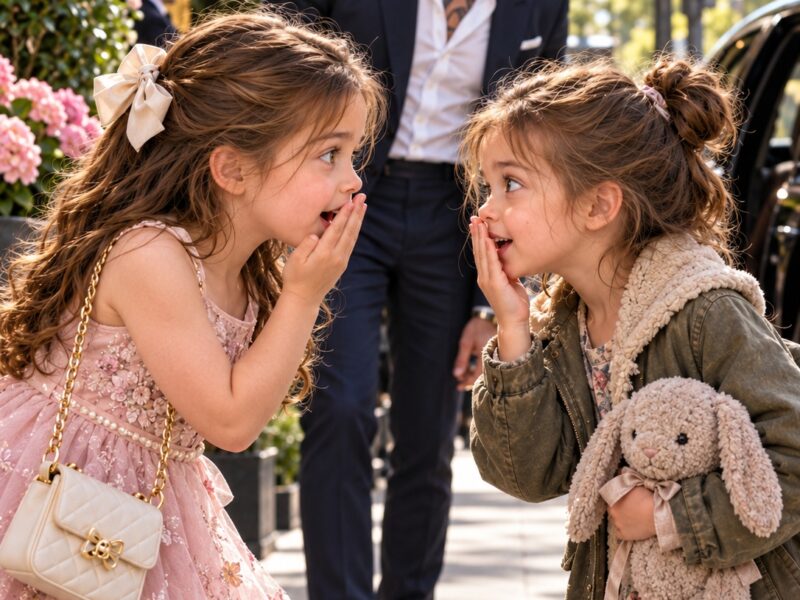
“AM I LOOKING IN A MIRROR?” THE MAFIA BOSS’S DAUGHTER ASKED—THEN HE SAW A TINY GIRL JUST LIKE HER AND UNCOVERED SIX YEARS OF LIES
“Daddy… am I looking in a mirror?”
The question stopped Vincent Romano in the middle of Chicago’s Michigan Avenue.
He had been walking quickly.
Always quickly.
People moved differently around Vincent Romano.
They stepped aside before deciding to.
Men who knew his name lowered their voices.
Women who recognized his face from society pages pretended they had not.
Five-year-old Sophie Romano did none of those things.
She simply stopped.
And because her small hand was wrapped around two of his fingers, Vincent stopped too.
“Sophie, sweetheart, the car is—”
“No.”
She tugged harder.
“Look.”
Vincent followed her gaze.
Twenty feet ahead, moving slowly against the current of pedestrians, was a little girl.
Thin blue coat.
One button fastened wrong.
White sneakers scuffed dark at the toes.
A brown paper bag held carefully against her chest.
Nothing unusual.
Except her face.
Vincent forgot to breathe.
Same gray eyes.
Same chestnut-brown hair.
Same small freckle near the left side of the nose.
Same habit of tilting her head slightly when studying something unfamiliar.
Even the mouth.
Narrow upper lip.
Fuller lower one.
Sophie’s face.
Not similar.
Repeated.
Vincent had walked into rooms where men intended to kill him.
He had sat through federal raids.
Funerals.
Ambushes.
Betrayals.
Nothing had ever produced the cold sensation now moving slowly down his spine.
“Daddy.”
Sophie whispered it this time.
“She looks like me.”
“I see her.”
Sophie let go of his hand.
“Sophie.”
Too late.
She walked toward the other girl.
Not running.
Carefully.
As if she understood instinctively that something fragile was happening.
The other child saw her.
Stopped.
For several seconds, they stood in the middle of the sidewalk while strangers flowed around them.
Two small girls.
Two nearly identical faces.
Two expressions of complete confusion.
Sophie spoke first.
“Hi.”
The other girl stared.
Then:
“Hi.”
Sophie pointed at herself.
“You look like me.”
The other girl considered this seriously.
Then pointed back.
“You look like me.”
Vincent approached slowly.
He crouched.
“What’s your name, sweetheart?”
The girl looked at him.
Not afraid.
Careful.
“Ruby.”
“Ruby what?”
“Ruby Carter.”
Vincent’s chest tightened.
Carter.
Before he could speak again, a woman’s voice called from down the sidewalk.
“Ruby!”
The child turned.
“Mommy.”
“Ruby, honey, I said wait by the flower stand.”
The crowd blocked Vincent’s view.
He saw only the edge of a beige coat approaching.
Ruby smiled at Sophie.
“I have to go.”
“Can I see you again?”
Ruby shrugged in the way children do when the future is something adults control.
“Maybe.”
She ran.
The crowd closed.
Vincent stood.
Then he saw it.
Around Ruby’s neck.
A silver chain.
Tiny blackbird pendant.
Wings spread.
His entire body went still.
Six years earlier, Vincent had stood inside a jewelry store on Oak Street holding an identical necklace in his palm.
He bought it for a woman named Olivia Bennett.
The only woman he had ever loved before learning love could disappear without leaving a body behind.
“Daddy?”
Sophie was staring up at him.
Vincent looked toward where Ruby had vanished.
“We’re going home.”
“But—”
“Now.”
Sophie knew that tone.
She took his hand.
For once, she did not argue.
The drive back to the Romano estate was thirty minutes.
Sophie talked for twenty-nine.
“Did you see her nose?”
“Yes.”
“And the little mark?”
“Yes.”
“She even did this.”
Sophie tilted her head.
Vincent gripped the steering wheel.
“Yes.”
“Maybe she’s my cousin.”
“Maybe.”
“Maybe she’s my sister.”
His hands tightened.
“Sophie.”
“What?”
“Don’t decide things before we know.”
She considered that.
Then:
“Can we find out?”
Vincent looked at her in the rearview mirror.
Five years old.
Pink cheeks.
Blue coat open.
Hope already blooming across a face that had lost her mother three years earlier.
His wife, Natalie, had died from an aneurysm when Sophie was two.
Not murdered.
Not targeted.
Nothing Vincent could punish.
That had almost destroyed him more completely than violence ever could.
He had spent three years telling himself Sophie was enough.
That the past was buried.
Olivia was gone.
Whatever life he imagined before Natalie, before marriage, before fatherhood, belonged to a version of him that no longer existed.
Now a little girl on Michigan Avenue wore Olivia’s necklace.
That night, after Sophie fell asleep, Vincent entered his study and locked the door.
He opened the bottom drawer.
Inside sat a walnut box.
Letters.
A dried white rose.
A concert ticket.
Photograph.
Olivia at twenty-four.
Sitting on the hood of his old car near Lake Michigan.
Hair across her face.
Laughing.
The blackbird pendant at her throat.
Vincent had not looked at the photograph in almost a year.
He held it under the desk lamp.
Six years ago.
Olivia had worked mornings at a small café on Clark Street.
Read books between customers.
Argued with him about Camus.
Mocked expensive coffee.
She thought Vincent worked in logistics.
Technically true.
For almost a year, she knew nothing about the Romano family.
Nothing about protection money.
Political favors.
Warehouses.
Men who called him boss.
Vincent had planned to tell her.
He brought her home first.
To meet his mother.
Margaret Romano welcomed Olivia warmly.
Too warmly, Vincent now realized.
Tea in the sunroom.
Questions about family.
Work.
Future.
Children.
Olivia left smiling.
“She likes me.”
Two weeks later, Olivia disappeared.
Apartment empty.
Phone disconnected.
Job abandoned.
No forwarding address.
Nothing.
Vincent searched quietly.
Then his mother told him to stop.
“She left.”
He remembered Margaret sitting in the sunroom.
Perfect posture.
Pearls at her throat.
“She was frightened by your life.”
“I didn’t tell her.”
“She learned.”
“How?”
“Does it matter?”
Yes.
It had mattered.
But Vincent had been thirty and proud.
Hurt people often choose the explanation that preserves dignity.
Olivia left.
Therefore Olivia chose to leave.
He stopped searching.
For six years.
The study door opened.
Vincent looked up sharply.
Sophie stood there in pajamas holding her stuffed fox.
“I knocked.”
“No, you didn’t.”
“I knocked in my heart.”
Despite himself:
“That is not legally binding.”
She walked in.
Climbed onto his lap.
Looked at the photograph.
“Who is she?”
Vincent hesitated.
“Someone I knew.”
“She has Ruby’s necklace.”
He looked at Sophie.
Of course she noticed.
“She does.”
“Is she Ruby’s mommy?”
“I don’t know.”
Sophie studied him.
“Did you love her?”
Children.
No mercy.
“Yes.”
“Like Mommy?”
“Different.”
“Did she die too?”
Vincent’s chest tightened.
“No.”
“At least I don’t think so.”
Sophie looked at the photograph again.
Then:
“Do I have a sister?”
Vincent closed his eyes briefly.
“I don’t know.”
“Can we find out tomorrow?”
He kissed the top of her head.
“Yes.”
After she left, he called Daniel Price, the only investigator in his organization he trusted with family.
“Find Ruby Carter.”
Pause.
“Child?”
“Five.”
“Parents?”
“Mother was near Michigan Avenue at four this afternoon.”
“Anything else?”
Vincent looked at the photograph.
“Blackbird necklace.”
Daniel understood the tone.
“Quiet?”
“Nobody knows.”
“Your mother?”
“Nobody.”
“Understood.”
Forty-eight hours later, Daniel entered Vincent’s office carrying no file.
Only his phone.
“I found the child.”
Vincent stood.
Daniel did not hand him the phone immediately.
“What?”
“You need to see the mother first.”
Vincent’s heartbeat slowed.
Daniel showed him the photograph.
A woman carrying groceries on a narrow street in Pilsen.
Shorter hair.
Older.
Tired.
But unmistakable.
Olivia.
Vincent sat.
Not because he wanted to.
Because his legs stopped cooperating.
“She’s alive.”
“Yes.”
“Address?”
“Apartment 3C.”
“Who does she live with?”
“Ruby.”
“Father?”
“None listed.”
“Boyfriend?”
“None I found.”
Vincent stared at Olivia’s face.
Six years.
He had buried somebody alive in his memory.
Now she was carrying groceries four miles from his house.
“Bring the car around.”
Daniel hesitated.
“Boss.”
“What?”
“You might want to go alone.”
Vincent looked at the photograph.
Then toward the ceiling.
Sophie’s room above.
“No.”
The next morning, Sophie wore her best navy coat and insisted on bringing daisies.
“Why?”
“Because when you visit someone, you bring flowers.”
“Who taught you that?”
“Grandma.”
Vincent’s jaw tightened slightly.
Of course.
They reached the brick apartment building at nine.
No convoy.
One car.
Daniel waited at the corner.
Vincent and Sophie climbed three narrow flights.
The hallway smelled like coffee and cinnamon.
Apartment 3C.
Vincent raised his hand.
Stopped.
Sophie looked up.
“You scared?”
He almost lied.
Then:
“Yes.”
She squeezed his fingers.
“You can knock.”
He did.
Quick footsteps inside.
“I got it!”
Ruby.
A woman’s voice:
“No. Check first.”
The steps retreated.
Slower ones approached.
Lock.
Chain.
Door opened.
Olivia Bennett stood there.
Jeans.
Gray sweater.
Flour on one wrist.
Kitchen towel tucked into her waistband.
For one second, nobody moved.
Vincent watched recognition travel across her face.
Color disappeared.
Her fingers tightened around the door.
“Vincent.”
His name.
First time in six years.
He opened his mouth.
Nothing.
Ruby appeared behind her.
“Mommy, who—”
Then she saw Sophie.
Her whole face lit.
“The mirror girl!”
Sophie forgot every adult problem in existence.
She rushed forward.
“Ruby!”
The two girls hugged in the doorway.
Daisies crushed between them.
Olivia still stared at Vincent.
“You shouldn’t be here.”
He heard the fear.
Not anger.
Fear.
“Why?”
“Please.”
“Why?”
“Not in front of them.”
Over Olivia’s shoulder, Vincent saw a framed newborn photograph.
Ruby.
Hospital blanket.
Gold lettering.
Ruby Elizabeth Carter — March 9, 2021.
Vincent calculated.
Automatically.
Five years.
Conception roughly six years earlier.
Before Olivia disappeared.
His throat tightened.
“Whose child is she?”
Olivia closed her eyes.
Then stepped aside.
“Come in.”
Small apartment.
Clean.
Books.
Crayons.
Hand-knit throw.
Two pairs of child shoes near the door.
The girls vanished toward a yellow bedroom.
Vincent sat on the couch.
Olivia put water on for tea.
Everything about that irritated him.
Tea.
As if six years had not just opened under his feet.
She returned with two mugs.
Sat in the chair farthest away.
Vincent did not touch his.
“Is she mine?”
Olivia looked at the floor.
“Ruby has a good life.”
“That isn’t an answer.”
“She has school.”
“Olivia.”
“She has friends.”
“Is she mine?”
“She doesn’t need what comes with your name.”
His jaw tightened.
“Answer me.”
Her eyes flashed.
“There.”
“What?”
“That voice.”
“What voice?”
“The one everybody obeys.”
He stopped.
She continued.
“You don’t get to walk into my apartment after six years and command the truth out of me.”
“I spent six years believing you left.”
“And I spent six years believing you chose not to answer.”
Silence.
Vincent frowned.
“Answer what?”
Olivia laughed once.
Not humor.
Pain.
“The letters.”
“What letters?”
Her face changed.
He saw it.
Confusion.
Then horror.
“You’re serious.”
“About what?”
“You never got them.”
“Got what?”
Olivia stood.
Her hands shook.
“Not today.”
“No.”
“Vincent.”
“No.”
She looked toward the yellow bedroom.
He followed her gaze.
The girls were laughing.
Olivia lowered her voice.
“Not with them there.”
Vincent forced himself to breathe.
“What letters?”
She shook her head.
“Go home.”
He stood.
“I need the truth.”
“You needed it six years ago.”
“I didn’t know there was a truth to ask for.”
That stopped her.
He continued.
“I am not going to force you.”
Her expression said she did not believe him.
“Not today.”
He stepped closer.
“Not tomorrow.”
“No lawyers.”
“No tests without your permission.”
“No taking Ruby.”
Olivia’s eyes filled.
“That’s what you think this is?”
“I don’t know what this is.”
He looked toward the bedroom.
“I know that girl has Sophie’s face.”
His voice broke slightly.
“And your necklace.”
Olivia touched her throat instinctively.
No necklace.
Of course.
Ruby wore it.
Sophie came running down the hall.
“Daddy!”
She held the blackbird pendant.
“Ruby says her mommy gave her this.”
Olivia went still.
Sophie continued.
“It looks like the one in your box.”
Vincent took the pendant carefully.
Same maker’s mark.
Same tiny scratch near one wing.
The necklace he had bought.
He looked at Olivia.
No accusation.
No need.
She lifted her chin.
Vincent gave it back to Sophie.
“Return it.”
“It’s important.”
Sophie nodded.
Ran off.
Vincent said quietly:
“When you’re ready, tell me.”
Then he left.
Inside the apartment, Olivia locked the door.
Walked three steps.
Sat on the floor.
Covered her face.
Her phone vibrated.
Unknown number.
One message.
He found you. Be careful.
Below it:
Margaret Romano.
Olivia stared.
Six years had not ended.
They had only returned.
Vincent spent that night in the wine cellar.
No alcohol.
No phone calls.
Just memory.
Olivia.
His mother.
Sunroom.
Two weeks between meeting Margaret and disappearing.
The timing.
Too clean.
At four in the morning, Vincent called Daniel.
“Pull everything on my mother from six years ago.”
Daniel was silent.
“Everything?”
“Accounts.”
“Drivers.”
“Assistants.”
“Storage.”
“Properties.”
“Phone records if they still exist.”
“Boss—”
“Daniel.”
“That’s your mother.”
Vincent looked at the stone wall.
“That is exactly why I need the truth.”
The next afternoon, Daniel returned with a cardboard box.
“What is it?”
“Storage unit.”
“Rented under Margaret’s maiden name.”
“When?”
“Six years ago.”
Vincent opened it.
Twenty-one envelopes.
All addressed to him.
All in Olivia’s handwriting.
None opened.
The first:
Vincent, please call me. Your mother said you’re away, but I need to talk to you.
Second:
Did I do something? I’m confused.
Third:
I’m pregnant.
Vincent stopped.
The room went silent.
He read again.
I’m pregnant. I’m scared. Please call me.
Fourth letter.
Fifth.
Sixth.
The handwriting changed as months passed.
Hope becoming caution.
Caution becoming anger.
Anger becoming exhaustion.
If you don’t want us, tell me. I deserve to hear it from you.
Another.
Your mother says you chose the family. I need to hear that from you, not her.
Another.
I will not let our daughter grow up believing her father ignored her because she was inconvenient.
Our daughter.
Vincent pressed one hand against the desk.
Kept reading.
The final envelope was dated February.
Vincent, I’m leaving Chicago.
Your mother says you read everything. She says your answer is silence.
I tried to believe she was lying.
I tried for months.
But eventually believing you rejected us hurt less than wondering if something worse happened.
Ruby will know your name.
I will tell her you were kind once.
I hope that version was real.
Vincent lowered the page.
Nothing dramatic happened.
No shout.
No smashed glass.
Something inside him simply split.
Quietly.
Six years.
His daughter’s first breath.
First tooth.
First word.
First birthday.
First day of kindergarten.
Gone.
Not because Olivia hid.
Because somebody had intercepted every attempt she made to reach him.
Vincent picked up his phone.
“Bring my mother here.”
Daniel paused.
“Tonight?”
“Now.”
Margaret Romano entered the study one hour later wearing a cream coat and pearls.
She saw the letters.
Stopped.
No surprise.
Vincent understood before she spoke.
“You knew.”
Margaret removed her gloves.
“Yes.”
His voice lowered.
“Why?”
“Because love makes men careless.”
He stared.
“She was pregnant.”
“I knew.”
Vincent’s face went still.
Margaret continued.
“I was trying to save you.”
“You stole my child.”
“I protected the Romano family.”
“You stole six years.”
“I protected your life.”
“No.”
His voice remained quiet.
“You protected your idea of my life.”
Margaret lifted her chin.
“Olivia was not built for this world.”
“Neither was Sophie.”
“That is different.”
“How?”
“She is Romano.”
“So is Ruby.”
Margaret flinched.
First crack.
Vincent stepped closer.
“Tell me everything.”
Margaret sat.
Not because he invited her.
Because age finally showed beneath posture.
“I met Olivia after you introduced us.”
“I liked her.”
“That made it worse.”
“What did you do?”
“I visited her café.”
“Alone?”
“Yes.”
“I offered money.”
Vincent’s jaw tightened.
“She refused.”
“Of course.”
“I told her what enemies do to women connected to men like you.”
Vincent closed his eyes briefly.
“What exactly?”
“That if she stayed, her child would become leverage.”
Margaret looked toward the letters.
“She was frightened.”
“She was pregnant and alone.”
“I was trying to help.”
“You were trying to control.”
Margaret said nothing.
Vincent continued.
“You told her I rejected her.”
“I told her you chose the family.”
“Did you forge anything?”
Margaret hesitated.
That was enough.
“What?”
“One letter.”
Vincent stared.
“From me.”
“Yes.”
“What did it say?”
“That you could not build a life with her.”
“That she should accept money and leave.”
Vincent’s chest tightened until breathing hurt.
“She believed it.”
“Eventually.”
“You made her think I abandoned my unborn child.”
“I thought she would disappear.”
“She did.”
Margaret looked away.
Vincent walked around the desk.
Picked up her gloves.
Held them out.
Margaret stared.
“What are you doing?”
“You’re leaving.”
“Vincent.”
“You will not enter this house.”
Her face hardened.
“I am your mother.”
“You were.”
She flinched.
Vincent corrected himself.
“You are.”
“That is why this hurts.”
“But you are not welcome here until I decide what forgiveness means.”
Margaret took the gloves.
“You’re punishing me for protecting you.”
“No.”
“I’m protecting my daughters from learning that love gives you permission to erase somebody’s choices.”
Margaret went still.
Vincent opened the door.
She left.
Outside, unseen across the road, a man inside a parked black sedan lowered binoculars.
His name was Arthur Callahan.
For months, he had been watching the Romano organization weaken after a succession dispute.
Now he had just discovered something more valuable than money.
A second daughter.
The following morning, Vincent returned to Olivia’s apartment alone.
She opened the door wearing sweatpants.
Eyes swollen.
He held one envelope.
Olivia saw it.
Her face collapsed.
“Where did you get that?”
“My mother.”
She stepped backward.
“I never got them.”
Olivia stared.
“None?”
“None.”
Her hand went to her mouth.
Vincent set the letter on the entry table.
“I read all twenty-one.”
She turned away.
“Six years.”
“I know.”
“I thought you read every one.”
“I know.”
“I hated you.”
“I know.”
She sat on the couch.
Vincent knelt several feet away.
Did not touch her.
“I am not asking you to forgive me for something I didn’t do.”
She looked up.
“I am asking you to understand I didn’t choose it either.”
Olivia cried quietly.
Not dramatic.
The kind of crying learned by mothers who cannot wake sleeping children.
Vincent waited.
Finally she said:
“Ruby doesn’t know.”
“What?”
“She thinks her father died before she was born.”
His face tightened.
“I told her he was good.”
Olivia wiped her cheek.
“That he loved her.”
Vincent closed his eyes.
“At least that part was true.”
Olivia looked at him.
“You didn’t know she existed.”
“I would have loved her if I had.”
She nodded.
“I know that now.”
Small footsteps.
Ruby appeared.
Yellow pajamas.
Coloring book.
She stared at Vincent.
“Mommy?”
Olivia straightened.
“Sweetheart.”
“Who is he?”
Vincent remained still.
Olivia opened her arms.
Ruby walked to her.
“This is someone from a long time ago.”
“Is he Sophie’s daddy?”
“Yes.”
Ruby looked at Vincent.
Then:
“Do you know my daddy?”
The question nearly destroyed him.
Olivia looked at Vincent.
He said nothing.
This answer belonged to her first.
“Can we talk tonight?”
Olivia asked Ruby.
“Just us?”
Ruby nodded.
Vincent left.
In the car, he immediately began planning.
Security.
School transfer.
Guest suite.
Lawyer.
DNA test.
Bodyguards.
Then remembered Olivia’s face.
The way she reacted to command.
He stopped himself.
That evening, she called.
“Ruby knows.”
Vincent stood.
“How did she take it?”
“She asked if you knew.”
“What did you say?”
“I said no.”
“Thank you.”
“She wants to see Sophie.”
“That can happen.”
“And you.”
He sat.
“What did she say?”
“She asked whether dead fathers can come back.”
Vincent closed his eyes.
“I told her sometimes stories are wrong because adults are afraid.”
Silence.
“Can I come tomorrow?”
“Yes.”
Their first weeks were not reconciliation.
They were introductions.
Vincent came to the apartment every other evening.
Never unannounced.
At first, Ruby watched him from behind Olivia.
Then she handed him crayons.
Then asked him to read.
Then asked why he wore suits all the time.
He said:
“Bad personality.”
Ruby laughed.
Sophie visited Saturdays.
The girls became inseparable immediately.
Matching drawings.
Matching braids.
Matching pajamas whenever they could convince adults.
Vincent watched them with a grief that slowly transformed into gratitude.
He could not recover first steps.
He could witness the next ones.
One Sunday, he brought pistachio ice cream.
Olivia looked at the carton.
“You remember.”
“Yes.”
“You remember my ice cream but not my birthday?”
“I remember your birthday.”
“When?”
“October third.”
She frowned.
“That’s right.”
Vincent smiled.
“I was pretending to be bad at birthdays because you looked less angry.”
She rolled her eyes.
“Manipulative.”
“Professional habit.”
She almost laughed.
Progress.
Then Vincent made his first major mistake.
“I want you and Ruby at the estate.”
Olivia’s face changed instantly.
“No.”
“Security is better.”
“No.”
“My enemies—”
“Then protect us here.”
“It is not the same.”
“You do not get to discover you’re her father and immediately reorganize her life.”
He stared.
“She has a school.”
“Friends.”
“Routine.”
“She sleeps with a light shaped like a moon because she’s afraid of closets.”
“You don’t know any of that yet.”
Vincent absorbed every word.
Olivia continued.
“You want to be her father?”
“Yes.”
“Then become one.”
“Don’t start by becoming her owner.”
Silence.
Vincent said:
“All right.”
She stopped.
“What?”
“All right.”
“You’re not going to argue?”
“I want to.”
“But?”
“You’re right.”
Olivia looked suspicious.
“That sounded painful.”
“Extremely.”
He arranged discreet security around the building.
No uniforms.
No visible weapons.
Ruby remained in school.
Vincent walked her there twice.
The first morning, she held one finger.
The second, his whole hand.
He said nothing about it.
Later that night, Sophie asked:
“So Ruby is my sister?”
“Yes.”
“Half sister?”
“Yes.”
“What half?”
Vincent blinked.
“What?”
“Which half is sister?”
He laughed.
“All of her.”
Sophie nodded.
“Then people should stop saying half.”
Fair.
Meanwhile, Margaret remained outside the main house.
She sent no apology letters.
Vincent had told her not to.
Instead, she moved into a guest cottage and waited.
One day Sophie asked why Grandma stopped coming.
Vincent answered honestly.
“Grandma made a very bad choice.”
“Is she bad?”
“No.”
Sophie looked confused.
“Then?”
“Good people can do bad things.”
“Can bad people do good things?”
“Yes.”
“That’s annoying.”
“Very.”
Margaret eventually asked to meet Olivia.
Olivia refused.
No explanation.
Vincent accepted it.
That was growth too.
Three peaceful weeks passed.
Then Olivia’s neighbor, Grace Monroe, knocked on apartment 3C one afternoon.
Grace was sixty-seven.
Retired nurse.
Sharp eyes.
Carried cornbread whenever worried.
She had become Olivia’s chosen family after Ruby’s birth.
That afternoon, Grace entered, placed the cornbread on the counter, then lowered her voice.
“A man asked me about the girls.”
Vincent stood immediately.
“What man?”
“Black leather coat.”
“Name?”
“Didn’t give one.”
“What exactly?”
Grace looked at Olivia.
“He said he was looking for twin girls.”
Olivia went pale.
Vincent called security.
Within twenty minutes, camera footage showed a man entering the building twice.
Face partially visible.
Daniel ran it.
Name:
Thomas Vale.
Low-level associate of Arthur Callahan.
Vincent knew Callahan.
Old rival.
Patient.
Never attacked strength directly.
He cut around it.
Olivia looked toward Ruby’s bedroom.
Vincent said:
“You need to come to the house.”
This time she did not say no immediately.
He continued:
“Tonight.”
She looked at him.
“Temporary.”
“Yes.”
“Ruby keeps her school.”
“Yes.”
“No guards inside her classroom.”
“Agreed.”
“You ask before changing anything.”
“Yes.”
Olivia studied him.
“Okay.”
“For her.”
“Yes.”
They moved that night.
No drama.
Suitcases.
Books.
Ruby’s moon-shaped light.
Her stuffed fox.
The girls slept in Sophie’s room anyway.
Head to foot.
One small hand gripping the other’s ankle.
At midnight, Vincent stood in the doorway watching.
Olivia appeared beside him.
“They look like mirrors.”
He whispered it.
Olivia looked at them.
“No.”
“What?”
“Sisters.”
The word landed gently.
The next morning, Vincent received photographs.
Both girls.
School.
Garden.
Car.
Someone had been watching longer than they realized.
Callahan sent one message.
You found what you lost. Shame if you lost it twice.
Vincent’s instincts returned.
Cold.
Violent.
Immediate.
Then Ruby came into his study carrying a drawing.
She climbed into his lap without asking.
“This is our house.”
He looked at the picture.
Four people.
Vincent.
Olivia.
Sophie.
Ruby.
Margaret stood outside the gate.
He nearly laughed.
“Why is Grandma outside?”
“Because Mommy says boundaries.”
Olivia appeared in the doorway.
“I did not teach her that.”
Ruby nodded.
“Grace did.”
Vincent looked back at the drawing.
Everything Callahan wanted depended on Vincent reacting like the man he used to be.
War.
Retaliation.
Public violence.
Chaos.
Instead, Vincent made a different choice.
He called federal counsel.
A legitimate attorney.
Then police contacts who were not corrupt.
Then private security.
Evidence first.
He wanted Callahan removed without turning the girls’ lives into a battlefield.
Daniel found Callahan’s operation through financial surveillance.
A warehouse lease.
A shell company.
Phones.
Vehicle records.
Vincent wanted to act immediately.
Olivia stopped him.
“You go in angry, you become predictable.”
He looked at her.
“What do you suggest?”
“Find out what he wants.”
“My territory.”
“No.”
She looked at the photographs.
“He could attack business directly.”
“He hasn’t.”
“He wants you emotional.”
Vincent stared.
She was right.
Again.
Callahan eventually contacted them through a lawyer.
Demand:
Shipping route concessions.
Two warehouse leases.
A board seat in a logistics company.
In exchange:
He would disappear.
Vincent laughed.
Olivia did not.
“What?”
She asked.
“He thinks he has leverage.”
“He does.”
Vincent’s face hardened.
“No.”
“He has photographs of our children.”
“That is not leverage.”
“It is to you.”
He looked at her.
She continued.
“Which is why you need to act like it isn’t.”
The trap was legal.
Financial.
Quiet.
Vincent agreed to preliminary negotiations through attorneys.
Callahan sent representatives.
Every conversation recorded lawfully.
Every threat preserved.
Financial demands documented.
Extortion case built.
When authorities arrested Callahan three weeks later, there was no shootout.
No dramatic warehouse rescue.
No wounded children.
Just handcuffs outside a downtown office after his own attorney realized his client had said too much in writing.
Vincent watched the arrest from across the street.
Daniel said:
“Feels anticlimactic.”
Vincent looked at him.
“My daughters are having pancakes.”
“That’s the climax.”
Daniel smiled.
“Fair.”
The danger passed.
But the family problem remained.
Margaret.
One morning Olivia found her in the garden.
Not planned.
Margaret was pruning roses near the guest cottage.
Olivia stopped.
Margaret straightened.
Neither spoke.
Finally:
“I owe you an apology.”
Olivia’s face remained still.
“Yes.”
Margaret swallowed.
“I believed I was saving my son.”
“You were protecting a name.”
“Yes.”
“You decided I was disposable.”
Margaret looked down.
“Yes.”
“You decided my daughter was acceptable collateral.”
Margaret’s eyes filled.
“Yes.”
Olivia did not soften.
“You don’t get forgiveness because you can finally name what you did.”
“I know.”
That answer mattered.
Olivia looked toward the main house.
The girls were visible through a window.
Laughing.
“Ruby wants a grandmother.”
Margaret started crying.
Olivia continued.
“That is not the same as me wanting you in my life.”
“I understand.”
“We start there.”
Margaret nodded.
No hug.
No instant healing.
Boundaries.
Later, Vincent asked:
“How did it go?”
Olivia shrugged.
“She cried.”
“Useful?”
“Maybe.”
Vincent nodded.
“My therapist says crying can indicate emotional processing.”
Olivia stared.
“You have a therapist?”
“Daniel says I should stop lying about it.”
She laughed.
“Good.”
Months passed.
Ruby began calling him Vincent.
Then Dad-Vincent.
Then one afternoon:
“Dad.”
No ceremony.
She wanted juice.
“Dad, Sophie drank the last apple juice.”
Vincent froze.
Olivia saw.
Ruby did not.
“Dad?”
He recovered.
“Yes.”
“I need justice.”
He laughed.
“I’ll investigate.”
That night he cried alone in the study.
Not from grief.
From receiving something he thought he had permanently missed.
Olivia found him.
Did not mention the tears.
Sat beside him.
“Apple juice?”
He smiled.
“Apple juice.”
Eventually, they talked about six years.
Not all at once.
That would have been impossible.
A winter night.
A drive.
A quiet dinner.
Fragments.
Olivia confessed she had almost come back when Ruby was one.
She drove to Chicago.
Parked outside the Romano estate.
Saw armed guards.
Turned around.
Vincent confessed he had looked for her for almost a year before believing his mother.
Then stopped because rejection hurt less than hope.
They apologized for choices.
Not for crimes others committed against them.
One evening Olivia asked:
“If your mother hadn’t interfered, would we have lasted?”
Vincent thought.
“No idea.”
She blinked.
“Romantic.”
“I’m serious.”
“We were young.”
“I was lying about half my life.”
“You hated asking for help.”
“You hated rich men.”
“I still do.”
“See?”
She laughed.
He continued.
“Maybe we would have failed anyway.”
Olivia nodded.
“That feels strangely better.”
“Why?”
“Because it means we don’t have to recreate the relationship we lost.”
Vincent looked at her.
“What do we create?”
“Something that actually exists now.”
That became their rule.
No restoring six years.
No pretending.
Build from present.
Vincent continued reducing illegal operations.
Not overnight.
Not because love magically made him moral.
Because fatherhood had changed the arithmetic.
Every dangerous enterprise now had two faces attached to consequence.
He sold some interests.
Legitimized others.
Walked away from revenue that required violence.
Older associates called him soft.
Vincent replied:
“Soft men survive too.”
Daniel nearly choked hearing that.
Sophie and Ruby turned six.
Joint birthday.
Two cakes because they disagreed on flavors.
Chocolate for Sophie.
Lemon for Ruby.
Margaret attended for one hour.
Invited by Olivia.
Sat at a side table.
Did not presume.
Ruby eventually walked over.
“Are you Grandma?”
Margaret’s eyes filled.
“Yes.”
“Why don’t you live here?”
Children.
Again.
No mercy.
Margaret answered:
“Because I hurt your mommy and your daddy.”
Ruby thought.
“Did you say sorry?”
“Yes.”
“Did they forgive you?”
“Not completely.”
Ruby nodded.
“Okay.”
Then handed her a cupcake.
That was all.
A year later, Olivia moved into the Romano estate.
Not because Vincent asked.
He had stopped asking.
She came to him one Sunday.
“Ruby wants to stay.”
“Okay.”
“Sophie wants us here.”
“Okay.”
“I want to stay.”
Vincent stopped breathing.
“Okay.”
Olivia raised an eyebrow.
“That’s all?”
“I’m trying not to turn this into an order.”
She smiled.
“You’re learning.”
He looked at her.
“Why?”
“Why what?”
“Why stay?”
Olivia walked closer.
“Because I spent six years believing this house was where I lost everything.”
She looked around.
“Turns out it’s where my daughter found her sister.”
Vincent touched her hand.
Only after she offered it.
They did not marry immediately.
Another year passed.
Then Vincent proposed in the kitchen.
No gala.
No diamonds in champagne.
He held a ring.
Olivia looked at it.
“You already tried grand romance once.”
“I know.”
“How did that go?”
“Poorly.”
She laughed.
He said:
“I cannot give you six years.”
“I cannot promise the future will be safe.”
“I cannot promise my family will stop being complicated.”
“Accurate.”
“But I can promise nobody speaks for me to you again.”
Olivia’s eyes filled.
“And nobody speaks for you to me.”
He nodded.
“Will you marry me?”
“Yes.”
Sophie and Ruby screamed from behind the pantry door.
Olivia turned.
“You were listening?”
Sophie shouted:
“We were supervising.”
Ruby added:
“Dad was nervous.”
The wedding was small.
Garden.
Family.
No press.
Margaret attended.
Grace sat in the front row.
Daniel cried harder than anyone and denied it.
The girls wore matching blue dresses.
During the ceremony, the officiant asked for the rings.
Ruby whispered:
“Are we mirrors now?”
Sophie whispered back:
“No.”
“We’re sisters.”
Vincent heard.
Looked at Olivia.
She heard too.
Years later, that became the family story.
Not the kidnapping threat.
Not Margaret’s betrayal.
Not letters.
Not the Romano name.
The sidewalk.
Two girls staring at each other.
“Am I looking in a mirror?”
Because everything began there.
A child noticed what adults had spent six years hiding.
Vincent eventually framed Olivia’s twenty-one letters.
Not the originals.
Copies.
The originals belonged to her.
He kept one sentence from the last letter on his desk.
She will know your name. I promise you it was a good name once.
For years, the line hurt.
Eventually, it became a responsibility.
Make the name good again.
Not famous.
Not feared.
Good.
Vincent could not erase everything attached to Romano.
But he could decide what Sophie and Ruby inherited.
They inherited houses.
Education.
Money.
Security.
But also something his own family had failed to give him.
Choice.
When Sophie was twelve, she asked about Margaret.
All of it.
Vincent told her.
Sophie cried.
Ruby sat beside her.
Then Sophie said:
“Grandma loved you.”
“Yes.”
“But she still hurt you.”
“Yes.”
“That’s confusing.”
Vincent smiled sadly.
“Most true things are.”
Ruby asked:
“Did Mommy forgive her?”
“Some.”
“Did you?”
Vincent thought.
“Enough to stop wanting punishment.”
“Not enough to forget.”
The girls accepted that.
Because children understand complexity if adults do not lie to them first.
Margaret died years later.
Peacefully.
Olivia sat beside her.
Not because history disappeared.
Because they had created something after it.
Margaret’s final words were not dramatic.
“Thank you for letting me know them.”
Olivia knew she meant both girls.
“You had to earn it.”
Margaret smiled faintly.
“I know.”
Afterward, Vincent found the blackbird necklace inside Margaret’s jewelry box.
A duplicate.
She had commissioned it after learning Ruby existed.
Never gave it.
Did not believe she had the right.
Vincent showed Olivia.
“What do we do with it?”
Olivia held the little bird.
Then smiled.
“Keep it.”
“For who?”
“Maybe their daughters someday.”
Years passed.
Sophie and Ruby grew different.
That amused everyone.
They still looked nearly identical.
But Sophie loved math.
Ruby hated numbers.
Ruby painted.
Sophie could not draw a straight line.
Sophie wore black.
Ruby wore yellow.
Sophie became serious.
Ruby became loud.
People saw them and called them twins.
They corrected everyone.
“Sisters.”
One afternoon when they were sixteen, Vincent watched them argue in the kitchen.
Ruby accused Sophie of stealing a sweater.
Sophie said:
“We are literally the same size.”
“That is not a defense.”
“It is practical.”
Olivia stood beside Vincent.
“Mirrors?”
He smiled.
“No.”
Sisters.
He finally understood the difference.
A mirror reflects what is already there.
A sister becomes her own person beside you.
That was what Vincent had almost lost.
Not another copy of Sophie.
A completely separate daughter.
A child who had spent five years building a life without him.
A daughter he had no right to reclaim.
Only the opportunity to know.
That distinction changed him more than any war ever had.
His entire adult life had been based on possession.
Territory.
Routes.
Buildings.
Loyalty.
People saying yes because no was dangerous.
Ruby taught him something different.
Love was not possession restored.
It was permission renewed.
Every day.
Years after everything settled, Vincent returned to Michigan Avenue with Olivia.
Winter.
Crowds.
Holiday lights.
Sophie and Ruby were away at college.
Vincent stopped near the flower stand.
Olivia noticed.
“This is it?”
“Yes.”
“The spot?”
“Approximately.”
He looked at the sidewalk.
“I was standing there.”
“Sophie was here.”
“Ruby there.”
Olivia smiled.
“I was half a block away buying bread.”
Vincent looked at her.
“You were twenty seconds from walking past me.”
“Probably.”
“And then Sophie stopped.”
Olivia touched his arm.
“She always was stubborn.”
“Like you.”
“Definitely you.”
He looked through the crowd.
For a second, he could almost see them.
Five years old.
Two identical faces.
Two little girls who had no idea they were carrying the proof of an entire stolen history.
Vincent whispered:
“I lost six years.”
Olivia looked at him.
“Yes.”
“I used to think that was the whole story.”
“And now?”
He smiled.
“I got the rest.”
Olivia leaned against him.
Across the street, a little girl tugged her father’s sleeve and pointed excitedly toward a shop window.
The man bent down to listen.
Vincent watched.
He had spent most of his life thinking power meant making people stop.
Stop talking.
Stop moving.
Stop resisting.
His daughter had taught him another version.
Sometimes power was simply noticing when a small voice said:
“Look.”
And actually looking.
Because the day Sophie Romano asked whether she was staring into a mirror, Vincent finally saw the life that had been hidden from him.
Not one lost woman.
Not one secret child.
Not one betrayal.
A whole family.
Waiting in plain sight.









