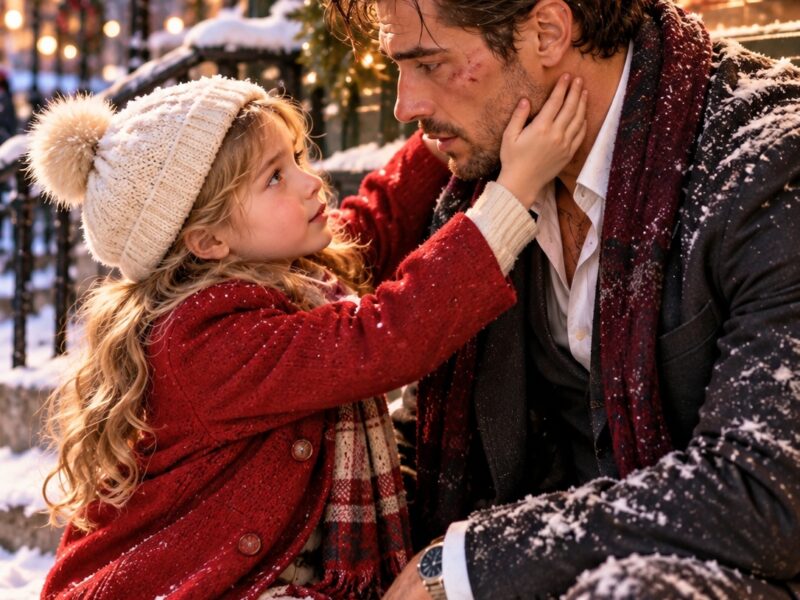
“Are You Cold?” Poor Little Girl Asked the Mafia Boss — What She Did Next Left Him Speechless!
“Are you cold, mister? You can have my scarf.”
The little girl couldn’t have been more than five. She stood outside a struggling Boston bakery on Christmas Eve, wearing oversized boots, a faded pink coat, and a red wool scarf that looked almost as long as she was tall.
The man sitting against the brick wall didn’t answer.
His expensive black overcoat was soaked from the falling snow. One hand pressed tightly against his left shoulder, and his breathing had become shallow and uneven. A dark stain spread beneath his fingers.
Lorenzo Duca had spent fifteen years making some of the most dangerous men in Boston afraid to look him in the eyes.
But tonight, he couldn’t even lift his head.
The little girl stepped closer.
“Mister?”
His eyes opened slightly.
She noticed the way he was shaking.
Without waiting for an answer, she carefully unwound the red scarf from her own neck. Standing on her tiptoes, she wrapped it around his shoulders as best she could.
“There,” she whispered. “Grandma says nobody should be cold on Christmas.”
Lorenzo stared at her.
He had survived betrayals, threats, and a gunshot less than an hour earlier. He knew what it meant to be feared. He knew what it meant to be obeyed.
But he could not remember the last time someone had offered him something without asking for anything in return.
“What’s your name?” he managed.
“Lucy.”
She smiled, revealing a small chip in one front tooth.
“Lucy Bennett.”
Something flickered in Lorenzo’s eyes.
Bennett.
He knew that name.
Or perhaps it was the pain making his thoughts wander.
Before he could ask another question, Lucy leaned closer.
“Does it hurt?”
Lorenzo had been asked whether he could still fight, whether he could stand, whether he could hold a weapon, and whether he intended to make someone pay.
Nobody had asked whether it hurt.
He swallowed.
“Yes, sweetheart.”
Lucy’s smile disappeared.
Then she turned toward the bakery door and shouted with all the strength in her little body.
“GRANDMA! THERE’S A MAN OUT HERE, AND HE NEEDS US!”
The door flew open.
An elderly woman appeared with flour on her sleeves and a dish towel in one hand. She stopped when she saw the wounded stranger.
Then she saw the dark stain on his coat.
Her expression changed.
“Lucy, get inside. Call 911.”
“But Grandma—”
“Now, sweetheart.”
Lucy ran toward the telephone.
The woman crouched beside Lorenzo.
“Can you hear me?”
He nodded faintly.
“Good. My name is Evelyn Bennett. Help is coming.”
Lorenzo tried to stand.
She placed a firm hand against his uninjured arm.
“Don’t move. You’re losing blood.”
“I can’t stay.”
“You most certainly can.”
“People are looking for me.”
“Then they can find you after a doctor has looked at that shoulder.”
He looked at her.
She was a small woman with silver hair, tired eyes, and the unmistakable authority of someone who had spent decades telling stubborn people what to do.
For reasons he could not explain, Lorenzo obeyed.
Minutes later, as an ambulance approached through the snow, Lucy returned carrying a small plate.
On it sat a gingerbread cookie shaped like a star.
One point was crooked.
The white icing had been applied with the unsteady enthusiasm of a child.
Lucy held it toward him.
“Grandma says when something hurts, you need something sweet.”
Lorenzo looked at the cookie.
His vision blurred.
He reached out with his good hand and accepted it.
“Thank you, Lucy.”
She nodded seriously.
“Don’t worry. I made more.”
Then she did something that would change far more than either of them understood.
She reached up and tucked the loose end of the red scarf inside his coat, carefully making sure it wouldn’t fall away.
At the bottom corner, almost hidden beneath the fringe, were two faded white letters.
C. B.
Lorenzo didn’t notice them until hours later.
And when he finally recognized the stitching, the most feared crime boss in Boston sat alone beside his fireplace, holding a child’s scarf with both hands.
Because eight years earlier, the only woman he had ever truly loved had disappeared after being accused of betraying him.
Her name was Clara Bennett.
And she had sewn those same two letters into everything she made.
Ninety minutes before Lucy found him, Lorenzo Duca had been walking away from a meeting he should never have attended.
The meeting took place in a private room behind a restaurant in Boston’s North End. Three men had come to discuss a disagreement involving a waterfront distribution company, missing money, and a contract that had become more profitable than anyone originally intended.
Lorenzo had listened for forty minutes.
Then he stood.
“We’re finished.”
The man across from him, Anthony Greco, looked surprised.
“We haven’t reached an agreement.”
“That’s because you haven’t offered one.”
Anthony leaned forward.
“Salvatore said you’d be reasonable.”
Lorenzo paused.
“My uncle spoke to you?”
“He said this could be handled quietly.”
Lorenzo looked at the other men.
They suddenly appeared interested in their glasses.
His uncle, Salvatore Duca, had helped raise him after his father’s death. He had taught him how to negotiate, how to recognize disloyalty, and how to survive in a world where an unanswered insult could become a dangerous misunderstanding.
But Salvatore had not mentioned this meeting.
And Lorenzo disliked surprises that came with his uncle’s name attached.
“I’ll speak to him myself,” Lorenzo said.
He put on his overcoat.
Outside, snow had begun falling.
Marco Rinaldi, his oldest friend and head of personal security, waited beside a dark sedan.
“Everything all right?”
“No.”
Marco studied his face.
“Want the car?”
“I want to walk.”
Marco looked toward the narrow street.
“Lorenzo, it’s Christmas Eve.”
“Then perhaps everyone will behave themselves.”
Marco didn’t smile.
He had known Lorenzo since they were teenagers. He knew the difference between humor and a warning.
They turned down a narrow passage behind an old church.
The first sharp crack came from above.
Lorenzo heard brick fragments strike the pavement.
Marco shouted his name.
A second crack followed.
Then another.
Something struck Lorenzo’s left shoulder with enough force to turn him sideways.
He staggered against the wall.
Marco caught his coat.
“Move!”
They stumbled toward the mouth of the alley.
More shots rang out behind them.
Marco pushed Lorenzo through a doorway into a service passage and dragged a metal gate shut.
For several seconds, neither spoke.
Lorenzo looked at his shoulder.
His glove was wet.
Marco reached for his phone.
“I’m calling an ambulance.”
“No.”
“Lorenzo—”
“Call Dominic. Tell him where we are.”
Marco glanced toward the alley.
“Someone knew we’d walk this way.”
Lorenzo looked back.
The meeting.
Anthony’s strange reference to Salvatore.
The fact that the passage had been almost empty.
“Yes,” he said.
Marco was already dialing.
But when voices approached from the far end of the passage, Lorenzo knew staying together would expose them both.
“Go toward Commercial Street,” he told Marco. “I’ll take the side streets.”
“Absolutely not.”
“They’ll follow the car. You know that.”
“Then I’m coming with you.”
Lorenzo shook his head.
“Get help. I’ll call when I’m somewhere safe.”
Before Marco could argue, Lorenzo slipped through a narrow opening into the next street.
He kept walking.
One block.
Then another.
The snow grew heavier.
His shoulder burned.
By the time he reached Hanover Street, his legs had begun to tremble.
Most businesses were closed.
The sidewalks were empty.
Christmas lights shone in apartment windows.
Then he noticed a bakery.
Its front window glowed yellow against the falling snow.
A hand-painted sign read:
Bennett’s Bakery — Fresh Bread, Cakes & Cookies.
Through the window, he could see a Christmas tree decorated with paper stars.
He smelled cinnamon.
Butter.
Warm bread.
For one bewildering moment, he remembered being a boy in his mother’s kitchen.
Then his knees gave way.
He sat down against the brick wall.
His phone slipped from his hand.
He tried to reach for it.
He couldn’t.
The bakery door opened.
And a little girl asked him whether he was cold.
At Boston Medical Center, the emergency physician told Lorenzo that he was fortunate.
The bullet had injured his shoulder without damaging the major blood vessels nearby. He needed treatment, observation, and time to recover.
Lorenzo disliked every part of that explanation except the final sentence.
Time was something he could arrange.
He had men who managed his appointments.
Men who canceled meetings.
Men who guarded doors.
Men who answered telephones before the second ring.
But there was no employee who could make the pain in his shoulder disappear.
Marco arrived shortly after the physician finished speaking.
He had a bandage around his upper leg and a furious expression.
“You look terrible.”
Lorenzo glanced at him.
“You always know how to improve a man’s mood.”
Marco pulled out a chair.
“Who found you?”
“A little girl.”
Marco stared.
“What?”
“Outside a bakery.”
“Which bakery?”
“Bennett’s. On Hanover.”
Marco nodded slowly.
“We’ll thank them.”
“I already did.”
“Not properly.”
Lorenzo looked toward the red scarf folded on the bedside table.
“Leave it alone for now.”
Marco followed his gaze.
“A scarf?”
“She gave it to me.”
Marco picked it up carefully.
“Child’s scarf.”
“Yes.”
“Nice wool.”
Lorenzo held out his hand.
Marco returned it.
Lorenzo unfolded the scarf and ran his thumb along the fringe.
That was when he noticed the letters.
C. B.
His chest tightened.
He turned the corner toward the bedside lamp.
The stitches were uneven.
Three strands of white thread had been pulled slightly too tight.
He recognized the habit.
Clara had always sewn initials that way.
She insisted they made a gift more personal.
Once, she’d embroidered his initials into a gray winter hat and laughed because the letters came out crooked.
He remembered teasing her.
You should stick to drawing.
She had tossed the hat at him.
Then freeze, Lorenzo Duca.
He stared at the red scarf.
Marco noticed his expression.
“Boss?”
Lorenzo didn’t answer.
“Lorenzo?”
He looked up.
“Find out who made this.”
Marco frowned.
“The scarf?”
“Yes.”
“Why?”
Lorenzo’s fingers tightened around the wool.
“Because I think it belonged to someone I buried in my heart eight years ago.”
Clara Bennett had been twenty-two when Lorenzo met her.
He was twenty-seven, already deeply involved in his family’s business, and becoming a man who rarely trusted the kindness of strangers.
She worked in a small art gallery on Newbury Street.
One afternoon, Lorenzo wandered inside to escape a sudden spring downpour.
He wasn’t interested in the paintings.
At least, that was what he told himself.
He noticed Clara standing on a ladder, trying to adjust a crooked frame.
“You should get someone to help,” he said.
She looked down.
“Are you offering?”
He hesitated.
“Yes.”
“Then hold the ladder.”
She returned to adjusting the frame.
Lorenzo stood beneath her, one hand resting against the ladder.
She looked down again.
“You’re supposed to hold both sides.”
“I am holding it.”
“With both hands.”
He obeyed.
“Do you always give orders to strangers?”
“Only the ones who need them.”
He almost smiled.
After a moment, she climbed down.
“There. Perfect.”
The painting still looked slightly crooked.
Lorenzo noticed.
Clara followed his gaze.
“Don’t say it.”
“I wasn’t going to.”
“You were thinking it.”
“Yes.”
She laughed.
That laugh stayed with him long after he left.
He returned the following Thursday.
And the Thursday after that.
Clara eventually asked why he kept buying inexpensive prints he clearly didn’t want.
“I like the gallery,” he said.
She folded her arms.
“The gallery?”
“Yes.”
“Not the woman who works here?”
He looked at her.
She smiled.
“That’s what I thought.”
They began meeting for coffee.
Then dinner.
Then long walks through Boston on evenings when Lorenzo could persuade his associates that he was unavailable.
Clara knew he came from a wealthy family.
She suspected his business involved things people didn’t discuss openly.
He told her more than he told most people.
Not everything.
But enough.
One night, while they sat overlooking the Charles River, Clara asked him what he wanted from his life.
He considered the question.
“I already have everything most men want.”
“That’s not what I asked.”
He looked across the water.
“I don’t know.”
She moved closer.
“Then perhaps you should find out before somebody else decides for you.”
Nobody had ever spoken to him like that.
Not his father.
Not his uncle.
Not Marco.
Clara had a way of asking questions that made every explanation sound incomplete.
He loved her for it.
They rented a small apartment above a florist on Charles Street.
It was supposed to be temporary.
A place outside the Duca family world.
Clara filled the windowsills with plants.
She hung sketches on the walls.
Lorenzo learned to cook two dishes badly and one reasonably well.
For nearly a year, he allowed himself to imagine leaving the family business.
He and Clara talked about moving to Vermont.
She wanted a small bookstore with an art studio in the back.
He wanted a place where nobody recognized his last name.
Once, on a rainy Thursday, she bought two bus tickets and placed them on the kitchen table.
“For when you’re ready,” she said.
“Ready for what?”
“To choose your own life.”
He kept the tickets in his wallet.
Then everything fell apart.
Three weeks before they planned to leave Boston, Salvatore came to Lorenzo with a folder.
His uncle looked unusually grave.
“I wish I didn’t have to show you this.”
Lorenzo opened it.
Inside were photographs.
Clara sitting at a restaurant table with a man connected to the Moretti crime family.
A bank transfer.
A hotel receipt.
Copies of messages describing a shipment that belonged to the Duca organization.
Then Salvatore played an audio recording.
A woman’s voice mentioned a warehouse address and a delivery schedule.
The voice sounded like Clara’s.
Lorenzo listened twice.
His hands went cold.
“Where did you get this?”
“People I trust.”
“Who?”
Salvatore shook his head.
“I can’t expose them.”
Lorenzo looked down at the photographs.
Clara had always insisted she wanted nothing to do with the family business.
Now the documents suggested she had been selling information to their enemies.
“Are you certain?”
Salvatore placed a hand on his shoulder.
“I spent a month checking before I brought it to you.”
Lorenzo believed him.
That was the mistake he would regret for the rest of his life.
He didn’t confront Clara in person.
He didn’t ask her about the restaurant.
He didn’t ask who the man was.
He didn’t show her the documents.
He called her.
“Don’t come Thursday.”
She sounded confused.
“What?”
“It’s over.”
“Lorenzo, what happened?”
“I know what you did.”
“What did I do?”
“Don’t make me say it.”
There was a long silence.
Then Clara whispered, “You’re frightening me.”
He closed his eyes.
“Goodbye.”
He ended the call.
By morning, the apartment above the florist was empty.
Clara’s clothing was gone.
Her books.
Her sketches.
Everything except one drawing pinned to the wall.
It showed Lorenzo asleep on the sofa, one arm hanging over the edge, his face relaxed in a way he rarely allowed anyone to see.
Below the drawing, Clara had written:
This is the man I believed you could become.
He took it down.
Folded it.
Put it in a drawer.
Then he returned to the Duca family house and became exactly the man she’d hoped he would leave behind.
Eight years passed.
Lorenzo took control of the family organization after his father died.
He expanded the legitimate logistics company.
He settled conflicts.
He acquired properties.
He developed a reputation for patience that was often more frightening than anger.
He never married.
He rarely spoke about Clara.
Marco knew better than to mention her.
Salvatore occasionally referred to the incident as proof that Lorenzo had learned an important lesson about loyalty.
Lorenzo allowed him to.
But there were nights when he returned from meetings and opened the drawer containing Clara’s drawing.
He would unfold it.
Look at the sleeping man she’d sketched.
Then put it away.
He never destroyed it.
He also never looked for her.
He told himself that was pride.
Only much later would he admit it was fear.
Fear that he’d been right.
Or worse, that he’d been wrong.
Now, lying in a hospital bed on Christmas morning, he held a red scarf marked with the same initials Clara once embroidered into his winter hat.
He couldn’t sleep.
At six, he called Marco.
“I need you to find out everything about Bennett’s Bakery.”
Marco was silent.
“Everything?”
“Ownership. Family. The little girl’s parents. Who lives upstairs.”
“Lorenzo—”
“And Marco?”
“Yes?”
“Do it without involving Salvatore.”
Marco understood immediately that the conversation concerned more than gratitude.
“I’ll handle it.”
Lorenzo was released from the hospital after further observation, with instructions to rest and follow up with his doctor.
He returned to the Duca residence on Beacon Hill.
The house looked exactly as it had when he left.
Stone steps.
Tall windows.
A polished front door decorated with a Christmas wreath.
Inside, the staff had prepared a small breakfast.
Nobody asked about the scarf.
But Lorenzo noticed the way several people looked at it.
A child’s red scarf around the neck of a man who owned more expensive clothing than most families could purchase in a lifetime.
He went directly to his study.
The room smelled of leather and wood smoke.
His father’s old desk stood near the window.
A photograph of his mother rested beside the lamp.
Lorenzo sat down and unfolded the scarf again.
C. B.
He remembered Clara sitting on the apartment floor with a needle and thread.
She’d been repairing the hem of a dress.
He asked why she bothered when she could afford a new one.
She looked at him.
“Because not everything broken needs replacing.”
He had laughed.
She hadn’t.
“Sometimes it just needs someone patient enough to fix it.”
The memory made him close his eyes.
He had spent eight years believing Clara betrayed him.
He had never considered that the evidence might have been wrong.
Or that the wrong person might have provided it.
At noon, Marco arrived.
He carried a thin folder.
Lorenzo stood.
“What did you find?”
Marco placed the folder on the desk.
“Evelyn Bennett owns the bakery. Sixty-eight. Widowed. Her husband worked on the waterfront before he died.”
“And Lucy?”
“Five years old. Her mother was Victoria Bennett.”
“Was?”
Marco hesitated.
“Victoria died three years ago.”
Lorenzo sat down.
“How?”
“Cancer.”
“And the father?”
“Not listed on the birth certificate. Evelyn has been Lucy’s legal guardian since Victoria died.”
Lorenzo looked at him.
“Other family?”
Marco opened another page.
“Victoria had a younger sister.”
He looked up.
“Clara June Bennett.”
Lorenzo stopped breathing for a moment.
Marco continued.
“She disappeared eight years ago. The family reported her missing, but the case was never resolved.”
Lorenzo stared at the paper.
“So Lucy is Clara’s niece.”
“Yes.”
He looked at the scarf.
“And the scarf?”
“I’m still checking.”
Lorenzo nodded.
Marco remained standing.
“There’s something else.”
“What?”
“Victoria spent years looking for Clara.”
Lorenzo looked up.
“How many?”
“Almost until she died.”
Marco turned the page.
“She filed missing-person reports. Hired investigators. Contacted hospitals and shelters. She even wrote to newspapers asking them to publish Clara’s photograph.”
Lorenzo felt something tighten in his chest.
“Did she find her?”
“We don’t know.”
Marco hesitated.
“Before Victoria died, she left a sealed box of documents with Evelyn. According to a hospice worker, she wanted the box kept until someone who knew Clara came looking.”
Lorenzo stared at him.
“Where is it?”
“At the bakery.”
He stood.
“Get the car.”
Marco looked at his sling.
“Lorenzo, the doctor said—”
“The car, Marco.”
This time, his voice wasn’t angry.
It was frightened.
And Marco knew better than to delay him.
By eleven the next morning, Lorenzo stood outside Bennett’s Bakery again.
The snow had stopped, leaving gray slush along the curb. The Christmas decorations still hung in the windows, and someone had drawn a smiling gingerbread man on the chalkboard beside the entrance.
Lorenzo had insisted on coming alone.
Marco had objected.
Lorenzo had replied that he wasn’t going to a meeting with rival criminals.
He was going to thank a grandmother.
For once, Marco had no argument that didn’t sound absurd.
Lorenzo pushed open the door.
A little brass bell rang overhead.
Lucy was behind the counter, standing on a wooden stool and carefully arranging paper napkins beside a plate of cookies.
She looked up.
Her eyes widened.
“Grandma! The cold man came back!”
She jumped down.
Lorenzo barely had time to kneel before she rushed toward him.
He caught her gently with his uninjured arm.
“Careful, little one.”
Lucy leaned back to examine his face.
“You look better.”
“I feel better.”
“Does it still hurt?”
“A little.”
She considered that.
“Did you eat breakfast?”
“Yes.”
“What?”
“Toast.”
She frowned.
“Just toast?”
“I’m afraid so.”
She shook her head with the disappointment of someone discovering a serious moral failing.
“That’s not enough.”
Lorenzo laughed.
It surprised him.
The sound came easily, without the calculation that accompanied most of his conversations.
Evelyn appeared from the kitchen carrying a metal tray.
She stopped when she saw him.
“You’re alive.”
“Thanks to you.”
“Thanks to the people at the hospital. We only kept you from making things worse until they arrived.”
Lorenzo stood carefully.
“I came to thank you.”
“You already did.”
“I brought something.”
He placed a small white bakery box on the counter.
Inside were twelve gingerbread stars from another shop in the North End.
Lucy opened the lid.
Her face lit up.
“Grandma! They made stars!”
Evelyn looked at the cookies.
“We make stars, too.”
“I know,” Lorenzo said. “But I couldn’t come empty-handed.”
Evelyn studied him.
Then she nodded toward the back.
“Sit down. I’ll put the kettle on.”
The same wooden table stood behind the display case.
Its surface was scratched from years of rolling dough.
Lorenzo remembered sitting there in pain while Evelyn stayed beside him, holding a clean towel against his shoulder and waiting for the ambulance.
Now a cup of tea appeared in front of him.
Evelyn sat opposite.
Lucy remained near the counter, where she had been given the important responsibility of keeping an eye on the cookie display.
For a moment, neither adult spoke.
Then Lorenzo carefully unfolded the red scarf.
Evelyn stared at it.
“I wondered if you’d bring that back.”
“I was hoping I could ask about it.”
“What about it?”
“The initials.”
He turned the corner toward her.
C. B.
Evelyn’s face changed.
She reached across the table.
“May I?”
He handed it to her.
She rubbed the wool between her fingers.
“My granddaughter’s.”
“Clara?”
Evelyn stopped moving.
The bakery seemed suddenly very quiet.
From the front, Lucy was humming to herself.
Evelyn lifted her eyes.
“How do you know that name?”
Lorenzo swallowed.
“I knew her eight years ago.”
“How well?”
He looked down.
“Well enough that I thought I’d spend the rest of my life with her.”
Evelyn leaned back.
For a long moment, she simply watched him.
Then she said, “Lorenzo.”
He looked up.
She repeated the name more slowly.
“Lorenzo Duca.”
He nodded.
“Yes.”
Evelyn closed her eyes.
“Oh, Lord.”
“You knew about me?”
“Clara told her sister. And Victoria told me.”
Lorenzo leaned forward.
“Did Clara come home after she disappeared?”
“No.”
“Did she call?”
“Not once.”
“Did she ever explain why she left?”
Evelyn looked toward the kitchen doorway.
“I’ve spent eight years asking myself that question.”
He waited.
She folded the scarf carefully.
“Clara wasn’t the kind of girl who disappeared without a word. She called on birthdays. She sent postcards when she traveled. If she borrowed five dollars, she’d write it down and pay it back.”
Her eyes filled.
“Then one day, nothing.”
Lorenzo lowered his head.
“I told her not to contact me.”
Evelyn looked at him sharply.
“Why?”
He hesitated.
“I believed she’d betrayed me.”
“Did she?”
“I don’t know anymore.”
The admission sounded dreadful.
He had been certain for eight years.
Certain enough to abandon her.
Certain enough never to look.
Now he couldn’t even explain his certainty to a grieving grandmother.
Evelyn stared at him.
“Clara loved you.”
His throat tightened.
“She told you that?”
“No. She told Victoria. Victoria told me because she was afraid that girl was giving her heart to someone dangerous.”
Lorenzo looked away.
“She wasn’t wrong.”
Evelyn’s expression softened slightly.
“Maybe not. But danger doesn’t always come from where you expect.”
She rose slowly.
“There is something upstairs.”
He looked toward her.
“Marco told me about Victoria’s box.”
Evelyn nodded.
“She left it when she was dying. I haven’t opened it.”
“Why?”
The elderly woman took a breath.
“Because I buried my husband. Then Victoria. And every time I saw that box, I imagined there might be something inside telling me Clara was gone, too.”
She looked toward the staircase.
“I wasn’t ready for another goodbye.”
Lorenzo said nothing.
Evelyn studied him.
“But perhaps it’s time.”
The apartment above the bakery was small and warm.
A Christmas wreath hung on the inside of the door. Family photographs covered the narrow hallway.
Lorenzo noticed one immediately.
Two girls stood beside a birthday cake.
The older girl had dark hair and a mischievous smile.
The younger wore a yellow sweater and held a stuffed rabbit.
Clara.
She couldn’t have been more than eleven.
He stopped walking.
Evelyn followed his gaze.
“That was her twelfth birthday.”
Lorenzo smiled faintly.
“She looks like herself.”
“She was always a serious child. Victoria could make her laugh, but nobody else had an easy time of it.”
They entered the kitchen.
Evelyn reached above a cupboard and brought down a brown cardboard box.
It was sealed with packing tape.
Across the lid, in careful black handwriting, were the words:
For Mama. When someone comes who can help us understand.
Evelyn placed it on the table.
She sat down.
“You open it.”
Lorenzo hesitated.
“Are you sure?”
“No. But I think we should.”
He removed the tape.
Inside were four objects.
A leather-bound journal.
An old passport.
A small silver flash drive.
And a sealed envelope marked with a tiny red cross.
He opened the passport first.
Clara June Bennett.
Born August 16, 1994.
The photograph showed her at twenty-one.
Her dark hair was pulled back.
Her mouth carried the familiar suggestion of a smile.
Lorenzo looked at it until the letters blurred.
A note was attached.
She left this with me the week she disappeared. If she ever needed to prove who she was, I wanted to have a copy.
It was signed V.
Evelyn picked up the journal.
“Victoria always wrote things down.”
Lorenzo opened it.
The early entries were ordinary.
Bakery expenses.
Lucy’s first words.
Appointments.
Lists of supplies.
Then, halfway through, the subject changed.
March 3. Called the investigator again. Nothing.
April 18. Someone in Vermont remembers a woman matching Clara’s description.
June 7. Another dead end. Mama cried today. I told her we weren’t stopping.
Lorenzo kept turning pages.
Victoria had recorded years of searching.
Hospitals.
Shelters.
Public records.
Missing-person organizations.
Every possibility she could afford to pursue.
Near the end, the handwriting became smaller and shakier.
One entry was underlined.
I was looking at the wrong people.
Lorenzo stopped.
He read the next line.
It wasn’t the Morettis who made Clara disappear. Someone inside the Duca family arranged everything.
He looked up.
Evelyn was watching him.
“What does it say?”
Lorenzo swallowed.
“Victoria believed someone in my family was responsible.”
Evelyn’s face tightened.
“For Clara?”
“Yes.”
He turned the page.
The next entry contained a name.
Salvatore.
Lorenzo’s uncle.
The man who had raised him.
The man who had shown him the evidence against Clara.
Lorenzo stared at the handwriting.
For a moment, he heard nothing but the refrigerator humming against the wall.
Evelyn leaned forward.
“Lorenzo?”
He looked up.
“Did Victoria ever explain why she suspected him?”
Evelyn shook her head.
“She wouldn’t tell me everything. She said it would be safer if I didn’t know until she could prove it.”
Lorenzo turned another page.
Victoria had written about a former employee of the Duca organization who contacted her anonymously.
The man claimed that Salvatore had arranged for photographs to be staged and records to be altered.
He said Clara had discovered something that could threaten Salvatore’s position in the family business.
Then the man disappeared.
Victoria’s investigator had obtained copies of financial transactions and communications relating to the alleged scheme.
Some were saved on the flash drive.
Lorenzo lifted it.
“May I examine this?”
Evelyn looked at the silver device.
“That was Victoria’s?”
“Yes.”
She thought for a moment.
“Only if you promise to bring it back.”
“I will.”
“And Lorenzo?”
He looked at her.
“If this is about people in your world, I don’t want Lucy involved.”
“Neither do I.”
“She lost her mother. She needs ordinary things. School. Cookies. Someone who remembers to buy milk.”
Lorenzo nodded.
“I understand.”
Evelyn studied him.
“I’m not certain you do.”
He looked toward the hallway.
On the wall hung a drawing made with crayons.
A red house.
A yellow sun.
Three stick figures holding hands.
He imagined Lucy standing outside the bakery, offering her scarf to a stranger who might have frightened anyone old enough to recognize him.
“You’re right,” he said.
Evelyn looked surprised.
“I don’t know enough about protecting a child from my world,” Lorenzo continued. “But I know she shouldn’t have to learn anything about it.”
The elderly woman nodded slowly.
“That’s a beginning.”
Lorenzo returned to Beacon Hill with the flash drive and a copy of Victoria’s journal entries.
He didn’t bring Marco into the study immediately.
Instead, he called a lawyer named Daniel Keating.
Daniel had represented the legitimate side of Duca Logistics for several years. Unlike the attorneys who attended every family meeting, he had never been asked to advise on criminal operations.
Lorenzo trusted him precisely because he knew less.
When Daniel arrived, he examined the materials without touching the original flash drive.
“What exactly are you asking me to do?”
“Help me preserve evidence.”
“Evidence of what?”
“Fraud. Possibly conspiracy. Maybe worse.”
“Against whom?”
Lorenzo looked toward the portrait of his father.
“My uncle.”
Daniel sat back.
“Lorenzo, before you tell me anything else, you should understand something.”
“I know what you’re going to say.”
“I doubt it.”
Lorenzo waited.
“If these records concern criminal activity involving the Duca organization, you need independent criminal counsel. And if you intend to report your uncle, you should expect questions about your own conduct.”
“I know.”
“Do you?”
Lorenzo almost smiled.
He had been hearing that question more often lately.
“Probably not.”
Daniel nodded.
“Then we’re making progress.”
They arranged for the drive to be copied and examined through a specialist who could preserve its contents and document how the copies were handled.
Lorenzo remained in the room while the files were reviewed.
Photographs appeared first.
A restaurant table.
Two men.
A familiar ring.
Salvatore Duca sat opposite Rocco Moretti, a senior figure in a rival organization.
Then came account records showing payments through companies Lorenzo recognized.
Some payments were old.
Others had continued long after Clara disappeared.
One set of invoices referenced the same company involved in the attempted ambush behind St. Anselm’s Church.
Daniel examined the dates.
“These aren’t enough by themselves to establish what happened,” he said.
“There’s more.”
The next folder contained audio recordings.
Daniel looked at Lorenzo.
“Before we play these, we need to determine how they were obtained.”
The specialist examined the accompanying documentation.
Victoria’s investigator had recorded notes explaining where the files came from, though the recordings’ authenticity and lawful use would still require verification.
Daniel nodded reluctantly.
“Listen, then. But don’t decide what they prove until we’ve had them examined.”
Lorenzo put on headphones.
The first recording began with the sound of glasses and indistinct restaurant conversation.
Then a man’s voice spoke.
Salvatore.
Lorenzo recognized the cadence immediately.
The boy won’t leave her on his own.
Another voice answered.
Rocco Moretti.
Then give him a reason.
Salvatore laughed softly.
Photographs. A transfer. A voice recording. Something he’ll recognize and something he’ll never question.
Lorenzo stopped breathing.
The recording continued.
And the girl?
She leaves Boston. The boy stays with us. Everyone gets what they want.
A pause.
Then Salvatore said something that made Lorenzo remove the headphones.
He trusts me more than he trusts himself.
Lorenzo sat motionless.
Daniel looked at him.
“Are you all right?”
“No.”
He put the headphones back on.
He listened to the remaining files.
By the end, he understood that the woman he believed had betrayed him had probably been the victim of a carefully arranged deception.
And the man responsible had been sitting beside him at family dinners for eight years.
Lorenzo removed the headphones.
He looked at Daniel.
“Can this be proved?”
“Perhaps. We need the originals, witnesses, financial tracing, and independent examination.”
Lorenzo nodded.
Then he asked the question that frightened him most.
“Can you help me find Clara?”
Daniel considered.
“If she’s alive and doesn’t want to be found, that’s something we have to respect.”
“I know.”
“Do you?”
Lorenzo looked down.
For eight years, he had imagined a reunion in which Clara would run toward him, forgive him, and let him explain everything.
Now he understood how selfish that fantasy had been.
He was the person who had abandoned her.
He had not asked questions.
He had accepted accusations.
And when she disappeared, he had done nothing.
“I only want to know she’s safe,” he said.
Daniel watched him for a long moment.
“Then that’s where we begin.”
That evening, Lorenzo returned to the bakery.
He called ahead.
Evelyn invited him to come after Lucy went upstairs for her bath.
The shop was closed when he arrived.
Snow had begun falling again.
Inside, Evelyn sat at the wooden table with a cup of tea.
She looked tired.
Lorenzo placed the flash drive on the table.
“I brought it back.”
“Thank you.”
He sat opposite her.
“Victoria was right about some things.”
Evelyn’s hand tightened around her cup.
“About Clara?”
“Yes.”
“Did someone hurt her?”
Lorenzo hesitated.
“I believe someone deliberately destroyed her relationship with me and forced her to leave Boston.”
Evelyn stared.
“Why?”
“Because she wanted me to leave the family business.”
The elderly woman looked away.
After a moment, she said, “She talked about that.”
Lorenzo raised his eyes.
“Clara?”
“Yes. She used to tell Victoria about a little bookstore she wanted to open someday. Somewhere nobody knew your family name.”
He swallowed.
“I promised her that.”
Evelyn looked at him.
“Then why didn’t you go?”
Lorenzo stared at the table.
“Because someone made me believe she’d betrayed me.”
“Did you ask her?”
“No.”
“Did you let her explain?”
“No.”
Evelyn said nothing.
That silence was worse than anger.
Finally, Lorenzo spoke.
“I was wrong.”
The elderly woman nodded slowly.
“Yes, Mr. Duca. You were.”
He looked up.
She continued.
“Clara was twenty-two. She was in love. She probably believed you would trust her when it mattered.”
Lorenzo closed his eyes.
“I know.”
Evelyn stood.
She walked toward the kitchen cupboard.
Then stopped.
“There’s one more thing in Victoria’s box.”
Lorenzo looked up.
“The sealed envelope.”
Evelyn nodded.
“I opened it after you left.”
She returned carrying a single sheet of paper.
The handwriting was shaky.
Victoria had written it shortly before her death.
Mama,
If Lorenzo Duca ever comes looking for Clara, tell him I found a place where she may have lived under another name.
I couldn’t confirm it before I became too sick to travel.
Please don’t send dangerous men after her. She left because she was afraid.
But if he truly wants to know the truth, perhaps he can ask her whether she wants to be found.
Below the message was an address.
A small bookshop in North Hero, Vermont.
Lorenzo stared at the words.
Evelyn watched him.
“Do you think she’s there?”
“I don’t know.”
“Will you go?”
He looked at the address again.
“Yes.”
She sat down.
“Then promise me something.”
“Anything.”
“If you find her, don’t decide for her what happens next.”
Lorenzo looked up.
Evelyn’s eyes were wet.
“She lost eight years. So did we. If she’s made a life somewhere else, you don’t get to take that away just because you’ve finally learned the truth.”
He nodded.
“I promise.”
Then Evelyn said something he hadn’t expected.
“And if she doesn’t want to come home, tell her I love her anyway.”
Lorenzo lowered his head.
For the first time since finding the scarf, he couldn’t keep the tears from his eyes.
He left Boston the following morning.
Not in an armored SUV.
Not with security vehicles following behind.
He borrowed a modest gray sedan from a legitimate business associate and drove north with the address folded inside his coat.
His shoulder still ached.
He stopped twice to rest.
At a roadside diner, he ordered coffee and left most of it untouched.
A waitress asked whether he wanted pie.
He almost said no.
Then he remembered Lucy solemnly instructing him to eat something sweet when he was hurt.
“Apple,” he said.
The waitress smiled.
“Good choice.”
He ate the pie slowly.
Outside, snow gathered along the edge of the parking lot.
For most of the drive, he rehearsed what he would say.
Clara, I was wrong.
Clara, my uncle lied.
Clara, I never stopped loving you.
Every sentence sounded inadequate.
By the time he reached the Vermont border, he stopped rehearsing.
He had no right to ask forgiveness.
He could only offer the truth.
The town was smaller than he expected.
North Hero sat beside Lake Champlain, where winter made the water look like dark glass beneath the gray sky.
A few restaurants lined the road.
A hardware store displayed snow shovels near its entrance.
Then Lorenzo saw the bookshop.
A wooden sign read:
The Lamplight — Used Books & Old Maps.
Warm light shone through the windows.
A handwritten notice announced that the shop would close at six.
It was five-forty.
Lorenzo parked across the street.
For several minutes, he remained behind the wheel.
He had walked into hostile meetings with less fear than he felt crossing that road.
Finally, he stepped out.
The bell above the shop door rang.
Inside, shelves filled the room from floor to ceiling.
A small heater hummed near the counter.
The air smelled of paper and cedar.
Behind the desk, a woman stood on a low step stool, reaching for a book.
“Just a moment,” she called.
Lorenzo knew the voice.
Eight years had passed.
His whole body recognized it.
She climbed down.
Turned.
And dropped the book.
It landed open on the wooden floor.
Neither moved.
Clara Bennett stood behind the counter with one hand pressed against her chest.
Her dark hair was shorter now.
There were small lines near her eyes.
She wore a gray cardigan over a blue shirt.
But the scar above her eyebrow was the same.
So were her eyes.
“Lorenzo?”
He couldn’t answer immediately.
Then he whispered, “Clara.”
She stared at him.
For one terrible moment, he thought she might run.
Instead, she gripped the edge of the counter.
“How did you find me?”
He looked at her.
“A little girl gave me a scarf.”
Clara’s expression changed.
“A scarf?”
“Red wool. With your initials.”
She brought one hand to her mouth.
“Lucy?”
He nodded.
“Lucy.”
Her eyes filled.
“My niece?”
“Yes.”
She looked toward the window.
“Is she all right?”
“She is.”
“And Evelyn?”
“She’s well.”
Clara’s breathing changed.
For a moment, she looked as though she might collapse.
Lorenzo stepped forward instinctively.
She raised one hand.
“Don’t.”
He stopped immediately.
The word took him back eight years.
To the phone call.
The accusations.
His refusal to listen.
Clara looked at him.
“You don’t get to walk in here and make everything happen at once.”
He lowered his head.
“I know.”
She stared.
“Do you?”
He didn’t answer.
After a long moment, she pointed toward a chair.
“Sit down, Lorenzo.”
He obeyed.
And then, in a quiet bookstore beside a frozen lake, the man who had ordered criminals to kneel before him sat across from the woman he had abandoned and waited for permission to speak.
Clara remained behind the counter.
She didn’t offer tea.
Didn’t ask about his shoulder.
Didn’t comment on the expensive watch he had forgotten to remove before making the trip.
For a long time, she simply looked at him.
Then she asked, “What did you come here to say?”
Lorenzo had imagined this moment too many times.
In some versions, she cried.
In others, she slapped him.
Sometimes she turned away, and he followed her through the door, begging for another chance.
None of those imagined reunions had prepared him for the woman sitting across from him now.
She looked older.
Tired.
Careful.
Not because life had defeated her, but because she had built something she intended to protect.
“My uncle lied to me,” Lorenzo said.
Clara didn’t move.
“He showed me photographs. Financial records. A recording.”
“I know what he showed you.”
Lorenzo looked up sharply.
“You do?”
“Not everything. Enough.”
She folded her hands.
“A man came to the gallery two days after you called me. He said he worked for your family. He knew where I lived. He knew where Victoria worked. He even knew which bus Evelyn took to the grocery store.”
Lorenzo felt cold.
“What did he want?”
“He told me you believed I was working with the Morettis. He said you’d lost faith in me, and that trying to change your mind would only make things worse.”
“Did he threaten you?”
Clara looked at him.
“He didn’t need to say very much. He left an envelope containing photographs of my family.”
Lorenzo closed his eyes.
“I never authorized that.”
“I know that now.”
He opened his eyes.
Clara continued.
“At the time, I didn’t know what you knew. I didn’t know whether you were angry enough to have sent him yourself.”
“I would never—”
He stopped.
Because she was looking at him in a way that made the unfinished sentence sound foolish.
“What?” she asked. “You would never frighten somebody to make them do what you wanted?”
Lorenzo lowered his gaze.
He couldn’t answer no.
Not truthfully.
Clara nodded.
“That’s what I thought.”
She looked toward the shop window.
“The man said if I left Boston and stopped contacting you, everyone could go back to their lives.”
“And you believed him?”
“I believed he knew where my family lived.”
Lorenzo covered his mouth with one hand.
For eight years, he had convinced himself that Clara disappeared because she had been caught betraying him.
Now he was beginning to understand that she had fled because she believed staying could put her family in danger.
“I tried to tell Victoria,” Clara continued. “I called her once from a pay phone. I told her I needed time and that I was safe.”
“Did she ask where you were?”
“Yes.”
“What did you say?”
“That it was better if she didn’t know.”
Clara looked down.
“I thought it would be a few months. I thought you would discover the lie, and the people behind it would lose interest.”
She laughed bitterly.
“Then a few months became a year. I moved twice. Changed jobs. Stopped using my old surname for anything that wasn’t legally required.”
“Clara—”
“I need to finish.”
He fell silent.
“I checked the news from Boston. I saw photographs of you at charity events. Business openings. Weddings. Funerals. You looked fine.”
Lorenzo stared.
“I wasn’t.”
She gave him a small, sad smile.
“You looked fine enough not to come looking.”
The words struck harder than the gunshot.
He looked at her.
“I thought you had betrayed me.”
“Then you should have asked me.”
“I know.”
“No, Lorenzo. You should have asked before you decided who I was.”
He sat motionless.
Clara rose from her chair and walked toward a narrow bookshelf near the window.
She pulled out a leather-bound sketchbook.
Its cover was worn at the corners.
She placed it on the counter.
“Do you remember this?”
He did.
She used to carry it everywhere.
He reached toward it, then stopped.
“May I?”
She nodded.
He opened it.
The first pages contained street sketches.
Boston rooftops.
People sitting on park benches.
A woman reading on a train.
Then he found himself.
He was sitting beside a window, looking down at a newspaper.
On the next page, he was laughing.
Then sleeping.
Then standing in the apartment kitchen holding a pan with something burned inside it.
Lorenzo’s throat tightened.
She had kept drawing him.
Even after he told her not to come back.
He turned another page.
The sketches changed.
A bus station.
A small rented room.
Snow falling outside a window.
Then a woman standing in a bookstore, seen from behind.
At the bottom, Clara had written:
First day. North Hero.
Lorenzo looked up.
“You built this.”
She nodded.
“It took time.”
“Is it yours?”
“Half. The previous owner sold me a share after I worked here for three years. I bought the rest last spring.”
He looked around.
The shelves.
The warm lamps.
The handwritten recommendations beside stacks of books.
The small desk covered with receipts and postcards.
He remembered their conversations about Vermont.
The bookstore.
The quiet life.
Clara had built it.
Without him.
The realization brought him pride and grief in equal measure.
“You did it,” he whispered.
“Yes.”
She looked at the sketchbook.
“I did.”
For the first time, Lorenzo understood that her survival wasn’t a story waiting for him to complete it.
She had been living all along.
He told her about Victoria slowly.
Not all at once.
Clara noticed something was wrong before he reached the hardest part.
“Why isn’t Vicky here with you?”
Lorenzo looked at his hands.
“She spent years looking for you.”
“I know.”
“She hired investigators.”
Clara nodded.
“She was always stubborn.”
“She never stopped.”
Clara’s smile faded.
“Lorenzo.”
He couldn’t make the words easier.
“Victoria died three years ago.”
Clara stared.
“No.”
He said nothing.
“No, that’s not possible.”
“I’m sorry.”
Clara shook her head.
“She’s forty—”
She stopped.
Lorenzo watched her realize she was calculating her sister’s age from the last time she’d seen her.
“She had cancer,” he said. “It progressed very quickly.”
Clara’s hand went to her mouth.
For several seconds, she didn’t move.
Then she rose.
Walked toward the back of the shop.
Stopped.
Turned.
“Did she ask for me?”
“Yes.”
The word came out almost soundlessly.
Lorenzo swallowed.
“She looked for you until near the end. She left records because she believed one day someone would find the truth.”
Clara pressed her palm against the wall.
“My sister was sick.”
“Yes.”
“And I wasn’t there.”
Lorenzo rose slowly.
“Clara—”
“Don’t.”
He stopped.
She turned toward him.
Tears were running down her face.
“I was so frightened of what your family might do that I let my sister spend years looking for me.”
“You were trying to protect them.”
“You don’t know that.”
“No,” he said quietly. “I don’t.”
She looked away.
He wanted to comfort her.
To tell her she had done the right thing.
To promise Victoria understood.
But he couldn’t know those things.
All he could offer was what he had learned.
“Victoria loved you,” he said. “That much is certain.”
Clara covered her face.
Then she began to sob.
Lorenzo remained where he was.
He had spent years believing love meant protecting someone from every painful truth.
Now he watched the woman he loved grieve and understood that the truth was painful partly because it belonged to her.
He couldn’t carry it for her.
After a while, Clara lowered herself into the chair near the heater.
Lorenzo stayed across the room.
The little heater clicked softly.
Outside, snow brushed against the window.
When Clara finally spoke, her voice was exhausted.
“Does Lucy look like her mother?”
Lorenzo nodded.
“Very much.”
“Does she laugh like Vicky?”
He considered.
“I don’t know how Victoria laughed.”
Clara wiped her eyes.
“Loud. She laughed so loudly the neighbors could hear her through the walls.”
Lorenzo smiled faintly.
“Then yes. Lucy does.”
Clara began crying again.
But this time, she was smiling, too.
Lorenzo stayed in North Hero that night.
Not at Clara’s apartment.
He booked a room at the small inn near the water.
Before leaving the bookshop, he placed his telephone number on the counter.
“You don’t have to call,” he said.
Clara looked at the paper.
“I know.”
“And if you decide you don’t want to see me again—”
“I’ll tell you.”
He nodded.
She studied him.
“Lorenzo, I need you to understand something.”
“Anything.”
“I don’t know whether I can forgive you.”
“I know.”
“I loved you. And when I needed you to trust me, you believed someone else.”
He lowered his head.
“You’re right.”
“And whatever your uncle did, you made that choice yourself.”
The words hurt because they were true.
He nodded.
“Yes.”
Clara looked toward the window.
“I’ll think about Boston.”
He looked up.
“About going back?”
“About seeing Evelyn. And Lucy.”
“Of course.”
She considered.
“Not about getting back together with you.”
“I understand.”
He moved toward the door.
Then stopped.
“Clara?”
She looked at him.
“I never stopped loving you.”
She closed her eyes briefly.
When she opened them, her expression was sad.
“Sometimes that isn’t enough, Lorenzo.”
He nodded.
“I know.”
The bell rang as he left.
Outside, the air smelled of snow and wood smoke.
He stood on the sidewalk for a moment.
Then walked toward the inn.
For the first time in eight years, he knew Clara was alive.
But knowing she was alive did not mean he had a place in her life.
It was a distinction he was only beginning to understand.
Back in Boston, Salvatore Duca was becoming impatient.
He had expected Lorenzo’s injury to create an opportunity.
The ambush had been designed to frighten the younger man, weaken his reputation, and make the family council question whether he could still maintain control.
Instead, Lorenzo had disappeared into medical appointments and unexplained absences.
He wasn’t responding to Salvatore’s calls.
He wasn’t attending meetings.
And Marco Rinaldi had become frustratingly uninformative.
On December 29, Salvatore arrived at the Duca residence without an appointment.
Marco met him at the front entrance.
“Lorenzo isn’t available.”
Salvatore smiled.
“He’s my nephew.”
“I know.”
“Then move.”
Marco remained where he was.
“Doctor’s orders. No visitors.”
Salvatore’s smile thinned.
“I helped raise that boy.”
Marco looked at him.
“Yes, sir.”
“Then you understand why I want to see him.”
“I understand.”
Neither moved.
Finally, Salvatore stepped back.
“Tell him the council is worried.”
“I will.”
“And tell him I’m the only reason certain people haven’t started asking whether he should step aside.”
Marco nodded.
“I’ll pass that along.”
Salvatore turned toward his car.
He had almost reached it when Marco spoke again.
“One question, Mr. Duca.”
Salvatore looked back.
“Yes?”
“Did you know Lorenzo visited Bennett’s Bakery after the shooting?”
Salvatore’s expression changed almost imperceptibly.
“Why would I know that?”
Marco shrugged.
“Just checking.”
Salvatore studied him.
Then got into his car.
Marco watched it leave.
He had learned something.
Not enough to prove anything.
But enough to make him more concerned about the bakery than he had been an hour earlier.
When Lorenzo returned from Vermont, he found Marco waiting in his study with Daniel Keating and a second attorney.
The second lawyer, Rebecca Sloan, specialized in criminal defense and corporate investigations.
She was fifty-three, direct, and unimpressed by the Duca surname.
Lorenzo explained what he had learned.
The recordings.
The financial documents.
The apparent scheme to frame Clara.
The connection to the ambush.
Rebecca listened without interrupting.
Then she said, “If you want the authorities to investigate this, you’ll need to cooperate in a way that can be independently verified.”
“I understand.”
“That may mean disclosing things about your own organization.”
“Yes.”
“Things that could expose you to prosecution.”
“I know.”
She studied him.
“What changed?”
Lorenzo glanced toward the red scarf folded on his desk.
“A little girl asked me if I was cold.”
Rebecca waited.
He smiled sadly.
“I thought I knew what it meant to be powerful. Then I nearly died outside a bakery, and a five-year-old gave me the only thing she had to keep herself warm.”
The lawyer looked at the scarf.
“That sounds like a reason to change your life. It isn’t a legal strategy.”
Lorenzo almost laughed.
“No.”
She leaned forward.
“So let’s deal with the strategy separately.”
They spent several hours reviewing the evidence.
Rebecca explained which documents could be preserved and presented, which claims required additional verification, and what risks Lorenzo would face if he cooperated.
She did not promise that Salvatore would be charged.
She did not promise Lorenzo immunity.
She did not suggest that one truthful statement could erase fifteen years of criminal involvement.
Lorenzo listened.
When the meeting ended, Rebecca stood.
“One more thing.”
“Yes?”
“Do not send men to confront your uncle. Do not threaten witnesses. Do not destroy anything that makes you look bad.”
He nodded.
“And don’t use that bakery as a place to discuss this.”
Lorenzo looked up.
“Why?”
“Because the people living there didn’t agree to become part of your criminal investigation.”
He thought of Lucy behind the counter.
The crooked gingerbread star.
Evelyn’s tired eyes.
“You’re right,” he said.
Rebecca picked up her briefcase.
“Then perhaps we can make something useful of this.”
The next morning, Evelyn found a letter pushed beneath the bakery door.
It wasn’t addressed to her.
It had no return address.
Inside was a photocopy of an old photograph showing Clara beside Lorenzo.
Across the bottom, someone had written:
Tell Duca to stop asking questions.
Evelyn called the police.
Then she called Lorenzo.
He answered immediately.
“Mrs. Bennett?”
“Someone left a threat at my shop.”
Lorenzo stood.
“Are you and Lucy safe?”
“Yes. She’s with a neighbor. The police have the letter.”
He closed his eyes briefly.
“I’ll arrange—”
“No.”
He stopped.
Evelyn continued.
“I don’t want your men outside my door. I don’t want black cars parked up and down the street. And I don’t want my granddaughter thinking the only way to be safe is to have dangerous people watching her.”
Lorenzo remained silent.
“Do you understand me?”
“Yes.”
“Then help the police by telling the truth.”
“I will.”
“And Lorenzo?”
“Yes?”
“Clara called this morning.”
His heart stopped for a moment.
“She did?”
“She wants to come home.”
He sat down slowly.
“When?”
“Tomorrow. She said she needs to see Lucy.”
Lorenzo looked toward the scarf.
“Does she know about the threat?”
“Yes.”
“Is she frightened?”
“Of course she is.”
He lowered his head.
Evelyn’s voice softened.
“But she says she’s done letting fear decide where she can go.”
Lorenzo closed his eyes.
He had once loved Clara because she could say things nobody else dared to say.
Now, eight years later, she was returning to Boston for the same reason she had left.
To protect her family.
And Lorenzo would have to prove he could help without taking control.
Clara arrived the following afternoon.
Evelyn waited at the bakery door.
Lucy stood beside her, holding a gingerbread star in each hand.
Lorenzo remained across the street.
He had come only after Evelyn agreed that he could.
He watched a small taxi stop near the curb.
A woman in a gray coat stepped out carrying a canvas bag.
Clara.
She looked toward the bakery.
Evelyn raised one trembling hand.
For a moment, neither moved.
Then Clara crossed the street.
Evelyn stepped forward.
They embraced on the sidewalk.
Eight years disappeared and remained all at once.
Clara buried her face against her grandmother’s shoulder.
Evelyn held her tightly.
Neither spoke.
Lucy watched with wide eyes.
After a while, she tugged Evelyn’s coat.
“Grandma?”
Evelyn turned.
“Sweetheart, this is Aunt Clara.”
Lucy looked up at the woman.
“My mommy’s sister?”
Clara knelt.
“Yes.”
Lucy studied her carefully.
“You look like the pictures.”
Clara began crying.
Lucy glanced at Evelyn.
“Did I say something wrong?”
“No, sweetheart,” Clara whispered. “You said something wonderful.”
Lucy considered that.
Then she held out one gingerbread star.
“I made you a cookie.”
Clara took it with shaking hands.
“Thank you.”
“It’s a little crooked.”
Clara looked at the cookie.
“That’s okay.”
Lucy smiled.
“Grandma says the crooked ones taste the same.”
Clara laughed through her tears.
It was a laugh Lorenzo remembered.
He stood across the street, unable to move.
For years, he had imagined being the person who brought Clara home.
Now he understood that the moment belonged to the women on the bakery steps.
Evelyn.
Clara.
Lucy.
Three generations of a family that had survived more loss than anyone should have to carry.
He remained where he was.
After a while, Clara looked across the street.
Their eyes met.
She didn’t wave him over.
He didn’t cross.
He simply nodded.
And for the first time in his life, Lorenzo Duca found that waiting was something he could do without feeling powerless.
The police investigation into the threat at the bakery moved alongside the larger inquiry into Salvatore’s activities.
Investigators examined the letter, interviewed Evelyn, and reviewed footage from nearby businesses.
Lorenzo’s attorneys supplied the preserved recordings and financial materials.
Several former employees of the Duca organization agreed to speak with investigators after receiving independent legal advice.
One described payments routed through companies controlled by Salvatore.
Another confirmed that the older man had arranged for false information about Clara to reach Lorenzo.
The more investigators learned, the clearer it became that Salvatore had spent years protecting his own position by making Lorenzo dependent on him.
The betrayal had begun long before Clara disappeared.
It had continued through business agreements, hidden payments, and efforts to make Lorenzo appear incapable of leading the organization without his uncle.
The attempted shooting became part of the investigation.
So did the threat to the bakery.
But proving every allegation would take time.
Lorenzo’s lawyer made that clear.
“You may have to testify,” Rebecca told him.
“I will.”
“You may also have to answer questions about illegal operations you directed.”
“I know.”
“And whatever happens to Salvatore, you may still face consequences.”
Lorenzo looked at her.
“I understand.”
Rebecca studied him.
“Then we’re ready to proceed.”
Salvatore was eventually arrested on charges arising from the financial and conspiracy investigations. Other alleged offenses remained under review.
There was no dramatic meeting where Lorenzo watched his uncle beg for forgiveness.
No execution.
No victorious announcement that the Duca empire had become pure overnight.
Instead, there were court appearances, seized records, lawyers, and employees who discovered that the organization they had served for years was changing in ways nobody could predict.
Lorenzo resigned from the criminal leadership structure and cooperated with the authorities through counsel.
His legitimate logistics company underwent independent review. Some contracts were terminated. Certain assets were placed under legal restrictions. Employees who had nothing to do with the unlawful operations remained a priority in the restructuring.
Lorenzo lost influence.
He lost business relationships.
He lost the comforting illusion that the worst things done in his name had always been someone else’s fault.
For the first time since his twenties, he began imagining a life that wasn’t organized around control.
It frightened him.
But less than the thought of becoming the same man again.
Clara stayed in Boston for three weeks.
She slept in the small room above the bakery that Evelyn had preserved almost unchanged since her disappearance.
There were old photographs on the dresser.
A bookshelf filled with novels.
A faded drawing taped beside the window.
The first night, Clara sat on the edge of the bed and cried for her sister.
The second night, she opened Victoria’s journal.
The third, she began reading it aloud to Evelyn.
Sometimes they laughed.
Sometimes they stopped because neither could speak.
Lucy wandered in and out, asking questions that adults found difficult and offering opinions nobody had requested.
“Mommy liked purple,” she announced one afternoon.
Clara smiled.
“She always did.”
“And she liked dancing.”
“Yes.”
“And she said you were good at drawing.”
Clara’s eyes filled.
“She told you about me?”
Lucy nodded.
“Lots.”
“What did she say?”
Lucy considered.
“She said you could draw a horse without looking at one.”
Clara laughed.
“That isn’t quite true.”
“She said you could.”
Lucy frowned.
“Maybe she was bragging.”
Clara pulled her close.
“Maybe she was.”
The room filled with laughter.
For a moment, Victoria seemed less absent.
Clara began making plans to return regularly.
She could manage her bookstore with help from the assistant she’d hired the previous year. Evelyn could visit Vermont in the summer. Lucy could come with her when school allowed.
They discussed practical things.
Travel.
Schedules.
Money.
Where Lucy would sleep.
Clara did not promise to make up for eight years in a month.
Evelyn didn’t ask her to.
They were learning to be a family again, one ordinary day at a time.
Lorenzo visited the bakery occasionally.
Always after calling.
Always without an entourage.
Sometimes Evelyn invited him to tea.
Sometimes Lucy insisted on showing him a drawing.
Sometimes Clara was there.
Sometimes she wasn’t.
He learned not to ask Evelyn where Clara had gone.
He learned not to interpret every quiet afternoon as rejection.
He learned that trust could not be rebuilt by making the other person move faster.
One afternoon, Clara invited him to walk with her along the harbor.
The sky was clear and cold.
They passed fishermen repairing equipment beside their boats.
A gull landed on a railing, watched them suspiciously, and flew away.
For several minutes, neither spoke.
Then Clara said, “I read the statement you gave your attorney.”
Lorenzo looked at her.
“Did Evelyn show you?”
“She asked if I wanted to see it.”
He nodded.
“What did you think?”
“That you finally told the truth about what happened.”
He looked toward the water.
“I should have done it years ago.”
“Yes.”
She stopped walking.
“Lorenzo, I need to ask you something.”
He turned.
“Anything.”
“If I hadn’t disappeared, would you really have left the family business?”
He thought for a long moment.
Eight years earlier, he would have answered immediately.
Of course.
For you.
For us.
But now he understood how easy promises were when no one had yet demanded that he fulfill them.
“I wanted to,” he said.
“That isn’t what I asked.”
He almost smiled.
“You still do that.”
“Do what?”
“Ask the question I don’t want to answer.”
She waited.
Lorenzo looked toward the harbor.
“I don’t know whether I would’ve been brave enough.”
Clara nodded slowly.
“Thank you.”
He turned back.
“Does that disappoint you?”
“A little.”
He lowered his eyes.
“But it’s an honest answer,” she continued. “And I think that’s more useful than another beautiful promise.”
They began walking again.
After a while, Clara said, “I loved you, Lorenzo.”
His chest tightened.
“I loved you, too.”
“I know.”
She looked toward the water.
“Some of that love survived. But it isn’t the same as trust.”
“I understand.”
“I’m not asking you to wait for me.”
“I know.”
“And I’m not making promises about what we might become.”
He nodded.
She stopped near a bench.
“But I would like to know who you are when nobody is afraid of you.”
Lorenzo looked at her.
For a moment, he didn’t know what to say.
Then he smiled faintly.
“So would I.”
Clara laughed.
They sat together watching the water until the sun began to lower behind the buildings.
It wasn’t a reconciliation.
Not yet.
But it was a conversation neither had thought they would ever have.
And for the first time, Lorenzo was willing to let that be enough.
Spring arrived slowly in Boston.
The snow melted.
The sidewalks dried.
Evelyn planted flowers in boxes outside the bakery.
Lucy turned six in April.
For her birthday, Clara painted a picture of the three Bennett women standing in front of the bakery.
Evelyn had flour on her apron.
Clara held a sketchbook.
Lucy wore her red scarf.
At the bottom, Clara had written:
Home is where someone remembers to leave the light on.
Lucy loved the picture.
She insisted it hang beside the register where every customer could see it.
Lorenzo came to the birthday gathering with a small gift.
A children’s book about stars.
No expensive toys.
No envelopes of money.
Just a book.
Lucy opened it and looked at him.
“Did you know I like stars?”
“I had a suspicion.”
She examined the cover.
“Are there crooked ones?”
He laughed.
“I’m sure there are.”
She hugged the book.
Then she looked at his shoulder.
“Does it still hurt?”
“Not much.”
“Good.”
She considered.
“Grandma says the doctor helped you.”
“He did.”
“And the scarf?”
Lorenzo smiled.
“The scarf helped, too.”
Lucy nodded, satisfied.
She ran to show Clara her new book.
Lorenzo watched her go.
Evelyn approached carrying a plate of cookies.
“You’re doing better,” she said.
He looked at her.
“At what?”
“Being here without trying to own the place.”
He laughed softly.
“I suppose that’s progress.”
Evelyn handed him a gingerbread star.
“Eat.”
He obeyed.
Christmas Eve returned almost before Lorenzo noticed the year had passed.
Boston was dressed in red lights and evergreen garlands.
The streets smelled of roasted chestnuts, coffee, and wet wool.
Snow began falling shortly after four.
At six-thirty, Lorenzo parked a modest gray sedan across from Bennett’s Bakery.
He no longer lived in the large Duca residence on Beacon Hill. With his legal circumstances still unresolved, he occupied a smaller apartment and followed the restrictions placed on his business activities.
Some mornings, he missed the certainty of his old life.
Other mornings, he felt relieved to wake without three men waiting outside his bedroom door.
He got out of the car carrying a small white box.
Inside was one gingerbread star.
He had made it himself.
The icing was crooked.
One point was slightly darker than the others.
Lucy would have approved.
He crossed the street.
The bakery window glowed the same warm yellow it had a year earlier.
Through the glass, he could see Evelyn behind the counter.
Lucy stood on a stool arranging cookies.
And Clara was in the kitchen, laughing at something her grandmother had said.
Lorenzo stopped on the same stone step where he had collapsed the previous Christmas.
He looked down.
There was no stain on the pavement.
No ambulance.
No frightened woman calling for help.
Only snow.
And warmth behind the glass.
He lifted his hand to knock.
Before he could, the door opened.
Lucy stood in the doorway wearing a flannel nightgown, boots that finally fit, and her familiar red scarf.
Her eyes widened.
“Mr. Cold Man!”
Lorenzo laughed.
“Hello, Lucy.”
She looked at the white box.
“Did you bring cookies?”
“One.”
“Only one?”
“I made it myself.”
Her mouth opened.
“You can bake?”
“A little.”
She looked impressed.
Then she glanced at the scarf around her own neck.
“Are you cold?”
Lorenzo smiled.
“A little. It’s snowing.”
Lucy unwound the scarf.
Before he could object, she held it toward him.
“Here.”
He knelt.
She carefully wrapped it around his neck, standing on tiptoe just as she had the year before.
The wool was warm from her skin.
At the corner, the two faded letters caught the light.
C. B.
Lorenzo touched them gently.
“Lucy, do you know who made this?”
She nodded.
“Aunt Clara.”
“That’s right.”
“She says it belonged to her a long time ago.”
“It did.”
Lucy looked toward the kitchen.
“She says sometimes things bring people home.”
Lorenzo swallowed.
“She’s right.”
Behind Lucy, Clara appeared in the doorway.
She wore a dark green sweater with flour on one sleeve.
Her hair had come loose from its clip.
She smiled when she saw him.
Not the careful, uncertain smile she’d given him in Vermont.
Something warmer.
Still cautious.
But real.
“Lorenzo.”
He stood.
“Clara.”
She looked at the cookie box.
“Only one?”
He laughed.
“I’ve been told it’s a serious deficiency.”
“Lucy will make you correct it.”
“I expect she will.”
Clara stepped aside.
“Come in. Evelyn’s making tea.”
Lorenzo looked at her.
“Are you sure?”
She smiled.
“Yes.”
He crossed the threshold.
The bell rang overhead.
Lucy took his hand and pulled him toward the wooden table.
Evelyn appeared carrying a tray.
“Sit,” she instructed. “And don’t tell me you’ve only had toast.”
Lorenzo laughed.
“No, ma’am.”
Clara placed three mugs on the table.
Then a fourth.
Lucy settled beside him and opened her book about stars.
She began explaining constellations with the certainty of someone who had invented them herself.
Lorenzo listened.
Clara watched him from across the table.
For eight years, she had imagined the man he might have become if he’d made different choices.
Now she was learning who he was when the choices were finally his.
There were still unanswered questions.
Legal matters.
Family wounds.
Years that could never be returned.
Clara had not promised him a future.
Lorenzo had stopped asking her to.
But tonight, she had opened the door.
And he had been invited inside.
After a while, Lucy leaned against his good arm.
“Mister?”
“Yes, sweetheart?”
“Are you still cold?”
Lorenzo looked around the bakery.
At Evelyn pouring tea.
At the crooked gingerbread stars.
At the portrait Clara had painted for Lucy.
At the woman who had once dreamed of escaping Boston with him and was now sitting across the table of her own free will.
He felt the old scarf against his neck.
And he remembered the man he had been one year earlier.
Wounded.
Frightened.
Unable to move.
Certain the world had nothing left to offer him except betrayal.
He looked down at Lucy.
“Not anymore, little one.”
She smiled.
“Good.”
Then she reached for another cookie.
Lorenzo sat quietly beside her, listening to the ordinary sounds of people who had chosen to welcome him.
A year earlier, he had believed the greatest power a man could possess was the ability to make every door open.
Now he knew something different.
The most important door in his life had opened because a little girl saw a stranger sitting in the snow and decided he shouldn’t be cold.
And this time, he didn’t have to order anyone to let him in.









