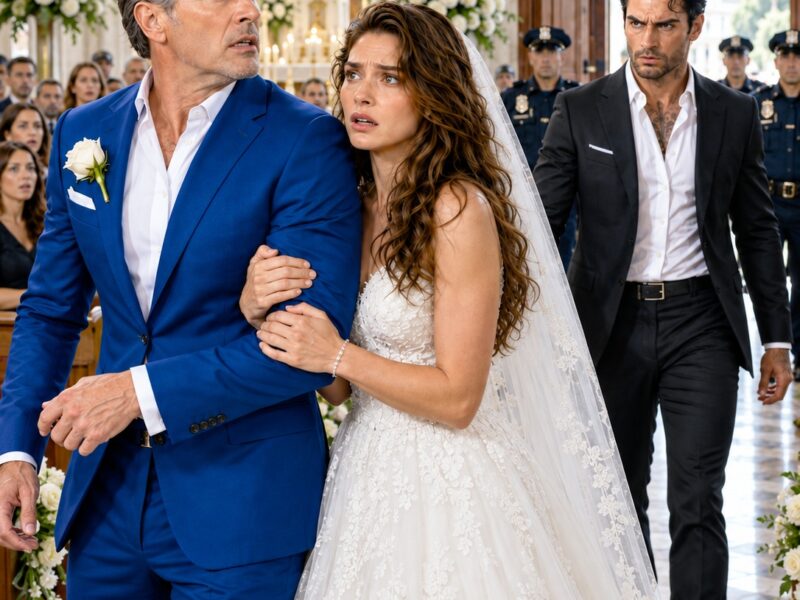
Blind Mafia Boss Regained His Sight—He Stormed the Cathedral to Stop His Secretary’s Forced Marriage
At 11:03 on a rain-dark Saturday morning, the doors of Saint Matthew’s Cathedral slammed open hard enough to turn every head inside.
Marin Whitlock stood at the altar in a white dress she had not chosen.
A pen lay beside the marriage license.
Wesley Doyle stood three feet away, smiling like a man who believed the last eight years had finally come due.
Then Marin heard a voice she had spent six weeks believing she would never hear again.
“Don’t sign that.”
Her entire body went still.
Raphael Castellano stood beneath the cathedral doors.
No dark glasses.
No hand on another man’s shoulder.
No one guiding him.
His eyes were open.
And for the first time since she had known him, they were looking directly at her.
Marin forgot the priest.
Forgot Wesley.
Forgot the hundred people staring.
Raphael took one step into the aisle.
Then another.
His vision had only been clear for forty-eight hours.
He still hated bright light.
Depth came strangely when he moved too fast.
But there was nothing uncertain about the way he walked toward her.
Wesley turned.
“You’re late.”
Raphael’s gaze moved briefly to him.
“No.”
His voice was level.
“You are.”
Then Raphael looked back at Marin.
He studied her face as if the cathedral had become empty.
His expression changed.
Not because she wore white.
Not because another man stood beside her.
Because after months of building her in his mind from touch, sound, memory, and imagination, he was finally seeing the woman whose voice had led him through the dark.
Marin’s lips parted.
“Raphael.”
A strange little smile touched his mouth.
“I was wrong.”
She stared.
“About what?”
“Your eyes.”
He came closer.
“They’re brown.”
Wesley’s smile disappeared.
Raphael stopped at the first pew.
Behind him, two state investigators entered the cathedral.
Then an assistant attorney general.
Then Gus Raldi.
The room changed.
Raphael looked at the pen beside Marin’s hand.
“Step away from the table.”
Wesley said, “She’s here voluntarily.”
Marin turned toward him.
For the first time that morning, she smiled.
“No.”
Wesley’s face hardened.
Raphael’s voice remained quiet.
“You spent eight years counting on her silence.”
He nodded once toward the investigators.
“That was your last mistake.”
Seven weeks earlier, Marin Whitlock had been standing outside Raphael Castellano’s iron gates asking for work.
It was seven in the morning.
Newport was gray with sea fog, and the cold had settled into the stone walls as if winter had arrived early just to make the rejection more efficient.
The guard looked Marin over.
Thirty-one.
Dark brown hair pinned back.
Old gray wool coat.
Leather boots polished carefully enough to disguise how worn the soles had become.
“No appointments.”
“I know.”
“We’re not hiring.”
“You are.”
The guard frowned.
Marin nodded toward the intercom.
“Call Mrs. Kessler.”
“Why?”
“Because your employer has gone through nine personal assistants in six months.”
His expression changed.
“That’s not public information.”
“No.”
“Who told you?”
“Nobody.”
That was not entirely true.
People talked around docks.
Drivers talked at gas stations.
Nurses heard men whisper outside emergency rooms.
And when you had spent eight years working nights in places where wealthy people assumed the woman carrying boxes or checking a patient’s blood pressure had no reason to remember their names, you learned far more than they expected.
The guard crossed his arms.
“Resume?”
“No.”
“References?”
“No.”
“Identification?”
“Yes.”
“Then why didn’t you send an application?”
“Because it would have been rejected.”
“At least you’re realistic.”
“I’m persistent.”
The guard looked at the coat.
“Woman wearing that doesn’t look desperate for a paycheck.”
Marin touched the sleeve.
“I bought it eight years ago.”
“So?”
“Eight years ago I still owned things that matched it.”
The guard’s amusement faded.
“Please call Mrs. Kessler.”
“You don’t know what kind of house this is.”
“I know exactly what kind.”
“That should make you leave.”
“It’s why I came.”
He stared at her.
Marin held his gaze.
“I can drive. I can read contracts. I remember everything people say in front of me, even when they wish I didn’t. And if your employer has a temper, I’ve survived worse.”
“That supposed to impress me?”
“No.”
“Then what?”
“Save you the trouble of interviewing a tenth person next week.”
The guard almost smiled.
Then he reached for the radio.
What he did not know was that Marin Whitlock had grown up three streets away.
Her father had once owned Whitlock Marine Works, the most respected custom boatyard on that side of Narragansett Bay.
She had attended charity dinners in houses whose servants now entered through the same doors she did.
Her mother had worn pearls to grocery stores because that was simply what her mother did.
Then everything collapsed.
Debt.
Foreclosure.
Lawsuits.
Her mother’s death.
Her father’s shame.
Marin left nursing school one semester before graduation and worked whichever night job paid fastest.
Ambulance dispatch.
Hospital transport.
Warehouse deliveries.
Private elder care.
She had learned to sleep sitting upright.
Learned which bills could wait.
Learned not to answer unknown numbers.
And she learned one name she never forgot.
Doyle.
Four months before she appeared at Raphael Castellano’s gate, that name surfaced again.
Two dockworkers were talking behind a refrigerated warehouse in Providence.
Someone had known exactly when Raphael Castellano’s car would take Bay Road.
Someone had sold the route.
The resulting ambush killed one man, injured another, and left Raphael with severe corneal trauma in both eyes.
He survived.
He could not see.
The Castellano organization spent months trying to determine who had provided the route.
Marin heard one dockworker say something else.
“Had to come from inside.”
The sentence stayed with her.
Because eight years earlier, she had once seen her father’s debt papers left open on their breakfast table.
One creditor.
A Doyle-controlled holding company.
One line beneath her father’s signature.
Her name.
She had been twenty-three.
She asked what it meant.
Her father said, “Nothing you need to worry about.”
Three months later, their shipyard was gone.
Now Raphael Castellano had been attacked.
Doyle money had surfaced around the marina again.
And Marin had come back to Newport not to find a job.
She had come to find a name.
The gate opened.
Miriam Kessler interviewed her in a room beside the servants’ entrance.
Sixty-two.
Silver threaded through dark hair.
Thirty years inside the Castellano house.
She asked for a resume.
Marin had none.
References.
None she was willing to use.
Then Miriam asked her last name.
“Whitlock.”
The older woman’s pen stopped.
“Desmond Whitlock?”
“My father.”
“I knew it.”
Marin’s shoulders tightened.
Miriam studied her.
“I met him once. Twenty years ago. Your yard built a launch for Mr. Castellano’s father.”
“That sounds like him.”
“What happened?”
“You live in Newport.”
“Yes.”
“Then you know.”
“I know the newspaper version.”
“That’s enough.”
Miriam closed the ledger.
“And now Desmond Whitlock’s daughter wants to work in this house with no references.”
“Yes.”
“Why?”
“I need money.”
“That is true.”
Marin looked at her.
Miriam’s mouth tightened.
“But incomplete.”
Marin said nothing.
The housekeeper leaned back.
“Good.”
Marin frowned.
“Good?”
“You understand that not every question needs an answer simply because someone asks it.”
She tapped one finger against the ledger.
“That quality will either keep you alive in this house or make you extremely dangerous.”
“Which would you prefer?”
“I haven’t decided.”
Miriam opened a folder.
“This position is not housekeeping.”
Marin waited.
“Mr. Castellano needs a secretary.”
“I can type.”
“He needs a driver.”
“I can drive.”
“He needs someone who will read to him.”
Marin understood.
Still, she did not react.
Miriam watched carefully.
“You knew?”
“I knew he was injured.”
“That isn’t what I asked.”
“No.”
Marin met her eyes.
“I didn’t know.”
Miriam believed her.
Probably because Marin did not soften her face.
Did not say I’m sorry.
Did not ask how terrible it was.
Miriam pushed the contract toward her.
“His last nine assistants lasted less than six months combined.”
“What happened to them?”
“You’re the first applicant who waited long enough to ask.”
“Did he hurt them?”
“No.”
“Then I don’t care.”
Miriam raised an eyebrow.
“He can be cruel.”
“So can people with perfect vision.”
“He hates pity.”
“So do I.”
“He recognizes voices after hearing them once. Footsteps after twice.”
“Useful.”
“He knows when people move his things.”
“I won’t.”
“He knows when someone is lying.”
Marin looked down at the contract.
“That one might be inconvenient.”
Miriam saw the answer for what it was.
A warning.
Still, she handed Marin the pen.
“Seven tomorrow morning.”
The next day, Raphael Castellano entered the rear seat of the car at 6:55.
Marin had been waiting ten minutes.
He was thirty-four.
Taller than she expected.
Dark hair.
A thin scar along his left cheekbone.
Dark glasses hid his eyes.
He carried no cane.
An older man named Gus Raldi walked beside him but did not touch him.
Raphael found the door by placing two fingers against the roofline.
Got in.
Closed it.
Marin turned slightly.
“Good morning. Marin Whitlock.”
Silence.
“I’ll be driving you.”
“Providence.”
That was all.
Marin faced forward.
They left the estate.
For four minutes, Raphael said nothing.
On the fifth, Marin noticed the gray sedan.
Four cars behind.
Same lane.
She changed lanes.
It changed.
She slowed.
It slowed.
She accelerated.
It held the same distance.
Marin watched through the mirror.
Raphael sat with his head slightly tilted.
Listening to the road.
She did not ask permission.
At the final possible second, she cut across toward an exit.
A horn screamed behind them.
The Castellano sedan dropped down the ramp.
Marin took two turns through the harbor district and slipped between warehouses into an alley barely wide enough for the mirrors.
She killed the engine.
Silence.
Thirty seconds.
Then the gray sedan passed the alley entrance.
Did not slow.
Marin exhaled.
Raphael spoke.
“What did you just do?”
His voice was calm.
That made it more dangerous.
“A gray sedan followed us for four miles.”
“You’re sure?”
“No.”
A pause.
“That’s an unusual answer.”
“I’m sure it behaved like a surveillance vehicle. I’m not sure it was one.”
“How many occupants?”
“Two in front.”
“Plate?”
“Massachusetts. Last three numbers six-one-eight.”
“You memorized it.”
“Yes.”
Raphael leaned slightly forward.
“Who told you to leave the route?”
“No one.”
“Who gave you permission to drive my car into an alley?”
“No one.”
“Do you have a problem with authority, Miss Whitlock?”
“Only when it interferes with doing the job.”
The corner of his mouth moved.
Maybe irritation.
Maybe something else.
“Start the engine.”
She did.
“Take Harbor Road.”
“All right.”
“And next time?”
Marin waited.
“If you see something, say it before you decide I’m too fragile to hear it.”
She glanced into the mirror.
His face remained still.
“I didn’t think you were fragile.”
“Good.”
The car rolled forward.
“Keep it that way.”
That afternoon, Marin entered Raphael’s study and discovered the darkness.
Curtains closed.
Lamps off.
Raphael stood behind his desk with both hands moving slowly across the surface.
Searching.
He located a glass.
A file.
A paperweight.
Then missed an envelope that had slid beneath a notebook.
Marin said nothing.
His fingers searched again.
“Who’s there?”
“Marin Whitlock.”
“Why are you standing quietly?”
“I wasn’t sure you wanted interruption.”
“I always want to know who enters.”
She remembered it.
Raphael’s hand moved again.
Finally found the envelope.
He held it toward where he thought she stood.
About eight inches too far left.
Marin stepped closer.
Before taking it, she touched the corner lightly with one finger.
His hand stilled.
Then she took it.
“Read.”
She did.
Shipping lease extension.
Three pages.
She read every word.
No special tone.
No careful slowness.
No changing words to make them easier.
At the end, Raphael said, “Again.”
She read it again.
“Paragraph four.”
She repeated it.
“What did they change from the old agreement?”
Marin had never seen the old agreement.
“I don’t know.”
“Good.”
He leaned back.
“Most people invent an answer when they think I can’t check.”
“I assume you can check everything.”
“I can.”
“I assumed that too.”
That was how it began.
Not romance.
Work.
Marin learned the house.
Raphael learned her footsteps.
She learned that he hated people moving chairs more than he hated almost anything.
He learned that she closed doors gently but never completely.
She learned he slept badly.
He learned she drank coffee only after it turned lukewarm.
She learned which men lowered their voices when discussing certain accounts.
He learned she knew maritime contracts far better than a woman who claimed to have spent the last eight years doing night jobs should.
On her third night, Marin entered the records room at 11:18.
She had memorized Miriam’s keys.
Memorized the night guard’s route.
Memorized which floorboards creaked.
She did not steal anything.
She photographed five pages.
Movement logs from the week Raphael was attacked.
The route change to Bay Road had been made the day before.
According to the official internal records, only four people knew.
Gus.
Miriam.
The driver.
Raphael himself.
Marin wrote the names on paper.
Four circles.
Then photographed them.
On the ceiling above her, hidden behind a shelf, a security camera recorded everything.
Marin never saw it.
Raphael did not see it either.
Gus did.
By the fourth day, a file on Marin Whitlock sat inside Raphael’s locked desk.
He learned almost everything.
Her father.
The shipyard.
Her unfinished nursing degree.
Her sister Josie.
The Whitlock debt.
The years of night work.
The camera image from the records room.
Gus stood beside his desk.
“She’s searching you.”
Raphael touched the photograph.
“Maybe.”
“Fire her.”
“No.”
“She broke into records.”
“Yes.”
“You going to wait until she breaks into your safe?”
“If she can, I deserve the lesson.”
Gus stared.
“This isn’t funny.”
“I’m not laughing.”
“What do you want?”
Raphael placed the photograph back inside the file.
“To see what she’s looking for.”
“You can’t see anything.”
The words came out before Gus could stop them.
Silence.
Raphael’s face became hard.
Gus closed his eyes.
“I’m sorry.”
“That apology is exactly why nine people have left.”
“I didn’t mean—”
“I know what you meant.”
Raphael closed the drawer.
“Leave her alone.”
“Why?”
“Because people who think they’re unnoticed eventually tell you what they actually want.”
Over the next two weeks, Marin made herself useful enough that no one could call her presence accidental.
She created a tactile filing system.
One paper clip for urgent decisions.
Two for background.
Three for completed matters.
She never changed furniture.
Never touched Raphael without warning.
When he needed a document, she placed his fingers on the edge before letting go.
One morning, Gus brought up a warehouse lease.
Four attorneys had reviewed it.
Marin read page one.
Page two.
Page three.
Then stopped halfway through page four.
Raphael turned his head.
“What?”
“Nothing.”
“Then keep reading.”
She looked back.
“It’s not nothing.”
Gus frowned.
“Legal cleared it.”
Marin ignored him.
“Page two defines ‘affiliate’ as any entity sharing even one beneficial owner.”
Raphael said, “And?”
“Page four lets the tenant transfer the lease to any affiliate without your approval.”
Silence.
Marin continued.
“Put those together, and you can sign with Company A today. Tomorrow they transfer all three warehouses to someone you’ve never heard of.”
Gus leaned forward.
“We’d still own the buildings.”
“Yes.”
“For seven years.”
“Yes.”
“And we would have no approval right.”
“No.”
Raphael sat very still.
“How many people reviewed this?”
“Four,” Gus said.
Raphael turned toward Marin.
“How did you catch it?”
“My father used to read contracts at dinner.”
“That’s not an answer.”
“It’s the one I have.”
“Miss Whitlock.”
She exhaled.
“My father built boats. People brought contracts home. He liked reading them aloud because he liked proving he understood every word.”
“And?”
“One day he stopped reading carefully.”
Raphael waited.
Marin closed the lease.
“We lost everything.”
Nobody spoke after that.
Raphael rejected the deal.
That evening he called Marin back into the study.
A gray silk tie hung around his neck.
Untied.
“Do this.”
Marin looked at him.
“No.”
His face turned.
“What?”
“You can tie your own tie.”
“Apparently I can’t.”
“You can.”
“I asked you to do it.”
“Yes.”
“And?”
“No.”
Raphael’s jaw tightened.
“Why?”
“Because tomorrow I might not be here.”
That surprised them both.
Marin continued before she could stop herself.
“You need to know how.”
“I survived thirty-four years without you.”
“You had eyes.”
The room changed.
Marin wished she could pull the words back.
Raphael’s face went flat.
“Get out.”
She stood.
Then stopped.
“No.”
Raphael turned.
Marin’s heart pounded.
“I shouldn’t have said it like that.”
“No.”
“But I’m not leaving because you’re angry.”
“Miss Whitlock.”
“You hate pity.”
“Yes.”
“So I won’t pity you enough to pretend you can’t learn something.”
He stared at darkness.
Marin picked up one end of the tie.
Did not touch him.
“Long end in your right hand.”
Nothing.
“Short end left.”
Still nothing.
Marin waited.
Finally his hands rose.
“Cross them.”
He did.
Wrong.
The knot twisted.
He cursed.
Marin corrected him.
Second attempt failed.
Third attempt worked.
Raphael touched the knot.
Centered.
Even.
He stood before the mirror he could not use.
Marin looked at their reflection.
A blind man in a black suit.
A woman behind him refusing to help in the way everyone else did.
“Third try,” he said.
“Yes.”
“You’ll make me do it again tomorrow.”
“Yes.”
A pause.
“Second try tomorrow.”
“If you’re lucky.”
The corner of his mouth lifted.
The next day, Raphael asked her to stay overnight in the outer room beside his study.
Miriam brought a folding bed.
Marin frowned.
“I have a room.”
“One minute away.”
“That’s close.”
“It isn’t at three in the morning.”
Raphael said nothing else.
Marin understood anyway.
Blindness had not made him helpless.
It had made night longer.
There was a difference.
Miriam tucked the sheet beneath the mattress.
“Thirty years,” she murmured.
“What?”
“He’s never let anyone sleep here.”
Marin looked toward the closed inner door.
“Not even his fiancée?”
Miriam paused.
“Sloan?”
“Yes.”
“No.”
That night, Raphael woke at 2:14.
“Marin.”
She sat up immediately.
“I’m here.”
Silence.
Then:
“What time?”
“Two fourteen.”
Another pause.
“Nothing.”
Marin lay back.
He called again twenty minutes later.
“Marin.”
“Yes.”
“Still there?”
“Yes.”
“Go back to sleep.”
She almost laughed.
So did he.
A week later, Dr. Ellery Bishop gave Raphael news nobody in the house had allowed themselves to expect.
Donor tissue.
A strong match.
Surgery in six weeks.
Dr. Bishop spoke plainly.
“Listen carefully. You are not waking up and seeing perfectly.”
Raphael’s hands tightened on his knees.
“I understand.”
“No, patients say that and then ignore me.”
Marin sat behind him.
Dr. Bishop continued.
“Your left eye has enough structural recovery that we can treat the remaining surface damage. The right needs the transplant. If the graft takes, you may regain useful vision.”
“How useful?”
“Faces. Reading. Depth.”
“When?”
“Gradually.”
Raphael leaned forward.
“Days?”
“Light and broad shapes first. Maybe movement. Clarity improves over a week or more. Full stabilization takes months.”
Raphael was silent.
Then:
“Will I see a face?”
“Yes.”
“Clearly?”
“If everything goes well.”
“When?”
“Don’t turn recovery into a deadline.”
Raphael almost smiled.
“You’ve met me twice.”
“Twice was enough.”
Outside the exam room, Raphael stopped.
“Marin.”
“Yes.”
“Six weeks.”
She knew what he meant.
“I’ll be here.”
“Don’t answer quickly.”
“I didn’t.”
“You did.”
“All right.”
She waited three seconds.
“I’ll be here.”
He held out his hand.
Not for guidance.
For confirmation.
Marin placed hers in it.
His thumb brushed across her knuckles.
“Good.”
In the parking garage ten minutes later, Marin heard her name.
Two men near the security booth.
“Whitlock.”
Her blood went cold.
“Brown hair.”
One man held a photograph.
“Have you seen her?”
Marin turned down another row.
Walked fast.
Did not run.
Reached the car from the far side.
By the time she collected Raphael, her hands were cold.
He noticed immediately.
At the first red light, he reached between the seats.
“Hand.”
“What?”
“Give me your hand.”
She did.
His fingers touched hers.
“Cold.”
“It’s windy.”
“The garage has walls.”
“Still cold.”
Raphael tilted his head.
“Something happened.”
“No.”
That was Marin’s first clean lie to him.
She heard how steady it sounded.
That frightened her.
Raphael withdrew his hand.
He said nothing for the rest of the drive.
But that evening he asked Gus one question.
“Who is looking for Marin Whitlock?”
Gus answered the next morning.
“Doyle people.”
Raphael sat very still.
“Why?”
“Don’t know.”
“Find out.”
“Do we tell her?”
“No.”
Gus stared.
Raphael heard the silence.
“What?”
“You’re becoming exactly what you hate.”
“Meaning?”
“Deciding what she needs to know.”
Raphael’s jaw tightened.
Then he said, “You’re right.”
That afternoon, he called Marin into the study.
“Doyle men are looking for you.”
She froze.
There was no point lying now.
“How long have you known?”
“Since this morning.”
She exhaled.
“Thank you.”
“For?”
“Telling me.”
Raphael faced her voice.
“What does Doyle want?”
Marin looked at his desk.
“Something my father owes.”
“What?”
“Money.”
“How much?”
“Enough.”
“No number?”
“I don’t know the real number anymore.”
“What does that mean?”
Marin’s mouth tightened.
“It means the paper changed over eight years.”
Raphael went still.
“Changed.”
“Yes.”
“Forged?”
“I think so.”
“Think.”
“I saw the original once.”
“And?”
“The amount Wesley Doyle claims now is almost three times larger.”
Raphael leaned back.
“Why is your name on it?”
Marin did not answer.
“Marin.”
“My father put it there.”
Raphael’s voice softened.
“How old were you?”
“Twenty-three.”
“Did you sign?”
“No.”
“Then it isn’t your debt.”
“In court, maybe.”
“And outside court?”
She looked at him.
“You know exactly how men like Wesley collect.”
Raphael did.
That was the problem.
The next Sunday, he asked Marin to take him down to the stone steps behind the estate.
The bay was dark blue.
Wind moved low over the surface.
They sat.
Across the water, a shipyard launched a white pleasure boat.
Children cheered.
Raphael tilted his head.
“What happened?”
“A launch.”
“Describe it.”
Marin looked across.
“White hull.”
“Big?”
“Forty feet.”
“Crowd?”
“Families. Children.”
“Keep going.”
She did.
The red ribbon on the bow.
Water turning silver beneath afternoon cloud.
A boy jumping so hard his hat fell off.
Raphael listened.
His face softened.
“Were you around this as a child?”
“All the time.”
“Do you miss it?”
“Yes.”
That answer cost her.
Raphael did not ask another question.
Later, as the cheering faded, he said:
“Can I ask you something strange?”
“That depends how strange.”
“Let me touch your face.”
Marin turned.
Raphael continued.
“I know your voice.”
His hands rested on his knees.
“I know your footsteps. I know you tap your thumb twice against the steering wheel when you’re angry. I know you stop breathing for half a second before you tell me something you think I won’t like.”
Marin stared.
“But I don’t know your face.”
His voice lowered.
“I don’t like the empty place where it should be.”
She said nothing for several seconds.
Then:
“All right.”
Raphael lifted one hand.
Waited.
Marin took his wrist.
Placed his fingers against her cheekbone.
Then released him.
His touch was slow.
Careful.
Never possessive.
Cheek.
Temple.
Bridge of her nose.
Jaw.
Hairline.
“You have a pointed chin.”
“Rude.”
“Small face.”
“Getting worse.”
“Green eyes.”
Marin laughed.
Raphael stopped.
“What?”
“Brown.”
“No.”
“Very brown.”
“I was certain.”
“You’ve never seen me.”
“I had constructed you.”
“Incorrectly.”
“Apparently.”
“And my hair?”
“Light brown.”
“Dark.”
He frowned.
Marin laughed harder.
The sound came out before she could stop it.
Raphael turned toward her.
“Again.”
“What?”
“Laugh again.”
“You cannot order laughter.”
“I order most things.”
“Not that.”
“Shame.”
He smiled.
The moment frightened Marin more than Doyle’s men.
Because fear was familiar.
Hope was not.
Three days later, she saved Raphael from signing another contract.
Not with four pages.
With three words.
They were at a Providence restaurant negotiating a logistics acquisition.
Marin read the ownership structure.
One Delaware company held nineteen percent.
Three initials.
A Latin surname.
Her throat closed.
She had seen it once.
Eight years earlier.
On her father’s debt paper.
She leaned toward Raphael.
Tapped the back of his hand twice.
His signal.
Then whispered:
“Walk away now.”
Raphael placed both palms on the table.
“Gentlemen.”
The other side stopped.
“I’m out.”
Confusion.
Arguments.
Three weeks of negotiation evaporated in twenty seconds.
Raphael did not ask why until they were in the car.
“That company.”
Marin watched the road.
“Yes.”
“You know it.”
“Yes.”
“How?”
Silence.
Raphael waited.
Marin prepared a lie.
He never asked the next question.
Instead he said:
“Four people reviewed that transaction.”
She glanced at him in the mirror.
“Not one saw what you saw.”
“Maybe they didn’t know the name.”
“Maybe.”
His head rested against the seat.
“Tonight you had three seconds.”
“For what?”
“To choose whether to warn me or protect whatever you’re hiding.”
Marin tightened her hands around the wheel.
“You warned me.”
“Yes.”
“So I’m going to give you something.”
Her heart dropped.
“A dismissal?”
“No.”
“You’re not my secretary anymore.”
Marin looked into the mirror.
Raphael’s face remained calm.
“You’re someone I trust.”
She could not speak.
Raphael continued.
“I’ve had three people in my life I would say that about.”
He paused.
“One is dead.”
Marin’s chest hurt.
Inside her coat pocket sat a phone containing five photographs stolen from his records room.
That night she did not sleep.
Two nights later, Raphael told her he loved her.
No orchestra.
No dramatic dinner.
They were on the same stone steps.
The tide was low.
Marin had been reading shipping reports aloud when Raphael interrupted.
“I love you.”
She stopped.
The paper lowered.
“What?”
“I don’t like repeating myself.”
“Then choose better first sentences.”
He almost smiled.
Marin’s heart pounded.
“You don’t know me.”
“I know enough.”
“No.”
She stood.
“You know what I let you know.”
Raphael remained seated.
“Everyone does that.”
“You don’t know why I came here.”
“I know it wasn’t for salary.”
Marin stared.
He continued.
“You arrived with no references. You knew I needed staff. You read contracts like someone raised around them.”
Her face went cold.
Raphael tilted his head toward her.
“I am not asking for your confession.”
“Then what are you asking?”
“For an answer about us.”
“There is no us.”
“That sounded dishonest.”
She almost laughed.
Instead her eyes burned.
“What if when your sight comes back, you discover I’m nothing like the woman you built in your head?”
“I already built the wrong hair and eyes.”
“That isn’t what I mean.”
“I know.”
Raphael stood.
He faced her voice.
“What if you’re not who I think?”
“Yes.”
“Then I learn.”
“What if you hate what you learn?”
“Then I decide after I know it.”
Marin swallowed.
“You make that sound easy.”
“Nothing about you has been easy.”
That finally made her smile.
He heard it.
“Is that yes?”
“To what?”
“That there is an us.”
Marin looked at the dark water.
“Yes.”
Raphael exhaled.
“But,” she said.
“Of course there’s a but.”
“You don’t own me.”
“No.”
“You don’t investigate me like property.”
He went still.
Marin noticed.
“What?”
“Nothing.”
“Raphael.”
He said nothing.
That silence would matter soon.
The following Friday, Raphael placed a gray file on his desk.
One paper clip.
Urgent.
“Read it.”
Marin sat.
Opened it.
Her full legal name.
Date of birth.
Old Newport address.
Mother.
Father.
Whitlock Marine Works.
Nursing school.
Ambulance employment.
Delivery company.
Josie’s university.
Debt records.
Marin stopped breathing.
Raphael waited.
“Continue.”
She turned the page.
A photograph.
Black and white.
Records room.
11:31 p.m.
Marin kneeling beside an open file.
Phone in hand.
She went cold.
“What is it?” Raphael asked.
“You know.”
“Yes.”
“How long?”
“Third day.”
She stood so fast the chair scraped backward.
“The third day?”
“Yes.”
“You knew I entered the records room.”
“Yes.”
“You knew who I was.”
“Yes.”
“You knew about Doyle.”
“Yes.”
Marin’s face burned.
“And you sat on those steps and told me you never asked about my past.”
“I didn’t.”
She stared.
“You had an entire file.”
“I said I did not ask.”
“That is not honesty.”
“No.”
Raphael absorbed the blow.
“You’re right.”
“The folding bed.”
He went still.
Marin laughed once.
No humor.
“You wanted me four steps away from your door because you trusted me?”
“At first?”
“Yes.”
“No.”
Her face changed.
Raphael continued.
“At first I wanted you where I could monitor you.”
Marin stepped back.
“You used me.”
“Yes.”
The word hurt more because he did not soften it.
“Why?”
“Your name.”
“My name?”
“Whitlock appears in financial records connected to Doyle.”
She felt sick.
“You thought I helped attack you.”
“I considered it.”
“And you let me drive you.”
“Yes.”
“You let me sleep outside your room.”
“Yes.”
“Why?”
“Because if you wanted to kill me, you had easier opportunities by day four.”
Marin’s eyes filled.
“This is funny to you?”
“No.”
“You told me you trusted me.”
“I do now.”
“Now.”
“Yes.”
“What changed?”
Raphael stood.
“Everything.”
“Convenient.”
“Marin.”
“No.”
She grabbed the edge of the desk.
“You let me believe I was choosing when the entire time you had me inside a cage.”
Raphael’s face tightened.
“You’re right.”
She stopped.
No defense.
No justification.
That made anger harder.
“You should have told me.”
“Yes.”
“Before you said you loved me.”
“Yes.”
Her voice broke.
“Before I said yes.”
“Yes.”
Silence.
Marin closed her eyes.
Then opened them.
“Show me the full movement log.”
Raphael frowned.
“What?”
“The day you were attacked.”
“Marin—”
“You want truth?”
“Yes.”
“Then stop giving me pieces.”
Thirty minutes later, Gus, Miriam, and the old driver sat in Raphael’s study.
Marin read every line.
Route chosen the day before.
Four people knew.
She placed her old personnel sheet on the desk.
Four names circled.
Gus stared.
“You did this your first night?”
“Yes.”
“How?”
“I asked who could know where a car would be.”
He looked at the names.
The same four.
Miriam.
Gus.
Driver.
Raphael.
They investigated each one.
Miriam had hidden a phone call from her brother because she was ashamed of his gambling debt.
Receipts proved it.
Gus had secretly met a Doyle contact.
He had paid for information and been cheated.
A humiliating truth.
But verifiable.
The driver’s movements were fully documented.
None sold the route.
By midnight, Raphael’s study felt smaller.
Gus stood at the window.
“If none of us told anyone…”
Marin looked at the route map.
“The marina.”
Raphael turned.
“What?”
“The car passed through South Marina before taking Bay Road.”
“Yes.”
“Anyone working there could have seen the driver prepare.”
Gus swore softly.
Raphael said, “Personnel records.”
Marin’s chest tightened.
“Four months ago.”
“Yes.”
Three days later, before Raphael’s final preoperative appointment, Marin found Wesley Doyle waiting in the hospital garage.
Forty-two.
Neat suit.
Polished shoes.
A smile too calm for a man who had spent eight years inside her nightmares.
“Miss Whitlock.”
Marin stopped.
Wesley removed a folded debt instrument.
Placed it on the hood of her car.
“Still recognize it?”
“I recognize the lie.”
“Strong opening.”
“My father never borrowed that amount.”
“He signed enough.”
“I didn’t sign anything.”
“Your father pledged family assets.”
“I am not an asset.”
Wesley smiled.
“No.”
He looked at her.
“You’re a name.”
Marin felt something colder than fear.
“What do you want?”
“Three weeks.”
“For what?”
“Marriage.”
She laughed because any other reaction would have been too frightening.
Wesley did not.
“Saturday. Saint Matthew’s.”
“You’re insane.”
“I’m practical.”
“Why?”
“The Whitlock name still holds a seat on the Harbor Preservation Trust.”
Marin stared.
Her grandfather’s generation had helped create it.
Mostly ceremonial now.
But not entirely.
Wesley continued.
“The Doyle name opens many doors.”
“Then use yours.”
“It opens the wrong doors.”
His smile thinned.
“Whitlock opens the rooms where old money pretends it has never met anyone like me.”
“You think marrying me cleans you.”
“I think people believe what they want to believe.”
“No.”
Wesley folded the paper.
“You should consider your sister.”
Marin went still.
“What about Josie?”
“North Hall. Biology.”
Her pulse thundered.
Wesley continued gently.
“She has loans.”
“Stay away from her.”
“I have.”
“Then keep doing it.”
“I can call those loans.”
“They’re federal.”
“Not all.”
Marin remembered.
One private bridge loan.
Cosigned by their father.
Wesley smiled.
“And your father?”
She said nothing.
“He gave me something four months ago.”
Marin’s stomach turned.
“What?”
“The route.”
Silence.
Wesley watched the truth reach her.
“He worked temporary maintenance at South Marina.”
“No.”
“He wanted your name removed from my paper.”
Marin could barely breathe.
“I told him I only needed to speak with Castellano.”
“What did you do?”
“Not what he thinks.”
“You blinded him.”
“I wasn’t driving.”
“You ordered it.”
Wesley’s smile vanished.
“Careful.”
Marin stepped closer.
“I will never marry you.”
“Then I call in everything.”
“Do it.”
“Your sister loses school.”
“I’ll fix it.”
“Your father becomes very interesting to the police.”
Marin stopped.
Wesley lowered his voice.
“And Castellano learns his beloved secretary came into his home because her father sold the road that took his sight.”
Marin said nothing.
“He may forgive you.”
Wesley shrugged.
“Men surprise us.”
He stepped closer.
“But will Gus? Will his people? Will the branches of that family?”
Marin’s jaw tightened.
“Three weeks.”
Wesley moved away.
“Eleven o’clock.”
Then he turned.
“One more thing.”
Marin looked at him.
“You’ve done excellent work inside Castellano’s house.”
Her blood chilled.
“I did nothing for you.”
“You told me plenty without speaking.”
“What?”
“I only needed to know where you were.”
He smiled.
“Where you went.”
He walked away.
Marin remained beside the car until her legs stopped shaking.
The next morning, Raphael went into surgery.
The night before, Marin took him to a small restaurant with a piano.
She had not told him about Wesley.
That omission sat between every word.
Halfway through dinner, Marin stood.
Raphael heard the chair.
“Where?”
“Piano.”
“You play?”
“Badly.”
“Excellent.”
She sang worse than she played.
Missed a note.
Then another.
A couple at the far table laughed.
Marin finished anyway.
When she returned, Raphael was laughing too.
Real laughter.
The first she had heard from him.
“You’re terrible.”
“I warned you.”
“You kept going.”
“I started.”
“That isn’t a reason.”
“It is to me.”
Raphael held out his hand.
Marin placed hers in it.
His laughter faded.
“Tomorrow.”
“Yes.”
“When I can see…”
“Not tomorrow.”
“You know what I mean.”
She did.
Raphael’s thumb moved over her fingers.
“When my vision clears, I want you there.”
Marin’s chest tightened.
“Raphael.”
“The first face.”
She could not breathe.
“I want yours.”
She nodded.
Then remembered.
“Yes.”
He smiled.
“Promise?”
Marin looked at the man whose sight her father had helped take.
“Yes.”
It was the cruelest lie she had ever told.
At eleven that night, Marin drove to South Marina.
She opened the archived personnel file.
Temporary workers.
Afternoon shift.
Seventeenth name.
DESMOND WHITLOCK.
Her father.
Signature beneath it.
The long downward hook she had watched him draw across boat contracts her entire childhood.
Marin sat on the floor.
No tears.
Only the sound of her own breathing.
The next morning she went to her father’s apartment.
Desmond opened the door wearing the same blue sweater he had worn for years.
“Marin.”
She entered.
Placed a photograph of the marina record on his table.
He sat down.
“I can explain.”
“No.”
“Please.”
“No.”
His face collapsed.
“He promised me.”
“Wesley.”
“Yes.”
“What did you tell him?”
“The route.”
Marin closed her eyes.
“He said he only wanted to stop the car.”
“And you believed him.”
“I needed your name off that debt.”
“You put my name there.”
“I know.”
“You tried to fix one betrayal by committing another.”
Desmond covered his face.
“I didn’t know.”
“That sentence doesn’t repair eyesight.”
He looked up.
“You know Castellano?”
“I work for him.”
Desmond froze.
Marin’s voice remained steady.
“He learned to tie his own tie because no one had bothered teaching him after the attack.”
Her father looked away.
“He learned every room in his house by counting steps.”
“Marin.”
“He asked me to be the first person he sees.”
Desmond’s eyes filled.
“I’m sorry.”
Marin swallowed.
“Wesley wants to marry me.”
Desmond stood.
“What?”
“In three weeks.”
“No.”
“He has the paper.”
“I’ll go to police.”
Marin looked at him.
“Then go.”
He stopped.
“I mean it.”
“You think I came here to protect you?”
Desmond stared.
Marin stood.
“I came to give you one chance to become the man you kept telling me you used to be.”
That afternoon, Desmond Whitlock walked into Providence Police headquarters with an attorney.
He confessed.
Raphael did not know.
Marin did not return to Newport.
Before dawn she entered the outer room beside Raphael’s study.
Placed her gray coat over the chair.
No note.
No explanation.
Then she left.
The surgery lasted a little over two hours.
Three days later, the bandages came off.
Raphael opened his eyes.
Light.
Nothing more.
White flooded everything.
He closed them again.
Dr. Bishop spoke.
“Slow.”
Raphael opened them.
Shapes.
Movement.
A dark form near the bed.
A smaller one beside the door.
“Marin.”
Silence.
“Marin?”
The figure moved.
Miriam’s voice.
“It’s me.”
Raphael’s heart dropped.
“Where is she?”
No one answered.
“Miriam.”
“She left.”
The room went still.
“When?”
“The night before surgery.”
Raphael shut his eyes.
“Why?”
“I don’t know.”
That was partly true.
By the fifth day, Raphael could distinguish faces at close distance.
By the sixth, he could read large print.
By the seventh, color sharpened.
Edges separated.
The world stopped looking submerged.
That morning, Miriam placed the gray coat on his bed.
Raphael stared.
He had never seen it.
But he knew it.
The whisper of wool against wool.
The first morning Marin crossed the hall.
The sound he had remembered before he even knew her name.
“She left this?”
“Yes.”
“Why?”
Miriam sat.
“She told the guard eight weeks ago it was the last thing she owned from the life she had before.”
Raphael ran his fingers across the sleeve.
Now he could see the worn elbow.
The faded collar.
Miriam said, “People leaving forever take the important things.”
Raphael looked up.
“She wanted me to know.”
“Yes.”
“Know what?”
“That she didn’t plan to come back.”
Raphael stood.
The room tilted slightly.
Miriam rose.
“Sit down.”
“No.”
“Doctor said—”
“I can walk.”
“You can also fall.”
“I did that already.”
He picked up the coat.
“Where is Gus?”
The answer came from the doorway.
“Here.”
Gus entered carrying a file.
His face looked older than Raphael remembered.
Seeing that hurt.
“Desmond Whitlock confessed.”
Raphael went still.
“To what?”
“Selling the Bay Road route.”
Marin.
Raphael’s fingers tightened around the coat.
“Where is she?”
“Not with him.”
“Doyle?”
Gus nodded.
“Wesley Doyle has scheduled a wedding.”
Raphael stared.
“What?”
“Three days.”
“Who?”
Gus did not answer.
He did not need to.
Raphael’s vision narrowed.
“Marin.”
“Yes.”
“No.”
“It’s in the registry notice.”
Raphael moved toward the door.
Gus blocked him.
“You cannot drive.”
“Move.”
“You cannot see well enough.”
“I said move.”
“Raphael.”
He stopped.
Gus rarely used his first name.
“You want to reach her?”
“Yes.”
“Then do not become useless halfway down the stairs.”
Raphael’s hands clenched.
Gus continued.
“Use the thing she spent six weeks teaching you.”
“What?”
“Ask for help.”
Raphael looked at him.
Then at the coat.
“Get the car.”
Sloan Ashford arrived before they left.
Raphael had not seen her face in four months.
The woman he once planned to marry stood in the drawing room.
Blond.
Elegant.
Nervous.
Raphael looked at her.
Strange.
For months he had imagined what seeing Sloan again would feel like.
Nothing happened.
“You look well,” she said.
“So do you.”
“I need to tell you something.”
“Bad timing.”
“I know.”
She removed a business card.
Set it down.
Raphael read the name.
WESLEY DOYLE.
His face changed.
Sloan spoke quickly.
“Three days after you came home blind, he visited me.”
Raphael looked up.
“He told me if I stayed with you, next time they wouldn’t stop with your eyes.”
Silence.
“He threatened you.”
“Yes.”
“And you left.”
“Yes.”
“Why didn’t you tell me?”
“I was afraid.”
Raphael stared at the card.
For four months, he had believed blindness revealed who Sloan truly was.
Now sight revealed something else.
Fear.
Not love.
Not cruelty.
Just fear.
Raphael looked at her.
“I’m sorry.”
Sloan blinked.
“For what?”
“For hating you for the wrong reason.”
Her face crumpled briefly.
She recovered.
“Find her.”
Raphael stood.
“That’s the plan.”
The next forty-eight hours were not spent preparing a war.
They were spent building a case.
Desmond’s statement.
Marina employment records.
The old debt instrument.
Forensic comparison proving Marin’s signature had been copied from a college financial form.
Sloan’s business card and statement.
Shell companies tied to Doyle.
Vehicle records from the Bay Road attack.
A surviving participant who agreed to cooperate after investigators confronted him with phone data.
And one more fact.
Wesley had been using the marriage not merely to collect a debt.
Whitlock Marine’s bankruptcy had left behind a narrow legal interest in the waterfront parcel.
Not enough to reopen the shipyard.
Enough to complicate redevelopment.
Marin, as Desmond’s oldest daughter, remained a contingent beneficiary.
Wesley wanted her signature on a marital property agreement assigning control of future claims.
The marriage gave the transaction a respectable story.
The pressure made sure she signed.
The debt made her think she had no alternative.
Raphael sat beside the investigators while they explained it.
A year earlier he would have sent men.
Now he listened.
The blindness had taught him something power never had.
When you could not see, guessing became dangerous.
When you could see again, guessing did not become evidence.
“Can you stop the wedding before Saturday?” Raphael asked.
The assistant attorney general nodded.
“Yes.”
“Then do it.”
“There’s a complication.”
Raphael’s eyes hardened.
“What?”
“Marin knows we’re investigating.”
He stared.
“She contacted us through her father.”
“She knew?”
“She agreed not to disappear because Doyle still holds original documents we need.”
Raphael stood.
“You’re using her.”
“No.”
The investigator’s voice remained calm.
“She made the choice.”
Raphael stopped.
That word mattered.
Choice.
“She agreed?”
“Yes.”
“Does she know I’m coming?”
“No.”
“Why?”
“She asked us not to tell you until the warrant was ready.”
Raphael almost laughed.
“That sounds like her.”
The warrant was signed Friday night.
Wesley still believed he was in control.
Saturday morning, Saint Matthew’s filled with old Newport names, Doyle associates, lawyers, and people who came because scandal was more interesting when served beside stained glass.
Marin arrived at ten-thirty.
White dress.
No veil.
No bouquet.
Josie sat in the second pew under police protection she did not know was police protection.
Marin’s father was not there.
He had surrendered his freedom so his daughter could recover hers.
Wesley stood at the altar.
“You look beautiful.”
Marin looked at him.
“You look temporary.”
His jaw tightened.
“Careful.”
“I’ve been careful for eight years.”
The priest approached.
Quietly.
“Ms. Whitlock.”
“Yes.”
“If you do not wish to proceed, I cannot perform this ceremony.”
Wesley’s face changed.
Marin looked at the priest.
“I know.”
He held her eyes.
“Are you here freely?”
Marin opened her mouth.
Wesley moved slightly closer.
Only she heard him.
“Think of Josie.”
Marin’s hands curled.
The priest waited.
Marin looked at her sister.
Then toward the doors.
No Raphael.
Good.
That hurt.
Also good.
She had made one promise to herself.
She would not let another man make her choices because she loved him.
Not Wesley.
Not Raphael.
The investigators needed Wesley present with the original debt agreement.
He had it in his coat.
Marin knew because he had shown it to her in the vestibule.
All she had to do was delay until the warrant team arrived.
Wesley placed the marital agreement beside the license.
“Sign this first.”
The priest frowned.
“This is not part of the ceremony.”
“Private matter.”
Marin picked up the pen.
Then the cathedral doors slammed open.
Everyone turned.
Raphael entered.
The world narrowed.
For Marin, there was no cathedral.
Only his face.
He was looking at her.
Really looking.
Her eyes.
Her hair.
Her mouth.
The white dress.
Everything he had once touched carefully in darkness now existed before him in color.
“Don’t sign that.”
Marin put the pen down.
Wesley turned.
“You’re late.”
“No.”
Raphael walked forward.
“You are.”
Marin’s eyes filled.
“Raphael.”
He smiled faintly.
“I was wrong.”
She almost laughed through tears.
“About what?”
“Brown.”
He came closer.
“Your eyes.”
Wesley stepped between them.
“This is a private ceremony.”
Raphael stopped.
“I know.”
“Then leave.”
Raphael looked at Marin.
“Do you want me to leave?”
Everyone waited.
Marin wiped one tear.
“No.”
That was all he needed.
Raphael looked at the investigators behind him.
They moved.
Wesley’s face changed.
“What is this?”
The assistant attorney general stepped forward.
“Wesley Doyle, we have a warrant.”
The cathedral erupted in whispers.
Wesley looked at Marin.
“You did this.”
Marin met his eyes.
“No.”
She nodded toward the documents.
“You did.”
He reached inside his coat.
Gus moved.
So did police.
Wesley froze.
Then slowly removed the folded debt instrument.
Two fingers.
Paper only.
The investigator took it.
Raphael watched.
Old instinct screamed for humiliation.
For pain.
For balance.
Instead he said nothing.
Wesley looked at him.
“She came to your house because of me.”
Raphael’s face remained still.
“I know.”
“Her father sold me your route.”
“I know.”
“She lied to you every day.”
Marin flinched.
Raphael saw it.
Wesley smiled.
“There.”
He looked between them.
“Tell him, Marin.”
She stared.
“You were searching his records.”
“Yes.”
“You broke into his files.”
“Yes.”
“You knew your father was tied to Doyle debt.”
“I suspected.”
“And you didn’t tell him.”
“No.”
Wesley turned triumphantly toward Raphael.
Raphael’s expression did not change.
“He told me first.”
Wesley stopped.
Raphael continued.
“I knew by her third day.”
Marin looked at him.
Even now, hearing it publicly hurt.
Raphael saw that too.
“We both made mistakes.”
He looked at Marin.
“Mine was believing information gave me permission to control the person carrying it.”
Then back to Wesley.
“Yours was believing everyone thinks that way.”
Wesley laughed.
“You think this ends with a warrant?”
“No.”
Raphael looked toward the investigators.
“That part belongs to court.”
Wesley’s smile faded.
“You’ve become soft.”
Raphael considered.
“Maybe.”
Then:
“I can see you clearly now.”
The investigators escorted Wesley down the aisle.
No blood.
No gunfire.
No dramatic revenge.
Just a man whose entire strategy depended on everyone behaving according to the rules of fear discovering that the rules had changed without his permission.
When the cathedral emptied, Marin remained near the altar.
Raphael stood several feet away.
Neither moved.
Finally Marin said:
“You saw me.”
“Yes.”
“That was supposed to happen in the hospital.”
“I noticed.”
She laughed.
Then cried.
Raphael stepped forward.
Stopped before touching her.
“Can I?”
Marin nodded.
He took her hand.
For several seconds he only looked.
She became self-conscious.
“Stop.”
“No.”
“Raphael.”
“You asked me six weeks ago what would happen if you were nothing like the woman I imagined.”
“Yes.”
“You’re not.”
Her face fell.
He smiled.
“You’re better.”
“That was terrible.”
“I’ve been blind. My lines are rusty.”
She laughed again.
His eyes moved over her face.
“Dark hair.”
“Yes.”
“Brown eyes.”
“Yes.”
“Pointed chin.”
“You got one thing right.”
“I knew your face before I saw it.”
Marin looked down.
Raphael squeezed her hand.
“I did not come here to replace one forced marriage with another.”
She looked up.
“I know.”
“If you never come back to the estate—”
“I’m coming back.”
He stopped.
“As what?”
Marin thought.
“Not your secretary.”
“Good.”
“Not your driver.”
“Also good.”
“Not someone sleeping four steps from your door because you’re secretly investigating her.”
Raphael winced.
“Fair.”
She stepped closer.
“Maybe as the woman who still hasn’t decided whether she forgives you.”
“I can work with that.”
“You don’t get to negotiate.”
“I negotiate everything.”
“Not this.”
He smiled.
“Then I’ll wait.”
The legal cases lasted more than a year.
Wesley Doyle was charged with extortion, fraud, conspiracy, witness intimidation, falsifying debt instruments, and crimes connected to the Bay Road attack.
Two associates pleaded.
One cooperated.
The original attack had been meant to force Raphael’s car to stop, but one man panicked when the driver accelerated.
The collision sent glass and metal into Raphael’s face.
Intent did not erase consequence.
Neither did the lack of a murder plan make the crime small.
Desmond Whitlock received a prison sentence.
Reduced because he confessed early and cooperated.
Marin visited him after three months.
He had aged.
“I write to Josie.”
“She reads them.”
“To you?”
“I read them.”
“You don’t answer.”
“Not yet.”
He nodded.
“I deserve that.”
Marin looked at him.
“I’m not doing this because you deserve punishment from me.”
“Then why?”
“Because forgiveness given too quickly becomes another way of pretending nothing happened.”
Desmond lowered his eyes.
“You sound like your mother.”
“I’ll take that.”
Six months after the cathedral, Raphael no longer needed tinted glasses indoors.
His right eye remained sensitive in strong sun.
He used drops.
Attended appointments.
Complained about every restriction.
Dr. Bishop complained louder.
Vision returned, but not exactly as before.
Night driving bothered him.
Bright headlights scattered.
Fine print tired him.
He accepted these facts slowly.
Marin refused to drive him everywhere.
“You have a driver.”
“I used to have you.”
“You also used to think black socks and navy socks were interchangeable.”
“They are.”
“No.”
“They are in darkness.”
“You are not in darkness.”
“Tragedy.”
Their relationship rebuilt itself through small things.
Not declarations.
Questions.
Raphael learned to ask instead of arrange.
“Do you want help?”
“Do you want me there?”
“Can I call Josie?”
“Do you want to talk about your father?”
Sometimes Marin said yes.
Sometimes no.
The first time she said no and Raphael simply answered, “All right,” she went upstairs and cried.
Not because she was sad.
Because freedom could feel unfamiliar enough to hurt.
She returned to nursing school.
One semester.
That was all she had left.
Raphael offered to pay.
Marin refused.
He tried once more.
She stared.
He stopped.
“Right.”
“Learning.”
“Yes.”
She used savings from work and a restitution fund created after Doyle assets were seized.
The Whitlock shipyard parcel eventually went to auction.
Raphael did not buy it secretly.
He had learned.
Instead he told Marin.
“Interested?”
She looked across the bay.
“Can’t afford it.”
“You could form a partnership.”
“With who?”
“Former yard workers.”
She turned.
“You researched this.”
“With permission?”
“You did not have permission.”
“I researched the property.”
“That is different.”
“Thank God.”
A year later, Whitlock Marine Cooperative opened on one-third of the old land.
Not the empire Desmond once imagined rebuilding.
Smaller.
Cleaner.
Employee-owned.
Marin retained a minority interest.
Josie handled environmental compliance after graduation.
Raphael invested exactly the same way outside investors did.
No special control.
No hidden gift.
Marin made his attorneys rewrite the agreement twice.
Raphael looked offended.
“I taught you well.”
“My father did.”
Silence.
Then Marin smiled.
“And you.”
Three months after the cathedral, Raphael brought Marin to the stone steps behind the estate.
Same bay.
Same wind.
He held a small box.
Marin looked at it.
“No.”
Raphael frowned.
“I haven’t opened it.”
“You’re about to.”
“Yes.”
“Too soon.”
He stared.
Marin sat.
Raphael remained standing.
“You stormed a cathedral to stop one wedding and three months later you think this is subtle?”
“I did not storm.”
“You slammed the doors open.”
“Gus did.”
“Your entrance had choreography.”
“It did not.”
“There were investigators behind you.”
“Coincidence.”
“Raphael.”
He sat beside her.
Put the box back in his pocket.
“Fine.”
Marin looked at him.
“You’re not angry?”
“Yes.”
She raised an eyebrow.
“I had a speech.”
“I’m sure it was excellent.”
“It was.”
“You can use it later.”
“When?”
“When I’m ready.”
Raphael considered.
“Can I ask approximately?”
“No.”
“This is cruel.”
“You’ll survive.”
He smiled.
“I usually do.”
Nine months later, Marin took him back to the same steps.
She wore the gray wool coat.
Raphael heard it before he saw her.
That soft brush of old fabric.
He turned.
Marin stood in the fading afternoon light.
“Recognize the sound?”
“Yes.”
“The coat you were told never to let me wear around you.”
“I never told you that.”
“Miriam did.”
“Why?”
“She said you would remember the sound.”
“She was right.”
Marin sat beside him.
“Do you still have the ring?”
Raphael stared.
“What ring?”
She held out her hand.
“Don’t make this painful.”
His expression changed.
“You said too soon.”
“That was nine months ago.”
“I was told not to pressure.”
“I’m reconsidering.”
Raphael stood so quickly he nearly lost his balance on the stone.
Marin laughed.
“Careful. Depth perception.”
“Not now.”
He pulled the box from his coat.
“You carry it?”
“Not every day.”
“Liar.”
“Almost every day.”
He knelt.
Marin covered her mouth.
Raphael looked up at her.
This time he did not begin with a speech.
He asked one question.
“Do you choose this?”
Marin’s eyes filled.
“Yes.”
“Me?”
“Yes.”
“Without debt.”
“Yes.”
“Without fear.”
“Yes.”
“Without anyone deciding for you.”
Marin smiled.
“Yes, Raphael.”
He opened the box.
“Then marry me.”
She held out her hand.
“Now you can use the speech.”
Raphael laughed.
“I forgot it.”
“Good.”
Their wedding was not held in a cathedral.
Marin had seen enough marble.
They married beside the water behind the cooperative shipyard.
Thirty-seven people.
Miriam cried before anyone else.
Gus denied crying entirely.
Josie stood beside Marin.
Desmond was still serving his sentence and sent one letter.
Marin carried it but did not read it until the next day.
Sloan sent flowers.
Raphael wore a navy tie.
He tied it himself.
First try.
Marin checked.
“Crooked.”
“It is not.”
She straightened it.
Raphael looked triumphant.
“You touched the tie.”
“Once.”
“So technically—”
“Finish that sentence and I’m leaving.”
He stopped.
At sunset, after everyone moved toward dinner, Raphael and Marin remained near the edge of the dock.
A newly restored launch floated beside them.
Children from the cooperative families chased one another between folding chairs.
Raphael looked across the bay.
Then at Marin.
For a moment, he closed his eyes.
She frowned.
“What are you doing?”
“Checking something.”
“What?”
He listened.
Wind.
Water.
Her gray coat brushing against itself.
He opened his eyes.
“Still you.”
Marin laughed.
“That is ridiculous.”
“No.”
Raphael looked at her.
“I spent most of my life believing sight told me the truth.”
His hand closed around hers.
“Then I lost it and discovered how often I had been looking without understanding anything.”
Marin squeezed his fingers.
“And now?”
“Now I verify.”
She laughed.
“You ruined the moment.”
“You like me anyway.”
“Unfortunately.”
Across the yard, someone called her name.
Marin turned.
Raphael watched her.
Not because he feared she would disappear.
Not because he needed to memorize the face he might lose again.
Because she was free to walk in any direction she wanted.
And she had chosen one that kept bringing her back.
For Raphael Castellano, that remained the clearest thing he had ever learned to see.









