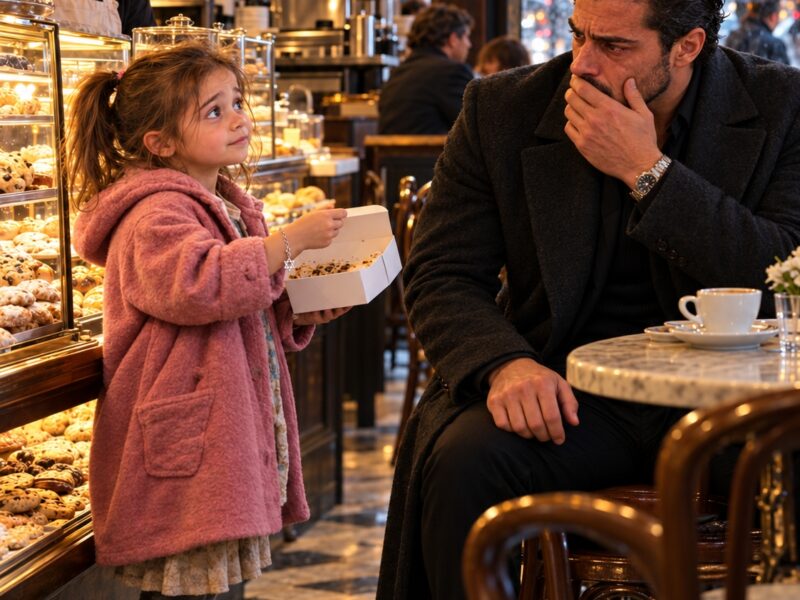
“Can I Have Some Leftover Cookie Crumbs?” a Hungry Little Girl Asked—The Mafia Boss Turned, Saw What Was on Her Wrist, and Froze as a Secret From His Dead Sister’s Past Came Back to Life
“Ma’am, could I please have the cookie crumbs you’re going to throw away?”
The little girl’s voice was so quiet that Mrs. Russo almost didn’t hear her over the espresso machine.
She leaned across the bakery counter, a dish towel in one hand.
“I’m sorry, sweetheart. What did you say?”
The child stood on the other side of the glass display case, barely tall enough to see the pastries arranged inside. She wore a faded pink coat several sizes too large, with fraying cuffs that covered half her fingers. Her dark brown hair was gathered into a crooked ponytail, and the toes of her once-white sneakers were worn almost gray.
She looked about five.
In her right hand, she held a collection of coins.
“The crumbs,” she repeated, pointing carefully toward the bottom of an almost-empty cookie tray. “When the cookies are gone, could I have the little pieces left over?”
Mrs. Russo put down the towel.
“Honey, why do you want those?”
The girl glanced at the cookies.
Chocolate chip.
Almond.
Honey butter.
She looked away quickly, as though staring too long might make someone think she intended to steal them.
“They’re for my mama.”
Mrs. Russo’s expression softened.
“Does your mama like cookies?”
The child nodded.
“She used to.”
“Used to?”
“She’s sick now.”
The little girl’s voice wavered.
“She didn’t eat yesterday. And she didn’t eat breakfast today. I thought maybe if I brought her something sweet, she would want to eat.”
Mrs. Russo pressed a hand against her chest.
The girl opened her fist.
“I have twenty-six cents.”
Six pennies, two nickels, and one dime lay against her small palm.
“I counted twice.”
The café went strangely quiet.
Outside, rain slid down the windows overlooking Hanover Street in Boston’s North End. A delivery truck rattled past. Two construction workers argued about the Patriots near the front door, and an old Italian song played softly from a radio behind the counter.
Nobody seemed to notice the child.
Nobody except the man sitting alone at the corner table.
Adrien Romano had spent most of his thirty-five years learning not to react to things that surprised him.
His father began those lessons when Adrien was seven.
Sit where you can see the entrance.
Remember faces.
Listen more than you speak.
Never let strangers know what frightens you.
By the time Adrien inherited the Romano organization, those lessons had become instinct.
He controlled freight terminals, warehouses, port contracts, restaurants, and a criminal network whose influence extended from Boston to Baltimore. Men twice his age spoke carefully around him.
He had watched powerful men beg.
He had survived betrayals.
He had learned to make difficult decisions without allowing his face to reveal what they cost him.
But now he sat motionless, listening to a little girl explain that twenty-six cents was all she could afford to spend on her sick mother.
Something about the careful way she spoke unsettled him.
She wasn’t begging.
She was negotiating.
As though she’d already learned that asking for too much could make people turn away.
Mrs. Russo glanced toward his table.
Adrien lifted two fingers.
It was a small gesture.
She understood immediately.
“Well,” Mrs. Russo said, turning back to the child, “it just so happens I have a fresh batch coming out of the oven.”
The little girl’s eyes widened.
“But I only want the crumbs.”
“I know, sweetheart.”
Mrs. Russo smiled.
“But would your mama prefer almond cookies or chocolate chip?”
The child stared at her.
“Real cookies?”
“Real cookies.”
She looked down at the coins in her hand.
“I don’t have enough.”
Adrien spoke for the first time.
“Keep your money.”
The girl turned toward him.
He sat beneath the window in a charcoal-gray sweater, his dark coat folded neatly over the empty chair beside him. His espresso had gone cold.
His face was serious.
Not unkind.
Simply the face of a man who had forgotten how to smile without considering whether somebody might mistake it for weakness.
“The cookies are on me,” he said.
The little girl looked uncertain.
“All of them?”
“Yes.”
“Even the big ones?”
A faint smile touched his mouth.
“Especially the big ones.”
Mrs. Russo began filling a white cardboard box.
“Chocolate chip, almond, or both?”
The child considered the question with the gravity of someone making a very important decision.
“Both, please.”
“Both it is.”
Warm butter and sugar filled the café.
Mrs. Russo lined the box with wax paper and arranged the cookies carefully. Then she closed the lid and tied it with thin red bakery string.
“Now,” she said, placing it on the counter, “you tell your mama these were made fresh this morning. And you tell her Mrs. Russo insists she eat at least two.”
The little girl nodded solemnly.
“I promise.”
She reached for the box.
It was nearly as wide as her chest.
Her pink sleeve slipped backward.
A thin silver chain slid down her wrist.
Adrien’s expression changed.
At first, he thought the light had deceived him.
Then the child lifted the box higher.
A small charm swung beneath her cuff.
A six-pointed silver star.
Hollow in the center.
One tip chipped along its lower edge.
Adrien stopped breathing.
He knew that star.
He knew the missing piece.
He knew exactly how it had happened.
Nineteen years earlier, in the drawing room of his family’s Beacon Hill house, his younger sister Isabella had been showing him the bracelet their mother gave her for her sixteenth birthday.
She had held it up, turning it toward the sunlight.
“It’s beautiful, isn’t it?”
Adrien had reached for it.
She pulled away.
They laughed.
Then the delicate charm struck the stone fireplace.
A tiny piece broke from one corner.
Isabella had been furious.
Adrien spent the following week trying to convince her he could repair it.
She refused.
“Leave it,” she’d told him. “Now it’s mine.”
She wore it every day afterward.
Even after their mother died.
Even after their father was buried.
Even when she became an adult and owned jewelry worth more than most people’s cars.
And she had been wearing it in the last photograph Adrien ever took of her.
Six years earlier.
Three weeks before she died.
Adrien stared at the child’s wrist.
His hands had gone cold.
“Sweetheart.”
The girl looked toward him.
“Yes, sir?”
“What’s your name?”
“Rosie.”
His throat tightened.
“Rosie what?”
“Rosie Miller.”
He swallowed.
“And that bracelet?”
She looked down.
“My star?”
“Yes.”
She smiled.
“Mama Clara says it belonged to somebody who loved me before I was born.”
The world seemed to fall silent.
Adrien looked at her face.
The dark hair.
The small nose.
The shape of her mouth.
A familiar line appeared beside her cheek when she smiled.
He had seen that expression thousands of times.
On his sister.
Isabella.
The person he loved more than anyone else in the world.
The person he had buried six years earlier.
The girl hugged the cookie box tightly.
“Thank you, Uncle Espresso.”
Adrien blinked.
“Uncle Espresso?”
She pointed at his cup.
“You have the tiny coffee.”
A sound escaped him.
Almost a laugh.
Almost a sob.
Then Rosie turned toward the door.
“Bye, Mrs. Russo!”
“Be careful crossing the street, sweetheart.”
“I will!”
The bell above the door chimed.
Cold air swept into the café.
The pink coat disappeared into the rainy morning.
Adrien stood so abruptly that his chair scraped across the tile.
He wanted to follow her.
To ask where she lived.
To ask who had given her the bracelet.
To ask whether she knew the name Isabella Romano.
But he couldn’t move.
For the first time in six years, his hands were shaking.
And one terrible possibility had begun forming in his mind.
His sister might have left something behind that nobody had ever told him about.
Adrien’s sister had died on a Thursday night in March.
He remembered the date more clearly than his own birthday.
March 14.
The weather had been miserable.
Rain against the windows.
Wind moving through the trees outside his father’s old house.
At eleven that evening, Isabella called.
He had been in his office reviewing shipping contracts.
“Adrien?”
He smiled when he heard her voice.
“Shouldn’t you be asleep?”
“Probably.”
“What’s wrong?”
There was a pause.
Then she said, “Can we have breakfast tomorrow?”
“We always have breakfast on Fridays.”
“I know. But I need you to promise you’ll come.”
He leaned back in his chair.
“What’s happened?”
“Nothing.”
“Isabella.”
“Please.”
Something in her voice made him sit forward.
“Sweetheart, tell me.”
“I can’t over the phone.”
“Then I’ll come over.”
“No.”
The answer came too quickly.
He frowned.
“Why not?”
“Just meet me tomorrow morning. At Russo’s.”
He glanced at his calendar.
“Eight?”
“Seven-thirty.”
“Fine.”
Another pause.
Then Isabella whispered, “I love you, Adrien.”
He smiled.
“I love you too.”
She never reached their breakfast.
At 3:06 the following morning, Massachusetts State Police called to report that a black sedan registered to Isabella Romano had gone through a bridge barrier and entered the Charles River.
Divers recovered the vehicle.
Isabella was pronounced dead at the hospital.
The investigation concluded that a mechanical failure had contributed to the crash.
Adrien never fully believed it.
Isabella was careful.
Her car was less than a year old.
And although she occasionally drove too fast, she never ignored warning lights or maintenance problems.
But grief did something strange to him.
Instead of making him investigate harder, it made him retreat.
He couldn’t bear looking at photographs of the car.
Couldn’t bear reading medical reports.
Couldn’t bear the possibility of learning that his sister had suffered.
He hired an investigator.
Reviewed some findings.
Then allowed the matter to be closed when his cousin Julian insisted the family needed stability.
Six years passed.
Romano Freight expanded.
Adrien became wealthier.
More feared.
More isolated.
He worked longer hours.
Ate alone.
Stopped answering personal invitations.
He moved into the Beacon Hill house after his father’s death and left Isabella’s room almost untouched.
But he rarely entered it.
Grief had become a locked door.
And every year, he added another lock.
Now a little girl in a faded pink coat had walked into Russo’s Café wearing the bracelet Isabella had been buried without.
Adrien returned home that morning without remembering the drive.
He entered his study.
Behind an old painting of the Tuscan coast was a safe.
He opened it.
Inside rested a small wooden box.
He carried it to his desk.
Lifted the lid.
And found the photograph.
Isabella on a boat near Nantucket.
Twenty-four years old.
Dark hair blowing across her face.
Yellow summer dress.
Laughing because Adrien had made a terrible joke.
Her right hand was raised toward the camera.
And there, on her wrist, hung the silver star.
Adrien touched the photograph.
The chipped corner.
Identical.
He sat down slowly.
“Isabella.”
The name sounded foreign in the empty room.
He hadn’t spoken it aloud in months.
For a long time, he stared at her smile.
Then he reached for his phone.
Not the one connected to his businesses.
A second phone he kept for private emergencies.
He called Marco Bellini.
Marco had worked for the Romano family for eleven years. He was a quiet, broad-shouldered man in his forties who had served Adrien’s father before becoming Adrien’s personal security adviser.
He answered on the second ring.
“Boss.”
“I need you at the house.”
“How soon?”
“Now.”
“Trouble?”
Adrien looked at Isabella’s photograph.
“I don’t know yet.”
Marco arrived fifty minutes later.
He found Adrien standing beside the study window, staring across Boston Common.
“What’s happened?”
Adrien handed him a written description.
“Five-year-old girl. Rosie Miller. Pink coat. Dark hair. She was at Russo’s Café around seven-thirty this morning.”
Marco read the note.
“You know her?”
“No.”
“Then why—”
“She was wearing something that belonged to Isabella.”
Marco stopped.
For a moment, neither man spoke.
Then Marco looked up.
“Are you certain?”
Adrien’s expression hardened.
“I’m certain of what I saw.”
Marco glanced toward the photograph on the desk.
Understanding crossed his face.
“You think the girl—”
“I don’t know what I think.”
Adrien took a breath.
“I need to find out who is raising her. I need to know whether she’s safe. But I don’t want anyone approaching the child.”
Marco nodded slowly.
“And Julian?”
“Nothing reaches Julian.”
That surprised him.
Julian Romano was Adrien’s older cousin.
He had been raised almost as a brother.
For years, Julian managed major commercial negotiations and maintained relationships with regional partners.
After Isabella’s death, he became increasingly influential.
Adrien trusted him.
Or had trusted him.
But something about Isabella’s final phone call had begun bothering him.
She had wanted to tell Adrien something privately.
And she’d been frightened.
“Is there a reason you’re keeping Julian out of this?” Marco asked.
“Because I don’t know what Isabella was trying to tell me.”
Marco studied him.
Then nodded.
“I’ll start with what can be verified.”
Adrien looked down at the photograph.
“And Marco?”
“Yes?”
“No one frightens that child.”
“Understood.”
The following morning, Adrien returned to Russo’s Café.
He arrived before seven.
Mrs. Russo greeted him with the familiarity of someone who had been serving his family for decades.
“You left your coat yesterday.”
“I know.”
“And a hundred dollars.”
“Keep it.”
She frowned.
“For a box of cookies?”
“They were good cookies.”
She studied his face.
Then said nothing.
He sat at his usual table.
Back to the wall.
Eyes toward the door.
At seven-fifteen, two construction workers came in.
At seven-twenty-two, a woman ordered cappuccino and hurried away.
At seven-twenty-eight, the bell chimed.
Rosie entered holding an older woman’s hand.
The woman looked about forty-two.
Light brown hair tied loosely behind her head.
A navy cardigan beneath a thin coat.
No makeup.
Dark circles beneath tired eyes.
She moved with the careful efficiency of someone accustomed to long shifts and little sleep.
Rosie saw Adrien first.
Her face brightened.
“Uncle Espresso!”
The woman stopped.
“Rosie, sweetheart, we don’t call strangers that.”
“He’s not a stranger.”
Rosie pointed.
“He bought Mama cookies.”
The woman looked across the café.
Adrien stood.
“Good morning.”
She examined him carefully.
“Good morning.”
“Your daughter was very polite yesterday.”
“Thank you.”
He hesitated.
“Adrien Romano.”
Something changed in her expression.
Not much.
Only a slight tightening around her eyes.
But Adrien noticed.
She knew the name.
“Clara Miller,” she replied.
Rosie tugged on her sleeve.
“Mama, can I have hot chocolate?”
Clara smiled down at her.
“If you promise not to spill it on your coat.”
“I promise.”
Mrs. Russo prepared the order.
Adrien remained near his table.
He wanted to ask Clara a hundred questions.
Instead, he said, “I hope the cookies helped.”
Clara’s expression softened.
“They did.”
Rosie nodded enthusiastically.
“Mama ate two.”
Adrien smiled.
“Good.”
“She cried though.”
Clara looked down.
“Rosie.”
“What?”
“Some things are private.”
The child considered that.
Then nodded.
“Okay.”
Adrien watched Clara carefully.
She wasn’t angry.
She was frightened.
Not of him, exactly.
Of what his name represented.
And when Rosie reached for her hot chocolate, the silver star slipped from beneath her sleeve again.
Clara saw Adrien looking at it.
She covered the bracelet gently with the child’s cuff.
“Come on, sweetheart.”
They left a moment later.
Adrien did not follow.
This time, he understood that forcing answers might endanger the very child whose existence had brought him back to life.
He waited until they were gone.
Then sat down.
His espresso remained untouched.
Marco called late that afternoon.
“I found the mother.”
Adrien was parked beside the Charles River.
“Tell me.”
“Clara Miller. Forty-two. Registered nurse. Currently working part-time at a community clinic in Mattapan.”
“And before?”
“Hospital work. Emergency medicine. Several years at Massachusetts General.”
Adrien tightened his grip on the steering wheel.
“When did she leave?”
“Five years ago.”
He closed his eyes.
“Was she working the night Isabella died?”
Marco paused.
“That’s what I haven’t been able to confirm yet.”
“Keep looking.”
“Adrien.”
He rarely used his first name during business calls.
“What?”
“I think you should speak to an attorney before we go further.”
Adrien opened his eyes.
“Why?”
“Because whatever this is, it involves a child. And if you’re right, there may be sealed family or medical records.”
Adrien stared across the darkening river.
He had spent years believing power meant having access to anything he wanted.
Now the thing he wanted most was an answer that nobody owed him simply because he demanded it.
“All right,” he said.
That evening, he called Elena Ruiz.
Elena was a forty-one-year-old attorney who had refused to represent certain Romano businesses twice before eventually accepting work on legitimate commercial matters.
She was not afraid of Adrien.
He respected that.
When he explained what he’d seen, she listened without interrupting.
Then she said, “You cannot treat this like a missing shipment.”
“I know.”
“Do you?”
“Elena.”
“A child isn’t evidence you can collect.”
Adrien said nothing.
“If there is a connection to your sister, we’ll establish it lawfully. And until then, you respect the woman raising her.”
He looked at the photograph beside his desk.
“I don’t want to take Rosie from her mother.”
“Good.”
“I want to know what happened to Isabella.”
“Then start by asking the person who may know.”
Two evenings later, Adrien stood outside an apartment building above a laundromat in Dorchester.
He had obtained Clara’s address after she agreed, through Mrs. Russo, to speak with him privately.
He wore a plain dark coat.
No bodyguards.
No expensive watch.
He carried no weapon.
He pressed the buzzer marked Miller.
A pause.
Then Clara’s voice came through the speaker.
“Who is it?”
“Adrien Romano.”
Silence.
“I know you probably don’t want me here,” he continued. “But I’d like to ask you about the bracelet Rosie was wearing.”
Another silence.
Then Clara said, “Is she in trouble?”
“No.”
“Are you going to take it?”
“No.”
The building door buzzed.
He climbed two flights of narrow stairs smelling of laundry detergent and old wood.
Clara stood at the top.
Her face was pale.
“Rosie’s asleep.”
“I’ll keep my voice down.”
She stepped aside.
The apartment was small.
A kitchenette opened into the living room.
Children’s drawings covered the refrigerator.
A faded couch sat beneath the window.
A low shelf held picture books arranged carefully by size.
Nothing was expensive.
Everything was clean.
Adrien noticed a small white cookie box on the kitchen counter.
The red bakery string remained tied around it.
Clara gestured toward the table.
“Sit.”
He obeyed.
She filled a kettle.
Neither spoke until she’d placed two cups of chamomile tea between them.
Then Adrien looked at her.
“You knew who I was at the café.”
Clara nodded.
“When you said your name.”
“And the bracelet?”
She closed her eyes briefly.
“I was wondering when you’d recognize it.”
His chest tightened.
“Where did it come from?”
Clara wrapped both hands around her cup.
“Your sister.”
Adrien did not move.
“Isabella?”
“Yes.”
He stared at her.
“Tell me.”
Clara looked toward the bedroom door.
Then back at him.
“I was working the overnight emergency shift when she was brought in.”
Adrien felt something shift beneath his ribs.
“She was alive?”
Clara nodded.
“For a little while.”
He gripped the edge of the table.
The official reports had described Isabella as having suffered injuries incompatible with survival.
He had always imagined she died before anyone reached her.
“Did she speak?”
Clara’s eyes filled.
“Yes.”
Adrien looked down.
For several seconds, he couldn’t find his voice.
Then he whispered, “What did she say?”
Clara swallowed.
“She was pregnant, Mr. Romano.”
The room went silent.
Adrien stared.
“Pregnant?”
“Full term.”
He shook his head.
“No.”
“She was.”
“I would have known.”
Clara looked at him sadly.
“Apparently, she hadn’t told you yet.”
Adrien remembered the phone call.
Can we have breakfast tomorrow?
I need you to promise you’ll come.
He closed his eyes.
Clara continued carefully.
“The doctors delivered the baby by emergency cesarean. Your sister didn’t survive her injuries.”
Adrien pressed both palms against the table.
“A baby?”
“A little girl.”
His breath caught.
“Rosie?”
Clara nodded.
He looked toward the bedroom.
The dark-haired child.
The silver star.
The familiar smile.
His sister’s daughter.
Alive.
Growing up a few miles from the house where he’d spent six years mourning Isabella.
“How?” he whispered.
Clara took a long breath.
“There were complications after your sister died. The authorities became involved. Her identity wasn’t immediately released publicly because investigators had concerns about the circumstances of the crash.”
Adrien lifted his eyes.
“What concerns?”
Clara hesitated.
“Before she died, Isabella told me something.”
He waited.
“She said someone close to the family had tried to hurt her.”
A cold sensation spread through him.
“Who?”
“She didn’t tell me.”
Clara’s hands tightened around the cup.
“She was frightened. She kept asking me not to let certain people near her baby.”
“Which people?”
“She said the family wasn’t safe.”
Adrien stared.
“Did she mention me?”
Clara looked at him.
“She said your name.”
His throat closed.
“She said you were the person she wanted to trust. But then she became frightened again.”
He looked away.
For six years, he’d blamed himself for not answering her final call differently.
Now he learned she’d been trying to tell him about a child.
And a betrayal.
Clara reached into her pocket.
She placed a small object on the table.
A plastic memory card.
No larger than a fingernail.
“Your sister had this.”
Adrien looked at it.
“She gave it to you?”
Clara nodded.
“She asked me to keep it safe.”
“What’s on it?”
“I don’t know.”
He stared.
“You never looked?”
“No.”
“Why?”
“Because I was afraid.”
She looked toward the bedroom.
“I had a newborn to protect. And I didn’t know who was telling the truth.”
Adrien remained silent.
Clara continued.
“After the investigation began, Rosie’s care became complicated. I stayed involved. Eventually, through the courts, I became her legal guardian and then adopted her.”
Adrien looked toward the bedroom.
“So she’s your daughter.”
“Yes.”
The answer came firmly.
No hesitation.
“I’ve raised her since she was born.”
He nodded.
Clara’s eyes shone.
“I know what she means to you now that you understand. But she is my daughter, Mr. Romano.”
Adrien looked at her.
He had commanded men.
Controlled companies.
Made decisions that altered hundreds of lives.
Yet none of that gave him the right to take a child from the woman who loved her.
“I understand,” he said.
Clara searched his face.
“Do you?”
“Yes.”
He looked toward the bedroom.
“Whatever happens, I won’t take Rosie away from you.”
For the first time that evening, Clara seemed able to breathe.
Adrien left the apartment shortly after nine.
He did not ask to wake Rosie.
He did not demand the memory card.
He did not offer money.
Before leaving, he asked Clara whether she would be willing to let Elena help them review the old records.
Clara hesitated.
Then nodded.
“Only if everything goes through proper legal channels.”
“Agreed.”
“And Rosie doesn’t get dragged into this.”
Adrien looked at her.
“That’s the last thing I want.”
Outside, the night air was cold.
Adrien walked three blocks before reaching his car.
He sat behind the wheel without starting the engine.
For a long time, he stared straight ahead.
Then he began crying.
Quietly.
Without covering his face.
Without trying to stop.
For six years, he had carried the belief that Isabella died alone.
Now he knew she had lived long enough to bring a daughter into the world.
A little girl named Rosie.
A little girl who had walked into a café with twenty-six cents and asked for crumbs because the woman raising her was sick.
He thought of Isabella at twenty-four.
Laughing on the Nantucket boat.
The yellow dress.
The chipped silver star.
“I found her,” he whispered.
Then he leaned forward against the steering wheel and cried until he had nothing left.
The following week, Elena began reviewing the available evidence.
The old crash investigation had several irregularities.
A preliminary mechanical assessment mentioned potential interference with the vehicle’s braking system.
A later report attributed the crash to mechanical failure without explaining the discrepancy.
The mechanic who last serviced Isabella’s vehicle had died several weeks after the accident.
His death had been ruled a suicide.
The circumstances troubled Elena.
“There are enough inconsistencies here to justify asking investigators to reopen the case,” she told Adrien.
He stood beside the conference table.
“Then do it.”
“Adrien, listen carefully.”
He turned.
“Reopening this means your family businesses may be examined too.”
“I know.”
“Your cousin’s financial activity. Your father’s old arrangements. Possibly your own decisions.”
He looked at her.
“I said do it.”
Elena nodded.
“Then we proceed properly.”
Meanwhile, Clara agreed to a court-supervised review of Rosie’s family history.
The documents confirmed the connection to Isabella.
The evidence was devastating.
Adrien spent an entire afternoon sitting in his study with the confirmation letter on his desk.
He had a niece.
A living piece of his sister.
He wanted to go to Dorchester immediately.
To hold Rosie.
To tell her everything.
Instead, he called Clara.
“May I come by tomorrow?”
She hesitated.
“Rosie has preschool until three.”
“I can come afterward.”
“She’s been asking about Uncle Espresso.”
Adrien smiled despite the ache in his chest.
“She has?”
“Yes.”
He looked toward Isabella’s photograph.
“I’d like that.”
The first afternoon Adrien visited Rosie as her uncle, he brought a small wooden puzzle.
Not expensive.
Not elaborate.
A simple picture of a lighthouse divided into twelve pieces.
Rosie examined the box.
“Is it for me?”
“Yes.”
“Why?”
“Because I thought you might like it.”
She considered that.
Then looked at Clara.
“Mama, can I open it?”
Clara nodded.
“Of course.”
They sat on the living room floor.
Rosie arranged the pieces carefully.
Adrien watched her.
She had Isabella’s habit of tilting her head when concentrating.
He remembered that habit from childhood.
Isabella used to sit beside him while he worked on model airplanes, asking questions until he became irritated.
Then she’d steal one piece and hide it behind her back.
Rosie held up a puzzle piece.
“This one goes here.”
Adrien looked.
“I think you’re right.”
She smiled.
“I’m very good at puzzles.”
“I can see that.”
“Are you?”
“Sometimes.”
She studied him.
“Then why are you doing it wrong?”
Clara laughed from the kitchen.
Adrien stared at the puzzle.
Then laughed too.
It was the first time in years he had laughed without remembering to stop.
Afterward, Rosie showed him her drawings.
A purple cat.
A green horse.
A red house with six windows and no door.
“Why doesn’t the house have a door?” he asked.
Rosie frowned.
“I forgot.”
“That’s going to make getting inside difficult.”
She considered the problem.
Then drew a bright yellow door.
“There.”
“Perfect.”
Clara watched them from the doorway.
For years, she had feared the Romano family would eventually find Rosie.
She had imagined expensive lawyers.
Threats.
A custody battle.
Men arriving at the apartment with orders rather than questions.
Instead, Adrien sat cross-legged on the carpet allowing a five-year-old to explain why horses could sometimes be green.
He hadn’t asked to change Rosie’s name.
Hadn’t tried to replace Clara.
Hadn’t demanded photographs or school records.
He simply showed up.
And listened.
Clara didn’t trust him completely.
Not yet.
But she began to understand why Isabella might once have believed her brother was worth trusting.
The first serious break in the investigation came three weeks later.
Elena located an old financial complaint Isabella had prepared shortly before her death.
It concerned unauthorized transfers associated with Romano Freight’s Baltimore operations.
The amounts were substantial.
The recipients were shell companies linked to Victor Cain, a South Boston operator with longstanding interests in regional freight contracts.
Adrien recognized the name immediately.
Victor had been a rival of his father’s.
A difficult negotiator.
A man who preferred influence to confrontation.
But the documents suggested Victor had not acted alone.
Several payment authorizations carried signatures from within Romano Freight.
One belonged to Julian Romano.
Adrien stared at it.
His cousin.
The man who had stood beside him at Isabella’s funeral.
The man who helped him through the months afterward.
The man who insisted the crash investigation should be closed so the family could move forward.
Adrien sat back slowly.
“No.”
Elena looked at him.
“I know what you’re thinking.”
“You don’t.”
“I know you’re hoping there’s another explanation.”
He stared at the document.
Julian had been part of his life since childhood.
They shared family holidays.
Summer vacations.
Business victories.
Their fathers had raised them almost as brothers.
Julian had been there when Isabella was born.
He had carried her on his shoulders at family picnics.
Adrien tried to imagine him participating in a scheme that endangered her.
He couldn’t.
Then he remembered the way Julian spoke about Isabella during the months before her death.
“She asks too many questions.”
“She doesn’t understand the business.”
“She’ll create trouble if you let her.”
Adrien had dismissed those remarks.
He thought Julian was being protective.
Now they sounded different.
Elena placed another document on the table.
“This isn’t proof of murder.”
Adrien looked up.
“I know.”
“But it’s enough to warrant deeper investigation.”
He nodded.
Then said something that surprised even him.
“I want the truth. Even if it means losing him.”
The following month brought increasing pressure.
Investigators reopened parts of the old case.
Several former employees agreed to interviews.
Financial records revealed a pattern of diverted payments.
Victor Cain’s businesses appeared repeatedly.
Julian became visibly unsettled.
At a meeting inside Romano Freight’s headquarters, he questioned Adrien about the review.
“You’re letting outside investigators into family business?”
“Yes.”
“After all these years?”
“Yes.”
Julian leaned forward.
“Adrien, think about what you’re doing.”
“I am.”
“You’ll damage the company.”
“If crimes were committed, the damage already exists.”
Julian stared at him.
Then smiled tightly.
“You’ve changed.”
Adrien looked back.
“Maybe.”
“Because of that child?”
Silence.
Adrien felt his chest tighten.
“What child?”
Julian shrugged.
“People talk.”
Adrien studied him carefully.
Julian knew.
Somehow, he knew about Rosie.
The thought made every instinct in Adrien’s body sharpen.
“She’s a little girl,” Adrien said.
Julian smiled.
“Then let’s keep her out of family matters.”
Adrien looked at him for a long moment.
“That depends on whether people in the family leave her alone.”
Julian’s smile disappeared.
Neither spoke again until the meeting ended.
That evening, Adrien called Clara.
“Are you home?”
“Yes.”
“Is Rosie with you?”
“She’s doing homework.”
He exhaled.
“Good.”
Clara heard the change in his voice.
“What’s happened?”
“Nothing I can explain over the phone.”
“Adrien.”
He closed his eyes.
“Please be careful.”
Clara went silent.
Then said, “Someone knows about us.”
He didn’t answer.
She didn’t need him to.
Two nights later, Clara and Rosie disappeared.
Adrien learned about it through a phone call shortly before midnight.
Julian’s voice sounded almost cheerful.
“Cousin.”
Adrien stood behind his desk.
“What do you want?”
“We need to discuss the future of Romano Freight.”
“Then schedule a meeting.”
“I think you’ll find this one urgent.”
A pause.
Then Julian said, “I have two guests who would very much like to go home.”
Adrien felt the room turn cold.
“Julian.”
“Now, don’t sound angry.”
“Where are they?”
“Safe.”
“Let me speak to Clara.”
“Eventually.”
Adrien gripped the phone.
“If you’ve frightened that child—”
“Then perhaps we should avoid making things worse.”
Julian’s voice remained calm.
“Tomorrow morning, you’ll authorize a transfer of operational control. The documents are already prepared.”
Adrien stared at the window.
“And if I refuse?”
“I think you understand.”
The call ended.
For several seconds, he couldn’t move.
Then he called Elena.
He told her everything.
She listened carefully.
“Don’t confront Julian alone,” she said.
Adrien’s voice was low.
“They have Rosie.”
“I know.”
“She’s five.”
“I know.”
Elena’s tone hardened.
“Then we do this in a way that gives her the best chance of coming home.”
That sentence stopped him.
For years, Adrien had relied on fear to solve problems.
His first instinct was to gather armed men and demand answers.
But this wasn’t a territorial dispute.
A child was involved.
And someone had already proven willing to hurt Isabella to protect money and power.
He could not afford to make his anger the center of the situation.
Elena contacted federal investigators already examining the financial conspiracy.
Adrien provided the call details and the evidence gathered so far.
The response was coordinated through law enforcement.
Hours passed.
Adrien remained awake.
He kept looking at the photograph of Isabella on his desk.
The yellow dress.
The silver bracelet.
Her smile.
“I won’t fail her,” he whispered.
Rosie had never been so frightened.
She sat beside Clara inside an unfamiliar office at an abandoned waterfront storage building.
The room smelled of dust and cold wood.
A single lamp stood on a desk.
Outside, footsteps moved through the corridor.
Clara kept one arm around her.
“Are we going home?” Rosie whispered.
“Yes, sweetheart.”
“When?”
“As soon as we can.”
Rosie pressed her face against Clara’s sweater.
“Is Uncle Espresso coming?”
Clara closed her eyes.
She wanted to say yes.
Wanted to promise that the man who bought them cookies would arrive and make everything safe.
But she had spent five years raising Rosie with one rule.
Never promise what you cannot control.
So she kissed the child’s forehead.
“People are looking for us.”
Rosie nodded slowly.
Then whispered, “I don’t like this place.”
“Neither do I.”
The child reached for the silver star on her wrist.
Clara looked at it.
For five years, she’d protected that bracelet.
It was the last gift Isabella had been able to give her daughter.
Now it rested against Rosie’s skin, a small reminder of the woman whose final request had shaped Clara’s entire life.
Keep her safe.
Clara tightened her arm around Rosie.
She had promised.
And she intended to keep that promise.
By dawn, investigators had located the property.
The operation that followed was tense but brief.
Officers entered the building while additional units secured the surrounding area.
Clara heard shouted instructions.
Then footsteps.
A door opened.
An officer identified herself and asked whether either of them was hurt.
Clara shook her head.
“Please,” she whispered. “My daughter.”
The officer crouched.
“She’s safe now.”
Rosie stared at the unfamiliar woman.
Then looked toward the doorway.
“Where’s Uncle Espresso?”
A familiar voice answered.
“Right here, sweetheart.”
Adrien stood beyond the officers.
He looked exhausted.
His coat was wrinkled.
His hair was disordered.
But the moment Rosie saw him, her face lit up.
“Uncle Espresso!”
He knelt.
She hurried into his arms.
Adrien held her carefully.
For a moment, he could not speak.
Then he whispered, “I’m here.”
Rosie wrapped both arms around his neck.
“You came.”
He closed his eyes.
“Yes.”
“You really came.”
He looked toward Clara.
She was crying quietly.
Adrien swallowed.
“I told you I’d try.”
Rosie leaned back.
“Mama Clara says you’re my uncle.”
He froze.
Clara approached slowly.
She looked at him.
Then nodded.
Adrien felt his throat tighten.
“Yes, sweetheart.”
Rosie studied him.
“Like a real uncle?”
He smiled through tears.
“A real uncle.”
She considered that.
Then reached for his face.
“You look sad.”
He laughed softly.
“I’m happy.”
“Then why are you crying?”
He closed his eyes briefly.
“Because sometimes people cry when they’re very happy.”
Rosie seemed satisfied.
Then she hugged him again.
Clara watched them.
For the first time since the night Isabella died, she felt the weight of her promise become something she no longer had to carry alone.
The arrests changed the Romano organization permanently.
Julian faced charges connected to the conspiracy, the financial fraud, and the abduction of Clara and Rosie.
Victor Cain was also taken into custody.
The reopened investigation established evidence that Isabella’s death had not been an ordinary accident.
The financial records she had collected became central to the case.
Her memory card contained copies of suspicious transactions and communications that helped investigators reconstruct the scheme.
Adrien cooperated fully.
That cooperation came at a price.
Romano Freight underwent an independent restructuring.
Contracts were reviewed.
Questionable accounts were frozen.
Several senior executives were removed.
The criminal operations connected to the company were dismantled under legal oversight.
Adrien lost money.
Influence.
And the loyalty of men who had once called him untouchable.
For a while, he barely recognized the business bearing his family name.
But he began sleeping better.
Not because the past had been erased.
Because he had finally stopped defending it.
One afternoon, Elena found him standing beside his study window.
“You’re quiet.”
Adrien looked toward Boston Common.
“Is that unusual?”
“For you? Not remotely.”
He smiled faintly.
She placed a folder on his desk.
“The court has confirmed Clara’s adoption remains valid. There are no pending challenges.”
Adrien exhaled.
“Good.”
Elena studied him.
“You could have made this difficult.”
“I know.”
“You didn’t.”
He looked toward Isabella’s photograph.
“Rosie already has a mother.”
Elena nodded.
“And an uncle.”
Adrien smiled.
“Yes.”
He turned back toward the window.
For years, he’d believed loyalty meant protecting the Romano name at any cost.
Now he understood that the name had never been worth more than the people who carried it.
Especially the smallest one.
Three months later, Adrien returned to Clara’s apartment.
This time, he knocked without fear.
Rosie answered from behind her mother.
“Uncle Espresso!”
He smiled.
“Hello, troublemaker.”
She giggled.
Clara stepped aside.
The apartment had changed slightly.
There were new curtains.
A repaired bookshelf.
A bright blue rug near the window.
The refrigerator still held the purple cat drawing.
Beside it was a newer picture showing three people holding hands.
Adrien looked at it.
“Who’s that?”
Rosie pointed.
“That’s Mama.”
“Yes.”
“That’s me.”
“Of course.”
“And that’s you.”
He looked down at her.
“Me?”
She nodded.
“You’re very tall.”
He smiled.
“Apparently.”
Clara invited him to sit.
Rosie returned to her coloring.
Adrien looked at Clara.
“I wanted to ask you something.”
She waited.
“Would you be comfortable with me seeing Rosie regularly?”
Clara studied him.
“What do you mean?”
“A few hours on Sundays. A museum. A park. Lunch.”
He took a breath.
“Only if you’re comfortable. And only if Rosie wants it.”
Clara looked toward her daughter.
“Rosie, sweetheart?”
The little girl looked up.
“Would you like to spend some Sundays with Uncle Adrien?”
Rosie considered the question.
Then asked, “Can we go to the aquarium?”
Adrien smiled.
“Yes.”
“Can Mama come sometimes?”
“Of course.”
“And can we get cookies?”
He laughed.
“Absolutely.”
Clara looked back at him.
“Sundays, then.”
Adrien nodded.
“Thank you.”
She leaned forward.
“One condition.”
“Name it.”
“She’s my daughter.”
He looked at her.
“I know.”
“Not just on paper. Not just because I raised her. She’s my daughter.”
Adrien held her eyes.
“And you’re her mother.”
Clara’s expression softened.
For the first time, she believed he understood.
Six months later, the bell above Russo’s Café chimed on a bright Tuesday morning.
Rosie Miller walked inside carrying a white cardboard box tied with red string.
She was six now.
Her pink coat had been replaced by a warm navy-blue one with small silver buttons shaped like stars.
Clara walked beside her.
Adrien followed a few steps behind.
He no longer sat automatically at the corner table.
These days, he preferred the one near the window.
Mrs. Russo looked up from the espresso machine.
Her face brightened.
“There’s my favorite little customer!”
Rosie smiled.
“Hi, Mrs. Russo!”
“Come for cookies?”
Rosie nodded.
“Lots.”
Mrs. Russo laughed.
“Then you’ve come to the right place.”
Adrien reached for his wallet.
But Rosie shook her head.
“No, Uncle Espresso.”
He stopped.
“What?”
“I have a job.”
He raised an eyebrow.
“A job?”
She nodded solemnly.
“Mama says helping people is important.”
Clara smiled.
Adrien looked between them.
“What are you planning?”
Rosie lifted the box.
Then walked toward a small table near the door.
A boy sat there alone.
He looked about eight.
His jacket was too thin for the weather, and a paper cup of hot water stood in front of him.
He was pretending not to look toward the pastry case.
Rosie stopped beside him.
“Hi.”
The boy looked up.
“Hi.”
She placed the box on his table.
“Do you like cookies?”
He stared at the box.
“Yes.”
Rosie untied the red string.
Inside were chocolate chip and almond cookies.
Warm.
Fresh.
Beautiful.
“Would you like some?”
The boy looked toward Clara.
Then Adrien.
Then back at Rosie.
“I only have twenty-six cents,” he whispered.
Adrien felt his chest tighten.
The exact words.
The same careful embarrassment.
The same small hope.
Rosie smiled.
“Keep your money.”
The boy blinked.
“What?”
She pushed the box closer.
“A nice man told me that once.”
Adrien turned away.
For a moment, he couldn’t speak.
Mrs. Russo pressed the back of her hand against her mouth.
Clara rested a hand on Rosie’s shoulder.
The boy reached slowly into the box.
He selected one chocolate chip cookie.
Then looked at Rosie.
“Thank you.”
She smiled.
“You’re welcome.”
She returned to her mother.
Adrien watched the boy take his first bite.
Then he reached into his coat.
From the inside pocket, he removed a small photograph.
Isabella.
Laughing on the deck of a boat off Nantucket.
Her yellow dress caught in the summer wind.
Her silver bracelet shining in the sunlight.
Adrien looked at the photograph.
Then toward Rosie.
The little girl who had asked for crumbs.
The child who had unknowingly led him back to the truth.
The niece he had believed lost before he knew she existed.
He touched the edge of Isabella’s picture.
“She’s safe,” he whispered.
Only he could hear the words.
“She’s loved.”
He looked toward Clara.
Then Rosie.
“And she’s kind.”
Outside, sunlight broke through the clouds above Hanover Street.
The old brick buildings turned gold.
The bell above the café door remained still.
For one warm moment, nobody spoke.
Adrien had spent years believing the Romano family legacy lived in contracts, ports, warehouses, and the power attached to his surname.
But now he understood something his father had never taught him.
A legacy could live in something as small as a cookie box.
In a nurse keeping a promise.
In a little girl wearing a chipped silver star.
In a stranger noticing somebody who had learned to ask for almost nothing.
And in the way kindness, once given, sometimes returned to the world through hands too small to understand how much they were changing it.
Rosie tugged on Adrien’s sleeve.
“Uncle Espresso?”
He looked down.
“Yes, sweetheart?”
“Can we get cookies for Mama too?”
He smiled.
“Of course.”
“And you?”
“Me?”
She nodded.
“You look like you need something sweet.”
Adrien laughed.
He crouched beside her.
“You know what?”
“What?”
“I think you’re right.”
Rosie took his hand.
And as they walked back toward the counter together, Adrien understood that the most important thing he’d ever inherited from his sister wasn’t the silver bracelet.
It was the little girl who wore it.
A child who had once asked for crumbs.
And who, the moment she had enough, turned around and offered someone else the whole box.









