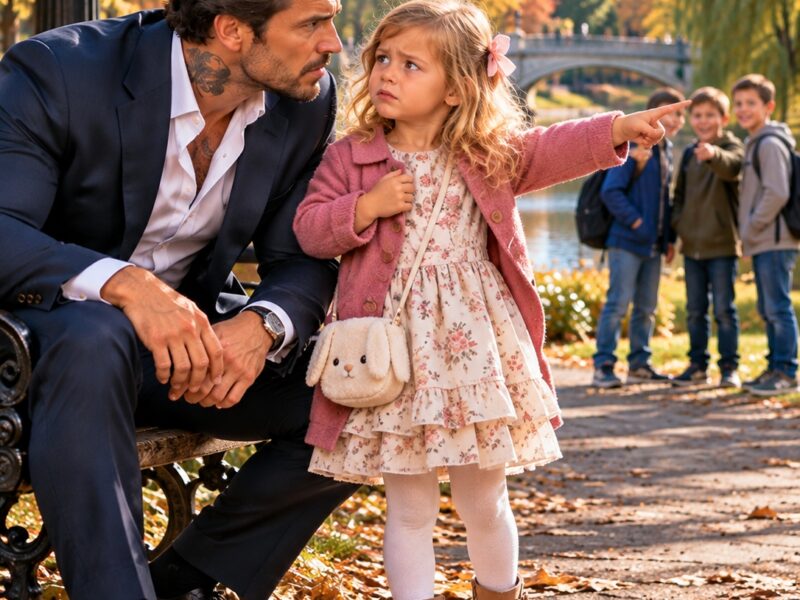
“Can You Get Those Shoes Back for Me?” a Poor Little Girl Asked the Most Feared Mafia Boss in Boston—And His Answer Uncovered a Family Betrayal Buried for Twenty-Three Years
“Can you get my shoes back, mister? My mommy can’t afford another pair.”
The little girl stood barefoot in the November cold, her dirty socks soaked through, asking a stranger on a park bench for help.
She didn’t know the man was Dante Moretti, one of Boston’s most feared organized-crime figures. She didn’t know that twenty-three years earlier, his family had destroyed another man’s life over a secret hidden inside an old wooden clock.
All she knew was that three older boys had stolen her pink sneakers, and she needed them back before her mother found out.
The first time I heard my daughter say the name Dante Moretti, I thought she had misunderstood something.
I was standing in our kitchen in Dorchester, scraping burned cheese from a saucepan, when six-year-old Sophie came through the front door wearing bright red leather shoes I had never seen before.
Behind her stood a tall man in a black wool coat.
He had dark hair, the beginnings of silver at his temples, and the unsettling stillness of someone accustomed to having an entire room stop talking when he entered it.
I recognized him before he introduced himself.
Everybody in Boston knew the Moretti name.
Some people associated it with restaurants, real estate, and shipping companies. Others connected it to the city’s old waterfront organizations, businesses that had spent decades operating in the uneasy space between legitimate commerce and criminal influence.
My father had taught me never to ask about that family.
Never accept favors.
Never get involved in their disputes.
And above all, never owe them anything.
Now one of them was standing on my porch with my daughter.
Sophie lifted her right foot proudly.
“Look, Mommy! He got my shoes back!”
I stared at the red leather.
Then at her dirty white socks, rolled carefully into a small paper bag.
Then at the stranger.
“Who are you?” I asked, although I already knew.
The man reached inside his coat and handed me a plain business card.
Dante Moretti.
Nothing else.
No address, title, or telephone number.
My mouth went dry.
“Sophie,” I said quietly, “come inside.”
“But Mommy, he—”
“Now, sweetheart.”
She looked confused by my tone.
The man didn’t object. He stepped back from the doorway and gave her room to pass.
When she was safely beside me, he spoke.
“Three older boys took her sneakers near Frog Pond. I helped get them back. One was damaged, so I bought her a replacement pair.”
I looked at the red shoes.
They were good shoes.
Soft leather, sturdy soles, proper stitching.
The kind I had admired through store windows and walked past because there was never enough money left after groceries and rent.
“You shouldn’t have done that,” I said.
His expression barely changed.
“She was cold.”
“I understand, but—”
“She also asked me to make sure she got home.”
A terrible thought entered my mind.
“How did you bring her here?”
“I drove her.”
My stomach tightened.
“You put my daughter in your car?”
He looked at me steadily.
“Yes. I should have contacted you first. She told me you were at work, and I made a decision I wouldn’t make again without a parent’s permission.”
That answer surprised me.
Men with his reputation didn’t usually admit they were wrong to women standing in faded diner uniforms.
I looked at Sophie.
She was examining the shiny toes of her new shoes, oblivious to the conversation unfolding above her.
“You walked away from the park with someone you didn’t know?” I asked.
Her smile vanished.
“He helped me.”
“That doesn’t mean you go somewhere with him.”
She lowered her head.
“I didn’t want to make you sad about my shoes.”
The words struck harder than I expected.
I crouched in front of her.
“Sophie, you never have to protect me from being sad about shoes. You come find me or another safe grown-up. You don’t leave with someone I haven’t told you is okay. Understand?”
She nodded.
Then she looked past me toward Dante.
“But he wasn’t mean.”
I followed her gaze.
For a moment, he looked almost uncomfortable.
I stood.
“Thank you for helping her. I’ll repay you for the shoes.”
“That’s unnecessary.”
“It isn’t to me.”
He considered my answer.
Then he said, “All right. The receipt is in the bag.”
That was the first thing about Dante Moretti that didn’t fit the stories I’d heard.
He didn’t argue.
He didn’t insist that his generosity entitled him to gratitude.
He simply respected the boundary I’d set.
I should have ended the conversation there.
But my father called from the living room.
“Clara? Who’s at the door?”
His voice was rough with the lingering effects of a respiratory illness.
I looked toward the hallway.
“Someone brought Sophie home.”
“Who?”
I hesitated.
Then answered.
“Dante Moretti.”
The house went silent.
I heard the old wooden floor creak beneath my father’s chair.
A moment later, he spoke again.
“Ask him to come inside.”
I stared toward the living room.
“Dad?”
His voice came back stronger.
“Please, Clara. Ask him in.”
Dante heard him.
I could tell by the change in his expression.
“You don’t have to,” he said.
But my father appeared in the hallway before I could answer.
He stood with one hand against the doorframe, his wooden cane trembling slightly in the other.
He was sixty-eight, thin from years of illness, with white hair and the tired eyes of a man who had spent most of his life expecting bad news.
When he saw Dante, his face went pale.
Then something happened that frightened me more than anything else that afternoon.
My father smiled.
Not politely.
Not nervously.
He smiled like a man seeing someone he had loved a very long time ago.
“You have Antonio’s eyes,” he whispered.
Dante stopped moving.
My father’s hand tightened around his cane.
“I would have known you anywhere.”
And in the silence that followed, I realized the stranger who had returned my daughter’s shoes was standing in front of a man his family believed had been dead for twenty-three years.
To explain how that happened, I have to go back to the beginning of that Friday afternoon.
The weather had turned cold earlier than usual.
A sharp wind moved through Boston Common, lifting the last copper-colored leaves from the gravel paths and sending them skittering toward the benches.
Sophie had been spending the afternoon with my neighbor, Mrs. Alvarez, who sometimes watched her between the end of her kindergarten program and my return from work.
Mrs. Alvarez was seventy-two and had known Sophie since she was a baby. She was reliable, affectionate, and strict about crossing streets.
But that afternoon, she received a call about her sister, who had been taken to the hospital.
She was distracted while arranging for another adult to take over.
Sophie wandered away from the playground area before Mrs. Alvarez realized she had gone.
Later, we would have a difficult conversation about that failure.
At the time, Sophie knew only that her heel hurt.
Her pink canvas sneakers had become too small.
I had noticed her rubbing the backs of her feet that morning, but I’d convinced myself they could last until my next paycheck.
She sat near Frog Pond and loosened the laces.
Three older boys noticed her.
They were twelve or thirteen, according to Sophie, wearing school jackets and carrying backpacks.
One stopped and pointed at her shoes.
“Those are baby shoes.”
Sophie ignored him.
Another laughed.
“Bet she got them out of the trash.”
She told them to leave her alone.
The tallest boy picked up one sneaker.
Then tossed it to his friend.
Sophie stood.
“Give it back!”
They laughed.
The shoe sailed over her head.
Then the other one disappeared too.
She ran after them in her socks, but the cold gravel hurt her feet.
One sneaker landed in the leaves.
The other caught on a low tree branch.
The boys continued laughing.
Finally, Sophie stopped following them.
She knew she wasn’t supposed to go beyond the path into the trees by herself.
She also knew she couldn’t walk home comfortably in wet socks.
So she looked for an adult.
She saw a man sitting alone on a stone bench.
He wore a dark coat and held an unlit cigarette between two fingers.
Nobody sat beside him.
People passing the bench seemed to give him slightly more room than they gave anyone else.
Sophie later told me he looked like a person who knew where things belonged.
I still don’t know what that meant.
But she walked toward him.
“Excuse me, mister.”
The man looked up.
Sophie pointed toward her feet.
“Can you get those shoes back for me?”
He stared at her socks.
“Where are your shoes?”
“Some big boys took them.”
He looked toward the pond.
“Where’s your mother?”
“At work.”
“Who’s watching you?”
“Mrs. Alvarez. But she had to make a phone call.”
He sat very still.
Then he asked the question that, according to Sophie, made him look sad.
“Why didn’t you go back to her?”
My daughter looked down.
“Because my mommy can’t buy more shoes.”
She told him she’d been trying to get them back herself.
She told him about the tree.
She told him she hadn’t followed the boys into the wooded area because her mother said that wasn’t safe.
The man listened.
When she finished, he took out his phone.
He contacted a park employee and asked for help locating the shoes and reuniting Sophie with her caregiver.
Then he removed his coat and placed it around her shoulders because she was shivering.
“Let’s get you somewhere warm while we find your grown-up,” he said.
Sophie looked toward the boys.
“But my shoes—”
“We’ll try to get those back too.”
She held the coat closed with both hands.
“Promise?”
He hesitated.
“I promise I’ll try.”
That distinction mattered to him.
I understood why only much later.
Dante Moretti had been eight years old when somebody stole his own shoes.
He told me the story months afterward, sitting at our kitchen table with a mug of tea he’d forgotten to drink.
His mother had bought the shoes secondhand.
Brown leather.
Scuffed heels.
One lace slightly shorter than the other.
She’d cleaned them with vinegar and polished them until they looked almost new.
They were his first pair that didn’t have holes in the soles.
He remembered wearing them to school on a Thursday morning in the North End.
He remembered the bakery on Hanover Street.
And he remembered four older boys stopping him near the corner.
They took the shoes from his feet.
His mother came out of the bakery carrying bread.
When she saw what had happened, she placed the bag on the sidewalk and asked the boys to return them.
She used the word please.
Twice.
They laughed.
Then walked away.
Dante said he had never forgotten his mother’s expression.
Not anger.
Not even humiliation.
Something worse.
The look of a woman realizing that the people hurting her child knew she couldn’t make them stop.
He told himself that day he would never become a man who had to ask for anything.
By the time he was thirty-five, that promise had shaped almost every decision he’d made.
He didn’t ask.
He ordered.
He didn’t negotiate unless he knew he could win.
He didn’t allow people to see him uncertain.
And he’d spent years confusing other people’s fear with their respect.
Then a little girl in dirty socks approached him and asked for help.
For a moment, he saw himself.
Not the man he had become.
The boy standing barefoot outside the bakery.
He couldn’t undo what had happened twenty-seven years earlier.
But he could make one small decision differently.
So he stood.
And went to find the shoes.
Dante didn’t approach the boys alone.
The park employee accompanied him while Sophie remained near the bench with another staff member.
The boys were still by the tree.
One sneaker lay beside the trunk.
The other hung from a branch just high enough to be inconvenient.
When the park employee asked who had put it there, the tallest boy looked away.
Dante stood several feet behind the employee.
He didn’t shout.
He didn’t threaten anyone.
He simply watched while the employee explained that taking another child’s belongings wasn’t a joke and that the shoes needed to be returned.
The tallest boy reluctantly admitted he’d thrown them.
A maintenance worker retrieved the sneaker from the branch using a long-handled tool.
The boys apologized.
At first, their apologies sounded rehearsed.
Then the tallest boy looked toward Sophie, who stood wrapped in Dante’s oversized coat.
He noticed her muddy socks.
And something in his face changed.
“Sorry,” he said again.
This time, he looked directly at her.
Sophie accepted the shoes.
But when she tried to put them on, she winced.
The heel of the left sneaker had split.
The sole of the right had begun separating from the canvas.
Dante noticed.
He knelt beside her.
“Those shoes don’t fit properly, do they?”
Sophie shook her head.
“Mommy says we’ll get new ones when we can.”
He examined the damaged heel.
Then he stood.
“We need to find your caregiver.”
By then, the park employee had reached Mrs. Alvarez.
She arrived frightened and apologetic, her cheeks red from running through the cold.
Sophie began crying the moment she saw her.
Mrs. Alvarez held her tightly.
After they explained what had happened, Dante offered to help replace the damaged shoes.
Mrs. Alvarez contacted me at work but couldn’t reach me immediately because I was covering a shift on the diner floor and my phone was in my locker.
She agreed to accompany Sophie to a nearby shop while continuing to try me.
That was how my daughter ended up choosing the red shoes.
The rest was considerably less mysterious than it first appeared.
The shoes fit.
The store had a proper measuring device.
Sophie walked across the carpet several times, declaring that they didn’t hurt anywhere.
Dante paid for them.
He also bought a practical pair of winter boots after Mrs. Alvarez mentioned that Sophie had outgrown hers.
When they returned to the park, Mrs. Alvarez’s sister called again.
She needed to leave for the hospital.
The park employee had recorded Dante’s identification and contact information, but the arrangements became confused as the adults tried to solve several problems at once.
Dante offered to drive Sophie home.
Mrs. Alvarez agreed, believing I’d been reached.
I hadn’t.
It was a mistake all of us would discuss afterward.
But it brought Dante Moretti to our front door.
And that mistake uncovered something that had been hidden for more than two decades.
After my father invited Dante inside, I sent Sophie upstairs to change her socks.
She protested.
I insisted.
This time, she obeyed.
Her new shoes made bright little sounds on the wooden stairs as she climbed.
Dante stood in our living room looking uncomfortable.
He was a large man in a small space.
Our sofa had one armrest repaired with upholstery tape. The floor lamp leaned slightly because one of its legs was shorter than the others.
We didn’t own a television.
Books filled a narrow shelf beside the window.
Everything was clean.
But nothing was expensive.
I noticed Dante looking around.
For a moment, I expected him to offer money.
He didn’t.
Instead, his attention settled on the mantel above our unused fireplace.
A dark wooden pendulum clock stood beside a black-and-white photograph.
The clock had belonged to my father for as long as I could remember.
Its face was cream-colored, marked with Roman numerals, and its brass pendulum moved behind a small glass panel.
Every hour, it made a soft mechanical sound.
The photograph beside it showed two men standing on a dock.
One wore a dark jacket and smiled directly at the camera.
The other, younger and thinner, held a notebook beneath one arm.
Dante crossed the room.
He picked up the photograph.
“Where did you get this?”
My father lowered himself into his chair.
“It’s mine.”
Dante turned the frame over.
On the back, in my father’s precise handwriting, were the words:
Antonio and Thomas — Boston Harbor, Spring 1989.
Dante stared at them.
Then looked at my father.
“Who are you?”
My father folded his hands.
“Thomas Bennett.”
Dante’s face changed.
I had never seen a man’s expression lose its certainty so completely.
For a moment, he looked younger.
Almost frightened.
“That isn’t possible.”
My father nodded.
“I imagine that’s what you’ve been told.”
Dante looked toward me.
Then back at the photograph.
“My uncle said Thomas Bennett died in Montreal.”
My father sighed.
“Your uncle has told you many things.”
Dante set the photograph down carefully.
“Why are you alive?”
It was an extraordinary question.
But my father answered as though he’d been expecting it for twenty-three years.
“Because I left before your uncle could make sure I wasn’t.”
My father had worked for Antonio Moretti, Dante’s father, for almost ten years.
He’d been hired as an accountant in the early 1980s, when waterfront businesses still relied heavily on handwritten ledgers, personal relationships, and agreements made over coffee in offices that smelled of cigarettes.
Antonio wasn’t an innocent man.
My father never pretended otherwise.
He controlled businesses that had benefited from intimidation, secret arrangements, and payments nobody wanted documented.
But according to Dad, Antonio had begun wanting something different as his son grew older.
He wanted to move more of the family’s business into legitimate commercial operations.
He wanted records that could survive scrutiny.
And he wanted Dante to inherit something other than a reputation built on fear.
“Your father trusted me with the accounts,” Dad told Dante.
We were sitting around the living-room table.
The tea had gone cold.
Outside, the streetlights flickered on.
Dante hadn’t taken his coat off.
He watched my father with an expression I couldn’t interpret.
“Why would he trust you?” Dante asked.
“Because I didn’t pretend every number matched when it didn’t.”
Dad smiled faintly.
“Antonio liked men who told him the truth, provided they could explain it.”
He described discovering discrepancies in the warehouse accounts.
At first, they were small.
A percentage point missing here.
A contractor paid twice there.
Then he noticed payments routed through businesses that didn’t appear to perform any genuine services.
Several were connected to Victor Moretti, Antonio’s younger brother.
Victor had been responsible for portions of the family’s warehouse operations.
He was charming, intelligent, and capable of making people feel important.
Dad said he had always been ambitious.
But ambition became something else when money began disappearing.
“I made copies,” Dad explained. “I wanted to be certain before I accused anybody.”
Dante leaned forward.
“Did you tell my father?”
“I tried.”
Dad looked toward the clock.
“I wrote him a letter. Included several ledger pages. Sent it through a courier I trusted.”
“What happened?”
“The courier never delivered it.”
My father paused.
“The next evening, men came looking for me.”
I felt my stomach tighten.
Dad had told me fragments of this story over the years.
He’d said we moved frequently when I was young because he had business trouble.
He’d said some people had threatened him.
He’d never told me how close those threats came to ending our lives.
“We left,” he said simply.
“Your mother?” Dante asked.
“My wife, Elaine. And Clara. She was little.”
I stared at him.
“How little?”
“Still a baby.”
Dad looked ashamed.
“We went to Canada first. Stayed near Montreal under another surname. I found work in a paper mill.”
“And your wife?” Dante asked.
“She died years later.”
His voice softened.
“Cancer.”
I looked down at my hands.
My mother had died when I was seven.
I remembered her mostly through photographs, the smell of her hand lotion, and one lullaby Dad used to hum when I couldn’t sleep.
I had never known the full truth about why we’d lived in Canada.
Or why Dad insisted on changing our surname back only after we returned to Boston.
Or why he sometimes checked the street through the window before opening the front door.
“Why didn’t you come forward?” I asked.
Dad looked at me.
“Because I didn’t know who I could trust.”
Dante said nothing.
Dad continued.
“By the time Antonio died, Victor had become the man everyone answered to. I couldn’t prove which accounts he’d changed, and I believed he still had people willing to protect him.”
Dante’s jaw tightened.
“You let me believe you stole from us.”
Dad met his eyes.
“I know.”
“For twenty-three years.”
“I know.”
Dante stood.
He walked toward the window.
For a moment, I thought he might leave.
Instead, he looked back.
“Do you still have the records?”
My father glanced at the clock.
“Yes.”
Dante followed his gaze.
And suddenly, I understood why my father had kept that old, heavy thing through every move, every unpaid bill, and every winter when we could barely afford to heat the house.
It wasn’t simply a family heirloom.
It was a hiding place.
Dante wanted to open the clock immediately.
My father refused.
“No.”
The single word surprised us both.
Dante turned.
“Why?”
“Because you’ve been inside this house for less than an hour, and the first thing you want is the only proof I’ve kept safe for twenty-three years.”
Dante stared at him.
“I’m Antonio’s son.”
“I know.”
“Victor is my uncle.”
“I know that too.”
Dad leaned back carefully.
“But blood isn’t evidence of trustworthiness.”
The room became very quiet.
I looked from one man to the other.
For years, I’d believed my father was frightened because he’d once made a mistake.
Now I realized he’d been living with the knowledge that powerful people might still want him silenced.
And Dante Moretti, a man whose name frightened half the city, was standing in our living room asking him to hand over the only protection he possessed.
“Dad’s right,” I said.
Both men looked at me.
My voice trembled.
But I continued.
“If those documents are real, we need someone independent to examine them.”
Dante studied me.
“Who do you suggest?”
“A lawyer. Somebody who doesn’t work for your family.”
He was silent.
I looked at my father.
“And somebody who understands what could happen to us if this becomes public.”
Dad nodded.
“That would be wise.”
Dante looked back at the clock.
For a moment, his expression hardened.
Then he exhaled.
“All right.”
I blinked.
He turned toward me.
“Do you know an attorney?”
“No.”
“I’ll ask mine for independent referrals, but you should choose your own counsel.”
I watched him carefully.
“You won’t object if Dad keeps the documents?”
“No.”
“And you won’t tell your uncle where we live?”
His expression changed.
“I won’t.”
I wanted to believe him.
But wanting wasn’t enough.
“Then I’d like you to leave for tonight.”
Dante looked surprised.
My father began to speak.
I raised one hand.
“Dad, please.”
I faced Dante.
“My daughter is upstairs. She thinks you’re a nice man who helped her get her shoes back. I don’t know what your family is capable of, and I don’t want her dragged into this.”
For several seconds, Dante said nothing.
Then he nodded.
“You’re right.”
He took a small card from his pocket.
This one had a telephone number.
“If anyone comes looking for your father, call the police. And if you need information from me, you can reach me here.”
He placed it on the table.
I didn’t touch it.
Dante looked toward the stairs.
“Please tell Sophie I said goodbye.”
Then he turned and left.
I watched his black car disappear down the street.
My father remained seated beside the old clock.
Neither of us spoke for a long time.
Finally, I asked the question I’d been afraid to ask since childhood.
“Dad, what else haven’t you told me?”
He looked at me.
And the sadness in his eyes frightened me.
“Clara,” he whispered, “I think Antonio Moretti’s death may not have been an accident.”
I spent the next hour trying to make my father explain what he meant.
He wouldn’t.
Not because he wanted to protect Victor Moretti.
Not because he distrusted me.
Because, as he kept reminding me, suspicion was not proof.
“Antonio died in a car accident,” Dad said. “That’s what the investigators concluded.”
“Then why would you say anything else?”
“Because some of the names connected to the missing money appeared around the same time as the accident. I knew Victor was under pressure. I knew Antonio had started asking questions about company records.”
“Did you tell the police?”
“I didn’t have enough evidence connecting those things to the crash.”
I stood beside the fireplace, staring at the clock.
The pendulum moved steadily behind its glass panel.
Tick.
Tick.
Tick.
Dad watched me.
“You’re frightened.”
“Of course I’m frightened.”
“I know.”
“No, Dad. I don’t think you do.”
He looked down.
I tried to control my voice.
“For twenty-three years, you’ve been carrying something dangerous without telling me. I’ve brought Sophie to this house almost every day of her life. She’s slept upstairs. She’s played in the backyard. And I didn’t even know there was something here somebody might want badly enough to hurt us.”
My father closed his eyes.
“I thought the safest thing was to leave the past alone.”
“Did it work?”
He didn’t answer.
I looked toward the stairs.
Sophie was singing softly in her bedroom.
She’d had a wonderful afternoon.
Someone had helped retrieve her shoes. She’d chosen a beautiful new pair. She’d ridden through Boston in a fancy car and met a stranger who treated her kindly.
She had no idea she’d brought home a man connected to her grandfather’s worst secret.
“I need to know everything,” I said.
Dad opened his eyes.
“All right.”
“And after that, we make a plan together. No more deciding what I can handle without asking me.”
He nodded.
That was the first decision I made.
I didn’t know yet how important it would become.
Dad told me the story over two evenings.
I put Sophie to bed early, made tea neither of us finished, and sat beside him with a notebook.
He explained that Antonio Moretti’s business interests had been divided among several companies. Some owned legitimate warehouses and trucking operations. Others had existed primarily to move money between businesses without revealing who controlled them.
Victor managed much of the day-to-day accounting.
Dad supervised financial reporting for the larger holding company.
In 1992, he noticed recurring discrepancies.
The numbers weren’t enormous at first.
A contract invoice paid twice.
A consulting fee routed through an unfamiliar company.
An account credited without a matching deposit.
Victor explained them as bookkeeping adjustments.
But the explanations changed whenever Dad asked for supporting documents.
“I began copying the records because I was afraid someone would change them,” he said.
“Did they?”
“Yes.”
He reached toward the notebook in my lap.
“One morning, I found a payment that had disappeared from the ledger overnight. The bank statement still showed it. That was when I knew I wasn’t dealing with ordinary mistakes.”
I wrote down the date.
He watched me.
“You have your mother’s habit of asking the next question before I’ve finished answering the first.”
I almost smiled.
Then I asked, “Where did the money go?”
“Some went through shell companies. Some appeared to be used for acquiring property in other people’s names. I couldn’t trace all of it.”
“How much?”
“Enough to matter.”
“Dad.”
He sighed.
“The amount I could document at the time was a little over two million dollars.”
I set down my pen.
That was more money than I could comfortably imagine.
“And Antonio didn’t know?”
“I don’t believe he knew the full extent.”
Dad looked toward the window.
“He wasn’t innocent, Clara. Don’t misunderstand me. He had made choices that hurt people. But toward the end, he was trying to change how the family operated.”
“Why?”
“Dante.”
He said the name quietly.
“Antonio saw the boy growing up around men who treated fear as a kind of respect. He started wondering what would happen when Dante inherited all of it.”
I thought about the man on my porch.
The expensive suit.
The controlled voice.
The way he’d accepted my demand that he leave.
“Did you ever meet Dante?”
“Several times. He was young.”
“What was he like?”
Dad smiled sadly.
“Quiet. Watchful. He used to take things apart just to understand how they worked.”
I looked toward the clock.
“And put them back together?”
“Usually.”
For a moment, Dad looked almost happy remembering him.
Then his expression darkened.
“When Victor realized I’d found the discrepancies, things changed. People stopped returning my calls. Files disappeared from my office. I was told to take a vacation.”
“Did you?”
“No.”
He looked at me.
“That was when I wrote the letter to Antonio.”
The letter vanished.
Soon afterward, Dad received an anonymous warning.
Then another.
He feared for my mother and me, and when strangers appeared near our house late one evening, he fled with us before anyone could explain what they wanted.
He’d spent years regretting that decision.
“I should have gone to the authorities sooner,” he said.
“Maybe.”
“I should have found a lawyer.”
“Probably.”
“I was afraid.”
I stopped writing.
My father looked ashamed.
I reached across and took his hand.
“You were trying to keep your family alive.”
He swallowed.
“That doesn’t make every choice I made right.”
“No.”
I looked at the notebook.
“But it means we can make different choices now.”
The next morning, I called a legal-aid office before leaving for my diner shift.
They couldn’t take the case.
The attorney who answered explained that what I was describing involved complex business records, potential criminal misconduct, and concerns about witness safety.
She gave me two referrals.
I wrote down both names on the back of a grocery receipt.
During my break, I called the first.
The consultation fee was more than I earned in three days.
The second attorney agreed to an initial conversation at a reduced rate after hearing that my elderly father might possess records relevant to an old financial investigation.
Her name was Rebecca Hale.
She had worked as a prosecutor before entering private practice and now handled white-collar investigations and witness representation.
Her office was above a pharmacy near Government Center.
I arranged an appointment for Monday.
Then I returned to work.
The lunch rush was beginning.
A man at table four wanted more coffee. A woman near the window complained that her soup wasn’t hot enough. The dishwasher had called out sick, and our cook was muttering at a broken refrigerator door.
Life continued making ordinary demands while my family’s history threatened to turn itself inside out.
At two-thirty, my manager, Elaine Porter, found me standing beside the storeroom shelves.
“You look terrible.”
“Thank you.”
“I mean tired.”
“I know.”
She folded her arms.
“Something going on?”
I hesitated.
Elaine had employed me for four years.
She wasn’t sentimental. She believed in showing up on time, keeping accurate receipts, and never arguing with a customer while holding a coffee pot.
But she’d helped me through difficult weeks before.
“My dad’s dealing with some old legal matters,” I said. “I might need time off.”
She considered that.
“How much?”
“I don’t know yet.”
“Give me as much notice as you can.”
“Thank you.”
She started walking away, then stopped.
“Clara.”
“Yes?”
“If your father’s in trouble, don’t try to work two jobs and solve it all by yourself.”
I looked at her.
She raised an eyebrow.
“You have that look.”
“What look?”
“The one people get right before they decide sleeping is optional.”
I laughed weakly.
Then she pointed toward the staff room.
“Take ten minutes. Eat something.”
I obeyed.
It was a small kindness.
I remember it because the days ahead would be filled with people making very large promises.
And I was beginning to understand how much trust could be built through someone doing one small, reasonable thing.
Rebecca Hale met my father and me on Monday afternoon.
Sophie stayed with Mrs. Alvarez, who had apologized repeatedly for losing sight of her at the park and had agreed that another caregiver should be present during future outings.
Rebecca wore a charcoal blazer, flat shoes, and no jewelry except a wedding ring.
She listened while Dad explained the old records.
She interrupted only to clarify dates and distinguish what he’d personally observed from what other people had told him.
When he mentioned the possibility that Antonio Moretti’s accident had been connected to Victor’s financial activities, she held up one hand.
“We need to separate those issues.”
Dad nodded.
“You may have evidence of financial misconduct. You may also have reasons to question what happened to Antonio. But we can’t assume one proves the other.”
“I understand.”
“Good.”
She looked at me.
“Have you told anyone else about the documents?”
“Only Dante Moretti.”
“Did he see them?”
“No.”
“Did he ask to take them?”
“Yes.”
“And?”
“I refused.”
For the first time, Rebecca smiled.
“That was sensible.”
I felt some of the tension leave my shoulders.
She turned toward Dad.
“Where are the records now?”
He glanced at me.
I waited.
“Inside the clock,” he admitted.
Rebecca’s expression didn’t change.
“Are they the originals?”
“Some are. Others are copies I made before leaving Boston.”
“Have you maintained them in the same condition?”
“As much as possible.”
She wrote something down.
“Don’t move or alter them until we document what exists. We need a careful inventory and a secure preservation plan.”
I looked toward Dad.
He nodded.
Rebecca continued.
“I can advise you about contacting appropriate authorities, and we can discuss whether your information should be presented through counsel. I also want you to understand that if those records relate to unlawful conduct in companies you worked for, investigators may ask difficult questions about your own role.”
Dad straightened.
“I expected that.”
“Then we begin with the truth.”
She looked at me.
“And you, Clara, need to decide how much involvement you want. You’re not obligated to become the messenger between your father and the Moretti family.”
I stared at her.
Nobody had said that before.
I’d spent the entire weekend feeling as though every decision depended on me.
My father.
My daughter.
Dante.
The records.
The danger.
Rebecca’s words reminded me that some responsibilities belonged to professionals.
Others belonged to the people who had created the problem.
I nodded.
“I want to protect my daughter and help my father tell the truth.”
“Good,” Rebecca said. “Those are clear goals.”
When we left her office, Dad seemed exhausted.
But he also looked lighter.
In the elevator, he touched my arm.
“Thank you.”
I shook my head.
“We’re doing this together.”
He nodded.
For once, he didn’t argue.
Dante called that evening.
I was stirring a pot of vegetable soup when my phone rang.
His number appeared.
I considered ignoring it.
Then I answered.
“Hello?”
“Clara.”
“Mr. Moretti.”
“Dante is fine.”
“I’m still deciding.”
He made a quiet sound that might have been amusement.
“How’s Sophie?”
“She wore the red shoes to school. Her teacher says she showed them to every person who entered the classroom.”
“Are they comfortable?”
“Yes.”
“Good.”
There was a pause.
Then he said, “I wanted to ask about your father.”
I turned off the stove.
“He’s getting legal advice.”
“From whom?”
“An attorney who represents him.”
Another pause.
“I understand.”
I waited.
He continued.
“I’ve been reviewing some of the things I was told about Thomas Bennett.”
“And?”
“There are inconsistencies.”
I leaned against the counter.
“What kind?”
“Dates. Accounts. People who claimed to have seen documents they couldn’t possibly have accessed.”
I looked toward the living room.
Dad sat beside Sophie, helping her sound out words in a library book.
“Dante, I need you to understand something.”
“Go ahead.”
“My father isn’t handing over those records simply because your family wants them.”
“I understand.”
“And I don’t want anyone from your household coming here without asking.”
He was quiet.
Then he said, “That’s reasonable.”
I was almost suspicious of how easily he agreed.
He seemed to sense it.
“You expected an argument.”
“Yes.”
“I probably would have given you one a few years ago.”
“What changed?”
He took a breath.
“I met a little girl who asked for help instead of being afraid to ask.”
I looked at the pot of soup.
Then toward Sophie.
She was laughing because Dad had deliberately pronounced a word incorrectly.
I smiled despite myself.
“That doesn’t make you harmless.”
“No.”
The honesty surprised me.
“It doesn’t,” Dante repeated. “And I won’t ask you to pretend otherwise.”
We spoke for several more minutes.
Then he told me he’d arranged for an independent forensic accountant to review certain company records.
He didn’t ask me to trust the findings.
He said any relevant documents could be made available through our attorneys.
When the call ended, I stood in the kitchen holding my phone.
The apartment was warm.
The soup smelled good.
My daughter was laughing.
And somewhere across Boston, a man who had built his life around never asking permission was beginning to learn how to wait for an answer.
Three days later, my father became frightened again.
It began with a car.
A dark sedan parked across from our house shortly after lunch and remained there for nearly two hours.
The driver never got out.
Dad noticed it from the living-room window.
At first, he told himself it was someone waiting for a neighbor.
Then the car returned the next afternoon.
Same color.
Same position.
I called Rebecca.
She advised us not to confront the driver, to record what we could safely observe, and to contact the police if the behavior suggested an immediate threat.
I did.
An officer came by and spoke with us.
The car was gone by then.
We couldn’t establish why it had been parked there.
The officer took the information and suggested several practical precautions.
I changed the routine for picking Sophie up from school.
I told the school office that no one except approved caregivers could collect her.
I checked the locks on our doors.
And I stopped allowing Dad to dismiss his own fear simply because he didn’t want to inconvenience me.
On Friday, the dark sedan appeared again.
This time, I photographed it from inside the house.
Then I called the police.
By the time an officer arrived, it had left.
I sent the photographs to Rebecca.
She asked whether Dante knew where we lived.
“Yes.”
“Could someone connected to him be watching the property?”
“I don’t know.”
That was the problem.
I didn’t know who was helping us.
I didn’t know who might be frightened of the records.
And I didn’t know whether the danger came from a secret buried twenty-three years earlier or from the decisions people were making now.
That night, after Sophie fell asleep, I sat beside Dad.
“You need to tell me if there’s anything else.”
He looked at the dark window.
“I’ve told you what I remember.”
“Everything?”
He hesitated.
I felt my stomach tighten.
“Dad.”
He sighed.
“There was one other document.”
“What document?”
“A letter Antonio wrote to me shortly before we fled.”
I stared.
“You never mentioned a letter from him.”
“I didn’t know whether to trust it. The envelope arrived after I had already decided to leave.”
“What did it say?”
Dad looked toward the clock.
“He wanted to meet privately. He said there were things about Victor he’d begun to question.”
I swallowed.
“Do you still have it?”
“Yes.”
“Inside the clock?”
He nodded.
I looked at the pendulum moving behind the glass.
All my life, I’d heard that steady ticking.
At night.
During storms.
While studying for school.
While waiting for my mother to come home from work.
I’d thought the clock was comforting because it was familiar.
Now every tick sounded like a reminder that my father had kept part of our lives locked away.
The document inventory took place the following Monday.
Rebecca arranged for a qualified professional to document the clock and its contents without damaging the mechanism.
We moved it from the mantel to the kitchen table.
Dad watched nervously.
Sophie was at school.
I was grateful for that.
The clock’s wooden case had darkened over the years.
There were scratches along one corner from a move I remembered making when I was twelve.
The back panel was secured with old brass screws.
As the specialist worked, my father sat beside the stove with both hands folded over his cane.
Nobody spoke much.
When the panel came away, I leaned forward.
Inside the case, behind a narrow compartment, was a sealed metal box wrapped in cloth.
Dad closed his eyes.
The specialist photographed its position before removing it.
Rebecca examined the exterior.
Then she looked at my father.
“Are you ready?”
He nodded.
The box contained a small notebook, several folded letters, copies of financial records, and a sealed envelope.
I recognized Dad’s handwriting immediately.
He’d written dates along the edge of each document.
Some papers were yellowed.
Others remained surprisingly clean.
Rebecca began the inventory.
One letter bore Antonio Moretti’s signature.
Another contained a summary of financial discrepancies Dad had identified.
The notebook recorded payments and transactions that appeared to involve companies controlled through Victor’s associates.
The specialist photographed every page.
Then Rebecca stopped at the sealed envelope.
She looked at my father.
“Do you remember what’s inside?”
Dad shook his head.
“I remember receiving it. I don’t remember opening it.”
Rebecca documented its condition.
The envelope was old, but the seal remained intact.
On the front, written in dark blue ink, was a name.
Thomas Bennett.
Beneath it:
Personal. From Antonio.
My heart began to pound.
Rebecca looked at Dad.
“This may be important.”
He nodded.
I thought about Dante.
About the family story he’d believed since childhood.
About the father he’d buried.
Then I looked toward the old clock lying open on our kitchen table.
Whatever Antonio Moretti had wanted Thomas Bennett to know, he’d written it before the lives of both families changed.
And for twenty-three years, nobody had read his words.
Rebecca insisted we proceed carefully.
She arranged for the sealed letter to be opened and documented in the presence of the specialist, then preserved with the other records.
Inside were two pages.
The first was handwritten.
The second was a list of company names and payments.
The letter began simply.
Thomas,
You were right to question the accounts.
My father closed his eyes when Rebecca read the first line aloud.
Antonio wrote that he’d begun conducting his own review.
He had discovered transactions that did not match the explanations provided by Victor.
He didn’t know yet whether the discrepancies resulted from theft, unauthorized deals, or broader misconduct.
But he had decided to remove Victor’s access to certain accounts until the matter could be resolved.
He wanted Thomas to meet him privately.
He also wrote something that made my father begin crying.
I know you’ve been trying to protect me from a difficult truth. You don’t need to do that anymore.
I had never seen Dad cry that way.
Not at my mother’s funeral.
Not when he lost his job.
Not when the doctor explained that his lungs would never fully recover.
He pressed both hands over his face.
“He believed me,” he whispered.
I moved beside him.
“He believed me.”
For twenty-three years, he’d carried the shame of thinking Antonio might have died believing him a thief.
Now the letter told him something different.
It didn’t prove Victor had caused Antonio’s death.
It didn’t explain every payment.
But it showed that Antonio had become suspicious of his brother before the family publicly accused Thomas.
And it confirmed that Dad had not invented his concerns.
Rebecca gave him time.
Then she said quietly, “We should discuss how to preserve this and provide it to the appropriate investigators.”
Dad nodded.
I looked at the letter.
The handwriting was firm, slightly slanted, with one word underlined near the end.
Truth.
I wondered what kind of man Antonio had really been.
Not the figure Dante remembered.
Not the businessman my father had admired.
A complicated man who had benefited from a dangerous system and then, perhaps too late, started questioning what it was doing to his family.
The letter couldn’t redeem everything he’d done.
But it might change what his son believed about him.
Dante received the news through his attorney.
We didn’t invite him to the house.
Rebecca provided a summary of the relevant documents to counsel after discussing the disclosure with my father.
Two days later, Dante called.
His voice sounded different.
“Clara.”
“Hello.”
“Is your father there?”
“He’s resting.”
A pause.
“I read the letter.”
I leaned against the kitchen counter.
“What did you think?”
He didn’t answer immediately.
Then he said, “My father knew.”
“Yes.”
“He knew Thomas was trying to help him.”
“Yes.”
Dante breathed out slowly.
“For years, Victor told me Thomas stole money and disappeared because he was afraid of being caught.”
I closed my eyes.
“I know.”
“He told me my father died disappointed in him.”
I looked toward the living room.
Dad was asleep in his chair, a blanket over his knees.
“That wasn’t true,” I said.
“No.”
The word sounded painful.
Then Dante asked, “Do you think Thomas would speak to me again?”
I looked at Dad.
“He might.”
“I’d like to apologize.”
I thought about that.
“Then tell him yourself. Don’t ask me to do it for you.”
There was a faint pause.
Then Dante said, “Fair enough.”
I smiled despite myself.
He continued.
“And Clara?”
“Yes?”
“Thank you for making sure the documents were handled properly.”
“You should thank Dad.”
“I intend to.”
When the call ended, I felt something shift.
We were no longer simply reacting to the past.
We were beginning to decide how much of it we’d allow to govern the future.
The investigation into the old accounts moved slowly.
Financial records from the early 1990s weren’t easy to reconstruct.
Some companies no longer existed.
Others had changed ownership.
Several original witnesses had died.
Rebecca warned us repeatedly that even compelling evidence might not establish criminal liability after so much time.
There were questions about record authenticity, missing documentation, and how various transactions had been approved.
My father understood.
He’d been an accountant.
He knew the difference between a suspicion and an audit trail.
But the new records were enough to prompt investigators to review certain financial connections.
They also reopened questions about the circumstances surrounding Antonio Moretti’s fatal crash fifteen years earlier.
The crash had occurred on a wet highway north of Boston.
Antonio was driving alone.
The police report attributed it to a loss of control, with weather and road conditions contributing.
There had been no official finding of intentional interference.
Rebecca made sure Dad understood that.
But the renewed financial inquiry identified an old payment to a repair shop that had serviced Antonio’s vehicle shortly before the crash.
The payment originated from an account associated with a company now linked to Victor’s financial activities.
That connection raised questions.
It did not answer them.
Investigators began reviewing the available records.
Meanwhile, Dante’s own independent accountants discovered that Victor had continued controlling a network of companies whose financial reporting had never been fully integrated into the family’s official books.
The network was substantial.
There were commercial property interests, consulting companies, and waterfront leases.
Some appeared legitimate.
Others warranted closer examination.
Dante had inherited the family business believing Victor was the one person who understood all of it.
Now he was discovering that the man who’d raised him after his father’s death had also maintained financial arrangements hidden from him.
One afternoon, Rebecca called me.
“Clara, I need to ask whether your father has received any unusual visitors.”
I looked toward the window.
“No.”
“Any calls?”
“Nothing we couldn’t identify.”
She paused.
“Good. We’ve learned that someone associated with Victor’s business office requested information about your father’s former employment.”
My stomach tightened.
“Do they know he’s alive?”
“I don’t know what they know. But I want you to remain alert and report any concerning contact.”
I looked at Dad sitting by the fireplace.
His eyes were closed.
For a moment, I considered telling him nothing.
He’d been through enough.
Then I remembered what I’d promised.
No more deciding what another person could handle without asking.
I sat beside him.
“Dad, Rebecca called.”
He opened his eyes.
I told him.
He listened quietly.
Then he reached for my hand.
“I’m sorry.”
I shook my head.
“We’re not going backward.”
He nodded.
Outside, a car slowed at the corner.
We both watched until it continued down the street.
The first person to confront me directly was Victor Moretti.
He didn’t come to the house.
He came to the diner.
It was a Wednesday morning near the end of November.
The breakfast rush had eased, and I was refilling salt shakers near the counter when a man in a dark overcoat entered.
He was in his late sixties, with silver hair and a polished manner.
He carried a folded newspaper beneath one arm.
He looked like the kind of customer who expected a clean table and remembered exactly how his coffee should be served.
He sat near the window.
I approached with a menu.
“Good morning. Coffee?”
“Please.”
His voice was warm.
I filled the cup.
He looked up.
“Clara Bennett?”
My hand stopped.
“Yes?”
He smiled.
“I’m Victor Moretti.”
For a moment, the diner’s ordinary sounds seemed to move farther away.
The grill hissed.
Someone laughed near the back.
A delivery truck rumbled past outside.
I placed the coffee pot on the counter behind me.
“What can I do for you?”
Victor looked toward the empty chair opposite him.
“Sit with me.”
“I’m working.”
“I can wait.”
I held his gaze.
“Then you’ll be waiting.”
His smile remained.
“Your father was a good man, Clara.”
I felt my stomach tighten.
“Was?”
Victor tilted his head.
“Perhaps I should say is.”
I said nothing.
He stirred his coffee although he hadn’t added anything to it.
“My nephew has become very interested in old stories lately.”
I looked toward the kitchen door.
Elaine was speaking to our cook.
There were customers nearby.
I was grateful for both.
Victor continued.
“Families sometimes remember things incorrectly. Especially after many years.”
“That’s possible.”
“Your father may have convinced himself of certain things.”
I folded my hands.
“If you have something to say about him, you should speak through his attorney.”
For the first time, Victor’s smile changed.
Only slightly.
“Lawyers make ordinary misunderstandings expensive.”
“Sometimes they keep people from making them worse.”
He studied me.
Then he laughed softly.
“You have courage.”
“No,” I said. “I have a job to do.”
I turned away.
He spoke again.
“Your daughter is very pretty.”
I stopped.
The words weren’t openly threatening.
That was what made them frightening.
I turned back.
“Don’t speak about my daughter.”
Victor lifted both hands.
“An innocent observation.”
“Then keep it to yourself.”
He watched me for another moment.
Then placed a twenty-dollar bill beside his untouched coffee.
“Tell Thomas I hope he’s well.”
He stood and walked out.
I remained beside the table until his car disappeared.
Then I went into Elaine’s office.
My hands were shaking so badly I could barely hold the phone.
I called Rebecca first.
Then the police.
And for the first time, I understood that Victor Moretti wasn’t just a name from my father’s past.
He knew where I worked.
He knew I had a daughter.
And he wanted me to know he knew.
Elaine took one look at my face and locked the office door.
“What happened?”
I told her.
She didn’t interrupt.
When I finished, she picked up the phone and asked our assistant manager to take over my tables.
Then she sat across from me.
“Are you going home?”
“I don’t know.”
“Do you want me to call someone?”
“I already called our attorney.”
She nodded.
Outside her office, dishes clattered in the kitchen.
The ordinary noise made me feel strangely detached, as though I were listening to somebody else’s workplace.
Elaine leaned forward.
“Clara, look at me.”
I did.
“You don’t owe that man a conversation because he walked into your job and ordered coffee.”
“I know.”
“Do you?”
I tried to answer.
Nothing came out.
She pushed a glass of water toward me.
“You’re one of the most capable people I’ve ever employed. But you have a terrible habit of acting as though being capable means you never get frightened.”
My eyes filled.
“I have Sophie.”
“I know.”
“And Dad.”
“I know that too.”
She softened her voice.
“Then let other people do their jobs. Your attorney. The police. Me. You don’t have to stand in every doorway yourself.”
I began crying.
Not loudly.
Just enough that I couldn’t pretend it was the cold making my eyes water.
Elaine passed me a napkin.
Then she said, “You’re taking the rest of the day off.”
“I can’t afford—”
“Paid.”
I looked up.
She raised one eyebrow.
“Don’t argue with the woman who makes your schedule.”
For the first time that morning, I laughed.
Rebecca took Victor’s visit seriously.
She instructed me to write down everything I remembered while it was fresh, including his exact words and the approximate times.
She also asked Elaine to preserve the diner’s security recording.
The footage showed Victor arriving, speaking with me, and leaving.
There was no dramatic confrontation.
No visible threat.
But it confirmed the encounter.
Rebecca contacted the investigators already reviewing the financial records and informed them that Victor had approached a potential witness’s daughter at her workplace.
The police took an incident report.
They couldn’t guarantee that every disturbing conversation would result in charges.
But they could document what had happened and assess whether it formed part of a larger pattern.
That afternoon, I picked Sophie up from school.
She came running toward me with a paper turkey she’d made from construction paper.
“Mommy!”
I hugged her.
“Hey, peanut.”
“Look! This one has purple feathers because ordinary turkeys are boring.”
I examined the artwork.
“Very artistic.”
She grinned.
Then she noticed my face.
“Are you sad?”
I hesitated.
A month earlier, I might have told her no.
Now I said, “I had a difficult day.”
She thought about that.
“Do you want my red shoes?”
I blinked.
“What?”
“They make me happy. You can wear them.”
I laughed.
“They’re a little small for me.”
She looked disappointed.
Then she said, “You can hold them.”
I knelt and hugged her.
For a moment, I closed my eyes.
The shoes had caused so much trouble.
But they had also brought my daughter home safely and revealed a truth we’d been afraid to examine.
I couldn’t decide whether I wished she’d never lost them.
That uncertainty stayed with me as we drove home.
Two weeks later, the investigators contacted Rebecca with news that changed the direction of the case.
A former employee of the repair shop that serviced Antonio Moretti’s car had agreed to provide an interview.
He had been a young apprentice at the time of the crash.
He remembered an unusual request involving the vehicle’s inspection records.
He also remembered that the shop owner appeared frightened after receiving a visit from someone connected to Victor’s business office.
The former employee couldn’t testify about things he hadn’t personally witnessed.
But he had kept copies of certain work orders because he’d been studying for his mechanic’s certification and used old documents as examples.
One of those copies contained a service notation missing from the file previously available to investigators.
The discovery did not prove Antonio’s crash had been deliberately caused.
It did, however, establish that the vehicle’s maintenance history required further examination.
Rebecca explained the update to Dad and me in her office.
My father listened quietly.
Then asked, “Will they investigate the shop owner?”
“He died years ago,” Rebecca said. “But they can examine available records and interview people who knew what happened.”
Dad looked down.
For a moment, I thought he might be disappointed.
He had carried the suspicion for so long that perhaps he’d imagined a single document would finally give him certainty.
Instead, the truth was arriving the way real investigations often do.
In fragments.
Some useful.
Some contradictory.
Some leading nowhere.
Rebecca folded her hands.
“Thomas, I want you to understand something. Your testimony and the documents you preserved matter even if the investigation never establishes everything you suspect.”
Dad nodded.
“I know.”
She continued.
“You told the truth. That’s something you control.”
He looked at me.
Then back at her.
“It’s taken me a long time to do it.”
Rebecca smiled gently.
“Then I’m glad you started.”
Dante came to our house the following Sunday.
This time, he called first.
I agreed because Dad wanted to speak with him and because Rebecca had arranged for the meeting to occur in her presence.
She arrived carrying a folder.
Dante arrived alone.
He wore a dark sweater beneath his coat and carried no briefcase.
Sophie was visiting Mrs. Alvarez for the afternoon, under a carefully agreed pickup arrangement.
I made tea.
Dad sat in his usual chair.
For several minutes, the conversation remained formal.
Rebecca reviewed the current status of the document examination and explained which information could be shared without compromising ongoing proceedings.
Dante listened.
When she finished, he turned toward Dad.
“Thomas.”
My father looked up.
“I owe you an apology.”
Dad remained still.
Dante continued.
“For years, I believed you stole money from my father and abandoned him. I repeated that story without ever asking whether it was true.”
He looked toward the clock.
“I had access to company records. I had opportunities to investigate. I didn’t.”
Dad folded his hands.
“You were young when it began.”
“I haven’t been young for a long time.”
The answer made my father lower his eyes.
Dante continued.
“I can’t give you back the years you spent afraid. I can’t undo what happened to your wife or the life you had to leave behind.”
His voice tightened.
“But I am sorry I helped keep Victor’s version of the story alive.”
My father was silent.
Then he said, “Your father cared about you.”
Dante looked up.
“Did he?”
“Very much.”
Dad smiled sadly.
“He wasn’t always a good man. I won’t lie to you about that. But he wanted you to become better than the world he’d built.”
Dante looked toward the window.
For a long time, nobody spoke.
Then Dad reached for his cane.
“I should have told someone sooner.”
“Maybe,” Dante answered.
My father looked at him.
Dante continued.
“But Victor’s choices belong to Victor.”
I thought about the many years my father had spent blaming himself.
The times he’d stood at the window.
The nights he’d checked the locks.
The small ways fear had shaped our family without ever explaining itself.
Then I looked at Dante.
For once, he didn’t look like a man trying to win an argument.
He looked like someone finally learning that grief could contain more than one truth.
The conversation turned toward the businesses.
Dante explained that his independent review had identified serious compliance problems within several companies he controlled.
Some appeared to date from before he assumed leadership.
Others had continued while he was responsible.
He didn’t attempt to excuse that distinction.
“I can’t claim I had no responsibility for companies whose profits I accepted,” he said.
Rebecca watched him carefully.
“What are you doing about it?”
“Working with counsel and auditors to identify the affected transactions. Preserving records. Cooperating with lawful requests.”
“And the businesses?”
“Some operations have been suspended pending review. Others are being restructured or sold through properly supervised transactions.”
I looked at him.
“Does Victor know?”
Dante’s expression hardened.
“He knows the records are being examined.”
“Has he threatened you?”
“Not directly.”
I thought of the diner.
Then I said, “He threatened me without saying anything that sounded like a threat.”
Dante turned toward me.
“I know.”
Something in his expression frightened me.
Not because he looked dangerous.
Because he looked ashamed.
“I should have warned you that he might approach you,” he said.
“Yes.”
He accepted the answer.
Then he looked toward Rebecca.
“I want to make sure Clara and Thomas receive appropriate information about any risks investigators identify. They shouldn’t have to rely on my judgment.”
Rebecca nodded.
“That can be arranged through the proper channels.”
I watched him.
It was a small decision.
But it mattered.
Dante Moretti, who had once believed everything depended on his ability to control a situation, was allowing people outside his family to manage something important.
And he wasn’t asking to be thanked.
That night, Dad asked me to bring down the red shoes.
I found them beside Sophie’s bed.
She was asleep beneath a quilt, her brown hair spread across the pillow.
The shoes stood neatly together.
She had worn them almost every day since Dante bought them.
The toes were already beginning to scuff.
I carried them downstairs.
Dad sat beside the clock.
He held out his hands.
I gave him the shoes.
He examined them carefully.
“Good stitching.”
I smiled.
“You sound like a shoemaker.”
“My father repaired shoes when I was little. Not professionally. Just to save money.”
He turned one over.
Then looked at me.
“Clara, have I made your life harder by keeping these records?”
The question startled me.
“Dad.”
“Answer me.”
I sat beside him.
“Yes.”
His shoulders lowered.
I continued.
“But not because the records exist. Because you kept me from understanding what we were living with.”
He nodded slowly.
“I was afraid you’d leave.”
I looked at him.
“Why would I leave?”
“Because I lied about our past.”
I shook my head.
“You were frightened. You made decisions I don’t agree with. But you’re my father.”
His eyes filled.
I took his hand.
“That doesn’t mean you get to make every decision for me.”
He laughed weakly.
“I’ve noticed.”
I smiled.
He looked down at the shoes.
“She has your mother’s stubbornness.”
“Sophie?”
“Yes.”
“She gets most of it from you.”
Dad laughed.
Then he grew quiet.
“Those shoes brought Dante to our door.”
“Yes.”
“Do you regret it?”
I thought about the question.
I thought about the boys at the park.
The old clock.
The letters.
Victor standing in the diner.
My daughter’s frightened face when she realized her grandfather had been hiding something.
Then I thought about the chance Dad finally had to stop carrying the story alone.
“No,” I said.
“I regret that Sophie was frightened and that she went somewhere without permission. I regret that we didn’t know the risks.”
I looked toward the stairs.
“But I don’t regret finding the truth.”
Dad nodded.
He placed the red shoes carefully beside the clock.
For a while, we sat listening to the pendulum.
Tick.
Tick.
Tick.
Then he whispered, “Neither do I.”
The next major development came in January.
After months of reviewing documents, investigators announced charges against Victor Moretti and several associates involving financial misconduct connected to business transactions under investigation.
The allegations included conspiracy and fraud-related offenses.
The old records contributed to the investigation, but they were not the only evidence.
The authorities had also obtained more recent business documents and testimony from other witnesses.
Victor denied wrongdoing through his attorney.
The court process would determine what could be proved.
The investigation into Antonio Moretti’s death remained open.
There was no sudden announcement that solved every mystery.
No confession that explained twenty-three years in one sentence.
And no guarantee that every person who had done something wrong would face the outcome we believed they deserved.
But the false story about Thomas Bennett had finally been challenged by evidence.
That mattered.
Dad sat at the kitchen table reading the newspaper report.
He read it twice.
Then folded it carefully.
I watched him.
“How do you feel?”
He thought for a long moment.
“Tired.”
I sat beside him.
“Anything else?”
He smiled faintly.
“Like I’ve been holding my breath for a long time.”
I took his hand.
Outside, snow settled along the windowsill.
Sophie was on the living-room rug building a village from wooden blocks.
She looked up.
“Grandpa, are you happy?”
Dad smiled.
“Yes, sweetheart.”
She considered him.
“Good.”
Then she returned to her blocks.
For a moment, everything was ordinary.
And after the months we’d endured, ordinary felt extraordinary.
Dante visited a week later.
This time, he brought something in a small paper bag.
Sophie answered the door before I reached it.
“Mr. Dante!”
He smiled.
“Hello, Sophie.”
She immediately showed him that one of the red shoes had developed a scuff near the toe.
“It’s okay,” she informed him. “Mommy says shoes are for walking.”
“Your mother is right.”
I appeared behind her.
“That’s what I keep telling everyone.”
Dante looked at me.
There was something different about him.
He still stood straight.
Still spoke carefully.
Still seemed capable of making a room quieter simply by entering it.
But the tension around his eyes had eased.
He handed me the paper bag.
“Something for your father.”
I opened it.
Inside was a framed copy of the photograph of Antonio and Thomas standing together on the dock.
The image had been professionally restored.
The scratches were gone.
The faces were clearer.
For the first time, I could see how young my father had been.
And how warmly Antonio smiled beside him.
I looked at Dante.
“This is beautiful.”
He nodded.
“The original belongs to Thomas. I thought he might appreciate a copy that hadn’t spent decades beside a fireplace.”
Dad came into the hallway.
When he saw the photograph, he stopped.
Dante held it out.
“For you.”
Dad took it carefully.
He studied Antonio’s face.
Then looked at Dante.
“Thank you.”
Dante nodded.
The two men stood quietly.
For a moment, I saw something neither of them could quite say.
They had both lost years to the same lie.
One had lived in hiding.
The other had lived inside the family that created the lie.
Neither could recover the past.
But they were no longer required to misunderstand it.
In February, I began taking evening classes again.
I’d stopped studying for my hospitality management certification years earlier because there was always something more urgent.
A shift at the diner.
A laundry schedule.
Dad’s appointments.
Sophie’s school activities.
Now Elaine offered me a more predictable schedule.
Rachel, a friend from work, helped with childcare two evenings a week.
Dad insisted on taking responsibility for Sophie’s reading practice.
And I finally submitted the application I’d been putting off.
The first evening, I sat at our kitchen table surrounded by notebooks and textbooks.
Sophie climbed onto the chair beside me.
“Are you going to school too?”
“Yes.”
She looked delighted.
“Do you get homework?”
“Unfortunately.”
She considered that.
“Can I help?”
I laughed.
“Maybe with the coloring.”
She pulled out her crayons.
Then she noticed the red shoes beside the door.
“Mommy?”
“Yes?”
“Do you think I’ll outgrow those?”
I looked at her.
“Eventually.”
She frowned.
“But they’re my favorite.”
“I know.”
“What happens when they don’t fit?”
“We find a pair that does.”
She thought about that.
“Will they be red?”
“If you want them to be.”
She smiled.
Then she went back to coloring.
I watched her for a moment.
Children grow.
Shoes wear out.
Circumstances change.
For years, I’d treated every good thing we owned as something we might lose if we weren’t careful enough.
Now I was beginning to understand that life wasn’t supposed to be spent preserving one pair of shoes forever.
Sometimes we needed to let things change because we were growing beyond them.
Dante and I remained in contact.
Not romantically at first.
There was too much unresolved history for either of us to pretend otherwise.
He was navigating serious legal and professional consequences.
I was raising my daughter and building a life that finally felt stable.
We met occasionally for coffee when there was a reason.
Sometimes he visited Dad.
Sometimes he asked about Sophie.
And sometimes, unexpectedly, we spoke about ordinary things.
He told me he’d begun cooking for himself.
I laughed.
“You?”
“Yes.”
“Successfully?”
“That’s a complicated question.”
I smiled.
“What did you make?”
“Pasta.”
“And?”
“The kitchen survived.”
I laughed harder.
He seemed pleased.
There were moments when I could imagine him outside the world that had shaped him.
But I didn’t confuse imagining with knowing.
Trust required time.
And I had learned enough from my father’s life to understand that loving someone didn’t mean surrendering judgment.
Dante seemed to understand that too.
He never asked me to overlook his past.
He never claimed that helping Sophie made him a good man.
He acknowledged what he was responsible for, accepted that legal proceedings could affect his future, and continued doing the unglamorous work of changing his companies.
One afternoon, he told me he had sold an interest in a warehouse business after independent review.
“Was that difficult?” I asked.
“Yes.”
“Why?”
He thought about it.
“Because my father helped build it.”
I nodded.
“And?”
“And keeping it would have meant preserving relationships and practices that shouldn’t continue.”
I looked at him.
He smiled faintly.
“I think Thomas would approve.”
“Maybe,” I said.
“He’d probably ask whether you read every page of the contract.”
Dante laughed.
“That sounds like him.”
For a moment, the past felt less like something chasing us.
And more like something we could finally examine without being consumed by it.
By late spring, my father’s health had improved enough for him to take short walks.
His doctor adjusted his treatment, and he began attending a community program twice a week.
He still used his cane.
He still tired easily.
But he no longer spent every afternoon sitting beside the window.
One Saturday, he asked me to take him to Boston Common.
I looked at him.
“Are you sure?”
“Yes.”
“It’s a long walk.”
“We can sit when I need to.”
I smiled.
“Okay.”
Sophie insisted on coming.
She wore her red shoes, which were beginning to fit a little tightly.
We took the bus into the city.
The park looked different in spring.
The trees were green.
Children played near the paths.
Couples sat on benches eating sandwiches.
Sophie led us toward Frog Pond.
“That’s where they took my shoes!”
Dad looked around.
“Here?”
She nodded.
Then she pointed toward a stone bench.
“And that’s where Mr. Dante was sitting.”
I studied it.
The bench was ordinary.
Gray stone.
A little weathered.
Nothing marked it as important.
I sat beside Dad.
Sophie stood in front of us.
She looked toward the trees.
Then at her shoes.
“Those boys were mean.”
“Yes,” I said.
“But Mr. Dante helped.”
“Yes.”
She thought for a moment.
“Do you think they’re nicer now?”
I looked at her.
“I hope so.”
She nodded.
Then she ran toward the path where another child was chasing bubbles.
Dad watched her.
“She’s growing up.”
I smiled.
“Too fast.”
He looked down at his hands.
“Clara.”
“Yes?”
“I’m proud of you.”
I turned.
He continued.
“You didn’t let fear decide what happened to our family.”
I swallowed.
“I was afraid every day.”
“I know.”
He smiled faintly.
“That isn’t the same thing as letting fear decide.”
I looked toward Sophie.
She was laughing as bubbles drifted above her head.
I thought about all the nights I’d stayed awake worrying whether I’d made the wrong choices.
The lawyer.
The documents.
The police.
The decision not to let Dante take control.
The decision to tell the truth even when I didn’t know what it would cost.
I reached for Dad’s hand.
“I’m proud of you too.”
He looked surprised.
I smiled.
“You finally told the truth.”
His eyes filled.
Then he nodded.
For a long time, we sat together watching Sophie play.
That summer, I finished my certification.
The examination took three hours.
I left the building convinced I’d failed.
Two weeks later, the results arrived.
I passed.
Elaine hugged me so hard I nearly dropped my phone.
Then she offered me a position managing operations for a second restaurant she was opening near the South End.
The salary was better.
The hours were more predictable.
And for the first time, I had a job that used skills I’d spent years developing without believing they mattered.
I accepted.
The new restaurant wasn’t fancy.
It had brick walls, small wooden tables, and a menu built around food people actually wanted to eat.
We hired experienced staff.
We established clear schedules.
We documented procedures.
And I made sure every employee knew they could report problems without worrying that honesty would cost them their job.
It wasn’t glamorous leadership.
But it was the kind I believed in.
One afternoon, Dante stopped by for lunch.
He asked before coming.
I told him the restaurant was open to the public and he could make a reservation like anyone else.
He did.
When he arrived, I was checking deliveries in the kitchen.
Our host seated him near the window.
I found him studying the menu.
“Anything look good?” I asked.
He looked up.
“The soup.”
“Excellent choice.”
“Did you make it?”
“No.”
He smiled.
“Then I trust the kitchen.”
I laughed.
When the food arrived, he tasted it carefully.
Then nodded.
“Very good.”
I raised an eyebrow.
“Surprised?”
“Impressed.”
I sat opposite him during my break.
Through the window, people moved along the sidewalk carrying shopping bags and coffee cups.
For a moment, neither of us spoke.
Then Dante said, “You built something good here.”
I looked around.
The restaurant was busy.
The staff seemed comfortable.
A waiter laughed with a customer near the counter.
“Yes,” I said.
“I did.”
He smiled.
I appreciated that he didn’t try to take any credit.
In September, Sophie started second grade.
She wore new sneakers.
Not red leather.
Blue canvas with yellow laces.
She’d chosen them herself.
The old red shoes no longer fit.
I put them in a box beneath her bed because she wasn’t ready to give them away.
One evening, she found me sorting clothes.
“Mommy?”
“Yes?”
“Why do you still have these?”
She held up the red shoes.
I smiled.
“Because they remind me of something important.”
She looked at them.
“Mr. Dante?”
“Partly.”
“The boys?”
“Partly.”
She frowned.
“Then what?”
I sat beside her.
“They remind me that you were brave enough to ask for help.”
She considered that.
“Because my feet hurt?”
“Yes.”
“And I needed my shoes?”
“Yes.”
She looked toward the window.
Then back at me.
“Mommy, everybody needs help sometimes.”
I felt my throat tighten.
“I know.”
She seemed satisfied.
Then she placed the shoes back in the box.
“Can we keep them until I’m big?”
I smiled.
“Of course.”
She closed the lid.
And went downstairs to help Grandpa make tea.
Dante’s uncle eventually faced the consequences of the financial case.
The court proceedings were long and complicated.
Some charges resulted in convictions after trial, while other allegations were resolved separately or remained unproven.
The renewed investigation into Antonio’s death identified serious unanswered questions about the vehicle’s maintenance history, but it did not produce a definitive public finding that Victor had arranged the crash.
Dante struggled with that uncertainty.
I knew because he told me.
One cold evening, we sat on a bench overlooking the Charles River.
The lights of Cambridge shimmered on the water.
He looked tired.
“Part of me keeps wanting an answer,” he admitted.
“About your father?”
“Yes.”
I waited.
“I want someone to tell me exactly what happened. Who knew. Who decided. Why.”
He looked at his hands.
“And I may never get all of it.”
I thought about my own family.
My mother’s death.
The years in Canada.
The things Dad had been too frightened to explain.
“No,” I said.
“You might not.”
He looked toward the river.
For a long time, we sat quietly.
Then he asked, “How do you live with that?”
I considered the question.
“You keep telling the truth about what you do know.”
He turned toward me.
“And the rest?”
“You don’t let the unanswered questions take every good thing you still have.”
He watched me.
Then nodded slowly.
It wasn’t an answer that made everything better.
But it was an answer he could live with.
And sometimes, that was enough.
The following November, almost a year after Sophie lost her shoes, Dante came to our house carrying a small wooden box.
He called first.
I told him to come after lunch.
Dad was sitting in his favorite chair with a book open on his knees.
Sophie was drawing at the kitchen table.
When the doorbell rang, she hurried into the hallway.
“Mr. Dante!”
He smiled.
“Hello, Sophie.”
She looked at the box.
“What’s that?”
“Something for you.”
I raised an eyebrow.
“Dante.”
“Nothing expensive.”
He placed the box on the table.
Sophie lifted the lid.
Inside, beneath a glass cover, rested her old pink canvas sneakers.
The shoes the boys had taken.
The split along one toe had been cleaned and stabilized.
The separated sole had been repaired enough to preserve the shape.
Beside them was a small photograph of Frog Pond on the day they met.
Sophie stared.
“My old shoes.”
“Yes.”
“You kept them?”
“Your mother saved them. She let me have them restored as a keepsake.”
I looked at him.
He smiled faintly.
“I asked permission.”
I laughed.
“Progress.”
Sophie examined the display.
“They’re tiny.”
“They fit you once,” I said.
She looked down at her new sneakers.
Then back at the old ones.
“I’m bigger now.”
“Yes, sweetheart.”
She turned toward Dante.
“Why did you help me that day?”
The question stopped him.
Dad looked up from his book.
Dante sat on the edge of the sofa.
For a moment, he seemed uncertain how to answer.
Then he told Sophie about the bakery.
The boys.
The shoes his mother had polished.
The way she’d asked for them back.
He kept the story simple.
He didn’t describe his later years or the things he’d done while trying to become someone nobody could humiliate.
He told her only that he’d once been a little boy who needed help.
Sophie listened carefully.
When he finished, she looked at him.
“Did somebody help you?”
Dante was quiet.
“No,” he said.
“Not that day.”
Sophie frowned.
Then she stood.
She walked toward him and took his hand.
“Well,” she said, “next time you can ask me.”
Dante looked down at her.
For three seconds, he didn’t speak.
Then his eyes filled.
He smiled.
“Thank you, Sophie.”
She squeezed his fingers.
“That’s what friends do.”
Dad looked away toward the window.
I watched Dante.
For most of his life, he’d believed strength meant never needing anyone.
My daughter had just offered him a different definition.
And this time, he was willing to hear it.
That evening, we sat on the porch drinking tea.
The air smelled of fallen leaves and wood smoke from a neighbor’s chimney.
Dad sat in his wicker chair with a blanket over his knees.
Sophie perched on the lowest step, the wooden display box beside her.
Dante sat one step above.
I sat near the door.
For a while, nobody spoke.
Then Dad looked at Dante.
“Your father would have liked this.”
Dante turned.
“What?”
Dad gestured toward the little house.
“The noise. The tea. The child asking questions nobody knows how to answer.”
Dante smiled.
“Maybe.”
Dad shook his head.
“No. I knew him. He would have.”
Sophie looked up.
“Was Mr. Dante’s daddy nice?”
The adults exchanged glances.
Dante considered the question.
“He could be kind,” he said.
“And sometimes he made choices that hurt people.”
Sophie thought about that.
“Like the boys who took my shoes?”
Dante nodded slowly.
“Sometimes.”
She looked down at the little display box.
“Did he say sorry?”
Dante’s expression softened.
“Not often enough.”
Sophie considered this.
Then she said, “My teacher says saying sorry is good, but fixing stuff is better.”
Dad chuckled.
“Smart teacher.”
Dante looked toward the street.
“Yes,” he said.
“Very smart.”
The porch light came on as the sun disappeared behind the houses.
I watched the man who’d arrived at our door almost a year earlier.
He was still Dante Moretti.
His past hadn’t vanished.
His responsibilities hadn’t disappeared.
And no amount of kindness toward my daughter could erase the harm caused by the world he’d helped build.
But he’d made choices that mattered.
He’d allowed evidence to replace family loyalty.
He’d accepted accountability instead of demanding protection.
He’d respected boundaries even when they disappointed him.
And he’d learned that helping someone didn’t make their life belong to him.
I had changed too.
I no longer believed poverty meant accepting every offer made by someone wealthier.
I no longer believed protecting my father required keeping his secrets.
And I no longer believed raising a child alone meant never allowing anyone else to help.
Sophie looked up at Dante.
“Mr. Dante?”
“Yes?”
“Do you still remember your brown shoes?”
He smiled faintly.
“Yes.”
“Were they nice?”
“They were the nicest shoes I owned.”
She thought about that.
Then she looked at the display box.
“I’m glad you got mine back.”
Dante glanced at me.
“So am I.”
Sophie rested her head against my knee.
The streetlights flickered on.
Inside the house, the old pendulum clock continued its steady ticking.
It had once hidden a secret that frightened my father for twenty-three years.
Now it stood on our mantel with its empty compartment and an ordinary photograph beside it.
The documents had been preserved.
The truth had been spoken.
The clock no longer needed to protect anyone.
I looked at my daughter.
Then at the man sitting beside her.
She had approached him because she needed her shoes.
He’d helped because he remembered being a boy nobody had helped.
Neither of them had known what that small encounter would uncover.
And perhaps that was the part I would remember longest.
Not the money.
Not the investigations.
Not the powerful men who discovered they couldn’t control everything.
Just a little girl standing in cold, dirty socks, finding the courage to ask a stranger for help.
Sophie lifted her head.
“Mommy?”
“Yes, peanut?”
“Can I wear my new shoes tomorrow?”
I smiled.
“Of course.”
She grinned.
Then she looked toward Dante.
“I’m getting really good at walking.”
He laughed.
“I’ve noticed.”
She stood and took one careful step down from the porch.
Then another.
Her blue sneakers made soft sounds against the wood.
Dante watched her reach the sidewalk.
For a moment, I saw the memory of the barefoot boy in his eyes.
But he didn’t stay there.
He stood and followed us down the steps.
And this time, nobody had to ask him to help.
We kept walking.









