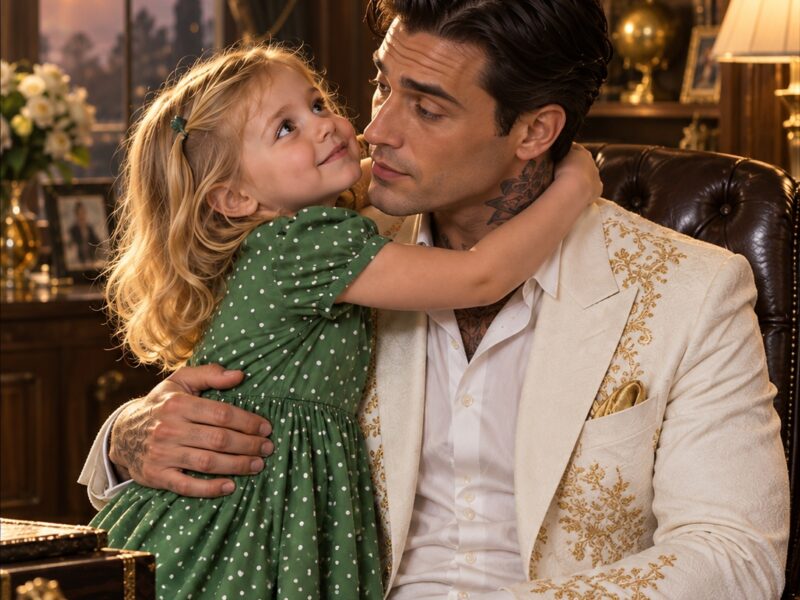
“Can You Hug Me for Five Minutes?” the Maid’s Toddler Asked the Mafia Boss—He Froze
“Can you hug me for five minutes?”
Victor Calder stopped turning the page.
The private breakfast room went so quiet that the soft hiss of the espresso machine in the adjoining kitchen suddenly sounded enormous.
Three men seated around the long walnut table looked toward the little girl standing beside Victor’s chair.
Maisie Nolan was four years old.
She wore yellow leggings, pink sneakers with one loose strap, and a housekeeping vest several sizes too large because she had apparently stolen it from her mother’s cart again.
A gray stuffed rabbit hung from one hand.
Her other hand rested against Victor Calder’s sleeve.
Nobody touched Victor without permission.
Not employees.
Not attorneys.
Not men who had known him twenty years.
Certainly not children wandering into rooms where conversations were conducted behind locked doors.
Vincent Hale, Victor’s security chief, rose first.
“Maisie.”
The child looked at him.
“Come away from Mr. Calder.”
Victor lifted one finger.
Vincent stopped.
Maisie looked back at Victor.
“You didn’t answer.”
Victor had spent most of his forty-four years learning how to respond when men lied, threatened, begged, negotiated, or reached for weapons.
No one had trained him for a four-year-old requesting a timed embrace before eight in the morning.
“Why five minutes?”
Maisie considered the question as if the answer should have been obvious.
“Because shorter doesn’t work.”
Something in Victor’s chest tightened.
At that moment Clare Nolan appeared in the doorway.
Her housekeeping key card swung from one wrist.
A stack of pillowcases was tucked against her hip.
The color left her face.
“Oh, God.”
She put the linens down so quickly two slipped to the floor.
“Maisie.”
Her daughter turned.
“Mama.”
“I told you to stay in the employee lounge.”
“I got lonely.”
Clare crossed the room.
“I’m sorry, Mr. Calder.”
She reached toward Maisie.
The little girl moved closer to Victor’s chair.
Not hiding exactly.
Just choosing a side.
Victor noticed.
Clare did too.
“I am so sorry,” she repeated. “My childcare canceled. Mrs. Conti said I could keep her downstairs until my break. She must have followed the breakfast cart.”
Maisie corrected her.
“I followed Bunny.”
Clare closed her eyes for half a second.
“Bunny was on the cart.”
“Yes.”
“So you followed the cart.”
Maisie thought.
“Bunny followed the cart first.”
One of the attorneys lowered his face toward his coffee.
Victor saw his shoulders move.
“Leave us,” Victor said.
The attorney stopped smiling.
All three men stared at him.
Victor looked toward Vincent.
“Ten minutes.”
Vincent understood.
He collected the folders.
The others followed.
Clare did not.
“Mr. Calder, I should take her downstairs.”
Victor’s eyes remained on Maisie.
“Why five minutes?”
Clare’s hand tightened around her daughter’s shoulder.
“Sir—”
“I asked her.”
That came out colder than he intended.
Maisie did not seem frightened.
Clare did.
Victor softened his voice.
“Why five?”
Maisie hugged the rabbit to her chest.
“Daddy said that’s how long.”
Victor went still.
Clare’s expression changed.
Not fear.
Something closer to pain.
Maisie continued.
“He said when somebody is sad, you hug them and count.”
Her small fingers opened and closed against the rabbit.
“One Mississippi. Two Mississippi. All the way to three hundred.”
Victor did not breathe.
The marble room disappeared.
He was twelve again.
Rain against a rowhouse window.
His father shouting downstairs.
A sixteen-year-old boy sitting beside him on the bedroom floor, one arm wrapped around Victor’s shoulders.
Don’t listen to him.
Victor remembered counting.
Not aloud.
Into the fabric of his brother’s sweatshirt.
One Mississippi.
Two Mississippi.
Three.
Gabriel always made him finish.
Three hundred, his brother would whisper. Five minutes. That’s how long it takes your body to remember it isn’t alone.
Victor’s hand flattened against the breakfast folder.
No one had said those words to him in thirty-two years.
Clare was watching him now.
Victor looked at her.
“What was your husband’s name?”
She froze.
Maisie answered first.
“Adam.”
Victor’s eyes stayed on Clare.
“Adam what?”
“Nolan.”
“Where was he from?”
Clare’s face tightened.
“Why?”
It was the first time he had heard her challenge him.
Quietly.
But definitely.
Victor looked at Maisie.
“Who taught your daddy that five-minute rule?”
Maisie shrugged.
“His brother.”
The room seemed to contract.
Clare took her daughter’s hand.
“That’s enough.”
Victor looked up.
“What brother?”
“I don’t know.”
“You were married to him.”
Clare’s mouth tightened.
“And he didn’t talk about his family.”
“Never?”
“Almost never.”
“Why?”
She looked at Maisie.
“Not in front of her.”
Victor understood that boundary even while everything inside him demanded answers.
He stood.
Too quickly.
The chair scraped backward.
Maisie flinched.
Victor immediately hated the sound.
He steadied himself.
“Vincent.”
The security chief appeared within seconds.
“Boss?”
“Cancel breakfast.”
“It already ended.”
“The meeting.”
Vincent’s eyebrows moved.
“The port review?”
“Yes.”
“Victor.”
“Cancel it.”
Vincent looked at Clare.
Then Maisie.
He did not ask.
“Done.”
Victor looked at Clare again.
“I need to speak with you.”
She straightened.
“About my husband?”
“Yes.”
“No.”
The refusal surprised the room.
Even Maisie looked up.
Clare’s voice shook, but she continued.
“You can ask me about my employment. You can fire me if bringing Maisie upstairs violated policy. But you don’t get to interrogate me about my dead husband because my daughter said something strange.”
Victor stared.
Most people mistook his silence for anger.
Clare seemed to know better.
She simply held Maisie’s hand tighter.
Finally Victor nodded.
“All right.”
She blinked.
He looked toward the little girl.
“What about the hug?”
Clare’s eyes widened.
Maisie smiled.
“You still need it.”
“How do you know?”
“You have the sad face.”
Victor almost asked which one.
Then Maisie imitated him.
Chin slightly lowered.
Mouth flat.
Eyes distant.
It was uncomfortably accurate.
Clare covered her lips.
Victor sat again.
Then did something none of the men waiting outside would have believed if told.
He opened one arm.
Maisie climbed into his lap.
No hesitation.
No fear.
She wrapped both arms around his neck.
Victor’s body locked.
The child smelled like strawberry shampoo and toast.
Her stuffed rabbit pressed awkwardly between them.
Victor had not held a child since his nephew’s funeral eleven years earlier.
He had forgotten how little they weighed.
Maisie began counting.
“One Mississippi.”
Victor closed his eyes.
“Two Mississippi.”
The past came back in pieces.
Gabriel laughing with a split lip.
Gabriel stealing food after their father locked Victor in his room.
Gabriel standing at seventeen between Anthony Calder and his younger brother.
Gabriel disappearing at twenty-nine.
A burned car near the harbor.
A dental identification.
A coffin Victor was told not to open.
Three hundred never arrived.
At twenty-seven, Maisie forgot where she was.
At twenty-eight, she started over.
Victor opened his eyes.
Clare stood beside the window, watching her daughter hold a man most of Baltimore preferred to avoid.
Tears shone in her eyes.
Not sentimental ones.
Grief.
Victor recognized it.
Maisie eventually whispered, “Three hundred.”
Then released him.
“There.”
Victor’s voice came rough.
“There what?”
“You’re not alone.”
He looked at her.
The phrase went deeper than the counting.
Victor reached for the rabbit because he needed something to do with his hands.
“What’s his name?”
“Rabbit.”
“That’s not creative.”
“Bunny was taken.”
“By whom?”
“My old rabbit.”
Victor nodded gravely.
“Understandable.”
Maisie smiled.
Clare did not.
Victor handed the toy back.
“You can go with your mother.”
Maisie slid down.
At the door, Victor spoke.
“Clare.”
She stopped.
“I won’t question you today.”
Her shoulders relaxed by perhaps an inch.
“But I need your husband’s date of birth.”
They tightened again.
“Why?”
Victor looked at the closed door.
“Because either your husband learned something from my brother…”
He paused.
“…or I have spent fifteen years believing the wrong man was dead.”
Clare’s face went completely still.
Maisie tugged her hand.
“Mama?”
Clare looked down.
Then back at Victor.
“You really knew someone who counted like that?”
“My brother.”
“What was his name?”
“Gabriel.”
Something passed across her face.
Fast.
Too fast for most people.
Not for Victor.
Recognition.
He rose.
“You know that name.”
“No.”
“Clare.”
“I heard it once.”
“From Adam?”
She hesitated.
Then nodded.
“When?”
“Two weeks before he died.”
Victor felt cold.
Adam Nolan had been dead almost three years.
A construction accident outside Annapolis.
That much Victor knew from the routine background check performed before Clare was hired.
“What did he say?”
Clare looked toward Maisie.
Victor understood.
“Vincent.”
“Yes.”
“Mrs. Conti can sit with Maisie in the conservatory.”
Clare immediately shook her head.
“No.”
Victor stopped.
“My daughter stays with me.”
“Then she stays.”
He looked toward Vincent.
“No questions around her.”
Vincent nodded.
Clare seemed surprised.
Victor was surprised too.
They moved to the smaller library.
Maisie settled on the rug with colored pencils and a pad of hotel stationery someone had brought from another Calder property.
Clare sat opposite Victor.
Vincent remained near the door.
Not because Victor needed protection from Clare.
Because Victor suddenly did not know who else he needed protection from.
“What did Adam say?”
Clare stared at her hands.
“He was in the hospital.”
“For the construction accident?”
“Yes.”
Adam had fallen two stories when temporary scaffolding failed at a renovation site.
He survived surgery.
Died two days later from internal complications.
Clare continued.
“He was on pain medication. In and out.”
“Did he say Gabriel?”
“He said, ‘Tell Gabriel I tried.’”
Victor’s face hardened.
“You never looked for him?”
“I did.”
“How?”
“Google.”
Despite everything, Vincent almost smiled.
Clare saw.
“I wasn’t married to a man who left me instructions for organized crime.”
Victor’s eyes sharpened.
“Careful.”
“No.”
Her grief suddenly became anger.
“I’m tired of everyone acting like I should have understood things Adam never explained.”
She leaned forward.
“He worked maintenance and construction. He made pancakes badly. He forgot birthdays unless I put them in his phone. He cried when Maisie was born.”
Her voice broke.
“He was my husband.”
Victor said nothing.
Clare wiped beneath one eye.
“Then he dies and leaves me one sentence with a name I don’t know.”
“What else?”
“A key.”
Victor’s pulse shifted.
“What kind?”
“Small. Brass.”
“Where?”
“At home.”
“Did he say what it opened?”
“No.”
“Did you try?”
“Yes.”
“And?”
“I don’t know what lock it belongs to.”
Victor leaned back.
Clare studied him.
“What are you thinking?”
“That my brother carried a brass key.”
“So do millions of people.”
“Yes.”
“Then don’t do that.”
Victor frowned.
“Do what?”
“Turn my husband into your brother because you want him back.”
The sentence landed cleanly.
Vincent looked away.
Clare continued.
“You have one phrase. One name. A key you haven’t seen.”
She breathed slowly.
“That is not proof.”
Victor felt something unexpected.
Respect.
“Correct.”
Clare blinked.
“You agree?”
“Yes.”
“I thought men like you hated being told they might be wrong.”
“Men like me?”
Her face flushed.
“You know what I mean.”
“I do.”
Victor looked toward Maisie.
She was drawing three people beneath what appeared to be a violently purple sun.
“We verify.”
Clare’s mouth tightened.
“How?”
“Records first.”
“No DNA without my permission.”
Victor looked at her.
She had thought ahead.
“Agreed.”
“No taking Maisie anywhere.”
“Agreed.”
“No telling her anything until we know.”
“Agreed.”
Vincent looked at Victor.
Three agreements in under a minute.
Possibly a personal record.
Clare noticed too.
“What if Adam was your brother?”
Victor’s eyes returned to her.
He had not allowed himself to answer that.
Finally he said, “Then someone lied very well.”
“Who?”
Victor looked toward the rain-dark windows.
“My father.”
Vincent’s expression changed.
Anthony Calder had been dead fourteen years.
People still lowered their voices when speaking his name.
Victor continued.
“My brother Gabriel disappeared in 2011.”
Clare listened.
“He was twenty-nine.”
“What happened?”
“A car burned near Pier Nine.”
Victor’s jaw tightened.
“Police recovered a body.”
“And you were told it was him.”
“Yes.”
“Told?”
“Dental records confirmed it.”
“You didn’t see him?”
“The body wasn’t viewable.”
Clare’s expression softened despite herself.
“I’m sorry.”
Victor ignored the sympathy.
“Gabriel had been fighting with my father for months.”
“About what?”
“Business.”
“That word does a lot of work around you.”
Vincent looked toward the ceiling.
Victor almost smiled.
Almost.
“Gabriel wanted out.”
“Out of the family?”
“Out of what the family was.”
Victor folded his hands.
“He thought we could move everything legitimate.”
“And you?”
“I thought he was naïve.”
Clare stared.
“You were twenty-five?”
“Twenty-five and arrogant enough to think cynicism was intelligence.”
That surprised her.
“What did your father think?”
“That Gabriel was dangerous.”
“Because he wanted to leave?”
“Because he knew where the bodies were.”
Clare’s face changed.
Victor added, “Figuratively.”
Vincent coughed.
Victor looked at him.
“Mostly.”
Clare did not laugh.
Probably wise.
“What happened before the fire?”
“Gabriel and my father had a fight.”
“About?”
“I don’t know.”
“You were there?”
“For the beginning.”
Victor remembered it too clearly.
Anthony at the head of the dining table.
Gabriel standing.
A folder in his hand.
Victor near the door.
Their father saying, You don’t get to clean a name you didn’t build.
Gabriel answering, You didn’t build it. You buried people under it.
Victor had never understood what folder contained.
“The next night Gabriel disappeared.”
“And your father?”
“Said Romano people had taken him.”
“You believed him.”
Victor looked at Clare.
“Yes.”
“Why?”
“Because twenty-five-year-old sons often believe fathers they have spent their whole lives trying to impress.”
Clare said nothing.
Vincent stepped forward.
“I can start with Nolan’s records.”
Victor nodded.
“Outside Calder systems.”
Vincent looked at him.
That instruction mattered.
“Why outside?”
Clare asked.
“Because if Gabriel survived, someone inside my family made sure I believed he didn’t.”
The room became quieter.
Maisie looked up from her drawing.
“Is Bunny family?”
Clare wiped her face quickly.
“Yes, baby.”
Maisie nodded.
Then colored him green.
Victor’s first search found nothing dramatic.
Adam James Nolan.
Born May 14, 1982, in Harrisburg, Pennsylvania.
Parents listed as Daniel and Ruth Nolan.
Both deceased.
Public school.
Army service for four years.
Honorable discharge.
Construction and industrial maintenance work.
Marriage to Clare Bishop in 2018.
Maisie born in 2021.
Death in 2023.
Ordinary enough to disappear inside.
Too ordinary, Victor thought.
Then Vincent found something small.
Adam Nolan’s Social Security record did not appear before 2014.
Clare stared at the report.
“What does that mean?”
“Could be clerical.”
Vincent said it carefully.
“Records get corrected.”
Victor nodded.
“Keep going.”
Military service created another problem.
No photograph in the database available to Victor’s investigator.
Personnel record partly restricted.
But the enlistment date existed.
Same year Adam’s Social Security history began.
“Witness protection?” Clare asked.
Victor shook his head.
“Possibly.”
“Can you just call someone?”
“Yes.”
“Are you going to?”
“No.”
“Why?”
“Because if a federal agency hid him, asking through the wrong person tells them who is looking.”
Clare stared at him.
“You think like this all the time?”
“Yes.”
“That sounds exhausting.”
“It is.”
Maisie came into the library carrying two cookies.
She handed one to Victor.
“You look tired.”
Clare closed her eyes.
Victor accepted the cookie.
“Thank you.”
Maisie pointed.
“Five minutes?”
“No.”
“Three?”
Victor looked at Clare.
She was trying not to smile.
“One cookie.”
Maisie considered the exchange rate.
“Okay.”
She climbed onto the sofa anyway.
Not touching him.
Just close.
Victor returned to the file.
Five minutes later, Maisie fell asleep against his arm.
He did not move for forty-three minutes.
The brass key arrived the next morning.
Clare brought it in a sandwich bag because she did not own evidence sleeves and did not appreciate Vincent laughing when she said that.
Victor recognized it immediately.
Not the key itself.
The scratch near the head.
A crude letter G cut with a pocketknife.
Gabriel had marked everything that belonged to him when they were children.
Victor still owned an old baseball glove with the same uneven G.
He did not touch the key.
Clare watched his face.
“You know it.”
“I know the mark.”
She sat.
“What does it open?”
Victor looked toward Vincent.
“Pier Nine.”
Clare’s stomach tightened.
“What at Pier Nine?”
“There used to be employee lockers under Warehouse Four.”
“The building that burned?”
“Yes.”
“Would any still exist?”
“Warehouse Four was demolished.”
Clare’s disappointment appeared.
Victor continued.
“But some storage units were moved before demolition.”
“Where?”
“One of my father’s old waterfront properties.”
Vincent had already started typing.
Two hours later they found an inventory entry from 2012.
Twelve steel lockers transferred to a Calder storage warehouse in Dundalk.
Most were later scrapped.
One was retained because it had “legal hold contents.”
Locker 317.
Victor stared.
Gabriel’s birthday was March 17.
Clare saw his face.
“No.”
“Yes.”
“You cannot possibly know—”
“I don’t.”
Victor stood.
“We check.”
Locker 317 remained in a secured archive room beneath a Calder-owned warehouse.
Victor had not entered that building in years.
He brought only Vincent and Clare.
Maisie stayed with Mrs. Conti at the estate.
Clare insisted on that.
Victor agreed.
The locker was smaller than memory.
Dented gray steel.
Rust near the base.
Number 317 stamped above the handle.
Victor inserted the key.
It turned.
Clare stopped breathing.
Inside sat one canvas duffel.
A Baltimore Orioles cap.
A cheap wristwatch.
Two notebooks sealed in plastic.
A photograph.
Victor reached for that first.
Gabriel.
Alive.
Older than the last image Victor remembered.
Standing beside Clare.
Victor looked at her.
She took the photograph.
Her knees nearly gave.
“That was our first apartment.”
Her fingers touched Adam’s face.
“No.”
Not denial.
Recognition collapsing into another name.
Victor looked closer.
Hair cut differently.
A beard.
A scar near the jaw Victor did not remember.
But eyes did not change that much.
Neither did the crooked left index finger Gabriel broke when they were teenagers.
Adam Nolan was Gabriel Calder.
Clare sat on an overturned crate.
“He never told me.”
Victor could not speak.
The photograph showed Gabriel with one arm around Clare.
Behind them, taped to a refrigerator, was a sonogram image.
Maisie.
Victor leaned against the locker.
His brother had lived.
Married.
Become a father.
Died.
And Victor had lost him twice without knowing the second death was happening.
Clare started crying.
Not quietly.
The kind of grief that anger had held back for years.
“I slept beside him.”
She covered her face.
“I had his child.”
Victor remained still.
“I buried him.”
Her voice broke.
“And he never told me his name.”
Victor understood why betrayal and grief could exist inside the same body without canceling each other.
He looked toward the duffel.
A sealed envelope sat beneath the notebooks.
Written across the front:
FOR CLARE — IF VICTOR EVER FINDS YOU
Clare stopped crying.
Vincent moved toward the door.
“I’ll wait outside.”
Victor nodded.
Clare picked up the envelope.
Her hands shook.
“Did you know?”
“No.”
“You swear?”
“Yes.”
She opened it.
The letter inside ran six pages.
Gabriel’s handwriting changed by the second page.
Victor knew it.
His brother pressed harder when angry.
Clare began reading silently.
Then stopped.
“Read it.”
Victor’s voice came low.
“It’s addressed to me.”
“I know.”
Clare looked at him.
Then started aloud.
Clare, if you’re reading this, I ran out of time or courage. Maybe both.
Her voice shook.
My name was Gabriel Anthony Calder. Adam Nolan wasn’t fake exactly. I became him because Gabriel was supposed to be dead.
Clare paused.
Her face folded.
Victor looked away.
She continued.
I didn’t tell you because I thought secrets kept you safe. That is the same lie men in my family used for years, and I hate that I became good at it.
Victor closed his eyes.
My brother Victor is not the man my father was. But when I disappeared, I did not know whether Victor would become him. I was afraid to find out.
Victor absorbed that without defense.
If Maisie exists when you read this, tell her I loved her before she had a name. Tell her five minutes is still five minutes. Tell her I stole that rule from the only good thing I knew how to do for my little brother when we were kids.
Clare’s voice failed.
Victor took the letter.
He continued.
Victor, if this reaches you, I am sorry. I should have trusted you enough to let you prove who you were. I didn’t.
Victor’s vision blurred.
He read on.
But before you decide Dad lied only because he wanted control, understand what I found. Pier Nine was not a Romano attack. Dad ordered the warehouse cleared after I found records showing Graham Pike had been selling schedules, union information, and acquisition plans to both sides. Graham knew the building had safety violations. Dad knew too.
Victor looked at Vincent.
His expression had hardened.
Graham Pike.
Victor’s senior counsel.
His father’s former consigliere.
The man who had attended Gabriel’s funeral.
The man who still sat at Victor’s right hand twice a week.
Victor continued.
I confronted Dad because I thought Graham was stealing from us. I was wrong about the size of it. Graham had been using the waterfront conflict to drive down property values. Dad learned about it and chose to profit instead of expose him. Pier Nine burned after both of them had reason to want records inside gone. I cannot prove who ordered the fire.
Victor stopped.
Important.
Gabriel had not claimed what he did not know.
Just like the source of every dangerous truth Victor had learned to trust.
Clare whispered, “Keep going.”
I survived because a dockworker pulled me through a service exit before the roof came down. I had burns, a broken shoulder, and no idea who I could trust. Graham’s man came to the hospital before Victor did. That answered enough.
Victor’s jaw tightened.
I left. A lawyer connected me with a federal investigator. They gave me Adam Nolan. The case went nowhere because records disappeared and I refused to testify while Victor was still inside the organization. Cowardice or survival. Call it what you want.
Victor read the final paragraph twice.
I came back to Baltimore because I wanted to tell Victor after Dad died. Then Graham found me first. He did not threaten me. He did something smarter. He told me Victor had become exactly what Dad wanted. He showed me photographs. Meetings. Men around him. I believed what I was afraid to believe.
Victor lowered the page.
Clare watched him.
“There’s more.”
He continued.
Years later I saw Victor quietly close two of Dad’s worst businesses and move the ports legitimate. That was when I knew Graham had lied. I started collecting proof. Then I met Clare. Then Maisie came. Suddenly dying for truth felt easier than risking them for it.
Victor swallowed.
If I had more time, I was going to reach out. The brass key leads to what I saved. Verify everything. Do not believe me because I’m dead. Do not believe Graham because he served Dad. Believe what can survive daylight.
The letter ended:
And Victor—if Maisie asks you for five minutes, give them to her. She has no idea why she asks. That is probably the best thing about her.
Victor folded the letter.
No one spoke.
Clare stared at the floor.
“You knew the phrase.”
“Yes.”
“He taught it to her.”
“Yes.”
“He knew she might meet you.”
Victor looked toward the locked archive door.
“He hoped.”
Clare laughed once through tears.
“That idiot.”
Her anger finally had somewhere human to land.
“He could have called.”
“Yes.”
“He could have trusted me.”
“Yes.”
“He could have told me before I married him.”
“Yes.”
Clare looked at Victor sharply.
“You’re not going to defend him?”
“No.”
“Why?”
“Because love doesn’t make what he did fair to you.”
That silenced her.
Victor looked at the notebooks.
“May I?”
Clare nodded.
Gabriel’s notes were not a confession.
They were better.
Dates.
Company names.
Property records.
A list of city inspection notices.
Copies of trust disbursements.
References to safety reports before the Pier Nine fire.
And Graham Pike’s name appearing repeatedly beside decisions made after Anthony Calder’s death.
Victor read for two hours.
One pattern emerged.
Graham had not merely protected Anthony’s old lie.
He had maintained it.
A worker named Elias Mercer had been blamed publicly for financial negligence around Pier Nine.
Gabriel’s notes suggested Mercer controlled union accounts but had no authority over warehouse maintenance.
Calder lawyers opposed three attempts to reopen Mercer’s case.
Graham signed two of those oppositions.
A surviving witness named Walter Dayne appeared in one note.
Presumed dead in Calder records.
Alive in municipal records.
Receiving quiet housing support from a trust Graham administered.
Victor sat back.
The air felt thin.
Clare asked, “What does this mean?”
“It means my brother left questions.”
“Not answers.”
“No.”
She nodded.
“Good.”
Victor looked at her.
“Good?”
“If he had left you a perfect story, you’d want to believe it.”
She touched Gabriel’s letter.
“This is harder.”
Victor almost smiled.
“My brother would have liked you.”
Clare looked at the photograph.
“He did.”
The words hurt both of them differently.
Victor did not confront Graham.
Not yet.
That evening he returned home before dinner.
Maisie was building a tower from wooden blocks in the family sitting room.
She saw him.
“You came back.”
Victor stopped.
He had not realized she expected him.
“I live here.”
Maisie nodded.
“Still.”
That sounded like information.
Clare sat on the sofa.
Her eyes were tired.
She had agreed they would not tell Maisie about Gabriel’s identity yet.
Not until they understood more.
Victor respected that.
Maisie held up one block.
“Do you want to play?”
“I have work.”
Clare looked at him.
Not accusing.
Simply watching.
Victor remembered Gabriel’s last line.
He removed his jacket.
Sat on the rug.
“What am I building?”
“A house.”
“I’m bad at houses.”
“You have one.”
“That does not mean I built it.”
Maisie handed him a block.
“Then learn.”
Clare looked away so he would not see her smile.
Later, Maisie fell asleep on the sofa.
Victor stood near the fireplace.
Clare approached.
“You’re going after Graham.”
“Yes.”
“Carefully?”
“Yes.”
“That sounded too quick.”
Victor looked at her.
“You don’t trust me.”
“I don’t know you.”
Fair.
“What do you want?”
“I want Maisie outside it.”
“She will be.”
“I want Adam—Gabriel—”
She corrected herself painfully.
“I want whatever happened to him proven before anyone turns his memory into a weapon.”
Victor nodded.
“And if your father was involved?”
“I expose what can be proven.”
Clare searched his face.
“Even if it destroys the story your family tells about itself?”
Victor looked toward Maisie sleeping.
“My family’s story already cost my brother his name.”
The next morning, Victor invited Graham Pike to breakfast.
Same walnut table.
Same room where Maisie asked for five minutes.
Graham arrived at eight precisely.
Seventy now.
Silver hair.
Wire-rim glasses.
A navy suit without a wrinkle.
He had advised Anthony Calder before Victor finished high school.
After Anthony died, Graham became the institutional memory of the Calder organization.
He knew where old agreements lived.
Which judges had retired.
Which enemies remained dangerous.
Which stories had become facts through repetition.
Victor poured coffee.
“Pier Nine.”
Graham’s hand paused.
Only once.
“What about it?”
“I’m reviewing waterfront redevelopment.”
That part was true.
Calder Holdings planned a major mixed-use project on several parcels near the old Pier Nine footprint.
Graham knew.
“We’ve already cleared historical title.”
“I know.”
“Then?”
Victor slid a city redevelopment certification across the table.
“No significant unresolved claims.”
Graham adjusted his glasses.
“Routine language.”
“Is it accurate?”
“As far as current records show.”
Victor nodded.
“What happened to Walter Dayne?”
The change was almost invisible.
Graham set down his coffee.
“Who?”
“Dockworker.”
“Victor, Pier Nine was more than thirty years ago.”
“Fifteen since Gabriel died.”
That name landed harder.
Graham’s expression softened.
Whether real or practiced, Victor could no longer tell.
“Your brother has nothing to do with waterfront title.”
“Maybe.”
Graham studied him.
“Why are we having this conversation?”
Victor leaned back.
“Because someone asked me a question yesterday.”
“Who?”
“A child.”
Graham smiled faintly.
“Children are dangerous researchers.”
Victor smiled too.
“Sometimes.”
He changed subjects.
Graham left fifteen minutes later.
Vincent followed him electronically.
Not close.
Not visibly.
Graham drove directly to a private records facility owned by Calder Legal Services.
He remained inside twenty-eight minutes.
When he left, he made two calls.
One to an attorney.
One to a number registered to the housing trust created after the Pier Nine fire.
Victor stared at the report.
Clare stood beside the window.
“He knows?”
“He knows I’m looking.”
“What now?”
“We let him believe I know less than I do.”
“That sounds dangerous.”
“It is.”
“You say that like you enjoy it.”
Victor looked at her.
“I used to.”
“And now?”
He glanced toward the hallway.
Maisie was somewhere upstairs arguing with Mrs. Conti about vegetables.
“Now I have more people to lose.”
Clare’s face changed.
She did not thank him for including them.
He appreciated that.
The investigation moved outside Calder channels.
Victor hired Naomi Price, a forensic accountant who had once testified against one of his legitimate competitors and therefore owed him nothing.
She cared about documents.
Not family mythology.
Gabriel’s notebooks gave her directions.
Nothing more.
Within three days she verified the first significant point.
Pier Nine had failed multiple safety inspections before the fire.
Blocked emergency exits.
Defective sprinklers.
Electrical violations.
Copies had been routed to the warehouse operator and Calder Waterfront Holdings.
Anthony Calder’s company.
Victor read the notice twice.
“My father knew.”
Naomi corrected him.
“His company received it.”
“That isn’t the same thing.”
“No.”
Clare, sitting across the conference table, looked at Victor.
He nodded.
“Keep the distinction.”
The second discovery was uglier.
Within weeks of the fire, Calder-backed entities acquired three neighboring waterfront parcels at substantially reduced values.
Profit after disaster.
Still not proof of arson.
But motive to tolerate danger.
The third discovery complicated everything.
Anthony Calder had created a legitimate worker housing trust six months after the fire.
It paid rent for displaced families.
Funded repairs.
Supported widows.
Quietly.
Not a publicity scheme.
Clare frowned.
“So was he guilty or sorry?”
Victor looked at the trust documents.
“Possibly both.”
“People hate that answer.”
“Reality does too.”
Naomi found Walter Dayne next.
Alive.
Sixty-eight.
Living in Baltimore.
Volunteer at a branch library twice a week.
Victor visited without security.
Walter recognized him before Victor spoke.
“You have Anthony’s eyes.”
Victor sat across from him.
“I’ve been told worse.”
Walter almost smiled.
Then Victor placed a photocopy of the safety notice on the table.
“Gabriel said you pulled him out.”
Walter’s face changed.
“Gabriel is dead.”
“Yes.”
Walter looked toward the windows.
“Then he told you.”
“He left notes.”
“That boy never learned when to let dead things stay buried.”
“He stayed buried fifteen years.”
Walter looked back at him.
“That wasn’t his choice.”
Victor did not waste time.
“Who burned Pier Nine?”
“I don’t know.”
The answer came fast.
Credible.
“What do you know?”
Walter looked at the safety notice.
“The building was dangerous.”
“Calder knew?”
“People around Calder knew.”
“My father?”
“I never saw Anthony read that notice.”
Victor nodded.
Walter noticed.
“You’re not going to make me say what helps you?”
“No.”
“Good.”
Victor waited.
Walter continued.
“Your brother had a folder.”
“What was in it?”
“Inspection copies. Property negotiations. Payments he thought connected Graham to Romano people.”
Victor’s jaw tightened.
“He confronted my father.”
“Yes.”
“How do you know?”
“Gabriel told me.”
“Before the fire?”
“That afternoon.”
Walter rubbed his right hand.
Two fingers moved stiffly.
“The fire started after midnight.”
“You pulled him out.”
“Barely.”
“Why did Calder records list you dead?”
Walter laughed without humor.
“Ask Graham.”
“Did he threaten you?”
“Not like movies.”
Walter looked toward the children’s section.
“He had someone mention my sister’s address. My nephews’ school.”
Quiet threats.
The kind that allowed everyone involved to pretend civility remained intact.
“I left.”
“Why not police?”
“I talked once.”
“And?”
“Information went somewhere.”
Walter studied Victor.
“Next morning Graham knew what I had told them.”
Victor felt his stomach tighten.
“Gabriel thought I was part of it.”
Walter was quiet.
“He didn’t know.”
“He should have called.”
“So should you.”
Victor stared.
Walter shrugged.
“You were his brother.”
The criticism hurt because it was true.
Victor had spent fifteen years framing himself as the abandoned one.
He had never asked what Gabriel believed he was escaping.
“Did my father know Gabriel survived?”
“I don’t know.”
“Did Graham?”
“Yes.”
“How?”
“He came looking.”
Victor’s hand tightened against the table.
Walter continued.
“Gabriel had already left the hospital.”
“What did Graham do?”
“Made sure the records became difficult.”
“Death certificate?”
“Never saw one.”
“Dental identification?”
Walter looked at him sharply.
“Whose dental records?”
That question followed Victor home.
The original identification report took Vincent six hours to obtain.
Dental comparison signed by Dr. Harold Pike.
Graham’s older brother.
Dead now.
Victor stared at the page.
Clare read over his shoulder.
“That doesn’t prove it was false.”
“No.”
“Can it be checked?”
“The remains were cremated.”
Clare closed her eyes.
“Convenient.”
Victor hated the word.
“Maybe.”
She looked at him.
“Maybe?”
“Gabriel told us to verify.”
That night Graham sent Victor a message.
We should talk before old grief starts making decisions for you.
Victor showed Clare.
She read it twice.
“That’s a threat.”
“No.”
“What is it?”
“An invitation to doubt myself.”
“Does it work?”
Victor looked at Gabriel’s letter beside him.
“Yes.”
That surprised her.
“Good.”
He frowned.
“Why?”
“Because people who never doubt themselves are terrifying.”
Victor almost smiled.
“You remain very comfortable criticizing me in my house.”
“You keep not firing me.”
“An oversight.”
Maisie entered in pajamas.
“Five minutes?”
Victor looked at her.
“Why?”
“You have the face.”
Clare laughed softly.
Victor sighed.
“Two.”
“Five.”
“Three.”
Maisie considered.
“Four and a cookie.”
Victor looked at Clare.
“She negotiates like you.”
Clare shook her head.
“She learned that here.”
Victor opened his arms.
Maisie climbed onto the sofa beside him and hugged him.
This time he did not freeze.
At one Mississippi, he thought about Gabriel.
At sixty, he thought about Anthony.
At one hundred twenty, he thought about Graham sitting at family dinners for decades.
At two hundred, Maisie yawned.
At two hundred eighty, Victor understood something.
Graham knew Clare and Maisie existed.
Maybe not who they were.
But if he learned Gabriel had a daughter, the child became leverage.
Victor ended the hug.
“Clare.”
She looked up.
“We need to move you.”
Her face closed.
“No.”
“You don’t understand.”
“I understand perfectly.”
“Graham may know.”
“Then add security.”
“He could target Maisie.”
“And taking us somewhere secret makes us dependent on you.”
Victor stopped.
Clare continued.
“That’s how Adam lived.”
The sentence changed everything.
Running.
Aliases.
Decisions made from fear.
Victor looked at Maisie.
“What do you want?”
Clare was not prepared for the question.
“What?”
“Stay here with visible security. Move to another property. Leave Calder employment entirely. I will cover relocation whether you stay employed or not.”
She stared.
“You’re giving me options?”
“I’m trying.”
Maisie whispered into Victor’s jacket, “Mama likes options.”
Victor looked down.
“I gathered.”
Clare chose to stay at the estate.
Not because Victor ordered it.
Because Graham would expect her to run if she became frightened.
Staying made her harder to isolate.
Vincent assigned two guards whose loyalty he personally verified.
Maisie called one Tall Sam and the other Other Sam even though neither was named Sam.
No one corrected her.
Graham moved next.
Not violently.
Legally.
A complaint reached the state child welfare hotline claiming Clare exposed her daughter to organized-crime activity while working at the Calder estate.
A second anonymous complaint alleged Clare used Maisie to extort money from Victor.
Clare stood in the kitchen holding the notice.
Her hands shook.
“He’s coming for her.”
Victor read it.
“We don’t know Graham filed this.”
“You believe he did.”
“Yes.”
“Then say it.”
Victor met her eyes.
“I believe he did.”
“What happens?”
“Child services investigates.”
“Can he take her from me?”
“Not because someone makes a call.”
“Victor.”
He lowered his voice.
“I don’t know.”
Clare looked like she might shatter.
That frightened him more than anger.
“My daughter is the only thing I have left.”
“No.”
She looked up.
“You have yourself.”
Her laugh was bitter.
“That is a very rich-man answer.”
“Maybe.”
He stepped closer but did not touch her.
“And you have evidence.”
“What evidence?”
“Employment records. Mrs. Conti’s childcare approval. Security footage. Pay records. Your apartment. School records.”
“You have cameras everywhere.”
“Yes.”
“For once I’m grateful.”
“So am I.”
The social worker arrived the next morning.
Victor did not attend the interview.
Clare insisted.
“You being in the room makes it look like I can’t answer without you.”
She was right.
He waited downstairs.
Maisie returned an hour later carrying a sticker.
“She liked Bunny.”
Victor looked at Clare.
Clare’s eyes were red.
“But?”
“Nothing.”
“The complaint?”
“Unsubstantiated so far.”
Victor exhaled.
Clare added, “There was something else.”
“What?”
“The caller knew Adam’s old military Social Security number.”
Victor went still.
That information did not appear in Clare’s employment file.
Not the public background report.
It appeared only in the restricted identity documents Naomi had recently obtained.
Which meant someone inside their investigation leaked it.
Victor turned to Vincent.
“Who has access?”
“Five people.”
“Names.”
Vincent listed them.
Himself.
Victor.
Naomi.
Daniel Mercer, the outside attorney.
And Graham.
Victor stared.
“How does Graham have access?”
Vincent’s face hardened.
“He shouldn’t.”
They checked the document portal.
One senior Calder legal credential had opened Adam Nolan’s identity file at 2:13 a.m.
Graham Pike.
That was evidence.
Not suspicion.
Victor called Graham.
“Dinner.”
A pause.
“When?”
“Tonight.”
“Your house?”
“Yes.”
“Should I bring anything?”
Victor looked at Gabriel’s letter.
“Your memory.”
Graham arrived at seven.
Clare and Maisie remained in the protected family wing.
Vincent controlled the doors.
Naomi waited in another room with copies of the evidence.
Victor seated Graham at the same dining table where Anthony Calder once presided.
No guards visible.
No guns on the table.
Graham looked almost amused.
“This feels theatrical.”
Victor poured wine.
“You taught my father that intimidation works better when people don’t notice it.”
Graham smiled.
“I taught your father many things.”
“Did you teach him how to fake Gabriel’s death?”
The smile vanished.
Victor watched the old man.
Not surprise.
Recognition.
“Where did you hear that?”
“Answer.”
Graham set down his glass.
“Gabriel survived Pier Nine.”
The words existed now.
After fifteen years.
Victor felt almost nothing.
Shock had already done its work days earlier.
“You knew.”
“Yes.”
“My father?”
Graham looked at the wine.
“At first, no.”
“And later?”
“He suspected.”
“Did he know?”
“Yes.”
Victor’s hand tightened.
“When?”
“Near the end.”
Years later.
After Victor had buried an empty story.
“Why didn’t he tell me?”
“Because Gabriel wanted to remain dead.”
“That isn’t your answer to give.”
“No.”
Graham leaned back.
“But it is true.”
Victor stared.
“What happened at Pier Nine?”
“Your brother misunderstood a complicated situation.”
Victor nearly laughed.
“That sentence has buried a lot of people.”
Graham’s eyes sharpened.
“Anthony received safety warnings. Yes.”
“Did he order the fire?”
“No.”
“Did you?”
“No.”
“Who did?”
“I don’t know.”
Victor believed that part.
Unfortunately.
Graham continued.
“The fire benefited us. That made every later action look uglier.”
“You bought land afterward.”
“Yes.”
“Cheap.”
“Yes.”
“While families buried people.”
Graham’s mouth tightened.
“Your father also housed those families.”
“After profiting from the reason they needed housing.”
“You think power arrives clean?”
“No.”
Victor leaned closer.
“I think that sentence is how men avoid washing their hands.”
Graham looked at him differently.
“Gabriel talked like that.”
“I know.”
“Then he ran.”
“He survived.”
“He abandoned you.”
Victor felt the old wound open.
Graham knew where to press.
“You stood beside his coffin.”
“You arranged it.”
“I protected him.”
“You protected yourself.”
Graham’s face hardened.
“From what?”
“His records.”
Silence.
Victor continued.
“Romano payments. Property acquisitions. Safety notices.”
“You have his notebooks.”
There.
Graham realized too late.
Victor had never mentioned notebooks.
The room changed.
Victor sat back.
“Thank you.”
Graham’s eyes closed briefly.
A mistake from a man who made very few.
“You opened Adam Nolan’s file last night.”
Graham looked toward the door.
“You filed a complaint against Clare.”
“No.”
“Someone using information only you accessed did.”
“That isn’t proof.”
“No.”
Victor nodded.
“Which is why I’m not accusing you of filing it.”
Graham looked at him.
“I’m accusing you of trying to find out what Gabriel left.”
The old man said nothing.
Victor continued.
“You’ve spent years controlling what survives.”
“The housing trust survived.”
“So did Walter.”
“Because I made sure he did.”
That surprised Victor.
Graham saw it.
“You think everything is simple now?”
“No.”
Graham leaned forward.
“Anthony wanted Walter watched.”
“Why?”
“Because Walter could reopen Pier Nine.”
“So you paid his housing support.”
“Yes.”
“Hush money?”
“Support.”
“Leverage?”
“Both.”
At least he admitted it.
“Mercer?”
Graham’s expression shifted.
“Elias Mercer was convenient.”
Victor’s stomach turned.
“You knew he was being blamed for things outside his authority.”
“Yes.”
“And you fought his petitions.”
“Yes.”
“After my father died.”
Graham said nothing.
There.
Personal responsibility.
No Anthony to hide behind.
“Why?”
“Because reopening Pier Nine reopened everything.”
“Including your role.”
“Yes.”
The honesty was almost relieving.
Graham looked tired suddenly.
“I built structures around Anthony’s compromise.”
“Lies.”
“Structures.”
“Lies with filing cabinets.”
Graham smiled faintly.
“You’ve become sentimental.”
“My brother had a daughter.”
That removed the smile.
Victor watched carefully.
“You didn’t know.”
“No.”
“You know now.”
Graham’s gaze hardened.
“So that’s what this is.”
“What?”
“Redemption.”
Victor shook his head.
“No.”
He thought of Clare.
Of Maisie counting Mississippi against his shoulder.
“It’s documentation.”
Graham stood.
“If you expose Pier Nine, you freeze the redevelopment.”
“Yes.”
“Hundreds of jobs.”
“Maybe.”
“Union contracts.”
“Yes.”
“Financing.”
“Yes.”
“You’ll damage people who had nothing to do with Anthony.”
Victor looked at him.
“That’s the first intelligent argument you’ve made tonight.”
Graham stopped.
Victor continued.
“So we separate what can continue from what must be reviewed.”
“You can’t.”
“We’ll see.”
“Victor.”
Graham’s voice softened.
“You think Gabriel would want you to burn everything down?”
“No.”
Victor stood.
“I think he wanted me to stop letting family stories outrank evidence.”
Graham looked old for the first time.
“What happens to me?”
“That depends on what the documents prove.”
“You could handle this privately.”
“Yes.”
“And you won’t.”
“No.”
“Why?”
Victor glanced toward the ceiling.
Above them, somewhere, Maisie was probably refusing bedtime.
“Because private truth is how we got here.”
The decisive evidence came forty-eight hours later.
Not from Gabriel.
Not from Walter.
From Calder Legal’s own archive.
After Graham’s access was suspended, Vincent found a scheduled destruction order covering Pier Nine historical liability files.
Added manually three days earlier.
Approved by Graham.
The order was frozen before anything was destroyed.
One folder was missing.
DAYNE / MERCER — LIABILITY & WITNESS AVAILABILITY.
Security footage showed Graham entering the archive two nights earlier carrying nothing.
Leaving twenty-three minutes later with a flat legal envelope.
Still not proof of what was inside.
Victor refused to jump.
Then the envelope appeared in Graham’s current Pier Nine redevelopment file after outside counsel issued a preservation order.
He had not destroyed it.
He had moved it under privilege.
Controlled access.
Controlled survival.
Victor opened the folder with Naomi and Vincent present.
There was no confession.
Truth rarely arrived with a title page.
Instead:
A memo noting Walter Dayne refused to confirm a revised timeline.
A legal analysis acknowledging Elias Mercer had no operational authority over the warehouse’s physical safety.
Correspondence showing Calder counsel knew Walter survived.
And an old handwritten note from Anthony Calder.
We benefited from a story that put too much on Mercer. Can we correct part of it without destabilizing the harbor?
Victor read the sentence until the ink blurred.
His father knew.
Not everything.
Enough.
Anthony had profited.
Allowed a false story to stand.
Then years later tried, weakly and incompletely, to repair it.
Graham had advised against reopening anything.
Again.
Again.
Again.
The final document was more recent.
An email from Graham to an associate after Anthony’s death.
The Calder position remains unchanged. Historical ambiguity serves present stability. Do not encourage review.
Clare read it that night.
“Present stability.”
“Yes.”
“That’s what he called lying?”
“Yes.”
She looked at Victor.
“What are you going to do?”
“Friday’s city hearing still happens.”
“The redevelopment?”
“Yes.”
“You’re signing?”
“No.”
Clare nodded.
Not praise.
Approval would have been easier.
Instead she asked, “What happens to the workers if the project freezes?”
Victor appreciated the question.
“We restructure the application.”
“How?”
“Undisputed parcels proceed. Pier Nine parcels enter independent title review.”
“Can you do that?”
“Not quickly.”
“So it costs you.”
“Yes.”
Clare looked toward Maisie’s bedroom.
“Good.”
Victor raised an eyebrow.
“That sounded personal.”
“It is.”
Friday morning, Baltimore Municipal Hearing Chamber was packed.
Reporters had learned something was wrong.
Union representatives filled two rows.
Graham sat with independent counsel.
No longer representing Calder Holdings.
Victor entered without spectacle.
No security line.
Vincent remained near the rear.
Clare did not attend.
Neither did Maisie.
Victor insisted.
This truth would not be placed on a child’s shoulders.
When his name was called, Victor stood.
He began with the safety notice.
Calder interests received warnings before the Pier Nine fire.
He presented the property acquisitions.
The worker trust.
Walter’s independently verified survival.
Mercer’s limited legal authority.
The petitions Graham opposed.
Archive access.
The destruction order.
The recovered folder.
No dramatic accusations.
Documents.
Dates.
Decisions.
One city commissioner interrupted.
“Mr. Calder, are you saying your father caused the Pier Nine fire?”
“No.”
The room quieted.
“I have no evidence establishing who caused the fire.”
A reporter’s fingers froze over her keyboard.
Victor continued.
“I am saying Calder entities had notice of safety failures before people died. Calder-connected entities benefited from depressed property values afterward. My father later recognized that public responsibility had been distributed unfairly and failed to correct it fully.”
He looked toward Graham.
“After my father’s death, people with authority continued protecting that version.”
Graham stood.
“You are stripping context from decades of legal decisions.”
Victor looked at him.
“That is why I am requesting independent review.”
He turned back to the panel.
“Calder Harbor Group will not sign the historical certification currently before the city.”
A murmur spread.
“We are withdrawing Pier Nine parcels from the present redevelopment application pending title and liability review.”
One commissioner frowned.
“That will significantly affect financing.”
“Yes.”
“Jobs.”
“Yes.”
“Timeline.”
“Yes.”
Victor did not soften it.
“We will negotiate a revised application for undisputed parcels and honor current worker commitments where legally possible.”
Graham laughed once.
Quietly.
“This began because a maid’s little girl asked for a hug.”
The room shifted.
Victor turned slowly.
There it was.
The attempt to make the smallest person responsible for everything that followed.
“No.”
His voice remained calm.
“No factual finding presented here depends on Maisie Nolan.”
Graham’s face tightened.
“She repeated a phrase.”
“She reminded me of a question I had stopped asking.”
Victor looked toward the hearing panel.
“Everything after that came from municipal records, insurance records, archived Calder documents, verified witness history, financial filings, security logs, and preserved legal correspondence.”
Then he looked at Graham.
“Do not put thirty years of adult choices on a four-year-old.”
No one spoke.
Victor continued.
“And do not put them on her mother.”
That ended it.
Not the legal case.
Not the hearings.
Not the audits.
But Graham’s control of the story.
For the first time in decades, evidence existed where people outside the Calder family could see it.
Graham faced professional investigation over archive manipulation, witness suppression, and later filings.
Whether every action became criminal was left to prosecutors.
Victor did not speculate publicly.
He had finally learned the difference between suspicion and proof.
The city ordered an independent historical review.
Mercer’s family was notified.
Walter gave one formal statement.
Nothing more.
He returned to reading badly to children at the library.
Three months later, Elias Mercer’s name was formally removed from several city summaries that had implied operational responsibility he never held.
His daughter attended the union meeting where the corrected record was read.
Victor did not.
Some moments did not need a Calder in the room.
Clare stayed at the estate through the end of the year.
Then she resigned.
Victor received the letter during breakfast.
He read it.
Looked up.
“You’re leaving.”
“Yes.”
“Why?”
“I want Maisie in a normal preschool.”
“That seems judgmental.”
Clare smiled.
“It is.”
Victor folded the letter.
“What will you do?”
“Hotel housekeeping supervisor.”
“Where?”
“Annapolis.”
“Salary?”
She named it.
Victor frowned.
“Too low.”
“Not your problem.”
“Correct.”
She waited.
He surprised both of them.
“Congratulations.”
Her face softened.
“Thank you.”
Victor looked toward the door.
“And Maisie?”
“She intends to visit.”
“I see.”
“She says you still owe her twenty-eight minutes.”
“How?”
Clare laughed.
“I stopped asking.”
They left six weeks later.
Victor paid nothing Clare had not earned.
No secret apartment.
No oversized check.
No job invented to keep her nearby.
He did quietly fund the preservation and expansion of the worker housing trust Anthony had started after Pier Nine.
Not under Maisie’s name.
Not Gabriel’s.
The beneficiaries did not need the Calder family’s grief turned into branding.
Victor also changed the organization.
Slowly.
Some illicit operations were sold or closed.
Others had already been moved legitimate years earlier.
Vincent joked that Gabriel had finally won an argument fifteen years late.
Victor did not laugh the first time.
The second time, he did.
The hardest part was Gabriel.
There was no clean reconciliation with a dead man.
Victor visited Adam Nolan’s grave outside Annapolis.
The headstone carried the name Gabriel chose.
ADAM JAMES NOLAN
HUSBAND. FATHER.
Victor stood there for almost an hour.
He did not change the stone.
That mattered.
Gabriel Calder was his brother.
Adam Nolan was the man Clare and Maisie loved.
One truth did not need to erase the other.
Victor placed the old photograph beneath the flowers.
“You should have called.”
Wind moved through the cemetery trees.
Victor stared at the name.
“I should have looked.”
Both statements remained true.
He took Gabriel’s brass key from his pocket.
Almost left it.
Changed his mind.
The key belonged to the living evidence now.
He kept it.
A year after Clare left, Maisie visited the Calder estate on a rainy Saturday.
She was five.
Then almost six, as she informed anyone who made the mistake of calling her five.
Clare dropped her off for an afternoon visit and stayed for coffee with Mrs. Conti.
Maisie found Victor in the library.
He was reviewing shipping contracts.
She stood beside his chair.
“Are you working?”
“Yes.”
“Is it fun?”
He looked at her.
“No.”
“Then don’t.”
He stared.
She had said almost the same thing during one of their first conversations.
Children repeated truths adults spent years trying to complicate.
Victor closed the folder.
Maisie climbed onto the sofa.
She had grown.
Not much.
Enough.
She no longer carried Rabbit everywhere.
Now a small plastic bracelet covered one wrist.
Victor pointed.
“What is that?”
“Friendship bracelet.”
“Who is your friend?”
“Emily.”
“Should I be jealous?”
“Yes.”
Victor nodded solemnly.
“Devastating.”
Maisie studied him.
“You have the face.”
Victor sighed.
“What face?”
“The sad one.”
“I have only one face.”
“No.”
She counted on her fingers.
“Mad face.”
“One.”
“Thinking face.”
“Two.”
“Someone-lied face.”
Victor stared.
“Your mother has been talking.”
Maisie grinned.
Then her expression softened.
“Do you miss Daddy?”
The question arrived without warning.
Victor did not hide.
“Yes.”
“Me too.”
She moved closer.
“Mama told me his other name.”
Victor went still.
“When?”
“My birthday.”
“What did she tell you?”
“That Daddy used to be Gabriel, and you were his little brother.”
Victor nodded.
Maisie studied him carefully.
“Did you love him?”
“Yes.”
“Even when you were mad?”
“Especially then.”
She considered this.
“Were you mean?”
“Sometimes.”
“Was he?”
“Yes.”
“What did he do?”
Victor smiled faintly.
“He put hot sauce in my cereal once.”
Maisie gasped.
“Why?”
“I broke his cassette player.”
“What’s that?”
Victor closed his eyes.
“I suddenly feel very old.”
She laughed.
Then became serious.
“Mama said Daddy was scared.”
“Yes.”
“Of you?”
Victor could have softened it.
He did not.
“Yes.”
Maisie looked troubled.
“But you’re nice.”
“Sometimes.”
She touched his hand.
“Maybe he didn’t know.”
Victor swallowed.
“No.”
“He should have asked.”
“Yes.”
Maisie thought.
“You should have asked too.”
Victor looked at her.
Children were ruthless in their fairness.
“Yes.”
She nodded.
Problem solved enough for a six-year-old.
Then she opened both arms.
“Five minutes?”
Victor smiled.
This time there was no shock.
No frozen breath.
No room full of powerful men watching.
“Five.”
Maisie climbed into his arms.
She began counting.
“One Mississippi.”
Victor rested his cheek lightly against her hair.
“Two Mississippi.”
Outside, rain tapped the library windows.
“Three Mississippi.”
His brother’s voice came back.
Not the fear.
Not the fire.
Not the funeral.
The teenage boy on a bedroom floor holding a frightened younger brother while their father shouted downstairs.
Victor had spent most of his life believing Gabriel taught him that five minutes could make fear disappear.
That was not quite right.
Fear remained.
So did grief.
So did anger.
Five minutes simply gave the body somewhere safe to carry them.
At one hundred sixteen, Maisie lost count.
Victor corrected her.
“You skipped twelve.”
“I did not.”
“You went from one hundred four to one hundred seventeen.”
“That’s close.”
“It is mathematically offensive.”
“You sound like Mama.”
“That is the cruelest thing anyone has said to me today.”
Maisie giggled against his shoulder.
They started over.
Victor did not mind.
By the time they reached three hundred, his phone had vibrated nine times on the table.
He had ignored all nine.
Maisie pulled back.
“Better?”
Victor thought carefully.
“Yes.”
“See?”
“You remain annoyingly confident.”
“That means right.”
“No.”
“Usually.”
Victor laughed.
Clare stood in the doorway.
He had not heard her enter.
She watched them.
Not sentimental.
Not fearful.
Just quiet.
“You ready?” she asked Maisie.
“No.”
“We agreed four o’clock.”
Maisie looked at Victor.
“Can I live here?”
“No,” both adults said.
She frowned.
“That was fast.”
Clare held out her hand.
Maisie climbed down.
At the doorway she turned.
“Uncle Victor?”
It was the first time she had called him that.
Victor felt the word land somewhere old.
“Yes?”
“Daddy said five minutes works.”
“He did.”
“Was he right?”
Victor looked toward the brass key resting beside Gabriel’s recovered letter in a locked glass case.
Then at the little girl.
“Yes.”
Maisie smiled.
She left with her mother.
Victor returned to the desk.
His phone vibrated again.
Vincent.
He answered.
“You’re late.”
“I know.”
“The board has been waiting fourteen minutes.”
“They’ll survive.”
Silence.
Then Vincent laughed.
“That child ruined you.”
Victor looked toward the empty doorway.
“No.”
He reached for the shipping folder.
“She reminded me what survived.”
Years later, that remained the version Victor preferred.
Not that a little girl saved a mafia boss.
Not that one hug redeemed a violent family.
Life was not that obedient.
Victor still carried decisions he regretted.
Gabriel remained dead.
Anthony Calder’s compromises remained part of the family history.
Graham’s legal consequences did not return thirty lost years to anyone.
Clare never became dependent on Victor’s money.
Maisie did not grow up believing she had fixed damaged adults simply by loving them correctly.
That mattered most.
She had asked a question.
Victor had finally listened.
Then he verified.
Documented.
Changed what could still be changed.
The Calder name remained powerful, but less mysterious.
Old family records were placed under independent governance.
Pier Nine victims received additional compensation after the historical review.
Worker protections became binding conditions on Calder redevelopment projects.
Victor stopped calling transparency weakness simply because his father had taught him secrecy looked like strength.
Once a year, he visited Gabriel’s grave.
Sometimes Clare came.
Sometimes Maisie did.
Usually Victor went alone.
He would stand beside the stone and talk badly.
Not prayers.
Arguments.
Updates.
“You would hate the new board.”
“You were right about Graham.”
“You were wrong about me.”
Pause.
“I was wrong about you too.”
Then he would leave.
On Victor’s fiftieth birthday, Maisie arrived at his house carrying a wrapped box.
She was ten now.
Tall for her age.
Her hair darker.
Far too capable of using sarcasm, which Victor blamed entirely on Clare.
“What is it?”
“Open it.”
Inside was a wooden kitchen timer.
Five minutes marked in bright red.
Victor stared.
“This is insulting.”
“It’s educational.”
“What am I supposed to do with it?”
Maisie smiled.
“When you get the face.”
Victor looked toward Clare.
She lifted both hands.
“Not me.”
Maisie placed the timer on his desk.
“Sometimes people don’t know how to ask.”
Victor’s expression changed.
That sounded older than ten.
Maisie shrugged.
“Daddy knew.”
Victor touched the timer.
“He did.”
“And now you do.”
She headed toward the door.
“Where are you going?”
“Cake.”
“You brought me a timer and immediately abandoned me.”
“Yes.”
“Terrible niece.”
She grinned.
“Five minutes later.”
Victor laughed.
After she left, he turned the timer.
Tick.
Tick.
Tick.
The study remained quiet.
The brass key rested in its case.
Gabriel’s letter beside it.
No shrine.
No mythology.
Evidence of one frightened man who had loved badly, hidden too much, and still managed to leave one good thing behind.
Victor listened until the bell rang.
Five minutes.
Not enough to undo the past.
Never enough for that.
But enough to remember that silence did not mean abandonment.
Enough to decide what came next.
And sometimes, Victor Calder had learned, that was the difference between inheriting a family’s damage and finally refusing to pass it on.









