“Do I Look Funny Now?” the Maid’s Little Daughter Asked—Then the Mafia Boss Laughed, and Her Teddy Bear Unraveled His Family’s Oldest Betrayal
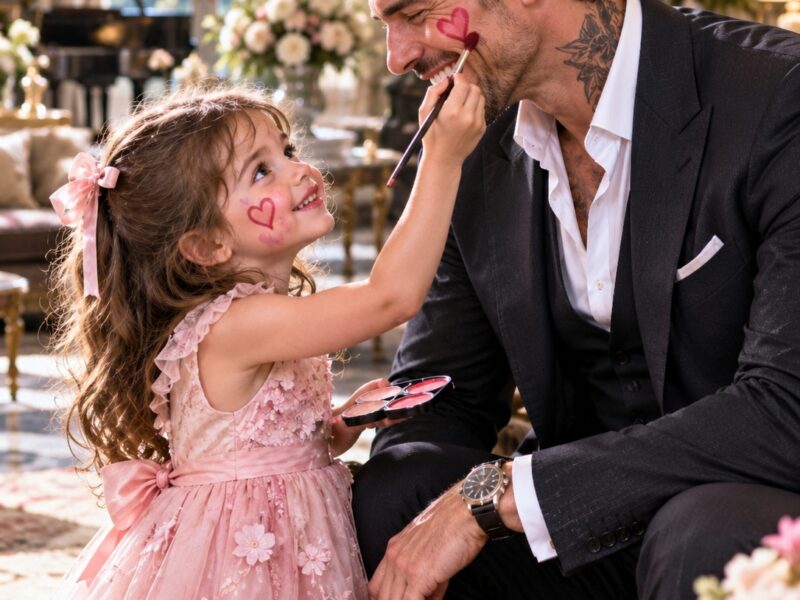
The first person to make Dominic Caruso laugh in five years was four years old, wearing pink face powder in her hair and three different shades of lipstick across her mouth.
She stood in the middle of his private sitting room while eight dangerous men pretended they had suddenly forgotten how to breathe.
“Do I look funny now?” she asked.
Dominic looked at her.
Then at the red heart drawn crookedly across one cheek.
Then at the powdered eyebrows.
Then at the tiny plastic makeup brush clutched in her fist like a weapon of great administrative importance.
The corner of his mouth moved.
Nobody in the room dared acknowledge it.
Lucy Vega took another step.
“Mr. Dominic?”
That did it.
A laugh escaped him.
Low at first.
Rusty.
Almost surprised.
Dominic immediately covered his mouth with one hand as though the sound itself had betrayed him.
Lucy smiled.
The harder she smiled, the harder Dominic laughed.
By the time Frank Mercer, his security chief, turned his face toward the window to hide a grin, Dominic Caruso—the man whose name made port supervisors return calls at midnight and whose silence could end arguments between men twice his size—had bent forward in his chair with tears gathering at the corners of his eyes.
Nobody had ever seen it.
Nobody except the little girl who had caused it.
The sitting-room door opened.
Marisol Vega appeared on the threshold.
Her apron was dusted with flour.
A strand of dark hair had escaped the knot at the back of her neck.
She had been searching for Lucy for eleven minutes.
Her eyes moved across the room.
Eight men.
Dominic.
Lucy.
Then the walnut desk.
A locked leather case sat open beside a stack of files.
Inside it, partially visible, was a handgun.
Lucy stood no more than three feet away.
All color left Marisol’s face.
“Lucy.”
The laugh vanished from Dominic.
Marisol crossed the room quickly, dropped to her knees, and pulled her daughter against her.
“Mommy.”
“What did I tell you?”
“I was making myself pretty.”
“You were supposed to stay in the kitchen.”
“But Teresa had flour.”
“That is not—”
Marisol stopped.
She looked toward Dominic.
Fear reorganized her face.
Not fear of him specifically.
Fear of losing something.
Her employment.
Housing.
The thin structure holding her life together.
“Mr. Caruso, I’m sorry.”
Dominic said nothing.
“I turned away for maybe one minute.”
“No more than that.”
“My sitter called this morning. She’s sick.”
“I couldn’t find anyone else.”
“I shouldn’t have brought Lucy into this part of the house.”
“I’ll pay for whatever she touched.”
Lucy whispered:
“I only touched the makeup.”
Marisol closed her eyes.
Dominic looked toward the desk.
He stood.
Every man around the long conference table instinctively straightened.
Dominic crossed the room.
Marisol tightened her arm around Lucy.
He did not approach them.
Instead he went to the desk.
Closed the leather case.
Locked it.
Then placed the key inside his pocket.
When he turned back, his expression was no longer amused.
It was something Marisol could not read.
“Frank.”
The security chief looked over.
“Yes?”
“No unsecured firearms in residential rooms again.”
Frank’s eyebrows moved.
Dominic continued.
“I don’t care whose meeting it is.”
“Understood.”
One of the men at the table looked uncomfortable.
Dominic glanced at him.
“If that is inconvenient, meet somewhere else.”
Nobody argued.
Dominic returned his attention to Marisol.
“The child did nothing wrong.”
Marisol stared.
“She entered a room she was told not to enter.”
“That is between you and her.”
He looked down at Lucy.
Lucy hid behind her mother’s shoulder.
Only slightly.
Dominic added:
“The red heart is objectively terrible.”
Lucy gasped.
Frank coughed into his fist.
Marisol nearly forgot she was frightened.
Lucy touched her cheek.
“You laughed.”
“I did.”
“That means funny.”
“That is a strong legal argument.”
“I’m four.”
“So I’ve heard.”
Lucy considered him.
Then nodded as if deciding the matter was settled.
Marisol rose.
“I’m sorry.”
Dominic’s eyes returned to her.
“You said that already.”
“I need this job.”
There.
The real sentence.
Marisol hated saying it.
She had spent the last two years needing things from people.
Doctors.
Landlords.
School administrators.
Employers.
Neighbors.
People who looked at her daughter before looking at her bank balance.
Dominic’s expression changed.
“You are not losing your job.”
Marisol’s throat tightened.
“Mr. Caruso—”
“You had no childcare.”
“No.”
“You brought your daughter because the alternative was not working.”
“Yes.”
“That is not misconduct.”
“It is in most houses like this.”
“This is my house.”
His voice was quiet.
“Today it isn’t.”
Marisol had no answer.
Dominic looked toward Frank.
“The meeting is over.”
There was immediate movement.
Folders closed.
Men stood.
No objections.
One older man named Calvin Rourke remained seated half a second longer than everyone else.
Marisol noticed because his eyes were on Lucy.
Then he stood too.
Calvin was Dominic’s chief operating lieutenant.
Fifty-eight.
Gray hair.
Measured voice.
He had been one of the first men to welcome Marisol when she started six months earlier.
Always polite.
Always asking whether Lucy liked the cookies Teresa baked.
Always calling Marisol “Mrs. Vega,” never “the maid.”
He gave her a small smile on his way out.
“Children improve meetings.”
Dominic looked at him.
“Not yours.”
Calvin laughed.
The door closed.
Silence returned.
Marisol looked down at Lucy.
The little girl had already forgotten terror.
She was studying Dominic.
“Do you have makeup?”
“No.”
“You should.”
“Why?”
“You look tired.”
Dominic stared.
Marisol covered her daughter’s mouth.
“Lucy.”
Dominic laughed again.
Smaller this time.
But real.
That was how it began.
Marisol had arrived at the Caruso estate in March because Teresa Alvarez knew her mother from church.
The estate sat above the Hudson outside Tarrytown, close enough to New York City for men in expensive suits to arrive before breakfast and far enough away for everything unpleasant to disappear behind trees.
Dominic inherited it when his father died.
He also inherited Caruso Freight Holdings, Caruso Maritime Services, six warehouses, two restaurants, several commercial properties, and the darker machinery that moved beneath those businesses.
Newspapers used careful phrases.
Federal investigators used less careful ones.
Marisol had avoided learning more than necessary.
Necessary already felt dangerous.
Her husband Mateo had been dead two years.
Truck accident.
Rain.
Brake failure on Route 9.
That was what the police report said.
Marisol had read the same two pages so many times the folds had nearly separated.
Mateo had driven commercial freight.
Not directly for Dominic, she thought.
For a subcontractor called North Hudson Transport.
After his death, bills gathered.
Then Lucy’s cardiologist found a congenital defect.
Not immediately life-threatening.
But serious enough to require surgery.
Marisol remembered sitting in a hospital corridor staring at an estimate she could not pay.
Then a week later a social worker called.
An anonymous medical foundation had covered the remaining balance.
Marisol cried so hard she could not thank the woman properly.
She never learned who funded it.
She had assumed anonymous miracles were best left unnamed.
Six months after Lucy recovered, Teresa called.
“The Caruso house needs help.”
Marisol had hesitated.
Everyone knew the name.
Teresa said:
“The pay is good.”
Marisol asked:
“Is it safe?”
Teresa answered after too long:
“For people who know when not to ask questions.”
Marisol took the job.
She did not have the luxury of moral purity purchased by somebody else’s rent money.
For the first weeks she barely saw Dominic.
He left early.
Returned late.
Ate alone.
Spoke little.
Staff moved around him with the quiet precision of people trained not to interrupt pressure.
Lucy changed that accidentally.
The morning after the makeup incident, Marisol arrived at the kitchen before sunrise.
Lucy was with the neighbor that day.
A note sat beside the coffee machine.
White paper.
Heavy handwriting.
The child may use the small room beside the library when necessary.
Below:
Please keep makeup away from her.
Marisol stared.
Teresa appeared behind her carrying bread dough.
“He wrote that.”
“I assumed.”
“Dominic does not write notes.”
“Apparently he does now.”
Teresa smiled.
“It has been a long time since that man laughed.”
Marisol looked over.
“Why?”
Teresa’s smile faded.
“His father.”
“What happened?”
Teresa shook her head.
“Not my story.”
Good answer.
Two days later, Lucy returned because her sitter was still ill.
Marisol brought books.
Crayons.
Snacks.
A faded brown teddy bear named Mr. Bear.
Mateo had bought it the afternoon Lucy was born.
One ear leaned sideways from repeated repairs.
Lucy carried the bear everywhere.
At eleven that morning Marisol walked past the library and heard voices.
One deep.
One small.
She stopped.
Dominic sat at the end of a long table.
Lucy occupied the opposite chair.
Between them lay crayons.
“Why do you wear black?”
Dominic considered.
“It is efficient.”
“What does efficient mean?”
“It saves unnecessary decisions.”
“Black is boring.”
Dominic looked at his suit.
“That is opinion.”
“It’s true.”
“That is still opinion.”
Lucy drew a purple line.
“What’s your favorite color?”
Dominic seemed genuinely troubled.
“I don’t know.”
Lucy stopped coloring.
Everybody has a favorite color.”
“I don’t.”
“You should pick.”
“Why?”
“So people know what balloon to get you.”
Dominic looked toward the ceiling.
“Blue.”
“Dark blue or happy blue?”
Marisol bit the inside of her cheek.
Dominic answered with the seriousness of a treaty negotiation.
“Dark.”
Lucy nodded.
“That makes sense.”
Marisol continued walking before either noticed her.
She smiled all the way to the linen room.
Small changes accumulated.
A child-sized cup appeared in the kitchen cabinet.
Dominic started eating breakfast at the side table rather than carrying coffee upstairs.
Teresa claimed coincidence.
Frank claimed security scheduling.
Marisol knew both were lying.
One afternoon Lucy’s teddy bear split along the ear.
She cried as if the world had become permanently unjust.
Marisol promised to fix it after work.
At ten that evening she went back to the kitchen for thread.
The light was on.
Dominic sat at the island.
Mr. Bear was in his hands.
A sewing kit lay open.
Marisol stopped.
He looked up.
“This is going badly.”
She laughed.
Dominic frowned.
“You find that funny.”
“Yes.”
“Helpful.”
“You’re pushing the needle through stuffing instead of the seam.”
“I noticed resistance.”
“That was the bear.”
Dominic looked down.
Marisol came over.
“Move.”
He moved.
She showed him how to fold the torn edges together.
Dominic watched.
“Mateo used to sew?”
“No.”
“He stapled a Halloween costume once.”
“Then why is this seam different?”
Marisol looked.
A section along the bear’s back had been stitched in darker thread.
“Mateo repaired it.”
“When?”
She thought.
“About a week before he died.”
Dominic’s expression changed.
Almost nothing.
His fingers pressed along the seam.
Then stopped.
Marisol noticed.
“What?”
“There’s something hard inside.”
“Probably part of the stuffing.”
“Stuffing is not rectangular.”
She took the bear.
Pressed.
He was right.
A tiny rigid shape.
Marisol frowned.
“Maybe a music box?”
“Does it play music?”
“No.”
Dominic looked at her.
“Then unlikely.”
She smiled.
“You investigate stuffed animals now?”
“I contain multitudes.”
Marisol laughed.
Dominic smiled.
Then the phone in his pocket vibrated.
The smile vanished.
He stood.
“Don’t cut that seam yet.”
“Why?”
He paused.
“I don’t know.”
“You’re being strange.”
“Yes.”
Then he left.
Marisol carried Mr. Bear upstairs.
For several nights, she forgot about the hard shape.
Dominic did not.
He ordered Frank to quietly pull every available file on Mateo Vega.
Not because of the toy.
He told himself that.
Because coincidence had begun arranging itself too neatly.
Mateo drove freight through Caruso-controlled terminals.
Mateo died in a brake failure.
Mateo repaired a child’s teddy bear days before death.
Something hard remained inside.
Dominic knew enough about frightened men to respect the places they hid information.
Then another problem surfaced.
Marisol’s name appeared in an old financial file.
Not as debt.
As beneficiary.
Lucy Vega.
Cardiac surgery.
$84,370.
Paid through the Valenti Children’s Medical Trust.
Dominic stared at the page.
The trust was one of his legitimate philanthropic funds.
He had authorized the payment himself.
But he had not remembered the child’s name.
Not until now.
Three years earlier, after a quiet internal inquiry suggested Mateo’s crash might not have been mechanical, Dominic had ordered financial support for the surviving family.
He never contacted them.
He told himself anonymity protected them.
Maybe it protected him from facing them.
Frank entered his office.
“You wanted the Vega file.”
Dominic tapped the folder.
“What did Mateo see?”
“Still unclear.”
“Who supervised North Hudson then?”
Frank hesitated.
“Calvin.”
Dominic looked up.
“Rourke?”
“Yes.”
“And who conducted the internal review after Mateo died?”
“Calvin.”
Dominic sat back.
For the first time in a long while, a familiar coldness entered him.
Not proof.
But a shape.
Frank saw it.
“You think Calvin?”
“I think certainty is expensive.”
“What do you want?”
“Nothing yet.”
Frank nodded.
“Watch him.”
“Already am.”
Dominic looked toward the closed study door.
“And nobody touches that bear.”
Frank blinked.
“The child’s bear?”
“Yes.”
“Understood.”
Three days later Marisol entered Dominic’s study without permission.
She did it because a storm had blown open one of the tall windows and papers had scattered across the carpet.
She intended only to stack them.
Then she saw the pale-blue folder.
VEGA, LUCY — CARDIOLOGY.
Marisol stopped.
She opened it.
Bills.
Surgical report.
Payment records.
Every invoice marked paid.
Authorized by Dominic Caruso.
Before she had ever worked in the house.
Her hands started shaking.
“Marisol.”
She turned.
Dominic stood in the doorway.
No jacket.
No surprise.
Only tired recognition.
“You paid these.”
He closed the door.
“Yes.”
“Why?”
He did not answer quickly enough.
“Dominic.”
“Mateo worked inside one of my freight networks.”
“My husband drove for North Hudson.”
“I owned forty-eight percent through another company.”
Marisol felt the floor shift.
“You knew him.”
“I met him twice.”
“Did he know who you were?”
“Yes.”
“And you knew he died.”
“Yes.”
“Everyone knew.”
“No.”
Her voice sharpened.
“You knew something else.”
Dominic looked toward the rain.
That told her.
Marisol whispered:
“It wasn’t an accident.”
“I don’t believe it was.”
The room went quiet.
She held the medical file against her chest as if it might stop her heart.
“You knew.”
“Not when it happened.”
“When?”
“Six months later.”
“And for a year and a half you said nothing.”
“I had suspicions.”
“You had enough suspicion to pay eighty thousand dollars.”
His jaw tightened.
“Yes.”
Marisol laughed once.
It sounded terrible.
“Why?”
“Guilt.”
There.
No decoration.
No noble story.
Marisol stared.
Dominic continued.
“I thought if Mateo died because of my business, Lucy should not also pay for it.”
“You didn’t think I should know?”
“I thought telling you would put you at risk.”
“No.”
She stepped closer.
“You thought deciding for me was easier.”
Dominic went still.
Marisol continued.
“Men love that sentence.”
“What?”
“I was protecting you.”
Her voice cracked.
“Mateo used it.”
Dominic looked up.
“He used to say, ‘Don’t worry about work, Mari. I’ll handle it.’”
“He handled everything until the day he did not come home.”
She wiped one angry tear.
“And now you tell me you protected me by hiding the reason?”
Dominic had no answer.
Good.
Marisol put the folder down.
“Who?”
“What?”
“Who killed him?”
“I don’t know yet.”
“You suspect someone.”
“Yes.”
“Who?”
Dominic said nothing.
The wall appeared.
Marisol saw it.
“You’re doing it again.”
“Marisol.”
She backed toward the door.
“No.”
“Listen.”
“No.”
“You found a name dangerous enough that you won’t say it.”
“I’m verifying.”
“And Lucy is here every day.”
“I have security.”
She laughed.
“Of course you do.”
Dominic took one step forward.
Marisol’s eyes flashed.
He stopped.
“I will not force you to stay.”
“Good.”
“But don’t leave without Frank escorting you.”
“That sounds like force with nicer grammar.”
He closed his eyes.
Fair.
When he opened them:
“Then tell me where you’re going.”
“No.”
“Marisol.”
“You don’t get information simply because knowing makes you comfortable.”
He stared.
That sentence landed.
She walked out.
Twenty minutes later Marisol packed their things.
Two bags.
Lucy’s coat.
Medicine.
Mr. Bear.
She told herself she was leaving because Dominic lied.
That was true.
She also left because the man she had begun trusting lived inside a world where people died for knowing things.
That was truer.
Lucy looked confused.
“Are we going home?”
“Yes.”
“Mr. Dominic didn’t say goodbye.”
“He’s busy.”
“Can we wait?”
“No.”
Marisol hated how sharp it sounded.
Lucy hugged Mr. Bear.
The estate’s long driveway was wet from rain.
Marisol carried one bag.
Lucy dragged the smaller one.
They had almost reached the outer gate when headlights appeared.
A dark sedan rolled across the road.
Stopped.
Calvin Rourke stepped out.
Gray coat.
Umbrella.
Kind face.
The same kind face he wore at breakfast.
“Mrs. Vega.”
Marisol stopped.
“Mr. Rourke.”
“Leaving?”
“Yes.”
“In this weather?”
“We’ll manage.”
His eyes dropped toward Mr. Bear.
A tiny movement.
Marisol felt every nerve in her body wake.
“You found something,” Calvin said.
She tightened her hand around Lucy’s.
“I don’t know what you mean.”
“In Dominic’s study.”
“Medical files.”
“Old things.”
His smile remained.
“Old things create new questions.”
Marisol’s pulse climbed.
Lucy pressed closer.
Calvin continued.
“Mateo was a decent man.”
Marisol stopped breathing.
“You knew him.”
“Oh, yes.”
“How well?”
“Well enough to know he should have minded his own route.”
Rain struck the umbrella.
Marisol’s hands went cold.
“You killed him.”
Calvin sighed.
“That word is dramatic.”
“You cut his brakes.”
“I ordered a mechanical delay.”
Her face twisted.
“Don’t.”
“He was supposed to miss a delivery.”
“You expect me to believe that?”
“No.”
The smile disappeared.
“That is the unfortunate part about consequences.”
Marisol pulled Lucy behind her.
Calvin looked toward the teddy bear.
“Mateo copied records.”
“What records?”
“Things Dominic never needed to know.”
“Things about you.”
“Partly.”
Marisol understood.
“The bear.”
Calvin’s eyes sharpened.
There.
He knew.
“Give it to me.”
“No.”
“Mrs. Vega.”
“No.”
Lucy whispered:
“Mommy?”
Marisol did not look away from Calvin.
“You searched everything after Mateo died.”
“Most things.”
“You never found this.”
“No.”
“And now you think whatever he hid is inside her toy.”
“Yes.”
Marisol tightened her grip.
Calvin stepped closer.
“I don’t want to hurt either of you.”
“You already did.”
“Not intentionally.”
“You killed my husband.”
“He forced a problem.”
“You sound like a man who has been forgiven by himself too many times.”
Calvin’s eyes went hard.
“Dominic has grown sentimental.”
“What does that have to do with me?”
“You and the child changed his habits.”
“Breakfast.”
“Lunch.”
“Coming home.”
“Where he stands in rooms.”
“People notice.”
Marisol felt sick.
“You’ve been watching us.”
“I watch everything that can affect him.”
Lucy said:
“Mr. Candy?”
Calvin looked down.
She remembered the peppermint candies.
His face changed.
Not guilt.
Annoyance.
That frightened Marisol more.
Calvin continued:
“I need Dominic to sign over the East River storage contracts.”
“What?”
“He has blocked me from restructuring them for two years.”
“And if he doesn’t?”
His eyes moved toward Lucy.
Marisol stepped fully in front of her.
“Don’t look at my daughter.”
Calvin smiled slightly.
“There’s the problem.”
“What?”
“He’ll listen now.”
A voice behind them said:
“No.”
Calvin turned.
Dominic stood in the rain.
No umbrella.
White shirt beneath an unbuttoned coat.
Frank stood several feet behind him.
Two security men farther back.
Dominic looked at Calvin.
“He won’t.”
Calvin laughed.
“You ran down the drive.”
Dominic said nothing.
Calvin looked him over.
“You actually ran.”
Marisol looked at Dominic.
His breathing was controlled.
Barely.
Calvin’s smile widened.
“You’ve gone soft.”
Dominic walked closer.
“Probably.”
The answer surprised everyone.
Calvin’s smile faltered.
Dominic stopped between Calvin and Marisol.
“You threatened a child.”
“I’m negotiating.”
“No.”
Dominic looked at him.
“You’re discovering what happens when the other person realizes the negotiation should never exist.”
Calvin’s expression hardened.
“Your father would be ashamed.”
“My father has been dead five years.”
“He built your organization.”
“He also taught me fear was loyalty.”
Dominic’s voice remained quiet.
“I believed him.”
Calvin glanced at Frank.
“Tell him.”
Frank did not move.
Calvin laughed.
“Look at this.”
“The great Caruso family reorganizing itself around a maid and a preschooler.”
Lucy tugged Marisol’s coat.
“Mommy?”
Dominic looked toward her.
Then back to Calvin.
“You killed Mateo Vega.”
Calvin stared.
“You don’t know that.”
“Not yet.”
A small shift.
Dominic saw.
“So that is why you need the bear.”
Calvin’s eyes snapped toward Lucy.
Too late.
Marisol understood at the same moment.
Dominic did too.
He turned toward her.
“Did you bring it?”
Marisol looked down.
Mr. Bear in Lucy’s arms.
“Yes.”
Calvin reached inside his coat.
Frank moved.
Dominic raised one hand.
Nobody drew anything.
Dominic’s voice lowered.
“Don’t.”
Calvin stopped.
“Not because I’m afraid of you.”
Dominic continued.
“Because if you move too quickly in front of that child, Frank will do something none of us can explain gently.”
Frank stared at the rain.
Accurate.
Calvin slowly removed his empty hand.
Dominic said:
“Friday.”
“What?”
“Pier Forty.”
“Come alone.”
Calvin’s eyes narrowed.
“I’ll bring whatever Mateo hid.”
“And the storage contracts?”
“If the evidence says what I think it says, the contracts will become irrelevant.”
Calvin studied him.
Then smiled.
“You finally sound like yourself.”
Dominic looked toward Lucy.
“No.”
“That’s the point.”
Calvin got back into his car.
Drove away.
Nobody moved until the gate closed.
Lucy looked up.
“Mr. Dominic?”
He crouched.
“Yes?”
“Are you mad?”
Dominic thought.
“Yes.”
“At us?”
“No.”
“At Mr. Candy?”
“Yes.”
Lucy considered.
“He needs time-out.”
Frank turned away.
Marisol covered her face.
Dominic laughed.
One short, helpless sound.
Even then.
Even now.
“Possibly.”
They returned to the kitchen.
Lucy fell asleep on a couch.
Teresa covered her with a blanket.
Mr. Bear remained under her arm.
Dominic, Marisol, and Frank stood at the island.
Dominic looked at Marisol.
“I found the hard object two weeks ago.”
She stared.
“You opened it?”
“No.”
“Why?”
“I didn’t know whether it belonged to you.”
“That didn’t stop you from investigating Mateo.”
“No.”
“Interesting boundaries.”
He accepted that.
“I was trying to be better.”
“Badly.”
“Yes.”
Frank said:
“Should I leave?”
Both looked at him.
“Probably,” he answered himself.
He walked to the door.
Marisol called:
“Stay.”
Frank stopped.
“If Mateo hid something, I want another witness.”
Dominic nodded.
Good.
Marisol lifted Mr. Bear carefully from Lucy’s arms.
The child stirred.
Did not wake.
At the kitchen counter, Dominic used a small seam cutter.
He opened the darker thread along the back.
Inside:
Stuffing.
More stuffing.
Then a black flash drive wrapped in wax paper.
Marisol’s knees nearly failed.
Dominic caught the counter instead of her.
A small thing.
But she noticed.
He gave her space.
Frank brought an offline laptop.
Dominic inserted the drive.
Folders appeared.
Invoices.
Shipping manifests.
Photos.
Audio files.
Bank transfers.
Names.
Calvin Rourke.
Again.
Again.
Again.
Payments from the Donnelly group, a rival criminal organization operating around New Jersey and Long Island.
Routes.
Storage schedules.
Cargo access.
Customs contacts.
Calvin had been selling information from inside Dominic’s businesses for at least four years.
Then another folder.
IF I DON’T COME HOME.
Marisol stopped breathing.
Dominic clicked.
A video opened.
Mateo.
Alive.
Sitting inside his truck cab.
He looked tired.
The timestamp was forty-eight hours before his death.
Marisol covered her mouth.
“God.”
Mateo looked into the camera.
“Mari.”
Her knees gave.
Dominic pulled a chair behind her.
Did not touch her.
She sat.
Mateo continued.
“If you’re watching this, I waited too long to tell you something.”
Marisol began crying.
Quietly.
Not because she had forgotten his voice.
Because memory had flattened it.
The recording gave it back dimension.
His pauses.
His breath.
The way he swallowed before difficult sentences.
“I saw Calvin Rourke take a payment at the Jersey warehouse.”
“I copied what I could.”
“He’s selling Caruso routes.”
“He knows somebody saw him.”
“I don’t know if he knows it was me.”
Mateo looked toward the passenger seat.
Mr. Bear sat there.
New.
Both ears straight.
Lucy had been one.
Marisol whispered:
“No.”
Mateo continued.
“I put the copy in Lucy’s bear because nobody searches a baby’s toy.”
Frank looked away.
Dominic’s face had gone completely still.
Mateo said:
“If Dominic Caruso sees this, I didn’t betray you.”
“I know what people say about you.”
“I don’t know which is true.”
“But Calvin is stealing from you.”
“And if he can kill me for seeing it, he’ll kill anybody else who gets close.”
Marisol sobbed once.
Mateo continued:
“Mari, I’m sorry.”
“I told myself I was protecting you by not saying anything.”
“That sounds stupid now.”
“I should have told you.”
“I should have given you the choice.”
Dominic closed his eyes.
Marisol looked at him.
He heard the echo too.
Then Mateo said:
“If I don’t come home, tell Lucy I loved her every day.”
“Not that I died for something.”
“Not that I was brave.”
“Just that I loved her.”
He paused.
“And if somebody gets this before Mari does…”
He swallowed.
“Help them.”
“My girls.”
The video ended.
No one spoke.
Rain tapped the windows.
Lucy slept.
Mr. Bear lay open on the counter.
Marisol cried into both hands.
Frank brought a towel.
She looked at him.
“A towel?”
He looked uncomfortable.
“It was closest.”
She laughed through tears.
That saved her from breaking completely.
Dominic stood motionless.
Then:
“There’s more.”
Marisol looked up.
Frank opened financial ledgers.
Not only Calvin.
Dominic’s organization.
Payments.
Shell companies.
Old bribes.
Tax evasion.
Off-book labor.
Transactions Dominic himself had approved.
Marisol stared.
“This destroys Calvin.”
Dominic nodded.
“And you.”
“Yes.”
Silence.
Frank looked at him.
“We can separate parts.”
Dominic’s gaze remained on the screen.
“How?”
“Turn over Calvin’s files.”
“Protect unrelated material.”
“Use counsel.”
“Negotiate.”
Dominic said nothing.
Marisol looked toward sleeping Lucy.
“Do it.”
Dominic turned.
“What?”
“Protect yourself.”
“You have proof for Mateo.”
“That’s enough.”
“No.”
“Dominic.”
“No.”
She stood.
“You have a child upstairs who thinks you’re funny.”
“I know.”
“You have people in this house who depend on you.”
“I know.”
“You don’t get to destroy everything because you suddenly found a conscience.”
His eyes met hers.
“That’s not what I’m doing.”
“What are you doing?”
Dominic looked at the drive.
“Stopping the rule that made Mateo expendable.”
Marisol’s throat tightened.
He continued.
“If I give investigators only Calvin, I tell myself my crimes were separate because mine didn’t kill your husband.”
“They weren’t separate.”
“They built the room he operated in.”
Frank said quietly:
“Boss.”
Dominic looked at him.
“You knew my father.”
“Yes.”
“He used to say weakness begins when you allow people to see where you care.”
Frank nodded.
Dominic glanced toward Lucy.
“He was wrong.”
Frank’s expression shifted.
Dominic continued.
“Weakness begins when everyone around you is too frightened to tell you the truth.”
Marisol looked at the purple makeup still faintly staining the collar of Lucy’s sweater.
Four years old.
No fear.
One question.
A laugh.
And somehow all roads led here.
Dominic contacted federal prosecutor Amelia Grant the next morning through outside counsel.
She had spent six years building cases around corrupt port contracting.
She did not trust him.
Good.
Dominic did not ask her to.
He offered the drive.
His books.
Calvin’s records.
A proffer.
No immunity demanded.
His attorney nearly resigned.
“You understand exposure?”
“Yes.”
“Prison.”
“Yes.”
“For tax conspiracy alone—”
“I know.”
“You are handing them cases they do not have.”
“I know.”
“Why?”
Dominic looked through the conference-room glass.
Marisol sat with Lucy in the waiting area.
The child was drawing.
“Because a dead driver left instructions.”
His attorney stared.
“What instructions?”
“Take care of my girls.”
“That is not a legal reason.”
“No.”
“It is the reason anyway.”
Calvin arrived at Pier Forty Friday evening.
Dominic met him.
No weapons visible.
No theatrics.
A briefcase rested on a table.
Calvin smiled.
“You came alone.”
“So did you.”
“Where’s the drive?”
“Gone.”
His smile disappeared.
“What?”
“Federal custody.”
Calvin’s hand twitched.
Dominic watched.
“Don’t.”
“You idiot.”
“Probably.”
“You handed over your own books?”
“Yes.”
Calvin laughed in disbelief.
“You’re going to prison.”
“Maybe.”
“For a maid?”
“No.”
“Then for the child.”
“No.”
Calvin’s voice rose.
“For what, then?”
Dominic looked at him.
“For the part of myself that kept calling men like you loyal because questioning you would cost me money.”
Calvin stared.
Dominic continued.
“Mateo saw you.”
“Copied everything.”
“He hid it.”
“You killed him.”
Calvin’s jaw tightened.
“You have no confession.”
“No.”
“Only records.”
“Those will do.”
Calvin laughed.
“Not for murder.”
Dominic’s expression did not change.
“You’re right.”
That confidence unsettled him.
Calvin looked around.
“Who is listening?”
“No one.”
“Then what is this?”
Dominic tapped the briefcase.
“Your resignation.”
Calvin opened it.
Corporate removal documents.
Termination of access.
Frozen partnership distributions.
Immediate independent audit.
All legal.
Calvin looked up.
“You think paperwork protects you?”
“No.”
“Then why?”
“Because the first thing I should have done when I suspected you was remove your authority.”
“I didn’t.”
“My mistake.”
Calvin’s face hardened.
“Mateo was going to ruin everything.”
Dominic said nothing.
Calvin continued.
“He had no idea what he copied.”
“True.”
“He thought he was some hero.”
“He specifically said he wasn’t.”
Calvin stopped.
Dominic looked at him.
“I watched his video.”
Calvin went pale.
Only slightly.
Enough.
“He begged?”
“No.”
“That sounds like him.”
Calvin’s mouth twisted.
“He should’ve kept driving.”
Dominic held his gaze.
“There.”
Calvin frowned.
“What?”
“The part where you always tell yourself the victim made you act.”
Calvin laughed.
“Don’t preach.”
“I’m not.”
Dominic checked his watch.
Outside, federal agents moved.
Calvin noticed too late.
The warehouse doors opened.
He looked at Dominic.
“You set me up.”
Dominic’s face remained calm.
“No.”
“You did that years ago when you decided nobody around you was allowed to question you.”
Calvin was arrested.
No shootout.
No dramatic execution.
No body on concrete.
Just handcuffs.
Charges.
Months of evidence.
A trial.
Mateo Vega’s death became part of a federal racketeering prosecution tied to sabotage, bribery, theft, and obstruction.
Calvin’s attorney argued the brake failure had been intended only to delay the truck.
Jurors did not find that comforting.
The mechanic who altered the system testified.
Payments matched.
Phone records matched.
Mateo’s video established motive and fear.
Calvin was convicted.
Dominic was prosecuted too.
Not for Mateo.
For his own books.
Tax conspiracy.
Illegal payments.
Records.
He pleaded guilty to charges his lawyers believed the government could prove.
He contested what they could not.
The judge accepted cooperation.
Restitution.
Divestment from several businesses.
Seventeen months federal custody.
The newspapers called it the Caruso collapse.
Frank called it “accounting with consequences.”
Marisol called it what it was.
Necessary.
That did not mean she forgave Dominic easily.
At sentencing, Lucy was five.
Marisol did not bring her into the courtroom.
She waited outside with Teresa.
Dominic found them afterward.
No handcuffs yet.
Plain suit.
Two marshals twenty feet away.
Lucy looked up.
“Are you leaving?”
“For a while.”
“Why?”
Dominic crouched.
“Because I broke rules.”
“How many?”
He almost smiled.
“More than three.”
“That’s bad.”
“Yes.”
“Do you have time-out?”
Marisol covered her mouth.
Dominic looked at Lucy.
“Yes.”
“How long?”
He glanced at Marisol.
“Longer than five minutes.”
Lucy frowned.
“That’s very bad.”
“Yes.”
She thought.
Then:
“Do you come back after?”
“If I do what I’m supposed to.”
“That’s not yes.”
Dominic smiled.
“No.”
“It is the truthful answer.”
Lucy nodded.
“Okay.”
Then she dug into her backpack.
Pulled out a folded piece of paper.
Purple crayon.
Dominic opened it.
RULE 5: NO LYING.
RULE 6: SAY SORRY.
RULE 7: COME BACK IF YOU CAN.
Dominic stared.
Marisol’s eyes filled.
Lucy pointed.
“Number seven is important.”
Dominic’s voice broke.
“I know.”
She hugged him.
He froze for half a second.
Then wrapped his arms around her.
Marisol watched.
She did not romanticize it.
A child loving a flawed man did not erase his history.
But neither did his history make the love false.
Both existed.
That was becoming the hardest lesson of Marisol’s life.
Dominic served fourteen months.
Lucy wrote almost every week.
Marisol dictated at first.
Then Lucy learned letters.
The correspondence was mostly rules.
Dear Mr. Dominic,
Rule 8: vegetables are not punishment.
Rule 9: you should say thank you to guards.
Rule 10: do not make a face at oatmeal.
Mr. Bear says hello.
Love, Lucy.
Dominic answered every one.
Dear Miss Vega,
Rule 8 is under appeal.
I comply with Rule 9.
Rule 10 is unreasonable but I am attempting reform.
Respectfully,
D. Caruso
Frank delivered some letters.
The prison mailed others.
Marisol wrote only twice.
The first:
Lucy’s cardiology appointment went well. Everything remains stable.
Dominic read that sentence three times.
The second:
I got the operations job at the hotel.
He wrote back:
Congratulations. You earned it.
Nothing more.
No demand.
No claim.
Good.
When Dominic was released, he did not return to the estate.
It had been sold.
He kept one legitimate logistics company and a small commercial real-estate portfolio overseen by a court-approved compliance program.
The great house became a conference center owned by a university.
Teresa complained the university would destroy the kitchen.
Frank said college students deserved punishment.
Dominic bought a smaller house near White Plains.
Five bedrooms.
One kitchen.
One office.
No ballroom.
No armed men inside.
Frank remained head of security for the legitimate company.
He said he stayed because somebody had to stop Dominic from buying black suits forever.
Marisol worked at a boutique hotel in Manhattan.
Operations coordinator.
Long hours.
Better salary.
Health insurance.
She rented a two-bedroom apartment in Yonkers.
No charity.
No Caruso property.
She insisted.
Dominic respected it.
Mostly.
The first time he visited after release was Lucy’s sixth birthday.
He arrived with a gift bag.
Lucy opened it.
Books.
No jewelry.
No expensive nonsense.
Marisol smiled.
“You asked Frank.”
“I asked three people.”
“Who?”
“Frank.”
“Teresa.”
“A bookseller.”
“Progress.”
Lucy looked at the final book.
“Why is this one about chess?”
Dominic froze.
“Do you not like chess?”
“I don’t know.”
“You once drew a rook.”
“That was a house.”
“Oh.”
Marisol laughed.
Dominic looked offended.
Lucy said:
“You can teach me.”
His expression softened.
“Okay.”
They began with pawns.
Then knights.
Lucy insisted knights were horses.
Dominic stopped correcting her.
Months passed.
Then years.
No grand romance.
Marisol refused to become a reward at the end of Dominic’s moral education.
Dominic did not ask her to.
They became friends.
Difficult friends.
She called when Lucy had to interview three middle schools and she needed someone to tell her she was overthinking.
He called when his company’s new HR director insisted executive managers attend conflict-resolution workshops.
“I have resolved conflicts for thirty years.”
“That sentence is why you need the workshop.”
“It is six hours.”
“Go.”
“You sound like Lucy.”
“Good.”
He went.
At eleven, Lucy discovered the hospital file.
Not the whole story.
Enough.
She came to Dominic’s house holding copies Marisol had kept.
“Did you pay for my surgery?”
Dominic looked at Marisol.
Marisol nodded.
Truth.
“Yes.”
“Why didn’t you tell us?”
“Because I was ashamed.”
Lucy frowned.
“Of helping?”
“No.”
“Of why help was necessary.”
He explained in age-appropriate language.
Mateo worked in a company connected to Dominic.
Bad people inside it hurt him because he found something they wanted hidden.
Dominic learned too late.
Instead of telling Marisol everything, he paid medical bills quietly.
Lucy listened.
“So you felt guilty.”
“Yes.”
“Was it your fault?”
Dominic thought carefully.
“Not the crash directly.”
“But I ran the kind of business where men believed hurting someone could solve a problem.”
Lucy looked down.
“That sounds like your fault a little.”
“Yes.”
Marisol watched his face.
Years earlier, he might have corrected the language.
Now he let it stay.
Lucy asked:
“Did Dad know you?”
“Yes.”
“Did he like you?”
Dominic almost smiled.
“I think he distrusted me.”
“Smart.”
Marisol laughed.
Dominic nodded.
“Probably.”
Lucy looked at him.
“Did you read his video?”
“Yes.”
“What did he say about me?”
Dominic’s throat tightened.
Marisol answered.
“He said he loved you every day.”
Lucy’s eyes filled.
“That’s all?”
“That was the important part.”
She nodded.
Then hugged Mr. Bear tighter.
The toy was nearly threadbare now.
The hidden seam remained visible.
Not evidence anymore.
Evidence lived in archives.
The bear belonged to Lucy.
At thirteen, Lucy asked Dominic another question.
“Do you love my mom?”
Marisol nearly dropped a bowl.
Dominic looked at Lucy.
“Why are you asking?”
“Because I have eyes.”
Marisol said:
“Lucy.”
“What?”
Dominic cleared his throat.
“Yes.”
Silence.
Lucy looked at Marisol.
“You knew?”
“No.”
Dominic’s face changed.
“That sounded wrong.”
Marisol laughed.
“When?”
He looked at her.
“Probably before prison.”
“That narrows nothing.”
“I didn’t know what to call it.”
Lucy stared.
“Adults are exhausting.”
She left the kitchen.
Marisol looked at Dominic.
“You meant it.”
“Yes.”
“How long?”
He thought.
“The makeup morning.”
“No.”
“Not then.”
“Good.”
“The weeks after.”
“When you were angry at me?”
“I was rarely angry at you.”
“You have a strange face for affection.”
“I have been told.”
Marisol smiled.
Then sobered.
“Dominic.”
“Yes.”
“I loved Mateo.”
“I know.”
“I still do.”
“I know.”
“He isn’t a chapter that closes because you became decent.”
“I know.”
“I don’t need another man deciding grief is finished because it inconveniences him.”
Dominic held her gaze.
“I would never ask you to stop loving your husband.”
Marisol looked down.
“That was the correct answer.”
“I practiced.”
She almost laughed.
Then:
“I don’t know what I feel about you.”
Dominic nodded.
“That is allowed.”
That mattered more than the declaration.
They went to dinner six months later.
Marisol chose the restaurant.
Dominic did not own it.
He checked.
Then lied about checking.
She found out.
“You researched the property?”
“Only public records.”
“Dominic.”
“It’s a reflex.”
“No.”
He sighed.
“Fine.”
She laughed.
The first dinner became another.
Then coffee.
Then theater.
Dominic hated musicals.
Lucy weaponized this.
“You need joy.”
“I have joy.”
“You read quarterly reports.”
“That is satisfying.”
“That is not joy.”
He attended one musical.
Then another.
He still hated them.
But learned not to announce it during applause.
Marisol saw change in small things.
Dominic asked before solving problems.
He listened when she said no.
When her landlord raised rent unfairly, he did not buy the building.
He gave her the name of a tenant attorney.
When Lucy wanted summer camp, he did not offer a private program.
He asked whether Marisol wanted help researching scholarships.
Sometimes love looked less like rescue and more like restraint.
Three years later Dominic and Marisol married.
No estate.
No cathedral.
A garden behind a small restaurant.
Forty people.
Teresa cried.
Frank claimed allergies.
Lucy, sixteen, wore a blue dress.
Mr. Bear sat on an empty chair beside a photograph of Mateo.
Dominic had suggested it.
Marisol almost cried when he did.
At the ceremony Dominic did not promise to protect Marisol from everything.
That promise had become suspicious to both of them.
He said:
“I spent most of my life believing protection meant control.”
“It does not.”
“I cannot promise that nothing painful will ever reach us.”
“I can promise that I will not decide what you are allowed to know simply because truth frightens me.”
Marisol looked at him.
“And if I tell you no?”
“It remains no.”
“If I leave the room?”
“I do not follow unless you ask.”
“If I need help?”
“I ask what kind.”
She smiled.
“Good.”
Marisol’s vow was simpler.
“I do not marry you because you paid bills.”
Dominic almost smiled.
“I do not marry you because you went to prison.”
Frank laughed quietly.
“I do not marry you because Lucy loves you.”
She looked toward her daughter.
“I marry you because after years of being afraid of people who knew more than I did, you finally learned not to make knowledge a weapon.”
Dominic’s eyes filled.
“And because you make terrible pancakes.”
He blinked.
“What?”
Lucy shouted:
“She’s right.”
Everyone laughed.
Dominic laughed too.
Still easily now.
That remained one of Marisol’s favorite changes.
At twenty-two Lucy graduated from college.
Criminal justice.
Dominic found that alarming.
“You could have studied literature.”
“I like evidence.”
“That appears hostile.”
“Dad did too.”
The word hung.
Dad.
Not for Dominic.
Mateo.
Always Mateo.
Lucy had never called Dominic Dad.
He never asked.
She called him Dom.
Sometimes Mr. Dominic when she wanted something.
That distinction mattered.
At graduation, Lucy gave Marisol and Dominic each a photograph.
Her father Mateo’s old truck.
Recovered from storage years earlier.
She had found the image in company archives.
On the back she wrote:
He left evidence because he wanted the truth to outlive fear.
Dominic stared.
Lucy added:
“I’m applying to law school.”
Marisol smiled.
Dominic sighed.
“Of course you are.”
Lucy laughed.
At twenty-eight, she became an attorney working on labor exploitation and workplace safety.
She kept Mr. Bear in her office.
Clients sometimes noticed.
“What happened to his back?”
Lucy smiled.
“Long story.”
The original flash drive lived in federal evidence storage.
The copy had helped convict Calvin.
The bear remained hers.
Years later, Dominic attended a fundraiser at Lucy’s nonprofit legal clinic.
He was sixty-four.
White at the temples.
Knees less cooperative.
Still wore black suits.
Marisol had given up.
Lucy’s six-year-old daughter, Emma, ran through the reception.
She wore a paper crown and had somehow acquired a marker.
Dominic was speaking to a retired federal judge when Emma appeared.
“Grandpa Dom.”
He looked down.
“Yes?”
“Do I look funny now?”
Everything inside him stopped.
Emma had drawn black whiskers across both cheeks.
A blue star on her forehead.
One eyebrow completely purple.
Dominic stared.
Across the room, Marisol saw.
So did Lucy.
Frank, now retired but apparently incapable of leaving family events, stood near the coffee table.
Dominic began laughing.
The judge looked confused.
Emma smiled proudly.
“You like it.”
“I do.”
“Mom said no marker on face.”
Dominic laughed harder.
Lucy crossed the room.
“Emma.”
The child froze.
“Come here.”
“No.”
“You drew on yourself.”
“Yes.”
“Why?”
Emma pointed at Dominic.
“I wanted him to laugh.”
Lucy stopped.
The room softened around that sentence.
Dominic wiped one eye.
Marisol reached them.
She looked at her granddaughter.
Then Dominic.
Thirty years folded suddenly.
Pink powder.
Crooked red heart.
A silent house.
A frightened maid.
A dead husband.
A teddy bear.
A prison visiting room.
A small garden wedding.
A thousand ordinary dinners in between.
Emma tilted her head.
“Why are you crying?”
Dominic crouched.
“My face is old.”
“That’s not why.”
Marisol laughed.
Dominic looked at Emma.
“No.”
“It isn’t.”
“Why?”
He thought.
“Because someone asked me that question a long time ago.”
“Who?”
Dominic looked at Lucy.
She knew.
Her eyes filled too.
“Your mom.”
Emma turned.
“Mommy looked funny?”
Lucy smiled.
“Very.”
“I have pictures.”
“You do?”
“Oh, yes.”
“Can I see?”
“Absolutely.”
Lucy took her daughter’s hand.
Before walking away, Emma looked back at Dominic.
“You have to stop crying.”
“Why?”
“Because it’s funny.”
He laughed again.
Marisol waited until the child left.
Then stood beside him.
“You all right?”
“Yes.”
“Truth?”
Dominic looked at her.
“The first time Lucy asked me that, I thought the surprising part was that I laughed.”
Marisol listened.
“I was wrong.”
“What was the surprising part?”
Dominic looked toward Lucy, kneeling beside Emma with her phone.
“The surprising part was that I eventually became someone who could keep laughing after she left the room.”
Marisol’s eyes filled.
Five years after his father died, Dominic had lived in a house so quiet he mistook silence for control.
Men feared him.
Doors opened.
Calls were answered.
Nobody corrected him.
Nobody interrupted.
Nobody made him ridiculous.
Then a four-year-old entered a meeting with lipstick across her face and asked an ordinary question.
He laughed.
That laugh did not redeem him.
A child should never have to redeem an adult.
It simply cracked something open.
The rest required choices.
Truth.
Consequence.
Prison.
Apology.
Listening.
Years.
Marisol slipped her hand into his.
Dominic looked down.
Even after all that time, he never treated the gesture as automatic.
He closed his fingers carefully around hers.
Across the room Lucy showed Emma the old photograph.
The little girl in the picture had pink powder in her hair and a crooked red heart on her cheek.
Beside the photograph sat Mr. Bear.
One ear slightly crooked.
A repaired seam running across his back.
Emma pointed.
“Is that the bear?”
“Yes.”
“What happened?”
Lucy looked across the room at Dominic.
He raised one eyebrow.
Her smile softened.
“A lot.”
Emma leaned closer.
“Was Grandpa Dom scary?”
Lucy thought.
“Yes.”
“Is he scary now?”
Lucy looked at Dominic again.
He was arguing with Marisol because she had taken his dessert plate away after he complained he was full.
“No.”
She smiled.
“Now he mostly needs supervision.”
Dominic heard.
“I object.”
Lucy called:
“Overruled.”
Frank laughed.
Marisol laughed.
Emma laughed.
And Dominic, once the kind of man who believed laughter in his presence meant somebody had forgotten their place, laughed with them.
Years earlier, he had thought power meant entering a room and making everyone quiet.
He knew better now.
Sometimes power was being safe enough for a child to tell you that your tie was ugly.
Safe enough for a wife to say no.
Safe enough for a daughter to demand the truth about her father.
Safe enough for an old friend to disagree.
Safe enough for a room to laugh.
The empire Dominic inherited had been built by people afraid to speak.
The family he eventually built was held together by people who did.
And it had all begun with a four-year-old girl in smeared lipstick, standing in front of the most feared man she had ever been too young to fear, asking him the simplest question in the world.
“Do I look funny now?”
For the rest of his life, Dominic Caruso would remember the answer.
Not because she looked funny.
Because for the first time in years, he had been allowed to feel ordinary enough to laugh.









