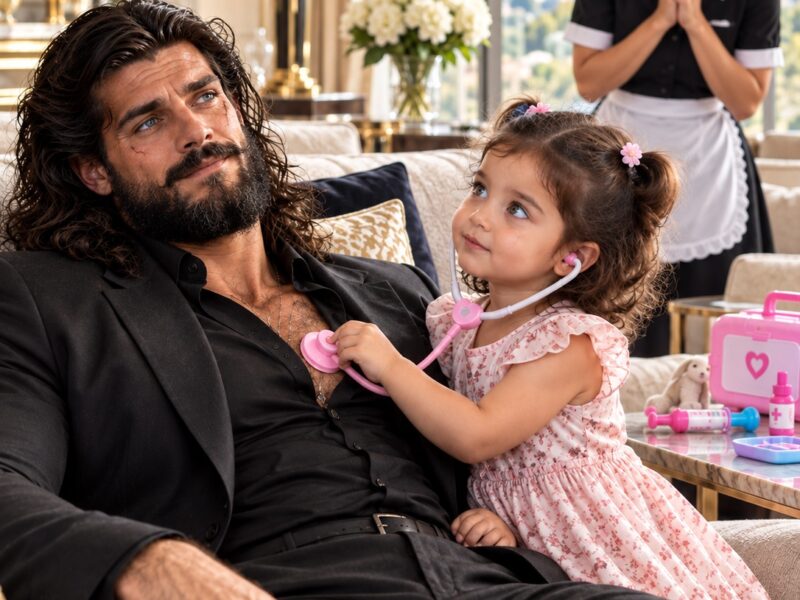
“Don’t Be Scared, I’m a Doctor!” the Maid’s Toddler Told the Mafia Boss—Then She Saved Him
Alexei Petrov hit the floor before anyone in the room understood he was dying.
His coffee was still warm on the desk.
A four-year-old girl carrying a plastic stethoscope was the first person to notice the thing every armed man around him missed.
And when she whispered, “Don’t be scared, I’m a doctor,” Maria Alvarez realized her daughter was no longer playing.
The sound came first.
A chair scraping hard across hardwood.
Then something heavier.
A body.
Maria stopped beside the linen cart in the upper hallway of the Petrov estate, a folded bath towel suspended between her hands.
For half a second there was nothing.
Then the study door flew open.
“Call an ambulance!”
Dmitri Volkov’s voice had never sounded like that.
Maria dropped the towel.
Her daughter Sophie sat six feet away against the wall, surrounded by crayons and a battered medical kit from the dollar store.
Four years old.
Wild dark curls.
Purple leggings.
Pink plastic stethoscope around her neck.
Maria pointed at her.
“Stay right here.”
Then she ran toward the study.
Sophie did not stay.
By the time Maria reached the doorway, three men were already crowded around Alexei Petrov.
One guard pressed two fingers against the side of his neck.
Another stood with a phone to his ear, shouting their address twice even though every emergency dispatcher in Lake Forest probably knew exactly where the Petrov estate was.
Dmitri had dropped to one knee.
“Alexei.”
No response.
“Alexei.”
Maria stopped at the threshold.
She had worked in the house for nineteen months.
During that time, she had seen Alexei Petrov angry exactly twice.
Neither time had he raised his voice.
He did not have to.
At forty-one, Alexei was one of those men whose reputation arrived before he did.
Petrov Logistics owned warehouses from Chicago to Detroit.
Petrov Hospitality ran restaurants and private clubs across Illinois and Wisconsin.
His real-estate companies owned enough lakefront property that newspapers regularly called him a billionaire developer.
The older stories used different language.
Crime family.
Syndicate.
Russian mob.
Mafia.
Alexei never discussed those words.
Neither did the staff.
Maria only knew that black SUVs came through the gates after midnight and men who intimidated everyone else called Alexei “sir.”
She also knew he had never humiliated her.
Not when she broke a crystal decanter during her second week.
Not when Sophie’s sitter canceled and Maria begged permission to keep her daughter in the staff room.
Not even when Maria once spilled coffee across documents apparently worth more than her apartment building.
Alexei had looked at the ruined pages.
Then at Maria’s horrified face.
“Paper dries.”
That was all.
Now he lay on the floor beside the same desk, skin frighteningly pale.
Dmitri barked:
“Move back.”
A guard stepped aside.
That was when Sophie slipped between two grown men.
“Sophie!”
Maria lunged.
Too late.
Her daughter dropped beside Alexei.
One tiny hand landed on his shirt.
The other lifted the plastic stethoscope.
A security man reached down.
“Get the child out.”
Sophie looked up.
“Don’t.”
The man actually stopped.
Maybe because she sounded so certain.
Maybe because nobody expected authority from a child with a stuffed unicorn printed on her shirt.
Sophie put the plastic disc against Alexei’s chest.
It could not possibly tell her anything.
Maria knew that.
The thing barely carried sound across two inches.
Sophie did not.
She frowned with the concentration she normally reserved for puzzles.
Then she patted Alexei’s shoulder.
“Don’t be scared.”
Dmitri stared.
Sophie leaned closer.
“I’m a doctor.”
For one impossible second, the entire room went silent.
Then one of the guards swore softly.
Maria reached her daughter.
“Baby, move.”
Sophie resisted.
“Mommy.”
“Sophie.”
“His mouth.”
Maria stopped.
“What?”
Sophie pointed.
“Wrong color.”
Maria looked.
Alexei’s lips had taken on the faintest gray-blue tint.
His breathing was shallow.
Irregular.
Something in Maria’s body changed.
The house disappeared.
The billionaire disappeared.
The armed men disappeared.
Seven years earlier she had worn navy scrubs and a plastic hospital badge that said MARIA ALVAREZ — PATIENT CARE TECHNICIAN.
She had completed most of the prerequisites for nursing school.
Then her husband got sick.
Bills multiplied.
School became shifts.
Shifts became survival.
After Carlos died, survival became Sophie.
Maria had not worked in medicine in five years.
Muscle memory did not care.
“Everyone back.”
Dmitri looked at her.
“What?”
“Back.”
She dropped beside Alexei.
“Give me room.”
Something in her voice made him obey.
Maria checked Alexei while the emergency dispatcher remained on speaker, following instructions and reporting what she saw.
His pulse was there but unstable.
His breathing was deteriorating.
She repositioned him and cleared the immediate obstruction she found, then kept his airway supported while the dispatcher guided the next steps.
No heroics.
No improvised surgery.
No miracle.
Just seconds becoming useful instead of wasted.
Sophie stayed beside his hand.
Maria should have sent her away.
She didn’t have enough attention left.
“Mr. Alexei.”
Sophie whispered.
His eyelids did not move.
“You have to breathe.”
Maria’s hands shook once.
She forced them steady.
Sophie tightened her fingers around his.
“Mama says breathe slow when scared.”
Dmitri turned toward the window.
Maria realized later that he was crying.
The paramedics arrived in under six minutes.
It felt like forty.
They took over with practiced speed.
Monitor pads.
Oxygen.
Questions.
Medication.
A stretcher.
Maria stood only when one of them touched her shoulder.
“You okay?”
“Yes.”
“You medical?”
“Used to be.”
“What did you notice?”
“My daughter noticed the color first.”
The paramedic glanced down.
Sophie stood clutching her pink stethoscope.
He looked back at Maria.
“You bought him time.”
Maria swallowed.
“Is he going to live?”
“We’re going to do everything we can.”
Not an answer.
The stretcher rolled toward the hall.
For one second, Alexei’s hand shifted over the blanket covering him.
Sophie brightened.
“He moved.”
Maria pulled her close.
“Yes.”
Dmitri walked beside the stretcher.
At the doorway he turned.
His face had returned to its usual controlled hardness.
“Maria.”
“Yes?”
“Nobody leaves the property.”
Her stomach tightened.
“What?”
“Nobody.”
He looked toward the desk.
Alexei’s coffee cup still sat there.
Half full.
Then Dmitri looked at her.
“Until we know why he fell.”
The gates closed before the ambulance disappeared down the drive.
The estate changed.
Not loudly.
That made it worse.
Security men took positions at every exit.
Kitchen staff were asked to remain in the service dining room.
Phones were not confiscated, but everyone was instructed not to discuss what had happened.
Dmitri photographed the study before anything moved.
The coffee cup went into a clean evidence bag.
So did the small plate beside it.
Maria noticed because once upon a time she had worked in places where contamination mattered.
At 11:40, a woman arrived in a dark sedan.
Rachel Sloan.
Alexei’s personal attorney.
Maria had seen her twice before.
Fifty-six.
Silver-black bob.
Glasses that made everyone look guilty.
Rachel entered the study, spoke to Dmitri, then immediately called local police.
That surprised Maria.
She had expected men like Alexei to keep trouble private.
Apparently nearly dying changed protocol.
A detective named Lena Brooks arrived thirty minutes later.
She looked around the mansion without appearing impressed.
Maria liked her immediately.
Detective Brooks interviewed everyone separately.
When it was Maria’s turn, Sophie sat beside her coloring a purple giraffe.
“You were outside the office?”
“Yes.”
“Did you see Mr. Petrov drink anything?”
“No.”
“Did you prepare the coffee?”
“No.”
“Who did?”
“I don’t know.”
“Who normally does?”
“Kitchen staff sometimes.”
“Sometimes his assistant.”
“Sometimes he does it himself.”
Brooks looked at Sophie.
“Did you see anything?”
Maria’s hand tightened.
“She’s four.”
“I know.”
“I’m not interviewing her without someone trained to do that.”
The detective nodded.
“Good.”
That surprised Maria.
Brooks closed the notebook.
“I wasn’t asking her formally.”
“She’s already had enough today.”
Maria relaxed slightly.
“Thank you.”
Sophie continued coloring.
Then said:
“Flower lady.”
Maria looked down.
“What?”
Sophie drew another line.
“Flower lady had coffee.”
Detective Brooks did not move.
Neither did Maria.
“What flower lady?”
Sophie frowned as if adults were exhausting.
“The flowers.”
Maria glanced at Brooks.
The detective did not ask another question.
Instead she said:
“Maria, later, with your consent, I’d like a child interviewer to speak to Sophie once.”
“No pressure.”
“You can stop at any time.”
Maria swallowed.
“Okay.”
Brooks stood.
“Do not coach her.”
“I won’t.”
“I mean even accidentally.”
“Don’t ask her what she saw ten times tonight.”
“Children want to please adults.”
“They fill gaps.”
Maria nodded.
That made sense.
Sophie looked up.
“Can I have crackers?”
The detective smiled.
“Yes.”
“That question I can answer.”
At two in the afternoon, Dmitri received the hospital call.
Alexei was alive.
Stable enough for intensive monitoring.
Abnormal heart rhythm.
Respiratory compromise.
Cause unknown.
Maria sat down hard on a kitchen stool.
Sophie watched.
“He okay?”
“For now.”
“Good.”
Then Sophie placed her plastic stethoscope against Maria’s chest.
“You fast.”
Maria laughed once through tears.
“Yes.”
“Too fast.”
“I know.”
Sophie patted her.
“Breathe slow.”
Maria did.
That night she barely slept.
The estate had a small staff apartment where she and Sophie stayed during late shifts.
Maria sat beside her daughter’s bed long after midnight.
Sophie slept sprawled diagonally beneath a yellow blanket, one fist wrapped around the plastic stethoscope.
Maria thought about Carlos.
He had died from an undiagnosed heart condition at thirty-three.
Not because anyone poisoned him.
Not because of a conspiracy.
Because life sometimes destroyed people without needing a villain.
He had collapsed in a grocery-store parking lot.
Maria had been eight miles away.
By the time she arrived at the hospital, everything important had already happened.
For years she carried one useless thought.
If I had been there.
Today she had been there.
And it terrified her.
At 3:12 a.m., someone knocked.
Dmitri.
Maria opened the door.
He looked exhausted.
Tie gone.
Shirt collar open.
“What happened?”
“The hospital found something.”
Her stomach dropped.
“What?”
“An unusual compound in his blood.”
“Poison?”
“We don’t know enough to use that word yet.”
His expression said they both knew it was probably the right one.
“Police have the cup.”
“Kitchen inventory is being checked.”
“Visitor logs too.”
Maria wrapped her cardigan tighter.
“Is Sophie in danger?”
Dmitri looked toward the sleeping child.
“No evidence says she is.”
“That is not what I asked.”
His eyes came back.
“No.”
Then, because he was honest enough not to pretend:
“I don’t know.”
Maria closed the door after he left and moved a chair beneath the knob.
Not because it would stop professionals.
Because mothers occasionally needed something physical to do with fear.
Four days passed.
Alexei woke fully on the fourth morning.
His first question was not about the business.
Not about who had access to his coffee.
Not about whether the newspapers knew.
“Where is the little doctor?”
Dmitri stared at him.
Alexei’s voice was weak.
“I remember somebody telling me not to be scared.”
Dmitri’s mouth moved.
Almost a smile.
“Her name is Sophie.”
Alexei closed his eyes.
“Bring her.”
Then opened them.
“And her mother.”
Maria refused at first.
Not forever.
For several minutes.
“He needs rest.”
Dmitri stood in the staff kitchen.
“He asked.”
“That does not make it medically sensible.”
Dmitri blinked.
“You sound like his doctor.”
“I used to work in healthcare.”
“I heard.”
Maria folded her arms.
“Sophie is not a mascot.”
His face changed.
“I didn’t say she was.”
“No.”
“But people like your boss turn gratitude into spectacle very easily.”
Dmitri absorbed the criticism.
“You’re right.”
That lowered Maria’s defenses more effectively than an argument would have.
“He wants to thank her.”
“That is all.”
Maria looked toward Sophie, who was arranging grapes by size.
“One visit.”
“One.”
The hospital suite occupied the corner of a private floor downtown.
Security stood outside but not inside.
That mattered.
Alexei sat upright against white pillows, color still missing from his face.
He looked smaller without the tailored suits.
Not weak.
Human.
Sophie stopped at the doorway.
Alexei looked at her.
“There she is.”
His voice came out softer than Maria had ever heard it.
“The doctor.”
Sophie’s shyness vanished.
She pulled the plastic stethoscope from her bag.
“You have to check after.”
Alexei glanced at Maria.
“She always this strict?”
“Worse.”
Sophie marched to the bed.
Alexei held still while she pressed the toy disc against his chest.
She frowned.
“Better.”
“Good.”
“Drink water.”
“I’ve been told.”
“And sleep.”
Alexei looked toward Dmitri standing at the wall.
“I am surrounded by tyrants.”
Dmitri said, “Finally somebody qualified.”
Maria laughed before she could stop herself.
Alexei looked at her.
Something warm crossed his face.
Then Sophie lifted one finger.
“No coffee.”
The room changed.
Maria saw it.
Dmitri saw it.
Alexei did too.
“Why no coffee?”
Maria immediately intervened.
“Don’t.”
Alexei looked at her.
“She said it.”
“She’s four.”
Maria lowered her voice.
“If you start questioning her because an answer scares you, she’ll start giving you answers she thinks you want.”
Alexei was silent.
Then nodded.
“You’re right.”
He looked at Sophie.
“No coffee today.”
That satisfied her.
When Sophie wandered toward the window, Alexei turned to Maria.
“The doctors say you kept me breathing until the ambulance arrived.”
“They say Sophie noticed first.”
Maria’s expression tightened.
“She noticed a color and told me.”
“She did not diagnose you.”
“She did not perform medicine.”
“She’s a child.”
Alexei studied her.
“You don’t like the story where the little girl saves the mafia boss.”
Maria almost smiled.
“I don’t like stories that make children responsible for adults surviving.”
That answer stayed with him.
He nodded.
“Fair.”
“You both helped me.”
“Yes.”
Maria accepted that.
Alexei leaned back.
“I also heard you trained medically.”
“Patient-care technician.”
“Some nursing prerequisites.”
“You stopped.”
“Life stopped it.”
“What does that mean?”
Maria’s face closed slightly.
“My husband died.”
“Bills existed.”
“School cost money.”
“Sophie needed diapers.”
“Very boring tragedy.”
Alexei did not offer sympathy quickly.
Good.
Pity irritated her.
Instead:
“Do you want to go back?”
Maria looked at him.
“To nursing?”
“Yes.”
She laughed once.
Not because it was funny.
“Wanting and being able are different departments.”
“What would make it possible?”
There it was.
The billionaire question.
Identify cost.
Remove cost.
Problem solved.
Maria recognized the instinct immediately.
“Don’t.”
Alexei frowned.
“Don’t what?”
“Reach for your checkbook because you almost died.”
His eyebrows lifted.
Dmitri suddenly became fascinated by the television.
Maria continued.
“I am grateful you are alive.”
“I am glad we helped.”
“But I don’t want to spend the next ten years wondering whether my career happened because my daughter happened to be standing beside you on the worst morning of your life.”
Alexei stared.
Then, unexpectedly:
“Good.”
“What?”
“You should say that.”
Maria narrowed her eyes.
“You’re a strange man.”
“So I’ve been told.”
He looked toward Sophie.
“Then I’ll ask differently.”
“If the estate had an education program available to all staff, would you apply?”
Maria paused.
“That is manipulation with better paperwork.”
“Probably.”
Dmitri coughed.
Alexei ignored him.
“But would you?”
Maria thought.
“Yes.”
“Then maybe my gratitude can fix a policy instead of buying a person.”
She had no answer for that.
The hospital door opened.
A doctor entered carrying a chart.
Her expression was controlled.
Too controlled.
Alexei noticed.
“What?”
“We have toxicology confirmation.”
Dmitri straightened.
The doctor looked at Maria and Sophie.
“This should probably be discussed privately.”
Alexei said, “Maria stays.”
Maria immediately said:
“I do not.”
Everyone looked at her.
“Sophie is here.”
She took her daughter’s hand.
“We’re leaving.”
Alexei’s mouth almost moved.
A small recognition.
Boundary.
“Understood.”
As they reached the door, he said:
“Maria.”
She looked back.
“Thank you.”
This time there was no billion-dollar solution attached.
Just two words.
She nodded.
“You’re welcome.”
Toxicology showed a deliberate exposure.
The exact substance mattered less to Alexei than the route.
Something had been added to his coffee.
Not enough to cause immediate collapse.
Enough to destabilize his heart and breathing after a delay.
The forensic lab found residue in the cup.
The kitchen coffee pot was clean.
That meant the contamination occurred after pouring.
Someone had handled his personal cup.
Security logs narrowed access to eleven people.
Kitchen staff.
Dmitri.
Two assistants.
A florist.
Three household employees.
Two executives who arrived early for the video meeting.
And Maria.
Dmitri hated that last name.
He brought the list to Alexei that evening.
Alexei read.
Stopped.
“Why Maria?”
“Housekeeping badge opened upper service corridor at eight forty-one.”
Alexei looked up.
“She told police she was downstairs until nine.”
“Yes.”
“Camera?”
“Gap.”
“How convenient.”
Dmitri’s jaw tightened.
“Alexei.”
“No.”
“I didn’t say she did it.”
“You thought it.”
Dmitri stared.
“I think everybody did it until somebody didn’t.”
“That is my job.”
Alexei looked back at the paper.
“Then do your job with evidence.”
“Not instinct.”
Dmitri bristled.
“My instinct has kept you alive for fifteen years.”
“A four-year-old kept me alive Tuesday.”
Silence.
Alexei softened slightly.
“I trust your instinct.”
“I don’t trust fear.”
“Pull raw access data from the vendor.”
“Not our internal system.”
Dmitri understood.
Someone inside the house could manipulate internal logs.
Raw vendor records were harder.
Rachel arrived thirty minutes later.
She read the list.
Then looked at Alexei.
“Maria has motive?”
“What possible motive?”
“You asking emotionally or legally?”
“Legally.”
“No obvious one.”
“Financial distress?”
“Everyone employed by rich people has less money than the rich person.”
“That is not motive.”
“Good.”
Rachel sat.
“Do not turn gratitude into innocence either.”
Alexei looked at her.
“I know.”
“That girl saved you.”
“Her mother helped.”
“You are vulnerable to believing they are good because you need the event to mean something.”
His expression cooled.
“Thank you for the therapy.”
“I bill higher for that.”
The raw badge records arrived the next morning.
Maria’s badge had not opened the upper corridor.
Someone had duplicated the internal event after the fact.
Dmitri stood beside Alexei’s hospital window.
“I was wrong.”
“You were cautious.”
“I was wrong.”
Alexei looked at him.
“Good.”
Dmitri frowned.
“What?”
“People who can say that are useful.”
The internal edit came from an administrator account.
Not enough to identify a person.
But it changed the investigation.
Somebody had poisoned Alexei.
Then somebody had altered access records to point toward the woman who helped save him.
That was not panic.
That was planning.
Detective Brooks returned to interview Maria.
This time at Maria’s request, Rachel did not attend.
Maria brought an attorney from a legal-aid referral.
Alexei respected that.
He did not offer to pay.
He wanted to.
He noticed the impulse.
Then let it pass.
Sophie’s forensic child interview happened in a bright county room with puppets, crayons, and no Petrov employees inside.
Maria watched through approved arrangements.
Sophie was asked open questions.
“What happened that morning?”
“Mr. Alexei fell.”
“What happened before that?”
“I was coloring.”
“Did you see anybody go into the office?”
Sophie drew a flower.
“Flower lady.”
“What flower lady?”
“She brings flowers.”
“What did she do?”
“Put flowers.”
“Anything else?”
Sophie thought.
“She had cup.”
“What cup?”
“Coffee.”
“Whose?”
“Mr. Alexei.”
“Did you see what she did with it?”
“She put it.”
“Where?”
“Desk.”
“Did she put anything in it?”
Sophie frowned.
“No.”
Important.
She had not seen poisoning.
Only delivery.
The interviewer did not push.
That made the statement useful.
Estate records showed a florist delivered arrangements every Tuesday.
Rosalind Harper.
Owner of Harper Floral Design.
Three years servicing the Petrov estate.
Background clean.
Business license valid.
No criminal record.
Dmitri wanted to bring her in.
Brooks said no.
“You are not law enforcement.”
Dmitri’s face hardened.
“I can ask questions.”
“You can ruin my case.”
He looked at Alexei.
Old Alexei might have chosen Dmitri.
New Alexei said:
“Detective handles it.”
Dmitri looked offended.
Then nodded.
Police checked the exterior camera.
Rosalind arrived at 8:22.
Entered with two arrangements.
At 8:37, a camera showed her leaving the flower cart near the study service door.
At 8:44, she exited.
Alexei’s coffee arrived at 8:39.
Six minutes unaccounted for.
Enough to matter.
Not enough to convict.
The cup contained one partial fingerprint besides Alexei’s.
Too smeared to identify.
Dmitri pulled vendor billing.
Nothing unusual.
Rachel pulled insurance paperwork.
Nothing.
Brooks obtained a warrant for Rosalind’s phone records after the toxicology and access sequence established probable cause.
By then Rosalind had disappeared.
Her apartment was empty.
Not hurriedly empty.
Prepared empty.
Lease terminated two weeks earlier.
Utilities scheduled to end Tuesday afternoon.
She had planned to leave before Alexei ever collapsed.
That changed the entire scale of the problem.
At the flower shop, investigators found one employee.
She cried the moment detectives arrived.
“I thought she was moving to Arizona.”
“Did she say why?”
“Family.”
“Did she have family there?”
“I don’t know.”
“Anyone visit her recently?”
The employee remembered one man.
Expensive coat.
Dark Mercedes.
Three times in six weeks.
Never bought flowers.
Security from a neighboring store captured his plate.
Registered to Marrow Strategic Holdings.
Alexei read the name from his hospital bed.
His face did not change.
Maria happened to be visiting with Sophie.
She saw the silence.
“Who?”
Alexei folded the paper.
“Sebastian Marrow.”
She knew the name.
Everyone around the estate did.
Alexei’s business partner.
Childhood friend, according to newspapers.
The polished blond man who came to dinner once a month and always remembered Sophie’s name even though something in his smile made Maria uncomfortable.
Dmitri stood near the window.
“He owns ten percent of Petrov Logistics.”
“More through family trusts.”
Alexei’s voice remained even.
Maria looked between them.
“Why would your partner kill you?”
Nobody answered.
Sophie put the plastic stethoscope against Alexei’s blanket.
“Heart fast.”
Maria almost told her not to say that.
Then realized she was right in the only way that mattered.
The room felt different.
Alexei’s voice lowered.
“There is a succession agreement.”
Maria frowned.
“What does that mean?”
“If I die, certain voting rights consolidate temporarily under Sebastian until my estate is settled.”
“How temporary?”
Rachel, who had just entered, answered.
“Up to eighteen months.”
Maria looked at Alexei.
“That seems like an obvious problem.”
“It was designed twenty years ago.”
“After my father died.”
“Back when stability mattered more than elegance.”
Rachel placed her bag down.
“And before anybody turns this into motive, we need evidence.”
Alexei nodded.
“Exactly.”
Maria noticed.
He was learning.
The next evidence did not come from a gun.
Or a confession.
Or somebody following Maria home.
It came from an invoice.
Harper Floral’s company had been losing money for eleven months.
Six weeks before the poisoning, Rosalind received a seventy-five-thousand-dollar “consulting payment” from a corporate event company.
That event company belonged to a holding company.
The holding company’s registered manager was Marrow Strategic.
Not Sebastian personally.
Still, closer.
The police obtained bank records.
Another payment.
Forty thousand.
Then cash withdrawals.
Then a text recovered from Rosalind’s cloud backup:
Tuesday. Same cup. No substitutions.
No name attached.
The sender used a prepaid number.
But location records placed that phone near Marrow headquarters repeatedly.
Brooks sat across from Alexei.
“We’re getting there.”
“Getting where?”
“To enough evidence for searches.”
Alexei’s jaw tightened.
“You know it’s him.”
“I know what I can prove.”
He looked at her.
Then smiled faintly.
“You and Rachel would get along.”
“I don’t know whether that is an insult.”
“It is.”
Two days later, Sebastian visited the hospital.
He brought no flowers.
Probably wise.
Alexei had already been discharged from intensive care but remained under observation.
Sebastian entered smiling.
“Look at you.”
Alexei looked up from a newspaper.
“Alive.”
“Rude.”
Sebastian crossed the room.
Dmitri stood by the door.
Maria was not there.
Sophie was at preschool.
That mattered.
Sebastian sat.
“You scared ten years off me.”
“Only ten?”
“You don’t have another ten to spare.”
Alexei watched him.
Twenty-three years.
They met when they were eighteen.
Two angry sons of complicated fathers.
They built legitimate businesses together because both claimed they were tired of men who thought fear counted as management.
Sebastian had stood beside Alexei when his younger sister Nadia died.
He had carried Alexei’s mother’s coffin.
He knew where every weakness lived.
“Police bothering you?”
Sebastian asked.
“Routine.”
“I heard they questioned vendors.”
“Probably.”
Sebastian nodded.
His face was calm.
Too calm?
Alexei hated how suspicion contaminated ordinary details.
Sebastian glanced at Dmitri.
“You can give us a minute.”
Dmitri looked at Alexei.
Alexei nodded.
Dmitri left.
Sebastian leaned back.
“I want you to consider something.”
“What?”
“You almost died.”
“I noticed.”
“Maybe it is time to activate continuity.”
Alexei’s pulse changed.
“What continuity?”
“Temporary management transfer.”
“Let the board name me acting chairman.”
“Take pressure off.”
Alexei stared.
Sebastian smiled.
“Don’t look at me like that.”
“You’re recovering.”
“I’m protecting the company.”
There it was.
Maybe innocent.
Maybe not.
Alexei folded the newspaper.
“The board can function without transferring control.”
“Technically.”
Sebastian’s smile thinned.
“Markets hate uncertainty.”
“Markets survive.”
“Sometimes.”
He stood.
“You’ve spent your whole life making sure nobody sees weakness.”
“Now they’ve seen it.”
Alexei looked at him.
“And?”
“Let somebody you trust carry some weight.”
Sebastian touched his shoulder.
“Before somebody worse decides to take it.”
Then he left.
Alexei waited twenty seconds.
Called Rachel.
“Get me the succession agreement.”
“You’re supposed to rest.”
“Rachel.”
“I’m bringing almonds.”
“Don’t.”
She arrived with almonds.
The agreement contained a clause Alexei had not read in years.
Upon death or medically certified incapacity exceeding thirty consecutive days, interim voting authority consolidated with the senior surviving partner.
Sebastian.
No crime there.
Then Rachel found an amendment.
Drafted three months earlier.
Not signed.
Requested by Marrow counsel.
It reduced thirty days to seven.
Alexei stared.
“Who authorized negotiation?”
“Corporate secretary says Sebastian raised it after the heart attack you didn’t have last year.”
Alexei looked up.
“What heart attack?”
Rachel’s mouth tightened.
“Exactly.”
Someone had used a rumor about Alexei’s health to push faster succession.
Still not proof of poisoning.
But now the shape had edges.
Rachel said:
“Do not call him.”
“I know.”
“You saying that voluntarily is disturbing.”
“I am evolving.”
“Slowly.”
Then Maria became the problem.
Not because she did anything.
Because somebody needed another explanation.
A gossip site published a story:
MYSTERY HOUSEKEEPER AT CENTER OF PETROV MEDICAL SCARE.
It included her name.
An old nursing-school photograph.
A reference to her abandoned medical training.
Anonymous source:
“She had unusual access and knew enough medicine to understand exactly what symptoms would appear.”
Maria saw it on her phone while picking Sophie up from preschool.
Her hands went numb.
Another parent looked at her.
Then away.
By evening, two reporters stood outside her apartment building.
Sophie pressed against Maria’s leg.
“Why people?”
Maria swallowed.
“Work stuff.”
“Bad?”
“Yes.”
She called Alexei.
Not Dmitri.
Not Rachel.
Alexei answered.
“Maria.”
“You said I was safe.”
Silence.
He did not defend himself.
“What happened?”
She told him.
His breathing changed.
“I did not leak your name.”
“I didn’t say you did.”
“But somebody around you did.”
“Yes.”
“I’m taking Sophie to my sister’s.”
“Okay.”
She stopped.
She had expected an argument.
“Okay?”
“Yes.”
“If you want security, tell me.”
“I don’t.”
“Then I won’t send it.”
Another pause.
Maria closed her eyes.
“Thank you.”
Alexei’s voice became colder.
“Send me the article.”
“What are you going to do?”
“Read it.”
“That’s all?”
“For the next ten minutes.”
Despite everything, she almost laughed.
Rachel traced the leak.
The article cited “a source familiar with household security.”
The metadata on a photograph embedded in an earlier version showed it had originated from a PR firm.
That PR firm worked for Marrow Strategic.
Not conclusive.
But ugly.
Alexei called the board chair.
Not Sebastian.
He requested an emergency independent committee.
Outside counsel.
Forensic accountants.
No Petrov family employees.
No Marrow employees.
He voluntarily stepped back from investigation decisions.
Dmitri stared at him.
“You’re giving outsiders our files.”
“Yes.”
“All of them?”
“Relevant files.”
“They’ll find other things.”
Alexei knew what he meant.
Old payments.
Gray contracts.
Relationships inherited from his father.
Things legal enough to survive.
Some not pretty enough to enjoy daylight.
“Yes.”
Dmitri was silent.
Alexei looked at him.
“If I only want truth when it hurts somebody else, I don’t want truth.”
That sentence cost him.
Good.
The independent committee found something police had not.
Sebastian had purchased a large key-man life insurance policy on Alexei through a partnership vehicle nine months earlier.
Legal.
Disclosed somewhere deep in risk documents.
But the beneficiary was a company Sebastian effectively controlled.
Twenty-five million dollars.
Again:
Motive.
Not act.
Then the forensic accountants found vendor overlap.
The same event company that paid Rosalind had billed Marrow Strategic for “hospitality consulting.”
The descriptions were vague.
The approver:
S. MARROW.
Rachel placed the file in front of Alexei.
“That is now evidence.”
His face went still.
“How much?”
“Enough for the police to move.”
Detective Brooks obtained search warrants.
Sebastian’s office.
Marrow Strategic.
His personal devices.
Rosalind was found two days later at a motel outside Indianapolis.
Alive.
Terrified.
She asked for a lawyer immediately.
Then began negotiating.
Maria learned about it from Rachel, not Alexei.
That was intentional.
Alexei had told Rachel:
“Maria deserves information from someone who does not employ her.”
Another improvement.
Rosalind’s statement did not make her innocent.
She admitted contaminating Alexei’s cup.
She claimed Sebastian told her the substance would cause a brief medical emergency, nothing fatal.
She said she was in debt.
Her flower business had collapsed.
Sebastian offered money.
She took it.
Then after Alexei nearly died, she realized she had been lied to.
She ran.
The burner phone contained one unsent draft:
I didn’t agree to kill him.
That mattered.
Police recovered encrypted messages from Sebastian’s laptop.
Not a full confession.
Enough.
References to “seven days.”
“Continuity.”
“Tuesday service.”
And one line sent the night before Alexei collapsed:
Once he is medically unavailable, the board will do what frightened boards always do.
Alexei read it once.
Then closed the file.
He did not smash anything.
Did not order anyone dragged to a warehouse.
Did not threaten Sebastian’s family.
He called Rachel.
“What happens next?”
She blinked.
“Legally?”
“Yes.”
She smiled slightly.
“I’ve waited twenty years to hear you ask that first.”
The climax happened in a boardroom.
Sebastian expected a medical-continuity vote.
He arrived at Petrov Logistics headquarters in a dark blue suit.
Twelve directors sat around the table.
Outside counsel.
Independent committee.
Rachel.
Alexei.
Sebastian stopped when he saw him.
“You should be resting.”
Alexei sat.
“I am.”
“This is me relaxed.”
Sebastian’s expression remained composed.
The chair opened:
“We are here to address interim governance.”
Rachel interrupted.
“Before that vote, the special committee has disclosures.”
Sebastian looked toward Alexei.
Alexei did not move.
Folders circulated.
Insurance policy.
Succession amendment request.
Marrow vendor payments.
Rosalind transfers.
PR leak.
Recovered messages.
Nobody spoke for almost a minute.
Sebastian finally laughed.
“You’re serious.”
Alexei looked at him.
“Very.”
Sebastian pushed the folder away.
“Rosalind is a desperate woman looking for a deal.”
“The vendor payments are legitimate.”
“The insurance policy protects the partnership.”
“The continuity amendment was responsible planning.”
Rachel said:
“Individually, perhaps.”
Sebastian looked at her.
“Collectively?”
She did not need to finish.
He turned to Alexei.
“You believe I tried to kill you.”
Alexei’s jaw tightened.
“I believe evidence says you arranged the exposure.”
“That is not an answer.”
“It is the only answer that matters in this room.”
Sebastian leaned back.
“Twenty-three years.”
“I know.”
“I helped you clean your father’s mess.”
“Yes.”
“I took risks when you wanted legitimacy.”
“Yes.”
“I kept unions calm.”
“I kept lenders quiet.”
“I made ugly things disappear so your name could become respectable.”
Alexei’s face hardened.
“You’re describing leverage.”
“I’m describing loyalty.”
“No.”
Sebastian’s voice rose.
“You think that little maid and her kid taught you morality?”
The room froze.
Alexei stood.
Very slowly.
“Do not.”
Sebastian smiled bitterly.
“There he is.”
“The man everybody pretends doesn’t exist.”
“Tell me, Alexei.”
“Did the child save your soul too?”
Alexei looked at him.
“No.”
The answer was quiet.
“She noticed I couldn’t breathe.”
“My attorney noticed your money.”
“The police noticed your messages.”
“An accountant noticed your invoices.”
“Turns out the problem with your plan is people noticing.”
Sebastian’s smile disappeared.
Alexei continued.
“And Maria is not ‘the maid’ in this conversation.”
“She is Maria Alvarez.”
“She helped keep me alive.”
“You tried to make her look guilty after she did.”
Sebastian’s eyes flickered.
There.
Tiny.
Rachel saw it too.
“You leaked her file.”
Alexei said.
Sebastian’s attorney leaned in.
“Do not answer.”
Too late.
Sebastian looked exhausted.
Not monstrous.
Just tired.
“You were going to destroy everything.”
“What?”
“The old structure.”
“The last relationships that protected us.”
“You called it reform.”
“I called it survival.”
Alexei stared.
Sebastian continued.
“Every year you cut another tie.”
“Another revenue stream.”
“Another man whose loyalty came from fear.”
“And every year our enemies saw less reason to fear us.”
“Our enemies?”
Alexei’s voice sharpened.
“We sell freight and restaurants.”
Sebastian laughed.
“That is what you tell reporters.”
“No.”
“That is what I wanted us to become.”
The room went quiet.
Sebastian looked at him.
“And I wanted what we were.”
There it was.
Not greed alone.
Identity.
Power.
A man watching his world become obsolete.
Alexei nodded slowly.
“That may be the first true thing you’ve said today.”
Sebastian’s shoulders lowered.
“You think becoming harmless will save you?”
“No.”
Alexei looked toward Rachel.
“I think becoming accountable might.”
The board chair spoke.
“Mr. Marrow, your authority is suspended effective immediately pending criminal proceedings and internal review.”
Sebastian’s face changed.
Police waited outside the conference room.
Not Petrov men.
Police.
Alexei had insisted.
When Sebastian saw them, he looked back.
“You brought cops.”
Alexei held his gaze.
“I brought daylight.”
Sebastian left without another word.
The consequences were not clean.
Petrov Logistics stock dropped.
Two lenders froze facilities temporarily.
Three old partners walked.
Reporters published every dirty historical association they could find.
Alexei spent twelve hours giving sworn testimony to investigators about businesses his father had built.
One minor subsidiary paid a large regulatory settlement over books predating Alexei’s reforms.
Dmitri hated almost all of it.
“This is humiliation.”
He said one night.
Alexei sat in his home study.
The same room where he had collapsed.
“No.”
He looked at the coffee stain still faintly visible on the rug because he had refused to replace it.
“This is accounting.”
Dmitri snorted.
“Rachel has infected you.”
“Probably.”
Rosalind pled guilty and cooperated.
Sebastian was indicted on attempted murder, conspiracy, fraud, obstruction, and related charges.
No mysterious disappearance.
No revenge.
No man found in a river.
Maria appreciated that more than she told Alexei.
Her own consequences mattered too.
The gossip article followed her.
Some parents at Sophie’s preschool whispered.
One staff member at the estate apologized for avoiding Maria after the poisoning.
Maria said:
“You should.”
The woman blinked.
Maria softened.
“But thank you for saying it.”
The estate education program launched six months later.
Not Maria Alvarez Scholarship.
She would have quit on principle.
EMPLOYEE CONTINUING EDUCATION BENEFIT.
Open to all full-time estate and company staff after one year.
Tuition assistance.
Schedule flexibility.
Certification support.
Maria applied.
So did a cook studying accounting.
A groundskeeper finishing an HVAC license.
One security guard taking business classes.
Rachel told Alexei:
“You accidentally created human resources.”
He looked horrified.
Maria began nursing school that fall.
Part-time.
Hard.
Real.
She failed her first pharmacology quiz.
Sat in her car afterward and cried from pure exhaustion.
Then laughed because five years earlier, failure had meant stopping.
Now it meant studying differently.
She told nobody except Sophie.
Sophie patted her arm.
“Don’t be scared.”
Maria looked at her.
“I’m a doctor.”
Maria laughed until she cried again.
Alexei returned to work gradually.
He drank tea for months.
Everyone noticed.
Nobody commented.
Sophie did.
“You scared coffee?”
Alexei looked offended.
“No.”
“You are.”
“I am exercising preference.”
She looked at Maria.
“He scared.”
Maria nodded.
“Terrified.”
Alexei glared at both of them.
Then laughed.
Their relationship changed slowly.
Not romance at first.
Gratitude would have made romance dishonest.
Maria still worked for him.
That mattered.
So Alexei did not ask.
He learned Sophie’s favorite color was green.
That she hated mashed potatoes.
That she believed all doctors should carry stickers.
He allowed a drawer in his study to become filled with crayons.
Dmitri complained.
“Operational degradation.”
Sophie handed him a sticker.
“You mad.”
He accepted it.
“Thank you.”
The sticker said GREAT JOB!
He wore it for twenty minutes because removing it made Sophie sad.
Maria watched all of this carefully.
Alexei had power.
People around powerful men often confused softness with safety.
She refused to.
One evening after class, she found Alexei sitting at the kitchen island alone.
No suit jacket.
Tea.
A medical report open beside him.
“You’re checking your heart again?”
He looked up.
“Preventive medicine.”
“Anxiety.”
“Preventive anxiety.”
Maria set down her textbook.
“Your cardiologist cleared you.”
“Yes.”
“You have follow-ups.”
“Yes.”
“You are still checking your pulse ten times a day.”
“Nine.”
She stared.
“Fine.”
“Ten.”
She sat.
For a while neither spoke.
Then Alexei said:
“Nadia was sixteen.”
Maria looked up.
He had mentioned a sister once.
Never more.
“My sister.”
“She had a congenital heart condition.”
“We were poor.”
“My father had money sometimes.”
“Not legal money.”
“Not stable money.”
“We spent years hiding from systems we also needed.”
He looked at his tea.
“One night she couldn’t breathe.”
“My father refused to call an ambulance because police were at the house earlier that week.”
Maria went still.
“By the time we drove her ourselves…”
He stopped.
No explanation needed.
Maria’s anger rose.
“At your father?”
“Yes.”
“At yourself?”
He did not answer.
That was yes too.
“I was nineteen.”
“I told her I’d fix everything.”
“I told her when I had enough money nobody around me would ever wait for help again.”
His mouth twisted.
“Then I built a life where everybody waited for my permission.”
Maria said nothing.
“That morning Sophie didn’t.”
“No.”
“She walked straight through men twice her size.”
“Yes.”
“And you did too.”
Maria shook her head.
“I followed training.”
“You acted.”
“So did the paramedics.”
“So did the hospital.”
“Do not turn us into saints because you were scared.”
Alexei looked at her.
“That is what you always do.”
“What?”
“Take the story away before I can make it sentimental.”
“Somebody has to.”
He smiled.
“Good.”
Maria completed nursing school two years later.
She did not become Alexei’s private nurse.
That had been his first idea.
She rejected it before he could finish the sentence.
“I need a job where you cannot fire me.”
He stared.
“That sounded personal.”
“It is professional.”
She accepted a position at a community hospital in Evanston.
Emergency department.
Night shifts at first.
Brutal.
Satisfying.
She left the estate.
Her farewell dinner happened in the staff kitchen because she refused the formal dining room.
Dmitri gave her flowers.
She looked suspicious.
“From a verified florist?”
He almost smiled.
“Background checked.”
Rachel gave her a pen.
“Documentation saves lives too.”
Sophie gave Alexei the pink plastic stethoscope.
He stared.
“What is this?”
“For your desk.”
“I thought doctors needed it.”
“I got real one.”
Maria looked at her.
“No, you got another toy.”
Sophie ignored her.
Alexei took the stethoscope.
“I’ll keep it.”
“Case you get sick.”
“Understood.”
Maria’s employment ended on a Friday.
Alexei waited eleven months before asking her to dinner.
Not because of some rule Rachel wrote.
Because Maria deserved time to build a life not connected to his payroll.
When he asked, it happened in the hospital cafeteria.
Bad coffee.
Plastic chair.
Maria wearing navy scrubs.
“You came here to ask me on a date?”
“Yes.”
“This cafeteria smells like bleach.”
“I was told romance depends on sincerity.”
“By whom?”
“Rachel.”
“Stop taking romantic advice from your attorney.”
“Noted.”
Maria looked at him.
He looked genuinely nervous.
That helped.
“One dinner.”
“Yes.”
“Public restaurant.”
“Yes.”
“No security sitting at the next table.”
“Across the street?”
She narrowed her eyes.
“Farther.”
“Negotiable.”
She laughed.
“Fine.”
Their relationship moved with the same caution the investigation had taught them.
Evidence before assumptions.
Questions before rescue.
No secret payments.
No surprise apartment.
No expensive school “gift” for Sophie.
The first time Alexei tried to buy Sophie a miniature electric car, Maria made him return it.
“She is seven.”
“It has a speed limiter.”
“Return it.”
He did.
Sophie received roller skates instead.
She fell twelve times.
Declared herself excellent.
Alexei agreed.
Maria did not.
Sebastian’s trial began three years after the poisoning.
By then Petrov Logistics had completed a full transition away from the remaining gray businesses Alexei’s father once considered essential.
Dmitri called the process “financial surgery without anesthesia.”
Alexei called it overdue.
At trial, prosecutors presented evidence in layers.
Rosalind’s testimony.
The cup analysis.
Payments.
Phone records.
The succession amendment.
Insurance.
The manipulated access log.
The PR leak targeting Maria.
No single magical clue.
No child carrying the whole case.
Sophie did not testify.
Detective Brooks and prosecutors determined her early interview was corroborative, not essential.
Maria cried when she learned that.
Relief.
Her daughter had already done enough.
Sebastian was convicted.
Alexei attended sentencing.
Maria did not.
When he came home, Sophie—seven now—was at Maria’s apartment doing homework.
Alexei sat at the kitchen table.
“He going away?”
She asked.
“Yes.”
“Because bad choice?”
“Many bad choices.”
Sophie thought.
“Did you make bad choices?”
Alexei smiled faintly.
“Yes.”
“You go jail?”
Maria nearly choked on tea.
Alexei considered.
“Not for those choices.”
“Okay.”
Then Sophie returned to spelling.
Children were mercifully uninterested in symbolic closure.
Later that evening, Maria stood with Alexei by the sink.
“How do you feel?”
He looked toward Sophie.
“Nothing dramatic.”
“Good.”
“I expected satisfaction.”
“And?”
“I mostly feel tired.”
Maria nodded.
“That sounds healthier.”
“You always say depressing things like compliments.”
“One of my gifts.”
He took her hand.
Not possessive.
Not desperate.
Simply there.
Five years after the morning Alexei fell, the original study looked almost the same.
Dark wood.
Tall windows.
Heavy desk.
One difference.
A pink plastic stethoscope sat in a glass-front drawer beside expensive fountain pens.
Another:
Coffee had returned.
Alexei drank it again.
Progress.
On a rainy Saturday, Maria arrived with Sophie after a hospital fundraiser.
Sophie wore a white coat costume over jeans because she had participated in a children’s science booth.
She marched into Alexei’s study.
He was reading.
She put the real-looking toy stethoscope around her neck.
“You need checkup.”
Alexei closed the folder.
“I had one last month.”
“Again.”
Maria leaned in the doorway.
“I would cooperate.”
“You raised a dictator.”
“I learned from your staff.”
Sophie pressed the stethoscope against his chest.
This one actually carried sound.
Her face became serious.
Alexei watched her.
For one tiny second, the room returned.
Floor.
Cold.
Unable to breathe.
Small hand.
Don’t be scared.
His jaw tightened.
Sophie noticed.
“You scared?”
He could have said no.
Old Alexei would have.
Instead:
“A little.”
Sophie nodded.
“That’s okay.”
Maria looked away briefly.
Sophie listened.
Then announced:
“Heart normal.”
Alexei exhaled.
“Excellent.”
“But…”
He frowned.
“But?”
“You need less work.”
Maria laughed.
Alexei looked betrayed.
“She is clearly practicing outside her license.”
Sophie pointed at him.
“And water.”
“This conspiracy is obvious.”
She smiled.
Then removed the stethoscope.
Alexei opened the desk drawer.
Took out the old pink plastic one.
One earpiece had cracked.
The tubing was yellowing.
Sophie stared.
“You kept it.”
“I said I would.”
“That was baby doctor.”
“You were four.”
“I was little.”
“You were terrifying.”
Maria laughed.
Sophie took the old toy.
Held it beside the newer one.
Then handed it back.
“You keep.”
“Why?”
She shrugged.
“Saved you.”
Alexei looked at Maria.
Maria shook her head gently.
“No.”
Sophie frowned.
Maria came into the room and crouched beside her daughter.
“You noticed something was wrong.”
“You told us.”
“That mattered.”
“Then Mommy helped.”
“The ambulance helped.”
“The doctors helped.”
“A lot of people helped.”
Sophie thought seriously.
“So team saved him.”
“Yes.”
Maria smiled.
“Team.”
Alexei looked at both of them.
For years, he had built his world around one idea:
The man at the top survives because he controls everything below him.
Sebastian had believed it too.
His father before them.
Power flowed downward.
Orders.
Fear.
Protection.
That morning on the study floor had shown Alexei something far less flattering.
He survived because a child looked closely.
Because a woman whose résumé he had barely noticed remembered what she knew.
Because frightened men listened when they were told to step back.
Because paramedics came.
Because doctors worked.
Because police followed evidence instead of his anger.
Because an attorney repeatedly stopped him from confusing instinct with truth.
Survival had never been proof of control.
It was proof of dependence.
Alexei picked up the old stethoscope.
“Team.”
He agreed.
Sophie climbed onto the leather chair opposite his desk.
“Can I have juice?”
“Yes.”
“Cookies?”
“One.”
“Three.”
“One.”
“Two.”
Alexei looked at Maria.
“She negotiates like Sebastian.”
Maria’s face changed.
He realized.
“Bad joke.”
“Yes.”
“Sorry.”
Sophie had already moved on.
“Two.”
Alexei sighed.
“Two.”
She grinned.
Maria walked toward the kitchen.
Alexei followed.
At the study door, he looked back once.
The coffee cup sat on his desk.
Steam rising.
Untouched for the moment.
Beside it, the pink stethoscope.
Five years earlier, that room had been the place where Alexei Petrov discovered how quickly power became useless when the body stopped obeying.
Now it was only an office.
That was better.
From the hall, Sophie shouted:
“Doctor says hurry!”
Alexei smiled.
Then went to find his family.









