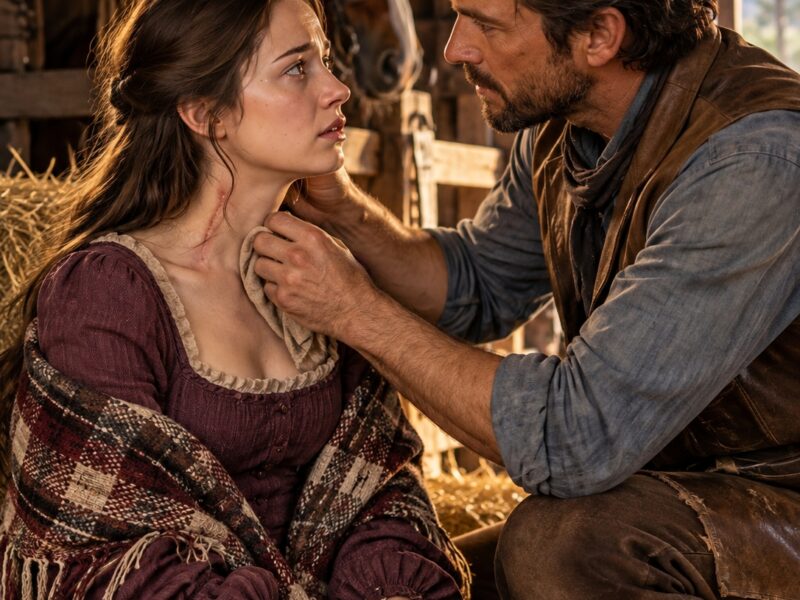
“Don’t Close Your Eyes Yet,” the Rancher Whispered as Her Dress Slipped From Her Shoulder—Then the Town Learned Why She Had Crossed Two Thousand Miles Alone
Eleanor Bell’s dress slipped from her shoulder in the hayloft, exposing the scar she had crossed two thousand miles to hide from anyone who might look at her differently.
Colt Maddox saw it at the same moment footsteps sounded below and a woman’s voice announced that half the town was about to learn what Eleanor had been doing in his barn.
Then Colt whispered, “Don’t close your eyes yet,” because the secret Eleanor feared most was not the one the people downstairs had come to expose.
The Woman on the Last Bus
Eleanor Bell arrived in Silver Hollow, Wyoming, on the last bus before a December storm with one suitcase, forty-three dollars in cash, and an employment letter from a town librarian who had apparently disappeared three weeks earlier.
She stood beneath the depot awning while wind drove dry snow across Main Street and reread the letter for the fourth time.
Position confirmed. Housing assistance available. Report January 3. — Reverend Harold Hartley, Library Board Chair.
The date was right.
The town was right.
Everything else had gone wrong.
The public library across the street had plywood covering two windows and a printed notice taped to the door.
CLOSED UNTIL FURTHER NOTICE — MUNICIPAL BUDGET ACTION.
Eleanor stared at it.
A teenage boy carrying groceries slowed nearby.
“You waiting for somebody?”
“Reverend Hartley.”
The boy’s face changed.
“Reverend Hartley’s in Denver.”
“For the day?”
“No, ma’am. He got sick.”
“How long?”
“Month, maybe.”
Eleanor looked back at the boarded library.
“And the library?”
“Council shut it down in October.”
The boy shrugged with the honest cruelty of someone too young to know when information should be softened.
“Mayor said books don’t pay heating bills.”
He continued toward the grocery store.
Eleanor remained beneath the awning.
The bus that had brought her from Denver was already gone.
Her return ticket would cost almost everything she had.
Back east, there was no apartment waiting.
No job.
No parents.
No fiancé.
Jonathan Ashford had taken one look at the scar running from beneath Eleanor’s left ear across her collarbone after the accident and tried for two months to pretend nothing had changed.
Then one evening he had said:
“You deserve someone who doesn’t have to work this hard not to notice.”
Eleanor had understood.
He had called it honesty.
She had called off the wedding before he could.
Now she touched the high collar of her wool coat, confirming the scar remained hidden.
Snow gathered on her suitcase.
She lifted the handle and started walking.
The town was smaller than she expected.
Hardware store.
Diner.
Feed store.
Church.
Bank.
A bar with neon beer signs glowing even in the afternoon.
Near the north end of Main Street, the buildings gave way to corrals and a long cedar barn.
Warm light glowed through its windows.
Horses moved inside.
Eleanor stopped.
Not because she had a plan.
Because the wind did.
It shoved a blast of snow beneath her coat hard enough to make her gasp.
The barn door opened.
A man stepped out carrying a western saddle.
Tall.
Thirty-six, maybe.
Dark hair beneath a worn felt hat.
Broad through the chest but uneven through the shoulders, his right side held slightly lower than the left.
He stopped when he saw Eleanor fighting her suitcase through six inches of powder.
“You lost?”
“I was promised employment.”
“That’s not the same question.”
Eleanor lifted her chin.
“No.”
“It isn’t.”
The man set the saddle on a rack beside the door.
“Where?”
“Silver Hollow Library.”
His eyes moved toward town.
Then back.
“That closed months ago.”
“I have recently been informed.”
“Who hired you?”
“Reverend Hartley.”
His jaw shifted.
“That sounds like Harold.”
“What does?”
“Promising something because he intends it to exist.”
Eleanor stared.
“Do you know where he is?”
“Denver Presbyterian.”
“Lung infection.”
“He’ll come home if the doctors let him.”
“So there is no job.”
“Not today.”
Snow blew between them.
The rancher glanced at her suitcase.
“You have somewhere to stay?”
“Yes.”
The lie left her too quickly.
His eyes narrowed.
“Where?”
“That is not your concern.”
“No.”
He looked toward the sky.
“But you’ve got maybe forty minutes before the county closes the highway, and the motel has been full since hunting season.”
Eleanor hated that he sounded practical instead of predatory.
“What are you suggesting?”
“I own the feed store next to the barn.”
“There’s a small apartment above it.”
“Bed.”
“Heat.”
“Bathroom.”
“You can use it tonight.”
Eleanor’s spine stiffened.
“I do not stay in strange men’s apartments.”
“It’s not my apartment.”
“That distinction does very little.”
Something almost like amusement touched his mouth.
“You can freeze somewhere respectable if you prefer.”
She should have walked away.
Instead another gust hit.
Her suitcase tipped.
The man caught it before it fell.
He did not touch her.
That mattered.
“My name’s Colt Maddox.”
he said.
“Ranch is three miles north.”
“Feed store’s mine.”
“You’ll have a deadbolt.”
“I stay at the ranch.”
“I’ll bring firewood and leave.”
Eleanor looked at him.
Gray eyes.
Weathered face.
A narrow pale scar visible just above the collar of his shirt.
Not handsome in the polished East Coast way she had learned to distrust.
More dangerous than that.
Real.
“Eleanor Bell.”
Colt lifted her suitcase.
She almost objected.
Then didn’t.
The apartment was exactly what he promised.
One room.
Iron bed.
Small stove.
Bathroom with a shower that groaned before producing hot water.
A clean quilt.
A narrow window overlooking the barn.
Colt carried in firewood and a covered container.
“Beef stew.”
“I can pay you.”
“You can pay me tomorrow if that makes you feel better.”
“It does.”
He nodded as though he understood more than she had said.
At the door he stopped.
“There’s a phone charger on the dresser.”
“The barn office has Wi-Fi.”
“Password is MADDOX7.”
Eleanor raised an eyebrow.
“Secure.”
“Nobody here wants my Wi-Fi.”
Then his expression changed.
Serious again.
“Lock the door.”
“I will.”
“If anybody bothers you, call the number taped beside the stove.”
“Yours?”
“My ranch foreman’s.”
“Why not yours?”
“Because if somebody bothers a woman alone at night, you should have more than one man’s number.”
That surprised her.
Colt stepped into the hallway.
Then left before the darkness could make his kindness complicated.
Eleanor locked the door.
Only then did she remove her coat.
The collar of her blue travel dress had slipped lower during the walk.
In the mirror, the upper edge of her scar showed.
Pale.
Jagged.
Permanent.
She pulled the fabric up immediately.
As if Jonathan might still be somewhere nearby.
As if Silver Hollow might already be watching.
Outside, Colt crossed the snow toward the barn.
He had not stared.
That should not have mattered.
It did.
Eleanor sat on the edge of the bed and looked at the deadbolt.
She had come west believing distance could make her anonymous.
By morning, she would discover Silver Hollow was the kind of town where nobody remained anonymous for more than twelve hours.
The Rancher With His Own Scars
At seven the next morning, Eleanor crossed the alley to the barn.
The storm had buried Main Street under nearly a foot of snow.
Colt stood inside brushing a bay mare while an old radio murmured weather reports from a shelf.
He glanced at Eleanor.
“Sleep?”
“Eventually.”
“Heat work?”
“Yes.”
“Then my hospitality standards remain undefeated.”
She put five dollars on the workbench.
Colt looked at it.
“What’s that?”
“Room and dinner.”
“Too much.”
“Then consider the remainder payment for sarcasm.”
He almost smiled.
She noticed the stiffness in his right arm when he set down the brush.
“Do you know anyone who needs bookkeeping?”
“Maybe.”
“Teaching?”
“Less likely.”
“Library work?”
“You’re committed to the books.”
“I crossed two thousand miles for the books.”
“Fair.”
Colt poured coffee from a black thermos.
Handed her a cup.
Eleanor accepted because refusing warmth to prove independence was beginning to feel stupid.
“What can you do besides read?”
he asked.
“Quite a lot.”
“With horses.”
Eleanor looked at the mare.
“I rode as a child.”
“That wasn’t my question.”
She looked at him.
“What was?”
“Can you learn?”
Something in the simplicity challenged her.
“Yes.”
Colt nodded.
“I need help through calving season.”
“Temporary.”
“Morning feed.”
“Records.”
“Cleaning stalls.”
“Medication logs.”
“Fifteen dollars an hour.”
“Apartment included for a month.”
Eleanor stared.
“You have no idea whether I’m useful.”
“I know you arrived yesterday, found out your job vanished, slept once, and showed up at my barn at seven asking for work.”
“That tells me something.”
“What?”
“You don’t sit still waiting for people to rescue you.”
The phrase irritated her.
“I didn’t ask to be rescued.”
“I know.”
That was why she said yes.
Work hurt.
By noon, her shoulders burned.
Her palms blistered beneath leather gloves.
The first horse she tried to lead planted all four feet and looked at Eleanor with personal contempt.
Colt said:
“Stop pulling.”
“I’m not.”
“You’re trying to win.”
“Isn’t that the objective?”
“Not with a thousand-pound animal.”
He took the lead rope.
Relaxed his grip.
The gelding stepped forward.
“Horses feel pressure.”
Colt said.
“They usually fight it before they understand it.”
Eleanor looked at him.
“That sounds suspiciously philosophical.”
“I spend winters with livestock.”
“Standards drop.”
He smiled.
Real smile.
It changed his face.
That afternoon, two women stopped outside the barn.
Eleanor heard them through the half-open side door.
One voice belonged to Martha Pritchard, who owned the dress shop beside the pharmacy.
Eleanor had met her that morning.
“Came alone.”
Martha said.
“Moved straight into Maddox’s building.”
The other woman answered:
“You don’t know she moved straight in.”
“I know the room is above his store.”
“A respectable woman doesn’t cross half the country alone unless she’s running from something.”
Eleanor froze with a pitchfork in her hands.
New York again.
Drawing rooms.
Hospital corridors.
Jonathan’s mother studying the scar and then smiling too brightly.
Different landscape.
Same instinct.
Find the hidden defect.
Colt returned from the corral twenty minutes later and discovered Eleanor packing her gloves.
“You leaving?”
“Yes.”
“Why?”
“Because your town has reached a verdict.”
“You’ve been here twenty-four hours.”
“Apparently sufficient.”
“Where will you go?”
“Denver.”
“With forty dollars?”
She hated him for remembering.
“That is my problem.”
Colt closed the barn door.
Not trapping her.
Blocking wind.
“I heard Martha.”
Eleanor’s face burned.
“Then you know.”
“I know Martha has opinions.”
“She is not alone.”
“No.”
Colt leaned against a stall gate.
“If you leave every place where somebody misreads you, you’ll spend your life moving.”
“You have the luxury of saying that.”
His face changed.
“What luxury?”
Eleanor gestured toward the ranch.
“This town knows you.”
“Respects you.”
“You walk into the diner and nobody wonders what you’re running from.”
Colt was quiet.
Then he unbuttoned the top of his shirt.
Eleanor stiffened.
He stopped at the second button.
Pulled the collar aside.
A scar crossed his throat.
White.
Rope-thick in places.
Disappearing beneath the shirt.
Then he turned slightly.
The right shoulder dropped farther than she realized.
“Iraq.”
he said.
“Vehicle rollover outside Mosul.”
“Crushed shoulder.”
“Shrapnel here.”
He touched the scar.
“I came back at twenty-seven.”
“Woman I was engaged to lasted six weeks.”
Eleanor looked at him.
“What happened?”
“She tried.”
“She really did.”
“Then one night she said she missed the man who left.”
Colt buttoned his shirt again.
“I told her so did I.”
Silence.
Eleanor’s fingers moved unconsciously toward her own collar.
Colt noticed.
Looked away.
Gave her the privacy to choose.
That was what made her choose.
Slowly, Eleanor loosened the top button of her dress.
Then another.
She lowered the collar enough to show the scar running from beneath her left ear toward her collarbone.
Colt’s gaze returned.
Not to the scar first.
To her face.
Eleanor swallowed.
“Car accident.”
“Taxi hit a delivery truck.”
“Window broke.”
“Jonathan was my fiancé.”
“He said nothing would change.”
Colt’s mouth tightened.
“Then?”
“He saw me after surgery.”
“That was when everything changed.”
Colt was quiet for a long moment.
“The scar isn’t the worst part.”
he said.
Eleanor’s throat tightened.
“No.”
“The worst part is remembering how people looked at you before.”
She nodded.
There.
Recognition.
Not pity.
The mare in the last stall suddenly kicked the partition.
Hard.
Both turned.
She kicked again.
Dropped.
Colt moved instantly.
“Colic.”
For the next two hours, there was no room for scars.
Only work.
Walking the mare.
Calling the veterinarian.
Checking gums.
Keeping her moving.
Eleanor held the lead rope until her arms shook.
When Dr. Olivia Chen finally arrived and treated the horse, Colt looked at Eleanor differently.
“You could’ve gone upstairs.”
“So could you.”
“It’s my horse.”
“She was attached to my rope.”
Colt smiled.
“Fair.”
The storm intensified before the vet left.
The path to Eleanor’s apartment drifted shut.
Colt opened the tack-room stove instead.
They sat opposite each other.
Coffee.
Wet gloves steaming.
A poetry book lay between two veterinary manuals.
Eleanor touched it.
“Robert Frost?”
Colt looked almost embarrassed.
“You’re allowed one comment.”
“I wasn’t going to mock you.”
“People do.”
“People are foolish.”
She opened it.
“Did you always read?”
“I wanted to teach English.”
“What happened?”
He moved his injured shoulder.
“Life revised the plan.”
Eleanor looked toward town.
“My plan got boarded shut.”
“Plans can reopen.”
“Libraries do not reopen themselves.”
“No.”
Colt said.
“But people can.”
Neither smiled.
Neither looked away.
That was the first time Eleanor thought she might stay.
The Doors That Opened Slowly
She stayed through Thursday.
Then Friday.
Then the return bus left without her.
Colt never asked whether she had decided.
He simply added her name to the ranch payroll correctly and handed her a key to the feed-store apartment.
That mattered.
It meant she was not staying as a favor.
The work became easier.
Not easy.
Eleanor learned which mare kicked when nervous.
Which gelding hated blue tarps.
How to clean tack.
How to tell a healthy appetite from discomfort.
Colt learned Eleanor could organize forty years of veterinary records in two afternoons and spot duplicate feed invoices without a calculator.
“You’re terrifying.”
he told her.
“You paid the same supplier twice in August.”
“See?”
At night, Eleanor read.
Sometimes Colt came into the feed store after closing and sat downstairs repairing tack while she read above.
They did not make excuses to see each other.
They simply stopped avoiding the fact that they wanted to.
One morning, a blue ceramic coffee mug appeared beside the barn thermos.
Painted flowers.
Unused.
Eleanor held it up.
“What is this?”
Colt did not look up from a saddle.
“Cup.”
“I recognize the category.”
“You keep burning your hand on the metal one.”
“Where did it come from?”
“Store.”
“You bought it.”
“Possibly.”
“Why flowers?”
“That was less deliberate.”
Eleanor smiled.
Next day, she left biscuits on his workbench.
No note.
Two nights later she repaired a tear in his heavy work shirt and hung it beside the tack room.
No note.
Their intimacy grew through objects nobody named.
Then Colt showed her the workshop.
Behind the barn.
One lantern.
Canvas pulled from something large.
Bookshelves.
Six of them.
Hand-built.
Eleanor stared.
“Colt.”
He looked at the floor.
“Thompson owes me for training two horses.”
“He has an unused room above his general store.”
“I talked to him.”
“You what?”
“He said if somebody managed it, he’d give the room rent-free for six months.”
Eleanor ran her fingers across smooth pine.
“You built these.”
“Couldn’t sleep.”
“You built six bookshelves because you couldn’t sleep?”
“I had lumber.”
“That is an alarming coping mechanism.”
He smiled.
Eleanor looked at him.
“Why?”
“Why what?”
“Why are you doing this?”
His smile disappeared.
“Because you crossed two thousand miles for a door somebody closed before you arrived.”
“And?”
“And maybe another door exists.”
Eleanor’s throat tightened.
“No one has done anything like this for me.”
Colt’s expression changed.
“I’m not buying anything.”
“I know.”
“You don’t owe me staying.”
“I know.”
“You don’t owe me—”
“Colt.”
He stopped.
Eleanor placed her hand over his.
Callused.
Warm.
His fingers turned beneath hers.
Palm to palm.
Neither moved.
One breath.
Two.
Then Colt stepped back.
Not rejection.
Restraint.
“It’s late.”
he said.
“I’ll walk you upstairs.”
That was their second intimate scene.
The lending library opened two weeks later.
Not officially municipal.
Private community room.
Donated books.
Twenty-three children arrived the first Saturday.
Adults pretended to bring them.
Then stayed.
Thompson donated coal for the stove.
Dr. Chen brought veterinary books.
The bartender donated poetry.
Nobody admitted whose poetry.
Eleanor kept careful records.
Loan cards.
Donor list.
Hours.
Rules.
No money changed hands except a donation jar she reported publicly.
The town began to soften.
Not Martha Pritchard.
She stood across Main Street some afternoons and watched.
One morning Eleanor heard her say:
“That woman came here with nothing.”
“Now Maddox builds furniture and Thompson gives her rooms.”
“We know what men expect eventually.”
Eleanor’s hands shook.
But she did not close the library.
That evening, she told Colt.
His jaw tightened.
“Want me to talk to her?”
“No.”
“You sure?”
“She wants me ashamed.”
“If you fight her for me, she still controls the story.”
Colt considered.
“What do you want?”
“To stay open tomorrow.”
“Then stay open.”
Simple.
Useful.
Eleanor looked at him.
“You’re very different from the men I knew.”
“That’s either flattering or devastating.”
“Both.”
A horse cried out in the foaling stall.
They ran.
The black mare was down.
Labor.
Foal malpositioned.
Dr. Chen was forty minutes away in weather.
Colt knew enough to help until she arrived.
Eleanor held the mare’s head.
Talked.
“Stay with me.”
“Come on.”
“Neither of us came this far to quit scared.”
Colt looked at her once.
He knew she was talking to more than the horse.
After nearly an hour, the foal came.
Still.
Colt worked over it.
Rubbed.
Cleared airways.
Then a gasp.
Tiny.
Sharp.
Alive.
Eleanor laughed.
Relief.
Colt sat back against the stall wall.
His face lifted toward hers.
The laugh stopped.
Her dress had torn at the shoulder on a broken board.
A thin scrape crossed her skin.
And beneath the torn fabric, the upper line of her old scar showed.
Eleanor grabbed her coat closed.
Colt stood.
“You’re hurt.”
“It’s superficial.”
“Let me clean it.”
“No.”
“Eleanor.”
“I’m fine.”
He did not push.
Dr. Chen arrived.
Checked Eleanor after the mare.
“Scratch only.”
she said.
“Needs cleaning.”
“Not stitches.”
Then, with one look between Eleanor and Colt:
“I’m going to pretend I don’t understand the tension in this room.”
“Good night.”
Snow had begun.
Heavy.
Eleanor could not safely cross the yard to the apartment.
Colt lit the stove in the hayloft office.
Not bedroom.
Office.
Chair.
Desk.
First-aid kit.
He set clean water down.
“You can do it yourself.”
he said.
Eleanor tried.
The wound sat too far back on her shoulder.
She could not see.
Her hands began shaking.
Colt noticed.
Not because of pain.
Fear.
“Tell me what you need.”
That phrase again.
Choice.
Eleanor looked at him.
“Help.”
Colt knelt beside the chair.
“May I move the fabric?”
She nodded.
He loosened one damaged button.
The torn dress slipped from her left shoulder.
The full scar appeared in firelight.
Pale from ear to collarbone.
Eleanor closed her eyes.
New York returned instantly.
Hospital smell.
Jonathan standing at the foot of her bed.
That involuntary flicker across his face.
Not disgust exactly.
Worse.
Loss.
Like beauty had been a contract term she had violated.
Eleanor waited for Colt to become still.
Waited for distance.
His voice came quietly.
“Don’t close your eyes yet.”
She opened them.
Colt was looking at her face.
Not the scar.
Her.
“You think that makes you less beautiful.”
Eleanor looked away.
“You don’t have to be kind.”
“I’m not.”
His hand hovered beside the scar.
“May I?”
Eleanor hesitated.
Then nodded.
His fingertips touched the edge.
Not tracing possession.
Testing where healthy skin met old injury so he would not irritate it while cleaning the new scrape.
Clinical.
Tender.
Respectful.
Eleanor’s breath caught anyway.
“Jonathan looked at me as if I had become someone else.”
Colt’s eyes lifted.
“Then he never knew who you were.”
Eleanor caught his hand before he could pull away.
Colt froze.
“Why do you come upstairs at night?”
She asked.
His face changed.
“You noticed.”
“I’m a librarian.”
“We notice recurring patterns.”
Colt looked at their joined hands.
“Sometimes I walk up the stairs.”
“Then I stop.”
“Why?”
“Darkness makes cowards believe they’re almost brave.”
Eleanor’s heart beat harder.
“And what would a brave man do?”
Colt leaned closer.
Not enough to kiss her.
Enough that she could feel the warmth of his breath.
“He’d tell you he’s thought about kissing you since the day you stood outside his barn arguing with a blizzard.”
Eleanor’s lips parted.
Then footsteps sounded below.
More than one person.
Barn door.
Voices.
Martha Pritchard shouted:
“I know she’s up there.”
Eleanor jerked the dress over her shoulder.
Colt stood.
“The whole town deserves to know what kind of woman she is.”
Martha’s shoes struck the stairs.
Two male voices followed.
Councilmen.
Colt moved between Eleanor and the loft entrance.
“No.”
Eleanor stood.
“What?”
“I’m not hiding behind you.”
“This isn’t about hiding.”
“It will become that if I let you stand in front of me.”
The trapdoor opened.
Martha appeared.
Behind her, Councilman Ross Hill and Councilman Dean Mercer.
Their eyes took in everything in one sweep.
Eleanor’s torn dress.
Bare shoulder.
Colt close.
Small cot against the far wall used during foaling nights.
First-aid basin.
They saw the story they had climbed the stairs expecting.
Martha smiled.
Not gleeful.
Satisfied.
As if a suspicion had become civic duty.
“By tomorrow.”
she said.
“That little library will be closed.”
The Story People Wanted to Believe
At eight the next morning, Eleanor found an official notice nailed to the library door.
TEMPORARY CLOSURE PENDING MUNICIPAL REVIEW.
Below it, written in black marker:
LEAVE MADDOX OR LEAVE SILVER HOLLOW.
Three children stood behind her holding books.
A little girl named Sadie whispered:
“Is the library gone?”
Eleanor stared at the marker.
Old Eleanor would have left.
New York Eleanor.
Train-station Eleanor.
The woman who crossed two thousand miles because she believed changing geography could spare her from being seen incorrectly.
She ripped the handwritten threat away.
Then unlocked the door.
“No.”
she said.
“Not today.”
They went inside.
Ten minutes later Colt arrived.
Snow on his shoulders.
Council order in his hand.
“We’re supposed to appear at noon.”
Eleanor shelved a returned book.
“Good.”
He watched.
“You sure?”
“No.”
“What do you want to do?”
The old reflex tempted her:
Leave.
Another town.
Another room.
Another collar buttoned high.
Then she looked at the children.
“No more running.”
Colt nodded.
“I’ll be beside you.”
“Not in front.”
“I know.”
At eleven, Ruthie Thompson—store owner’s wife and unofficial town accountant—brought Eleanor a folder.
“What’s this?”
“The room lease.”
“Signed by my husband.”
“Six months.”
“Private property.”
Eleanor stared.
Ruthie continued.
“Council can revoke your municipal library designation.”
“They cannot legally evict you from our upstairs room.”
“Especially not over morality accusations unrelated to safety or zoning.”
“You checked?”
“My sister practices municipal law in Casper.”
“She gets bored.”
“I called.”
Ally.
Stable.
Useful.
Not savior.
Eleanor hugged her.
Ruthie went rigid.
“We’re not that kind of friends.”
“Too late.”
The council room filled by noon.
Parents.
Ranchers.
Shopkeepers.
Children along the walls.
Mayor Robert Whitman sat at the center.
Martha Pritchard front row.
Perfect hair.
Navy coat.
Not villain.
Eleanor reminded herself.
A woman convinced public morality was part of communal survival.
That belief had roots.
Martha’s husband left her eighteen years earlier for a woman he met at a hotel.
The town knew.
Martha rebuilt her life by becoming unimpeachable.
Respectability had become both shield and weapon.
Mayor Whitman opened.
“Miss Bell has been accused of improper conduct while operating an unlicensed public service from commercially zoned property.”
Eleanor stood.
“The room is privately leased.”
“Correct.”
“But you advertise yourself as Silver Hollow Lending Library.”
“Yes.”
“Which creates confusion regarding municipal sanction.”
“Then I’ll change the name.”
Murmurs.
Eleanor continued.
“The conduct accusation?”
Martha stood.
“I found you half-dressed in an unmarried man’s barn.”
“You found me after I helped deliver a foal.”
“My dress tore.”
“I had a bleeding scrape.”
“Mr. Maddox cleaned it.”
Martha’s mouth tightened.
“I know what I saw.”
Eleanor looked at her.
“No.”
“You saw what you arrived expecting.”
The room shifted.
Martha flushed.
Eleanor continued.
“You did not ask why my sleeve had blood on it.”
“You did not walk downstairs and see the newborn horse.”
“You did not ask Dr. Chen, who was there.”
Martha looked toward Olivia.
Dr. Chen stood at the back.
“She’s telling the truth.”
Martha turned.
“Truth about the wound does not explain her relationship with Mr. Maddox.”
Eleanor’s face warmed.
Colt began to rise.
She touched his arm.
No.
Her answer.
“Our relationship is none of the council’s business unless it affects my lease, the children, or the operation of the library.”
Mayor Whitman looked uncomfortable.
“Technically.”
“Correct.”
Martha said:
“You teach children.”
“Yes.”
“Character matters.”
“It does.”
Eleanor held her gaze.
“So does fairness.”
Then Colt stood.
“I offered her a room because she had nowhere to sleep.”
“Work because she asked for work.”
“She earned every dollar.”
“She helped save two horses.”
“She built the library’s catalog.”
“She got your children reading.”
He looked at Martha.
“The only shame I’ve seen is a town that let a woman arrive alone in winter and gave her gossip before it gave her directions.”
Silence.
Martha’s eyes flashed.
“You are hardly impartial.”
“No.”
Colt answered.
“I love her.”
Eleanor turned.
He had never said it.
Not privately.
Not yet.
The room seemed to move backward around her.
Colt continued.
“And if she ever agrees to marry me, it will not make her respectable.”
“She was respectable before she knew my name.”
“It will mean I was lucky enough that she chose me.”
Eleanor’s eyes filled.
Mayor Whitman cleared his throat.
“Mr. Maddox, however moving that may be, it does not resolve the licensing problem.”
Good.
Realism.
Love did not solve zoning.
Eleanor almost laughed through tears.
Then the back door opened.
Reverend Hartley entered.
Cane.
Oxygen concentrator in one hand.
Pale.
Angry.
“Actually.”
he said.
“The licensing problem is mine.”
Everyone turned.
Harold held up Eleanor’s employment letter.
“I hired Miss Bell.”
Mayor Whitman sighed.
“You were not authorized to reopen the library.”
“I was authorized to hire a librarian before you closed it.”
“You never informed her.”
“I was in intensive care.”
“Poor administrative planning.”
A few people laughed.
Hartley continued.
“The council closed municipal premises.”
“Fine.”
“The books were donated through the church foundation.”
“Half the collection legally belongs to the church.”
Mayor Whitman froze.
Hartley smiled weakly.
“I brought the paperwork.”
Ruthie whispered:
“Old men are terrifying.”
Eleanor smiled.
But the deeper change came next.
Martha’s daughter Sarah stepped forward.
Sixteen.
Quiet.
Always borrowed books after school.
“Mom.”
Martha turned.
Sarah held a copy of Jane Eyre.
“I’ve been coming every day.”
Martha’s face lost color.
“You told me you were studying with Claire.”
“I lied.”
“Sarah—”
“Because you said Miss Bell wasn’t respectable.”
Sarah looked at Eleanor.
“She helped me with my college essays.”
“She told me I’m allowed to leave Wyoming if I want.”
“She also told me I’m allowed to stay if I want.”
“She didn’t tell me what kind of woman to be.”
“She told me I should become one on purpose.”
Martha stared at her daughter.
Pain arrived.
Not public embarrassment.
Fear.
“I was protecting you.”
Sarah’s voice softened.
“I know.”
“But sometimes you protect me from things that aren’t dangerous.”
There.
The antagonist’s wound exposed.
Martha sat down.
Eleanor did not feel victorious.
She felt sad.
Mayor Whitman called recess.
Then returned.
The council’s decision was technical.
The town would not recognize Eleanor’s private room as the municipal library without formal vote.
But the lease stood.
No closure authority.
Hartley transferred the church-owned collection.
The council scheduled a public hearing on creating a nonprofit library partnership.
Eleanor won nothing glamorous.
She kept the door open.
That was enough.
Outside, snow had stopped.
Colt followed Eleanor onto the courthouse steps.
“What I said inside—”
“You said many things.”
“I said I love you.”
Eleanor turned.
People streamed past.
She looked at him.
“Say it again when nobody is watching.”
Colt nodded.
“Okay.”
No proposal.
No public kiss.
Good.
Trust required private evidence now.
What He Had Been Hiding
The midpoint secret arrived that evening.
Colt took Eleanor back to the ranch.
Not the loft.
Kitchen.
Coffee.
No audience.
He said:
“I love you.”
Eleanor believed him.
Then he added:
“There’s something I should’ve told you before saying it publicly.”
Her stomach tightened.
“Not an excellent beginning.”
“No.”
Colt looked toward the dark window.
“Martha didn’t come to the barn because she happened to see us.”
“What?”
“She received a note.”
“From who?”
“I don’t know.”
“Someone told her you were upstairs with me.”
Eleanor went still.
“Why?”
“Because somebody wanted that scene.”
“Who benefits?”
Colt looked at her.
“That’s the question.”
Eleanor’s librarian mind shifted.
Records.
Patterns.
Who opposed the library?
Council?
Property?
Not Martha alone.
“Did someone want the library closed?”
“Maybe.”
“Why?”
“Thompson’s building.”
Eleanor frowned.
“What about it?”
Colt pulled a document from a drawer.
Purchase offer.
A regional development group wanted the entire Main Street block.
Boutique hotel.
Restaurants.
Parking.
Thompson had refused.
Then the library increased foot traffic and made community opposition to redevelopment stronger.
Eleanor looked up.
“Who represents the developer?”
Colt’s face tightened.
“My brother.”
Silence.
“You have a brother.”
“Half brother.”
“Evan Maddox.”
“Denver attorney.”
“We don’t speak much.”
Eleanor stared.
“He knew about me?”
“He knew Thompson rented the room to you.”
“Did he send the note?”
“I don’t know.”
“Do you think he did?”
“Yes.”
Eleanor stood.
Colt did too.
“No.”
she said.
“What?”
“You don’t get to confront him.”
“I wasn’t—”
“You were.”
He stopped.
She continued.
“If this is about closing the library to pressure Thompson into selling, then this is not a family argument.”
“It is a legal and civic issue.”
“We document.”
“We do not threaten.”
Colt’s jaw tightened.
“You really think I threaten people?”
“I think you’re angry.”
“So am I.”
“And anger likes shortcuts.”
He absorbed that.
Then nodded.
“What do you want?”
“Copies.”
“All offers.”
“Any communication with Thompson.”
“Council records.”
“Who knew the loft situation.”
“And Martha’s note if she still has it.”
Colt stared.
“What?”
“You’re terrifying.”
“Someone has said that before.”
They began.
That became their third intimate scene in an unexpected way.
Not kissing.
Two laptops at a kitchen table.
Coffee.
Documents.
Their shoulders touching occasionally.
Colt never once reached across to take over.
Eleanor found that more intimate than flowers.
Ruthie obtained Thompson’s correspondence.
Martha produced the anonymous note after Sarah convinced her.
Printed.
No signature.
If you care about Silver Hollow’s reputation, go to Maddox Ranch tonight after ten. The woman is in the loft.
Printer analysis impossible casually.
But phrasing mattered.
“Silver Hollow’s reputation.”
Evan used similar language in his development proposal.
Revitalizing Silver Hollow’s reputation as a destination community.
Not proof.
Clue.
Second clue:
One councilman who accompanied Martha, Dean Mercer, had met privately with Evan’s developer clients.
Public records.
Third:
The municipal closure notice for the private library had been drafted before the barn incident.
Timestamp.
Ten that morning.
Hours before Martha saw Eleanor in the loft.
That changed everything.
The scandal was not cause.
It was justification prepared in advance.
Eleanor sat in Ruthie’s back office staring at the metadata.
“They were going to close us anyway.”
Ruthie nodded.
“Needed public reason.”
“Why?”
“Development pressure.”
“Or politics.”
Eleanor said:
“Both.”
Then the deeper truth.
Councilman Mercer had no financial bribe.
No envelope.
No villain money.
His hardware store was failing.
Developer offered him a lease in the renovated project.
He feared losing everything.
Martha feared scandal and changing social norms.
Evan wanted the deal.
Different motives.
Same pressure aligned.
Eleanor did not need a mastermind.
Systems rarely had one.
Then Colt confessed something else.
“Evan called me before you arrived.”
Eleanor looked up slowly.
“What?”
“He knew Hartley hired someone.”
“He asked whether I thought reopening a library would complicate redevelopment.”
“And?”
“I said I didn’t care.”
“You knew before the train?”
“I knew a librarian might come.”
“Did you know it was me?”
“No.”
“Did you know the library was already closed?”
“Yes.”
Eleanor’s face changed.
Colt knew immediately.
“I should’ve told you.”
“Yes.”
“I didn’t know Hartley hadn’t.”
“But when you saw me at the depot—”
“I knew.”
Eleanor stepped back.
Another omission.
Not romantic betrayal.
Still betrayal.
“You let me explain I had been promised employment.”
“Yes.”
“While knowing the job did not exist.”
“Yes.”
“Why?”
“I was trying not to humiliate you in the street.”
She laughed without humor.
“You men are addicted to deciding which truths women can survive.”
Colt flinched.
Accurate.
“You’re right.”
“Stop saying that like it repairs things.”
“It doesn’t.”
Eleanor grabbed her coat.
“Where are you going?”
“My apartment.”
“Eleanor.”
She stopped at the door.
“I love you.”
Colt said.
“I know.”
That was worse.
“Love is not permission to curate reality for me.”
Then she left.
Colt did not follow.
That mattered.
The Lowest Point
For five days, Eleanor spoke to Colt only about ranch work.
Then she resigned from the ranch.
Not because she hated him.
Because living above his store while loving him and distrusting him was impossible.
Ruthie offered her spare bedroom.
Eleanor accepted.
Learning to accept help remained uncomfortable.
Good.
The library continued.
Then the developer escalated legally.
Thompson received a formal notice claiming the upstairs use violated fire occupancy limits.
This one had merit.
The room had only one staircase.
No secondary egress.
Maximum occupancy too low.
The fire marshal inspected.
Closed public access immediately.
Not corruption.
Safety.
That was the lowest point.
Because this time Eleanor could not morally fight the closure.
Children stood outside again holding books.
Sadie asked:
“Now is it gone?”
Eleanor looked at the red fire notice.
“Yes.”
“For now.”
The words almost broke her.
Reverend Hartley offered church hall.
But it also lacked accessibility.
Repairs needed.
Money.
Time.
Winter deepening.
Eleanor sat alone among boxed books.
The scar beneath her collar itched the way it did when she was stressed.
Ruthie sat beside her.
“You’re allowed to cry.”
“I dislike permission.”
“Fine.”
“Don’t cry.”
Eleanor laughed.
Then cried.
Colt appeared at the bottom of the stairs.
Did not enter.
“Can I come up?”
Eleanor wiped her face.
“No.”
He nodded.
Then:
“I found something.”
She almost said leave it.
Instead:
“What?”
“Old Carnegie grant file.”
“Silver Hollow had one.”
“1914.”
“The original library property was deeded with a reversion clause.”
“If the town stopped using it as a free public reading room for more than eighteen months, title reverted to the church foundation.”
Eleanor stood.
“What?”
“Council closed it fourteen months ago.”
“So not triggered.”
“Not yet.”
“Four months.”
Colt nodded.
“Developer wants the building demolished before then.”
There.
Timeline.
That was why pressure had accelerated.
If eighteen months passed, the town could lose control of the old library parcel to the church, complicating redevelopment.
Eleanor’s grief sharpened into purpose.
“Where did you find the deed?”
“County archive.”
“You went digging.”
“Yes.”
“For me?”
“For the library.”
He corrected.
Better.
“What else?”
“Original Hartley foundation charter says the church can operate literacy services anywhere it leases.”
Eleanor stared.
“We need safe premises.”
“Yes.”
“Accessible.”
“Yes.”
“Fire compliant.”
“Yes.”
“You know a building?”
Colt hesitated.
“Maybe.”
“No grand gestures.”
“I know.”
“Say it.”
“The old veterinary clinic behind my feed store.”
“Single story.”
“Two exits.”
“Ramp.”
“Vacant.”
“I own it.”
Eleanor shook her head.
“No.”
“Why?”
“Because then the whole library depends on you.”
“Fair.”
Colt nodded.
“Then lease it to the nonprofit.”
“Market rate?”
“Reduced community rate published equally for any nonprofit.”
“Independent board.”
“No control from me.”
“No naming rights.”
Eleanor stared.
“You’ve been talking to lawyers.”
“Ruthie.”
“Worse.”
A smile threatened.
She killed it.
Not yet.
The nonprofit incorporated within three weeks.
Board:
Ruthie.
Hartley.
Dr. Chen.
Two parents.
One high-school student advisory seat.
Eleanor as paid director, nonvoting on conflict matters.
Colt leased the clinic building under documented terms.
No rescue.
Structure.
Meanwhile, Eleanor investigated the redevelopment process through public records.
She found no criminal conspiracy.
Good.
What she found was more realistic.
A town desperate for tax revenue.
A developer promising jobs.
A council willing to overlook public assets.
A hardware-store owner frightened of bankruptcy.
An attorney—Evan—using opposition research aggressively but legally.
And Martha, manipulated by an anonymous note that probably came from Evan’s assistant but could not be conclusively proved.
No single monster.
Yet Eleanor discovered one document that changed everything.
Economic-impact projections.
The developer’s traffic study assumed closure of the public reading program because it classified the old library building as “functionally abandoned.”
Eleanor’s nonprofit operation demonstrated demand.
Seventy-three registered borrowers.
Forty-one children.
Adult literacy classes planned.
Public value.
If citizens wanted it.
That was the leverage.
Not scandal.
Participation.
Eleanor scheduled a community meeting.
Not council.
Town.
Invited developer.
Invited Evan.
Invited Martha.
Invited Mercer.
Colt asked:
“What do you want me to do?”
“Sit.”
“That’s all?”
“And don’t give speeches.”
He looked wounded.
“My council speech was excellent.”
“It was.”
“That is why you are prohibited.”
He smiled.
Trust had not healed fully.
But laughter returned.
The night before the meeting, Jonathan Ashford called.
Eleanor almost did not answer.
Four years.
Why now?
“Eleanor?”
“Yes.”
“I heard about you.”
Her stomach tightened.
“How?”
“Article online.”
“Wyoming library dispute.”
“Small-town morality story.”
Of course.
Internet collapsed distance.
Jonathan continued.
“I wanted to say…”
He hesitated.
“I’m sorry.”
Eleanor sat.
“For what?”
“I thought I was being honest.”
“After the accident.”
“I told myself ending the engagement was kinder than pretending.”
“It probably was.”
“That’s not what I mean.”
He breathed.
“I made your scar the explanation.”
“It wasn’t.”
“What was?”
“I was shallow.”
“Afraid.”
“I didn’t want people asking questions.”
“I cared about how our wedding photographs would look.”
The admission hurt less than Eleanor expected.
Because she no longer needed him to be better.
“Thank you.”
“That’s all?”
“What do you want?”
“I don’t know.”
“Forgiveness?”
“Maybe.”
Eleanor looked at her reflection in the dark window.
Collar open tonight.
Scar visible.
“I don’t carry you heavily enough to need to forgive you every day.”
Silence.
“That sounds worse.”
“It isn’t.”
“It means I’m okay.”
They ended kindly.
Eleanor sat afterward.
Then called Colt.
First personal call in weeks.
He answered immediately.
“What happened?”
“How do you know something happened?”
“You called after nine.”
She told him.
Jonathan.
Apology.
Photographs.
Colt was quiet.
Then:
“You okay?”
“Yes.”
“You want me to say something ugly about him?”
“No.”
“I have several things prepared.”
She laughed.
“Thank you for preparing.”
A pause.
Then Eleanor said:
“I miss you.”
Colt stopped breathing for half a beat.
“I miss you too.”
“That doesn’t mean we’re fixed.”
“I know.”
“I still don’t trust you completely.”
“I know.”
“But I want to.”
Colt’s voice softened.
“That’s enough.”
No pressure.
That was how trust returned.
The Town Meeting
The gymnasium at Silver Hollow High held two hundred people.
Almost full.
Developer representatives came.
Evan Maddox came.
Colt sat in the third row exactly where Eleanor told him.
Martha sat beside Sarah.
Councilman Mercer stood in the back.
Eleanor took the microphone.
Scar visible.
Not deliberately displayed.
Not hidden.
She wore a simple green dress with a modest open neckline.
That choice took more courage than she admitted.
She began with facts.
Not scandal.
Registered borrowers.
Library hours.
Children’s reading sessions.
Adult GED resources.
Employment-search computers donated by the county college.
Budget.
Fire-compliant relocation plan.
Lease.
Funding.
Then development.
Jobs.
Tax revenue.
Real needs.
“I am not here to say Silver Hollow should never change.”
Eleanor said.
“People who love small towns sometimes confuse preservation with freezing them in time.”
“A town that cannot create work for young people becomes a town they leave.”
Evan looked up.
He had expected sentimentality.
She continued.
“But change that requires erasing the things people already use should have to prove the erasure is necessary.”
Applause.
Small.
Growing.
Eleanor raised her hand.
“Please.”
“Not yet.”
Then she invited Evan.
He came forward.
Professional.
Forty.
Similar eyes to Colt.
Better suit.
He presented.
Hotel.
Thirty-five jobs.
Restaurant leases.
Increased tax base.
Streetscape improvements.
He did not lie.
That mattered.
Eleanor asked:
“Does your project require demolition of the former library?”
“Yes.”
“Could design preserve it?”
“Technically.”
“Cost?”
“Approximately six hundred thousand additional.”
“Why?”
“Foundation integration.”
“Parking redesign.”
“ADA work.”
Eleanor nodded.
“So preservation is possible.”
“At cost.”
“Yes.”
She turned to the audience.
“Then the question is not whether we can keep it.”
“It is whether we value keeping it at six hundred thousand dollars.”
That changed the discussion.
Price visible.
Choice visible.
Not inevitability.
A retired teacher stood.
Then a diner owner.
Then a parent.
Some supported development.
Some preservation.
Real disagreement.
Martha eventually rose.
The room quieted.
She looked at Eleanor.
“I owe you something.”
Eleanor waited.
Martha continued.
“I thought reputation was protection.”
“My husband embarrassed me publicly.”
“Afterward, everything I had was built around making sure nobody could ever say I failed to see wrongdoing again.”
She looked toward Sarah.
“I started seeing wrongdoing everywhere.”
Sarah took her hand.
Martha’s voice shook.
“I was wrong about the barn.”
“I’m sorry.”
Eleanor nodded.
“Thank you.”
No humiliation.
No victory speech.
Then Councilman Mercer spoke.
“My hardware store is four months from closing.”
People turned.
He swallowed.
“The developer offered me commercial space at reduced rent.”
“I should have disclosed that before voting on library matters.”
There.
Conflict.
Not bribe.
Still serious.
Mayor Whitman’s face hardened.
Mercer continued.
“I convinced myself it wasn’t relevant until the lease existed.”
“It was relevant.”
“I’m recusing from the redevelopment vote.”
Accountability.
Then Evan stood again.
“Eleanor.”
She looked at him.
“I sent Martha the note.”
The room changed.
Colt half rose.
Eleanor looked at him.
Sit.
He sat.
Evan continued.
“I did not invent what I thought was happening.”
“I had been told you and Colt were in the loft.”
“I believed public controversy would weaken library opposition.”
“It was legal.”
“It was also wrong.”
Colt’s jaw tightened.
Eleanor asked:
“Why admit it?”
Evan looked at his brother.
“Because I spent twenty years telling myself Colt’s problem was he cared too much about individual people to make rational decisions.”
“And tonight I watched you make a rational argument for preserving something I wanted removed.”
He looked at the crowd.
“I don’t agree with your conclusion.”
“But I respect the process more than what I did.”
No redemption.
Truth.
Eleanor asked:
“Will your client redesign?”
Evan breathed.
“If the town contributes to preservation cost and grants density adjustment on the western parcel, I believe yes.”
Negotiation.
Real.
The room erupted into discussion.
Four hours later:
No dramatic unanimous victory.
Framework.
Old library preserved as community reading and education center.
Developer proceeds with hotel on adjacent parcels.
Town applies for historic preservation grant.
Nonprofit raises private funds.
Traffic redesign.
Eleanor’s new library remains operating during construction.
Compromise.
The climax was not Colt fighting Evan.
Not romance.
Eleanor had rejected the easy narrative of heroes and villains and forced everyone into the harder work of naming what things cost.
She drove the outcome.
After the meeting, people carried folding chairs away.
Colt waited.
No public declarations.
Eleanor approached.
“You behaved.”
“Painful.”
“I’m proud.”
“Dangerous encouragement.”
She smiled.
Then:
“Walk me home.”
The snow outside was light.
They walked three blocks.
At Ruthie’s porch, Eleanor turned.
“Colt.”
“Yes?”
“I love you.”
His face changed completely.
She continued.
“That doesn’t erase the lying.”
“I know.”
“I need you to understand that before you become happy.”
“I understand.”
“Good.”
Colt smiled slowly.
“Can I be happy now?”
“A little.”
He laughed.
Eleanor reached for him.
Kissed him.
Not because the town approved.
Not because Jonathan apologized.
Not because Colt defended her.
Because over months he had learned the difference between standing beside her and standing in for her.
The Eyes She Kept Open
They did not marry immediately.
That surprised Silver Hollow more than the scandal.
Eleanor moved into her own apartment above the bakery.
Colt hated the stairs because of his shoulder.
Visited anyway.
They dated.
Actually dated.
Dinner.
Movie in Laramie.
Grocery shopping.
Arguments about coffee.
He asked before fixing things in her apartment.
Mostly.
Once he repaired a cabinet hinge without permission.
Eleanor made him remove it and reinstall it after she said yes.
He called that psychological warfare.
She called it training.
The library grew.
Eleanor became executive director.
Salary modest.
Real.
No dependence on Colt.
Reverend Hartley recovered enough to attend board meetings and fall asleep during budgets.
Martha donated two boxes of books anonymously.
Everyone knew.
Nobody embarrassed her.
Sarah graduated.
Studied education in Montana.
Sent Eleanor letters.
Councilman Mercer sold his hardware store to two employees under a seller-financing arrangement rather than accept the development lease.
He survived smaller.
Not ruined.
Evan remained the developer’s attorney.
He and Colt began speaking again slowly.
No sentimental reunion.
Thanksgiving dinner lasted forty-eight minutes before they argued.
Progress.
One year after Eleanor arrived, the old library building reopened.
Restored.
Historic facade.
New ramp.
Sprinklers.
Heat.
Children’s room.
Community computers.
A small plaque listed donors.
Colt’s name nowhere prominent.
His company had won the restoration bid through a competitive process overseen by the nonprofit board.
He had recused from pricing discussions.
Eleanor insisted.
He secretly loved that she insisted.
At the opening, Eleanor wore her blue ceramic mug pendant—Ruthie had turned a broken piece from the old cup into jewelry after Colt dropped it during renovation.
“Symbolism.”
Ruthie said.
“It’s a shard.”
Eleanor replied.
“Most symbolism is.”
Colt stood in the back.
Eleanor read a poem to the children.
Not Frost.
One Colt wrote anonymously.
She knew.
He knew she knew.
Afterward, she found him near the old circulation desk.
“You submitted that poem under C.M.”
“Coincidence.”
“Terrible poem.”
His face fell.
Eleanor smiled.
“I kept it.”
“Cruel woman.”
“Yes.”
Two months later, Colt proposed.
Privately.
Barn loft.
Same place everything almost collapsed.
No crowd.
He had moved the old cot out long ago.
Now the loft held hay and winter tack.
Eleanor climbed the stairs wearing jeans and a sweater.
No dress.
No exposed scar.
No symbolism required.
Colt stood near the window.
“I had a speech.”
“Of course.”
“I forgot most of it.”
“Good.”
He held his mother’s ring.
Simple silver.
Eleanor recognized it from a photograph.
Colt said:
“I loved you before I knew how to tell you the truth properly.”
“That is not the romantic part.”
“I know.”
“I’m getting there.”
He breathed.
“You taught me kindness without respect is control.”
“You taught me protecting someone from information is still taking choice away.”
“You also taught me libraries are apparently more complicated than cattle.”
“Much.”
Colt smiled.
“I don’t want to rescue you.”
“I don’t want you to rescue me.”
“Excellent.”
“I want to build a life where neither of us has to become smaller so the other can feel useful.”
Eleanor’s eyes filled.
“That was good.”
“I practiced.”
“How long?”
“Months.”
“Continue.”
Colt laughed.
Then:
“Will you marry me?”
Eleanor looked at him.
No fear.
Not because fear vanished.
Because fear was no longer making the decision.
“Yes.”
They married the following summer.
Outside.
Ranch meadow.
Reverend Hartley performed the ceremony with an oxygen concentrator hidden badly behind flowers.
Martha cried.
Ruthie denied crying.
Evan stood beside Colt.
Sarah read.
Eleanor wore a simple ivory dress.
The neckline revealed the entire scar.
No shawl.
No high collar.
She had not designed the dress around hiding or displaying it.
That was the point.
During photographs, the photographer asked:
“Chin slightly left?”
Eleanor froze.
That angle would hide the scar.
Old instinct.
Colt saw.
He said nothing.
Eleanor turned slightly right instead.
Scar toward camera.
Her choice.
The photographer took the picture.
Years later, it hung in the library office.
Children rarely noticed the scar.
Adults sometimes did.
Eleanor stopped noticing who noticed.
Marriage did not erase Colt’s injuries.
Winter made his shoulder ache.
He still woke some nights from dreams he could not explain.
Eleanor learned not to ask every time.
Presence did not require interrogation.
Her scar remained numb in places.
Sometimes a shirt collar rubbing it made her furious for no rational reason.
Colt learned not to tell her she was beautiful every time that happened.
Beauty was not medicine.
Sometimes he simply changed the laundry detergent.
Practical love.
The ranch expanded its therapeutic riding program for veterans.
Not Colt’s redemption project.
A partnership with Dr. Chen and county mental-health services.
He was a participant before he was a donor.
That mattered.
Eleanor created a mobile library route to remote ranches.
Martha volunteered once a month.
Her strongest skill turned out to be enforcing return deadlines with terrifying efficiency.
Ruthie became board chair.
Nobody could stop her.
Five years after the scandal, Jonathan sent a wedding announcement.
He had remarried.
Eleanor smiled.
Put it in recycling.
Not dramatic.
Finished.
On a February evening eight years after Eleanor stepped from the last bus, a young woman entered the library.
Twenty-two.
Coat buttoned to her throat despite the warm room.
Scar visible along her jaw when she turned.
She stood near the door as if planning escape.
Eleanor recognized the posture.
“Can I help?”
The woman touched her collar.
“I heard you hire part-time.”
“We do.”
“I don’t have much experience.”
“Can you learn?”
The woman looked surprised.
Eleanor smiled.
Someone had once asked her the same thing in a barn.
“Yes.”
“Then fill this out.”
The woman sat.
Later, Colt arrived carrying takeout.
He watched the new employee leave.
“Another stray?”
Eleanor raised an eyebrow.
“That is a terrible term for humans.”
“You married me.”
“Evidence of occasional poor judgment.”
He kissed her forehead.
As Eleanor removed her cardigan, the neckline of her blouse slipped from her shoulder.
The scar caught the library’s warm light.
Years earlier she would have reached for the fabric.
She did not.
Colt touched the place gently.
Eleanor closed her eyes out of habit.
His voice came near her ear.
Same words.
Older now.
Softer.
“Don’t close your eyes yet.”
Eleanor opened them.
Colt was looking at her exactly as he had in the loft.
Not past the scar.
Not heroically ignoring it.
Seeing all of her.
Behind him, shelves stretched across the room.
Children’s drawings hung from the ceiling.
Snow moved softly beyond the windows.
The institution everyone once called unnecessary was warm and full and real.
Eleanor glanced at the framed photograph from their wedding.
Her scar facing the camera.
Eyes open.
She smiled.
“I’m not hiding.”
Colt nodded.
“I know.”
That was why the words meant something different now.
Once, don’t close your eyes had meant:
Stay long enough to see whether he recoils.
Now it meant:
Stay present.
Look at what survived.
Look at what changed.
Look at what you built after people told you your life had become smaller.
Eleanor turned off the circulation desk lamp.
Colt held out her coat.
She slipped it on.
No high collar.
No armor.
At the library door, she looked back once.
The room was empty now.
Still warm.
Tomorrow children would return.
Books would open.
Questions would be asked.
Nobody would be required to earn the right to belong before entering.
Colt waited outside in the snow.
Eleanor joined him.
He offered his hand.
She took it.
And kept her eyes open.









