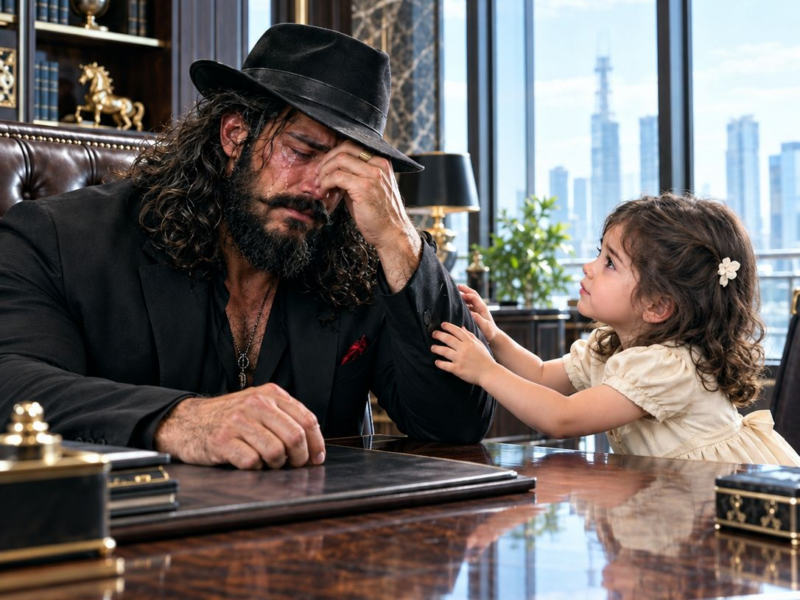
“Don’t Cry… Even the Deepest Wounds Heal,” the Maid’s Little Girl Told the Mafia Boss—He Froze
The rain had been falling over the Moretti estate since noon.
By evening, it had softened into a steady whisper against the tall windows of the east wing, the kind of rain that made a large house feel even larger because every empty room seemed to listen.
Elina Ruiz stood outside Vincent Moretti’s study with a silver tray in both hands.
The coffee on it had gone cold.
Again.
Nobody had entered the study in three days.
Not Marco DeLuca, Vincent’s head of security.
Not the attorney who had driven up from Manhattan twice and gone home without being received.
Not the men who normally appeared in the east wing with folders, numbers, shipping schedules, and the careful faces of people who understood exactly whose house they were standing in.
Vincent Moretti had locked the door on Sunday night.
It was Wednesday now.
The staff had learned to walk softly past it.
Elina had worked in the Moretti household for six years. She knew the difference between silence and danger.
Usually, the mansion was quiet because Vincent demanded order.
This silence felt different.
It felt wounded.
She lifted one hand to knock.
Then stopped.
A small humming sound came from farther down the hall.
Elina’s blood turned cold.
“Sophia?”
No answer.
She set the tray on a side table so quickly that coffee splashed over the saucer.
“Sophia.”
Her seven-year-old daughter was supposed to be in the kitchen coloring at the staff table.
She was not supposed to be anywhere near the east wing.
Elina rounded the corner.
There she was.
Sophia stood barefoot outside Vincent Moretti’s study with one palm pressed flat against the dark walnut door.
Her curls had escaped both yellow ribbons Elina tied that morning. One sock was missing. A purple crayon stuck out of the pocket of her cardigan.
She did not look frightened.
That frightened Elina enough for both of them.
“Sophia.”
Her whisper came out sharper.
“Come here. Right now.”
Sophia looked back.
“He’s sad, Mama.”
Two guards stood near the staircase.
Both pretended not to hear.
Marco did not.
He had just entered the hallway carrying a phone.
He stopped.
Elina hurried forward.
“That is not our business.”
Sophia turned back toward the door.
“I can hear him.”
Elina’s stomach dropped.
No one said Vincent Moretti cried.
People said Vincent destroyed contracts.
Ended partnerships.
Closed ports to men who betrayed him.
They said competitors who underestimated him eventually became very quiet about having done so.
They did not say he cried.
“Sophia.”
Elina reached for her daughter.
The study door opened.
Every adult in the hallway stopped breathing.
Vincent stood in the doorway.
He looked nothing like the man whose photograph appeared in business journals beside stories about Moretti Maritime Holdings.
His tie was gone.
His white shirt was creased.
His sleeves were pushed to the elbows.
Dark stubble shadowed his jaw.
His eyes were red.
Not angry red.
Worse.
Raw.
Hollow.
For one unguarded second, Elina did not see the man who had controlled half the commercial waterfront on the New Jersey side of the Hudson before he was forty.
She saw a fifty-year-old widower standing inside a room that had become too small for whatever he had been carrying.
Sophia looked up at him.
“You’ve been crying.”
Elina nearly stopped existing.
“Sophia.”
Vincent raised one hand.
Barely.
Elina froze.
He kept looking at the child.
His voice was rough.
“Go back to your mother.”
“Okay.”
Sophia did not move.
She studied his face with the unnerving directness children sometimes had before adults taught them to pretend not to notice pain.
Then she reached into her cardigan.
Elina expected a crayon.
Sophia pulled out a small, battered book.
Its blue cloth cover had faded nearly gray.
Vincent’s entire body changed.
Sophia did not notice.
She hugged the book against her chest.
“Don’t cry.”
Vincent’s fingers tightened against the doorframe.
Sophia smiled gently.
“Even the deepest wounds heal.”
The hallway became absolutely still.
Vincent stared at her.
Then at the book.
Then back at her face.
His lips parted.
Nothing came out.
Elina knew immediately that this was no ordinary sentence to him.
Sophia tilted her head.
“My book says so.”
Vincent’s right hand began to shake.
Only slightly.
Marco saw it.
So did Elina.
Vincent looked at the faded blue cover again.
“Where did you get that?”
Sophia glanced at Elina.
“Library.”
“Which library?”
“The little one.”
Elina knew what she meant.
The old family reading room at the back of the west wing.
Hardly anyone used it now.
A room of children’s books, old novels, and furniture covered in white sheets until the housekeeper opened it for cleaning last month.
Elina’s heart started beating harder.
“Sophia, give Mr. Moretti the book.”
Vincent said, “No.”
Everyone looked at him.
He swallowed.
“Let her keep it.”
Sophia hugged it tighter.
“I like the rabbit.”
Vincent closed his eyes.
Just for a second.
When he opened them again, whatever had broken through his face was being forced back behind the walls everyone recognized.
“Go with your mother.”
This time Sophia obeyed.
She walked toward Elina.
Then stopped.
Turned.
“Good night, Mr. Moretti.”
Vincent could not answer.
Elina took Sophia’s hand.
They moved down the hallway.
She did not breathe properly until they reached the servants’ stairs.
Behind them, Vincent remained in the doorway.
Marco waited nearby.
Finally Vincent looked at him.
“That book.”
Marco said nothing.
Vincent’s voice dropped.
“That room was supposed to be locked.”
“It hasn’t been used in years.”
“Who opened it?”
“Housekeeping, probably.”
Vincent looked toward the corridor where Sophia had disappeared.
“That was Lucia’s.”
Marco’s face changed.
“I know.”
“No.”
Vincent stepped backward into the study.
“You don’t.”
The door closed.
Elina did not sleep that night.
Sophia did.
Children had a cruel talent for creating emotional earthquakes and then asking whether breakfast could include pancakes.
At eleven thirty, Elina lay in the narrow bed in the staff apartment above the south kitchen, staring at the ceiling.
Sophia breathed evenly beside her.
The blue book rested on the nightstand.
Elina had finally looked at it.
The title was almost rubbed away.
The Brave Little Rabbit and the Winter Tree.
Inside, someone had written a name in looping purple ink.
Lucia M.
Elina stared at it until the letters blurred.
She had worked in the Moretti house six years.
She knew there had once been a Mrs. Moretti.
She knew there had been a child.
Nobody talked about either.
Older employees did not gossip about them.
That absence of gossip was its own warning.
Elina closed the book.
Sophia rolled over.
“Mama?”
“I thought you were asleep.”
“I was.”
“Then go back.”
Sophia opened one eye.
“Was Mr. Moretti mad?”
“No.”
“Sad?”
Elina hesitated.
“Yes.”
Sophia nodded as if this confirmed something obvious.
“His little girl liked rabbits.”
Elina’s breath caught.
“How do you know?”
“She wrote in the book.”
Sophia reached toward the nightstand.
“Her name.”
“That does not mean—”
“There’s a picture.”
Elina sat up.
“What picture?”
Sophia yawned.
“In the back.”
Elina opened the book again.
The final page had separated slightly from the binding.
Behind it was an old photograph no bigger than a playing card.
A man much younger than Vincent sat beneath a tree.
A dark-haired woman leaned against him.
Between them was a little girl around five years old holding the blue rabbit book open in her lap.
Vincent was smiling.
Not the faint controlled smile he used for business photographs.
A real one.
Elina had never seen his face look like that.
Sophia touched the girl.
“That’s her.”
Elina whispered, “Lucia.”
“You know her?”
“No.”
“Mr. Moretti does.”
Elina closed the book.
“Tomorrow we give this back.”
Sophia frowned.
“He said I could keep it.”
“This is different.”
“Why?”
“Because it belongs to his family.”
Sophia thought.
“Maybe he wants someone to read it.”
Elina looked at her daughter.
Seven years old.
One sock still missing somewhere in the house.
No understanding of money, power, territory, old grief, or the complicated rules adults created around sorrow.
Maybe that was why she had walked through a door everyone else had spent seventeen years avoiding.
At breakfast, Marco found Elina before she found him.
He stood outside the staff dining room.
“He asked about Sophia.”
Elina stopped.
Her hand tightened around the book hidden inside her apron.
“Is she in trouble?”
“No.”
“You’re sure?”
Marco’s expression shifted.
“I’m sure he didn’t sound angry.”
“That is not the same thing.”
“No.”
Marco had worked for Vincent longer than Elina had.
Nearly twenty years.
Gray had begun appearing at his temples.
He was built like a man who had spent his life making other people reconsider bad ideas.
Sophia liked him because he carried peppermints.
Elina trusted him only because six years of observation had given her reasons to.
“What did he ask?”
“Her full name.”
Elina’s stomach tightened.
“Why?”
“I don’t know.”
“Marco.”
“He asked how old she was. What school she attends. Whether her father is involved.”
Elina went cold.
“Why would he ask where she goes to school?”
Marco saw the fear immediately.
“No.”
“What?”
“That was my mistake.”
His voice softened.
“He asked whether she has a father. He did not ask for the school.”
Elina stared.
“You added it in your head because that is what security people ask.”
“Yes.”
“Wonderful.”
“Sorry.”
She exhaled.
Sophia appeared from the kitchen carrying toast.
“Mr. Marco.”
Marco reached into his jacket.
Peppermint.
Elina slapped his hand lightly.
“Breakfast first.”
Sophia looked betrayed.
Marco pocketed it.
“Your mother runs a strict operation.”
“Yes.”
Sophia took another bite.
Then noticed the book under Elina’s arm.
“You’re giving it back.”
“Yes.”
“You promised?”
“I promised nothing.”
“You said—”
Vincent’s voice came from the end of the corridor.
“She can keep it.”
Everyone turned.
He wore a charcoal suit now.
Tie perfect.
Hair combed.
No sign of the man from the study doorway except the tiredness around his eyes.
Sophia smiled.
“Good morning.”
Vincent looked at her.
“Good morning.”
Elina removed the book from her apron.
“There’s something inside.”
Vincent’s face tightened.
She opened the back cover.
The photograph.
For several seconds he simply looked.
Then he took it.
Carefully.
As if the paper could bruise.
Marco looked away.
Vincent ran one thumb across the edge.
“I forgot this existed.”
Sophia leaned closer.
“That’s your daughter?”
Elina whispered, “Sophia.”
Vincent did not stop her.
“Yes.”
“Where is she?”
The question entered the corridor softly.
Vincent’s shoulders became rigid.
Elina reached for Sophia.
Vincent answered first.
“She died.”
Sophia looked at him.
Children understood death differently depending on when it first entered their world.
Sophia had lost her grandfather at four.
To her, dead meant gone and still loved.
“I’m sorry.”
Vincent nodded.
“She liked rabbits.”
“Yes.”
“This one?”
Vincent looked at the cover.
“It was her favorite book.”
Sophia thought.
“Do you want it back?”
His face almost broke again.
“No.”
“Why?”
Vincent looked toward the photograph.
“Because books should be read.”
Sophia smiled.
Then ran toward the kitchen before Elina could remind her not to run in corridors.
Marco watched her go.
Vincent stayed where he was.
Elina gathered courage.
“Mr. Moretti.”
He looked at her.
“I’m sorry she went to your study.”
“So am I.”
Her stomach dropped.
Then he continued.
“Because no child should learn adults make sadness dangerous to approach.”
Elina stared.
He seemed surprised by his own sentence.
Vincent looked at the photograph again.
“That will be all.”
He walked away.
Marco waited until Vincent turned the corner.
Then he whispered, “What did your daughter do?”
Elina watched the empty hallway.
“I think she knocked on a door without knocking.”
That afternoon, Vincent summoned Elina to his study.
For the first time in six years, she entered.
The room was darker than she expected.
Heavy bookshelves.
Black wood.
A fireplace burned despite the mild spring weather.
On the desk sat the photograph.
Beside it was another.
Isabella Moretti holding a newborn.
Lucia.
Vincent stood at the window.
“Sit.”
Elina sat.
Her hands folded in her lap.
Vincent remained standing.
“Where did Sophia learn that sentence?”
“The one about wounds?”
“Yes.”
“From the book.”
“I know it is in the book.”
His voice tightened.
“Did anyone tell her to say it to me?”
“No.”
“Did anyone discuss Lucia around her?”
“Not in my hearing.”
“Isabella?”
“No.”
He turned.
“Salvador Conti?”
Elina frowned.
“I don’t know who that is.”
Vincent studied her long enough to decide whether that was true.
Apparently it was.
He sat.
“Lucia used to say that line whenever she thought I was upset.”
Elina said nothing.
“She could not pronounce deepest correctly.”
His mouth moved faintly.
“Dee-pest.”
A small sound escaped him.
Almost laughter.
Almost pain.
“She would bring me this ridiculous rabbit book and tell me even the dee-pest wounds heal.”
Elina’s throat tightened.
Vincent looked down.
“I had not heard the sentence in seventeen years.”
“I’m sorry.”
“Everyone says that.”
“I don’t know what else to say.”
“Good.”
She looked at him.
Vincent leaned back.
“People around me have spent seventeen years saying whatever they think I need to hear.”
“And what do you need?”
The question escaped before Elina could stop it.
Vincent’s eyes lifted.
A long silence.
“I don’t know.”
It was probably the most dangerous answer he could have given.
Because it sounded human.
He looked toward the photograph.
“Three days ago I received a message.”
Elina waited.
“A man connected to the Conti family requested a meeting.”
“The people who…”
She stopped.
Vincent finished.
“Who I believed killed my wife and daughter.”
Elina’s blood chilled.
“That is why you locked yourself in here.”
“One reason.”
“What did the message say?”
Vincent’s expression hardened.
“That I had spent seventeen years hating the wrong man.”
Elina forgot her fear.
“What?”
“He wants to come here.”
“Why?”
“To tell me what actually happened.”
Rain struck the windows harder.
Vincent looked toward it.
“I have built half my adult life around the answer to one question.”
“Who did it.”
“Yes.”
“And now?”
“Now someone wants to tell me the answer was convenient.”
He smiled without humor.
“I dislike convenient truths.”
Elina thought of Sophia’s book.
“Will you meet him?”
Vincent looked at her.
“I already agreed.”
The visitor arrived at midnight two days later.
Elina knew because nobody in the house slept.
A black sedan passed through the gates at 11:58.
Marco personally met it beneath the portico.
The man who stepped out was seventy if he was a day.
Silver hair.
Dark overcoat.
No visible fear.
Salvador Conti had once controlled union contracts and trucking routes from Newark to Elizabeth.
Now age had narrowed him.
Not weakened.
Narrowed.
Like an old knife.
Vincent waited in the study.
Marco stayed inside.
No one else.
At 3:40 in the morning, Salvador left.
Vincent did not.
At six, Marco found Elina making coffee.
He looked twenty years older.
“What happened?”
“Not my story.”
“Is he all right?”
Marco stared into the coffee pot.
“No.”
That was enough.
Vincent appeared in the garden after noon.
He had never been a garden man.
The Moretti estate had twelve acres of them anyway.
Money created hobbies a person did not need to have.
Elina saw him standing beside the stone wall where Sophia fed a stray orange cat.
She almost kept walking.
Then Vincent said, “Elina.”
She stopped.
He did not turn.
“Did Marco tell you?”
“No.”
“He is learning.”
“What happened?”
Vincent looked toward the wet grass.
“Conti did not order the bombing.”
Elina said nothing.
“A man named Arturo Vescari did.”
“Who was he?”
“An ambitious lieutenant.”
“Yours?”
“No. Conti’s.”
Vincent’s jaw tightened.
“He wanted war.”
“Why?”
“Because peace made him ordinary.”
Elina understood more than she expected.
Some men required enemies to remain important.
Vincent continued.
“Vescari planted evidence pointing to Salvador.”
“Why tell you now?”
“Because he is dying.”
“Salvador?”
“Yes.”
“And Vescari?”
“Dead fourteen years.”
Vincent laughed once.
“Shot by his own people during a dispute over money.”
Elina looked at him.
“So the man you wanted revenge against…”
“Was already dead while I spent fourteen years punishing everyone around his name.”
Wind moved through the trees.
Vincent’s face remained controlled.
That made the pain worse to witness.
“What did Salvador bring?”
“Records.”
“Proof?”
“Enough to investigate.”
Vincent finally looked at her.
“Not enough for forgiveness.”
“You don’t owe him forgiveness.”
“No.”
He seemed surprised.
Elina continued.
“You owe yourself the truth.”
His expression changed.
Sophia’s voice came from the other side of the wall.
“Sunflower!”
The orange cat shot through the hydrangeas.
Sophia ran after it.
Elina sighed.
Vincent almost smiled.
“She named the cat?”
“Yesterday.”
“Why Sunflower?”
“It hates flowers.”
“That makes no sense.”
“She’s seven.”
Sophia appeared.
Stopped when she saw Vincent.
“Mr. Moretti.”
“Miss Ruiz.”
Sophia held up the blue book.
“I finished it.”
Vincent looked at the cover.
“Did the rabbit survive?”
“Yes.”
“Good.”
“He got hurt.”
“I remember.”
“But he walked home.”
Vincent nodded.
Sophia studied him.
“Are you still sad?”
Elina closed her eyes.
Vincent answered.
“Yes.”
Sophia nodded as if sadness were a weather report.
“Okay.”
Then she ran after the cat.
Vincent watched.
“She doesn’t try to fix it.”
“No.”
“She did the first night.”
“She told you wounds heal.”
“That sounds like fixing.”
“No.”
Elina smiled faintly.
“She didn’t say when.”
Vincent looked at her.
For the first time, he laughed.
Quietly.
It lasted less than two seconds.
Still, two gardeners fifty feet away stopped working.
Nobody at the estate was accustomed to the sound.
Over the next week, Vincent changed in ways small enough to be deniable.
He stopped eating every dinner alone.
Not every night.
Just once.
Then twice.
Sophia usually ate with Elina in the smaller family dining room after Elina’s shift.
One evening Vincent appeared in the doorway.
Sophia waved.
“Come sit.”
Elina nearly dropped a serving spoon.
Vincent looked at her.
Permission.
That surprised her.
Elina nodded once.
He sat.
Sophia had drawn a garden full of purple flowers.
Vincent studied it.
“The sun has a face.”
“Yes.”
“The sun does not have a face.”
Sophia frowned.
“Everything has a face if you look long enough.”
Vincent had no answer.
He ate soup.
Sophia told him the orange cat had scratched Marco.
Vincent looked toward Marco standing outside the door.
“Did it?”
Marco said, “No.”
Sophia gasped.
“You said a bad word.”
Marco’s face went blank.
Vincent looked at him.
“What word?”
“Stupid.”
Marco stared at the ceiling.
Vincent almost smiled.
After dinner, Elina found a folded napkin beside Sophia’s drawing.
A crude sun.
Two eyes.
A mouth.
She kept it.
Not because it mattered.
Because somehow it did.
Then the questions began.
At first they seemed harmless.
The butcher at the neighborhood market asked Elina whether Sophia went to the Catholic school on Maple Avenue.
“No.”
The question bothered her only later.
Two days afterward, a man outside the pharmacy asked whether she worked “up at the big Moretti place.”
Elina did not answer.
That bothered her immediately.
She told Marco.
His expression sharpened.
“Describe him.”
“Forties. Brown coat. Beard.”
“Accent?”
“New Jersey.”
“That narrows it to six million people.”
She glared.
Marco apologized.
Security reviewed cameras.
No clear identification.
Then another report.
A black sedan parked three blocks from Sophia’s school for twenty minutes.
Once.
Could be nothing.
Twice.
Not nothing.
Marco quietly increased the route coverage.
Vincent was not told.
That lasted six hours.
“Why wasn’t I told?”
Marco stood inside the study.
Elina had been asked to come because the threat involved her child.
“Because we were verifying.”
“You verify after you protect.”
“We protected.”
“You moved the route.”
“Yes.”
“Good.”
Vincent looked at Elina.
“Sophia stays on the estate.”
Elina’s spine stiffened.
“No.”
Silence.
Marco looked at her.
Vincent looked more surprised than angry.
Elina’s hands trembled.
She kept going.
“She has school.”
“She can be taught here.”
“She has friends.”
“They can visit.”
“She has a life.”
“She has a threat.”
“And locking her inside a mansion tells her exactly what?”
Vincent’s face hardened.
“That she is alive.”
“No.”
Elina hated the fear in her own voice.
“That the world belongs to men who scare us.”
Marco looked down.
Vincent said, “You do not understand what happens when someone decides a child matters to me.”
“No.”
Elina stepped closer.
“But I understand what happens when powerful men decide fear gives them the right to choose for everyone else.”
The words landed.
Hard.
Vincent became very still.
Elina thought of his reputation.
Thought of all the stories.
Thought of losing her job.
Then thought of Sophia asking why she could not see her friends.
Vincent finally said, “What do you suggest?”
The question stunned her.
“Security.”
“We have security.”
“Quiet security.”
Vincent’s eyes narrowed.
“She goes to school. Marco changes routes. Someone watches from a distance. No men standing outside her classroom door.”
Marco said, “Possible.”
Vincent looked at him.
“You agree with her?”
“I enjoy living.”
“Marco.”
“Yes.”
He became serious.
“She’s right about one thing. If whoever is watching wants to test how much Sophia matters, locking the estate down confirms it.”
Vincent looked away.
Seventeen years earlier, his instinct had been the same.
Walls.
Guards.
Armored cars.
He had learned too late that protection could become predictable.
“All right.”
Elina breathed again.
Vincent looked directly at her.
“If anything changes, she comes home.”
“We discuss it.”
His jaw tightened.
“Elina.”
“We discuss it.”
Marco developed a sudden interest in the carpet.
Vincent stared at her for a long time.
Then nodded.
“We discuss it.”
That agreement mattered more than Elina realized.
Two days later, a photograph arrived.
Not anonymously.
Placed under the windshield wiper of Elina’s car outside the grocery store.
Sophia stood beside her.
Taken from across the street.
On the back:
HE LOST ONE DAUGHTER ALREADY.
Elina nearly collapsed.
Marco had the photograph in an evidence sleeve within fifteen minutes.
Vincent arrived at the security office three minutes later.
He looked at the picture.
All color left his face.
Not rage.
Fear.
Elina had never seen it so clearly.
Vincent Moretti, who had built his adult life around making other people fear him, was terrified.
“Bring them to the west wing.”
Elina shook her head.
“Vincent.”
It was the first time she used his first name.
Everyone noticed.
He did not.
“West wing. Tonight.”
“Elina,” Marco said quietly, “this time I agree.”
She looked at the photograph.
Sophia’s profile.
School backpack.
Hair ribbons.
The message.
“All right.”
Vincent immediately turned toward Marco.
“Double gate coverage. Pull the school detail. No outside staff rotation without review.”
“Done.”
“I want the market cameras.”
“Already requested.”
“Every vehicle that crossed Elina’s route.”
“Working.”
“Call Conti.”
Marco hesitated.
Vincent saw.
“What?”
“You think this is him?”
“No.”
Vincent’s voice was quiet.
“I think whoever did this wants me to think it is.”
That changed the room.
Elina looked at him.
Vincent continued.
“Salvador comes here after seventeen years. Two days later someone starts watching Sophia.”
Marco nodded slowly.
“Too obvious.”
“Exactly.”
“Someone wants the old war back.”
Vincent looked at the photograph again.
“And they found a child to light it with.”
Sophia moved into the west guest wing that night.
She hated the mattress.
Loved the bathtub.
Named two of the guards.
One refused his assigned name.
Sophia ignored him.
At 10:20, she sat cross-legged on the bed coloring.
Elina checked the window lock for the third time.
Sophia looked up.
“Mama.”
“Yes?”
“You already did that.”
“I know.”
“Then why again?”
Elina stopped.
Because fear makes people fast.
Vincent’s life had somehow begun teaching her things too.
“I’m scared.”
Sophia put down the crayon.
“Of the man?”
“Yes.”
“Mr. Moretti is scared too.”
Elina looked toward the door.
“He is.”
“Not for himself.”
“No.”
Sophia thought.
“That’s how I know he’s not all bad.”
Elina almost laughed despite herself.
“Sophia.”
“What?”
“People are more complicated than good and bad.”
She considered.
“Like broccoli?”
“What?”
“It’s bad, but you say it’s good.”
Elina stared.
Then laughed.
“Go to bed.”
Near two in the morning, headlights swept across the garden.
A vehicle approached the main gate too slowly.
Stopped.
Reversed.
Then accelerated forward.
Security moved.
Elina heard shouting through the corridor radios.
She grabbed Sophia.
Not because anyone told her.
Because mothers did not wait for protocol when engines revved outside the windows.
They entered the interior dressing room.
Marco had shown her the reinforced door.
Lock.
Phone.
Second exit into the service corridor.
“Is this the boring room?”
Sophia asked.
Elina stared.
“What?”
“Mr. Marco said if something happens we go somewhere boring.”
Despite everything, Elina smiled.
“Yes.”
“The boring room.”
The disturbance lasted seventeen minutes.
The driver abandoned the car near the lower gate and tried to escape through woods bordering the property.
Police caught him before dawn.
He was not a Moretti rival.
Not officially.
He was a freelance surveillance contractor with an old criminal record and recent payments from a consulting company no one recognized.
Inside the vehicle, police found cameras.
Maps.
Elina’s grocery schedule.
Sophia’s school route.
And another photograph.
Vincent kneeling beside Sophia in the garden two days earlier while she showed him the rabbit book.
Somebody had been watching the estate closely enough to document affection.
When Vincent entered the west wing, his composure was gone.
He went directly to Sophia.
Stopped before touching her.
That detail mattered.
“Hug?”
Sophia nodded.
Vincent knelt.
She wrapped her arms around his neck.
He closed his eyes.
His hands shook.
“I’m okay.”
“I know.”
“You’re scared.”
“Yes.”
Sophia pulled back.
Her small hand touched his cheek.
“Don’t cry.”
Vincent made a broken sound.
Sophia continued.
“Even the deepest wounds heal.”
This time he did cry.
Not dramatically.
No collapse.
Just tears he did not wipe away fast enough.
Marco looked toward the window.
Elina looked down.
Sophia stayed where she was.
Vincent whispered, “Lucia used to say that.”
Sophia frowned.
“The girl in my book?”
“Yes.”
“How did she know?”
Vincent laughed through the tears.
“She read too much.”
“I read too much.”
“Apparently.”
Sophia hugged him again.
Vincent let her.
The next morning, he gathered his senior men.
Marco.
His attorney, Daniel Hart.
Two operations lieutenants.
One was Carlo Rizzi, a man in his mid-forties who had worked for the Moretti organization since his twenties.
Elina was asked to remain with Sophia near the rear of the room.
She did not understand why until Vincent spoke.
“I built this house to protect what I loved.”
Nobody moved.
“I built the rest because I failed.”
Carlo shifted.
Vincent noticed.
He continued.
“Seventeen years ago, Isabella and Lucia died because someone wanted a war.”
His voice remained controlled.
“I gave him one.”
Marco looked at Vincent.
Carlo did not.
“I spent seventeen years believing fear was protection.”
Vincent looked toward Sophia.
“It isn’t.”
Carlo finally spoke.
“With respect, Vincent, now is not the time to become philosophical.”
The room changed.
Vincent turned.
“What time is it?”
“A man photographed a child tied to this house.”
“Yes.”
“And you’re talking about feelings.”
Vincent stared.
Carlo continued.
“We should make an example.”
“Of whom?”
“The contractor.”
“He is in police custody.”
“Then whoever hired him.”
“When we know who.”
Carlo’s jaw tightened.
“We know where this started.”
“Do we?”
“Conti.”
Vincent looked at Marco.
Marco stayed expressionless.
Vincent returned to Carlo.
“Why?”
“He comes here after seventeen years. Suddenly we have surveillance.”
“Too obvious.”
“Sometimes obvious is correct.”
Vincent stepped closer.
“And sometimes men who profit from war prefer familiar enemies.”
Carlo’s face barely changed.
Barely.
Vincent noticed.
So did Marco.
The meeting ended twenty minutes later.
No declaration of war.
No retaliation.
Instead:
Independent financial review.
External digital forensics.
Coordination with state police on the surveillance contractor.
Temporary suspension of route information outside Marco’s direct team.
Carlo hated every decision.
That was useful.
The first evidence arrived two days later.
The surveillance contractor’s payment came from Raven Strategic Risk LLC.
A legitimate consulting company on paper.
Its largest client over the previous eighteen months was a Moretti-controlled warehousing vendor managed through Carlo Rizzi’s division.
Not proof.
A connection.
Carlo explained easily.
“We use outside risk companies constantly.”
True.
Daniel Hart confirmed.
Vincent did not accuse him.
He ordered deeper review.
Carlo smiled.
“You don’t trust me.”
Vincent answered, “I don’t trust anyone enough to stop checking.”
That included himself now.
The second evidence item arrived from Marco.
A recovered message from the contractor’s seized phone.
Not from Carlo.
From a burner number.
MAKE SURE THE CHILD IS SEEN WITH HIM. CONTI NEEDS TO BELIEVE HE HAS SOMETHING TO LOSE AGAIN.
Vincent read it twice.
Marco said, “This was never about taking Sophia.”
Elina stood beside the desk.
“What was it about?”
“Creating a picture.”
Vincent answered.
“What picture?”
Vincent looked at the message.
“That I had a new child I cared about.”
Marco continued.
“And making Conti’s side see the same thing.”
Elina understood.
“If Conti thinks Sophia matters…”
“He worries we’re preparing leverage against him,” Vincent said.
“And you think Conti is watching her.”
“Yes.”
“War starts.”
Marco nodded.
“A photograph can do what a bullet does if the right men are afraid enough.”
Elina felt sick.
Vincent’s voice became ice.
“Who benefits?”
Marco said nothing.
Vincent already knew the answer.
Not a name.
A category.
Anyone whose power depended on the old feud remaining alive.
The forensic accountants found irregularities inside Carlo’s division.
Not spectacular theft.
Something more strategic.
Payments to private security vendors.
Transportation contractors.
Information brokers.
All justified through “competitive intelligence.”
Carlo had built a parallel network.
Useful during conflict.
Expensive during peace.
If Vincent and Conti stopped treating one another as permanent enemies, Carlo’s influence shrank.
Vincent confronted him in the study.
Marco stayed.
Daniel Hart stayed.
No guns on the table.
No theatrical execution.
Carlo looked at the financial reports.
“Every dollar served this organization.”
“Some served you.”
Carlo smiled.
“We all serve ourselves.”
“Did you hire Raven?”
“Yes.”
“Did you authorize surveillance of Elina and Sophia?”
“No.”
Vincent placed the recovered message on the desk.
Carlo read it.
His face did not move.
“Not my number.”
“True.”
“Then what exactly are we doing?”
Vincent sat back.
“Waiting.”
Carlo frowned.
“For what?”
“For you to explain why the burner that sent this message activated from the same cell sector as your driver’s phone on three separate dates.”
Carlo’s eyes sharpened.
Marco added, “Including the night the photograph was placed on Elina’s car.”
Silence.
Carlo looked at Marco.
“You’re building a story.”
Vincent said, “Read first. Defend later.”
Carlo looked at him.
The words hung.
Then he laughed once.
“You’re letting a maid and a child change how you run this family.”
Vincent’s face became still.
“No.”
Carlo leaned forward.
“You think peace makes you better?”
“I think truth makes me less stupid.”
“You sound weak.”
Vincent almost smiled.
“There it is.”
“What?”
“The thing you actually fear.”
Carlo’s jaw tightened.
Vincent continued.
“If Conti stops being the enemy, what are you?”
“I built your security operations.”
“Marco did.”
“I built the streets under them.”
“You built a business inside a war.”
Vincent’s voice dropped.
“And now you need the war.”
Carlo looked toward Elina.
That was his mistake.
Not threatening.
Assessing.
Vincent saw.
“Elina leaves.”
“No.”
Everyone turned.
Elina stood straighter.
“This concerns my daughter.”
Carlo almost smiled.
Vincent looked at her.
For years he would have ordered.
Now he asked.
“Are you sure?”
“Yes.”
He nodded.
Carlo saw that too.
The shift.
He hated it.
“You think this is kindness?”
Carlo asked.
Vincent said nothing.
“You think asking permission makes you clean?”
“No.”
Good answer.
Carlo leaned back.
“We survived because nobody questioned you.”
Vincent’s expression hardened.
“No.”
“We survived because everyone feared consequences.”
“Same thing.”
“No.”
Vincent looked at him.
“That belief is why you thought you could use a seven-year-old to manage me.”
Carlo’s face changed.
There.
Small.
Real.
Marco saw it.
Carlo said, “I never meant for the girl to be touched.”
Elina stopped breathing.
Vincent did not.
Daniel Hart closed his eyes.
The confession was not complete.
But it was enough to change the room.
Vincent asked, “What did you mean?”
Carlo realized.
Too late.
He recovered.
“I meant if this ridiculous theory were true.”
“No.”
Vincent’s voice remained quiet.
“Say what you meant.”
Carlo stared at him.
Then years of restraint broke.
“You were becoming soft.”
Elina’s skin went cold.
Carlo continued.
“Conti comes here. You sit in the garden. You eat with staff. Men notice.”
“So?”
“So men test.”
“You tested me.”
“I reminded everyone who you are.”
“With my daughter’s photograph.”
“She is not your daughter.”
Vincent moved so fast Marco took one step forward.
Then Vincent stopped himself.
That mattered more than anyone in the room understood.
Carlo smiled bitterly.
“There he is.”
Vincent’s hands clenched.
Carlo wanted anger.
Violence would prove him right.
The old Vincent would return.
War restored.
Instead Vincent sat.
Slowly.
“You’re right.”
Carlo blinked.
“Sophia is not my daughter.”
Elina looked at him.
Vincent continued.
“She has a mother.”
He looked toward Elina.
“And I will not make choices about her life without that mother.”
Then back to Carlo.
“But you endangered a child because you thought my grief belonged to you.”
Carlo’s face hardened.
“You built us on that grief.”
Vincent nodded.
“Yes.”
The answer robbed Carlo of momentum.
Vincent continued.
“That part is mine.”
Silence.
“I let vengeance become policy.”
He looked at Marco.
“I let loyalty become permission.”
Then Daniel.
“I let fear become governance.”
Finally Carlo.
“But you mistook my guilt for your authority.”
Vincent pressed one button on the desk phone.
Two state investigators entered from the adjoining conference room with Daniel’s outside counsel.
Carlo stared.
“You brought police into this house?”
Vincent said, “For the surveillance case.”
“You son of a—”
“For seventeen years I handled everything myself.”
Vincent’s voice remained calm.
“Look where that brought us.”
Carlo stood.
Marco moved.
Carlo stopped.
Not because Marco threatened him.
Because he understood.
No dramatic last stand.
No blood.
Just evidence.
Accounts.
Messages.
Surveillance.
Conspiracy.
The kind of things that survived after anger cooled.
Carlo was escorted out.
He looked back once.
“You’ll regret this.”
Vincent answered.
“I regret enough already.”
The house did not become peaceful overnight.
That would have been another lie.
Carlo’s arrest exposed divisions.
Three employees resigned.
Two contracts collapsed.
Vincent lost control of a warehouse operation after partners panicked.
Rumors spread.
Some said Vincent Moretti had become weak.
Others said handing Carlo to authorities was a strategy to protect the legitimate businesses.
Both were partly true.
Vincent paid a price.
So did Elina.
She no longer pretended working inside his world was harmless.
One evening she stood in the study.
Sophia slept upstairs.
“I need to leave.”
Vincent looked up.
The words hurt before he could hide it.
“The estate?”
“Yes.”
“Why?”
“You know why.”
He did.
“You think she’s unsafe here.”
“I think she was endangered because she mattered to you.”
Vincent looked down.
“That will not happen again.”
“You cannot promise that.”
“No.”
He forced himself to say it.
“I cannot.”
Elina breathed.
“If I stay only because you can protect us, then I’m teaching Sophia the same thing Carlo believed.”
Vincent looked at her.
“That power decides where people belong.”
He sat back.
“What do you want?”
“A normal apartment.”
“You have one here.”
“Not yours.”
He nodded slowly.
“School stays the same?”
“Yes.”
“Job?”
“I’m keeping my job unless you fire me.”
He almost smiled.
“You’re telling me you’re moving out of my house but still coming here every morning.”
“Yes.”
“That seems inefficient.”
“It seems normal.”
Sophia’s favorite word lately.
Boring.
Normal.
Vincent had once despised both.
Now they sounded luxurious.
“I’ll have Marco review the building.”
Elina gave him a look.
“Ask first.”
He closed his eyes.
“May I have Marco review the building?”
“Yes.”
“No permanent guard?”
“No.”
“Emergency contact?”
“Yes.”
“Driver?”
“No.”
“Car allowance?”
“Vincent.”
He stopped.
“Fine.”
Elina smiled.
Progress.
Sophia cried when told they were leaving the staff apartment.
Not because she wanted marble halls.
Because Sunflower lived in the garden.
Vincent solved that problem badly.
“You can take the cat.”
Sophia gasped.
Elina said, “No.”
Vincent looked confused.
“She loves the cat.”
“The landlord does not.”
“Buy the building.”
Elina stared at him.
“No.”
Sophia whispered, “That would be cool.”
Elina pointed at her.
“No.”
Vincent looked personally wounded.
“Then Sunflower stays.”
Sophia negotiated weekends.
Vincent accepted.
Six months later, the Moretti estate sounded different.
Not cheerful exactly.
That would have been too simple.
But less afraid.
Vincent still ran businesses that required men to speak carefully in his presence.
He still had enemies.
Still made decisions Elina preferred not to understand.
But inside his house, certain things changed.
No one disappeared from employment because they disagreed in meetings.
Marco established independent review for household security decisions.
Staff could report concerns outside their managers.
Vincent started asking questions he once considered signs of weakness.
“What am I missing?”
“Who disagrees?”
“What does this look like to someone without my information?”
The first few times, his men thought it was a trap.
It was not.
Sophia still visited after school twice a week.
Elina insisted those visits belong to her daughter, not Vincent.
If Sophia wanted ballet, she went to ballet.
If she wanted to eat cookies with Mrs. Alvarez instead of see Vincent, she did.
The first time she chose cookies, Vincent looked offended.
Elina enjoyed it.
“She has priorities.”
“Apparently.”
“Chocolate chips beat organized crime.”
“Do not say that sentence in public.”
One rainy evening, Sophia found Vincent in the smaller dining room reading the blue rabbit book.
She stopped.
“You’re reading my book.”
He looked up.
“Technically mine.”
“You said I could keep it.”
“Then yours.”
She climbed into the chair opposite him.
“Where are you?”
“Winter.”
“That part is sad.”
“I know.”
“The tree breaks.”
“Yes.”
“But not all the way.”
He looked at her.
“No.”
Sophia opened the book to the page.
A rabbit beneath a damaged tree after a storm.
The line sat beneath the illustration.
Even the deepest wounds heal, though never into the shape they had before.
Vincent stared.
He had remembered only the first half for seventeen years.
Maybe because the second half was harder.
“Read that.”
Sophia did.
Slowly.
“Though never into the shape they had before.”
Vincent looked toward the rain.
Lucia.
Isabella.
The man he had been.
The man he became.
Healing had never promised restoration.
Only change.
Sophia closed the book.
“You look sad again.”
“I am.”
“Bad sad?”
Vincent thought.
“No.”
She nodded.
“Okay.”
Again.
No fixing.
No demand.
Just room.
Vincent finally understood why the child’s kindness had reached him.
She did not ask grief to leave before sitting beside it.
A year after Carlo’s arrest, Salvador Conti died.
His son invited Vincent to the funeral.
Marco expected him to refuse.
Vincent went.
No entourage beyond Marco.
No display.
At the cemetery, Salvador’s son approached.
“My father wanted you to have this.”
A sealed envelope.
Inside was a copy of an old ledger page.
Payment from Arturo Vescari to the mechanic who altered the Moretti car seventeen years earlier.
Evidence.
Late.
Cold.
Still evidence.
Vincent looked at it for a long time.
Marco asked, “What do you want to do?”
Once, the answer would have involved graves.
Now Vescari had been dead fourteen years.
No vengeance remained available.
Only truth.
“Archive it.”
Marco nodded.
“That’s all?”
Vincent folded the paper.
“What else would make Lucia less dead?”
Marco had no answer.
Neither did Vincent.
That was the point.
On the anniversary of Isabella and Lucia’s deaths, Vincent visited the cemetery.
For seventeen years he had gone alone before dawn so nobody could witness it.
This time Sophia asked to come.
Elina said the decision was Vincent’s.
Vincent said the decision was Sophia’s.
Progress again.
They stood beneath yellow autumn trees.
Isabella’s stone was larger.
Lucia’s smaller.
Sophia held wildflowers from the Moretti garden.
“This is her?”
Vincent nodded.
“My Lucia.”
Sophia placed the flowers down.
“Hi.”
Vincent almost laughed.
“She can’t hear me?”
“I don’t know.”
Sophia thought.
Then spoke louder.
“Hi.”
Vincent laughed for real.
The cemetery felt less like betrayal for containing the sound.
Sophia touched the little stone.
“I have your book.”
Vincent looked away.
“She knows.”
“How?”
“I tell her when I come.”
Sophia accepted that.
Then she said, “I can remember her too.”
Vincent’s throat tightened.
“You never knew her.”
“I know the rabbit.”
He looked at her.
“That’s not the same.”
“No.”
Sophia’s voice softened.
“But it’s something.”
Vincent knelt.
Seventeen years of power had taught him to reject inadequate things.
Partial answers.
Small consolations.
Incomplete justice.
Children seemed built to accept that some things could matter without being enough.
“Yes.”
He whispered.
“It’s something.”
Sophia placed one flower on Lucia’s grave and one on Isabella’s.
Then she took Vincent’s hand.
Not because he needed saving.
Because they were walking back to the car.
Six years later, Sophia was thirteen.
She no longer believed Sunflower was immortal, though the cat seemed determined to make the argument.
Elina had become household operations manager after Vincent offered the job twice and she rejected the first offer because the salary was “ridiculous in the wrong direction.”
He increased it.
She accepted.
Not as gratitude.
As work.
That distinction remained important.
Vincent was fifty-six.
More gray.
Less myth.
Still dangerous in the ways his world required.
But the Moretti organization itself had changed.
Not clean.
Not redeemed.
Life rarely transformed that neatly.
Vincent had sold several operations he could no longer pretend were compatible with the future he wanted.
Legitimate maritime holdings expanded.
Private enforcement shrank.
Lawyers became more important than lieutenants.
Men who liked the old structure left.
Some loudly.
Some quietly.
Vincent let them.
Marco once asked whether Sophia had done all that.
Vincent laughed.
“No.”
“What did?”
“Consequences.”
Marco waited.
Vincent continued.
“She just made me look at them.”
That was more accurate.
On Sophia’s fifteenth birthday, Vincent gave her a new edition of The Brave Little Rabbit and the Winter Tree.
She opened it.
“This isn’t mine.”
“Your copy is falling apart.”
“I like mine.”
“I know.”
She turned the new book over.
Hardcover.
Beautiful illustrations.
First-edition facsimile.
Probably expensive.
Sophia looked suspicious.
“How much?”
Vincent looked offended.
“Children do not ask gift prices.”
“I’m fifteen.”
“Still no.”
She smiled.
Then noticed the inscription.
Vincent had written:
For Sophia—who taught me healing was not the same as forgetting.
She read it twice.
Then closed the book.
“You know I didn’t teach you that.”
Vincent leaned back.
“No?”
“The rabbit did.”
“Ungrateful.”
“Also Lucia.”
His expression softened.
“Yes.”
“And my mom.”
“Yes.”
“And Mr. Marco.”
Marco, standing near the door, said, “Leave me out of this.”
Sophia smiled.
Vincent did too.
The original blue book remained in Sophia’s room.
Lucia’s name still inside.
Photograph still behind the last page.
Elina once asked Vincent whether he wanted the photograph back.
“No.”
“Why?”
Vincent looked toward Sophia.
“Because grief was never supposed to be locked in my desk.”
That might have been the closest he came to explaining everything.
Years later, when people talked about Vincent Moretti, they still told old stories.
Ports.
Unions.
Deals.
Men who had feared him.
The Moretti name did not become gentle simply because a child once stood outside a study.
That would have insulted everyone harmed along the way.
Sophia did not redeem Vincent.
Children should never carry that job.
She did something smaller.
More honest.
She opened a forgotten book.
Repeated a sentence another little girl had loved.
Then refused to be afraid of a grieving man simply because every adult around her had decided fear was the safest language.
Vincent did the harder work afterward.
He checked the old story he had built his life around.
Accepted that some of it was wrong.
Stopped treating vengeance as proof of love.
Protected Sophia without claiming her.
Let Elina choose where to live.
Let evidence decide Carlo’s fate instead of rage.
Visited Lucia’s grave without turning grief into another private punishment.
None of that brought Isabella back.
None brought Lucia back.
The deepest wounds did not heal by disappearing.
They healed into scars.
Visible sometimes.
Painful in bad weather.
Evidence of damage.
Evidence of survival too.
On a rainy evening almost exactly ten years after Sophia first wandered into the east wing, Vincent sat alone in the study.
The door was open.
That was new.
Sophia, seventeen now, walked past carrying a stack of college brochures.
She stopped.
“You okay?”
Vincent looked at the rain.
“Yes.”
“That answer sounded suspicious.”
He smiled.
“I am sad.”
She leaned against the doorway.
“Bad sad?”
“No.”
“Okay.”
The old exchange.
Older voices.
Same meaning.
Sophia looked at the desk.
Lucia’s photograph stood there openly now.
Beside Isabella.
No drawer.
No hidden frame.
No rule against saying their names.
Sophia smiled.
“College applications are terrible.”
“So I’ve heard.”
“Mom says I should stay close.”
“Your mother says that because she loves you.”
“You think I should go far?”
Vincent considered.
“I think you should go where you choose.”
Sophia raised an eyebrow.
“Who are you?”
“Be respectful.”
She laughed.
Then became serious.
“Were you always this dramatic?”
“Yes.”
“Mom says worse.”
“Your mother is insubordinate.”
“She works for you.”
“Exactly.”
Sophia stepped into the study.
The rain tapped the windows.
Ten years earlier, everyone in the house had feared this room.
Now the door stayed open often enough that Sunflower’s successor—a fat orange cat named Tuesday—slept beneath Vincent’s desk.
Sophia picked up Lucia’s photograph.
“She looks happy.”
“She was.”
“Do you still miss her?”
“Every day.”
“Does it still hurt?”
“Yes.”
Sophia looked at him.
Vincent waited.
She smiled faintly.
“Guess the book was right.”
He looked toward the old blue cover on a shelf.
“About which part?”
“The wound.”
Vincent thought of seventeen years spent waiting for healing to mean the pain stopped.
Then ten more learning something else.
“Yes.”
He said.
“It was.”
Sophia replaced the photograph.
She started toward the door.
“Good night.”
“Good night.”
She paused.
“Vincent?”
He looked up.
She rarely used his first name.
“Thank you for never making me replace her.”
His throat tightened.
“You couldn’t.”
“I know.”
Sophia smiled.
“That’s why it worked.”
She left.
Vincent sat in the quiet study.
No locked door.
No untouched coffee.
No men waiting outside because they feared what grief might make him do.
Only rain.
Photographs.
An old children’s book.
And somewhere downstairs, Elina calling Sophia back because she had forgotten her umbrella.
Vincent closed his eyes.
For years he had believed healing would be betrayal.
If he laughed again, perhaps he had loved Isabella less.
If another child mattered, perhaps Lucia became replaceable.
If the feud ended, perhaps their deaths stopped meaning enough.
Grief had taught him cruel mathematics.
Sophia had never accepted the equation.
Love did not divide that way.
It accumulated.
The dead remained loved.
The living were allowed to matter.
The wound stayed part of him.
It simply stopped being the only part.
Vincent opened the study door wider before returning to his chair.
Ten years earlier, a seven-year-old girl had stood on the other side of it and said something simple enough to sound impossible.
Don’t cry. Even the deepest wounds heal.
He had frozen because he thought she was asking him to stop hurting.
He understood now that she never had.
She had only been telling him the pain did not have to decide what happened next.









