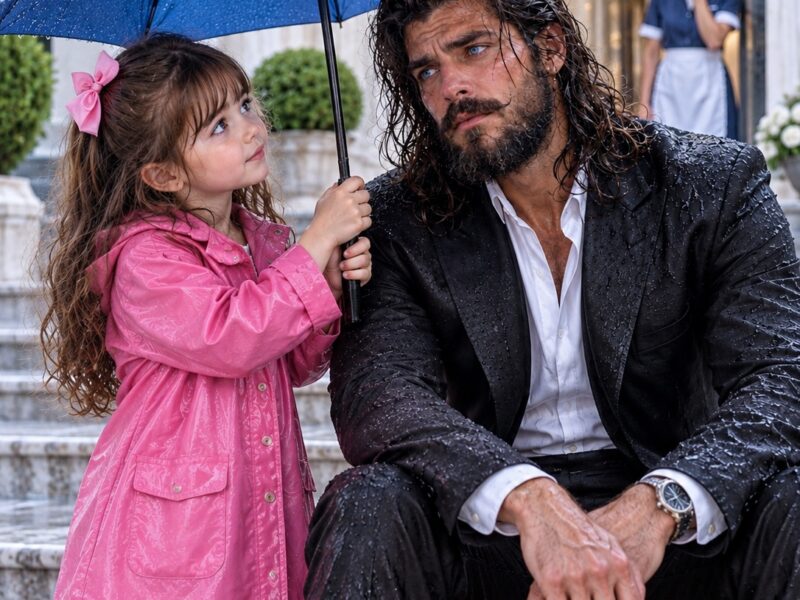
“Don’t Cry, Mister… I’ll Keep You Dry,” the Maid’s Little Girl Told the Mafia Boss—He Froze!
The whole city feared Adrien Voss, but that night he sat alone in the rain like a man waiting to be punished.
My six-year-old daughter crossed the driveway with a three-dollar duck umbrella and held it over his head.
When she whispered, “Don’t cry, mister… I’ll keep you dry,” the glass slipped from his hand—and he looked at her as if a ghost had just spoken.
The rain came down so hard that night it sounded deliberate.
Not ordinary October rain. Not the kind that softened the city or left clean streets behind it. This storm struck the windows sideways and drove sheets of water across the stone driveway until the security lights looked like pale coins beneath the surface of a river.
Nobody at the Voss estate went outside.
Nobody except Adrien.
I saw him through the staff-room window.
At first, I thought one of the guards had been left on the porch. Then lightning opened the sky over Lake Michigan, and for one white second I saw the shape clearly.
Adrien Voss sat on the bottom step of his own mansion.
No coat.
No umbrella.
His white dress shirt was soaked through at the shoulders, and a glass of whiskey rested loose between his fingers. He was not drinking it. He was just letting the rain strike his face as though he had decided the weather was allowed to do something no human being in Chicago dared.
Touch him without permission.
My name is Maria Delgado, and by then I had worked in that house for almost two years.
Two years was long enough to learn that Adrien Voss never needed to raise his voice.
Men did that for him.
His name did it for him.
Black sedans waited outside private restaurants when he ate. Politicians who claimed not to know him returned his calls before dinner. Trucking companies, warehouses, private security firms, and several pieces of waterfront real estate carried different corporate names, but everyone who mattered understood where the decisions eventually led.
To Adrien.
The newspapers called him a logistics executive when they were being careful.
People in neighborhoods closer to the docks used older words.
Boss.
Family.
Organization.
Sometimes, when they were sure nobody was listening, mafia.
I did not ask which description was technically correct.
I needed a paycheck.
My daughter needed health insurance.
Rent did not become more forgiving because the man signing my checks frightened people.
So I followed the rules.
Do not enter the west study unless called.
Do not look at papers left on desks.
Do not ask why cars arrived at two in the morning.
Do not repeat names you heard behind closed doors.
And above all, never bring your personal life close enough to become Mr. Voss’s problem.
My daughter had never learned that last rule.
Lily was six.
At six, powerful men were still just men.
Mansions were big houses.
Security guards were people who carried radios.
And Adrien Voss was not a criminal legend whose private elevator could make senior executives suddenly remember appointments elsewhere.
He was, in Lily’s words, “the sad man.”
The first time she called him that, I nearly dropped a laundry basket.
“Do not say that here.”
“Why?”
“Because it is rude.”
“He is sad.”
“You don’t know that.”
“I do.”
“How?”
She shrugged.
“He looks out windows when nobody is outside.”
Children notice the things adults train themselves not to see.
That night, Lily sat cross-legged on the staff-room rug drawing houses with too many chimneys while I folded towels.
Thunder rolled over the roof.
She looked up.
“Mama?”
“Yes?”
“Is the rain going to break the house?”
“No.”
“It sounds mad.”
“It will pass.”
She abandoned her crayons and pressed her face against the window.
Then she saw Adrien.
“Mama.”
Something in her voice changed.
I kept folding.
“What?”
“The sad man is outside.”
My hands stopped.
I followed her gaze.
Adrien had not moved.
The rain streamed from his hair and jaw. His elbows rested on his knees, and his head was slightly bowed. For a man whose posture was usually so exact, the shape of him looked wrong.
Collapsed without actually falling.
“He’ll come inside.”
“He’s getting wet.”
“He knows.”
“Maybe he doesn’t.”
“He knows, baby.”
Lily frowned.
Children are suspicious of adult explanations that contain no solution.
Then she looked toward the back door.
My stomach tightened.
“Lily.”
She moved.
“Don’t.”
Her pink umbrella leaned in the corner.
Cheap plastic handle.
Three cartoon ducks printed across the fabric.
I had bought it at a neighborhood discount store the week before because she stood in the aisle hugging it until I agreed that three dollars would not destroy our grocery budget.
She reached for it.
“Lily.”
“He needs one.”
“He has twenty umbrellas.”
“Then why isn’t he using one?”
I opened my mouth.
No answer.
That should have been my warning.
The door clicked.
“Lily!”
She was already outside.
Socks.
No shoes.
Pink umbrella shaking in both hands as the wind caught it.
I ran after her.
Then stopped.
Because she was halfway across the driveway, and Adrien’s security men had already noticed.
Three guards turned at once.
One moved toward her.
Adrien lifted a hand.
The guard stopped.
Lily kept walking.
Rain soaked her pajamas below the umbrella.
“Lily, come back!”
She looked over her shoulder.
“But he’s wet.”
Adrien raised his head.
Even from twenty feet away, I saw his expression change.
Not anger.
Confusion.
My daughter reached the porch.
The umbrella barely cleared his shoulder.
She stood on the step below him and stretched both arms as high as she could.
The ducks tilted over his head.
Water that had been striking Adrien’s face began striking Lily instead.
He stared at her.
She stared back.
Then she said it.
“Don’t cry, mister.”
My heart stopped.
Adrien’s face became completely still.
Lily adjusted the umbrella.
“I’ll keep you dry.”
The whiskey glass slipped from his fingers.
It struck the stone.
Shattered.
Nobody moved.
Rain rushed through the silence.
Adrien looked at Lily with an expression I had never seen on him.
Not fury.
Not authority.
Something raw.
Something almost frightened.
Lightning flashed again.
His mouth opened.
No words came.
Lily frowned.
“Did you hurt your hand?”
Adrien looked down at the broken glass as though he had forgotten it existed.
“No.”
His voice sounded different.
Rough.
She leaned closer.
“You are crying.”
“It’s rain.”
“There’s rain in your eyes too?”
One of the guards looked away.
I wanted the earth to open.
“Lily.”
I hurried forward.
“Mr. Voss, I am so sorry.”
I reached for her shoulder.
Adrien spoke.
“Wait.”
One word.
I froze.
So did every guard.
Adrien’s gaze remained fixed on Lily.
“Don’t take her yet.”
I pulled my hand back.
Lily continued holding the umbrella over him, sacrificing almost all of its protection without realizing it.
Adrien looked from her face to the yellow plastic handle.
Then back.
“What is your name?”
“Lily.”
“Lily what?”
“Delgado.”
Something moved through him.
“Your middle name?”
I stared.
Why would he ask that?
Lily answered before I could decide whether I should stop her.
“Rose.”
Adrien inhaled.
A tiny sound.
Barely there.
“Rose?”
“After Grandma.”
He looked at me.
“Your mother’s name was Rose?”
“No.”
I swallowed.
“My mother’s mother was Rosa. Lily’s middle name is the English version.”
He nodded slowly.
Still watching my daughter.
“Your mother.”
“What was her name?”
Every instinct I had learned in that house told me to answer simply and leave.
“Elena.”
Adrien’s fingers closed around the edge of the step.
“What?”
“Elena Delgado.”
His face lost color.
I had never seen that happen to him.
Not once.
Lily lowered the umbrella slightly.
“Mister?”
Adrien stood too quickly.
One guard stepped forward.
He waved him away.
“Inside.”
His voice had returned.
Cold.
Controlled.
Except his hands were not.
They trembled.
“Mr. Voss?”
“Maria, take Lily inside.”
I stared.
His eyes found mine.
“I’m not angry.”
That frightened me more.
“Take her somewhere warm.”
He looked at Lily.
“Please.”
The word surprised all of us.
I led her inside.
Halfway across the marble entryway, she twisted around.
Adrien remained in the rain.
No umbrella.
No whiskey.
Just broken glass at his feet.
“Mama.”
“Yes?”
“Why is he more sad now?”
I looked back once.
“I don’t know.”
That was true.
But before morning, I would realize the question had started thirty-two years earlier.
I barely slept.
Lily did.
She fell asleep wrapped in two blankets, the duck umbrella drying open beside the radiator.
I sat at our kitchen table until almost three.
Elena Delgado.
My mother.
I tried to remember everything she had ever said about her childhood.
Very little.
She avoided it.
If I asked about grandparents, she would change the subject.
If I asked where she grew up, she said, “Everywhere and nowhere.”
If I asked about my father, she gave me a different silence.
My mother was not secretive about ordinary things.
She told me when we were poor.
Told me which creditors called.
Told me when she was scared.
But anything before my birth existed behind a wall.
She died when I was nineteen.
Cancer.
Fast.
Six months from diagnosis to funeral.
There were questions I thought adulthood would eventually give me time to ask.
Adulthood did not.
At six forty the next morning, my phone rang.
House manager.
“Mr. Voss would like to see you before your shift.”
My stomach dropped.
“Am I being fired?”
Daniel paused.
“If he were firing you, Maria, I suspect I would have been told before breakfast.”
“That is not comforting.”
“It was not intended to be.”
At seven thirty, I stood outside the west study.
The same door I had spent two years avoiding.
Daniel opened it.
Adrien sat behind an oak desk.
Dry now.
Dark suit.
Cuff links.
Coffee untouched.
Every part of him had been put back in place.
Except his eyes.
He looked like he had not slept.
“Come in.”
I sat.
He waited until Daniel closed the door.
“I owe you an explanation.”
That was not how I expected the conversation to begin.
“About last night?”
“Yes.”
“Did Lily offend you?”
“No.”
His answer came immediately.
“She did something nobody has done in a very long time.”
“Walked into your personal space without permission?”
A corner of his mouth almost moved.
“That too.”
Then nothing.
He looked at the rain streaks on the window.
“My younger sister used to say that.”
I frowned.
“Say what?”
“‘I’ll keep you dry.’”
His voice changed on the words.
“She said it whenever it rained.”
I stayed silent.
Adrien folded his hands.
“When I was twelve, my father punished me for losing a set of keys.”
He looked almost embarrassed admitting it.
“Nothing dramatic. Nothing worth a movie.”
“But I was frightened of disappointing him.”
“Elena found me behind our garage during a storm.”
“She held her umbrella over me and got soaked herself.”
Adrien looked at me.
“She said, ‘Don’t cry, Addy. I’ll keep you dry.’”
Cold moved along my arms.
“Children say things.”
“I know.”
“Similar things.”
“I know.”
He repeated it more sharply.
Then breathed out.
“I am not claiming your daughter is some message from God.”
“Good.”
“I don’t believe in convenient miracles.”
“Neither do I.”
“But your mother’s name is Elena.”
“Yes.”
“Did she ever use another last name?”
“Not that I know.”
“Where was she born?”
“She never told me.”
“Parents?”
“No.”
“Photographs?”
“Almost none.”
His jaw tightened.
“Maria.”
“Yes?”
“How old are you?”
“Thirty-one.”
The number landed.
Adrien leaned back.
“What month were you born?”
“March.”
He closed his eyes.
My heartbeat began changing.
“What?”
“My sister disappeared thirty-two years ago.”
I stared.
“She was twenty.”
He continued.
“Our father had arranged a marriage.”
“Not because she wanted it.”
“Because it strengthened a business relationship.”
“Elena was in love with someone else.”
“A mechanic.”
“No money.”
“No family name my father respected.”
“She refused the marriage.”
I swallowed.
“What happened?”
“She ran.”
“Did you know?”
“I helped her once.”
The admission was quiet.
“I gave her money.”
“Then I got scared.”
“Scared of your father?”
“Yes.”
There was no pride in the answer.
“I told him where I thought she was going.”
My stomach tightened.
Adrien looked toward the desk.
“He sent men after her.”
“To bring her home.”
“She disappeared before they found her.”
“You never saw her again?”
“No.”
His voice was controlled, but I could see what control cost.
“For years I thought something happened because I gave him that information.”
“Did you search?”
“Everywhere I knew how.”
“My father said he searched too.”
“Nothing.”
I looked down at my hands.
My mother’s face came back to me.
Dark hair pinned quickly before work.
A scar near her thumb.
The way she never let anyone take photographs if she could avoid it.
“You think Elena Delgado was your sister.”
“I think it is possible.”
“Because Lily held an umbrella over you?”
“No.”
His expression sharpened.
“Because your age fits.”
“Because your mother’s first name fits.”
“Because Elena once joked that if she ever escaped our family, she would take a surname nobody would connect to us.”
“What surname?”
Adrien hesitated.
“Delgado.”
The room became too quiet.
I almost laughed.
Not because it was funny.
Because disbelief needed somewhere to go.
“That is impossible.”
“Probably.”
“Then why are we talking?”
“Because probably is not proof.”
He opened a drawer.
Removed nothing.
Then closed it again.
“I want your permission to look.”
“At what?”
“Old records.”
“Photographs.”
“My father’s papers.”
“Anything that could identify where Elena went.”
“You are asking permission?”
“Yes.”
I studied him.
The man people whispered about.
Asking.
Not ordering.
“What if I say no?”
“Then I stop.”
“Completely?”
“Yes.”
That answer changed something.
Not trust.
Not yet.
But possibility.
“You can look at your own family records.”
I said.
“You cannot investigate Lily.”
“Or her school.”
“Or my medical records.”
“Or dig into my life without telling me.”
Adrien nodded.
“Agreed.”
“If you find something, you show me.”
“Yes.”
“Everything?”
He paused.
I noticed.
“Everything relevant to you.”
“No.”
His eyes met mine.
“Everything.”
Another pause.
Then:
“Everything.”
I stood.
“Good.”
At the door, Adrien said my name.
I turned.
“I am sorry about last night.”
“For what?”
“For making your daughter responsible for my memories.”
I had not expected that.
“She didn’t know.”
“I did.”
I left before I had to answer.
For three days, nothing happened.
At least nothing I could see.
Adrien behaved normally.
Meetings.
Calls.
Men arriving and leaving.
Lily returned to school.
I worked.
But the mansion changed in ways houses do when people inside them are waiting.
Ruiz, Adrien’s longtime security chief, spent hours in the old east office.
Daniel carried sealed boxes from storage.
A locksmith opened a cabinet that had not been touched in years.
On Thursday afternoon, Ruiz found me polishing silver.
“Maria.”
I looked up.
“Yes?”
“Boss wants you in the study.”
My hands went cold.
“Did he find something?”
Ruiz did not answer.
That was answer enough.
Adrien was standing when I entered.
A cardboard archive box sat on the desk.
Beside it lay an old photograph.
He pointed to the chair.
I did not sit.
“What is it?”
“Look.”
I moved closer.
The photograph had yellowed at the corners.
A young woman stood outside a brick apartment building.
Dark hair.
Wide smile.
Baby in her arms.
I forgot how to breathe.
My mother.
Not similar.
Not maybe.
Elena Delgado.
Twenty-something.
Alive.
Holding an infant.
Me.
“How?”
My voice cracked.
Adrien stared at the photograph as though touching it might destroy it.
“This was in my father’s private files.”
“He knew.”
My eyes lifted.
Adrien’s face had hardened in a way I recognized.
Not toward me.
Toward a dead man.
“When was this taken?”
“Thirty years ago.”
“Then he knew.”
“Yes.”
“You told me he searched.”
“He told me he searched.”
The distinction landed.
Ruiz stood near the window.
His expression looked older than usual.
“What else?”
I asked.
Adrien did not answer.
“What else?”
Ruiz spoke.
“There was a letter.”
“From my mother?”
“Yes.”
“To Dominic Voss?”
Adrien’s father.
“Yes.”
“Where?”
Adrien slid an envelope toward me.
The handwriting struck harder than the photograph.
I knew it.
My mother’s grocery lists.
Birthday cards.
Notes inside my school lunches.
Different age.
Same hand.
I did not touch it.
“Read it.”
Adrien said.
“You already did.”
“Yes.”
“Then tell me.”
He looked almost ill.
“She told him she was safe.”
I waited.
“She told him not to bring her back.”
My throat tightened.
“She said she had a daughter.”
“Me.”
“Yes.”
“She said she wanted you raised outside our world.”
I looked at Adrien.
“He respected that?”
Adrien’s laugh contained no humor.
“He respected her request.”
“And let you think she was dead?”
His eyes darkened.
“Yes.”
“Why?”
“No explanation.”
“Nothing?”
“There are more files.”
“We are still sorting them.”
I picked up the photograph.
My mother looked happy.
That hurt.
I had always imagined her lonely before me.
Like I had been the beginning of her life.
Now I understood I had entered a story already moving.
“What did she call herself?”
“Elena Delgado.”
“Then she chose it.”
“Yes.”
I thought of her old joke.
A surname nobody would connect to us.
My mother had built a door and closed it behind her.
Then somehow, decades later, I had applied for a housekeeping job inside the very family she ran from.
I started laughing.
Ruiz looked concerned.
Adrien did not.
He understood.
“Of every house in Chicago.”
I said.
“I know.”
“Your mother runs away from this family.”
“Raises me never telling me who she is.”
“Dies.”
“I need a job.”
“And I walk straight back through your gate.”
Adrien’s expression almost softened.
“Apparently subtlety is not hereditary.”
I looked at him.
For one second, despite everything, I smiled.
Then another thought hit.
“Why did your father keep the photograph?”
Adrien’s expression changed.
“That is what I intend to find out.”
He found out the next night.
Dominic Voss had not merely known where Elena lived.
He had helped her stay hidden.
Not from Adrien.
From Victor Castellin.
That name meant nothing to me when Ruiz first said it.
It meant plenty to Adrien.
“Victor controlled the South Harbor crews in the nineties.”
Adrien explained.
“His father and mine were negotiating territory.”
“Elena’s arranged marriage was part of it.”
I stared.
“She was supposed to marry Victor?”
“No.”
“His nephew.”
“Victor helped broker it.”
“When she ran, my father’s agreement weakened.”
“What does that have to do with hiding her?”
Adrien opened another letter.
Not Elena’s.
Dominic’s.
Never sent.
“My father discovered Victor intended to use Elena’s return to force the marriage anyway.”
“He could not refuse publicly without starting a war.”
“So he did something rare.”
“What?”
“He let Victor believe he could not find her.”
I frowned.
“He lied to everyone?”
“Yes.”
“Even you?”
“Yes.”
The word carried thirty years of resentment.
“Why not tell you privately?”
Adrien looked at the letter.
“My father did not trust young men with pain.”
“Even his son.”
“Especially his son.”
“What did Victor get?”
“Nothing.”
“That sounds unlikely.”
“It was.”
Adrien folded the letter carefully.
“My father promised him three harbor blocks as compensation for the failed marriage alliance.”
“Then never transferred them.”
“Why?”
“Because the land sat inside a trust partly connected to Elena’s inheritance.”
“Transferring it could have exposed her location through beneficiary records.”
“So he chose her.”
“Yes.”
“And created a debt.”
“Yes.”
“Is Victor still alive?”
Adrien looked at me.
“Very.”
I did not like the answer.
That evening, Lily found him in the kitchen.
Adrien rarely entered the staff kitchen.
He stood near the coffee machine reading something on his phone when she walked in dragging the duck umbrella behind her.
It was not raining.
Children do not care whether objects are contextually appropriate.
“Mister.”
Adrien looked down.
“Hello, Lily.”
“Are you still sad?”
Everyone in the kitchen stopped pretending not to listen.
Adrien considered the question.
“A little.”
“Why?”
He looked at me.
I gave no help.
“Because I found out someone I loved was okay a long time ago.”
Lily frowned.
“That sounds happy.”
“It should.”
“Then why sad?”
Adrien glanced toward the window.
“Because I did not know.”
Lily accepted that for several seconds.
Then:
“You know now.”
“Yes.”
“So be happy now.”
Daniel coughed into his hand to hide a laugh.
Adrien looked at Lily.
“You make very aggressive emotional arguments.”
“I’m six.”
“So I’ve heard.”
She opened the umbrella.
Inside.
Daniel nearly protested.
Adrien raised a hand.
Lily held it over both of them.
“There.”
“What?”
“Now you’re not sad alone.”
Adrien stared.
His eyes changed.
Not breaking.
Not dramatically.
Just softening enough to remind me that power could become a habit so complete a person forgot how to be witnessed.
“Thank you.”
He said.
Lily nodded.
Then ran away.
The umbrella struck a chair.
Daniel closed his eyes.
“Family.”
He muttered.
Adrien heard him.
So did I.
Nobody corrected him.
The black sedan appeared the next evening.
Ruiz saw it first.
Parked beyond the gates.
Lights off.
Engine running.
Security approached.
It left.
The plate belonged to a corporate rental account.
Ruiz traced the company.
Castellin Maritime Consulting.
Victor.
Adrien told me immediately.
That mattered.
“Somebody watched the house.”
He said.
I stared across his desk.
“Why?”
“I don’t know yet.”
“Lily?”
“We do not know that.”
“You think it.”
“I think several possibilities.”
“Tell me all of them.”
His jaw tightened.
Then relaxed.
“Victor may have learned Elena had descendants.”
“Why would he care?”
“The harbor trust.”
My stomach dropped.
“The three blocks.”
“Yes.”
“Are they mine?”
“No.”
“Not directly.”
“Then Lily?”
“Not directly.”
“Stop saying directly.”
Adrien leaned forward.
“The old agreement could potentially be challenged using Elena’s branch of the family as evidence that my father concealed beneficiaries while refusing transfer.”
“Legally?”
“Not successfully.”
“And outside court?”
His silence answered.
“What does Victor want?”
“Leverage.”
“Then give him land.”
“It is not that simple.”
“Make it simple.”
Something flashed in his face.
Not irritation at me.
At the situation.
“Those three blocks are worth almost eighty million dollars now.”
I stared.
“Congratulations.”
He almost laughed.
“That was not admiration.”
“No.”
“I am saying if eighty million dollars is why someone is sitting outside my daughter’s home, then stop talking to me about history and solve the present.”
Adrien became very still.
No one spoke to him that way in his study.
I knew it.
He knew I knew it.
Then he nodded.
“You are right.”
I was so surprised I nearly lost my anger.
“I am?”
“Yes.”
“But I will not transfer property because a man watches a six-year-old.”
“That teaches him the method works.”
“Then what?”
“I meet him.”
“No.”
Adrien’s eyes narrowed slightly.
“No?”
“You are not going to sit in some restaurant with armed men and come home telling me you protected us.”
“My mother did that.”
“Everyone around me has spent thirty years calling secrecy protection.”
“If this affects Lily and me, I know the plan.”
He leaned back.
For a moment, I expected the boss.
Instead I got the man from the rain.
“Fair.”
The meeting would be formal.
Neutral restaurant.
Daylight.
Attorneys.
No private armed entourage inside.
Victor’s people outside.
Adrien’s outside.
Maria informed before and after.
Me.
Not “the maid.”
Not the secret relative.
A person entitled to know.
Before the meeting happened, another truth arrived.
DNA.
I had insisted on an independent attorney before agreeing.
Adrien did not object.
Rachel Sloan specialized in family law and estate disputes and had no connection to the Voss companies.
She explained everything.
A simple test between Adrien and me could establish a probable avuncular relationship, but because the generation difference and family tree were complicated, the lab recommended using archived material from Elena if available.
I had some.
A hairbrush.
Ridiculous thing to keep.
My mother’s old wooden brush sat in a box beneath my bed because throwing it away had once felt like erasing the last evidence she stood at my bathroom mirror.
The lab obtained usable material.
My cheek swab.
Adrien’s.
Elena’s hair.
The result came back consistent with the family relationship.
Elena Delgado had been Elena Voss.
Adrien was my uncle.
Lily was his grandniece.
I read the report three times.
Then put it down.
Adrien did not touch me.
I was grateful.
“So.”
I said.
“So.”
“I cleaned your floors for two years.”
“Yes.”
“You are my uncle.”
“Yes.”
“That feels ridiculous.”
“It does.”
“You never noticed?”
“You look like her around the eyes.”
“Helpful now.”
“I am not claiming brilliance.”
I laughed.
Then cried.
I hated the crying.
Adrien quietly pushed a box of tissues toward me.
No speeches.
No reaching across the desk.
That was exactly right.
“My mother knew who you were.”
I said.
“Yes.”
“She chose not to tell me.”
“Yes.”
“Does that hurt you?”
He looked toward Elena’s photograph.
“Yes.”
“Are you angry?”
“Yes.”
“At her?”
“No.”
“At your father?”
“Yes.”
“At yourself?”
A long pause.
“Yes.”
“Why?”
“Because guilt became useful.”
I frowned.
Adrien looked at his hands.
“For years I believed I lost Elena because I was weak.”
“That belief made me hard.”
“Hardness became identity.”
“Then authority.”
“Then reputation.”
“If my father had told me she was safe…”
He stopped.
“You might have become someone else.”
“Maybe.”
“That’s not her fault.”
“No.”
“It isn’t.”
The answer mattered.
The past could explain a man without absolving him.
I had begun learning that.
Victor Castellin requested the meeting before Adrien could.
That was the first sign he wanted negotiation more than war.
The second was that his attorney sent proposed terms in writing.
Three harbor blocks.
No claim against Elena’s descendants.
Mutual release of old obligations.
Confidentiality regarding Dominic’s concealment.
Adrien showed me everything.
I read slowly.
“I don’t understand half of this.”
“Rachel can explain.”
“She already will.”
He nodded.
“What do you think?”
I stared.
“You’re asking me?”
“Yes.”
“They’re your properties.”
“Your mother is why the debt exists.”
“That does not make the decision mine.”
“No.”
“But your safety is part of it.”
I thought for a long time.
“Do not give him anything because of Lily.”
Adrien waited.
“Give him what your father actually owed if the debt is real.”
“Not more.”
“Not less.”
“And make every term legal enough that nobody’s child inherits another secret.”
Adrien stared at me.
Then smiled faintly.
“Elena would have liked you.”
I looked at her photograph.
“She did.”
That answer silenced both of us.
The meeting happened on a Tuesday afternoon.
Adrien came home after dark.
I was in the kitchen helping Lily with spelling words.
He stood at the doorway.
No tie.
Coat over one arm.
Lily looked up.
“Sad man.”
He closed his eyes.
I covered my mouth.
She still occasionally called him that when she wanted something.
“Hello, Lily.”
“Did you fix it?”
Adrien looked at me.
“She knows there was a problem.”
I said.
“Not details.”
He nodded.
“Yes.”
He told me after Lily went upstairs.
Victor was seventy-one.
Older than Adrien expected him to look.
Gray hair.
Cane he refused to admit he needed.
Still sharp.
Still calculating.
He had not ordered surveillance to threaten Lily.
He had ordered it to confirm whether Maria Delgado was actually connected to Elena.
That did not make it acceptable.
Adrien told him so.
Victor did not apologize.
Men from that generation treated apology like currency they could not replenish.
But he stopped the surveillance.
The harbor debt was real.
Dominic had signed a private transfer commitment thirty-one years earlier.
Adrien’s attorneys confirmed the underlying obligation would not survive cleanly in modern court, but Adrien chose not to hide behind that.
Three blocks would transfer.
Not the current eighty-million valuation.
One block had been redeveloped with outside investors who had rights.
Victor accepted a cash-equivalent settlement plus the two remaining parcels.
Everything documented.
Everything taxed.
Everything finished.
“Why did he accept?”
I asked.
“Because he wanted closure.”
“Men like him don’t want closure.”
Adrien looked tired.
“Old men do.”
He poured water.
“Victor said something before I left.”
“What?”
“My father did not hide Elena only because of the harbor trust.”
I waited.
“He had another reason.”
Adrien reached into his coat.
An envelope.
Old.
Sealed years ago.
Victor had received it from Dominic before he died.
Instructions said to give it to Adrien only if Elena’s line ever returned.
“That is manipulative.”
I said.
“Yes.”
“You’re going to read it?”
“Yes.”
“Now?”
Adrien looked toward the staircase.
“No.”
“Tomorrow.”
“Why?”
“Because tonight Lily wants me to help build a cardboard castle.”
I stared.
“You’re helping?”
“Apparently.”
“You own construction companies.”
“She says contractors are cheating.”
“That sounds hereditary.”
His mouth twitched.
The letter waited until morning.
So did I.
Adrien opened it in the study.
Maria,
I corrected myself mentally.
Not maid.
Niece.
Family, whether I wanted the word yet or not.
Dominic Voss’s letter was eight pages.
Adrien read aloud only what concerned Elena and me.
His father had known Elena was alive within two years of her disappearance.
He had paid a private investigator to find her.
Then he visited her alone.
She refused to return.
Not because she hated Adrien.
Because she knew Adrien would try to protect her.
And protection, in their family, always became possession.
She wrote:
If Adrien knows, he will come for me because he loves me. Father, if you love either of us, let him hate you instead.
Adrien stopped reading.
His throat worked.
I looked away.
Dominic had obeyed.
Partly.
He kept Elena’s location secret.
He also watched from a distance.
Paid for emergency medical expenses through anonymous trusts twice.
Elena discovered one payment and returned it.
She wanted no debt.
No strings.
No Voss men at her door.
Dominic respected the boundary badly but more than I expected.
Then came the part about Adrien.
Dominic had let his son carry guilt because he believed guilt kept Adrien cautious.
Made him less reckless.
Made him less likely to search for Elena in ways Victor’s people might notice.
In other words:
Protection.
Control.
Punishment.
Love.
All twisted together.
Adrien put the letter down.
“He made me into the man he thought could survive losing her.”
I said nothing.
“He could have told me she was alive.”
“Yes.”
“He chose not to.”
“Yes.”
“I spent thirty-two years—”
His voice broke.
He stopped.
I waited.
This time I did not fix the silence.
That was something my mother might have done.
Not me.
Finally Adrien said:
“I was sitting in the rain because yesterday was the anniversary.”
“The anniversary?”
“The day she disappeared.”
Everything connected.
The storm.
The porch.
The whiskey he never drank.
Lily seeing the sad man.
“I do that every year.”
“You sit in the rain?”
“Sometimes.”
“Why?”
Adrien looked embarrassed.
“Punishment, I suppose.”
“For telling your father where she might be.”
“Yes.”
I folded my arms.
“That is stupid.”
He looked at me.
Nobody called Adrien Voss stupid.
“I am beginning to notice the family resemblance.”
I ignored that.
“You were twenty-three?”
“Yes.”
“You were frightened of your father?”
“Yes.”
“Did you intend for Elena to be hurt?”
“No.”
“Did she survive?”
“Yes.”
“Did she build a life?”
“Yes.”
“Did she love you?”
Adrien looked at her letter.
“I think so.”
“Then maybe stop letting your father punish you from the grave.”
His eyes lifted.
“You make that sound simple.”
“It isn’t.”
“That’s why you should start now.”
He looked toward the window.
Clouds were gathering again over the lake.
“Lily said the same thing.”
“Lily also believes chocolate milk counts as breakfast.”
“Her credibility is mixed.”
That was the first time I heard my uncle laugh.
Not politely.
Not briefly.
A real laugh.
It sounded rusty.
He covered it with one hand as though surprised by the noise.
I laughed too.
Then I cried again.
Family was becoming inconvenient.
The weeks after were not magical.
That mattered.
Adrien did not become gentle because he discovered a niece.
I did not suddenly trust a man whose world my mother had spent her life avoiding.
We argued.
Frequently.
About Lily.
About publicity.
About money.
About whether I should continue working in the mansion.
Adrien’s first instinct was to solve.
My first instinct was to resist anything that looked like solving.
“I can purchase the apartment building.”
He said once.
“No.”
“I did not finish.”
“You purchased a verb.”
“No.”
“The landlord is raising rents.”
“That is my problem.”
“It does not have to be.”
“Exactly.”
He stared.
“That sentence makes no sense.”
“It makes perfect sense.”
“If you buy the building because I am your niece, then where I live becomes another favor I have to emotionally manage.”
He went quiet.
“That is not what I intend.”
“I know.”
“Intent is not the only thing that matters.”
He nodded slowly.
“Then what would help?”
That question surprised me.
“Nothing today.”
“Fine.”
“And Lily stays at her school.”
“Yes.”
“No security men standing at classroom doors.”
“They would stand outside.”
“No.”
“Maria.”
“No.”
He looked genuinely pained.
“Compromise.”
“One plainclothes driver during the month after Victor’s surveillance.”
“No following her inside.”
“Agreed.”
“No telling the school he works for you.”
“Agreed.”
“No gun visible.”
His expression changed.
“That one is operationally—”
“Adrien.”
He sighed.
“Agreed.”
Learning family apparently involved negotiation.
Lily took the news differently.
We waited until the DNA confirmation and the Victor issue settled.
Then Rachel, a child therapist, and I told her in age-appropriate pieces.
Adrien sat across the room.
Not beside me.
Good choice.
“Mr. Voss knew your grandma when she was little.”
I began.
Lily’s eyes widened.
“Sad man knew Grandma?”
“Yes.”
“He was her brother.”
Silence.
She looked at Adrien.
Then at me.
“Like Uncle?”
“Exactly.”
She thought.
“So he’s my…”
“Great-uncle.”
“That’s too many words.”
Adrien said:
“I agree.”
Lily pointed at him.
“Uncle Adrien.”
He froze.
Almost exactly like the night with the umbrella.
I watched thirty-two years of loss cross his face in one second.
Lily noticed.
“Is that okay?”
Adrien’s answer took effort.
“Yes.”
“Very.”
She climbed off the couch.
Walked toward him.
He remained still.
Lily hugged him.
Not dramatically.
Around the middle.
Then let go because six-year-olds have appointments with toys.
“Okay.”
She said.
“Can I have cookies?”
Adrien looked at me.
I shrugged.
“Family does not automatically authorize cookies.”
He nodded solemnly.
“Important boundary.”
Lily groaned.
The mansion changed.
Not because we moved in.
We did not.
My mother had spent her life wanting distance from the Voss world.
I was not going to honor her memory by moving my daughter into its center without thinking.
I kept our apartment.
Kept my job initially.
That became another fight.
“You are my niece.”
Adrien said.
“You should not be cleaning my house.”
“I was cleaning your house yesterday.”
“Yesterday I did not know.”
“The floor did not develop dignity overnight.”
“That is not what I mean.”
“I know.”
“What do you want?”
I considered.
That question had begun appearing often.
At first, I hated it.
Then I realized nobody in my life had asked enough.
“I want six months.”
“For what?”
“To decide what I want my work to look like.”
“Fine.”
“No salary changes.”
He frowned.
“Fine.”
“No mystery trust fund.”
Another frown.
“Define mystery.”
“Anything I did not ask Rachel to review.”
He sighed.
“You are exhausting.”
“So was your sister?”
“Constantly.”
“Good.”
He smiled despite himself.
Six months later, I left housekeeping.
Not because it was beneath me.
Because I realized what I liked most about the job had never been cleaning.
It was organizing.
Scheduling.
Solving practical problems.
I had spent years managing a household while raising Lily alone.
Adrien’s property director helped me interview—not hired me—for an operations coordinator position at a nonprofit housing organization the Voss companies did not control.
I got it.
On my own qualifications.
Adrien sent flowers.
No giant arrangement.
Lily had clearly supervised.
The card read:
YOU DID IT YOURSELF.
I AM STILL ALLOWED TO BE PROUD.
—UNCLE A.
I kept it.
The old Voss world changed more slowly.
Adrien began moving money and operations out of businesses that depended on threats no contract could explain.
Some men hated it.
Ruiz did not.
He had spent thirty years watching old promises become new enemies.
“Paperwork is boring.”
He told me once.
“I have grown very fond of boring.”
Victor Castellin kept his word.
The harbor transfer ended the debt.
The black sedan never returned.
But Adrien did something I did not expect.
He asked Victor for one more meeting.
Not about territory.
About Elena.
Victor had known pieces.
Not all.
His family had heard she survived.
Dominic told him enough to prevent a search.
Victor admitted he had once considered finding her anyway.
Then decided a young woman who fought that hard to disappear probably deserved the success.
I disliked him slightly less after that.
Only slightly.
Adrien learned to live with incomplete forgiveness.
His father had protected Elena.
His father had hurt him.
Both facts remained true.
Elena had loved her brother.
Elena had chosen not to contact him.
Both true.
People always want one fact to erase the other.
It rarely does.
The following October, almost exactly a year after the storm, rain returned.
Not as violent.
Steady.
Cold.
I was at the mansion because Lily insisted on delivering a school project to Adrien herself.
Family tree.
Of all things.
She had drawn circles.
Me.
Grandma Elena.
Uncle Adrien.
A blank space marked GREAT-GRANDPA DOMINIC with a small frowning face beside it.
“You cannot editorialize a family tree.”
Adrien told her.
“He lied.”
“That is true.”
“Then frown.”
Adrien accepted defeat.
By five, thunder moved over the lake.
I found him near the front porch.
He stood under the roof this time.
Coat on.
No whiskey.
Progress.
Lily appeared behind me carrying the same pink umbrella.
The ducks had faded.
One metal spoke bent outward.
She ran past.
“Shoes!”
I called.
She was wearing them this time.
Also progress.
Adrien looked down as she opened the umbrella.
“It is raining.”
He said.
“I noticed.”
“You know we are already under a roof.”
“Yes.”
“Then why the umbrella?”
Lily looked at him as though the answer should embarrass him.
“Tradition.”
Adrien glanced at me.
I lifted both hands.
“Your family.”
He smiled.
Lily stepped into the rain.
“Come on.”
Adrien did not move.
She frowned.
“Uncle Adrien.”
“Yes?”
“Last year you were sad outside.”
“Yes.”
“You said you do it every year.”
His expression changed.
I had not told her that.
Children collect adult conversation like coins under furniture.
“I did.”
“Are you going to?”
Adrien looked at the rain.
Then at me.
Then back to Lily.
“No.”
“Why?”
He breathed out.
“Because I think I am finished punishing someone who no longer exists.”
Lily frowned.
“You exist.”
Adrien’s eyes closed briefly.
“Yes.”
“I do.”
“Then come.”
She walked into the rain.
Umbrella wobbling.
Adrien followed.
I stayed on the porch.
Lily held the umbrella over him.
He bent slightly so it would actually work.
She looked up.
There was no tragedy in her face.
No awareness that she was recreating the moment that had opened thirty-two years of locked history.
Just Lily.
Six turning seven.
Missing one front tooth.
Serious about weather.
“Don’t cry, Uncle Adrien.”
She said.
“I’ll keep you dry.”
This time he did not freeze.
He smiled.
Then he took the umbrella handle with one hand so her arm could rest.
“You know.”
He said.
“You are getting wet.”
She shrugged.
“You can share.”
So he did.
That should have been the ending.
It wasn’t.
Because healing is not one scene in the rain.
It is what happens afterward when nobody is watching.
Two months later, Adrien received an invitation to speak at a transportation association dinner.
He hated speaking.
Everyone assumed men with power enjoyed attention.
Adrien enjoyed control.
Different thing.
The event honored his company’s transition into fully regulated logistics operations.
His old associates mocked the wording.
Transition.
As though paperwork could erase history.
Adrien did not pretend it could.
During his remarks, he said something that made Ruiz nearly choke on water.
“Our companies spent decades treating secrecy as strength.”
The room went still.
“We were wrong.”
No confession.
No incriminating detail.
Just truth broad enough to matter.
“Anything that requires the next generation to inherit your fear is not stability.”
“It is deferred damage.”
I heard about the speech afterward.
He did not tell me.
Ruiz did.
I called Adrien.
“You are becoming philosophical.”
“It was three sentences.”
“Dangerous beginning.”
“I blame Lily.”
“Good.”
By spring, my mother’s old apartment building was scheduled for demolition.
I had not known.
The neighborhood had changed.
Condos.
Coffee shops.
Rents impossible for the people who used to live there.
I went alone.
The landlord let me inside.
Our old unit was empty.
Smaller than memory.
The kitchen where Elena made soup when money was thin.
The bedroom where she slept beside an inhaler during her last months.
I found pencil marks inside a closet.
My childhood height.
Dates.
Her handwriting.
I touched the wall.
Then I called Adrien.
“I found something.”
He arrived forty minutes later.
No entourage inside.
Just him.
He stood in the living room.
“My sister lived here?”
“For nineteen years.”
His face changed.
He walked slowly.
Touched nothing.
I showed him the height marks.
“Maria, age eight.”
“Maria, ten.”
“Maria, thirteen.”
Under the last mark, my mother had written:
TOO TALL. SEND BACK.
Adrien laughed.
Then covered his mouth.
“That was her.”
“You remember?”
“She wrote the same thing when I passed her height.”
We stood there.
Two adults connected by a woman who had intentionally kept us apart.
I felt no anger toward her in that room.
Only understanding.
She had wanted ordinary.
This apartment was ordinary.
Cheap linoleum.
Cracked window frame.
A radiator that probably hated winter.
She had chosen it.
Built a life here.
Raised me.
That was not a tragedy.
Adrien looked toward the window.
“I spent years imagining where she might have been.”
“Was it better?”
“What?”
“In your imagination.”
He considered.
“No.”
“Why?”
“Because I always imagined her waiting.”
The answer hurt.
I looked around.
“She wasn’t.”
“No.”
He nodded.
“She was living.”
That mattered.
Before we left, Adrien asked the landlord for the closet door.
The man stared.
“The door?”
“Yes.”
“What for?”
Adrien looked at me.
I shook my head.
“He is weird.”
The landlord named a ridiculous price.
Adrien paid it.
I complained the entire drive home.
Later, I found the door mounted inside a simple frame in Adrien’s private hallway.
Not displayed for guests.
Just where he passed every morning.
The pencil marks remained untouched.
Under the glass, a small brass plate read:
ELENA LIVED.
Not vanished.
Not lost.
Lived.
I cried when I saw it.
Adrien pretended not to notice.
Family.
Again.
Lily turned seven.
Then eight.
The duck umbrella finally broke beyond repair.
One windy afternoon inverted it completely.
She carried the wreckage to Adrien.
“Fix.”
He examined it.
“I own freight companies.”
“So?”
“I do not repair umbrellas.”
“You know people.”
I laughed from the doorway.
Adrien looked betrayed.
“You encouraged this.”
“Absolutely.”
He called the estate maintenance manager.
The man spent forty minutes repairing a three-dollar umbrella while Lily supervised like a federal inspector.
When he finished, one duck had been stitched over a tear with pink thread.
Lily loved it more.
Adrien understood why.
Some objects become valuable precisely because you can see where they were repaired.
By then, I had stopped thinking of him as the mafia boss.
Not because his history disappeared.
It did not.
I knew enough now to understand that some of the fear around the Voss name had been earned.
Adrien knew it too.
He spent years afterward untangling things his father called necessary.
Some could be closed.
Some could be sold.
Some mistakes became settlements.
Others became apologies that were never fully accepted.
He learned to survive that.
Accountability without guaranteed forgiveness.
That might have been his hardest lesson.
One evening, Ruiz retired.
The staff held a dinner.
Lily gave him a drawing of a security guard with enormous muscles.
Ruiz looked offended.
“My arms are bigger.”
“You’re seventy.”
“Respect your elders.”
Adrien gave him a watch.
Ruiz gave Adrien something else.
One sealed envelope.
“Elena wrote this.”
Adrien went still.
“When?”
“The year before your father died.”
“He told me to destroy it if you never found her family.”
“You didn’t.”
“No.”
“Why?”
Ruiz looked at Lily.
“Because old men disobey too.”
Adrien waited until everyone left.
He opened the letter alone.
Then called me the next morning.
I came to the house.
He handed it over.
It was addressed to him.
Addy.
My mother’s writing.
I could barely see the page.
I know you think you failed me.
You didn’t.
You were young, and Father trained both of us to confuse obedience with love.
I left because I wanted my child to learn something different.
If you ever find this, do not come looking for me out of guilt.
Live a life that makes the guilt unnecessary.
That will be enough.
Adrien stood near the window.
I finished reading.
Neither of us spoke for a long time.
Finally:
“She knew.”
He said.
“Yes.”
“She knew I blamed myself.”
“Yes.”
“And she still stayed away.”
I folded the letter.
“Yes.”
His jaw tightened.
I walked closer.
“Do you want me to tell you that does not hurt?”
“No.”
“Good.”
“It should hurt.”
He looked at me.
“She loved you.”
“And she still chose distance.”
“Both can be true.”
Adrien nodded slowly.
That was the answer he had spent thirty years resisting.
Love does not always mean access.
Protection does not always mean possession.
Forgiveness does not always mean return.
My mother had understood those things before any of us.
Adrien placed the letter beside her photograph.
Then looked at me.
“Do you think she would approve of me now?”
I hated the question.
Not because it was wrong.
Because it was impossible.
“I don’t know.”
His face fell slightly.
I continued.
“But I think she would recognize you.”
He looked surprised.
“Is that good?”
“Yes.”
“Why?”
“Because the man she ran from would not ask.”
That stayed with him.
Years passed.
Not many.
Enough.
Lily grew tall enough that the duck umbrella no longer covered both of them properly.
She called Adrien Uncle A when she wanted him to buy something and Uncle Adrien when she wanted him to listen.
He learned the difference.
He never had children of his own.
People assumed that made Lily a replacement.
She was not.
Children should never be assigned the job of filling adult absences.
Adrien learned that too.
He loved her as herself.
Not Elena.
Not redemption.
Not proof that his life had been repaired.
Lily.
The girl who hated peas, loved thunderstorms, drew horses badly, and once convinced a feared businessman to spend two hours helping construct a volcano for a science fair.
The volcano failed.
Completely.
It produced pink foam rather than red lava.
Lily won honorable mention.
Adrien accused the judging system of corruption.
I told him to stop being a mafia boss at elementary school.
He looked offended.
“I said nothing.”
“You stared at the judge.”
“I have eyes.”
“Control them.”
He eventually did.
When Lily turned twelve, she asked me the question I had known would come.
“Why did Grandma run away?”
Not the child version.
The real one.
We sat at my dining table.
Adrien was there because she asked him to be.
I told her.
Arranged marriage.
Power.
Fear.
Her great-grandfather.
The hidden years.
The debt.
Not every violent detail.
Enough truth.
Lily listened.
Then looked at Adrien.
“Did you help her leave?”
“A little.”
“Did you tell your dad?”
“Yes.”
“Was that wrong?”
Adrien took his time.
“I betrayed something she trusted me with because I was afraid.”
“So yes.”
“Yes.”
“Did she forgive you?”
He looked at the letter on the table.
“I think she understood me.”
“That’s different.”
“Yes.”
Lily nodded.
“I forgive you.”
Adrien’s face changed.
He shook his head.
“You don’t have to.”
“I know.”
“I wasn’t asking.”
“I know.”
“Then why?”
She shrugged.
“Because you fixed my umbrella.”
I laughed so suddenly I choked.
Adrien stared at her.
“That cannot be the moral framework.”
“It is mine.”
He eventually laughed too.
But later, after Lily went upstairs, he said something quietly.
“She gave me forgiveness for a crime against someone else.”
I nodded.
“It doesn’t erase Elena’s choice.”
“No.”
“Then don’t use Lily’s forgiveness to avoid what still hurts.”
He smiled faintly.
“You are extremely difficult family.”
“So I’ve heard.”
The last time I saw Adrien sit alone in the rain was on the tenth anniversary of Lily’s umbrella night.
Not because he was punishing himself.
He was waiting.
Lily was sixteen.
She had her driver’s permit.
Which frightened Adrien more than any rival ever had.
A storm moved over Chicago that afternoon.
I found him sitting on the porch step.
Coat beside him.
Not wearing it.
“Seriously?”
I asked.
He looked over.
“What?”
“You have learned nothing about weather.”
“I’m waiting.”
“For?”
A car turned through the gate.
Lily’s mother-approved, extremely unglamorous used sedan.
She parked crooked.
Adrien winced.
“Do not criticize.”
I said.
“That was an assault on geometry.”
“She passed.”
“Barely.”
Lily jumped out.
Pink umbrella in her hand.
The same one.
Repaired five times.
The ducks almost colorless.
She ran through the rain.
Adrien stood.
She opened the umbrella over him.
At sixteen, she was almost tall enough not to stretch.
“Don’t cry, mister.”
She said.
“I’ll keep you dry.”
Adrien smiled.
“I haven’t been ‘mister’ for a decade.”
“Tradition.”
She handed him the umbrella.
Then hugged him.
I stood beneath the porch roof watching them.
Ten years earlier, I had seen my daughter walk toward a man everyone feared and thought she was breaking every rule that kept our lives safe.
I was wrong.
She had broken one rule.
The oldest one in that family.
The rule that said love had to arrive with permission.
Adrien looked toward me over Lily’s shoulder.
No whiskey.
No broken glass.
No dead father’s secret waiting behind another locked drawer.
The rain fell.
Lily laughed.
The faded ducks trembled above them.
And for the first time in generations, nobody in the Voss family was hiding from the storm or mistaking distance for protection.
They were simply standing in it together.









