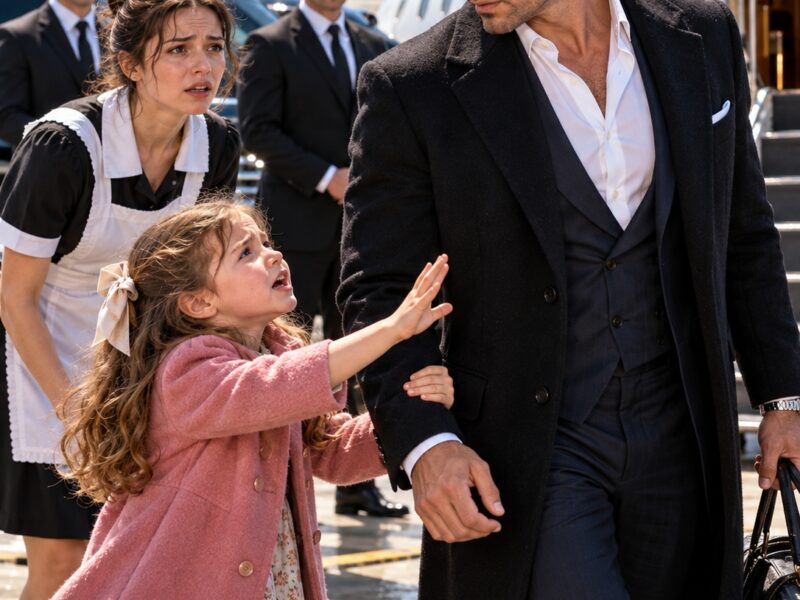
“Don’t Get on the Plane!” the Maid’s Three-Year-Old Daughter Screamed at the Mafia Boss—Minutes Later, His Private Jet Exploded, and Her Terrifying Secret Exposed the Man He Trusted Most
“DON’T GET ON THE PLANE!”
The little girl screamed so suddenly that three armed security guards reached beneath their jackets.
Lorenzo Moretti stopped with one foot on the first step of his private jet.
Across the tarmac, a tiny child in pink pajamas was running toward him, her dark curls bouncing wildly, a battered gray stuffed rabbit dragging from one hand.
“Uncle Lorenzo! No! Don’t go!”
A young woman in a housekeeper’s uniform chased after her, her face drained of color.
“Mia! Stop! Come back!”
But the child kept running.
She was three years old, barefoot inside a pair of oversized pink slippers, and entirely unaware that she was charging toward one of the most feared men in New York.
Lorenzo watched in disbelief as she slipped past a security guard and wrapped both arms around his leg.
“Please,” she sobbed, looking up at him. “Don’t go on the airplane. The bad men said you won’t come back.”
The morning seemed to fall silent.
Behind Lorenzo, the jet’s engines hummed softly. A fuel truck was moving away from the aircraft, and a ground technician stood near the nose with a clipboard.
Marco Bellini, Lorenzo’s security chief and closest friend, approached immediately.
“Get the kid away from him.”
The young housekeeper arrived seconds later.
“Mr. Moretti, I’m so sorry. She slipped out while I was changing. I didn’t realize she’d followed me to the garage.”
She reached for her daughter.
Mia clung tighter.
“No, Mommy! He can’t go!”
Lorenzo looked down.
He had seen the child before, usually peeking around corners in the mansion or sitting quietly beside her mother in the service courtyard. He knew her name, although he had never spoken more than a few words to her.
Now she was trembling against his leg.
He crouched.
“Mia, isn’t it?”
She nodded, tears shining on her cheeks.
“Why don’t you want me on the plane?”
The girl glanced nervously toward Marco.
Then she leaned closer.
“Because the airplane is going to make a big fire.”
Marco laughed sharply.
“Kids have imaginations, boss. We’re already behind schedule.”
Lorenzo ignored him.
“Who told you that, sweetheart?”
Mia’s bottom lip quivered.
“The men in the dark room.”
Lorenzo’s expression changed.
“What men?”
Before she could answer, her mother scooped her into her arms.
“I’m sorry,” she whispered again. “She had a bad dream. Please don’t be angry.”
Lorenzo stood.
He looked from the frightened woman to the little girl burying her face against her mother’s shoulder.
Then he turned toward the pilot.
“Hold departure.”
Marco frowned.
“Lorenzo, the Chicago meeting—”
“Five minutes.”
“Because of a child?”
Lorenzo looked at him.
Marco fell silent.
The pilot acknowledged the order over the radio. The crew began shutting down the boarding procedure while Lorenzo walked toward the terminal building.
Clara Bennett stood beside the security vehicle, holding her daughter tightly.
She expected dismissal.
Perhaps worse.
Instead, Lorenzo stopped in front of her.
“Take her home.”
“Yes, sir.”
“And stay available. I want to speak with you both when I return.”
Clara nodded, barely breathing.
Lorenzo started toward the terminal.
He had walked perhaps thirty yards when the first alarm sounded.
A ground crew member shouted.
Someone pointed toward the aircraft.
Lorenzo turned.
A flash of orange light burst beneath the jet.
Then came the explosion.
The blast rolled across the private airfield with a force that shook the terminal windows.
A tremendous cloud of black smoke swallowed the aircraft as burning debris scattered across the runway.
Marco grabbed Lorenzo and pulled him behind a concrete barrier.
People screamed.
Fire alarms sounded.
Emergency vehicles raced toward the wreckage.
For several seconds, Lorenzo could hear almost nothing beyond a high ringing in his ears.
His jet was burning.
The plane he had been about to board.
The plane on which he had already placed his briefcase.
He stared at the flames.
If a three-year-old child had not delayed him, he would have been inside.
“Everybody back!” a firefighter shouted.
Lorenzo barely heard him.
His eyes searched the tarmac until he spotted Clara near the security vehicle, kneeling with Mia pressed against her chest.
The little girl was crying.
Not because of the explosion.
Because nobody had listened to her until it was almost too late.
Lorenzo looked at her.
Then at the burning aircraft.
For the first time in nineteen years, the man who controlled half of New York’s criminal waterfront felt fear without knowing whom to blame.
And the question that frightened him most was not who wanted him dead.
It was how a little girl knew they were coming.
By noon, the explosion was on every major news channel in New York.
The first reports called it a suspected mechanical failure involving a parked private aircraft. Investigators had not yet established a cause, and the airport had been closed while federal and local authorities examined the wreckage.
All three flight crew members and the ground mechanic had cleared the aircraft before the blast.
Nobody had been killed.
Lorenzo should have felt relieved.
Instead, he stood inside the security room of his Long Island estate staring at six monitors displaying the same smoking remains.
The jet had been purchased three years earlier.
Its maintenance schedule was strictly controlled.
Its flight plans were known to fewer than a dozen people.
Yet somebody had apparently known exactly when he intended to board.
Marco stood beside him.
“We need to assume this was deliberate.”
Lorenzo folded his arms.
“Investigators haven’t confirmed that.”
“You know what this is.”
“Then tell me.”
Marco hesitated.
“The Castellanos.”
Lorenzo looked at him.
“That’s convenient.”
Marco frowned.
“Convenient?”
“They’ve wanted me dead for four years. Every time something goes wrong, you mention their name.”
“Because they’re our enemies.”
“Being an enemy doesn’t make a man responsible for everything.”
Marco stared at him.
It was an unusual disagreement.
For more than a decade, Lorenzo had trusted Marco’s judgment almost automatically.
They had grown up together in Brooklyn.
When Lorenzo’s father was murdered outside a restaurant in Little Italy, Marco stood beside him at the funeral.
When Lorenzo inherited control of the Moretti organization at nineteen, Marco helped him survive the first brutal years.
Eight years earlier, Marco had taken a bullet in the shoulder while protecting him during an attack.
Lorenzo had never forgotten it.
He trusted very few people.
Marco had always been the exception.
Now Marco was studying him with an expression Lorenzo could not quite understand.
“What do you want me to do?” Marco asked.
“Find out who had access to the aircraft.”
“Already doing it.”
“And the child’s mother?”
“What about her?”
“Clara Bennett.”
Marco gave a dismissive shrug.
“The maid?”
“She said her daughter had a bad dream.”
“Probably did.”
“She mentioned men in a dark room.”
“Lorenzo, she’s three.”
“I noticed.”
“Children hear things. They make up stories.”
Lorenzo looked toward the monitor again.
A section of the aircraft’s fuselage had collapsed inward.
“Not every story ends with a plane exploding.”
Marco said nothing.
That evening, Lorenzo did something that unsettled the entire household.
He walked into the staff quarters.
For nearly three years, Clara Bennett had lived in a narrow apartment behind the estate’s garages.
She was twenty-seven, with tired brown eyes, dark hair usually tied into a loose bun, and the careful movements of someone accustomed to avoiding attention.
She worked long hours cleaning guest rooms, polishing furniture, and helping maintain a mansion whose owners could afford to replace anything that became inconvenient.
Her daughter Mia was the center of her life.
The little girl had been born shortly before Clara came to the estate.
Clara had arrived with one suitcase, a newborn baby, and a request for work that included housing.
The house manager had offered her a room.
She had been grateful enough to cry.
From the beginning, Clara followed one rule.
Keep Mia away from the powerful men who visited the mansion.
She had seen enough of their world to know children did not belong in it.
But on the morning of the explosion, Mia had escaped her supervision for less than two minutes.
Those two minutes had changed everything.
When Lorenzo knocked on Clara’s apartment door, she nearly dropped the dish she was drying.
“Mr. Moretti.”
He wore a charcoal sweater and dark trousers rather than his usual tailored suit.
Somehow that made his presence more unsettling.
“May I come in?”
Clara stepped aside.
The apartment consisted of a small living area, one bedroom, and a kitchenette.
Children’s drawings decorated the refrigerator.
A basket of folded laundry sat beside the couch.
There were books stacked on a windowsill and a pair of tiny slippers beneath the table.
Lorenzo looked around.
For the first time, he considered how little he knew about the people living on his property.
“Where’s Mia?”
Clara immediately became tense.
“She’s in the bedroom.”
“I’d like to speak with her.”
“Sir, she’s only three. She doesn’t understand what happened.”
“I know.”
“She was frightened.”
“So was I.”
Clara stared at him.
Lorenzo’s expression remained serious.
“I’m not here to punish either of you.”
The bedroom door opened.
Mia appeared carrying her gray rabbit.
“Hi, Uncle Lorenzo.”
The greeting surprised him.
“Hello, Mia.”
She studied his face.
“Your airplane broke.”
“Yes.”
“I told you.”
“You did.”
Clara closed her eyes.
Lorenzo crouched so he was level with the child.
“Mia, your mommy says you had a bad dream.”
Mia shook her head.
“Not a dream.”
“What happened?”
She looked at Clara.
Her mother knelt beside her.
“It’s okay, sweetheart. Tell him what you told me.”
Mia rubbed her eyes.
“I woke up and Mommy wasn’t there.”
Clara spoke quietly.
“I was folding laundry in the basement. She was asleep when I left. I was gone about twenty minutes.”
Mia continued.
“I went looking for Mommy.”
“Where?”
“In the big house.”
Lorenzo straightened slightly.
“The mansion?”
She nodded.
“It was dark. I couldn’t find the kitchen.”
“Where did you go?”
“The long hallway with the big brown doors.”
Lorenzo knew immediately.
The east wing.
His private offices.
“Were the lights on?”
“Only under one door.”
“What did you see?”
“Two uncles talking.”
Clara’s hand tightened around her daughter’s shoulder.
Lorenzo kept his voice gentle.
“Do you remember what they said?”
Mia frowned in concentration.
“Big words.”
“That’s okay.”
She twisted the rabbit’s worn ear between her fingers.
“One uncle said tomorrow you get on the airplane.”
Lorenzo held still.
“And?”
Mia lowered her voice.
“He said you won’t come back.”
The room went silent.
Clara covered her mouth.
Lorenzo felt something cold move through his chest.
“Did you see their faces?”
“Only one.”
“Can you tell me who?”
Mia walked toward the window.
Outside, several guards stood beside the parked vehicles.
She pointed through the glass.
“That uncle.”
Lorenzo followed her finger.
Marco Bellini stood near a black SUV, speaking to two men.
Mia pressed her hand against the window.
“The one who always stands next to you.”
Lorenzo didn’t move.
He looked at Marco.
Then at the child.
He had spent nineteen years watching enemies.
He had never considered that the man closest to him might be the most dangerous one.
Lorenzo did not confront Marco.
That was the first decision he made after leaving Clara’s apartment.
The second was to change everything about how he investigated the explosion.
He had spent years relying on Marco to handle threats.
If Mia was right, that system was already compromised.
The next morning, seven senior associates gathered around the long mahogany conference table.
Coffee steamed in porcelain cups.
Nobody mentioned the child’s warning.
Marco entered carrying a thick folder.
“My people located a mechanic in Newark,” he announced. “Claims two Castellano associates approached him three days before the explosion asking about aircraft maintenance.”
Several men began speaking at once.
Marco waited until the room settled.
“This wasn’t random. They knew your schedule.”
Lorenzo studied him.
“Who is the mechanic?”
“Anthony Peres. Twenty-nine. Works for an airport subcontractor.”
“Has he spoken to investigators?”
“Not yet.”
“Then he should.”
Marco looked surprised.
“Federal investigators?”
“An aircraft exploded at a public airport.”
“That doesn’t mean we hand them our business.”
“I’m not asking you to hand them anything. I’m asking you not to interfere.”
A few men exchanged glances.
Marco leaned forward.
“The Castellanos made a move. We need to answer it.”
“How?”
“We know which warehouses they control. We can make them understand the consequences.”
Lorenzo looked at the men around the table.
Yesterday, he would have agreed.
He would have accepted Marco’s evidence and allowed the situation to escalate.
Today, a child’s frightened voice remained in his head.
The uncle who always stands next to you.
“No,” Lorenzo said.
Marco blinked.
“No?”
“We wait for evidence.”
“Lorenzo—”
“That’s the decision.”
Silence spread around the table.
Marco smiled after a moment.
“Of course.”
But his fingers tightened around the folder.
Lorenzo noticed.
Later, he walked into the garden, past the cameras and the marble fountain, until he reached a weathered stone bench beneath an old oak tree.
He took a cheap prepaid phone from his pocket.
Only three people knew the number.
Two were dead.
The third lived in Queens.
The phone rang six times.
Then a rough voice answered.
“Who is this?”
“It’s Lorenzo.”
Silence.
“Your father’s boy?”
“Yes.”
Salvatore Greco sighed.
“I saw the airplane on television.”
“Then you know why I’m calling.”
“No, son. I don’t.”
“I need somebody to look at my books.”
Sal laughed.
“You have accountants.”
“I need somebody who doesn’t work for Marco.”
Another silence.
Sal had served as financial controller for Lorenzo’s father for nearly thirty years.
He retired six years earlier after refusing to approve a restructuring plan proposed by Marco.
Lorenzo had accepted Marco’s explanation that Sal was becoming too old-fashioned for the business.
Now he wondered whether that explanation had been another mistake.
“What are we looking for?” Sal asked.
“I don’t know yet.”
“That makes it difficult.”
“I know.”
“Does Marco know you’re calling?”
“No.”
“Good.”
Lorenzo looked toward the mansion.
“I need everything checked. Five years of company records.”
Sal exhaled.
“I’ll help you for your father’s sake. But understand something.”
“What?”
“When you begin opening old books, you may find debts you can’t pay with money.”
Lorenzo stared at the stone path.
“I’m beginning to understand that.”
Sal’s apartment occupied the fourth floor of an old brick building in Queens.
The elevator had been broken for years.
Lorenzo arrived shortly after midnight wearing a gray coat and driving a borrowed sedan.
He climbed the stairs alone.
Sal opened the door before he knocked.
At seventy-one, the old accountant had thinning white hair, thick glasses, and the same impatient expression Lorenzo remembered from childhood.
“You look like your father when he knew he was in trouble,” Sal said.
“Good evening to you too.”
“Coffee?”
“Please.”
The apartment smelled of old books and fresh espresso.
Stacks of financial records covered the kitchen table.
Sal had already obtained years of publicly filed documents and several company records Lorenzo had authorized him to review through counsel.
“Sit.”
Lorenzo obeyed.
Sal tapped one page.
“Hudson Freight. Your New Jersey trucking operation.”
“What about it?”
“Revenue increased three years running. Profits declined.”
“Maintenance costs.”
“That’s what the reports say.”
Sal placed another page beside it.
“Except the maintenance providers are strange.”
He pointed to three names.
Harborline Services.
Eastbridge Holdings.
Silver Coast Logistics.
“Ever heard of them?”
“No.”
“Neither has anyone in the industry.”
Lorenzo leaned forward.
“Meaning?”
“Meaning somebody paid millions of dollars to companies with no verifiable employees, no real offices, and almost no operating history.”
“Shell companies.”
“That’s what they look like.”
“Who authorized the payments?”
Sal held up a signed approval form.
Lorenzo stared.
His own signature.
He remembered none of it.
Sal watched him.
“You signed things Marco brought you, didn’t you?”
Lorenzo said nothing.
“Routine paperwork?”
“Yes.”
“Too busy to read?”
Lorenzo looked away.
Sal leaned back.
“Your father made mistakes. Plenty of them. But he read everything before signing.”
“My father was murdered by a man he trusted.”
“And you decided trusting only one man would solve the problem.”
Lorenzo looked at him.
Sal shrugged.
“Turns out one is still enough to ruin you.”
For four nights, Lorenzo returned to Queens.
They reviewed company records, payment authorizations, travel schedules, and employment histories.
On the third night, Sal discovered something worse.
“Miami,” he said, sliding over an old calendar.
Lorenzo looked down.
Two years earlier, he had canceled a private meeting after someone fired at one of his vehicles on the highway.
The attack had been attributed to a rival organization.
“Chicago,” Sal continued.
Another date.
Another incident.
Lorenzo had narrowly avoided being detained during a raid on a restaurant where illegal business was being conducted.
Then Philadelphia.
Then Newark.
Each event involved a last-minute schedule change known to Marco.
“Someone was leaking your movements,” Sal said.
Lorenzo stared at the dates.
“All of them?”
“Enough to establish a pattern.”
“Why didn’t anyone notice?”
Sal removed his glasses.
“Somebody did.”
He placed a yellow sheet on the table.
Eleven names.
Accountants.
Drivers.
Payroll clerks.
Administrative assistants.
Each had reported irregularities.
Each had subsequently lost their job.
Lorenzo read the names slowly.
His eyes stopped near the bottom.
Clara Bennett.
He looked up.
“Clara?”
Sal nodded.
“The maid in your house.”
Lorenzo felt the room tilt.
The next evening, Lorenzo knocked on Clara’s door holding an old personnel file.
She opened it while wiping her hands on a dish towel.
“Mia has a cold,” she said immediately. “That’s why she hasn’t been near the main house today.”
Lorenzo looked past her.
Mia lay asleep on the bed, her gray rabbit tucked beneath her chin.
Then he held up the folder.
“Why didn’t you tell me you worked for Hudson Freight?”
Clara froze.
He placed the file on the table.
An old photograph stared back at her.
She was twenty-three, pregnant, smiling nervously for an employment badge.
At the bottom of the record was a termination notice.
Failure to perform assigned duties.
Signed by Marco Bellini.
Clara slowly looked up.
“Where did you get this?”
“Answer me.”
She took a step backward.
Lorenzo saw fear return to her face.
The same fear she had shown when Mia approached his jet.
He hated it.
But he needed the truth.
“You were fired by Marco. Months later, you came to work in my house. Your daughter overheard a conspiracy against me. Tell me what I’m missing.”
For several seconds, Clara said nothing.
Then something in her expression changed.
“Missing?”
Her voice trembled.
“You want to know what you’re missing?”
Lorenzo remained silent.
Clara opened the file.
“I worked for Hudson Freight for two years. I handled invoices, delivery reports, and vendor payments.”
She tapped the page.
“I was good at my job.”
“I’m listening.”
“One month, I noticed payments for trucks that hadn’t left the yard. Then repair invoices for work nobody remembered authorizing.”
Lorenzo glanced toward the file.
“Which vendors?”
“Harborline. Eastbridge. A few others.”
His jaw tightened.
Clara continued.
“I spent two weeks checking every number. I was eight months pregnant and staying late because I thought I’d found something serious.”
“Who did you tell?”
“Mr. Bellini.”
Lorenzo closed his eyes briefly.
“He came to the office himself,” Clara said. “He smiled. Told me I was smart. Said he’d take my report straight to you.”
“And?”
“A week later I was fired.”
Her voice cracked.
“They escorted me out with a cardboard box. I couldn’t even carry it properly because of my stomach.”
Lorenzo looked at her.
“I never saw your report.”
Clara laughed bitterly.
“Of course you didn’t.”
“Mia’s father?”
The question came out before he could stop himself.
Clara’s expression hardened.
“Not part of your investigation.”
“You’re right.”
She looked surprised by the immediate apology.
Then her shoulders sagged.
“He left when I told him I was pregnant. We weren’t married. He said he wasn’t ready to be a father.”
Lorenzo said nothing.
“Mia was born three weeks after I lost my job. I had no income, no family nearby, and a newborn who needed everything.”
She wiped her eyes.
“I sold my furniture. Then my mother’s ring. Eventually I had to choose between buying diapers and buying groceries.”
Lorenzo stared at the floor.
“When I heard a wealthy family needed a live-in housekeeper, I applied. I didn’t know whose house it was until I arrived.”
“Why stay when you found out?”
Clara looked toward the sleeping child.
“Because the room was warm. The paycheck came on time. And Mia had somewhere safe to sleep.”
Her eyes returned to him.
“You want to know why I never told you about Hudson Freight?”
“Yes.”
“Because men like you don’t notice women like me unless something goes wrong.”
Lorenzo held her gaze.
“We clean your floors. Carry your laundry. Fix your mistakes. And when we notice something important, somebody tells us to be quiet.”
Her voice softened.
“I was tired of being punished for telling the truth.”
The room fell silent.
From the bedroom came Mia’s congested breathing.
Lorenzo looked at the termination notice again.
Marco’s signature.
Clara’s old photograph.
The date.
Everything fit.
And suddenly Lorenzo understood the full cost of his blindness.
He had not simply trusted the wrong person.
He had allowed that trust to destroy people he never bothered to see.
Clara waited for him to defend himself.
Instead, he lowered his head.
“You’re right.”
She stared.
“I didn’t fire you,” Lorenzo continued. “I didn’t know you worked there. But that doesn’t make me innocent.”
He closed the folder.
“I gave Marco authority. I signed documents without reading them. I believed whatever he told me.”
Clara looked away.
“An apology won’t give me those years back.”
“No,” Lorenzo said. “It won’t.”
He stood.
“I intend to correct what I can.”
She looked at him skeptically.
“I’ve heard powerful men say that before.”
“Then don’t believe the words.”
He moved toward the door.
“Judge what happens next.”
He had almost reached it when Mia began crying.
Not loudly.
A thin, exhausted sound.
Clara rushed into the bedroom.
“Mia?”
She placed a hand against her daughter’s forehead.
Her face changed.
“Oh, sweetheart.”
Lorenzo followed.
The child’s cheeks were flushed.
Her breathing was faster than normal.
Clara checked the digital thermometer.
104.1 degrees.
Her hands began shaking.
“I’m taking her to the emergency room.”
“I’ll drive,” Lorenzo said.
She looked at him.
“What?”
“I’ll have the car brought around. You call her pediatrician on the way.”
For a moment Clara simply stared.
Then she grabbed Mia’s coat.
Twenty minutes later, they were at a pediatric emergency department.
Lorenzo waited while the medical staff examined the child.
He did not argue when a nurse asked him to step outside.
He did not demand special treatment.
He sat in a plastic chair beneath a flickering ceiling light, holding a gray stuffed rabbit Clara had accidentally left in the car.
A little over an hour later, the doctor explained that Mia appeared to have a viral illness and was dehydrated. After treatment and observation, her temperature began to fall.
Clara finally exhaled.
Lorenzo stayed.
At two in the morning, Mia stirred in the hospital bed.
Her small hand searched blindly until it found his finger.
“Uncle Lorenzo,” she whispered.
“I’m here.”
“Don’t go on the plane.”
He leaned closer.
“I won’t.”
“Bad men.”
“I know.”
She tightened her grip.
“Stay.”
Lorenzo looked toward Clara.
She sat in a chair near the window, exhausted.
He turned back to Mia.
“I’m not going anywhere tonight.”
Her eyes closed.
Lorenzo remained beside the bed until dawn.
Just before sunrise, Mia woke again.
She blinked at him.
“You’re still here.”
“I told you I would be.”
A sleepy smile spread across her face.
Then she whispered, “Can I have pancakes?”
For the first time in days, Lorenzo laughed.
The following week changed the atmosphere inside the Moretti mansion.
Clara and Mia temporarily moved into a small guest apartment near the main house after someone was discovered lingering outside their staff-room door late at night.
Lorenzo arranged independent security through two longtime employees, Tommy Ferraro and Gino Lombardi, who had served his father before Marco took control of the household arrangements.
He also offered Clara the option of staying elsewhere.
She chose the guest apartment because it allowed her to continue working while Mia recovered.
The decision remained hers.
Lorenzo made certain of that.
Mia, meanwhile, decided the mansion belonged to her.
Or at least Lorenzo’s office did.
On Monday morning, she appeared in the doorway wearing pink socks and carrying half a cookie.
“Hi, Uncle Lorenzo.”
He looked up from a financial report.
“Hello, Mia.”
She walked in and placed the cookie directly on top of his papers.
“That’s for you.”
He studied it.
“You already ate half.”
“I checked it.”
“Checked what?”
“If it’s yummy.”
“And?”
She nodded gravely.
“Very yummy.”
He looked at the cookie.
Then at her.
“Thank you.”
Clara arrived seconds later, horrified.
“Mia! You can’t interrupt Mr. Moretti.”
Lorenzo raised a hand.
“It’s fine.”
Clara stared.
Mia beamed.
“See, Mommy? He likes cookies.”
The following morning, Mia brought a crayon drawing.
It showed a large black car, a yellow sun, and a stick figure with enormous eyebrows.
Lorenzo examined it.
“Who’s that?”
“You.”
“Why are my eyebrows so big?”
“Because you’re always doing this.”
She frowned dramatically.
From the hallway, Tommy coughed to hide his laughter.
On Wednesday, Lorenzo discovered Mia sitting under his desk coloring a sheet of paper she had mistaken for scrap.
It was a copy of Sal’s financial calculations.
Across the numbers she had drawn an enormous purple rabbit.
“Mia.”
She looked up.
“Yes?”
“Those papers are important.”
“I know.”
“Then why did you draw on them?”
She held up the page proudly.
“Now they’re more important.”
Lorenzo stared.
“It has a bunny.”
He opened his mouth.
Closed it.
Then laughed.
It was a strange sound inside that office.
Clara heard it from the hallway.
She stopped walking.
In nearly three years at the estate, she had never heard Lorenzo Moretti laugh like that.
Something about it frightened her almost as much as his anger had.
Because she was beginning to see a man who did not fit the stories she had believed about him.
And because her daughter was beginning to trust him without hesitation.
Clara knew trust could be dangerous.
She had learned that lesson before Mia was born.
She intended never to forget it.
Three days later, Sal called.
“Come tonight,” he said. “I found something you need to see.”
Lorenzo arrived in Queens just after seven.
Sal had a brown folder waiting beside the yellow list of dismissed employees.
“I contacted several of these people,” he said. “With their permission, I reviewed the complaints they filed before losing their jobs.”
Lorenzo sat.
“And?”
“They weren’t reporting separate problems.”
Sal spread out the documents.
“Same vendors. Same payment authorization structure. Same supervisor.”
“Marco.”
“Yes.”
“But why fire them? Couldn’t he just ignore the reports?”
Sal looked at him.
“Because paper creates a trail. And honest employees have a habit of making copies.”
Lorenzo studied the documents.
Clara’s original six-page complaint was among them.
She had saved a photocopy.
For years it sat in a box beneath her bed.
Sal had obtained it with her permission earlier that afternoon.
The report was careful, precise, and detailed.
Clara had identified irregular invoices, inconsistent vendor addresses, duplicate equipment charges, and payments that could not be reconciled with delivery records.
She had highlighted the discrepancies.
Attached supporting documentation.
Requested an independent audit.
At the bottom of the final page, she’d written:
I believe these issues may indicate deliberate misuse of company funds and should be reviewed before additional payments are approved.
Lorenzo read it twice.
“She was twenty-three,” he said quietly.
Sal nodded.
“Eight months pregnant.”
“And she did better work than half the people I paid six figures to.”
Sal watched him.
“Competence doesn’t become less valuable because somebody wears a uniform.”
Lorenzo looked down.
“I know.”
“Do you?”
He remained silent.
Sal leaned back.
“Your father used to say loyalty was everything. He was wrong about that.”
Lorenzo looked up.
“Careful.”
The old man smiled sadly.
“You’ve been threatening me since you were twelve, son. It never worked.”
Despite himself, Lorenzo smiled.
Sal tapped Clara’s report.
“Loyalty without accountability becomes permission.”
The words stayed with Lorenzo all the way home.
He returned to the estate shortly after eleven.
The halls were quiet.
Most of the staff had gone to bed.
He stopped outside Clara’s apartment.
For a moment he considered knocking.
Then he decided against it.
He had begun finding excuses to see her.
He was not sure when that started.
But he knew enough to recognize that a woman employed in his household, with a child dependent on housing he provided, deserved freedom from his personal expectations.
He turned away.
At the end of the corridor, Marco stood waiting.
“Late night?”
Lorenzo kept his expression neutral.
“Work.”
“Anything I should know?”
“Nothing urgent.”
Marco studied him.
“You’ve been spending time with the maid.”
Lorenzo stopped.
“Clara?”
“And the child.”
“Mia was sick.”
“I heard.”
“Then you know why.”
Marco smiled.
“Of course.”
Something in his tone made Lorenzo’s skin tighten.
“Is there a problem?”
“No problem.”
Marco stepped aside.
“Just be careful, Lorenzo. People notice when powerful men develop weaknesses.”
Lorenzo looked at him for a long moment.
“Good night, Marco.”
He walked away.
But the conversation confirmed something he had suspected for days.
Marco was watching Clara and Mia.
And he was becoming impatient.
The next afternoon, Mia was coloring at a small table near Lorenzo’s office while Clara dusted shelves in the hallway.
Lorenzo sat behind his desk reviewing records.
The child’s humming filled the room.
He had stopped finding it distracting.
In fact, he occasionally caught himself waiting for it.
Mia reached for a blue crayon.
As she did, her eyes lifted toward the partly open office door.
Her humming stopped.
The crayon slipped from her fingers.
Lorenzo looked up.
“Mia?”
She was staring at the doorway.
Her face had gone pale.
Slowly, she pointed.
“That man.”
Lorenzo stood.
“What man?”
“The man from the dark hallway.”
He crossed the room.
Opened the door.
The corridor was empty.
Clara stood near the staircase holding a dusting cloth.
“Did you see anybody?” Lorenzo asked.
She shook her head.
“No.”
He turned back to Mia.
The little girl had climbed onto her chair and pulled her knees against her chest.
He crouched.
“Sweetheart, look at me.”
She looked down.
“You’re safe.”
Her lip trembled.
“Did you see his face?”
She shook her head.
“Not good.”
“That’s okay.”
“But he had a snake.”
Lorenzo frowned.
“A snake?”
Mia traced a crooked line across the back of her wrist.
“Here. A snake crawling on his hand.”
Lorenzo felt his heartbeat slow.
A tattoo.
“And he talked funny,” Mia added.
“Funny how?”
She lowered her voice into a rough whisper.
“Like this.”
Clara stepped closer.
“You don’t have to remember anything else, baby.”
Mia nodded.
Lorenzo looked toward the doorway.
He knew several men in Marco’s circle had tattoos.
But the snake narrowed the possibilities.
He went to Queens again that night.
Tommy and Gino joined him.
Together with Sal, they compared employment records, building access logs, and descriptions of the men who had worked the east wing the night before the explosion.
They identified three possible suspects.
One had been in Chicago.
Another was assigned to an off-site property that evening.
The third was a senior guard named Vincent Russo.
Thirty-six years old.
Eight years with the organization.
A snake tattoo curled across his right wrist.
He also had a distinctive raspy voice from an old injury.
Lorenzo sat quietly.
“Russo works for Marco.”
Tommy nodded.
“Directly.”
“Was he on the property that night?”
“Yes.”
“Can we establish where?”
“Access logs put him near the east corridor.”
Sal folded his arms.
“That’s not enough to accuse him of attempted murder.”
“I know.”
Lorenzo studied the records.
He would not rely solely on a child’s memory.
Not when the stakes involved her safety.
Not when he had already seen how dangerous unsupported accusations could become.
They needed independent evidence.
The next morning, Tommy reviewed security footage from the east wing.
The camera outside the meeting corridor had been disabled for eleven minutes.
The access system, however, retained a mechanical override log.
Vincent Russo’s credential had been used during that interval.
Two days later, Sal found recurring payments to Russo from Harborline Services.
Fifteen thousand dollars a month.
Then a fifty-thousand-dollar payment the morning after the explosion.
Lorenzo stared at the report.
“What did he do for the money?”
Sal looked grim.
“That’s what we need him to explain.”
Vincent Russo tried to leave New York before sunrise.
A one-way bus ticket to Atlanta sat in his jacket.
He carried a duffel bag and enough cash to make a new life somewhere far away from the Moretti family.
At Port Authority, two men approached him near the departure gate.
Tommy Ferraro and Gino Lombardi.
“Morning, Vinnie,” Tommy said.
Russo stopped.
His eyes moved toward the exits.
“Going somewhere?” Gino asked.
Russo forced a smile.
“Family emergency.”
“Then you won’t mind speaking to investigators first.”
They did not threaten him.
They did not touch him.
But when Russo saw the officers waiting nearby, he understood he had run out of places to hide.
Within hours, federal investigators were questioning him.
He initially denied everything.
Then they presented the payments.
The access logs.
The altered maintenance records connected to the aircraft.
And evidence linking a contractor involved in the sabotage to one of Marco’s shell companies.
Russo’s confidence collapsed.
Through his attorney, he began cooperating.
He described how Marco had spent years diverting money from Moretti businesses.
How he used loyal employees to intimidate anyone who questioned the transactions.
How he planted false evidence against rivals to keep Lorenzo occupied.
And how he eventually decided that replacing Lorenzo would be easier than continuing to steal beneath him.
The aircraft attack had been planned to look like a maintenance accident.
Lorenzo listened to the recorded interview with his attorney present.
His face remained still until Russo mentioned Mia.
“Marco saw the child delay him,” Russo said.
The investigator leaned forward.
“And?”
“He figured she heard something.”
“What did he tell you to do?”
Russo stared at the table.
“He said we had to find out what she knew.”
“Anything else?”
A long silence.
“He said if the kid became a problem, she’d have to disappear too.”
Lorenzo closed his eyes.
For a moment he could not hear anything beyond the sound of Mia laughing as she offered him half a cookie.
A little girl who still slept with a stuffed rabbit.
A child who believed everyone important was called Uncle.
Marco had been willing to destroy her life to protect his ambition.
Lorenzo looked toward the investigator.
“Whatever evidence you need from me, you’ll have it.”
His attorney shifted beside him.
“Lorenzo—”
“I understand what I’m saying.”
For the first time, he was prepared to accept scrutiny of his own organization rather than allow another innocent person to become collateral damage.
The investigation moved quietly.
Federal prosecutors obtained evidence through financial records, witness interviews, and authorized surveillance.
Sal’s findings helped identify the suspicious transactions, but the case required more than a former accountant’s calculations.
Investigators needed corroboration.
Documents.
Communications.
Proof of intent.
Russo’s testimony provided the first direct connection to Marco.
Lorenzo provided the second.
He agreed to a recorded meeting under the supervision of the investigation team.
The plan frightened Clara more than anything since the explosion.
She found Lorenzo in his office the evening before.
He was reviewing a stack of documents.
“It’s true, then?”
He looked up.
“What?”
“You’re meeting Marco.”
“Yes.”
“Alone?”
“Investigators will be nearby.”
“He tried to kill you.”
“I know.”
“What makes you think he won’t try again?”
Lorenzo set down his pen.
“I don’t.”
Clara stared.
“That isn’t reassuring.”
“No.”
She stepped closer.
“Then why do it?”
“Because I need the truth recorded. Not just for me. For everyone he hurt.”
Her eyes filled.
“Clara?”
She looked away.
“What do I tell Mia if you don’t come back?”
The question settled between them.
For weeks, Clara had been afraid for her daughter.
Only her daughter.
Now she realized something had changed.
She was afraid for Lorenzo.
Not because he was her employer.
Not because he controlled the home where she lived.
Because she had watched him sit beside Mia’s hospital bed.
Because she had seen him accept correction without anger.
Because he had listened when she told him about Hudson Freight.
Because somewhere beneath the cold reputation and expensive suits, there was a lonely man trying to become someone better.
Lorenzo stood.
He approached slowly.
“You don’t owe me anything, Clara.”
She looked at him.
“I know.”
“I don’t want you staying here because you feel responsible for me.”
“I’m not.”
“Then why are you crying?”
She wiped her cheeks.
“Because you’re the first person in years who looked at Mia and saw a child worth protecting instead of a problem somebody had to manage.”
Lorenzo swallowed.
“She’s extraordinary.”
“Yes.”
He hesitated.
“So is her mother.”
Clara looked at him.
For a moment neither moved.
Then Mia called from the hallway.
“Mommy! Mr. Buttons fell behind the couch!”
Clara laughed softly through her tears.
“I should go.”
Lorenzo nodded.
She stopped at the doorway.
“Come back,” she whispered.
He held her gaze.
“I’ll do everything I can.”
The following evening, Lorenzo arrived at an abandoned warehouse near the Brooklyn waterfront.
Marco was waiting beside a wooden table.
Two chairs stood beneath a single hanging light.
The smell of cold concrete and river water filled the enormous room.
Marco smiled.
“Just like old times.”
Lorenzo sat.
“Not quite.”
Marco laughed.
“Remember when we used to sneak into old warehouses near the docks? Your father would have killed us if he’d known.”
“He usually knew.”
“Probably.”
For several minutes, Marco spoke about their childhood.
The streets of Brooklyn.
The first restaurant Lorenzo’s father owned.
The night Marco took a bullet in his shoulder.
Then his tone changed.
“I’ve spent ten years standing beside you.”
“I know.”
“Ten years cleaning up problems.”
“I know that too.”
Marco placed a leather briefcase on the table.
Inside were financial documents.
Payment orders.
Bank transfers.
Company approvals.
Lorenzo recognized his own signatures.
Marco spread the papers across the table.
“Millions moved through these companies. Every major authorization carries your name.”
Lorenzo looked down.
“What do you want?”
“Half.”
He lifted his eyes.
“Half of what?”
“The legitimate businesses. Shipping. Property. Port contracts.”
Marco leaned back.
“You keep your public position. I control the assets I built.”
“And if I refuse?”
Marco smiled.
“These documents become everybody’s problem.”
Lorenzo studied him.
“Why?”
Marco frowned.
“Why what?”
“After everything, why?”
The smile disappeared.
“Because I’m tired of being your shadow.”
Lorenzo said nothing.
“Every deal I made, people thanked you. Every crisis I solved, people praised you. I was there when your father died. I helped build this empire.”
“You were compensated.”
Marco laughed bitterly.
“Compensated?”
His voice rose.
“I took a bullet for you.”
“I remember.”
“And what did I get? A salary. A title. A chair at the end of your table.”
He leaned forward.
“You inherited a kingdom. I did the work.”
Lorenzo looked at the documents.
“And Clara Bennett?”
Marco froze briefly.
“What about her?”
“She reported irregularities at Hudson Freight.”
“She was incompetent.”
“Her report was accurate.”
“Lorenzo—”
“You fired her.”
Marco shrugged.
“Employees get fired.”
“She was eight months pregnant.”
“That wasn’t my concern.”
Lorenzo stared at him.
“No. It wasn’t.”
Marco’s expression hardened.
“Don’t tell me this is about the maid.”
“It’s about what you did.”
“I did what was necessary.”
“For whom?”
Marco slammed his hand against the table.
“For us!”
Lorenzo let the silence stretch.
Then he asked, “And the plane?”
Marco went still.
“What plane?”
“My jet.”
Marco laughed.
“The Castellanos. We already know that.”
“Do we?”
“I brought you evidence.”
“You brought me a story.”
Marco leaned forward.
“Careful, Lorenzo.”
“Russo is cooperating.”
The change was immediate.
Marco’s face lost its color.
“Vincent Russo?”
“Yes.”
For one long moment, neither man spoke.
Then Marco shook his head.
“That coward.”
Lorenzo watched him.
“He told investigators about Harborline. The payments. The altered maintenance records.”
Marco’s jaw tightened.
“He doesn’t know anything.”
“He knows enough.”
Marco pushed back his chair.
“After everything I did for you—”
“You arranged the attack.”
The words were quiet.
Marco stared at him.
Then something broke in his expression.
“Yes.”
His voice rose.
“Yes, I did.”
Lorenzo remained seated.
Marco began pacing.
“I built that operation. I knew every schedule, every contractor, every weak point. I made you powerful, and you never once considered that I deserved more.”
“You could have left.”
Marco laughed.
“And become what? Another man nobody remembers?”
He stopped.
“You want to know what ruined everything?”
Lorenzo said nothing.
“That child.”
Marco’s eyes burned.
“A housekeeper’s little girl. Three years old. You should have been on that plane.”
Lorenzo felt his hands tighten beneath the table.
Marco leaned closer.
“You’d have been gone, and nobody would have questioned it.”
“And Mia?”
Marco’s expression turned cold.
“She should have stayed in bed.”
Lorenzo looked directly at the man he had once called his brother.
For nineteen years, he had feared the consequences of trusting the wrong person.
Now he finally understood that the danger wasn’t trust itself.
It was refusing to examine what someone did with it.
A movement sounded near the warehouse entrance.
Marco reached inside his jacket.
Lorenzo did not move.
“Don’t,” he said quietly.
The doors opened.
Federal agents entered, identifying themselves and ordering Marco to show his hands.
For one tense moment, Marco looked as though he might resist.
Then he saw the officers surrounding the exits.
His shoulders dropped.
He slowly raised his hands.
An agent secured the weapon from his jacket.
Marco was handcuffed and escorted toward the doors.
As he passed Lorenzo, he turned.
“You chose a maid’s child over me?”
Lorenzo stood.
“No.”
Marco glared.
“I chose to listen to someone who was telling the truth.”
The doors closed behind him.
Lorenzo remained in the warehouse while investigators secured the scene.
Then he reached into his coat.
Inside the breast pocket was a folded piece of paper.
Mia had given it to him that morning.
A crayon drawing.
Three stick figures holding hands.
A large yellow sun.
And an airplane flying safely through a blue sky.
Across the bottom, Clara had helped Mia write four words.
Come home, Uncle Lorenzo.
He looked at the drawing until his eyes blurred.
The sun was rising when Lorenzo returned to the estate.
The mansion stood quiet beneath a pale gray sky.
He stepped from the car.
Before he reached the front entrance, a small figure appeared in the courtyard.
Pink pajamas.
Dark curls.
A gray rabbit clutched in one hand.
“UNCLE LORENZO!”
Mia ran toward him.
Clara appeared behind her, calling for her to slow down.
Lorenzo crouched.
Mia threw her arms around his neck.
“You came back!”
He held her carefully.
“I did.”
“You promised.”
“I remember.”
She pulled away and studied his face.
“Did you fix the bad men?”
He looked toward Clara.
Then back at Mia.
“The people who hurt others are going to answer for what they did.”
Mia considered that.
“Okay.”
Then she hugged him again.
Lorenzo closed his eyes.
He had survived the destruction of his aircraft.
The betrayal of his closest friend.
The collapse of a system he had trusted for nearly two decades.
But nothing made him feel more grateful to be alive than the weight of that small child in his arms.
Clara stood a few feet away.
Her eyes were wet.
Lorenzo looked up at her.
“I’m home.”
She smiled.
Not the careful, frightened smile of an employee speaking to her boss.
A real one.
“I’m glad.”
The arrests continued over the following weeks.
Marco was charged in connection with the attempted murder, financial fraud, and related offenses.
Russo cooperated with investigators.
Several compromised accountants and contractors were implicated in the financial conspiracy.
The investigation also exposed crimes inside businesses Lorenzo had controlled.
That part was harder.
For years, Lorenzo had believed he could separate legitimate enterprises from the darker operations that funded his family’s influence.
Now he understood how thoroughly they had become entangled.
He could not simply blame Marco.
Some decisions had carried Lorenzo’s signature.
Some failures had resulted from his deliberate refusal to ask questions.
He retained legal counsel and cooperated with the proceedings, accepting financial penalties and restrictions while investigators examined the extent of his responsibility.
The transformation was neither quick nor painless.
Businesses closed.
Properties were sold.
Employees lost positions and needed assistance finding new work.
Lorenzo established independent oversight for the remaining legitimate companies and helped fund transition support for workers affected by the closures.
Sal returned temporarily as an adviser.
Not because Lorenzo asked him to trust another powerful man.
Because the new structure gave him the authority to refuse one.
“What changed?” Sal asked during their first formal board meeting.
Lorenzo looked at the documents on the table.
“I finally learned that a signature means something.”
Sal smiled faintly.
“About time.”
Lorenzo also contacted the employees whose warnings had been ignored.
Eleven people.
A bookkeeper now driving a taxi in the Bronx.
A dispatcher who had lost her home.
An accountant whose reputation had been damaged by accusations of misconduct.
Each received formal acknowledgment of the wrongful treatment and compensation determined through independent review.
The final envelope went to Clara.
Lorenzo delivered it himself.
She sat at the small kitchen table while Mia colored on the floor.
Inside was a letter officially correcting her employment record at Hudson Freight.
There was also compensation for lost wages and the financial harm caused by her wrongful dismissal.
Clara read the letter twice.
Her hands trembled.
“They cleared my name?”
“Yes.”
“All of it?”
“The termination notice has been withdrawn. The record now reflects what actually happened.”
She looked at him.
“Thank you.”
Lorenzo nodded.
“I wish I’d listened sooner.”
Clara folded the letter carefully.
Then she looked toward Mia.
“She saved your life.”
“Yes.”
“But that isn’t what I prayed for.”
Lorenzo pulled out a chair.
“What did you pray for?”
“That she’d be safe.”
Clara’s voice softened.
“Every night after she was born, that was all I wanted. A room where she could sleep. Food in the refrigerator. A life where she didn’t have to be afraid.”
Lorenzo looked at Mia.
The child was drawing an enormous purple rabbit.
“That’s what she should have.”
Clara nodded.
“And that’s why we’re moving.”
He went still.
“Moving?”
“I found an apartment in Queens. Near a preschool. There’s a park across the street.”
Lorenzo said nothing.
“I want her to grow up somewhere ordinary,” Clara continued. “Without guards at the gate. Without men whispering in hallways.”
He looked down.
Every part of him wanted to ask her to stay.
The thought surprised him with its intensity.
He had grown accustomed to Mia appearing in his office.
To Clara bringing coffee without being asked.
To the sound of laughter in hallways that had been silent for years.
The mansion would feel empty without them.
But Lorenzo understood something now that he had not understood before.
Protection did not mean keeping people close because their presence made him feel better.
It meant helping them live without needing him.
He looked at Clara.
“You’re right.”
She blinked.
“I am?”
“Mia deserves an ordinary childhood.”
Clara studied him.
“You aren’t going to argue?”
“No.”
For a moment, she looked almost disappointed.
Then she smiled.
“That’s new.”
“I’ve been told I’m capable of learning.”
“Slowly.”
“Very slowly.”
They laughed.
And somewhere inside Lorenzo, a door that had been locked for years began to open.
On a bright Saturday morning, Clara loaded the last suitcase into her small blue car.
Mia sat in the back, secured in her car seat, with Mr. Buttons resting on her lap.
Tommy carried the final box outside.
Lorenzo stood beside the driveway.
Clara approached him.
“I wanted to thank you.”
“You already did.”
“For letting us leave without making it difficult.”
He looked toward the car.
“I don’t want Mia to remember this place as somewhere she was trapped.”
Clara nodded.
“And I don’t want her to forget the good parts.”
Lorenzo smiled faintly.
“Were there good parts?”
She looked at him.
“Yes.”
For a moment they stood without speaking.
Then Mia called through the open window.
“Uncle Lorenzo!”
He approached.
She held out a folded drawing.
“For your office.”
He accepted it.
Another purple rabbit.
A yellow sun.
Three people holding hands.
“Thank you.”
“Don’t lose it.”
“I won’t.”
“Promise?”
“I promise.”
She smiled.
Clara started the car.
As they drove toward the gates, Mia waved through the rear window.
Lorenzo raised his hand.
He remained in the courtyard long after the vehicle disappeared.
The mansion had never felt so quiet.
During the following days, he noticed the absence everywhere.
No small footsteps in the corridor.
No half-eaten cookies on his desk.
No tiny voice asking why he looked grumpy.
One evening, he dropped a pen.
When he bent to retrieve it, he found an old drawing beneath the desk.
A purple rabbit stretched across one of Sal’s financial reports.
Lorenzo sat on the carpet holding the page.
For the first time, he admitted something he had been avoiding.
He missed them.
Not because Clara had worked for him.
Not because Mia had saved his life.
Because in the middle of the most dangerous weeks he had ever experienced, those two people had made his house feel like a home.
Three weeks later, a plain gray sedan parked outside a modest brick apartment building in Queens.
Lorenzo stepped out carrying a paper bag.
No convoy.
No expensive suit.
No armed entourage.
Just a man wearing jeans, a dark sweater, and an expression that suggested he was more nervous than he had been entering the warehouse to confront Marco.
He climbed three flights of stairs.
Then knocked.
Clara opened the door.
For a moment, she looked genuinely surprised.
“Lorenzo?”
He lifted the bag.
“Cookies.”
A delighted shriek came from inside.
“UNCLE LORENZO!”
Mia appeared at the end of the hallway.
She ran straight toward him.
He crouched and caught her.
“You came!”
“I did.”
“Did you bring cookies?”
“Yes.”
She turned toward Clara.
“Mommy! He remembered!”
Clara looked at Lorenzo.
Something warm moved across her face.
“Come in.”
That was how it began.
At first, Lorenzo visited once a week.
Then twice.
He learned which neighborhood bakery made Mia’s favorite cookies.
He learned how to push a swing high enough to make her laugh without making Clara nervous.
He learned to sit in a tiny plastic chair during preschool performances while children sang songs about weather and animals.
He learned that bedtime stories were apparently required to be read at least three times.
Because Mia insisted the third reading was always the best.
Clara watched carefully.
She had known men who gave gifts because they wanted control.
Men who offered help because they expected gratitude.
Men who apologized only when they feared losing something.
She waited to discover which kind of man Lorenzo would become.
But week after week, he continued showing up.
He never asked Clara to return to the mansion.
Never offered to buy her a larger apartment.
Never treated her kindness as an obligation.
He asked about her new job at a logistics company.
Listened when she talked about the difficulties of raising a child alone.
Helped Mia with puzzles.
Washed dishes after dinner.
And occasionally sat on Clara’s couch looking genuinely happy to be somewhere nobody feared him.
Slowly, Clara began to trust him.
Not the way she had trusted powerful men before.
Not because of promises.
Because his actions had become consistent.
One Saturday afternoon, Lorenzo arrived to find Mia asleep on the couch.
Clara stood in the kitchen making coffee.
“She was waiting for you,” she said.
“I can come back.”
“No.”
Clara smiled.
“Stay.”
He took off his coat.
For an hour, they sat together talking about ordinary things.
Clara told him she wanted to complete an accounting certification and eventually manage financial compliance for small businesses.
Lorenzo listened.
“You’d be good at it.”
She laughed.
“You sound very confident.”
“You identified fraud when everyone around you ignored it.”
“That didn’t turn out well.”
“It will this time.”
Clara looked at him.
“You can’t promise that.”
“No,” he admitted. “I can’t.”
Then he smiled.
“But I can say you deserve the opportunity.”
She watched him carefully.
“You really are different.”
Lorenzo looked toward Mia sleeping beneath her yellow blanket.
“I’m trying.”
Clara’s expression softened.
“I know.”
By early autumn, the trees in the park across from Clara’s apartment had begun turning gold.
Children raced through fallen leaves.
Parents pushed strollers along the paths.
A group of teenagers played basketball near the fence.
Lorenzo walked beside Clara while Mia skipped ahead carrying Mr. Buttons.
The little girl stopped near a bench.
Across the grass, a father lifted his young son onto his shoulders.
The boy laughed.
Mia watched them.
Then she turned toward Lorenzo.
“Uncle Lorenzo?”
“Yes, sweetheart?”
“Can I ask you something?”
“Anything.”
She looked at Clara.
Then back at him.
“Can you be my daddy?”
Lorenzo stopped walking.
For a moment, every sound in the park seemed to fade.
He had faced armed enemies.
He had survived an explosion.
He had watched his closest friend betray him.
Yet this simple question from a little girl made him feel completely unprepared.
He looked at Clara.
She did not answer for him.
Her eyes were warm, but she remained silent.
The choice belonged to Lorenzo.
And the child’s future mattered too much for an easy promise.
He crouched.
“Mia, do you know what being a daddy means?”
She considered the question.
“Pancakes.”
Lorenzo smiled.
“Sometimes.”
“And bedtime stories.”
“Yes.”
“And coming back when you say you will.”
His throat tightened.
“That’s important.”
Mia stepped closer.
“Mommy says family is people who love you and take care of you.”
Lorenzo looked toward Clara.
She nodded slightly.
He turned back to Mia.
“Your mommy is right.”
The little girl tilted her head.
“So?”
Lorenzo opened his arms.
“If you want me in your family, sweetheart, I’d be very happy to be there.”
Mia threw herself against him.
He held her carefully.
“Always?” she whispered.
He looked at Clara.
Then answered with the honesty he had learned too late in life.
“I’ll keep showing up, Mia. And when things are difficult, we’ll talk about them instead of disappearing.”
She hugged him tighter.
Clara knelt beside them.
For a moment, the three remained together beneath the autumn trees.
Then Mia leaned back.
“Can we get ice cream?”
Lorenzo laughed.
“Of course.”
“Strawberry?”
“Yes.”
“Two scoops?”
He looked toward Clara.
She raised an eyebrow.
“One scoop,” Clara said.
Mia sighed.
“Mommy is very strict.”
Lorenzo laughed again.
Clara reached for his hand.
He looked down.
Then gently closed his fingers around hers.
It was not a promise of marriage.
Not a declaration that the past had disappeared.
It was something quieter.
A beginning.
And for the first time in his life, Lorenzo Moretti understood that a beginning did not need to be controlled to be worth trusting.
A year later, Lorenzo’s office occupied the second floor of a modest shipping company’s headquarters.
The building overlooked a busy street rather than the guarded gardens of his old estate.
His legitimate businesses were smaller now.
Independent audits remained in place.
The legal consequences of his former life had not vanished, and some relationships had never recovered.
But the company was honest.
Employees could question decisions without fear.
Managers were evaluated by the quality of their work rather than personal loyalty.
Sal visited occasionally to complain about the coffee.
Tommy and Gino had retired from security work.
Clara had completed the first stage of her accounting certification and taken a position helping small businesses improve financial controls.
She and Lorenzo were still together.
Slowly.
Deliberately.
Learning how to build a life neither had expected.
And Mia?
Mia remained the most demanding person Lorenzo had ever known.
She was four now.
She had opinions about everything.
Especially cookies.
On Lorenzo’s desk sat a simple wooden picture frame.
Inside was the drawing Mia gave him before he confronted Marco.
Three people holding hands.
A yellow sun.
And an airplane flying safely through a bright blue sky.
Sometimes visitors noticed it.
They asked whether it was a drawing made by his daughter.
Lorenzo always smiled.
“Yes.”
He never offered a longer explanation unless someone asked.
Because the drawing was not simply a reminder of the day his life was saved.
It reminded him of something far more difficult.
How close he had come to losing everything while believing he controlled it all.
How easily people with power ignored the warnings of those without it.
How a young woman had lost her livelihood because she told the truth.
And how her three-year-old daughter had done something an entire organization of trained security professionals failed to do.
She had spoken when she was frightened.
She had insisted on being heard.
She had refused to walk away when the adults around her told her to be quiet.
One Friday evening, Clara arrived at the office with Mia.
The little girl rushed inside carrying a paper bag.
“Daddy Lorenzo!”
He looked up immediately.
“Hello, princess.”
She climbed onto the chair opposite his desk.
“I brought you a cookie.”
“Thank you.”
She placed it on his paperwork.
One large bite was missing.
Lorenzo looked at it.
“Did you check this one too?”
Mia nodded seriously.
“To make sure it’s yummy.”
“And?”
“Very yummy.”
He laughed.
Clara stood in the doorway watching them.
“Are you ready to go home?” she asked.
Lorenzo looked at the clock.
It was barely five.
A year earlier, he would have stayed until midnight, answering calls and reviewing documents that could have waited until morning.
Now he closed the folder.
“Yes.”
Mia climbed down.
“Can we have pancakes for dinner?”
Clara laughed.
“We had pancakes yesterday.”
“But Daddy Lorenzo makes them funny.”
Lorenzo frowned.
“Funny?”
“Some are black.”
Clara covered her mouth.
“She’s not wrong.”
He shook his head.
“I’m surrounded by critics.”
Mia reached for his hand.
Clara took the other.
Together they walked toward the office door.
Outside, evening sunlight spilled across the street.
People hurried toward subway stations.
Cars moved through traffic.
Somewhere nearby, a child laughed.
It was an ordinary Friday.
No alarms.
No security emergency.
No men waiting in dark corridors.
And Lorenzo realized that ordinary had become his favorite word.
Once, he had commanded hundreds of men and believed that made him powerful.
Now he had a small hand wrapped around his fingers and a woman beside him who loved him without fearing him.
The difference was everything.
Mia tugged on his arm.
“Daddy?”
“Yes?”
“Are you listening?”
He smiled.
“Always.”
She looked satisfied.
Then she began explaining, in great detail, why pancakes should sometimes be shaped like rabbits.
Lorenzo listened to every word.
Because years earlier, when a frightened little girl had screamed for him not to board an airplane, he had nearly dismissed her as just a child.
Instead, he listened.
And the decision saved his life.
But what he understood now was that Mia had given him something more valuable than another morning.
She had given him the chance to become a man whose life was worth coming home to.
And he intended to spend every ordinary day proving he deserved it.









