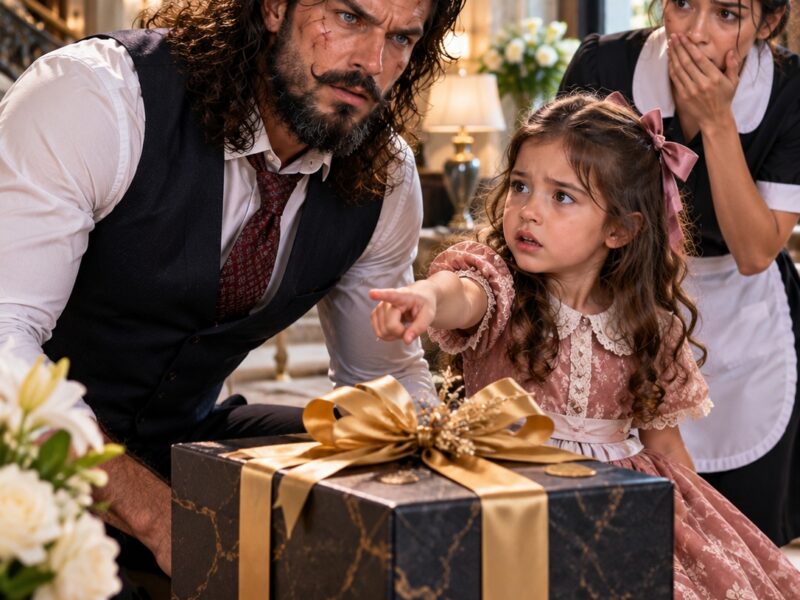
“DON’T OPEN THAT GIFT BOX,” THE MAID’S LITTLE GIRL WARNED THE MAFIA BOSS—THEN SHE WHISPERED A DEAD MAN’S NAME AND EXPOSED THE BETRAYAL INSIDE HIS OWN HOUSE
I remember the ribbon better than I remember the night my husband died.
Dark green.
Wide.
Glossy enough to catch the firelight every time someone moved past it.
It was tied around a silver box sitting in the middle of Dominic Valenti’s study, and by the time my eight-year-old daughter came running through the door in her socks and screamed, “Don’t open it,” Dominic already had two fingers under the bow.
Everyone in the room froze.
Rain struck the tall windows behind him.
One of the guards reached for Sophie.
Dominic lifted one hand.
The guard stopped instantly.
That was the first thing you learned about Dominic Valenti.
He almost never raised his voice because he had built a life in which other men stopped moving before he needed to.
“Sophie,” I whispered.
She stood in the doorway with one hand gripping the frame, breathing hard.
Her pajama pants were too long.
One cuff had slipped halfway under her heel.
She should have looked ridiculous.
Instead, every grown man in that room was watching her.
“Mrs. Bennett,” Dominic said without looking at me, “let her speak.”
My face burned.
“I’m sorry, Mr. Valenti. She knows she isn’t supposed to come upstairs.”
Sophie shook her head so hard her dark curls slapped her cheeks.
“Please don’t touch it.”
At Dominic’s right shoulder, Marcus DeLuca gave a quiet laugh.
Marcus had worked beside Dominic for thirty-one years.
Gray hair.
Perfect coats.
Soft voice.
The kind of man who remembered staff birthdays and sent flowers when somebody’s mother died.
He was the only person in the house besides Dominic who ever thanked me by name.
“Children and storms,” Marcus said. “Everything becomes a monster after midnight.”
Sophie did not look at him.
She looked only at Dominic.
Dominic slowly removed his hand from the ribbon.
“Why shouldn’t I open it?”
Sophie glanced at me.
I gave the smallest nod I could.
She walked into the room.
The guard moved aside.
Dominic came around his desk.
He was fifty-three, tall, dark-haired except for gray at his temples, with a face that looked carved into permanent restraint.
I had seen elected officials wait outside that room for him.
I had seen men twice my size come out sweating.
I had seen nobody make Dominic Valenti kneel.
He knelt in front of my daughter.
“Tell me.”
Sophie looked at the other men.
“I can only tell you.”
Dominic’s eyes shifted toward me.
Then to Marcus.
Something almost amused touched Marcus’s expression.
Dominic bent closer.
Sophie cupped her hand around his ear.
I could not hear the first sentence.
I saw what it did to his face.
All the color left him.
Then I heard her whisper one name.
“Leo.”
Dominic did not move.
The rain seemed to get louder.
Marcus stopped smiling.
Dominic stayed on one knee for another second.
Then two.
When he stood, his expression had changed into something I would not understand until much later.
Not fear.
Recognition.
“Everyone out.”
Marcus frowned.
“Dom—”
“Everyone.”
“Let me take the box downstairs.”
“No.”
“Security already cleared it.”
Dominic looked at him.
That was all.
Marcus’s mouth closed.
He nodded toward the two guards.
They left first.
Marcus followed.
At the door, he glanced back.
Not at Dominic.
At Sophie.
His eyes remained on her a fraction too long.
Then he was gone.
Dominic locked the door himself.
I had worked in the Valenti house for four months.
Until that night, I had spent most of that time pretending I did not know what kind of man employed me.
The house sat above the Massachusetts coast north of Boston, all white stone, black iron gates, and windows facing an ocean that looked steel-gray nine months of the year.
On my first morning, the head housekeeper, Teresa Romano, gave me three rules.
Do not ask who visitors are.
Do not repeat anything you hear.
Do not enter a closed room unless someone asks you to.
“Do those three things,” she had said, “and you’ll earn more here than you ever earned cleaning hotel rooms.”
I needed that money.
My husband, Michael, had been dead six years.
A car accident, I had been told.
Wet road.
Bad curve.
A phone call at 2:17 in the morning.
A closed casket.
An eight-year-old daughter who knew her father only through photographs and a handful of videos I could not watch without feeling something collapse under my ribs.
Sophie had outgrown three pairs of shoes in one year.
There were days when survival made morality look very theoretical.
So I took the job.
Dominic confused me from the beginning.
I expected a man people whispered about to be loud.
He was not.
I expected cruelty to announce itself.
His never did.
Men arrived in black cars at night.
Some left relieved.
Some left pale.
Nobody shouted.
Nobody threatened anyone in front of the staff.
But there were details.
Drivers checked underneath vehicles with mirrors.
The pantry contained a locked cabinet I was told never to open.
Two men stood at the gate even on Christmas morning.
Every visitor handed over a phone.
I told myself Dominic owned shipping companies.
Commercial property.
Security contracts.
I told myself many things because the alternative meant asking whether I should take my daughter somewhere else and then admitting there was nowhere else that paid enough.
Sophie had not been supposed to come with me.
My older sister watched her after school until she accepted a nursing job in Vermont.
After that, I had no solution.
Teresa finally said Sophie could stay in the little staff sitting room behind the kitchen if she remained quiet.
For nearly two months, my daughter became invisible.
Then Dominic discovered her.
It happened close to midnight.
I was polishing serving trays.
Sophie sat under the kitchen table drawing by the refrigerator light because she said the overhead bulb buzzed.
Dominic walked in for water.
I nearly dropped a tray.
“I’m sorry, sir. I can explain.”
He looked past me.
Sophie held up her picture.
“What’s that?” he asked.
“A dog.”
Dominic studied it.
“That’s a good horse.”
Sophie frowned.
“It’s a dog.”
He nodded seriously.
“Then it’s an excellent dog.”
He drank his water.
Left.
The next morning, a box of seventy-two colored pencils sat on the kitchen counter.
No note.
That evening, Sophie found a mug of hot chocolate waiting in the staff room.
The same thing happened the next night.
And the next.
I assumed Teresa was doing it.
Teresa swore she was not.
I never asked Dominic.
Some kindnesses become harder to receive when you name the person offering them.
Now, four months into that strange household, my daughter stood beside the silver box while Dominic stared at her as though she had just returned someone from the dead.
He lowered himself onto the carpet again.
This time he sat cross-legged.
A man in a three-thousand-dollar suit sitting on the floor so an eight-year-old would not have to look up at him.
“Start from the beginning.”
Sophie twisted the sleeve of her pajama top.
“I woke up when Mama went downstairs.”
I frowned.
I had started at five thirty that morning.
“You were supposed to sleep.”
“I tried.”
Dominic almost smiled.
“Then what?”
“My window faces the glass garden.”
The greenhouse.
At the east edge of the property.
Dominic’s smile vanished.
“There was a light inside.”
“What time?”
“The sky was still dark.”
“Did you see the clock?”
“Five fourteen.”
I looked at her.
“You checked?”
“My tablet.”
Of course she had.
Sophie remembered numbers the way some children remembered songs.
“There was a man in the greenhouse,” she continued. “He had his hood up.”
Dominic’s eyes shifted toward the box.
“What was he doing?”
“Wrapping that.”
My skin went cold.
Sophie pointed.
“He tied the green ribbon. Then he took it off and tied it again because the first bow was crooked.”
Dominic asked, “Did he see you?”
“No. I was behind the curtain.”
“Did you see his face?”
“No.”
“Anything else?”
“He was talking on the phone.”
Dominic did not move.
“What did he say?”
Sophie looked at him.
“He said, ‘Tell him Leo says hello.’”
Dominic’s jaw tightened.
Then she added, “He laughed.”
“What else?”
“He said, ‘Let’s see if he’s still soft.’”
The room went silent.
I had heard the name Leo once before.
Years ago.
Not in that house.
In a newspaper article about Dominic.
It had referred to his younger brother.
Leonard Valenti.
Dead thirteen years.
A car crash on Harbor Road.
Dominic stood slowly.
“Then what happened?”
“The man carried the box outside.”
“Which way?”
“Toward the little service gate behind the greenhouse.”
“Was anyone waiting?”
Sophie nodded.
“A gray van.”
“Anything on it?”
“A fruit sticker.”
“What kind?”
She thought.
“Pineapple.”
Dominic looked at me.
I shook my head.
I had seen no van.
Sophie continued.
“At breakfast, I saw the same van at the front gate.”
Dominic’s eyes changed.
“The same?”
“Same dent by the back wheel. Same pineapple.”
“What happened?”
“Mrs. Romano brought the box upstairs.”
None of us spoke.
The meaning settled slowly.
The box had been inside the estate before dawn.
Someone had carried it out through a service gate.
Then it had returned through the main entrance as an anonymous delivery.
Whoever wanted Dominic to believe the package came from outside had controlled both sides of his security.
Dominic turned toward the desk.
There was a tablet built into the surface.
He opened the camera system.
East greenhouse.
A gray screen appeared.
OFFLINE — SCHEDULED MAINTENANCE.
He checked the date.
Then another.
His thumb stopped.
“How long?” I asked before remembering I should not.
Dominic did not seem to care.
“Eighteen days.”
Sophie touched my arm.
“Mama says if a secret makes your stomach hurt, you tell a grown-up.”
Dominic looked at her.
“That’s good advice.”
“My stomach hurt.”
He nodded.
“Mine does too.”
It was such an ordinary answer that I almost cried.
Instead Dominic asked, “Did you notice anything about the man?”
Sophie frowned.
“He wore a ring.”
“What kind?”
“A big one.”
She held up her hand.
“Red stone.”
Dominic went very still.
Sophie rubbed her thumb against her ring finger in a small circular motion.
“He kept doing this.”
Something inside me tightened.
I knew that movement.
I could not place it.
Dominic looked toward the locked door.
Then back to my daughter.
“Are you certain?”
“Yes.”
He stood.
“Mrs. Bennett.”
“Yes, sir?”
“Take Sophie downstairs.”
I reached for her.
“Tell nobody what she saw.”
I nodded.
“Not Teresa.”
That surprised me.
Dominic noticed.
“Especially not Teresa.”
He walked to the desk, unlocked a drawer, and took out an old gray phone.
Not his regular one.
He dialed from memory.
“Caleb.”
A pause.
“Kitchen entrance.”
Another pause.
“Bring your old kit.”
He hung up.
Sophie and I were halfway to the door when Dominic said, “Sophie.”
She turned.
“Thank you.”
Her little shoulders dropped.
“You’re welcome.”
I opened the door.
Dominic added, “The pencils were from me.”
Sophie smiled.
“I knew.”
That surprised him.
“How?”
“Mrs. Romano buys cheap ones.”
For one second, Dominic laughed.
Then the box pulled the room back into silence.
Caleb Russo arrived forty-five minutes later.
He was seventy-two, heavy through the shoulders, with a bad left knee and a canvas case he carried himself.
No guards escorted him upstairs.
Dominic met him at the kitchen entrance.
I later learned Caleb had served in Army explosive ordnance disposal before becoming one of the first men Dominic’s father trusted outside the family.
He had retired years earlier.
Dominic still knew his number.
That told me enough.
I stood in the doorway to the morning room with Sophie behind me.
Dominic had said we could watch from there.
Caleb did not touch the box immediately.
He walked around it.
Used a flashlight.
A small mirror.
Thin tools.
His hands never shook.
The only sound came from rain sliding down the windows.
After nearly twenty minutes, he straightened.
“This isn’t a gift.”
Dominic’s face did not move.
Caleb looked at him.
“Whoever built it expected you to lift the lid yourself.”
“What happens if I do?”
Caleb glanced toward Sophie.
Dominic understood.
“Say it.”
“You don’t get a second chance.”
I pulled Sophie closer.
Caleb continued.
“There’s more.”
He angled the mirror beneath the lid.
“Taped underneath.”
Dominic stepped closer.
“What?”
“A card.”
Caleb adjusted the light.
“There’s writing.”
Dominic bent.
His hand went to the edge of the desk.
Not for support.
For control.
“What does it say?” I asked.
He whispered, “My name.”
Then his voice changed.
“That’s Leo’s handwriting.”
Caleb looked up.
“You’re sure?”
Dominic stared through the mirror.
“My brother wrote every birthday card I got until he died.”
The dead had entered the room.
Not literally.
Worse.
Through details only the living should have known.
Caleb moved the box to the old wine cellar beneath the house.
He asked for coffee.
Blankets.
No interruptions.
“If I come upstairs before morning,” he told Dominic, “that’s good.”
“And if you don’t?”
Caleb looked at him.
“Then you call someone younger.”
Dominic almost smiled.
Almost.
That night I found him in the kitchen.
Not the formal dining room.
Not the study.
The staff kitchen.
He sat at the long wooden table where cooks ate breakfast.
No jacket.
Sleeves rolled to his forearms.
A mug of hot chocolate sat in front of him.
When he saw me, he pushed it toward the chair across from him.
“It was you.”
He knew what I meant.
“The cocoa.”
“And the pencils.”
“Yes.”
“Why?”
He looked toward the ceiling.
Sophie slept one floor above us.
“My brother used to draw.”
The answer seemed too personal to ask more.
So I sat.
For a while we listened to the rain.
Then Dominic spoke.
“Leo was four years younger.”
I said nothing.
“He hated this life.”
His mouth shifted.
“He wanted to open a restaurant in Gloucester. Six tables. No reservations. Fish soup every Friday.”
“That sounds very specific.”
“He had a menu.”
For the first time that night, something warm entered Dominic’s voice.
“He wanted a stupid dog.”
Sophie would have approved.
“What kind?”
“He never decided. He wanted to name it Senator.”
I smiled despite myself.
Dominic looked down at his hands.
“Thirteen years ago, I asked Leo to attend a meeting for me.”
The warmth disappeared.
“There was a dispute with a trucking outfit. Nothing that should have been dangerous. I thought sending him instead of me would calm everyone down because people liked him.”
“What happened?”
“His car left Harbor Road in the rain.”
I knew this story.
The papers had called it an accident.
“They said the road was slick,” Dominic continued. “Car burned before responders reached it.”
His fingers closed around the mug.
“I stood at the funeral blaming the man on the other side of that meeting.”
He looked at me.
“The truth is I put Leo in the car.”
“You didn’t crash it.”
“No.”
“That matters.”
“Not as much at three in the morning.”
I understood that.
There were forms of guilt logic could not touch.
Dominic rubbed his thumb along the cup.
“My brother wore our father’s watch.”
He spoke slowly.
“Silver. Initials engraved inside.”
“Was it recovered?”
“No.”
His eyes lifted.
“I told nobody.”
“Why?”
“Because it felt like one thing in his death that still belonged to us.”
A phone buzzed on the table.
The gray one.
Dominic read the message.
Device neutralized. Card untouched. Handwriting extremely convincing. Need more time.
He set the phone down.
Then he looked at me differently.
Like he had reached a decision he hated.
“Mrs. Bennett.”
The tone made my shoulders tighten.
“What?”
“Your husband’s name was Michael Bennett.”
My fingers stopped around my tea.
“Yes.”
“He died six years ago.”
“Yes.”
“Harbor Road.”
The cup slipped slightly.
“How do you know that?”
Dominic did not look away.
“Michael drove for Leo.”
I stared at him.
“No.”
“He did.”
“No. Michael drove for a commercial carrier.”
“That company belonged to us.”
The kitchen tilted.
I stood.
The chair scraped across the floor.
“What did you say?”
“Michael was driving the car the night Leo died.”
I could hear my own breathing.
“They told me he was alone.”
“They lied.”
“Who?”
Dominic’s face tightened.
“My people.”
“Your people.”
“Yes.”
My hands began to shake.
“You knew who I was when you hired me.”
“Yes.”
“How long?”
“From the application.”
Something broke loose in my chest.
“The school scholarship.”
He looked down.
“Yes.”
“The extra hours Teresa always somehow had for me.”
“Yes.”
“The apartment deposit when my landlord sold the building.”
Dominic closed his eyes.
“Yes.”
I laughed once.
The sound frightened even me.
“I thought someone here was helping us.”
“I was.”
“No.”
I stepped back.
“You were paying a debt.”
“Yes.”
He did not defend himself.
That made me angrier.
“You let me pour your coffee.”
“I know.”
“You watched my daughter sit in this kitchen.”
“I know.”
“You knew her father died driving your brother.”
“I knew.”
“And you said nothing.”
His voice dropped.
“I did not know how.”
I stared at him.
“You’re Dominic Valenti.”
His face changed.
“What does that mean?”
“It means everyone in this house acts like you know exactly what to say.”
He looked almost tired.
“They are wrong.”
I left the kitchen.
I intended to take Sophie and walk out.
I reached the staff corridor.
Stopped at the door.
Listened to her sleeping.
Then remembered something.
Six years earlier, after Michael died, I had kept his old phone.
The police returned it with his wallet and keys.
The screen was cracked.
One final voicemail remained in my inbox.
I never deleted it.
I never understood it either.
My hands moved before I decided anything.
The phone lived in a shoe box under my bed.
I retrieved it.
Returned to the kitchen.
Dominic was still sitting exactly where I left him.
I placed the phone on the table.
“Michael left this the night he died.”
Dominic looked at it.
“I have never played it for anyone.”
“Why not?”
“Because I thought it was just another terrible thing I couldn’t fix.”
I pressed play.
Static.
Wind.
An engine.
Then Michael’s voice filled the kitchen.
Warm.
Tired.
Alive enough to make my knees weak.
“Anna, hey. It’s me. Running late.”
I had not heard his voice in years.
Dominic stared at the phone.
Michael continued.
“Don’t wait up.”
A breath.
“Car’s acting weird. Brakes feel soft. Raymond says he checked them and it’s probably rain in the lines.”
Dominic’s face changed.
My body went cold.
Michael laughed faintly.
“You know me, worrying about everything.”
Then his voice shifted.
“Got a curve coming. I’ll call you when—”
Static.
End.
Dominic did not move.
I looked at him.
“Who is Raymond?”
He whispered, “Raymond Caruso.”
The name meant nothing to me.
Then he added:
“My security chief.”
The kitchen became silent enough that I heard the refrigerator motor cycle off.
Dominic reached toward the phone.
Stopped before touching it.
“Play it again.”
I did.
“Brakes feel soft. Raymond says he checked them.”
Second time.
Dominic listened with his head lowered.
When it ended, he said, “Raymond personally cleared that vehicle.”
“How do you know?”
“He told me.”
“When?”
“The afternoon Leo died.”
He stood.
“He told me the car had been inspected because I asked if the rain would be a problem.”
His hands flattened against the table.
“Then he stood beside me at Leo’s grave.”
My throat tightened.
“Who is Raymond to you?”
Dominic looked toward the dark window.
“The closest thing I have left to a brother.”
Morning came without either of us sleeping.
Caleb returned from the cellar at six twenty.
His face looked gray.
“Safe?”
Dominic asked.
“Yes.”
“What was inside?”
“A pressure-triggered device.”
I will not describe more than that.
I only remember thinking how ordinary the silver box had looked.
Caleb continued.
“Whoever assembled it knew exactly how your staff screens deliveries.”
Dominic’s expression remained blank.
“Anything traceable?”
“Possibly.”
Caleb set three photographs on the table.
“The van Sophie described belongs to Lowell Floral Supply.”
Dominic knew the name.
I saw it.
“Raymond’s cousin.”
Caleb nodded.
“Second. The east garden camera was disabled manually from security administration.”
“With whose credentials?”
Caleb looked at him.
“Raymond’s.”
My fingers tightened around the chair.
“And the gate?”
“Package was waived through.”
“By?”
“Raymond’s standing authorization.”
Dominic sat down slowly.
Thirty-one years.
That was how long Raymond Caruso had stood beside him.
He had taught Dominic to drive.
Buried Dominic’s father.
Held Dominic upright at Leo’s funeral.
Run the security of the house.
Approved the people at the gates.
Known which rooms were watched.
Which cameras could disappear for eighteen days without creating suspicion.
Which memory would make Dominic personally touch a package everyone else would hesitate to open.
Leo.
The dead brother.
The one wound deep enough to override training.
Raymond had not chosen a random weakness.
He had chosen grief.
That was what made the betrayal feel intimate.
Teresa found me in the pantry at seven.
She looked sick.
“Anna.”
I turned.
Her fingers twisted the edge of her apron.
“I need to tell you something.”
I closed the pantry door.
“What?”
“Mr. Caruso told me yesterday that if a package arrived, I should carry it upstairs myself.”
My stomach dropped.
“Why?”
“He said it was a private gift.”
“For Dominic?”
She nodded.
“Birthday.”
“His birthday is in April.”
Teresa covered her mouth.
“I know.”
“Then why?”
Her eyes filled.
“My son owes Raymond money.”
I stared.
“How much?”
“Enough.”
“Why didn’t you tell Dominic?”
“Because my boy is twenty-seven and stupid and I kept thinking I could fix it before anyone knew.”
She began to cry.
“Raymond told me it was one favor. He said the package had already been inspected.”
“You didn’t know?”
“No.”
I believed her.
Not because I was generous.
Because I recognized the expression of someone who had compromised one small thing and discovered too late that another person had designed the small thing to become enormous.
“Come with me.”
She resisted.
“No.”
“Yes.”
“He’ll fire me.”
“Maybe.”
“My son—”
“Teresa.”
I took her hands.
“If we hide one more thing in this house, Raymond owns that too.”
She stared at me.
Then nodded.
Dominic listened.
He did not interrupt.
When she finished, Teresa stood trembling.
“I’m sorry.”
Dominic looked at her.
“Go sit with Sophie.”
She blinked.
“What?”
“She trusts you.”
“Mr. Valenti—”
“We’ll discuss your job later.”
Teresa began crying harder.
Dominic looked away as though kindness embarrassed him.
She left.
At seven sixteen, the kitchen door opened.
Raymond Caruso entered carrying two coffees.
I had seen him almost every day for four months.
Yet once suspicion has a shape, a familiar face becomes a different face.
The first thing I noticed was his right hand.
No ring.
A pale groove circled his finger.
He set one coffee beside Dominic.
“You look terrible.”
Dominic glanced at it.
“Long night.”
Raymond sat.
“The men are talking.”
“About?”
“The box.”
“What are they saying?”
“That it came from the Moretti side.”
The Morettis were the Valenti family’s oldest rivals.
Raymond smiled faintly.
“They’ll say you were scared of a ribbon.”
Dominic said nothing.
“Open it tonight.”
My skin tightened.
Raymond continued.
“In the great room. Everyone watching.”
Dominic looked at him.
“Why?”
“Because fear travels faster than facts.”
“You taught me that.”
“I taught you many things.”
Dominic’s expression did not change.
From the corner of my eye, I saw a drawing on the counter.
Sophie’s.
She had drawn the greenhouse.
The gray van.
A man in a hood.
And on the man’s hand, a large red ring.
Raymond saw it too.
He picked up the page.
My heart stopped.
“That’s good.”
Sophie appeared in the doorway behind Teresa.
“I drew it.”
Raymond smiled at her.
Warmly.
Too warmly.
“You notice a lot.”
He rubbed his bare ring finger with his thumb.
A small circular motion.
The exact motion Sophie had demonstrated.
The air left my lungs.
Raymond’s eyes shifted toward me.
Then back to Sophie.
“Just like your father.”
Nobody moved.
I could hear Sophie breathing.
My mouth went dry.
Raymond had never met Michael in front of me.
Nobody in the house had mentioned Michael’s job.
I had told no one but Dominic about the voicemail.
Raymond folded the drawing.
Once.
Twice.
Slid it into his coat pocket.
“I’ll keep this.”
Sophie frowned.
“It’s mine.”
Raymond smiled.
“A souvenir.”
Dominic finally spoke.
“Give it back.”
Raymond looked at him.
A beat.
Then he removed the paper and placed it on the counter.
“Of course.”
He stood.
At the door, his gaze settled on me.
“Mrs. Bennett.”
“Yes?”
“We should all be very careful today.”
His smile remained.
“Especially with children.”
He left.
My hands started shaking after the door closed.
Dominic stood.
“Teresa, take Sophie downstairs.”
“No,” Sophie said.
I looked at her.
“Sophie.”
“No.”
She pointed toward the door.
“He knows I saw him.”
Dominic looked at her.
“Yes.”
She swallowed.
“Is he going to hurt us?”
Dominic’s face tightened.
“No.”
“How do you know?”
He looked at me.
Then at her.
“Because I know now.”
That answer seemed to satisfy her less than it satisfied him.
A guard appeared ten minutes later.
“Sir.”
“What?”
“The property is locked down.”
“By whose order?”
“Mr. Caruso.”
Dominic’s face remained still.
“Which team is on the gates?”
The guard hesitated.
“His.”
Every exit.
Every gate.
Every vehicle.
Raymond’s people.
Dominic’s phone buzzed.
Unknown number.
He read the message.
Then handed it to me.
OPEN IT TONIGHT IN FRONT OF EVERYONE OR SOMEONE ELSE PAYS. NOT YOU.
I looked toward the hallway where Sophie had disappeared.
Dominic read my face.
“He wants you afraid.”
“I am afraid.”
“So am I.”
That honesty steadied me more than a promise would have.
“What are you going to do?”
Dominic walked to the window.
For several seconds he watched rain move across the lawn.
Then he took out the gray phone.
Dialed.
When the other person answered, Dominic said, “Anthony.”
His tone changed.
Formal.
Careful.
“Don’t hang up.”
I realized before he said the name.
Anthony Moretti.
The supposed enemy.
“Someone is trying to start something between us.”
A long silence.
“It isn’t coming from your side.”
Dominic listened.
Then said, “I know what you think of me.”
Another pause.
“No. I’m not asking for trust.”
He looked toward me.
“I’m buying certainty.”
His next sentence nearly made me drop the dish towel in my hand.
“The East Wharf is yours.”
Even I knew what that meant.
The East Wharf was the Valenti family’s financial heart.
Warehouses.
Shipping rights.
Three blocks of waterfront.
Men had been hurt over smaller pieces of property.
Dominic continued.
“Contracts too.”
He listened.
“Yes.”
“Tomorrow morning.”
Another pause.
“In return, I need your line open tonight.”
He turned away.
“Eleven of your people. People you trust.”
My stomach tightened.
“I need witnesses.”
When he hung up, I stared at him.
“You’re giving away the waterfront?”
“Yes.”
“For this?”
“For certainty.”
“That took you thirty years to build.”
Dominic looked exhausted.
“It took my father forty before me.”
“Then why?”
He looked toward the staff corridor.
“Because I spent thirty years protecting property.”
His eyes found mine.
“I’m tired of protecting the wrong things.”
At nine that night, the great room filled.
Thirty-two men.
Older captains.
Younger soldiers.
Lawyers.
Business managers.
Security.
The rain hammered the glass roof.
In the center stood a polished walnut table.
On it sat the silver box.
Green ribbon restored.
Caleb had made it safe.
Raymond did not know that.
He stood at Dominic’s left shoulder.
Wearing the red ring now.
The stone caught the candlelight.
Sophie and I waited behind a locked side door with Teresa.
Caleb stood with us.
“Whatever happens,” he whispered, “stay behind me.”
I looked at Sophie.
Her hand felt small and hot inside mine.
Dominic addressed the room.
“Someone sent me a gift.”
Quiet laughter.
Raymond smiled.
Dominic touched the ribbon.
I stopped breathing.
He untied it.
Slowly.
Lifted the lid.
Inside lay the disabled device.
And beside it, something Caleb had discovered beneath the false bottom.
A silver watch.
Dominic picked it up.
Turned it over.
His face changed.
He read the engraving.
“DV.”
Then:
“LV.”
His father’s watch.
Leo’s watch.
The one never recovered after the crash.
Raymond’s thumb stopped rubbing the ring.
Dominic looked at him.
“Do you know this?”
Raymond did not blink.
“The Morettis took it.”
“So quickly?”
Raymond frowned.
“What?”
“You answered quickly.”
“It’s obvious.”
“Is it?”
“They had people near the crash.”
Dominic held the watch up.
“I never told anyone this was missing.”
Raymond’s expression remained calm.
Dominic continued.
“Not police.”
A pause.
“Not Caleb.”
Another.
“Not even my mother.”
The room grew still.
“The only people who could know this watch disappeared from Leo’s body were the people who found him before authorities arrived.”
Raymond’s eyes hardened.
Then I stepped into the doorway.
Dominic had not wanted me there.
I insisted.
I held Michael’s cracked phone.
Raymond saw it.
For the first time all night, he looked frightened.
I pressed play.
Michael’s voice filled the great room.
“Brakes feel soft. Raymond says he checked them and it’s probably rain in the lines.”
No one moved.
The recording ended.
Dominic looked at Raymond.
“My brother died because his driver could not stop the car.”
Raymond’s jaw tightened.
“My husband was that driver,” I said.
Every face turned toward me.
Dominic remained focused on Raymond.
“You told me you inspected the vehicle.”
“I did.”
“You told Michael the brakes were safe.”
“I told him they were usable.”
“Usable.”
“It was raining.”
“Caleb found the original garage log.”
Raymond’s eyes flickered.
Dominic continued.
“Brake lines replaced four days earlier.”
Silence.
“Then somebody swapped one fitting before departure.”
Raymond’s hand moved toward his coat.
Three men shifted.
Dominic raised a hand.
Nobody drew.
Raymond laughed softly.
“You think this proves something?”
“No.”
Dominic’s voice stayed quiet.
“This does.”
He held up the watch.
“The camera access.”
Another pause.
“The florist van.”
Raymond’s face hardened.
“The gate override.”
Then:
“Sophie.”
My daughter stepped closer behind me.
Raymond looked at her.
The last softness left his face.
“That child sees too much.”
The sentence landed harder than a confession.
Dominic’s eyes changed.
Raymond realized it too late.
He moved.
Fast.
Four long strides.
I shoved Sophie behind me.
Raymond grabbed my arm.
Twisted.
Pulled Sophie toward him.
She screamed.
A gun appeared in his other hand.
Nobody moved.
Every man in the room froze.
Raymond dragged Sophie against his chest.
The barrel pointed toward the floor.
Close enough.
“Back.”
Dominic stepped away from the table.
“Raymond.”
“I said back.”
Dominic slowly removed the gun from inside his jacket.
Raymond tightened his grip on Sophie.
“Put it down.”
Dominic set the weapon on the table.
Then raised both hands.
“You wanted me.”
Raymond’s face had changed entirely.
Thirty-one years of politeness gone.
“Here I am.”
Dominic walked forward.
“Let her go.”
“You were always weak.”
Dominic stopped.
Raymond laughed once.
“Leo knew it.”
“Don’t.”
“He was leaving.”
The room went silent.
Raymond continued.
“He wanted out.”
Dominic’s face tightened.
“He wanted the restaurant.”
“He wanted to take money with him.”
“What money?”
“Family money.”
Dominic shook his head.
“He wanted his share.”
“He wanted to abandon everything your father built.”
“So you killed him?”
Raymond looked around the room.
Like he needed someone to understand.
“Someone had to protect the family.”
My stomach turned.
“My husband?”
Raymond looked at me.
“Wrong man driving the wrong car.”
Sophie whimpered.
I nearly moved.
Caleb stopped me.
Dominic lowered himself onto one knee.
Every man in that room watched.
He looked at Sophie.
“Sweetheart.”
She was crying.
“Close your eyes.”
She shook her head.
“Look at me.”
She did.
Dominic spoke slowly.
“You remember the dog you drew?”
Sophie blinked through tears.
“What color?”
“Brown.”
“Good.”
“What was his name?”
“I didn’t name him.”
“You should.”
Raymond tightened his arm.
“Stop talking.”
Dominic ignored him.
“Name him.”
Sophie looked at Dominic.
“Senator.”
Something broke in Dominic’s expression.
Leo’s stupid dog.
Senator.
“Perfect.”
Then a voice came through the small speaker hidden in Dominic’s inside pocket.
Old.
Calm.
Every man heard it.
“This is Anthony Moretti.”
Raymond went still.
The room changed.
Anthony continued.
“Eleven of my men are on this call.”
A pause.
“Four of Dominic’s captains are connected separately.”
Raymond’s face emptied.
“We heard everything.”
Dominic had never ended the call.
The entire confrontation had been witnessed.
Raymond’s arm loosened.
Sophie moved.
Just enough.
She ducked.
I lunged.
Caught her.
Pulled her behind me.
A guard named Paul stepped toward Raymond.
“Sir.”
Raymond pointed the gun.
Paul did not stop.
Another man moved.
Then another.
Not weapons raised.
Just men stepping away from Raymond’s authority.
The people he believed belonged to him.
One by one.
Raymond looked around.
For the first time, he was alone.
His gun lowered.
Paul took it from his hand.
Raymond let him.
“I did it for you.”
His voice cracked.
He looked at Dominic.
“Thirty-one years.”
Dominic stood.
“You murdered my brother.”
“I protected your family.”
“You murdered Michael Bennett.”
Raymond’s mouth tightened.
“He was collateral.”
I felt Sophie’s face against my coat.
Dominic looked at Raymond for a long time.
“No.”
He spoke almost gently.
“You did it for yourself.”
Raymond’s face changed.
“You needed this family to be a war because war was the only place you mattered.”
“That is not true.”
“You kept threats alive because threats made you necessary.”
Raymond stared.
“You called cruelty loyalty because loyalty sounded better.”
The room was silent.
Dominic stepped back.
Raymond looked toward the older men.
“You all know what this life requires.”
Nobody answered.
Dominic said, “Nobody touches him.”
Several men looked surprised.
Raymond did too.
“Paul, hold him.”
Dominic turned to Caleb.
“Call the number.”
Raymond laughed bitterly.
“What number?”
Dominic looked at him.
“The one my family has avoided for fifty years.”
Police arrived before midnight.
Not local officers.
Federal agents.
State investigators.
People Dominic had spent most of his adult life ensuring never crossed his gate unless he controlled the meeting.
He opened the gate himself.
He gave them Raymond.
The recordings.
Michael’s voicemail.
The watch.
The access logs.
The disabled device.
Every document Caleb had gathered overnight.
Then Dominic gave them something nobody expected.
His own files.
Accounts.
Names.
Warehouses.
Shipments.
Everything.
The next morning, he signed the East Wharf to Anthony Moretti exactly as promised.
By the end of the month, half the black cars were gone.
By spring, the clubs had been sold.
The warehouses closed.
Men who needed bosses found new ones.
Dominic Valenti did not become a saint.
He did something harder.
He became smaller.
The criminal case reopened Michael’s death.
Investigators reconstructed the night.
Raymond had tampered with the vehicle intending to kill Leo.
Michael died because he happened to be the driver.
Leo had survived the initial crash long enough for Raymond’s men to reach the vehicle before emergency services.
The silver watch disappeared then.
Raymond kept it.
A trophy.
Insurance.
Memory.
I never understood which.
Maybe he did not either.
Raymond later admitted that years after Leo’s death, Dominic’s growing desire to reduce violence terrified him.
Dominic had started moving family businesses toward legitimate shipping, real estate, and hospitality.
Raymond saw every peaceful decision as erosion.
He believed Dominic was becoming weak.
Then he discovered that Caleb had begun quietly reviewing old records around Leo’s crash.
Raymond panicked.
The box was supposed to kill Dominic and frame the Moretti family.
A murder.
A war.
A reset.
Raymond would become indispensable again.
He almost succeeded.
Except an eight-year-old girl woke early.
Looked through a curtain.
Noticed a crooked ribbon.
A pineapple sticker.
A red ring.
Small details.
The kind powerful men never imagine children are recording.
I left the Valenti house after the arrests.
I had to.
I could not walk those corridors without hearing Michael’s voicemail.
Dominic did not ask me to stay.
That mattered.
He sent one letter every Sunday.
Short.
No excuses.
No request for forgiveness.
The first said:
Michael deserved the truth while he was alive. You deserved it before you entered my house. I failed both of you.
The second:
Sophie’s tuition has been placed in an independent trust. You may reject it. The money is legally hers if you accept. There are no conditions.
I nearly tore that one up.
I did not.
The third simply said:
The kitchen feels too quiet.
Sophie read that one over my shoulder.
“Mr. Dominic is lonely.”
“He has people.”
“That’s not the same.”
Children are unfairly perceptive.
Six months later, Dominic asked if I would meet him.
Not at the house.
A coffee shop.
Public.
Midday.
He looked different without men behind him.
Older.
More ordinary.
“I sold the north property,” he said.
I stirred my coffee.
“Why are you telling me?”
“I’m turning the estate into something else.”
“What?”
“A school.”
I looked at him.
“For harbor families.”
He almost smiled.
“I know a woman whose husband died driving for my family because he needed money.”
My throat tightened.
“So now you want absolution in the form of scholarships.”
“No.”
He met my eyes.
“I want to use a building I no longer deserve to live in for something less useless than guilt.”
That was a better answer.
“What do you want from me?”
“Help.”
“With what?”
“Making sure it does not become another rich man’s monument to himself.”
I laughed.
He looked relieved.
“You are serious.”
“Unfortunately.”
I did not say yes.
Not then.
But two months later, I walked back through those gates.
Not as a maid.
As operations director for the Valenti Harbor School.
Teresa became facilities manager.
Caleb taught a small after-school engineering club once a week and pretended not to enjoy it.
Sophie got her own desk in the library.
Dominic kept one office upstairs.
Smaller than his old study.
No guards outside.
The greenhouse became an art room.
Sophie insisted on that.
The place where she had once seen Raymond tie the ribbon filled with paint, paper, clay, and children arguing over glitter.
I thought that was appropriate.
A year after the night of the box, December rain returned.
I came home from the school late.
Sophie was upstairs.
A package sat on our kitchen table.
Silver paper.
Dark green ribbon.
My entire body stopped.
For one terrible second, twelve months disappeared.
Then Sophie appeared at the top of the stairs.
“Mom.”
I could not speak.
She looked at the package.
Then at me.
“Don’t open it.”
My heart dropped.
She burst out laughing.
I stared at her.
“That is not funny.”
“It was a little funny.”
“Sophie.”
“I checked it.”
“You checked it?”
“With Mr. Caleb.”
I closed my eyes.
I would apparently spend the rest of motherhood losing years of my life in increments of thirty seconds.
“Who sent it?”
She smiled.
“You know.”
I approached the box.
There was no card.
No return name.
For a moment, I considered leaving it closed.
Then I untied the ribbon.
Inside lay black tissue paper.
On top rested Michael’s wedding ring.
I stopped breathing.
I had believed it burned in the crash.
Investigators had recovered it months earlier from a sealed property bag connected to Raymond’s old storage unit.
Nobody told me.
I picked it up.
The gold was scratched.
Darkened in one place.
But it was Michael’s.
I knew because of the tiny dent beneath the band from the day he dropped a toolbox on his hand and refused to buy another ring because, in his words, “This one already knows me.”
Underneath the ring was a framed picture.
Sophie’s first drawing from the Valenti kitchen.
The terrible dog.
Four legs different lengths.
A tail like a broom.
I laughed through tears.
On the back, Dominic had written:
No name on the box this time.
Below that:
You deserved the choice to open it.
I sat at the kitchen table.
Michael’s ring in my palm.
Sophie climbed onto the chair beside me.
I cried then.
Not the way people cry in movies.
No graceful tear.
No beautiful silence.
I folded forward.
Covered my face.
Made sounds I had spent six years refusing to make because there was always rent and breakfast and school and a child who needed to believe her mother knew what came next.
Sophie wrapped both arms around my neck.
We stayed that way for a long time.
Later, after she went to bed, I called Dominic.
He answered on the first ring.
“You found it.”
“Yes.”
Silence.
“Thank you.”
“You’re welcome.”
I rubbed the wedding ring between my fingers.
“Dominic?”
“Yes?”
“Why green?”
“What?”
“The ribbon.”
“The first box. Why did Raymond use green?”
He was silent for several seconds.
“Leo’s favorite color.”
Of course.
One more intimate detail turned into a weapon.
I looked at the ribbon lying on my table.
“And this one?”
“Same reason.”
“That seems cruel.”
“I almost chose blue.”
I smiled.
“Why didn’t you?”
“Because I was tired of letting Raymond own things that belonged to my brother.”
That answer stayed with me.
I kept the ribbon.
It sits in a drawer beside Michael’s old phone.
I keep the phone charged although I almost never play the voicemail anymore.
For years I believed keeping it meant refusing to let go.
Now I think it means something else.
Evidence that Michael existed before the tragedy.
That Leo existed before guilt.
That Dominic existed before power hollowed parts of him out.
That Raymond had been loved before he turned loyalty into possession.
People like simple stories about dangerous men.
Good boss.
Bad lieutenant.
Innocent maid.
Brave child.
But nothing that happened in that house was simple.
Raymond loved Dominic.
I believe that.
He also betrayed him.
Dominic loved Leo.
He also sent him into a meeting that ended in death.
Michael trusted Raymond’s word about the brakes.
That trust cost him everything.
Teresa helped carry the box upstairs because fear for her son made one terrible favor seem manageable.
And I accepted money from a man I suspected was dangerous because poverty can make danger feel abstract until it sits on the table wrapped in silver paper.
Sophie was the only one among us who had no complicated theory.
She saw something wrong.
Her stomach hurt.
She told someone.
Sometimes adults spend decades constructing systems to avoid doing the one thing children understand immediately.
Say what you saw.
That school still operates.
The east greenhouse windows are covered in fingerprints now.
The great room where Raymond once held my daughter fills every December with folding chairs and children singing badly.
Dominic sits in the last row.
Always.
Sophie is eleven now.
She no longer hides under kitchen tables.
She still draws dogs terribly.
Dominic still tells her they are horses.
She rolls her eyes.
Every once in a while, I see him watching her and understand what she represents to him.
Not salvation.
That word is too convenient.
A reminder.
That somebody small can walk into a room full of powerful people and change the entire future simply because she refuses to treat fear as an instruction to stay quiet.
I once asked Sophie if she remembered exactly what she felt when she saw Raymond in the greenhouse.
She thought for a long time.
“I knew he didn’t want anyone to see him.”
“How?”
“He kept looking behind him.”
“Were you scared?”
“Yes.”
“Then why did you go upstairs?”
She frowned at me as though the answer were obvious.
“Because Mr. Dominic was going to open it.”
There are adults who would call that courage.
Sophie would not.
To her, courage was never the point.
Someone she knew was in danger.
She had information.
So she spoke.
That was all.
Maybe that should be enough.
Years earlier, Raymond Caruso built his entire identity around being the man Dominic needed when things became dangerous.
He created danger whenever peace threatened that identity.
My daughter did the opposite.
She prevented one terrible thing and never once needed anybody to call her important afterward.
On rainy December nights, I still think about the study.
The silver box.
The dark green bow.
Dominic’s fingers under the ribbon.
Marcus—Raymond, as I knew him later—smiling and telling him not to be afraid of ribbons.
And one little girl standing barefoot in the doorway saying:
“Don’t open it.”
That sentence saved Dominic.
It saved Sophie.
It reopened Michael’s death.
It gave Leo his truth back.
It destroyed the man who believed thirty-one years of loyalty entitled him to decide who lived and who died.
And it forced every adult in that house to finally look at what they had spent years refusing to see.
The box had been designed to kill one man.
Instead, because a child spoke before he opened it, it exposed almost everyone.









