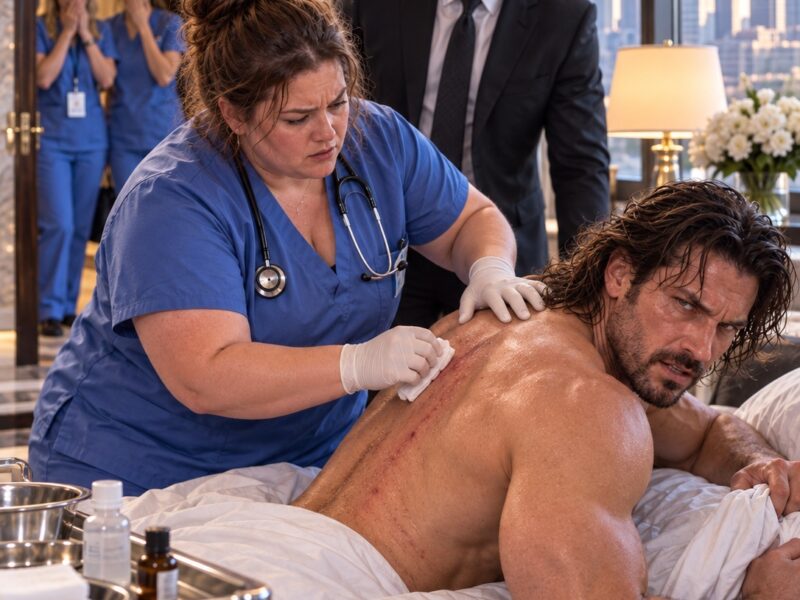
Every Nurse Quit the Mafia Boss’s Night Shift — The Chubby One Stayed and Found the Second Scar
“You have four minutes to pack your kit and leave before he wakes up.”
Mateo Russo tapped the cracked face of his watch, then looked toward the enormous bed at the far end of the penthouse.
“The last nurse stayed ten hours. He threw a crystal decanter through the wall beside her head.”
The other agency nurse did not need four minutes.
Clara Whitcomb ripped her stethoscope from the nightstand, shoved it into her bag, and hurried toward the private elevator.
At the doors, she looked back once.
Her gaze moved over Norah Hayes’s wide hips, soft stomach, and blue scrubs.
“Let the chubby one stay,” Clara muttered. “Maybe she’s got enough padding to survive him.”
The elevator closed.
Norah did not answer.
She stood at a stainless-steel basin washing her hands while Clara’s footsteps disappeared behind eighty-two floors of polished marble and money.
Then she snapped on a pair of gloves.
The sound was small.
In the silence of Dante Russo’s bedroom, it sounded like a decision.
Mateo stared at her.
“You heard me, right?”
“Yes.”
“And her?”
“Yes.”
“You don’t look offended.”
Norah turned off the faucet.
“I stopped arranging my career around other people’s opinions of my body when I was thirty.”
Mateo blinked.
“How old are you?”
“Thirty-six.”
“That was six years ago.”
“Good. You can subtract.”
Under different circumstances, Mateo might have smiled.
Tonight he was too frightened.
Norah noticed that immediately.
Men like Mateo did not advertise fear. He stood six-foot-two, wore a dark tailored jacket, and kept one hand close to the weapon beneath it. There was a scar along his jaw and the controlled posture of someone accustomed to being the most dangerous person in a room.
Yet every few seconds he looked toward the bed.
Not like a guard.
Like a brother waiting for bad news.
Four nurses had quit Dante Russo’s night shift in five days.
That was what the agency had told Norah.
They had not told her why.
They also had not told her that Dante was deteriorating fast enough to die before sunrise.
Norah approached the bed.
Dante Russo lay half-conscious beneath dark sheets, one shoulder heavily bandaged. His skin had the dull gray cast of poor circulation. Sweat dampened his hair despite the cool temperature of the room.
His breathing came in shallow, irregular pulls.
Norah counted silently.
Fourteen.
Twelve.
Eleven.
Too slow.
She checked the monitor.
Heart rate: 132.
Temperature: 103.1.
Blood pressure dropping.
His oxygen saturation flickered between eighty-eight and ninety-one.
“Why isn’t he on oxygen?”
Mateo looked toward the equipment cart.
“He keeps ripping it off.”
“Why?”
“He says he can’t breathe with anything over his face.”
“Claustrophobic?”
“No.”
“Paranoid?”
Mateo’s jaw tightened.
“Lately.”
Norah looked at Dante.
“What medications?”
Mateo pointed toward a tray.
She read the labels.
Pain medication.
Sedative.
Antibiotic.
A second sedative.
Another pain medication.
Too much sedation for a man whose respiratory drive was already failing.
“How much of this has he actually received?”
“Whatever the doctor prescribed.”
“That wasn’t my question.”
Mateo’s eyes narrowed.
Norah looked at him.
“If you want me to be afraid of you, we can schedule it after I keep him alive.”
That silenced him.
He stepped toward the tray.
“Pain medication six hours ago. Antibiotic around nine. He refused the sedative.”
“Good.”
“Good?”
“Yes.”
Norah reached for Dante’s wrist.
“He doesn’t need more medication until I know why he’s crashing.”
Her fingers almost touched his skin.
Dante’s hand shot upward.
He caught her forearm with enough force to make her breath hitch.
His eyes opened.
They were dark and unfocused, pupils wide with fever and suspicion.
“Who are you?”
His voice scraped from his throat.
Norah did not pull away.
“Nora Hayes. Night nurse.”
His grip tightened.
Pain traveled through her wrist.
Mateo moved.
Dante lifted one finger.
Mateo froze.
Even half-delirious, Dante still controlled the room.
Norah had met men like him before.
Chief surgeons.
Hospital executives.
Trauma patients who had spent entire lives believing control was the only thing separating them from vulnerability.
The costume changed.
The fear underneath usually did not.
“The others ran,” Dante whispered.
Norah watched his breathing.
Ten breaths a minute now.
“You’re still here.”
“I don’t run from fevers.”
Something flickered in his expression.
“You should run from me.”
“Mr. Russo, your oxygen level is eighty-seven percent, your heart is trying to compensate for something, and your temperature is high enough to affect your judgment.”
His fingers pressed harder into her arm.
Norah kept her voice level.
“You can continue proving how dangerous you are, or you can release me so I can stop you from dying.”
The room went quiet.
Dante stared at her.
The violence in his face weakened.
Not because he trusted her.
Because the sentence had surprised him.
Norah leaned closer.
“And if you break my wrist, I’m billing you for the X-ray.”
Mateo made a sound that might have been a cough.
Slowly, Dante released her.
His arm dropped heavily to the mattress.
The effort alone left him breathing harder.
Norah rubbed her forearm once.
Then she reached for the oxygen tubing.
“This goes under your nose. Not over your face.”
Dante’s eyes tracked her.
“No mask?”
“No mask.”
He allowed it.
Within thirty seconds, his oxygen rose to ninety-three.
Norah looked at Mateo.
“When did his legs stop working?”
Mateo’s face changed.
“Yesterday morning.”
“Completely?”
“He could move his toes the day before.”
“And before that?”
“Weakness. Numbness.”
“After a shoulder wound?”
Mateo nodded toward the bandage.
“Bullet clipped him three weeks ago.”
“Where?”
“Right upper shoulder. Passed through muscle. Didn’t hit the lung.”
“Any spinal injury?”
“They said no.”
“Imaging?”
“At the private clinic.”
“Who read it?”
“The surgeon.”
“Which surgeon?”
“Doctor Aris.”
Norah had heard the name.
Not personally.
Reputation.
Private trauma work for people who preferred not to appear in emergency departments.
Expensive.
Discreet.
Technically brilliant.
That did not reassure her.
Norah checked Dante’s pupils, then his hands.
Grip weak but equal.
Upper extremities responsive.
Lower extremities nearly flaccid.
She pressed against the sole of his foot.
Nothing.
She touched along the calf.
Nothing.
Then higher.
Dante’s face tightened only when her fingers reached mid-thigh.
A sensory level.
That was wrong.
Very wrong.
“Roll him.”
Mateo looked at her.
“What?”
“Onto his left side.”
“No.”
Norah straightened.
“Why?”
“He hates anyone touching his back.”
“That isn’t a medical reason.”
“The bullet wound hurts.”
“The bullet wound is near his shoulder.”
Mateo’s voice hardened.
“You don’t understand.”
“I understand his legs stopped working after a wound that should not have caused paralysis.”
Norah stepped closer.
“And I understand four nurses were so focused on surviving his temper that apparently nobody performed a complete neurologic skin assessment.”
Dante’s eyes opened slightly.
Mateo stared at her.
Norah pointed toward the bed.
“Roll him.”
A long silence.
Then Dante whispered, “Do it.”
Mateo looked at him.
“Boss—”
“Do it.”
Together they turned him.
Dante gritted his teeth.
A low sound escaped him, but not from the shoulder.
Norah saw it immediately.
His reaction came when his lower back shifted.
She moved the sheet.
The shoulder dressing was clean.
The skin around it showed healing consistent with a three-week-old injury.
Norah ignored it.
Her gloved fingers traced carefully down Dante’s spine.
Thoracic area.
Nothing.
Lumbar.
He flinched.
Norah stopped.
“Where does that hurt?”
Dante’s breathing changed.
“Lower.”
“Can you feel my hand?”
“Pressure.”
“Sharp?”
“No.”
Norah reached into her pocket for a penlight.
Mateo leaned closer.
“What are you looking for?”
“I don’t know yet.”
That was the most honest answer she could give.
She moved the light slowly across Dante’s lower back.
There.
Almost invisible.
A thin line hidden inside a natural crease just left of his spine.
Two inches.
Maybe less.
Covered with translucent surgical adhesive.
Norah’s stomach tightened.
“Get me saline.”
Mateo handed her a bottle.
She soaked gauze and cleaned the area gently.
Dried blood came away.
The line became clearer.
A surgical incision.
Small.
Precise.
Recent.
And badly inflamed.
The skin surrounding it was red and swollen.
Norah touched lightly near the edge.
Dante jerked.
“There.”
His voice was suddenly clearer.
“What is it?”
Norah did not answer immediately.
She looked at Mateo.
“When he was treated after the shooting, was there any procedure involving his lower spine?”
“No.”
“Lumbar puncture?”
“No.”
“Epidural?”
“No.”
“Pain catheter?”
“No.”
“Anything?”
Mateo’s face had gone pale.
“No.”
Norah sat back on her heels.
Dante watched her over his shoulder.
“What?”
She hated delivering frightening information before she understood it.
But hiding it would be worse.
“You have a second surgical scar.”
Nobody moved.
Outside the windows, Chicago glittered eighty-two floors below them.
Inside, the room seemed to shrink.
Dante’s eyes sharpened.
“What did you say?”
Norah pointed the penlight toward the incision.
“This was made recently. It has sutures beneath the adhesive. It’s infected.”
Mateo leaned over.
“I’ve never seen that.”
“You weren’t supposed to.”
His expression changed.
Norah continued.
“The shoulder injury does not explain progressive lower-body paralysis. This might.”
Dante’s face became perfectly still.
The fever was still there.
So was the weakness.
But something colder had returned behind his eyes.
The mafia boss.
“Someone operated on me.”
Norah looked at him.
“Yes.”
“Without telling me.”
“Yes.”
Mateo stepped back.
“No.”
He ran one hand over his face.
“No, he never left our sight.”
Norah looked at him.
“Never?”
“At the clinic.”
“How long was he under anesthesia?”
“Two hours.”
“Who was in the operating room?”
“Aris. His team.”
“Who chose the clinic?”
Mateo stopped.
Norah saw the answer before he gave it.
“Leo.”
Dante’s younger brother.
The name changed the air.
Dante closed his eyes.
Norah watched his jaw tighten.
Not grief.
Not yet.
Resistance.
He did not want the thought forming in his head.
Mateo pulled out his phone.
“I’m calling the clinic.”
“No.”
Dante’s voice was weak but absolute.
Mateo looked at him.
“Boss—”
“No calls until we know who hears them.”
That told Norah more about Dante’s world than she wanted to know.
She removed her gloves.
“We need imaging.”
Mateo gestured around the penthouse.
“There’s a medical suite.”
Norah frowned.
“In the apartment?”
“Down the hall. Dante had it installed last year.”
“CT?”
“Portable CT, ultrasound, X-ray.”
Of course he did.
Rich men could apparently build emergency departments beside wine cellars.
Norah looked at Dante.
“You need a hospital.”
“No.”
“This is not negotiable.”
“It is.”
“You are septic, neurologically compromised, and possibly carrying a foreign device near your spine.”
Dante’s eyes opened.
“And someone had access to me inside a private clinic.”
The implication landed.
Hospitals required names.
Movement.
Records.
People.
In his life, visibility could be dangerous.
Norah hated that his paranoia was suddenly medically inconvenient and logically justified.
“If we stabilize you here, I still need a neurosurgeon.”
Mateo said, “I can get one.”
“Not anyone connected to Aris.”
“No.”
Dante watched Norah.
“You know someone.”
It was not a question.
Norah looked away.
“I know a surgeon who will answer my call.”
Mateo studied her.
“Agency nurses usually have neurosurgeons waiting by the phone?”
Norah met his eyes.
“Agency nurses usually get asked medical questions instead of résumé questions at one in the morning.”
Dante almost smiled.
It vanished quickly.
“Call.”
Norah hesitated.
The person she was about to call had every reason not to answer.
She dialed anyway.
Doctor Evelyn Park picked up on the fourth ring.
“Norah?”
The voice carried sleep and disbelief.
Norah swallowed.
“Hi, Evie.”
A pause.
“It’s one fourteen in the morning.”
“I know.”
“Last time you called me at one in the morning, a patient was bleeding into his chest.”
“This is worse.”
Another pause.
Evelyn sighed.
“Of course it is.”
Norah gave her the clinical picture without names at first.
Thirty-nine-year-old male.
Recent shoulder gunshot wound.
Progressive paraplegia.
High fever.
Altered mental status.
Lumbar incision not documented in reported surgical history.
Possible postoperative infection or implanted device.
By the time she finished, Evelyn sounded fully awake.
“He needs MRI.”
“No MRI here.”
“CT may show hardware if there is any.”
“I have portable CT access.”
“Since when?”
Norah looked around the penthouse.
“Tonight has been strange.”
“Norah.”
“Yes?”
“Who is the patient?”
Norah looked at Dante.
He was watching her.
“Dante Russo.”
Silence.
Then Evelyn said, “Absolutely not.”
Norah closed her eyes.
“Evie.”
“I have children.”
“I know.”
“I have a hospital credentialing hearing next month.”
“I know.”
“The man you’re describing has been investigated by every federal agency in Illinois.”
“I know.”
“Then why are you there?”
Norah looked at Dante’s pale face.
Because every other nurse left.
Because he is dying.
Because a patient does not become less human because people fear his name.
She chose the simplest answer.
“Because he needs help.”
Evelyn was silent.
Then she swore softly.
“Send me images.”
Twenty minutes later, the portable CT confirmed what Norah feared.
There was something near the L4 region.
Small.
Not normal hardware.
Not a conventional pain device.
A narrow radiopaque component sat beside the spinal canal.
Evelyn viewed the scan remotely.
“What am I looking at?”
Norah stared at the monitor.
“I was hoping you’d tell me.”
“It could be a catheter anchor. Implant port fragment. Foreign body.”
“Would any of those cause this?”
“If infected, yes. If there’s compression, yes. If it’s delivering something…”
She stopped.
Norah heard it.
“So you thought it too.”
“I didn’t say anything.”
“You stopped saying something.”
“That is not evidence.”
Norah looked toward Dante.
He had drifted in and out of consciousness during the scan.
His blood pressure had fallen again.
“Can you come?”
Evelyn breathed out slowly.
“Give me the address.”
Mateo heard.
“I’ll send a car.”
“No,” Evelyn said through the speaker. “My husband drives me.”
Mateo blinked.
Norah almost smiled.
Evelyn Park had always been difficult to intimidate.
That was why they had once worked so well together.
“We’ll clear the garage,” Mateo said.
“Don’t clear anything. I want normal security, no men pointing weapons at me, and if anyone touches my husband, I walk.”
Mateo looked personally offended.
Norah said, “Agreed.”
Dante opened one eye.
“Boss?” Mateo asked.
Dante whispered, “Agreed.”
For the next forty minutes, Norah worked to keep him stable.
Fluids.
Oxygen.
Careful medication.
Cooling measures.
She refused to add more sedation.
Dante drifted awake again while she checked his blood pressure.
“You’re not afraid of me.”
Norah did not look up.
“I am.”
He studied her.
“No.”
“Yes.”
“You don’t act like it.”
“That’s because fear and competence can occupy the same body.”
His gaze moved across her face.
Most people looked away first.
Norah did not.
Finally Dante said, “The other nurse insulted you.”
“She wasn’t creative.”
“You hear it often?”
“My weight?”
He nodded.
Norah adjusted the IV tubing.
“Enough.”
“And you don’t care.”
“I care.”
That seemed to surprise him.
She continued.
“I just don’t confuse being hurt with being defeated.”
Dante stared at her.
Norah checked the monitor.
“Blood pressure’s holding.”
“You changed the subject.”
“Yes.”
“Why?”
“Because you’re my patient, not my therapist.”
A weak breath that might have been laughter escaped him.
Then the double doors opened.
Mateo turned instantly.
Leo Russo entered.
He looked ten years younger than Dante and twice as polished.
Charcoal suit.
Silver tie.
Perfect dark hair.
He carried concern on his face as carefully as other men carried briefcases.
Two security men followed him.
Behind them walked Doctor Julian Aris.
Norah recognized him from medical journals.
He recognized her too.
That was worse.
Leo’s gaze went first to Dante.
Then to the monitor.
Then to Norah.
His expression tightened.
“What happened?”
Mateo stepped between him and the bed.
“Where were you?”
Leo stopped.
“What?”
“The night Dante was shot.”
Leo looked offended.
“At the clinic. You know that.”
“Who arranged the surgical team?”
“I did.”
Norah watched his face.
Not the answer.
The timing.
Too quick.
Ready.
Leo looked past Mateo.
His gaze traveled over Norah.
Head to toe.
She knew that look.
Assessment turning into dismissal.
“Who is she?”
“Nurse.”
Leo gave a short laugh.
“This is the person the agency sent?”
Norah remained still.
Leo looked at her body again.
“You people have very flexible definitions of concierge care.”
There it was.
Not as crude as Clara.
More expensive.
Same contempt.
Norah looked at Dante’s monitor.
Heart rate rising.
She ignored Leo.
Doctor Aris stepped closer.
“You need to move away from the patient.”
Norah finally looked at him.
“No.”
His eyebrows rose.
“I treated Mr. Russo.”
“That’s exactly why you aren’t touching him.”
The room changed.
Leo’s face went blank.
Aris stiffened.
Mateo looked at Norah.
Dante’s eyes opened.
Leo laughed.
“What is this?”
Norah held out a printed CT image.
“This is a foreign object near his lower lumbar spine.”
Aris looked at it.
For less than one second.
Then his face reset.
“It’s artifact.”
Norah’s stomach turned.
He had answered too fast.
“From what?”
“Portable CTs produce noise.”
“Noise doesn’t create a two-inch incision.”
Leo looked toward the bed.
“What incision?”
Mateo stepped closer.
“The one nobody told us about.”
Leo’s concern became convincing enough that Norah almost admired it.
“What are you talking about?”
“Lower back.”
“I never saw one.”
“Neither did we.”
Leo turned to Aris.
“Julian?”
Aris frowned.
“This is absurd. Mr. Russo sustained a traumatic injury. Secondary neurologic symptoms can occur.”
Norah’s professional anger sharpened.
“Not from a superficial shoulder trajectory that never approached the spinal canal.”
Aris looked at her more closely.
“Who are you?”
“Norah Hayes.”
Recognition arrived.
His eyes narrowed.
The room went colder.
Leo noticed.
“You know her?”
Aris did not answer immediately.
Norah did.
“We’ve met professionally.”
That was generous.
Aris had been on the credentialing committee that destroyed her career three years earlier.
He had voted to suspend her hospital privileges after she reported altered transplant-priority records.
He had called her unstable.
Vindictive.
Difficult.
The words were all over the file that followed her from hospital to hospital.
Norah had spent three years pretending his name no longer mattered.
Now he stood six feet away from a man with a secret surgical scar.
Aris smiled faintly.
“Ms. Hayes is not exactly an objective medical authority.”
Mateo looked between them.
“What does that mean?”
“It means she lost her hospital position after serious professional concerns.”
Norah felt the old heat climb her neck.
Humiliation had muscle memory.
For one second she was back in a conference room while seven administrators read accusations she knew were manufactured.
Unsafe conduct.
Documentation irregularities.
Boundary violations.
Everything vague enough to ruin her.
Nothing clear enough to fight cleanly.
Leo smiled.
“And this is who’s treating my brother?”
Norah heard Clara’s voice.
Let the chubby one stay.
She heard supervisors who praised her work privately and criticized her appearance publicly.
She heard Aris three years ago saying, “Some people simply aren’t suited to high-pressure institutional medicine.”
Norah looked at Dante.
His lips had lost more color.
The monitor showed his blood pressure falling again.
Shame disappeared.
There was no room for it.
“Doctor Aris,” she said, “if you want to discuss my résumé, survive the next hour with him first.”
His face tightened.
“I am taking over.”
“No.”
“You’re an agency nurse.”
“And you’re a physician connected to an undocumented spinal incision on a patient you treated.”
That landed.
Aris stopped.
Leo’s eyes moved to him.
Mateo caught it.
Norah continued.
“Until Doctor Park arrives, nobody who participated in the original surgery goes near him.”
Leo’s expression changed.
“Park?”
“Neurosurgery.”
“You called an outsider?”
“I called someone who has not already lied about what was done to his body.”
Dante’s eyes opened.
“Norah.”
She turned.
His voice was barely audible.
“Stay.”
Two syllables.
But everyone heard them.
Leo looked at his brother.
Dante repeated it.
“She stays.”
Norah did not feel triumphant.
That would have been dangerous.
She felt the weight of responsibility.
Doctor Evelyn Park arrived fourteen minutes later carrying a black medical case and the kind of expression that made residents stop lying.
Her husband remained downstairs.
Evelyn entered the room, took one look at Norah, then at Dante.
“Hell of a reunion.”
Norah almost smiled.
“Hi.”
Evelyn reviewed the CT.
Examined the incision.
Tested Dante’s reflexes.
Then she stood.
“He needs decompression and removal of whatever this is.”
Leo said, “At the hospital.”
Evelyn looked at him.
“Preferably.”
Mateo said, “Movement risk?”
“Manageable with proper stabilization.”
Dante spoke.
“No public hospital.”
Evelyn’s mouth tightened.
“Then you may die in a very expensive bedroom.”
“Evie,” Norah said quietly.
Evelyn looked at her.
Norah nodded toward the private medical suite.
“Can it be done there?”
“Not by one surgeon and a nurse.”
Mateo said, “What do you need?”
“An anesthesiologist I trust. Two OR nurses. Surgical microscope. Full sterile capability. Blood access. ICU monitoring.”
Mateo pointed down the hallway.
“We have most equipment.”
Evelyn stared at him.
“Of course you do.”
“People?”
“I can call two.”
Leo stepped forward.
“This is insane.”
Evelyn turned toward him.
“You’re right.”
For the first time, he looked relieved.
Then she added, “The patient should have been in a hospital three days ago.”
His relief vanished.
Dante’s condition decided the argument.
His pressure dropped sharply.
The monitor alarmed.
His breathing became erratic.
Norah moved before anyone spoke.
“Dante.”
No response.
She pressed against his sternum.
“Dante.”
His eyes opened but did not focus.
Evelyn looked at the monitor.
“We are out of time.”
The next hour turned the penthouse into a controlled crisis.
Mateo locked down the private floors.
Evelyn’s team arrived through the underground garage.
Norah remained beside Dante through preparation.
Leo stayed.
That bothered her.
He should have been angry.
He should have been demanding.
Instead, once the surgical team took control, he became quiet.
Watching.
Waiting.
Norah noticed him glance twice toward Aris.
Aris refused to leave.
He claimed professional concern.
Evelyn ordered him outside the sterile suite.
He argued.
Mateo moved one hand toward his jacket.
Aris left.
Before the doors closed, Norah saw Leo follow him into the hallway.
She looked at Mateo.
“Watch them.”
He nodded.
Inside the medical suite, the surgical lights came on.
Dante lay positioned for the procedure.
He was conscious for a final minute before anesthesia.
Norah adjusted a line near his hand.
His eyes found hers.
“If I wake up…”
“You will.”
“You don’t know that.”
“No.”
His mouth tightened.
Most people lied to powerful men.
Norah never did.
Dante looked at her.
“If I wake up and can’t move?”
“We deal with what’s real then.”
His gaze held hers.
“Not afraid to tell me bad news.”
“I’m afraid of false hope.”
Something softened behind his eyes.
“Norah.”
“Yes?”
“Why did you stay?”
She knew what he meant.
Not tonight.
Why stay after Clara left?
After Mateo warned her?
After learning who he was?
Norah checked his pulse.
“Because you were sick.”
“That simple?”
“No.”
She looked at him.
“But simple things can still be true.”
The anesthesiologist pushed medication.
Dante’s eyelids grew heavy.
The last thing he saw before the room disappeared was Norah standing beneath the surgical light.
Not thin.
Not polished.
Not frightened.
Steady.
Exactly where she had decided to be.
The foreign device was smaller than Norah expected.
Evelyn removed it after opening the infected incision.
A narrow polymer reservoir connected to a microscopic catheter.
Not standard equipment.
Not documented.
The tissue surrounding it was inflamed enough to explain part of Dante’s neurologic decline.
But not all of it.
Evelyn placed the device into a sterile container.
“What the hell is this?”
The anesthesiologist looked toward the specimen.
“Drug pump?”
“No commercial markings.”
Norah stared through the clear lid.
A faint amber residue remained inside.
Evelyn’s eyes met hers.
“Get toxicology.”
Mateo had a private lab contact.
Of course he did.
The sample left the penthouse under two guards.
That was Evidence One.
The physical device.
No theories.
No family accusations.
Something had been surgically placed near Dante’s spine.
And somebody had wanted it hidden.
The procedure lasted two hours.
They drained infected tissue, removed the device, started targeted broad-spectrum treatment, and relieved pressure around the affected region.
When Evelyn finished, she looked exhausted.
“Now we wait.”
Norah looked at Dante’s legs.
“Prognosis?”
“Depends on how much nerve injury is inflammatory versus permanent.”
“Respiratory?”
“Better.”
“Sepsis?”
“Still dangerous.”
Evelyn removed her gloves.
“You found it early enough to give him a chance.”
Norah looked at the man on the table.
A chance.
Medicine was full of that word.
Never promise.
Never certainty.
Only doors that might still open.
Mateo entered.
“There’s something else.”
His face was grim.
Norah followed him into the hallway.
Leo stood near the windows.
Aris beside him.
Neither spoke.
Mateo handed Norah a tablet.
“Clinic footage.”
“What about it?”
“Security archive.”
Leo’s head turned.
Mateo did not look at him.
“The clinic sent us six hours of video the night Dante was treated.”
Norah glanced down.
Footage showed Dante arriving.
Mateo beside him.
Leo.
Aris.
Orderlies.
Then, at 1:17 a.m., the operating corridor camera went black.
Not the whole building.
One camera.
It returned forty-three minutes later.
Mateo’s jaw tightened.
“Server log says manual maintenance override.”
Norah looked at Leo.
He stared at the city.
Mateo continued.
“Override credentials belonged to Doctor Aris.”
Aris laughed.
“You think I personally manage security cameras?”
“No.”
Mateo swiped again.
A different angle.
Loading dock.
At 1:22, a man entered carrying a sealed medical transport case.
Face partly obscured.
He used a staff access badge.
At 2:01, he left.
Same case.
Norah zoomed in.
The man’s posture seemed familiar.
Leo said, “This proves nothing.”
Norah looked at him.
“You’re right.”
He seemed surprised.
She continued.
“It proves someone concealed forty-three minutes of activity during your brother’s surgery.”
Aris scoffed.
“That could have been anything.”
Norah handed the tablet back to Mateo.
“That’s Evidence Two.”
Mateo looked at her.
“You already decided?”
“Device and footage.”
She looked toward Leo.
“Everything else is noise until the lab comes back.”
Leo smiled without warmth.
“You think like a cop.”
Norah’s gaze hardened.
“No.”
“I think like someone who learned what happens when powerful people bury evidence under louder stories.”
Aris’s face changed.
He remembered.
Norah saw it.
Three years earlier, she had discovered altered transplant priority records at Saint Jude’s Medical Center.
Not organ trafficking.
The truth had been quieter and, in some ways, uglier.
Wealthy private patients had been moved ahead of poorer patients through falsified complication scores.
Aris served as a consulting surgeon then.
Norah found mismatched timestamps.
She documented them.
Reported them.
The hospital board promised an internal review.
Two weeks later, an unrelated medication error was attributed to Norah.
Then another complaint surfaced.
Then questions about her “temperament.”
By the time federal investigators asked for records, Norah’s credibility had already been dismantled.
The hospital paid a fine years later without admitting wrongdoing.
Her license was eventually restored.
Her career never was.
Elite hospitals did not like whistleblowers who had embarrassed boards.
So Norah became an agency nurse.
Night shifts.
Private clients.
People who paid cash and rarely asked about old headlines.
Aris had signed one of the letters criticizing her “professional judgment.”
Now he avoided her eyes.
Norah felt something inside her settle.
Not revenge.
Clarity.
She did not need to destroy him.
She needed him unable to destroy evidence.
“Mateo,” she said.
“Yes.”
“No one leaves.”
Leo turned.
“You cannot imprison us.”
Norah almost laughed.
“This is your family. I’m not the person to debate unlawful detention with.”
Mateo smiled for the first time that night.
“Fair.”
Norah returned to Dante.
He remained unconscious until late afternoon.
When he woke, the city outside had turned silver under winter clouds.
Norah was charting.
His voice came rough.
“Water.”
She stood immediately.
Small amount.
Ice chips first.
He frowned.
“I asked for water.”
“You also asked your body to survive surgery. It has priorities.”
His eyes moved around the room.
“Where’s Mateo?”
“Outside.”
“Leo?”
“Also outside.”
That woke him more.
“What happened?”
Norah sat beside the bed.
“You had a foreign device implanted near your spine.”
His face gave nothing away.
She continued.
“We removed it.”
“Can I move?”
Norah looked at his feet.
“Try.”
Dante stared at the blanket.
Nothing.
His jaw tightened.
“Again.”
A muscle near his ankle twitched.
Norah leaned closer.
“Again.”
His toes moved.
Barely.
Dante stopped breathing.
Norah smiled before she could stop herself.
“There.”
He looked at her.
“You saw?”
“Yes.”
His eyes closed.
For several seconds, he said nothing.
When he opened them, they were wet.
He looked away immediately.
Norah pretended not to notice.
That was dignity too.
After a while, he asked, “Who?”
“We don’t know yet.”
“You suspect.”
“Yes.”
“Leo.”
Norah did not answer.
Dante turned his head.
“That silence is insulting.”
“You hired me to keep you alive, not confirm family betrayals before toxicology.”
His expression darkened.
“He arranged the clinic.”
“Yes.”
“Aris worked for him.”
“Yes.”
“Security footage was altered.”
Norah paused.
“You already know?”
“Mateo tells me things.”
“Apparently while ignoring postoperative nursing.”
That almost earned another smile.
Dante looked toward the door.
“My brother thinks I’m weak.”
“Does he?”
“I wanted out.”
Norah waited.
He continued.
“Not out of everything.”
His voice was low.
“The legal companies stay. Hotels. Logistics. Construction.”
“And the rest?”
“I was closing it.”
“What is ‘it’?”
He looked at her.
“You know.”
Norah did.
She simply wanted him to say it.
“Protection money. Smuggling. Everything my father built that requires fear to function.”
“Why?”
Dante watched the ceiling.
“Because it doesn’t end.”
“What doesn’t?”
“The debt.”
His mouth tightened.
“My father inherited enemies from his father. I inherited them from mine. Every year somebody says we only need one more violent season before things become stable.”
He looked at Norah.
“They never become stable.”
She thought of hospitals.
Different institutions.
Same excuse.
We only need one quiet settlement before reform.
One sacrificed employee.
One buried error.
Stability as a reason not to change.
“What did Leo want?”
“The empire.”
“Why?”
“Because he thinks fear is inheritance.”
Dante’s voice hardened.
“He thinks if I dismantle the old operations, I make our father’s life meaningless.”
“And you?”
“I think carrying a dead man’s mistakes is not the same as honoring him.”
Norah looked at him for a long moment.
“Your brother knows this?”
“Yes.”
“Then he has motive.”
Dante laughed once.
“Now you sound like a cop.”
“No.”
She stood.
“I sound like a nurse who wants your blood pressure below one-fifty.”
For the next three days, Dante fought recovery like a man offended by biology.
He hated assistance.
Hated weakness.
Hated the walker Norah eventually put in front of him.
“You want me to use that?”
“Yes.”
“I’m thirty-nine.”
“Congratulations.”
“I don’t need a walker.”
“You currently need three people to stand.”
“That is temporary.”
“So is the walker.”
He glared at her.
Norah folded her arms.
“Your intimidation technique is losing market value.”
Mateo coughed into his fist.
Dante looked at him.
“Leave.”
Mateo left smiling.
Norah remained.
“You enjoy this.”
“I enjoy patients who mistake stubbornness for physical therapy.”
He gripped the walker.
Norah positioned herself beside him.
Dante looked at her hand.
“Don’t touch me.”
“Then don’t fall.”
He stood.
His arms shook.
Sweat appeared at his temples.
One foot moved.
Then the other.
His knees buckled.
Norah caught him around the torso.
He was much heavier than her.
For one second they nearly fell together.
Norah planted her feet.
Her body, the same body other nurses mocked, held.
Soft did not mean weak.
Wide did not mean slow.
Dante steadied.
Their faces ended up inches apart.
Neither spoke.
Norah became aware of his hand at her shoulder.
Dante became aware of hers around his waist.
The moment changed.
Not dramatically.
Quietly.
Norah released him first.
“Sit.”
He sat.
His breathing remained uneven.
“Good.”
“That was terrible.”
“That was six steps.”
“Terrible steps.”
“Still six.”
Dante looked at her.
“You always do that?”
“What?”
“Refuse to let people insult progress?”
Norah’s face changed.
He saw it.
She turned toward the monitor.
“Not always.”
Dante waited.
Norah knew he would not let it go.
“I used to be very good at believing other people.”
“About what?”
“Myself.”
His gaze traveled over her.
Not judging.
Understanding.
“Your weight.”
“That too.”
“What else?”
“Career.”
She checked his blood pressure.
“Reputation.”
“Aris.”
Norah’s hand paused.
Dante noticed.
She exhaled.
“I reported a hospital fraud scheme.”
He said nothing.
“The hospital blamed me for unrelated safety incidents, suspended me, and made sure every credentialing committee in the state had questions about my judgment.”
“Were the accusations true?”
“No.”
“You proved it?”
“Eventually.”
“And?”
“And being cleared is not the same as being welcomed back.”
Dante understood that immediately.
In his world, reputation could survive evidence.
Sometimes it was stronger than evidence.
“What happened to the people you exposed?”
“Some resigned. Hospital paid fines. Nobody went to prison.”
“And Aris?”
“Stayed wealthy.”
Dante looked toward the door.
Norah recognized the expression.
“No.”
He looked at her.
“I didn’t say anything.”
“You don’t have to.”
“You think I’m going to hurt him.”
“I think you solve problems with power.”
“That is generally how power works.”
“No.”
She faced him.
“That’s how control works.”
The words landed harder than she expected.
Dante’s expression cooled.
“You lecture all patients?”
“Only billionaires with criminal organizations.”
“I’m not a billionaire.”
“Really?”
“No.”
She raised an eyebrow.
“Hundreds of millions.”
“Thank you for clarifying your hardship.”
He smiled despite himself.
Then his face changed.
“What do you want done with Aris?”
Norah thought.
“I want the medical board to receive the device analysis, surgical findings, and security footage.”
“That’s it?”
“I want the truth documented where he cannot intimidate it.”
“You believe systems work?”
“No.”
That answer surprised him.
Norah continued.
“I believe records make lying harder.”
Dante looked at her for a long time.
Then nodded.
“Done.”
She frowned.
“Just like that?”
“You asked.”
“I didn’t ask you.”
“You said what you wanted.”
“That is different.”
He leaned back.
“You are exhausting.”
“Your vitals are improving.”
The toxicology report arrived that evening.
The reservoir contained a synthetic neurotoxic compound designed to release gradually.
Not enough to kill quickly.
Enough to create progressive paralysis, respiratory depression, confusion, and eventually death.
Symptoms that could be blamed on infection or vascular complications after trauma.
Doctor Park read the report twice.
Then handed it to Dante.
His face became still.
Mateo stood beside him.
Norah remained near the window.
“What happens if it stays in?” Dante asked.
Evelyn answered.
“Days. Maybe a week.”
“Cause of death?”
“Respiratory failure, sepsis, possibly cardiac arrest.”
“Would anyone know?”
“If no one looked for the device?”
She shook her head.
“Not necessarily.”
Mateo swore quietly.
Dante looked toward Norah.
“The second scar.”
She nodded.
“If you hadn’t found it?”
Norah did not answer.
Nobody needed her to.
Dante looked down at his hands.
For the first time, anger seemed smaller than grief.
“My brother.”
Mateo said, “We still don’t have proof Leo ordered it.”
Dante looked at him.
“He arranged Aris.”
“He could say Aris acted alone.”
“Why would Aris?”
Mateo had no answer.
Norah did.
“Money.”
Both men looked at her.
“Or leverage. Fear. Another secret.”
Dante’s expression sharpened.
“You think Aris might talk.”
“Yes.”
Mateo asked, “To police?”
Norah almost smiled.
“Eventually.”
She looked at Dante.
“But first, he needs to believe the truth will survive longer than whoever threatened him.”
They brought Aris into Dante’s study.
No guns visible.
That was Norah’s condition.
Mateo objected.
Dante supported her.
Aris entered expecting violence.
That was obvious.
He kept looking at corners.
Hands.
Doors.
Norah placed the toxicology report on the desk.
Aris did not sit.
Dante did.
Weakness still showed in the way he lowered himself into the chair.
But his presence had returned.
“Doctor,” Dante said.
Aris looked at him.
“You know what this is.”
Silence.
Dante slid the report forward.
Aris glanced at it.
His face changed.
There.
Recognition.
Mateo saw it.
Norah saw it.
Dante definitely saw it.
“Who paid you?” Dante asked.
Aris shook his head.
“You have no idea what you’re accusing me of.”
Norah spoke.
“Then explain the undocumented incision.”
Aris looked at her.
“You have always enjoyed accusations.”
Norah felt the old anger rise.
She let it pass.
“This isn’t Saint Jude.”
His expression flickered.
“No board is going to spend six months debating whether I sound difficult.”
She pushed the specimen photograph toward him.
“This was inside his spine.”
Aris looked away.
Dante leaned forward.
“I’m not asking whether you did it.”
His voice was quiet.
“I’m asking whether my brother ordered it.”
Aris went pale.
That was answer enough emotionally.
Not legally.
Norah needed more.
“Doctor,” she said, “the medical board will receive everything.”
He looked at her.
“Security footage too.”
His breathing changed.
“Your credentials were used to disable the camera.”
“I didn’t—”
“That’s fine.”
Norah’s voice remained calm.
“You can explain that.”
Aris stared.
She continued.
“But if Leo used your access, you are currently protecting the person who made you look like the surgeon who secretly implanted a toxin reservoir.”
That hit.
Aris looked toward Dante.
Then Mateo.
Then the door.
Dante said nothing.
Norah watched the calculation.
Men like Aris were not brave.
They were self-protective.
That was different.
Finally he whispered, “Leo said it was temporary.”
Dante’s face changed.
Mateo stepped forward.
Norah raised one hand.
He stopped.
Aris looked at the floor.
“He said the device would cause weakness. Enough to force Dante into retirement.”
Dante’s voice became cold.
“You believed that?”
“No.”
Everyone went still.
Aris swallowed.
“I knew there was more.”
“Then why?”
“My son.”
Norah’s anger paused.
Aris looked at her.
“Leo had photographs. My son gambling. Owing money to people who don’t forgive debt.”
Dante’s jaw tightened.
Aris continued.
“He said if I refused, they would collect from him.”
Norah felt no sympathy for what Aris had done.
But motive complicated hatred.
It always did.
“How much did you know?” she asked.
Aris closed his eyes.
“The compound would cause progressive neurologic failure.”
“You knew it could kill him.”
“Yes.”
Silence.
Dante’s hands curled.
Norah looked at him.
He looked back.
A conversation without words.
Control.
Evidence.
Not revenge.
Not yet.
Dante stood slowly.
He needed the desk for balance.
That somehow made the next sentence more powerful.
“You will give a recorded statement.”
Aris looked at him.
“To whom?”
“My attorney.”
“And then?”
“The medical board.”
Aris laughed bitterly.
“You think they’ll protect me?”
“No.”
Dante glanced at Norah.
“But I think records make lying harder.”
She stared at him.
He remembered.
Aris finally sat.
The statement took ninety minutes.
Leo had approached him six weeks before the shooting.
The shooting itself was real but engineered to be survivable.
A distraction.
Leo arranged the clinic.
During surgery, Dante remained under anesthesia longer than necessary.
Aris implanted the reservoir.
A security technician on Leo’s payroll disabled the camera.
The compound would slowly incapacitate Dante.
Once his respiratory failure became irreversible, Leo planned to announce that Dante’s injuries had worsened.
The organization would accept succession without war.
That was Leo’s strategy.
Not madness.
Not simple jealousy.
He believed Dante’s transition away from criminal operations would destroy the Russo family.
He believed the old system required a ruthless leader.
So he planned to remove his brother quietly while preserving the myth of loyalty.
It was almost elegant.
That made it worse.
Dante listened to the entire statement.
Then he asked only one question.
“Did Leo ever hesitate?”
Aris looked at him.
“No.”
Dante nodded.
Something in his face closed.
Later, Norah found him alone near the windows.
He was standing with the walker.
Without assistance.
“Show-off,” she said.
He did not smile.
She came closer.
“You should be in bed.”
“My brother tried to kill me.”
“Yes.”
“You say that like it’s a lab result.”
“Would you prefer screaming?”
“No.”
Dante looked at the city.
“When we were kids, he used to sleep on the floor outside my room.”
Norah said nothing.
“Our father drank.”
That was new.
Dante’s voice remained flat.
“When he got violent, Leo came to me.”
The city lights blurred in the glass.
“I used to lock my bedroom door and tell him I’d kill anyone who came through it.”
Norah watched his reflection.
“He believed me.”
“You probably believed yourself.”
“Yes.”
Dante swallowed.
“I kept him safe.”
“For a while.”
His face tightened.
“You always do that.”
“What?”
“Take a sentence I want to make permanent and add time to it.”
Norah stepped beside him.
“Because nothing stays permanent just because we need it to.”
He looked at her.
“Does that help?”
“No.”
“Good.”
A humorless breath escaped him.
“What would help?”
Norah thought.
“Not turning grief into a decision tonight.”
Dante looked toward the door.
“You think I’ll kill him.”
“Yes.”
“Would you blame me?”
“That isn’t the question.”
“What is?”
“What choice lets you live with yourself after the anger changes shape?”
Dante’s eyes narrowed.
“You assume anger changes.”
“It always does.”
“And betrayal?”
“That too.”
He stared at her.
“You speak from experience.”
“Yes.”
“Did you forgive Aris?”
“No.”
That surprised him.
Norah continued.
“Forgiveness is not a requirement for healing.”
“Then what is?”
“Boundaries. Truth. Time.”
Dante looked at her.
“That sounds less satisfying.”
“It usually is.”
Leo was brought to the penthouse the following morning.
He came voluntarily.
That was the strange part.
Perhaps he believed Aris had stayed silent.
Perhaps he thought Dante was still too weak to act.
Perhaps denial had carried him farther than logic.
He entered Dante’s study wearing a navy suit and a concerned expression.
Then he saw Norah.
His face changed.
“Still here?”
Norah stood beside the bookcase.
“Disappointing, I know.”
Leo looked at Dante.
“You look better.”
“I am.”
A flicker.
Tiny.
Fear.
Dante gestured toward the chair.
“Sit.”
Leo sat.
Mateo closed the door.
No visible weapons.
No guards inside.
Only four people.
Dante.
Leo.
Mateo.
Norah.
“You remember when Father made us spend that winter in Lake Forest?” Dante asked.
Leo frowned.
“What?”
“You were twelve.”
“I remember.”
“You fell through the ice.”
Leo’s face changed.
Dante continued.
“I went in after you.”
“Dante—”
“You cried the whole drive home because you thought Father would be angry.”
Leo looked away.
“He was.”
“Yes.”
Dante sat back.
“I told him it was my fault.”
Leo’s jaw tightened.
“Why are we talking about this?”
“Because I spent thirty years believing protecting you was something I did once.”
Silence.
Dante’s voice lowered.
“I didn’t understand that sometimes protecting someone means stopping them.”
Leo looked toward Mateo.
Then Norah.
His posture became careful.
“What did Aris say?”
Nobody answered.
Leo’s face hardened.
“Coward.”
There it was.
No denial.
Dante closed his eyes once.
When he opened them, grief had become certainty.
“You tried to kill me.”
Leo leaned forward.
“I tried to save what you were destroying.”
Norah watched Dante’s hands.
Still.
“That’s your defense?”
“You were going to dismantle everything.”
“The criminal side.”
“The family.”
“No.”
Dante’s voice sharpened.
“The family is people.”
Leo laughed.
“That’s Norah talking.”
Norah felt his contempt before he looked at her.
“A nurse spends six days in your bedroom and suddenly you’re a philosopher.”
Dante’s expression changed.
Leo continued.
“You think the docks stay ours because workers respect your retirement plan? You think enemies leave us alone because you donate to hospitals?”
“You tried to poison me.”
“I tried to prevent a war.”
“By murdering your brother.”
“By replacing a weak leader before weakness killed everyone.”
Mateo moved.
Dante lifted one hand.
Mateo stopped.
Leo looked at Norah.
“And you.”
His gaze traveled over her body.
“Do you honestly think he sees you?”
Norah’s face remained calm.
Leo smiled.
“Men like Dante don’t fall in love with women like you.”
The cruelty was deliberate.
Not random.
He had realized force would not move Dante.
So he chose shame.
Norah had spent half her life meeting men who believed a woman’s body was the easiest place to attack her confidence.
Leo had simply chosen the oldest weapon.
“Women like me?” she asked.
Leo smiled.
“You know.”
Norah looked down at herself.
Blue scrubs.
Broad hips.
Soft stomach.
Strong thighs.
A body that had carried her through eighteen-hour shifts, chest compressions, grief, bad marriages, humiliations, and one impossible week inside a mafia penthouse.
Then she looked back at Leo.
“Yes.”
His smile widened.
Norah continued.
“Competent women.”
The smile disappeared.
Mateo looked down quickly.
Dante’s mouth almost moved.
Leo turned toward his brother.
“This is who you’re listening to?”
Dante answered quietly.
“She found what every expensive doctor missed.”
Aris had not missed it.
But Dante’s meaning was clear.
Leo stood.
“This is ridiculous.”
Dante remained seated.
“No.”
“You cannot hold me here.”
“I’m not.”
Leo stopped.
Dante nodded toward the door.
“You can leave.”
Everyone looked at him.
Even Norah.
Leo frowned.
“What?”
“You heard me.”
Suspicion replaced anger.
“What’s the game?”
“No game.”
Dante stood.
His legs shook slightly.
He did not hide it.
“The statement is already with my attorney.”
Leo’s face changed.
“The toxicology report and clinic footage are duplicated.”
Dante stepped around the desk using a cane now instead of the walker.
“The medical board has Aris’s statement.”
“You gave this to outsiders?”
“Yes.”
“You idiot.”
Leo’s composure finally cracked.
“You think law enforcement will distinguish you from me once they start digging?”
Dante looked at him.
“No.”
That stopped Leo.
Dante continued.
“That’s why my attorneys are negotiating my cooperation regarding the operations I was already shutting down.”
Mateo stared.
Norah did too.
Dante had not told them.
Leo went pale.
“You’re turning state’s evidence?”
“I’m documenting everything I planned to dismantle.”
“You’ll destroy us.”
“No.”
Dante opened the study door.
“I’m ending what should have ended years ago.”
Leo’s breathing accelerated.
“You think this makes you good?”
“No.”
“Then what?”
Dante looked toward Norah.
Then back at his brother.
“Accountable.”
Leo’s face twisted.
For one moment, Norah thought he might attack.
Instead, he laughed.
A broken sound.
“Father would hate you.”
Dante flinched.
Barely.
But Norah saw.
Leo saw too.
He had found the wound.
Dante took a breath.
“Maybe.”
Leo looked surprised.
Dante continued.
“But Father is dead.”
His voice became quieter.
“I’m tired of letting dead men vote on how the living behave.”
Leo stood frozen.
Then he walked out.
No one followed.
Mateo waited until the elevator doors closed.
“You’re letting him go?”
Dante looked at him.
“For now.”
“He tried to kill you.”
“Yes.”
“He’ll run.”
“Probably.”
Mateo looked furious.
Dante continued.
“But if I imprison him here, everything he said about me remains true.”
Mateo stared.
Norah understood.
“You’re changing the battlefield.”
Dante looked at her.
“Yes.”
Leo ran.
He made it as far as a private airfield outside Gary, Indiana.
Federal agents arrested him there based on evidence connected to Aris’s statement and a broader conspiracy investigation already developing around the Russo organization.
Dante did not celebrate.
Neither did Norah.
Consequences were rarely clean.
Leo cooperated eventually.
Aris lost his medical license and faced criminal charges tied to the unlawful procedure.
The case reopened questions around his earlier work.
Including Saint Jude.
That part came months later.
For Norah, the first sign arrived as an envelope.
Illinois Department of Financial and Professional Regulation.
She stared at it on the kitchen table of her apartment for ten minutes before opening it.
Formal review.
New evidence.
Prior disciplinary findings subject to reconsideration.
Not vindication.
Not yet.
A door.
She called Evelyn.
“I got a letter.”
“What kind?”
Norah read the first line.
Evelyn screamed loudly enough that Norah held the phone away.
Three months after Dante’s surgery, Norah returned to the penthouse for what she insisted was a final nursing assessment.
He could walk without a cane now.
Slowly.
His right leg still fatigued.
Permanent nerve damage remained possible.
But he walked.
That mattered.
Mateo met Norah at the elevator.
“You’re late.”
“Seven minutes.”
“He’s been unbearable for six.”
“Normal baseline?”
“Worse.”
Norah walked into the living room.
Dante stood near the windows wearing a dark sweater instead of a suit.
No monitor.
No IV.
No hospital bed.
The giant mahogany bed had been replaced.
Norah noticed.
“What happened to the old one?”
“Mateo burned it.”
Mateo said from the hallway, “It was cursed.”
Norah opened her bag.
Dante frowned.
“You brought equipment.”
“I’m a nurse.”
“You said this wasn’t a shift.”
“It isn’t.”
She pointed toward the sofa.
“Sit.”
He did.
That amused her more than it should have.
Blood pressure good.
Heart rate normal.
Strength improved.
Sensation returning.
Reflexes uneven but present.
Norah wrote notes.
Dante watched her.
“You’re not coming back.”
It was not a question.
“No.”
“Agency reassigned you?”
“I quit.”
His face changed.
“What?”
Norah continued writing.
“My license review moved forward.”
Dante said nothing.
She looked up.
“I’ve been offered a supervised return position at Saint Catherine’s ICU while the board completes the case.”
A slow smile appeared.
Not possessive.
Proud.
Norah felt something warm in her chest.
“That’s good,” he said.
“It is.”
“You’re going back.”
“Yes.”
Silence.
Norah put away the blood pressure cuff.
Dante walked toward the windows.
She watched him.
“You could pretend to be happy.”
“I am.”
“You look like someone canceled Christmas.”
“I don’t celebrate Christmas properly.”
“That explains nothing.”
He looked at the city.
Norah closed her bag.
“Dante.”
He turned.
For a man who frightened entire rooms, he suddenly looked almost uncertain.
“I got used to you being here.”
The honesty caught her off guard.
She leaned against the table.
“That sounds dangerous.”
“It is.”
Norah smiled faintly.
He continued.
“You were the first person in this house who didn’t need something from me.”
“I needed you not to die.”
“That was inconvenient.”
“Extremely.”
Dante moved closer.
Not too close.
He had learned her boundaries.
“Have dinner with me.”
Norah stared.
“You’re asking your former nurse on a date?”
“Yes.”
“Ethically questionable.”
“You’re no longer my nurse.”
“Seven minutes ago I checked your reflexes.”
“Then dinner tomorrow.”
Norah laughed.
Dante smiled.
She looked at him.
No fever.
No paranoia.
No weakness hiding behind violence.
Just a man who had lost a brother without losing him to death.
A man dismantling an empire his father had taught him to worship.
A man learning to walk twice.
Once physically.
Once morally.
Norah’s smile faded into something softer.
“One dinner.”
Dante nodded.
“One.”
“No bodyguards at the table.”
“Fine.”
“No restaurant you own.”
He hesitated.
She raised an eyebrow.
“That eliminates options.”
“You live in Chicago.”
“Fine.”
“And I’m choosing.”
His eyes narrowed.
“This feels hostile.”
“Get used to it.”
Their first dinner lasted three hours.
Their second lasted four.
Nothing about the relationship moved quickly.
Norah refused.
Dante learned patience because the alternative was losing access to her honesty.
She returned to hospital work.
The first month nearly broke her.
Not clinically.
Socially.
Whispers followed her.
Some nurses remembered the old headlines.
Some physicians recognized her name.
One resident asked whether she was “that whistleblower.”
Norah answered, “Yes.”
He looked embarrassed.
She did not rescue him from it.
Her body remained a subject for strangers too.
A younger nurse once suggested a weight-loss medication during lunch.
Norah looked at her sandwich.
Then at the nurse.
“Did I ask?”
The woman went red.
“No.”
“Good talk.”
Norah ate the sandwich.
Dante heard about it that evening.
He looked furious.
“Name.”
“No.”
“Norah.”
“You are not intimidating hospital staff because someone commented on my body.”
“I could intimidate politely.”
“That sentence is why we have rules.”
He sighed.
Their relationship developed inside rules.
His and hers.
Mostly hers.
No money without discussion.
No interfering with her job.
No “solving” conflicts unless asked.
No surveillance.
No drivers sent without permission.
Dante failed the driver rule once during a snowstorm.
Norah sent the car back empty.
He never did it again.
She failed too.
When his federal cooperation became public, she tried to distance herself “for his safety.”
He called it what it was.
Control disguised as sacrifice.
That argument lasted two days.
They learned.
Six months after the night shift, Norah’s professional disciplinary record was formally amended.
The old findings connected to the Saint Jude retaliation were withdrawn.
She received a written statement acknowledging deficiencies in the prior investigation.
No apology from Aris.
No restoration of lost years.
No magical return to who she had been.
Norah read the letter twice.
Then folded it.
Dante watched from across her kitchen.
“That’s all?”
She looked at him.
“What?”
“They destroyed your career and sent a letter?”
“Yes.”
His jaw tightened.
Norah smiled tiredly.
“You’re doing the thing.”
“What thing?”
“Trying to turn disappointment into war.”
He leaned back.
“I hate paper.”
“Paper saved your life.”
“The scar saved my life.”
“I documented the scar.”
He considered.
“Fine. I hate certain paper.”
Norah set the letter beside her coffee.
“You know what I thought this would feel like?”
“What?”
“Bigger.”
Dante nodded.
“Justice usually arrives smaller than revenge fantasies.”
Norah looked at him.
“That sounded suspiciously healthy.”
“I have a therapist.”
She stared.
He looked annoyed.
“Mateo told you?”
“No.”
“Then why are you laughing?”
“Because the city should know.”
“No.”
She crossed the kitchen and kissed him.
It was not their first kiss.
But it was the first after the letter.
It felt different.
Not like being saved.
Like being witnessed.
A year after the night every other nurse ran, Norah returned to the Russo penthouse.
Not for a patient.
For dinner.
The medical equipment was gone from the bedroom.
The trauma suite remained, but Dante had donated most of its supplies to a free clinic on the South Side.
Quietly.
Norah found out because the clinic director recognized her name.
“You did that?”
Dante looked irritated.
“You weren’t supposed to know.”
“Why?”
“Because then it looks performative.”
“You’re learning.”
“Stop saying that.”
Mateo entered carrying wine.
He looked at Norah.
“Do you know he made me interview six clinics?”
Dante frowned.
“You were told to assess capacity.”
“You asked for financial statements.”
“Responsible giving requires due diligence.”
Norah smiled.
“Definitely therapy.”
Dante gave her a look.
Dinner was simple.
Pasta.
Salad.
Bread.
No chandeliers.
No men standing at walls.
Dante had reduced his security dramatically after the federal agreements.
Several old businesses had been sold.
Others closed.
The legal companies remained.
He was still wealthy.
Still intimidating.
Still capable of making a room quiet when he entered.
But power no longer seemed to be the only language he understood.
After dinner, Mateo left.
Norah and Dante stood by the windows.
Snow moved between the towers outside.
“You know what tonight is,” Dante said.
Norah looked at the date on her phone.
Then understood.
“One year.”
“Yes.”
“Since Clara called me chubby and ran?”
Dante frowned.
“I still dislike her.”
“You’ve never met her.”
“I dislike efficiently.”
Norah laughed.
He looked at her.
“You stayed.”
“So did you.”
“I was unconscious.”
“Technicality.”
Dante moved closer.
His hand rested lightly at her waist.
Not grabbing.
Not claiming.
A question.
Norah leaned into him.
“One year ago,” he said, “I thought strength meant nobody seeing me weak.”
“And now?”
“I think weakness seen by the right person is just information.”
Norah smiled.
“That’s the least romantic thing anyone has ever said.”
“You like accuracy.”
“I do.”
He looked down at her.
“Then accurately, I love you.”
Norah’s breath caught.
They had not said it.
Not yet.
Not because the feeling was absent.
Because both of them distrusted words that arrived before proof.
Dante’s love had appeared in small places.
Physical therapy appointments he never skipped because she asked.
Phone calls he did not make on her behalf.
A hospital dinner delivered to the whole ICU rather than only her.
Sitting through a nursing board hearing without entering the room.
Listening.
Changing.
Norah looked at him.
“You know I’m not moving in here.”
His mouth twitched.
“I said I love you, not sign a lease.”
“And I’m keeping my job.”
“Yes.”
“And I am not becoming your private nurse.”
“God forbid.”
She narrowed her eyes.
Dante smiled.
Then Norah touched his face.
“I love you too.”
No audience.
No dramatic room.
No one gasped.
Outside, snow continued falling.
Inside, Dante rested his forehead against hers.
The man who had once terrified four nurses into quitting stood perfectly still because the fifth had stayed long enough to see what everyone else missed.
Not simply a second scar.
The scar had only been the beginning.
Norah had seen the fear beneath his anger.
The grief beneath his control.
The brother beneath the boss.
And Dante had seen something in Norah too.
Not a body other people considered too soft.
Not a disgraced nurse.
Not the woman an agency sent because nobody more glamorous wanted the shift.
He saw the person who remained when everyone else decided survival meant leaving.
Norah never romanticized that decision.
Staying was not always brave.
Sometimes leaving was the bravest thing available.
Clara had been right to protect herself from a patient throwing objects.
The other nurses had not failed Dante.
The system around him had.
Pain, infection, secrecy, and bad medicine had turned a dangerous man into a delirious one, and nobody had created conditions safe enough for nurses to work.
Norah stayed because she saw something clinically wrong.
Then she insisted the environment change.
That distinction mattered to her.
Months later, when she gave a lecture to new critical-care nurses at Saint Catherine’s, someone asked about the famous Russo case.
The details had become public during the criminal proceedings.
Not all of them.
Enough.
A young nurse raised her hand.
“Were you scared?”
Norah smiled.
“Yes.”
The room seemed surprised.
She continued.
“Competence doesn’t erase fear.”
Another nurse asked, “Then why stay?”
Norah looked through the auditorium windows.
Chicago spread beyond them.
Somewhere among those towers was a penthouse where she had once found a hidden incision under bad lighting.
She answered carefully.
“Because the patient’s story did not match his body.”
The students listened.
“And when the story and the body disagree, believe the body long enough to investigate.”
She paused.
“That applies to medicine.”
Then she smiled.
“And sometimes to people.”
After the lecture, Norah walked outside.
Dante waited across the street.
No black convoy.
No bodyguards surrounding him.
Just a dark coat and a cane he no longer needed but carried on icy days because Norah had threatened him with professional consequences.
She crossed.
“You’re early.”
“You’re late.”
“I was speaking.”
“I know.”
“How?”
“You sent me the schedule.”
Norah narrowed her eyes.
“Acceptable.”
He offered her coffee.
She took it.
They started walking.
A group of nurses passed behind them.
One recognized Dante.
Another recognized Norah.
Whispers followed.
Norah heard one phrase.
“That’s her.”
Years earlier, those words would have tightened something inside her.
The fat nurse.
The disgraced one.
The whistleblower.
The difficult woman.
She had spent too long allowing other people to finish the sentence.
Now she did it herself.
That’s her.
The nurse who noticed.
The woman who stayed.
The person who found the second scar because she looked where everyone else had stopped looking.
Norah sipped her coffee.
Dante glanced at her.
“What?”
“Nothing.”
“You’re smiling.”
“I’m allowed.”
“Suspicious.”
She bumped his shoulder.
He pretended to stagger.
“Careful. Nerve damage.”
“You walked five miles yesterday.”
“Emotionally, I remain fragile.”
Norah laughed.
They reached the corner.
The pedestrian light changed.
Dante offered his hand.
Norah took it.
Behind them, the hospital doors opened and closed as another night shift arrived.
Somebody somewhere was probably being underestimated.
Some nurse was probably entering a room afraid.
Some patient was probably hiding a truth their body would eventually reveal.
Norah no longer believed courage meant never leaving.
She no longer believed strength meant staying at any cost either.
Strength was knowing why you stayed.
Knowing when to leave.
Knowing when to speak.
And refusing to let someone else’s fear, money, title, cruelty, or opinion decide what you knew to be true.
Dante squeezed her hand.
The light changed.
They crossed the street together.
And somewhere high above Chicago, behind the windows of a penthouse that had once held four abandoned night shifts and one hidden scar, the old medical suite sat empty.
The bed was gone.
The bloody bandages were gone.
The secret was gone.
But on a shelf beside the door, Dante had kept one thing.
A cheap stainless-steel penlight.
Norah’s first one.
The light she had used to find the second scar.
Not because it reminded him that she saved his life.
Norah hated when he said that.
She always corrected him.
“I found the problem. A whole team saved your life.”
So he stopped saying it.
Instead, when anyone asked why a scratched twelve-dollar penlight sat among expensive books and family photographs, Dante gave the answer Norah had taught him to respect.
“It reminds me to look twice.”









