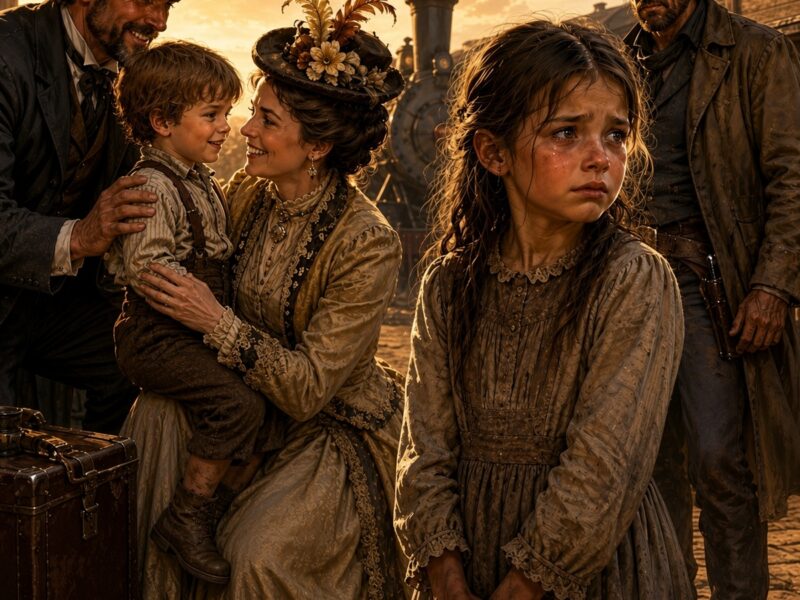
Everyone Came for the Little Boy—Until One Quiet Cowboy Chose the Scarred Girl Nobody Wanted and Exposed the Deal Waiting to Sell Her Away
Everyone crowded around the smiling six-year-old boy while his thirteen-year-old sister stood at the far end of the station platform with a scar down her face and nobody asking her name.
By noon, three families wanted Nathan, while the agent quietly marked Miriam “unclaimed” and arranged to send her to a textile school that paid for unwanted children.
Then a widowed cowboy arrived looking for the boy, studied the girl everyone had rejected, and asked the one question no adult had bothered to ask her.
The Girl at the End of the Line
The train reached Harmon, Kansas, at 10:08 on a bright April morning in 1883, hissing steam across the station platform as twelve children were arranged in a row like merchandise somebody had tried to make presentable.
Their faces had been scrubbed too hard.
Their hair had been combed flat.
The boys wore stiff shirts and trousers donated in New York. The girls wore wool dresses that scratched their necks despite the warm Kansas sun.
Pinned to every collar was a card.
Name.
Age.
A few words describing health.
Sometimes religion.
Never fear.
Nathan Bright stood first.
That was not an accident.
He was six years old, with pale blond hair, clear blue eyes, and the rare ability to look grateful before anyone had offered him anything.
When women approached, Nathan smiled.
When men asked whether he minded chores, he said, “No, sir.”
When a farmer’s wife touched his hair without permission, he stood still.
People liked him immediately.
Miriam stood last.
Her card said:
MIRIAM HOLT — AGE 11 — HEALTHY — GOOD WORKER.
Only one part was true.
She could work.
Miriam was thirteen.
The agent, Cyrus Aldrich, had changed her age before they left New York because thirteen-year-old girls did not inspire charity, while children under twelve could be placed under contracts that became dangerously difficult to challenge once they crossed several state lines.
Miriam knew this because she had watched him erase the number herself.
She had said:
“I’m thirteen.”
Aldrich had answered:
“Not today.”
Then he had pinned eleven to her collar.
The scar on Miriam’s face began at her left temple and traveled along her cheek to the edge of her jaw.
Pink.
Raised.
Impossible to ignore.
Two years earlier, fire had torn through the tenement where Miriam lived with her mother and Nathan.
Their mother shoved Miriam from a second-floor window.
Miriam landed in a pile of broken furniture and ash behind the building.
Her mother never came out.
Nathan had been sleeping at a neighbor’s apartment.
The scar remained.
So did the dreams.
Miriam no longer covered the scar.
Hiding it took energy.
She saved her energy for things that changed outcomes.
Across the platform, Mrs. Pruitt from the mercantile knelt in front of Nathan.
“You read?”
“A little.”
“Animals?”
“I like dogs.”
“We have two.”
Nathan looked toward Miriam.
She gave him the smallest nod.
Keep smiling.
They had discussed this on the train.
At night, while other children slept against wooden seats, Miriam told him Kansas had houses with porches and beds that did not belong to four children at once.
She said some families kept dogs.
Maybe horses.
Maybe apple trees.
She promised he could be happy without her.
That last promise had nearly broken her.
Nathan whispered:
“What about Miriam?”
Mrs. Pruitt followed his gaze.
Her eyes landed on the scar.
Her face changed politely.
“We only have room for one.”
Nathan’s smile vanished.
Miriam stepped forward before he could protest.
“She means you.”
Nathan shook his head.
“Miriam—”
“Don’t make it hard.”
Her voice remained gentle.
“You’re doing fine.”
He stared at her.
“You said we stay together.”
“I said I’d find you.”
“That’s different.”
“I know.”
Aldrich appeared beside Miriam.
“Back in line.”
She ignored him.
Nathan whispered:
“What if nobody takes you?”
The question was innocent.
It still felt like someone pushing a thumb into a bruise.
Miriam smiled.
“Somebody will.”
She lied well enough.
Nathan did not believe her.
But six-year-olds sometimes cooperate with lies because they understand love is trying.
Mrs. Pruitt took his hand.
Another couple waited behind her.
Then a banker and his wife.
Nathan had three offers before noon.
Miriam received none.
One farmer asked whether she could cook.
“Yes.”
His wife whispered something.
The farmer looked at Miriam’s scar again.
“Maybe not.”
Another man inspected Miriam’s hands.
“Strong?”
“Yes.”
“You got fits?”
“No.”
“Night screaming?”
Miriam’s face hardened.
Aldrich answered for her.
“Occasional disturbances.”
The man stepped away.
By one o’clock, Nathan left with a widow named Evelyn Greer.
Blue bonnet.
Soft voice.
A house five miles outside Harmon.
Morning light in the spare room.
One old sheepdog.
Miriam had extracted every detail before allowing herself to breathe.
Mrs. Greer did not object when Miriam asked for the address.
That mattered.
Nathan hugged Miriam so hard the card on her dress bent.
“Come soon.”
“I will.”
“You promise?”
Miriam’s throat closed.
“Yes.”
He walked away.
Turned once.
Miriam lifted her hand.
He disappeared beyond the freight office.
The platform emptied.
Three children remained.
Miriam.
Two coughing brothers named Eli and Peter Sloan.
Aldrich opened his ledger.
“Unclaimed.”
He wrote the word beside Miriam’s name with an elegant flourish.
She watched the ink dry.
“What happens now?”
Aldrich barely looked up.
“Bright Future Industrial Academy has room.”
Miriam had heard of it.
Not officially.
From older children.
Textile work.
Long shifts.
Punishment for missed quotas.
Children calling it school because adults did.
“When?”
“Freight train at six.”
“I’m not going.”
Aldrich finally looked at her.
“You are under the Society’s authority.”
“My mother never gave me to your Society.”
“Your mother is dead.”
Miriam’s hands curled.
Aldrich turned a page.
“Be grateful there’s somewhere willing to take you.”
“Damaged girls rarely receive second opportunities.”
The word damaged landed exactly where he intended.
Miriam’s chin lifted.
Then she heard boots on the platform.
Slow.
Unhurried.
A cowboy came from the south end of the station.
Tall.
Broad shoulders.
Brown coat worn at the cuffs.
Hat good enough to last, old enough not to impress anyone.
He stopped near the two coughing boys.
Looked at Aldrich.
Then at Miriam.
Not her scar.
Her eyes.
“How old are you?”
he asked.
Miriam blinked.
Nobody had asked her that since New York.
“Thirteen.”
Aldrich’s pen stopped moving.
The cowboy looked at her card.
“It says eleven.”
Miriam held his gaze.
“Then the card is lying.”
For the first time that day, somebody smiled at her instead of despite her.
The Cowboy Who Asked Twice
His name was Emmett Ward.
He owned eighty acres twelve miles north of Harmon, plus grazing rights on another piece of land beside Cottonwood Creek.
He had come to the station because the pastor at Harmon Methodist told him there was a six-year-old boy needing placement.
Nathan.
Emmett admitted that immediately.
“I heard about the boy.”
Miriam felt something inside her close.
Of course.
Everybody came for Nathan.
Emmett continued:
“But the boy seems to have found somebody.”
“He did.”
“Good woman?”
“I think so.”
“Thinking counts.”
He looked at Miriam’s boots.
Two sizes too large.
Newspaper stuffed in the toes.
Her hands.
Raw from lye soap.
Then:
“Can you ride?”
“No.”
“Cook?”
“Some.”
“Read?”
“A little.”
“Work?”
“Yes.”
“Keep your word?”
Miriam hesitated.
That question felt different.
“Yes.”
Emmett nodded.
“I value that more.”
Aldrich stepped between them.
“Mr. Ward.”
“You are not authorized to conduct your own inspection.”
Emmett looked at him.
“I asked her questions.”
“This girl is already spoken for.”
Miriam’s head turned.
“No, I’m not.”
Aldrich ignored her.
“The Bright Future Industrial Academy in Topeka has agreed to accept her.”
Emmett’s expression changed.
“Academy.”
“Yes.”
“Textile mill.”
“Vocational institution.”
“The mill pays placement fees.”
Aldrich’s face tightened.
“Administrative reimbursements.”
“How much?”
“That is not your concern.”
Emmett looked at Miriam.
“Did anybody explain the contract to you?”
“No.”
“Did you sign anything?”
“No.”
Aldrich laughed.
“She is a child.”
“She does not sign placement authority.”
Emmett nodded.
“That was not my question.”
Miriam felt hope rise.
She disliked it immediately.
Hope made people careless.
Aldrich closed his ledger.
“Mr. Ward, I respect your charitable instinct, but a single rancher taking an adolescent female into an isolated household raises obvious issues of propriety.”
Miriam looked at Emmett.
He did not flinch.
“That concern is reasonable.”
Aldrich seemed surprised.
Emmett continued:
“So we deal with it properly.”
“I petition Judge Harland.”
“Mrs. Callaway from the neighboring ranch can act as temporary female sponsor until the court reviews.”
“Miriam sleeps in my daughter’s old room.”
“A female teacher can visit weekly.”
“Anything else?”
Aldrich’s face reddened.
“You planned this?”
“No.”
“I know how guardianship works.”
Miriam looked at him more closely.
“Why?”
Emmett’s eyes shifted.
“Had reason to learn once.”
Pain.
Quiet.
Deep.
She recognized the shape.
Aldrich opened the ledger again.
“The matter is settled.”
“No.”
Emmett said.
“Not if her age is false.”
Silence.
Stationmaster stopped sweeping.
A woman carrying eggs slowed.
Aldrich looked at Miriam.
Emmett asked:
“When were you born?”
“March 4, 1870.”
“Proof?”
Miriam touched the inside seam of her dress.
Aldrich’s face changed.
That was enough to make Emmett notice.
“What’s there?”
Miriam did not answer.
She had carried her mother’s last letter sewn into her hem since New York.
Aldrich knew about the letter.
Not where it was.
Emmett said:
“You don’t have to show me.”
That mattered too.
Aldrich snapped:
“Her documentation is correct.”
Miriam said:
“No.”
The whole platform heard.
Aldrich turned.
“Excuse me?”
“You changed it.”
“When?”
“Before St. Louis.”
“You said thirteen was too old.”
“And eleven was easier.”
Aldrich laughed.
“Children misunderstand administrative matters.”
Miriam stared.
“You used an eraser.”
The egg woman muttered:
“Lord.”
Emmett’s eyes hardened.
“What does Bright Future pay?”
Aldrich gathered his papers.
“This conversation is over.”
Emmett stepped aside.
Not blocking him.
“Fine.”
“I’ll go to the telegraph office.”
Aldrich stopped.
“Why?”
“Ask New York for the original manifest.”
“Ask Topeka whether an indenture exists.”
“Ask Judge Harland whether you can remove a thirteen-year-old across county jurisdiction without a hearing.”
Emmett adjusted his hat.
“And I know Deputy Marshal Reeves.”
“Federal marshal?”
“Deputy.”
“He’ll still enjoy your ledger.”
Aldrich stared.
This time the silence belonged to him.
Miriam understood something.
Emmett’s strength was not violence.
He did not puff his chest.
Did not reach for the revolver visible beneath his coat.
He simply knew where authority ended.
That was new.
Aldrich tried another direction.
“You understand what she is?”
Emmett’s face went still.
Aldrich gestured toward Miriam.
“Scarred.”
“Traumatized.”
“Old enough to be difficult.”
“You won’t marry her off easily.”
“She wakes screaming.”
“She’s been caught striking boys.”
“One.”
Miriam said.
“He stole Nathan’s bread.”
A few people laughed.
Aldrich snapped:
“You see?”
Emmett looked at Miriam.
“Did you strike him?”
“Yes.”
“Did he steal the bread?”
“Yes.”
“Would you do it again?”
Miriam thought.
“Probably not the same way.”
Emmett almost smiled.
Then Aldrich said the phrase he would later regret more than any other.
“She’s damaged goods.”
Miriam’s face went hot.
Emmett’s smile vanished.
“I lost my wife and daughter in a fire.”
he said.
Aldrich blinked.
“I have nightmares too.”
Then Emmett held out his hand.
Not to Aldrich.
To Miriam.
“If you want to come see the ranch while the court decides what’s legal, I’ll file for temporary guardianship today.”
“If you don’t, I won’t touch you.”
Miriam stared at the hand.
Calloused.
Scarred.
Steady.
Nobody had asked what she wanted in months.
Nathan’s face appeared in her mind.
Her mother.
Fire.
The word unclaimed in Aldrich’s ledger.
Miriam put her hand in Emmett’s.
“I want to see the ranch.”
Aldrich said:
“You cannot simply take her.”
Emmett answered:
“Then walk with us to Judge Harland.”
That afternoon, the judge issued a seventy-two-hour temporary placement pending review.
Mrs. Callaway, a widowed rancher from the neighboring property, signed as supervising sponsor.
Miriam listened to every word.
Asked questions.
“What if I don’t like it?”
Judge Harland looked at her.
“Then you tell me.”
“What if he lies?”
“You tell me.”
“What if Mr. Aldrich comes back?”
Judge Harland’s iron-gray eyebrows lifted.
“I suspect he will.”
Emmett muttered:
“So do I.”
Miriam heard.
That should have frightened her.
Instead, for the first time since Nathan left the platform, she felt less alone.
The Room Facing East
Emmett’s ranch was not impressive.
Miriam liked that.
The house was whitewashed plank.
Barn needed paint.
Corral fence leaned slightly where the ground softened near the creek.
Three horses.
Six hens.
A brown dog named Amos who trotted toward Miriam, smelled her skirt, and sat on her boot.
“He does that.”
Emmett said.
“Why?”
“He’s lazy.”
Miriam almost smiled.
Emmett gave her a biscuit wrapped in cloth.
“Eat.”
“I’m not hungry.”
“You watched the station café for twenty minutes.”
Miriam looked at him sharply.
He shrugged.
“I notice things.”
She ate.
The biscuit tasted like flour, salt, and something close to safety.
Her room faced east.
Small bed.
Blue-and-yellow quilt.
Wooden dresser.
Washbasin.
One pencil drawing pinned to the wall.
A horse with kind eyes.
Child’s hand.
Emmett stood in the doorway.
“My daughter drew that.”
Miriam touched her scar without noticing.
“Lucy?”
“Yes.”
“She would have been fourteen this spring.”
“How did she die?”
Emmett looked toward the window.
“Fire.”
Miriam’s hand stopped.
“My wife too.”
“Both?”
“Yes.”
Four years earlier.
Barn fire.
His wife, Hannah, ran in after frightened horses.
Lucy followed.
Emmett was in town buying seed.
By the time he returned, barn and part of the house were gone.
Miriam stared at the horse drawing.
“You can take it down.”
Emmett said.
“No.”
She answered quickly.
“I like it.”
He nodded.
“Dinner at six.”
“What work do I do?”
“Nothing today.”
Miriam turned.
“I’m not charity.”
“I didn’t say you were.”
“You need help.”
“Yes.”
“So give me work.”
Emmett considered.
“Feed chickens.”
“Bring wood.”
“Learn what you don’t know.”
“School once we settle guardianship.”
Miriam frowned.
“I can work more.”
“You’re thirteen.”
“I’ve worked twelve-hour days.”
“That doesn’t make it good.”
She stared.
No adult had said that before.
“I don’t need a servant.”
Emmett continued.
“I need help around a ranch.”
“That means everybody works.”
“Me included.”
“What if I’m not good enough?”
“At what?”
“Any of it.”
“Then you learn.”
That answer irritated her.
Because it left nowhere to hide.
First morning, she failed at milking.
Cow stepped on her boot.
She swore.
Emmett pretended not to hear.
Second morning, fire went out.
Third, she burned biscuits until Amos sniffed one and walked away.
Miriam stood beside the stove staring at the blackened tray.
Her hands began shaking.
Emmett noticed.
“What?”
“Nothing.”
“That word is usually a lie.”
Miriam waited.
For ridicule.
Anger.
A reminder she should be grateful.
Emmett picked up a biscuit.
Tried to break it.
Could not.
“Impressive.”
Miriam stared.
“My wife once used salt instead of sugar.”
“Whole batch.”
“We ate them because we were twenty-three and too proud to admit defeat.”
He scraped Miriam’s biscuits into the stove.
“Try again.”
“That’s it?”
“What else?”
“I ruined flour.”
“We own more flour.”
She tried again.
Second batch edible.
Emmett ate three.
Maybe two and a half.
The dog ate one.
That night Miriam woke screaming.
Fire.
Her mother shouting jump.
Beams collapsing.
She sat upright.
Dark.
For several seconds she did not know Kansas from New York.
Then she heard footsteps outside her room.
Emmett stopped at the door.
Did not enter.
“Miriam?”
“I’m fine.”
“Do you want water?”
“No.”
“Lamp?”
“No.”
Silence.
Then:
“I’m sitting in the hall.”
She frowned.
“Why?”
“Because I don’t sleep well either.”
“You don’t have to.”
“I know.”
He sat anyway.
She heard him settle against the wall.
No questions.
No touching.
Eventually Miriam slept.
At breakfast, neither mentioned it.
That mattered.
Four days later, Nathan arrived.
Mrs. Greer drove him in a wagon.
Nathan jumped down before wheels stopped.
“Miriam!”
She ran.
Forgot dignity.
Forgot scar.
Forgot thirteen.
He hit her like a small blond cannon.
Mrs. Greer smiled.
“I told him we could visit after Judge Harland confirmed where you were.”
Miriam studied her.
“You came.”
“I said I would.”
Nathan pulled Miriam toward the wagon.
“We have a dog.”
“I know.”
“His name is Percy.”
“You told me.”
“My room has a window.”
“I know.”
“I can see sunrise.”
Miriam looked at Mrs. Greer.
The woman had kept her promises.
Good.
Nathan whispered:
“Come live with us.”
Miriam’s chest tightened.
Mrs. Greer said gently:
“There is space if the court permits.”
Miriam looked toward Emmett.
He was repairing harness near the barn.
Did not watch.
Did not pressure.
Miriam answered:
“I want to stay here until the hearing.”
Nathan frowned.
“With him?”
“Yes.”
“Why?”
Miriam did not know yet.
She only knew that when she burned biscuits, nobody called her useless.
When she screamed at night, nobody threatened punishment.
When Nathan visited, Emmett did not act as if affection elsewhere weakened his claim.
He had no claim.
That might have been the reason.
Then hoofbeats sounded from the road.
A buckboard approached.
Cyrus Aldrich.
Beside him sat a thin man carrying a leather case.
Emmett looked up.
Miriam felt hope turn immediately back into danger.
The Paper That Called Her Property
Aldrich introduced the man as Calvin Doss.
Attorney.
Doss had narrow shoulders, careful hair, and the habit of speaking to Emmett while looking past Miriam.
He produced a court document.
“Writ of recovery.”
Emmett read.
Miriam watched his face.
Nothing.
Doss said:
“The child is bound by indenture to Bright Future Industrial Academy.”
“You unlawfully interfered with placement.”
“Unless she is released by Friday noon, Mr. Ward, we will pursue charges.”
“Kidnapping.”
“Interference.”
“Potential moral misconduct involving a female minor.”
Mrs. Greer pulled Nathan closer.
Miriam’s face burned.
Emmett folded the paper.
“Where is the original indenture?”
Doss smiled.
“Filed in Topeka.”
“Signed by?”
“The Society’s authorized agent.”
“Not Miriam?”
“She’s a minor.”
“Parent?”
“Deceased.”
“Court authorization from New York?”
Doss’s smile faded.
“Kansas recognizes placement authority.”
“Does Kansas recognize a false age?”
Aldrich stepped forward.
“She is eleven according to official documents.”
Miriam said:
“I am thirteen.”
Doss finally looked at her.
“Children are often confused regarding dates.”
Miriam’s anger sharpened.
“I remember my birthday.”
Emmett said:
“So does her mother.”
Aldrich froze.
Emmett pulled an envelope from his coat.
Miriam recognized it.
Her letter.
She had shown him that morning after he asked whether she possessed proof of age.
He had read only the outside.
Then asked permission before opening.
Inside:
A letter written by Miriam’s mother on the day she was born.
March 4, 1870.
Names.
Parents.
A request that Miriam and Nathan remain together if anything happened.
Emmett said:
“Thirteen.”
“In Kansas, children over twelve can be heard directly by a court in guardianship matters.”
Doss said:
“Not universally.”
“No.”
“That’s why Judge Harland is hearing it Monday.”
Aldrich went pale.
“You contacted her?”
“She contacted the territorial records office herself.”
Miriam looked at Emmett.
“When?”
“Yesterday.”
“What did you send?”
“Copy of your letter.”
“Your card.”
“My temporary order.”
“Nothing you didn’t authorize.”
He had learned.
Permission.
Miriam felt it.
Doss recovered.
“Judge Harland can review guardianship.”
“She cannot nullify a lawful placement contract without jurisdiction.”
Emmett nodded.
“Then bring the original.”
Aldrich said:
“We don’t owe you—”
“You owe the court.”
Emmett looked directly at him.
“And if the original says she’s thirteen while your transport ledger says eleven, you’ll have another problem.”
Aldrich’s mouth tightened.
Nathan whispered:
“Is he taking Miriam?”
Mrs. Greer said:
“No one is taking anyone today.”
Doss turned to her.
“Madam, stay out of this.”
Mrs. Greer’s eyes sharpened.
“I have buried a husband and run eighty acres alone.”
“Do not call me madam like it means quiet.”
Emmett almost smiled.
Doss packed his papers.
Before leaving, Aldrich looked at Miriam.
No anger.
Worse.
Calculation.
She knew that look.
The look men used when deciding how expensive a child was to keep versus move.
That night, Miriam could not sleep.
She sat in Lucy’s room wrapped in the quilt.
Emmett found her holding the horse drawing.
“He’ll come back.”
“Yes.”
“You knew.”
“I suspected.”
“Why help me?”
Emmett sat at the edge of the chair, not the bed.
“Because you needed help.”
“That’s not enough.”
“Why?”
“People don’t risk prison because somebody needs help.”
“They do sometimes.”
“Why me?”
Emmett looked down.
“I came for Nathan.”
Miriam flinched despite knowing.
Emmett continued.
“I thought I wanted a small boy because a boy felt easier.”
“Less likely to remind me of Lucy.”
Miriam looked at him.
“That’s terrible.”
“Yes.”
“I know.”
He rubbed his hands.
“Then I saw you.”
“Everybody was studying Nathan.”
“You were studying everybody else.”
“Watching him.”
“Protecting him.”
“Already preparing yourself to be left.”
“I recognized that.”
Miriam’s throat tightened.
“From what?”
“The day after Hannah and Lucy died.”
“People kept coming.”
“Food.”
“Blankets.”
“Pastor.”
“Neighbors.”
“They meant well.”
“Every single person looked at me like they were waiting for me to become the man I had been before.”
“I knew I never would.”
He looked around Lucy’s room.
“I spent four years living in the house like I was waiting for permission to leave it.”
“When I saw you, I thought…”
He stopped.
“What?”
“That maybe choosing somebody wasn’t the same as replacing somebody.”
Miriam stared at the quilt.
“My mother pushed me out the window.”
Emmett’s face tightened.
Miriam continued.
“Fire blocked the stairs.”
“Nathan was next door.”
“She could have jumped first.”
“She pushed me.”
“I fell into garbage.”
“That’s the scar.”
“I tried to go back.”
“The hallway was gone.”
“I dream about her telling me to jump.”
Emmett remained quiet.
No “not your fault.”
No easy sentence.
Finally:
“Lucy dreamed about wolves.”
Miriam looked up.
“She’d never seen one.”
“Still dreamed they got into the house.”
“Hannah would sit beside her.”
“She always said, ‘The wolves are outside. The house is strong, and I am stronger.’”
Emmett stood.
He walked to the door.
Then turned.
“The house is strong, Miriam.”
She almost rolled her eyes.
He finished:
“And you don’t have to be strong every minute just because you survived.”
That was better.
After he left, Miriam slept.
No fire.
Morning brought the first major secret.
Mrs. Greer returned.
Not with Nathan.
With a woman from town named Abigail Price who had once worked at the Harmon station telegraph office.
Abigail carried copies of telegram entries.
“Aldrich sent these.”
she said.
Three weeks before the orphan train arrived.
To Bright Future Academy.
EXPECT 4 FEMALE / 3 MALE LABOR ELIGIBLE. AGES ADJUSTED WHERE NEEDED. PAYMENT ON DELIVERY.
Miriam felt sick.
Emmett stared.
“This isn’t placement.”
“No.”
Abigail answered.
“It’s procurement.”
The children had not merely been unwanted.
Some had been selected in advance for labor.
And Miriam’s false age was not an individual lie.
It was part of a system.
What Happened to the Children Nobody Chose
Emmett wanted to send the telegram copies immediately to Deputy Marshal Reeves.
Miriam stopped him.
“No.”
Everyone looked at her.
Emmett frowned.
“Why?”
“Because Aldrich will say they’re fake.”
“Abigail can testify.”
“He’ll say she hates him.”
Abigail smiled.
“I do.”
Miriam continued.
“He’ll say I lied because I don’t want to go.”
“That Emmett made me.”
“That everybody here wants revenge.”
Mrs. Greer asked:
“What do you suggest?”
Miriam looked at Nathan’s empty chair.
“The other children.”
Emmett understood.
“Witnesses.”
“Yes.”
“Where?”
Miriam named them.
Eli and Peter Sloan.
Two girls transferred earlier at Wichita.
A boy named Samuel taken by a grain operator.
A girl named Cora marked ten though she was twelve.
Miriam remembered everything.
Names.
Stations.
Who complained.
Who disappeared from cars before official stops.
Aldrich thought children did not notice paperwork.
Children noticed everything adults said around them when they believed childhood meant invisibility.
Emmett and Abigail sent telegrams.
Not accusations.
Questions.
Within a day, replies began.
Eli and Peter had been sent to Bright Future.
Not school classrooms.
Mill housing.
Cora too.
The mill claimed apprentices worked legal hours.
A former teacher wrote otherwise.
Twelve-hour shifts during production rushes.
Locked dormitories after dark.
Children paid in credits deducted for food.
Mrs. Greer whispered:
“Dear God.”
Miriam felt no surprise.
Only confirmation.
Then another telegram arrived.
Nathan’s placement had been challenged.
Aldrich had sent Mrs. Greer notice claiming Nathan and Miriam were a sibling unit improperly separated from Society authority and demanding Nathan’s return pending review.
Miriam’s stomach dropped.
“He’s using Nathan.”
Mrs. Greer said:
“He’s not getting him.”
Emmett remained calm.
“Judge Harland.”
“Tomorrow morning.”
Nathan was frightened.
He arrived before sunset.
“Are they taking me back?”
Miriam crouched.
“No.”
“How do you know?”
She almost lied.
Then stopped.
“I don’t know.”
His eyes filled.
“But we’re going to court.”
“And you get to tell the truth.”
“What if truth loses?”
Miriam had no answer.
Emmett crouched beside them.
“Then we keep telling it.”
Nathan looked at him.
“That sounds like losing.”
“Sometimes it is.”
Emmett said.
“For a while.”
That night everyone ate together.
Mrs. Greer.
Nathan.
Mrs. Callaway.
Emmett.
Miriam.
Stew too salty.
Biscuits decent.
No one watched how much Miriam ate.
Afterward Nathan slept in Lucy’s room beside Miriam.
Before closing his eyes, he asked:
“Did you want me to stay with you?”
“Yes.”
“Then why did you tell me to go?”
Miriam stared at ceiling.
“Because Mrs. Greer looked kind.”
“She is.”
“I thought being loved somewhere else was better than being unwanted beside me.”
Nathan rolled toward her.
“You weren’t unwanted by me.”
The sentence hurt.
Miriam turned away so he would not see her cry.
The next morning Judge Harland held a preliminary hearing.
Not final guardianship.
The courthouse smelled of varnish.
Aldrich’s attorney argued procedure.
Society authority.
Interstate charitable placement.
Moral concerns regarding single male guardianship.
Emmett did not dramatize.
He produced the telegram copies.
Abigail testified.
Judge Harland’s face changed.
She ordered Bright Future Academy records subpoenaed.
She extended Miriam’s placement with Emmett under Mrs. Callaway’s supervision.
Nathan stayed with Mrs. Greer.
Then Judge Harland said:
“I want the original New York manifest.”
Aldrich’s face tightened.
“And until I have it, no child named in these telegrams leaves Kansas jurisdiction.”
Miriam felt something shift.
Not victory.
Space.
Enough to move.
Outside, reporters from a Topeka paper waited.
Emmett tried to guide Miriam away.
She stopped.
One reporter asked:
“Miss Holt, were you mistreated?”
Miriam looked at Emmett.
He did not answer for her.
“I was lied about.”
she said.
“How?”
“They changed my age.”
“Why?”
“So I could be sent where they wanted.”
“Did Mr. Ward save you?”
Miriam’s eyes narrowed.
“No.”
The reporter blinked.
“He gave me a choice.”
“That isn’t the same.”
The line appeared in the paper two days later.
It changed public attention.
People began asking not whether Emmett was a heroic cowboy.
But why a child’s age had been falsified.
Aldrich hated that.
His strategy changed.
If he could not win cleanly through documents, he would make Emmett morally untouchable.
Saturday morning, the sheriff came.
The Day Emmett Rode Away
Miriam heard the wagon first.
Heavy wheels.
Horse tack.
Then more horses.
She was grooming Bess in the barn.
Emmett stepped out of the house.
Six riders accompanied Sheriff Colby.
Aldrich sat in his own wagon.
So did Attorney Doss.
The sheriff carried a warrant.
“Emmett Ward.”
“Disturbing the peace.”
“Interference with authorized child placement.”
“Witness intimidation.”
Then he hesitated.
“Moral corruption of a minor.”
Miriam’s brush stopped.
Everything inside her turned hot.
Emmett’s expression barely changed.
“What witness?”
Doss said:
“Two men state you removed Miriam Holt for improper purposes.”
Miriam walked from the barn.
“That’s a lie.”
Sheriff Colby looked at her.
“Girl, stay back.”
“My name is Miriam.”
“You don’t understand legal matters.”
“I understand when a man lies about me.”
Aldrich smiled.
Small.
Private.
The smile told her why.
Inventory that spoke back needed punishment.
Emmett went inside.
Returned carrying his rifle.
The riders shifted.
Sheriff Colby’s hand moved toward his holster.
Emmett turned.
Held the rifle out to Miriam.
“Take this.”
She stared.
“I don’t know how to use it.”
“You don’t need to.”
“Hold it.”
She did.
Heavy.
Emmett walked toward the sheriff.
Held out his hands.
“I’ll come voluntarily.”
Miriam’s heart slammed.
“No.”
He looked at her.
“We knew he’d come back.”
“You said they don’t always win.”
“They haven’t.”
“You’re leaving.”
“For court.”
“You don’t know that.”
“No.”
He answered.
“I don’t.”
That honesty terrified her.
Emmett turned to Sheriff Colby.
“Because I surrender voluntarily, you have no reason to search my property without a separate warrant.”
“You do not touch Miriam’s papers.”
“You do not enter Lucy’s room.”
“My foreman Jed Calloway arrives within the hour.”
“Mrs. Callaway has temporary supervisory authority under Judge Harland’s order.”
Doss said:
“You think legal phrases make you clever?”
Emmett looked at him.
“No.”
“I think legal phrases make it harder for you to improvise.”
Sheriff Colby almost smiled.
Then hid it.
Aldrich snapped:
“The girl should come.”
Sheriff Colby looked at his warrant.
“No custody order here.”
Aldrich’s jaw tightened.
Emmett turned to Miriam.
“Judge Harland Monday.”
“Bring your mother’s letter.”
“Telegram copies.”
“Everything.”
Miriam whispered:
“I can’t do this.”
“Yes.”
“You can.”
“I’m thirteen.”
“That doesn’t mean you can’t speak.”
“It means you shouldn’t have had to.”
Different thing.
Miriam’s eyes filled.
Emmett lowered his voice.
“They want you scared enough to disappear.”
“Don’t disappear.”
Then they took him.
Miriam stood in the yard holding a rifle she could not fire.
Dust rose behind the wagon.
The darkest feeling was not fear.
It was recognition.
People left.
Mother.
Nathan.
Now Emmett.
The old lesson returned:
Do not expect.
Expectation gives grief somewhere to enter.
Jed Calloway arrived.
Sixty.
One eye cloudy.
Talked to horses more than people.
He took the rifle.
“Come inside.”
Miriam shook her head.
“I need the telegraph office.”
“What?”
“Aldrich lied.”
“Again.”
“About witnesses.”
“If he can invent witnesses, we need people he can’t control.”
Jed stared.
Then grinned.
“Emmett chose a difficult one.”
“I heard that.”
“I intended you to.”
They rode into Harmon.
Miriam sent telegrams herself.
New York Children’s Aid office.
Topeka labor inspector.
Deputy Marshal Reeves.
Bright Future’s former teacher.
The reporter.
Then one more.
Mrs. Greer.
BRING NATHAN MONDAY. HE SHOULD SPEAK IF HE WANTS.
That evening, Miriam returned to the ranch.
She entered Lucy’s room.
Took her mother’s letter from the tin box.
Then saw something she had never noticed.
Writing on the back.
Faded.
Her mother:
Miriam knows Nathan’s birthday song. If they are ever separated, ask her to sing the second verse. Only family knows it. Keep my children together if they want it. Do not force one to carry the other.
Miriam read the final sentence repeatedly.
Do not force one to carry the other.
Her mother had understood.
Miriam had treated Nathan’s happiness as her job.
Even after their mother died.
Even at the station.
She had pushed him toward Mrs. Greer because she thought love meant carrying his future at the cost of her own.
Maybe choosing did not require sacrifice every time.
Maybe family could remain family across two homes.
Monday arrived.
Emmett was still in jail.
Judge Harland refused release until the accusation hearing.
The courthouse filled.
Town gossip had transformed the case.
Some came expecting scandal.
Some justice.
Most spectacle.
Miriam wore a borrowed lavender dress.
Too large.
Scar visible.
She sat in front.
Nathan beside Mrs. Greer.
Emmett entered without cuffs at Judge Harland’s order.
He saw Miriam.
She nodded.
Not reassurance.
Partnership.
Aldrich’s attorney rose.
The courtroom battle began.
The Girl Who Refused to Be Evidence
Doss spoke first.
Smooth.
Respectable.
Dangerous.
He described charitable organizations overwhelmed by poverty in Eastern cities.
Children transported west toward opportunity.
Families needing labor.
Children needing homes.
A noble system vulnerable to emotional interference.
Then Emmett.
Single rancher.
Grieving father.
“Unusual attachment.”
An adolescent girl.
“Questionable propriety.”
Two witnesses claimed Emmett told men at a saloon he intended to “keep the girl whether law liked it or not.”
Emmett’s attorney?
He had one now.
Rachel Harland—not related to the judge—had arrived from Topeka after the newspaper coverage.
Thirty-six.
Black dress.
Sharp voice.
She cross-examined the witnesses.
First man admitted Aldrich paid his train fare.
Second admitted he had never spoken directly with Emmett.
One said he heard the saloon statement “from somebody.”
“Who?”
“Couldn’t say.”
The accusation weakened.
Then Doss introduced the Bright Future contract.
Official seal.
Indenture for:
Miriam Holt, age 11.
Judge Harland examined it.
“Where is New York authorization?”
Doss said it was en route.
Rachel Harland stood.
“Your Honor, we have it.”
The courtroom shifted.
Deputy Marshal Reeves entered.
Dust on coat.
Carrying a leather pouch.
Aldrich’s face changed.
The marshal gave documents to the clerk.
Original manifest.
Miriam Holt.
Age 13.
No Bright Future placement.
No indenture.
Destination:
GENERAL FAMILY PLACEMENT — KEEP WITH BROTHER IF PRACTICABLE.
Miriam stopped breathing.
Nathan took her hand.
Doss tried:
“Administrative discrepancy.”
Marshal Reeves placed another document down.
Aldrich’s personal ledger.
Obtained under warrant from his Topeka lodging.
Payments.
Bright Future Industrial Academy.
Four dollars for “prime male.”
Three dollars for “domestic female.”
Two dollars for “blemished.”
Miriam’s entry:
M. Holt — blemished / age reduce / mill acceptable.
The word hit the courtroom.
Blemished.
She had heard worse.
Yet seeing herself priced on paper made something inside her go strangely calm.
Aldrich stood.
“This is being misinterpreted.”
Judge Harland’s voice cut:
“Sit.”
He sat.
Rachel Harland called Abigail Price.
Telegram records.
Then Bright Future’s former teacher, Sarah Wills.
She testified that children worked ten to twelve hours during peak orders.
Education sometimes thirty minutes.
Sometimes none.
Wages deducted for food.
Locks on dormitories.
Several attempted escapes.
Doss attacked credibility.
“Were children beaten?”
Sarah said:
“I saw corporal punishment.”
“Legal discipline.”
“I saw a twelve-year-old work until her hand swelled too much to close.”
Doss said:
“Not relevant to Miriam’s guardianship.”
Judge Harland said:
“It becomes relevant when the proposed placement is represented as educational.”
Then Rachel called Miriam.
Emmett turned.
He had not wanted this.
Miriam knew.
Before court he had said:
“You do not have to testify.”
She answered:
“Yes.”
“I do.”
Now she walked to the witness chair.
Her legs shook.
She sat.
Swore.
Rachel began gently.
“How old are you?”
“Thirteen.”
“When did Mr. Aldrich know that?”
“Before we left New York.”
“How?”
“I told him.”
“What did he do?”
“Changed my card to eleven.”
“Why?”
“He said eleven traveled easier.”
“Did you consent to work at Bright Future?”
“No.”
“Did anyone explain an indenture contract?”
“No.”
“Did Mr. Ward force you to leave the station?”
“No.”
“Did he threaten you?”
“No.”
“Offer money?”
“No.”
“Why did you go?”
Miriam looked at Emmett.
“Because he asked.”
“Asked what?”
“What I wanted.”
The courtroom went quiet.
Rachel nodded.
“Did anyone else?”
“No.”
Doss stood for cross-examination.
He smiled.
Not unkind.
That was worse.
“Miriam, Mr. Ward gives you a room?”
“Yes.”
“Food?”
“Yes.”
“Clothes?”
“Some.”
“You work?”
“Yes.”
“So, labor in exchange for support.”
“No.”
Doss’s eyebrows lifted.
“No?”
“I feed chickens.”
“Bring wood.”
“He feeds chickens too.”
“He cooks.”
“Badly.”
A few people laughed.
Judge Harland’s mouth moved.
Doss continued.
“Mr. Ward lost a daughter.”
“Yes.”
“You sleep in her room.”
“Yes.”
“He keeps her drawing.”
“Yes.”
“Could he be replacing his dead child with you?”
Emmett stiffened.
Miriam thought.
Doss expected anger.
Instead she said:
“Maybe he was afraid of that.”
The attorney paused.
“What?”
“He told me he came looking for Nathan because a boy felt safer.”
“That choosing a girl close to Lucy’s age scared him.”
“That doesn’t sound like somebody pretending I’m Lucy.”
Doss recovered.
“But he needs you emotionally.”
Miriam looked directly at him.
“So?”
“You are a child.”
“You should not bear adult grief.”
“I don’t.”
“He has his grief.”
“I have mine.”
“Sometimes we sit in the same house with both.”
No perfect line.
Just truth.
Doss changed direction.
“Mrs. Greer offered you a home with your brother.”
“Yes.”
“You refused.”
“Yes.”
“Why?”
“Because I want to live with Emmett.”
“Even though your mother asked you to stay with Nathan.”
Miriam’s stomach tightened.
There.
Aldrich knew the letter.
Doss smiled.
“Your mother’s request is in evidence.”
Miriam said:
“Read the back.”
Doss stopped.
Rachel Harland rose.
“Your Honor?”
Miriam took out the letter.
“The back wasn’t copied before.”
“I found it Saturday.”
Judge Harland received it.
Read.
Then handed to clerk.
The clerk read aloud:
Keep my children together if they want it. Do not force one to carry the other.
Nathan began crying silently.
Miriam looked at him.
“I carried him because I loved him.”
she said.
“Now Mrs. Greer can love him too.”
“That doesn’t make us less brother and sister.”
Mrs. Greer covered her mouth.
Doss sat.
Judge Harland asked Nathan whether he wished to speak.
Nathan did.
He stood beside the clerk because he was too short for the witness chair without help.
“Do you want to live with Mr. Ward?”
Judge Harland asked.
Nathan looked at Miriam.
“No.”
Miriam’s heart skipped.
Nathan continued:
“I want Mrs. Greer.”
“Percy sleeps by my bed.”
“I like my room.”
“I want Miriam to stay with Mr. Ward if she wants.”
Judge Harland nodded.
“Thank you.”
Nathan turned to Aldrich.
Then added:
“He told Miriam nobody would want her.”
The courtroom froze.
Aldrich whispered:
“Child—”
Nathan said:
“I wanted her.”
Six years old.
Simple.
Miriam lowered her head.
For the first time since the train arrived, she cried in public.
Not because she had lost control.
Because she no longer needed it every second.
The Choice That Broke the Ledger
The hearing could have ended with Miriam’s guardianship.
It did not.
That was Miriam’s choice.
Judge Harland announced a recess.
Rachel asked whether Miriam wanted to leave.
Miriam wiped her face.
“No.”
“Why?”
“Aldrich brought twelve children.”
“Not just me.”
Marshal Reeves was investigating.
Bright Future records had already triggered state inquiry.
But Miriam understood something adults sometimes missed.
Systems survived when each victim accepted an individual escape.
She had hers.
Emmett.
Ranch.
Room facing east.
Nathan safe.
She could go home.
Aldrich wanted exactly that.
Miriam asked Judge Harland for permission to speak before the guardianship ruling.
Granted.
She stood.
No witness chair.
Just herself.
“My name is Miriam Holt.”
“I am thirteen.”
“Mr. Aldrich wrote eleven because eleven was worth more to him.”
She looked at the benches.
“There were twelve children at Harmon.”
“Some got good homes.”
“Maybe.”
“Some got work.”
“Some got sent places where nobody asked what they wanted.”
“Eli and Peter Sloan are at Bright Future.”
“Cora Bellamy too.”
“There were others before us.”
“Aldrich kept names in his ledger.”
“He calls us placements.”
“But he wrote prices.”
She looked at Judge Harland.
“If you only decide where I sleep, he loses one girl.”
“If somebody reads the whole ledger, maybe he loses the business.”
Aldrich stood.
“This is outrageous.”
Judge Harland slammed the gavel.
“Sit down.”
He did.
Miriam continued.
“My mother told me dignity is something nobody can take unless you hand it over.”
“I thought that meant never crying.”
“Never asking.”
“Never needing anybody.”
“I was wrong.”
She looked at Emmett.
“Sometimes dignity means getting to choose who helps you.”
“Sometimes it means helping back.”
“So I want the court to keep my papers.”
“I want Marshal Reeves to take the ledger.”
“I want somebody to find the other children.”
The courtroom remained silent.
Then Judge Harland said:
“That is already underway.”
Miriam exhaled.
“Good.”
The guardianship decision came after lunch.
Judge Harland addressed Emmett first.
“Single male guardian.”
“Recent bereavement.”
“Limited formal education.”
“Financially stable.”
“Strong community references.”
“Mrs. Callaway agrees to regular household oversight for six months.”
“School enrollment mandatory.”
Emmett nodded at each.
Then Miriam.
“Miss Holt, under Kansas law and this court’s equitable authority, your wishes carry significant weight given your age.”
“Do you understand guardianship?”
“I think so.”
“Mr. Ward becomes legally responsible for education, medical care, housing, and welfare.”
“He does not own your labor.”
“Yes.”
“You retain a relationship with your brother.”
“Yes.”
“Mrs. Greer may petition for sibling visitation guarantees.”
Miriam almost smiled.
“She already told me she would.”
Judge Harland looked over spectacles.
“Do you choose Emmett Ward?”
Every eye turned.
This was the moment the station had denied her.
Choice.
Not selection.
Miriam stood.
Her dress too large.
Scar uncovered.
“I choose him.”
Emmett’s face broke.
Only slightly.
Enough.
Judge Harland signed.
“Guardianship granted.”
Then turned toward Aldrich.
“Cyrus Aldrich, based on evidence presented and federal warrant now lodged with this court, you are remanded pending investigation for fraud, unlawful labor trafficking, falsification of records, and related offenses.”
The sheriff stood.
For once, not bored.
Aldrich looked at Miriam.
The private smile was gone.
He said:
“You think this man fixes you?”
Miriam looked at him.
“I wasn’t broken.”
The sentence traveled through the room like wind.
Aldrich was taken away.
Outside, people gathered.
The reporter asked Emmett:
“How does it feel to save the girl nobody wanted?”
Emmett’s jaw tightened.
Miriam answered first.
“He didn’t.”
The reporter looked confused.
Miriam continued:
“He chose me.”
“And I chose him back.”
Then Nathan barreled into her.
Mrs. Greer laughed.
Emmett stood awkwardly beside them.
Miriam reached out.
Took his hand.
Not because she needed to be led.
Because family sometimes meant deciding not to walk alone.
A House Strong Enough for Two Kinds of Grief
Spring softened the prairie.
Miriam planted beans.
Too deep.
Then onions.
Too close.
Mrs. Callaway corrected her.
Miriam hated correction less than before.
Nathan visited Sundays.
Mrs. Greer always stayed for dinner.
No competition.
No adult asking children to prove loyalty.
One Sunday Nathan said:
“You could still come live with us.”
Miriam smiled.
“I know.”
“Why don’t you?”
She looked toward Emmett fixing a gate.
“Because I have a home.”
Nathan frowned.
“You have two.”
That was better.
“Yes.”
“Maybe.”
School began in May after Judge Harland insisted Miriam’s education not wait until fall.
She entered Harmon School older than several classmates.
Children stared at her scar.
One boy asked:
“Does it hurt?”
“Not now.”
Another whispered:
“Ugly.”
Miriam turned.
“You should see the other side.”
The class laughed.
The boy never tried again.
She learned quickly.
Reading first.
Then arithmetic.
Numbers fascinated her because they could expose lies if kept honestly.
By July, she was reading Emmett’s ranch accounts.
“You paid too much for seed.”
she said.
He looked offended.
“I negotiated.”
“Badly.”
“You’ve been literate four months.”
“And still found it.”
He laughed.
A real laugh.
Unexpected.
Lucy’s drawing remained on Miriam’s wall.
Not shrine.
Companion.
Sometimes Miriam spoke to it.
Not because she believed Lucy heard.
Because houses keep conversations even when people are gone.
Emmett still walked at night.
Miriam still woke sometimes.
One night thunder cracked.
She opened her door.
Emmett stood in hall.
Both froze.
“You awake?”
he asked.
“Obviously.”
“Coffee?”
“I’m thirteen.”
“Milk?”
“That’s insulting.”
“Tea?”
“Fine.”
They sat at kitchen table until storm passed.
No therapy speeches.
No pretending grief disappeared.
Just company.
That summer, Marshal Reeves returned.
Bright Future Industrial Academy had been shut pending prosecution.
Twenty-seven children identified through Aldrich’s records.
Some returned to relatives.
Some moved to better placements.
Some situations remained difficult.
There was no magical restoration.
One boy ran away before officials could reach him.
Two girls chose to remain with families connected to the mill because those families had become home despite how placement began.
Miriam learned justice did not always make stories neat.
Aldrich was eventually convicted on federal fraud and labor-trafficking charges.
He received years in prison.
Not because the world suddenly cared about every poor child.
Because evidence accumulated.
Ledgers.
Telegrams.
Witnesses.
Miriam’s testimony.
Nathan’s.
Sarah Wills.
Abigail Price.
Emmett’s persistence.
No hero alone.
Judge Harland visited in August.
Brought cake.
Terrible frosting.
Miriam asked whether Aldrich going to prison meant the Society was bad.
Judge Harland answered carefully.
“No.”
“It means a system gave one man enough unexamined power to abuse people.”
“Then people failed to inspect what he did.”
Miriam thought.
“Like a fence.”
“What?”
“One rotten post.”
“If you never check the posts, whole fence falls.”
Judge Harland smiled.
“Exactly.”
Miriam began writing letters.
Children’s Aid Society in New York.
State officials.
Newspapers.
She wrote about age falsification.
Sibling separation.
Labor contracts.
She did not demand the whole program end.
Some children had found good homes.
Nathan had.
She demanded records.
Court review.
Children old enough to speak being heard.
No secret placement payments.
Emmett mailed every letter.
Sometimes corrected spelling.
Never changed meaning.
In September, the Society responded.
Formal language.
Defensive.
Then a second letter arrived.
An internal review had begun.
Aldrich’s authority terminated.
Regional placement procedures revised.
Not revolution.
Movement.
Miriam kept both letters.
One to remember resistance.
One to remember pressure works slowly.
Autumn arrived.
Exactly one year after the train.
Miriam sat at the table in her east-facing room.
Moon over prairie.
She wrote to her mother.
Dear Mama,
She stopped.
How do you tell the dead you survived them?
Not survived them.
Survived without them.
Different.
She continued.
Nathan is safe. He has a dog named Percy who steals biscuits. Mrs. Greer lets him climb trees too high. I complain and she says I sound like an old woman.
Miriam smiled.
I go to school. I can read almost anything now. Emmett says I read contracts like I’m planning to sue somebody. Maybe I am.
She looked at Lucy’s horse drawing.
I live in a room that belonged to another girl. Her name was Lucy. I worried that meant I was taking her place. I’m not. There can be room for people who are gone and people who are still here. I didn’t know that before.
She paused.
Then:
I used to think being chosen meant somebody looked at you and decided you were worth keeping. That isn’t enough. Home is where you get to choose too.
Miriam folded the letter.
Put it inside the tin box with her mother’s original.
Then went outside.
Emmett sat on porch.
Whittling a useless piece of wood.
Amos asleep at his boots.
Fireflies in tall grass.
“You write it?”
“Yes.”
“Feel better?”
“No.”
“Fair.”
Miriam sat.
After a while:
“I used to think home was a building.”
Emmett shaved a curl of wood.
“It isn’t?”
“No.”
“What is it?”
She thought.
“The place where your scar stops being the first thing anybody sees.”
Emmett’s knife stopped.
“And where you don’t have to earn every meal.”
“Good.”
“And where people know the frightened parts.”
She looked at him.
“And choose you anyway.”
Emmett’s eyes went wet.
He did not look away.
“Lucy would have liked you.”
Miriam swallowed.
“I think I would have liked her.”
“She’d say you were brave.”
“She’d be wrong.”
“I’m stubborn.”
Emmett laughed.
“That’s the useful kind.”
Sunday, Nathan came.
They walked to the creek.
He threw stones.
Miriam missed every skip.
Nathan said:
“You’re bad at this.”
“I know.”
“Emmett picked you anyway.”
Miriam laughed.
“Yes.”
“He’s weird.”
“Yes.”
Nathan grew serious.
“Did everyone really want me?”
Miriam looked at him.
“At the station?”
“Yes.”
“Lots.”
“Why?”
She could have said because you were beautiful.
Small.
Unscarred.
Easy to imagine rescuing.
Instead:
“They thought they knew you quickly.”
Nathan frowned.
“That’s not the same as wanting me.”
Miriam stopped walking.
Six years old had become seven.
He was becoming complicated.
“No.”
“It isn’t.”
“Mrs. Greer knows me.”
“Yes.”
“She gets mad when I leave boots by the door.”
“That sounds promising.”
Nathan nodded.
“She still wants me.”
Miriam looked at him.
There it was.
The difference.
Selection loves the idea.
Family learns the inconvenience.
They walked back.
At the ranch, Emmett burned dinner.
Again.
Mrs. Greer brought pie.
Mrs. Callaway criticized fence posts.
Nathan fed Amos under the table.
Miriam looked around.
No one had rescued anyone cleanly.
Mrs. Greer needed Nathan’s noise after years alone.
Emmett needed Miriam’s refusal to let grief become a permanent address.
Miriam needed adults who asked instead of deciding.
Nathan needed permission to belong somewhere without abandoning his sister.
Even Judge Harland admitted later that the case changed how she heard children in court.
Choice traveled.
Years later, people in Harmon remembered the story differently.
Some said Emmett Ward went to the station and saved a scarred orphan.
Miriam corrected them whenever she heard it.
“I was not waiting for rescue.”
Others said Miriam healed a grieving cowboy.
She corrected that too.
“I was thirteen.”
“He healed himself.”
The truth was less tidy.
A man arrived wanting a little boy because a boy seemed easier.
A girl stood at the end of a line because adults had already calculated her usefulness.
He noticed.
She evaluated him.
Both carried fire.
Neither could bring back the dead.
They chose one another anyway.
When Miriam turned eighteen, Emmett gave her legal title to forty acres adjoining the ranch.
She almost refused.
Then read the deed.
Independent.
No conditions.
No marriage requirement.
No labor obligation.
No repayment.
She looked at him.
“Why?”
“You’re grown.”
“You need choices.”
“I already have a home.”
“I know.”
“Land isn’t home.”
“I know that too.”
She signed.
Later she trained with a veterinarian in Topeka.
Returned.
Worked horses.
Cattle.
Farm dogs.
Children brought injured animals to her because Miriam Ward—she had taken Emmett’s name legally at sixteen, by her own petition—had a reputation for noticing pain before it became obvious.
Nathan became a teacher.
Mrs. Greer cried when he left for college.
Miriam did too.
Emmett pretended dust caused his eyes to water.
The original cereal-box style of their life never became polished.
That was fine.
The ranch expanded.
House got paint.
Then weather ruined it.
Amos died old.
Miriam buried him beneath cottonwoods.
Lucy’s horse drawing stayed on the wall until paper yellowed.
Miriam eventually placed it behind glass.
Not because she wanted the past frozen.
Because some things deserve protection after they have been allowed to live openly.
On Emmett’s seventieth birthday, Nathan returned with his own children.
They crowded the porch.
Someone asked Miriam about her scar.
A granddaughter.
Five.
No cruelty.
Just curiosity.
Miriam touched the faded line.
“Fire.”
“Did it hurt?”
“Yes.”
“Are you still hurt?”
Miriam looked across the yard.
Emmett asleep in a chair.
Nathan arguing with his son over a fishing pole.
Mrs. Greer long gone but still present in stories.
Lucy’s drawing visible through the east window.
“No.”
Miriam said.
“Not like before.”
The child accepted that.
Ran away.
That evening, Miriam found the old tin box.
Her mother’s letter.
Her own letters.
Court papers.
Newspaper clipping:
COWBOY CHOOSES UNWANTED GIRL; PLACEMENT AGENT INVESTIGATED.
She hated the headline.
Still kept it.
Because history often gets the first sentence wrong.
Miriam took a pencil.
On the back she wrote:
He chose me because everyone else looked away. I stayed because he learned to look without owning what he saw.
Then she added:
I chose him too.
Outside, moon rose.
Same prairie.
Different girl.
The station had taught Miriam that being wanted depended on appearance, age, usefulness, and luck.
The ranch taught her something harder.
Being chosen mattered.
Choosing mattered more.
She closed the tin box.
From the porch Emmett called:
“Coffee’s ready.”
Miriam smiled.
“You make terrible coffee.”
“Then don’t drink it.”
“I didn’t say that.”
She went outside.
The porch boards creaked beneath her.
No line.
No card pinned to her collar.
No ledger deciding what she was worth.
Just a chair waiting beside his.
Miriam sat.
And nobody had to choose her anymore.









