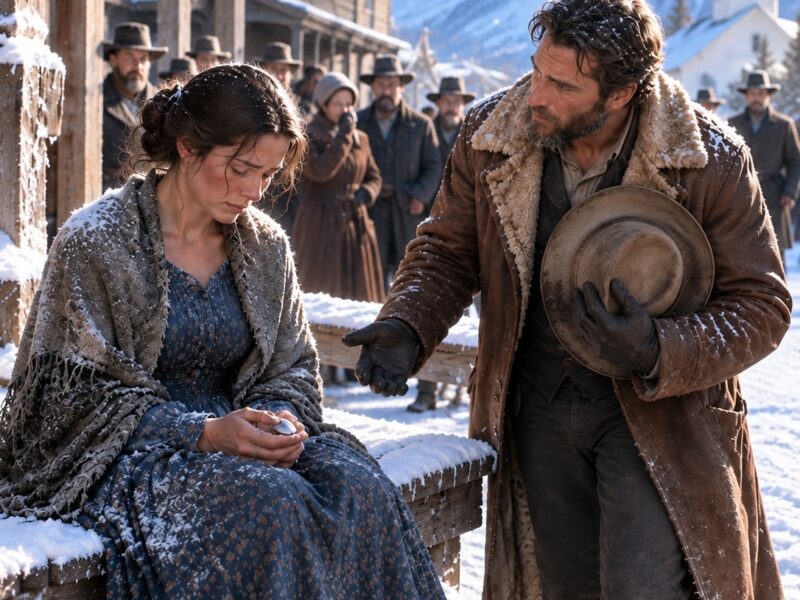
Everyone in Town Crossed the Street to Avoid the Widow—Then a Quiet Rancher Took Off His Hat and Offered Her the One Thing Nobody Else Would
On a cold Sunday morning in Ridgeway, Colorado, Clara Brennan stood outside church with her seven-year-old daughter while an entire congregation crossed the street rather than pass beside them.
Sixteen months after her husband died in a mine collapse, the company still blamed him, the town still believed it, and even children were being taught that shame could be inherited.
Then rancher Isaac Holbrook walked straight toward the woman everyone avoided, removed his hat, and made an offer that would force Ridgeway to decide whether it feared the truth more than it despised her.
The first woman crossed the street before Clara Brennan had even stepped off the church stairs.
Mrs. Ames had spent the service two pews behind her, singing the same hymns, bowing her head beneath the same prayer, listening while Reverend Cole spoke at length about mercy. Yet the moment Clara and her daughter reached the boardwalk, Mrs. Ames took one look at them, gathered her skirts, and guided both her sons across the muddy road as though sickness stood where Clara did.
A second family followed.
Then another.
Within a minute, the entire front of Ridgeway’s little white church had become a demonstration in avoidance.
Clara held Lily’s hand and watched people she had known for eleven years suddenly find urgent reasons to inspect wagon wheels, storefront windows, and the opposite side of the street.
The October air was cold enough to sharpen every sound. Hooves struck packed earth. A bakery door slammed. Somewhere near the livery, a horse shook its harness bells.
Lily looked up.
“Are we contagious today?”
Clara’s throat tightened.
“No.”
“Then why is everybody over there?”
“Because people sometimes prefer distance when they don’t know what to say.”
Lily considered that with the seriousness she brought to all adult explanations.
“That seems inefficient.”
Clara almost smiled.
Almost.
At seven, Lily Brennan had the bluntness of a hammer and the private conviction that everything in the world deserved a proper name. The kitchen stove was Hestus. The neighbor’s old hound was Senator. Clouds were named by shape and then scolded when they changed without permission.
That morning she held a smooth gray river stone in one mittened hand.
She had named it Professor.
Professor, unlike the congregation, was apparently willing to remain beside them.
Clara shifted the worn basket on her arm.
“Come on.”
They walked toward the mercantile.
A man approaching from the opposite direction saw them and altered his path six feet before they met. He tipped his hat vaguely toward empty air and kept going.
Lily watched him.
“He saluted a fence post.”
“Yes.”
“Should I tell him?”
“No.”
“He might want to know.”
“He’ll survive.”
Clara’s voice remained even because keeping it even had become a form of labor.
Sixteen months earlier, Thomas Brennan had died with three other men inside the Silver Crown Mine when a tunnel roof failed without warning—or at least that was the story the company printed in the Ridgeway Gazette.
Thomas had been the mine’s survey engineer.
Within three days of the collapse, the Silver Crown Mining Company released a statement blaming “incorrect structural measurements and inadequate caution” for the disaster.
By the end of the week, Thomas Brennan’s name had become a place for everyone else to put their anger.
By the end of the month, Clara had become the widow of the man who killed three husbands.
No hearing had formally found Thomas negligent.
No territorial inspector had completed an independent review.
None of that mattered once a company with lawyers, investors, and newspaper advertising explained the disaster before the dead were buried.
Clara had spent sixteen months discovering that a reputation could be destroyed more efficiently than a house.
The mercantile door stood twenty yards ahead.
Before she reached it, a rider crossed Main Street.
Isaac Holbrook.
Clara knew him only slightly.
Everyone did.
Thirty-nine. Widower. Cattle ranch five miles north. Five hundred acres, give or take. Two hundred head in a good year. Quiet enough that Ridgeway had built more stories around him than he had ever bothered denying.
He saw her.
Clara expected the same small courtesy most decent men offered now: a nod from a distance, brief enough that nobody could accuse them of friendship.
Instead, Isaac dismounted.
He tied his horse to the rail.
Then he walked straight across the street toward her.
People noticed.
Mrs. Ames stopped outside the bakery.
Two men near the feed store turned.
Even Lily stopped explaining geological facts to Professor.
Isaac reached Clara and removed his hat.
“Mrs. Brennan.”
“Mr. Holbrook.”
His hair was dark with a little gray near the temples. His face looked like weather had been arguing with it for years and had not quite won.
“I need a camp cook and someone who can mend fence.”
Clara blinked.
“For three weeks.”
He continued.
“Autumn drive. North line needs repair before snow. Pay is fair. There’s a cabin. Your daughter is welcome.”
The silence around them became louder than conversation.
Clara’s first instinct was humiliation.
She had learned to recognize charity even when it wore work clothes.
“I don’t take pity, Mr. Holbrook.”
“I didn’t offer any.”
His tone did not soften.
That helped.
“I need work done.”
“If you can’t cook or handle fence wire, say so and I’ll ask someone else.”
Lily lifted her chin.
“Mama can do both.”
Clara closed her eyes briefly.
Isaac looked down.
Lily continued.
“And I can carry tools.”
“I’m considerably strong.”
Isaac’s mouth twitched.
“How considerable?”
“I carried a full bucket yesterday.”
“No spilling.”
“None.”
“Impressive.”
Clara stared at him.
He looked back without sympathy in his face.
No rescue.
No performance.
Just a business proposition.
“You can leave if the arrangement doesn’t suit,” he said. “I’ll pay you for every day worked.”
Clara felt half the town waiting for her answer.
“When?”
“This afternoon.”
Lily squeezed her hand.
Clara looked at Isaac’s hat still held respectfully against his chest.
Then toward the people across the street.
Sixteen months of bowed heads.
Closed doors.
Whispers.
Invisible laundry left on her porch because people wanted clean sheets without being seen paying the widow who washed them.
“When do we leave?”
Isaac put his hat back on.
“One hour.”
Then he mounted his horse and rode toward the livery.
Lily watched him go.
“Mama?”
“Yes?”
“Is he nice or only quiet?”
Clara looked at the rider moving through the center of town.
“I don’t know yet.”
By the time Isaac returned with a wagon, Clara had packed everything they needed into two canvas bags, a wooden crate, and one quilt tied with cord.
Everything they did not need fit inside the cottage anyway.
That was another thing grief had done.
Reduced a life.
Lily brought a cloth sack that clinked when she dropped it into the wagon.
Isaac looked.
“Rocks?”
“They all have names.”
“Good to know.”
They left Ridgeway beneath a sky the color of tin.
People watched.
Mrs. Beatrice Tully stood in the bakery doorway and watched harder than most.
She had suggested Clara to Isaac two days earlier.
“Strong woman,” she had told him. “Needs work.”
Then, because Mrs. Tully was incapable of making a kind suggestion without disguising it beneath something practical:
“Won’t be missed if she’s away from town a few weeks.”
Isaac had bought his bread and said nothing.
Mrs. Tully now counted three women whispering before the wagon cleared Main Street.
She also counted how many unnecessary trips Isaac Holbrook had made into Ridgeway during the previous month.
Five.
A man who hated town did not suddenly need five sacks of flour one at a time.
Mrs. Tully smiled and went inside.
The Holbrook ranch sat where the valley widened against dark pine slopes.
It was smaller than the spread Clara had imagined.
Well kept.
Barn straight.
Fences repaired in patches.
Main house built of timber weathered silver at the corners.
Isaac showed them to a guest cabin twenty yards away.
One room with a small stove.
Table.
Two narrow beds.
Washstand.
Chair.
Clean floor.
Fresh stack of split wood near the wall.
Lily walked to the stove.
“This one is Constance.”
Isaac set Clara’s crate down.
“Why Constance?”
“She looks reliable.”
He examined the stove.
“Fair.”
Clara looked around.
“This is more than adequate.”
“It leaks near the south window in hard rain.”
“Does it?”
“I haven’t fixed it.”
“I can.”
Isaac glanced at her.
“I hired you for camp work.”
“And I prefer dry beds.”
He nodded once.
“Fair.”
That first evening Clara made fried potatoes, bacon, and cornbread.
It was the first meal she had cooked for another adult since Thomas died.
Isaac ate almost silently.
Finished everything.
Lily talked enough for both of them.
“Did you know clouds are water?”
“I’ve heard.”
“Tiny droplets.”
“So I’m told.”
“They are not solid fluff.”
“I’m relieved.”
Lily nodded.
She liked a man who accepted correction efficiently.
After supper Clara washed the dishes.
Isaac sat on his porch smoking a short pipe while the mountains turned purple.
No one mentioned Thomas.
No one mentioned Rachel Holbrook either.
Clara knew about Rachel.
Everyone did.
Isaac’s wife had died three years earlier after childbirth. Their son lived less than one night.
Since then, Isaac had organized his existence around cattle.
People called him devoted.
Clara recognized the strategy.
Work until grief became too tired to follow.
By the third morning, they had built a rhythm.
Breakfast before sunrise.
Eggs.
Bread.
Coffee.
Then fencing.
Lily carried a small toolbox Isaac gave her.
She narrated the landscape while they worked.
“That hill is Patience.”
Isaac tightened wire.
“Why?”
“It’s been waiting there a long time.”
“Reasonable.”
“That tree is Argus.”
“Who’s Argus?”
“He watches everything.”
By noon, Isaac was calling the hill Patience.
Clara noticed.
Did not comment.
The work suited her.
Wire resisted.
Posts split.
Hands blistered.
But tasks did not whisper.
A fence either held or it did not.
There was dignity in problems that admitted what they were.
Isaac watched her set a post one morning.
“Thomas teach you?”
“No.”
She hammered again.
“After he died, part of our fence went down.”
“No one would take paid work from me, and I couldn’t afford a hand.”
“So I learned.”
Isaac looked at the post.
“Good work.”
That was all.
Clara looked away before he saw how much two plain words could hurt.
At the end of the first week, tension began leaving her shoulders without permission.
She slept through the night twice.
Lily stopped asking why Ridgeway children did not play with her.
No one crossed the road here.
No one cared who Thomas Brennan had supposedly been.
One morning Lily announced the rooster was “the loudest, rudest, most self-important creature in Colorado.”
Isaac looked over his coffee.
“That so?”
“Yes.”
“So his name should be Mayor.”
Isaac inhaled coffee wrong.
He coughed into his fist.
Clara laughed.
The sound startled her.
Short.
Unpracticed.
Gone quickly.
Isaac looked at her.
For one second her face had changed.
Not widow.
Not accused man’s wife.
A woman.
He looked down at his cup.
“That’s disturbingly accurate.”
Lily beamed.
“I am good at names.”
The following Saturday Isaac went to town for supplies.
Mrs. Tully trapped him immediately.
“How’s the cook?”
“Fine.”
“She can cook?”
“Yes.”
“Fence?”
“Yes.”
“Child still naming things?”
“Rooster is Mayor.”
Mrs. Tully laughed until flour shook from her apron.
By sundown half Ridgeway had heard.
At the ranch, Clara found herself waiting for the wagon return.
She disliked noticing.
That evening, while Lily played on the cabin floor, Isaac came to tell Clara supper would be delayed because one mare had gone lame.
Then he saw the object in Lily’s hand.
A brass surveying compass.
Old.
Scratched.
“Where’d you get that?”
Clara looked up from the stove.
“Thomas’s.”
Isaac crouched.
“May I?”
Lily surrendered it.
“It’s called Compass.”
Isaac looked at her.
“No better name?”
“Sometimes correct is better than clever.”
Isaac nodded.
“True.”
He turned the compass in his hands.
Heavy brass.
Glass scratched.
A tiny rear latch.
He gave it back.
Then looked toward Clara.
“The mine.”
Her shoulders stiffened.
“Do you believe Thomas made a mistake?”
The room went still.
“No.”
Immediate.
Certain.
Isaac waited.
Clara set down the spoon.
“He told me the supports were wrong.”
“What does wrong mean?”
“Rock was moving differently from the company map.”
“He said the ceiling pressure changed after spring runoff.”
“He asked for reinforcement.”
“Twice.”
“What happened?”
“They told him production was behind.”
“Then after the collapse, they printed his name before I even saw his body.”
Her voice did not break.
That made it worse.
“Do you have his reports?”
“The company does.”
“Copies?”
“Not enough.”
“Thomas kept notes, but the office collected his field books after the collapse.”
“I had his clothes.”
“That compass.”
“A few personal papers.”
“No one listens.”
Isaac’s jaw tightened.
“Why?”
Clara looked at him as though the answer were obvious.
“I am Thomas Brennan’s widow.”
He understood.
She turned back to the stove.
Conversation over.
He left.
That night, after Lily slept, Clara sat wrapped in the quilt outside the cabin.
Stars burned hard over the dark valley.
Isaac approached from the main house.
Stopped below the porch.
“Mind?”
“No.”
He sat on the step.
Not beside her.
Near enough to talk.
For a while neither did.
Then:
“Rachel died three years ago.”
Clara pulled the quilt tighter.
“I know.”
“Boy too.”
“I know.”
Isaac stared into the dark.
“I thought working hard enough would fix the part where I had time to remember.”
“Did it?”
“No.”
Clara nodded.
“Still do it?”
“Yes.”
“That seems inefficient.”
Lily’s language.
Isaac almost smiled.
“It is.”
The wind moved through the pines.
Somewhere a coyote called.
Clara looked straight ahead.
“I’m not trying to replace her.”
Isaac answered immediately.
“I know.”
She swallowed.
“And I don’t need anyone to replace Thomas.”
“I know that too.”
Silence again.
Different now.
Not empty.
Two people acknowledging there were dead people at the table even when only the living sat there.
Isaac stood after a while.
“Cold.”
“Yes.”
“Go inside.”
“So should you.”
He walked back toward the main house.
Clara watched until he disappeared.
The next Monday Isaac rode into Ridgeway for fence wire and salt blocks.
Snow threatened in the clouds.
A polished man stepped from the land office wearing a new wool coat and boots too clean for local mud.
Mrs. Tully appeared beside Isaac at the mercantile before he asked.
“That’s Garrett Finch.”
“Who?”
“Denver attorney.”
“Silver Crown.”
Isaac stopped loading wire.
“What’s he doing here?”
Mrs. Tully’s mouth tightened.
“Filed a lien against Clara’s cottage.”
Isaac turned.
“On what basis?”
“Company says Thomas owed them twelve hundred dollars for damaged equipment and lost ore.”
“That mine killed him.”
“Told you who the lawyer works for.”
“How long?”
“Six weeks.”
Isaac’s hands closed around the wagon rail.
“Twelve hundred.”
“She has nowhere near it.”
Mrs. Tully watched him.
“Thought you’d want to know.”
Isaac said nothing.
He drove halfway toward the ranch.
Stopped.
Sat in the wagon with mountains ahead.
Then turned the horses back toward town.
He went to the county clerk.
Howard Marsh listened.
Methodical man.
Fifty-six.
Spectacles always clean.
“Is the lien legal?”
“Filed properly.”
“Doesn’t make it truthful.”
“No.”
“Can she challenge it?”
“Yes.”
“With what money?”
Marsh removed his glasses.
“That is the problem.”
Isaac drove home.
Clara sat on the porch mending a harness.
Lily sorted rocks by size.
Isaac climbed down.
“There’s something you need to know.”
Clara’s hands stopped.
“Silver Crown filed a lien on your cottage.”
No expression.
“Twelve hundred dollars.”
“For what?”
“Equipment loss.”
“Lost ore.”
“They’re blaming Thomas’s estate.”
Color left her face.
“How long?”
“Six weeks.”
Clara set down the harness carefully.
“I have forty-three dollars.”
“I know.”
“I will never have twelve hundred.”
“We’ll find another way.”
She looked sharply at him.
“Why?”
“This isn’t your trouble.”
Isaac met her eyes.
“Maybe I don’t want it to be only yours.”
The sentence stayed between them.
Lily stopped arranging stones.
“Mama?”
Clara looked away first.
Lily held up Thomas’s compass.
“Can we use this?”
“What?”
“Papa’s compass.”
“It has scratches inside.”
Clara frowned.
“Where?”
Lily ran inside.
Returned with it.
She opened the small rear latch.
Inside the brass lid were tiny markings scratched with a surveyor’s precision.
Numbers.
Dates.
Initials.
Clara’s breath caught.
“I never saw these.”
Isaac leaned closer.
“Can you read them?”
“Some.”
She turned the compass toward light.
“Bearings.”
“Strata notes.”
“Pressure readings.”
“I know someone who can compare these.”
Next morning they rode into town.
Lily stayed with Mrs. Tully after extracting a promise she could help knead bread.
Clara and Isaac entered Howard Marsh’s land office.
Clara placed the compass on his desk.
“My husband recorded measurements.”
Marsh opened the latch.
Read.
Then went to a cabinet.
He unrolled a county copy of the mine survey.
For twenty minutes, only the wall clock spoke.
Marsh compared figures.
Marked lines.
Returned to the compass.
Finally he looked up.
“These readings indicate instability in the upper strata.”
Clara gripped the desk edge.
“The company map?”
“No warning marked.”
“What does that mean?”
“If these are Thomas Brennan’s contemporaneous measurements, it suggests he identified the danger.”
“Suggests?”
“I am not a mining inspector.”
“I cannot make the official finding.”
“But?”
“I can refer it.”
“How long?”
“Four weeks.”
“Five if weather slows him.”
Clara exhaled.
“My deadline is six.”
“I’ll mark it urgent.”
“Today.”
“Thank you.”
The office door opened.
Garrett Finch entered.
Perfect coat.
Perfect smile.
“Mrs. Brennan.”
“Mr. Holbrook.”
“Mr. Marsh.”
He placed a leather satchel down.
“I assume you received the filing.”
Marsh nodded.
“And Mrs. Brennan submitted evidence potentially relevant to the claim.”
Finch’s smile did not move.
“The company’s position is established.”
“Her husband’s negligence caused the collapse.”
Marsh replied:
“The territorial inspector can decide whether that remains accurate.”
Finch looked toward Clara.
“The longer this continues, the more expensive it becomes.”
“The company is prepared to reduce the claim to eight hundred dollars if you settle before Friday.”
Clara said nothing.
Isaac did.
“She’s not settling.”
Finch turned.
“Mr. Holbrook.”
“This is not your concern.”
“It is now.”
Clara looked at him.
Finch studied them both.
Then returned to Clara.
“Friday.”
“After that, full amount.”
He took the satchel.
Left.
Door closed softly.
Clara exhaled.
Marsh said:
“I’ll send the inspector request today.”
Outside, Clara walked to the wagon without speaking.
Only when Ridgeway disappeared behind them did she say:
“He can afford to wait.”
“We can’t.”
Isaac held the reins.
“We wait anyway.”
“What if the inspector doesn’t come?”
“Then we find the next thing.”
“What next thing?”
“Don’t know yet.”
Clara gave him a tired look.
“That is a poor plan.”
“It is the plan available.”
Back at the ranch she tried working.
Burned cornbread.
Dropped a bucket.
Finally sat on the porch steps.
Isaac found her there.
Sat beside her.
No touching.
No advice.
After several minutes Clara spoke.
“I can’t lose that cottage.”
“It is barely worth twelve hundred dollars.”
“I know.”
“It leaks.”
“I know.”
“Chimney leans.”
“I know.”
“Then why?”
She looked toward the cabin where Lily slept.
“It’s where Thomas carried her the first day we brought her home.”
“He built the shelf beside the kitchen himself.”
“He carved her initials into the doorframe.”
“It is the last place she remembers him existing.”
Isaac looked down at his hands.
“We’ll keep it.”
Clara laughed bitterly.
“You cannot promise that.”
“No.”
“I can promise I’ll stay until we know.”
She looked at him.
“Why are you doing this?”
Isaac was quiet.
Then:
“Because nobody helped me when Rachel died.”
“I wished someone had.”
Clara’s eyes filled.
She looked away toward the pasture.
“Thank you.”
Isaac nodded.
They sat until the light disappeared.
Three days later, the first snow came early.
Not enough to close the valley.
Enough to make roads dangerous.
The territorial mining inspector still had not replied.
Then another letter arrived.
Not from the inspector.
From Garrett Finch.
He increased pressure.
The company claimed interest and administrative fees could be added if Clara formally contested the lien and lost.
Isaac read the letter twice.
“They’re trying to scare you into settling.”
“It’s working.”
Clara folded it carefully.
“I am scared.”
That honesty mattered.
“I have Lily.”
“If I lose the house and the town won’t hire me—”
Isaac interrupted.
“You’ll still have work here.”
Clara looked up sharply.
“That sounds like pity again.”
“No.”
“It sounds like a job.”
“For how long?”
“As long as there is work.”
“There’s always work.”
She stared.
Isaac realized too late what the sentence could sound like.
He looked away.
Clara did not rescue him from it.
That evening Lily found another mark inside Thomas’s compass.
A small set of letters scratched beneath the hinge.
H.M.
Clara wondered if Thomas had intended “Howard Marsh.”
Next morning Isaac rode to town alone and asked Marsh whether Thomas had ever spoken with him before the collapse.
Marsh went quiet.
“Yes.”
“When?”
“Two days before.”
“About what?”
“He asked whether a private survey notation had legal weight if the company refused to amend the official mine map.”
Isaac’s pulse changed.
“What did you tell him?”
“That I needed the measurements in writing.”
“Did he submit them?”
“No.”
“Or I never received them.”
“Which?”
Marsh looked toward the records cabinet.
“I don’t know.”
They searched.
Not openly at first.
Old correspondence.
Mine filings.
Survey duplicates.
Nothing.
Then Marsh found an entry in the incoming ledger.
Thomas Brennan.
Envelope received.
October 17, 1890.
Day before collapse.
No document attached.
Marsh stared.
“The envelope was logged.”
“Where is it?”
“Not here.”
“Who collected mine correspondence?”
“At the time?”
Marsh’s expression hardened.
“Silver Crown’s clerk had standing permission to collect duplicate filings after review.”
“Name?”
“Ellis Ward.”
“Still here?”
“Denver office now.”
That was a new thread.
Not proof.
But Thomas had sent something.
The company’s claim that he never warned anyone was becoming less stable.
Marsh sent a second letter to the territorial inspector.
Now marked not merely urgent.
Potential document suppression.
Three days later, Garrett Finch came to the ranch.
Isaac saw the buggy first.
Clara stepped onto the porch.
Finch removed his gloves.
“Mrs. Brennan.”
“You know where town is.”
“I preferred privacy.”
“Why?”
His smile thinned.
“Because litigation becomes unpleasant.”
“I’m already having an unpleasant year.”
Finch glanced toward Isaac.
“I’d like to speak to you alone.”
Clara shook her head.
“No.”
“Mr. Holbrook has no legal standing.”
“He has ears.”
Finch opened his satchel.
Produced papers.
“Eight hundred dollars settlement.”
“Waive the lien.”
“Company admits no fault.”
“You agree not to pursue future claims related to your husband’s death.”
Clara read.
There.
That clause mattered more than the money.
If Silver Crown believed Thomas was solely at fault, why purchase her silence about future claims?
She looked up.
“You’re afraid of the inspector.”
Finch’s expression remained pleasant.
“I’m offering certainty.”
“No.”
“You may lose your house.”
“I know.”
“You have a child.”
“I know.”
“You have no income sufficient to satisfy the lien.”
“I know.”
His voice softened.
“That makes this offer generous.”
Clara folded the agreement.
Handed it back.
“No.”
For the first time, irritation entered Finch’s eyes.
Isaac saw it.
Clara did too.
Finch put the papers away.
“Friday was the original deadline.”
“It remains available until sunset today.”
“No.”
“You haven’t discussed it.”
“I just did.”
He looked toward Isaac.
“Mr. Holbrook, perhaps you can persuade her to be practical.”
Isaac replied:
“She heard you.”
Finch left.
Clara waited until the buggy disappeared.
Then her hands began shaking.
Isaac noticed.
“Sitting?”
“No.”
“Coffee?”
“No.”
“Want me to say you did the right thing?”
“No.”
“What do you want?”
Clara breathed slowly.
“I want to be scared without someone treating that as evidence I should surrender.”
Isaac nodded.
“All right.”
So they stood there.
That was the second intimate moment between them.
Not touch.
Permission.
The inspector arrived nine days later.
Not four weeks.
Marsh’s second letter had changed the route.
His name was Elias Callahan.
Fifty-eight.
Weathered.
Tired eyes.
He had spent more than twenty years reviewing mine incidents across western Colorado.
He met Clara at the land office.
No ceremony.
“Mrs. Brennan.”
“Inspector.”
“I read the company report.”
“And?”
“I don’t decide from company reports.”
Good answer.
He examined Thomas’s compass.
Compared measurements.
Requested archived mine maps.
Asked Marsh for the incoming ledger.
Sent a telegram to Denver for Ellis Ward’s deposition and Silver Crown’s internal correspondence.
Finch objected.
Callahan ignored him.
For three days he worked.
Clara stayed at the ranch because waiting inside the office would not speed anything.
She cooked.
Mended.
Checked fence.
Pretended not to watch the road.
Lily asked every morning:
“Decision?”
“No.”
At noon:
“Decision?”
“No.”
At supper:
“Decision?”
“No.”
On the third evening, Lily said:
“He is slow.”
Clara replied:
“Sometimes slow is careful.”
Isaac looked at her.
The sentence belonged to everything they had learned.
The fourth morning, Marsh rode out.
Snow fell lightly.
Clara saw him from the cabin window.
Her heart began pounding.
Isaac came from the barn.
Marsh dismounted.
Removed his hat.
“Mrs. Brennan.”
Clara walked toward him.
“The inspector issued a preliminary ruling.”
She could not breathe.
“Thomas Brennan documented unstable strata before the collapse.”
“The company received written warning.”
Clara’s knees weakened.
Marsh continued.
“Silver Crown’s internal correspondence confirms their Denver office received a duplicate of his report.”
“Production was not halted.”
“The warning was not incorporated into the official map.”
“The inspector found no basis for the company’s allegation that Thomas caused the collapse.”
Clara closed her eyes.
Snow landed on her lashes.
“The lien?”
“Void.”
Isaac caught her arm when she swayed.
Marsh’s voice softened.
“There’s more.”
She opened her eyes.
“Callahan referred the matter to territorial authorities.”
“Possible fraudulent claim against your husband’s estate.”
“Possible suppression of a safety filing.”
“Civil compensation may follow.”
Clara pressed one hand over her mouth.
For sixteen months she had imagined hearing somebody say Thomas’s name without blame.
Now the moment arrived and language seemed too small.
“Garrett Finch?”
Marsh hesitated.
“He left Ridgeway this morning.”
“Company instructed him back to Denver.”
Clara nodded.
Marsh mounted.
“I’m sorry it took this long.”
The words surprised her.
Not because he owed the apology alone.
Because somebody finally said it.
After he rode away, Clara stood in falling snow.
Isaac remained beside her.
“You all right?”
“No.”
A laugh broke through tears.
“No, I don’t think so.”
He waited.
“Thomas was right.”
“Yes.”
“He knew.”
“Yes.”
“They knew he knew.”
“Seems so.”
She cried then.
Not delicately.
Sixteen months of anger, shame, exhaustion, fear, and defending a dead man who could no longer speak.
Isaac did not pull her toward him immediately.
He waited.
When Clara reached for his coat, he put both arms around her.
That distinction mattered.
Lily came running from the cabin.
“Is Mama hurt?”
Clara laughed against Isaac’s chest.
“No.”
Lily looked suspicious.
“You are making the crying face.”
“I know.”
“Did the inspector decide?”
Clara knelt.
“He did.”
“And?”
“Papa didn’t cause the mine to fall.”
Lily went very still.
Then:
“I knew that.”
Children sometimes say sentences adults spend years trying to earn.
Clara hugged her.
Within two weeks, Ridgeway began behaving differently.
Not nobly.
Gradually.
People who once crossed the street now nodded.
Some spoke.
Mrs. Ames approached Clara outside church and said:
“We heard the ruling.”
Clara waited.
Mrs. Ames twisted her gloves.
“I suppose the company misled everyone.”
Clara looked at her.
“No.”
Mrs. Ames blinked.
“The company lied.”
“You chose to believe them.”
Mrs. Ames flushed.
“I only meant—”
“I know what you meant.”
Clara walked away.
That was important too.
Vindication did not create an obligation to make other people comfortable about how they had treated her.
Mrs. Tully handled reconciliation differently.
She placed two cinnamon rolls in front of Clara at the bakery.
“No charge.”
Clara raised an eyebrow.
“Charity?”
“Bribery.”
“For?”
“Your forgiveness for not speaking louder.”
Clara looked at her.
Mrs. Tully crossed her arms.
“I gave you laundry.”
“Anonymous.”
“Yes.”
“Because I was cowardly enough to help privately and not publicly.”
Clara’s face softened.
“That’s more honest.”
“I am old.”
“Dishonesty wastes time.”
Clara took one roll.
“Lily gets the other.”
“Obviously.”
The civil case expanded.
Silver Crown denied intentional wrongdoing but conceded Thomas’s measurements had not been incorporated properly.
Territorial investigators found correspondence from a production manager instructing supervisors to continue work until the reinforcing timber arrived.
It never arrived before the collapse.
The company’s lawyers negotiated.
Months later Clara received compensation large enough to clear Thomas’s small debts, repair the cottage, and create a modest account for Lily.
Not fortune.
Enough stability to choose instead of merely endure.
That timing complicated everything.
Because by then Clara no longer wanted the life she had before.
She and Lily remained on Isaac’s ranch through winter.
Not as charity.
Clara became paid ranch staff.
Books kept.
Wages written.
She insisted.
Isaac agreed.
Snow closed the roads twice.
They learned each other slowly.
Isaac liked coffee too strong.
Clara hated cold biscuits.
Lily believed all cattle deserved individual names and had to be stopped after naming eleven.
The third intimate scene came during a January storm.
Wind pushed snow against the cabin door.
A hinge came loose.
Isaac arrived with tools.
Clara held the lantern.
They fixed it together.
Afterward, the storm became too hard for him to walk safely back to the main house.
He sat at Clara’s table.
Lily asleep in one bed.
Snow hammering the roof.
They drank coffee.
Clara said:
“Rachel liked storms?”
Isaac stared into the cup.
“She hated them.”
“Why?”
“Roof leaked our first year married.”
“She spent every storm putting pans under the drips.”
“After I fixed it, she said rain sounded wrong without pots.”
Clara smiled.
“Thomas loved storms.”
“He said mines were quieter after rain.”
Her smile faded.
Isaac looked up.
“Sorry.”
“No.”
She shook her head.
“I want to be able to say his name without ruining the room.”
Isaac understood.
“So say it.”
They talked until midnight.
Rachel.
Thomas.
Baby boy who never got a name because Isaac had been too shattered to choose.
Clara cried quietly when he admitted that.
Then she said:
“You could name him now.”
Isaac looked at her.
“Would that matter?”
“Maybe to you.”
He thought for a long time.
“Samuel.”
Clara smiled.
“Good name.”
“I always liked it.”
Outside, the storm continued.
Inside, the dead finally had names instead of shadows.
Spring came late.
With it came a letter from Leadville.
Payroll clerk position.
Company-provided cottage.
Reliable wages.
The territorial inspector had recommended Clara because she understood mine records and because part of the restitution agreement required Silver Crown’s parent company to fund a clerical post independent of site management.
Clara read the offer at breakfast.
Isaac watched.
Lily stopped eating.
“Are we leaving?”
Clara folded the letter.
“I don’t know.”
Isaac took it when she offered.
Read slowly.
“It’s good.”
“Yes.”
“Stable.”
“Yes.”
“School for Lily.”
“Yes.”
He set it down.
“I’d miss you.”
Clara looked up.
“But the choice is yours.”
There it was.
The thing that changed everything more than an offer of marriage ever could.
Choice.
Not rescue.
Not debt.
Not gratitude.
Choice.
Clara stood.
Walked to the stove.
Poured coffee she did not need.
Then turned.
“I’m not staying because I need you.”
Isaac went still.
“I’m not staying because you hired me.”
Silence.
“I’m not staying because you helped prove Thomas was right.”
Lily looked between them.
Clara continued.
“I’m staying because when I imagine leaving, I don’t feel relieved.”
“I feel like I’m walking away from home.”
Isaac put down his cup.
He stood.
Walked toward her.
Stopped close enough that Clara could see the lighter ring around his brown eyes.
“I’d like to marry you.”
Her breath caught.
“If that is something you want too.”
Clara smiled through tears.
“I do.”
“I do too,” Lily said loudly.
Both adults turned.
She was eating eggs.
“I have waited weeks.”
Isaac blinked.
“For what?”
“You two.”
She sighed.
“You’re very slow.”
Isaac laughed.
A rough, surprised sound Clara had never heard.
Then she laughed too.
Then cried.
Isaac held her.
Lily finished breakfast.
“I’m telling the chickens.”
She left the door open.
Two months later, Clara and Isaac married at Ridgeway’s church.
Plain ceremony.
January light.
Snow along the street.
Mrs. Tully served as witness.
Howard Marsh and his wife came.
Even some people who once crossed the road attended.
Not everyone apologized.
Clara noticed.
She also noticed she did not need them to.
Lily held Thomas’s brass compass through the ceremony.
When Reverend Cole asked whether anyone objected, Lily said:
“No. This is correct.”
The church laughed.
Clara did too.
Afterward they stepped outside.
Sixteen months earlier, people had crossed that same road to avoid her.
Now townspeople gathered around.
Clara saw Mrs. Ames standing near the fence.
For one second their eyes met.
Clara did not punish her.
Did not rescue her from embarrassment either.
She simply turned toward Isaac.
That evening the ranch house filled with food.
Mrs. Tully brought bread.
Marsh brought wine.
Lily named the event “The Least Surprising Wedding in Colorado.”
Isaac said she was probably right.
Clara sat at the table and looked around.
Thomas’s compass lay beside Lily’s plate.
Rachel’s old blue serving bowl sat near the bread.
Isaac had brought it out deliberately.
No dead person had been erased to make room for the living.
That, Clara realized, was what frightened her most about love after grief.
She had believed a new happiness required betrayal of the old one.
It did not.
Three years later, spring came early.
Clara stood in the ranch kitchen while Lily tried teaching her younger brother how to use the compass.
The boy was two.
His name was Samuel Thomas Holbrook.
Samuel for the son Isaac had finally allowed himself to name.
Thomas for the father he would never meet.
Lily held the compass flat.
“The needle finds north.”
Samuel grabbed at it.
“Norf.”
“North.”
“Norf.”
“Close enough,” Isaac said from the doorway.
He entered carrying cold air and the smell of hay.
Walked to Clara.
Kissed the top of her head.
The ordinary tenderness of it still surprised her sometimes.
Lily handed the compass to Samuel.
“No matter where you turn, it knows the way.”
Clara watched the needle settle.
Once, she had believed being abandoned by a town meant the town had defined her.
She had believed Thomas’s death had ended the part of life in which anyone could choose her without pity.
Isaac once believed grief was a private debt a man paid alone.
They had both been wrong.
It had taken a child naming rocks, a rancher taking off his hat in public, a brass compass scratched with evidence, and one woman refusing to accept a lie about the dead.
Clara touched the old compass.
Not because it had saved her.
She had saved herself by refusing to sell certainty for safety.
By taking the work.
By carrying the evidence into town.
By rejecting Finch’s settlement.
By staying when she could finally afford to leave.
The compass only pointed.
She chose the direction.
Outside, a wagon passed along the road toward Ridgeway.
Lily looked through the window.
“Someone’s coming.”
Isaac glanced out.
“Probably Marsh.”
“Why?”
“Paperwork.”
Lily groaned.
“Worst visitor.”
Clara laughed.
Then she looked down at Samuel holding the brass compass upside down.
The needle still turned.
Still searched.
Still found north.
And Clara understood something Thomas had known long before anyone believed him.
Truth may be buried.
Ignored.
Blamed.
Delayed.
But given enough courage, it still points somewhere.
Home was simply where she had finally chosen to follow it.









