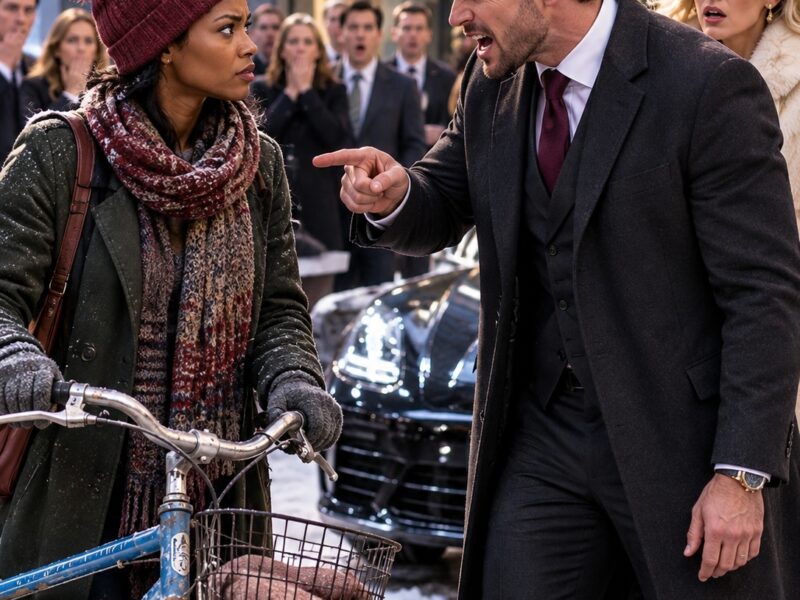
Ex-Boyfriend Mocked Her Cheap Bicycle Outside His Glass Tower—Then Walked Into a Promotion Meeting and Discovered the Woman He Humiliated Now Controlled His Entire Company
Preston Whitmore laughed when Tessa Monroe arrived on a faded blue bicycle, then loudly suggested security remove his “broke ex-girlfriend” from the executive entrance.
He had spent four years believing the woman he abandoned had failed while he climbed toward the corner office, never realizing she had quietly built a technology company worth more than his career.
In less than twenty minutes, Preston would enter the most important meeting of his life—and discover that the chair with the most power in the room belonged to her.
The laughter started before Tessa Monroe had even finished locking her bicycle.
It was 7:47 on a gray December morning in downtown Chicago, the sidewalks glazed with old snow and fresh salt, when a black Porsche eased toward the executive entrance of Helion Technologies. Tessa looked up from the worn combination lock wrapped around the frame of her faded blue Schwinn and saw Preston Whitmore step onto the curb.
For half a second, neither of them moved.
Then Preston laughed.
Not the surprised laugh of somebody running unexpectedly into a person he once loved. This one was sharper, deliberately louder, shaped for the employees passing behind him with coffee cups and security badges.
“No way.”
Tessa straightened.
Preston stared at the bicycle.
“You still have that thing?”
Snow had gathered in the scratches along its top tube. Black tape covered one grip. The wire basket had been bent years earlier and repaired with a narrow metal brace.
Tessa brushed a flake from the seat.
“Good morning, Preston.”
He glanced toward Clare Bennett, Helion’s communications director, who had stepped from the passenger side of the Porsche. Clare was elegant in a camel coat and cream scarf, but her expression tightened as soon as she understood who Tessa was.
Preston did not notice.
He rarely noticed discomfort when he was enjoying an audience.
“I’m serious,” he said. “Four years, Tessa. You could at least have upgraded the bicycle.”
Employees slowed near the revolving doors.
Tessa could feel them trying not to stare.
She remembered that sensation.
Being turned into somebody else’s entertainment while everyone pretended not to participate.
“It still works.”
Preston smiled.
“That was always your standard.”
Tessa looked at him.
“Does it work?”
“Is it cheap?”
“Can I survive with it?”
He spread his hands toward the forty-six-story tower rising above them.
“Meanwhile, some of us decided to move forward.”
Clare touched his sleeve.
“Preston.”
He ignored her.
“I heard your little startup did okay for a while.”
Tessa said nothing.
Preston’s smile widened.
“But this place is different.”
He tilted his head toward Helion.
“Hundreds of millions in enterprise contracts. Real infrastructure. Real leadership.”
Tessa looked at the building.
“I know.”
“I’m getting promoted today.”
“Are you?”
“Executive leadership announcement at nine.”
He adjusted one cuff beneath his charcoal overcoat.
“Everyone knows what’s happening.”
“I’ve practically been running business development for two years anyway.”
Tessa checked the simple steel watch on her wrist.
7:49.
A message waited on her phone.
Transfer documents executed. Voting control confirmed. Board is ready when you arrive. —Graham
She locked the screen.
Preston noticed only the phone’s plain case.
“You here for an interview?”
“A meeting.”
“With who?”
“Walter Hayes.”
Preston barked another laugh.
Several people turned.
“The chairman?”
“Yes.”
He looked toward Clare as if Tessa had delivered a punch line for him personally.
“Derek!”
The head of building security had stepped outside.
Preston waved him over.
“This is the executive arrival area. My friend needs to use the public entrance.”
Derek Sullivan approached with professional caution.
He was broad-shouldered, mid-forties, his dark security jacket zipped against the cold.
“Morning, ma’am.”
“Tessa Monroe.”
“Do you have an appointment?”
“Yes.”
“With Mr. Hayes.”
Derek hesitated.
Something in her stillness registered where her clothes did not.
Preston rolled his eyes.
“She’s my ex.”
Tessa looked at him.
He continued.
“She used to do data analysis for a twelve-person company.”
“Trust me, Derek.”
“If Walter Hayes is expecting her, I’m about to become chairman of the Federal Reserve.”
A few employees laughed.
Not many.
That seemed to irritate Preston.
Derek’s expression remained neutral.
“If you lock the bicycle around the corner, Ms. Monroe, I can have the lobby desk verify your appointment.”
“That’s fine.”
Tessa nodded.
Preston adjusted his cuffs again.
“Still agreeable.”
“That was another problem we had.”
Tessa rested one hand on the bicycle seat.
“What problem was that?”
“You always thought patience was ambition.”
His smile faded slightly.
She added:
“I hope you prepared well for your meeting.”
Something about the sentence made Clare turn.
Preston did not.
He was already heading toward the private entrance.
“You should find something that matches the bicycle, Tessa.”
She watched him disappear behind the glass.
Then wheeled the faded blue Schwinn around the corner.
Her phone vibrated again.
Seventy-eight percent controlling voting interest now registered to Monroe Capital Partners. You have final authority over senior management appointments under the acquisition agreement.
Tessa read the message once.
Then looked up toward the forty-second-floor boardroom hidden behind mirrored glass.
Nine minutes earlier, Preston Whitmore had humiliated a woman he believed still had nothing.
At nine o’clock, he was going to ask that same woman for the most powerful job in the company.
Tessa slipped her phone away.
For the first time that morning, she smiled.
The bicycle had belonged to her father.
That was the part Preston had never understood.
Eddie Monroe repaired Chicago Transit Authority buses for thirty-one years. His hands always smelled faintly of machine oil no matter how aggressively he scrubbed them, and he considered buying something new a moral failure if the old version could still be repaired.
When Tessa was twenty-four, the blue Schwinn’s rear hub cracked.
She had planned to throw it away.
Eddie found it beside the alley trash cans.
Three weeks later, he presented it to her in his garage.
New hub.
Straightened wheel.
Brake cables replaced.
Black tape around the grips.
“Ugly.”
Tessa had said.
“Reliable.”
he corrected.
He died eleven months later after a sudden stroke.
The bicycle became the last machine they ever repaired together.
Preston knew that.
He had still hated it.
At first, almost playfully.
“You’re dating a man with a Porsche and riding around like a graduate student.”
Then less playfully.
“People notice.”
Eventually:
“Do you have any idea what my coworkers think?”
Tessa always answered the same way.
“I don’t care.”
Preston did.
That difference had eventually become almost everything.
Four years earlier, Tessa had been twenty-eight and working at a small data consultancy on Chicago’s Near West Side. The office had eleven employees, unreliable heat, and one printer that jammed whenever anyone needed it urgently.
She loved the work.
Numbers behaved better than people.
Given enough clean data, a pattern eventually confessed.
Tessa’s specialty was operational risk: finding small inconsistencies before they became expensive problems.
Preston had admired that when they first met.
They met at a hospital fundraiser a friend forced Tessa to attend.
Preston was handsome, charming, newly hired into Helion’s management-development program, and astonishingly good at making ambition sound like optimism.
They dated three years.
He proposed after two.
The ring was modest.
Tessa adored it.
Then Preston began rising at Helion.
New suits.
Country-club invitations.
Investor dinners.
A Porsche leased before his previous car was paid off.
He began describing people by title.
Worth.
Connections.
Tessa became increasingly inconvenient to the image he was constructing.
She still wore ordinary coats.
Still cooked at home.
Still rode Eddie’s bicycle.
And at night, she worked on software Preston barely pretended to understand.
She called it Meridian.
The idea was simple in description and brutal in execution.
An enterprise analytics platform that combined procurement, logistics, labor, contract, and revenue data to identify hidden cost risks months earlier than normal quarterly reporting.
One Sunday night, she showed Preston the prototype.
He looked at her laptop for perhaps four minutes.
“You’ve been doing this instead of sleeping?”
“Yes.”
“Why?”
“Because it works.”
“For who?”
“Eventually companies.”
Preston laughed.
“Tess.”
“What?”
“You’re a data analyst.”
“So?”
“So serious software companies have teams.”
“Capital.”
“Sales divisions.”
“Not one woman sitting in a rental apartment writing code at two in the morning.”
The words hurt.
She pretended they did not.
Two months later, her employer collapsed after losing its largest client.
Tessa received two weeks of severance.
Instead of immediately finding another salaried job, she did the one thing Preston considered unforgivable.
She bet on herself.
Her savings became startup capital.
She rented a desk inside a shared workspace.
Worked consulting contracts during the day.
Built Meridian at night.
For six months, she lived on eggs, cereal, pasta, and stubbornness.
That was when Preston ended their engagement.
Not privately.
At an expensive steakhouse on Rush Street.
His colleagues were there.
Clare too, though she and Preston were not yet dating.
Tessa remembered the white tablecloth.
The silver butter knife.
Preston turning the wineglass stem between two fingers.
“I need somebody who fits where I’m going.”
Tessa stared.
“What does that mean?”
“It means I can’t keep explaining you.”
“Explaining what?”
He glanced toward the restaurant windows.
“The bike.”
“The startup.”
“The fact that every conversation about money turns into some speech about your dad.”
Tessa felt heat spread across her face.
Preston leaned closer.
“I’m going somewhere, Tess.”
“I need a woman who can stand beside me.”
“Not someone constantly trying to climb out of being poor.”
Nobody at the table spoke.
Tessa removed the engagement ring.
Set it beside his wineglass.
“Then find somebody who fits your world.”
Preston looked surprised.
Then amused.
“You’ll regret this.”
Tessa stood.
“No.”
She picked up her coat.
“I think you will.”
She had not known whether she believed it.
For a while, Preston appeared correct.
Meridian’s first year was brutal.
Tessa missed rent once.
Borrowed from no one.
Worked freelance analytics for health-care companies and restaurants.
The bicycle became her primary transportation because CTA fares accumulated and she refused a car loan.
Then a regional logistics company hired her.
Forty-thousand-dollar contract.
Her system found a procurement leak costing them nine hundred thousand annually.
They recommended her to a larger client.
That contract was worth $1.8 million.
Meridian Logic hired engineers.
Then sales staff.
Then compliance analysts.
By its third year, it employed eighty-four people.
Tessa raised institutional capital without surrendering control.
The company’s software became valuable precisely because it did what she had spent her twenties learning to do.
Notice what powerful people ignored.
Meridian’s success eventually led her to Helion.
Not because of Preston.
Not initially.
Two years earlier, Meridian’s engineers discovered several features inside Helion’s flagship enterprise platform that looked strangely familiar.
Some matched a small module Helion had legitimately licensed from Meridian.
Others did not.
Tessa’s counsel investigated quietly.
The unauthorized overlap appeared significant.
She could have sued.
Instead, while studying Helion, Tessa found something larger.
Excellent engineers.
Strong customer relationships.
Useful patents.
Bad leadership.
Inflated revenue assumptions.
Expensive projects chosen for executive prestige rather than profitability.
A company worth saving.
Helion’s institutional shareholders wanted out.
Tessa assembled an acquisition consortium through Monroe Capital Partners.
The $420 million transaction used equity from her firm, financing from institutional partners, and acquisition debt supported by Helion’s operating assets.
Tessa did not personally possess $420 million in cash.
She possessed something more relevant.
Control.
Under the deal closing that morning, Monroe Capital held seventy-eight percent of voting rights.
Tessa controlled Monroe Capital.
Which meant that while Preston polished a speech for the chief executive position, the woman he had mocked at the curb could decide whether he kept access to the executive elevators.
Tessa entered the main lobby at 8:11.
Derek approached immediately.
“Ms. Monroe.”
His tone had changed.
A woman from reception had evidently verified her name.
“My apologies for the entrance issue.”
“You were polite.”
“Mr. Whitmore was not.”
“That isn’t your responsibility.”
Derek hesitated.
“I should have checked first instead of assuming.”
Tessa looked at him.
That mattered.
“Thank you.”
Graham Bellamy waited near the elevators.
Forty-eight, precise, quietly dressed, chief legal officer of Monroe Capital.
He shook her hand.
“Congratulations.”
“Too early.”
“The deal closed.”
“The hard part starts now.”
Graham smiled.
“That answer is why investors backed you.”
As they entered the elevator, his expression changed.
“There’s something else.”
“What?”
“Naomi Brooks sent preliminary audit findings overnight.”
Tessa looked at him.
“Internal audit director?”
“Yes.”
“Several transactions under business development require immediate review.”
“How much?”
“Approximately twelve million.”
The elevator began rising.
“Fraud?”
“Unknown.”
“Accounting manipulation?”
“Possibly.”
“Who approved them?”
Graham paused.
“Preston Whitmore.”
Tessa looked toward the floor numbers.
Thirty-one.
Thirty-two.
Thirty-three.
The morning had just changed.
“Does Preston know?”
“No.”
“Keep it that way until Naomi presents facts.”
“Agreed.”
“No accusations.”
“No punishment based on suspicion.”
Graham watched her.
“Even after downstairs?”
“Especially after downstairs.”
The doors opened.
At 8:55 the boardroom was nearly full.
Walter Hayes sat at the head.
Sixty-one.
Silver-haired.
Interim chairman for eleven exhausting months.
Around him were institutional directors, executives, outside counsel, Naomi Brooks from internal audit, and Preston Whitmore in a charcoal suit holding a ninety-million-dollar expansion proposal.
Preston looked radiant.
He leaned toward Clare.
“After today, this whole floor changes.”
Clare watched him.
“Have you met the new controlling investor?”
“No.”
“You don’t think that matters?”
“Investors want growth.”
“That’s me.”
At nine precisely, Walter called the meeting to order.
“Yesterday evening, the final regulatory and lender conditions for Monroe Capital Partners’ acquisition were satisfied.”
Preston sat straighter.
“This morning, the equity transfer closed.”
Before Walter could continue, Preston stood.
“Walter, if I may.”
Walter looked mildly surprised.
“Briefly.”
Preston smiled around the table.
He had prepared for this moment.
He spoke about growth.
Client acquisition.
Market positioning.
His “vision” for Helion.
Then moved seamlessly into leadership.
“With the ownership transition, this company needs energy.”
“Decisiveness.”
“Someone who understands both the customers and the market.”
He gave a modest laugh.
“I believe my record speaks for itself.”
Naomi shifted in her chair.
Preston continued.
His restructuring proposal included workforce reductions.
Eighteen percent.
Mostly lower-pay functions.
Administrative support.
Quality control.
Customer-service teams.
He called them “replaceable costs.”
Naomi set down her pen.
“The efficiency data doesn’t support those reductions.”
Preston did not turn.
“We’ve discussed this.”
“No.”
Naomi said.
“You dismissed it.”
Several directors glanced between them.
Preston’s voice hardened.
“This is a strategic leadership discussion, Naomi.”
“We don’t need internal audit turning every proposal into a courtroom.”
Naomi’s jaw tightened.
Then the doors opened.
Graham entered first.
“The controlling owner has arrived.”
Preston stood.
Adjusted his tie.
Prepared his best smile.
Graham stepped aside.
Tessa entered.
Same navy coat.
Same worn leather bag.
Drops of melted snow still bright on her hair.
Preston laughed.
Actually laughed.
“What is this?”
Nobody answered.
“Tessa?”
She walked past him.
Past Clare.
Past Naomi.
Graham pulled out the chair at the head of the table.
Walter stood.
“Ladies and gentlemen, Tessa Monroe.”
“Founder and executive chair of Monroe Capital Partners.”
“Effective this morning, Monroe Capital holds seventy-eight percent of Helion Technologies’ voting rights.”
“And Ms. Monroe is the controlling decision-maker for the new ownership group.”
Preston’s hand remained frozen on his tie.
Color left his face.
Clare stared at him.
Then at Tessa.
Naomi’s lips parted.
Tessa removed her coat.
Folded it over the chair.
Sat.
Her plain steel watch caught the boardroom light.
Preston whispered:
“This isn’t possible.”
Tessa opened her leather bag.
Removed a thick folder.
“Before we discuss senior appointments…”
She looked directly at him.
“I’d like Mr. Whitmore to explain several things.”
Preston forced a laugh.
“What exactly are you doing?”
Tessa turned to Graham.
“Please summarize the ownership structure.”
Graham did.
Voting rights.
Board nomination power.
Leadership authority.
Acquisition terms.
Preston stared.
“But she’s a data analyst.”
Tessa finally looked at him.
“That was four years ago.”
Silence followed.
Tessa stood.
“I want one thing clear before we continue.”
“I did not acquire Helion to punish anyone.”
Preston exhaled.
Too early.
Tessa continued.
“I acquired it because good companies sometimes become trapped under bad incentives.”
“And because hundreds of employees should not lose careers because leaders confuse personal status with corporate value.”
Several directors lowered their eyes.
Tessa turned toward Naomi.
“Ms. Brooks.”
“Yes.”
“You have preliminary findings?”
Naomi opened her laptop.
Preston interrupted.
“Those are unverified.”
Tessa looked at him.
“I know.”
“They’re incomplete.”
“I know.”
“Then this is inappropriate.”
“No.”
Tessa folded her hands.
“What would be inappropriate is treating suspicion as guilt.”
Preston’s shoulders loosened.
Then she added:
“Your transaction authority will be temporarily suspended while an independent audit is conducted.”
His face flushed.
“You can’t—”
Graham spoke calmly.
“She can propose it.”
“The board must approve.”
Walter called the motion.
Unanimous.
Preston stared around the table.
Then his composure cracked.
“You’re doing this because I left you.”
No one moved.
Clare closed her eyes.
Tessa watched him.
There were moments when answering an insult gave it weight.
She let silence do the work.
Preston heard himself.
So did everyone else.
The accusation sounded exactly what it was.
Small.
He sat.
The audit began that afternoon.
Tessa hired an outside forensic accounting firm.
No Helion loyalties.
No Monroe Capital loyalties.
Naomi received whistleblower protections and direct access to the board audit committee.
At five, she entered Tessa’s temporary office carrying a manila folder.
“I found something else.”
“What?”
“I don’t know yet.”
She placed it down.
The cover read:
HELION ENTERPRISE RISK PLATFORM — ORIGINAL SYSTEM ARCHITECTURE
Author:
Preston Whitmore.
Tessa stared.
Then opened it.
Data-flow diagram.
Cost-risk engine.
Procurement anomaly model.
Variable abbreviations.
Even a strange notation Tessa had invented in college because she disliked writing the word “variance” repeatedly.
Her hands became cold.
“This is mine.”
Naomi looked up.
“You’re sure?”
“I wrote this.”
“When?”
“Four years ago.”
Before the breakup.
Before Meridian became a company.
Tessa turned pages.
On the final sheet was an internal Helion filing date.
Three months after Preston ended their engagement.
A certification signature beneath.
Not Preston’s.
Malcolm Sterling, CFO.
Naomi watched her face.
“Tessa?”
“Get Graham.”
“What is it?”
Tessa closed the folder.
“The reason Preston got promoted.”
Graham traced the file origin.
Archived executive drive.
Old project-management database.
Backup server.
The evidence chain was incomplete but disturbing.
Tessa remembered the Sunday night in her apartment when she sent Preston the full proposal.
Tell me if it sounds stupid.
He called it a pipe dream.
Months later, he had apparently delivered it to Helion as his own concept.
Helion hired engineers.
Built parts of it.
The product helped Preston rise.
But the engineers had never received Tessa’s underlying development logic.
The resulting platform performed poorly.
That weakness created pressure.
Preston responded the way men who build reputations on appearances often do.
He adjusted the appearances.
Naomi’s audit files showed revenue timing changes.
Costs shifted between periods.
Consulting payments.
Bonuses tied to targets created by manipulated reporting.
When Naomi challenged the entries eighteen months earlier, Preston summoned her privately.
“If you want a future here…”
he had said.
“Stop acting like every judgment call is fraud.”
Naomi had a mortgage.
A mother in assisted living.
She stopped challenging him publicly.
She did not stop preserving records.
Emails.
Screenshots.
Meeting notes.
Tessa read everything.
Anger came.
Then instinct.
Expose him.
Immediately.
Stand in the lobby.
Show every employee.
Make Preston feel publicly what she had felt on the sidewalk.
For perhaps thirty seconds, she wanted it badly.
Then she remembered what she had promised the board.
Fairness.
Evidence.
Not revenge.
“Nothing public yet.”
Naomi stared.
“He’ll attack you.”
“I know.”
“He attacked me.”
“I know.”
“Then why protect him?”
“I’m not.”
Tessa looked at the files.
“I’m protecting the truth from becoming a revenge story.”
That night Graham discovered another trail.
Whitmore Strategic Holdings.
Consulting company.
Beneficial owner:
Preston.
Payments from Helion over two years:
$4.6 million.
Services vaguely described.
Market development.
Strategic access.
Client intelligence.
Many invoices lacked work-product attachments.
Potential conflict of interest.
Potential self-dealing.
Not yet proof of fraud.
Enough for deeper review.
Preston learned about the audit the following morning.
He responded first with politics.
Calls to former directors.
Clients.
Investors.
Then communications.
A Chicago business publication published an article:
NEW TECH OWNER’S OLD ROMANCE RAISES GOVERNANCE QUESTIONS
Photograph of Tessa’s bicycle.
Details of her earlier unemployment.
Reference to her relationship with Preston.
Anonymous insiders alleging personal retaliation.
The audit appeared once.
Paragraph seventeen.
Two major clients called.
One paused a contract.
A lender requested clarification.
Helion’s stockholders in the acquisition vehicle demanded a governance briefing.
Preston smiled over breakfast.
He believed pressure would force Tessa into the emotional response he had already described to reporters.
She did the opposite.
Company-wide message:
Independent review underway. No findings final. No employee should speculate publicly. Leadership decisions will be based on documented performance and verified facts.
No mention of Preston.
No self-defense.
No breakup.
The calm frustrated him more than anger would have.
At the next executive meeting, Preston attacked directly.
Twenty managers.
Large conference table.
Tessa at the front.
Preston leaned back.
“So what’s the new corporate transportation policy?”
A few people looked confused.
He smiled.
“Bike from meeting to meeting?”
Uneasy laughter.
Tessa pressed the remote.
Slide one.
Three contracts managed by Preston.
All missed profit targets six consecutive quarters.
Slide two.
Spending overruns.
Slide three.
Customer churn.
Slide four.
Internal risk warnings ignored.
The laughter vanished.
Preston tried explaining.
“Those were growth investments.”
Tessa clicked.
“Then growth should appear.”
Another chart.
It did not.
He blamed market conditions.
She displayed peer performance.
Blamed staff.
She showed turnover under his division was twice company average.
Blamed legacy management.
She showed his written approvals.
Then Tessa turned off the screen.
“I’m not interested in humiliating anyone.”
Preston scoffed.
“Could’ve fooled me.”
“I am interested in whether managers accept responsibility for decisions.”
She looked around the table.
“Every department stays intact during review.”
“No mass layoffs.”
“Leadership roles will be evaluated using documented performance and conduct.”
Then:
“Naomi Brooks will lead an internal audit unit reporting directly to the board audit committee.”
Naomi looked stunned.
Tessa met her eyes.
“You asked questions when questions were unpopular.”
“We need more of that.”
After the meeting Clare found Preston near the elevators.
He was furious.
“Put something out.”
“What?”
“Communications.”
“Remind people she’s emotionally compromised.”
Clare stared.
“You told me she was a failure.”
“She was.”
“No.”
Clare said.
“You left before the results came in.”
Preston’s face hardened.
“Whose side are you on?”
Clare looked toward the boardroom.
“For the first time?”
“My own.”
She walked away.
That night, at 11:40, Helion’s audit database registered a mass deletion request.
Security automatically froze it.
Administrator account:
Preston Whitmore.
Derek called him at home.
Preston panicked.
“I didn’t do it.”
“Mr. Whitmore, your credentials—”
“I’m looking at my laptop.”
“I haven’t logged in since six.”
Derek contacted Tessa.
Her first reaction was disbelief.
Second was caution.
“Preserve everything.”
“No conclusions.”
Graham looked surprised when she said it.
“You think he’s innocent?”
“I think we don’t know.”
“He has motive.”
“So do several people.”
“Naomi?”
“I said several.”
Tessa looked at him.
“That is why we investigate.”
Independent forensic specialists arrived before nine.
They imaged laptops.
Collected server logs.
Badge history.
VPN records.
Administrative permissions.
The first layer looked terrible for Preston.
His account had accessed financial data after midnight repeatedly.
Then inconsistencies emerged.
Login locations did not match his devices.
Some sessions occurred while his badge showed him at client events.
A legacy laptop carried an authentication token tied to his administrator profile.
Preston seized on the findings.
Email to executive staff:
I am being framed.
Then he accused Naomi.
“She had access.”
“She has a vendetta.”
Tessa called Naomi immediately.
Naomi entered pale.
“You think I did it?”
“No.”
Naomi’s eyes filled.
“You didn’t even ask.”
“I’m asking whether there’s anything investigators may find that needs context.”
“No.”
“Then we wait.”
Tessa leaned forward.
“I will not do to you what Preston did.”
Naomi swallowed.
“Thank you.”
The forensic team eventually traced the suspect sessions.
Former CFO Malcolm Sterling.
Fifty-two.
Retired seven months earlier.
Old Helion laptop never returned.
Remote access left open.
Malcolm and Preston’s families had known each other decades.
Graham placed Malcolm’s name beside the archived design certification.
Same signature.
Tessa stared.
“Not Preston alone.”
“No.”
Then a complicated truth emerged.
Preston had not performed the attempted deletion.
But he had knowingly given Malcolm his credentials months earlier.
Internal email:
Use mine when you need to clean up the quarter-end presentation. Easier than requesting access every time.
Violation.
Serious.
And potentially connected to financial manipulation.
Tessa faced Preston in the executive committee.
He arrived with counsel.
First, his attorney played an audio recording.
Tessa’s voice.
Edited.
“I intend to remove Preston…”
“…make certain he never works…”
“…this company will understand what he did to me.”
Directors shifted.
Preston’s smile returned.
Tessa waited.
Then looked at the technology director.
“Play the complete recording from the official conference system.”
Full audio.
Her actual statements:
If the audit establishes misconduct, I intend to remove Preston from management. We will preserve evidence and make certain he never works under a falsified record. This company will understand what he did to employees, not what he did to me personally.
The edited version collapsed.
Preston’s attorney stopped taking notes.
Then Graham presented the forensic report.
Malcolm had made the deletion attempt.
Preston’s relief lasted seconds.
Then the credential-sharing email appeared.
His jaw tightened.
Tessa looked at him.
“You were not responsible for Tuesday night’s deletion.”
Preston nodded quickly.
“Exactly.”
“But you gave a former executive unauthorized continuing access to financial systems.”
Silence.
“You also knew he was adjusting reports.”
“No.”
Graham slid another email forward.
Malcolm: moved Q4 implementation costs into the next reporting period. Makes the margin target.
Preston: Good. Keep the board deck clean.
Preston stared.
His counsel whispered to him.
Tessa continued.
“You are not being judged on rumor.”
“Not on our relationship.”
“Not on a bicycle.”
“Only on what can be proven.”
That night investigators recovered a deleted email from Malcolm.
Sent three weeks before the acquisition:
If Monroe ever finds the original contract, we both lose everything.
The next morning, Tessa finally explained to Walter, Naomi, and Graham why she had considered Helion in the first place.
Meridian’s technology.
Unauthorized use.
Narrow license exceeded.
She could have filed suit.
Potential damages enormous.
Walter looked pale.
“Are you planning to?”
“Against Helion?”
“Yes.”
“No.”
He stared.
“Tessa, your company owns the intellectual property.”
“And Helion employs nine hundred people who did not steal it.”
“What do you want?”
“Corporate licensing resolved fairly.”
“Individuals accountable separately.”
Naomi watched.
“You really didn’t buy this company for Preston.”
Tessa smiled sadly.
“No.”
“I knew he worked here.”
“I expected him to keep his job.”
Naomi looked surprised.
“After what he did?”
“Yes.”
“Why?”
“Because ownership shouldn’t become revenge.”
Tessa looked through the glass wall toward the offices beyond.
“If I use power that way, I become another version of him.”
Graham’s IP investigation completed two days later.
Archived repositories proved Tessa developed the core risk model before Preston presented it to Helion.
Emails proved she had sent him the proposal personally.
Helion had a limited Meridian license for one module years later, not the broader architecture.
Preston’s archived presentation copied language from Tessa’s original document nearly word for word.
More damaging:
An old email between Preston and Malcolm.
Preston: She won’t pursue this. She doesn’t have resources.
Malcolm: Then move fast.
Tessa read that sentence three times.
There it was.
Not merely theft.
Calculation based on her poverty.
They believed the person with less money had less ownership of her own work.
That hurt more than the breakup.
Malcolm cooperated once investigators confronted him.
He admitted Preston had brought Tessa’s proposal into Helion.
Malcolm supported presenting it as an internal concept because leadership desperately needed an innovation story.
After weak implementation hurt margins, they began moving expenses between periods to protect bonuses and investor confidence.
Malcolm justified it as temporary.
Then temporary became policy.
He also confirmed Whitmore Strategic Holdings received consulting payments.
Some represented genuine introductions.
Others did not.
Inflated invoices helped return money to Preston without increasing his visible executive compensation.
The scheme was not a cinematic master conspiracy.
It was something more believable.
Small ethical compromises layered until stopping became more expensive than continuing.
Preston had wanted advancement.
Malcolm wanted stable earnings before retirement.
Helion leadership wanted better quarterly numbers.
Everybody told themselves the next correction would clean up the last.
Nobody did.
The board scheduled Preston’s removal vote.
That evening, he came to Tessa’s office.
No smile.
No Porsche arrogance.
Snow drifted outside.
Tessa’s navy coat hung on a hook.
Her steel watch rested beside her laptop while charging.
Preston looked at both.
“You still keep all that.”
Tessa did not look up.
“You wanted to talk.”
He sat.
“I didn’t know.”
“About what?”
“Meridian.”
“What it became.”
“You never asked.”
He flinched.
“Tess.”
“Don’t call me that.”
Silence.
Preston tried another direction.
He talked about their apartment.
Lake Shore Drive.
Cheap pizza on Sundays.
The ring.
“I was scared.”
Tessa looked up.
“Of what?”
“You were building something I didn’t understand.”
“And I had just gotten inside Helion.”
“Everybody around me cared about status.”
“I thought if I slowed down, somebody would pass me.”
Tessa listened.
“I started seeing everything as proof.”
“Cars.”
“Addresses.”
“Titles.”
“You didn’t fit the picture.”
“No.”
Preston’s voice softened.
“I was wrong.”
“About the bicycle?”
“About you.”
Tessa leaned back.
That might once have mattered.
Now it sounded incomplete.
Preston continued.
“Keep me.”
She stared.
“At Helion.”
“I know the clients.”
“I know the executive team.”
“I can help you stabilize relationships.”
“I’ll apologize publicly.”
“And the employees?”
He paused.
“What?”
“Naomi.”
“People whose promotions disappeared after manipulated reviews.”
“Teams you proposed cutting to protect your margins.”
“What do they get?”
Preston opened his mouth.
Nothing came.
Tessa watched understanding arrive.
“You’re not sorry they were hurt.”
she said.
“You’re sorry the consequences reached you.”
His face hardened.
“There it is.”
“What?”
“The superiority.”
“You get money and suddenly you think you’re better.”
Tessa almost laughed.
“No.”
She stood.
“I had money this morning when you laughed at my bicycle.”
“You just didn’t know.”
He went still.
“That’s the entire problem, Preston.”
“You decide who deserves respect before you know anything.”
His voice became cold.
“You’re destroying my career.”
“No.”
Tessa opened the door.
“Your decisions brought your career here.”
He left.
The board met at nine the next morning.
Same walnut table.
Same windows.
Same city.
Preston sat where he had sat while proposing the eighteen-percent layoff.
Graham presented the independent findings.
Unauthorized credential sharing.
Undisclosed conflict of interest.
Self-dealing through Whitmore Strategic Holdings.
Material reporting manipulation.
Misappropriation of intellectual property.
Retaliatory conduct toward audit staff.
Evidence was referred to outside counsel and appropriate regulators where required.
The board voted.
Unanimous removal.
Preston was given time to speak.
He reminded everyone of accounts he brought.
Revenue.
Years.
Relationships.
Tessa let him finish.
Then:
“Contribution does not place anyone above rules.”
Preston looked around.
Clare’s eyes remained on her notes.
Naomi sat upright.
No fear.
Security procedure required Preston to surrender badge, laptop, company phone.
Derek met him in the lobby.
Tessa crossed the marble floor minutes later.
Preston saw her.
Then looked beyond her.
Outside.
Blue bicycle chained to the rack.
Snow dusted the seat.
His voice sounded hollow.
“You could buy any car you want.”
Tessa followed his gaze.
“Several.”
“Then why keep that thing?”
She looked at the bicycle.
“My father rebuilt it.”
“You know that.”
Preston looked away.
Tessa continued.
“It carried me to contract work when I couldn’t afford transportation.”
“To meetings where people told me no.”
“To the first client who said yes.”
“It never once made me ashamed.”
She met his eyes.
“You did.”
He swallowed.
“You laughed because you thought the bicycle proved I had nothing.”
“No.”
“I—”
“Yes.”
Tessa’s voice stayed gentle.
“That is exactly what you thought.”
She looked toward the executive elevators.
“The bicycle never measured my worth.”
“You did.”
“And you measured wrong.”
She walked away.
Derek opened the doors for Preston.
The winter air entered.
He stepped out.
Past the bicycle.
Toward the black Porsche he had once considered evidence of winning.
Tessa did not watch him leave.
Late that afternoon Naomi entered Tessa’s office carrying an envelope.
“What’s this?”
“From staff.”
Inside was a letter signed by employees.
Administrative assistants.
Engineers.
Accounting staff.
Customer-service representatives.
People who had been ignored.
Threatened.
Passed over.
One note:
Thank you for asking us what happened before deciding who was right.
Another:
Thank you for not firing everyone to save executive bonuses.
Behind the letters was a photograph.
Tessa froze.
She was twenty-four in it.
Standing beside the blue Schwinn outside her first office.
Cheap coat.
Windblown hair.
Laughing.
On the back:
You told me once you wanted to build a workplace where people didn’t have to be embarrassed about where they came from. Keep going. —Rosalind
Tessa sat.
Then cried.
Not because she had defeated Preston.
That victory already felt smaller than she expected.
She cried because she finally understood how much of her life she had spent arguing against a sentence one man said over dinner.
Someone who is always trying to climb out of being poor.
She had built millions.
Hired people.
Saved a company.
And some part of her still wanted Preston to know he had been wrong.
Tessa wiped her eyes.
Then folded the photograph carefully.
The true victory was not making him know.
It was realizing she no longer needed him to.
One month later, Helion announced governance reforms.
Tessa did not appoint herself CEO.
The board ran an independent search.
An experienced technology executive named Dr. Amelia Grant took day-to-day leadership.
Tessa remained controlling owner and board chair.
Naomi became chief audit and compliance officer with direct board reporting rights.
Every employee performance review influenced by manipulated financial targets was reopened.
Some promotions were restored.
Several managers received training rather than punishment when evidence showed they had followed bad systems without knowing the fraud beneath them.
Clare stayed.
Tessa met her privately.
“You were there that morning.”
“Yes.”
“You didn’t join his jokes.”
“No.”
“You didn’t stop them.”
Clare looked down.
“No.”
“Why?”
“Cowardice.”
Tessa appreciated the answer.
Clare continued.
“I spent two years laughing at things I didn’t find funny because it was easier than making Preston angry.”
“Do you want to stay?”
“Yes.”
“Then change that.”
Clare did.
The company launched an internal reporting system protecting employees from retaliation.
Tessa funded leadership training for workers without traditional executive backgrounds.
Not charity.
Infrastructure.
Helion settled the intellectual-property dispute by licensing Meridian’s underlying technology on independently reviewed commercial terms.
The money did not come personally from employees or pension funds.
Insurance and transaction escrows established during the acquisition covered part of the settlement.
Preston and Malcolm faced separate civil claims.
Regulators reviewed financial reporting.
Malcolm cooperated.
Preston’s attorneys negotiated.
Some allegations became restitution obligations.
Others remained disputed.
Consequences looked less dramatic than viral stories preferred.
They were also more real.
Loss of title.
Loss of credibility.
Legal bills.
Repayment exposure.
Restricted future leadership.
Former friends suddenly “busy.”
Clare ended their relationship two days after his removal.
Not because Tessa won.
Because Clare had finally heard Preston describe employees as replaceable and realized one day that category could include her.
Preston moved out of his luxury apartment six months later.
The Porsche disappeared shortly afterward.
One evening he saw Tessa interviewed on a local business program.
The host asked:
“After everything, what keeps you grounded?”
Tessa smiled.
“My father was a bus mechanic.”
“He taught me repaired things can be valuable.”
“And being underestimated teaches you to look carefully before underestimating anyone else.”
Preston switched off the television.
For once, nobody was there to see his face.
Christmas Eve came with soft snow.
Helion closed early.
At five-thirty, Graham found Tessa wrapping her scarf near the lobby.
“Driver’s downstairs.”
“No.”
“You’re really riding?”
“Roads are clear.”
“It’s twenty-seven degrees.”
“I own gloves.”
Graham sighed.
Derek stood near the side entrance.
He smiled when Tessa approached.
“Merry Christmas, Ms. Monroe.”
“Merry Christmas, Derek.”
He looked at the bicycle.
“I had maintenance oil the chain.”
Tessa stopped.
“You did?”
“Seemed noisy.”
She smiled.
“Thank you.”
Outside, the city glowed red and gold.
Tessa brushed snow from the bicycle seat.
Placed her worn leather bag in the basket.
Pulled on her helmet.
The glass tower rose behind her.
Months earlier, Preston’s laughter had bounced off that same entrance.
Today people passing through the lobby knew exactly who she was.
That mattered less than she expected.
Tessa pushed off.
Cold wind came off Lake Michigan.
Traffic lights changed.
Her tires whispered over damp pavement.
The bicycle was still scratched.
Still old.
Still worth almost nothing on paper.
At a red light, Tessa rested one boot on the street.
A teenager beside her stared at the bike.
“That thing is ancient.”
Tessa laughed.
“My father rebuilt it.”
“Still works?”
“Perfectly.”
The light turned green.
She rode on.
Three years later, Helion was profitable again.
Not spectacularly.
Reliably.
Employee turnover dropped.
The company launched a redesigned enterprise-risk platform using legitimately licensed Meridian technology.
Naomi’s audit department became one of the most respected internal-control teams in Chicago’s technology sector.
Tessa continued riding the bicycle.
Not daily.
Winter roads sometimes made that stupid.
She was practical, not symbolic.
But on clear mornings, she chose it.
One spring day, she stopped outside a small community technology center funded jointly by Meridian and Helion.
The program taught data analytics and coding to adults changing careers.
Former warehouse workers.
Single parents.
Veterans.
People without expensive degrees.
A woman named Jasmine approached Tessa after class.
Thirty-eight.
Two children.
Former hotel housekeeper.
“I almost didn’t apply.”
“Why?”
“Everybody looked younger.”
“Smarter.”
“Like they belonged.”
Tessa looked at her.
“What changed your mind?”
Jasmine smiled.
“I saw the picture in the hallway.”
“What picture?”
“You with that bicycle.”
Tessa turned.
Someone had mounted the old Rosalind photograph near the classroom entrance.
Tessa laughed.
“I did not authorize that.”
Jasmine shrugged.
“It helped.”
Tessa looked at her younger self.
Too-thin coat.
Cheap bicycle.
No idea what came next.
“What did you think when you saw it?”
“That maybe success doesn’t always look successful while it’s happening.”
Tessa went quiet.
“That’s good.”
“You should put it on the brochure.”
“No.”
“Why?”
“Because you just said it.”
“It belongs to you.”
Jasmine grinned.
Six months later, Jasmine became a junior analyst at Helion.
Not because Tessa ordered it.
She passed the interview.
That mattered.
Walter Hayes retired.
At his dinner, he raised a glass.
“To the woman who walked into my boardroom carrying snow on her coat and terrified half the executive committee without raising her voice.”
Tessa groaned.
Walter continued.
“And to the bicycle that caused more governance reform than any consulting firm I ever hired.”
Everyone laughed.
Naomi leaned toward Tessa.
“He’s right.”
“Don’t encourage him.”
“I’m considering buying a terrible bicycle.”
“You already have a car.”
“Exactly.”
Years later, people still told the story incorrectly.
They said Preston dumped Tessa because she was poor.
Then she became rich.
Then she bought his company and fired him.
Neat.
Satisfying.
Wrong.
Tessa had not been poor because she rode a bicycle.
She had not become worthy because investors valued her company.
And she had not bought Helion for revenge.
The real story was harder.
A talented woman let someone else’s contempt live inside her longer than she realized.
Then, given power, she had to choose whether to use it the same way people once used power against her.
She chose evidence.
Restraint.
Fair process.
And consequences that matched facts rather than anger.
That was why the ending lasted.
Ten years after the snowy morning outside Helion Tower, Tessa returned to Eddie Monroe’s old garage.
The building had been sold after his death.
A mechanic now rented it.
He let her inside.
Same concrete floor.
Different tools.
Tessa wheeled the blue Schwinn to the place where her father had rebuilt it.
The bicycle had finally developed a crack in the original frame.
Repairable.
Probably.
The mechanic examined it.
“You know you can buy a new one for less than what restoration would cost.”
Tessa smiled.
“I’ve heard that argument.”
“Sentimental?”
“Yes.”
“That usually gets expensive.”
“I know.”
He ran one finger along the weld.
“I can fix it.”
“How long?”
“Two weeks.”
Tessa nodded.
Then paused.
“Don’t make it look new.”
The mechanic looked up.
“No?”
“No.”
“Keep the scratches.”
“The tape.”
“The dents.”
“Why?”
Tessa touched the handlebar.
“Those are the parts that tell the truth.”
Two weeks later, she picked it up.
The weld was clean.
Frame strong.
Everything else unchanged.
Tessa rode downtown.
Helion’s tower appeared ahead.
She slowed near the curb where Preston once laughed.
The Porsche was long gone.
Preston had become a consultant in another state after resolving his civil cases.
They had not spoken in years.
Tessa felt no anger.
That surprised her less than it once would have.
She stopped beside the executive entrance.
A new security officer stepped outside.
“Ms. Monroe.”
“Morning.”
“You want us to bring the bike inside?”
Tessa looked at the rack around the corner.
“No.”
“It knows where it belongs.”
She locked it herself.
Then entered through the same glass doors.
No one laughed.
No one moved aside because they feared her.
People simply greeted her.
That was better.
In the elevator, Tessa checked her reflection.
Older.
More confident.
Same plain steel watch.
At the forty-second floor, doors opened.
Naomi waited with a report.
“Problem?”
“Potential one.”
“Good.”
Naomi frowned.
“Good?”
Tessa smiled.
“Those are cheaper.”
They walked toward the boardroom.
Through the windows, Chicago spread beneath a clear winter sky.
Before stepping inside, Tessa glanced down toward the street.
From forty-two floors up, the blue bicycle was almost impossible to see.
Almost.
She knew exactly where it was.
And she never needed anyone else to understand what it was worth.









