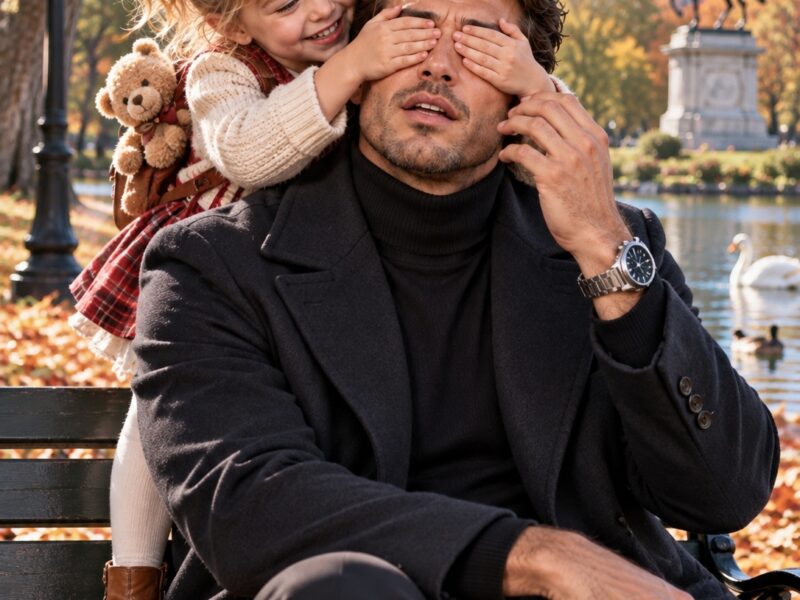
“Guess Who I Am?” the Orphan Girl Whispered, Covering the Mafia Boss’s Eyes—But the Brass Key in Her Pocket Exposed the Betrayal Inside His Family
The five-year-old covered Dante Moretti’s eyes before either security guard could reach her.
She thought he was the kind old man who brought cookies to her children’s home every Thursday—and who had now vanished.
Then a brass key fell from her sweater, stamped with the symbol Dante’s father had ordered destroyed twenty years earlier.
The Hands Over His Eyes
“Guess who I am?”
The small voice touched the back of Dante Moretti’s neck a fraction of a second before two cold hands covered his eyes. For one strange moment, the October air inside Boston Common seemed to stop moving. Yellow leaves spun across the gravel path near Frog Pond, but Dante sat perfectly still.
Thirty feet behind him, Marco Bellini stepped away from a half-bare maple tree. Luca moved from the opposite side of the path, already scanning the benches, food carts, and passing pedestrians. Both men had been trained to respond before anyone else realized danger existed.
Dante lifted two fingers.
The signal stopped them immediately.
No one had touched Dante without permission in seven years. Men in Boston called him a shipping executive in public and a mafia boss when they believed walls were thick enough to protect them. Politicians returned his calls, competitors lowered their voices when he entered a room, and strangers usually understood that approaching him required an invitation.
The hands over his eyes were too small to belong to anyone dangerous. They smelled faintly of butter and chocolate, as though their owner had carried cookies without a napkin. One little finger rested against the scar beside Dante’s eyebrow, unaware that grown men had avoided looking directly at it.
“Come on,” the voice insisted. “Guess.”
Dante had buried Nicholas Ferraro that morning. Nicholas had served as a dock supervisor, family adviser, and one of the few men willing to tell Dante when he was behaving like his father. Lung cancer had reduced him slowly, without dignity or mercy, until the funeral director had needed a photograph to remember how his suit should fit.
Dante had come to the Common afterward because it was the only place in Boston where nobody called him sir. A shipping contract lay unread beside him, its corners held down by a paperback purchased from a street vendor near the cemetery. He had read the first sentence seven times and understood none of it.
The hands squeezed his eyes once, delighted by his silence.
“I don’t know,” Dante said at last. His voice emerged softer than either Marco or Luca had ever heard it. “Who are you?”
A giggle warmed the cold air. The hands disappeared, and Dante turned slowly.
A little girl stood behind the bench.
She could not have been older than five. Her red wool sweater had been repaired at both elbows with thread that did not match, and one of her sneakers was tied properly while the other had been knotted twice across the middle. Reddish-brown hair hung in two uneven braids around a face bright with victory.
She held a folded paper bag against her chest. Dark circles of butter had spread through the brown paper, and the warm, sweet smell of chocolate reached Dante even in the wind.
The girl looked directly into his face.
Her smile did not fade. It collapsed.
Her mouth remained open for half a second, as if it had not yet received the message from her eyes. Then her shoulders dropped, and the paper bag slipped lower in her arms.
“You’re not Mr. Henry,” she whispered.
Dante rose from the bench and then reconsidered. Standing made him tower over her, so he lowered himself into a crouch on the gravel path. His knees objected beneath his tailored trousers, but he ignored them.
“No,” he said. “I’m not.”
Behind him, Marco and Luca remained motionless. A woman pushing a stroller slowed, recognized Dante, and quickly continued walking. The little girl noticed none of them.
“Who is Mr. Henry?” Dante asked.
“He wears a coat like yours.” She looked at the expensive black cashmere around his shoulders. “Except his has a button that doesn’t match, and one pocket is crooked.”
Dante glanced at his coat as if seeing it for the first time. It had been cut on Newbury Street by a tailor who had dressed three generations of Moretti men. No one had ever compared it to a retired man’s crooked pocket.
“Does Mr. Henry come here often?”
“On Thursdays. He brings cookies from the bakery with the blue door.” She lifted the paper bag. “I was going to give him these because Mrs. Alvarez let me carry a box, and I didn’t drop even one.”
“That sounds difficult.”
“It was twelve pounds.”
“That sounds extremely difficult.”
The solemn approval seemed to earn him another few seconds of trust.
Dante kept his voice quiet. “When did you last see him?”
The girl counted by pressing one finger against each knuckle of her opposite hand. “Three Thursdays.”
“Did he tell you he was going away?”
She shook her head. “Sister Margaret says grown-ups are allowed to be busy. But Mr. Henry is never busy on Thursday.”
“What does he do when he visits you?”
“He reads. He knows the voices.” She considered this important distinction. “He does the whale correctly. Most people make whales sound like bears.”
Dante did not know how a whale was supposed to sound, but he nodded as if he did.
“Where does he visit you?”
The girl looked toward the path behind her. Her fingers tightened around the bag.
“My house.”
“And where is your house?”
“It has lots of beds and a kitchen that smells like soup even when the soup is gone.” She twisted the end of one braid. “There’s a cross over the door, but it needs paint.”
Dante understood.
He had passed St. Agnes Children’s Home dozens of times without looking at the windows. The organization had once requested a donation from the Moretti Foundation. One of his assistants had sent a check and filed the thank-you letter without mentioning it to him.
“St. Agnes,” he said. “On Harrison Avenue.”
Her eyes widened. “You know it?”
“I know where it is.”
“I’m not supposed to leave.”
The confession came quickly now, as if saying it to a stranger made the offense smaller. She had been sitting in the reading corner when she saw a black coat pass the front window. She thought Mr. Henry was walking toward the park, so she followed him.
“I run very fast,” she added.
“I believe you.”
“Are you going to tell Sister Margaret?”
Dante looked at the worn elbows of her sweater and the two cookies cooling inside the paper bag. She had crossed several busy streets alone because one adult had failed to keep a promise. Fear had not stopped her; it had merely kept pace beside her.
“What’s your name?” he asked.
“Ellie Parker.”
A yellow leaf landed on her shoulder and remained there.
“I’ll take you back, Ellie.”
She studied Marco, Luca, and the black Mercedes waiting near the curb. “Is that your car?”
“Yes.”
“It looks expensive.”
“It was.”
“Mr. Henry’s car makes a sound like a tired horse.”
“Mine is quieter.”
“That doesn’t mean it’s better.”
Marco looked away to hide the beginning of a smile.
Dante opened the rear door himself. Ellie climbed inside, sat with both legs extended because they were too short to reach the edge, and carefully buckled her seat belt. The bag of cookies rested upright on her lap.
The Mercedes pulled away from Boston Common. Ellie examined the dark wood paneling, the small reading lights, and the privacy screen.
“This car is too quiet,” she concluded.
Dante sat across from her. “What did Mr. Henry tell you before he disappeared?”
She looked out at the brick buildings sliding past the window. “He said old promises sometimes come back and ask to be kept.”
Dante felt something cold move beneath his ribs.
“What kind of promises?”
“He didn’t say.” Ellie touched the folded top of the bag. “He said if he ever missed a Thursday, I shouldn’t think he forgot me. He said he might be helping an old friend.”
“Did he name the friend?”
“No. But he said the friend had forgotten who he was.”
Streetlights moved across her face in pale orange bars. Dante looked toward Marco behind the wheel.
Marco met his eyes in the mirror.
Neither man spoke for the rest of the drive.
The Man Who Missed Three Thursdays
St. Agnes stood between a dry cleaner and a closed pharmacy on Harrison Avenue. The brick building had four floors, narrow windows, and a stone cross above the entrance that had not been cleaned in years. Children’s paper decorations covered the inside of the glass door.
Ellie pushed open the car door before Dante could help. As she jumped to the sidewalk, something metallic slipped from her sweater pocket and struck the curb with a bright, dull sound.
She did not notice.
Dante bent and picked it up.
It was a small brass key attached to an oval tag worn smooth by years of handling. A capital M had been pressed into its center—thick serifs, an oval border, and a tiny cross-stroke at the bottom of the first stem.
Dante’s breath slowed.
It was the original Moretti Maritime insignia, used from 1982 until 1989. His grandfather had issued fewer than forty brass tags to senior employees with access to restricted company buildings. After a federal investigation, Dante’s father had ordered every piece carrying the old emblem destroyed.
Dante had watched boxes of letterhead, signs, and brass tags burn behind a warehouse when he was eight years old.
This one should not have existed.
“Ellie.”
She turned on the bottom step. Dante opened his palm.
Relief crossed her face. “I thought I lost it.”
“Did Mr. Henry give this to you?”
She nodded and reached for it.
Before Dante released the tag, he noticed four tiny numbers engraved along its edge.
The front door opened.
Sister Margaret stood beneath the stone archway in a navy cardigan buttoned to her throat. She was in her early sixties, with short gray hair and a wooden cross hanging from a plain cord. Her face showed the exhaustion of someone who had spent decades protecting children from promises adults found convenient to break.
“Ellie Parker,” she said.
Ellie lowered her head. “I’m sorry.”
“You left the reading corner.”
“I thought I saw Mr. Henry.”
Sister Margaret’s anger softened without disappearing. “Go to the dining room. We will discuss this after you’ve warmed up.”
Ellie passed her, still holding the cookies. Sister Margaret watched until the little red sweater vanished down the hallway.
Then she looked at Dante.
Recognition moved across her face, but she neither flinched nor stepped aside.
“Mr. Moretti.”
Dante was accustomed to hearing his name spoken with fear, caution, or calculated respect. Sister Margaret spoke it like the name of a severe winter storm—dangerous, inconvenient, and survivable with preparation.
“She was alone in the Common,” he said.
“I know where you found her. She told me where she intended to go last Thursday.” Sister Margaret’s eyes dropped to the brass tag. “Come inside.”
Her office contained a wooden desk, two mismatched chairs, and towers of paperwork separated by colored folders. A radiator knocked beneath the window. The room smelled of old paper and the same lingering soup Ellie had described.
“Henry Walsh,” Sister Margaret said after closing the door. “Seventy-two. Retired accountant. He has volunteered here every Thursday for three years.”
“When did he disappear?”
“Twenty-three days ago. He did not visit, call, or answer his phone. By the end of the week, the number was disconnected.”
“Did you report him missing?”
“The officer wrote down his name and reminded me that adults are allowed to leave voluntarily.”
“Did Henry have family?”
“No surviving relatives that I know of.”
Dante placed the brass tag on her desk. “Why did he give this to Ellie?”
“He said it was a key to an old promise.”
“That is not a key.”
“Ellie is five. To her, anything made of brass and attached to a ring is a key.”
“Did he know me?”
Sister Margaret looked toward the closed office door. “He mentioned you once.”
“What did he say?”
“That Ellie might someday meet a tall man in a black coat wearing a silver watch.” Her gaze dropped to Dante’s wrist. “He said the man would appear severe, but she should not be afraid of him.”
Dante’s father’s watch sat beneath his left cuff.
“Why would he say that?”
“I hoped you could tell me.”
Dante retrieved his checkbook and wrote an amount sufficient to repair the roof, replace the boiler, and fund the home for a year. He folded the check and set it beside the brass tag.
“An anonymous donation.”
Sister Margaret did not touch it. “We do not need you to purchase your way out of this room.”
His pen stopped.
“We need Henry,” she continued. “Ellie arrived here after both her parents died. She did not speak for four months. Henry was the first person who persuaded her to use her voice.”
“What did she say?”
“She asked whether the whale in his book was lonely.”
Dante glanced through the small window in the office door. Ellie sat at the end of a long dining table, carefully arranging two cookies on a paper napkin. She kept moving them, trying to create a perfect square from two round objects.
Dante left the check.
Sister Margaret left it untouched.
Marco waited beside the Mercedes. Once the doors closed, he handed Dante a tablet without speaking.
The personnel record on the screen carried a faded photograph.
HENRY J. WALSH—SENIOR ACCOUNTANT, MORETTI MARITIME. HIRED 1984. RETIRED 2010.
“Why didn’t you tell me?” Dante asked.
“I confirmed it while you were inside.”
“Who authorized his pension?”
Marco enlarged the final page.
A signature appeared above the date of the most recent quarterly payment.
Samuel Reed.
Dante looked at the name for a long time.
Samuel had been his father’s closest adviser for thirty years. He had carried twelve-year-old Dante away from his mother’s grave when Dante refused to leave. He had taught him to drive, attended every graduation, and called him son even when Antonio Moretti could not find the words.
“His phone?” Dante asked.
“Disconnected yesterday.”
Dante looked back at the narrow windows of St. Agnes.
Inside, Ellie broke one cookie in half and set aside the larger piece for a man who had already missed three Thursdays.
“Find Henry,” Dante said. “And do it without the company knowing we’re looking.”
The order should have been simple.
By nightfall, Dante understood it was not.
Henry’s Dorchester home had a porch light burning in daylight, an overflowing mailbox, and a newspaper trapped beneath the front gate. A neighbor had not seen him in three weeks. The back door showed no damage, but a kitchen window had been unlocked from inside.
In the trash bin, Marco found a spiral notebook torn into pieces by hand.
One page had escaped destruction.
Across the bottom, Henry had written a sequence of account numbers. Beneath them, underlined twice, was a single name.
ELLIE PARKER.
The Key That Should Not Exist
Dante returned to St. Agnes the next morning after less than two hours of sleep.
Ellie sat in the dining room explaining to a younger child why stickers were not food. When she saw Dante in the doorway, she abandoned the lesson and ran across the room.
She collided with his legs and wrapped both arms around one knee.
Dante stopped breathing.
He had negotiated with men who controlled ports, judges, unions, and city contracts. He had stood beside his father during investigations and funerals and had learned before adulthood that affection was most dangerous when it could be used as leverage. Yet he had no idea where to put his hands when a child hugged him because she was glad he had returned.
Sister Margaret watched from the doorway.
Slowly, Dante rested one palm on Ellie’s head.
“You came back,” she said.
“I said I would.”
“No, you didn’t.”
He considered that. “You’re right.”
“But you came anyway.”
The distinction seemed important to her.
Dante crouched. “I need to ask you more about Mr. Henry.”
Her happiness dimmed, but she nodded.
“Did he ever take you somewhere besides the park?”
“Once. Sister Margaret came too. We went to a little wooden house near a pond.”
“Which pond?”
“He said Jamaica Pond. There were fish, but the little ones ate more bread because they had to try harder.”
Sister Margaret confirmed the visit. Henry had called it a children’s picnic, though Ellie had been the only child invited. He spent most of the afternoon watching the path rather than the water.
“Do you remember the house?” Dante asked.
“Brown walls. Green door. One chair outside with a blanket on it.” Ellie smiled. “Mr. Henry said the chair got cold.”
She reached under the table and produced a folded sheet of construction paper. “I made this for you.”
The drawing showed three figures. An old man in a brown coat stood on the left. Ellie, represented by a red triangle and uneven braids, stood on the right.
Between them was a tall man in black.
A careful silver circle had been drawn around his wrist.
Dante looked at her.
“Mr. Henry said a tall man with a silver watch would come looking for me,” Ellie explained. “He said I should tell him that Dany didn’t forget. Dany just got lost.”
Every sound in the dining room seemed to move farther away.
No one had called Dante “Dany” in twenty-four years.
His mother had used the name. Henry had used it when Dante was a boy learning to fold paper cranes at the kitchen table. On the morning of his mother’s funeral, Antonio Moretti had taken him aside and said, “Dany was a child. From today, you are Dante.”
Dante folded the drawing with unnatural care.
“Did Mr. Henry say anything else?”
“He said the black-coat man would know which old doors were safe to open.”
Dante thanked her and stood.
As he walked toward the exit, Ellie called after him.
“Are you Dany?”
He stopped but did not turn.
Children who had already lost too much could recognize silence as an answer.
The cabin by Jamaica Pond took Marco and Dante two searches to find. It stood at the end of a dirt track hidden behind wet branches, with brown siding, a green door, and a single chair beneath the porch roof. A gray blanket had been left folded across the back.
The door was locked. A small rear window had been broken from outside.
Inside, the cabin smelled of cold wood, stale coffee, and damp paper. The computer’s hard drive had been removed. Desk drawers stood open, and a gray cardigan hung over the back of an armchair.
“He knew he might have to leave,” Marco said.
“How?”
“Nobody keeps a hidden cabin this neat unless they expect someone to search it.”
Dante walked through the room without touching anything. His father had taught him to notice not what belonged, but what sat slightly wrong.
The second floorboard from the hearth rested higher than the others.
Beneath it was a shallow compartment. Someone had emptied it, but one sheet of paper remained taped to the underside of the board, missed because it could be seen only when the wood was removed completely.
Dante peeled it free.
It was a wire-transfer confirmation for $4.7 million from Moretti Maritime through two intermediary accounts into a Delaware corporation called Blue Harbor Holdings. The transfer had occurred two years earlier.
Samuel Reed had authorized it.
Three weeks after the transfer, David and Clare Parker—Ellie’s parents—had died in what police described as a highway accident.
Marco read the document twice.
“Samuel raised you,” he said carefully.
“I know.”
“If this is real, there is no small version of what happens next.”
Dante folded the page and placed it inside his coat.
“Find everything on the Parkers.”
That evening, Dante met Samuel at Trattoria Vicenzo in the North End.
Samuel stood and embraced him. Silver hair, navy jacket, warm smile—the same man who had sat beside Dante through childhood fevers and corporate hearings. He ordered the pasta Antonio Moretti had always preferred and asked whether Dante was sleeping enough.
Dante answered every question normally.
Halfway through dinner, he set down his fork. “Do you remember Henry Walsh?”
Samuel blinked once.
It lasted slightly too long.
“Of course,” he said. “Dry humor. Excellent accountant. Retired years ago.”
“His name appeared in an old pension file.”
“I approved his retirement personally.”
“Did you stay in contact?”
“Christmas cards. Nothing more.” Samuel poured more wine. “Why do you ask?”
“No reason.”
Samuel reached across the table and squeezed Dante’s wrist just above the silver watch.
“If you have questions, come to me, son.”
“I will.”
Outside the restaurant, Samuel kissed the side of Dante’s head before entering his car. Dante watched him through the Mercedes window.
The warm smile remained until Samuel believed he could no longer be seen.
Then it disappeared.
Marco delivered the Parker file the following night.
David Parker had worked as a junior accountant in Henry’s private firm. He had reviewed several Moretti shipping accounts and reported unusual transfers shortly before his death. The official accident report blamed the age of the family’s car.
A sealed mechanical assessment told a different story.
The failure had been deliberate.
Someone had pressured a local judge to remove the assessment from the public file. That judge owed his appointment, his mortgage refinancing, and his son’s first legal job to Samuel Reed.
Dante sat beside the window of his thirty-fourth-floor office. Harbor lights blurred beneath the rain.
On his desk stood Ellie’s drawing.
When he reached to straighten it, his hand trembled.
Marco saw.
He turned toward the window and gave Dante the dignity of pretending he had not.
The Second Father
Dante requested permission to take Ellie for ice cream the following Saturday.
Sister Margaret listened without interruption. “One hour.”
“I understand.”
“No, you do not.” She stood inside the doorway, blocking it with her entire body. “That child has had four adults who mattered. Two are buried. One is missing. I will not allow you to become another person who arrives dramatically and disappears when affection becomes inconvenient.”
Dante accepted the warning without defending himself. “One hour.”
Ellie waited in a navy coat two sizes too large. The brass tag was clipped to a belt loop, and a stuffed cat with one damaged ear protruded from her small backpack.
At Faneuil Hall, she chose strawberry ice cream because the menu displayed a real strawberry beside it. Dante ordered black coffee, which Ellie described as “sad ice cream without the ice.”
They sat on the market steps watching pigeons gather around tourists.
Ellie ate carefully, flattening each spoonful with her tongue to prevent it from dripping. When they walked toward the fountain, she wrapped her whole hand around Dante’s index finger as if he were the one likely to wander away.
“Mr. Henry told me true stories,” she said.
“What kind?”
“One was about a boy named Dany. The boy’s mother died, and his father became quiet.”
Dante slowed.
“Mr. Henry said another man helped raise Dany. But the man wanted to own everything, even people. He was nice when people watched him.”
“Did Henry give the man a name?”
Ellie shook her head. “He said Dany would know.”
A street musician began playing a slow, uncertain song nearby.
Ellie looked up. “Are you Dany?”
Dante crouched and wiped a spot of ice cream from her chin.
“Yes.”
She accepted the answer with less surprise than he expected. “Did you get lost?”
“For a long time.”
“Mr. Henry said you would find the right road when somebody needed you.”
Dante looked at the little hand still holding his finger. “Mr. Henry expected too much.”
“He usually doesn’t.”
Dante returned Ellie twelve minutes late. Sister Margaret expressed her disapproval with a silent stare powerful enough to unsettle men who feared nothing else.
The following morning, she called him at 7:03.
“A white van has been parked across from St. Agnes since four. Two men are inside.”
Dante was already reaching for his coat. “Move the children away from the windows. Open the door only for Marco.”
Security arrived within minutes. The van left before it could be identified, but a camera from the dry cleaner captured enough of the driver’s face to connect him to a private investigations company Samuel had used for years.
Dante called his mentor.
“Uncle Sam.”
“Dany. Twice in one week. I am becoming spoiled.”
“Come to my office at four. I need your opinion.”
Samuel arrived early in a camel-colored coat carrying the leather folio he had owned since Dante was a child. Dante poured him bourbon and placed the transfer confirmation on the walnut table.
Samuel read it in three seconds.
Then he laughed.
“Oh, Dany. You still worry exactly like your father.”
“Explain it.”
“A private reserve. Your father established several outside the main books to protect the company during emergencies.”
“Why Blue Harbor?”
“Separation from operating accounts.”
“Where is the authorization?”
“I will send it tomorrow.”
Dante waited.
Samuel lifted his glass. “Is there something else?”
“No.”
The older man stood and squeezed Dante’s wrist above the watch.
“You never need to investigate me, son. Ask, and I will answer.”
“I know.”
After Samuel left, Marco stepped from the adjoining room.
“Follow every movement,” Dante said. “Quietly.”
Samuel entered his car outside Moretti Tower and removed a small phone from his coat. Marco’s team could not hear the call, but traffic footage showed him speaking for nineteen seconds.
Within an hour, a second surveillance vehicle appeared near St. Agnes.
That evening, Dante found a plain white envelope on his desk.
Inside was a photograph of Ellie sleeping in her narrow bed. The image had been taken through the window. The brass tag rested on her nightstand beside a glass of water.
Dante reached St. Agnes in twenty minutes.
Ellie was unharmed, sitting at the dining table and cutting a pancake into exact triangles. She looked up and smiled around a mouthful of syrup.
Dante remained in the doorway until his breathing steadied.
Sister Margaret led him into her office.
“A man came yesterday,” she said. “Silver hair, camel coat, expensive watch, gentle voice practiced by someone accustomed to obedience.”
“Samuel.”
“He claimed to be a friend of Ellie’s parents. He wanted to leave her a book.”
“Did you accept it?”
“I burned it.”
Dante stared.
“The spine had been removed and glued back badly,” Sister Margaret explained. “I have protected children for forty years. I do not let strangers leave objects they have taken apart.”
Samuel had likely concealed a listening device inside it.
Dante glanced through the office window at Ellie.
“I need you both to come to my house.”
Sister Margaret’s expression did not change.
“You will have separate rooms,” Dante continued. “Keys to every door. Twelve security staff outside, none inside your rooms. If you decide at any moment that I am not safe for her, you leave, and I will not interfere.”
“For how long?”
“Until Henry is found and Samuel can no longer reach her.”
“Do you know where Henry is?”
“Not yet.”
“Then find him.”
Dante nodded.
Sister Margaret studied him for several seconds. “We will come.”
Marco discovered the warehouse forty-six hours later.
The property stood near the Chelsea waterfront, leased through a company connected to Blue Harbor. Two men delivered food twice daily and remained inside for eleven minutes each time.
Someone was being kept there.
Dante refused to storm the building. A reckless rescue could endanger Henry and destroy the evidence needed to protect Ellie permanently.
Instead, he contacted a federal prosecutor whose office had investigated Moretti Maritime years earlier. He supplied the financial transfer, the false accident report, the surveillance records, and evidence that an elderly missing person was likely being held against his will.
Federal agents obtained a sealed warrant.
Henry Walsh was found alive in a locked office behind the warehouse’s storage floor. He was weak, disoriented, and heavily sedated, but he recognized Dante when paramedics carried him into the cold morning light.
His cracked lips moved.
“Dany.”
Dante took the old man’s hand. “I’m here.”
Henry’s eyes filled. “The child?”
“Safe.”
Only then did Henry close his eyes.
The House That Had Forgotten Laughter
Dante’s Beacon Hill home stood behind an iron gate beneath two gas lamps. Five stories of dark brick and limestone overlooked Mount Vernon Street, containing more bedrooms than Dante had used in his entire adult life.
Ellie entered carrying a blue duffel bag and Mr. Whiskers, the damaged stuffed cat. Her sneakers made small, bright sounds across the marble entry floor.
She stared upward at the chandelier and curved staircase. “Do you live here alone?”
“Yes.”
She considered the enormous, silent hallway. “Why?”
Dante had no useful answer.
“Not tonight,” he said.
Sister Margaret selected adjoining guest rooms and personally checked every window. She questioned Marco about emergency exits, security cameras, food allergies, and whether any member of the household had completed pediatric first-aid training.
By the time she finished, Marco looked more exhausted than he had after most corporate crises.
Ellie could not sleep.
At St. Agnes, radiators clicked, buses sighed outside, children turned beneath blankets, and someone was always coughing down the hall. Dante’s home had thick walls and deep carpets. The silence possessed edges.
Near midnight, she followed a line of lamplight beneath the library door.
Dante sat at a long table surrounded by files. His tie lay beside a cold cup of coffee, and his shirt sleeves had been rolled to his elbows.
“Couldn’t sleep?” he asked.
“It’s too quiet.”
“Come in.”
She climbed into a green leather chair. Her legs extended straight before her, unable to reach the edge. The brass tag hung from the hem of her nightgown.
For a while, she watched the fire.
Then she asked, “Did my mom and dad hurt when they died?”
Dante closed the folder in front of him.
He could have offered a comforting lie. His father had believed children needed protection from truth, then used that belief to hide almost everything.
“I don’t know,” Dante said. “But I read the reports. I believe it happened very quickly.”
Ellie nodded. Her face tightened, but she did not cry.
“Okay.”
The answer became another invisible weight she would carry because no adult could remove it.
“Is Mr. Henry alive?” she asked.
“Yes.”
“Do you know?”
“I saw him this morning.”
She slid off the chair. “Where?”
“He’s in a hospital. He needs rest, but the doctors believe he will recover.”
Ellie crossed the library before Dante finished. She stopped beside him, unclipped the brass tag, and turned his hand palm-up.
“Hold this until he comes home.”
She placed the metal in the center of his palm and closed his fingers around it with both hands.
Dante felt the raised M press into his skin.
“Why me?”
“Because Mr. Henry picked you.”
“He may have been wrong.”
“He usually isn’t.”
She climbed back into the chair, curled her feet beneath her nightgown, and watched the fire.
The next morning, Dante discovered Ellie eating breakfast in the kitchen. She had arranged blueberries around her pancake to create what she claimed was a security fence.
Sister Margaret drank coffee at the opposite end of the table. “She wakes at six.”
“So I have learned.”
“She dislikes eggs unless the yolk is completely hidden.”
“I didn’t know yolks could hide.”
“They can under toast.”
Ellie pushed a blueberry toward Dante. “You need breakfast.”
“I have coffee.”
“That isn’t breakfast.”
Sister Margaret raised one eyebrow. “She is correct.”
Dante ate the blueberry.
That afternoon, he attempted to work from home. Ellie constructed a city from empty shipping boxes outside his study. Each time the phone rang, she added another building to block the sound.
At three, she opened his door without knocking, stopped, remembered the rule, stepped outside, and knocked.
“Come in.”
“Do you know how to braid?”
“No.”
“My hair is becoming dangerous.”
Sister Margaret was speaking with the hospital, and Ellie refused assistance from the housekeeper. Dante found a hairbrush and approached the task as he approached shipping negotiations—with preparation, concentration, and misplaced confidence.
The first braid leaned sharply left. The second unraveled before he secured it. Ellie examined the result in a silver serving tray.
“It looks worried.”
“It has reason to be.”
She laughed.
The sound traveled through rooms that had not held a child’s laughter since Dante himself was young. He felt it move along the hallway and into the study where his father’s portrait watched from above the mantel.
That evening, Marco brought an update.
Samuel had withdrawn cash, contacted two attorneys, and reserved a chartered flight under an associate’s name. Federal agents were watching him but waiting for Henry’s sworn testimony before making an arrest.
“He will know the warehouse is lost,” Marco said.
“Then he will try to control the story.”
“And Ellie?”
“He will not come near her.”
Marco looked toward the kitchen, where Ellie was explaining to the housekeeper that cookies required more chocolate than the recipe suggested.
“You are changing the organization for her.”
“No.”
Marco waited.
Dante corrected himself. “I am finally looking at it because of her.”
The Moretti organization had begun with shipping contracts and protection rackets under Dante’s grandfather. By Antonio’s generation, it owned legitimate freight companies, restaurants, real estate, and construction firms, but illegal arrangements still ran beneath the surface like old pipes inside renovated walls.
Dante had inherited them without asking which ones poisoned the water.
A child’s hands over his eyes had forced him to see.
The next morning, Henry asked to speak.
The Letter Antonio Never Sent
Henry told the story from a private hospital room while rain moved against the windows.
Samuel began stealing in small amounts fifteen years earlier. False vendor invoices, diverted shipping surpluses, and payments routed through companies that existed only on paper. Henry discovered the scheme and brought it to Antonio Moretti.
“My father did nothing?” Dante asked.
“He stopped the theft, but he did not expose Sam.”
“Why?”
Henry looked at him with exhausted sorrow. “Because of you.”
The monitor beside the bed marked the silence in steady intervals.
“Your mother had died,” Henry continued. “Antonio could not comfort you because every time he looked at your face, he saw hers. Sam carried you out of the cemetery. He taught you to drive, sat through your school ceremonies, and stayed when your father could not.”
Dante turned toward the rain.
“Antonio told me that exposing Sam would take a second father from you,” Henry said. “He threatened him privately and forced him to repay part of what he stole. The theft stopped for seven years.”
“Until my father died.”
“Within six months, Sam began again. Larger amounts. He believed the company belonged to him because he had kept your family standing.”
“And David Parker?”
“My junior accountant.” Henry’s voice broke. “Quiet, careful, stubborn about numbers. He found a transfer linked to Blue Harbor.”
“Why didn’t you go to the authorities?”
“I asked him for one week. I wanted to secure the evidence I had already collected.” Henry looked down at his hands. “He received nineteen days instead.”
David and Clare Parker died before Henry could protect them.
Eight months later, Ellie’s grandmother suffered a fatal stroke. Ellie entered state care. Henry wanted guardianship but feared Samuel would recognize the connection and reach the child through him.
“So you visited her every Thursday,” Dante said.
“I brought cookies. I read the whale book. I waited until she was old enough to remember a message.”
“You placed a five-year-old inside this.”
“I gave her one piece no one would search her for.” Henry’s eyes filled. “I am not proud of the risk. I was an old man running out of safe people.”
“The brass tag.”
“Serial number 0417. Safe-deposit box 417 at Suffolk Trust. Your father opened it under another name.”
Dante closed his hand around the tag inside his pocket.
“Why did Samuel take you?”
“He learned David had copied the original transfer. He believed I still had it. He searched the cabin and my house.”
“Why keep you alive?”
“He wanted access codes to the encrypted drive.”
“Do you have them?”
Henry gave the faintest smile. “Ellie knows them.”
Dante’s body went still.
“Not as numbers,” Henry added quickly. “The first letters of the titles of four books I read her in a specific order. She does not know what they mean, and Sam does not know she knows.”
Dante wanted to be angry. Instead, he saw the years Henry had spent alone, trying to keep one child alive while protecting evidence against men with money, influence, and no patience for conscience.
“You should have come to me.”
“I did not know which Moretti you had become.”
“Do you now?”
“I know you brought a federal warrant instead of an army.”
The answer carried more weight than praise.
Suffolk Trust occupied a granite building on Franklin Street. Dante presented the brass tag and the name Henry provided. An attendant led him into a private room and brought box 417.
Inside lay two handwritten ledgers, an encrypted drive, copies of financial records, and a cream envelope addressed to Dante.
He recognized his father’s handwriting before touching it.
The letter was dated two months before Antonio’s fatal stroke.
Son,
If you are reading this, Sam crossed the line I drew, and Henry lived long enough to guide you toward the truth.
I told myself I protected you by keeping Samuel’s betrayal hidden. Perhaps I protected only my own grief. I used your love for him as an excuse because I lacked the courage to destroy what remained of our family.
Do what I failed to do. Use the law, not fear. Do not answer betrayal by becoming more dangerous than the man who betrayed you.
I taught you that our name answered to no one. That lesson was wrong.
At the bottom, Antonio had written the private number of a federal prosecutor who once offered him cooperation.
Dante read the letter three times.
His father had spent years teaching him never to kneel, confess, or invite strangers into family business. Yet his final instruction asked Dante to do all three.
Dante called the number.
“My name is Dante Moretti,” he said when a woman answered. “I have records involving financial crimes, unlawful detention, obstruction, and two deaths that were falsely classified as an accident.”
The woman’s voice became formal. “Are you requesting counsel?”
“No. I’m requesting a meeting.”
“Do you understand that any information you provide may expose your own organization?”
“Yes.”
“What changed?”
Dante looked at the brass tag beside the letter.
“A child covered my eyes,” he said. “I finally saw what we had become.”
The encrypted drive contained twenty years of Moretti accounts. Some belonged to Samuel’s theft. Others documented illegal arrangements Antonio had tolerated and Dante had inherited without examining closely enough.
Dante surrendered everything.
His attorneys warned that he could lose companies, licenses, contracts, and freedom. Marco asked only one question.
“Are we finishing this?”
“Yes.”
Marco nodded. “Then we finish it clean.”
For three days, Dante met investigators inside an office with no Moretti employees present. He named shell companies, explained coded payments, and signed waivers his father would once have considered unforgivable.
Samuel continued calling.
Dante continued answering as if nothing had changed.
On the fourth afternoon, the prosecutor confirmed that Henry’s affidavit, the ledgers, the drive, and Samuel’s communications established sufficient grounds for arrest.
Dante called Samuel one final time.
“Come to Mount Vernon Street tonight,” he said. “Seven o’clock. Just us.”
Samuel paused for exactly one breath.
“Of course, son. Shall I bring wine?”
“Bring whatever helps you tell the truth.”
The Last Dinner at Mount Vernon Street
Dante arranged four items on the walnut dining table.
The encrypted drive came first. Then Henry’s two ledgers, his sworn affidavit, and Antonio’s letter.
Sister Margaret and Ellie remained in the sunroom at the rear of the house. Marco waited nearby, but Dante had insisted no security staff enter the dining room.
At three minutes before seven, Samuel’s car stopped beyond the gate.
He entered carrying a bottle of wine and the familiar warmth he had worn for three decades. He embraced Dante and kissed the side of his head.
“The gate took too long,” Samuel said. “You changed the code.”
“I have changed many things.”
Samuel followed him into the dining room.
When he saw the table, his smile remained in place but stopped belonging to his face.
He set down the bottle carefully.
“Where did you get those?”
“Henry.”
“So he survived.”
“Yes.”
Samuel sat in his usual chair. “And what has the frightened old man told you?”
“That you stole from my grandfather, my father, and me. That you arranged the Parkers’ accident and paid to bury the mechanical findings. That you held Henry until he surrendered access to the drive.”
Samuel looked toward Antonio’s letter.
“Your father protected me.”
“My father protected a grieving child. You used that child as cover.”
“I raised you.”
“You did.”
“I attended every school event Antonio missed. I taught you how to shave, how to negotiate, how to know when a man was lying.”
“You should have remembered the final lesson.”
Samuel’s expression hardened. “Everything I did preserved this family.”
“You took nearly forty million dollars.”
“Money your father would have wasted trying to make criminals look respectable.”
“And David Parker?”
Samuel’s jaw tightened. “He threatened an organization that employed thousands.”
“He was an accountant with a wife and a three-year-old daughter.”
“He made a choice.”
Dante’s voice lowered. “No. You removed his choices.”
For the first time, Samuel looked afraid.
“Dany,” he said, returning to the childhood name as if it were a key. “You will not hand me to them. You are your father’s son.”
“I am trying not to be.”
“I was there when your mother died.”
“I know.”
“I held you when you could not breathe.”
“I remember.”
“You owe me your life.”
Dante looked toward the hallway leading to the sunroom. Beyond two closed doors, Ellie was likely coloring at the small table, believing the adults around her would keep their promises.
“A child is not a debt,” Dante said. “Neither is love.”
The doorbell rang.
Samuel did not turn.
“How long?” he asked.
“Less than a minute.”
“You could let me walk through the kitchen.”
“I could.”
“You could give me one hour.”
“I could.”
“After everything I did for you?”
Dante met his eyes. “After everything you did to her.”
Federal agents entered the front hall. Their footsteps crossed the marble at an even pace.
Samuel stood and straightened his jacket.
“Your father would be ashamed.”
Dante placed one hand over Antonio’s letter. “My father told me to make this choice.”
For one final moment, Samuel looked like the man who had carried a devastated boy from a cemetery. Then the expression disappeared, leaving only an aging man who had mistaken another family’s love for permanent immunity.
He walked into the hall and surrendered without resistance.
The front door closed behind him.
Dante remained beside the dining table.
Marco appeared at the doorway but did not enter. “It’s done.”
“No,” Dante said. “It has started.”
The investigation lasted months.
Samuel pleaded guilty to financial crimes, unlawful confinement, evidence tampering, and conspiracy connected to the Parker case. The retired judge who buried the mechanical report resigned from several boards and faced prosecution. Two former executives agreed to testify in exchange for reduced sentences.
Moretti Maritime lost government contracts and paid substantial penalties. Several assets were placed under court supervision. Dante surrendered control of companies tied to illegal activity and sold properties to fund restitution for employees, families, and businesses harmed by the organization.
He was not treated as innocent.
He did not ask to be.
Because Dante had voluntarily disclosed evidence, cooperated fully, and separated legitimate businesses from the criminal network, prosecutors allowed a monitored restructuring rather than total dissolution. The legal shipping, construction, and restaurant companies moved under independent boards.
Marco became chief operating officer of the remaining freight business.
He complained constantly about compliance paperwork and completed every page.
The Chelsea warehouse where Henry had been held was transferred to a regional food bank. Its painted windows were replaced with clear glass.
At home, Dante encountered consequences of another kind.
Ellie asked why Samuel no longer visited. Dante told her that Samuel had hurt people and would face a judge.
“Did he hurt my mom and dad?”
Dante sat beside her on the library rug. “Yes.”
She stared at Mr. Whiskers in her lap. “Did you love him?”
“Yes.”
“Do you still?”
The question was harder than anything federal investigators had asked.
“Part of me remembers loving him,” Dante said. “But loving someone does not make what they did less wrong.”
Ellie considered this. “Mr. Henry says people can be two things.”
“He is right.”
“Can you?”
Dante looked around the library where his father’s files had once hidden more truth than books.
“I’m trying.”
Ellie placed Mr. Whiskers against his knee. “You can hold him while you try.”
The Answer in the Park
Henry recovered slowly.
By the fifth week, he could walk the hospital corridor without a handrail. By the sixth, he demanded his gray cardigan and informed the doctor that hospital coffee violated several basic principles of human dignity.
His home, he said, was no longer Dorchester.
He owned a small cottage near Wellfleet, purchased decades earlier with money earned from the first honest account he completed for Antonio Moretti. He wanted to return there.
Dante offered staff, security, and renovations.
Henry refused everything except repairs to the roof.
“I would like to open my own door,” he said.
Dante drove him to Cape Cod on a cold Thursday morning. Henry climbed the two porch steps alone and unlocked the cottage with a key he had carried for thirty years.
At the threshold, he turned.
“Bring Ellie when the weather warms.”
“I will.”
“And Dany?”
“Yes?”
“Do not visit only when you have a problem.”
Dante almost smiled. “I will try.”
Back in Boston, Dante spent three afternoons each week at St. Agnes.
He learned to braid Ellie’s hair through trial, error, and considerable criticism. His first attempt resembled a rope tied during an emergency. By the twelfth, he could produce a respectable French braid.
He read stories in the reading corner. His wolf sounded like an irritated businessman, and his princess sounded like the same businessman speaking more quietly. Ellie corrected him patiently.
He attempted to cook pasta in the St. Agnes kitchen. He burned the first pot, oversalted the second, and produced an edible third serving for children willing to lower their standards.
Sister Margaret watched all of it.
She watched Dante teach Ellie to tie her second shoe correctly. She watched him refuse an international call during story hour and apologize to the children for the interruption. She watched Ellie stop checking the door every time he left because he returned when he said he would.
One evening, Sister Margaret handed Dante a plain folder.
“If you are serious, fill this out.”
The first page read PETITION FOR GUARDIANSHIP AND ADOPTION.
Dante stared at it.
“Your name will complicate the process,” she said. “Your former organization will complicate it further. There will be home studies, financial reviews, interviews, background investigations, court supervision, and people who will assume your money is the reason you should win.”
“It isn’t.”
“I know. You will need to prove that to everyone else.”
“What if they refuse?”
“Then you remain someone who keeps showing up.”
Dante completed the application.
The process lasted fourteen months.
Investigators examined every company he had owned and every charge ever connected to the Moretti name. Social workers visited Mount Vernon Street without warning. A judge questioned whether a man raised inside organized crime could provide emotional safety to a child whose parents had been harmed by someone from that world.
Dante answered without minimizing anything.
He admitted he had benefited from fear. He admitted he had accepted illegal arrangements because examining them threatened the identity his father left behind. He described the reforms, independent supervision, therapy, parenting classes, and the continuing presence of Sister Margaret and Henry.
Most importantly, the court listened to Ellie.
A child specialist asked where she felt safe.
“At St. Agnes,” Ellie said. “And at Dante’s house.”
“What makes his house safe?”
“I have my own key.”
“What happens when you make a mistake?”
“He explains it too much.”
The specialist smiled. “Does he frighten you?”
“Only when he tries to sing.”
During the temporary guardianship period, Ellie moved into Mount Vernon Street with weekly visits to St. Agnes. Sister Margaret retained unrestricted access and used it frequently.
The house changed.
Children’s books appeared beneath the portraits. A pink raincoat hung beside Dante’s black cashmere coat. One stair developed a permanent collection of toy animals participating in what Ellie called an important meeting.
Dante stopped dining at the long walnut table.
He and Ellie ate in the kitchen, where she could reach the napkins and criticize his vegetables.
On difficult nights, she still woke from dreams about parents whose faces she remembered only in pieces. Dante never told her not to be sad. He sat beside the bed until she slept and learned that comfort was not the art of producing the correct sentence.
Sometimes it was simply refusing to leave.
The adoption became final on a clear October morning.
Ellie wore a navy dress and red sweater. Dante wore a dark suit and his father’s silver watch. Henry traveled from Wellfleet, and Sister Margaret sat beside him in the front row.
The judge reviewed the documents and addressed Ellie.
“You understand that Mr. Moretti will legally become your father?”
Ellie nodded.
“Do you want that?”
“Yes.”
“Why?”
Ellie looked at Dante. “Because he comes back.”
The judge signed the order.
Three months later, Boston Common wore the same colors it had on the day they met. Yellow leaves crossed the path near Frog Pond, and cold air carried the smell of wet stone and grass.
Dante sat on the same bench in the same black coat.
No security team waited beneath the trees. Marco had argued, lost, and taken the morning off under protest. The old cars connected to Dante’s former life remained in a garage with their engines cold.
A picture book rested in his hands.
It told the story of a blue whale searching for her song. Dante had read it eleven times and had finally learned that whales were not supposed to sound like bears.
The old brass tag hung from his coat zipper.
Beside it, attached to the same ring, was a bright pink plastic rabbit with one damaged ear. Ellie insisted the two objects would become lonely if separated.
Dante turned the page.
Two warm hands covered his eyes.
They smelled faintly of butter and chocolate.
“Guess who I am?”
Dante did not freeze.
He did not signal anyone to approach. He touched the little hands with the backs of his fingers and pretended to consider the question seriously.
“Is it Sister Margaret?”
A giggle. “No.”
“Mr. Henry?”
“No.”
“The person I love most in the world?”
The hands disappeared.
Ellie ran around the bench, her cheeks pink from the cold and one braid already coming loose.
“It’s me, Daddy.”
Dante set down the whale book.
He lifted her beneath the arms and swung her into the air. Her laughter traveled across the pond, struck the water, and returned to them.
At the far edge of the path, Henry stood in his gray cardigan. He raised one hand.
Dante waved back.
Then he held Ellie against his chest, beneath the silver watch and above the heart that had once mistaken loneliness for strength.
The yellow leaves continued falling around them.
This time, Dante knew exactly who she was.









