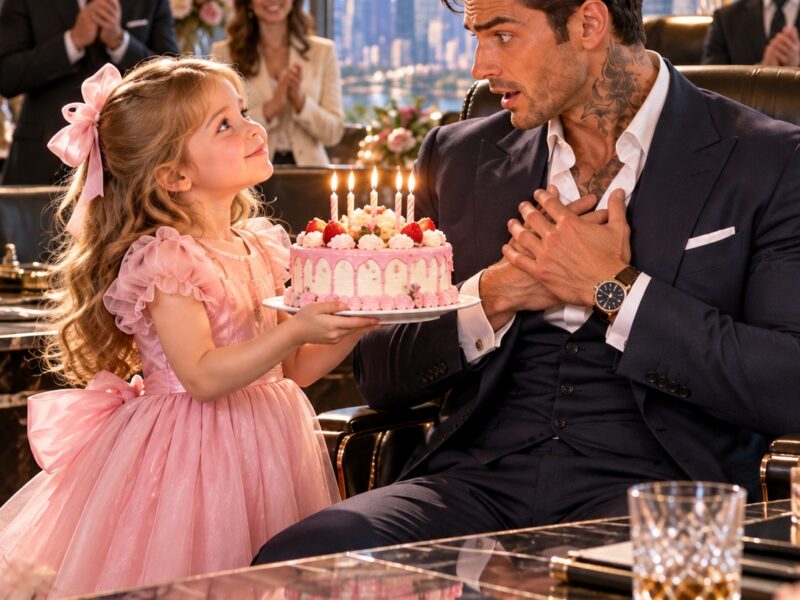
“Happy Birthday, Mister Scary Face,” the Maid’s Little Girl Told the Mafia Boss—Then One Word on Her Cake Reopened a Secret His Family Buried for Twenty-Five Years
Four-year-old Emma Carter walked into a closed executive meeting carrying a tiny birthday cake and called the most feared man in the room “Mister Scary Face” without the slightest fear.
Vincent Hail expected embarrassment, maybe laughter—until he lifted the lid and saw a name written in pink icing that nobody in Boston should have known.
Then he looked at Emma’s mother downstairs, noticed the scar beneath her jaw, and realized the child’s innocent birthday surprise might be connected to the sister he had spent twenty-five years trying to find.
“Happy birthday, Mister Scary Face.”
The little voice cut through the executive conference room so cleanly that seven grown men stopped talking at once.
Vincent Hail lifted his eyes from a shipping ledger.
The room had been built for seriousness. Dark walnut table. Charcoal leather chairs. Floor-to-ceiling windows looking over Boston Harbor beneath a November sky the color of wet steel. Men did not wander in without permission. Staff did not interrupt.
Children certainly did not walk through the oak doors carrying bakery boxes.
Yet there she was.
Four years old, maybe five at most. Pale blue eyes. Blond hair tied badly on one side with a pink ribbon. A blue cotton dress beneath a red cardigan. White sneakers marked gray at the toes.
She held a square bakery box against her chest with both arms.
Marco Rinaldi, seated two chairs to Vincent’s right, moved by instinct.
His chair shifted.
Vincent raised one hand.
Marco stopped.
The little girl noticed none of it.
She crossed the polished floor, reached the head of the table, and carefully placed the box in front of Vincent.
“You’re Mister Scary Face, right?”
One man at the far end coughed into his fist.
Vincent looked at her.
“Who told you that?”
“My mommy.”
A dangerous silence followed.
Then the girl grinned.
“She said you’re not actually scary. You just look like you forgot how to smile.”
Marco lowered his eyes to the table.
Vincent had survived indictments, rival crews, hostile takeovers, and one Christmas dinner where a cousin had accused him of ruining three generations of family tradition.
Nothing had prepared him for this.
“What’s your name?”
“Emma.”
“Emma what?”
“Carter.”
She pushed the box closer.
“I brought your cake.”
“I didn’t order cake.”
“I know.”
“Then why do I have one?”
“Because birthdays are sad when nobody knows.”
Vincent’s face changed by less than an inch.
Today was his birthday.
Thirty-six.
He had not celebrated since he was eleven.
Almost nobody in the room knew the date.
The men closest to him knew not to mention it.
Vincent looked at Emma.
“How did you know?”
She shrugged.
“Mister Thomas said today was yours. He said nobody makes you cake.”
Thomas Keane.
The old Hail steward.
Vincent glanced toward the doorway.
Thomas stood there holding an empty silver coffee pot.
His face had gone strangely pale.
Emma tugged the pink string around the box.
“So Mommy made a little one.”
Vincent untied it.
The room remained completely still.
He lifted the lid.
Butter and vanilla rose into air that usually smelled of black coffee, leather, and expensive wool.
Inside sat a small round cake covered in white buttercream. Yellow roses had been piped carefully around the edge.
In the center, four words were written in pink icing.
Happy Birthday, Rosie’s Vin.
Vincent did not breathe.
Nobody called him Vin.
Nobody alive.
And Rosie—
Rosie had been six years old when she disappeared from the woods behind the Hail family house in Weston.
His younger sister.
Rose Hail.
His father called her Rose.
His mother called her sweetheart.
Only Vincent called her Rosie.
And only Rosie called him Rosie’s Vin when she wanted something.
Thomas’s coffee pot trembled once.
Emma looked pleased with the silence.
“Mommy said the writing was funny.”
Vincent slowly raised his eyes.
“What did your mother say exactly?”
Emma thought.
“She said she didn’t know why she wrote it.”
The men around the table disappeared from Vincent’s awareness.
The harbor disappeared.
The ledger beneath his hands disappeared.
He was eleven again.
Wet pine needles beneath his shoes.
His little sister running ahead through red October woods.
A yellow scarf.
Her hand in his.
Then empty.
Twenty-five years of searching came back in one breath.
Private investigators.
Police files.
Missing-child databases.
False sightings.
A woman in Vermont.
A girl in Montreal.
A body in Maine that turned out not to be hers.
Nothing.
Until a four-year-old child walked into his meeting with a cake carrying a name nobody should have known.
Vincent stood.
His chair rolled backward.
Emma looked up.
“Are you mad?”
“No.”
His voice sounded unfamiliar.
“Where is your mother?”
“Kitchen.”
“What’s her name?”
“Rachel.”
Vincent looked at Thomas.
The old steward’s lips barely moved.
“Mr. Vincent.”
Vincent understood.
Not here.
Not in front of everyone.
He looked at Emma again.
“Will you show me where she is?”
Emma smiled.
“I know the elevator.”
Of course she did.
Vincent left the conference room without closing the ledger.
Seven men watched him go.
Nobody asked when the meeting would resume.
Emma took his hand inside the elevator.
Vincent stared at the small fingers wrapped around his.
Rosie’s hand had felt like that.
He had spent twenty-five years remembering the moment it disappeared.
The service level smelled of warm sugar and butter.
Emma led him through double doors into the pastry kitchen.
A woman stood at a marble worktable folding dough.
Dark hair pulled into a low bun.
Gray sweater beneath a white apron.
Slim.
Early thirties.
She looked up.
For a second Vincent forgot why he had come.
Something about her face caught at memory before thought could name it.
Not resemblance exactly.
A line around the eyes.
The shape of her cheek.
Then she turned toward Emma.
A loose strand of hair shifted.
There was a small dark mole just below her left ear.
Vincent’s stomach tightened.
Rosie had one there.
Rachel Carter wiped flour from her fingers.
“Emma.”
Her eyes moved to Vincent.
“Mr. Hail.”
No fear.
That surprised him too.
Most people who worked in Hail Tower looked at Vincent with some awareness of his reputation.
Rachel looked annoyed.
“I’m sorry. She slipped out while I was in the stock room.”
“She brought me cake.”
Rachel closed her eyes briefly.
“I’m even more sorry.”
Emma protested.
“He liked it.”
Vincent looked at Rachel.
“The writing.”
Her expression changed.
“What writing?”
“Rosie’s Vin.”
Rachel frowned.
“I don’t know.”
“You wrote it.”
“Yes.”
“Why?”
She stared at him.
“I thought it sounded right.”
“That’s all?”
“That’s all.”
Vincent stepped closer.
Rachel’s shoulders stiffened.
“Have we met?”
“No.”
“You’re sure?”
“I would remember.”
“How old are you?”
Suspicion sharpened in her eyes.
“Why?”
“Humor me.”
“Thirty-two.”
“Where were you born?”
“If this is employment paperwork, HR has it.”
“It isn’t.”
“Then I don’t see how it’s your business.”
Emma tugged Rachel’s apron.
“Mommy, he’s sad.”
Rachel looked at Vincent.
Something shifted.
Not recognition.
Not yet.
Vincent said:
“Do you have family in Massachusetts?”
“No.”
“Ever live in Weston?”
“No.”
“Do you remember being six?”
Rachel went still.
There.
Not an answer.
A door.
Locked.
“Some.”
“What do you remember?”
“Why are you asking me this?”
Emma looked between them.
Vincent stopped.
The child did not need this.
He stepped back.
“Nothing.”
Rachel watched him carefully.
“I need to finish morning prep.”
“Of course.”
Vincent turned to leave.
Then saw it.
When Rachel bent to lift a tray from the lower shelf, fluorescent light caught the right side of her jaw.
A thin crescent scar beneath her chin.
His sister had fallen down the brass-edged back stairs at four.
Four stitches.
A tiny crooked scar.
Vincent had held her hand while the doctor closed it.
He walked out without saying goodbye.
He took the service stairs twelve floors because the elevator felt too small.
At the thirty-sixth floor he called Dante Mercer, an investigator who handled problems Vincent could not solve through accountants or lawyers.
“Rachel Carter.”
“New pastry hire.”
“Daughter Emma.”
“I want public records, adoption records if we can lawfully get them, old addresses, prior employers, husband, parents.”
Dante paused.
“How fast?”
“Tonight.”
“Reason?”
Vincent looked through the glass toward Boston.
“I don’t know yet.”
He ended the call.
Then unlocked the lowest drawer of his private credenza.
A brass key lived in his wallet.
Inside sat a small wooden box he had not opened in years.
He placed it beneath the desk lamp.
Opened it.
Half a silver swallow rested on black velvet.
Broken down its center.
His father had made two matching halves when Rose turned five.
One for Vincent.
One for Rosie.
“Even if you two fight,” his father had joked, “you’re still one bird.”
Rose disappeared wearing hers.
Vincent closed his hand around the metal.
A knock came.
Arthur Bennett stepped in.
Sixty-two.
Silver hair.
Navy suit.
Warm smile.
His father’s oldest friend.
Vincent’s guardian after his parents died.
The man who had raised him from twelve onward.
“How did the terminal meeting go?”
“Fine.”
Arthur looked toward Vincent’s hand.
“What’s that?”
Vincent closed the wooden box.
“Nothing.”
Arthur studied him.
“You look pale.”
“Long morning.”
“Go home early.”
Fatherly.
Familiar.
Safe.
Arthur left.
Vincent watched the door after it closed.
For the first time in decades, the warmth felt rehearsed.
Dante’s report arrived at 12:12 a.m.
Vincent opened it alone.
Rachel Elizabeth Carter.
Age thirty-two.
Born—unknown.
Adopted at six by Thomas and Grace Carter of Portland, Oregon.
Prior records incomplete.
Arrived at St. Agnes Children’s Home six days after Rose disappeared.
Delivered by unidentified adult male.
No surrender signature.
No paperwork.
Child reportedly refused to speak for eleven weeks.
Vincent sat perfectly still.
Then he read further.
Adoptive parents deceased.
Rachel married David Carter, investigative journalist.
One daughter.
Emma Rose Carter.
David died two years earlier in Boston.
Single-vehicle crash.
Vincent’s pulse slowed.
Emma Rose.
He opened the scanned adoption intake report.
Age estimated six.
Blond hair darkened with dirt.
Blue eyes.
Small crescent scar beneath right jaw.
Vincent stood so abruptly his chair struck the wall.
He did not sleep.
At five fifty-five he entered the pastry kitchen.
Rachel was measuring flour.
She looked up.
“You’re here early.”
“So are you.”
“I work here.”
Vincent almost smiled.
“I need a favor.”
Rachel waited.
“I was told pastry department keeps old family recipes.”
“It does.”
“Could you write one down for me?”
Her suspicion returned.
“Which?”
“Anything.”
She stared at him.
Vincent realized how ridiculous he sounded.
He did not care.
Rachel washed her hands.
When she tilted her head beneath fluorescent light, the scar showed clearly.
Exact place.
Exact curve.
Vincent forgot the recipe.
He left.
In the service corridor, both of his hands were shaking.
Rachel watched the doors swing closed.
Then looked down at her hands.
Something about Vincent disturbed her in a way she could not name.
Not because he was dangerous.
She had expected that.
She had researched him for two years.
That was why she worked there.
David’s unpublished notes mentioned Hail shipping companies.
Shell corporations.
Container manifests.
A source who vanished.
An email threatening him three days before his fatal crash.
Rachel believed someone connected to the Hail organization had killed her husband.
She had taken the pastry position because staff hiring offered building access.
She wanted documents.
Not revenge.
At least that was what she told herself.
Yet when Vincent looked at her scar, she felt something older than suspicion.
Recognition without memory.
That evening she brought Emma home to their small Beacon Hill apartment.
Three rooms above a Thai restaurant.
Emma ate macaroni at the kitchen table.
“Mommy?”
“Yes?”
“Mister Scary Face liked the cake.”
“I noticed.”
“He’s lonely.”
Rachel stopped stirring sauce.
“You don’t know him.”
“He has lonely eyes.”
Children.
Impossible.
Rachel put Emma to bed.
Then opened her laptop.
Maps of Hail Tower.
Public filings.
David’s notes.
Photographs of Vincent entering cars.
Rachel had spent two years studying his face as the face of an enemy.
Tonight, for the first time, she saw something else.
The shape around his eyes looked like her own.
She shut the laptop.
Went to the bedroom.
From the top closet shelf she removed a shoe box containing everything from before her adoption.
An intake photograph.
An orphanage card.
Tiny shoes.
Folded white linen.
Inside the linen lay half a silver swallow.
Her only object from childhood.
Rachel touched it.
Memory came in fragments.
Pine needles.
A woman humming.
A boy holding her hand.
A voice calling:
“Rosie.”
Rachel froze.
She had not remembered that in years.
Five blocks away, Vincent held the matching silver bird beneath a green desk lamp.
Two pieces.
Same city.
Neither yet knew what the other carried.
The next morning Emma escaped again.
Rachel had turned her back for perhaps forty seconds.
Enough.
Emma found the elevator.
Pressed the highest button she could reach after watching staff.
Reached the executive floor.
Vincent returned to his office and found his leather chair spinning.
A small sneaker appeared, disappeared, appeared again.
He stopped in the doorway.
Emma saw him.
“You’re here.”
“I work here.”
“So does Mommy.”
Vincent closed the door.
Instead of sitting behind the desk, he lowered himself onto the wool rug.
Emma slid from the chair and sat opposite him.
“Why do you wear black?”
“Easy in the morning.”
“You should wear yellow.”
“I don’t own yellow.”
“Mommy says men think black makes them look important.”
Vincent looked toward the ceiling.
“Your mother has opinions.”
“She has lots.”
Emma leaned closer.
“Do you have a dog?”
“No.”
“Why?”
“No time.”
“Do you have babies?”
“No.”
“A wife?”
“No.”
“Why?”
“Emma.”
“What?”
“You ask many questions.”
She considered that.
“That’s how you know stuff.”
Vincent could not argue.
Her silver pendant slipped from beneath her shirt.
Half a swallow.
Everything inside him stopped.
He reached slowly.
“Who gave you that?”
Emma covered it with her hand.
“Mommy.”
“Can I see it?”
She thought.
Then lifted the cord.
Vincent did not touch it.
Same jagged edge.
Same etched feather lines his father made by hand.
“Where did your mommy get it?”
“Grandma.”
“Which grandmother?”
“The one from a long time ago.”
Vincent sat back.
Certain.
Almost.
But certainty had ruined men around him before.
He needed proof.
He called Rachel upstairs that afternoon.
She refused the chair.
“The croissant dough has twelve minutes.”
Vincent nodded.
“I won’t take eleven.”
She looked annoyed.
Good.
Anger meant honest edges.
“Your daughter wears a silver pendant.”
Rachel’s face changed.
“Why are you asking about my child?”
“Because I have one like it.”
Silence.
Vincent opened the drawer.
Then stopped.
Not yet.
“Where did yours come from?”
“I don’t know.”
“You told Emma it came from her grandmother.”
“That’s what I tell Emma.”
“Truth?”
Rachel looked at him.
“It’s mine.”
“From before I was adopted.”
“The only thing I had.”
Vincent’s heart pounded.
“May I see it?”
“No.”
Not fear.
Boundary.
He respected it.
“For what it’s worth,” Vincent said, “your daughter did not disturb me.”
Rachel’s expression softened slightly.
“If she comes up again, call the kitchen.”
“I will.”
She left before he could say more.
Vincent called Dante.
“Two men on Rachel and Emma.”
“Protection only.”
“No contact.”
“From what?”
“Anything.”
At seven Dante called back.
“Boss.”
“We’re not first.”
Vincent stood.
“What?”
“Gray sedan on Garden Street.”
“Another watcher on Cambridge.”
“Professionals.”
“Have they approached?”
“No.”
“Whose?”
“I’m working on it.”
Vincent looked at Rachel’s personnel file.
Then at Arthur’s office across the executive hall.
“Keep coverage.”
That night Arthur brought whiskey.
Same ritual for twenty years.
“You’ve been distracted.”
“Work.”
“New problems?”
“No.”
Arthur’s eyes swept the desk.
They paused on a folder labeled R. CARTER.
Less than a second.
Still enough.
Arthur finished his drink.
“Be careful with strangers, Vincent.”
“People appear when they need something.”
“Usually money.”
Vincent lifted his glass but did not drink.
“What if they don’t know what they need?”
Arthur smiled.
“Then they are more dangerous.”
He left.
Vincent looked down at the folder.
It had moved almost an inch.
The next evening Rachel stayed late.
Emma slept in the staff lounge.
Rachel made tea.
In the pocket of her apron rested a small unlabeled vial.
Not lethal.
She had researched enough to know the dose could cause severe stomach illness and hospital observation.
Thirty-six hours.
That was all she wanted.
Thirty-six hours with Vincent out of his office.
Thirty-six hours to use a duplicated janitorial card and search executive files for David’s name.
She hated herself.
She also remembered David’s coffin.
The police officer saying fatigue.
The threatening email.
Drop the story or your wife becomes a widow.
Rachel poured a second cup.
Three drops.
The service door opened.
Vincent entered.
No jacket.
Sleeves rolled.
“I came for water.”
“The tap is there.”
He looked exhausted.
Rachel heard herself ask:
“Tea?”
He hesitated.
“Please.”
She set the cup before him.
Vincent reached.
Emma burst through the door in bee-print pajamas.
“Mommy!”
She wrapped both arms around Vincent’s leg.
“Mister Scary Face is drinking tea!”
Rachel froze.
Emma looked up at him.
“See, Mommy? He’s a good man.”
Vincent’s hand closed around the cup handle.
Rachel saw Emma’s face.
Trust.
Absolute.
Something inside her broke.
“Wait.”
Vincent stopped.
Rachel snatched the cup.
“That one’s gone cold.”
She dumped it into the sink.
Steam rose.
Vincent looked at her.
Not at the cup.
At her.
“What was in it?”
Rachel could have lied.
She had spent two years preparing lies.
None came.
She whispered:
“You don’t want to know.”
Vincent’s expression hardened.
Emma looked between them.
Vincent crouched.
“Good night, Emma.”
She kissed his cheek.
Rachel nearly cried.
He left.
At eight the next morning Thomas arrived with a folded note.
Please come to the thirty-sixth floor. Bring Emma. No one else will be present. — V.H.
Rachel considered running.
Instead she took Emma’s hand.
Vincent waited alone.
No visible guards.
No Arthur.
No Marco.
On his desk sat the wooden box.
Rachel sat this time.
Vincent opened it.
Half a silver swallow.
Rachel’s breath stopped.
Her hand moved to Emma’s neck.
She removed the matching half.
Placed it beside his.
The jagged edges fit perfectly.
One bird.
Whole.
Rachel covered her mouth.
Emma whispered:
“Mommy?”
Vincent’s voice came quietly.
“Your birth name is Rose Hail.”
Rachel looked up.
“No.”
“You were six when you disappeared.”
“No.”
“Our father made those pendants.”
“No.”
“You have a scar under your jaw from falling down the back stairs when you were four.”
Rachel stood.
Her chair scraped.
“Stop.”
“Our mother hummed ‘Blue Moon’ when she cooked.”
Rachel’s face changed.
Memory.
A woman.
Kitchen.
Humming.
Vincent continued.
“You hated peas.”
“You hid them in napkins.”
“You called me Vin.”
Rachel shook her head.
“You called me Rosie’s Vin.”
“Stop.”
“I searched for you for twenty-five years.”
“Stop.”
Emma began to cry.
Rachel gathered her.
Vincent immediately stopped.
No pushing.
No demand.
After several minutes Rachel looked at the silver bird.
Then at Vincent.
If he was her brother—
Then Hail was not simply the enemy.
It was family.
Which made David’s death worse.
Her grief turned hard.
“Then answer me.”
Vincent waited.
“If you’re my brother, tell me why your people killed my husband.”
Vincent went still.
“What?”
“David Carter.”
“I don’t know that name.”
“Don’t.”
“I swear.”
“Do not swear to me.”
She sent Thomas downstairs with Emma for cocoa after Vincent promised Thomas would not leave the child alone.
Then Rachel opened her tote.
David’s article.
The threat email.
Police report.
Notes.
Vincent read them.
Slowly.
He stopped at the email header.
“This did not originate offshore.”
Rachel stared.
“What?”
“It’s masked.”
“How can you know?”
“Hail Corp uses a private relay format.”
“I recognize it.”
He turned the page.
“This fragment points to a server inside this building.”
Rachel sat.
“How many people can access it?”
“Three.”
“You.”
“Yes.”
“Marco?”
“Yes.”
“And?”
Vincent looked toward the closed door.
“Arthur Bennett.”
Rachel’s face changed.
Vincent said:
“I did not know David.”
“I did not order this.”
“I believe your husband may have been murdered.”
“But if this came from my infrastructure, someone used my name as cover.”
He called Dante.
“Trace it.”
“Preserve chain.”
“Use outside forensics.”
Dante arrived.
Took copies.
No shortcuts.
No break-ins.
Vincent looked at Rachel.
“I want you somewhere safe.”
“I’m not going anywhere with your men.”
“Then choose the place.”
“My apartment.”
“You’re already being watched.”
Her face tightened.
“You knew?”
“Since yesterday.”
“Why didn’t you tell me?”
“Because I didn’t know whether the watchers belonged to the same person who took you.”
Rachel stared.
“You had me followed too.”
“For protection.”
She laughed without humor.
“That word covers a lot of sins in your family.”
Vincent took that.
“You’re right.”
They arranged a hotel under Rachel’s chosen attorney’s name, with security outside the floor and no guard inside her room.
She agreed because Emma was involved.
That afternoon Vincent called Thomas.
“Tell me about the day Rose disappeared.”
The old steward sat straight.
“I arrived after Arthur.”
Vincent’s body went still.
“What?”
“Mr. Bennett was already directing the search.”
“Four men with him.”
“No police yet.”
“I thought it unusual.”
“Why never tell me?”
“I had suspicion.”
“No proof.”
“Then your parents died six months later.”
Vincent stared.
The crash on Route 2.
Arthur became legal guardian afterward.
Thomas continued:
“Your father supposedly changed guardianship documents four weeks before the crash.”
“I did not witness the signing.”
“Neither did his longtime attorney.”
Vincent stood.
“Why stay?”
Thomas looked at him.
“Because you were twelve.”
“Someone had to.”
Vincent reached across the desk and covered Thomas’s hands with his own.
“Thank you.”
For six hours Vincent reviewed records with an outside forensic accountant.
Asset transfers.
Shell companies.
Deals Arthur had “rescued.”
Every major Hail loss followed by a brilliant recovery engineered by Arthur.
Every recovery increased his control.
Beneficial ownership slowly traced through layers of entities.
Not proof of murder.
Proof of decades-long self-dealing.
Dante returned the next afternoon.
“We have the email.”
Vincent stood.
“Originating workstation was Arthur’s office.”
“Server logs survived at backup vendor.”
“Keycard shows Arthur entered at 11:39 p.m.”
“Message sent at 11:42.”
Rachel sat across the desk.
Her hands clenched.
Dante continued.
“Financial side.”
“Five million moved into Arthur-linked shell one week after David’s crash.”
“Source account is harder.”
“Not enough to prove murder.”
“But enough to justify subpoenas.”
Vincent nodded.
“What about Rose?”
“St. Agnes intake had no surrender signature.”
“Former administrator remembers an unusual cash donation the same week.”
“Foundation donor traces to charitable account Arthur controlled.”
Another thread.
Then Thomas brought an old Hail charity photo.
Arthur stood beside a man later matching the description of the adult who delivered Rachel to St. Agnes.
Circumstantial.
Still something.
Rachel stood behind Vincent.
For the first time, she touched his shoulder.
Barely.
He closed his eyes.
Brother and sister.
Twenty-five years.
No embrace yet.
Too much between them.
Then Vincent noticed something above the office molding.
A tiny matte lens.
Not on current security diagram.
Dante brought an independent technician.
Hidden camera.
Feed routed to a remote server through Arthur’s residence.
Vincent looked at Rachel.
“He knows.”
That night Rachel insisted on returning home for Emma’s medicine, clothes, and stuffed rabbit.
Vincent offered a car.
She refused his driver but accepted an independent car service with security following at distance.
At the service exit, she changed route without telling anyone.
Old habit.
Bad choice.
A dark SUV stopped near the curb.
Two men got out.
Rachel reacted immediately, pulling Emma toward the building.
One man blocked her.
The other lifted Emma into the vehicle.
No weapon appeared.
No shots.
Only speed.
Coordination.
A mother screaming her child’s name.
Rachel fell hard against wet pavement.
The SUV disappeared into traffic.
The leather cord around Emma’s neck snapped.
Half the silver swallow landed near Rachel’s hand.
She picked it up.
Called Vincent.
“They took her.”
His world narrowed.
“Where?”
She told him.
He arrived within minutes.
Not alone.
Police had already been called.
Dante preserved street-camera footage.
Vincent did not bury the kidnapping to protect his reputation.
Rachel stood shaking.
The pendant half was in her fist.
“They took Emma.”
Vincent put both hands on her shoulders.
“I’m going to find her.”
“No.”
She looked directly at him.
“We are.”
He nodded.
“Yes.”
At 8:15 Arthur called.
Speakerphone.
Warm voice.
“Vincent, my boy.”
Rachel covered her mouth.
Vincent said:
“I’m listening.”
“You’ve had a busy day.”
Arthur no longer pretended.
He demanded control of Vincent’s corporate voting shares and access to several offshore accounts tied to Hail’s criminal operations.
Vincent asked:
“Where is Emma?”
“Safe.”
“I want proof.”
Arthur sent a live video.
Emma sat in a small office room.
Scared.
Unhurt.
Vincent asked to speak.
“Uncle Scary Face?”
“I’m here.”
“Mommy?”
“She’s here.”
“I want to go home.”
“You’re coming home.”
Arthur ended the video.
“Two a.m.”
“Chelsea.”
“Come alone.”
The FBI became involved because the kidnapping and financial coercion crossed jurisdictions.
Vincent resisted for approximately ten seconds.
Rachel stopped him.
“If you turn this into your kind of rescue, Emma becomes a battlefield.”
He looked at her.
“You’re asking me to trust people who don’t understand Arthur.”
“I’m asking you not to make my daughter pay for your pride.”
That silenced him.
He agreed.
It became the most difficult decision of his adult life.
A controlled operation was planned.
Arthur wanted transfer documents.
Federal agents prepared documents designed to preserve evidence without actually transferring control.
Vincent wore a recording device.
Rachel wanted to enter the warehouse.
Agents refused.
She argued.
They compromised.
She would remain close enough to visually identify Emma before any exchange, in a protected vehicle, with a direct line to the operation.
Vincent entered the old Chelsea warehouse shortly after two.
Arthur stood beneath warehouse lights in a camel-colored coat.
Two men flanked him.
Emma sat in a chair nearby with a blanket around her shoulders.
Vincent’s chest tightened.
“Let her go.”
“Documents.”
“After she crosses halfway.”
Arthur smiled.
“You still bargain like your father.”
Vincent set the folder down.
“You hated him.”
“No.”
“I pitied him.”
Arthur’s facade finally cracked.
“Your father was going to dismantle everything.”
“He wanted to leave the shadows.”
“He wanted accountants, regulators, respectable partners.”
“He wanted to turn the Hail name into something ordinary.”
Vincent looked at Emma.
“So you took Rosie.”
Arthur’s eyes sharpened.
“You paid a man to take her.”
Arthur said nothing.
“You sent her to Oregon.”
Silence.
“You killed my parents.”
Arthur smiled faintly.
“You don’t know that.”
“You killed David Carter.”
“Journalists make dangerous choices.”
“That is not answer.”
“I warned him.”
“And the crash?”
Arthur adjusted his cuff.
“I told people to stop publication.”
“What happened after that was operational.”
Vincent’s stomach turned.
Not a theatrical confession.
Something colder.
Management language.
The same language Arthur had used for twenty-five years to turn people into expenses.
Vincent moved the document case closer.
“Emma first.”
Arthur signaled.
One of the men brought her forward.
Halfway across floor, Vincent crouched.
“Come here.”
Emma ran.
Arthur’s expression changed when side doors opened.
Federal agents entered with clear commands.
Arthur did not reach for anything.
He looked around.
Then at Vincent.
“You brought them.”
Vincent wrapped one arm around Emma.
“Yes.”
“You destroyed the family.”
“No.”
“You did.”
Arthur was arrested.
So were the men with him.
Rachel entered only after the scene was secured.
Emma ran to her.
Rachel dropped to her knees.
Mother and daughter held each other.
Vincent remained several feet away.
Rachel looked over Emma’s shoulder.
Their eyes met.
She mouthed:
Thank you.
Vincent shook his head.
Not his victory.
Her insistence on a lawful rescue had prevented the night from becoming the kind of story Arthur would have understood.
The investigation took months.
Arthur was charged with kidnapping conspiracy, extortion, financial fraud, obstruction, and other offenses supported by the records.
David’s death was reopened.
There was no miraculous conviction in a week.
There were subpoenas.
Bank records.
Digital logs.
Witness interviews.
A retired contractor who remembered a payment.
A former intermediary who finally agreed to cooperate.
The process was slow because truth that could survive court had to be stronger than rage.
Rachel took a DNA test.
99.999 percent probability of sibling relationship.
Rose Hail was alive.
Rachel Carter kept her name.
Vincent never asked her to change it.
That mattered.
Their relationship did not become instant family.
For the first two weeks, Rachel called him Vincent.
Emma called him Mister Scary Face.
Then Uncle Scary Face.
Vincent bought Emma an elaborate dollhouse.
Rachel returned it.
“She needs an uncle.”
“Not a sponsor.”
Vincent looked at the enormous box sitting in his office.
“I’m bad at this.”
“Yes.”
“What do uncles bring?”
“Sometimes nothing.”
“That sounds inefficient.”
Rachel almost smiled.
The next Sunday he arrived at her apartment with no present.
Emma opened the door.
“Where’s my thing?”
Vincent looked at Rachel.
She folded her arms.
He crouched.
“Apparently I’m the thing.”
Emma considered.
“Okay.”
She took his hand.
They spent afternoon making sugar cookies.
Vincent was terrible at icing.
Emma informed him that his stars looked like potatoes.
He claimed the stars were abstract.
Rachel laughed for the first time around him.
It startled all three of them.
Weeks later Rachel invited Vincent to dinner.
David’s photograph sat on a bookshelf.
Vincent looked at it.
“He looks kind.”
“He was.”
“I’m sorry.”
“You didn’t kill him.”
Vincent looked at her.
“But my world gave Arthur somewhere to hide.”
Rachel set down her fork.
“That is closer.”
He nodded.
“I signed things.”
“Trusted things.”
“Didn’t ask.”
“My name protected men I didn’t supervise enough.”
Rachel studied him.
“You sound like you want me to absolve you.”
“No.”
“Good.”
She drank water.
“Because I can’t.”
“I know.”
“But I can believe you didn’t know David existed.”
Vincent exhaled.
That was more than he expected.
Another month passed before they went to Weston.
The old Hail estate had been closed for years except groundskeeper.
Rachel chose day.
Not Vincent.
They walked woods behind house.
Leaves red.
Pine needles underfoot.
Rachel stopped near narrow stream.
Her breathing changed.
Vincent waited.
“I remember this.”
“What?”
“The water.”
She closed eyes.
“And your hand.”
Vincent’s face tightened.
“I let go.”
“You were eleven.”
“I was supposed to watch you.”
“You were eleven.”
“I ran ahead.”
“You were eleven.”
He looked away.
Rachel stepped closer.
“You have spent twenty-five years punishing a child who doesn’t exist anymore.”
Vincent swallowed.
She touched his sleeve.
“I am not saying stop missing what happened.”
“I’m saying stop making that boy guilty for what a grown man planned.”
Vincent looked at her.
For the first time since she reappeared, he saw his sister not as something returned to him.
But as an adult woman choosing what their relationship would become.
That was better.
The federal investigation into Arthur opened doors into Vincent’s own organization too.
Naomi Chen, his attorney, told him directly:
“Cooperation against Bennett does not clean you.”
“I know.”
“Do you?”
“Yes.”
“Because federal agents are looking at tax violations, illegal gambling interests, contracting pressure, financial structuring.”
Vincent looked toward Rachel sitting at the other end of conference room.
She did not look away.
Naomi continued.
“If you cooperate, it may matter.”
“It will not erase.”
“Good.”
Vincent signed a proffer agreement.
For months he answered questions.
Some he hated.
Some made him ashamed.
He distinguished Arthur’s crimes from his own.
He did not blame a dead father.
Did not blame “the life.”
Did not claim coercion where he had chosen.
He had approved illegal financial arrangements.
He had benefited from fear.
He had allowed pressure on competitors.
He had known enough to be responsible for what he actually knew.
That mattered.
Marco once asked:
“You really doing this?”
“Yes.”
“Giving them books?”
“The ones they subpoenaed.”
“We could fight.”
“Yes.”
“You don’t want to?”
Vincent looked through Hail Tower windows.
“I spent twenty-five years believing Arthur was the man who saved everything.”
“He survived because nobody asked what saving cost.”
“I’m done with that.”
Marco nodded slowly.
“What happens to us?”
“Legitimate companies stay legitimate.”
“The rest?”
“We close what we can.”
“Sell what we can.”
“And answer for what we can’t.”
Marco laughed softly.
“Your father would not recognize you.”
Vincent thought of Arthur saying same thing.
“Good.”
Hail Corporation changed.
Not overnight.
Legitimate shipping, commercial real estate, and hospitality operations moved under independent compliance oversight.
Several executives resigned.
Some employees stayed.
Some feared layoffs that never came.
Some business disappeared because it had only existed through pressure.
Vincent’s influence shrank.
He slept better.
Rachel left Hail Tower.
Not because she hated the kitchen.
Because every hallway carried too much history.
She took pastry job at independent bakery in the North End.
Less prestige.
Better hours.
Emma started preschool nearby.
Vincent visited Sunday mornings.
He sat at corner table.
Never asked for special treatment.
Once a customer recognized him.
Whispered.
Rachel said:
“You could sit in back.”
“No.”
“Why?”
“I’m eating pastry.”
“That’s your defense?”
“Yes.”
She set coffee down.
“You don’t even like coffee.”
“I’m learning.”
“You don’t have to learn everything I like.”
“I know.”
“Then why coffee?”
Vincent looked toward Emma coloring napkins.
“Because she thinks adults drink coffee together.”
Rachel smiled.
“That is terrible reason.”
“Still drinking it.”
Arthur’s case moved toward trial.
He maintained innocence on the most serious historical allegations.
His lawyers argued extortion recording was coerced context.
They challenged digital evidence.
Some charges remained strong.
Others uncertain.
David’s case produced the hardest break when a former intermediary agreed to testify that Arthur paid him to arrange “an accident” after the reporter refused to stop investigating.
The evidence was corroborated with bank records and location data preserved from old business records.
Rachel sat in prosecutor’s office when they told her.
She did not cry.
Not then.
She went outside.
Vincent followed.
She stood beside harbor rail.
“Twenty-four months.”
“What?”
“I spent twenty-four months thinking it was you.”
“I know.”
“I took a job in your building.”
“I planned to make you sick.”
Vincent looked at water.
“Yes.”
“If Emma hadn’t come in—”
“You stopped.”
Rachel’s face twisted.
“I almost did it.”
Vincent turned.
“You want me to be afraid of you?”
“No.”
“You want me to tell you it didn’t matter?”
“No.”
“Then what?”
Rachel covered her face briefly.
“I don’t know.”
He stood beside her.
No hug.
No speech.
After a while she said:
“David would have hated what I became.”
Vincent shook his head.
“You don’t know that.”
“He hated revenge.”
“You stopped.”
“Because Emma walked in.”
“Then maybe David left you a good kid.”
Rachel laughed through tears.
“She got that from him.”
“Definitely not from this family.”
That was the first time Rachel called Hail her family without realizing it.
Vincent did.
He said nothing.
Arthur eventually entered a plea on financial, extortion, conspiracy, kidnapping-related, and obstruction charges after several cooperating witnesses strengthened the case.
The historical cases involving Vincent’s parents remained legally uncertain.
The evidence established manipulation and suspicious financial benefit, but not enough for every allegation prosecutors initially considered.
Vincent hated that.
Rachel accepted it before he did.
“Truth is not whatever punishes him most,” she said.
“It’s what can be proved.”
Vincent looked at her.
“You sound like Naomi.”
“That’s insulting.”
“Very.”
Arthur received a long federal sentence.
At sentencing he asked to speak.
He looked at Vincent.
“I raised you.”
Vincent answered only because judge allowed victim-impact response later.
“You controlled me.”
“There’s a difference.”
Arthur looked toward Rachel.
For a second his face became old.
Not powerful.
Not strategic.
Just old.
“I gave you a life.”
Rachel’s voice stayed steady.
“Strangers gave me a life.”
“You took one.”
Arthur looked away.
Rachel did not feel victorious afterward.
She felt tired.
Vincent understood.
Six months later his own case resolved.
He pled guilty to several financial and conspiracy-related offenses tied to businesses he had knowingly operated outside the law.
Cooperation reduced exposure.
Did not erase it.
At sentencing judge acknowledged his assistance in dismantling Arthur’s scheme.
Then imposed twenty-six months.
Rachel sat in back row.
No Emma.
Vincent had insisted.
Children did not need courthouse memories built for adults.
Outside, Rachel asked:
“Scared?”
“Yes.”
She raised an eyebrow.
“Really?”
“Yes.”
“Good.”
“That’s cruel.”
“No.”
“It means you understand it matters.”
Vincent looked toward waiting car.
“I used to think consequences were for people who lost.”
Rachel shook her head.
“Consequences are for people who did things.”
He smiled faintly.
“You should have been lawyer.”
“I like butter.”
“Fair.”
Before surrender date, Vincent spent his birthday at Rachel’s apartment.
Emma insisted on cake.
She had just turned five.
This time she made letters herself.
Pink icing.
Crooked.
Happy Birthday, Mister Less Scary Face.
Vincent read it.
Emma waited.
“Well?”
He looked at her.
“Less?”
“You smile sometimes.”
“Do I?”
“Yes.”
“When?”
“When Mommy says something mean.”
Rachel called from kitchen:
“I can hear you.”
Emma whispered:
“See?”
Vincent laughed.
Rachel brought plates.
No men in suits.
No closed conference room.
No harbor maps.
Just a child, a sister, and a cake.
Before he left, Emma hugged him.
“You come back?”
“Yes.”
“Promise?”
Vincent looked at Rachel.
Promises had weight now.
“I promise I’ll do everything I can.”
Emma thought about careful wording.
“Okay.”
Prison was less dramatic than stories made it.
Rules.
Noise.
Waiting.
He was not protected by mystique.
Not entirely.
He read.
Worked.
Answered letters.
Emma sent drawings every Sunday.
Rachel wrote less often but longer.
One letter described bakery disaster where an entire wedding order collapsed because refrigerator compressor failed.
Vincent read it twice.
Normal disaster.
Beautiful.
After fourteen months, a letter came from Rachel with photograph.
Emma standing beside bakery counter.
Missing front tooth.
Holding sign:
UNCLE VIN OWES ME A BIRTHDAY.
Vincent laughed aloud.
A man at next table asked what was funny.
“My niece.”
“Kids ruthless.”
“You have no idea.”
He served twenty-two months with credits.
Release morning was cold.
No cameras.
No press arranged by family.
Rachel drove.
Emma waited in back seat.
When Vincent got in, she stared.
“You look older.”
Rachel said:
“Emma.”
“What?”
Vincent smiled.
“She’s right.”
Emma leaned forward.
“You still scary.”
“Good.”
“But less.”
“Also good.”
Rachel drove toward Boston.
Vincent looked at skyline when it appeared.
Hail Tower still there.
He no longer controlled top floor.
Marco’s professional board did.
His ownership had been reduced and placed under monitored structure.
He could have returned.
He did not.
First stop was bakery.
Rachel had become co-owner with two longtime employees using her savings, ordinary bank financing, and later a civil settlement from Arthur’s forfeited personal assets overseen through legal process.
Vincent had offered money once.
She refused.
He never offered again.
That morning bakery was closed to public for an hour.
Thomas was there.
Older.
Still straight-backed.
Marco too.
Naomi had stopped by for coffee.
On center table sat one small white cake.
Yellow roses.
Pink icing.
Vincent stopped.
For a second the room blurred.
Emma stood behind it.
Nine years old now.
Hair still impossible.
She pointed.
“Read.”
Vincent looked down.
Happy Birthday, Uncle Vin.
No Rosie’s Vin.
No Mister Scary Face.
Just Uncle Vin.
He could not speak.
Emma frowned.
“You okay?”
Rachel stood across table.
The silver swallow hung whole at her throat.
After the criminal proceedings ended, Vincent had given his half to her.
Not because it belonged more to her.
Because the bird was meant to be whole.
Rachel wore it on days she wanted.
Not every day.
Vincent finally answered.
“Yes.”
Emma narrowed her eyes.
“You look like you’re going to cry.”
“I’m not.”
“You are.”
Rachel handed him napkin.
“Take it.”
Vincent did.
Everyone pretended not to notice.
They ate cake.
Thomas complained icing was too sweet.
Emma told him he was old.
Marco laughed hard enough to choke.
For one hour, nobody discussed court.
Money.
Arthur.
Business.
The past existed.
It simply did not get the head seat.
Later Rachel and Vincent drove to Weston.
The old estate had been sold.
Part of property became conservation land after estate settlement.
The woods remained.
They walked same path.
Emma ran ahead, then remembered something and came back.
She took Rachel’s left hand.
Vincent’s right.
“Don’t lose anybody.”
Rachel stopped.
Vincent did too.
Emma looked confused.
“What?”
Rachel squeezed her hand.
“Nothing.”
They continued together.
At clearing, Rachel found no magical flood of memory.
Just trees.
Cold air.
Fragments.
That was enough.
She looked at Vincent.
“For years you thought this was where your life ended.”
“A version.”
“And?”
He looked at Emma crouching to examine pinecone.
“It didn’t.”
Rachel smiled.
“No.”
A year later Vincent began consulting on risk and compliance for legitimate logistics companies.
The irony amused Rachel endlessly.
“A compliance consultant.”
“Apparently.”
“You?”
“Yes.”
“Do clients know your résumé?”
“All of it.”
“That seems unwise.”
“It’s selling point.”
He became good at identifying systems where one trusted person had too much unchecked authority.
Experience.
Expensive teacher.
He never rebuilt old empire.
Some associates wanted him back.
One came to bakery.
“Boss.”
Vincent looked up.
“Don’t call me that here.”
“We need you.”
“No.”
“People still respect name.”
“That’s problem.”
“You’re just walking away?”
“I walked away years late.”
He returned to his coffee.
The man left.
Rachel placed croissant in front of him.
“Proud of yourself?”
“A little.”
“Dangerous.”
“Very.”
Emma grew.
At twelve she asked full story.
Not sanitized fairy tale.
Rachel and Vincent told age-appropriate truth.
Rachel had been taken.
Arthur manipulated family.
David investigated corruption.
He died because powerful people feared what he knew.
Vincent had committed crimes too.
He went to prison.
Emma listened.
Then asked:
“Was Daddy brave?”
Rachel looked at Vincent.
Vincent answered:
“Yes.”
“Was Uncle Vin bad?”
Rachel said:
“Sometimes.”
Vincent nodded.
“Yes.”
Emma frowned.
“Can people be both?”
Vincent leaned back.
“That is usually problem.”
She looked at him.
“Are you bad now?”
“I try not to be.”
“That’s not answer.”
He smiled.
“You sound like your mother.”
“Thank you.”
At fifteen Emma baked Vincent a birthday cake without help.
It leaned slightly left.
Icing rough.
Yellow roses uneven.
He loved it.
The message:
Happy Birthday, Still Kind of Scary.
Vincent laughed.
Rachel said:
“Progress.”
Thomas had died year before at eighty-four.
Peacefully.
Vincent kept his white gloves in small box.
Not because Thomas served Hail family.
Because he stayed for a frightened twelve-year-old boy when everyone else around that boy wanted something.
Marco retired.
Moved to Florida.
Hated humidity.
Refused to admit mistake.
Arthur died in federal custody years later after illness.
Rachel did not attend funeral.
Vincent did.
Alone.
No speeches.
He stood at grave.
Tried to locate simple emotion.
Hatred had become too heavy to carry every day.
Love felt dishonest.
Grief existed anyway.
Arthur had raised him.
Also used him.
Both could be true.
Vincent placed no flowers.
He said:
“You should have let us go.”
Then left.
Rachel never fully recovered every childhood memory.
She stopped trying after a while.
“I know who I am now,” she told Vincent.
“Rachel Carter.”
“Rose Hail.”
“David’s wife.”
“Emma’s mother.”
“Your sister.”
“All true.”
“I don’t need childhood to choose which name I answer to.”
Vincent nodded.
“What should I call you?”
She smiled.
“Rachel.”
He did.
Except once a year.
On birthday morning, he sometimes texted:
Morning, Rosie.
She always answered:
Happy birthday, Vin.
No more.
Enough.
Twenty-five years after a missing child had become thirty-two-year-old woman, and years after a four-year-old girl carried a cake into a room where she had no business being, Vincent stopped celebrating birthdays as evidence of survival.
They became ordinary.
That was better.
On his fiftieth, Rachel closed bakery early.
Emma came home from college.
She was studying journalism.
Vincent objected.
“Absolutely not.”
Emma grinned.
“Why?”
“Family history.”
“That’s exactly why.”
Rachel laughed.
“You walked into that.”
Vincent looked at Emma.
“You understand reporters make terrible money?”
“I’ll marry rich.”
Rachel raised eyebrow.
Emma said:
“Kidding.”
Vincent pointed.
“Not funny.”
“Very funny.”
The cake arrived.
White.
Yellow roses.
Pink icing.
Same design as first one.
Vincent stared.
Emma sat beside him.
Rachel across.
On cake were four words.
Happy Birthday, Mister Scary Face.
Exactly where story began.
Vincent laughed.
Really laughed.
Not the brief surprised sound Emma first pulled from him years ago.
Something warm.
Unrestrained.
Rachel watched.
“You finally learned.”
“What?”
“To smile.”
Emma cut cake badly.
Vincent corrected angle.
She slapped his hand away.
“Birthday people don’t micromanage.”
Rachel said:
“She’s right.”
Vincent leaned back.
The bakery windows held the amber reflection of Boston at dusk.
People passed outside without knowing who sat inside.
No guards at door.
No closed ledgers.
No child missing.
No sister lost.
The silver swallow lay warm against Rachel’s throat.
Emma handed Vincent the first slice.
He looked at pink icing.
Then at the two people across from him.
The little girl who once called him Mister Scary Face had grown into a young woman who knew exactly why he had earned the name.
The sister he had spent half his life searching for no longer needed to be found.
And for the first time since he was eleven, his birthday did not feel like the anniversary of someone disappearing.
It felt like proof that they had stayed.
This time, nobody was missing.









