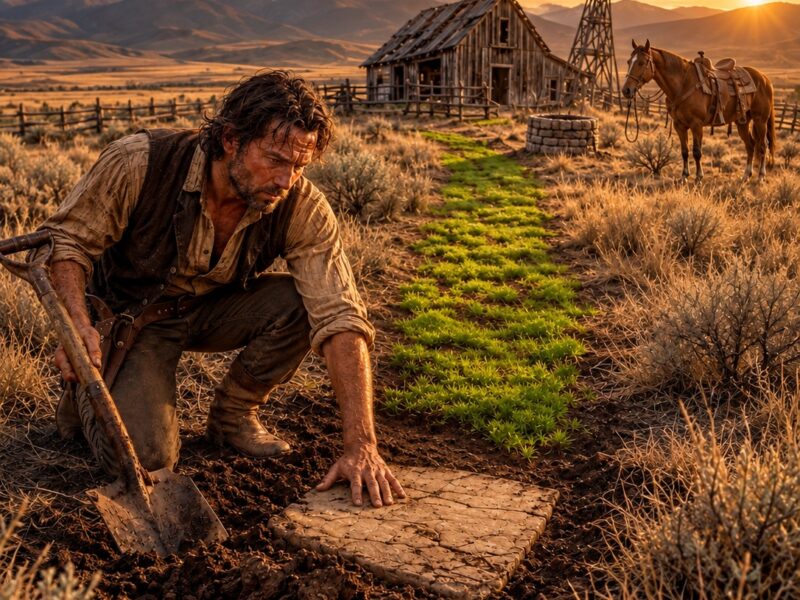
HE BOUGHT A 50-ACRE ABANDONED FARM. THE TOWN LAUGHED—UNTIL HE DISCOVERED WHAT WAS HIDDEN BENEATH IT
Adapted closely from the story framework you provided, including Raven Bend, the failing well, the windmill restoration, the drought, and the forgotten water system beneath the lower meadow.
The first time Bram Alder came to Raven Bend asking for water, nobody in Coldwater Basin was laughing anymore.
Five months earlier, men had told Kellen Rourke he had paid good money for fifty acres of dead Wyoming dirt.
Now half the basin was drying up—and beneath the farm everyone had mocked, something buried for decades was still moving water through the earth.
By nine in the morning, the cattle had begun striking the empty stock tank with their horns.
The sound carried across Raven Bend in the August heat: hollow wood, restless hooves, the low complaint of animals that did not understand why yesterday’s water had disappeared. Kellen Rourke stood beside the dry outlet pipe with his sleeves rolled above his elbows and mud already black beneath his fingernails. He held his palm beneath the opening until one drop formed, trembled, and fell.
Then nothing.
Behind him, twenty-six cattle crowded the fence, raising dust around their legs.
Bram Alder swung down from his horse without saying good morning. Three empty barrels rattled in the wagon behind him.
Kellen looked at them once.
“Your north well?”
“Dropped four feet since Tuesday.”
Kellen nodded toward his own trough. “Mine isn’t doing much better.”
Bram’s jaw tightened.
Five months earlier, that would have pleased him.
Now neither man smiled.
The windmill above the yard turned slowly in the hot western wind. Its rebuilt wooden tail creaked. The repaired gears moved. The pump rod rose and fell exactly as Kellen had taught it to do.
But machinery could not pump water that was no longer reaching the bottom of the well.
The thing that had kept Raven Bend alive through July wasn’t the windmill anymore.
It was what lay beneath the lower meadow.
And sometime during the night, it had stopped.
Kellen crossed the pasture at a run.
He followed a strip of darker grass barely visible beneath the summer yellow, dropped to one knee beside a flat sandstone slab, and drove his fingers beneath its edge. Bram caught up as Kellen lifted the stone.
Beneath it was the small settling chamber Kellen had built over an older system.
It should have held clear, cold water.
Instead, it was packed with brown silt.
Bram crouched beside him. “Can you clear it?”
“I can clear this.”
“That isn’t what I asked.”
Kellen looked toward the cattle.
The answer mattered more than either man’s pride.
“I don’t know.”
For several seconds, the only sound was the dry wind sliding through the grass.
Then another wagon appeared along Raven Bend’s northern fence.
Leah Fenner was driving it.
Her ten-year-old son Noah sat beside her.
Two more empty barrels stood in the wagon bed.
Kellen closed his eyes.
The day before, he had filled those same barrels because Leah’s well no longer produced enough for her milk cow.
He had told her she could return if she needed more.
He had believed the underground spring would refill the tank overnight.
Now Leah stopped her wagon fifty yards away and saw the cattle surrounding the empty trough.
She did not ask for water.
That somehow made it worse.
Kellen turned back to the buried line.
“Move the herd away from the lower fence.”
Bram looked at him.
“Why?”
“Because I’m going underground.”
Five months earlier, when Kellen Rourke first rode into Coldwater Basin, Bram Alder had been among the men convinced he would not survive until winter.
It was April of 1883.
Raven Bend had been abandoned for nearly six years.
From the road, the place looked less like a farm than something the prairie had started digesting.
Rabbit brush had swallowed the fence lines. One side of the barn sagged toward the ground. The garden wall had split open beneath years of frost. A windmill leaned above the yard, its blades frozen in place like the hands of a broken clock.
There were fifty acres on the deed.
Most people in Coldwater Basin considered perhaps ten of them useful.
The rest they considered a lesson.
Kellen had paid for all fifty.
He learned what the town thought of his purchase the first morning he stepped into Amos Bryce’s general store.
Three men were standing beside the stove despite the mild weather. One stopped talking when Kellen entered. Another looked at the new saddlebag over Kellen’s shoulder and then at Amos.
Amos gave Kellen the uncomfortable smile of a man who preferred selling nails to joining an argument.
“You’re the fellow who bought Raven Bend.”
“Kellen Rourke.”
“Amos Bryce.”
They shook hands.
The youngest man near the stove laughed.
Not cruelly.
Almost sympathetically.
“Thought Abel Turner’s family finally gave up trying to sell that place.”
“They did.”
“What’d you pay?”
Kellen looked at him.
The man lifted both hands.
“Fair enough.”
A voice came from behind Kellen.
“They should’ve paid you.”
Kellen turned.
Bram Alder stood near the front window, broad-shouldered and sun-darkened, his hat tucked beneath one arm. He was somewhere in his mid-forties and carried himself like a man accustomed to owning enough land that other people measured distance by his fences.
Kellen had seen the Alder ranch on his ride in.
It bordered Raven Bend to the east.
Bram nodded toward the store window.
“That ground goes brown early.”
Kellen said nothing.
“The well’s shallow.”
Still nothing.
“And that lower pasture grows brush better than grass.”
Kellen studied him.
“You’ve spent a lot of time looking at my land.”
A few men near the stove stopped smiling.
Bram’s expression barely changed.
“I spent twenty years looking across the fence at it.”
“Then I appreciate the information.”
Bram waited for something sharper.
It never came.
Kellen bought flour, coffee, salt, lamp oil, and two bundles of square nails. When Amos totaled the amount, Kellen counted the coins carefully before placing them on the counter.
Bram noticed.
Kellen noticed him noticing.
Neither spoke about it.
That evening, Kellen walked Raven Bend alone.
His mare, Juniper, followed without being led.
Kellen had learned a long time ago that land revealed itself differently on foot. From horseback, distance mattered. On foot, details did.
The soil near the house was powder dry.
The garden held more stone than vegetables.
The upper pasture showed old cattle trails, bare and hard where animals had once passed repeatedly between shade and water. Near the barn, the ground beneath the trough had cracked into small gray plates.
Kellen knelt beside it.
He pressed two fingers into the dirt.
Dry above.
Cool underneath.
He left his fingers there.
During the war, he had learned never to trust the appearance of ground from a distance.
A green field could hide mud deep enough to cripple a horse. A clear creek could disappear a mile upstream. A dry ravine could turn deadly after rain fell twenty miles away.
Water decided more battles than officers liked admitting.
After the war, Kellen had spent years hauling freight between towns where the map mattered less than the next dependable spring.
He had slept beside dry creek beds.
He had watched horses scent water before men saw it.
He had learned to respect anything that remained green when the country around it did not.
That was why the cottonwoods bothered him.
Four old trees stood along a shallow fold in Raven Bend’s lower meadow.
They were too large.
Too alive.
The land surrounding them looked starved, yet their branches carried new spring leaves.
Kellen walked toward them.
Juniper moved ahead of him.
He expected the mare to angle toward the shallow well beside the yard.
She did not.
She crossed directly into the lower meadow.
Kellen stopped.
Juniper lowered her nose near the base of the shallow draw.
She sniffed.
Moved ten feet.
Sniffed again.
Kellen looked toward the cottonwoods.
Then he noticed several flat stones barely visible beneath the grass.
Not scattered naturally.
Aligned.
He crouched and brushed soil from one.
Sandstone.
Another lay six feet away.
Then another.
The line curved toward the lower pasture.
Kellen stood slowly.
Behind him, the abandoned windmill did not move.
Ahead of him, the cottonwoods trembled in the evening breeze.
Something about Raven Bend had been forgotten.
He just didn’t know what.
The farm began punishing him the next morning.
The north sill of the barn was worse than it appeared. Kellen spent hours digging away rot before realizing the damaged timber carried more weight than he had expected.
He set temporary supports beneath the wall.
Then he added two more.
He should have added four.
When he worked the first rotten timber loose, the building groaned.
Kellen froze.
A brace slipped.
He threw himself backward as a beam dropped hard enough to shake dust from the rafters.
It struck the ground where his shoulder had been.
Juniper jerked against the corral rail.
Kellen remained on one knee.
Blood ran from his palm where a nail had torn the skin.
For several breaths, he stared at the beam.
The old version of himself would have stood immediately.
War had trained men to pretend pain had not happened.
Age had taught him that pretending was expensive.
Kellen wrapped his palm with a strip of cloth, walked around the barn twice, and spent the rest of the afternoon adding supports.
Near sundown, Bram rode along the boundary.
He stopped when he saw the braces.
“Looks like you’re repairing a corpse.”
Kellen drove a wooden wedge beneath one support.
Bram waited.
Kellen struck it again.
“One piece at a time.”
“You planning to rebuild everything yourself?”
“Everything I can.”
“And the things you can’t?”
Kellen finally looked up.
“I’ll learn.”
Bram laughed once.
Not loudly.
He rode on.
Kellen watched him disappear.
Then he reopened his bandaged hand, flexed his fingers, and picked up the hammer again.
By the end of the second week, Raven Bend had stripped Kellen of the illusion that owning land meant possessing it.
The farm owned his mornings.
The barn owned his afternoons.
The fence owned what remained of his strength.
He cut rabbit brush until his shoulders burned. He replaced only the fence posts that could no longer stand and reset those that could. He pulled rusted wire from grass that had grown around it years earlier.
At night, he ate beans at a small table in Abel Turner’s abandoned kitchen.
He kept the lamp low to save oil.
Sometimes the silence of the house reminded him of places after battles had ended.
Not the fighting.
The absence afterward.
Kellen had discovered during the war that men prepared themselves for noise but almost never for silence.
The farmhouse had that kind of silence.
Someone had once sharpened knives on the stone beside the stove.
Someone had marked children’s heights on a doorframe.
Someone had patched a cracked chair instead of throwing it away.
Kellen did not remove any of it.
Inside the barn, he found an old horseshoe hanging from a loose wooden peg.
He tightened the peg.
He left the horseshoe.
It had belonged to someone else’s life.
Raven Bend had already lost enough.
The problem Kellen could not repair with a hammer was money.
After the purchase, feed, seed, food, and the first round of supplies, he counted what remained at Amos Bryce’s counter.
Forty-three dollars and sixty cents.
He counted twice.
Amos pretended not to watch.
Kellen looked at the box of nails he had ordered.
“Give me half.”
Amos paused.
“You sure?”
“Half.”
Amos removed the other bundle.
Outside, two men were discussing Raven Bend.
They did not know Kellen could hear them through the open door.
“He’ll be hauling water by August.”
“Before.”
“That well barely survived when Abel was alive.”
Bram’s voice joined them.
“Gone by first hard freeze.”
The store went quiet.
Kellen picked up his nails.
Walked outside.
Bram met his eyes.
Kellen passed him without speaking.
The sentence followed him all the way home.
Gone by first hard freeze.
That night, Kellen sat beside the shallow well and calculated how many barrels of water nine cattle would require if he had to haul it from town.
The arithmetic was worse than the gossip.
He could repair Raven Bend.
He could not afford to carry water to it every day.
The windmill had to work.
The next morning, Kellen climbed its twenty-eight-foot wooden tower.
He tested every brace before trusting it.
The tower itself was weathered but usable.
The machinery was another matter.
The tail vane had disappeared.
One gear tooth had broken.
The crank had seized.
The pump rod was bent badly enough to scrape against its guide.
When Kellen removed the lower assembly, the leather cup inside was dry and stiff as bark.
Bram stopped again while Kellen arranged the pieces across the yard.
He looked at the rusted iron.
“Take the tower down.”
Kellen did not answer.
“Good firewood.”
Kellen picked up the bent rod.
“You ever repair one?”
“No.”
“Then we’re equally qualified to decide whether it’s dead.”
For the first time, Bram smiled.
“Fair enough.”
Kellen loaded the damaged pieces behind Juniper and rode to Ephraim Cole’s blacksmith shop.
Ephraim was sixty-three, with shoulders that had thickened from forty years behind a forge and hands burned enough times that small scars overlapped one another.
He examined the pump assembly.
Named a price.
Kellen did not reach for his pocket.
Ephraim glanced at him.
“Too much.”
“I didn’t say that.”
“You didn’t have to.”
Kellen looked at the iron.
“What can be saved?”
“Most of it.”
“What can’t?”
“Your money, if I do all the work.”
Kellen almost smiled.
Ephraim pointed toward the forge.
“There’s another way.”
“What way?”
“You come Saturdays.”
Kellen waited.
“I teach you.”
Kellen looked from him to the hammer.
“How much?”
“Enough that you’ll respect my time. Less than enough to ruin you.”
“When do we start?”
Ephraim placed the hammer beside him.
“Now.”
The blacksmith taught without comforting.
Kellen ruined his first leather cup.
Overheated one section of pump rod.
Filed the damaged gear tooth too aggressively and had to reshape it.
Ephraim rarely corrected him immediately.
He let Kellen notice.
“You could’ve told me.”
“You could’ve looked.”
Kellen glared at him.
Ephraim shrugged.
“I won’t be at Raven Bend when it breaks.”
That sentence stayed with Kellen.
He stopped trying to make the iron obey.
He began studying why it resisted.
The rod straightened a few inches at a time.
The crank needed alignment, not force.
The gear needed enough play to move without binding.
By late spring, the repaired assembly rested on Ephraim’s bench.
Kellen rolled the pump rod across the surface.
Straight.
Ephraim nodded once.
“That’ll do.”
Coming from him, it felt extravagant.
Meanwhile, Raven Bend changed so slowly that nobody noticed.
Kellen rebuilt the barn corner.
Patched the roof.
Reset the garden wall.
Using salvaged glass, old lumber, and manure beneath the soil for warmth, he built a low cold frame.
On cold mornings, he placed his hand beneath the glass and felt heat trapped inside.
It wasn’t much.
But neither was forty-three dollars and sixty cents.
Small things had become Kellen’s arithmetic.
A fence post saved was a post not purchased.
A repaired hinge was money not spent.
A cabbage grown was food not hauled home.
A machine learned was a bill avoided.
Raven Bend was teaching him that survival rarely arrived dramatically.
Usually it appeared disguised as one less expense.
In June, Kellen reassembled the windmill.
The new tail vane he made from pine boards looked crude enough that even he disliked it.
But it caught wind.
For most of the morning, the air remained still.
The wheel moved half a turn.
Stopped.
Kellen stood beneath it with both hands on his hips.
Juniper waited beside the trough.
“Don’t look at me.”
The mare flicked an ear.
Near noon, wind spilled down from the western ridge.
One blade moved.
Then another.
The crank turned.
Above Kellen, old iron began clicking.
The pump rod rose.
Dropped.
Rose again.
Nothing came from the pipe.
Kellen’s jaw tightened.
Another stroke.
Nothing.
Then the pipe coughed.
Brown water spat into the trough.
Juniper stepped backward.
A second stroke brought more.
Mud first.
Then cloudy water.
Then a thin steady stream.
Kellen did not cheer.
He simply stood beside it.
Across the property line, Bram stopped working.
The sound of the windmill traveled across the basin.
Old metal.
Uneven rhythm.
A machine everyone had considered dead.
Bram rested both arms on the fence.
The trough filled only a few inches before the wind weakened.
That didn’t matter.
The machine worked.
Juniper drank.
Kellen placed his hand against the iron housing.
He could feel the repaired linkage moving inside.
For several seconds, he thought of Ephraim’s forge.
A working mechanism needed room to move.
Funny.
So did a man.
The windmill gave Raven Bend water.
It did not give it abundance.
Kellen began with nine cattle.
One milk cow.
Juniper.
Within weeks, the animals exposed another weakness.
They grazed the same places repeatedly.
Near water.
Near shade.
Along familiar paths.
Grass disappeared from those areas while taller sections farther away remained untouched.
Kellen had planned to open the entire lower pasture.
Then Mara Bellamy came to Raven Bend.
Amos had told her about him.
Kellen suspected Amos told everyone about everyone.
Mara was a widow in her early fifties who had managed cattle with her husband for twenty-seven years and without him for seven.
She studied Raven Bend without insulting it.
Kellen appreciated that.
She pointed toward a bare strip beside the trough.
“What happened there?”
“They ate it.”
“All of it?”
“Near enough.”
“What happens when you open that section?”
Kellen looked toward the ungrazed grass.
“They eat that.”
“And tomorrow?”
Kellen frowned.
Mara waited.
He looked behind him.
The answer embarrassed him because it was obvious.
“They come back here.”
Mara nodded.
Kellen changed his plan.
Using temporary stakes, rope, salvaged rail, and more walking than seemed reasonable, he divided the pasture.
He moved the cattle before they stripped one section bare.
Then he left the used ground alone.
Bram watched this from his ranch.
One afternoon, he rode over.
“You planning to fence every cow individually?”
“If one starts complaining, I’ll reconsider.”
“You’re making more work.”
“For now.”
Bram looked at the taller grass in a rested section.
“Does it help?”
“I’ll tell you in August.”
Bram’s expression changed slightly.
Neither mentioned his prediction.
By early summer, the cold frame and garden began producing more than Kellen could eat.
Onions.
Beans.
Cabbage.
Turnips.
Nothing impressive by the standards of men farming richer ground.
But Kellen remembered the freight road south.
He knew where stage wagons stopped.
He knew what food disappeared first after days of travel.
He knew fresh vegetables could be more valuable twenty miles from a garden than beef was twenty feet from a steer.
He loaded what Raven Bend could spare.
The stage stop bought some.
The freight station traded for hay.
Kellen returned with salt, lamp oil, seed, and another bundle of square nails.
Amos looked at the supplies.
“Farm turning a profit?”
“No.”
“Then what do you call that?”
Kellen lifted the bag of nails.
“Not buying these with savings.”
Amos considered that.
“Close enough.”
It wasn’t.
Kellen knew the difference.
Raven Bend was not earning him a living.
It had simply begun paying for some of what it consumed.
For the first time since buying it, something had left through the gate and returned as something useful.
He slept better that night.
Then July arrived.
The rain stopped.
Within two weeks, the basin changed color.
Green became yellow.
Yellow became gray.
Shallow ponds shrank.
Hoofprints hardened like fired clay.
The windmill turned more often, but each day it took longer to fill the trough.
The well was recovering slowly.
One morning, Kellen lowered the bucket and listened.
He knew the sound immediately.
Too far.
Bram’s prediction returned.
August.
Kellen walked the pasture that evening.
The rested grass had helped.
The garden had helped.
The windmill had helped.
But none of those things could manufacture water.
He considered selling cattle before prices dropped.
Then Juniper stopped in the lower meadow.
The mare lowered her nose.
Kellen followed her gaze.
A narrow strip of grass remained green.
Not green by memory.
Green now.
It curved through soil that had dried on both sides.
Kellen walked its length.
Thirty feet.
Perhaps more.
The cottonwoods stood farther uphill.
Then he saw sandstone.
The same flat stones he had noticed in April.
Only now their alignment was unmistakable.
Kellen returned with a shovel.
The blade cut through grass.
Roots.
Then struck something solid.
He cleared soil with his hands.
A flat sandstone slab appeared.
Kellen moved six feet.
Dug again.
Another.
He followed the curve.
A third.
The town had spent years calling Raven Bend dry.
Someone had once spent a great deal of labor burying stone exactly where the ground remained wet.
Kellen knelt beside the first slab.
He loosened its edges.
Lifted.
Rolled it aside.
The underside was cold.
The soil beneath it was dark.
Wet.
Kellen touched it.
Water gathered slowly around his fingers.
He stared.
Not treasure.
Not silver.
Not some impossible fortune hidden by an outlaw.
Something more useful.
Water.
He should have stopped.
That became one of the most important lessons Raven Bend ever gave him.
But hope can make a careful man reckless faster than desperation.
Kellen believed the answer was simple.
If opening one narrow section exposed water, opening a larger one should expose more.
He removed another slab.
Then another.
The wet soil widened.
Mud formed.
A little water seeped into the trench.
Kellen worked faster.
He imagined a spring.
A pond.
A permanent source beneath the meadow.
Then the bank collapsed.
Wet earth slumped inward.
Silt rolled across the bottom.
The clear seep turned brown.
Kellen dug it out.
More collapsed.
He dug again.
The flow weakened.
By afternoon, the trench was twice as large and producing less water than when he started.
Bram appeared at the boundary.
He dismounted.
Walked over.
This time, he did not laugh.
He looked at the excavation.
Then at Kellen.
“You may have found water and killed it in the same afternoon.”
Kellen’s hand tightened around the shovel.
There were times when another man’s criticism hurt because it was cruel.
This hurt because it was accurate.
Bram waited for an argument.
Kellen gave him none.
Near dusk, he stopped digging.
He sat beside the damaged trench.
Cloudy water collected in one corner.
Barely enough to wet his palm.
Mud covered his hands.
For months, he had accused Raven Bend of being difficult.
That evening he understood the land had offered him something rare.
He had damaged it because he had been too impatient to understand it.
“For once,” he whispered, “you didn’t fail me.”
Juniper stood behind him.
Kellen looked at the muddy trench.
“I failed you.”
The next morning, he did not touch the shovel.
He rode to Mara Bellamy’s place.
Mara listened while he described the stones.
The green strip.
The seep.
His mistake.
When he finished, she asked only one question.
“Where exactly does the stone line run?”
Kellen showed her.
Mara stared toward the western ridge.
“My husband kept survey papers.”
They searched an old wooden chest in her house.
Most of the documents were useless.
Property measurements.
Fence notes.
Creek crossings.
Tax records.
Then Mara unfolded a county plat almost twenty years old.
A pencil line crossed Raven Bend’s lower meadow.
Beside it were two words.
WET DRAW.
Farther uphill sat a small symbol.
A spring.
A thin line followed the slope downhill.
And beside that line was a name.
JORY BELL.
“You know him?” Kellen asked.
Mara shook her head.
“Ephraim might.”
They took the papers to the blacksmith.
Ephraim studied the name.
His eyebrows lifted.
“Jory Bell.”
“You remember him?”
“Barely.”
“What did he do?”
“Stone work. Ditches. Water.”
Kellen leaned closer.
“What kind of water work?”
“The kind people paid him for.”
“Ephraim.”
The blacksmith smiled.
“Traveling ditch builder. Came through twenty-some years ago. If a rancher had water in the wrong place, Bell tried putting it in the right one.”
Mara touched the line on the plat.
“This isn’t a well.”
Kellen looked at her.
She traced the pencil mark.
“I think it’s a collection gallery.”
He said nothing.
Mara explained slowly.
A shallow wet seam could be protected rather than excavated.
Gravel allowed water to move.
Willow bundles trapped silt.
Flat stone kept soil from collapsing into the seep.
Then gravity carried collected water downhill.
Kellen stared at the old map.
The sandstone had not been covering water.
It had been protecting the earth that carried it.
Every slab he had removed had been part of the system.
He closed his eyes.
“I tore it apart.”
“Part of it.”
“I widened the trench.”
“Yes.”
“I cut into the wet layer.”
“Yes.”
Kellen looked at Mara.
“You could stop agreeing.”
“You came here for the truth.”
That silenced him.
Ephraim folded his arms.
“You learned iron because you stopped forcing it.”
Kellen looked at him.
The blacksmith nodded toward the map.
“Try learning dirt.”
That afternoon, Kellen returned to the lower meadow.
He brought the shovel.
This time, he used it to put earth back.
He removed loose mud.
Packed firm clay against the weakened sides.
Added coarse gravel where the seep had originally moved.
Cut thin willow and bundled it across the wet seam.
Then he replaced the sandstone.
Slowly.
One slab after another.
The work felt wrong.
Every instinct told him progress required opening, exposing, building, adding.
Instead, he was covering something.
Protecting it.
Disturbing less.
Mara arrived before sunset.
They waited beside a small collection pocket Kellen had left exposed.
Nothing happened.
Then the gravel darkened.
A drop appeared.
Another.
A narrow thread of clear water formed between two stones.
Kellen leaned closer.
Mara crouched beside him.
“The stones aren’t making it.”
“I know.”
“They’re keeping what’s already there from disappearing into mud.”
The water continued.
Kellen touched it.
Cold.
He had repaired the windmill by making old machinery move again.
The meadow demanded the opposite.
Sometimes a repair meant leaving something alone.
For the next week, Kellen followed the buried line downhill.
The original conduit had nearly disappeared.
Some cedar sections crumbled when he touched them.
Others had survived in damp soil long enough to reveal how they had been fitted.
Kellen stopped trying to recreate Jory Bell’s work exactly.
He concentrated on the principle.
Collect above.
Let sediment settle.
Carry water downhill.
Keep the line cool.
Keep soil out.
Where cedar worked, he used cedar.
Where it did not, he built narrow channels from flat stone.
He sealed joints with cloth and warm pine pitch.
He measured the fall repeatedly before covering anything.
At the lower pasture, he positioned an old stock tank.
Then he connected the final section.
Nothing happened.
Kellen waited.
Walked uphill.
Checked the grade.
Returned.
Still nothing.
He was halfway back to the collection pocket when he heard it.
Tap.
He stopped.
Tap.
Then a thin stream of water struck the bottom of the tank.
Kellen turned.
The windmill above the farm stood completely still.
Not one blade moved.
The underground line continued running.
Water crossed Raven Bend without a bucket.
Without wind.
Without Kellen’s strength.
He walked to the outlet.
Held his hand beneath it.
The flow was not impressive.
No man would have photographed it.
No newspaper would have written about it.
But it kept coming.
That mattered more than force.
Kellen sat beside the tank until darkness covered the meadow.
The first failure came four days later.
The stream slowed.
Then stopped.
Old Kellen would have opened everything.
New Kellen started at the top.
The settling pocket held silt.
Willow had caught debris.
One cedar joint had drawn air where pitch separated.
A section of conduit had too little fall.
Three small problems.
Together, they stopped the whole system.
Kellen repaired each one.
Then he changed the design.
He covered the settling pocket with one broad sandstone slab that could be lifted later.
Maintenance access.
Ephraim would have approved.
That evening, water ran again.
Kellen sat on the stone.
He understood something he had never learned during the war.
Finding an answer did not mean problems ended.
A good answer simply showed you where effort mattered.
August arrived carrying the worst drought Coldwater Basin had seen in years.
Bram’s north pond disappeared.
Leah Fenner’s well dropped.
Two ranchers drove cattle toward another valley.
At Amos Bryce’s store, men stopped discussing whether Kellen would fail.
They were too busy measuring their own water.
Raven Bend was hurting too.
Kellen’s well recovered more slowly each day.
The underground gallery produced less.
But it still produced.
One afternoon, Leah arrived with Noah and two barrels.
Kellen understood before she climbed down.
“My well’s below the bucket.”
He looked toward her wagon.
“The cow?”
“She’s drinking.”
Leah hesitated.
“For now.”
Kellen walked to the tank.
He calculated.
His cattle.
Her cow.
Tomorrow.
The day after.
Leah saw him doing it.
“Forget it.”
He looked at her.
“We’ll find another way.”
“You already drove here.”
“That doesn’t mean you owe me water.”
Kellen opened the valve.
The first barrel filled.
The level in his tank dropped visibly.
Leah swallowed.
“One is enough.”
Kellen rolled the second barrel into place.
“Kellen.”
“Your boy needs milk.”
Noah looked away.
Kellen opened the valve again.
After they left, he stood beside the half-empty tank.
He had made the decision quickly.
Living with it took longer.
That night the wind changed.
A dry storm moved through without rain.
Dust crossed Raven Bend in sheets.
It filled window tracks.
Covered the porch.
Worked beneath doors.
By morning, the underground line had stopped.
Which brought Kellen back to the empty trough.
The anxious cattle.
Bram’s barrels.
Leah waiting quietly in her wagon.
And one terrifying question.
Had he given away water his own animals needed to survive?
Kellen cleared the settling pocket.
Cleaned the screen.
Checked the inlet.
Nothing.
He opened one access point downhill.
Dry.
Another.
Water stood inside the conduit.
That made no sense.
He checked the next.
Dry.
Kellen stared at the ground between them.
Then understood.
The drought had shrunk the soil.
A section had settled.
The conduit sagged downward before rising again.
Water collected in the low point.
Air trapped beyond it.
The gravity line had lost its continuous fall.
Kellen looked toward the sun.
Already climbing.
Hours of heat remained.
Bram approached.
“You find it?”
“I think so.”
“What do you need?”
Kellen pointed toward the herd.
“Keep them away from me.”
Bram moved without another word.
Months earlier, he had stood across a fence making predictions.
Now he opened the gate.
Drove Kellen’s cattle back.
Repaired a loose temporary rail without being asked.
Kellen exposed only the damaged section.
Not the whole line.
He placed flat stones beneath the sag.
Raised the cedar conduit a fraction at a time.
Checked the grade using a straight board.
Raised it again.
Water shifted inside.
Mud came out.
Then air.
Kellen reset the joint.
Packed soil firmly around it.
He ran downhill.
Waited at the outlet.
Nothing.
Bram joined him.
Leah remained beside the wagon.
Noah held the milk cow’s lead.
A steer struck the trough.
Kellen could hear his own breathing.
A drop fell.
Nobody moved.
Another.
Then water appeared.
A thread.
Thin.
Uncertain.
Kellen lowered himself beside the outlet.
The stream strengthened.
Water struck wood.
One cow lifted its head.
Bram opened the gate.
The animals crowded forward.
Kellen stayed where he was.
The stream held.
Ten minutes.
Twenty.
An hour.
Still running.
Leah covered her mouth with one hand.
Bram crouched beside the outlet.
He placed two fingers beneath the water.
Kellen watched him.
For a long time, neither man spoke.
Then Bram asked, “How far below that first sandstone did you find the wet seam?”
Kellen almost laughed.
Not because the question was funny.
Because of everything it meant.
“About eighteen inches.”
Bram nodded.
“My south meadow has cottonwoods.”
Kellen looked at him.
“Old ones?”
“Older than the house.”
“Any green ground nearby?”
“Sometimes.”
“Sandstone?”
Bram’s face changed.
“I don’t know.”
Kellen stood.
“Then that’s where you start.”
Bram looked toward his empty barrels.
“I was wrong about you.”
Kellen wiped mud across his trousers.
“You were right about the well.”
“That’s not what I mean.”
Kellen met his eyes.
Bram had expected ridicule in return.
Kellen gave him none.
“I know.”
They filled one of Bram’s barrels before sunset.
Not three.
One.
Enough to carry several calves through the evening.
Bram accepted the limit without argument.
That mattered too.
News spread.
Not exaggerated news.
Something more powerful.
Practical news.
Bram Alder had gone to Raven Bend for water.
By September, men who had laughed beside Amos Bryce’s stove were asking different questions.
Did cottonwoods always mean groundwater?
No.
Did sandstone always hide a spring?
No.
Could a buried gallery save every ranch?
No.
Kellen refused to turn one success into superstition.
He walked land with men.
Looked for wet seams.
Old ditches.
Plants that remained green longer than surrounding grass.
Depressions suggesting forgotten drainage.
He told them what Mara had told him.
“Don’t dig because you hope.”
“Dig because you’ve found a reason.”
At the forge, Ephraim began seeing broken pumps brought in by farmers who previously would have ordered new ones.
He complained about the extra work.
Then taught them anyway.
Mara’s old survey maps became more valuable than anyone expected.
One contained markings for an abandoned spring west of the basin.
Another showed an irrigation ditch that had disappeared beneath forty years of sediment.
Jory Bell, dead for years, began influencing Coldwater Basin again.
Not because anyone remembered his face.
Because his work still made sense.
Raven Bend survived the summer.
Not comfortably.
Kellen sold two cattle earlier than planned.
The garden produced less.
The upper pasture went nearly white.
But the rested grazing sections recovered after September rain.
The buried gallery continued feeding the lower trough.
The windmill still pumped whenever wind crossed the ridge.
The farm had no single miracle.
That became the truth Kellen trusted most.
Everything mattered together.
The repaired machine.
The rested grass.
The garden.
The freight road.
The buried water.
The willingness to ask people who knew something he did not.
In October, Bram entered Amos Bryce’s store while Kellen was buying lamp oil.
The same men who had mocked Raven Bend the previous spring were there.
One of them grinned.
“Bram, weren’t you the one said he’d be gone by first freeze?”
The room quieted.
Kellen continued measuring nails.
Bram could have defended himself.
He could have blamed the drought.
The forgotten waterworks.
Abel Turner’s neglected farm.
Bad information.
He did none of those things.
“I was wrong.”
That was all.
Kellen looked over.
Bram looked back.
A small thing passed between them.
Respect, perhaps.
Or simply the recognition that both men had been wrong about something important and had survived admitting it.
Winter came early.
One November morning, Kellen crossed the lower meadow beneath frost.
The world had turned pale.
Fence rails.
Grass.
Barn roof.
Even Juniper’s whiskers carried white crystals.
Kellen walked toward the sandstone line.
Nearly everything above ground was frozen.
But one narrow strip remained dark.
Moisture moved below it.
He stopped where he had first lifted the stone.
The slab was buried again.
Grass covered it.
A stranger could cross Raven Bend and never know the system existed.
Kellen liked that.
The best things on the farm had stopped needing to announce themselves.
Behind him, the barn stood straight.
Not new.
Straight.
The garden wall had been repaired.
Smoke rose from the farmhouse chimney.
Above the yard, the windmill turned slowly.
Its ugly pine tail vane still caught the wind.
Kellen had considered replacing it with something prettier.
He never did.
Ephraim said there was no reason to improve a piece of machinery simply because other people had finally decided to admire it.
Kellen suspected the blacksmith was talking about more than machinery.
The following spring, Raven Bend looked different.
Not transformed.
That word would have insulted the work.
Transformation sounded sudden.
Raven Bend had changed because someone had noticed thousands of small things and refused to ignore them.
Kellen increased his herd carefully.
He added fencing.
Expanded the garden.
Built a second settling tank below the buried gallery.
He never excavated the wet seam again.
Once each month, he lifted the access stone.
Cleaned silt.
Checked willow.
Inspected joints.
Then covered it again.
One afternoon, Leah Fenner arrived without barrels.
Noah jumped from the wagon holding a small wooden box.
“For you.”
Kellen opened it.
Inside lay a new leather cup for the windmill pump.
He looked at Leah.
“Noah made most of it.”
The boy immediately objected.
“Mr. Cole helped.”
Ephraim had obviously helped considerably.
Kellen held the leather.
“Why?”
Noah looked toward the lower pasture.
“Ma says you gave us water when you didn’t know if you had enough.”
Leah’s face tightened slightly.
She disliked owing people.
Kellen understood.
He placed the leather cup back into the box.
“Then I’ll keep this until the old one fails.”
Noah frowned.
“You’re not putting it in?”
“Not yet.”
“Why?”
Kellen smiled.
“Because replacing something that still works is how a man with forty-three dollars ends up with twenty.”
Leah laughed.
Noah did not understand.
Someday he would.
By summer of 1884, travelers passing through Coldwater Basin sometimes asked about Raven Bend.
The farm had acquired a reputation larger than the farm itself.
People imagined a powerful underground river.
Some said Kellen had discovered a natural spring large enough to supply the whole valley.
One man claimed Abel Turner had buried an iron pipe from the mountains.
Another claimed Spanish miners had constructed tunnels beneath the property.
Kellen corrected anyone who asked him directly.
“It is a wet seam, gravel, stone, cedar, gravity, and maintenance.”
Most listeners appeared disappointed.
People preferred miracles.
Kellen trusted mechanisms.
One evening, Mara Bellamy came for supper.
Afterward, they sat on the porch while sunset moved across the basin.
She watched the windmill.
“You know what bothers people about Raven Bend?”
Kellen drank coffee.
“That it exists?”
“That too.”
She smiled.
“They want the answer to be the spring.”
“It isn’t?”
“You know it isn’t.”
Kellen waited.
Mara looked across the fifty acres.
“If you hadn’t repaired the barn, you’d have lost hay.”
He nodded.
“If you hadn’t fixed the windmill, you’d have failed before discovering the gallery.”
Another nod.
“If you hadn’t rested the pasture, your cattle would’ve eaten the place bare before August.”
“Yes.”
“If you hadn’t known the freight road, you’d have spent your last money buying what you traded for.”
Kellen looked at her.
“And if I hadn’t torn open the spring?”
“You wouldn’t have learned how it worked.”
He stared into his coffee.
“That is a generous description of stupidity.”
“It can be both.”
For a moment, neither spoke.
Mara’s expression softened.
“The thing beneath Raven Bend didn’t save you, Kellen.”
“No.”
“You learned how to use what was already here.”
He looked toward the cottonwoods.
The statement unsettled him because it was larger than farming.
For years, Kellen had believed survival meant becoming harder.
The war taught hardness.
Freight work rewarded it.
Loneliness made it convenient.
Raven Bend had demanded something else.
Attention.
Patience.
Help.
Restraint.
The ability to admit that another person understood something he did not.
Those qualities had once felt softer.
Now he understood how much strength they required.
Late that summer, Bram rode over carrying an old county plat.
He unfolded it across Kellen’s kitchen table.
“My south meadow.”
Kellen studied it.
A faint line crossed Bram’s property.
Bram tapped it.
“Could be nothing.”
“Could be.”
“You’ll come look?”
Kellen folded the map.
“Tomorrow.”
Bram nodded.
At the door, he stopped.
“There is one thing I still don’t understand.”
“What?”
“Why did you buy Raven Bend?”
Kellen leaned against the table.
Nobody had asked him that directly.
They assumed the answer was price.
Partly, it was.
But not entirely.
Kellen looked out the window.
“I spent most of my life going somewhere.”
Bram waited.
“Army sent me one place. Freight companies sent me another. Every road had a next town. Every camp had a morning when you packed it again.”
He touched the old kitchen table.
“When I saw Raven Bend, everybody told me reasons not to stay.”
Bram smiled slightly.
“So naturally you stayed.”
“Apparently I’m difficult.”
“I’ve noticed.”
Bram opened the door.
Kellen stopped him.
“There was another reason.”
Bram turned.
“The cottonwoods.”
Bram laughed.
For once, so did Kellen.
Years later, Coldwater Basin remembered the story differently depending on who told it.
At Amos Bryce’s store, the story became one about a stranger buying worthless land while wiser men laughed.
At Ephraim Cole’s forge, it became a story about repairing machinery instead of throwing it away.
Mara Bellamy told people it was about old survey maps.
Leah Fenner told Noah it was about a man opening his valve when he could not be sure he had enough water for himself.
Bram Alder told it shortest.
“I misjudged the land.”
If someone asked Kellen, he usually refused to tell the story at all.
He would take them to the lower meadow.
He would show them the cottonwoods.
The green strip.
The access slab.
He would lift the sandstone carefully.
Beneath it, cold water still collected among gravel and willow before entering the line that carried it downhill.
Then Kellen would replace the stone.
“What am I supposed to be looking at?” one young rancher asked him once.
Kellen brushed soil across the slab.
“What somebody before us understood.”
The young man looked disappointed.
“That all?”
Kellen glanced toward the stock tank.
Water fell steadily from the outlet.
“You’ll find ‘that all’ is usually plenty.”
On the second anniversary of Kellen’s arrival, frost covered Raven Bend again.
He crossed the meadow before sunrise.
Juniper walked beside him, older now but still inclined to choose her own path.
She stopped at the green strip.
Kellen smiled.
“You knew first.”
The mare lowered her head.
Farther down, cattle drank from the trough.
The windmill turned above the farm.
The barn no longer leaned.
Smoke rose from the chimney.
Nothing about Raven Bend looked wealthy.
Nothing about it looked miraculous.
It looked used.
Maintained.
Alive.
Kellen stood beneath the cottonwoods and remembered the men beside Amos Bryce’s stove.
Gone by first hard freeze.
He did not resent them anymore.
If he had seen Raven Bend through their eyes, perhaps he would have laughed too.
A ruined barn.
A dying well.
A broken windmill.
Dead fences.
Fifty acres priced low enough to warn any sensible buyer away.
They had valued the property by what they could see.
Kellen had almost made the same mistake.
The thing that changed Raven Bend had been beneath their boots the entire time.
Not a chest of money.
Not gold.
Not oil.
Not some secret fortune waiting to make one man rich.
Water.
Old workmanship.
Forgotten knowledge.
A hidden system built by a man whose name had nearly disappeared.
And even that had not been enough by itself.
The buried gallery had needed repair.
The conduit needed maintenance.
The spring still weakened during drought.
The farm still demanded work every morning.
That was why Kellen never described what he found as treasure.
Treasure implied possession.
Water demanded responsibility.
As the sun rose across Coldwater Basin, light reached the lower meadow.
Most of the frost began disappearing.
A narrow dark line remained where moisture traveled under the soil.
Kellen followed it with his eyes.
From the forgotten spring.
Past the buried sandstone.
Through the repaired conduit.
Toward the trough.
Then beyond Raven Bend, toward ranches where men were now studying old plats, repairing pumps, resting pasture, reopening forgotten ditches, and looking twice at trees that stayed green when the surrounding land went brown.
Jory Bell had died without knowing whether anyone would remember what he built.
Abel Turner had died believing Raven Bend was simply becoming too difficult to maintain.
The heirs who sold it thought they had finally gotten rid of fifty useless acres.
The men in town thought Kellen Rourke had bought a failure.
They had all been partly right.
Raven Bend was difficult.
It had been neglected.
Its well was weak.
Its buildings were failing.
And the fifty acres would never make Kellen a rich man.
But the town had made one mistake that mattered more than all the others.
They thought abandoned meant empty.
Kellen rested his hand against the trunk of the oldest cottonwood.
Beneath him, unseen beneath stone, roots, gravel, willow, cedar, and earth, water continued moving.
Quietly.
Patiently.
Exactly where it had been all along.









