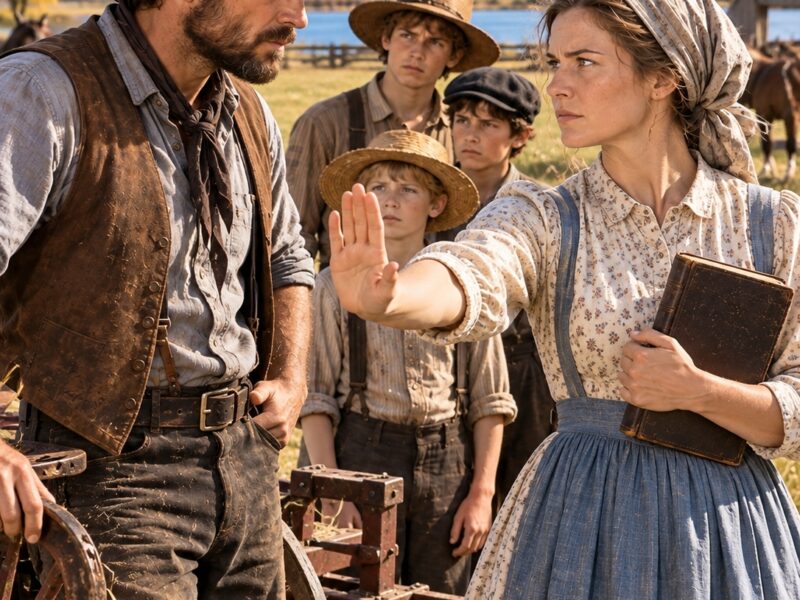
He Had Ten Days to Save His Winter Hay—Then a Widowed Mother Refused Sunday Work and Forced Him to Choose Between His Herd, His Word, and His Faith
Ezra Colton had eighty acres of hay standing under a blue Dakota sky, two hundred cattle depending on it, and ten days before the first hard frost could ruin everything.
The only workers left in Fairlee were a widowed immigrant mother and her five sons—but before Ezra could hire them, she placed one condition between his herd and winter survival.
What looked like an impossible demand would soon expose a frightened son, a broken promise, a threatened homestead, and the difference between faith that costs nothing and faith tested under a darkening sky.
Ezra Colton had ten days of hay to cut and exactly ten days to cut it in.
That was the arithmetic he carried into Fairlee on Thursday morning, September 16, 1886, riding thirty miles down the James River road beneath a sky so hard and clean it looked hammered from blue metal. The prairie grass along the lower flats had cured to the color of old brass, and every gust through it sounded dry enough to burn.
It had been the worst summer Ezra could remember in thirteen years of ranching Dakota Territory. The upland pastures were cropped to dirt, the creek had narrowed to a ribbon between cracked banks, and his eighty-acre slough meadow was the only decent stand of hay left within twenty miles.
Two hundred cattle would need that grass by January.
Without it, he could sell half the herd before winter or watch good animals go thin.
Neither possibility felt like survival.
His four hired hands had quit three days earlier for railroad work east of town, where contractors paid a dollar and a half a day and did not care whether a man knew cattle from fence posts. That left Ezra, his foreman Sam Teller, one horse mower, one rake, and a deadline no machine respected.
“With six good hands and no trouble, week and a half,” Sam had said before sunrise, squinting west. “Frost by month’s end. Rain might beat it. I wouldn’t count on a day of grace.”
“I’ll bring six men back.”
Sam spat into the dust.
“From Fairlee?”
“Yes.”
“Good luck.”
By noon Ezra understood the sarcasm.
The livery had nobody.
Feed store had nobody.
Boardinghouse had three men recovering from railroad injuries and one traveling salesman who claimed hay made him sneeze.
At the saloon, the bartender wiped a glass and said, “Every man strong enough to lift a pitchfork is laying rail twenty miles east.”
Ezra stepped back onto the boardwalk.
The town shimmered in dry afternoon light. A wagon rattled past the bank. Two dogs slept beneath the mercantile awning. Somewhere behind the blacksmith shop, iron rang against iron.
Then Ezra noticed the wagon near the stock pens.
Canvas top patched in three colors.
Two tired oxen.
A woman sat upright on the seat wearing a gray kerchief tied over dark hair streaked prematurely with silver.
Five boys sat in a row on an overturned feed trough beside her.
Tallest to shortest.
Like fence posts planted by a patient hand.
Their clothes were old but clean. Knees patched. Sleeves mended. Boots repaired rather than replaced.
They were not begging.
That was the first thing Ezra noticed.
The second was the long-handled tool wrapped in sacking across the oldest boy’s knees.
Another beside the second boy.
Another beside the third.
Scythes.
Ezra stopped.
The woman saw him looking.
“You seek workers.”
Her English was careful, accented, each word set down deliberately.
“I do.”
“For hay?”
“Yes.”
“How much?”
“Eighty acres. Ten days. Six dollars a day for the family, meals included.”
She did not answer immediately.
Her eyes moved over him once—not flirtation, not suspicion exactly. Calculation. The same plain arithmetic Ezra had been doing since dawn.
“My name is Katarina Reimer. These are my sons. Jakob, Johann, Peter, Martin, Emil.”
Each boy lifted his chin as she said his name.
The smallest, Emil, perhaps five, lifted his highest.
“My husband died in April,” Katarina continued. “We have a homestead claim north of Wessington. House is not finished. Winter comes. We need wages.”
Ezra nodded.
“If you can work, I can pay.”
“We work.”
“Good.”
“One thing.”
Her hand rose.
Palm out.
Not asking permission.
Making a boundary visible before anyone could pretend later not to have seen it.
“We work six days.”
Ezra waited.
Katarina’s steady gray eyes did not move from his.
“My sons will not work on the Lord’s Day.”
For several seconds Ezra heard only the stock-yard gate knocking in the wind.
Then he looked at the boys.
None looked embarrassed.
None looked away.
Even Emil seemed to understand that whatever happened next mattered.
“Mrs. Reimer,” Ezra said slowly, “I’ve got ten days before frost if the weather holds. Two of those are Sundays.”
“Then you have ten days.”
“And you have eight.”
“Perhaps nine if God is generous with weather.”
“That isn’t how hay works.”
“No.”
She said it without offense.
“That is why I tell you now.”
Ezra pushed his hat back.
“You understand I could lose most of my winter feed.”
“Yes.”
“And if rain catches cut hay before stacking, I lose more.”
“Yes.”
“Then why travel looking for harvest work if you won’t harvest when the crop needs it?”
Katarina’s expression did not harden.
That somehow made the answer more difficult to dismiss.
“Because before we left Russia, my husband and I kept Sunday when keeping it was easy. We kept it when it was difficult. I do not teach my sons that a promise becomes optional when money is on the other side.”
Ezra looked toward the road.
Empty.
The town had produced no better solution.
“What if I pay double on Sunday?”
“No.”
“Triple?”
“No.”
“Ten dollars each?”
Katarina’s mouth almost moved.
Not quite a smile.
“I told you before money so you would not waste time finding the price of something not for sale.”
The oldest boy, Jakob, watched Ezra steadily.
Sixteen, Ezra guessed.
Lean.
Already carrying a man’s shoulders because circumstances had decided childhood was over.
“Any of you used a horse mower?”
Katarina glanced at Jakob.
“He learns quickly.”
“That wasn’t the question.”
“No.”
“We have scythes. We cut hay since they were children.”
Ezra looked at the boys again.
“Can they keep up with a machine?”
Katarina answered with unusual care.
“I will not promise that.”
He raised an eyebrow.
“I promise they will not stop.”
That was a strange answer.
It was also the first claim she had made that Ezra believed completely.
He looked at the canvas wagon, the exhausted oxen, the family’s possessions tied down beneath patched canvas. A widow with five boys and a homestead claim half built against a Dakota winter had probably learned more about not stopping than most men he knew.
“Follow me.”
Katarina blinked once.
“Mr…?”
“Colton. Ezra Colton.”
“Mr. Colton.”
“We make the meadow by dark. Start at dawn.”
Emil grinned.
Peter whispered something in German to Johann.
Katarina simply nodded.
“Then we work.”
Sam Teller saw the Reimer wagon coming up the ranch track at dusk and went completely still.
That was Sam’s way of expressing seventeen emotions at once.
He leaned on the corral rail while the patched canvas wagon creaked toward them.
“Those are the six hands?”
“Five boys and their mother.”
“I can count.”
“Good.”
“Boss, smallest one is barely taller than the hay rake.”
“He carries water.”
Sam looked at the scythes.
“They brought blades.”
“I noticed.”
Then Sam narrowed his eyes.
“Something else?”
Ezra unloaded a sack of flour from his horse.
“No.”
Sam continued staring.
Ezra hated that the man had worked for him eleven years.
“Sunday.”
Sam said.
Ezra sighed.
“They don’t work Sunday.”
Sam removed his hat.
Scratched his forehead.
Put the hat back.
“We have ten days.”
“Eight working days.”
“Eight.”
“Yes.”
“To do ten days’ work.”
“Yes.”
Sam looked at the sky as though asking it to confirm he had heard correctly.
“You tell me how that arithmetic works.”
“I’ll tell you after we try.”
“That your plan?”
“It is now.”
Sam muttered something Ezra chose not to hear.
The line shack sat on a slight rise above the lower meadow. One room. Iron stove. Two narrow bunks along one wall, floor space enough for bedrolls, small plank table, and a roof Sam had repaired badly enough that daylight still entered near the chimney.
Katarina walked through it once.
She checked the stove.
Roof.
Window latch.
Water barrel.
Then began giving orders in German.
Quiet.
Fast.
Ten minutes later Jakob and Johann swept the floor. Peter hauled water. Martin gathered kindling. Emil carried three pieces of firewood at a time with the solemnity of a government official.
Ezra stood in the doorway feeling oddly unnecessary on his own land.
Katarina unpacked a cast-iron pot.
Dried beans.
Onion.
A slab of salt pork.
Dark bread wrapped in cloth.
“You don’t need to cook for us,” Ezra said.
“We need to eat.”
“That isn’t what I meant.”
“I know.”
She cut the onion.
“You feed workers?”
“Yes.”
“Then tonight I cook. Tomorrow you decide.”
The beans were better than anything Ezra had eaten in months.
Katarina watched every boy take his first portion before touching hers. When Emil reached for a fourth slice of bread, she tapped his knuckles without looking.
He withdrew his hand.
Then looked at Ezra with tremendous betrayal.
“He can have it.”
“Mr. Colton,” Katarina said mildly, “he has had three.”
“Ja, Mama,” Emil whispered.
Ezra laughed.
A short, surprised sound.
Across the table Jakob smiled for the first time.
After supper, the older boys sharpened their scythes outside.
The whetstones made a long patient rasp in the dusk.
Ezra watched Jakob work the stone along the blade in measured strokes. Johann sat beside him doing the same, more tense, eyes usually on his boots rather than anyone’s face.
Peter, eleven, possessed the most English and apparently considered silence a personal enemy.
“In Russia grass shorter.”
“So I’ve heard.”
“Papa says grass is grass, only men are different.”
Jakob spoke without looking up.
“Peter.”
“What?”
“Talk less.”
“I only say what is true.”
“Say true quieter.”
Ezra turned toward the shack.
Katarina stood in the doorway with a shawl around her shoulders.
She watched her sons.
“My husband was a good man.”
The sentence came without invitation.
Ezra stopped.
“A horse kicked him in April. It took three days.”
“I’m sorry.”
“Thank you.”
“He wanted us to continue to Dakota claim.”
“Not return to relatives.”
“So we continue.”
Her voice remained steady.
Grief sat inside it anyway.
“You are kind, Mr. Colton. I did not think you say yes.”
“I wasn’t sure I would.”
Katarina smiled slightly.
“No. I saw.”
At first light, Ezra hitched his team to the mower.
The sickle bar clattered awake.
First swath fell smooth and gold behind him.
Jakob learned the hay rake in less than half an hour. Sam took the second. Johann and Peter trimmed wet corners and low ground with scythes where the machine bogged.
Martin stacked loose bundles near the field edge.
Emil carried water in a bucket nearly as large as his torso.
By dusk, thirteen acres lay cut.
Saturday they cut fourteen more.
The Reimer boys worked unlike any crew Ezra had hired.
No boasting.
No disappearing toward shade.
No arguments over who carried more.
When one tired, another quietly took his place.
Johann worked hardest.
Too hard.
Ezra noticed.
At sundown Katarina stepped from the shack holding a lantern.
One sentence in German.
Every boy put down his tool.
They washed in the creek.
Changed shirts.
Jakob covered the scythes beneath canvas.
Katarina approached Ezra.
“Tomorrow is Sunday.”
“I remember.”
“We keep it.”
“I know.”
“You may join us.”
“For?”
“We read. Sing. Pray.”
“I’ll be around.”
Not yes.
Not no.
Katarina seemed to understand.
Sunday dawned colder.
Ezra woke in the barn loft to voices.
A hymn.
German.
Six voices rising from the line shack.
Slow.
Low.
He did not know the words.
He knew the tune’s shape.
His mother had sung something like it in an Ohio kitchen thirty years earlier while sunlight fell across flour on the table.
Ezra lay still longer than he intended.
When he descended, Sam stood at the corral staring toward the idle meadow.
Cut hay cured in pale rows.
More than fifty acres still stood.
“They’re not working.”
“I noticed.”
“We lost a day.”
“We didn’t lose it.”
Sam turned.
“What would you call it?”
“Sunday.”
Sam stared.
“We have hay standing.”
“Yes.”
“Rain doesn’t care what day it is.”
“I gave her my word.”
“You gave it before seeing how slow they’d be.”
“They weren’t slow.”
“You know what I mean.”
Ezra did.
He still said:
“Eight working days.”
Sam shook his head.
“You’ll hold to that if rain comes?”
Ezra looked toward the line shack.
The hymn continued.
“Yes.”
He surprised himself with how quickly he answered.
At four that afternoon, Ezra walked toward the far meadow to check cured windrows.
A movement caught his eye.
Standing grass.
One figure.
Scythe.
Johann.
Fourteen years old.
Cutting alone.
The blade swung in a smooth practiced arc.
Long row behind him.
“Johann.”
The blade stopped.
The boy went white.
“Put it down.”
“Mr. Colton—”
“Down.”
“Nobody sees.”
“I see.”
“One corner only.”
“No.”
“I cut. Rake. No one knows.”
“I know.”
Johann’s breathing quickened.
“Mr. Teller says we are lazy.”
Ezra’s jaw tightened.
“He says we cost you day.”
“He should not have said that.”
“He is right.”
“No.”
“My mother’s rule costs work. Then our claim. Then winter. I am fourteen. I understand.”
Ezra stepped closer.
Johann’s hands trembled on the scythe handle.
“I think God does not mind one corner.”
“Maybe not.”
The boy looked up.
“Then why?”
Ezra placed one hand gently on the wooden shaft.
“Because your mother told me before you touched a blade.”
Johann stared.
“I hired you knowing it.”
“If I let you break her condition because I’m nervous, I’m the one changing the bargain.”
“But I choose.”
“Do you?”
Johann’s face tightened.
“I am man enough.”
“Yes.”
“That isn’t what I asked.”
The boy looked away.
Ezra softened his voice.
“You’re afraid your brothers lose wages.”
“Yes.”
“You’re afraid your mother loses the claim.”
“Yes.”
“You think breaking her rule is protecting them.”
Johann swallowed.
“Yes.”
“That sounds like fear choosing.”
The scythe loosened in his hands.
Ezra took it.
“Go back.”
“She will be angry.”
“Maybe.”
“She will be disappointed.”
“Probably worse.”
Johann looked miserable.
Ezra almost smiled.
“Tell her anyway.”
“What about Mr. Teller?”
“If Sam has something to say about Sunday again, he says it to me.”
Johann walked toward the shack.
Ezra did not watch what happened inside.
At dusk the lamp came on.
Through the window he saw Katarina sitting at the table.
Johann stood before her with head bowed.
Later Peter told him everything because Peter always did.
Katarina had not shouted.
She told Johann he was old enough to choose.
If he chose Sunday work, she would not stop him.
But she hoped he understood why his father had never worked the Sabbath except when human life or sick livestock required it.
Johann sat outside afterward until stars covered the prairie.
Monday morning he picked up his scythe with everyone else.
He did not look at his mother.
But he worked beside her.
That day Ezra drove the mower until his shoulders ached.
Another thirteen acres.
Tuesday the meadow looked striped.
Gold standing grass.
Pale windrows.
Dark stacked hay.
Katarina raked like a woman with a personal grievance against unfinished work.
Her kerchief darkened with sweat.
She never asked Ezra for special treatment.
That evening he found the sleeve of his work shirt mended where it had ripped on the mower.
Small, tight stitches.
He knew immediately who had done it.
He said nothing.
Next morning Katarina found him beneath her wagon replacing a split wheel pin with seasoned oak.
She stood holding coffee.
“You did not need.”
“Neither did you.”
She looked at his repaired sleeve.
Then handed him the cup.
A tear.
A stitch.
A wheel.
Coffee.
That became the shape of their kindness.
Not gifts large enough to create debt.
Small things that returned people to usefulness.
Tuesday night Jakob tried teaching Ezra to use a scythe.
Ezra swung three times.
Produced a patch of cut grass approximately the size of his hat.
Peter laughed.
Martin covered his mouth.
Johann almost smiled.
Jakob took the scythe.
“Mr. Colton.”
“Yes?”
“You cut with arms.”
“That is generally where I hold tools.”
“You cut with body.”
Jakob demonstrated.
One sweep.
Six-foot swath fell cleanly.
Ezra stared.
“I’ll use the mower.”
Jakob nodded gravely.
“That is wise.”
Katarina laughed from beside the wagon.
Ezra turned.
The sound changed her face.
For a second she looked younger.
Not because grief disappeared.
Because something besides grief had entered the room with it.
Wednesday just before noon, the mower made a sound Ezra had never heard.
Flat crack.
Metallic.
Final.
The team lurched.
Cutter bar dragged sideways and stopped.
Ezra set the brake.
Climbed down.
The pitman arm had snapped clean through.
Sam came running.
Looked once.
Swore.
“That isn’t getting repaired in a meadow.”
“No.”
“Twenty-one acres standing.”
“I can count.”
“Fairlee blacksmith might have one.”
“If not?”
“Yankton.”
“Ride.”
Sam saddled within ten minutes.
Ezra stood in the meadow holding broken iron.
Katarina and her sons watched.
Nobody spoke.
Then Jakob said:
“We have scythes.”
Ezra looked at him.
“Twenty-one acres.”
“Yes.”
“That’s a lot.”
“Five cutters, perhaps four days.”
“Four if no one slows.”
“In Russian harvest we cut in lines.”
Jakob’s voice grew steadier.
“Forty men sometimes. Man in front sets pace. Others follow. If one tires, line slows. It is not fast.”
He paused.
“But line does not break.”
Ezra studied him.
“Can you set pace?”
Jakob swallowed.
“Yes.”
They began that afternoon.
Jakob led.
Johann behind him.
Peter third.
Katarina last.
Martin raked.
Emil carried water.
The blades hissed through grass.
One stroke after another.
A moving line.
Beautiful.
Slow.
By sundown four acres lay down.
Four.
Not thirteen.
After the boys slept, Ezra sat on the shack step with a tin cup.
Standing hay formed a dark wall across the meadow.
Katarina came outside.
Sat several feet away.
“You worry.”
“I count.”
“I see counting in your face.”
“Four days.”
“You do not rest.”
“I’m sitting.”
“You are counting while sitting.”
Ezra almost argued.
Did not.
Katarina continued.
“First awake. Last sleeping. Sunday you walked whole meadow.”
“I like knowing where things stand.”
“No.”
She shook her head.
“You are afraid of what happens when you stop.”
Ezra stared into the cup.
For a while only crickets spoke.
Then words came from somewhere he had not planned to open.
“My father was Methodist elder.”
Katarina waited.
“Ohio.”
“He kept Sabbath like fence law.”
“No work.”
“No hunting.”
“No horses except necessity.”
“We sat in front room and read.”
“You disliked?”
“Hated it.”
He laughed once.
“I left at seventeen.”
“Worked every Sunday I could for twenty years because no one could tell me not to.”
Katarina looked at him.
“And you are tired.”
Ezra rubbed his thumb across the cup rim.
“I’ve been tired a long time.”
“In Russia my grandfather said Sabbath is not only rule.”
“What then?”
“Promise.”
Katarina looked toward the stars.
“We stop because we say God holds world while we sleep.”
“That’s a lot to trust.”
“Ja.”
She smiled faintly.
“My Friedrich said he was not brave enough to carry world seven days.”
“So Sunday he put it down.”
Ezra looked at the dark field.
“I think I’d like to know how that feels.”
“Come Sunday.”
She stood.
“Sit with us.”
“I don’t know German.”
“You do not have to sing.”
Ezra watched her return inside.
For the first time, the possibility of rest did not sound like laziness.
Thursday the sky changed.
A thin high veil appeared west.
By noon, sunlight turned yellow and flat.
Ezra removed the aneroid barometer from the shack wall.
Tapped it.
Needle dropped.
Katarina watched his face.
“How much left?”
“Seventeen standing.”
“And stacked?”
“Not enough.”
“Rain?”
“Sunday night, maybe Monday.”
“And machine?”
“Sam won’t return before Friday.”
Katarina looked across the field.
Her sons moved in their line.
Her fingers tightened around her apron.
That evening she approached Ezra.
“I ask something.”
“All right.”
“You hired six hands.”
“Yes.”
“I gave six.”
“Yes.”
“Good bargain.”
“Very.”
“Now you need more.”
“Yes.”
“Different bargain.”
Ezra frowned.
“Who?”
“My husband’s cousin.”
“Gottlieb Reimer.”
“Cottonwood Springs colony. Nine miles north.”
“Eleven families.”
“Scythes.”
“Strong sons.”
Ezra understood.
“You haven’t asked.”
“No.”
“Why?”
Katarina lifted her chin.
“Pride.”
There was no embarrassment in admitting it.
Only irritation at herself.
“After Friedrich died, his cousin offered us room.”
“I said no.”
“I said our claim is ours.”
“I wanted my sons to know we could stand.”
Ezra looked toward the patched wagon.
“You have.”
“Maybe too much.”
Her fingers worried the edge of the apron.
“Tonight I swallow pride.”
“Katarina.”
First time he used her given name.
Both noticed.
“You don’t owe me that.”
“I know.”
Her eyes met his.
“That is why it is mine to do.”
Peter rode north at dusk carrying a letter inside his hat.
Katarina watched until the horse disappeared.
Ezra stood beside her.
Neither spoke.
Friday dawned gray.
Peter returned before breakfast.
Exhausted.
Proud.
He handed Katarina a folded reply.
She read.
Folded it small.
Put it into her apron.
“What did he say?”
“He speaks with elders.”
“And?”
“We will see.”
Not much to build hope on.
At four, Sam returned.
Empty saddle.
Bad face.
“No pitman.”
“Fairlee?”
“None.”
“Yankton?”
“Freight Monday earliest.”
Ezra looked west.
Cloud streaks hung low.
Mare’s tails.
Horses shifted uneasily.
Sam looked at the meadow.
“Seven standing.”
“Thirty-three stacked.”
“Forty curing.”
He kept his voice down.
“We have maybe two days.”
“I know.”
Sam stepped closer.
“Boss.”
“What?”
“I’ve cut hay thirty years.”
“Every farmer in Dakota works Sunday if weather is coming.”
Ezra said nothing.
“The Lord isn’t going to damn a man for saving feed.”
“Ask them.”
“No.”
“You promised before the mower broke.”
“I promised.”
“Circumstances changed.”
“I know.”
“Then be practical.”
Ezra’s jaw ached.
Because Sam’s argument was reasonable.
Worse, it sounded like Ezra twenty years earlier.
He found Katarina behind the shack washing clothes.
Sleeves rolled.
Forearms red from cold water and lye soap.
“Katarina.”
“Mr. Colton.”
“I need to ask something I said I wouldn’t.”
The washboard continued.
“Ja.”
“Glass is falling.”
“I know.”
“Rain before hay is stacked, I lose most of it.”
“I know.”
“My father used to quote something.”
She stopped scrubbing.
“‘The Sabbath was made for man, not man for the Sabbath.’”
“Mark.”
“Yes.”
“I think there’s room for necessity.”
Katarina wrung out the shirt.
Laid it over the tub.
When she looked up, she was not angry.
That made Ezra feel worse.
“I know this verse.”
She wiped her hands.
“Friedrich read it when Johann was sick once and work could not wait.”
“So—”
“But think who says it.”
Ezra stopped.
“The Lord of Sabbath.”
Katarina’s voice remained calm.
“He may tell what Sabbath is for.”
“Not you.”
“Not me.”
“If God tells me cut, I cut.”
“But He has not.”
She looked toward the darkening sky.
“It is only that you are afraid.”
Then back at Ezra.
“And I am afraid.”
“And frightened people search Bible for verse agreeing with fear.”
Ezra felt the words beneath his ribs.
Katarina looked toward the shack.
“If you ask my sons, I will not forbid them.”
“They are becoming men.”
Ezra turned.
All five stood at the corner.
They had heard.
Jakob stepped forward.
Pale.
Straight.
“Mr. Colton.”
“Yes?”
“I will not cut Sunday.”
“Jakob—”
“It is not because I do not want help.”
His voice caught.
“It is because if Papa did it and Mama does it only when easy…”
He swallowed.
“Then it means nothing.”
Johann stepped beside him.
“I will not either.”
His eyes moved toward his mother.
“And I was wrong before.”
Katarina’s expression changed slightly.
Johann continued.
“I was ashamed we looked lazy.”
“I was wrong.”
Silence.
Ezra took off his hat.
Turned it.
Put it back.
“All right.”
He looked at Katarina.
“I’m sorry I asked.”
Then the boys.
“I won’t ask again.”
Emil looked up.
“Mr. Colton is not angry?”
“No.”
“Mr. Colton is not angry.”
Katarina made a tiny sound that might have been laughter.
She returned to washing.
That night Ezra lay in the barn loft listening to heavy air.
He smelled rain far off.
Too close.
Two hundred cattle.
Seven acres standing.
Forty acres vulnerable.
He calculated until numbers became punishment.
After midnight he climbed down.
Walked into the meadow.
No moon.
Standing grass against his knees.
Ezra Colton had not prayed aloud since he was seventeen.
The words came rough.
“Lord.”
He stopped.
Felt foolish.
Continued.
“I don’t know how to do this.”
Wind moved through grass.
“My mower’s broke.”
“My herd needs feed.”
“I’ve got weather coming.”
“I’ve got a woman trusting You with five boys and me standing here pretending I understand any of it.”
He exhaled.
“I told them Sunday.”
“I keep Sunday.”
He looked into darkness.
“You keep hay.”
Nothing answered.
Of course nothing answered.
Ezra went back to the barn.
For once, he slept.
He woke to wheels.
Many.
Ezra sat upright.
Gray predawn.
A wagon came up the ranch track.
Then another.
Another.
Eleven.
Ox teams.
Farm horses.
Canvas tops.
Buckets swinging.
Men walked beside them carrying long-handled scythes over shoulders.
Women sat among sacks of bread, cheese, flour.
Children peered over wagon sides.
Ezra stood outside the barn hatless.
Straw in his hair.
Unable to speak.
At the head came an old man with a white beard reaching the second button of his coat.
He climbed down slowly.
Katarina emerged from the shack.
Her hands flew to her mouth.
“Gottlieb.”
They spoke softly in German.
The old man took both her hands.
Then turned to Ezra.
“You are Mr. Colton?”
“Yes.”
“I am Gottlieb Reimer.”
“Sir.”
“My cousin’s wife says you require scythes.”
Ezra looked past him.
“How many?”
“Twenty-two men and boys cut.”
“Eleven women rake.”
“Many children carry water and interfere with useful work.”
His eyes crinkled.
Ezra found his voice.
“I’ll pay.”
“No.”
“Mr. Reimer—”
“We are not hired.”
“Katarina asked?”
“She did not ask.”
The old man looked at her.
“She said only that your crop may fail and she had been foolishly proud.”
Katarina’s eyes lowered.
Gottlieb continued.
“We have all been foolishly proud.”
“This is Saturday.”
“Saturday is for work.”
He smiled.
“Tomorrow we rest.”
“And you will see we do that equally well.”
“I cannot accept thirty people without payment.”
“Then October you lend team and two men at threshing.”
Ezra answered immediately.
“Done.”
“Good.”
Gottlieb extended his hand.
“Fair bargain.”
Sam stood by the corral rail.
Mouth open.
For once in eleven years, no opinion arrived.
At first light the cutters formed a line.
Gottlieb beside Jakob at the front.
Twenty-two blades.
Each man half a pace behind the next.
When Jakob swung, the line moved.
Scythes whispered through grass in one enormous exhale.
Hay fell in a swath as wide as a road.
Ezra had never seen anything like it.
By nine, the last seven standing acres were down.
Women and children followed with rakes.
Cutters exchanged blades for pitchforks.
Stacks rose.
Ezra worked without counting.
That was the strangest part.
He stopped looking at his watch.
Stopped checking the barometer.
Stopped measuring acres every hour.
People moved because work needed moving.
Across one stack Katarina pitched hay with her kerchief gone, dark hair slipping loose.
She caught Ezra’s eye.
Gave him a tired, incredulous smile.
He smiled back.
Clouds arrived at three.
Gray wall from the west.
Wind first.
Then scent of rain.
Loose hay began skittering.
Someone shouted in German.
Everyone moved faster.
Four stacks unfinished.
One barely begun.
At five, moisture touched Ezra’s neck.
Nobody stopped.
At six, with light fading, the final forkful rose.
Emil sat on Gottlieb’s shoulders.
Someone handed the boy one last handful.
He placed it ceremoniously atop the stack.
Everyone cheered.
Then a fat raindrop struck the hay.
Another.
Ezra turned.
“Sam?”
“I see it.”
“How much?”
Sam looked across the meadow.
Fifteen stacks.
Rounded.
Tightly thatched.
People running children toward wagons.
Rain beginning.
His face did something complicated.
“All.”
Ezra stared.
“Every stem?”
“Every damn stem.”
Ezra laughed.
It came out of him like water released from deep ground.
He leaned against the haystack because his knees felt unreliable.
Sam began laughing too.
Katarina approached.
She did not laugh.
She stared across the stacks.
Closed her eyes.
Bowed her head.
Said something in German.
Ezra asked:
“What was that?”
“Thank You.”
“To Gottlieb?”
She opened her eyes.
“No.”
The cousins left after dark.
Before departing, Gottlieb stopped beside Ezra.
“You did not make her boys work Sunday.”
“I came close.”
“Ja.”
The old man nodded.
“That is not failure.”
“Temptation is not the promise.”
“What you do after temptation is.”
He climbed into his wagon.
“Tomorrow we rest.”
Rain fell throughout Sunday.
Soft.
Steady.
It drummed on the line-shack roof.
Families crowded inside.
Plank benches.
Children on floors.
Steam from wet coats.
German hymns.
Ezra sat at the back with his hat on his knees.
Katarina walked down the row.
Placed an open hymnbook in his hands.
He could not read one word.
He held it anyway.
Did not sing.
Did not work.
For the first Sunday in twenty years, Ezra’s hands rested quietly.
And nothing fell apart.
Beyond the window, fifteen stacks stood dry beneath the rain.
That should have been the end of the story.
It was only the first turning.
On Monday morning, after the Reimer relatives departed, a black carriage came up the ranch track.
Not a farm wagon.
Painted body.
Good horse.
A man stepped down wearing a dark city coat despite the mud.
Ezra recognized him.
Silas Vale.
Land agent out of Huron.
He had purchased several abandoned homestead claims from widows and immigrants unable to meet final filing requirements.
Ezra had never trusted him.
Silas took off his gloves.
“Morning, Colton.”
“Vale.”
His eyes moved to the Reimer wagon.
“Katarina Reimer here?”
Katarina stepped from the shack.
“I am.”
Silas smiled professionally.
“Mrs. Reimer, we need to discuss your husband’s claim.”
Her face changed.
“What?”
“You received notices.”
“No.”
“Then perhaps mail failed.”
He removed papers.
“Final residency improvements were due August thirty-first.”
“Our house is unfinished because Friedrich died.”
“Yes.”
“Territorial law allows widow continuation.”
“Usually.”
Silas unfolded a form.
“Problem is the original filing listed your husband as principal claimant.”
“I know.”
“His death triggered supplemental proof requirement.”
“I submitted.”
“To whom?”
“Agent Koenig in Wessington.”
Silas’s expression became sympathetic.
“Mr. Koenig left federal service in July.”
Cold entered Katarina’s eyes.
“He took my papers.”
“I don’t doubt you.”
“Then where?”
“That is the difficulty.”
Ezra stepped closer.
“What are you saying?”
Silas glanced toward him.
“That unless she proves timely continuation, claim becomes open.”
“When?”
“Friday.”
Katarina went still.
Friday.
Four days.
“Our house.”
Silas looked genuinely regretful.
“I have an investor interested in that section.”
There it was.
Not cruelty.
Interest.
The Reimer claim lay near a surveyed railroad expansion corridor.
Land values had doubled.
“You are investor?”
Katarina asked.
Silas smiled.
“I represent parties.”
“Which parties?”
“Confidential.”
Ezra’s voice hardened.
“She has five children and improvements on the land.”
“And if records support her, she keeps it.”
Silas folded the paper.
“If not, law is law.”
Katarina took the notice.
Her hand remained steady.
“Friday?”
“Five p.m.”
Silas looked toward the hay.
“You earned wages?”
“Yes.”
“Good.”
He said it as if that solved something.
Then left.
Ezra waited until the carriage disappeared.
“We go Wessington.”
Katarina shook her head.
“You have cattle.”
“Hay is stacked.”
“I do not need—”
“Katarina.”
She stopped.
“We find Koenig.”
“You do not owe.”
“I know.”
“That is why it’s mine to do.”
Her own words.
Katarina almost smiled.
Instead her eyes filled.
She turned away before tears formed completely.
They rode to Wessington Tuesday.
Sam stayed with the ranch.
Jakob came because the original filing bore his father’s signature and family records.
Wessington’s land office occupied two rooms over a hardware store.
Dust.
Ink.
Crowded shelves.
Clerk named Hollis Grant.
He listened.
Pulled index books.
“Friedrich Reimer.”
He found the entry.
“Supplemental packet logged June twenty-third.”
Katarina leaned forward.
“Logged?”
“Yes.”
“Then where?”
Grant frowned.
“No final notation.”
“Who signed intake?”
He looked.
“J. Koenig.”
Ezra felt tension shift.
The packet had existed.
Silas said it had not.
“Where’s Koenig?”
“Sioux Falls, maybe.”
“He resigned after accusations he mishandled fees.”
“Accusations?”
“Nothing proven.”
Katarina studied the ledger.
“Can I copy this?”
“Yes.”
“What does logging prove?”
“That documents were received.”
“Does it save claim?”
“Not alone.”
“Where would packet go?”
“Territorial office in Yankton.”
“How long?”
“Mail coach two days if road good.”
Ezra looked out.
Rain.
Road not good.
Grant said:
“I can telegraph inquiry.”
“Do it.”
That afternoon reply arrived.
No supplemental packet under Reimer.
Katarina closed her eyes.
Jakob’s jaw tightened.
“Koenig stole it.”
Grant said quickly:
“We do not know that.”
Ezra agreed.
“Then we prove what happened.”
They visited Koenig’s old boarding room.
Landlady remembered him.
“He left owing me three dollars.”
“Papers?”
“Always papers.”
“Any boxes?”
“One trunk shipped Sioux Falls.”
“Who paid?”
She thought.
“Man from Huron.”
Ezra’s attention sharpened.
“Name?”
“Vale.”
Katarina looked at him.
Silas Vale.
First real evidence.
Not enough.
The landlady found a shipping receipt in old account papers.
Vale Land & Title had paid freight on Koenig’s trunk.
Now the story changed.
Silas had not simply discovered missing documents.
He had financed removal of the man who handled them.
They returned to Fairlee Wednesday morning.
Silas was waiting outside the feed store.
His face remained pleasant.
“I heard you went asking questions.”
Katarina stepped from the wagon.
“Yes.”
“You should be careful.”
“Why?”
“Because accusing a man of interfering with federal filings is serious.”
“I accused no one.”
“You are implying.”
“No.”
She held up the freight receipt.
“I am asking.”
Silas’s eyes touched the paper.
Only once.
Enough.
Ezra noticed.
Katarina noticed too.
She said:
“Why did your office pay Koenig’s freight?”
Silas smiled.
“Mr. Koenig performed consulting work for several land companies after resigning.”
“What work?”
“Private.”
“My packet disappeared from his office.”
“That is unfortunate.”
“You want my land.”
“I represent someone who does.”
“And you paid man who lost papers keeping me on land.”
Silas’s jaw tightened.
“Mrs. Reimer, I advise you not to mistake coincidence for conspiracy.”
Katarina stepped closer.
“I have buried husband.”
“Crossed ocean.”
“Driven oxen across half territory.”
“Raised five sons.”
“I do not frighten because man in clean coat says long word.”
A few people outside the store stopped pretending not to listen.
Silas lowered his voice.
“There may be another solution.”
Ezra disliked the tone.
“What?”
Silas addressed Katarina.
“Sell your improvements voluntarily.”
“Investor offers three hundred dollars.”
“For land worth?”
“Unproved claim has uncertain value.”
“Your investor knows value.”
“Yes.”
Katarina stared.
“What if I say no?”
“Then Friday the claim opens.”
“I say no.”
Silas looked toward Ezra.
“You’ve become unusually involved.”
Ezra answered:
“She works for me.”
“Her harvest ended.”
Ezra paused.
Then:
“Maybe involvement didn’t.”
Silas smiled without warmth.
“Careful, Colton.”
“About?”
“You have a grazing lease renewal next spring.”
That was not a threat exactly.
That was what made it effective.
Silas worked with people who touched county records.
Water easements.
Grazing applications.
Railroad surveys.
Power did not always arrive shouting.
Sometimes it wore polished boots and reminded a rancher how many pieces of paper stood between ownership and security.
Ezra looked at him.
“My lease paperwork is current.”
“Then you have nothing to worry about.”
Silas walked away.
Katarina stared after him.
“He threatened you.”
“Indirectly.”
“Because of me.”
“No.”
“Yes.”
Ezra looked at her.
“Don’t decide for me what risk I take.”
The sentence stopped her.
Because that was what she had been doing.
Protecting his choice by removing it.
She nodded.
“All right.”
That evening they searched Friedrich’s papers.
Every receipt in Katarina’s wagon trunk.
Homestead filing.
Tax slips.
Seed invoices.
Letter from Koenig acknowledging supplemental documents would be forwarded.
Then Peter found something inside an old German Bible.
A folded note.
Friedrich’s handwriting.
Not legal evidence by itself.
But a name.
Mr. Alden Pike witnessed Koenig seal the packet.
Who was Pike?
Jakob remembered.
A surveyor.
Worked railroad routes.
Last seen near Cottonwood Springs.
Gottlieb knew him.
Thursday before dawn Ezra and Katarina rode north.
They found Alden Pike at a camp measuring grade.
He remembered Friedrich.
Remembered Koenig.
And remembered the envelope.
“Big packet.”
“Homestead continuation.”
“I witnessed because Reimer didn’t trust the clerk.”
“Why?”
“Koenig asked a fee that sounded wrong.”
“How much?”
“Twenty dollars.”
“Federal filing didn’t require that.”
“Exactly.”
“Friedrich refused?”
“Yes.”
“Made Koenig write receipt.”
Katarina’s breath caught.
“Receipt?”
“Your husband kept carbon.”
“Where?”
Pike thought.
“He put it inside leather map case.”
Katarina went pale.
“The case is at claim house.”
Thirty miles.
Road wet.
Deadline next day at five.
They rode.
Reached unfinished homestead near midnight.
Two-room sod-and-frame structure.
Roof incomplete.
Wind through boards.
Katarina lit a lantern.
The place smelled like earth and abandoned plans.
Friedrich’s map case hung from a nail where she had left it in May.
Inside:
Survey sketches.
Letters.
Then carbon receipt.
Signed by Koenig.
Received supplemental widow-continuation documents for forwarding to territorial land office.
June 23.
Alden Pike witness.
Katarina sat on the unfinished floor.
For months she had believed Friedrich’s death left every decision on her shoulders.
Now his careful habit had reached forward from the grave.
He had prepared evidence because he distrusted a process.
Ezra sat across from her.
“He knew.”
“Yes.”
“He always kept copies.”
She laughed through tears.
“It made me crazy.”
Ezra waited.
Katarina looked around the unfinished house.
“He wanted boys here.”
“Then we keep it.”
She looked at him.
“We?”
Ezra corrected gently.
“You keep it.”
That distinction mattered.
Friday they reached Fairlee before noon.
Silas Vale waited at the land office.
Hollis Grant had come from Wessington after Ezra sent a rider overnight.
Alden Pike came too.
So did Gottlieb.
The room became crowded.
Silas saw the carbon receipt.
His face changed.
Not panic.
Calculation.
He said:
“Receipt proves intake, not forwarding.”
Grant answered:
“It proves federal clerk accepted timely filing.”
“Failure to forward is administrative error.”
“Not claimant default.”
Silas’s jaw tightened.
Katarina stood at the center.
No rich rescuer.
No man speaking over her.
She placed each paper down herself.
Original filing.
Death certificate.
Continuation application copy.
Koenig acknowledgment.
Carbon receipt.
Pike’s witness statement.
Then shipping receipt connecting Vale’s company to Koenig.
Silas looked at the last one.
“That has no bearing on validity.”
“Maybe not claim.”
Katarina’s voice was quiet.
“But perhaps bearing on why you knew my packet missing before territorial office told anyone.”
Silence.
Grant looked toward Silas.
“When did you learn?”
Silas hesitated.
There.
The first uncontrolled pause.
“I routinely review open claims.”
“This one wasn’t open.”
Grant said.
“Not officially.”
Silas’s face hardened.
“My clients invest heavily in railway-adjacent property.”
“I monitor vulnerable filings.”
Katarina replied:
“You mean widows.”
Silas exhaled.
“Mrs. Reimer, the territory is changing.”
“Rail brings towns.”
“Capital.”
“Schools.”
“Markets.”
“Half-built claims sometimes block development for families who cannot complete them.”
There was his motive.
Not simple cruelty.
He believed consolidation was progress.
People like Katarina were inefficiencies.
“You think because Friedrich died, my sons and I are unfinished paperwork.”
Silas did not answer.
Katarina continued.
“We built fence.”
“Broke ground.”
“Planted potatoes.”
“Buried husband beside cottonwoods because he said this was home.”
“You call it obstruction because you want rail value.”
“That does not make my home empty.”
Grant wrote something.
Then said:
“Claim remains protected pending territorial review.”
Silas looked at him.
“You cannot—”
“I can.”
“On evidence of timely filing.”
Silas gathered his gloves.
His eyes moved toward Ezra.
“This will cost people opportunities.”
Ezra replied:
“Not every opportunity belongs to whoever can push hardest.”
Silas left.
But the deeper truth came later.
Territorial inquiry into Koenig’s records found payments from three land companies, including Vale Land & Title.
No proof Silas ordered documents destroyed.
There was proof he paid Koenig consulting fees while purchasing claims made vulnerable by missing or incomplete filings.
Silas lost his land-agent license pending investigation.
Several widow claims were reopened.
Katarina’s became one among them.
The consequence mattered because it extended beyond her.
That winter Ezra kept his cattle.
Barely.
The hay lasted.
Not because of miracle alone.
Because Katarina swallowed pride.
Because Gottlieb answered.
Because twenty-two cutters worked Saturday.
Because Ezra kept a promise Friday night when breaking it would have been easy to explain.
And because community, once invited, accomplished what one man’s arithmetic could not.
October brought threshing at Cottonwood Springs.
Ezra kept his word.
Sent Sam and a team.
Then went himself.
Sam looked offended.
“You said team and a man.”
“I’m a man.”
“Questionable with a scythe.”
Ezra ignored him.
At the colony, Katarina’s sons treated Ezra as if he had always belonged.
Emil followed him everywhere.
Peter supplied unnecessary information.
Johann spoke more.
Jakob began asking ranch questions.
Katarina worked beside the threshing tables.
Their relationship continued in small exchanges.
A torn glove repaired.
A wagon axle greased.
Coffee placed beside a man before he asked.
One evening after threshing, Gottlieb played fiddle inside the meetinghouse.
Children danced badly.
Ezra stood outside because crowds made him restless.
Katarina found him.
“You always leave when people begin enjoying themselves.”
“Not always.”
“You are outside now.”
“I like air.”
She leaned against the railing.
“Liar.”
Ezra looked at her.
Katarina smiled.
He laughed.
That was the fourth intimate moment, though neither named it.
Snow arrived in November.
Katarina and the boys moved onto their claim after Gottlieb’s community helped finish the roof and chimney.
Ezra hauled lumber.
Katarina tried paying.
He refused cash.
She objected.
So they made a bargain.
Katarina would keep his ranch books twice a month through winter.
She was good with numbers.
Better than Ezra.
Sam discovered this immediately and became her enthusiastic supporter after she found a feed invoice overcharged by eighteen dollars.
“Boss,” Sam said, “marry that woman.”
Ezra nearly dropped his coffee.
Katarina, sitting across the table, did not look up.
“Mr. Teller.”
“Yes, ma’am?”
“You are paid to manage cattle.”
“Yes, ma’am.”
“Continue.”
Sam left smiling.
Ezra stared at the ledger.
“Sorry.”
“You did not say it.”
“No.”
“Would you?”
He looked up.
Katarina’s face was calm.
The question had been asked without softness.
No easy answer.
“Not if you thought I was paying you for saving hay.”
“I do not.”
“Not if you thought I wanted mother for boys.”
“I do not need father for sons.”
“I noticed.”
“Then why?”
Ezra stared into his coffee.
“Because I think about you when I’m not supposed to.”
Katarina went very still.
“That is not proposal.”
“No.”
“Good.”
“Wasn’t meant to be.”
“Good.”
Silence.
Then her mouth curved.
“Maybe someday you learn better words.”
“Maybe.”
That winter they did not court openly.
They became necessary to one another in smaller ways.
Ezra taught Jakob cattle accounting.
Katarina taught Ezra enough German to embarrass himself.
Johann began visiting Sam for blacksmithing basics.
Peter discovered newspapers and read everything aloud.
Martin built traps for mice.
Emil believed every cow needed a Christian name.
Ezra opposed this on practical grounds.
Emil ignored him.
Christmas Eve came with clear stars.
Katarina invited Ezra and Sam to the claim house.
Gottlieb’s family filled benches.
After supper hymns began.
Ezra held the same German hymnal Katarina had given him during the rain.
Still could not read much.
This time he sang the English words he remembered from childhood.
Katarina heard.
Looked at him.
He did not stop.
Spring brought final proof on the Reimer homestead.
Katarina rode to the land office herself.
Signed.
Received the certificate confirming continuation rights in her own name.
Not Friedrich’s.
Not eldest son’s.
Hers.
She stood outside holding the paper.
Ezra waited beside the wagon.
“Well?”
Katarina looked at the certificate.
“Mine.”
Ezra smiled.
“Yours.”
She crossed to him.
For one second he thought she would shake his hand.
Instead she hugged him.
Briefly.
Hard.
Then stepped back.
“You helped.”
“You did it.”
“We both know this is not true.”
“No.”
Ezra looked at her.
“Other people helped.”
“But decision was yours.”
“Every time.”
Katarina’s eyes filled.
That evening she rode home with five sons and land no clean-coated agent could call abandoned.
Summer returned.
The meadow greened.
Ezra hired two new hands early.
Sam made certain of it.
Then in August Jakob approached Ezra privately.
“I want work.”
“You have work at home.”
“Mama says claim needs less now.”
“What kind?”
“Ranch.”
“You asking because family needs money?”
“No.”
“Why?”
Jakob looked toward the cattle.
“I like it.”
Ezra smiled.
“Then wages same as any hand.”
Jakob nodded.
“Sunday?”
Ezra asked.
Jakob’s expression became suspicious.
Ezra laughed.
“Yes.”
“Sunday too.”
“You will not work?”
“No.”
“Good.”
By September, one year after the desperate harvest, eighty acres stood ready again.
This time weather forecast was kinder.
Labor sufficient.
Mower repaired.
Ezra still felt the old impulse to count everything.
Days.
Acres.
Clouds.
Men.
Then Sunday arrived.
He stopped.
Not because Katarina demanded.
She was miles away.
He stopped because rest had become something other than surrender.
Sam found him sitting on porch.
“You sick?”
“No.”
“Mower ready.”
“Tomorrow.”
Sam nodded.
No argument.
That afternoon Ezra rode to Katarina’s claim.
She stood outside hanging laundry.
Five boys scattered around chores.
“Mr. Colton.”
“Mrs. Reimer.”
“You come without emergency.”
“I’m improving.”
“Slowly.”
He dismounted.
Removed his hat.
Almost exactly as he had in Fairlee the first day.
Katarina noticed.
“What?”
Ezra looked toward the unfinished barn, the wheat patch, the boys, the small house that had survived paperwork, death, winter, and pride.
Then at her.
“I have better words.”
Katarina’s face changed.
“Do you?”
“Some.”
He stepped closer.
“I don’t need a cook.”
“Good.”
“I’ve seen your bread.”
She stared.
Then laughed.
“I don’t need someone to save my hay.”
“Good.”
“I don’t need someone to teach me Sunday.”
“You learned badly enough.”
“Probably.”
He took a breath.
“I want you.”
Katarina became still.
“Not the boys.”
“Though I care for them.”
“Not your work.”
“Though I respect it.”
“Not because Friedrich died.”
“Not because I am lonely.”
“I want you because when you tell me I am afraid, I believe you before I believe myself.”
“Because you make promises expensive.”
“Because you will choose against me if you think I am wrong.”
“Because when I picture winter ten years from now, I keep placing your coffee on my table.”
Katarina looked away.
Her eyes shone.
Ezra continued.
“I would like to marry you.”
“If you want.”
“No debt.”
“No gratitude.”
“If no, I still send Jakob home Saturday night.”
A long silence.
Then Katarina asked:
“Sunday?”
Ezra blinked.
“What?”
“If wedding is Sunday, you work?”
He stared.
She smiled through tears.
Ezra laughed.
“No.”
“Good.”
Then she reached for him.
The kiss was quiet.
No audience except Emil, who appeared from behind the water barrel and shouted:
“Mama kissed Mr. Colton!”
Five minutes later the entire claim knew.
Peter demanded details.
Johann threatened him with a broom.
Jakob walked away smiling.
They married in October.
Not because marriage solved Katarina’s insecurity.
Her land remained hers.
Ezra’s ranch remained legally his.
They drew agreements through the county clerk because Katarina had learned the cost of depending on assumptions.
Sam called this unromantic.
Katarina called it sensible.
Ezra agreed.
The wedding happened Saturday.
Gottlieb played fiddle.
Sam wore a suit that looked painful.
Emil fell asleep before supper ended.
Sunday morning everyone rested.
Ezra woke early anyway.
Habit.
He stepped outside.
Frost silvered grass.
Katarina came beside him with a shawl.
“You count?”
“No.”
“You lie.”
“A little.”
She slipped one hand into his.
“Hay?”
“Stacked.”
“Cattle?”
“Fed.”
“Boys?”
“Too many.”
She laughed.
Ezra looked across the ranch.
One year earlier he had believed survival depended entirely on how tightly a man held every hour.
Now five boys slept inside.
His wife stood beside him.
Hay stacks waited.
The world had somehow continued despite one day of rest.
Years later, the story people told in Fairlee simplified.
They said Ezra Colton once had hay threatened by rain and immigrants came from miles away to save it because he honored their Sabbath.
That was true.
It was not the whole truth.
The whole truth was less miraculous and more demanding.
Katarina had asked for help despite pride.
Johann had nearly broken faith because fear made compromise look responsible.
Ezra had almost asked a widow to surrender the one condition she stated before work began.
Gottlieb’s colony had come because community only works when somebody admits need.
And Silas Vale had almost taken a family’s land because systems often favor the person who understands paperwork over the person doing the work.
Nothing was saved by one perfect person.
People chose.
Again and again.
That was what made the ending fair.
Silas eventually lost his license permanently after territorial investigators tied his company to multiple questionable transfers from failed homestead claims. He avoided prison because prosecutors could not prove he ordered files destroyed, but he paid civil penalties and several sales were voided.
Hollis Grant became known for checking widow-continuation filings twice.
Alden Pike joined a survey office and refused private fees.
Sam Teller worked for Ezra another twelve years and never again called Sabbath rest laziness.
Johann became a blacksmith.
Peter became a schoolteacher, which surprised nobody except Peter.
Martin farmed neighboring acreage.
Emil never stopped naming cattle.
Jakob eventually bought a small ranch three miles from Ezra and married Gottlieb’s granddaughter, though Katarina insisted she had not arranged it.
Nobody believed her.
On a September Saturday almost fifteen years after the first harvest, Ezra stood at the same lower meadow.
Gray in his beard now.
Back less forgiving.
Mower newer.
Hay already stacked.
Katarina walked toward him carrying lunch.
Their youngest daughter Anna came behind her with Emil, now twenty, arguing about whether a particular cloud meant rain.
Ezra took the basket.
“How much left?”
“Nothing.”
Katarina looked across the field.
“You finished?”
“Yesterday.”
She raised an eyebrow.
“Before Sunday?”
“I learn.”
“Slow.”
“Still learn.”
They sat beneath the cottonwood.
Ezra could see the line shack in the distance.
Roof replaced.
Walls repaired.
Still standing.
He remembered Katarina there in gray kerchief.
Five boys on feed trough.
No money.
No finished house.
No husband.
Still unwilling to sell a promise for wages.
“What?”
she asked.
“Thinking.”
“That is dangerous.”
“About first day.”
“In Fairlee?”
“Yes.”
“You looked angry.”
“I was desperate.”
“You looked angry.”
“I had ten days.”
“You said this many times.”
“I still had ten.”
“You had eight.”
Ezra smiled.
“Apparently enough.”
Katarina leaned against the tree.
“No.”
“What?”
“We did not have enough.”
Ezra looked at her.
“We asked.”
He understood.
That was the part of the story people forgot.
Enough had not existed inside Ezra’s ranch.
Not in his labor.
Not his machinery.
Not his strength.
It appeared only after people stopped pretending they could carry everything alone.
The church bell from the small settlement rang faintly across the prairie.
Saturday evening.
Katarina packed the basket.
“Come.”
“Where?”
“Home.”
Ezra stood.
They walked toward the wagon.
He looked once at the meadow.
Years earlier he had prayed awkwardly in that field and told God he would keep Sunday if God kept the hay.
For a long time Ezra thought the answer to that prayer had been eleven wagons arriving before dawn.
Age had changed his mind.
The answer began earlier.
It began with a widow sitting beside five sons, refusing to bargain away what mattered because she was desperate.
It began when Ezra hired them anyway.
It continued every time someone chose trust when fear offered a more practical argument.
The wagons were only what everyone could see.
Katarina climbed into the wagon.
Ezra handed her the reins.
“You drive.”
“You always say I drive too fast.”
“You do.”
“Then why?”
“Sunday tomorrow.”
She looked at him.
“And?”
“I am practicing not controlling everything.”
Katarina smiled.
“Fifteen years.”
“I said practicing.”
She clicked to the horses.
The wagon rolled away from the meadow.
Behind them, fifteen years of harvests had changed the land.
Ahead, home lights waited.
Ezra did not turn around to count the stacks.
For once, he already knew there was enough.









