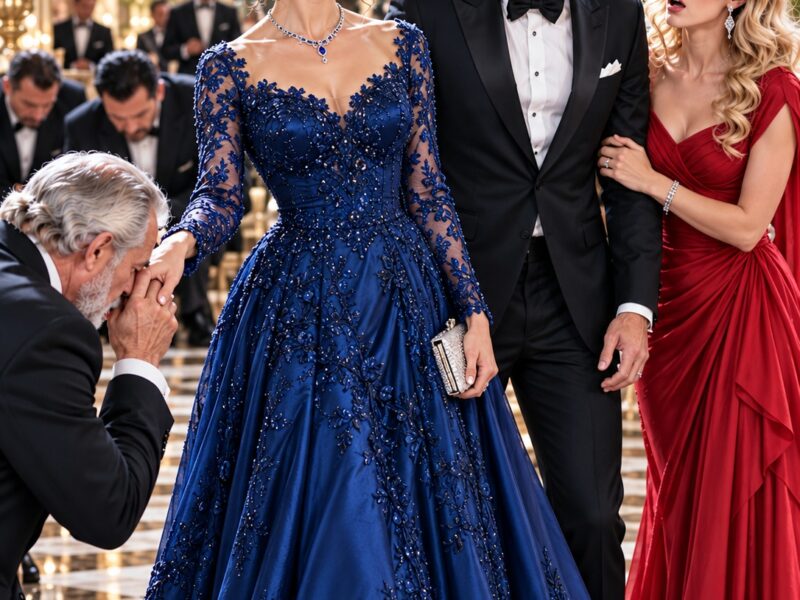
He Ordered His Wife to Serve His Mistress—But the Mafia Boss Froze When the Guests Bowed
“Catherine, bring Chloe another glass.”
Victor Costello said it loudly enough for the entire ballroom to hear.
The string quartet had just finished a waltz, and for one strange second before the applause began, his voice traveled cleanly beneath the crystal chandeliers of the Long Island mansion. Two hundred guests heard him. So did the three men standing twenty feet away whom Victor had spent six months trying to impress.
Catherine stopped beside a silver serving table.
She wore midnight blue silk, no necklace, no diamonds beyond the plain wedding band on her left hand. Her dark hair was pinned low at her neck, and anyone looking quickly would have seen exactly what Victor wanted them to see: the quiet wife of a loud man.
Chloe Harrington reclined against Victor’s arm in a scarlet gown.
“My glass is empty,” she said, giving Catherine a smile that was almost playful. “And I think I spilled a little on the table.”
Victor laughed.
“There you go. Bring a napkin too.”
The humiliation was deliberate.
Catherine understood that immediately.
More importantly, so did everyone else.
For the past three years, Victor had tested the boundaries of her silence the way some men tested fences around property they intended to steal. A late night became an unexplained weekend. An unexplained weekend became photographs with women he no longer bothered hiding. Then Chloe appeared, first at restaurants, then at charity galas, then in the guesthouse less than a hundred yards from Catherine’s bedroom.
Catherine had endured all of it without a public scene.
Victor had mistaken that for surrender.
Tonight, he wanted witnesses.
His annual autumn gala was supposed to establish him as the undisputed broker of a new East Coast alliance. The room was full of shipping executives, construction men, lawyers who charged more per hour than most families earned in a month, union figures, nightclub owners, lobbyists, elected officials who preferred not to be photographed beside certain guests, and older men whose influence had never appeared on a ballot.
Victor wanted them to see that even his wife obeyed him.
Especially his wife.
Catherine reached for a champagne flute.
Across the room, Chloe crossed one leg over the other and smiled.
Victor raised his cigar.
“You see, gentlemen?” he said to the three newly arrived guests. “A house runs properly when everyone understands their position.”
That was when Don Alejandro Vargas looked at Catherine.
Not Victor.
Catherine saw recognition pass through his face.
Beside him, Viktor Sokolov went rigid.
Arthur Kensington, the silver-haired Englishman standing on Vargas’s other side, closed his eyes for half a second as though a question he had carried for years had just been answered.
Victor noticed none of it.
He was still smiling.
Catherine lifted the champagne from the tray.
She walked toward them.
The room slowly quieted.
At first, Victor assumed everyone was watching because of him.
That assumption had carried him through most of his life.
He had been born in Queens above a bakery his father used as a meeting place after closing. By twenty-seven, he had turned a collection of trucking contracts and protection rackets into an organization that touched ports from Newark to Baltimore. By thirty-eight, he owned construction companies, warehouses, restaurants, real estate partnerships and enough compromised officials to make ordinary consequences feel optional.
Success had taught him the most dangerous lesson a man could learn.
That whatever happened around him happened because of him.
Catherine stopped three steps from the high table.
Victor extended one hand impatiently.
“For Chloe.”
She looked at him.
For a moment, nothing in her face changed.
Then Don Alejandro Vargas stepped forward.
Victor smiled wider.
“Don Vargas. Finally. I was beginning to think you’d forgotten your manners.”
Vargas did not answer.
He walked past Victor.
The cigar in Victor’s fingers lowered.
Vargas stopped in front of Catherine.
The old man was seventy-three, compact and silver-haired, with the stillness of someone who had survived decades by never moving unnecessarily. Heads of government took his calls. Shipping magnates waited for him. Men with private armies watched their tone in his presence.
He bowed.
Not a polite dip of the head.
A full, formal bow from the waist.
The room went silent.
Victor’s smile disappeared.
Before anyone could speak, Viktor Sokolov stepped beside Vargas and lowered his head.
Then Arthur Kensington did the same.
Somewhere near the orchestra, a champagne flute slipped from a server’s hand and shattered against the marble.
Catherine did not move.
Victor stared at the three men.
“What are you doing?”
No one answered him.
Vargas straightened slowly.
His eyes remained on Catherine.
“It has been a long time, Katerina.”
Victor looked from Vargas to his wife.
“What did you call her?”
Catherine’s fingers tightened slightly around the champagne glass.
Not because she was frightened.
Because hearing the name spoken aloud after ten years felt like opening a door into a room she had convinced herself no longer existed.
Katerina Nikolayevna Volkov.
Daughter of Nikolai Volkov.
Granddaughter of Mikhail Volkov.
Last surviving heir of a family whose influence had once stretched through shipping, commodities, private banking, political patronage and the violent machinery that lived beneath all those respectable words.
A family half the room believed had disappeared forever.
Catherine looked at Vargas.
“Don Alejandro.”
His expression softened in a way Victor had never seen.
“You kept us waiting.”
“I needed time.”
“You had it.”
Sokolov spoke next.
His Russian accent was softer than Victor remembered from their previous meetings.
“The old agreements remain.”
Victor stepped between them.
“What agreements?”
Nobody looked at him.
That frightened him.
Not much frightened Victor Costello.
He had spent twenty years making sure fear traveled in only one direction.
But something was happening in his ballroom that had no relationship to the hierarchy he understood.
He reached for Catherine’s wrist.
She turned her head.
Victor stopped before touching her.
It was only a look.
Yet something in it made him hesitate.
Catherine placed the champagne on a nearby table.
Chloe laughed nervously.
“Okay. What is this? Some kind of European joke?”
Vargas finally glanced at her.
He did not look angry.
That was worse.
“Who is she?”
Victor opened his mouth.
Catherine answered first.
“Someone who believed an invitation made her important.”
Chloe’s cheeks flushed.
“Excuse me?”
Catherine looked at Victor.
“And someone he believed would make me feel small.”
Victor’s jaw hardened.
“Enough.”
The old instinct returned.
Command.
Force.
Volume.
He faced the room.
“This is my house.”
Arthur Kensington removed his glasses.
“No,” he said.
Victor stared at him.
Kensington cleaned one lens with a folded handkerchief.
“Technically, Mr. Costello, it is not.”
For the first time that evening, Catherine smiled.
It was a small smile.
Almost sad.
Victor felt a cold pressure forming beneath his ribs.
“What does that mean?”
Kensington replaced his glasses.
“It means we have several things to discuss.”
The ballroom remained silent.
Catherine looked toward the servants waiting beside the wall.
“Please continue dinner service.”
Nobody moved.
She smiled gently at Rosa, the house manager.
“It’s all right.”
Rosa nodded.
Within seconds, the staff began moving again.
That frightened Victor more than anything so far.
They obeyed Catherine without looking at him.
Three years earlier, he had met her in the reading room of the Morgan Library in Manhattan.
She had been seated near a window beneath winter light, wearing black trousers and an ivory blouse, repairing the binding of a nineteenth-century ledger with a patience Victor found almost irritating.
He had been there to meet a lawyer.
The lawyer was late.
Catherine was not.
Victor had watched her for nearly ten minutes before she finally looked up.
“Can I help you?”
He smiled.
“Maybe.”
She returned to the book.
Most women who recognized him reacted somehow.
Interest.
Fear.
Calculation.
Catherine displayed none of those things.
Victor moved closer.
“You don’t know who I am?”
“I know you’re standing close enough to cast a shadow over my work.”
That made him laugh.
She did not.
“What are you repairing?”
“A shipping ledger from 1891.”
“That sounds boring.”
“To you, perhaps.”
“What’s interesting about it?”
Catherine ran one finger along a faded column.
“People think records are about numbers. They aren’t. They’re about what people wanted the future to believe.”
Victor considered her.
“What does this one want us to believe?”
“That everyone paid their debts.”
“And did they?”
She looked up.
“No.”
That was the first conversation Catherine Volkov ever had with Victor Costello.
He spent the next two months pursuing her.
Flowers appeared at the library.
She sent them to a hospital.
He invited her to Le Bernardin.
She declined.
He sent a car.
She took the subway.
Victor was not accustomed to indifference.
It fascinated him.
Eventually Catherine agreed to coffee.
Then dinner.
Then a weekend in Newport where Victor discovered she could identify nearly every painting in his friend’s mansion but claimed not to know the names of half the people at the party.
She listened more than she spoke.
She never asked about his money.
She never asked about his enemies.
Victor mistook discretion for innocence.
Catherine encouraged the mistake.
At that time, Catherine was living under a name that was technically hers.
Her American-born mother had been Margaret Catherine Bell before marrying Nikolai Volkov in London. After the Volkov family collapsed, Catherine had taken her mother’s middle name and surname, shortened her history, and disappeared into archives where old papers demanded more attention than living people.
It was meant to be temporary.
Ten years passed.
The night her family fell apart had started with a phone call in Moscow.
Her older brother Alexei told her not to come home.
She was twenty-four and studying conservation science in Boston.
“What happened?” she asked.
“Listen to me, Katya.”
His voice shook.
She had never heard Alexei afraid.
“Do not call Papa. Do not call anyone in the family. Take the emergency passport from the safe deposit box and go to Aunt Elena.”
“Alexei—”
“You have to disappear.”
There was shouting behind him.
Then the call ended.
Within forty-eight hours, Catherine learned that her father, brother and two uncles were dead.
A rival coalition had dismantled the Volkov network faster than anyone thought possible.
Warehouses burned.
Accounts froze.
Men who had toasted her father on Friday denied knowing him by Monday.
The newspapers called it a criminal reckoning.
Catherine called it the end of the world she understood.
Her aunt Elena moved her through Toronto, Lisbon and finally New York.
For two years, Catherine expected someone to find her.
No one did.
Then fear slowly changed into something stranger.
Freedom.
She could buy groceries without security.
Walk into a museum alone.
Sit in a coffee shop without someone watching the door.
Nobody cared who her grandfather had been.
For the first time in her life, Catherine could become ordinary.
She discovered she liked ordinary.
She studied archival conservation.
Worked in libraries.
Rented a one-bedroom apartment on West 87th Street where the radiator screamed every winter.
She bought cheap flowers from a corner stand.
She learned to cook badly.
There were days when she almost believed Katerina Volkov had died with the rest of her family.
Then letters began arriving.
Not paper letters.
Messages through channels she had been taught never to forget.
Old bankers.
Former allies.
Men who had survived by stepping aside rather than choosing a side.
The first message came from Arthur Kensington.
The accounts were not gone.
The second came from Vargas.
Some loyalties remained.
Sokolov contacted her last.
Your father made mistakes, he wrote. But not every debt died with him.
Catherine ignored them for nearly a year.
She had seen what power did to families.
Her father had loved her, but he had also been a brutal man who believed survival excused almost anything.
Her brother Alexei had wanted to change parts of the organization.
He never got the chance.
Catherine wanted none of it.
Then she discovered that the men who destroyed her family were taking over the financial structures Nikolai Volkov had built and using them for operations even her father had refused.
Human trafficking routes.
Weapons moving into conflicts disguised as humanitarian shipments.
Young girls treated as inventory.
Catherine’s refusal became harder to defend.
She did not want the throne.
But she could not pretend the throne had ceased to exist simply because she walked away from it.
So she answered Arthur Kensington.
One message.
Not yet.
He replied within two minutes.
We will wait.
Then Victor Costello appeared in the library.
Loud.
Ambitious.
Photographed constantly.
Connected to ports and contractors but not important enough to be closely watched by the old European networks.
Catherine had recognized his usefulness before their third date.
A man like Victor attracted attention the way flame attracted moths.
Anyone hunting Katerina Volkov would look at Victor and see exactly what Victor wanted them to see.
A rising American boss with a decorative wife.
Nobody would look at the wife.
At first, Catherine told herself that was the only reason she married him.
Years later, she would admit that was not entirely true.
Victor had once been charming.
Not the polished charm he used on donors or reporters.
A quieter version.
He brought takeout to her apartment.
Fixed a leaking faucet himself because he refused to wait for the landlord.
Once, during a thunderstorm that knocked out electricity across the Upper West Side, they sat on the kitchen floor eating melting ice cream directly from the carton.
Victor told her about his mother.
How she had died when he was nineteen.
How he still dialed her old number sometimes before remembering.
Catherine listened.
That night, she almost told him who she was.
Almost.
Then Victor asked her to marry him.
For a few months after the wedding, Catherine allowed herself to imagine something dangerous.
That maybe a lie could become a life.
Victor destroyed that possibility slowly.
Success changed him.
Or perhaps success removed the need to hide what had always been there.
He began treating waiters badly.
Then employees.
Then Catherine.
At first, it was small.
“You don’t understand business.”
“Let me handle the important conversations.”
“Wear the diamonds. People expect my wife to look expensive.”
He laughed when she suggested financial risks he had not considered.
Then lost money exactly where she warned him he would.
He never remembered the warning.
Only the loss.
Catherine stopped correcting him.
That made him feel smarter.
Victor interpreted her restraint as dependence.
He began sleeping with other women.
Catherine knew before he began lying.
There was a particular carelessness men developed when they thought a person had nowhere else to go.
Chloe Harrington arrived during the second year.
She was thirty-one, beautiful, socially hungry and clever in the specific way of people who understood rooms better than consequences.
Her father washed money through real estate.
Chloe had grown up close enough to power to crave it, but never close enough to understand its cost.
Victor liked being admired.
Chloe admired professionally.
Within four months, she was at every event.
Within six, Victor stopped pretending.
The afternoon he told Catherine that Chloe would be moving into the guesthouse, Catherine sat beside the window of their bedroom reading a biography of Eleanor Roosevelt.
Victor remained near the door.
“Say something.”
Catherine turned a page.
“What would you like me to say?”
“Get angry.”
“Why?”
“Because normal wives get angry.”
“Normal husbands don’t move their mistresses onto the property.”
Victor laughed.
“That’s better.”
She looked at him.
He wanted emotion because emotion would prove he mattered.
Catherine understood that.
So she gave him none.
Victor came closer.
“You know what your problem is?”
“I suspect you’re about to tell me.”
“You think silence makes you superior.”
“No.”
She closed the book.
“I think silence prevents me from saying things I would later regret.”
His smile disappeared.
For a second, the old Victor appeared.
The man who had once sat on a kitchen floor eating ice cream beside her.
Then pride returned.
“Chloe moves in Friday.”
Catherine opened her book again.
“All right.”
After he left, she sat motionless for fifteen minutes.
Then she went into the bathroom and cried so quietly that nobody heard.
Not because Victor was cheating.
That grief had already passed.
She cried because some stubborn corner of her had still been mourning the marriage she once thought might exist.
That evening, Catherine sent Arthur Kensington a message.
Begin final consolidation.
The response came immediately.
At last.
For the next eleven months, Victor became louder while Catherine became almost invisible.
He bought a Ferrari in a color that could be seen from space.
She quietly acquired the debt attached to his Hamptons development through a Luxembourg subsidiary.
Victor lost twelve million dollars at private gaming tables over eighteen months.
Catherine’s holding company purchased the distressed note on his estate.
He pushed into a Newark shipping partnership without reading the minority rights clauses.
Arthur acquired the minority stake through three intermediaries.
Victor bribed politicians.
Catherine documented which ones could be removed from future contracts without collapsing legitimate operations.
He believed he was building an empire.
Catherine was purchasing the ground beneath it.
She did not do everything herself.
That was another difference between them.
Victor trusted obedience.
Catherine trusted competence.
Kensington handled finance.
Vargas managed Latin American relationships.
Sokolov protected the surviving Eastern European assets.
A network of lawyers spent three years separating legitimate businesses from criminal structures and creating exits for employees who had never chosen the life Victor claimed to represent.
Catherine refused to rebuild her father’s empire exactly as it had been.
That created conflict.
Some old allies wanted revenge.
Others wanted territory.
One man in Prague suggested eliminating the families responsible for the Volkov attack.
Catherine terminated the meeting.
“My father believed fear created loyalty,” she said.
The man stared at her.
“And?”
“He died surrounded by people afraid of him.”
No one suggested it again.
By the autumn of Victor’s gala, Catherine’s war was almost finished.
The men directly responsible for her family’s destruction had been arrested, financially ruined, or pushed out by their own partners.
Some had died through the ordinary violence of the world they occupied.
Catherine did not celebrate those deaths.
She simply checked names off a list.
Victor knew none of this.
To him, Catherine spent her days discussing flowers with decorators and choosing linen colors.
The morning of the gala, he entered her dressing room while she was fastening an earring.
“Tonight matters.”
“I know.”
“I mean it, Catherine.”
She met his eyes in the mirror.
“So do I.”
He misunderstood.
“I’ve got Vargas coming. Sokolov. Kensington. If this works, every major East Coast operation will be aligned by Christmas.”
Catherine adjusted the earring.
“Under you?”
Victor smiled.
“Who else?”
She almost laughed.
Instead she turned.
“You look pleased.”
“I’m about to become untouchable.”
“No one is untouchable, Victor.”
His smile faded slightly.
“That sounds ominous.”
“It’s history.”
He glanced at her blue gown.
“At least you dressed properly.”
“Thank you.”
“And Catherine?”
“Yes?”
“Chloe will sit beside me tonight.”
She said nothing.
Victor watched for pain.
He found none.
“You’ll take the second table.”
“Of course.”
“If she needs anything, make sure she gets it.”
Catherine looked at him for three full seconds.
Victor shifted.
“As hostess,” he added.
“As hostess,” Catherine repeated.
Her phone vibrated after he left.
Arthur.
High table confirmed. All three coming.
A second message arrived.
They understand the protocol.
Catherine stared at the screen.
Her hands were perfectly steady.
Three years of hiding.
Ten years of grief.
A marriage that had begun as strategy, briefly threatened to become love, and ended as education.
She typed one word.
Proceed.
Now, in the ballroom, Victor stood staring at the three bowed men.
His voice came out smaller than Catherine had ever heard it.
“Katerina?”
Catherine turned toward him.
“You always did prefer Catherine.”
“Who are you?”
Chloe gave an uncertain laugh.
“Victor, don’t be ridiculous. She’s your wife.”
Catherine looked at her.
“Yes.”
Then back at Victor.
“And no.”
Vargas stepped aside.
Arthur Kensington approached the center of the room.
He carried a slim leather portfolio beneath one arm.
Victor saw it.
“What is that?”
“Your education,” Kensington said.
Catherine almost sighed.
“Arthur.”
“Yes, forgive me. That was unnecessarily theatrical.”
Vargas smiled.
Sokolov did not.
Victor looked around the room.
People who had laughed with him thirty minutes earlier would no longer meet his eyes.
His lieutenants Tommy Russo and Silvio Marchetti stood near the doors.
“Tommy.”
Tommy looked at him.
“Get these people out of my house.”
Nobody moved.
Victor’s face changed.
“Did you hear me?”
Tommy glanced toward Catherine.
That tiny gesture broke something inside Victor.
“You too?”
Tommy’s jaw tightened.
“You stopped listening a long time ago, Vic.”
Victor stepped toward him.
“I made you.”
“No.”
Tommy’s voice remained calm.
“You hired me.”
The distinction landed hard.
Catherine watched Victor understand, for perhaps the first time in his life, that employment was not ownership.
Kensington placed the portfolio on the table.
“Shall we?”
Victor faced Catherine.
“You planned this.”
“Yes.”
“How long?”
She considered lying.
There was no reason to.
“Before Chloe.”
His expression twisted.
“So this whole marriage was fake?”
The question surprised her.
Not because he asked.
Because of the hurt beneath it.
Catherine looked down at her wedding ring.
“No.”
Victor blinked.
She removed it slowly.
“It began with a lie.”
The room remained silent.
“But there was a period when it could have become real.”
Victor stared.
Catherine continued.
“You brought soup to my apartment when I had influenza. You called your mother’s old telephone number when you missed her. You once drove three hours because I mentioned that my favorite bookstore was closing.”
His face softened.
“You remember that?”
“I remember everything.”
“Then why—”
“Because eventually you decided kindness embarrassed you.”
Victor’s mouth closed.
“You wanted every person around you to be afraid of losing your approval. Then you began confusing fear with respect.”
“That has nothing to do with us.”
“It has everything to do with us.”
Catherine looked toward Chloe.
“You did not betray me because you loved another woman.”
Chloe lowered her eyes.
“You used another woman to demonstrate that I could be humiliated without consequence.”
Victor’s face reddened.
“I never—”
“Tonight you ordered your wife to bring your mistress a drink in front of two hundred people.”
Nobody moved.
Catherine’s voice remained almost gentle.
“Do not insult both of us by pretending you didn’t understand what you were doing.”
Victor looked away.
For the first time, Chloe’s expression changed.
The smugness disappeared.
Catherine saw something younger beneath it.
Fear.
Perhaps shame.
Victor turned toward Kensington.
“What’s in the portfolio?”
Kensington opened it.
“First, the estate.”
Victor laughed.
“My estate?”
“The property is owned by Costello Manor Holdings.”
“I own Costello Manor Holdings.”
“Thirty-eight percent.”
Victor’s smile froze.
Kensington continued.
“The remaining equity was pledged as security against your mezzanine debt following your losses in Macau and the failed Brooklyn development.”
Victor stared at Catherine.
“You knew about Macau?”
“Yes.”
“You told me you didn’t care where I went.”
“I didn’t.”
Kensington removed another page.
“The debt changed hands fourteen months ago.”
“To whom?”
“A private holding company.”
Victor’s breathing quickened.
“What company?”
Kensington looked toward Catherine.
“Volkov Meridian.”
Victor sat down.
Not gracefully.
His knees seemed to make the decision before his mind did.
The chair caught him.
Catherine had imagined this moment many times.
She expected satisfaction.
Instead, she felt tired.
Kensington continued through the legitimate companies.
The Newark terminal stake.
The construction financing.
Two warehouses.
A hotel partnership.
A private lending arrangement.
Victor still owned pieces.
But control was an illusion.
He had borrowed against tomorrow so often that Catherine had simply purchased tomorrow from his creditors.
Finally, Victor lifted one hand.
“Stop.”
Arthur stopped.
Victor looked at Catherine.
“You bought my life.”
“No.”
She folded her hands.
“I bought your debt.”
“What’s the difference?”
“You chose the debt.”
Victor flinched.
Sokolov’s mouth almost formed a smile.
Catherine looked at him.
He wisely stopped.
Victor’s voice dropped.
“And the people?”
“What people?”
“My people.”
Catherine glanced toward Tommy.
“They were never property either.”
Tommy stepped forward.
“I’m out, Victor.”
Victor stared.
“After everything?”
“I have three children.”
“So?”
Tommy’s face hardened.
“So I’m tired of wondering whether their father gets shot because you wanted someone to respect you at dinner.”
A murmur moved through the room.
Victor stood again.
“You ungrateful—”
Catherine raised one finger.
Victor stopped.
She hated that he stopped.
Not because she wanted him to continue.
Because the reflex revealed how completely the balance had changed.
“Sit down.”
He did not.
Catherine studied him.
Then something unexpected happened.
Victor laughed.
It was quiet at first.
Then louder.
He ran both hands through his hair.
“This is unbelievable.”
Nobody joined him.
“My wife is Katerina Volkov.”
Still no laughter.
“The dead princess.”
Catherine’s eyes cooled.
“Do not call me that.”
“The ghost.”
Victor looked around.
“All these years.”
His attention returned to her.
“You let me think I was protecting you.”
“No.”
“You lived behind my walls.”
“Yes.”
“My guards protected this house.”
“They protected the gate.”
Victor stepped closer.
“From the people hunting you.”
“For a while.”
His voice cracked.
“You used me.”
The accusation was true.
Catherine did not hide from it.
“Yes.”
Victor recoiled as though the honesty hurt more than denial.
She continued.
“I needed visibility around me. You were visible.”
“You married me because I was useful.”
“At first.”
“At first.”
Victor repeated the words.
Catherine saw the question before he asked it.
“And after?”
Her throat tightened.
This was the part no one else in the room understood.
Power could buy silence.
It could purchase debt.
It could move businesses and frighten rivals.
But it could not simplify memory.
“After,” Catherine said, “I hoped I had been wrong about you.”
Victor stared at her.
The room seemed farther away.
“I loved you,” she said.
Chloe looked up sharply.
Victor’s face changed.
Catherine had never said the words aloud.
Not once in three years.
“I loved the man who ate terrible Chinese food in my apartment because you knew I hated expensive restaurants on Mondays. I loved the man who spoke about his mother when nobody else was around. I loved the man who once stood outside in the rain for forty minutes because an old woman’s dog had gotten loose on the highway.”
Victor looked as if she had struck him.
“But that man kept disappearing whenever someone was watching.”
Her voice became quieter.
“And eventually I understood that the man you are in public is not a mask.”
Victor swallowed.
“It is the man you chose to become.”
Silence followed.
Chloe began crying.
Softly.
She wiped her face quickly as though ashamed.
Catherine turned toward her.
Chloe’s chin trembled.
“I didn’t know.”
Catherine waited.
“I didn’t know who you were.”
Several people looked uncomfortable.
Catherine’s expression changed.
“That is exactly the problem.”
Chloe blinked.
Catherine stepped closer.
“If I had really been an archivist with no family and no money, would tonight have been acceptable?”
Chloe said nothing.
“You laughed when he ordered me to serve you.”
“I was—”
“You enjoyed it.”
Chloe’s eyes dropped.
“Yes.”
Catherine nodded.
That answer mattered.
“Thank you.”
Chloe looked confused.
“For what?”
“For telling the truth.”
Victor stepped toward Chloe.
“Don’t answer her.”
Chloe turned on him.
For the first time all evening, anger replaced fear.
“You shut up.”
Victor stared.
Chloe laughed bitterly.
“You knew exactly what you were doing to her.”
“Chloe—”
“And you told me she deserved it because she was weak.”
Catherine went still.
Victor’s face darkened.
Chloe looked at Catherine.
“He said you were grateful for everything. That you had nothing before him.”
Catherine smiled without humor.
“That part appears to have been a misunderstanding.”
Chloe wiped beneath one eye.
“I’m sorry.”
Catherine believed she meant it.
That did not erase anything.
But it changed the next decision.
“You should leave.”
Chloe nodded immediately.
“No one will stop you.”
Victor turned.
“What?”
Catherine looked toward Rosa.
“Please have a car brought around for Miss Harrington.”
Rosa nodded.
Chloe hesitated.
“My things?”
“Anything you purchased yourself is yours.”
Victor opened his mouth.
Catherine continued.
“Anything Victor purchased through company accounts stays until the accountants determine ownership.”
Chloe almost laughed.
“That means most of it.”
“Yes.”
She looked toward Victor.
“Figures.”
For a second, Catherine saw two women on opposite sides of the same man.
Not friends.
Not equals.
But both reduced by Victor into roles that fed his ego.
Wife.
Mistress.
Virtue.
Desire.
Catherine suddenly wanted no part of the competition.
“Chloe.”
She stopped.
“You’re thirty-one.”
Chloe looked at her.
“Whatever you do next, build something that still belongs to you when a man stops looking.”
Chloe’s face crumpled.
She nodded.
Then she left.
Victor watched her go.
“You’re letting her walk?”
“Yes.”
“After everything?”
Catherine turned.
“Did you expect me to punish her for your choices?”
Victor had no answer.
Arthur Kensington cleared his throat.
“We still have business.”
Victor looked exhausted.
“What business?”
“The merger.”
A faint spark returned to Victor’s expression.
“Exactly.”
He turned toward Vargas.
“This circus doesn’t change the fact that everyone here needs the East Coast routes.”
Vargas nodded.
“Correct.”
Victor straightened.
“You need my ports.”
“No.”
Victor paused.
Vargas looked at Catherine.
“We need hers.”
The spark died.
Catherine walked toward the high table.
On its polished surface lay a map Victor had prepared for his presentation.
Port Newark.
Baltimore.
Philadelphia.
Boston.
Lines marked proposed distribution agreements.
Catherine studied it.
Victor followed.
“You can’t just take an organization.”
“No.”
She looked at him.
“People leave it.”
Tommy stepped beside the table.
Then Silvio.
Then two other senior men.
Victor looked from face to face.
“How many?”
Tommy answered.
“Enough.”
“You met without me.”
“Yes.”
“When?”
“Several times.”
Victor turned toward Catherine.
“You corrupted them.”
Tommy’s expression hardened.
“She gave us something you stopped giving us.”
Victor laughed.
“Money?”
“A choice.”
That shut him up.
Tommy continued.
“She said anyone who wanted out of the criminal side could leave without retaliation. She created severance funds for the warehouse crews. She offered legitimate contracts to the drivers.”
Victor looked genuinely confused.
“Why?”
Catherine answered.
“Because most of them have families.”
“This is business.”
“So are pensions.”
Vargas chuckled.
Victor glared.
Catherine pointed to the map.
“The merger you planned will happen.”
Victor stared.
“But without the extortion operations, without narcotics distribution through the legitimate warehouses, and without your political bribery structure.”
Sokolov lifted an eyebrow.
“You Americans invent very complicated ways to call corruption consulting.”
Catherine ignored him.
Victor looked almost offended.
“What are you building?”
“I haven’t decided yet.”
Everyone looked at her.
That answer surprised them.
Catherine continued.
“My father built an empire by assuming survival justified everything.”
Her voice remained steady.
“He died because everyone around him eventually made the same calculation.”
Vargas lowered his eyes.
Catherine knew he had loved Nikolai.
She also knew he understood.
“I will not rebuild his empire exactly as it was.”
Sokolov leaned against the table.
“Some will not follow you.”
“They don’t have to.”
Victor stared.
“You think these men came because they love you?”
“No.”
That answer came immediately.
Catherine looked around the ballroom.
“Some came because they respected my father. Some because they owe my family money. Some because Arthur controls contracts they cannot afford to lose. Some because they believe working with me is more profitable than fighting me.”
She paused.
“That is not love.”
Vargas smiled faintly.
“At least she learned something from her father.”
Catherine returned the smile.
“I learned many things from my father.”
“Mostly what not to do?”
“Mostly.”
A few people laughed.
The tension shifted.
Victor noticed.
People were relaxing around Catherine.
Around him, they had always performed.
The difference devastated him.
“What happens to me?”
The question silenced the room again.
Catherine looked at him.
Victor Costello had once seemed enormous to her.
He had filled doorways.
Filled rooms.
Filled conversations.
Now he looked like a man in an expensive tuxedo who had just discovered that the stage continued after he left it.
“Arthur has divorce papers.”
Victor’s jaw tightened.
“Of course he does.”
“They were filed this afternoon.”
“You filed before telling me?”
“Yes.”
“You can’t do that.”
Arthur said, “She can.”
Victor glared at him.
“Stay out of my marriage.”
Kensington blinked.
“You invited two hundred people into it tonight.”
Several guests looked away to hide smiles.
Victor’s face flushed.
Catherine almost felt sorry for him.
Almost.
“You’ll retain your personal bank accounts that are not tied to company funds.”
Victor stared.
“Meaning?”
“Approximately four hundred thousand dollars after outstanding tax obligations.”
His mouth fell open.
“My watches alone are worth more than that.”
“Some were purchased through Costello Hospitality.”
“My cars?”
“Leased by corporate entities.”
“The boat?”
“Collateral.”
Victor looked sick.
“The house?”
“Mine.”
“My businesses?”
“Some still partially yours.”
Hope returned.
Catherine allowed it for one second.
“Subject to audits.”
The hope vanished.
Victor stepped toward her.
“You are leaving me with nothing.”
Catherine’s expression hardened.
“You are thirty-eight years old, healthy, educated by experience, and leaving with more money than most families see in years.”
“You know what I mean.”
“Yes.”
She looked directly into his eyes.
“You mean I am leaving you without status.”
Victor said nothing.
“That is different from leaving you with nothing.”
He stared at her.
For all her preparation, Catherine had not known how this moment would feel.
She expected revenge to feel hot.
Instead it felt cold and strangely quiet.
She removed her wedding ring.
Victor watched.
Catherine placed it on the table between them.
His eyes stayed on it.
“Did any of it matter?”
The question came so softly she almost missed it.
She knew exactly what he meant.
Their wedding.
The rainy weekend in Maine.
Christmas mornings.
The way he used to place one hand against her back when they crossed busy streets.
The small human moments that had existed between lies.
“Yes.”
Victor looked up.
“That’s worse.”
“I know.”
He swallowed.
“If it had all been fake, I could hate you.”
“You probably will anyway.”
“I already do.”
Catherine nodded.
“That may help.”
Victor’s eyes filled.
He turned his face quickly.
The room pretended not to notice.
Catherine did.
She remembered crying alone in the bathroom while Victor discussed moving Chloe into the guesthouse.
There was no pleasure in seeing pain returned.
Only recognition.
“I could have been good to you,” Victor whispered.
Catherine’s heart tightened.
“Yes.”
He looked at her.
“That is the part you should think about when you are alone.”
The cruelty of the sentence struck her immediately.
She almost took it back.
Then Victor nodded.
“No.”
His voice broke.
“She’s right.”
Catherine said nothing.
Victor looked around the ballroom.
“I thought everyone wanted what I had.”
Nobody answered.
He laughed through his tears.
“I thought that meant they wanted me.”
Catherine’s anger softened.
Not enough to change the outcome.
Enough to see the man underneath it.
Victor took a breath.
“What do I sign?”
Arthur produced a second folder.
“Divorce acknowledgment, resignation from management of the entities under audit, and a temporary noninterference agreement.”
Victor skimmed the pages.
“No territory?”
Tommy shook his head.
Victor looked at Catherine.
“You really bought everyone.”
“No.”
She glanced around the room.
“I gave them an exit.”
Victor picked up the pen.
Before signing, he stopped.
“Do you remember the bookstore?”
Catherine’s breath caught.
“Yes.”
“The one in Newport.”
“Yes.”
“You wanted that first edition of Edith Wharton.”
“It was too expensive.”
“I went back the next day.”
Catherine stared at him.
“What?”
“I bought it.”
She frowned.
“I never received it.”
“I was saving it for our anniversary.”
The anniversary was three weeks away.
Victor laughed quietly.
“Guess that’s not happening.”
Something inside Catherine hurt.
Genuine hurt.
Not enough to undo three years.
Enough to remind her that people were rarely one thing.
Victor had been cruel.
Victor had also bought a book because he remembered she loved it.
Both could be true.
“That was kind,” she said.
He signed the first page.
“I should’ve done more of that.”
“Yes.”
He signed the next.
“And less of everything else.”
“Yes.”
When he finished, Arthur collected the documents.
Victor stood.
Tommy approached.
“I’ll drive you wherever you want.”
Victor looked at his former lieutenant.
“Still babysitting me?”
“No.”
Tommy’s voice softened.
“Giving you a ride.”
Victor almost smiled.
He looked at Catherine one final time.
“What happens tomorrow?”
“To you?”
“Yes.”
“You wake up.”
He waited.
“That’s it?”
Catherine nodded.
“Then you decide what kind of man exists when no one is afraid of him.”
Victor looked away.
After a long moment, he walked toward the ballroom doors.
Nobody stopped him.
Nobody threatened him.
Nobody bowed.
That seemed to wound him most.
The doors closed.
Catherine remained standing beside the high table.
For several seconds, the room waited.
The old habit of power had returned.
People expected instructions.
Catherine looked around at men and women whose decisions affected thousands of lives.
Some were criminals.
Some merely pretended they were not.
A few had spent decades convincing themselves there was a meaningful moral difference between the two categories.
She suddenly felt exhausted.
Don Vargas pulled out the center chair.
“My lady.”
Catherine looked at it.
It had been positioned for Victor.
Raised slightly above the others.
She hated it immediately.
“Remove the platform.”
Vargas paused.
“The platform?”
“The chair is higher.”
“Yes.”
“I don’t want it higher.”
Sokolov smiled.
“Your grandfather would object.”
“My grandfather is dead.”
“That did not usually stop him from objecting.”
Catherine laughed.
A real laugh.
The room released a breath.
Two staff members removed the small riser beneath the chair.
Catherine sat at the same height as everyone else.
Arthur opened his ledger.
“Where do we begin?”
She looked toward the map.
“With the ports.”
Vargas nodded.
“Newark?”
“With the drivers.”
That surprised them.
Catherine continued.
“Every transport contractor gets audited. Anyone being coerced into illegal work gets an exit route.”
Sokolov frowned.
“That will cost money.”
“Yes.”
“How much?”
“Less than funerals.”
He considered.
“Fair.”
“Second, all trafficking relationships are terminated immediately.”
The room became quieter.
A man from Philadelphia shifted uncomfortably.
Catherine noticed.
“You have a problem?”
“No.”
“Good.”
She looked at Arthur.
“Any entity connected to trafficking loses access to Volkov financing.”
Arthur wrote it down.
“And narcotics?”
Vargas asked.
Catherine paused.
“This is not a church.”
Nobody smiled.
“I am not pretending every person in this room becomes respectable at midnight. But legitimate companies stay legitimate. No warehouses employing ordinary families become shields for operations that put those families at risk.”
Tommy nodded.
That mattered more to Catherine than Sokolov’s approval.
She continued for almost an hour.
Not a coronation.
A negotiation.
Some men resisted.
One walked out.
Another argued that Catherine was sentimental.
She answered with projected legal exposure and insurance liabilities until he stopped calling it sentiment.
At eleven forty, dinner finally resumed.
Catherine ate almost nothing.
Rosa approached quietly.
“Mrs. Costello?”
Catherine looked up.
Rosa hesitated.
“What should we call you?”
The question hit harder than expected.
For three years, Catherine had answered to Mrs. Costello.
For ten, Catherine Bell.
For the first twenty-four, Katerina Volkov.
Each name belonged to a different version of her.
“Catherine is fine.”
Rosa smiled.
“Catherine.”
“Yes?”
“You handled tonight well.”
Catherine looked toward the closed doors Victor had left through.
“I’m not sure.”
Rosa followed her gaze.
“That is usually how you know you did.”
Catherine smiled.
“Thank you.”
Near midnight, the ballroom began emptying.
Vargas remained.
He found Catherine alone on the terrace overlooking Long Island Sound.
The October air was cold.
She had wrapped a wool shawl around her shoulders.
“You let him leave.”
Catherine did not turn.
“Yes.”
“Some expected otherwise.”
“I know.”
“Your father would not have.”
“I know that too.”
Vargas joined her at the railing.
For a while they listened to the water.
Finally he said, “Nikolai loved you.”
Catherine’s jaw tightened.
“He loved Alexei too.”
“Yes.”
“And he still built a world that killed him.”
Vargas lowered his eyes.
Catherine continued.
“When I was young, I thought my father was powerful because everyone went silent when he entered a room.”
She looked back through the windows.
“Tonight everyone went silent for me.”
Vargas smiled.
“You noticed.”
“I hated it.”
That surprised him.
Catherine faced the water again.
“I don’t want people silent because they are afraid of the consequences of speaking.”
Vargas considered.
“You may have chosen the wrong group of acquaintances.”
She laughed.
“Yes.”
Then he became serious.
“Why did you really marry him?”
Catherine knew Vargas would not accept the simple answer.
“He was camouflage.”
“At first.”
She looked at him.
“You too?”
“Arthur talks.”
“I may kill Arthur.”
“No, you won’t.”
“No.”
Vargas waited.
Catherine sighed.
“I wanted to know what ordinary felt like.”
“Was Victor ordinary?”
“More than my family.”
“That is a low standard.”
“I know.”
She rubbed her thumb over the pale indentation where her wedding ring had been.
“I thought maybe if I chose someone outside that old world, I could build something else.”
Vargas looked through the glass at the ballroom.
“You did build something else.”
“It failed.”
“Did it?”
Catherine looked at him.
He pointed toward the doorway Victor had left through.
“Ten years ago, that man would be dead.”
Catherine said nothing.
“So would the woman.”
“Chloe.”
“Yes.”
“You remember her name.”
“I am making progress.”
Catherine smiled.
Vargas continued.
“You lost a marriage. Perhaps.”
He looked toward Arthur arguing with a lawyer beside the high table.
“But maybe you did not fail at becoming different from your father.”
The words stayed with her.
At 1:20 in the morning, Catherine finally went upstairs.
Victor’s dressing room was open.
Half the closets were empty because Tommy had instructed staff to pack essentials.
His watch case remained.
So did dozens of suits.
Catherine entered their bedroom.
The bed had already been turned down.
On Victor’s bedside table sat a photograph.
She had forgotten it existed.
Maine.
Two years earlier.
Catherine wore an oversized sweater and no makeup.
Victor stood behind her with both arms around her waist.
They were laughing.
She picked up the frame.
For several seconds, grief moved through her with unexpected force.
Not grief for Victor as he had become.
For what had almost existed.
There was a knock.
Arthur stood in the doorway holding a package.
“What is that?”
“Mr. Costello asked Tommy to bring it upstairs.”
Catherine knew before opening it.
The book from Newport.
A first edition of The Age of Innocence.
Inside the cover, Victor had written a note.
For C.
You once told me the saddest lives are the ones people choose because they are too afraid to choose differently.
Still thinking about that.
—V.
Catherine sat on the edge of the bed.
Arthur remained near the doorway.
“Are you all right?”
“No.”
He nodded.
“Good.”
She looked up.
“Good?”
“You have spent ten years pretending being all right is a moral achievement.”
Catherine stared at him.
Arthur cleared his throat.
“My apologies.”
“No.”
She looked at the book.
“You’re right.”
Arthur sat in the chair opposite her.
For a while, neither spoke.
Eventually Catherine said, “Did I destroy him?”
Arthur considered.
“No.”
“You answer quickly.”
“He had considerable assistance from himself.”
She smiled faintly.
Arthur continued.
“You removed the environment that rewarded his worst instincts.”
“What if those instincts are all he has?”
“Then he will have an unpleasant future.”
“And if they aren’t?”
Arthur shrugged.
“Then perhaps losing everything will become the first useful thing that happened to him.”
Catherine looked down.
“Where did Tommy take him?”
“A hotel in Manhattan.”
“Which one?”
Arthur named it.
Not luxurious.
Not terrible.
Catherine nodded.
“Make sure nobody bothers him.”
Arthur raised an eyebrow.
“Protection?”
“Privacy.”
“Understood.”
“And Chloe?”
“Her sister collected her.”
Catherine relaxed slightly.
Arthur noticed.
“You are allowed to dislike them.”
“I do.”
“You are also allowed to care whether they survive.”
“I know.”
“That was not always obvious in your family.”
Catherine looked at him.
“No.”
Arthur stood.
“Sleep.”
“Impossible.”
“Attempt it.”
He left.
Catherine remained alone.
At two seventeen, she received a text.
Victor.
She stared at the name.
Then opened it.
One sentence.
I found the other earring from Maine in my coat pocket.
Catherine closed her eyes.
She did not reply.
Five minutes later another message arrived.
I’m sorry.
She read it twice.
Then placed the phone face down.
An apology could be real.
It could also be late.
Those truths were not contradictory.
Six months passed.
Winter settled over New York.
Then spring.
The Costello organization did not disappear overnight.
Real life was not that clean.
There were investigations.
Accounts had to be separated.
Contracts renegotiated.
Several men refused Catherine’s terms and formed smaller operations of their own.
One was arrested within four months.
Another left the country.
Tommy Russo became chief operating officer of a legitimate freight company employing nearly three hundred former Costello workers.
He hated the title.
Catherine made him keep it.
“You need a business card,” she told him.
“I had a business card.”
“It said logistics consultant.”
“I liked that.”
“It meant nothing.”
“It meant people didn’t ask questions.”
“Exactly.”
Catherine sold the Long Island mansion.
That shocked everyone.
Vargas objected.
“It is magnificent.”
“It has forty-seven rooms.”
“So?”
“I use four.”
“Rich people are meant to waste rooms.”
“Then you buy it.”
He stopped objecting.
The property sold to a hotel group.
Catherine kept none of the furniture except the library desk, three paintings and Victor’s first edition of The Age of Innocence.
She moved into a townhouse in Manhattan.
Not modest.
Catherine had no interest in pretending she was poor.
But smaller.
Manageable.
Quiet.
On Sunday mornings, she walked to the same corner flower stand she had used before marrying Victor.
The owner remembered her.
“You disappeared.”
“I got married.”
“Bad idea?”
Catherine considered.
“Educational.”
The woman laughed.
One afternoon in May, Catherine entered the Morgan Library.
The same reading room.
The same windows.
The same quality of silence.
She found herself standing near the table where Victor had first spoken to her.
A young archivist was repairing a damaged ledger.
Catherine watched for a moment.
The woman looked up.
“Can I help you?”
Catherine smiled.
“No.”
The answer made her laugh quietly.
She continued toward the exhibit hall.
Her phone vibrated.
Tommy.
She answered.
“What?”
“You have a visitor at the office.”
“Who?”
“He says you know him.”
“That describes several thousand unpleasant people.”
Tommy hesitated.
“Victor.”
Catherine stopped walking.
Six months.
She had not seen him once.
They communicated only through attorneys.
“What does he want?”
“Wouldn’t tell me.”
“Is he alone?”
“Yes.”
Catherine looked around the library.
“Tell him I’ll be there in forty minutes.”
Victor waited in the conference room.
When Catherine entered, she almost did not recognize him.
His hair was shorter.
No tailored suit.
Dark trousers, white shirt, simple jacket.
He looked thinner.
Healthier somehow.
Also older.
Victor stood.
“Hi.”
Catherine closed the door.
“Hello.”
For a second they were two strangers who remembered being married.
Victor gestured toward the chair.
“Can I?”
“It’s a conference room, Victor.”
He smiled faintly.
“Right.”
They sat.
Catherine folded her hands.
“What do you need?”
Victor looked down.
“I got a job.”
She blinked.
“What?”
He laughed.
“I knew you’d do that.”
“You got a job.”
“Yes.”
“Doing what?”
“Operations.”
“For?”
“A construction company in Connecticut.”
Catherine stared.
“They know who you are?”
“Everyone knows who I am.”
“Fair.”
“The owner is someone I used to do business with legitimately. He said I’m good at scheduling projects when I’m not ruining my own life.”
Despite herself, Catherine laughed.
Victor smiled.
“I make one hundred and forty thousand a year.”
“That must be traumatic.”
“You have no idea.”
She laughed again.
The sound changed something between them.
Victor became serious.
“I’m not here for money.”
“I didn’t think you were.”
“I wanted you to know I’m working.”
“Why?”
He considered.
“Because the last thing you told me that night was that I had to decide who I was when nobody was afraid of me.”
Catherine remembered.
“I hated you for saying it.”
“I assumed.”
“I thought about it every day.”
She looked at him.
Victor continued.
“The first month, I sat in that hotel and called everyone I thought was my friend.”
His smile was embarrassed.
“Almost nobody answered.”
Catherine said nothing.
“Then I realized I didn’t know how to do anything alone.”
“That isn’t true.”
“I didn’t know that.”
He rubbed his hands together.
“I couldn’t cook. I had never booked my own dentist appointment. I didn’t know what my health insurance cost.”
Catherine’s expression softened.
Victor laughed.
“You think that’s funny.”
“A little.”
“I deserve it.”
“No one deserves American health insurance paperwork.”
He laughed.
Then his eyes lowered.
“I treated you terribly.”
The room changed.
Catherine waited.
Victor continued.
“I know I apologized that night.”
“You did.”
“I wasn’t apologizing for the right thing.”
She remained silent.
“I was sorry because I lost you.”
His voice tightened.
“That’s still selfish.”
Catherine felt something in her chest shift.
Victor looked directly at her.
“I’m sorry because I made you smaller so I could feel bigger.”
No excuses.
No explanation.
Catherine swallowed.
Victor continued.
“I’m sorry I brought Chloe into your home. I’m sorry I laughed when people disrespected you. I’m sorry I made you think the good parts of me were fake.”
He looked away.
“They weren’t.”
“I know.”
He looked back.
That seemed to surprise him.
Catherine smiled sadly.
“That was what made leaving difficult.”
Victor nodded.
Tears appeared in his eyes.
He did not hide them this time.
“I don’t expect anything.”
“Good.”
He laughed softly.
“Still you.”
“Yes.”
Victor stood.
“I should go.”
Catherine stood too.
At the door, he paused.
“Was it really love?”
She knew what he was asking.
“Yes.”
He closed his eyes.
“Okay.”
Then he smiled.
Not Victor Costello’s public smile.
The old one.
The kitchen-floor smile.
“Take care of yourself, Catherine.”
“You too.”
He left.
Catherine stood in the conference room after the door closed.
She cried.
Not because she wanted him back.
She didn’t.
She cried because sometimes healing did not restore what was broken.
Sometimes healing simply allowed you to touch the broken edge without bleeding.
That evening, Catherine attended a dinner with Arthur Kensington, Don Vargas and Viktor Sokolov.
A year earlier, such a dinner would have been held behind armed doors.
Now it took place in a private room at an ordinary Manhattan restaurant.
Vargas complained about the lighting.
Sokolov complained about the wine.
Arthur complained about both of them.
Catherine listened.
Eventually Vargas raised his glass.
“To Katerina.”
Catherine looked at him.
“No.”
He frowned.
“No?”
She lifted her own glass.
“To surviving ourselves.”
Arthur smiled.
Sokolov considered.
“That is annoyingly philosophical.”
“You can drink or leave.”
He drank.
They all did.
After dinner, Catherine stepped outside alone.
Rain had begun.
Light rain.
The kind that softened Manhattan without stopping it.
Cars moved along Madison Avenue.
A couple argued beneath one umbrella.
A delivery cyclist shouted at a taxi.
Someone laughed from an apartment window above the restaurant.
Catherine stood beneath the awning.
For years she had imagined reclaiming her name would feel like returning home.
It did not.
There was no old home to return to.
The Volkov estate outside Moscow was gone.
Her father was gone.
Alexei was gone.
Her marriage was gone.
Power had returned.
But power was not home.
She understood that now.
Home would have to be something she built deliberately.
Not inherited.
Not conquered.
Not hidden inside another person.
Her phone buzzed.
A message from Rosa.
The buyers found a box in the attic during the mansion inventory. It has your name.
Catherine smiled.
What is it?
A photograph album. And one ridiculous porcelain dog.
Catherine laughed aloud.
Victor had hated that dog.
She loved it because it was ugly.
Keep both. I’ll collect them tomorrow.
She put the phone away.
Across the street, the light changed.
Catherine stepped into the rain.
A year after the gala, people still told stories about that night.
Some said every man in the ballroom had fallen to his knees.
They hadn’t.
Some said Catherine had secretly commanded Victor’s organization throughout the entire marriage.
She hadn’t.
Others claimed she had married him purely to destroy him.
That was not true either.
Stories preferred clean lines.
Heroes.
Fools.
Queens.
Monsters.
Real people were messier.
Victor had humiliated the woman he once loved because admiration had become more important to him than intimacy.
Catherine had entered a marriage under false pretenses, then discovered that strategy did not protect the heart as efficiently as she believed.
Chloe had participated in cruelty because proximity to power made her feel safe.
Then learned how quickly borrowed status disappeared.
And the men who bowed to Catherine had not done so because she was magical, invincible or destined to rule them.
They bowed because history had returned to the room wearing a blue dress.
Because debts remembered longer than people did.
Because the quiet woman everyone had dismissed possessed relationships, assets and authority they understood even if Victor did not.
But Catherine remembered something else about that moment.
Not Vargas bowing.
Not Sokolov lowering his head.
Not the champagne glass in her hand.
She remembered Victor saying, “A house runs properly when everyone understands their position.”
For years afterward, the sentence stayed with her.
It became almost funny.
Because Victor had been right about one thing.
People did need to understand their position.
He had simply mistaken position for worth.
Catherine never made that mistake again.
Three years later, she attended Tommy Russo’s daughter’s wedding in Brooklyn.
Victor was there.
So was Chloe.
Not together.
Chloe had opened a small event-planning company in New Jersey and had somehow been hired by the bride without Tommy realizing the connection until contracts were signed.
When Catherine saw her, Chloe froze.
Then laughed.
“You have got to be kidding me.”
Catherine smiled.
“You did beautiful work.”
Chloe looked around the ballroom.
“Apparently public humiliation gave me a marketable skill.”
Catherine laughed.
Chloe had changed too.
Less jewelry.
Less performance.
More confidence.
Real confidence.
“You look well,” Catherine said.
“So do you.”
They stood awkwardly for a moment.
Then Chloe nodded toward Victor.
“He saw you.”
Catherine looked.
Victor stood near the bar speaking with two construction executives.
He noticed her.
Their eyes met.
He smiled.
Catherine smiled back.
Nothing more.
Chloe watched.
“That’s incredibly mature.”
“It took years.”
“I would’ve thrown a drink.”
“You did enjoy drinks.”
Chloe laughed.
“I deserved that.”
“No.”
Catherine shook her head.
“You deserved consequences. Not permanent humiliation.”
Chloe studied her.
“You really believe that?”
“I’m trying to.”
The music started.
Tommy appeared and demanded Catherine dance with his eighty-year-old father.
She agreed.
Later that evening, Catherine stood near the edge of the floor watching three generations of one family celebrate.
Victor approached.
“Can I say hello?”
“You just did.”
He smiled.
“You look happy.”
“I am.”
“Good.”
Catherine looked at him.
“You?”
Victor glanced toward the wedding party.
“Most days.”
“That counts.”
He laughed.
“That sounds familiar.”
The bride called Catherine’s name.
She turned.
Victor touched her arm lightly.
“Catherine?”
“Yes?”
He looked around the room.
“No one bowed tonight.”
She smiled.
“Thank God.”
Victor laughed.
Catherine walked toward the bride.
At midnight, the newlyweds left beneath a tunnel of sparklers.
Catherine stood on the sidewalk as people cheered.
For a moment she remembered another ballroom.
Another night.
Crystal chandeliers.
A scarlet dress.
A champagne glass.
A husband convinced that humiliating his wife would prove he was powerful.
Then three men had bowed.
Victor had thought that was the moment his world collapsed.
Catherine knew better now.
His world had begun collapsing much earlier.
The first time he chose humiliation when kindness would have cost him nothing.
The first time he confused fear with loyalty.
The first time he looked at the woman beside him and decided her silence meant she had no power of her own.
The bow simply made the truth visible.
Catherine looked toward the newly married couple disappearing into their waiting car.
Power, she had learned, was rarely what entered a room loudly.
Sometimes it was a debt quietly purchased.
A truth patiently documented.
A door left open for someone who wanted to escape.
Sometimes it was refusing to destroy a person simply because you finally had the ability to do it.
And sometimes it was a woman standing in a crowded ballroom with a glass meant for her husband’s mistress, realizing she no longer needed revenge nearly as much as she needed her own life back.
That had been Catherine’s real victory.
Not that dangerous men bowed to her.
Not that Victor lost his mansion.
Not that his empire dissolved around him while two hundred people watched.
It was that, when the room finally understood who Catherine Volkov was, she no longer needed their understanding to know it herself.









