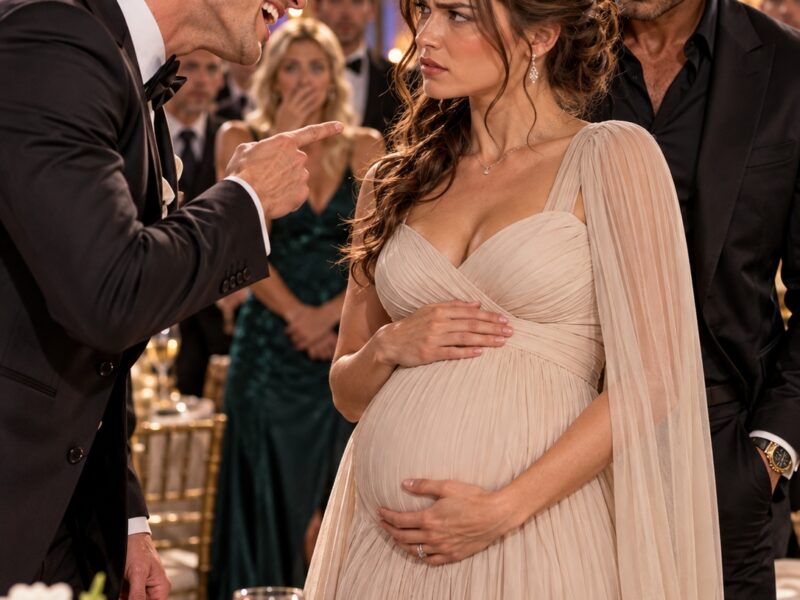
Her Ex Laughed, “What Happened to You?”—Then the Mafia Boss Saw Her Pregnant Belly and Realized Someone Had Turned Their Son Into Leverage Against Him
Caleb Voss mocked Tessa Whitmore’s body loudly enough for the hospital ballroom to hear, never realizing the weight he was laughing at was a six-month pregnancy she had kept almost completely private.
Tessa had survived his humiliation before, but this time she was carrying the child of Roman Vale—the quiet, feared man whose name could empty a room faster than any threat.
Then Roman walked in, saw where Tessa’s hand had instinctively moved, and understood that Caleb’s cruelty might not have been random at all.
“You got fat.”
Caleb Voss said it loudly enough that three people beside the champagne table stopped smiling before Tessa Whitmore did.
For one strange second she heard everything except him: the scrape of a violin bow from the quartet near the ballroom windows, the delicate click of crystal, the low hum of donors discussing oncology grants beneath chandeliers shaped like frozen rain. Then the baby kicked hard beneath her cream wool coat, and Tessa’s right hand moved instinctively toward the curve she had spent months disguising.
She stopped halfway.
Caleb noticed the movement.
Not what it meant.
His gaze traveled over her body with the same smug entitlement she remembered from the final year of their engagement.
“Seriously, Tess. What happened to you?”
Six months pregnant and standing inside the hospital where she had once worked, Tessa understood with almost comic clarity that her ex-fiancé genuinely believed heartbreak had done this to her.
He thought she had gained weight because leaving him had ruined her.
He had no idea whose son was moving under her ribs.
More importantly, he had no idea the father had just entered the ballroom.
Tessa tightened her fingers around the blue presentation folder she had come to deliver.
“Good seeing you too, Caleb.”
She stepped left.
Caleb stepped directly into her path.
Eight months ago, that small maneuver would have worked. Tessa would have apologized for trying to leave, then hated herself afterward for the apology.
Tonight she looked at his polished shoes, then slowly raised her eyes.
“Move.”
Caleb laughed.
“Still dramatic.”
The reception continued around them, but more quietly now. People were doing the particular kind of listening wealthy adults preferred—faces politely angled elsewhere while every useful detail entered memory.
Caleb leaned closer.
“I almost didn’t recognize you.”
“That sounds peaceful.”
“You used to take care of yourself.”
Tessa’s jaw tightened.
The baby kicked again.
This time she rested her palm over the movement without hiding it.
“I take excellent care of myself.”
“Could’ve fooled me.”
Caleb’s grin widened.
“What, twenty pounds?”
Tessa stared at him for one long beat.
Then smiled.
“Funny.”
His confidence brightened.
“You still look exactly like the mistake I left.”
Someone behind Caleb coughed badly enough to disguise a laugh.
His expression changed.
That had always been Caleb’s problem. Cruelty remained amusing only while he controlled its direction.
“You always did have a mouth.”
“And you always confused having an opinion with being important.”
Tessa moved again.
This time Caleb caught her elbow.
Not hard.
That almost made it worse.
It was familiar, proprietary, casual—as though eight months had disappeared and he still possessed the right to steer her body through rooms.
Tessa looked down at his fingers.
“Take your hand off me.”
“I’m trying to talk.”
“Learn to do it without touching me.”
He released her.
Irritation flashed through his face.
“Fine. I’m worried about you.”
Tessa nearly laughed.
“You disappeared. You quit the hospital. Now you show up looking like this.”
His eyes dropped again.
“Whatever you’re going through, you don’t have to pretend you’re okay.”
He thought she was broken.
He did not know Tessa had spent that morning listening to her son’s heartbeat while the ultrasound technician quietly pointed out ten perfect fingers.
He did not know a glossy photograph rested inside her purse.
He did not know why she had really left the hospital.
And he definitely did not know Roman Vale.
“I’m not pretending.”
Caleb lowered his voice.
“If this is because of us, you could’ve called.”
Tessa stared at him.
“There is no us.”
His mouth hardened.
“Come on.”
He gestured toward her body.
“You expect me to believe leaving me worked out?”
A chair scraped somewhere behind him.
Then the atmosphere changed.
It was not silence.
It was awareness.
Conversations faltered one by one. A trustee near the ballroom entrance straightened. Two men in dark suits stepped aside without being asked.
Tessa knew that reaction.
She had watched rooms respond to Roman Vale before she understood why.
Caleb did not.
He was still smiling when a deep voice came from directly behind him.
“Say it again.”
Caleb turned.
Roman Vale stood several feet away in a black suit with no tie, broad shoulders motionless beneath the ballroom light. Silver had begun threading his dark hair near the temples, though he was only forty, and the expression people mistook for calm was usually something more deliberate.
He was not looking at Caleb.
He was looking at Tessa’s hand.
More precisely, the hand resting over her stomach.
Roman’s eyes lifted to hers.
The question arrived before words.
Are you hurt?
Tessa gave the smallest shake of her head.
Only then did Roman look at Caleb.
Caleb’s face changed in stages.
Annoyance.
Recognition.
Calculation.
Then the polite expression people found when they realized the man in front of them had consequences attached.
“I’m sorry,” Caleb began.
Roman walked closer.
“You commented on her body.”
His voice remained almost conversational.
“I asked you to say it again.”
Caleb glanced around.
The ballroom was listening openly now.
“This is between me and my ex.”
Roman stopped beside Tessa.
Close enough that she felt the warmth from his coat.
Not touching her.
He never touched her in public without waiting for her to choose it first.
That had taken months to teach him.
Caleb noticed.
His gaze moved between them.
Confusion replaced arrogance for half a second.
Tessa saw it.
And made her decision.
She unbuttoned her coat.
The soft cream fabric opened.
The unmistakable curve of her six-month pregnancy appeared beneath the deep green dress.
Caleb’s mouth fell open.
His eyes dropped.
“You’re pregnant.”
Tessa held his stare.
Roman went completely still beside her.
Not because the pregnancy surprised him.
Because now the room knew.
Tessa reached across the inches separating them.
Placed her hand deliberately inside his.
Roman’s fingers closed around hers.
Caleb looked at their joined hands.
Then at her belly.
Then back at Roman.
Tessa said quietly:
“Now ask me what happened to me.”
Caleb’s humiliation would have been easy to enjoy.
Tessa did not.
She had spent too many years confusing revenge with recovery.
His voice came out smaller.
“You’re pregnant.”
“Very observant.”
“Whose?”
Roman’s thumb stopped against her knuckles.
Tessa answered before he could.
“His.”
Caleb laughed once.
A short, disbelieving sound.
Nobody joined him.
“You’re serious?”
“Completely.”
Recognition finally reached him.
“Vale.”
Roman gave him nothing.
Caleb swallowed.
“Roman Vale.”
Tessa’s mouth curved.
“Now you remember how names work.”
Color climbed Caleb’s face.
“Tessa, I didn’t know.”
“That’s what made it funny?”
“I was joking.”
“No.”
She looked directly at him.
“You thought I was unhappy.”
“You enjoyed that.”
That landed harder than anger.
Caleb glanced around, suddenly aware of witnesses.
“I wouldn’t have said it if I knew you were pregnant.”
Tessa’s expression cooled.
“That is not the apology you think it is.”
Roman looked at her.
Something almost approving moved through his eyes.
Caleb stepped backward.
“I don’t want trouble.”
Roman finally spoke.
“Then you’ve made your first good decision tonight.”
His voice remained quiet.
Caleb stopped moving anyway.
Tessa squeezed Roman’s hand once.
It was not reassurance.
It was instruction.
Roman understood.
He turned toward her instead of Caleb.
“Are you finished here?”
“I am now.”
Roman took the folder from her.
When his free hand hovered near the small of her back, he waited.
Tessa noticed.
Gave the slightest nod.
Only then did he touch her.
They crossed the ballroom.
Behind them, Caleb said nothing.
Outside, cold November air touched Tessa’s face.
A black sedan waited beneath the hospital awning.
The moment the rear door closed, Tessa pulled her hand away.
“You were not supposed to come.”
Roman placed her folder beside him.
“Neither were you.”
“I had documents to sign.”
“Your ultrasound ended at three twelve.”
Tessa turned sharply.
“Excuse me?”
“It is five twenty-seven.”
“Are you timing my appointments now?”
“You didn’t answer your phone.”
She reached into her purse.
Found it beneath the ultrasound photograph.
Black screen.
“Battery died.”
Roman looked at the phone as if it had personally betrayed him.
“That is why chargers exist.”
“And this is why normal people don’t track pregnant women by the minute.”
His jaw tightened.
“Normal people aren’t carrying my son.”
“There it is.”
Tessa leaned back.
“The royal decree.”
“Tessa.”
“No.”
She raised two fingers between them.
Roman’s eyes narrowed.
He hated the rule.
She had invented it after the third time he mistook concern for command.
“Choice one: you ask whether I’m okay like a human being.”
She lowered one finger.
“Choice two: you sit there looking terrifying while I ignore you.”
The driver stared very hard through the windshield.
Roman exhaled.
“Are you okay?”
Tessa lowered the remaining finger.
“Yes.”
“Was the appointment okay?”
The irritation left her.
She pulled out the ultrasound photograph.
Handed it to him.
Roman took the image with both hands.
For a man who controlled rooms without raising his voice, he handled the thin strip of glossy paper like it might bruise.
“He’s healthy.”
Tessa watched him.
“Everything measured where it should.”
Roman stared at the tiny profile.
His thumb stopped just above the image.
“Good.”
One word.
His shoulders loosened anyway.
Tessa turned toward the window.
Then the sedan slowed unexpectedly.
Roman looked up.
“Why are we stopping?”
“Traffic ahead, sir.”
The driver checked the mirror.
Roman looked through the rear window.
Then the side mirror.
His expression changed.
Tessa followed his gaze.
A dark gray sedan had turned when they turned.
Changed lanes when they changed lanes.
Now it waited three vehicles behind them.
Roman handed the ultrasound back.
“Seat belt.”
“Roman.”
“Now.”
She fastened it.
He leaned forward.
“Don’t take us home.”
The driver turned at the next intersection.
Gray sedan followed.
Three turns.
Still there.
Tessa felt Roman reach for her hand.
This time she gave it without making him ask.
His palm was steady.
His thumb was not moving.
That was how she knew he was afraid.
“Service entrance under Mercer Tower,” Roman said.
The driver looked into the mirror.
“That puts us underground.”
“I know.”
Their sedan descended into a concrete garage.
The gray car followed.
Tessa’s pulse climbed.
Roman released her hand.
Reached beneath his jacket.
Tessa caught his wrist.
“No.”
His eyes shifted.
“Stay inside.”
“That’s an order.”
“Yes.”
“Then I hate it.”
The faintest flicker touched his mouth.
“You can hate me alive.”
Their driver swung around a descending ramp and stopped beside a row of support columns.
Roman stepped out.
Tessa hated how quickly fear changed him.
He became pure calculation.
Distance.
Angles.
Exit routes.
The gray sedan appeared around the curve.
Slowed when its driver saw Roman standing alone in the lane.
Then reversed hard.
The vehicle clipped a plastic parking barrier and disappeared back up the ramp.
Something white fluttered onto the pavement.
Roman picked it up.
Tessa was opening her door when he turned.
“I told you to stay inside.”
“I considered it.”
“For how long?”
“Almost two seconds.”
He crossed to her.
Placed both hands on her shoulders.
Checked her face.
Then her stomach.
“I’m fine.”
“You don’t know that.”
“I’m pregnant, Roman. I’m not made of glass.”
His jaw flexed.
For a moment she saw the other Roman.
The one who had first entered her life nine months earlier with his right arm nearly useless and his patience already gone.
He arrived after midnight at the private rehabilitation floor where Tessa occasionally treated discreet clients after hours.
No hospital record.
No insurance card.
Three silent men in the hallway.
Roman refusing pain medication.
Refusing imaging.
Refusing to explain anything.
“Lift your arm,” Tessa had said.
“No.”
She folded her arms.
“Then enjoy not using it properly again.”
Nobody spoke to Roman Vale like that.
He had stared at her for ten full seconds.
Then lifted his arm.
Two weeks of therapy became six.
He hated resistance bands.
She hated his refusal to arrive on time.
He tried commanding.
She gave choices.
Do the exercise correctly or leave.
Come at seven or lose the appointment.
Stop lying about pain or find another therapist.
Somewhere between arguments, frozen shoulders, and the first time Tessa made him laugh against his will, something changed.
Their first kiss came after his final scheduled appointment.
Their first night together came months later.
Neither had intended a relationship.
Then Tessa stared at two pink lines in her bathroom.
For twelve minutes she considered not telling him.
Then hated herself for considering it.
Roman listened without moving.
No anger.
No joy she could read.
He left.
Tessa spent the night convinced silence had answered everything.
At seven the next morning, he returned.
Placed a key on her kitchen table.
“My house.”
Tessa stared.
“That’s not an answer.”
“Your choice.”
“That’s one choice.”
The following morning another key appeared.
“Apartment two blocks from your work.”
Tessa laughed until she cried.
Roman had begun learning.
Protect her.
Do not own her choices.
Now, inside the parking garage, he held out the paper the gray sedan had dropped.
Four words were printed in black.
AN HEIR CHANGES EVERYTHING.
Tessa read them twice.
The warmth left her.
“They know.”
Roman corrected quietly.
“Someone knows.”
He reached for his phone.
Tessa caught his sleeve.
“Two choices.”
His expression hardened.
“This isn’t the time.”
“Especially now.”
She raised two fingers.
“You can hide me somewhere and spend every minute wondering whether I’ll run.”
One finger lowered.
“Or you can tell me what carrying your son actually means.”
Roman stared at her.
At her stomach.
At the note.
When he spoke, the command was gone.
“It means men who have spent twenty years wondering what happens when I die now have an answer.”
Tessa folded the paper.
“Then I’m done being the last person told about my own danger.”
Something shifted in him.
Not defeat.
Trust.
“All right.”
He opened the car door.
“No more half-truths.”
The townhouse stood behind an ordinary brick facade on a quiet residential street.
No gate.
No visible guards.
Three narrow floors.
Old brass number beside the door.
Tessa stepped inside.
“You own this?”
“Yes.”
“Why?”
“Sometimes survival requires looking unimportant.”
Tessa looked at his plain white shirt.
“You should try it.”
Roman glanced down.
“I’m not wearing cuff links.”
“Practically invisible.”
His almost-smile vanished when he looked at her stomach.
Tessa placed the note on the kitchen counter.
“You promised everything.”
Roman stood opposite her.
“My son changes succession.”
“He is not running your organization from a crib.”
“It doesn’t matter.”
“To whom?”
“Everyone.”
Roman looked at the paper.
“My position has always depended on one assumption.”
“That when I’m gone, nobody inherits enough authority automatically to reorganize the structure.”
“Men can plan around that.”
“A son changes the math.”
Tessa lowered herself onto a stool.
“So whoever followed us could be an enemy.”
“Yes.”
“Or your own people.”
Roman paused.
“Yes.”
That frightened her more.
“How many people knew?”
“Five.”
“Names.”
“My driver, Elias Mercer.”
“Dr. Hsu.”
“My attorney.”
“Gideon Shaw.”
“And me.”
Tessa looked up.
“Who is Gideon?”
“My second.”
“For how long?”
“Seventeen years.”
“Do you trust him?”
Roman did not answer immediately.
That was an answer.
“For months,” Tessa said, “I thought you were obsessive because you were afraid someone might hurt me.”
“I am.”
“No.”
She shook her head.
“You’re afraid you don’t know from which direction.”
Roman looked away.
Then:
“Yes.”
He reached toward his phone.
Tessa raised two fingers.
Roman stared.
“You’re abusing that rule.”
“It is my best rule.”
“What are my choices?”
“You can call twenty men and turn this place into exactly what whoever followed us expects.”
One finger down.
“Or you can tell only the people who need to know we’re safe and sit here long enough to think before you start a war.”
“I don’t start wars impulsively.”
“You chased a sedan through a parking garage on foot.”
“That was reconnaissance.”
Tessa laughed.
The tension broke for three seconds.
Then her laugh became a sharp gasp.
Roman crossed the room so quickly the stool almost tipped.
“What?”
“Nothing.”
“You grabbed your stomach.”
“Your son kicked me.”
Roman’s hands hovered.
“Tessa.”
“He is a baby.”
“Not an assassin.”
“I’m fine.”
The sight of his useless hovering softened her.
This man could stop a ballroom with one sentence.
Pregnancy reduced him to asking permission without words.
Tessa opened her coat.
Took his right hand.
Pressed his palm against the side of her belly.
They waited.
Nothing.
Roman frowned.
“He stopped.”
“Maybe he doesn’t perform on command.”
“He is definitely yours.”
Then the baby kicked.
Roman froze.
Every hard line in his face emptied at once.
Another kick.
His fingers spread over her belly.
“There.”
Tessa whispered.
“I felt it.”
Roman’s voice was barely sound.
“He does that when you panic.”
“I don’t panic.”
The baby kicked again.
Tessa bit her lip.
“Interesting timing.”
Roman laughed.
Brief.
Rusty.
Warm.
Tessa realized she wanted to hear it again.
That realization frightened her more than the note.
Hours later Roman stood in the kitchen staring suspiciously at a skillet.
“What are you doing?”
“Dinner.”
“Should I call the fire department?”
“Sit.”
“Order.”
Roman closed his eyes.
“Two choices.”
Tessa smiled.
“Proceed.”
“Sit voluntarily.”
“Or stand there while I ruin dinner.”
“Much better.”
The eggs were terrible.
Toast burned.
Tessa ate both.
For one quiet hour danger stayed outside.
Then Roman’s phone vibrated.
One message.
He read.
Went still.
Tessa watched.
“What?”
Roman turned the screen.
Security photograph.
Hospital ballroom.
Caleb stood near the exit.
A man Tessa did not recognize handed him an envelope.
Roman enlarged the image.
“Your ex did more than embarrass you.”
“We don’t know what’s in that envelope.”
“I know what being paid looks like.”
“And I know what you look like when you decide the answer before asking the question.”
Roman’s eyes lifted.
Tessa plugged in her dead phone.
Thirty-seven notifications appeared.
Then more.
A former coworker sent a link.
Three question marks.
Tessa opened it.
Video.
Caleb blocking her.
“You got fat.”
Her answer.
Roman entering.
Then Tessa opening her coat.
Her belly.
Their hands joining.
The clip ended there.
Headline:
ROMAN VALE’S SECRET HEIR.
Tessa’s face went cold.
“He recorded me.”
“Twelve minutes ago.”
Roman watched the view count rise.
“This wasn’t about humiliating you.”
“Someone wanted the pregnancy public.”
The insult that had seemed like ordinary cruelty now looked staged.
Caleb as provocation.
The room as camera.
Roman as reaction.
Tessa watched the numbers climb.
Roman dialed.
“Take it down everywhere.”
She ended the call before connection.
Roman stared.
“You cannot erase the internet.”
“I can make it difficult.”
“Tomorrow there will be ten copies.”
“Then fifty.”
Tessa took back her phone.
“I’m done hiding.”
Roman’s face hardened.
“That isn’t bravery.”
“That is exposure.”
“Tomorrow is the opening of my rehabilitation center.”
“Canceled.”
Tessa raised two fingers.
“Absolutely not.”
“Neither choice includes you walking into a public building after somebody announced my son to every enemy I have.”
“Our son.”
Roman stopped.
Tessa stepped closer.
“That center is mine.”
“I signed the lease before you entered my treatment room.”
“I spent two years building it.”
“I will not teach our child that fear gets to take his mother’s life first.”
Roman looked away.
“Choice one.”
She lowered one finger.
“You stand beside me tomorrow.”
The last finger remained.
“Choice two.”
“You watch me walk through those doors alone.”
Roman looked back.
“Those are terrible choices.”
Tessa smiled slightly.
“Now you know how I feel.”
At nine the next morning, cameras crowded outside the Whitmore Rehabilitation Center.
Tessa sat in the sedan across the street wearing a navy dress beneath an open camel coat.
No hiding.
Roman beside her looked as though sleep had become theoretical.
“Last chance.”
“For you to stay in the car?”
“Tessa.”
She opened the door.
Roman was beside her before both heels touched pavement.
This time she took his hand first.
Camera shutters exploded.
They crossed.
Someone shouted:
“Mr. Vale, is the baby yours?”
Roman kept walking.
Tessa stopped.
He stopped with her.
She faced the cameras.
“Yes.”
One word.
Noise erupted.
Roman looked at her.
Surprise first.
Then something like pride.
Inside, employees applauded.
Tessa exhaled.
She had done it.
Then a vehicle horn blared from the street.
A dark SUV jumped the curb.
Not fast enough to guarantee impact.
Fast enough to terrify.
It struck a temporary barrier and stopped at an angle against a concrete planter.
Roman pulled Tessa behind another planter.
People screamed.
Security moved.
The driver escaped through the passenger side and ran into a construction alley.
Tessa stayed upright.
Roman’s hands went instantly to her shoulders.
“Are you hurt?”
“No.”
“Baby?”
She pressed her palm against her stomach.
Waited.
Kick.
“He’s moving.”
Roman closed his eyes.
Relief lasted one second.
Then he started toward the street.
Tessa caught his sleeve.
Roman looked at the running man.
Then her.
“Don’t chase him.”
The choice showed in his face.
Old instinct.
New promise.
He stayed.
Pulled out his phone.
“Find the driver.”
Then:
“And find out who paid Caleb.”
By noon, Tessa sat in a private examination room while Dr. Hsu confirmed she and the baby were unharmed.
Roman read a preliminary security report beside her.
Stolen SUV.
Barrier brackets loosened from inside the event perimeter.
Caleb’s intermediary had entered one of Roman’s buildings three nights earlier using authorization assigned to Gideon Shaw’s office.
Roman read the name twice.
“Who exactly is Gideon?”
“My second.”
“You said seventeen years.”
“Yes.”
“And now?”
Roman folded the report.
“Now he made a mistake.”
The coldness in his voice made Tessa straighten.
“What mistake?”
“He came near you.”
Roman stood.
Tessa caught his hand.
“No.”
“This isn’t negotiable.”
“Then explain why the SUV missed.”
Roman stopped.
Tessa had replayed everything.
Angle.
Crowd.
Cameras.
Driver fleeing almost immediately.
“If someone wanted me dead, that was a terrible plan.”
Roman’s expression changed.
“The cameras.”
“Yes.”
“They wanted everyone watching.”
He looked at the report.
Pieces changed shape.
Caleb exposed the pregnancy.
The video attached Roman’s name publicly.
The SUV created a threat in front of cameras.
Roman’s natural response would be retaliation.
“He wanted me angry.”
Tessa nodded.
“What happens if you give him that?”
Roman walked to the window.
“Gideon has argued for years that leadership cannot survive sentiment.”
“If I retaliate publicly over you, he can say I’m unstable.”
“If you attack everyone you suspect, he gets proof.”
Tessa rose carefully.
“So the baby isn’t the target.”
Roman turned.
“I am.”
The realization settled.
Gideon had not discovered Roman’s weakness.
He had manufactured a stage where Roman could destroy himself trying to protect it.
Roman’s phone rang.
He listened.
Then:
“No one touches Shaw.”
Pause.
“No moves.”
“Not yet.”
He ended the call.
Tessa studied him.
“That sounded painful.”
“Extremely.”
“Good.”
Almost a smile.
Then Roman looked at her stomach.
“I’m still moving you.”
“No.”
“Tessa.”
Two fingers.
Roman stared with exhausted disbelief.
“You were almost hit by an SUV this morning.”
“Which is why hiding me now proves one threat can rearrange your life around me.”
“This is not pride.”
“Neither is my answer.”
Choice one:
Hide me.
Chase Gideon.
Become predictable.
Choice two:
“Stop giving him the Roman Vale he planned for.”
Roman stared.
“What does that mean?”
“Stand beside me.”
“Publicly.”
“Calmly.”
“Let everyone see loving me did not make you lose control.”
Something changed.
Not surrender.
Strategy.
By afternoon Tessa exited the hospital through the main doors.
Roman beside her.
Cameras surged.
He did not threaten anyone.
Did not shield her face.
When she took his hand, he held it.
That evening Roman called his senior men.
“No retaliation.”
“No public action.”
“We meet tomorrow.”
Gideon’s plan had failed.
So Gideon changed tactics.
At 10:14 p.m., inside the townhouse, the security panel chimed.
Roman looked up.
Front door unlocked.
Valid code.
Tessa stood.
“Who has that?”
Roman was already moving toward her.
His expression answered first.
“Someone I trusted.”
Floorboard creaked.
Inside the house.
Roman killed the kitchen light.
“Back treatment room.”
“Lock it.”
Tessa grabbed his sleeve.
“You’re staying here.”
“They’re already inside.”
Another creak.
Closer.
“Go.”
For once, she did.
One hand beneath her stomach, she moved down the narrow hallway.
The treatment room had an emergency rear corridor used during renovation.
Tessa locked the main door.
Then the rear door opened.
Elias Mercer, Roman’s driver, stumbled inside.
One hand pressed against his shoulder.
“Tessa.”
She caught him.
His shirt was torn.
No severe bleeding, but he was pale.
“They used my access.”
“Sit.”
Training replaced fear.
Tessa pulled the first-aid kit.
Cleaned the wound.
Applied pressure.
Wrapped it.
“Hold.”
“You need to leave.”
“So do you.”
No cell signal.
Network disabled.
Something struck the hallway door.
Tessa looked toward the rear corridor.
“Can you walk?”
“Yes.”
“Then walk.”
She helped Elias up.
Another impact.
They entered the service stairwell.
Footsteps above.
Tessa froze.
Roman appeared first.
Shirt torn at one shoulder.
Breathing hard.
A man followed, trying to get past him.
Roman caught the attacker’s arm and forced him against the railing without striking wildly.
“Who gave you the code?”
The man laughed.
“You know.”
Roman’s face went still.
“Shaw.”
The man smiled.
“He’s waiting.”
Then twisted free enough to knock into the railing.
Tessa stepped backward.
Her heel missed one stair.
She caught the handrail.
But her body twisted.
A sharp pain crossed her lower abdomen.
She gasped.
Roman released the man instantly.
The attacker ran.
Roman could have followed.
Tessa saw the choice again.
Gideon’s man disappearing downward.
Tessa holding the rail.
“Don’t chase him.”
Roman was already climbing to her.
“I’m not.”
He dropped to one knee.
“Where?”
“Low.”
“Sharp.”
Fear entered her voice despite her control.
“I don’t know what it means.”
Roman’s hand hovered.
“Is he moving?”
Tessa waited.
Nothing.
Her face changed.
“I don’t know.”
Roman lifted her.
Elias leaned against the wall.
“Sir, Shaw wants you following.”
“That’s why he sent them.”
Roman did not look back.
“Then Shaw waits.”
Twenty minutes later, hospital monitors filled the silence.
Tessa lay on her side.
A nurse adjusted the fetal monitor.
Then the room filled with a fast, steady heartbeat.
Tessa closed her eyes.
Roman bowed his head until his forehead touched her hand.
The doctor confirmed no immediate labor.
No placental issue.
Observation overnight.
Their son remained stable.
Roman’s phone vibrated.
One message.
Gideon had called every senior lieutenant to an emergency meeting.
The explanation was already circulating:
Roman Vale had allowed an intruder to escape because a pregnant woman needed him.
Proof he could no longer lead.
Tessa read over his shoulder.
“He thinks he won.”
Roman looked at the monitor.
“If I stay here, he has.”
“Then don’t.”
Roman turned.
“I’m not leaving you.”
Tessa raised two fingers.
Her hand trembled.
“Choice one.”
“Stay because you’re afraid.”
“Let Gideon decide what loving me means.”
One finger down.
“Choice two.”
“Go finish this without becoming the man he needs you to be.”
Roman stared at her.
Then their son’s heartbeat.
“And you?”
Tessa closed her fingers around his hand.
“I’ll be here when you come back.”
At 11:38 Roman left the hospital alone.
At 11:57 he entered a private dining room above a restaurant he had used for meetings nearly fifteen years.
Twelve men sat at a table built for twenty.
Gideon Shaw stood at the far end.
One hand resting on Roman’s usual chair.
Nobody rose.
That told Roman exactly what Gideon believed.
“Three minutes early.”
Gideon smiled.
“I expected the hospital to keep you.”
Roman removed his coat.
“Tessa and my son are safe.”
Gideon’s smile widened.
“That’s the problem.”
“Your first sentence used to be business.”
Roman looked around.
Some men met his eyes.
Others did not.
“You called the meeting.”
“Speak.”
Gideon stepped away from the chair.
“This morning an attack happens publicly.”
“You refuse retaliation.”
“Tonight your safe location is breached.”
“The responsible man escapes because you abandon pursuit for a pregnant woman.”
Silence.
Then:
“Roman Vale has become predictable.”
Roman’s expression remained still.
“Anything else?”
Gideon’s smile faded.
“You built this table by making choices weaker men refused.”
“And you believed putting Tessa in danger would make me forget how rooms change.”
Gideon’s eyes narrowed.
“Careful.”
Roman took one step.
“Caleb Voss accepted money from your intermediary.”
“The hospital barrier was compromised using credentials tied to your office.”
“My townhouse was entered through access that passed through your network.”
“You did not attack my weakness.”
“You built a performance.”
“And?”
Roman’s voice lowered.
“You performed too well.”
Gideon spread his hands.
“You left a threat standing because she had stomach pain.”
Roman’s jaw tightened.
Did not move.
Gideon mistook restraint for hesitation.
“You’re right.”
Roman said.
“I chose her.”
Gideon brightened.
“Then we agree.”
“No.”
Roman looked toward the oldest man at the table.
“Mr. Mercer.”
The man stood.
Then another.
Then a third.
Chairs scraped.
Eight men moved away from the table.
Not toward Roman.
Away from Gideon.
Gideon’s confidence disappeared.
Roman had ordered no retaliation that afternoon because he needed Gideon convinced the plan had worked.
The emergency meeting exposed every man willing to support him.
Violence could have frightened them into hiding.
Patience separated them.
Gideon stared.
“You knew.”
“I knew you would call them the moment you believed I was frightened.”
“You let me.”
“I needed to know who came.”
Gideon looked at four remaining men.
Two immediately stood.
Stepped away.
His face hardened.
“You think this proves strength?”
“No.”
Roman approached.
“What I did at the hospital proves strength.”
Gideon’s composure finally cracked.
He reached into his coat.
Two men moved before Roman needed to.
Caught his arm.
Removed a small handgun without firing it.
Set it far across the table.
Roman did not touch the weapon.
Gideon struggled once.
Then stopped.
“Do it yourself.”
he said.
“Show them what she turned you into.”
Roman’s hands tightened.
Months earlier he would have answered differently.
Everyone in that room knew.
Gideon knew too.
Roman pictured two raised fingers.
Choice one.
Choice two.
His hands opened.
“You mistook love for weakness.”
He looked at Gideon.
“It gave me something worth controlling myself for.”
The room went silent.
Roman turned toward Mercer.
“Secure every account Shaw can access.”
“Legal counsel gets the records before sunrise.”
“Anyone involved in the public endangerment gets turned over with evidence.”
Gideon stared.
“You’re using police now?”
“I’m using consequences you cannot manage.”
“You built this organization outside their permission.”
“And I can dismantle parts of it without yours.”
Gideon’s face changed.
Roman picked up his coat.
“Remove him.”
At 1:16 a.m., Roman entered Tessa’s hospital room.
Bruise along his jaw.
No dramatic injuries.
No victory in his face.
Tessa was awake.
Fetal monitor still tracing their son.
Her eyes moved over him.
“Finished?”
“Yes.”
Then:
“Are you finished?”
Roman understood the difference.
He sat.
Placed his hand over hers.
“Yes.”
Tessa watched him.
Raised two fingers.
For the first time since inventing the rule, Roman laughed before hearing the choices.
Her eyes filled.
His did too.
Tessa lowered both fingers.
Pulled him closer.
By sunrise, Gideon Shaw had lost access to every Moretti—no, Vale—account, door code, vehicle pool, shell company, and internal communication system Roman controlled.
Elias gave a statement.
The man from the townhouse was arrested after seeking treatment at an urgent-care clinic using a false name connected to one of Gideon’s security vendors.
Caleb’s intermediary cooperated when confronted with bank-transfer records.
Caleb himself was not charged with the more serious plot because evidence showed he believed he was being paid to provoke and secretly record Tessa, not to facilitate later threats.
That distinction mattered legally.
It did not make him innocent.
The hospital reviewed his conduct.
His employer reassigned him away from client-facing work after an internal ethics investigation.
He kept his job.
Lost status.
For Caleb, that was consequence enough to hurt.
Gideon faced conspiracy, unlawful surveillance, financial crimes, coercion, and charges tied to the townhouse intrusion and vehicle incident.
Roman’s own organization came under scrutiny too.
That was unavoidable.
Evelyn Hart, his outside attorney, sat across from him three days later.
“You understand disclosure cuts both directions.”
“Yes.”
“They investigate Gideon, they will inspect structures he used.”
“I know.”
“Some belong to you.”
“I know.”
“Some should not exist.”
Roman looked through the window toward Tessa sleeping in the adjoining room.
“I know.”
Evelyn closed the folder.
“Then decide before prosecutors decide for you.”
Roman did.
Not all at once.
Not because fatherhood transformed him into an innocent man.
He began closing the operations most dependent on coercion.
Moved legitimate companies into independently audited structures.
Removed men whose loyalty required secrecy from financial control.
Some left voluntarily.
Others fought through attorneys.
Roman absorbed losses.
Power became slower.
Messier.
Less absolute.
Tessa approved of the slowness.
Roman hated it.
That became one of their recurring arguments.
Three months after the hospital gala, sunlight poured through the entrance of the Whitmore Rehabilitation Center.
Tessa walked beneath the sign with her son asleep against her chest.
Healthy.
Warm.
One tiny fist beside his chin.
Roman walked beside her carrying a diaper bag that cost less than most of his shoes.
It looked absurd on him.
Tessa loved it.
Employees greeted her.
Patients filled treatment rooms.
The center had survived the headlines.
Security scare.
Gossip.
Every suggestion that Tessa should disappear until public attention faded.
Instead, she returned on her own schedule.
Near the reception desk, a familiar voice said:
“Tessa.”
She stopped.
Caleb stood beside a corporate representative.
His confidence from the gala was gone.
He had apparently spent three months practicing an apology.
Roman remained beside Tessa.
Said nothing.
More importantly, did not step forward.
He looked at her.
Let the decision belong to her.
“You can talk.”
Caleb swallowed.
“What I said that night was cruel.”
Tessa waited.
“What I did with the video was worse.”
“You took money.”
“Yes.”
“Why?”
“I was angry.”
“Someone told me embarrassing you would hurt Vale’s image.”
“I thought…”
He stopped.
“I thought you deserved to be knocked down.”
Tessa looked at him.
“For leaving you?”
“For looking happier without me.”
That was at least honest.
Caleb glanced at the sleeping baby.
“I didn’t know the rest.”
“You didn’t need to.”
Tessa adjusted the blanket.
“You only needed to know my private life wasn’t yours to sell.”
Caleb nodded.
“You look happy.”
Tessa smiled.
Not for him.
“I am.”
He hesitated.
“You changed.”
The words carried the echo of the ballroom.
What happened to you?
Tessa looked at her son.
At Roman.
At the center she built before either man could define her future.
“You were right about one thing.”
Caleb looked up.
“I changed.”
Then she walked past him.
Roman followed beside her.
Not ahead.
That evening Roman placed two keys on Tessa’s kitchen table.
She stared.
“What did you buy?”
“Nothing today.”
He touched the first.
“My house.”
Second.
“A house six minutes from your center.”
Tessa looked at him.
“Two choices?”
“I’m learning.”
She picked up both keys.
Put them into her pocket.
Roman frowned.
“That was not an option.”
“Third choice.”
“We choose one together.”
Roman considered.
“No argument?”
“You have become suspiciously reasonable.”
“Pregnancy trained you.”
“No.”
He looked toward the bassinet where their son slept.
“Fear did.”
Tessa’s face softened.
Roman reached into his jacket.
Placed a small velvet box where the keys had been.
She went completely still.
He opened it.
Did not remove the ring.
Did not kneel.
Waited.
Tessa studied him.
Months earlier Roman would have assumed the answer if he believed enough in the outcome.
Now he waited.
She gave the smallest nod.
Only then did he kneel.
The most feared man she had ever met looked up without command, demand, or plan made on her behalf.
“Will you choose me?”
Tessa’s eyes filled.
Roman’s voice stayed steady.
“Not because of him.”
He glanced toward their son.
“Not because we survived Gideon.”
“Not because people expect it.”
“Because when every emergency is quiet and nobody is watching, I want your arguments in my kitchen.”
Tessa laughed through tears.
“You hate my arguments.”
“I hate losing them.”
“You lose most.”
“I remember differently.”
She touched his face.
“Yes.”
Roman’s eyes closed once.
Relief.
Then she added:
“Conditions.”
He almost smiled.
“Of course.”
“My center stays mine.”
“Yes.”
“Our son gets a childhood, not a succession plan.”
“Yes.”
“No one decides his future because of your name.”
“Yes.”
“You do not turn concern into surveillance.”
Roman hesitated.
Tessa narrowed her eyes.
“Roman.”
“I am considering wording.”
“Wrong answer.”
“Yes.”
She smiled.
“And when you forget?”
“Two choices.”
“Good.”
They did not marry immediately.
That mattered.
Engagement became ordinary life.
Pediatric visits.
Sleep deprivation.
Roman learning diaper tabs had a correct direction.
Tessa discovering that a man capable of coordinating four companies could not assemble a crib without swearing at the instructions.
He wanted to hire someone.
She made him finish.
“You need character.”
“I have too much.”
“Then read step nine.”
Their son, Luca, did not care about Roman’s reputation.
He screamed during conference calls.
Spit milk on tailored suits.
Refused to sleep whenever Roman had early meetings.
Roman considered this targeted opposition.
Tessa told him the child had excellent instincts.
The second close, quiet moment of their life after the crisis happened at three in the morning.
Luca had finally fallen asleep.
Tessa sat on the kitchen floor because standing felt like work.
Roman joined her.
No suit.
Old gray T-shirt.
Hair disordered.
Tessa looked at him.
“Your men would lose faith.”
“They already survived the diaper bag.”
Roman leaned his head against the cabinet.
“I’m afraid.”
Tessa turned.
He rarely offered the sentence without being cornered.
“Of what?”
“Becoming my father.”
Tessa knew little about Victor Vale.
Only enough.
Authority.
Distance.
A son raised mostly by tutors.
Affection expressed as preparation for danger.
Roman continued.
“He taught me readiness.”
“Not softness.”
“He believed softness gave people leverage.”
Tessa looked toward the baby monitor.
“And now?”
“Now I think pretending not to love people gives fear more control, not less.”
She rested her head on his shoulder.
“That sounded expensive.”
“It was.”
Third intimate scene came months later when Tessa returned fully to clinical work.
A patient suffered a setback.
No threat.
No conspiracy.
Just medicine being imperfect.
Tessa came home exhausted.
Roman had dinner waiting.
Actually edible.
She took one bite.
“Who cooked?”
Roman looked insulted.
“I did.”
“Who supervised?”
“Elias.”
“I knew it.”
They ate.
Tessa talked about the patient.
Roman did not solve it.
Did not call anyone.
Did not suggest money.
He listened.
When she finished, he asked:
“Do you want an opinion or company?”
Tessa stopped.
“That’s new.”
“I wrote it down.”
She smiled.
“Company.”
Roman moved closer.
Tessa took his hand.
Their romance became trust through repetition.
Not rescue.
Not danger.
By the time they married, Luca was fourteen months old and had learned to run faster than either parent expected.
The ceremony was small.
No ballroom.
No press.
Tessa wore ivory.
Roman wore dark gray.
Elias stood with Roman.
Dr. Hsu stood with Tessa.
Luca attempted to eat a flower petal halfway through the vows.
Tessa laughed.
Roman stopped reciting.
Looked at his son.
Then at Tessa.
“What?”
she whispered.
“Nothing.”
“You’re staring.”
“I’m allowed.”
“For thirty seconds.”
Roman smiled.
When the officiant asked Tessa whether she chose him, Roman did not look certain.
That moved her.
He had finally learned not to assume yes.
“I do.”
His shoulders dropped.
People laughed softly.
Roman whispered:
“You enjoyed making me wait.”
“Deeply.”
Marriage did not solve Roman’s world.
Gideon’s prosecution lasted years.
Financial cases moved slowly.
Some charges ended in pleas.
Others in convictions.
Several businessmen connected to him cooperated.
Caleb testified about the payment.
Not heroically.
Because his lawyer advised it.
That was believable enough.
Roman’s restructuring reduced his power before it made his life safer.
Some former allies called him weak.
Others called him smart.
Tessa called him late for dinner.
He considered hers the most dangerous criticism.
At the center, Tessa expanded maternal rehabilitation programs.
Not because pregnancy had become her identity.
Because she saw how many women were dismissed when pain, pregnancy, injury, and employment collided.
She hired clinicians.
Built childcare partnerships.
Created policies protecting patient privacy after her own had been stolen.
Roman offered funding once.
Tessa said no.
He accepted.
Six months later, the center applied through the Vale Foundation’s public grant process.
Independent board.
Blind scoring.
They received less than Roman wanted.
He complained.
Tessa was delighted.
“That means it works.”
“It means your grant committee lacks vision.”
“It means you cannot buy your wife an outcome.”
Roman sighed.
“Marriage is oppressive.”
“Tragic.”
Caleb appeared in her life only once more.
Two years after the gala.
He attended another hospital fundraiser with his new employer.
Tessa saw him across the room.
He saw her.
Neither approached.
Then a young staff member dropped a tray.
Champagne spilled.
People looked.
Caleb bent first.
Helped gather glasses.
Tessa noticed.
Not redemption.
Not punishment.
Just a small sign that consequences sometimes teach ordinary lessons.
She preferred that.
Roman came beside her.
“Who?”
“No one important.”
Roman looked toward Caleb anyway.
Tessa raised two fingers.
Roman groaned.
“I did nothing.”
“You were thinking loudly.”
“That is not a crime.”
“Yet.”
They laughed.
Years passed.
Luca became a child who asked questions no security plan could manage.
Why did Daddy have drivers?
Why did men stand outside meetings?
Why did Mommy tell Daddy he was bossy?
At six:
“Are you a bad guy?”
Roman nearly choked on coffee.
Tessa continued buttering toast.
“Answer.”
Roman looked at his son.
“I’ve done bad things.”
“Like what?”
Tessa intervened.
“Age-appropriate version.”
Roman nodded.
“I’ve made choices because I thought power mattered more than fairness.”
Luca thought.
“Did Mom yell?”
“Yes.”
“I did not yell.”
Roman looked at her.
“You raised two fingers aggressively.”
“That is not yelling.”
Luca laughed.
At eight, he learned the strange version of how his parents met.
Not Caleb.
Not Gideon.
The therapy room.
“Mom made you exercise?”
“Yes.”
“Did you complain?”
“Constantly.”
“Did she care?”
“No.”
Tessa smiled.
“That’s why he came back.”
Roman corrected:
“That’s why my shoulder worked.”
“Same result.”
They gave Luca pieces of truth as he grew.
Not mythology.
Not mafia romance.
Roman did not make himself a misunderstood hero.
He explained consequences.
Choice.
The danger of turning people into tools.
When Luca asked about Gideon at fifteen, Roman answered.
“He believed caring for people made me easier to control.”
“Did it?”
“Yes.”
Luca looked surprised.
Roman continued.
“He was right about that part.”
“Then?”
“He was wrong that being controllable is worse than being empty.”
Tessa looked at her husband.
Even after years, he sometimes surprised her.
The final major test came not from violence.
It came from succession.
Roman turned fifty-two.
His legitimate businesses had grown more transparent.
His old organization had shrunk substantially.
The remaining senior men began asking what role Luca would eventually have.
Roman hated the question.
Tessa hated it more.
At a family dinner one older associate told sixteen-year-old Luca:
“One day all this becomes yours.”
The room went still.
Luca looked toward Roman.
Roman’s face hardened.
Before he spoke, Tessa did.
“No.”
The man blinked.
“Mrs. Vale, I only meant—”
“I know what you meant.”
She put down her glass.
“My son is not inheritance with a pulse.”
Roman looked at her.
Then at Luca.
“You choose your own life.”
Luca swallowed.
“I know.”
Roman addressed the room.
“If anything I built requires my son to inherit it unwillingly, it deserves to end.”
That decision cost him.
Some businesses were sold.
Some partnerships dissolved.
Trusts were rewritten.
Professional managers installed.
Luca received financial security, education, and options.
Not command.
Roman’s men complained he was dismantling legacy.
Roman answered:
“Legacy is what survives without imprisoning the next person.”
Tessa smiled privately.
He had finally understood the keys.
One for his house.
One for hers.
Third choice.
Together.
On the tenth anniversary of the hospital gala, Whitmore Rehabilitation hosted a fundraiser in the same ballroom.
Tessa almost declined.
Then decided memory should not own real estate indefinitely.
She wore deep green.
No coat.
No reason to hide her body.
Roman arrived late from a board meeting.
Still no tie.
Silver fully visible at his temples now.
Luca, ten years older than the child once hidden beneath her dress, was at a summer program out of state.
Tessa stood beside the champagne table.
A young physical therapist approached.
“Nervous?”
“Why?”
“Big room.”
“Donors.”
Tessa smiled.
“Rooms are only powerful when you let everyone inside agree on what they mean.”
The therapist looked confused.
“Sorry.”
“Long story.”
Roman appeared behind them.
“Very long.”
Tessa turned.
“You’re late.”
“Traffic.”
“That excuse is older than our son.”
“It remains statistically credible.”
She laughed.
Across the ballroom, a waiter dropped a glass.
People glanced.
Then returned to conversations.
Nothing happened.
That was the luxury Tessa valued now.
Nothing happening.
No threat.
No reveal.
No public humiliation requiring transformation.
Roman offered his hand.
Tessa looked at it.
He waited.
Always waited now.
She took it.
They walked toward the windows.
Manhattan lights stretched across the glass.
Roman looked at her.
“Do you remember what Caleb asked?”
Tessa groaned.
“Unfortunately.”
“What happened to you?”
“Yes.”
Roman’s thumb moved over her knuckles.
“I hated him for saying it.”
“I know.”
“For years I thought the answer was Luca.”
Tessa turned.
“And now?”
Roman looked around the ballroom.
At the rehabilitation center’s name on the program.
At his wife.
At their reflection in the glass.
“No.”
“He was part of it.”
“What happened to you?”
He smiled slightly.
“You stopped apologizing for taking up space.”
Tessa stared.
“That might be the nicest thing you’ve ever said.”
“Don’t tell anyone.”
“Your reputation?”
“Fragile.”
She laughed.
Then another memory returned.
Her hand moving automatically toward her hidden belly.
Stopping halfway.
Trying to protect even the gesture.
Tessa placed Roman’s hand over her waist.
Nothing hidden there now.
No baby.
No secret.
No leverage.
Just the life afterward.
Roman said:
“Two choices.”
Tessa raised an eyebrow.
“You stole my rule.”
“I improved it.”
“Dangerous claim.”
“Choice one: we stay another hour and speak to donors.”
Tessa grimaced.
“Terrible.”
“Choice two: we leave, buy Luca the terrible pizza he likes, and call him from home.”
She pretended to consider.
“What’s the third choice?”
Roman smiled.
Tessa slipped her arm through his.
“We make one together.”
And they walked out before anyone else could decide for them.









