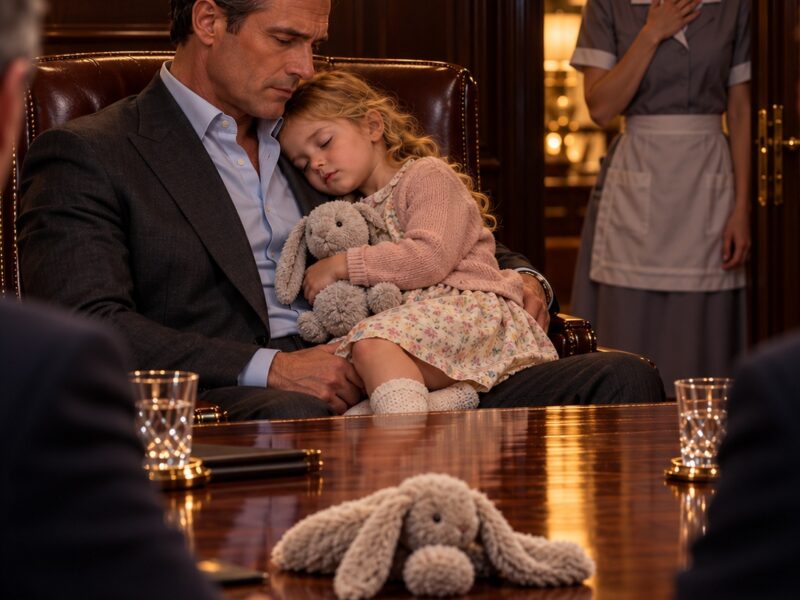
“Is Your Lap Taken, Mister?” the Maid’s Toddler Asked the Mafia Boss — Then Her Bunny Crackled
“Is your lap taken, mister?”
Nathaniel Crane stopped speaking in the middle of a sentence.
Eight men sat around the walnut conference table on the second floor of his Chicago estate, men who controlled trucking contracts, nightclubs, construction companies, and businesses that were never discussed in front of accountants. For the past hour, they had been arguing over three missing containers at the river docks.
Now every one of them was staring beneath the edge of the table.
A little girl stood beside Nathaniel’s chair.
She couldn’t have been older than three.
Honey-blond curls framed a round, serious face. Pink socks covered her feet, but she wore no shoes. A gray stuffed rabbit dangled from one hand by its long ear.
Nathaniel looked down at her.
The child looked back.
“Is your lap taken?” she repeated.
Across the table, Tommy Barone lowered his cigar.
Walter Shaw’s eyebrows lifted.
Nobody laughed.
People did not bring children into Nathaniel Crane’s meetings.
People barely brought adults into Nathaniel Crane’s meetings without permission.
Nathaniel leaned back slightly.
“No,” he said. “Apparently it isn’t.”
“Good.”
Before anyone could react, the little girl climbed.
She planted one hand on Nathaniel’s knee, used the side of his chair for leverage, and scrambled onto his lap with the absolute confidence of someone who had not yet learned that Nathaniel Crane frightened grown men.
He could have stopped her.
He didn’t.
She turned once, tucked herself against his chest, pulled the gray rabbit beneath her chin, and sighed.
Nathaniel stared down.
“What are you doing?”
“Resting.”
Tommy coughed into his fist.
Nathaniel looked up.
Tommy immediately became interested in the documents in front of him.
The child settled more deeply against Nathaniel.
Within a minute, she was asleep.
Nobody knew what to do.
Nathaniel least of all.
He was thirty-seven years old. He owned seventeen legitimate companies, six properties under his own name, and enough influence around Chicago’s freight corridors that men twice his age asked before changing routes he considered his.
He had negotiated with union presidents.
He had stared across restaurant tables at men who had ordered murders.
He had once sat through a federal deposition for nine hours without drinking water because the attorney questioning him believed discomfort made people careless.
None of that had prepared him for thirty-two pounds of sleeping toddler.
“Boss?” Tommy finally said.
Nathaniel lifted one finger.
“Keep talking.”
Tommy looked toward the child.
Then back at Nathaniel.
“Right.”
The meeting continued.
Quietly.
Nathaniel heard almost none of it.
The little girl was warm against him. Her breathing slowed until he could feel it through his shirt.
Every few minutes, she made a tiny movement, as though confirming he was still there.
Nathaniel found himself holding his left arm slightly away from his body because her head rested in the crook of his elbow.
He was afraid moving would wake her.
That realization irritated him.
Then the rabbit crackled.
Everyone stopped.
A faint burst of static came from somewhere inside the stuffed animal.
Then a woman’s voice.
“Poppy?”
Nathaniel looked down.
The rabbit crackled again.
“Baby, where are you?”
The woman sounded frightened.
“Answer Mommy, please.”
Nathaniel turned the stuffed rabbit over.
There was a small fabric pocket stitched beneath its tail.
Inside was a white baby monitor no bigger than a deck of cards.
A green light glowed.
Nathaniel stared.
Walter Shaw leaned forward.
“What the hell?”
Nathaniel found a button marked TALK.
He pressed it.
“She’s with me.”
Silence.
Then—
“Who is this?”
“Nathaniel Crane.”
The silence became absolute.
Nathaniel continued.
“Second-floor conference room. She’s asleep.”
“Oh my God.”
“She’s fine.”
“I’m coming.”
“Take your time.”
That last sentence made Tommy look at him strangely.
Nathaniel ignored him.
Thirty-seven seconds later, the conference room door opened.
Claire Hollis stood in the doorway.
Nathaniel knew her, though until that moment he had never spoken more than ten words to her at once.
She had joined the household staff six weeks earlier.
Twenty-nine years old.
Widowed, according to the employment file.
One daughter.
Worked housekeeping during the morning and laundry in the afternoons.
Mrs. Babcock, who managed the estate, had described her as quiet, punctual, and “the only person in Illinois who folds fitted sheets without swearing.”
Now Claire was breathless.
Her gray uniform was wrinkled. Several strands of honey-blond hair had escaped from the clip at the back of her head.
Her eyes went first to Poppy.
Then to Nathaniel.
Then, for half a second, to Walter Shaw.
Nathaniel noticed.
Claire hurried forward.
“I’m so sorry, Mr. Crane.”
Her voice was barely above a whisper.
Nathaniel looked at the sleeping child.
“She appears comfortable.”
“She was supposed to be in the staff room.”
Claire crouched.
“Poppy?”
The girl did not wake.
Claire closed her eyes.
“My daycare flooded this afternoon. Mrs. Babcock said I could bring her for one evening. I thought she was sleeping downstairs.”
“You put a monitor in the rabbit?”
Claire looked embarrassed.
“It’s old. The regular unit broke. I sewed the receiver pocket into Gus because she won’t sleep without him.”
Nathaniel looked at the rabbit.
“Gus?”
“His name.”
“Of course.”
Claire gently lifted Poppy.
The child complained softly and buried her face against her mother’s neck.
Nathaniel released her reluctantly.
That bothered him more than it should have.
Claire adjusted Poppy on her shoulder.
“This will never happen again.”
Nathaniel looked at her.
He could have said, Make sure it doesn’t.
That was the answer everyone expected.
Instead he asked, “How long was the monitor transmitting?”
Claire glanced at Gus.
“Maybe twenty minutes.”
“It barely has range.”
“It had range tonight.”
Her expression changed slightly.
Before Nathaniel could ask why, Walter Shaw spoke.
“Children don’t belong upstairs during business.”
Claire immediately lowered her eyes.
“No, sir.”
Nathaniel looked at Walter.
Walter had been part of the Crane family since Nathaniel was a child.
He had worked thirteen years beside Nathaniel’s father, Malcolm, and six years beside Nathaniel after Malcolm died.
Walter had taught Nathaniel to knot a tie.
Taught him how to read a balance sheet.
Taught him that restaurants were safer if you sat facing the door.
At Malcolm Crane’s funeral, Walter had stood beside Nathaniel for the entire service with one hand resting on his shoulder.
Nathaniel trusted him more than almost anyone alive.
Still, something in Claire’s reaction bothered him.
Not fear exactly.
Awareness.
Nathaniel reached for Gus.
“You’ll need this.”
Claire hesitated.
Then took the rabbit.
“Thank you.”
Poppy opened one eye.
“Mister?”
“Yes?”
“Your lap is nice.”
Nathaniel heard Tommy choke.
Claire turned bright red.
“Poppy.”
The child closed her eye again.
Nathaniel almost smiled.
“Good to know.”
Claire left.
The door closed.
For several seconds, none of the men spoke.
Then Tommy leaned back.
“Well.”
Nathaniel looked at him.
“Finish that sentence carefully.”
Tommy reconsidered.
“No sentence.”
Walter shook his head.
“You let a child walk into a captains’ meeting.”
“She’s three.”
“That doesn’t make it better.”
“It makes her unlikely to be working for the federal government.”
Someone laughed.
Walter did not.
Nathaniel noticed that too.
The meeting ended at eight thirty-one.
By nine forty-eight, Nathaniel was in his study reviewing a logistics report when Mrs. Babcock knocked.
She was sixty-four, wore navy dresses every day regardless of weather, and had run the Crane estate long enough to ignore most social hierarchies.
Tonight she looked troubled.
Nathaniel set down his pen.
“What happened?”
“Claire left.”
He frowned.
“What do you mean?”
Mrs. Babcock held out an envelope.
“She resigned.”
Nathaniel took it.
One typed page.
Professional.
Apologetic.
Effective immediately.
No explanation.
“She quit because her daughter wandered upstairs?”
“I asked.”
“And?”
“She said it was personal.”
“Where is she?”
“Probably on her way to Harland Street.”
Nathaniel looked up.
“The bus terminal?”
“She asked me how to reach Burlington.”
“Vermont?”
Mrs. Babcock nodded.
“She said she has a cousin there.”
“When is the bus?”
“Eleven fifteen.”
Nathaniel looked at the clock.
9:51.
Mrs. Babcock remained standing.
“There’s something else.”
She pointed toward the resignation letter.
Nathaniel turned it over.
A small dry-cleaning ticket had been stapled to the back.
KESSLER CLEANERS — 4471
Beside it was a yellow sticky note.
Claire’s handwriting.
Pool house. Twelve shirts. Men.
Nathaniel read it twice.
“Did she explain this?”
“No.”
“Did you ask?”
“She was already frightened.”
Nathaniel looked at Mrs. Babcock.
“Frightened of what?”
“If I knew, I’d have written it on the sticky note.”
He almost smiled.
Then stopped.
Kessler Cleaners.
The name mattered.
The Kessler family operated three dry-cleaning businesses on Chicago’s South Side.
They also controlled an independent freight company that had competed with Crane Logistics for years.
The legitimate rivalry was public.
The other rivalry wasn’t.
Eleven years earlier, Malcolm Crane and Emil Kessler had nearly turned a disagreement over river-dock contracts into something bloodier.
Eventually they made peace.
Nathaniel had believed the peace still existed.
“Where’s the girl?”
“With Claire.”
“She stripped the room,” Mrs. Babcock said.
“What?”
“Sheets folded. Towels in the laundry basket. Trash emptied.”
Nathaniel stared.
“She resigned and cleaned the room?”
“Exactly.”
“Who does that?”
“Someone raised properly.”
Nathaniel stood.
“Or someone trying not to leave anything behind.”
He walked upstairs.
The conference room was dark.
Nathaniel turned on one lamp.
The walnut table had been wiped clean.
Every chair was pushed precisely into place.
Claire’s work.
He remembered leaving Gus beside his chair.
The rabbit was gone.
She had come back for it.
Of course she had.
A three-year-old did not ride overnight to Vermont without the gray rabbit she slept with.
Nathaniel stood beside his chair.
When he had left the room at eight thirty-one, Walter had still been inside.
“Go ahead,” Walter had said. “I’ll lock up.”
Nathaniel remembered it clearly.
Walter always locked up.
He pulled out his phone.
“Tobias.”
His head of security answered immediately.
“Yes, boss?”
“Study. Now.”
Tobias Reyes arrived four minutes later.
He was forty, broad-shouldered, former Chicago Police before deciding the Crane salary was better and the internal politics were only marginally worse.
Nathaniel handed him the ticket.
Tobias studied it.
“Kessler?”
“Who’s staying in the pool house?”
“Alarm contractors.”
“How many?”
“Four.”
“Who hired them?”
Tobias paused.
“Walter.”
“When?”
“Monday.”
“What are they doing?”
“Upgrading the perimeter system Saturday night.”
Nathaniel looked at him.
“Show me the pool-house camera.”
Tobias opened the security application on his laptop.
The feed showed a gray maintenance screen.
He frowned.
“That’s wrong.”
“How long?”
Tobias checked.
“Since Monday afternoon.”
“Whose authorization?”
Another pause.
Then Tobias turned the laptop around.
ADMIN OVERRIDE: WS-02
Walter Shaw.
Tobias’s expression changed.
“Boss—”
“You trusted him.”
“I should’ve caught it.”
“So should I.”
Nathaniel returned to the conference-room records.
Electronic entry logs showed every attendee leaving between 8:28 and 8:31.
Walter remained.
Eleven minutes.
Alone.
Nathaniel pictured the rabbit lying beside his chair.
Green light glowing.
Claire downstairs with the receiver still in her apron pocket.
Eleven minutes.
“She heard something,” Nathaniel said.
Tobias looked up.
Nathaniel was already moving.
Claire’s staff room stood open.
He stopped at the threshold.
He did not enter.
The bed was stripped.
Sheets folded.
One suitcase gone.
Poppy’s cheap plastic cup remained by the sink.
On the wall above the bed was a crayon drawing.
Nathaniel stared.
A large figure in a black suit sat in a brown chair.
A small girl with yellow hair sat on him.
Between them was a gray rabbit with enormous ears.
At the top, in shaky blue letters:
MISTER NATE + POPPY + GUS
The crayon was still on the windowsill.
Tobias appeared behind him.
“I can put two men at Harland Street.”
“No.”
“Boss.”
“No guns at a bus station because a housekeeper quit.”
“We need to know what she heard.”
“I’ll ask.”
“You’re going alone?”
Nathaniel put on his coat.
“Yes.”
“That’s a terrible idea.”
“I’ve had several tonight.”
He drove himself.
The Harland Street depot sat beneath an elevated rail line west of downtown. The waiting room smelled like burnt coffee, wet coats, and industrial floor cleaner.
Fluorescent lights hummed overhead.
A departures board read:
BURLINGTON — 11:15 — ON TIME
Nathaniel checked his watch.
10:35.
Forty minutes.
Claire sat on the last bench near the window.
Poppy slept stretched across a navy duffel bag, one of Claire’s coats covering her legs.
Gus was tucked beneath the child’s arm.
Claire held a paper cup of tea between both hands.
She wasn’t drinking it.
When she saw Nathaniel, she closed her eyes briefly.
“You came alone.”
“I did.”
“You don’t go anywhere alone.”
“I’m experimenting.”
Claire looked toward the terminal doors.
“Did Mrs. Babcock call you?”
“She gave me the resignation.”
Her mouth tightened.
“And the tag.”
Claire looked at him.
Nathaniel pointed toward the seat beside her.
“Taken?”
For the first time that night, a tiny smile appeared.
“That’s Poppy’s line.”
“She’s asleep. I’m stealing it.”
Claire moved her purse.
Nathaniel sat one seat away.
“I’m not here to stop you from leaving.”
She looked at him skeptically.
“If you get on that bus, I’ll carry the bag to the door. I’ll tell the driver her name. Then I’ll leave.”
“Why come at all?”
“Because I would like you to explain the dry-cleaning ticket.”
Claire turned the paper cup.
“You could have security investigate.”
“I am.”
“So why me?”
“Because you noticed first.”
She looked down.
“I do laundry.”
“That seems to be becoming relevant.”
She almost smiled again.
Nathaniel nodded at the tea.
“That’s cold.”
“It was cold twenty minutes ago.”
“Why hold it?”
Claire shrugged.
“A woman sitting alone at a bus station with a sleeping child gets asked if she’s okay.”
“And holding cold tea prevents that?”
“It makes me look like I have a plan.”
“Do you?”
“No.”
Nathaniel understood that more than he expected.
He looked toward Poppy.
“How old?”
“Three and two months.”
“Talks like she’s forty.”
“She learned from Mrs. Babcock.”
“That explains everything.”
Claire laughed once.
Small.
Surprised.
The departures board flickered.
Thirty-seven minutes.
Nathaniel folded his hands.
“Tell me about the rabbit.”
Claire’s expression changed.
“When you gave Poppy back to me, Gus stayed on your table.”
“I remember.”
“I realized in the stairwell.”
“So you went back.”
“The door was closed.”
Nathaniel waited.
“Walter was inside.”
“Alone?”
“Yes.”
Claire touched the pocket of the coat she still wore.
“The baby monitor receiver was in my apron.”
Nathaniel stared.
“It was still connected?”
She nodded.
“I heard his call.”
“What did he say?”
Claire looked toward her sleeping daughter.
Then she spoke.
“He said Saturday the alarm would be down just before two.”
Nathaniel’s face stayed still.
“Anything else?”
“He said the men were already in the pool house.”
Claire swallowed.
“He said you never sleep, but it wouldn’t matter because you would be alone.”
Nathaniel looked toward the dark window.
For nineteen years, Walter had occupied a place in his life somewhere between employee, uncle, and surviving piece of his father.
Now Claire’s voice continued.
“I didn’t know who he was talking to.”
“You knew about the men before tonight.”
“Yes.”
“How?”
Claire raised one finger.
“Mrs. Babcock told me four alarm contractors were staying in the pool house.”
A second finger.
“I prepared four beds.”
A third.
“They sent twelve dress shirts to be cleaned.”
Nathaniel looked at her.
“Alarm contractors own dress shirts.”
“Of course.”
“Twelve?”
“Pressed on hangers.”
Nathaniel waited.
Claire continued.
“They wake at six and run around the tennis court.”
“Maybe health-conscious contractors.”
“They make their beds military tight.”
“That’s more suspicious.”
“Yesterday one asked me whether the service driveway camera recorded audio.”
Nathaniel’s jaw tightened.
Claire reached into her coat.
She handed him three additional dry-cleaning tags.
Numbers 4468, 4472, 4479.
“The shirts were all one order.”
“How do you know?”
“Sequential tags.”
“Why Kessler?”
“Because the Kesslers own the cleaner.”
Nathaniel looked at her.
“You knew that?”
“My first apartment was four blocks away.”
She shrugged.
“Everybody knew.”
“Why keep the tags?”
Claire looked offended.
“I keep everything.”
“Everything?”
“Buttons. Receipts. Missing cufflinks. I have one earring in the laundry office from 2019.”
“You started six weeks ago.”
“It was in a drawer.”
Nathaniel laughed.
He actually laughed.
Claire stared.
“I didn’t know you did that.”
“Neither did I.”
The laugh disappeared.
“How long have you suspected Walter?”
“Suspected something? Wednesday.”
“Why didn’t you tell me?”
“Shirts aren’t proof.”
“And tonight?”
“The call.”
Nathaniel nodded.
“Why leave?”
Claire said nothing.
He waited.
Eventually she looked at him.
“Because he found me first.”
Nathaniel’s entire body went still.
“When?”
“After I came back for Gus.”
“What happened?”
“He was waiting in the service corridor.”
“Did he touch you?”
“No.”
“Threaten Poppy?”
“Not exactly.”
“What does that mean?”
Claire’s fingers tightened around the paper cup.
“He told me eight men had watched your meeting tonight.”
Nathaniel waited.
“He said they watched Poppy climb into your lap.”
Her voice remained controlled.
“Then he said by morning every family in Chicago would know you had let a maid’s child sleep against you.”
Nathaniel looked at Poppy.
Claire continued.
“He said men like you aren’t attacked through doors anymore.”
Nathaniel’s jaw tightened.
“What exactly did he say?”
Claire looked directly at him.
“If you care about that little girl, leave. If you care about Nathaniel Crane, leave faster.”
The terminal sounds seemed to recede.
Nathaniel stared at the floor.
After a long silence, he asked, “So you decided you were my weakness.”
Claire’s laugh had no humor.
“I’m a maid with a three-year-old, Mr. Crane.”
“Nate.”
“No.”
“Why?”
“I’m not calling the man who signs my paycheck Nate at a bus station.”
“You resigned.”
She considered.
“Good point.”
Nathaniel turned toward her.
“Can I tell you what the weakness actually was?”
Claire waited.
“A man I trusted for nineteen years.”
She looked at him.
“A man with codes to every camera, every door, every schedule.”
His voice remained calm.
“That was the weakness.”
Claire looked away.
“You and Poppy didn’t create it.”
“Walter thinks differently.”
“Walter is currently losing credibility.”
“You don’t understand.”
“I understand enough.”
“No.”
Claire’s voice sharpened.
Nathaniel let her speak.
“I grew up in a house where men decided love gave them ownership.”
Her hands began trembling.
“My father fixed problems with his fists. Walls. Furniture. People.”
Nathaniel said nothing.
“I left when I was seventeen.”
Her voice softened.
“My mother didn’t.”
He watched her.
“She died when I was twenty-one. And I promised myself that if I ever had a child, she would never grow up listening for footsteps to figure out what kind of night she was about to have.”
Nathaniel looked at Poppy.
“So when Walter told me people might hurt you because of us, I believed him.”
She swallowed.
“Because men like Walter understand worlds like yours better than women like me do.”
Nathaniel shook his head.
“Tonight suggests otherwise.”
Claire looked tired.
“That isn’t funny.”
“I wasn’t joking.”
The departure board flickered again.
Twenty-four minutes.
Nathaniel asked, “What do you think I’m going to do to Walter?”
Her eyes snapped toward him.
“That’s what I’m afraid of.”
“Why?”
“Because he betrayed you.”
“Yes.”
“And because men like you don’t send people to Milwaukee with severance checks when they betray you.”
Nathaniel almost smiled.
“Specific.”
“I’m serious.”
“So am I.”
Claire faced him fully.
“I’m asking you something.”
“Ask.”
“Whatever you do tonight, don’t turn into the thing I spent my life running from.”
Nathaniel stared.
She continued.
“Poppy thinks you’re safe.”
The words hit somewhere unexpected.
Claire’s eyes filled.
“She climbed onto you because she decided you were safe.”
Nathaniel looked toward the child.
“I don’t know why.”
“I don’t either.”
Claire gave a weak smile.
“She once tried to feed a parking meter crackers. Her judgment isn’t perfect.”
Nathaniel laughed softly.
Then became serious.
“I can’t promise Walter faces no consequences.”
“I’m not asking that.”
“Good.”
“I’m asking you not to make fear the consequence.”
He understood.
Not immediately.
But enough.
Nathaniel reached into his coat.
He removed an old brass key.
He set it on the bench.
Claire looked down.
“What is that?”
“East kitchen entrance.”
“I have an employee key.”
“You resigned.”
She stared.
“This one isn’t in the electronic system.”
“Why?”
“It belonged to my mother.”
Claire looked at him.
“She hated security codes.”
“Smart woman.”
“She once told my father anything that needed six cameras to protect probably shouldn’t be in the house.”
Claire smiled.
Nathaniel pushed the key closer.
“If you get on the bus, mail it back.”
She looked at him.
“No note necessary.”
“And if I don’t?”
Nathaniel stood.
“Then use it.”
Claire stared at the key.
“You’re leaving?”
“I have a conversation to finish.”
“You came all the way here and now you’re walking away?”
“The choice should be yours.”
He looked at her.
“Not something you make because I’m standing over you.”
Claire’s expression changed.
He looked at the board.
11:02.
Thirteen minutes.
Nathaniel bent toward Poppy.
He touched one long gray rabbit ear.
Poppy murmured in her sleep.
Then he straightened.
“Goodbye, Claire.”
She swallowed.
“Goodbye, Nate.”
It was the first time she called him that.
He walked out before it could change his mind about leaving.
Walter Shaw was waiting in Nathaniel’s study when he returned.
Of course he was.
Walter sat beside the fireplace with a glass of brandy.
His tie had been loosened exactly one inch.
Everything about Walter was controlled.
Even disloyalty, apparently.
“You went out,” Walter said.
“Yes.”
“Alone.”
“Yes.”
“Your father would have hated that.”
Nathaniel closed the door.
“My father hated many things.”
Walter swirled the brandy.
“He understood survival.”
“He died at sixty-two.”
“That isn’t an argument.”
“No.”
Nathaniel removed his gloves.
“It’s an observation.”
Walter watched him carefully.
“The maid left.”
“I heard.”
“Probably best.”
Nathaniel crossed toward the desk.
“Why?”
Walter shrugged.
“Children in a house like this create complications.”
Nathaniel’s eyes hardened.
“Who’s in my pool house?”
Walter did not move.
“The contractors.”
“What kind?”
“You know what kind.”
“Tell me.”
“Alarm.”
Nathaniel nodded.
“Why has the camera been disabled since Monday?”
“Maintenance.”
“Using your administrative code.”
“Yes.”
“Why?”
“Because that is how maintenance access works.”
Nathaniel stared at him.
“Why did your contractors send twelve dress shirts to Kessler Cleaners?”
Silence.
Very small.
But real.
Walter set down the glass.
“You’re listening to a cleaning woman now?”
Nathaniel’s voice remained quiet.
“I’m listening to the person who noticed.”
Walter stood.
“She does laundry.”
“Yes.”
“You have an entire security department.”
“Yes.”
“And you’re taking the word of some woman you’ve known six weeks?”
“No.”
Nathaniel opened a folder.
“I’m taking her observation and checking it.”
He placed printouts on the desk.
“Pool-house camera disabled with your code.”
Another page.
“Estate car signed out by you Tuesday.”
Another.
“Kessler Cleaner tickets delivered the same afternoon.”
Walter’s jaw tightened.
Nathaniel continued.
“And security records show you alone in the conference room for eleven minutes tonight.”
The fire popped.
Walter stared at him.
Nathaniel said, “That’s the problem with numbers.”
Walter said nothing.
“They don’t care how long I’ve loved you.”
The sentence changed the room.
Walter looked away first.
Nathaniel felt something break inside himself.
It was quieter than anger.
Far worse.
“You taught me to tie a tie,” Nate said.
Walter closed his eyes.
“You taught me how to drive.”
“I remember.”
“You sat beside me when my father died.”
“Yes.”
“So tell me why.”
Walter looked suddenly older.
“Because somebody had to think past you.”
Nathaniel waited.
Walter’s voice changed.
The careful paternal warmth disappeared.
What remained was tired.
Cold.
“Eight men watched a toddler climb into your lap tonight.”
Nathaniel stared.
Walter continued.
“You sat there holding a maid’s child during a captains’ meeting.”
“That’s your reason?”
“It’s evidence.”
“Of?”
“Softness.”
Nathaniel almost laughed.
Walter didn’t.
“Your father would never have allowed anyone that close.”
“My father barely allowed me that close.”
“He survived thirty years.”
“He died alone.”
“He died respected.”
Nathaniel’s face hardened.
“So you made a deal with the Kesslers.”
Walter’s jaw moved.
“Yes.”
The admission hurt less than the waiting.
“What deal?”
“If you continued dismantling the old operations, the Crane organization would fragment.”
“Those operations are destroying legitimate companies.”
“They are what made the legitimate companies possible.”
“Thirty years ago.”
Walter stepped forward.
“You think the city changed because you bought nicer offices?”
“No.”
“You think regulators suddenly became honest?”
“No.”
“You think our rivals look at your hotel investments and decide not to smell weakness?”
Nathaniel waited.
Walter pointed toward him.
“You inherited something your father built with blood.”
“I know.”
“And you’ve spent six years apologizing for it.”
“I’ve spent six years trying not to hand it to another generation.”
Walter shook his head.
“You are embarrassed by what you are.”
Nathaniel thought about that.
“No.”
He surprised himself.
“I’m embarrassed by what I used to think I had to be.”
Walter’s face tightened.
“The Kesslers offered stability.”
“By killing me?”
Walter looked away.
That was enough.
Nathaniel’s voice dropped.
“Were they going to kill me?”
“If necessary.”
Nathaniel stared at the man who had once tied his shoelaces when his mother was sick.
Walter whispered, “I thought I could convince you to step aside.”
“You put four men in my pool house.”
“Because you never step aside.”
“And after?”
Walter said nothing.
Nathaniel nodded.
“I see.”
His phone buzzed.
A message from Tobias.
POOL HOUSE SECURE. 4 MEN COOPERATING. NO INJURIES.
Another message followed.
THEY WANT THEIR SHIRTS.
Nathaniel actually smiled.
Walter noticed.
“What?”
“Nothing.”
Nathaniel picked up the desk phone.
He dialed.
A man answered after three rings.
“Hello?”
“Emil Kessler.”
Silence.
“Nathaniel.”
“I have four guests of yours.”
Another silence.
Nathaniel continued.
“They’ll be returned within the hour.”
Walter stared.
“Unharmed.”
Kessler finally spoke.
“This doesn’t need to become a war.”
“It won’t.”
“What do you want?”
“We talk tomorrow.”
“And Walter?”
Nathaniel looked at him.
“That’s family business.”
He hung up.
Walter shook his head.
“You’re letting them walk.”
“Yes.”
“They came here to remove you.”
“Yes.”
“Your father would—”
“My father is dead.”
Nathaniel’s voice cracked through the room.
Walter stopped.
Nathaniel lowered it again.
“I am tired of living according to what a dead man might have done.”
He looked toward the door.
“Tobias.”
The security chief entered.
Walter stared at him.
Nathaniel said, “Mr. Shaw has a sister in Milwaukee.”
Tobias nodded slowly.
“He’ll go there tonight.”
Walter laughed bitterly.
“That’s it?”
“No phone connected to Crane businesses. No company accounts. No access to any property. His retirement package remains intact.”
Walter’s face changed.
“You’re paying me?”
“You earned the legitimate part of your pension.”
“After this?”
“After nineteen years.”
Walter stared.
Nathaniel continued.
“If you contact the Kesslers or interfere with Crane property again, attorneys will handle it.”
“Attorneys.”
Walter almost spat the word.
Nathaniel smiled tiredly.
“I know. Terrifying.”
“You have become weak.”
Nathaniel looked toward the dark window.
A sleeping child’s weight returned to his memory.
A woman at a bus station telling him not to become the thing she ran from.
“Maybe.”
He faced Walter.
“But tonight I found out I don’t mind.”
Walter’s anger collapsed.
For the first time, he simply looked sad.
“I loved your father.”
“I know.”
“I loved you too.”
Nathaniel swallowed.
“I know that too.”
Walter’s eyes filled.
“Then why does this feel like nothing?”
“Because love without trust becomes a memory.”
Walter lowered his head.
Tobias escorted him out.
Nathaniel waited until the door closed.
Then he checked his watch.
11:31.
The Burlington bus had left sixteen minutes earlier.
He stood alone.
For a moment, he told himself he was relieved.
Claire and Poppy were safer elsewhere.
That was logical.
He had spent his entire life believing logic was easier to carry than need.
He put his coat back on.
Tobias appeared.
“Boss?”
“I’m going out.”
“You just sent your security adviser to Milwaukee for conspiring against you.”
“Correct.”
“And now you’re leaving alone again?”
Nathaniel considered.
“Come halfway.”
“Halfway?”
“Follow me. Stay outside.”
Tobias smiled.
“Progress.”
The Harland Street depot was nearly empty at 11:46.
The Burlington departure had disappeared from the board.
The last bench by the window was empty.
No duffel.
No cold tea.
No sleeping child.
Nathaniel stood there with his hands in his coat pockets.
He had built an entire life around never needing anyone to stay.
He knew how to purchase loyalty.
How to reward it.
How to frighten people out of leaving.
He had never once looked at another person and simply said:
Stay because I want you here.
Maybe he did not know how.
Maybe he was not entitled to ask.
He looked at the empty bench.
Poppy’s crayon drawing came back to him.
MISTER NATE + POPPY + GUS.
He almost laughed.
Instead, something in his chest hurt.
He turned toward the doors.
“Is this bench taken, mister?”
Nathaniel stopped.
He turned.
Claire stood near the diner counter.
Poppy slept against her shoulder.
Gus dangled by one ear.
The duffel bag sat beside her feet.
Nathaniel stared.
“You missed the bus.”
Claire shook her head.
“I didn’t miss it.”
“What happened?”
“I watched it leave.”
“That seems like missing it.”
“No.”
She shifted Poppy higher.
“There’s a difference.”
Nathaniel walked toward her slowly.
“Why?”
Claire looked toward the diner.
“I’ll tell you after you buy me something to eat.”
“What?”
“I’ve had cold tea since ten.”
The diner had six stools and a cook named Earl who looked at Nathaniel Crane exactly the same way he looked at everyone else.
“Coffee?”
Nathaniel nodded.
“Black.”
“Of course.”
Earl looked at Claire.
“Food?”
“Grilled cheese.”
“You sharing with the kid?”
“She’s asleep.”
Earl made one anyway.
He placed a small container of applesauce beside Poppy.
Claire smiled.
“I like him.”
Nathaniel looked at Earl.
“He’s already more popular than me.”
“Applesauce is powerful.”
Claire ate half the sandwich before speaking again.
Nathaniel let her.
Eventually she put it down.
“Well?”
“Well what?”
“Did you become the thing I ran from?”
Nathaniel turned the coffee cup slowly.
“No.”
Claire watched him.
“Walter?”
“Alive.”
Her shoulders relaxed.
“Where?”
“On his way to Milwaukee.”
“You exiled him to Wisconsin?”
“He has a sister.”
“That’s somehow worse.”
Nathaniel smiled.
“He keeps his pension.”
Claire stared.
“Seriously?”
“Nineteen years don’t disappear because the twentieth was terrible.”
“That is either very mature or deeply strange.”
“Both can be true.”
“And the men?”
“Going home.”
“With their shirts?”
“Pressed.”
Claire laughed.
The sound filled the tiny diner.
Poppy shifted but didn’t wake.
Nathaniel watched Claire.
He realized he had never seen her laugh before.
It made her look younger.
Less careful.
He wanted to see it again.
That thought frightened him almost as much as Walter’s betrayal.
Claire took another bite.
“So.”
Nathaniel waited.
“Why didn’t you leave?”
She looked toward Poppy.
“I stood at the bus door.”
Her voice softened.
“The driver had my ticket.”
Nathaniel said nothing.
“And I thought about Walter telling me I was your weakness.”
She looked at him.
“Then I remembered Poppy’s drawing.”
Nathaniel’s expression changed.
“You saw me in the doorway.”
“Mrs. Babcock saw you.”
“Mrs. Babcock spies.”
“Mrs. Babcock manages information.”
“She texted me after you left.”
Nathaniel groaned.
“What did she say?”
Claire smiled.
“She said you stood outside my room looking at the drawing like the floor was lava.”
“That woman is fired.”
“She owns the house emotionally. You can’t fire her.”
“True.”
Claire’s smile faded.
“Poppy drew it before bed.”
Nathaniel listened.
“She told me, ‘That’s the mister whose lap wasn’t taken.’”
Nathaniel looked down.
Claire touched Gus’s ear.
“I kept thinking about why she climbed onto you.”
“So have I.”
“She doesn’t do that with strangers.”
“You said she asks everyone.”
“She asks.”
Claire smiled.
“She doesn’t usually climb.”
Nathaniel’s throat tightened.
“What changed?”
“I don’t know.”
For a moment, neither spoke.
The elevated train rumbled above them.
Earl wiped the counter.
Claire looked at Nathaniel.
“You came back.”
“Yes.”
“Why?”
“To make sure you were safe.”
“That’s not why.”
Nathaniel sighed.
“You’re irritating.”
“So I’ve been told.”
He placed both hands on the counter.
“I can do math.”
Claire waited.
“Money. Territory. Risk. Labor. How many people a building needs at two in the morning. What a company is worth after taxes.”
“That is extremely romantic.”
“I’m getting there.”
“The diner closes at midnight.”
Nathaniel looked at her.
“I tried doing the math tonight.”
Claire became still.
“What math?”
“What it would cost if you and Poppy were gone.”
He swallowed.
“I couldn’t make the numbers work.”
Her eyes softened.
“There’s no column for it.”
Neither moved.
Nathaniel continued.
“I’m not going to order you back.”
“Good.”
“I’ve ordered people around my entire life.”
“I noticed.”
“I’m very talented at it.”
“I noticed that too.”
He almost smiled.
“I don’t want to be talented at it with you.”
Claire stopped breathing for a second.
Nathaniel’s hands were not steady.
That surprised him.
“So I’m asking.”
She waited.
“Come back.”
He took a breath.
“Not because I pay you.”
Claire watched him.
“Not because you owe me.”
He looked at Poppy.
“Because I would like both of you there.”
The words felt absurdly difficult.
“Please.”
Claire looked at him for a long time.
Then she stood.
Nathaniel’s stomach dropped.
Perhaps he had misunderstood.
Perhaps she was leaving.
Instead she carefully lifted Poppy from her shoulder.
Then placed the sleeping child directly onto Nathaniel’s lap.
Poppy opened one eye.
She looked up.
Her small hand patted his chest twice.
“Still not taken?”
Nathaniel swallowed.
“No.”
“Okay.”
Her eye closed.
Within seconds, she was asleep again.
Something inside Nathaniel became quiet.
Not the quiet he understood.
Not silence forced by fear.
The quiet of a house after everyone you care about has finally come home.
Claire reached into her coat pocket.
She removed the brass key.
Nathaniel looked at it.
She did not return it.
Instead she attached it to her own key ring.
“Pay for my grilled cheese,” she said.
Nathaniel looked up.
“Then take us home.”
Three weeks later, eight men gathered around the walnut conference table again.
Walter Shaw’s chair remained empty.
Nobody suggested replacing him yet.
Nathaniel had learned that empty chairs sometimes deserved time.
Gus the rabbit sat beside the water pitcher.
The baby monitor light glowed green.
Tommy Barone looked at it.
“Is that necessary?”
Nathaniel looked up.
“Yes.”
“For security?”
“Excellent hearing.”
Tommy nodded gravely.
“Understood.”
At seven forty-two, the door opened.
Pink socks appeared.
Poppy walked into the room carrying a small blanket.
Every man fell silent.
She approached Nathaniel.
“Is your lap taken, mister?”
He pushed his chair back.
“Still not.”
“What about Gus?”
Nathaniel looked toward the rabbit.
“Gus has a seat at the table.”
Poppy considered.
“Good.”
She climbed onto him.
This time Nathaniel helped.
She settled against his chest.
The men resumed talking.
More quietly.
Within two minutes, Poppy was asleep.
Downstairs, Claire folded towels in the laundry room with the receiver clipped to her belt.
She was not listening for conspiracy.
Not anymore.
She was listening to her daughter’s breathing.
Slow.
Steady.
Then Nathaniel’s voice came softly through the speaker.
Not to the meeting.
To Poppy.
“I’ve got you.”
Claire stopped folding.
She looked toward the ceiling.
Then smiled.
Life did not transform immediately.
Nathaniel Crane did not stop being who he was because a toddler fell asleep on him.
There were still businesses to untangle.
Rivals who viewed restraint as weakness.
Old relationships built on fear.
Legal exposure from decisions made years before.
But Walter’s betrayal had shown him something his father never taught him.
The strongest wall could fail if the wrong person held the key.
And sometimes the person who saved you was the woman nobody important thought to notice.
Nathaniel began changing the estate’s security structure.
No single adviser controlled every system.
Tobias rebuilt access protocols.
Independent audits were introduced.
Nathaniel also began separating more of the Crane businesses from the old criminal arrangements his father had left behind.
It cost money.
A lot.
Some men left.
Others complained.
One evening Tommy told him, “Your father would be spinning in his grave.”
Nathaniel signed another legitimate freight contract.
“My father spun when the Cubs lost.”
“Fair.”
Claire returned to work, but something between them had shifted.
Nathaniel refused to pretend otherwise.
A month after the bus station, he asked her to meet Mrs. Babcock in the estate office.
Claire arrived suspicious.
Mrs. Babcock handed her a folder.
“What is this?”
“A job description.”
“I already have one.”
“Not anymore.”
Claire looked at Nathaniel.
He leaned against the window.
She opened the folder.
HOUSEHOLD OPERATIONS ASSISTANT
Higher pay.
Health insurance.
Set hours.
Daycare allowance.
Training budget.
Claire stared.
“No.”
Nathaniel blinked.
“No?”
“You cannot promote me because I uncovered a murder plot.”
“Why not?”
“Because that is insane.”
Mrs. Babcock cleared her throat.
“I promoted you.”
Claire looked at her.
“What?”
“I’m sixty-five. I would like to retire before Nathaniel gives me a coronary.”
“I heard that.”
“You were meant to.”
Claire looked back at the folder.
Mrs. Babcock continued.
“You notice things.”
“That’s not a qualification.”
“It is in a household this size.”
Claire looked uncertain.
Nathaniel spoke.
“You’re allowed to say no.”
She looked at him.
“You really mean that now?”
“I’m practicing.”
Mrs. Babcock said, “Slowly.”
Claire laughed.
Then accepted.
Nathaniel and Claire did not become a couple quickly.
That mattered.
He had power over too much of her life already.
He knew it.
She knew it.
So they built boundaries.
Claire moved out of the staff wing after four months.
Nathaniel helped her find an apartment near Poppy’s preschool.
She insisted on signing the lease herself.
He offered security.
She accepted one camera and rejected everything else.
“You cannot put a guard outside my building.”
“I can.”
“You may not.”
He frowned.
“Different sentence.”
“Yes.”
He learned.
They had coffee sometimes.
Then dinner.
Never at the estate at first.
Neutral places.
Cheap places Claire chose deliberately.
The first restaurant was a Mexican place with laminated menus.
Nathaniel arrived in a tailored suit.
Claire stared.
“You look ridiculous.”
“I dress this way.”
“Not here.”
“What should I wear?”
“Something that doesn’t make the waiter think you’re buying the building.”
He looked at the waiter.
“I could.”
Claire covered her face.
Eventually Nathaniel learned jeans.
Poppy approved.
“Your pants look normal.”
“Thank you.”
“Your shoes still look rich.”
Nathaniel looked at Claire.
“Is that a problem?”
“Yes.”
A year after the night with Gus, Nathaniel sold the last nightclub that had tied the Crane family to the old protection structure.
Tommy thought he was crazy.
Tobias thought it was smart.
Claire asked only one question.
“Do you sleep better?”
Nathaniel considered.
“Some nights.”
“That counts.”
Walter sent a Christmas card from Milwaukee.
Nathaniel stared at it for two days before opening.
Inside was one handwritten sentence.
Your mother would have liked who you are becoming.
Nathaniel sat alone in his study for a long time.
Then he called Walter.
The conversation lasted seven minutes.
Neither apologized properly.
Men from their world rarely knew how.
But when Nathaniel hung up, some old weight had moved slightly.
Claire found him afterward.
“You okay?”
“No.”
She nodded.
“Want tea?”
“Yes.”
“Strong?”
“Terrible.”
“Coming up.”
Poppy turned five.
Her daycare no longer flooded.
Gus survived three repairs, one washing-machine accident, and an unfortunate encounter with grape jelly.
The baby monitor stopped working.
Claire offered to remove it.
Poppy refused.
“Gus listens.”
So it stayed.
One evening, Nathaniel returned from a long meeting and found Poppy asleep on the library sofa.
Claire sat nearby reading.
Nathaniel removed his jacket.
“What happened?”
“She waited for you.”
“Why?”
Claire smiled.
“She has a question.”
Poppy woke ten minutes later.
She rubbed her eyes.
“Nate?”
He had stopped being Mister Nathaniel somewhere around her fourth birthday.
“Yes?”
“Is your lap taken?”
Claire laughed softly.
Nathaniel sat in the rocking chair near the window.
“No.”
Poppy climbed up.
She was getting heavier.
Nathaniel mentioned it.
She looked offended.
“I’m growing.”
“So I’ve been informed.”
She tucked Gus beneath her chin.
Then looked toward Claire.
“Mommy?”
“Yes?”
“Your lap is taken too.”
Claire looked down at the book.
“Is it?”
“By Nate.”
Silence.
Nathaniel stared at the child.
Claire turned red.
“Poppy.”
“What?”
“That is not how laps work.”
Poppy considered.
“How do they work?”
Nathaniel looked at Claire.
“I would also appreciate clarification.”
Claire threw a cushion at him.
Poppy laughed until she hiccuped.
Later, when she was asleep, Claire stood in the doorway.
Nathaniel remained in the rocking chair with Poppy curled against him.
“You can put her in bed.”
“I know.”
“You’ll lose feeling in your arm.”
“I already have.”
“And?”
Nathaniel looked down.
“I don’t mind.”
Claire watched him.
Then she crossed the room.
She leaned down and kissed his forehead.
It was the first time.
Nathaniel froze.
Claire smiled.
“You look terrified.”
“I am.”
“Good.”
She walked toward the door.
“Claire.”
She turned.
He looked at her.
“Is yours?”
She raised an eyebrow.
“My what?”
“Your lap.”
She laughed.
“Go to sleep, Nate.”
It would take another six months before she kissed him properly.
Another year before they moved into the same house.
Nathaniel did not ask Claire to marry him until almost three years after Poppy first walked into the conference room.
He did it in the kitchen.
No restaurant.
No photographers.
No men standing guard.
Poppy was doing homework at the table.
Nathaniel had burned garlic bread.
Claire was annoyed.
He put the ring beside her plate.
She stared.
“That better not be what I think it is.”
Nathaniel looked worried.
“What do you think it is?”
“A proposal hidden next to burned garlic.”
“That is remarkably accurate.”
Claire laughed.
Then cried.
Poppy climbed onto her chair.
“Are you saying yes?”
Claire looked at Nathaniel.
He did not command.
Did not persuade.
Did not explain.
He waited.
The man who had spent most of his life forcing answers from the world simply waited for one.
Claire touched the ring.
Then looked at Poppy.
Then back at him.
“Yes.”
Poppy screamed.
Nathaniel laughed.
Gus fell off the chair.
Their wedding was small.
Mrs. Babcock sat in the front row and complained about the flowers.
Tobias cried and denied it.
Tommy gave a speech so inappropriate that Claire threatened to take away the microphone.
Walter came from Milwaukee.
He remained near the back.
Afterward, Nathaniel approached him.
For a moment, both men stood uncertainly.
Then Walter held out his hand.
Nathaniel ignored it.
He hugged him.
Walter closed his eyes.
“You’ve gone soft.”
Nathaniel smiled.
“Yes.”
That evening, Poppy fell asleep before dessert.
Nathaniel carried her upstairs.
Gus hung from one hand.
Halfway down the hallway, she opened her eyes.
“Nate?”
“Yes?”
“Is your lap still not taken?”
Nathaniel laughed quietly.
“Not by anyone else.”
“Good.”
She went back to sleep.
Years later, Claire would tell people the story differently depending on who asked.
If strangers asked how she met Nathaniel Crane, she said she worked for his family.
If friends asked, she said her daughter introduced them.
If Poppy told the story, she insisted Gus deserved credit because without the baby monitor, nobody would have discovered Walter’s phone call.
Nathaniel never argued.
He had learned not to argue with Poppy about Gus.
The gray rabbit eventually lost most of his stuffing.
His ears no longer matched.
One button eye was replaced twice.
But the little monitor stayed sewn into the pocket beneath his tail long after the battery died.
Claire asked Poppy once why she kept it.
Poppy, then eleven, shrugged.
“Because that’s how Nate heard us.”
Nathaniel overheard from the hallway.
He stood there for several seconds.
Then quietly walked away before either of them noticed.
He understood what she meant.
Not the electronics.
The bunny had done something more important than transmit sound.
It had carried a frightened mother’s voice into a room where no one expected to hear it.
And because Nathaniel listened, another voice had followed.
Claire’s.
A woman who noticed shirts.
Laundry tickets.
Camera outages.
A man’s careful words when he thought nobody important was listening.
For most of Nathaniel’s life, importance had been measured in money, reputation, fear, and how many people stood when you entered a room.
He knew better now.
Sometimes the most important person in the room was the one folding towels downstairs.
Sometimes it was a toddler in pink socks asking the wrong question at exactly the right moment.
And sometimes the thing that saved a man’s life was not power, loyalty, or the locked gates around his mansion.
Sometimes it was a cheap gray stuffed bunny crackling softly against his hand.
And a little girl asking, with complete trust:
“Is your lap taken, mister?”









