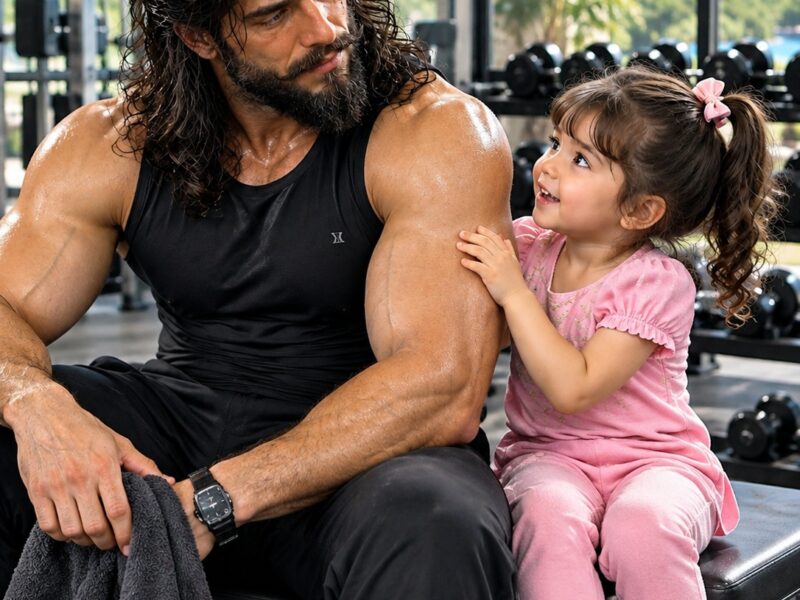
“How Can I Get Muscles Like Yours?” the Maid’s Little Girl Asked the Mafia Boss
I was four years old when I walked into the only room in the mansion everyone had warned me never to enter.
The most feared man in Chicago was inside, shirtless and scarred, pulling himself toward a steel bar as if gravity had personally offended him.
I hugged my one-eared rabbit to my chest and asked, “How can I get muscles like yours?”
Most memories from when I was four come back as pieces.
The smell of my mother’s cold cream.
The yellow stool I used to reach our bathroom sink.
The scratchy collar of the red coat I hated wearing to church.
But I remember that morning whole.
Rain ran down the tall glass wall of Dominic Moretti’s private gym in crooked silver lines. The room smelled of rubber mats, iron plates, and the lemon disinfectant the staff used on every surface in that house as if cleanliness could make a mansion less dangerous.
My mother had told me not to leave the kitchen.
She had told me twice in Spanish, once in English, and then once more while holding my chin so I could not pretend I had misunderstood.
“Lucy, you stay here.”
“I know.”
“You do not wander.”
“I know.”
“This is not our house.”
“I know.”
“You do not open doors.”
That part I apparently did not know well enough.
My mother, Alina Delgado, worked as a housekeeper at the Moretti estate. She had been there eleven months, long enough to understand the rhythm of a house where people spoke softly even when nobody was sleeping.
I understood less.
I knew the gardener removed his cap when a certain black sedan turned onto the drive. I knew men in expensive suits sometimes sat in the west hallway for an hour without being offered coffee. I knew the cooks could argue about produce, the house manager could complain about heating bills, and grown security guards could joke about football—but when Dominic Moretti walked into a room, everybody seemed to remember somewhere else they needed to look.
To me, he was simply Mr. Moretti.
The man with gray eyes.
The man who rarely smiled.
The man my mother told me never to bother.
That morning, the cook was arguing with a delivery driver because twelve cases of San Marzano tomatoes had somehow become twenty-one. My mother was upstairs polishing the east gallery.
I was bored.
My rabbit, Benny, was bored too.
Benny had one ear because our neighbor’s terrier had made a bad decision six months earlier. My mother kept promising to sew another one on.
I preferred him damaged.
It gave him character.
The sound came from below the kitchen.
Thump.
Pause.
Thump.
Pause.
I followed it.
Down a narrow staircase.
Past a hall I had never seen.
Toward a door left open perhaps three inches.
I pushed.
The room beyond it looked enormous to a four-year-old.
One wall was mirrors. Another was glass facing a rain-dark garden. Black weights sat arranged on racks with such precision that even I understood touching them would create a problem.
In the middle of the room, a man hung from a steel bar.
His back was toward me.
He pulled himself upward slowly.
No grunting.
No music.
No trainer shouting.
Only breathing.
Up.
Down.
Up.
Down.
The muscles along his shoulders moved beneath his skin like cables. Old pale scars crossed his back. One curved around his left shoulder. Another disappeared beneath the waistband of his training pants.
I knew who he was before he turned around.
Everyone in that house changed when he entered it.
That was enough identification for a child.
I should have run.
Instead, I stood there holding Benny by his remaining ear.
Dominic dropped silently from the bar.
He reached for a towel.
Then he saw me.
He stopped.
I stopped.
For perhaps five seconds, the most feared man in Chicago and a four-year-old in purple socks simply stared at each other.
He was taller than I expected.
But that was not what surprised me.
He looked tired.
Adults had faces for children and faces for other adults. My mother could be exhausted, then kneel in front of me and smile as if exhaustion had politely stepped outside.
Dominic did not seem to know how to do that.
His face simply looked like whatever had happened before I entered was still sitting there.
He wiped the back of his neck.
Said nothing.
That silence saved me.
If he had shouted, I probably would have cried.
Instead, I looked at his arms.
Then my own.
And asked the most important question available to me.
“How can I get muscles like yours?”
The words came out smaller than I intended.
Dominic blinked.
The gym door slammed open behind me.
I jumped so hard Benny flew from my hand.
A huge man with a shaved head and black jacket rushed inside, one hand already reaching beneath his coat.
I knew him vaguely.
Enzo.
Security.
The kind of adult who had a permanent crease between his eyebrows.
His eyes landed on me.
Then Dominic.
Then the stuffed rabbit on the floor.
“Boss, I’m sorry. I didn’t know she—”
Dominic raised two fingers.
Enzo stopped speaking.
It was impressive.
My mother needed approximately eight sentences and my full name to produce the same effect.
Dominic looked at me again.
“Why?”
His voice was low and rough.
“Why what?”
“Why do you want muscles?”
I glanced at Enzo.
Then down.
There are truths adults can hide because they understand the consequences of saying them.
Four-year-olds mostly have truths.
My mother’s face came into my head.
Not her normal face.
The one from the night before.
She had been sitting at our kitchen table with her phone beside her.
It rang.
She answered.
Then all the color left her cheeks.
Later, I heard the bathroom faucet running for a long time.
When she came out, her eyes were red.
She told me soap had gotten in them.
Even at four, I knew soap rarely made people lock the bathroom door.
“To help Mama.”
Dominic’s expression changed.
“How?”
“She cries with the water on.”
Enzo shifted.
Dominic did not.
“And a man calls her.”
I swallowed.
“She gets scared.”
Dominic’s towel stopped moving.
“He called last night?”
I nodded.
“She checked our door three times.”
I held up four fingers because counting under pressure was difficult.
“Maybe four.”
Dominic stared at me.
“If I was big, I could stand in front.”
Something moved across his face.
At four, I had no word for it.
Years later, I would.
Recognition.
Not recognition of me.
Of the idea.
A small child believing size might stop fear.
Dominic slowly crouched until his face was level with mine.
Enzo made a quiet sound behind us.
I later learned that in nineteen years of working for Dominic Moretti, he had seen the man kneel for exactly three things: his mother’s coffin, a dropped gun during an arrest when he was twenty-four, and me.
“What’s your name?”
“Lucia.”
He waited.
“People call me Lucy.”
“How old?”
“Four.”
“Four.”
He considered this seriously.
“That is a little early for deadlifts.”
“What’s deadlift?”
“Something you are not doing.”
I nodded.
“Okay.”
“The first thing you need to know about getting strong is that muscles come last.”
I looked at his arms.
That seemed objectively false.
Dominic continued.
“Breakfast comes first.”
“I eat breakfast.”
“What?”
“Cereal.”
His face suggested disappointment.
“With what?”
“Milk.”
“Better.”
“Then sleep.”
“I sleep.”
“Enough?”
I looked toward Enzo.
Enzo looked at the ceiling.
Dominic’s mouth nearly moved.
“Then you learn how to breathe when you are scared.”
I frowned.
“That makes muscles?”
“No.”
“It makes strength.”
The word landed differently in the room.
Even Enzo stopped examining the ceiling.
Dominic picked up Benny.
He looked at the missing ear.
“Combat injury?”
“Dog.”
“Understood.”
He handed the rabbit back.
“Ask your mother if you may come tomorrow morning.”
My eyes widened.
“Here?”
“Yes.”
“To gym?”
“Yes.”
“Can I lift this?”
I pointed at a barbell.
“No.”
“What can I lift?”
“Yourself.”
I looked confused.
“So far that appears to be enough trouble.”
Enzo coughed.
I suspect he was laughing.
Dominic stood.
“If your mother says no, you do not come.”
“I understand.”
“Do you?”
“Yes.”
“Good.”
I started toward the door.
Then turned.
“Mr. Moretti?”
“Yes?”
“When do I get arms like yours?”
His eyes followed me.
“Ask me in twenty years.”
“That’s too long.”
“Most worthwhile things are.”
That was the first lesson Dominic Moretti ever gave me.
The second arrived thirty seconds later when Mrs. Howard, the head housekeeper, appeared carrying a silver coffee service and saw me leaving his private gym.
Her mouth opened.
The tray tilted.
A porcelain creamer slid across it, hit the marble, and shattered.
Everybody stared at the pieces.
Mrs. Howard went white.
“I am so sorry, Mr. Moretti.”
Dominic looked at the broken porcelain.
Then at me.
Then at the rabbit.
A small smile appeared.
Barely.
“Leave it.”
Mrs. Howard looked as if he had started speaking Mandarin.
“Sir?”
“Someone get Lucy milk.”
He walked back toward the pull-up bar.
“And find her mother before she assumes we killed the child.”
Enzo finally laughed.
My mother did not.
She appeared three minutes later, still holding a polishing cloth.
“Lucia Elena Delgado.”
That was worse than any mafia title.
I hid behind Enzo.
He immediately moved aside.
Coward.
“You left the kitchen.”
“I found gym.”
“I told you not to leave the kitchen.”
“Mr. Moretti says I can get muscles.”
My mother closed her eyes.
Dominic turned around.
“Only with your permission.”
Her eyes opened.
There was something almost funny about watching my mother realize that the man who frightened every adult in the house had just placed the final authority in her hands.
“Sir, she cannot bother you.”
“She didn’t.”
“She talks.”
“I noticed.”
“A lot.”
“I have meetings with men who say considerably less and accomplish nothing.”
Enzo looked away again.
My mother stared at Dominic.
“Why?”
It was not disrespectful.
Just honest.
Why would a man like him spend time teaching a maid’s daughter anything?
Dominic glanced at me.
“She asked.”
My mother did not seem satisfied.
But she took my hand.
“We will discuss this at home.”
I knew those words.
They did not mean yes.
They also did not mean no.
That evening I explained everything from my bed while my mother folded my clothes.
Dominic’s arms.
The breathing.
Breakfast.
The insult against my cereal.
The rabbit’s combat history.
She listened with her lips pressed together.
Finally she said:
“Do you understand who Mr. Moretti is?”
“Yes.”
“Who?”
“Rich.”
She sat down.
“That is not what I mean.”
“He has gym.”
“Lucy.”
“He’s nice.”
My mother looked toward the window.
Outside, our block in Little Village shone wet beneath streetlamps.
“He can be kind to you and still be a man you need to be careful around.”
That confused me.
At four, people were good or bad largely according to whether they shared snacks.
“Is he bad?”
My mother took too long to answer.
“He lives in a world I do not want you learning too much about.”
“Then why you work there?”
That question hurt her.
I saw it.
“Because sometimes adults make choices based on what keeps the lights on.”
I pointed toward our lamp.
“That?”
She laughed despite herself.
“Yes.”
“That.”
My mother kissed my forehead.
“Sleep.”
I did not.
At 11:18, her phone buzzed.
I opened my eyes a crack.
She sat on the edge of my bed listening to a voicemail.
A man’s voice scratched faintly through the speaker.
Could not hear the words.
I heard hers.
“Rafael.”
A pause.
“Please.”
Her shoulders tightened.
“Not here.”
Another pause.
“You left.”
Then quieter:
“You do not get to decide you are her father when it becomes convenient.”
My stomach tightened beneath the blanket.
I knew my father only through one photograph.
A thin man with dark hair holding me when I was a baby.
My mother kept it facedown in a drawer.
When I asked where he was, she said:
“Some people love badly.”
I had never understood.
That night, his name stayed in my head.
Rafael.
In the morning, my mother said I could return to the gym.
Years later, she admitted there were three reasons.
First, she was afraid that refusing Dominic Moretti might look ungrateful.
Second, she trusted him more around children than she trusted most men around adults, although she could not explain why.
Third, Rafael had called again at dawn.
A small part of her wanted me somewhere protected, even if the protection frightened her too.
Dominic was waiting when we arrived.
Not beside equipment.
At a small table.
On it sat oatmeal.
Eggs.
Apple slices.
A tiny glass of milk.
I stared.
“Is this all mine?”
“Yes.”
“I can’t eat that.”
“Why?”
“That is food for five people.”
“Eat what you can.”
My mother folded her arms.
“She eats before exercise?”
Dominic glanced at her.
“Always.”
Something in his answer softened her by one degree.
That first week, he did not let me touch a weight.
Not one.
I learned to stand with my feet apart.
To put one hand on my stomach.
Breathe in for four.
Hold.
Out for four.
Again.
“If you panic, your body spends energy before you know what problem you have.”
Dominic told me.
I nodded as if this was obvious.
Then he turned everything into games.
Bear crawls across the mat.
Frog jumps.
Standing on one foot while he called it “tree in a storm.”
Pushing a soft medicine ball that weighed less than my rabbit.
He never praised me for being tough.
He praised consistency.
“You came back.”
“You tried again.”
“You stopped when something hurt.”
“That is smart.”
The last one bothered me.
Adults often praised children for ignoring pain.
Dominic did the opposite.
When I fell, he did not rush to lift me.
He stood close.
Waited.
If I looked at him, he said:
“You okay?”
If I nodded:
“Then get up.”
If I said no:
We stopped.
I began looking forward to mornings.
So did he, though he would never admit it then.
The evidence appeared in ridiculous little ways.
A pair of white sneakers on the bench.
Exactly my size.
Gray shorts.
A plastic cup with a cartoon fox.
Dominic was stretching when I arrived.
He did not look toward them.
“Enzo bought those for another child.”
Enzo, standing near the door, nearly choked.
“They didn’t fit.”
Dominic continued.
“Take them.”
I looked at Enzo.
He became fascinated by his shoes.
Later, in the hall, I asked:
“What kid?”
Enzo crouched.
He was enormous close up.
“Little one.”
“Yes?”
“I have worked for that man nineteen years.”
“Okay.”
“Nobody uses that gym.”
“I do.”
“That is my point.”
“Why?”
Enzo rubbed his jaw.
“I have asked myself that every night for three weeks.”
I grinned.
“Maybe he likes me.”
Enzo stared toward Dominic’s closed office door.
“Yes.”
He said quietly.
“I think that might be the problem.”
My mother saw it too.
The oatmeal.
The sneakers.
Dominic ordering the gym floor replaced in one corner because the mat was “worn,” although even I could see it looked new.
Friday exceptions to his no-sweets-before-noon rule.
A little stool added beside the sink.
Once, when I fell asleep on a bench after training, he canceled a meeting rather than let six men enter the gym and wake me.
My mother became increasingly uncomfortable.
“Do not get attached.”
She told me.
I was coloring at our table.
“To who?”
“Mr. Moretti.”
“Why?”
“Because people with his kind of life…”
She stopped.
“What?”
“They lose things.”
I looked at her.
“Then we should not leave.”
My child logic defeated her.
She turned toward the stove.
Years later I understood her fear.
Kindness from a powerful person can feel safer than cruelty.
It can also create dependency before either person notices.
My mother had spent years surviving men who thought providing something gave them rights over her.
She did not want to owe Dominic.
And Dominic, I later learned, was already carrying a debt she knew nothing about.
The first crack appeared because of a scar.
I was hanging from Dominic’s forearm like a monkey while he walked slowly across the gym.
“Again?”
He asked.
“Yes.”
“No.”
“You said muscles come from doing boring things.”
“They also come from rest.”
I dropped onto the mat.
His sleeveless shirt exposed the long pale mark over his left shoulder.
“What happened?”
He looked.
“That?”
“Yes.”
He picked up his water bottle.
“Old.”
“That isn’t what happened.”
He gave me a look.
Four-year-olds make excellent interrogators because they do not respect evasive answers.
Dominic sat on the bench.
“When I was nine, a man came to our apartment.”
“Why?”
“My father owed money.”
“Like rent?”
“Worse.”
I sat beside him.
“My mother tried to stop the man from coming upstairs.”
“What did he do?”
Dominic’s eyes moved toward the rain-dark garden.
“He hurt her.”
“How?”
He hesitated.
“Broke her arm.”
I touched my own arm.
“On purpose?”
“Yes.”
“Why?”
“Because he wanted my father to understand something.”
“Did your dad understand?”
“Yes.”
“Did it fix it?”
“No.”
I thought about that.
“Where were you?”
“On the stairs.”
“Did you hit him?”
“No.”
“Why?”
“I was nine.”
The shame in his voice was older than the memory.
“I froze.”
I patted his arm.
“But you were little.”
Dominic looked at me.
“Little people can’t stop big people.”
The words came naturally.
They were what I believed.
They were why I had asked about muscles.
His expression changed.
“Sometimes they can.”
“How?”
“They can get help.”
“They can remember.”
“They can refuse to become the same kind of big person later.”
That last sentence sounded like it was not for me.
I looked at the scar.
“Who helped you?”
Dominic became still.
I swung my legs.
“After.”
He frowned.
“After what?”
“After bad man.”
He looked down at his hands.
“A woman.”
“What woman?”
“Someone kind.”
“Name?”
He almost smiled.
“You ask a lot.”
“Yes.”
Dominic exhaled.
“Rosa.”
My feet stopped swinging.
“My grandma is Rosa.”
The change was immediate.
Dominic looked at me.
“What?”
“Grandma Rosa.”
“What was her last name?”
“Delgado.”
A dumbbell slipped from his hand.
It hit the rubber floor with a heavy crack.
Enzo appeared in the doorway instantly.
“Boss?”
Dominic did not answer.
His face had gone pale beneath his olive skin.
“Lucy.”
His voice was quieter.
“Your grandmother’s name was Rosa Delgado?”
“Yes.”
“She dead.”
My mother had explained death bluntly.
“Heaven.”
“When?”
“Before me.”
Dominic stood.
Too quickly.
“Go get your oatmeal.”
“But—”
“We’re finished for today.”
“Did I do bad?”
His face changed.
“No.”
Immediately.
“No, Lucy.”
He crouched.
“You did nothing wrong.”
“Then why done?”
“Because I remembered something.”
“What?”
He looked toward Enzo.
Then back at me.
“Something I should have remembered a long time ago.”
That night, I woke while my mother was still working.
The estate had a small room off the kitchen where staff with children sometimes let them nap during late shifts.
I had left my fox cup in the gym.
The house was quiet.
I took Benny.
Crept down the hall.
The gym door stood open.
No lights.
Only the garden lamps spilling soft shadows across the floor.
Dominic sat on the bench.
Alone.
He held something in both hands.
A little blue ceramic cup.
Chipped at the rim.
I had seen it once behind glass in his study.
No expensive object beside it.
No label.
Just a cup.
Dominic turned it slowly.
Then whispered:
“Rosa.”
I backed away.
The next morning I told my mother.
Because I was four.
Secrets at that age last approximately twelve minutes.
She went still.
“Where?”
“In gym.”
“What exactly did he say?”
“Rosa.”
“Anything else?”
“No.”
My mother set down her coffee.
“Stay with Mrs. Howard.”
“Why?”
“Because I need to talk to Mr. Moretti.”
She walked directly to his study.
Without knocking.
The entire corridor noticed.
I waited perhaps ninety seconds before following.
Mrs. Howard had turned toward the sink.
I slipped away.
The study doors were partly glass.
I pressed my face against one panel.
I could see my mother’s back.
Dominic behind his desk.
Enzo near the door.
I could not hear everything.
Years later, Enzo gave me the parts I missed.
My mother began without greeting.
“Why did you say my mother’s name?”
Dominic put down his pen.
He did not lie.
“When I was nine, after the men hurt my mother, I ran.”
“How far?”
“Across the river.”
“In snow.”
“No coat.”
“I ended up on the back steps of a building in Pilsen.”
My mother said nothing.
“A woman opened the door.”
“Rosa Delgado.”
“Yes.”
My mother sat down.
Dominic remained standing.
“She brought me inside.”
“Put me near the stove.”
“Gave me bread.”
“And milk in that blue cup.”
He looked toward a shelf.
“She did not ask who my father was.”
“She did not call police until I was warm enough to speak.”
“She let me sleep on her kitchen floor.”
“One night?”
Dominic shook his head.
“My mother’s arm was badly broken.”
“My father disappeared for weeks.”
“Rosa kept me whenever home was not safe.”
“Two winters.”
My mother covered her mouth.
“She taught me English.”
Dominic said.
“Your family spoke Italian?”
“And enough English to get by.”
“But I was behind in school.”
“Rosa taught me reading with grocery ads and library books.”
“She used to tell me a frightened boy could still be brave if he did the next right thing.”
I stood outside the glass.
Benny pressed to my cheek.
My mother asked:
“Did she know what you became?”
Dominic was silent.
“I don’t know.”
“That is not an answer.”
“No.”
He admitted.
“I went back when I was twenty-seven.”
“With money.”
“With men.”
“With every stupid thing I thought proved I mattered.”
“She had died two years earlier.”
My mother’s shoulders dropped.
Dominic looked toward the blue cup.
“The thrift shop downstairs had bought some of her things from the landlord.”
“I found the cup.”
“That is all?”
“No.”
“A lawyer found she had a daughter.”
My mother’s body went rigid.
“Me.”
“Yes.”
“You knew about me?”
“Not everything.”
“How long?”
“Years.”
“And you never contacted me.”
“No.”
“Why?”
Dominic lowered his eyes.
“Rosa helped me because I was a scared child.”
“I did not want to turn that kindness into ownership of her family.”
My mother laughed once.
Sharp.
“Yet somehow I work in your house.”
Dominic’s silence answered before he did.
Her face changed.
“No.”
“Alina—”
“No.”
“You arranged this job.”
“Yes.”
She stood.
“I applied through an agency.”
“The agency handles several of my properties.”
“You told them to send me here.”
“Yes.”
“Why?”
“Because Rafael left.”
My mother froze.
I did too.
“You know about him?”
“Yes.”
“You investigated me.”
“Only enough to know you were about to lose your apartment.”
“That is enough.”
Dominic accepted that.
“I told myself I was repaying Rosa.”
My mother stared at him.
“My mother fed you because you were hungry.”
Her voice shook.
“Not so you would owe her forever.”
“I know.”
“No.”
“You do not.”
“She did not put bread in front of a nine-year-old so that thirty years later a powerful man could quietly arrange her daughter’s life.”
Dominic’s jaw tightened.
Not anger.
Shame.
“I was trying to help.”
“I know.”
That made him look up.
“And that is why this is complicated.”
My mother continued.
“Helping people without telling them what you are doing can still become control.”
Dominic nodded once.
“You are right.”
My mother seemed almost irritated by how quickly he admitted it.
“And Lucy?”
“I did not know she would enter the gym.”
“But you let her stay.”
“Yes.”
“Why?”
Dominic looked toward the glass door.
Toward me.
I ducked.
Too late.
He had seen my forehead.
“Because I like her.”
That answer was painfully simple.
My mother turned.
“Lucia.”
I stepped inside.
Nobody looked surprised except Enzo.
He had apparently believed I was capable of obeying instructions.
Amateur mistake.
My mother reached for me.
I went to her.
Dominic opened his desk drawer.
Removed a small brass key.
Placed it on the blotter.
“The apartment on Fifth Street.”
My mother stared.
“What about it?”
“Paid through December.”
“In your name.”
“You did that?”
“Yes.”
She looked furious.
Dominic continued.
“It is yours whether you leave this job tomorrow or stay.”
“No conditions.”
“No security people.”
“No one reporting to me.”
“If you want to go, you go.”
My mother looked at the key.
Then him.
“You think that fixes this?”
“No.”
“Good.”
She did not take the key.
Not yet.
Something else had changed in her expression.
The anger remained.
But underneath it was the first edge of understanding.
Then she said:
“Rafael has been calling.”
Dominic became completely still.
“You know who he is.”
“Yes.”
“How?”
“I know Victor Carrara.”
That name changed the temperature of the room.
Even I felt it.
“Rafael owes him money.”
My mother whispered.
Dominic nodded.
“How much?”
“About two hundred thousand.”
She closed her eyes.
“No.”
“He told me it was forty.”
“He lied.”
“What does Victor want?”
“Rafael has no money.”
Dominic’s voice hardened.
“Carrara controls pieces of the east docks.”
“He has wanted access to mine for years.”
My mother looked at me.
Then at Dominic.
“You think Rafael would use Lucy?”
“I think a desperate man does things he can later spend the rest of his life explaining.”
“He is her father.”
“That does not make him safe.”
“No.”
My mother’s voice sharpened.
“It also does not give you the right to decide anything for her.”
Dominic nodded.
“You are right.”
“What do we do?”
The question was quiet.
It was the first time she said we.
Dominic did not miss it.
“First, you decide whether you want to stay here temporarily.”
“Not for me.”
“For security.”
“Second, we talk to a family lawyer who does not work for me.”
“Third, you tell me everything Rafael has said.”
“And you tell me everything you learn.”
She answered.
“No more arranging things in rooms I cannot see.”
“No more secrets dressed as protection.”
Dominic looked at her.
“No more secrets.”
I did not understand the weight of that promise.
Not yet.
We stayed.
The next week felt almost normal.
I trained.
My mother worked.
Dominic stopped pretending Enzo bought my clothes.
Friday morning he gave me a small pair of training gloves.
“You bought these.”
I said.
“Yes.”
I beamed.
“Good job telling truth.”
Enzo turned away to hide his face.
Dominic pointed toward the mat.
“Bear crawl.”
I dropped to my hands and feet.
Twice across.
Then twice more because I believed decisions had been made and children sense safety before adults are willing to name it.
My mother laughed in the garden that Saturday.
Briefly.
I had not heard that laugh in months.
Sunday afternoon destroyed it.
Her phone buzzed on the kitchen table.
No words.
Only a photograph.
Me.
I was kneeling beside the rose garden.
Gray shorts.
White sneakers.
Benny held toward a bee because I believed the rabbit needed educational opportunities.
The angle was close.
Too close.
Below the photograph were three words.
She’s growing fast.
My mother stopped breathing.
Enzo entered carrying coffee.
Saw her face.
Saw the screen.
Something changed in him.
Cold replaced everything else.
He took the phone.
“Where is Lucy?”
“Here.”
My mother pulled me against her.
Enzo looked toward the hall.
“Stay in this room.”
He walked fast.
Within ninety seconds, the estate changed.
Quietly.
That was what frightened me most.
No alarms.
No shouting.
Men appeared.
Doors locked.
Security footage was pulled.
The garden wall was checked.
Dominic entered the kitchen.
He took one look at my mother holding me.
Then the photograph.
His face became unreadable.
“Alina.”
She stood.
“You promised.”
“I know.”
“Tell me.”
“We find where it was taken.”
“Then what?”
“Then we know whether someone got through the perimeter.”
“And if they did?”
Dominic looked at me.
Then back at her.
“We change the perimeter.”
Not:
I kill them.
Not:
I make someone pay.
Even then, he was trying to choose a different kind of strength.
It took three hours.
Nobody had climbed the wall.
The image had been taken from the garden’s east maintenance gate.
Only four people had unrestricted keys.
Two gardeners.
Enzo.
And Sergio Ricci.
Sergio had been beside Dominic for twenty-two years.
Silver-haired.
Elegant.
Always carrying mints.
The first adult in that mansion who learned I liked chocolate coins.
I adored him.
That made what happened worse.
Dominic called each key holder separately.
The gardeners’ access logs cleared them.
Enzo’s badge showed him inside the security office at the time.
Sergio’s did not.
When he entered the study, his tie was loosened.
He looked mildly irritated.
Not frightened.
Even at four, that seemed wrong.
Innocent adults become afraid when powerful men suspect them.
Sergio seemed tired.
“Dom.”
He said.
“What is this?”
Dominic held up the photograph.
No answer.
Twenty-two years lived in the silence between them.
Finally:
“Tell me it wasn’t you.”
Sergio looked at the screen.
His expression emptied.
“You have changed.”
Dominic did not move.
“That is not an answer.”
“The men see it.”
Sergio continued.
“Everybody sees it.”
“You spend mornings teaching a maid’s child to crawl across mats while Carrara takes contracts from us.”
“You turn problems over to attorneys.”
“You negotiate things you used to settle.”
“You call it discipline.”
“They call it weakness.”
Dominic’s voice became quieter.
“You told Carrara about Lucy.”
“I told him a child mattered to you.”
My mother made a sound behind me.
Sergio looked toward her.
“I never told him to send a photograph.”
“You gave a predator a child’s name.”
Dominic said.
“You knew what leverage means.”
Sergio’s face tightened.
“Leverage is why you are alive.”
“No.”
“It is why men still fear this house.”
“I spent my life helping them fear you.”
“For what?”
“So you could become sentimental over a dead woman’s granddaughter?”
Dominic went still.
“How did you know about Rosa?”
The room changed again.
Sergio closed his eyes.
Too late.
Dominic understood.
“Twenty-two years.”
He whispered.
“What did you know?”
Sergio looked older suddenly.
“I was nineteen.”
Enzo’s hand moved beneath his coat.
Dominic noticed.
“Leave it.”
Enzo stopped.
Sergio looked at Dominic.
“The night your mother fell on those stairs.”
My skin prickled.
“I was driving your father’s car.”
Dominic’s face lost color.
“Whose men?”
“Carrara’s uncle.”
“Your father owed them.”
“You knew?”
“I knew enough.”
“You saw my mother hurt?”
“Yes.”
“And never told me.”
Sergio laughed bitterly.
“What would I have said?”
“Hello, Dom, I was the terrified kid behind the wheel while your childhood ended?”
“I spent twenty-two years beside you trying to make up for one night.”
Dominic looked at him.
“And then?”
“And then you got soft.”
“No.”
Dominic’s voice was almost gentle.
“You got scared.”
Sergio’s eyes flashed.
“Of what?”
“That if I stopped being the boy on those stairs, you would have to stop being the driver outside.”
The words hit.
Sergio stared.
Dominic continued.
“You needed me angry enough to justify who you had become.”
“Carrara offered stability.”
Sergio snapped.
“No more war.”
“A leadership change.”
“He would take the east docks.”
“You would keep the rest.”
“Everyone lives.”
Dominic looked almost sad.
“You sold a four-year-old for a succession plan.”
“I did not sell her.”
Sergio’s voice broke.
“I never thought he would touch the child.”
“You gave him the possibility.”
Sergio said nothing.
Dominic closed his eyes.
One breath.
Two.
When he opened them:
“Get him out of my house.”
Enzo looked surprised.
“Boss?”
“You heard me.”
No beating.
No basement.
No revenge.
Two security men escorted Sergio toward the door.
At the threshold, he stopped.
“You think you are different now?”
Dominic did not answer.
Sergio looked toward me.
Then my mother.
“It is too late.”
My mother stiffened.
“What does that mean?”
Sergio swallowed.
“Carrara has the preschool schedule.”
Dominic’s head snapped up.
“What?”
“I gave him pickup times two weeks ago.”
Before I understood anything, my mother lifted me.
“I stayed home today.”
I said.
She looked at me.
I had a fever that morning.
Dominic had canceled training.
The preschool shuttle would still be returning children to our neighborhood.
My mother ran.
The front drive blurred.
We reached the gate at 3:12.
The van stood at the curb.
The driver was outside.
Pale.
Talking to security.
My mother clutched me.
“What happened?”
The driver looked from me to her.
Confusion became horror.
“Mrs. Delgado?”
“Yes.”
“I thought—”
“What?”
“A man came with identification.”
“He said he was Lucia’s father.”
“He had a copy of the enrollment form.”
“And an emergency temporary pickup authorization.”
“Where is the child?”
The driver looked at me again.
“I thought she was—”
My mother’s voice changed.
“Where is the child?”
Another parent screamed from the sidewalk.
“Anna?”
Mrs. Lopez ran toward the van.
My best friend.
Anna Lopez.
Four years old.
Same height.
Same dark bob haircut.
That morning I had loaned her my fox scarf because she liked it.
She had worn a red coat similar to mine.
The substitute shuttle aide had matched the scarf and hair to the photograph provided by the man.
Rafael’s man had taken the wrong child.
The driver sank against the van.
“I’m sorry.”
Mrs. Lopez began screaming.
My mother almost dropped me.
Dominic stepped between both women and the crowd.
Not physically controlling.
Creating one point of calm.
“Call 911.”
He told Enzo.
“Already done.”
“Amber Alert information to Detective Alvarez.”
“Van footage preserved.”
“Do not touch the driver’s phone.”
Then Dominic turned to Anna’s mother.
“Mrs. Lopez.”
She hit him.
Hard.
Across the face.
Everyone froze.
“You brought this!”
She screamed.
“My daughter!”
Dominic took the blow.
Did not move.
“You are right.”
He said.
“We are getting her back.”
His phone rang.
Unknown number.
Dominic answered.
A woman’s voice.
Even I heard it.
“Mr. Moretti.”
Pause.
“Calumet Avenue.”
“Number eleven.”
“Nine tonight.”
“Come alone.”
“No weapon.”
“No followers.”
“If you want the girl returned.”
The line went dead.
Enzo grabbed Dominic’s arm.
“No.”
Dominic looked at him.
“It is a trap.”
“Yes.”
“He has the wrong child.”
“Yes.”
“The second he discovers that, Lucy becomes the target again.”
“Yes.”
“So we use the location while he still thinks he controls it.”
My mother stepped forward.
“You are not walking in alone.”
Dominic looked at her.
“I am not asking your permission to protect Anna.”
“You promised me information.”
“You have it.”
“That is not the same as consultation.”
For once, he looked irritated.
“I do not have time.”
“You have five minutes.”
She pointed toward the house.
“And you are going to use them.”
I had never seen anyone point at Dominic Moretti.
He obeyed.
Inside the study, Enzo paced.
Detective Lena Alvarez from Chicago Police was already en route. Dominic’s attorney joined by secure call.
Dominic unlocked a drawer.
Removed a thick sealed envelope.
Handed it to Enzo.
“If I do not call by ten—”
“No.”
Enzo said.
Dominic looked at him.
“No?”
“I am tired of schedules for catastrophe.”
Enzo took the envelope.
“What is this?”
“Records.”
“Carrara’s operations.”
“My own.”
My mother stared.
“All of them?”
“Enough.”
“For what?”
Dominic looked at her.
“For a federal prosecutor named Celia Hart.”
“She has been trying to build a racketeering case around the docks for three years.”
My mother’s face changed.
“You have been keeping evidence.”
“As insurance.”
“Against Carrara?”
“And myself.”
Enzo opened the flap slightly.
His face tightened.
“Boss.”
“If this goes to Hart, you lose everything.”
Dominic nodded.
“You could go to prison.”
“Yes.”
My mother whispered:
“Why now?”
Dominic looked toward me.
“Because I told Lucy strength was doing the next boring right thing when you are afraid.”
“That envelope is the right thing.”
“And it is not boring.”
Enzo almost laughed.
Dominic continued.
“You give it to Hart if I am not out.”
Enzo looked at him.
“I might give it to her before.”
Dominic stared.
Then nodded.
“That is your decision.”
That was the moment Enzo knew his boss had changed.
Not because Dominic surrendered authority.
Because he allowed another man to exercise judgment without treating disagreement as betrayal.
I remember what happened afterward in fragments.
Adults argued.
Plans formed.
My mother refused to leave the estate.
Mrs. Lopez went with police.
Dominic departed at eight twenty.
Enzo disappeared ten minutes later with the envelope.
A young security driver named Tomaso was ordered to remain behind.
At eight thirty-five, he quietly took his own car.
He planned to follow from several blocks back.
He did not know I was under a blanket in his back seat.
I had slipped through the kitchen door.
Climbed into his car.
Taken Benny.
Because Dominic had taught me that if you wanted to protect someone, you did not panic.
You got close enough to do the next right thing.
My understanding of that lesson was imperfect.
Tomaso discovered me when he parked.
His face remains one of my clearest childhood memories.
“Mother of God.”
“Hi.”
“Lucy.”
“Yes?”
“What are you doing?”
“Helping.”
“No.”
He grabbed his radio.
Then stopped.
If he spoke, he might expose their position.
He crouched.
“Listen to me.”
I did.
For almost twelve seconds.
“You stay in this car.”
“Yes.”
“Doors locked.”
“Yes.”
“You do not get out.”
“Yes.”
“If anyone approaches, horn.”
“Yes.”
“Say it back.”
“Stay car.”
“Good.”
He left.
I stayed.
Almost a minute.
Then I heard a child crying somewhere across the street.
I unlocked the door.
Bad decision.
Very bad.
I crossed beneath rain that had begun falling again.
Number eleven Calumet Avenue was an abandoned three-flat beside an empty lot.
The side door stood open.
One flickering stairwell bulb.
I entered.
Up half a flight.
On hands and feet.
Bear crawl.
Dominic had made me practice it.
At the landing, I saw them.
Victor Carrara stood near the top of the staircase.
Heavy camel coat.
Round face.
Gray hair.
Eyes that seemed wet even when he did not blink.
Beside him stood a thin man I recognized from the photograph in my mother’s drawer.
Rafael Cortez.
My father.
Anna sat wrapped in a blanket on the top step.
Crying.
Unhurt.
Dominic stood at the bottom.
Alone.
Hands open.
No coat.
No visible weapon.
“You came.”
Carrara said.
“I said I would.”
“You always were predictable when women and children were involved.”
“You have the wrong child.”
Carrara glanced at Anna.
“I know now.”
“Let her go.”
“She means nothing to me.”
“Then release her.”
Carrara smiled.
“Eventually.”
Rafael shifted.
“This wasn’t what you told me.”
Carrara ignored him.
Dominic looked at Rafael.
“Your daughter is safe.”
Rafael’s face changed.
“How do you know?”
“Because she is with her mother.”
“You know Alina?”
“Yes.”
Rafael looked confused.
Carrara laughed.
“He knows her very well.”
“That is why we are here.”
Dominic kept his eyes on Rafael.
“You owe him two hundred thousand.”
Rafael swallowed.
“I can pay it.”
“No, you can’t.”
Dominic’s voice was not cruel.
“I will.”
Carrara stopped smiling.
Dominic continued.
“Tonight.”
“Full amount.”
“Clean transfer.”
“Documented debt release.”
“If Rafael walks away from Alina and Lucy and does not participate in whatever you planned.”
Rafael stared.
“Why?”
“Because Lucy wants muscles so she can protect her mother from you.”
The words struck harder than shouting.
Rafael’s face broke.
“She said that?”
“Yes.”
He looked toward the floor.
“I never wanted her afraid.”
Dominic answered quietly:
“Most frightening men say that.”
Carrara clapped once.
“Touching.”
He stepped forward.
“But Rafael is not the asset I want.”
Dominic looked at him.
“What?”
“Your east-dock share.”
“No.”
“Port Authority contacts.”
“No.”
“Your ledger.”
Dominic’s eyes changed.
“There it is.”
Carrara smiled.
“Sign them over.”
“And I forget the Delgado child exists.”
Dominic looked toward Anna.
“And her?”
“Returned.”
“You abducted a four-year-old by mistake.”
Carrara’s mouth tightened.
“Words.”
“Lawyers enjoy them.”
For the first time, uncertainty entered Carrara’s face.
“You did not come here to negotiate.”
Dominic said.
“You came because Sergio told you I was too sentimental to burn my own house down.”
Carrara stared.
Dominic continued.
“He was right about the sentimental part.”
“What house?”
“The organization.”
Carrara’s expression changed.
Dominic had not brought a ledger.
He had already sent it somewhere else.
I did not understand.
Carrara did.
“You wouldn’t.”
“I did.”
A man beside Carrara moved toward Dominic.
Rafael grabbed his sleeve.
“Wait.”
Carrara turned.
“Remove your hand.”
Rafael let go.
His eyes moved upward.
And found me.
I had risen slightly from the dark corner.
Benny against my chest.
My father saw me for the first time since I was a baby.
He knew.
I watched the recognition travel through his face.
“Lucy.”
Carrara turned.
Everything happened quickly after that.
Too quickly for a child’s memory to sequence cleanly.
Carrara swore.
One man moved toward me.
Rafael stepped into his path.
Dominic climbed one stair.
Another man struck Dominic.
He stumbled.
Caught the banister.
Stood.
The man struck him again.
Blood appeared at his lip.
I wanted him to hit back.
The strongest man I knew had arms that could lift his whole body from a bar.
He did nothing.
Another blow.
Dominic stood again.
Carrara laughed.
“Where are your muscles now?”
Dominic wiped his mouth.
Then said:
“I taught a little girl this month that making people afraid is not the same as being strong.”
He looked at me.
Even now.
Even there.
“Turns out I needed the lesson too.”
Carrara’s man raised his hand again.
I could not stay quiet.
“Stop hurting him!”
My voice echoed up and down the stairwell.
Everyone froze for perhaps one breath.
Then came footsteps below.
Many.
Fast.
Heavy.
Carrara smiled.
“Your men?”
Dominic listened.
“No.”
The first person around the lower landing was a small gray-haired woman wearing a dark jacket with white federal lettering across the back.
Behind her:
Agents.
Chicago police.
Enzo.
Tomaso, looking ready to die because he had lost me.
Federal prosecutor Celia Hart had not waited until ten.
Neither had Enzo.
He had opened the envelope at eight thirty-seven.
He had read the first pages.
Seen Carrara’s ledgers.
Seen Moretti’s records.
And driven directly to Hart.
Dominic had been in quiet contact with her office through counsel for six months, exploring what cooperation might look like if he ever dismantled the illegal pieces of his organization.
He had never committed.
Until that night.
Hart already had warrants drafted around parts of Carrara’s business.
The envelope supplied probable cause for the rest and documented the child threat.
The operation moved.
Carrara attempted to leave through the rear stairs.
He made it one landing.
Rafael did not run.
He sat beside Anna.
Covered her with his coat.
Raised both hands.
I remember Enzo reaching me first.
“You.”
His voice shook.
“You disobey everything.”
I clung to him.
“Sorry.”
“You are going to be sorry for twenty years.”
Dominic was sitting on the bottom stair.
His lip split.
One eye swelling.
A paramedic knelt beside him.
Dominic pushed the man’s hand away.
“Lucy.”
Enzo carried me down.
Dominic saw me.
Closed his eyes.
Then whispered something in Spanish.
I did not know it then.
My mother later told me.
Rosa’s language.
A prayer of thanks she had taught him beside a stove when he was nine.
My mother arrived twelve minutes later.
Police had refused to let her enter sooner.
She ran past everyone.
Found me.
Held me so tightly I could barely breathe.
Then she saw Dominic.
Her face changed.
She walked toward him.
He tried to stand.
“Don’t.”
She said.
He stopped.
“You brought federal agents into your own organization.”
“Yes.”
“You knew what that would cost.”
“Yes.”
“You still went inside.”
“Yes.”
“You idiot.”
Dominic almost smiled.
“Also yes.”
My mother began crying.
Not dramatically.
Just exhaustion finally finding somewhere to leave her body.
Dominic looked away.
“I’m sorry.”
“For what?”
“All of it.”
She shook her head.
“We are not doing all of it tonight.”
Good answer.
Anna Lopez went home shortly after midnight.
No physical injuries.
Her family moved from our block within a year.
Her mother never completely forgave Dominic.
He never asked her to.
He paid for therapy through a victim fund administered by an independent attorney, but he did not call it generosity.
He called it responsibility.
Rafael was arrested.
He cooperated almost immediately.
His lawyer presented evidence that Carrara had manipulated his gambling debt and promised help securing legitimate visitation with me if he participated.
That did not erase what he did.
The court did not pretend it did.
But intent and cooperation mattered.
He received a shorter sentence than Carrara’s men.
My mother attended one hearing.
No more.
When Rafael wrote asking to see me years later, she gave the letter to a therapist rather than deciding for me.
At twelve, I chose one supervised meeting.
At sixteen, another.
He never became Dad.
Sometimes biology opens a door.
It does not decide who lives inside the room.
Sergio Ricci received eleven years on charges tied to conspiracy, extortion, and the child surveillance scheme.
Dominic visited him once.
Enzo drove.
When Dominic returned, he sat in the car outside our apartment for twenty minutes.
My mother eventually walked down.
He rolled the window open.
“What did he say?”
She asked.
Dominic stared forward.
“He apologized.”
“Did you accept?”
“No.”
“Did you want to?”
“Yes.”
My mother leaned against the door.
“Both can be true.”
Dominic looked at her.
“You say that often.”
“Because you keep needing to hear it.”
Carrara’s case took nearly a year.
So did Dominic’s.
That is the part stories about powerful men often skip.
The cleanup.
Dominic had cooperated.
He had prevented further harm.
He had provided evidence against an older criminal network.
He had also committed crimes.
Real ones.
Financial coercion.
Illegal payments.
Conspiracy tied to port contracting.
He did not transform cooperation into innocence.
At sentencing, his attorney argued for leniency.
The prosecutor agreed to less time because his cooperation dismantled an extortion structure and helped recover money for several victims.
The judge still looked at him for a long time.
“You spent years exercising power outside the law.”
She said.
“Then when a child was endangered, you discovered the usefulness of the law.”
Dominic nodded.
“Yes, Your Honor.”
“Late enlightenment does not erase early conduct.”
“No.”
“You understand that?”
“Yes.”
He received three years.
Less than some believed he deserved.
More than his old associates thought a man like him should ever serve.
He did not appeal.
The Moretti estate was sold as part of settlements and restructuring.
The east-dock holdings changed hands.
The illegal pieces of the organization disappeared into forfeiture orders, prosecutions, and bankruptcy proceedings.
Men who had once waited for Dominic’s approval stopped answering his calls.
Enzo retired from private security.
Sort of.
He continued appearing wherever my mother and I were, usually claiming coincidence.
We visited Dominic every second Sunday.
The first visit was terrible.
Gray room.
Plastic chairs.
No tailored suit.
No men standing outside the door.
Dominic looked smaller.
Not weak.
Human-sized.
I brought Benny.
He sat across from me.
“How are bear crawls?”
“I do them.”
“Show me.”
A correctional officer stared.
Dominic raised one eyebrow.
“Probably not here.”
I nodded.
My mother brought soup after she learned the facility allowed certain sealed food items during family programs.
Dominic complained there was too much salt.
She threatened never to return.
He ate all of it.
Months passed.
I brought drawings.
Then school worksheets.
Then my first report card.
He studied it more carefully than financial statements probably deserved.
“B in handwriting.”
He said.
“You can improve.”
“I’m five.”
“Excuses begin early.”
My mother laughed.
Dominic stared.
For one second, he looked surprised by the sound.
Then he smiled without seeming to know he was doing it.
When he came out on a cold March morning, his hair had more gray.
No black sedan waited.
No driver in a suit.
Only Enzo in a plain coat.
My mother.
And me.
I was five.
I held the blue cup.
The one with the chipped rim.
Enzo had tracked it after the estate auction.
Bought it from the buyer.
My mother insisted I give it back.
Dominic stepped beyond the gate.
Saw us.
Stopped.
I held out the cup.
“Breakfast first.”
I said.
He took it.
His hands shook.
Tears appeared.
I remember that clearly.
The strongest man I had ever known crying outside a prison with a chipped cup in his hands.
At four, I had believed strength looked like shoulders and arms.
At five, I began understanding it was often much less impressive to look at.
Sometimes strength was returning something.
Sometimes admitting what you broke.
Sometimes walking out of prison with nobody afraid of you anymore.
Dominic did not rebuild his empire.
That surprised a lot of people.
He could have.
Enough legal money remained.
Enough relationships survived.
Instead, he bought a failing three-story building in Pilsen.
Rosa’s old building.
Not as a private monument.
Through a nonprofit trust with an independent board.
My mother insisted.
“Your name does not go on it.”
Dominic frowned.
“I paid for most of it.”
“Exactly.”
Enzo laughed.
The ground floor became a gym.
Small.
Nothing like the mirrored room in the mansion.
Rubber mats.
Used equipment.
Windows that rattled when buses passed.
Behind it was a kitchen.
There was always oatmeal.
Upstairs became after-school rooms.
Then counseling offices.
A childcare room for mothers working evenings.
No membership fee for neighborhood children.
No questions about why someone’s father was absent.
No photographs of Dominic on the walls.
The only object from the old estate sat on a shelf behind the front desk.
Blue cup.
Chipped rim.
Rosa Delgado Community Strength Center.
That was the name.
Dominic fought it.
He lost.
Good.
I grew up there.
At six I learned proper squats with no weight.
At eight, swimming.
At ten, boxing footwork, mostly because Enzo believed every child should know how to move away from trouble before learning how to move toward it.
At twelve, I started helping younger kids.
At fourteen, I understood for the first time why my original question had affected Dominic so deeply.
“How can I get muscles like yours?”
I thought I was asking how to become big enough to stand between my mother and fear.
He had spent his entire life asking the same question.
His answer had been money.
Men.
Weapons.
Territory.
Reputation.
Then a four-year-old walked into his gym and accidentally showed him the flaw.
If your strength requires everyone around you to be afraid, you have not escaped fear.
You have simply distributed it.
I became a strength coach first.
Then studied kinesiology.
Then physical therapy.
The education trust Dominic once wanted to create for me never happened.
My mother refused.
Instead, I earned scholarships through the foundation and worked.
Dominic contributed to the foundation the same way other donors did.
Publicly.
With oversight.
He complained.
My mother said:
“You survived prison. You can survive accounting.”
Their relationship confused people.
They never married.
They never officially dated in the way neighbors could gossip efficiently about.
They became something quieter.
Family.
Mutual responsibility without ownership.
He came to our apartment for Sunday dinner.
My mother yelled if he arrived late.
He fixed cabinet hinges badly.
She fixed them again.
Once I asked whether they loved each other.
My mother said:
“Many kinds of love exist, Lucy.”
Dominic said:
“Your mother is avoiding the question.”
She threw a dish towel at him.
I decided that was enough evidence.
Enzo became the center’s security director, which was absurd because the most serious threat we faced in the first year was a twelve-year-old stealing protein bars.
He caught the boy.
Did not call police.
Put him to work stocking shelves twice a week and sent groceries home with him.
Dominic noticed.
“You have gone soft.”
He told Enzo.
Enzo looked at him.
“Learned from the boss.”
Dominic never corrected the word.
Years passed.
The one-eared rabbit eventually lost the other ear.
My mother repaired both with fabric from one of her old aprons.
The white sneakers disappeared.
The fox cup cracked.
The blue cup remained.
So did the first lesson.
Breakfast.
Sleep.
Breathe.
Consistency.
Ask for help.
Strength is not the absence of fear.
One spring morning, twenty-three years after I first entered Dominic Moretti’s private gym, I was setting out mats at the Rosa Center when the front door opened.
A woman came in holding the hand of a little girl.
Four, maybe five.
Serious face.
Curly brown hair.
Stuffed rabbit under one arm.
I stopped.
Life has a sense of humor so obvious sometimes it becomes rude.
The mother looked embarrassed.
“She has been asking about classes.”
“We have one at ten.”
I said.
“Movement games.”
“No weights.”
“Great.”
The girl was not listening to us.
She was looking across the room.
Dominic stood by a bench wiping it down.
Seventy now.
Gray.
Slower.
His left knee bothered him in cold weather.
Still broad through the shoulders.
Still impossible to convince that somebody else could wipe equipment.
The little girl stared.
Dominic noticed.
“Can I help you?”
He asked.
She looked at his arms.
Then mine.
Then back at his.
“Excuse me.”
Her voice was tiny.
Dominic stopped moving.
“How can I get muscles like yours?”
The cloth hung from his hand.
I looked at him.
He looked at me.
For one second, I was four again.
Purple socks.
One-eared rabbit.
Rain on a glass wall.
A scared mother.
A powerful man who did not yet understand that everything he thought made him strong was about to be tested.
The corner of Dominic’s mouth lifted.
I crouched beside the little girl.
“First.”
I said.
“We start with breakfast.”
She frowned.
“I ate pancakes.”
Dominic approached.
“With protein?”
She looked suspicious.
“What’s protein?”
“Problem number one.”
I laughed.
He lowered himself carefully until his eyes were level with hers.
It took longer now.
A small groan escaped.
The girl waited.
Dominic asked the same question he had asked me.
“Why do you want to know?”
She pointed toward her mother.
“To help her carry groceries.”
Dominic looked at me.
I looked at him.
Not every child arrives carrying a secret.
Not every question opens an old wound.
Sometimes a little girl just wants to carry groceries.
That, too, was progress.
Dominic smiled.
“Good reason.”
He stood.
“Come on.”
On the shelf behind him, the blue cup sat beneath a small framed photograph.
Rosa Delgado.
My grandmother.
Beside her was another photograph taken outside the prison years later.
Dominic holding the cup.
My mother beside him.
Me between them, missing a front tooth and smiling so hard my eyes had disappeared.
The little girl’s mother apologized.
“She asks everyone questions.”
Dominic looked toward me.
“I have experience.”
We started class.
Bear crawls.
Frog jumps.
Trees in a storm.
Exactly as before.
When the little girl fell, Dominic did not rush to pick her up.
He stood near.
She looked at him.
“You okay?”
He asked.
She nodded.
“Then get up.”
She did.
At the far side of the room, my mother entered carrying paperwork.
She was sixty now.
Still capable of making three grown administrators feel inadequate with one raised eyebrow.
She watched Dominic teaching.
Then looked at me.
“You see it?”
She asked.
“What?”
“The answer.”
I understood.
Twenty-three years earlier, I had asked how to get muscles like his.
I thought the answer would be lifting something heavy.
Dominic had spent the rest of his life teaching me something harder.
Strength was eating breakfast when grief destroyed your appetite.
Showing up again after shame.
Telling the truth when secrecy would protect your comfort.
Letting another person choose even when their choice might take them away from you.
Standing between a child and danger without claiming the child afterward.
Accepting punishment without calling accountability persecution.
Building something after everything built on fear had been taken away.
And, sometimes, strength meant letting a four-year-old see that even the strongest man in the room could cry.
I looked across the gym.
Dominic had picked up the blue cup.
He poured warm milk into it.
Set it on the counter beside the little girl’s backpack.
She stared.
“That cup is broken.”
Dominic examined the chip.
“No.”
He said.
“It’s just been used.”
The little girl considered that.
Then accepted the milk.
Outside, rain began tapping softly against the windows.
Not a storm.
Just weather.
Dominic glanced toward it.
For years, rain had carried him back to staircases, debts, violence, and a frightened nine-year-old running through snow.
Now he simply watched it fall.
Then he turned back toward the children.
“Again.”
He said.
Five small bodies dropped into bear crawls.
I joined them.
Mostly because children enjoy watching adults suffer.
My mother laughed from the doorway.
Enzo, now retired for the fourth time, shouted from the office that my knees were too high.
Dominic told him to mind his own joints.
The room filled with noise.
Not fear.
Not obedience.
Life.
And on the shelf behind us, the chipped blue cup caught a thin strip of morning light.
The first time I walked into Dominic Moretti’s gym, I wanted enough muscle to stand in front of my mother.
I spent years believing he had given me that.
He hadn’t.
What he gave me was better.
He taught me that protecting someone does not mean standing in front of them forever.
Sometimes it means standing beside them until they discover they can stand on their own.









