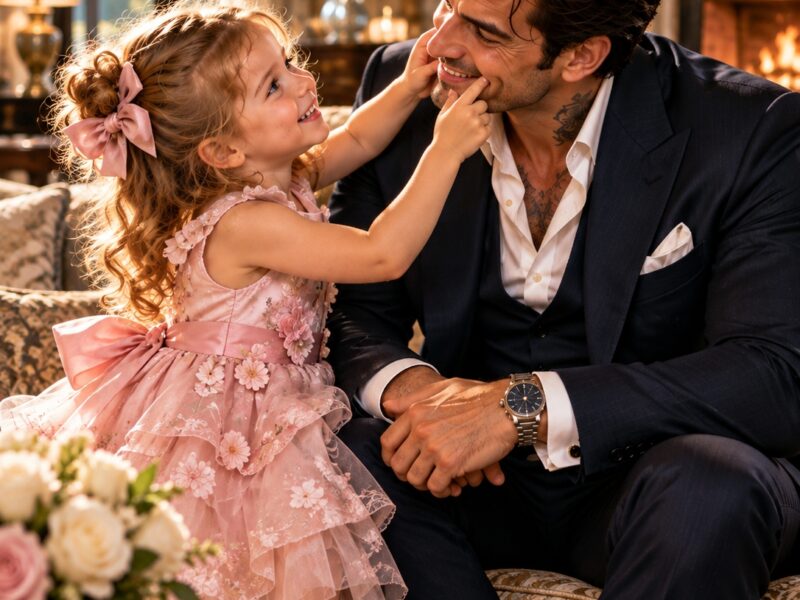
“How Much Does Your Happiness Cost?” the Maid’s Little Girl Asked the Mafia Boss—His Answer Broke Her Heart, but the Photograph She Recognized Changed Everything
“How much money do I need to make you happy, mister?”
Gabriel Moretti had been sitting alone in his study for nearly three hours, staring at a photograph of his dead younger brother, when a little girl in a red nightdress appeared beside his desk and asked him that question.
She couldn’t have been older than three.
Her blonde curls were flattened on one side from sleep, and a stuffed brown bear dangled beneath her arm. In her other hand, she held a collection of coins so tightly that their edges had left small red marks across her palm.
Gabriel didn’t answer.
He was forty-one years old, controlled a business empire worth hundreds of millions of dollars, and had spent most of his adult life surrounded by people who were afraid to speak without permission.
Yet this child had walked into a room even his senior advisers avoided and offered to spend her savings on a smile.
“Why?” he finally asked.
She looked at him with the solemn concentration only small children possess.
“Because you look sad. Mommy says we should help sad people.”
Gabriel turned away before she could see his eyes fill.
The little girl stepped closer.
“Is five dollars enough?”
He stared at the coins.
Then at the photograph.
And for the first time in three years, he found himself unable to remember why he’d believed money could protect him from losing everything that mattered.
But the question about his happiness wasn’t what would keep Gabriel awake for the rest of that night.
It was what happened when the child pointed at the photograph and said, “I know that man. Mommy keeps his picture in our little wooden box.”
Because the man in the photograph was Daniel Moretti.
Gabriel’s younger brother.
A man who had been dead for three years.
And the little girl’s mother was Sophia Bennett, a quiet housekeeper who had worked in the Moretti estate for four years without once mentioning that she knew him.
Gabriel had always hated the anniversary of Daniel’s death.
He hated the sympathy.
The cautious conversations.
The way people lowered their voices when they entered his office, as though grief were an illness that could spread through the air.
Most of all, he hated the knowledge that the last words he’d spoken to his brother had been cruel.
It was late October, and rain had been falling over Long Island since dinner.
The Moretti estate stood behind limestone walls and iron gates on a broad stretch of property north of Oyster Bay. The original house had been built by Gabriel’s grandfather, with later additions that made it look less like a family home than a private institution.
There were thirty-one rooms.
A greenhouse.
A small chapel beneath the pine trees.
Gardens that required an entire maintenance crew.
And a security operation whose annual budget exceeded what many families earned in a lifetime.
Gabriel had inherited responsibility for much of it at thirty-two.
By thirty-eight, he’d become the undisputed head of the family’s organization.
Its legitimate interests included commercial properties, shipping companies, construction firms, and restaurants across New York and New Jersey.
Other interests were considerably less respectable.
There were freight arrangements that avoided scrutiny, cash businesses used to disguise questionable transactions, and men who owed their careers to the Moretti family’s willingness to solve problems through intimidation.
Gabriel knew what his world was.
He had never pretended otherwise.
But he had once believed that controlling enough of it would allow him to protect the people he loved.
Then Daniel died.
And no amount of money, influence, or fear had brought him back.
That evening, Gabriel had dismissed his staff early and locked himself in the study.
A lamp illuminated the broad walnut desk.
Near its edge stood a silver photograph frame containing an old picture of two brothers on the estate lawn.
Gabriel was sixteen in the photograph.
Daniel was thirteen.
Daniel had one arm thrown around his older brother’s shoulders and was laughing at something outside the camera’s view.
Gabriel was pretending to be annoyed.
He’d kept that photograph for twenty-five years.
Beside it lay Daniel’s old watch, its brown leather strap permanently creased near the second hole.
And beside the watch was a cream-colored envelope.
Gabriel had received it after the funeral.
The letter inside contained one sentence he had read so many times that he knew the exact shape of Daniel’s handwriting.
I hope you find something more precious than power and revenge.
He had never read the rest.
Every time he reached that sentence, he folded the page and put it away.
He told himself it was because he wasn’t ready.
Three years later, he was still using the same excuse.
The grandfather clock in the corner chimed eleven.
Gabriel rubbed both hands over his face.
He hadn’t cried during the funeral.
He hadn’t cried when the police explained that Daniel had been shot on a Brooklyn street.
He hadn’t cried when investigators told him that the evidence was incomplete and the case remained open.
He had simply become quieter.
Then harder.
Then more feared.
But alone in his study, with nobody watching, the tears came without warning.
He leaned forward, one hand covering his eyes.
He didn’t hear the door open.
He didn’t hear the small footsteps moving across the carpet.
He heard only a soft voice.
“Mister?”
Gabriel looked up.
The little girl stood beside the chair opposite his desk.
Her nightdress was red, decorated with tiny white flowers.
One sock had slipped halfway down her ankle.
Her bear was missing an eye.
Gabriel stared at her.
“Who are you?”
She hugged the bear.
“Lily.”
He recognized the name.
Sophia Bennett’s daughter.
The housekeeper had been allowed to live in the staff apartments with her child under arrangements approved by the household manager. Lily attended daycare while Sophia worked and sometimes played in the garden when her mother was off duty.
Gabriel had seen her from a distance.
A little blonde head moving along the gravel path.
A small figure beside Sophia at the grocery delivery entrance.
But he’d never spoken to her.
After Daniel’s death, he had ordered that children not be brought into the private family wing.
He couldn’t bear the sound of laughter in the rooms where he’d once played with his brother.
The rule had become so familiar that nobody questioned it anymore.
Now Lily was standing in the middle of the forbidden room.
“Lily,” Gabriel said, trying to steady his voice, “you shouldn’t be here.”
She nodded.
“Mommy says that too.”
“Then why are you here?”
She considered the question.
“I heard sad noises.”
Gabriel went still.
“What noises?”
She pointed toward him.
“Yours.”
He looked away.
He hadn’t realized he’d made any sound.
“You need to go back to your mother.”
Lily didn’t move.
Instead, she climbed carefully onto the chair opposite him.
It was too tall.
She used both hands to pull herself onto the leather seat, then sat with her bare knees together.
Gabriel watched, unable to decide whether he should call someone or simply carry her back himself.
Then Lily placed her bear on the desk.
“His name is Button.”
Gabriel looked at the worn toy.
“Does he know he’s missing an eye?”
She nodded seriously.
“He’s okay with it.”
For one unexpected moment, Gabriel almost smiled.
Lily noticed.
Her face brightened.
Then she reached into the pocket of her nightdress.
“I have money.”
He watched her place a folded dollar bill and several coins on the walnut desktop.
Some rolled toward the photograph.
She caught them and arranged them into a careful little pile.
“Mommy gave me these for being good,” she explained.
Gabriel looked at the money.
“Did she?”
Lily nodded.
“I saved them.”
“What for?”
She considered that.
“A purple scooter.”
“That’s a good thing to save for.”
She nodded.
Then pushed the money toward him.
“But you can have it.”
Gabriel stared.
“Why?”
The little girl looked at his face.
“Because you’re sad.”
He couldn’t answer.
She leaned forward.
“How much does your happy cost?”
He looked down at the coins.
A quarter rested beside his brother’s watch.
A faded dollar bill lay near a photograph of a boy who would never grow older.
Gabriel swallowed.
“Happiness isn’t something you buy, Lily.”
She frowned.
“Not even with five dollars?”
“No.”
Her little shoulders lowered.
“Oh.”
He immediately regretted the disappointment in her voice.
“That’s a lot of money,” he added gently.
She nodded.
“It is.”
She looked at her coins again.
Then pushed them another inch toward him.
“I can save more.”
Gabriel felt his throat tighten.
“Sweetheart, you don’t need to.”
“But I want you happy.”
He looked into her eyes.
There was no calculation in them.
No expectation.
No fear.
She simply saw someone hurting and wanted to help.
“Why?” he whispered.
Lily looked puzzled.
“Because sad feels bad.”
Then she said something even quieter.
“Mommy cries sometimes.”
Gabriel watched her.
“She does?”
Lily nodded.
“When she thinks I’m sleeping.”
Her fingers touched Button’s remaining eye.
“I give her my bear. Sometimes she smiles.”
Gabriel stared at the little girl sitting across from him.
For three years, he’d believed he was the loneliest person in his own house.
Now he was discovering that a woman who cleaned his rooms had been grieving behind a closed door only a few corridors away.
Lily looked toward the photograph.
Then her expression changed.
She leaned forward.
Her small finger pointed at Daniel’s face.
“I know him.”
Gabriel stopped breathing.
“What?”
“The man.”
“Which man?”
She touched the glass lightly.
“That one.”
Daniel.
Gabriel followed her finger.
His brother’s smile stared back at him.
“Where have you seen him?”
Lily looked surprised by the question.
“Mommy’s box.”
“What box?”
“The wooden one. With flowers.”
Gabriel leaned forward.
“Where does she keep it?”
“Under her bed.”
His heart began beating harder.
“What is in the box?”
Lily counted on her fingers.
“Pictures. Papers. A blue ribbon.”
She glanced at Daniel again.
“Mommy looks at that man.”
Gabriel held himself very still.
“Does she know his name?”
Lily shook her head.
“Maybe. She doesn’t tell me.”
Then she added, “Sometimes she says sorry.”
Gabriel looked from the child to the photograph.
For three years, he had searched for the people who killed Daniel.
He had blamed rivals.
He had questioned associates.
He had paid investigators.
He had even allowed violence to continue between organizations because he believed the people responsible belonged to another family.
But no one had ever told him that a Moretti housekeeper kept a photograph of his brother hidden beneath her bed.
Lily yawned.
Gabriel looked at her.
Then at the door.
“Come on, sweetheart.”
She stretched out her arms.
He hesitated.
It had been years since he’d held a small child.
Then he carefully lifted her.
She settled against his chest as though she trusted him completely.
Button dangled from one arm.
“Did I make you happy?” she whispered.
Gabriel closed his eyes.
“A little.”
Lily smiled sleepily.
“Good.”
He carried her toward the door.
The five dollars remained on his desk.
Beside the photograph.
Beside the watch.
Beside the letter he had never finished reading.
Sophia Bennett woke when someone knocked softly at her apartment door.
She was thirty-two, had dark brown hair that she usually pinned into a neat bun, and worked as a housekeeper in the Moretti estate’s east wing.
Her small apartment occupied two rooms above the service kitchen.
There was a kitchenette, a bathroom, and a narrow bedroom she shared with Lily.
The arrangement wasn’t luxurious.
But it allowed Sophia to work close to home, avoid an expensive commute, and save for the future.
Before Thomas died, they’d lived in a modest apartment in Queens.
After his death, Sophia had struggled to pay the rent.
Her husband had worked in freight dispatch for Harborline Logistics, a shipping company with contracts throughout New York.
His death in a road accident left her with medical bills, funeral expenses, and a child too young to understand why Daddy wasn’t coming home.
The housing included in her employment had kept them from losing everything.
Now, when she opened the door and saw Gabriel Moretti holding her sleeping daughter, she felt the blood leave her face.
“Mr. Moretti.”
Her voice came out almost inaudibly.
Gabriel stood in the hallway wearing his dark jacket and an expression she couldn’t read.
“Lily found her way into my study.”
Sophia pressed one hand to her mouth.
“Oh, God.”
“She’s all right.”
“I am so sorry.”
Gabriel looked down at the child.
Lily’s cheek rested against his shoulder.
Her stuffed bear hung from two small fingers.
Sophia stepped forward.
“I thought she was asleep. I only went downstairs to finish the laundry. Mrs. Marino was supposed to—”
“Sophia.”
She stopped.
Gabriel waited until she looked up.
“She’s safe.”
Sophia swallowed.
“Thank you.”
He carefully transferred Lily into her arms.
The little girl stirred.
“Mommy.”
“I’m here, baby.”
Lily opened one eye.
“Mr. Gabriel was sad.”
Sophia’s expression changed.
“Lily, sweetheart—”
“I tried to buy his smile.”
Gabriel looked toward the hallway.
Sophia stared at her daughter.
“What?”
Lily yawned.
“With my money.”
Sophia closed her eyes.
“Oh, honey.”
Gabriel spoke quietly.
“She was trying to be kind.”
Sophia looked at him.
For a moment, her expression softened.
Then Lily murmured, “I saw your picture man.”
Sophia went very still.
Gabriel noticed.
The change lasted less than a second.
But he’d spent years watching people’s expressions during negotiations.
He recognized fear.
Sophia tightened her arms around Lily.
“She’s very tired,” she said quickly.
Gabriel studied her.
Then nodded.
“She should sleep.”
“Of course.”
He stepped back.
But before leaving, he looked at Sophia again.
“Please make sure she doesn’t wander into the private wing. There are rooms that aren’t safe for a child.”
Sophia nodded immediately.
“I understand.”
Then he added, “If you need help arranging childcare during your shifts, speak with Mrs. Marino. We’ll review the schedule.”
Sophia stared.
“Thank you, sir.”
He turned and walked away.
Behind him, Sophia closed the apartment door.
She carried Lily into the bedroom.
Placed her beneath the quilt.
Then sat beside her until the child’s breathing settled.
Only then did she kneel beside the bed and pull out a small wooden box decorated with faded painted flowers.
She held it on her lap.
For a long time, she didn’t open it.
Then she whispered into the quiet room, “Thomas, what am I supposed to do now?”
Gabriel didn’t sleep.
At five in the morning, he was still standing beside his study window.
The rain had stopped.
A thin layer of mist covered the lawn beyond the garden.
He hadn’t touched Lily’s money.
The coins remained in a small pile beside Daniel’s photograph.
Her bear, forgotten during the trip back to the apartment, sat at the edge of the desk.
Gabriel turned toward the photograph.
His brother had been twenty-eight when he died.
Gabriel was thirty-eight.
They had fought three nights before the murder.
The argument had begun over a shipment Daniel believed was connected to something he could no longer tolerate.
He’d wanted to bring concerns to outside attorneys.
Gabriel had insisted he was overreacting.
Their uncle Vittorio had told him Daniel was becoming reckless.
Gabriel had believed him.
When Daniel accused the family of protecting people who profited from illegal freight, Gabriel lost his temper.
“You don’t understand what it takes to keep this organization together,” he’d said.
Daniel looked at him.
“I understand exactly what it’s costing.”
Gabriel told him to stop interfering.
Daniel refused.
Then Gabriel said the sentence that returned to him every night.
“If you can’t live with this family, don’t come back through that door.”
Daniel stood quietly.
His face changed.
For a moment, Gabriel thought he’d apologize.
Instead, Daniel said, “One day you’re going to find out what you’ve been protecting.”
Then he left.
Three nights later, he was shot in Brooklyn.
The police found no evidence sufficient to identify the killer.
Several possible motives were investigated.
There had been longstanding disputes between the Moretti organization and the Falcone family.
The two groups had fought over shipping contracts, waterfront interests, and allegations of interference.
Vittorio was convinced the Falcones were responsible.
He’d urged Gabriel to retaliate.
And Gabriel, consumed by grief, had allowed himself to believe the explanation that required the least painful self-examination.
Now Lily Bennett had pointed at Daniel’s photograph and told him her mother kept another picture hidden in a box.
Gabriel crossed the study.
He opened the door.
Salvatore Russo stood in the corridor.
At fifty-six, Salvatore had worked in the Moretti family’s security organization for more than twenty years.
He had gray hair, a broad face, and a habit of speaking only when necessary.
He noticed Gabriel’s expression immediately.
“Boss?”
“Come inside.”
Salvatore followed him into the study.
Gabriel pointed toward the desk.
“Do you know Thomas Bennett?”
Salvatore frowned.
“The shipping dispatcher?”
Gabriel went still.
“You recognize the name?”
Salvatore hesitated.
“Harborline Logistics. He died in a road accident a few years back.”
“How do you know that?”
“We reviewed several incidents involving contracted freight workers after Daniel’s death. Bennett’s accident was one of them.”
Gabriel stared.
“Why was his accident included?”
Salvatore looked uncomfortable.
“Because he died shortly before Daniel.”
The room became quiet.
Gabriel moved toward the window.
“How long before?”
“About three weeks.”
He closed his eyes.
Three weeks.
A dead freight worker.
A dead brother.
A housekeeper who kept Daniel’s picture beneath her bed.
“Find the records,” Gabriel said.
Salvatore nodded.
“Everything?”
“Everything we lawfully possess and can review. His employment records, the circumstances of the accident, and any connection to Daniel’s final meetings.”
Salvatore watched him.
“Do you think the two deaths are connected?”
Gabriel looked toward the coins.
“I don’t know.”
It was the first time in three years he’d admitted that aloud.
Sophia spent the following morning trying not to look frightened.
She folded linen.
Changed sheets.
Checked the household inventory.
Prepared rooms for guests who would arrive the next afternoon.
Every task required concentration because her thoughts kept returning to the little wooden box.
She had hidden it for three years.
At first, she’d kept it beneath her bed in Queens.
Then inside a suitcase when she moved.
Eventually, after taking the job at the Moretti estate, she’d tucked it beneath the bed again.
She had never intended Lily to see the photographs.
But children noticed things.
Especially the things adults tried to hide.
Sophia had told herself she was protecting her daughter by keeping quiet.
Now she wasn’t sure.
Just after noon, Mrs. Marino found her in the laundry room.
The household manager was sixty-two, wore her silver hair in a tidy bun, and had worked for the Moretti family since Gabriel was a teenager.
She was practical, demanding, and much kinder than most people realized.
“Sophia.”
Sophia looked up.
“Yes?”
“Mr. Moretti asked about Lily.”
Sophia felt her stomach drop.
Mrs. Marino continued.
“He wants to make sure your childcare arrangements are adequate.”
Sophia stared.
“He said that?”
“Yes.”
“I thought he was angry.”
Mrs. Marino looked at her.
“About last night?”
Sophia nodded.
The older woman sighed.
“Mr. Moretti hasn’t liked children wandering through the house since his brother died. But he didn’t ask anyone to dismiss you.”
Sophia looked down.
“He was gentle with her.”
Mrs. Marino’s expression softened.
“Gabriel used to be gentle with children.”
Sophia looked up.
“Used to?”
The older woman hesitated.
Then said, “He was different before Daniel died.”
Sophia swallowed.
She wanted to ask more.
But Mrs. Marino had already turned toward the clean linen shelves.
“Finish the east bedrooms before lunch. Afterward, take your daughter to the garden. She needs some fresh air.”
Sophia nodded.
As Mrs. Marino walked away, Sophia looked toward the window.
Lily was playing outside with a small red bucket.
She had no idea that the photograph she’d recognized might change the course of both their lives.
That afternoon, Gabriel saw Lily sitting beside the path leading to the chapel.
He had gone into the garden because the house felt unbearable.
The air was cool.
The late sun turned the grass gold.
Beyond the clipped hedges stood the old limestone chapel his grandmother had restored when he was a child.
Gabriel and Daniel had used it as a hiding place.
They’d read comic books there.
Invented secret codes.
Argued over baseball.
Once, when their uncle Vittorio had been shouting at the dinner table, they’d escaped to the chapel and stayed until Mrs. Marino came looking for them.
Daniel had called it their kingdom.
Gabriel hadn’t entered it since the funeral.
Now Lily sat on the lowest stone step arranging small pebbles into a heart.
Her red dress spread around her knees.
Button lay beside her.
Gabriel stopped a few feet away.
“Hello, Lily.”
She looked up.
“Mr. Gabriel!”
He smiled faintly.
“What are you making?”
“A heart.”
“I can see that.”
She placed another stone.
“It’s for Daddy.”
Gabriel looked down.
“Your father?”
She nodded.
“Mommy says he’s in heaven.”
Gabriel sat on the step beside her, leaving space between them.
Lily studied the arrangement.
“If I make it big, he can see it.”
Gabriel swallowed.
“That makes sense.”
She nodded.
Then looked at him.
“Do you have a daddy?”
“Mine died a long time ago.”
She considered that.
“Do you miss him?”
“Sometimes.”
She placed another pebble.
“I miss mine, but I don’t know him.”
Gabriel looked toward the trees.
Lily continued working.
Then she asked, “Do you still need a smile?”
He looked at her.
“What?”
“I have my money.”
Gabriel felt something move inside his chest.
“Keep your money, sweetheart.”
She frowned.
“But you were sad.”
“I know.”
She looked down at the stones.
Gabriel considered telling her nothing.
That was what he was good at.
Silence.
But something about the child made silence feel unnecessarily cruel.
“I had a brother,” he said.
Lily looked up.
“Like a big brother?”
“A younger one.”
“What’s his name?”
“Daniel.”
She nodded.
“The picture man.”
Gabriel went still.
“Yes.”
“Is he in heaven too?”
He swallowed.
“Yes.”
She thought about that.
Then set her small hand on top of his.
Gabriel looked down.
Her fingers barely covered two of his.
“Was he nice?” she asked.
“He was.”
“Did he like you?”
Gabriel’s throat tightened.
“He loved me.”
Lily looked satisfied.
“Then he still loves you.”
Gabriel closed his eyes.
For a moment, he saw Daniel standing in the study.
Angry.
Hurt.
Still waiting for his older brother to listen.
“I said something unkind to him,” Gabriel whispered.
Lily looked up.
“What?”
“I told him to go away.”
She frowned.
“Did you say sorry?”
“No.”
“Why not?”
Gabriel looked toward the chapel.
“Because I didn’t get another chance.”
Lily studied his face.
Then she said, “Mommy says love stays even when somebody is mad.”
Gabriel turned toward her.
“She says that?”
Lily nodded.
“I threw my spoon once.”
He almost laughed.
“Did you?”
“At dinner.”
“That sounds serious.”
She nodded solemnly.
“Mommy got mad.”
“What happened?”
“She still loved me.”
Gabriel looked down.
The little girl returned to her stones.
As if she’d answered the question completely.
For the first time in three years, Gabriel allowed himself to consider that Daniel might not have died believing his brother hated him.
He didn’t know whether it was true.
But the possibility felt like light entering a room that had been closed for years.
Salvatore returned to the study that evening carrying a folder.
Gabriel was standing near the fireplace.
“Tell me.”
Salvatore set the papers on the desk.
“Thomas Bennett worked for Harborline Logistics for nearly eight years. He was a dispatch coordinator assigned to the Red Hook freight operation.”
Gabriel nodded.
“Continue.”
“He was killed in a single-vehicle crash on a service road leaving the port. Heavy rain. No other vehicle identified. The accident report lists loss of control as the most likely cause.”
Gabriel looked toward the window.
“Any reason to question it?”
“Not from the public report alone.”
Salvatore opened another document.
“But there are unusual circumstances.”
“What?”
“Thomas had raised concerns about discrepancies between freight manifests and internal delivery records. His supervisor recorded a dispute shortly before the crash.”
Gabriel frowned.
“Who was the supervisor?”
“A man named Victor Rossi. He left the company six months later.”
Gabriel recognized the name.
Rossi had worked closely with his uncle Vittorio for years.
The connection made him uneasy.
Salvatore continued.
“There’s another thing.”
Gabriel waited.
“Daniel’s private calendar.”
He placed a photograph of several handwritten pages on the desk.
Gabriel recognized his brother’s writing.
Small.
Neat.
Often abbreviated.
Seven entries over several months.
Meetings at coffee shops, a diner, and a public park.
Each marked with the same initials.
T.B.
Thomas Bennett.
Gabriel stared.
“He met my brother?”
“Yes.”
“How many times?”
“At least seven confirmed entries.”
Gabriel picked up the pages.
His hands were steady.
But his face had gone pale.
For years, he’d believed Daniel was acting impulsively.
Now there was evidence he’d been investigating something carefully.
A dock worker had come forward.
Daniel had listened.
They’d met repeatedly.
Then both men died within weeks.
Gabriel looked at Salvatore.
“Does Sophia know?”
“I haven’t asked.”
Gabriel nodded.
“Don’t.”
Salvatore watched him.
“Boss?”
Gabriel looked toward Daniel’s photograph.
“I’ll speak with her myself.”
Sophia was putting away Lily’s laundry when Mrs. Marino came to her apartment.
The little girl sat on the floor, trying to make Button wear a pair of her socks.
Mrs. Marino knocked gently.
“Sophia, Mr. Moretti would like to speak with you.”
Sophia’s hands stopped.
“Now?”
“Yes.”
She looked toward Lily.
Mrs. Marino followed her gaze.
“I’ll stay with her.”
Sophia nodded.
Then looked down at her work clothes.
“Should I change?”
“You’re fine.”
Sophia hesitated.
“Did he say what he wanted?”
Mrs. Marino’s expression softened.
“No. But he asked me to tell you that you’re not being dismissed.”
Sophia looked up sharply.
“He said that?”
“Yes.”
For a moment, Sophia felt relief.
Then something colder took its place.
If Gabriel wasn’t calling her to discuss Lily’s behavior, there could be only one other reason.
The photograph.
The little wooden box.
The truth she’d hidden for three years.
She washed her hands.
Smoothed her gray uniform.
Then followed Mrs. Marino toward the main house.
The hallway seemed longer than usual.
She knew every polished surface.
Every stair.
Every doorway.
She had spent four years cleaning rooms while carefully avoiding the family conversations that took place inside them.
Now she was walking toward the one room she had always feared entering.
Gabriel’s study.
Salvatore opened the door.
Sophia stepped inside.
Gabriel stood beside the desk.
The photograph of Daniel faced the chair opposite him.
Lily’s money was still arranged near the silver frame.
When Sophia saw the coins, her throat tightened.
“Mr. Moretti.”
Gabriel looked at her.
“Please sit.”
She did.
Her hands folded automatically in her lap.
He remained standing.
For several seconds, neither spoke.
Then Gabriel touched the photograph.
“Your husband was Thomas Bennett.”
Sophia went still.
“Yes.”
“He worked for Harborline.”
“Yes.”
“He died three weeks before my brother.”
She looked down.
“That’s right.”
Gabriel moved the photograph toward her.
“Thomas met Daniel several times before they died.”
Sophia closed her eyes.
The room seemed to lose its air.
“How do you know?”
“I have Daniel’s calendar.”
She stared at the photograph.
Then at Gabriel.
For four years, she had imagined this conversation.
Sometimes she pictured him furious.
Sometimes disbelieving.
Sometimes ordering her and Lily out of the estate.
She had never imagined him looking frightened.
“Did Thomas tell you why he met Daniel?” Gabriel asked.
Sophia’s hands tightened.
She looked toward the door.
“Mr. Moretti, I have a little girl.”
“I know.”
“She has no one else.”
Gabriel’s expression changed.
He sat opposite her.
“Sophia, I’m not asking you to do anything that would endanger her.”
She looked at him.
“You can’t promise that.”
The words surprised him.
Then he nodded slowly.
“No,” he admitted. “I can’t promise that telling the truth is free of danger. But I can listen without threatening you.”
Sophia studied his face.
For a moment, she saw not the man whose name frightened half the household, but someone who had spent years searching for a brother.
She took a breath.
“Thomas noticed discrepancies in freight records.”
Gabriel waited.
“He was good at his job. He knew which shipments were delayed, which containers had been reassigned, and which drivers were supposed to arrive at particular loading bays.”
She looked at her hands.
“At first, he thought somebody was making clerical mistakes. Then he found shipments whose destinations didn’t match the final delivery records.”
“What kind of shipments?”
“I don’t know everything. Thomas didn’t want me involved.”
She swallowed.
“But he said money was moving through companies that weren’t doing the work their invoices described.”
Gabriel looked toward the desk.
“Did he tell his supervisor?”
“Yes.”
“What happened?”
“His supervisor told him to stop asking questions.”
Gabriel looked up.
“Victor Rossi?”
Sophia stared.
“You know him?”
Gabriel nodded.
Sophia’s breathing quickened.
“Thomas said Rossi handled certain contracts for people close to your uncle.”
Gabriel’s expression hardened.
She continued before she could lose courage.
“He tried to report the discrepancies through normal channels. Then he was warned that making allegations without proof could cost him his job.”
“That’s when he went to Daniel?”
“Yes.”
“Why Daniel?”
Sophia looked at the photograph.
“Thomas said Daniel had a reputation for being fair to workers.”
Gabriel felt something tighten beneath his ribs.
She continued.
“Your brother listened. He didn’t promise anything. He asked Thomas to preserve records through appropriate channels and helped him find an attorney who understood financial misconduct.”
Gabriel stared.
He’d spent three years remembering Daniel as a younger brother who’d become reckless and emotional.
Now Sophia was describing a man who’d been asking questions carefully.
“What happened next?”
Sophia lowered her eyes.
“Thomas became frightened.”
“Of what?”
“He thought someone had discovered he was cooperating with Daniel.”
She swallowed.
“The last week, he stopped sleeping properly. He checked the locks twice. He asked me not to take Lily anywhere alone after dark.”
Gabriel remained still.
“Then one night he came home with an envelope.”
Sophia looked toward the door again.
“He told me that if something happened to him, I should keep it safe.”
“What was inside?”
“I didn’t know then.”
“Where is it now?”
Sophia closed her eyes.
“Mr. Moretti, I need time to think.”
Gabriel wanted to demand an answer.
He could feel the old instinct rising.
The desire to control.
To press.
To make uncertainty disappear through force.
Then he looked at Lily’s coins.
A child had offered him everything she possessed because she thought he was sad.
And her mother was sitting before him, frightened that telling the truth might cost her daughter a safe home.
He took a breath.
“Then take time.”
Sophia looked up.
He continued.
“I would like you to speak with an attorney who represents your interests, not mine. We can arrange for independent legal advice without requiring you to give anything to me.”
She stared.
“You would do that?”
“Yes.”
“Why?”
Gabriel looked toward Daniel’s photograph.
“Because my brother died trying to find out something important. And I don’t want to repeat the mistake of frightening the people who may know what he found.”
Sophia’s eyes filled.
For several seconds, she couldn’t speak.
Then she whispered, “Thomas trusted Daniel.”
Gabriel nodded.
“I wish I’d listened to him.”
Sophia didn’t sleep much that night.
She sat beside Lily’s bed, watching her daughter breathe.
The wooden box rested on her knees.
Inside were photographs, letters, a faded ribbon from her wedding bouquet, and an envelope Thomas had given her during the last week of his life.
She had moved the envelope so many times that the corners were worn.
After Thomas died, she had opened it once.
There was a photograph of Daniel Moretti standing beside Thomas at a public waterfront event, apparently taken by someone else.
Behind it lay a folded sheet covered in unfamiliar symbols.
Sophia couldn’t read them.
She assumed they were codes related to shipping.
She was too frightened to show them to anyone.
Three weeks later, Daniel was murdered.
When the news appeared on television, Sophia understood that her husband’s death might not have been an isolated accident.
She wanted to go to the police.
But she didn’t know what she could prove.
And she’d already heard enough from Thomas to fear that someone inside the freight operation might have influence over the people investigating it.
She consulted a legal aid organization and reported what she knew about his workplace concerns.
The attorney explained that suspicions alone weren’t enough to establish a crime.
There were records to request.
Questions to ask.
But progress was slow.
Meanwhile, Sophia needed money.
Harborline’s surviving-spouse benefits were limited and disputed.
She couldn’t afford the apartment.
Lily needed childcare.
When a staffing agency offered her a position at the Moretti estate, Sophia hesitated.
The connection was frightening.
Harborline’s contracts had involved Moretti-controlled businesses.
She knew the family name.
But the job included housing and reliable wages.
And part of her hoped that working close to the family might help her understand what Thomas had been investigating.
She accepted.
She told herself she’d remain careful.
For four years, she had done exactly that.
She worked.
Raised Lily.
Saved money.
And watched Gabriel Moretti from a distance.
She saw him pass employees without acknowledging them.
Heard stories about ruthless business decisions.
Watched powerful men lower their voices when he entered.
She also saw quieter things.
He arranged medical coverage for a long-serving gardener after the man’s wife became ill.
He refused to dismiss a cook who had made a mistake during a large dinner.
Once, when an older housekeeper slipped on the back stairs, he ordered the damaged flooring replaced rather than blaming her for the accident.
Sophia didn’t know what to make of those contradictions.
She wasn’t foolish enough to believe small acts of kindness erased serious wrongdoing.
But she began to wonder whether the man who led the organization was fully aware of what people close to him were doing.
Then Lily wandered into the study.
And everything changed.
The next morning, Gabriel did something he hadn’t done in years.
He read Daniel’s letter.
All of it.
He sat at the desk before sunrise.
The house was quiet.
The cream envelope lay beside the photograph.
He unfolded the page.
The first lines were familiar.
Daniel wrote that he knew they disagreed about the family business.
That he understood Gabriel felt responsible for keeping things together.
That he didn’t hate his older brother for being afraid of change.
Gabriel’s eyes blurred.
Then came the sentence he’d never moved beyond.
I hope you find something more precious than power and revenge.
He took a breath.
And kept reading.
Daniel wrote that he’d discovered serious irregularities in freight contracts and suspected people close to the family were profiting from arrangements Gabriel had never approved directly.
He didn’t identify anyone in the letter.
He said the evidence was incomplete.
He was working with someone who understood the records and hoped to bring the matter to appropriate investigators once the documents could be verified.
Then he wrote something Gabriel would remember for the rest of his life.
You once told me the family survives because nobody walks away from it.
I think a family survives because somebody is willing to tell the truth before everyone gets hurt.
Gabriel lowered the paper.
For a moment, he couldn’t breathe.
The final paragraph was brief.
I love you, Gabe. I know you love me too, even when we’re angry. Whatever happens next, please don’t let the worst thing we said to each other become the last thing you remember about us.
Gabriel covered his face.
For three years, he’d believed Daniel died after being rejected by the person he trusted most.
Now his brother was telling him, in his own handwriting, that the love between them had survived the argument.
Gabriel began crying.
Quietly.
Without trying to stop.
Outside, the first birds were calling from the trees.
The grandfather clock ticked beside the fireplace.
He let himself grieve until the sun rose.
Then he folded the letter.
Placed it beside Lily’s coins.
And called his attorney.
Her name was Rebecca Sloan.
She had represented several of Gabriel’s legitimate companies for years, but he knew he couldn’t assume her duties to the companies made her his personal lawyer.
He asked her to recommend independent counsel for a matter involving possible criminal conduct and conflicts within the family.
She listened.
Then said, “Gabriel, if the evidence points to wrongdoing involving the businesses you control, you need to understand that you’re not automatically outside the investigation.”
“I know.”
“Do you?”
He looked toward the photograph.
“Yes.”
There was a pause.
Then she said, “That’s going to change how we proceed.”
“Good.”
Rebecca sounded surprised.
Gabriel continued.
“I’ve spent three years allowing people to tell me my brother died because of another family. I want to know what actually happened.”
“Then we start with evidence you have the right to review and preserve. We don’t pressure witnesses. We don’t alter records. And we don’t conduct our own retaliation.”
Gabriel looked toward the window.
For a moment, the words felt like an insult.
Then he remembered Daniel.
He nodded.
“Agreed.”
Vittorio Moretti arrived just after breakfast.
He was sixty-four, tall and broad-shouldered, with silver hair combed carefully back.
He had been Gabriel and Daniel’s guardian after their father died.
For years, Gabriel had thought of him as a second father.
Vittorio had taught him how to negotiate contracts, how to recognize threats, and how to keep emotions out of business decisions.
He also taught him something Gabriel no longer wanted to believe.
That loyalty meant never questioning the people closest to you.
Vittorio entered the study carrying two cups of coffee.
“Gabriel.”
“Uncle.”
He set the tray down.
“Mrs. Marino says you didn’t sleep.”
Gabriel looked at him.
“No.”
Vittorio sighed.
“Three years today.”
Gabriel nodded.
His uncle’s expression softened.
“Daniel was a good boy. Too trusting for this world.”
Gabriel said nothing.
Vittorio looked toward the photograph.
Then at Lily’s coins.
“What is that?”
“A child’s savings.”
Vittorio frowned.
“Excuse me?”
“Lily Bennett came into the study last night.”
The older man’s smile disappeared.
“The housekeeper’s daughter?”
“Yes.”
“I thought you had rules about children entering the private wing.”
“I do.”
Vittorio shook his head.
“Then the mother should be disciplined.”
Gabriel looked at him.
“For what?”
“For allowing the child to wander.”
“She was three.”
“Children need supervision.”
“Yes. And we can improve that.”
Vittorio studied him.
Something shifted in his expression.
“Gabriel, children notice things. They repeat things they don’t understand.”
Gabriel remained still.
His uncle continued.
“You’ve spent years protecting this house from people who could use innocent mistakes against you.”
Gabriel looked toward Daniel’s photograph.
For the first time, he heard something beneath Vittorio’s concern.
Not affection.
Calculation.
He couldn’t prove it.
He didn’t act on it.
Instead, he said, “We’re making changes to the household rules.”
Vittorio raised an eyebrow.
“Are we?”
“Yes.”
Gabriel looked directly at him.
“Children aren’t a threat simply because they notice what adults would rather ignore.”
For a moment, Vittorio looked almost angry.
Then he smiled.
“Of course, nephew.”
He picked up his coffee.
“But be careful what you allow into your private rooms.”
After he left, Gabriel stood alone for a long time.
Then he called Salvatore.
“Tell me something.”
“Yes, boss?”
“Who had access to Daniel’s private calendar after he died?”
Salvatore hesitated.
“Several people.”
“Who?”
“You. Me. Vittorio. The estate records manager.”
Gabriel looked toward the door.
“And who first told us the Falcones were responsible?”
Salvatore was silent.
Then he answered.
“Your uncle.”
Sophia met with independent counsel two days later.
Her attorney, Elaine Porter, had experience representing employees and witnesses involved in complex financial cases.
Sophia explained everything she could remember about Thomas.
The shipping discrepancies.
His meetings with Daniel.
The envelope.
The old photograph.
The strange symbols.
Elaine listened carefully.
Then said, “You understand that the paper may be important, but we don’t yet know what it means.”
Sophia nodded.
“I know.”
“And you don’t have to give it to Gabriel Moretti simply because he employs you.”
“I understand.”
Elaine looked at her.
“Are you afraid of him?”
Sophia considered the question.
“Yes.”
“Because of something he’s done to you?”
“No.”
“Then why?”
Sophia looked down.
“Because I know what people say about him.”
Elaine nodded.
“That’s enough reason to protect your choices.”
They discussed options for preserving the document, arranging forensic review, and sharing information with investigators without surrendering Sophia’s rights.
Sophia also asked about leaving her job.
Elaine advised that she could resign, request her employment records, and make decisions about housing separately from the investigation.
For the first time in years, Sophia felt she had a choice.
She could stay.
She could leave.
She could help.
She could refuse.
And none of those choices automatically made her disloyal to Thomas.
That evening, she returned to the estate carrying the wooden box.
She met Gabriel in the presence of Elaine and his independent attorney.
She placed the box on the table.
Then carefully removed the envelope.
“This is what Thomas left.”
Gabriel looked at it.
His hands were steady.
But his eyes were not.
Elaine explained that the document would be photographed, preserved, and examined appropriately.
Gabriel nodded.
Then Sophia handed over the photograph of Thomas and Daniel.
He stared at his brother’s face.
Daniel was smiling faintly.
Thomas stood beside him wearing a work jacket, looking uncomfortable in front of the camera.
On the back was a date.
Three months before Thomas died.
Gabriel swallowed.
“They really knew each other.”
Sophia nodded.
“Yes.”
He looked at her.
“Did Thomas like Daniel?”
Her eyes filled.
“He trusted him.”
Gabriel lowered his head.
For several seconds, nobody spoke.
Then Sophia said something quietly.
“Mr. Moretti, my husband wasn’t a brave man in the way people usually mean.”
Gabriel looked up.
“He was frightened. He worried about losing his job. He worried about Lily. He wanted to come home every night.”
Her voice trembled.
“But when he realized somebody might be using the freight system to hurt people, he couldn’t stop asking questions.”
Gabriel stared at her.
Sophia continued.
“He said Daniel was the first person who treated him like someone worth listening to.”
Gabriel looked down at the photograph.
He remembered dismissing Daniel’s concerns as sentimental.
Naive.
Dangerous.
Now he realized the younger brother he’d underestimated had been trying to protect people Gabriel barely noticed existed.
And the evidence might still be waiting for them to find it.
The symbols in Thomas’s envelope meant nothing to the document examiner.
They looked like a child’s invented alphabet: short angled marks, loops, dots, and lines arranged in groups.
There were no obvious numbers.
No ordinary abbreviations.
No recognizable freight codes.
But when Gabriel saw a photograph of the page, he felt his stomach tighten.
He had seen those marks before.
He and Daniel invented them when Gabriel was eleven and Daniel was eight.
Their grandmother had forbidden them from interrupting adults at family dinners, so the boys created a private alphabet they could use to exchange notes.
They practiced for weeks.
They wrote messages about baseball, dessert, and the servants’ endless arguments over who had misplaced the pantry key.
Eventually, the alphabet became so familiar that they could read it without effort.
Nobody else in the family learned it.
Not even Vittorio.
Gabriel hadn’t thought about the code in decades.
Now he stared at the page Thomas had carried.
Then he began reading.
The first line contained a location.
The chapel.
The next identified a stone near the altar.
The third was an instruction to find a sealed package and take it to someone outside the family.
Gabriel read it twice.
Then called his attorney.
He explained what the symbols meant.
He didn’t go to the chapel alone.
He didn’t pry up the floor in the middle of the night.
Instead, counsel arranged a carefully documented examination of the location with appropriate independent witnesses, because Gabriel understood that anything found there could become evidence in a serious investigation.
The next morning, the small limestone chapel opened for the first time in three years.
Dust covered the pews.
The stained-glass windows admitted a weak yellow light.
At the base of the altar, beneath a removable stone Daniel had helped repair years earlier, they found a sealed metal container.
Gabriel stood near the doorway while the examiner photographed it.
When the lid was opened, he recognized Daniel’s handwriting immediately.
Inside were copies of financial records, freight correspondence, and a letter addressed to Gabriel.
There was also a small recording device with a labeled storage card.
Gabriel didn’t touch anything.
He watched while the materials were documented.
Then the examiner lifted Daniel’s letter.
Gabriel closed his eyes.
For a moment, he remembered his little brother at eight, sitting on the chapel steps with a stolen pencil and a mischievous smile.
Let’s make a language nobody else can understand.
Gabriel had laughed.
Why?
Daniel grinned.
So we can tell each other the truth.
Now, twenty-five years later, that childish invention had carried a message no one else in their family was supposed to read.
The evidence didn’t solve everything overnight.
There were records to authenticate.
Business relationships to trace.
Financial transactions to explain.
The recording required technical examination and verification.
But it raised serious questions about the account Gabriel had accepted after Daniel’s death.
Some records indicated that people connected to Vittorio had received money through companies involved in suspicious freight transactions.
Other documents suggested that Thomas and Daniel had identified irregular payments and were preparing to bring their findings to outside investigators.
The recording contained conversations that appeared to involve Vittorio discussing disputed shipments.
Another section included language suggesting someone wanted Daniel’s inquiries stopped.
The content was troubling.
It wasn’t yet proof of every crime Gabriel suspected.
But it was more than rumor.
And it pointed toward someone Gabriel had trusted for most of his life.
His uncle.
Vittorio had raised him after his father’s death.
Taught him how to manage the family businesses.
Comforted him at Daniel’s funeral.
Then encouraged him to blame the Falcones.
For three years, Gabriel had permitted hostility between the two organizations to continue.
People had lost jobs.
Businesses had suffered.
Violence had occurred.
Gabriel had told himself it was necessary to defend his brother’s memory.
Now he was beginning to wonder whether he’d been protecting the person who benefited most from Daniel’s death.
He sat alone in the study that evening.
Daniel’s photograph stood beside Lily’s five dollars.
The room looked unchanged.
But Gabriel knew he couldn’t return to the life he’d lived the previous morning.
His lawyer had advised him that a full investigation could examine conduct within his own companies and his own involvement in questionable arrangements.
Gabriel understood.
He had approved transactions he didn’t examine closely enough.
Allowed dangerous men to act in his name.
Accepted explanations because they came from people he loved.
The truth wouldn’t belong only to his uncle.
Some of it would belong to him.
He looked toward Daniel’s photograph.
Then whispered, “I’m sorry.”
For the first time, the words felt like the beginning of something rather than another way to punish himself.
Sophia moved Lily out of the estate the following week.
Gabriel didn’t stop her.
He offered assistance with the transition, but Sophia made the arrangements through her attorney and the household administrator.
She found a small apartment near her aunt in Queens.
It had two bedrooms, a narrow balcony, and a kitchen where Lily could sit at the table while Sophia cooked.
The rent was manageable with her savings and income from a new housekeeping position at a nearby hotel.
Lily was excited.
“Is this our house?”
Sophia smiled.
“Our apartment.”
“Can Button have a bed?”
“Of course.”
“Can we plant flowers?”
“On the balcony, maybe.”
Lily considered that.
“Can Mr. Gabriel visit?”
Sophia stopped unpacking.
She looked at her daughter.
For a moment, she pictured Gabriel standing in his study, the five dollars beside his brother’s photograph.
Then she said, “Maybe someday.”
Lily nodded.
“Okay.”
She went back to arranging Button’s blanket.
Sophia watched her.
There was something both wonderful and frightening about the way children trusted simple answers.
She hoped she could spend the rest of Lily’s childhood giving her reasons to keep that trust.
The investigation became public in stages.
Financial regulators reviewed transactions linked to several companies.
Law enforcement examined the evidence associated with Thomas Bennett’s workplace concerns and Daniel Moretti’s death.
Witnesses were interviewed.
Former employees came forward.
Some documents supported allegations of fraud and conspiracy involving companies connected to Vittorio.
Others required explanation and further analysis.
Gabriel cooperated through independent counsel.
He also began removing himself from direct control of businesses whose operations could not withstand legitimate scrutiny.
It was expensive.
Complicated.
And, in some cases, humiliating.
He had spent years believing that admitting mistakes would make him weak.
Now he discovered that refusing to correct them had made him dangerous.
His relationship with Vittorio deteriorated rapidly.
The older man denied wrongdoing.
He accused Gabriel of allowing grief to distort his judgment.
He insisted Daniel had been reckless.
He described the evidence as incomplete and misleading.
For a while, Gabriel wanted to confront him privately.
To sit across the desk and demand an explanation.
To hear the man who had helped raise him admit what he’d done.
His attorney advised against it.
The investigation needed evidence, not a family confrontation that could create more disputes about what had been said.
Gabriel followed that advice.
It was one of the hardest decisions he’d ever made.
He was accustomed to solving problems by entering a room and forcing people to deal with him.
Now he had to allow other people to do their jobs.
And accept that justice might not arrive on his preferred schedule.
The first charges were announced months later.
They concerned financial misconduct, obstruction, and alleged conspiracies involving several individuals associated with the freight operations.
Vittorio was among those accused.
He denied the allegations.
The proceedings continued through the courts.
The case involving Daniel’s murder remained a separate and complicated investigation.
Evidence connected certain suspects to the circumstances surrounding his death, but prosecutors still had to establish individual responsibility.
Thomas Bennett’s accident was also reexamined.
Investigators reviewed the original crash report, surviving employment records, and newly recovered information.
The review identified discrepancies that warranted further inquiry.
But it didn’t immediately establish that the crash had been deliberately caused.
Sophia struggled with that uncertainty.
For years, she’d hoped one document would explain her husband’s death.
Now she had more information than she’d ever imagined.
And still no complete answer.
Some days, she felt relieved.
Other days, she felt furious.
Occasionally, she wanted to stop discussing the investigation altogether.
Her attorney reminded her that she could decide how much involvement was healthy for her.
Sophia began seeing a counselor.
She returned to work.
Made friends.
Took Lily to the park.
And slowly learned that her life could contain grief without being organized entirely around it.
Gabriel visited Sophia’s apartment for the first time on a rainy Sunday afternoon.
He called beforehand.
She invited him for coffee.
Lily was sitting at the kitchen table coloring when he arrived.
She looked up.
“Mr. Gabriel!”
He smiled.
“Hello, Lily.”
She ran toward him.
Sophia stepped forward automatically.
“Careful, sweetheart.”
But Gabriel crouched.
Lily wrapped both arms around his neck.
He held her gently.
“Hello, little one.”
She pulled back.
“Are you happy now?”
The question caught him off guard.
He looked at Sophia.
Then back at Lily.
“Sometimes.”
She frowned.
“Only sometimes?”
He smiled.
“That’s how it works for grown-ups too.”
She considered that.
Then took his hand.
“I have a picture.”
She led him toward the table.
On the paper were three people.
A tall figure in a black suit.
A smaller woman with brown hair.
And a tiny girl in a red dress.
Button was represented by a large brown circle with one black eye.
Gabriel studied the drawing.
“Who’s that?”
Lily pointed.
“Me.”
“And that?”
“Mommy.”
He nodded.
“And the tall man?”
She grinned.
“You.”
Gabriel looked at the paper.
For a moment, he couldn’t speak.
Sophia stood beside the counter.
She watched his expression change.
Then she said quietly, “Lily, why don’t you get your crayons from the bedroom?”
The little girl nodded and ran off.
Sophia looked at Gabriel.
“You don’t have to pretend everything is okay for her.”
He turned.
“I know.”
“She sees more than we think.”
He smiled sadly.
“I’ve noticed.”
For a while, neither spoke.
Then Gabriel said, “I wanted to thank you.”
Sophia shook her head.
“You already have.”
“No.”
He looked toward the drawing.
“You trusted me with information that frightened you. You helped my brother’s work finally receive the attention it deserved.”
Sophia looked down.
“Thomas did the difficult part.”
Gabriel nodded.
“So did Daniel.”
She took a breath.
Then looked at him.
“Mr. Moretti, my husband used to say there were people in your world who had forgotten what ordinary lives were worth.”
Gabriel remained still.
She continued.
“He was afraid that if he made the wrong person angry, Lily would grow up without him.”
Her voice trembled.
“And she did.”
Gabriel closed his eyes.
“I know.”
Sophia looked at him.
“I don’t need you to promise me the past will change.”
He nodded.
“I can’t.”
“But I need you to understand that people like Thomas shouldn’t have to die for asking whether something is wrong.”
Gabriel looked down.
For a long moment, he didn’t answer.
Then he said quietly, “You’re right.”
Sophia studied his face.
She had never expected those words from him.
Not because he was incapable of saying them.
Because men with that much power rarely had to.
Over the following year, Gabriel’s life became smaller.
In some ways, painfully so.
He sold interests in several businesses.
Placed others under independent management.
Cooperated with legal obligations arising from investigations.
And stopped pretending that the Moretti name entitled him to operate outside ordinary rules.
Some longtime associates abandoned him.
Others accused him of dishonoring the family.
He lost money.
Influence.
Relationships.
And much of the fear that had once followed him into every room.
At first, he missed it.
That embarrassed him.
He had spent most of his adult life believing control was the same thing as security.
Without it, he often felt exposed.
Then he began noticing things he’d ignored for years.
The sound of birds in the estate garden.
The smell of fresh bread in the kitchen.
The way the late sun fell across the chapel windows.
He started reading again.
Not business reports.
Books.
He took walks without planning every minute.
He attended counseling to address the grief he’d carried since Daniel’s death.
Some sessions were difficult.
He discovered that remembering his brother didn’t have to mean reliving their final argument.
He could remember Daniel laughing in the pear tree.
Daniel stealing the last piece of birthday cake.
Daniel insisting that every dog in the neighborhood liked him best.
The ordinary memories had been there all along.
Gabriel had simply buried them beneath anger.
Sophia didn’t fall in love with Gabriel because he was wealthy.
In fact, his wealth was one of the things that made her cautious.
She knew how unequal their lives were.
She had seen what happened when powerful people confused generosity with entitlement.
She had a daughter to protect.
A job she wanted to keep.
And a home she’d worked hard to make safe.
Gabriel understood that she didn’t owe him affection because he’d helped bring attention to Thomas’s case.
For months, they remained friends.
He visited when invited.
Sometimes he brought books for Lily.
Sometimes he arrived with dinner and let Sophia complain about the terrible traffic near her hotel.
He learned that she liked strong coffee and hated lilies because they reminded her of the funeral arrangements after Thomas died.
She learned that Gabriel could cook only three things.
Pasta.
Eggs.
And an extraordinarily bad chicken soup.
The first time he made it for them, Lily took one spoonful and frowned.
“It’s funny.”
Gabriel stared.
“Funny?”
Sophia tried not to laugh.
Lily nodded.
“Soup’s supposed to taste different.”
Gabriel looked at Sophia.
She covered her mouth.
He sighed.
“Then perhaps we should order pizza.”
Lily cheered.
And Gabriel laughed.
A real laugh.
The kind Sophia had never heard from him at the estate.
For a moment, she saw the man Daniel might have known before grief and power reshaped him.
It frightened her how much she liked him.
One evening, Sophia found Gabriel sitting alone on her balcony.
Lily was asleep.
Rain tapped against the railing.
The city lights blurred in the distance.
Gabriel held a mug of coffee between both hands.
She stepped outside.
“Cold?”
“A little.”
She sat beside him.
For a while, they listened to the rain.
Then Gabriel said, “Daniel would have liked this.”
Sophia looked at him.
“What?”
“Your apartment.”
She smiled faintly.
“He never saw it.”
“I know.”
Gabriel looked toward the kitchen window.
“He used to say he wanted a place where people could come over without checking whether they were important enough to be invited.”
Sophia laughed softly.
“That sounds like him.”
Gabriel turned toward her.
“You remember him?”
“Only a little.”
She looked down.
“But I remember how Thomas spoke about him.”
Gabriel nodded.
For a moment, he seemed far away.
Then Sophia said, “You know, you don’t have to make yourself miserable to prove you loved him.”
He looked at her.
The words landed somewhere he hadn’t expected.
She continued.
“Thomas would have hated knowing I spent the rest of my life trying not to smile.”
Gabriel looked down.
Sophia reached toward his hand.
Then stopped.
He noticed.
For a moment, neither moved.
Finally, she asked, “May I?”
He nodded.
She placed her hand over his.
It was a small gesture.
No dramatic declaration.
No promise.
Just two people who had lost someone they loved, sitting in the rain-softened quiet of an ordinary apartment.
Gabriel looked at their hands.
Then whispered, “I don’t know how to do this.”
Sophia smiled sadly.
“Neither do I.”
He looked up.
For the first time, uncertainty didn’t feel like something he needed to defeat.
It felt like something they could acknowledge together.
The relationship that followed was slow enough to annoy Mrs. Marino.
By then, Sophia no longer worked at the estate, but the older woman still called her twice a week and had appointed herself an unofficial adviser on matters nobody had asked her to manage.
“You’ve been seeing him for six months,” she said one afternoon.
Sophia laughed.
“And?”
“And Gabriel has never been particularly good at knowing what he wants until it is standing directly in front of him.”
“Mrs. Marino.”
“I’m simply making an observation.”
Sophia smiled.
Then glanced toward Lily, who was arranging toy animals beneath the kitchen table.
“I have to be careful.”
Mrs. Marino’s voice softened.
“Of course you do.”
Sophia looked down.
“Thomas was a good husband.”
“I know.”
“And I loved him.”
“Nobody is asking you to stop.”
Sophia swallowed.
For a moment, she thought about the box beneath her bed.
The photograph.
The folded wedding ribbon.
The nights she’d sat on the floor wondering how she was supposed to raise Lily alone.
Then she said quietly, “Sometimes being happy again feels like leaving him behind.”
Mrs. Marino didn’t answer immediately.
When she did, her voice was gentle.
“Perhaps it means he gave you enough love to remember what being loved should feel like.”
Sophia covered her mouth.
She couldn’t speak for a while.
The next autumn, Gabriel returned to the old chapel with Lily.
She was four now, old enough to ask increasingly complicated questions and young enough to believe nearly every problem could be improved by snacks.
Sophia had brought her to the estate for a Saturday visit.
The gardens were different.
The reflecting pool had been cleaned.
The paths had been repaired.
And the private family wing was no longer closed to children simply because their laughter reminded Gabriel of his brother.
Lily walked beside him carrying Button.
The bear had a new button eye.
Sophia had repaired it after Lily announced that he was ready to see properly again.
When they reached the chapel, Gabriel noticed the small heart of stones Lily had arranged the previous year.
It had survived the winter.
Some stones had shifted.
A few had disappeared into the grass.
But the shape remained.
Lily crouched beside it.
“It’s still here.”
Gabriel smiled.
“Yes.”
She looked up.
“Did Daddy see it?”
Gabriel sat on the step.
“I don’t know, sweetheart.”
She considered that.
“Maybe he did.”
“Maybe.”
She placed another stone near the top of the heart.
Then looked at him.
“Did Daniel see it?”
Gabriel’s throat tightened.
“I hope so.”
Lily nodded.
Then climbed onto the step beside him.
For a while, they sat quietly.
The breeze moved through the pines.
Somewhere beyond the hedges, a gardener was trimming shrubs.
Lily leaned against Gabriel’s arm.
“Are you still sad sometimes?”
“Yes.”
“About Daniel?”
“Sometimes.”
She nodded.
“Mommy’s sad about Daddy too.”
Gabriel looked toward the garden.
“I know.”
Lily considered that.
Then asked, “Does being sad mean you aren’t happy?”
He turned toward her.
The question was so simple that it took him a moment to answer.
“No,” he said finally. “I think you can be both.”
She frowned.
“At the same time?”
“Yes.”
She thought about it.
Then smiled.
“Like when Mommy says it’s bedtime and I want to play, but I still love my bed?”
Gabriel laughed.
“Something like that.”
She nodded, satisfied.
Then took his hand.
“I think you’re happier now.”
Gabriel looked at her.
“Do you?”
“Yes.”
“Why?”
“Because you laugh.”
He smiled.
She added, “And you don’t tell me to go away.”
The words touched something deep inside him.
For a moment, he remembered telling Daniel not to come back through the study door.
He looked toward the chapel.
Then down at Lily.
“No,” he whispered. “I don’t.”
The case involving Vittorio continued through the courts.
Some financial allegations resulted in convictions after documentary evidence and testimony established responsibility for particular transactions.
Other matters remained contested.
The investigations into Daniel’s murder and Thomas’s fatal accident were more difficult.
Years had passed.
Witnesses had disappeared.
Some records had been lost.
But the recovered materials had prompted renewed examination of both deaths, including the possible involvement of individuals connected to the freight network.
Gabriel attended the hearings he was required to attend.
Sophia did the same.
Neither received the simple, complete explanation they once hoped for.
There were still questions.
Still legal proceedings.
Still painful uncertainties.
But enough evidence had emerged to show that Daniel and Thomas had raised legitimate concerns about serious misconduct.
Their work had not been imaginary.
Their questions had not been foolish.
And their names were no longer spoken only in connection with the circumstances of their deaths.
For Sophia, that mattered.
She kept a copy of the official findings among Thomas’s photographs.
Not to show Lily yet.
One day, when her daughter was old enough to understand, she wanted to explain that her father had tried to do the right thing even when he was frightened.
For Gabriel, it meant something different.
He had spent years believing the best way to honor Daniel was to punish the people he blamed.
Now he understood that honoring his brother required doing something Daniel had tried to convince him to do while he was alive.
Change the system.
Question the people who claimed they deserved unquestioning trust.
And stop treating fear as the foundation of loyalty.
One Saturday in April, Gabriel sat beneath the pear tree near the chapel, reading a book.
The sunlight was warm.
His jacket hung over the back of the chair.
He’d stopped wearing expensive suits around the estate on weekends because Lily had once informed him that they made him look like he was “going to a very boring party.”
He hadn’t argued.
The garden smelled of fresh grass and white blossoms.
Sophia was helping Mrs. Marino prepare lunch inside.
Lily came running across the lawn carrying a small shoebox.
“Mr. Gabriel!”
He looked up.
“Hello, little one.”
She stopped in front of him.
Her face was serious.
“I brought something.”
He closed his book.
“What is it?”
She climbed onto the chair beside him and placed the box on his lap.
The lid was covered in crayon hearts.
Purple.
Blue.
Yellow.
Pink.
“Open it.”
Gabriel lifted the lid.
Inside, on a piece of folded tissue paper, lay the five dollars she’d offered him more than a year earlier.
He had returned the money to Sophia after that first night.
Lily had kept it in her savings box.
Gabriel looked at the coins.
Then at the little girl beside him.
“You kept it.”
She nodded.
“It’s my special money.”
“I remember.”
She touched the folded dollar bill.
“I was going to buy your smile.”
Gabriel smiled.
“I remember that too.”
Lily looked at him carefully.
“But you smile now.”
“Sometimes.”
She nodded.
“So I don’t need to buy it.”
“No, sweetheart.”
She considered that.
Then asked, “Can I use my money to buy Mommy flowers?”
Gabriel laughed softly.
“Of course.”
She smiled.
“Good. She likes pink ones.”
He looked toward the house.
Through the open kitchen window, he could hear Sophia laughing at something Mrs. Marino had said.
The sound was warm.
Ordinary.
The kind of sound that had been missing from his home for far too long.
Lily followed his gaze.
“Do you like Mommy?”
Gabriel looked down.
He had negotiated complex contracts without blinking.
He had faced hostile business partners.
He had testified in uncomfortable legal proceedings.
And yet a four-year-old girl’s question made him feel suddenly nervous.
“Yes,” he said.
Lily nodded.
“I thought so.”
He raised an eyebrow.
“Did you?”
She leaned closer.
“Mommy smiles when you call.”
Gabriel laughed.
“She does?”
“Yes.”
“That’s nice to know.”
Lily looked thoughtful.
Then whispered, “Sometimes she says your name when she’s making coffee.”
Gabriel covered his mouth.
“I see.”
Lily nodded seriously.
“I think she likes you too.”
He looked toward the house again.
Sophia stood in the doorway carrying a dish towel.
She had clearly heard enough to understand the conversation.
Her cheeks were pink.
“Lily Bennett.”
The little girl looked up innocently.
“What?”
Sophia tried to look stern.
But she was smiling.
Gabriel rose.
He set the shoebox carefully on the chair.
Then walked toward her.
Lily stayed beneath the tree, counting her coins.
When Gabriel reached the porch, Sophia shook her head.
“She has absolutely no sense of privacy.”
He smiled.
“I’m beginning to appreciate that.”
Sophia looked up.
For a moment, neither spoke.
Then Gabriel said, “Would you have dinner with me next Saturday?”
She raised an eyebrow.
“We’ve had dinner together before.”
“I know.”
“Several times.”
“Yes.”
He smiled faintly.
“I’d like to take you somewhere that doesn’t involve Mrs. Marino telling me I haven’t eaten enough.”
From inside the kitchen, Mrs. Marino called, “I heard that!”
Sophia burst out laughing.
Gabriel laughed too.
Then he looked at her.
“Just us.”
Her smile softened.
She thought about Thomas.
About Lily.
About the years she’d spent learning how to survive alone.
And about the man standing before her, who had lost so much and was finally beginning to understand what it meant to ask rather than demand.
“Yes,” she said.
“I’d like that.”
Gabriel smiled.
A real smile.
Not the careful expression he wore in meetings.
Not the cold, controlled look people expected from the head of the Moretti family.
The kind of smile Daniel had known when they were boys.
Sophia reached for his hand.
Then held it.
Later that afternoon, Lily climbed onto the porch steps beside them.
She had purchased a small bunch of pink flowers with Sophia’s help.
Most of her five dollars remained safely tucked inside the shoebox.
She offered the flowers to her mother.
“For you.”
Sophia knelt.
“Oh, sweetheart.”
Lily smiled proudly.
“Because you like pink.”
Sophia hugged her.
Gabriel watched.
For a moment, he thought of Daniel.
The brother he couldn’t bring back.
The apologies he’d never spoken in time.
The years he’d wasted believing grief could be answered with revenge.
Then Lily looked toward him.
“Mr. Gabriel?”
“Yes?”
“Do you still cry?”
He considered the question.
Then nodded.
“Sometimes.”
Her face changed.
“Even when you’re happy?”
“Yes.”
She thought about that.
Then asked, “Why?”
Gabriel crouched beside her.
“Because sometimes we miss people we love.”
Lily nodded.
“Like Daddy and Daniel.”
“Exactly.”
She looked at him for a moment.
Then held out her arms.
Gabriel hugged her.
She rested her cheek against his shoulder.
After a moment, she whispered, “You don’t have to cry by yourself.”
Gabriel closed his eyes.
Sophia placed one hand gently against his back.
And for the first time, he understood the answer he should have given Lily that first night.
His happiness didn’t cost five dollars.
It didn’t cost five million.
It couldn’t be purchased with power, protected by fear, or demanded from people who depended on him.
It required something he’d spent years trying to avoid.
The courage to love people without trying to control what happened next.
Gabriel lifted his head.
Sophia was smiling through tears.
Lily looked between them.
Then she grinned.
“You’re happy!”
Gabriel laughed.
“Yes, little one.”
He looked at Sophia.
Then back at Lily.
“I think I am.”
Outside, sunlight moved across the old chapel steps.
The little heart of stones remained beside the path.
And inside the estate that had once been ruled by silence, a child laughed loudly enough that nobody could pretend not to hear her.
For years, Gabriel Moretti had believed there was no price too high to pay for the people he loved.
Now he knew there was something more important than being willing to pay.
It was learning how to be present while they were still there.









