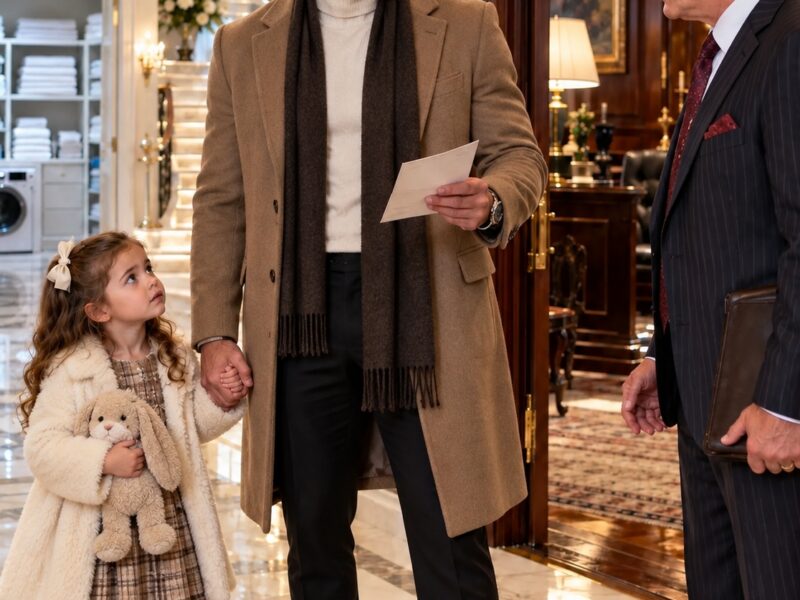
I came home early and found my Housekeeper’s three-year-old Daughter scrubbing my $3,000 Shirt with freezing Hands—but when she whispered, “Please, Mr. Luca, don’t let him take our Home,” I discovered the Man I’d trusted for seven Years had been hiding a terrifying Secret inside my own Mansion.
The little girl was only three years old.
She stood barefoot on a wooden stool in my laundry room, desperately scrubbing a blue ink stain from one of my custom-made shirts.
Her tiny fingers were red and swollen from the freezing water, and her entire body trembled beneath the oversized sleeves of another shirt she wore like an apron.
When she saw me standing in the doorway, she didn’t smile.
She didn’t run toward me.
She looked terrified.
“Please, Mr.
Luca,” she whispered, clutching the dripping fabric against her chest.
“I’m almost finished.
Please don’t make Mama leave.”
I had made more than forty million dollars in my lifetime.
I owned three companies, two vacation properties, and an estate worth more than most people would earn in ten lifetimes.
Yet nothing I had ever purchased, built, or accomplished prepared me for the sight of a frightened three-year-old trying to earn her mother’s right to have a roof over her head.
And the worst part?
The man who had convinced her she needed to do it was someone I had trusted with my life for seven years.
My name is Luca Moretti.
I was forty-two years old when I discovered that the greatest betrayal of my life had been happening under my own roof.
That Thursday afternoon began like any other.
I was supposed to spend six hours negotiating a commercial property acquisition in downtown Chicago.
My attorneys had prepared three hundred pages of contracts, my driver was waiting downstairs, and my schedule was packed until almost eight that evening.
Then, at eleven forty-three, the lead investor called to postpone the meeting.
For once, I decided not to fill the unexpected free hours with more work.
I told my driver to take me home.
Looking back, I sometimes wonder what would have happened if that meeting hadn’t been canceled.
How many more days would Nora have been frightened?
How many more employees would have remained silent?
And how much longer would I have trusted a man who had turned my generosity into his personal weapon?
My estate stood behind tall iron gates on the outskirts of Chicago.
Thirty rooms, polished marble floors, a private garden, a heated swimming pool, and enough expensive furniture to fill a museum.
My mother would have hated it.
Not because it was beautiful, but because she would have looked at the enormous dining room and asked why one man needed a table that could seat twenty-four people.
She had raised me alone in a tiny apartment above a grocery store.
She cleaned hotel rooms during the day and office buildings at night.
When I was eight, I would sometimes sit beside her while she washed work uniforms in our kitchen sink because we couldn’t afford a washing machine.
She died before I made my first million.
Everything I built afterward was supposed to honor her sacrifice.
That was what I told myself.
But as I walked through my silent mansion that afternoon, I was about to discover how badly I had failed to understand the difference between owning a beautiful house and making it a decent home.
I entered through the side door.
Usually, someone greeted me immediately.
Harland had always insisted that the household staff remain attentive whenever I was present.
That afternoon, the hallway was empty.
I loosened my tie and headed toward my study when I heard a soft, frightened voice behind the laundry-room door.
“Please come out.
Please, please.”
I stopped.
For a moment, I thought someone was speaking to a pet.
Then I heard a small sob.
“Mr.
Luca needs this shirt.”
I opened the door.
Nora stood at the deep porcelain sink, gripping a soaked white shirt with both hands.
The water was running cold, and a blue ink stain spread across the fabric.
She was wearing a pale pink dress beneath my oversized shirt.
Her dark curls were messy, and her little bare feet barely fit on the stool.
“Nora?”
She turned so abruptly that the stool wobbled.
I lunged forward and caught her before she fell.
She immediately reached back toward the sink.
“I’m sorry!
I’m sorry!
I didn’t finish!”
“Hey,” I said gently.
“You’re all right.”
But she wasn’t listening.
“I can make it white again.”
Her fingers shook as she tried to grab the fabric.
I shut off the tap.
The water was painfully cold.
“Nora, sweetheart, why are you washing my shirt?”
She glanced toward the security camera above the doorway.
Then she looked down.
“Because Mama is sick.”
“Where is she?”
“In bed.”
“Did your mother ask you to do this?”
Nora shook her head.
“Mr.
Harland said if people don’t work, they can’t stay.”
I felt something cold settle in my stomach.
“Did Mr.
Harland ask you to wash this?”
She hesitated.
“He said Mama made a mistake.”
“What mistake?”
“She got sick.”
For a moment, I couldn’t speak.
Nora pointed toward the blue stain.
“He said your shirt costs more than Mama makes.
He said somebody has to fix it.”
I looked at the stain, then at her swollen hands.
“Did he put the ink on the shirt?”
Nora’s eyes widened.
“I didn’t see.”
Then she whispered something that changed the way I would look at my home forever.
“He said if I told you, you’d send us away before Christmas.”
Christmas was still weeks away.
I crouched in front of her.
“Nora, look at me.”
She reluctantly raised her eyes.
“You haven’t done anything wrong.”
“But the shirt—”
“I don’t care about the shirt.”
Her mouth fell open slightly.
“It’s expensive.”
“I know.”
“Mr.
Harland said it’s three thousand dollars.”
I swallowed.
“Then it’s a very silly shirt.”
For the first time, a tiny flicker of confusion replaced her fear.
I found a clean towel in the cupboard, gently dried her hands, and wrapped them in its warmth.
Then I picked her up.
“Where is Mr.
Harland?”
She pointed toward the hallway.
“In your office.”
Of course he was.
Harland had managed my estate for seven years.
He supervised my employees, controlled household purchasing, handled repairs, and arranged accommodations for staff who lived on the property.
He was polished, efficient, and unfailingly respectful whenever I was present.
He also maintained the household budget, processed staff wages, and regularly assured me that everyone working in my home was satisfied.
I had believed him.
As I carried Nora toward my study, she tightened her arms around my neck.
“Mr.
Luca?”
“Yes, sweetheart?”
“Please don’t tell him I told you.”
The words struck harder than any accusation.
“Why?”
She pressed her face against my shoulder.
“Because he gets very angry when people make trouble.”
I stopped walking.
Then I promised her something I intended to keep.
“Nora, you’re not the one who’s going to be in trouble.”
Harland’s voice came through the heavy wooden doors of my study.
“I’m telling you, Evelyn, the transfer must happen before Monday.”
I froze.
Evelyn Price was my longtime accountant.
Harland continued speaking.
“No, Luca doesn’t review those reports personally.
That’s why he pays me.”
A pause.
Then he laughed.
“He wouldn’t recognize a household discrepancy if it walked into his dining room.”
I stood motionless.
Nora lifted her head.
The man inside my study had no idea I was listening.
“Just move the remaining funds through the maintenance account,” Harland said.
“After the property sale closes, none of this will matter.”
Property sale?
What property sale?
I pushed open the door.
Harland was sitting behind my desk.
My desk.
His expensive leather shoes rested on the edge of a Persian rug, and a crystal tumbler stood beside a stack of documents.
He turned toward me.
For one glorious second, his expression revealed everything.
Surprise.
Fear.
Calculation.
Then came his usual charming smile.
“Mr.
Moretti!
You’re home early.”
I stepped inside.
“Apparently.”
His eyes dropped to Nora.
The smile disappeared.
“What is that child doing here?”
Nora buried her face against my shoulder.
I didn’t answer immediately.
Instead, I closed the door behind me.
“Funny,” I said.
“I was about to ask you the same question.”
Harland stood.
“There seems to have been some misunderstanding.”
“About what?”
“Mrs.
Bennett’s daughter.
She has a habit of wandering into restricted rooms.
I’ve spoken to her mother repeatedly.”
Mrs.
Bennett was Nora’s mother, Elena.
She had worked for me for almost four years.
Quiet, reliable, never late, and always grateful whenever I remembered to ask about her daughter.
I looked directly at Harland.
“Why was a three-year-old washing my clothes in freezing water?”
His expression hardened.
“Children sometimes imitate adults.
I’m sure she was playing.”
“She was crying.”
“Then perhaps she damaged something and became frightened.”
“She told me you threatened to evict her mother.”
Harland’s jaw tightened.
“Mr.
Moretti, I strongly advise against accepting accusations from a toddler.”
I shifted Nora higher against my shoulder.
“Choose your next words carefully.”
He glanced at the girl.
Then he lowered his voice.
“Luca, perhaps we should discuss this privately.”
“We are.”
“With the child present?”
I walked to the sofa and sat down, keeping Nora beside me.
“She stays.”
Harland’s nostrils flared.
For seven years, I had never seen him lose control of his carefully cultivated expression.
Now his mask was slipping.
“Elena has become unreliable,” he said.
“Frequent absences.
Poor performance.
And she has repeatedly abused your kindness.”
I felt my hands tighten.
“What absences?”
“She missed three shifts this month.”
“Because she’s sick?”
“Allegedly.”
“Did you call a doctor?”
“That isn’t my responsibility.”
“Did you arrange paid sick leave?”
He laughed humorlessly.
“Mr.
Moretti, with respect, if you gave paid leave to everyone who claimed to have a headache, this estate would collapse.”
I stared at him.
I paid nearly two million dollars annually to maintain that property.
The idea that three days of paid leave could financially damage me was absurd.
More importantly, I distinctly remembered approving a generous employee benefits package three years earlier.
Including paid sick leave.
“Harland,” I asked quietly, “what happened to the employee medical assistance fund?”
His face changed.
Only slightly.
But I saw it.
“It’s functioning normally.”
“How much money did we allocate this year?”
“I’d have to check.”
“I’ll save you the trouble.
Two hundred and forty thousand dollars.”
He shifted his weight.
“And how much has been distributed?”
“I don’t have those numbers available.”
“Then we’ll get them.”
I reached for my phone.
Harland took a step forward.
“Luca, you’re overreacting.”
I looked up.
It was the first time in seven years he had addressed me without an honorific during a disagreement.
“No,” I replied.
“I think I’ve been underreacting for seven years.”
Then Nora tugged gently at my sleeve.
“Mr.
Luca?”
“Yes?”
“Can Mama still have her medicine?”
I turned toward her.
“What medicine?”
Her voice became barely audible.
“Mr.
Harland took the money for it.”
Harland went completely still.
I carried Nora out of the study before asking another question.
Whatever was happening, I wasn’t going to force a frightened child to witness a confrontation between two angry adults.
I called Daniel Brooks, the head of my personal security team.
Daniel had worked with me for eleven years, four years longer than Harland.
Unlike most people in my professional life, he never exaggerated, never flattered, and never pretended something was fine when it wasn’t.
“Daniel, I need you at the estate immediately.”
“Is there a security issue, sir?”
“Yes.”
“How serious?”
I looked down at Nora’s hands.
“Very.”
I asked him to quietly preserve all security footage from the laundry room, staff corridor, and study, and to make sure no one deleted or altered the recordings.
I also told him to keep Harland on the property without confronting or physically restraining him.
Then I took Nora to the small staff cottage behind the eastern garden.
Elena lived there with her daughter.
I had authorized free accommodation for several employees with families, believing it was one small way to make their lives easier.
The cottage itself was charming from the outside, with white shutters, a garden path, and a little porch.
But when I knocked and received no answer, my concern deepened.
“Elena?”
A faint voice answered.
“Come in.”
I opened the door.
The room smelled faintly of medicine and stale air.
Elena lay on a narrow bed near the window, her cheeks flushed with fever.
A half-empty glass of water stood beside her, along with an unopened envelope and a pharmacy receipt.
She struggled to sit up when she saw me.
“Mr.
Moretti!”
“Please, stay down.”
Her eyes went immediately to Nora.
“Oh, sweetheart.
Where have you been?”
Nora climbed onto the bed.
“I was helping.”
Elena looked confused.
“Helping whom?”
I pulled a chair close.
“Elena, we need to talk.”
Her face drained of color.
“Did I do something wrong?”
That question.
Again.
I was beginning to hate those words.
“No.
But I need to understand what’s happening in this house.”
She glanced toward the window.
Then she whispered, “Did Mr.
Harland send you?”
“No.”
Her shoulders sagged.
I noticed the envelope beside her medicine.
It carried the estate’s official letterhead.
“May I see that?”
Elena hesitated.
Then she handed it to me.
The first line made my blood run cold.
FINAL NOTICE OF TERMINATION AND EVICTION.
According to the letter, Elena’s employment would end in forty-eight hours unless she repaid an outstanding household damage assessment of $8,750.
The notice was signed by Harland.
But beneath his signature was another name.
Mine.
Luca Moretti.
The signature looked almost perfect.
Almost.
“Did I give you this?”
I asked.
Elena stared at me.
“Mr.
Harland said you personally approved it.”
“When?”
“Yesterday.”
“Did he show you anything else?”
She nodded slowly.
“A document saying you wanted all staff debts collected before the end of the year.”
I looked again at the forged signature.
“Are you in debt to the estate?”
Tears filled her eyes.
“I don’t know anymore.”
She opened a drawer and removed a thin folder.
Inside were dozens of receipts.
Uniform replacements.
Cleaning supply charges.
Cottage maintenance fees.
Transportation deductions.
Emergency payroll advances.
I scanned them quickly.
The totals were shocking.
Elena had supposedly accumulated more than seventeen thousand dollars in debt while working in my home.
“How much do I pay you?”
I asked.
She looked embarrassed.
“One thousand nine hundred a month, after deductions.”
I stared at her.
That couldn’t be right.
I had personally approved an annual salary of $54,000 for her position, plus housing and benefits.
Even accounting for normal taxes, her reported take-home pay was far too low.
“Who handles your paycheck?”
“Mr.
Harland.”
“Have you ever seen the full payroll statement?”
She shook her head.
“He gives us envelopes with the amounts and a summary.”
My stomach turned.
“Elena, why didn’t you come to me?”
Her expression broke.
“Because he said you knew.”
The room fell silent.
Then she said something I would never forget.
“He told us you were generous when people deserved it, but you didn’t tolerate weakness.
When I asked about the missing medical allowance, he said you’d stopped paying for employees’ personal problems.”
I closed my eyes.
My mother had once worked for a hotel manager who deducted money from her wages whenever a guest complained.
Even if the complaint had nothing to do with her.
I remembered her standing at our kitchen table, calculating whether she could afford groceries after rent.
And now, inside the estate built with the money I had earned to escape that life, another mother had been doing the same thing.
Only this time, the cruelty carried my name.
“Elena,” I said, “you were supposed to receive your full salary and medical benefits.”
She looked at me.
“What?”
“Your housing was supposed to be free.
Your sick leave was supposed to be paid.
And nobody was authorized to charge you for ordinary household supplies.”
Her lips trembled.
“But Mr.
Harland said—”
“I know what he said.”
I reached for the folder.
“And I’m going to find out why.”
Daniel arrived twenty minutes later.
By then, I had arranged for a physician to examine Elena and Nora.
Nora’s fingers were painfully chilled and irritated but showed no lasting injury.
The doctor gently warmed her hands and advised us to keep her comfortable.
Elena had a respiratory infection and a high fever that required proper treatment, rest, and follow-up care.
The physician was concerned that she had delayed filling her prescription because of its cost.
When I asked why she hadn’t used the medical assistance fund, Elena began crying.
“I tried.”
Those two words told me more than a hundred accounting reports.
I met Daniel in the private conference room.
He placed a laptop on the table.
“We’ve preserved the recordings, sir.”
“Show me.”
He hesitated.
“Some of this may be difficult to watch.”
I sat down.
“Play it.”
The first recording was from that morning.
At 9:18, Harland entered the laundry room carrying my white shirt.
He examined it briefly.
Then he uncapped a blue pen.
With deliberate movements, he pressed the ink tip against the fabric.
He created the stain himself.
I watched without moving.
A few seconds later, Elena appeared in the doorway.
She looked exhausted, one hand pressed against her chest.
Harland held up the shirt.
There was no audio in that particular camera angle, but his body language was unmistakable.
He pointed toward the stain.
Then toward Elena.
Then toward the door.
Elena lowered her head.
At 9:24, she left the room.
Harland followed.
For several minutes, nothing happened.
Then at 9:37, Nora entered alone.
She looked around nervously before dragging the small wooden stool toward the sink.
She climbed onto it, turned on the water, and began rubbing the shirt.
My throat tightened.
She worked for almost an hour.
Sometimes she paused to blow warm air onto her fingers.
Sometimes she looked toward the door.
Once, she wiped her eyes with the oversized sleeve.
Daniel quietly paused the video.
“Sir?”
I couldn’t answer.
Because what destroyed me wasn’t merely that Harland had manufactured a reason to punish Elena.
It was what the little girl had done afterward.
With no adult directing her, she had decided to finish the task herself.
Somebody had frightened her so thoroughly that she believed her mother’s survival depended on her tiny hands.
“Keep going,” I whispered.
Daniel resumed the footage.
At 10:46, Harland returned.
He stood in the doorway, watching Nora scrub.
He didn’t stop her.
He didn’t help.
He simply looked at the shirt, checked his watch, and walked away.
I stood so abruptly that my chair scraped across the marble floor.
Daniel closed the laptop.
“There’s more.”
I turned.
“How much more?”
He took a breath.
“Harland’s access records show unusual activity in the payroll system.
There are also encrypted files copied to an external drive during the past three months.”
“Can you identify them?”
“Not without proper authorization from the system administrator.”
“You have it.
Preserve everything lawfully, and bring in an independent forensic accountant.”
Daniel nodded.
Then he added, “There’s something else you should know.”
“What?”
“Two employees resigned last year after being accused of theft.”
“I remember.”
Harland had informed me that a gardener and a kitchen assistant had been caught taking supplies.
He provided written reports.
I approved their termination.
Daniel leaned forward.
“Neither was reported to the police.
And both were made to sign repayment agreements.”
I stared at him.
“Were there actual thefts?”
“We don’t know.
But the security logs for both incidents were deleted.”
“By whom?”
Daniel’s silence answered before he spoke.
“Harland’s administrative account.”
I looked through the conference-room windows at the beautiful gardens beyond.
For years, I had complimented Harland on keeping the estate running smoothly.
I had thought the quiet hallways and perfect service were evidence of good management.
Now I wondered whether they were evidence of frightened employees who had learned that remaining invisible was safer than being noticed.
“Daniel,” I said, “I want every employee’s payroll records reviewed.
All seven years.”
He nodded.
“And find those two former employees.”
“Yes, sir.”
“Offer them the opportunity to speak directly with an independent investigator.
No pressure.”
Daniel stood.
Then he paused at the door.
“Mr.
Moretti?”
“Yes?”
“I’ve worked in security for fifteen years.
People like Harland don’t usually start with the worst thing they’ve ever done.”
I looked at the paused image of Nora on the laptop.
“I know.”
And for the first time that afternoon, I began to fear that the laundry room was only the beginning.
That evening, I called an emergency meeting with my attorney, Rebecca Shaw, and an outside forensic accounting firm.
Rebecca had represented me since I founded my first company.
She knew my finances better than almost anyone.
When I explained what had happened, her expression became increasingly grim.
Then I showed her the eviction notice.
She studied the signature.
“Luca, did you authorize this document?”
“No.”
“Did you ever give Harland signing authority over residential property?”
“Only routine service agreements.”
She turned the paper over.
“This isn’t routine.”
“What do you mean?”
She pointed toward a paragraph near the bottom.
The notice claimed Elena occupied the cottage under a temporary commercial housing agreement.
“That language could be part of an attempt to assert broader control over the property,” Rebecca said.
“But it doesn’t establish that Harland owns anything.
We need to examine the actual records.”
“Why?”
“Because a man who forges your signature on an eviction notice may have forged it elsewhere.”
A chill moved down my spine.
Rebecca opened her laptop.
Within minutes, she located an electronic filing connected to one of my estate’s subsidiary property companies.
An application had been submitted to transfer management and future purchase rights over six employee cottages.
The proposed buyer was a newly formed company called Northbridge Residential Holdings.
I had never heard of it.
Rebecca searched the corporate registration.
Its managing member was listed through another business entity.
A second search revealed the person behind that entity.
Charles Harland.
For several seconds, neither of us spoke.
Then Rebecca turned toward me.
“Luca, he’s attempting to acquire the staff housing.”
My pulse hammered.
“With whose approval?”
“The documents claim yours.”
“I never signed them.”
“I believe you.
But we need to establish exactly what was submitted, who submitted it, and whether any binding transfer occurred.”
I stood and walked toward the window.
The six cottages stood beyond the eastern garden, partly hidden by tall trees.
I had built them five years earlier so employees with families wouldn’t have to spend half their wages on Chicago rent.
I remembered the day the first families moved in.
Children laughing.
Boxes on porches.
Elena had cried when I gave her the keys.
She told me Nora would finally have a small bedroom of her own.
Now I understood why Harland had become so aggressive about employee debts.
If he could convince the workers they owed thousands of dollars, he could pressure them to surrender their housing.
And if he could acquire control of the cottages through a fraudulent transaction, he could potentially charge rent or sell the properties for a substantial profit.
It was more than payroll theft.
It was a scheme to turn vulnerable people’s homes into his private investment.
Rebecca continued examining the records.
Then she looked up sharply.
“There’s a deadline.”
“What deadline?”
“The proposed closing is Monday.”
Four days away.
“Can we stop it?”
“We can immediately notify the relevant parties that you dispute the authorization and seek emergency relief.
We also need to secure the company’s records and contact law enforcement about the suspected forgeries.”
“Do it.”
Rebecca studied me.
“Luca, this could become a criminal investigation.”
“Good.”
“And the financial exposure may be substantial.”
“I don’t care how much it costs.”
She shook her head.
“That’s not what I mean.
We may discover you’ve lost money that cannot be recovered.”
I thought of Nora’s little hands.
“Rebecca, I’ve already lost something far more important.”
She softened.
“What?”
“Seven years in which I could have protected people who trusted me.”
The next morning, I did something I should have done years earlier.
I ate breakfast in the staff dining room.
The moment I entered, the conversation stopped.
Twelve employees sat around the long table, wearing neatly pressed uniforms.
Some immediately stood.
Others looked toward the entrance as if expecting Harland to appear behind me.
“Please,” I said.
“Sit down.”
Nobody moved.
I pulled out a chair and sat first.
Slowly, the others followed.
A cook named Maria poured coffee with visibly shaking hands.
“Is everything all right, Mr.
Moretti?”
“No,” I answered.
Her hand froze.
“But I intend to change that.”
I explained that Harland had been removed from his management duties pending an investigation, with his system access revoked and records secured.
I told them their housing would not be threatened because they reported concerns, and that independent professionals would review wages, benefits, and alleged debts.
Then I asked whether anyone had been charged for household damages.
Nobody spoke.
I waited.
Finally, an older gardener named Samuel raised his hand.
“Sir, are we allowed to answer honestly?”
The question humiliated me more than any public scandal could have.
“Yes, Samuel.”
He glanced around the table.
“Mr.
Harland said complaining to you was grounds for immediate dismissal.”
I felt my jaw tighten.
“That was never my policy.”
Maria looked up.
“He told us you didn’t want staff speaking to you unless spoken to.”
“That’s not true.”
A young groundskeeper cleared his throat.
“He said you were tired of employees asking for money.”
I looked from face to face.
“What money?”
Maria swallowed.
“The Christmas bonuses.”
I stared at her.
Every December, I authorized holiday bonuses equal to one month’s salary.
“How much did you receive last year?”
She hesitated.
“Two hundred dollars.”
I put down my coffee.
“That isn’t what I approved.”
Samuel’s eyes narrowed.
“How much did you approve?”
“One month’s salary for every eligible employee.”
Nobody spoke.
Then Maria covered her mouth.
Her eyes filled with tears.
“Mr.
Moretti…
I thought you knew.”
Within an hour, the stories began pouring out.
A driver had been charged $2,400 for an alleged scratch on a vehicle that had never been inspected.
A kitchen assistant had been denied medical reimbursement because she supposedly submitted the wrong forms.
A groundskeeper had been forced to pay for equipment that the estate already owned.
Two employees had been threatened with eviction after requesting time off to care for sick relatives.
Every accusation followed the same pattern.
Harland identified something the employee couldn’t afford to lose.
A job.
A home.
Medical treatment.
A reputation.
Then he used that fear to maintain control.
But the most shocking testimony came from Maria.
She had worked for me for nine years.
Her husband had died the previous winter.
I remembered sending flowers to the funeral and instructing Harland to arrange a $15,000 hardship payment.
When I mentioned it, she stared at me.
“What payment?”
I felt the room tilt.
“Maria, did you receive the money I authorized after your husband’s death?”
She slowly shook her head.
“No, sir.”
I couldn’t breathe properly.
“Harland told me you had refused assistance because you wanted privacy.”
Maria began crying.
“He told me you wouldn’t help because my husband didn’t work for you.”
I closed my eyes.
For a moment, I saw my own mother again.
Standing in her uniform.
Too proud to beg.
Too exhausted to fight.
I had built an empire believing money was enough to protect people.
But I had handed that money to someone without checking what he did with it.
And people had suffered because of my absence.
When the meeting ended, Samuel remained seated.
“Mr.
Moretti,” he said quietly, “may I ask you something?”
“Anything.”
“Why didn’t you ever come downstairs before?”
I looked at him.
I could have explained my schedule.
My companies.
The meetings and flights and responsibilities.
All the impressive reasons I had been too busy.
Instead, I told him the truth.
“Because I thought paying someone else to care was the same as caring.”
Samuel studied me.
Then he nodded.
“It’s not, sir.”
“No,” I whispered.
“It isn’t.”
By Saturday afternoon, the forensic accountants had uncovered the first major financial discrepancies.
Over seven years, more than $1.8 million had been transferred through suspicious household expense accounts.
Some charges represented inflated vendor invoices.
Others were employee benefits approved but never distributed.
Several payments went to companies connected to Harland through relatives and business associates.
The investigators also identified altered payroll records that appeared designed to disguise unauthorized deductions.
Rebecca sat across from me in my study, surrounded by folders.
“This is preliminary,” she warned.
“We still need to distinguish what can be proven from what merely looks suspicious.”
“How much can we prove?”
“Enough to refer the evidence to the authorities and pursue substantial civil claims.”
I nodded.
Then Daniel entered carrying a sealed envelope.
“We located one of the former employees.”
“Which one?”
“Anthony Reed.
The gardener dismissed last year.”
“Will he speak to us?”
“He already has.”
Daniel handed me a written statement.
Anthony had worked on the property for five years.
He was a single father with a teenage son.
According to his account, Harland accused him of stealing an expensive watch from a guest bedroom.
Anthony denied the accusation.
Harland then showed him a still image from a security recording that appeared to place him near the room.
He demanded repayment of $12,000.
When Anthony couldn’t pay, Harland threatened to report him to the police.
Anthony signed an agreement under pressure and surrendered his final wages.
He lost his job.
Then he lost his apartment.
For two months, he and his son stayed with relatives.
I stared at the statement.
“Did anyone ever find the watch?”
Daniel nodded.
“In a locked cabinet inside Harland’s office.”
I slowly looked up.
“What?”
“It was among several items we found during an authorized inventory after securing the room.
We photographed and preserved everything.”
Rebecca held out her hand.
“Give me the inventory.
We need a clear chain of custody.”
I looked back at Anthony’s statement.
Another name ruined.
Another family displaced.
Another decision supposedly made on my behalf.
“Get Anthony an independent attorney,” I said.
“At my expense, if he’ll accept it.
And tell him I want to apologize personally, but only if he wants to see me.”
Daniel nodded.
Then he hesitated.
“There’s one more detail.”
I closed my eyes briefly.
“Tell me.”
“Anthony says Harland told him something before he left.”
“What?”
Daniel read from the statement.
“Mr.
Moretti doesn’t care whether you live in a house or under a bridge.
He only cares that his property stays clean.”
I sat motionless.
For a long time, nobody spoke.
I had spent decades building a reputation as a ruthless negotiator.
A man who rarely lost.
A man who could walk into a room and make multimillion-dollar decisions without hesitation.
Yet the most devastating thing I heard that day was that a frightened employee believed I wouldn’t care if his child became homeless.
And the terrible truth was that my behavior had given him little reason to believe otherwise.
That evening, I went back to Elena’s cottage.
The doctor had treated her, and her fever was beginning to improve.
Nora sat on the living-room rug, building a crooked tower from colorful wooden blocks.
When she saw me, her face lit up.
“Mr.
Luca!”
The sound stopped me.
Yesterday, she had trembled when I entered a room.
Tonight, she smiled.
It felt like the first genuinely valuable thing I had received in years.
“Hello, Nora.”
She held up a blue block.
“I’m building a castle.”
“That’s impressive.”
“It’s for Mama.”
“Does Mama get the biggest bedroom?”
Nora considered the question.
“No.
Mama gets the kitchen.”
Elena laughed softly from the sofa.
“Apparently I have a job even inside her imaginary castle.”
I sat cross-legged on the rug.
“And what do I get?”
Nora studied me seriously.
“You can have the laundry room.”
Elena’s smile vanished.
She looked embarrassed.
“Nora, sweetheart—”
But I laughed.
A real laugh.
The first in two days.
“Fair enough.
But I’m not very good at laundry.”
Nora giggled.
“I can teach you.”
I looked at her tiny hands.
“No,” I said gently.
“I think I’ll learn from an adult.”
She nodded, satisfied.
Then she handed me the blue block.
“Here.
You can help build.”
For the next fifteen minutes, I sat on the floor of a small cottage, constructing a lopsided wooden castle with a three-year-old girl.
No contracts.
No phone calls.
No negotiations.
Just laughter and the occasional collapse of our poorly designed tower.
It was the happiest I had felt in months.
Later, when Nora went to wash her hands before dinner, Elena turned toward me.
“Mr.
Moretti, I don’t know how to thank you.”
“Please don’t.”
“But you’re paying for my medicine, and someone brought groceries, and the doctor said—”
“Elena.”
She stopped.
“You don’t owe me gratitude for benefits you should have received all along.”
Her eyes filled.
“I was afraid you’d think I was taking advantage.”
I leaned forward.
“Can I ask you something?”
She nodded.
“Why did you stay?”
Elena looked toward the kitchen, where Nora was singing softly to herself.
“Because of her.”
I waited.
“When Nora’s father died, I had nothing saved.
Medical bills took everything.
I found this job, and it came with a home.
For the first time, my daughter had a garden.
A safe bedroom.
Food in the refrigerator.”
She wiped her cheek.
“Mr.
Harland knew I couldn’t afford to leave.”
I felt a heavy ache behind my ribs.
“He reminded me whenever I complained.”
I looked at her.
“What did he say?”
Her voice dropped.
“He said women like me should be grateful wealthy men let us live near them.”
Something inside me went painfully still.
My mother had heard words like those.
Different employer.
Different decade.
Same cruelty.
“Elena, listen carefully.
Your job and your home are not gifts you have to beg to keep.
We made an agreement, and you upheld your responsibilities.
The estate failed to uphold its own.”
She looked down at her hands.
“I’m not sure what happens next.”
“Neither am I,” I admitted.
“But Harland doesn’t get to decide your future anymore.”
Before I left, Nora ran toward me holding a folded piece of paper.
“I made you something.”
It was a drawing.
Three figures stood beneath a huge yellow sun.
One was small, with curly hair.
One wore a pink dress.
The third was tall, dressed in a black suit.
All three were holding hands.
“That’s Mama,” Nora explained.
“That’s me.
That’s you.”
I stared at the paper.
“Why am I so tall?”
She grinned.
“Because you can reach the cookies.”
Elena laughed.
But I couldn’t.
Not immediately.
Because for the first time in my adult life, someone had drawn me into a family picture.
Not because I was wealthy.
Not because I owned anything.
But because I had shown up when they needed help.
I folded the drawing carefully.
And I took it home.
Monday morning, the proposed property transaction was scheduled to close.
It never did.
Rebecca had already notified the parties involved that I disputed the signatures and authority behind the documents.
Emergency legal steps were taken to prevent the disputed transfer, and the financial records were preserved.
Investigators were reviewing the suspected fraud.
Harland, however, still believed he could talk his way out of everything.
He had contacted me repeatedly.
At first, his messages were calm.
“Luca, we need to resolve this unfortunate misunderstanding.”
Then indignant.
“After seven years of loyalty, I deserve a private conversation.”
Then threatening.
“You have no idea how much damage these accusations could do to your reputation.”
I agreed to speak with him once, in my attorney’s office, with counsel present.
He arrived wearing a charcoal-gray suit, polished shoes, and an expensive watch I had given him for his fifth anniversary of service.
He smiled as though we were discussing an ordinary business disagreement.
“Luca.”
I didn’t shake his hand.
He noticed.
Then he sat down.
Rebecca placed a folder on the conference table.
“Mr.
Harland, this meeting concerns serious allegations involving estate finances, employee compensation, and disputed corporate documents.”
Harland gave a small laugh.
“I’m aware of the accusations.
They’re outrageous.”
I remained silent.
He turned toward me.
“You’re really going to destroy seven years of trust because a sick maid’s child misunderstood something?”
I felt heat rise in my chest.
But I kept my voice level.
“Her name is Nora.”
He blinked.
“What?”
“The child.
Her name is Nora.”
He waved dismissively.
“Yes, of course.
Nora.”
I leaned forward.
“Did you put blue ink on my shirt?”
His expression didn’t change.
“No.”
Rebecca opened her folder.
“We have preserved security footage showing you doing so.”
A flicker of annoyance crossed his face.
“That recording could be interpreted several ways.”
“Did you threaten Elena with eviction?”
“I enforced household standards.”
“Did you deduct money from her wages?”
“Authorized expenses.”
“Did you withhold medical assistance funds?”
“No.”
“Did you forge my signature?”
His eyes narrowed.
“Careful, Luca.”
I stared at him.
“Answer the question.”
Rebecca raised a hand.
“Mr.
Moretti, we’ll let the documented evidence speak for itself.”
Harland settled back in his chair.
For a moment, he seemed almost relieved.
Then he made his mistake.
“You have no idea what it takes to manage that place,” he said bitterly.
“You fly around making deals while I deal with people who constantly want more.
More money.
More time off.
More sympathy.”
He looked at me with open contempt.
“You gave them houses, and they still complained.”
I stared at him.
“They worked for those houses.”
He scoffed.
“They should’ve been grateful.”
“Grateful for what?”
“For everything you handed them.”
I thought of Maria.
Samuel.
Anthony.
Elena.
Nora.
People who had spent years cleaning my floors, preparing my meals, tending my gardens, and protecting my property.
People who had jobs and contractual rights, not favors they were required to repay with silence.
“You treated human beings like debts you could collect,” I said.
Harland’s face reddened.
“Don’t lecture me about fairness.
You weren’t even there.”
The words hung between us.
Because he was right about one thing.
I hadn’t been there.
Not enough.
Not when employees needed someone to listen.
Not when benefits disappeared.
Not when people were threatened with losing their homes.
I looked directly at him.
“You’re right.
I wasn’t there.”
He seemed surprised.
I continued.
“And that’s a failure I’m going to live with.
But my absence didn’t give you permission to steal from people or terrorize their children.”
His mouth tightened.
Rebecca slid a printed document across the table.
“This is the registration information connecting you to Northbridge Residential Holdings.”
Harland glanced down.
Then back up.
“There’s nothing illegal about owning a business.”
“No,” Rebecca replied.
“But the disputed authorization used in the proposed property transaction raises serious questions.”
She placed another document beside it.
“These are the apparent discrepancies in payroll and benefits accounts.”
He didn’t touch either paper.
For the first time, the confidence drained from his face.
“Luca,” he said quietly, “we can settle this.”
I looked at him.
“Settle what?”
“I can return some money.
We can make the employees whole.
Nobody needs to know.”
I felt an almost unbearable surge of anger.
Not because he had finally acknowledged wrongdoing.
But because even now, he believed everything was a financial negotiation.
“You think this is about money?”
He swallowed.
“What else?”
I leaned closer.
“A little girl spent an hour scrubbing a shirt in freezing water because she thought her mother would become homeless.”
Harland looked away.
“And you watched her.”
He said nothing.
“You watched her work.
You saw her crying.
Then you walked away.”
He shifted in his seat.
“I never told her to—”
“Don’t.”
My voice was so quiet that he stopped.
“Don’t you dare make this about what you technically told a three-year-old.”
Rebecca closed the folder.
The meeting was over.
I stood.
“Any repayment, restitution, or settlement will be handled through the appropriate legal process.
And the authorities will receive the evidence.”
Harland stared at me.
“After everything I’ve done for you?”
I paused at the door.
Then I answered.
“The worst thing you did wasn’t steal my money, Charles.
It was make innocent people believe I agreed with you.”
The investigation continued for months.
I learned quickly that the legal system did not move at the speed of my anger.
Evidence had to be authenticated.
Financial transactions traced.
Witnesses interviewed.
The difference between suspicion and proof mattered.
Harland denied many of the accusations through his attorney, even after investigators identified additional records connecting him to diverted funds and unauthorized deductions.
Eventually, prosecutors brought charges involving fraud, forgery, and theft.
The disputed property transfer was blocked, and later proceedings established that Harland had no valid claim to the staff cottages.
He ultimately entered a guilty plea to multiple financial offenses and received a prison sentence.
Civil proceedings and recovery efforts continued separately.
Not every dollar could be recovered.
Not every damaged reputation could be repaired with a document.
And no court order could erase years of fear.
But the people who had been wronged finally had the chance to speak without Harland controlling the room.
I personally met with employees and former employees who wanted to see me.
Some accepted my apology.
Others didn’t.
Anthony Reed was among the latter.
When we met, he listened as I explained that the theft accusation against him had been discredited.
I told him the estate would correct its records and provide appropriate financial restitution.
He looked at me for a long time.
Then he said, “My son slept on a couch for two months because of that man.”
I nodded.
“I know.”
“No, Mr.
Moretti.
You know now.”
I couldn’t answer.
Anthony stood.
“I appreciate you trying to make it right.
But I don’t think I can forgive you yet.”
I didn’t ask him to.
Some wounds don’t heal because the person responsible finally discovers them.
They heal, if they heal at all, on their own timetable.
And I had no right to demand forgiveness as another form of service.
The staff compensation review eventually identified substantial unpaid wages, benefits, and improperly withheld funds.
We reimbursed the affected workers, with independent legal oversight where appropriate.
I replaced the old management structure with a system that separated payroll, housing administration, and employee complaints.
No single manager could control someone’s wages, home, and ability to report mistreatment.
Employees received direct access to their payroll records and benefits information.
An independent reporting process was established, and I made regular visits to the estate’s staff areas without announcing them as inspections.
But the most important change wasn’t written into a policy.
It was a decision I made one morning while standing outside my mother’s old apartment building.
The grocery store downstairs had closed years earlier.
The windows were boarded up.
Our second-floor apartment was empty.
I stood on the sidewalk remembering a little boy who had promised to build a better life.
That boy had believed success meant never having to worry about rent again.
He was wrong.
Success meant being able to recognize the fear in someone else’s eyes and refusing to ignore it.
For years, I had measured my life by the things I acquired.
Now I began measuring it by the things I was willing to take responsibility for.
Six months after the day I found Nora in the laundry room, my estate looked very different.
The marble floors were still polished.
The crystal chandeliers still sparkled.
The gardens remained immaculate.
But the house was no longer silent.
Employees laughed in the kitchen.
Samuel played music while working in the greenhouse.
Maria complained affectionately whenever I wandered into her workspace and stole a freshly baked pastry.
And Nora?
Nora had become the unofficial ruler of my entire estate.
Elena had recovered fully and returned to work on a schedule she chose.
She was offered the opportunity to train for a better-paid administrative position, and she accepted after several weeks of consideration.
I also established an independently administered education fund for employees’ children, with transparent rules so no one would need to flatter a manager to receive help.
Nora was too young to understand any of that.
She cared about three things.
Her mother.
Her picture books.
And the fact that I owned a kitchen full of cookies.
One Saturday afternoon, Elena brought her to the main house for a small holiday celebration.
Nora arrived wearing a cream-colored dress with tiny pink flowers embroidered around the collar.
Her dark curls were tied with a ribbon.
She spotted me beside the Christmas tree.
“Mr.
Luca!”
I knelt just in time for her to run into my arms.
“Hello, princess.”
She immediately held up both hands.
“Look!”
I examined them solemnly.
“What am I looking at?”
“My fingers!”
I smiled.
“They look wonderful.”
“They’re not red anymore.”
The words caught me completely off guard.
I stared at her little hands.
Healthy.
Warm.
Perfectly ordinary.
Exactly as a child’s hands should be.
“No,” I said softly.
“They’re not.”
She smiled proudly.
Then she reached into her pocket.
“I have a present.”
She pulled out a folded piece of paper.
Another drawing.
This time, she had drawn a huge house beneath a bright yellow sun.
There were flowers in the garden.
A blue car in the driveway.
And three people standing outside.
I recognized the little girl and her mother immediately.
The third figure was tall, wearing a black suit.
But there was something different.
Above the drawing, Elena had helped Nora write five words in large, uneven letters.
“OUR HOME IS SAFE NOW.”
I stared at the picture.
For a moment, the room blurred.
Elena approached quietly.
“She wanted to give you that herself.”
I swallowed.
“Thank you, Nora.”
The little girl looked at me seriously.
“Mr.
Luca?”
“Yes?”
“Are you sad?”
I shook my head.
“No, sweetheart.”
“But your eyes are wet.”
I laughed softly.
“Sometimes grown-ups cry when they’re happy.”
She considered this.
Then she placed one small hand against my cheek.
“It’s okay.”
Two words.
Such simple words.
But in that instant, I remembered the frightened child standing barefoot on a wooden stool.
The cold water.
The blue ink.
The trembling voice.
Please don’t make Mama leave.
I gently took her hand.
“Nora, can I tell you something?”
She nodded.
“When you grow up, I hope you remember that you never have to earn kindness by being afraid.”
She frowned thoughtfully.
“Even if I make a mess?”
“Even then.”
“Even if I spill juice?”
“Even then.”
She leaned closer.
“Even if I get blue on your shirt?”
I laughed through the tears.
“Especially then.”
Nora grinned.
Then she reached for my hand and pulled me toward the Christmas tree.
“Come on.
Mama says we’re taking pictures.”
I let her lead me.
Behind us, the enormous house glowed with warm holiday lights.
Music drifted from the dining room.
Someone was laughing in the kitchen.
For the first time since buying the estate, I felt as though it was truly alive.
A year later, I made one final change.
I removed the expensive portrait of myself that hung above the fireplace in my private study.
It had been commissioned shortly after my fortieth birthday.
In it, I stood beside a marble column wearing a tailored black suit, looking toward the horizon with the practiced confidence of a man who believed he’d conquered the world.
The painting had cost nearly sixty thousand dollars.
For years, I had considered it a symbol of everything I accomplished.
Now it embarrassed me.
I donated it to a charity auction and replaced it with something worth almost nothing.
A drawing.
Crayon on ordinary white paper.
A crooked castle.
A bright yellow sun.
Three people holding hands.
The first picture Nora had ever given me.
One afternoon, Rebecca stopped by to review the final updates to the employee assistance program.
She noticed the drawing above the fireplace.
“Luca,” she said, smiling, “what happened to your portrait?”
“I replaced it.”
“I can see that.”
She walked closer.
“Who drew this?”
“A very important person.”
Rebecca studied the crooked figures.
Then she looked at me.
“This is quite a change in your taste.”
I smiled.
“My mother would approve.”
After Rebecca left, I remained in the study for a long time.
Outside, snow began drifting past the windows.
I thought about Harland.
About the employees who had suffered.
About the terrible distance between the person I believed myself to be and the person my workers had been taught to fear.
I knew I couldn’t rewrite the past.
But I could refuse to repeat it.
My phone buzzed.
It was a photograph from Elena.
Nora was standing in her preschool classroom holding a certificate.
Her smile was enormous.
Beneath the photograph, Elena had written:
She received an award for helping another child who was afraid on their first day.
When her teacher asked why she stayed beside the little boy, Nora said, “Because nobody should have to be scared by themselves.”
I read the message twice.
Then I sat down.
I remembered the promise I’d made to my mother when I was eight years old.
One day, I would be rich enough to make sure nobody in my family had to live in fear.
It had taken me thirty-four years to understand what that promise truly meant.
It wasn’t enough to build walls high enough to keep poverty outside.
I had to make sure those walls never became a prison for the people inside.
And wealth wasn’t proof of character.
It was a test of what I would do when someone with less power needed protection.
I looked up at Nora’s drawing.
Then at the framed photograph of my mother on my desk.
She stood outside our old apartment building wearing her cleaning uniform, smiling into the camera after a fourteen-hour shift.
Her hands were rough.
Her shoes were worn.
But her eyes were kind.
I touched the frame.
“I’m still learning, Mama,” I whispered.
Then I thought of the little girl who had changed my life without understanding what she’d done.
Nora hadn’t asked me for millions.
She hadn’t asked for an expensive gift, a grand promise, or a place in my will.
She had asked for something far simpler.
She wanted her mother to be safe.
And on the day I finally listened to her, I discovered a truth that every business deal and every dollar had somehow failed to teach me.
A wealthy man can own a thousand houses and still know nothing about creating a home.
I had built my fortune believing the most important thing in life was never to be powerless again.
But the greatest moment of my life didn’t happen when I signed a multimillion-dollar contract.
It didn’t happen when I bought my mansion.
It didn’t happen when a magazine put my face on its cover.
It happened in a cold laundry room, when I caught a frightened little girl before she fell.
Because that was the moment I finally understood what my mother had spent her entire life trying to teach me.
Real power isn’t making people afraid of what you can take away.
It’s making them feel safe because of what you choose to protect.
And if I had to lose every expensive shirt I owned to learn that lesson, I would have considered it the greatest bargain of my life.
THE END.









