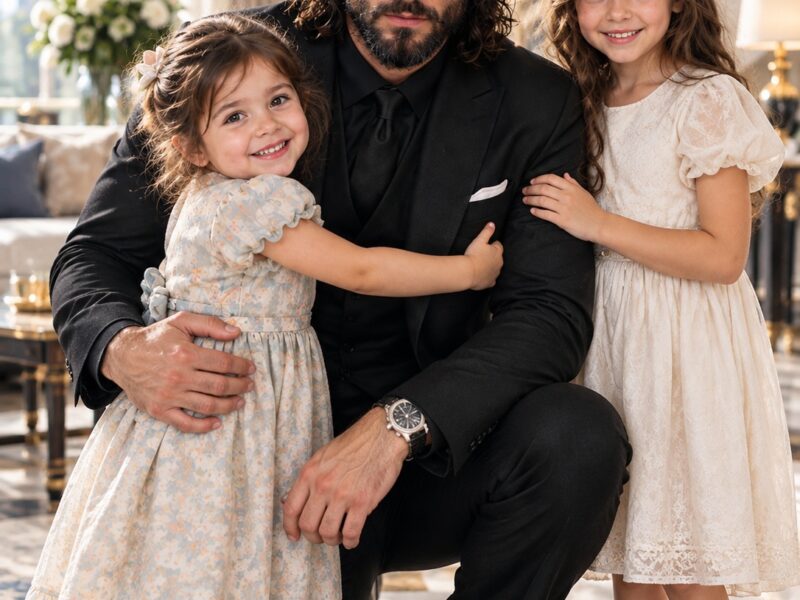
“I Came to Play With You,” the Maid’s Toddler Said—Then the Mafia Boss Froze at His Daughter’s Reaction
“I came to play with you.”
Nico Bellini looked up from the ledger on his desk.
For a moment, the sentence made so little sense inside his private study that he wondered whether he had imagined it.
Then the stuffed rabbit appeared first.
One worn gray ear dragged over the threshold, followed by a tiny hand, a cloud of dark curls, and finally three-year-old Mia Alvarez herself.
She stood in the open doorway in pink socks and a pale blue dress, entirely unaware that grown men twice her mother’s age rarely entered that room without being summoned.
Nico stared.
Mia smiled.
“I brought Bunny.”
The armed guard outside appeared behind her, horrified.
“Mr. Bellini, I’m sorry. She slipped past when—”
Nico raised one finger.
The guard stopped talking.
Mia walked farther into the room.
His study was built to intimidate adults.
Dark walnut.
Leather chairs.
Tall windows overlooking the Long Island Sound.
No family photographs except one silver frame positioned where only Nico could see it from his desk.
No toys.
No softness.
Mia looked around as if she had entered a slightly boring playroom.
“What are you playing?”
“I’m working.”
She considered that.
“Is it fun?”
“No.”
“Then don’t.”
Nico almost smiled.
Almost.
He heard another set of footsteps.
Fast.
Barely controlled.
His seven-year-old daughter Sophia appeared in the hallway.
And Nico forgot Mia’s question.
Sophia stopped so abruptly that one hand struck the doorframe.
Her face went pale.
Not annoyed.
Not embarrassed.
Afraid.
Nico had spent twenty-two years reading fear.
Men hid it by talking too much.
Politicians disguised it as outrage.
Rivals smiled when frightened because they believed teeth looked like confidence.
Children were usually simpler.
Sophia’s fear was not for herself.
Her eyes went straight to Mia.
“Mia.”
The toddler looked over her shoulder.
“Sophie!”
Sophia crossed the room in three quick steps.
She caught Mia gently by both shoulders, moved her backward, and placed herself between the child and Nico’s desk.
Nico became completely still.
He knew that movement.
His own security detail used it around him.
Body between threat and protected person.
Sophia was seven.
“What are you doing?” he asked.
She looked at him.
“Nothing.”
“That didn’t look like nothing.”
“She wasn’t supposed to come in.”
“It’s all right.”
Sophia’s eyes flicked toward the desk.
Then toward the silver photograph facing Nico.
Then back to Mia.
“She bothers you when you work.”
“Mia has been in this room for approximately thirty seconds.”
Sophia said nothing.
Nico leaned back.
“Mia said she came to play.”
“She says that to everybody.”
Mia frowned.
“No, I don’t.”
Sophia looked at her sharply.
Mia hugged the rabbit.
“I came to play with him.”
“Why?”
“Because Mama said he’s lonely.”
Nico’s eyebrows rose.
Somewhere in the house, Rosa Alvarez had just acquired a problem she did not yet know existed.
Sophia’s reaction was different.
She looked frightened all over again.
“Mama Rosa didn’t mean—”
Mia continued cheerfully.
“She said lonely people need somebody to sit by them.”
“Mia.”
Sophia’s voice came too quickly.
Too hard.
The toddler’s smile disappeared.
Nico saw Sophia regret it immediately.
She crouched.
“I’m sorry.”
Mia looked down.
“I just don’t want you in here.”
“Why?”
Sophia glanced at Nico.
“Because Daddy works.”
Mia thought about this, then walked around Sophia and approached Nico anyway.
Sophia grabbed her hand.
Nico saw it.
“Let her go.”
Sophia froze.
He kept his voice calm.
“Sophia.”
Slowly, she released Mia’s hand.
Mia arrived beside the desk.
She placed her stuffed rabbit on top of a shipping report worth several million dollars.
Nico looked at the rabbit.
Then at her.
“His name is Bunny?”
“Yes.”
“Unimaginative.”
Mia did not know what the word meant and therefore refused to be insulted.
“You can hold him.”
“I’m all right.”
“He helps.”
“With what?”
“When you miss somebody.”
The room went quiet.
Nico’s eyes moved toward Sophia.
She had gone white again.
Mia picked up the rabbit and held it toward him.
“My sister likes him too.”
Nico felt something cold pass through his chest.
Sophia moved.
“Mia, let’s go.”
Nico looked directly at his daughter.
“What did she say?”
“Nothing.”
“I heard her.”
“She gets words mixed up.”
Mia objected.
“No, I don’t.”
Sophia’s jaw tightened.
Nico knew that expression.
Her mother had worn it when refusing to lose an argument she had already lost.
“Sophia.”
“I said she gets mixed up.”
It was a lie.
Not a child’s careless lie about cookies or homework.
A deliberate one.
Nico knew because his daughter rarely lied well.
Today she did.
That was what frightened him.
Mia took the rabbit back.
“Can I come tomorrow?”
Nico continued looking at Sophia.
“Yes.”
“No,” Sophia said simultaneously.
Mia turned between them.
Nico’s eyes narrowed.
Sophia realized what she had done.
“I mean…”
She swallowed.
“If Daddy says.”
“I just did.”
Sophia lowered her eyes.
Nico dismissed the guard with a glance.
Then he crouched in front of Mia.
“If you want to visit, you knock.”
Mia nodded.
“And wait until someone says come in.”
“Okay.”
“And your mother knows where you are.”
Another nod.
“Can Bunny come?”
Nico looked at the rabbit.
“I suppose.”
Mia smiled.
Sophia did not.
That was the image Nico carried through the rest of the afternoon.
Not Mia walking into a forbidden room.
Not the rabbit on his ledger.
Sophia standing between them.
Protecting.
Hiding.
When Nico came downstairs for dinner, both girls were in the smaller family kitchen instead of the formal dining room.
Mia sat in a booster seat beside her mother.
Rosa Alvarez was twenty-nine, slight, dark-haired, and careful in almost everything she did.
Careful with expensive china.
Careful with schedules.
Careful around Nico.
Especially careful when discussions in the house turned quiet.
She had worked at the Bellini estate for a little over two years.
Long enough for Nico to know she was reliable.
Not long enough for him to know much else.
“Sophia tells me Mia entered my study.”
Rosa’s fork stopped.
Color left her face.
Nico noticed.
“I am so sorry.”
Rosa stood so quickly her chair scraped the floor.
“I told her she cannot wander. It will never happen again.”
Mia looked at her.
“I knocked.”
“You did not.”
“I did in my head.”
Sophia nearly smiled.
Rosa did not.
“Nico.”
He held up a hand.
“She didn’t damage anything.”
“That isn’t the point.”
“What is the point?”
Rosa’s eyes met his.
Then moved away.
That bothered him.
“Mia is three.”
Rosa lowered her voice.
“She needs to understand some rooms are private.”
“Why are you frightened?”
Rosa went still.
“I’m not.”
Another lie.
Two in one day.
Nico looked toward Sophia.
His daughter was watching Rosa.
There was communication between them.
Not obvious.
A glance.
A tiny shake of Sophia’s head.
Rosa saw it.
Nico saw both.
Something in the house had shifted.
He did not question either of them at dinner.
People who believed they had successfully hidden something became careless later.
Nico had learned that before Sophia was born.
He ate.
Asked Mia whether she had offended any other powerful men that afternoon.
She said no.
Asked Sophia about school.
She complained about fractions.
Rosa barely touched her food.
At bedtime, Sophia insisted on helping Rosa carry Mia upstairs.
That was not unusual.
Sophia had been attached to the little girl almost since the day Rosa brought her into the house.
At first Nico considered it sweet.
Then understandable.
Sophia had been four when her mother died.
After Elena’s funeral, his daughter became a different child.
She stopped asking people to pick her up.
Stopped sleeping without a light.
Stopped running toward unexpected sounds.
For almost a year, she barely played with other children.
Then Rosa began working for them.
She had no dependable childcare at the time, and Mrs. Conti, the house manager, asked Nico whether Rosa could bring her infant daughter during certain evening shifts.
He had nearly refused.
Children did not belong near his world.
He had one child already, and keeping her alive occupied more of his fear than he admitted to anyone.
Then he saw Rosa standing outside his study with eight-month-old Mia asleep against her shoulder.
Exhaustion hollowed the young woman’s eyes.
“Just until I find another arrangement,” she had said.
Nico surprised both of them.
“All right.”
Within weeks, Sophia belonged wherever Mia was.
At ten months, Mia learned to crawl.
Sophia followed her around with cushions in case she fell.
When Mia started walking, Sophia developed the habit of placing herself near stairs.
When the toddler slept, Sophia sometimes sat beside the crib reading quietly.
“It’s like she thinks she’s her sister,” Mrs. Conti had said once.
Nico had smiled sadly.
“Maybe she needs one.”
He thought grief had invented the bond.
Now he was no longer certain.
At eleven thirty that night, Nico passed Sophia’s bedroom.
Light showed beneath the door.
He knocked once.
No answer.
He opened it.
Sophia sat cross-legged on her bed.
Something disappeared beneath her pillow.
Nico stopped.
“You’re awake.”
“So are you.”
“It’s my house.”
“It’s my room.”
Nico almost smiled.
Again, Elena.
He entered.
“What did you hide?”
“Nothing.”
“Your lying has deteriorated since dinner.”
Sophia’s eyes dropped.
Nico sat on the edge of the bed.
He did not demand.
He waited.
For three years, he had struggled with when to treat Sophia as a child and when grief had already made that impossible.
Tonight, she looked seven.
Small bare feet.
Purple pajamas.
Hair braided loosely for sleep.
But something older sat in her expression.
“Are you angry?” she asked.
“Not yet.”
“That isn’t comforting.”
“I’m your father, not a customer service department.”
A tiny smile came and disappeared.
Nico lowered his voice.
“Show me.”
Sophia reached beneath the pillow.
She removed an old photograph.
The corner had been bent and flattened again.
She held it to her chest.
Nico’s breath changed.
He recognized Elena before Sophia turned it around.
His wife stood in a garden.
Not their garden.
A smaller one.
Wild lavender behind her.
Sunlight across her face.
She was laughing at someone outside the frame.
Nico had forgotten how young she looked when she laughed.
Then he saw her body.
His stomach tightened.
The photograph had been taken from the side.
Elena wore a loose white dress.
Both hands rested over an unmistakably pregnant stomach.
Nico stared.
“Where did you get this?”
Sophia’s fingers tightened.
“Mama gave it to me.”
“When?”
“Before.”
“Before what?”
Sophia’s eyes filled.
“You know.”
Before she died.
Nico looked again.
Three years.
Three years of reports.
Police statements.
Hospital documents.
Coroner photographs he wished he had never seen.
No pregnancy.
No mention of a baby.
Nothing.
“Was this before the accident?”
Sophia nodded.
“How long before?”
“I don’t know.”
“Did she tell you she was pregnant?”
Another nod.
Nico stood.
Then immediately sat again because he realized the movement had frightened Sophia.
“Why didn’t you tell me?”
Tears slid down her face.
“She made me promise.”
“Your mother made you keep this from me?”
Sophia wiped her cheek angrily.
“She said it was dangerous.”
The room seemed to shrink.
“What was dangerous?”
“The baby.”
Nico stopped breathing for a beat.
Sophia continued because once children opened a door they had kept closed too long, sometimes everything came out at once.
“She said there were bad people who knew things they weren’t supposed to know.”
“What things?”
“I don’t know.”
“She gave you this photograph?”
“Yes.”
“And told you what?”
Sophia looked toward the hallway.
Nico followed her eyes.
Toward the wing where Rosa and Mia slept.
The answer arrived before his daughter spoke.
He rejected it instantly.
Then Sophia whispered, “She said if a little girl came back someday, I had to take care of her.”
Nico stared.
“What little girl?”
Sophia began crying harder.
“Mia.”
The name struck harder than a gunshot ever had.
Nico stood this time.
He crossed to the window.
Needed distance.
Cold glass.
Something solid.
Behind him Sophia said, “I didn’t know when she first came.”
Nico turned.
“But then?”
“She had Mama’s song.”
“What song?”
“The one Mama sang when I was scared.”
His chest tightened.
“Mia knew it?”
“She hums it when she’s tired.”
“That can happen.”
“I know.”
Sophia looked insulted by how badly he needed rational explanations.
“And she has the mark.”
“What mark?”
“Mama showed me.”
Sophia touched the skin beneath her right collarbone.
“She said the baby had a little red moon here.”
Nico remembered.
Mia had a birthmark beneath her collarbone.
He had seen it once when Rosa carried her from the pool.
A crescent.
Small.
Red.
Nico sat again.
“Sophia.”
His voice had become rough.
“Did Rosa ever tell you Mia was your sister?”
“No.”
“Did you ask?”
“She told me not to.”
“Why?”
Sophia looked at him with the exhausted frustration of a child who had obeyed rules adults never should have given her.
“Because Mama said not until it was safe.”
Nico closed his eyes.
Elena.
He heard her voice.
Not the voice from their last argument.
Older memories.
Laughing.
Angry.
Whispering beside him at two in the morning because newborn Sophia had finally fallen asleep.
Three years earlier, Elena had left the Bellini estate for nearly five months.
She told Nico she needed space.
Their marriage had been fraying under pressure from his work.
Threats.
Late nights.
One shooting outside a restaurant that came too close.
Elena said Sophia needed peace and she needed distance.
She stayed at a property belonging to an old college friend somewhere upstate.
Nico visited twice at first.
Then Elena stopped allowing visits.
Said she was sick.
Said stress had triggered an autoimmune condition.
Video calls became brief.
Nico was furious.
Proud.
Busy fighting an expanding conflict with the Romano organization.
He let distance become routine because anger was easier than admitting his wife might be safer away from him.
Five months later, Elena returned.
Thinner.
Tired.
Different.
She hugged Sophia for almost ten minutes.
She and Nico spent three days attempting to decide whether their marriage could survive.
On the fourth, Elena drove toward the coast to meet someone.
Her tire failed on a wet road.
The SUV crossed the divider.
She died before reaching the hospital.
Nico had spent three years believing that was the worst truth.
Now there was another child hidden inside those missing months.
“Sophia, go to sleep.”
Her eyes widened.
“Are you mad?”
“No.”
“At me?”
“Never.”
“At Mama?”
Nico could not answer.
That frightened him.
He kissed Sophia’s forehead.
“Lock your door.”
She stared.
“Why?”
He immediately regretted the instruction.
“Habit.”
“Daddy.”
He looked at her.
“Mia’s safe, right?”
Nico thought of the study.
Of the guards.
Of the men whose loyalty he had purchased, inherited, or assumed.
He thought of Elena telling a four-year-old child that something was not safe.
“I’m going to make sure.”
Sophia grabbed his wrist.
“Don’t send her away.”
Nico looked down.
“She’s my sister.”
The certainty in her voice broke something.
He squeezed her hand.
“I’m not sending anyone anywhere tonight.”
He left the room carrying the photograph.
Rosa was awake.
Nico knew before knocking because light glowed beneath the door of the small suite she shared with Mia.
He knocked once.
“Rosa.”
Silence.
Then movement.
The door opened.
Rosa wore a robe over pajamas.
Her expression changed when she saw the photograph in Nico’s hand.
That was all the confirmation he needed.
“Come with me.”
Mia slept.
Nico posted one of his oldest guards outside the door.
Not Marco’s men.
His father’s.
Then he took Rosa to the study.
She remained standing.
Nico placed the photograph on the desk.
“You knew my wife.”
Rosa closed her eyes.
“Yes.”
“How?”
“College.”
“You never told me.”
“No.”
“Why?”
“Because she asked me not to.”
He laughed once.
There was nothing humorous in it.
“Apparently Elena asked everyone to lie to me.”
Rosa flinched.
Nico regretted the sentence as soon as it left.
Not because it was false.
Because grief made unfairness feel righteous.
“Start at the beginning.”
Rosa looked toward the photograph.
“We met at Northwestern. Sophomore year.”
“Elena went to Northwestern for one semester.”
“Two.”
Nico stared.
Rosa almost smiled.
“She told you one because she hated admitting she dropped out before Christmas the second year.”
Despite himself, Nico remembered Elena doing exactly that.
Rosa continued.
“We stayed friends.”
“I never met you.”
“She kept some parts of her life separate from yours.”
“That sounds healthy.”
“It probably was.”
The answer irritated him because it was true.
“When did you know she was pregnant?”
“Before she left this house.”
Nico’s jaw tightened.
“Before me.”
“Yes.”
“Why?”
Rosa looked directly at him now.
“Because she was afraid someone near you would know if you knew.”
That silenced him.
“Explain.”
“Elena found financial records.”
“What records?”
“She wouldn’t show me.”
“Names?”
“No.”
“Rosa.”
“I’m telling you what I know.”
Her voice shook but remained firm.
“She said information about your movements was being sold.”
Nico felt cold.
“To Romano?”
“She thought so.”
“By whom?”
“She didn’t know at first.”
“And later?”
Rosa hesitated.
That was enough.
“Later she suspected someone.”
“Who?”
“She never said.”
Nico slammed one palm onto the desk.
Rosa jumped.
He immediately hated himself.
“Sorry.”
He stepped away.
“Continue.”
“Elena found out she was pregnant around the same time.”
Nico closed his eyes.
He remembered that month.
Threats.
Two bombed cars belonging to associates.
A warehouse fire.
Elena becoming quieter.
“She told me if whoever was leaking information learned she was carrying another Bellini child, the baby could become leverage.”
“So she left.”
“Yes.”
“She told me she needed space.”
“That was partly true.”
Nico looked at her sharply.
Rosa refused to soften it.
“You two were hurting each other.”
He looked away.
“She stayed with you?”
“At my aunt’s property in the Hudson Valley.”
“The autoimmune condition?”
“Morning sickness.”
His laugh was hollow.
“All those video calls.”
“She wore loose sweaters and kept the camera high.”
“How did I not see it?”
Rosa’s eyes softened.
“Because you were angry.”
That was worse than accusation.
Nico looked at the photograph.
“When was Mia born?”
“Twenty-six days before Elena died.”
He stared.
The timeline suddenly became brutal.
Elena returning thin.
Her exhaustion.
The way she held Sophia.
The way she flinched when he touched her abdomen.
He had thought she no longer wanted him near her.
She had given birth less than a month earlier.
“You delivered her?”
“No. A midwife and a retired doctor Elena trusted.”
“Where?”
“At the house.”
“Records?”
“Private.”
“Birth certificate?”
“Filed under my surname.”
“That’s illegal.”
“Yes.”
Rosa said it without defense.
“Whose name is listed as father?”
“None.”
Nico turned away.
For years, men had falsified cargo manifests for him.
Moved cash through corporations that existed mostly on paper.
He understood how records disappeared.
He simply never imagined his wife would use those same principles to hide his own daughter from him.
“Elena planned to tell me?”
“Yes.”
“When?”
“After she knew who the leak was.”
“How convenient.”
Rosa’s face hardened.
“Do not do that.”
Nico turned.
“What?”
“Do not make her the villain because she died before she could explain herself.”
His eyes narrowed.
Rosa’s fear returned, but she did not retreat.
“She loved you.”
“That didn’t stop her from taking my daughter.”
“She was trying to keep her alive.”
“And what about Sophia?”
Rosa’s eyes filled.
“That was the part she couldn’t bear.”
Silence.
“She went back because of Sophia.”
Nico looked at the photograph.
Rosa continued.
“I begged her to wait.”
Her voice cracked.
“She kept saying, ‘My daughter thinks I abandoned her.’”
Nico closed his eyes.
“She left Mia with me. Said she would spend one night with Sophia, then come back. She had evidence she wanted to show you.”
“What evidence?”
“I don’t know.”
“Where is it?”
“I don’t know.”
“And she crashed.”
Rosa nodded.
Nico’s eyes opened.
“The tire.”
“Yes.”
“You don’t believe it blew accidentally.”
“No.”
“Neither did Elena.”
His breath stopped.
“What?”
Rosa reached into the pocket of her robe.
She removed a folded piece of paper.
Old.
Opened many times.
“She wrote this the morning she left.”
Nico took it.
The note contained seven lines.
Elena’s handwriting.
Rosa—if I don’t come back, do not trust anyone who says the crash was random. Do not give Mia to Nico until you know the leak is gone. Sophia knows enough to recognize her sister someday. I hate that I’m making a child keep a secret, but I don’t know who else is safe. If I’m wrong, hate me later. If I’m right, keep them alive.
Nico read it twice.
Then a third time.
His hands began shaking.
Rosa looked away.
“Why come here?”
He barely heard his own voice.
“Why take a job in my house?”
“Because eight months later someone started asking questions.”
Nico looked up.
“What questions?”
“About a woman with an infant who had lived near Poughkeepsie.”
“Who?”
“I never found out.”
“You could have called me.”
“I didn’t know whether calling you meant calling the person Elena feared.”
That sentence settled like ice.
Rosa continued.
“Your house was the last place anyone would look for a hidden Bellini child.”
“Hidden in plain sight.”
“Yes.”
“And you trusted Sophia not to speak.”
“I didn’t know Elena had told her Mia’s name.”
Rosa wiped a tear.
“I knew Sophia watched her strangely. I thought maybe children sense things.”
“She knew.”
“I know that now.”
Nico looked toward the doorway.
Two daughters upstairs.
One he had raised.
One who had lived under his roof for more than two years while calling him Mr. Nico.
His stomach turned.
“We test.”
Rosa stiffened.
“For paternity.”
“Yes.”
“She’s three.”
“A cheek swab.”
“I know what it is.”
Rosa’s voice sharpened.
“What happens when it confirms what we already know?”
Nico stared.
“What do you mean?”
“You don’t take her from me.”
For a moment he was offended.
Then he understood.
Rosa had changed diapers.
Sat through fevers.
Held Mia through nightmares.
Taught her to walk.
Taken her to pediatric appointments under a false name.
Lived every day waiting for men she had never met to discover the child existed.
Nico had blood.
Rosa had history.
“I won’t.”
“You can say that now.”
“Put it in writing.”
She blinked.
“What?”
“Your guardianship.”
Nico spoke more slowly.
“If Mia is mine, you remain legally protected in her life.”
Rosa stared at him.
“You’d do that?”
“You kept her alive.”
“That wasn’t for you.”
“I know.”
He looked at Elena’s note.
“That may be why I trust it.”
The DNA sample was collected before dawn.
Nico used a private lab owned by a physician who had treated the Bellini family for decades.
Only four people knew.
Nico.
Rosa.
The doctor.
And Daniel Conti, Nico’s attorney, who had been in Nico’s life since childhood and whose loyalty had never passed through Marco Russo.
Not Marco.
Especially not Marco.
By nine the next morning, Nico began investigating his wife’s death for the second time.
This time he did not use his normal security structure.
Marco had run the first investigation.
Marco had selected the private accident reconstruction firm.
Marco had interviewed employees.
Marco had told Nico the blown tire was a manufacturing defect complicated by wet pavement.
Marco had eventually put both hands on Nico’s shoulders and said, “You have a living daughter who needs you. Stop digging a grave beside Elena’s.”
At the time, Nico thought it was mercy.
Now he heard something else.
Stop looking.
Marco Russo had been beside Nico for almost twenty years.
They met when Nico was twenty-two.
Marco was older by four years, already useful to Nico’s father.
He knew how to make difficult problems become smaller.
He also knew how to sit silently after funerals, which was rarer.
When Nico’s father died, Marco stayed.
When Nico took control, Marco steadied half the organization through the transition.
When Elena died, Marco handled everything Nico could not.
If Marco was the leak, grief had not merely blinded Nico.
It had embraced him.
At noon, Nico called three separate men into his study.
He told each a different lie.
To Vincent, he said an old mechanic had contacted him claiming Elena’s tire had been cut.
To Carlo, he said a retired patrol officer remembered another vehicle near the crash.
To Marco, he said a witness had photographed the car leaving the road.
None of the stories were true.
Then Nico waited.
At 2:17 that afternoon, a burner phone belonging to one of Marco’s drivers connected to a known Romano intermediary.
Daniel obtained the record through an investigator outside Bellini channels.
Nico stared at the timestamp.
Twenty-three minutes after Marco left the study.
Not proof.
Direction.
The DNA result arrived at five.
Nico did not open it alone.
Rosa sat across from him.
Sophia sat beside her because Rosa insisted the older child had already carried too much truth without adults.
Mia was upstairs with Mrs. Conti.
Nico opened the envelope.
Read.
Read again.
Probability of paternity: 99.9987%.
For several seconds, nothing happened.
Then Sophia began crying.
Not loudly.
Relief.
She covered her mouth.
“I knew.”
Nico stared at the page.
Rosa’s face crumpled.
He had imagined what discovering another child might feel like.
No.
That was a lie.
He had never imagined it.
There was no room in grief for surprise inheritance.
He stood.
Walked to the window.
Mia was in the garden below.
Mrs. Conti held her hand.
The toddler stopped beside a puddle and jumped into it.
Sophia laughed through her tears.
“She always does that.”
Nico looked at her.
“What?”
“Jumps in water even if she has nice shoes.”
The familiarity of Sophia’s answer nearly destroyed him.
His daughter knew Mia.
Nico did not.
He knew her favorite rabbit.
Knew she disliked peas.
Knew she visited the kitchen whenever cookies were cooling.
That was not knowing a child.
Three years.
Lost first steps.
First word.
First fever.
First birthday.
Second.
Third.
He had lived in the same house for the last two years and still lost pieces.
Rosa stood.
“I’m sorry.”
Nico looked at her.
Part of him wanted to say something cruel.
You should be.
He could feel the sentence.
Instead he looked again at Elena’s note.
If I’m wrong, hate me later.
If I’m right, keep them alive.
Nico closed his eyes.
“You followed her instructions.”
“Yes.”
“I hate them.”
Rosa nodded.
“So do I.”
That honesty saved them.
Nico went outside.
Mia saw him from twenty feet away.
“Mr. Nico!”
The name struck strangely now.
She ran toward him.
Mrs. Conti looked alarmed because mud covered Mia’s shoes.
Nico barely noticed.
The child stopped in front of him.
“I made a splash.”
“I see that.”
“Big one.”
“Apparently.”
Mia held up both arms.
Nico froze.
She wanted to be picked up.
He had lifted her once before.
Months ago, when she fell asleep in the library and Rosa’s hands were full.
He had carried her upstairs like an employee’s child.
Now his arms felt useless.
Mia frowned.
“You forgot how?”
Nico almost laughed.
He bent.
Picked her up.
She settled against him without ceremony.
One arm around his neck.
Mud near the bottom of her dress.
The rabbit trapped between them.
“You’re squishing Bunny.”
“Bunny will recover.”
She studied his face.
“Are you sad?”
Nico looked toward the terrace.
Sophia stood beside Rosa.
Watching.
“Yes.”
“Why?”
Because your mother is dead.
Because I did not know you existed.
Because the woman you call Mama is not your biological mother but has earned the name more thoroughly than I have earned Daddy.
Because someone inside my life murdered your mother and spent three years breathing the same air as you.
Instead Nico said, “I found out something important.”
Mia nodded as if adults did that every day.
“Can we play?”
His throat tightened.
“What?”
“You said tomorrow.”
The study.
She remembered.
Nico looked at Sophia.
His older daughter had stopped crying.
For the first time since Mia entered the study, Sophia did not look afraid.
“Yeah.”
He held Mia a little tighter.
“We can play.”
Nico did not tell Mia who he was that afternoon.
She was three.
Biology did not need to arrive like an explosion simply because adults had discovered it late.
Rosa agreed.
The family therapist agreed.
Sophia wanted to tell her immediately and then understood when Nico explained that Mia needed time.
“She calls Rosa Mommy,” Sophia said.
“She should.”
“But you’re her daddy.”
“Yes.”
Sophia frowned.
“What does she call you?”
Nico looked toward the study where Mia sat on the rug arranging wooden animals.
“We’ll let her decide.”
Sophia considered this.
Then sat beside Mia.
Nico watched both of them.
That evening, Marco came to dinner.
Nico invited him deliberately.
Marco entered the dining room carrying a bottle of wine.
He kissed Sophia’s head.
He smiled at Mia.
“Two troublemakers now?”
Nico watched every detail.
Mia hid partly behind Sophia.
Interesting.
Marco poured wine.
Discussed a labor problem at one of the warehouses.
Complained about city inspectors.
Asked whether Nico had followed up with the “witness.”
Nico looked at him.
“What witness?”
One second.
Marco recovered.
“The one you mentioned.”
Nico lifted his glass.
“I told you I had new information.”
Marco smiled.
“Same thing.”
“No.”
Silence.
Then Nico smiled too.
“I’m messing with you.”
Marco laughed.
The sound was wrong.
Nico suddenly remembered Elena saying years earlier, Marco smiles before he knows whether a joke is funny.
At the time, Nico teased her for distrusting everyone.
Now he wondered how long she had been watching.
After dinner, Marco stepped outside to make a call.
Nico’s new investigator captured the number.
Romano.
The pattern tightened.
Still not enough.
Nico wanted everything.
He wanted Elena’s death proven.
Wanted every man Marco bought identified before Marco realized the walls had changed.
Most of all, he wanted both girls alive when it ended.
He moved Sophia, Mia, and Rosa into the central family wing.
Marco noticed.
“Security concern?”
“Routine.”
“You don’t do routine.”
“Then I’m growing.”
Marco smiled.
Another wrong smile.
Nico also replaced six guards.
Quietly.
Not through Marco.
Through Tommy DeSantis, an old family driver who had never sought promotion and therefore had never attracted Marco’s attention.
The oldest men in a house often saw the newest betrayals because no one remembered to lie in front of them.
Tommy found the first real evidence.
A maintenance invoice.
Elena’s SUV had been serviced three days before her death.
Not at the dealership listed in the police report.
At a private garage partly owned by a shell company tied to one of Marco’s cousins.
Daniel verified the payment.
Cash deposited the morning after the crash.
Nico stared at the page.
Evidence number one.
Not enough by itself.
Then Tommy remembered a mechanic.
The mechanic had disappeared after the crash.
Not dead.
Arizona.
Daniel found him.
He agreed to speak only after being shown a federal subpoena prepared through an attorney Nico had once considered an enemy.
The mechanic admitted Marco paid him to weaken the tire sidewall.
Not cut it enough to fail immediately.
Enough for speed, heat, and road pressure to finish the job.
“He said nobody was supposed to die,” the mechanic claimed.
Nico nearly ended the interview.
Daniel stopped him.
The mechanic continued.
Marco said he wanted to frighten Elena.
Force her car off the road.
Recover documents before she reached Nico.
The plan became murder because wet pavement turned sabotage into catastrophe.
Nico did not care whether Marco intended the exact manner of death.
He ordered nothing.
Did nothing.
Went home.
That surprised everyone.
Especially himself.
At home, Sophia was sitting outside Mia’s room.
“What are you doing?”
“Waiting.”
“For?”
“She’s having a bad dream.”
Nico heard crying behind the door.
Rosa was inside.
Sophia looked up at him.
“She does this when it rains.”
Nico stopped.
“Why?”
Sophia shrugged.
“Mama Rosa says she was born during a storm.”
Of course.
Elena had given birth during a storm.
Nico sat beside his daughter.
For a while, neither spoke.
Then Sophia leaned her head against his shoulder.
“Did you find the bad person?”
He looked at her.
“How do you know?”
“You’re doing your face.”
“What face?”
“The one where everybody leaves rooms.”
Despite everything, Nico almost smiled.
“I think I did.”
“Who?”
“I’m not telling you yet.”
“Why?”
“Because you’re seven.”
“That never stops anybody from giving me secrets.”
The sentence cut deep.
Nico looked away.
“You’re right.”
Sophia drew up her knees.
“Mama shouldn’t have made me keep Mia secret.”
“No.”
“But she was scared.”
“Yes.”
“So was she wrong?”
Nico thought.
Elena dead.
Mia alive.
Sophia carrying a secret no four-year-old should have carried.
Rosa spending three years inside a lie.
“People can make the wrong choice for a loving reason.”
Sophia considered.
“Are you mad at her?”
“Yes.”
“Do you still love her?”
Nico looked at the rain.
“Yes.”
“How?”
Children asked questions adults avoided because adults knew answers could contradict.
Nico rubbed his thumb over his wedding ring.
“I don’t know.”
Sophia leaned harder against him.
“That’s okay.”
The simplicity almost undid him.
Inside the room, Mia stopped crying.
Rosa opened the door.
“She wants Sophia.”
Sophia stood immediately.
Nico watched her enter.
Mia reached for her.
Sophia climbed into bed beside her little sister.
Nico stayed in the hallway.
He understood then that whatever happened next, the answer could not simply be revenge.
Marco had already taken Elena.
If Nico answered by turning the house into another battlefield, Marco would take more.
He called Daniel at midnight.
“I want law enforcement.”
Long silence.
“You understand what that means?”
“Yes.”
“They will want cooperation.”
“I know.”
“They may investigate you.”
“They should.”
Another silence.
“Nico.”
“Set it up.”
The meeting with the federal organized-crime unit lasted ninety minutes.
Nico brought evidence.
Not every piece of his life.
Enough.
The prosecutor wanted Marco.
Wanted the Romano network.
Wanted financial records proving years of freight manipulation.
Nico wanted protection for his daughters and Rosa.
The prosecutor did not promise immunity.
Nico did not ask.
They agreed on a controlled strategy.
Nico would continue acting unaware.
Marco would be allowed to move.
Not toward the girls.
Never that.
But enough to expose his partners.
For nine days, it worked.
Then Marco stopped following the pattern.
He missed a meeting.
Turned off a phone.
Two of his men disappeared.
Nico knew before anyone said it.
“He knows.”
Daniel looked at the reports.
“Maybe.”
“He knows.”
Nico went home immediately.
The house seemed normal.
Too normal.
Mrs. Conti in the kitchen.
Sophia doing homework.
Rosa bathing Mia.
Tommy near the front entrance.
Nico checked every room himself.
At ten, nothing.
At midnight, still nothing.
At 12:42, a fire alarm activated in the east service corridor.
Security protocols moved staff toward predetermined safe zones.
Nico reached Sophia’s room in less than thirty seconds.
Empty.
His blood turned cold.
He checked Mia.
Empty.
Rosa ran into the hallway barefoot.
“She’s gone.”
Nico felt the world flatten.
“What happened?”
“A guard came.”
“Who?”
“I don’t know. New face. He said there was smoke and the girls had to go to the basement safe room.”
“You let them?”
“He had your security badge.”
Rosa’s face broke.
“Sophia went with Mia.”
Nico grabbed his phone.
No network.
Jammer.
Marco.
Tommy appeared.
“West service gate opened forty seconds ago.”
Nico ran.
By the time they reached it, one vehicle was gone.
A second guard lay unconscious.
On Sophia’s pillow was a note.
Come alone if you want the truth about Elena to stay between us. No police. No soldiers. No tracker. Pier 19.
Nico stared at the paper.
Rosa stood behind him.
“Bring them back.”
Not pleading.
Commanding.
He looked at her.
“I will.”
Sophia’s phone was missing.
Mia’s rabbit was on the floor.
That frightened him more than anything.
Mia never left Bunny voluntarily.
Nico picked it up.
For half a second, his knees almost failed.
Then he saw something.
A tiny red light.
Inside the rabbit’s fabric tag.
Nico stared.
Sophia.
Three months earlier, Tommy had given Sophia a child-safety locator small enough to hide in a backpack.
Nico told her it was only for emergencies.
She had hidden it inside Mia’s rabbit.
But the rabbit remained here.
Useless.
Then Tommy touched Nico’s sleeve.
“Look.”
A seam had been torn.
The tracker was gone.
Sophia had taken it out.
Placed it somewhere else.
Nico checked the receiver.
Signal.
Weak.
Moving east.
Not Pier 19.
Marco had lied about the location.
Of course he had.
Nico looked at the note again.
No tracker.
Sophia had become more careful than the men trying to kidnap her.
His pride hurt almost as much as his fear.
He called the federal team from a hard line.
They tracked the locator toward an abandoned cold-storage warehouse near Red Hook.
Nico drove alone in his car.
Federal units stayed several blocks away.
Not because Marco demanded it.
Because if he saw tactical movement before Nico arrived, the girls could die.
Nico wore no visible transmitter.
The recording device was stitched inside his belt.
A trick Daniel arranged.
He hated every second.
The warehouse smelled like salt, rust, and old refrigeration.
Marco waited beneath a row of industrial lights.
Sophia sat on a wooden crate.
Mia was in her lap.
Both girls had their hands free.
Marco was not stupid enough to hurt them before Nico arrived.
Two armed men stood near the loading door.
Sophia looked at her father.
No tears.
That frightened him.
She was performing courage.
Again.
Mia was crying quietly.
“Nico.”
Marco spread his hands.
Twenty years of friendship stood between them like a body neither man wanted to acknowledge.
“You came.”
“You have my daughters.”
Marco glanced at Mia.
“One and a half, technically.”
Nico’s expression changed.
“So you know.”
Marco sighed.
“That was the problem.”
Sophia tightened her arms around Mia.
Nico kept his voice steady.
“How long?”
“Did I know about Elena?”
“How long?”
“Before she died.”
The words landed cleanly.
Nico felt almost nothing at first.
That was shock.
Marco continued.
“She was smart.”
“You always said she was paranoid.”
“She was both.”
“What did she find?”
“Payments.”
“To Romano.”
“Yes.”
“Routes.”
“Yes.”
“Names.”
Marco smiled sadly.
“All of it.”
Nico looked at Sophia.
She was watching him.
He forced himself not to show what the confession did.
“Why?”
Marco laughed quietly.
“Because your father promised me half a life and gave you all of it.”
“Money?”
“Power.”
“You had power.”
“Borrowed.”
Marco’s face hardened.
“I was always the man behind you.”
“You were family.”
“No.”
The answer came too fast.
“You called me family when you needed someone to clean up after you.”
Nico thought of every funeral.
Every hospital.
Every night Marco sat across from him drinking whiskey.
“You could have left.”
“Men like us don’t leave.”
“Elena tried.”
“And look what happened.”
Sophia flinched.
Nico saw it.
Marco saw that Nico saw it.
For the first time, shame crossed his face.
“I didn’t plan to kill her.”
“No?”
“She had the records.”
“So you sabotaged her car.”
“I told them to scare her.”
Nico almost laughed.
“The tire.”
“Yes.”
“She drove in rain.”
“I didn’t know she would.”
“You weakened a tire.”
Marco’s voice rose.
“I said I didn’t mean for her to die.”
Nico stepped closer.
“You meant to make a mother lose control of her car because she found out you were stealing from me.”
Marco said nothing.
“What did you think would happen?”
Silence.
Nico’s voice lowered.
“You killed her.”
Marco’s jaw tightened.
“And then you held me at her funeral.”
Sophia began crying.
Quietly.
Nico wanted to cross the room.
Could not yet.
Marco looked away from the child.
“I thought the baby died too.”
Nico’s hands curled.
“You knew she was pregnant.”
“Yes.”
“How?”
“I had her medical file copied.”
The violation felt obscene.
“She disappeared.”
“I lost her.”
“You were looking.”
“I had to know what she knew.”
“You were looking for my unborn child.”
Marco’s eyes hardened.
“She was leverage.”
Nico’s entire body went cold.
Not rage.
Clarity.
“So Elena was right.”
Marco stared.
“She hid Mia from me because of you.”
“Yes.”
The single word crossed the warehouse.
Sophia buried her face in Mia’s curls.
Mia whispered, “Sophie?”
“I’m here.”
Nico looked at Marco.
“What do you want?”
“Sign the freight companies over.”
Nico almost smiled.
“Seriously?”
“The legitimate holding companies. The ports. You walk.”
“And my daughters?”
“They leave with you.”
“You expect me to trust that.”
“No.”
Marco shrugged.
“I expect you to understand I have no reason to hurt them once I have what I want.”
Nico looked around.
“And Romano?”
“Not your problem anymore.”
“You sold my wife’s life for a seat.”
Marco’s face tightened.
“Don’t make this moral.”
“You kidnapped two children.”
“One of them is technically evidence.”
Nico moved before he decided to.
One step.
Marco’s guard raised a pistol.
Sophia screamed, “Daddy!”
Nico stopped.
Marco looked at him.
“There.”
He smiled.
“That’s why you’ll sign.”
Nico breathed once.
Then looked at Sophia.
She stared back.
A tiny nod.
Not reassurance.
Instruction.
Nico followed her eyes.
Toward Mia’s shoe.
A small black square rested beneath the strap.
The tracker.
Sophia had hidden it there.
Good girl.
Nico looked back at Marco.
“You always underestimated her.”
“What?”
“Sophia.”
Marco frowned.
“She’s seven.”
“So was Elena once.”
Something changed in Marco’s face.
Nico heard it then.
Faint.
Outside.
Vehicles.
Marco heard too.
His eyes widened.
“No.”
The loading doors opened from both ends.
Federal agents entered with commands sharp enough to cut the room in half.
Marco’s men froze.
One lifted his weapon.
Marco shouted, “Don’t.”
The man hesitated.
That saved him.
Nico moved toward the girls as agents secured the room.
Marco looked at him.
“You wired yourself?”
“No.”
Nico reached Sophia.
Dropped to his knees.
She hit him with enough force to make him rock backward.
Mia came next.
He gathered both.
Sophia sobbed into his neck.
“I kept her safe.”
Nico closed his eyes.
“I know.”
“I did what Mama said.”
The sentence tore through him.
He held her tighter.
“You don’t have to anymore.”
Sophia cried harder.
“No more secrets.”
“No.”
He kissed her hair.
“No more.”
Mia touched his cheek.
“Mr. Nico?”
He looked at her.
Her face was wet.
“Are we going home?”
Nico could barely speak.
“Yes.”
Marco was being handcuffed behind them.
“Daddy.”
Sophia whispered the word.
Mia looked between them.
Then back at Nico.
Something in the room went quiet inside him.
Not now.
He would not tell her here.
Not beside guns.
Not while men photographed evidence.
He lifted both girls.
“Yes,” he told Mia instead. “Home.”
The legal consequences took months.
Marco’s confession in the warehouse, combined with the mechanic’s testimony, financial records, and years of route leaks, gave prosecutors more than enough.
The Romano network collapsed with him.
Nico was investigated too.
He expected it.
Some of his businesses survived.
Others did not.
He closed the ones he could no longer defend to himself.
Sold two freight terminals.
Exited private gambling interests.
Paid penalties through negotiated agreements.
Men who once called him boss began calling him a sellout.
Nico discovered he preferred the insult to raising daughters behind armed doors.
Rosa stopped working as a maid.
Not because Nico dismissed her.
Because she had been family long before he understood it.
The guardianship agreement was signed before Mia’s corrected birth certificate.
Rosa remained her legal parent alongside Nico during the transition.
Mia kept Alvarez as one of her surnames.
Nico insisted.
Blood could correct a record.
It did not erase who had stayed awake beside a crib.
Telling Mia happened slowly.
A therapist helped.
Rosa sat on one side.
Nico on the other.
Sophia on the rug nearby because Mia refused to have the conversation without her.
Rosa explained that Mia had two mothers who loved her.
One who gave birth to her.
One who raised her.
Mia’s first question was devastatingly practical.
“Do I still sleep in my room?”
Rosa laughed through tears.
“Yes.”
“Does Bunny know?”
Nico looked at Sophia.
Sophia nodded solemnly.
“I told him.”
Mia accepted this.
Then Nico explained that he was her father.
Mia studied him for so long he nearly lost the courage to breathe.
“You’re Daddy?”
“Yes.”
“Like Sophie?”
“Yes.”
She frowned.
“Why didn’t you know?”
Rosa covered her mouth.
Nico answered.
“Because the grown-ups made a lot of scared choices.”
Mia thought.
“Bad choices?”
“Some.”
“Did Mama Elena love me?”
Nico’s eyes burned.
“Yes.”
“How much?”
Sophia answered before he could.
“A lot.”
Mia looked at her.
“How do you know?”
Sophia crawled closer.
“Because she made me promise to take care of you.”
Mia smiled.
“You did.”
Sophia began crying.
Mia hugged her.
Nico looked away because some moments did not belong to the man with the most power in the room.
They belonged to children who had carried enough.
The photograph of Elena moved from Nico’s private drawer to the family sitting room.
Not hidden.
Not made into a shrine.
Visible.
Elena laughing in sunlight, pregnant with a daughter Nico never knew she carried.
Below it, Nico placed another photograph months later.
Sophia and Mia together on the back steps.
Mia laughing.
Sophia holding her hand.
Rosa stood behind them.
Nico almost did not enter the frame.
Sophia demanded it.
“You’re family.”
So he stood beside them.
The first year after Marco’s arrest was not peaceful in the easy sense.
There were hearings.
Therapy appointments.
Security changes.
Nightmares.
Sophia stopped sleeping whenever cars idled outside.
Mia cried during thunderstorms.
Rosa woke some nights convinced someone had entered the house.
Nico learned that surviving danger did not mean danger left when the doors closed.
He also learned how useless money could be against memory.
So he did small things.
Breakfast.
School pickup.
Reading.
Listening.
He missed meetings.
Men survived.
He stopped pretending otherwise.
One evening, he was working in the study when the door opened.
No knock.
Nico looked up.
Mia stood there carrying Bunny.
Five now.
Longer legs.
Same dark curls.
“I came to play with you.”
The exact sentence.
Nico froze.
For a second he saw three-year-old Mia.
Sophia rushing behind her.
Fear.
Secrets.
Elena’s photograph still hidden beneath a child’s pillow.
Then Sophia appeared in the doorway.
Nine now.
She did not look pale.
Did not move in front of Mia.
She leaned against the frame and smiled.
“Can we stay?”
Nico looked at the papers on his desk.
Years earlier, nothing interrupted business.
Not dinner.
Not marriage.
Not a frightened wife trying to tell him danger had entered their home.
He closed the file.
Pushed it aside.
Mia ran toward the rug.
Sophia joined her.
Nico moved from behind his desk and sat on the floor.
Mia stared.
“You’re playing?”
“I was invited.”
“What do you want to be?”
He looked at the wooden animals scattered across the rug.
“A lion.”
Sophia laughed.
“You can’t always be the lion.”
“Why not?”
“Too obvious.”
Mia handed him a small gray rabbit.
“You’re this.”
Nico looked at it.
“A rabbit.”
“He listens.”
The answer stopped him.
Mia had no idea what she had said.
Sophia did.
She looked at her father.
A quiet understanding passed between them.
Nico accepted the rabbit.
“All right.”
For twenty minutes, the most feared man many people in New York had ever known sat on a Persian rug while his daughters constructed a kingdom from wooden animals.
No guards entered.
No phone interrupted.
Outside, evening settled over the Sound.
Inside, Mia made the rabbit mayor.
Sophia argued that a lion should not be allowed to run the bakery.
Nico lost the argument.
He had lost stranger things.
Later, after Rosa took Mia upstairs, Sophia stayed.
She stood beside Nico’s desk looking at Elena’s photograph.
“Do you still miss her?”
“Every day.”
“Are you still mad?”
“Sometimes.”
“At her?”
“Yes.”
Sophia looked surprised.
Nico continued.
“And I love her.”
“Still?”
“Still.”
Sophia considered that.
“Those can happen together?”
“Yes.”
She nodded.
“That’s useful.”
Nico smiled.
“For what?”
“Being a person.”
He laughed.
Sophia looked at him.
“Mama was wrong to make me keep the secret.”
Nico’s smile disappeared.
“Yes.”
“But if she didn’t…”
She looked toward the hallway Mia had just disappeared down.
Nico knew what she meant.
Maybe Mia would not have survived.
Maybe Elena made the only choice she could see.
Maybe fear created outcomes nobody could judge cleanly afterward.
“We don’t have to decide whether everything she did was right.”
Sophia looked relieved.
“We can just love her?”
“Yes.”
“And be mad?”
“Yes.”
“Okay.”
She leaned against him.
Nico wrapped one arm around his daughter.
There had been a time when he believed protection meant knowing everything before danger arrived.
Elena taught him the arrogance of that belief.
Sophia taught him something harder.
Protection also meant making a home where a frightened child did not have to hold an adult’s secret alone.
Mia taught him the simplest lesson of all.
Sometimes someone entered a room you had built to keep the world out and asked only to play.
The correct answer was not always to defend the room.
Sometimes it was to move the papers.
Years later, Nico would remember the sound more clearly than Marco’s confession or the handcuffs closing around his wrists.
Small feet crossing marble.
A stuffed rabbit dragging behind them.
A toddler standing in a doorway where no child was supposed to stand.
“I came to play with you.”
At the time, Nico thought Mia had interrupted his work.
He understood now that she had interrupted something much more dangerous.
A life built around silence.
And because his daughter Sophia had gone pale, because one child had tried to protect another, because an old photograph finally came out from beneath a pillow, the lies holding his family apart had begun to collapse.
Nico never thanked fate.
He did not believe in it.
He thanked Rosa.
He apologized to Sophia more than once.
He spoke Elena’s name without turning it into either sainthood or blame.
He told Mia about the mother who gave birth to her and the mother who carried her afterward.
And on nights when both girls wandered into his study long past bedtime, he no longer asked why they were there.
He simply looked at the clock.
Closed whatever file was open.
And made room.









