I Gave a Homeless Mother the Key to My Family’s Abandoned Warehouse—Three Months Later, I Opened the Door and Found the Person We’d Been Searching For
The first time I saw the young woman, she was standing beneath a dead bus-stop light in a snowstorm with a little girl tucked inside her coat.
The second time I saw her, three months later, she was living inside my family’s abandoned warehouse.
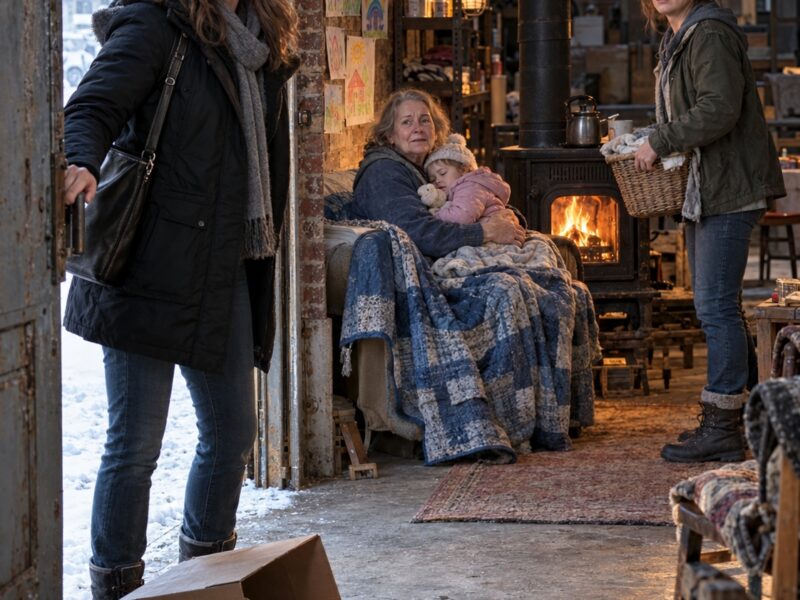
And sitting beside her wood stove, wrapped in an old quilt and humming to that child, was the woman my family had spent seventeen days searching for.
My mother.
I dropped the grocery box in my hands.
A jar of tomato sauce struck the concrete floor and shattered.
The young woman spun around.
My mother looked up.
For several seconds, nobody moved.
Then I heard myself whisper, “Mom?”
She stared at me with the cautious confusion of someone trying to recognize a face through fog.
The toddler sleeping against her chest stirred.
And that was the moment I understood that the stranger I had once rescued from the cold had somehow become the person who rescued the one woman I could not afford to lose.
But none of that had happened yet on the December night when I first pulled over.
Back then, I thought I was only doing one decent thing.
My name is Rachel Mercer.
I was thirty-four that winter, an operations compliance manager for a medical-equipment manufacturer outside Indianapolis. It was not glamorous work, but I liked systems, lists, measurable problems, and the relief that came from knowing exactly what a mistake looked like.
Family problems were different.
Family problems could be staring directly at you while everyone in the room disagreed about what they were.
My younger brother, Evan, had been ours for years.
At twenty-six, Evan was handsome in the careless way that let strangers forgive him too quickly. He had our father’s dark hair, our mother’s soft brown eyes, and an instinctive ability to sound sincere five minutes before doing exactly the thing he had promised not to do.
He was not stupid.
That was part of what made loving him exhausting.
He could fix a transmission, charm a landlord into extending rent, calculate poker odds in his head, and talk his way into jobs he would abandon three weeks later because some supervisor “didn’t respect him.”
My father called him restless.
My mother called him lost.
I had stopped calling it anything polite.
By the winter I met Hannah Cole, Evan had accumulated more than forty thousand dollars in gambling debt, personal loans, title loans, unpaid cards, and favors from men who did not mail statements.
My parents had spent five years trying to save him.
Each rescue had been described as the last.
The last rent payment.
The last car repair.
The last legal fee.
The last debt.
The last time they would believe him when he said he had finally understood.
The word last had become meaningless in our family.
That December evening, however, Evan was not on my mind.
The weather was.
Central Indiana had been under a winter storm warning since noon. By six, freezing rain had coated the roads, and by eight, snow had begun falling hard enough to erase lane markings.
I had stayed late at the manufacturing plant because one of our sterile-packing lines failed an audit.
The drive home should have taken thirty-eight minutes.
It took more than an hour.
I was twelve miles outside Fort Wayne when I saw the woman.
At first, she was only a dark shape beside an abandoned bus shelter.
I nearly drove past.
Then my headlights caught the child.
Small pink hat.
Tiny sneakers.
One mitten.
The woman had opened her coat and wrapped both sides around the little girl standing against her stomach.
I slowed.
Every story women are taught about stopping on dark roads entered my mind at once.
Danger.
Trap.
Keep driving.
Call someone.
Do not get out.
Then the child turned her face toward the road.
She could not have been more than two.
I pulled onto the shoulder.
The woman backed away immediately when I lowered the passenger window.
“I’m not asking for money,” she said.
That surprised me.
“I didn’t say you were.”
“The buses stopped.”
Her teeth were chattering.
“I know.”
“My phone died.”
I looked at the child.
“Where are you trying to go?”
The woman hesitated.
That answer told me more than an address would have.
“Anywhere warm.”
I unlocked the doors.
“Get in.”
She stared.
“I’m not—”
“Your daughter is shaking.”
That ended the debate.
She opened the rear door and climbed in with the child.
Heat poured over them.
The little girl immediately began crying.
Not loudly.
The exhausted crying of a child who had waited too long to admit she was miserable.
The woman held her.
“I know, baby.”
I turned the heater higher.
“My name’s Rachel.”
“Hannah.”
She rubbed the child’s hands between her palms.
“This is Lucy.”
Lucy looked at me through wet eyelashes.
“Hi, Lucy.”
No answer.
“Where were you staying?”
Hannah’s hands stopped.
“A shelter.”
“Which one?”
“Hope House.”
“That’s downtown.”
She nodded.
“Why are you out here?”
Another hesitation.
“They filled up.”
“Tonight?”
“The family rooms did.”
“Do you have somewhere else?”
“No.”
I looked through the windshield.
Snow crossed the headlights sideways.
“Hotels?”
Hannah gave me a tired smile.
“I have fourteen dollars.”
That smile embarrassed me.
Not because she asked for pity.
Because she clearly expected none.
I drove.
For the first several miles, neither of us spoke.
Lucy fell asleep almost immediately.
Hannah sat beside her, one hand resting on the child’s knee even after she stopped shivering.
I considered taking them to my apartment.
Then pictured everything that could go wrong.
A stranger.
A toddler.
My lease.
My company laptop.
My own fear.
Then I remembered the warehouse.
It belonged to my father technically, though nobody had used it for nine years.
Mercer Machine Works had once operated there.
My grandfather repaired farm equipment in that building.
Then my father expanded into automotive work and moved to a newer facility closer to town.
The warehouse remained.
Brick.
Ten thousand square feet.
One small office.
A bathroom that worked if the pipes had not frozen.
A cast-iron stove my grandfather installed during the Reagan administration.
My father kept saying he would sell it.
He never did.
“Do you need somewhere for one night,” I asked, “or longer?”
Hannah looked at me.
“I don’t know.”
I appreciated the honesty.
“I might have something.”
Twenty minutes later, I unlocked the warehouse.
Cold air rushed out.
Lucy woke and started crying again.
Hannah stood in the doorway.
“This is yours?”
“My family’s.”
The place looked worse than I remembered.
Dust.
Old shelving.
Covered machinery.
A torn office chair.
But the roof was sound.
The bathroom worked.
There was running water.
And when I stacked split wood into the cast-iron stove and lit it, the building slowly began to warm.
Hannah watched me.
“You don’t know me.”
“No.”
“I could steal something.”
I looked around.
“If you can carry that lathe, you’ve earned it.”
She laughed.
First time.
It changed her face.
She was younger than I had thought.
Maybe twenty-eight.
“Seriously,” she said.
“So am I.”
I found an old folding cot in the storage office.
Two wool blankets.
A space heater.
A box of unopened paper cups.
Hannah helped without needing instructions.
When I handed her the spare key, she did not take it immediately.
“What is this?”
“A key.”
“I know.”
“Then why did you ask?”
Her eyes narrowed.
“What are you expecting?”
“Nothing.”
“Nobody expects nothing.”
There was history inside that sentence.
I recognized it because my brother had spent years teaching our family the opposite lesson.
Every favor became leverage eventually.
Every rescue generated entitlement.
Every debt became somebody else’s problem.
“Then expect this,” I said. “Keep the place clean. Don’t burn it down. If something breaks, call me.”
“That’s it?”
“That’s it.”
“How long?”
I looked toward Lucy.
She had fallen asleep again on the cot beneath both blankets.
“Stay as long as you need.”
Hannah’s face changed.
I knew instantly I had said something too large.
So I corrected myself.
“Within reason.”
She smiled through tears.
“That sounded more believable.”
I wrote my number on a piece of cardboard.
Then drove home.
The next morning, I told my father.
He stared at me across his garage office.
“You gave a stranger a key to the old building?”
“Yes.”
“With a child?”
“Yes.”
“For how long?”
“I don’t know.”
He removed his reading glasses.
“Rachel.”
“What?”
“That building hasn’t been inspected in years.”
“The roof is good.”
“How do you know?”
“It didn’t fall on us.”
My father was not amused.
His name was Tom Mercer.
Sixty-one.
Mechanic since he was sixteen.
Hands permanently black around the nails no matter how hard he scrubbed.
He looked severe until he smiled.
Then he looked like someone’s favorite uncle.
“You should’ve called me.”
“It was ten at night.”
“I have a phone.”
“I know.”
“You could have brought them here.”
That surprised me.
My parents lived in the same modest ranch house where Evan and I grew up.
Three bedrooms.
One bathroom.
Mortgage finally paid.
“Mom would have brought out the good sheets,” he continued.
“She probably would’ve adopted them by breakfast.”
Dad smiled.
Then the smile disappeared.
Because mentioning Mom had become complicated.
My mother, Diane, was fifty-nine.
For most of my life she had been movement.
Sewing machine.
Kitchen radio.
Garden gloves.
Phone calls.
Casseroles appearing whenever anyone on our street had surgery.
She ran a small alteration business from home and remembered everyone’s measurements without writing them down.
But over the previous year, something in her had changed.
At first we blamed stress.
Then age.
Then Evan.
She misplaced things.
Repeated questions.
Forgot appointments.
Once she drove to a grocery store she had used for twenty-three years and called my father because she could not remember the way home.
She laughed afterward.
Dad did too.
Neither laugh convinced me.
I had been pushing for a neurological evaluation.
Mom resisted.
“I’m tired.”
“You’ve been tired for months.”
“So have you.”
“Mom.”
She would smile.
“Don’t make me old before I am.”
Then Evan’s problems accelerated.
The first serious disaster came in October.
Police raided an illegal poker room in a warehouse near Lima Road.
Evan was there.
My father received the call at one fourteen in the morning.
Bail was three thousand dollars.
I told them not to pay.
Dad paid.
Mom cried.
Evan came home angry at the police.
Not himself.
“Everyone there got charged.”
“That’s your defense?” I asked.
“You don’t understand.”
“I understand gambling in an illegal building is illegal.”
“You always think you’re better than me.”
Dad stepped between us.
“Enough.”
Evan pointed at me.
“She loves this.”
“What?”
“She loves being the good one.”
I looked at him.
Maybe part of me did.
That ashamed me more than I admitted.
“I would love,” I said quietly, “for you to stop giving me the job.”
He left the room.
Three weeks later, Dad’s truck disappeared.
It was a 2013 Ford F-250 with dents on both sides and more sentimental value than actual market value.
Dad used it every day for work.
He reported it stolen.
Forty-eight hours later, a title lender called.
Evan had forged Dad’s signature and used the truck as collateral.
Twenty-eight hundred dollars.
Dad sat at the kitchen table holding the paperwork.
Mom stood behind him.
Evan paced.
“I was going to win it back.”
Nobody spoke.
“I had a tournament.”
Still nothing.
“The prize was fifteen grand.”
Dad’s voice came out very quiet.
“You stole my truck.”
“I borrowed against it.”
“You forged my name.”
“I was fixing it.”
Mom sank into a chair.
Dad looked at him.
“For who?”
Evan stopped.
“For who were you fixing it?”
The question finally shut him up.
We bought back the truck.
Dad borrowed money from his older brother.
I covered part.
Mom emptied an emergency account.
Christmas came.
Nobody enjoyed it.
Evan gave Dad a wrench set he clearly bought on credit.
Dad thanked him.
That somehow made the dinner worse.
Then, the first week of January, two men came to my parents’ house.
Not movie criminals.
No dark sunglasses.
No dramatic threats.
One wore a Colts jacket.
The other carried a folder.
That made them scarier.
Dad called me.
I arrived twenty minutes later.
The document on the kitchen table showed a private loan for five thousand two hundred dollars.
Collateral information included my parents’ property.
The signature was Evan’s.
The attached copy of the deed had come from Mom’s locked vanity drawer.
Dad stared at the paper.
“How did you get this?”
Evan had no answer.
Mom did.
“You took it.”
She sat beside him.
“You came into my bedroom.”
“Mom—”
“You opened my drawer.”
“I was desperate.”
“You stole our house.”
“I didn’t steal it.”
Dad stood.
“You used my home as collateral.”
“I was going to pay it.”
“With what?”
“I had a plan.”
Dad slammed both hands against the table.
For the first time in my life, I saw my father frighteningly angry.
“Your plans are why we’re broke!”
Evan shoved the chair backward.
“So everything is me?”
“Yes,” I said.
He turned.
Dad pointed toward the door.
“Don’t.”
I continued.
“The bail was you. The truck was you. This is you.”
“You think you’re perfect.”
“No.”
“At least I live.”
I laughed once.
“What does that mean?”
“You go to work. You come home. You make spreadsheets. You judge everyone.”
“At least my spreadsheets don’t steal Dad’s truck.”
He swept his arm across the table.
A plate hit the floor.
Mom flinched.
Dad stepped forward.
Evan froze.
For one terrible second I thought my father might hit him.
Dad did not.
Instead he opened the front door.
“Go.”
Evan stared.
“Dad.”
“Get out before I say something I cannot take back.”
Evan grabbed his coat.
Left.
The house became silent.
Mom stared at the broken plate.
“I bought that set when Rachel was born.”
That sentence destroyed Dad.
He sat beside her.
Mom picked up one fragment.
Then another.
Her hands shook.
Over the next month, she deteriorated.
Not dramatically at first.
She stopped sewing.
Slept badly.
A doctor diagnosed severe depression and ordered additional testing because the memory problems had started before the family crisis.
Mom missed the follow-up appointment.
Dad rescheduled.
She refused to go.
Then forgot refusing.
Sometimes she was completely herself.
Other afternoons, she stared at the television without processing what was playing.
One evening she called me “Amy.”
Amy was her sister.
Dead fourteen years.
I crouched beside her.
“Mom?”
She blinked.
Then laughed nervously.
“I know who you are.”
Dad looked away.
I knew he was crying.
We finally convinced her to see a specialist.
The appointment was scheduled for March third.
Mom disappeared February twenty-fourth.
Dad called me at six eighteen in the morning.
His voice sounded wrong.
“Rachel.”
I sat up.
“What happened?”
“Your mother’s gone.”
I was already reaching for clothes.
“What do you mean gone?”
“The front door is open.”
“Did you check outside?”
“I checked everywhere.”
“Car?”
“Here.”
“Phone?”
“Kitchen.”
“Coat?”
“Gone.”
The temperature outside was nineteen degrees.
I drove faster than I should have.
Dad stood on the front porch when I arrived.
No coat.
I pushed him inside.
Mom’s tea sat on the kitchen table.
Untouched.
Her purse remained by the chair.
Wallet inside.
Medication inside.
No identification.
Nothing.
We called police.
Because of her cognitive symptoms and the weather, they treated the disappearance seriously.
Patrol units searched.
Hospitals checked admissions.
Public transit reviewed camera footage.
Volunteers arrived.
We printed flyers.
My mother’s photograph appeared in gas stations, grocery stores, shelters, churches, urgent-care waiting rooms.
MISSING VULNERABLE ADULT.
Those words looked impossible beneath her smiling face.
For thirty-five years, my mother had been the person who found everything.
Keys.
Receipts.
Missing buttons.
Lost children in department stores.
Now she was the missing thing.
Evan returned that afternoon.
Dad opened the door.
My brother stood on the porch.
Unshaven.
“I heard.”
Dad stepped aside.
Evan came in.
For several hours he behaved exactly as he always did under pressure.
Defensive.
Restless.
Certain there had to be an easy explanation.
“She walks to St. Luke’s sometimes.”
Police checked.
“Maybe she took a bus.”
No confirmed boarding.
“She knows people.”
“Who?” I asked.
Evan looked at me.
“People.”
“Name one.”
He couldn’t.
By midnight, the confidence disappeared.
Two detectives sat at the kitchen table.
Dad lay on the couch because exhaustion had made him dizzy.
Mom’s rocking chair stood empty by the window.
Evan stared at it.
Something changed.
“I did this.”
I looked at him.
“No.”
“You all keep saying she was sick.”
“She was.”
“But I made it worse.”
I wanted to tell him he was right.
Part of me wanted to hurt him.
Instead I said, “Right now she needs us looking, not assigning percentages.”
He nodded.
The next morning, Evan joined the search.
At first I assumed guilt would last two days.
It lasted longer.
He walked bus routes.
Visited shelters.
Handed flyers to delivery drivers.
Stopped answering calls from gambling friends.
When his phone rang, he looked at the number and turned it off.
On the fourth day, Dad asked him why.
Evan stared at the floor.
“They only want money.”
“That surprise you?”
“No.”
He swallowed.
“I think I knew.”
Days passed.
Every unidentified hospital patient became hope.
Every call became terror.
Every sighting failed.
A woman in a brown coat at a Walmart.
Not Mom.
A confused passenger at a bus terminal.
Not Mom.
Someone sleeping beneath an overpass.
Not Mom.
Day ten.
Eleven.
Twelve.
Police expanded the search.
Then reduced active manpower.
They did not say they were giving up.
They used phrases like reallocating resources.
I hated all professional language that month.
On day fourteen, Dad stopped shaving.
On day fifteen, Evan came home with bleeding heels because he had walked nine miles in wet boots.
On day sixteen, I realized something.
The warehouse.
Hannah.
Lucy.
I had not checked on them in almost three months.
Guilt punched through everything else.
I had given a stranger shelter and then become so consumed with my own family that I barely called.
I texted Hannah.
The message stayed undelivered.
Her old prepaid number must have died.
The next morning I filled a cardboard box.
Soup.
Bread.
Fruit.
Milk.
Children’s clothes from a coworker.
Blankets.
I told Dad I would be gone two hours.
“Where?”
“The old warehouse.”
He looked confused.
Then remembered.
“The woman?”
“Yes.”
“You think Mom—”
“No.”
The thought had not occurred to me.
It should have.
I drove through pale morning frost.
Snow had mostly melted, leaving dirty piles along the roads.
The warehouse came into view behind a chain-link fence.
First thing I noticed:
Smoke.
White smoke rose from the old brick chimney.
Good.
They were alive.
I parked.
Carried the box.
Unlocked the metal door.
Warm air touched my face.
Tea.
Toast.
Wood smoke.
The warehouse had changed.
Floor swept.
Old shelves organized.
A thrift-store couch near the stove.
Curtains hung around a makeshift sleeping area.
Children’s drawings taped to one wall.
Someone had built order out of abandonment.
Then I saw the couch.
An older woman sat beneath a quilt.
Brown coat folded beside her.
Gray hair loose.
A sleeping toddler across her lap.
She hummed.
Three notes.
Pause.
Three notes.
The same lullaby my mother sang when storms frightened me as a child.
The grocery box fell.
Glass broke.
Hannah turned.
My mother looked up.
“Mom?”
She stared.
The toddler woke.
Hannah immediately lifted Lucy.
“Rachel?”
I could not answer.
I crossed the room.
Dropped to my knees.
Took Mom’s hands.
Cold.
Thin.
Real.
“Mom.”
She studied me.
Her eyes searched.
Nothing.
Then something.
“Rachel?”
My breath stopped.
“Yes.”
She touched my cheek.
Then frowned.
“Amy?”
My heart broke and healed in the same second.
“It’s Rachel.”
She smiled apologetically.
“My girls.”
Hannah stood behind us.
“I didn’t know.”
I turned.
“How long?”
“Twelve days.”
“What?”
“I found her near the river.”
“Why didn’t you call police?”
Hannah’s face changed.
“I tried.”
“What does that mean?”
“She wouldn’t tell me her name.”
“You didn’t need her name.”
“I know.”
Hannah swallowed.
“The first night I thought I could get her warm and take her somewhere in the morning.”
“And?”
“In the morning she panicked when I mentioned police.”
“Why?”
“I don’t know.”
Mom squeezed my hand.
Hannah continued.
“She kept saying, ‘They’ll take the house.’”
Evan.
The debt collectors.
The deed.
Something inside Mom’s confused mind had welded police, banks, and losing the house into one fear.
Hannah crouched.
“I took her to a community clinic.”
My anger paused.
“You did?”
“They checked her.”
“Which clinic?”
She told me.
Small nonprofit on the south side.
I knew it.
“They said she was dehydrated, underfed, confused, but not in immediate medical distress. They wanted to call adult protective services.”
“And?”
“She walked out while I was talking to the nurse.”
I closed my eyes.
Hannah’s voice shook.
“I followed her.”
“Why didn’t the clinic report it?”
“They probably did.”
Later I learned they had.
The description simply entered the system under an approximate name because Mom had called herself “Diane Ellis,” using her maiden name.
The connection had not been made.
Hannah continued.
“I was scared she’d disappear again.”
“So you brought her here.”
“Yes.”
“For twelve days.”
“Yes.”
“You had my number.”
“My phone broke.”
“There are phones everywhere.”
“I know.”
My anger rose again.
Then I looked around.
Fresh food.
Medication arranged beside the sofa.
A pharmacy receipt.
Clean clothes.
Hannah had spent money she did not have.
“Where did this come from?”
“Food pantry.”
“And medicine?”
“The clinic gave some. I bought the rest.”
“With what?”
She looked away.
I understood.
Fourteen dollars.
The woman had once possessed fourteen dollars.
Now she had spent what little she earned protecting my mother.
“I should have found you,” Hannah whispered.
“Yes.”
Her eyes filled.
“I know.”
That stopped me.
No excuse.
No self-defense.
Just acknowledgment.
“I kept thinking tomorrow I’d figure out who she was.”
Hannah looked at Mom.
“She knew things sometimes.”
“What things?”
“Your name.”
I froze.
“She said Rachel?”
“Once.”
“When?”
“Three days ago.”
“And you didn’t—”
“She also said Rachel was nine.”
I stopped.
Hannah continued gently.
“Then she said Rachel was at school.”
Memory.
Not current reality.
“She kept calling Lucy ‘my baby’ sometimes.”
Hannah looked at her daughter.
“And when she held her, she calmed down.”
I looked at Mom.
Lucy had fallen asleep again against Hannah’s shoulder.
Mom watched the child.
Her face softened.
“Good baby.”
I cried.
Not elegantly.
Not quietly.
I lowered my forehead onto my mother’s hands and cried harder than I had during the entire search.
Mom patted my hair.
“It’s okay.”
She did not fully know why I was crying.
She comforted me anyway.
Some parts of a person live deeper than memory.
I called Dad.
I kept my voice controlled.
“Sit down.”
“Why?”
“Dad.”
“What happened?”
“I found her.”
Silence.
Then a sound.
Not a word.
“Where?”
“She’s safe.”
“Rachel.”
“She’s alive.”
He began crying.
I heard something fall.
“Where?”
“The warehouse.”
“The—”
“I’ll explain. Bring Evan.”
Twenty-six minutes later, Dad’s truck hit the gravel so fast stones sprayed against the fence.
He ran inside.
My father had arthritis in both knees.
That morning he ran.
He saw Mom.
Stopped.
Then dropped to his knees beside her.
“Di.”
Mom looked at him.
He took her hands.
“Di, it’s Tom.”
She stared.
Dad’s face broke.
Then Mom touched his hair.
“You need a haircut.”
He laughed and sobbed at the same time.
“Yeah.”
“You always wait too long.”
“I know.”
Recognition.
Small.
Enough.
Then Evan entered.
He stayed near the door.
His shoulders collapsed.
Mom looked past Dad.
Saw him.
Something changed immediately.
Not full recognition.
Emotion first.
Fear.
Mom’s hand tightened around Dad’s.
Evan saw it.
He stopped.
That moment hurt him more than any accusation I could have invented.
“Mom.”
She whispered:
“The house.”
Evan covered his mouth.
“No.”
“The house.”
“I’m fixing it.”
Mom looked frightened.
Evan did not approach.
He sank onto the concrete floor where he stood.
“I’m sorry.”
Dad looked at him.
Evan shook his head.
Not at Dad.
At himself.
“I’m sorry.”
He repeated it.
Mom did not tell him everything was okay.
It wasn’t.
That mattered.
Hannah stood with Lucy near the stove.
Evan finally noticed her.
“Who are you?”
“The person who found Mom,” I said.
He stared.
I continued.
“And the person I found in a snowstorm three months ago.”
Dad looked toward me.
Then Hannah.
Understanding moved slowly across his face.
“You’re the woman Rachel brought here.”
Hannah nodded.
Dad stood.
He walked toward her.
Hannah looked nervous.
My father opened his arms.
She hesitated.
Then he hugged her.
“Thank you.”
Hannah cried instantly.
Dad held her.
“You kept my wife alive.”
“I should have called sooner.”
“Yes.”
Hannah pulled back.
Dad did not pretend otherwise.
“But you kept her warm.”
He looked at the stove.
“You fed her.”
“Yes.”
“You stayed.”
Hannah nodded.
Dad wiped his face.
“So both things are true.”
That sentence stayed with me.
Both things are true.
Hannah had made a serious mistake by not finding help sooner.
Hannah had also saved my mother from freezing.
Evan loved our family.
Evan had also nearly destroyed it.
Dad had rescued his son repeatedly out of love.
Those rescues had also helped Evan avoid consequences.
Mom had hidden how confused she was because she feared becoming a burden.
That secrecy made protecting her harder.
People rarely fit inside one clean moral sentence.
I had spent my career auditing systems.
Families were not systems.
They were contradictions held together by memory, responsibility, anger, love, and what people did after being shown the damage they caused.
We took Mom to the hospital.
She was dehydrated.
Underweight.
Exhausted.
Doctors found no stroke.
No acute brain injury.
Her cognitive problems required more evaluation, and the severe stress, poor sleep, nutritional problems, and untreated depression had likely worsened whatever had already been developing.
Nobody promised us she would “return to normal.”
I appreciated that.
After the weeks of uncertainty, false certainty felt insulting.
Mom stayed four nights.
Dad never left except to shower.
Hannah visited once.
She stood awkwardly at the room door.
Mom saw her.
“Holly?”
Hannah smiled.
“Hannah.”
Mom frowned.
“Hannah.”
“Yes.”
“You fed me soup.”
Hannah’s eyes filled.
“Yes.”
“Too much pepper.”
I laughed.
First real laugh in weeks.
Hannah laughed too.
“Sorry.”
Mom looked pleased with herself.
Lucy colored beside the bed.
The doctors recommended structured routines, outpatient neurological evaluation, counseling, medication review, and constant supervision for the immediate future.
Dad listened.
For once, he did not pretend love alone made him qualified to solve something.
We hired help.
Not twenty-four-hour luxury care.
We could not afford that.
A home-health aide came mornings.
I rearranged my work schedule twice a week.
Dad reduced garage hours.
And Evan?
Evan did something none of us trusted at first.
He got a job.
Not the kind with promises.
A real one.
Night shift at a regional distribution center.
Eleven p.m. to seven thirty a.m.
Steel-toed boots.
Barcode scanner.
Loading pallets.
Thirty-minute unpaid lunch.
He did not announce a transformation.
That helped.
He simply went.
The first Friday he received a paycheck, he gave Dad an envelope.
Dad did not take it.
“What’s that?”
“Debt.”
“You need money.”
“I need consequences.”
Dad looked at him.
Evan pushed the envelope forward.
“Please.”
Dad accepted it.
Half Evan’s paycheck.
The rest went into a checking account Dad could see but not control.
Evan contacted the lender connected to the forged property document.
With an attorney’s help, we discovered the agreement was not enforceable against my parents in the way the collectors had threatened because the deed transfer and signature were fraudulent.
That did not erase Evan’s debt.
It changed who legally owed it.
Evan.
For once, he did not ask Dad to solve it.
He negotiated a repayment plan.
Sold his gaming computer.
Sold a motorcycle he had hidden at a friend’s garage.
Canceled three cards.
Entered a gambling-recovery program.
The first meeting he attended, he sat in his truck for twenty minutes before going inside.
I know because he called me.
“I can’t do it.”
“Yes, you can.”
“These people are going to think I’m pathetic.”
“They’re in the same meeting.”
Silence.
“What if I walk in and leave?”
“Then you walked in.”
He breathed.
“You’re really bad at comforting people.”
“So I’ve been told.”
He went inside.
Hannah remained at the warehouse temporarily.
I visited every few days after finding Mom.
What I learned about her came slowly.
She had grown up in foster care.
Aging out at eighteen meant the state gave her information about services, several documents, and no family to call when life went wrong.
Lucy’s father, Derek, had been charming when they met.
Then controlling.
Then unreliable.
He never hit Hannah.
She was careful about saying that.
“He didn’t have to.”
“What does that mean?”
She looked at Lucy sleeping nearby.
“He could make me feel like everything I owned only existed because he hadn’t taken it yet.”
When Hannah became pregnant, Derek disappeared for weeks at a time.
After Lucy was born, he returned.
Promised stability.
Then emptied their joint account.
Six months later, he left permanently.
Hannah worked as a restaurant server.
Then the restaurant closed.
She fell behind on rent.
An eviction followed.
Shelters became temporary addresses.
Temporary addresses made childcare harder.
No childcare made employment harder.
Poverty, I learned, did not always look like one catastrophic mistake.
Sometimes it was ten ordinary problems arranged so tightly that solving one made another worse.
“You could have told me,” I said.
“About what?”
“All of it.”
“You were a stranger.”
“I gave you a warehouse.”
“That didn’t make you not a stranger.”
Fair.
“I’m sorry.”
“For what?”
“For assuming help entitled me to your story.”
Hannah looked at me.
Then smiled.
“You’re learning.”
“Apparently everyone decided this is my year.”
She laughed.
After Mom came home from the hospital, she asked about the warehouse repeatedly.
Not accurately.
“Where is the baby house?”
“What baby house?”
“The big room.”
“You mean Hannah’s?”
“Yes.”
Then five minutes later she forgot.
Some days were better.
Some worse.
Her neurologist eventually diagnosed mild cognitive impairment with depressive symptoms and significant stress-related worsening.
It was not the clean answer we wanted.
There was no single pill.
But treatment helped.
Sleep helped.
Routine helped.
Removing financial chaos helped most visibly.
Mom began sewing again.
At first simple hems.
Then pillowcases.
Dad moved her old machine beside the brightest window.
One morning I found her measuring a sleeve.
“What are you doing?”
She looked offended.
“Working.”
I cried in the laundry room afterward.
Healing rarely announces itself.
Sometimes it is a woman threading a needle.
Hannah became part of the rhythm too.
At first she visited Mom because Mom remembered her unpredictably.
Then because Lucy calmed Mom.
Eventually because she wanted to.
One Saturday, Dad drove to the warehouse.
He found Hannah replacing weather stripping around a door.
“You know how to do that?”
“No.”
“Then why are you doing it?”
“Cold air comes through.”
“That wasn’t the question.”
Dad took the screwdriver.
He showed her.
The following week, Hannah helped Dad organize invoices at the garage because his receptionist was sick.
“You know spreadsheets?” he asked.
“A little.”
She reorganized his entire filing system in two hours.
Dad called me.
“You know that girl you put in my warehouse?”
“Yes.”
“She’s irritating.”
“Why?”
“She found eighteen unpaid invoices.”
“That sounds useful.”
“It’s humiliating.”
“You’ll survive.”
Dad offered Hannah part-time administrative work.
She refused.
He offered again.
She asked whether it came with expectations beyond the job.
Dad understood immediately.
“Clock in.”
“Work.”
“Clock out.”
“Go home.”
“No gratitude?”
“Not unless you fix my printer.”
She took the job.
Home remained the warehouse.
For a while.
I did not push.
By April, Hannah could afford a small apartment.
She showed me the listing.
Two bedrooms.
Second floor.
Playground nearby.
“Looks good.”
“Yeah.”
She seemed unhappy.
“What?”
“Nothing.”
“Hannah.”
She looked toward Lucy.
“The warehouse is weird.”
“Accurate.”
“But it’s the longest we’ve stayed anywhere since she was born.”
I understood.
Security attaches to strange things when you have had too little of it.
“You don’t have to leave because you can afford to.”
She looked at me.
“You said stay as long as you want.”
“Yes.”
“I assumed you didn’t mean it literally.”
“I regretted it several times.”
She smiled.
“Good.”
“Stay until leaving feels like a choice.”
Her eyes filled.
“Don’t say things like that.”
“Why?”
“Because then I have to cry, and I hate crying in front of competent women.”
I laughed.
“You have wildly misjudged me.”
In May, we held Mom’s sixtieth birthday in my parents’ backyard.
She had forgotten her age twice that week.
Dad did not correct her until she asked.
No surprise party.
Her doctor advised predictable gatherings.
So we told her exactly who was coming.
Me.
Dad.
Evan.
Hannah.
Lucy.
Uncle Raymond.
Two neighbors.
Mom spent the morning making potato salad with Dad.
She cut celery.
Forgot she had cut it.
Cut more.
We ate an unreasonable amount of celery.
Nobody complained.
During dinner, Lucy climbed onto Mom’s lap.
Mom looked at Hannah.
“May I?”
Hannah smiled.
“She already decided.”
Mom kissed Lucy’s hair.
Evan watched.
He had been sober from gambling for four months.
I use the word sober because that was the word he chose.
Gambling had altered his brain around hope.
Every loss felt temporary because the next bet might reverse it.
Recovery meant learning some losses were supposed to remain losses.
His motorcycle.
Money.
Trust.
Time.
Mom’s fear.
He could repair parts.
Not erase them.
After dinner, Dad handed Hannah an envelope.
Hannah’s face changed.
“No.”
“You haven’t opened it.”
“I recognize envelopes from this family.”
Dad smiled.
“Open it.”
Inside was a lease.
For the warehouse.
One dollar a year.
Renewable.
Hannah stared.
“What is this?”
“You’ve been keeping the place better than I ever did.”
“I can’t accept property.”
“It isn’t property.”
Dad pointed.
“Lease.”
“At one dollar.”
“Inflation.”
She laughed despite herself.
Dad continued.
“If you want to keep living there while you save, you can.”
Hannah looked at me.
I raised both hands.
“Not my idea.”
“It was mine,” Mom said.
Everyone turned.
Some days Mom spoke in fragments.
That sentence was perfectly clear.
Dad smiled.
“Yes, Di.”
Mom looked at Hannah.
“You found me.”
Hannah’s eyes filled.
Mom shook her head.
“No.”
She pointed toward me.
“She found you.”
Then at herself.
“You found me.”
She pressed one hand against Lucy’s back.
“Maybe house found all of us.”
Silence.
Mom frowned.
“What?”
Nobody answered.
She looked embarrassed.
“That sounded stupid.”
“No,” I said.
“It didn’t.”
Evan looked down at his plate.
Later that evening, he found Hannah alone near the fence.
I did not mean to listen.
Then I heard my name and stopped.
“I’m sorry,” Evan said.
Hannah looked confused.
“For what?”
“For Rachel having to deal with me.”
“That’s between you and her.”
“I know.”
He rubbed the back of his neck.
“My mother walked out because of what I did.”
Hannah’s expression sharpened.
“You don’t know that.”
“I know enough.”
“No.”
Her voice became firm.
“You know you hurt people.”
“Yes.”
“You know your choices created stress.”
“Yes.”
“You don’t get to take ownership of every bad thing that happened afterward.”
Evan stared.
Hannah continued.
“That sounds like guilt, but sometimes guilt is still making yourself the center of everything.”
That hit him.
It hit me too.
“You want to make amends?” she asked.
“Yes.”
“Do useful things.”
Then she walked away.
Evan stood alone.
The next morning, he repaired the broken step at the warehouse without telling anyone.
No speech.
No apology note.
Just wood.
Screws.
Work.
I began to trust his change only after it became boring.
Month seven.
Month eight.
Same job.
Meetings.
Payments.
No crisis phone calls.
He still got angry.
Still complained.
Still occasionally blamed someone else before catching himself.
Real transformation was much less cinematic than remorse.
That made it more convincing.
In August, Dad called me to the garage.
Hannah sat behind the reception desk.
Lucy colored nearby.
Dad placed a folder in front of me.
“We’re selling the warehouse.”
Hannah looked up sharply.
“What?”
Dad immediately raised his hands.
“To Rachel.”
Now I was confused.
“I’m buying what?”
“Nothing yet.”
Dad opened the folder.
The neighboring property developer had offered to buy the warehouse lot.
Good money.
Enough to finally pad my parents’ retirement.
Dad had refused.
Instead, he proposed transferring the warehouse into a small family trust.
Hannah could continue leasing.
Eventually it might become something else.
“What?” I asked.
Dad looked toward the office where three mechanics were eating lunch.
“A transitional workshop.”
“For what?”
He shrugged.
“Hannah knows books.”
“She does.”
“Evan knows what it’s like to ruin his life.”
“He’s an expert.”
Dad smiled.
“There are people coming out of shelters who can work.”
Hannah had apparently mentioned two women from Hope House who could not find jobs compatible with childcare.
Dad’s garage needed administrative help.
A nearby furniture-repair business needed trainees.
An HVAC company owned by Dad’s friend needed warehouse space.
The old building could become a shared skills center.
Not charity.
Work.
Temporary storage units could become small studios.
Office converted to childcare.
I stared at them.
“You planned this without me.”
Dad smiled.
“You were working.”
“That has never stopped any of you from bothering me.”
Hannah laughed.
The warehouse changed again.
Permits.
Inspections.
Heating.
Fire suppression.
New windows.
Volunteers.
My company donated old office furniture.
Dad’s friends donated tools.
I wrote grants.
Hannah eventually managed operations.
Evan spent weekends painting walls after night shifts.
Lucy learned to ride a scooter down one aisle.
Mom visited but hated the noise.
She sat in the quiet office and hemmed curtains.
We called the place Harbor House.
It was not a shelter.
It was not treatment.
It was not a miracle factory.
People could stay temporarily in four small studio units while working or training.
There were rules.
Leases.
Employment counseling.
Childcare.
No one was required to tell a tragic story to earn dignity.
Hannah insisted on that.
“People always want pain as proof,” she told me.
“Proof of what?”
“That you deserve help.”
She shook her head.
“Sometimes you’re just behind on rent.”
That became our operating philosophy.
The first resident was not dramatic.
A forty-seven-year-old woman named Denise who left an apartment after a rent increase she could not absorb.
She worked full-time.
No addiction.
No abusive husband.
No grand tragedy.
She simply needed ninety days to save a deposit.
Good.
Life already contained enough drama without requiring people to perform it.
Hannah moved into her own apartment that fall.
The night before, she sat on the warehouse floor after everyone left.
Lucy slept on a blanket.
Boxes surrounded them.
“Scared?” I asked.
“Yes.”
“Why?”
“Because this worked.”
“What?”
“This.”
She looked around.
“I know how to survive bad situations.”
She swallowed.
“I’m less practiced at leaving good ones.”
I sat beside her.
“You aren’t leaving us.”
She looked at me.
“You’re leaving a building.”
“That sounds like therapy.”
“I’m cheaper.”
“You’re not.”
Fair.
The following morning, we carried boxes upstairs to her apartment.
Dad installed a lock.
Evan assembled Lucy’s bed wrong.
Twice.
Mom sat on a chair folding kitchen towels that did not need folding.
At lunch, Lucy looked around.
“Home?”
Hannah nodded.
“Home.”
Then Lucy asked:
“Warehouse home too?”
Hannah smiled.
“Maybe.”
I understood.
Some places stop being addresses.
They become evidence.
Evidence that you survived.
Evidence someone opened a door.
Evidence you later opened one for someone else.
Winter returned.
One year after the night I found Hannah at the bus stop, snow began falling almost exactly the same way.
I noticed while leaving work.
For several seconds, I sat in my car watching it cross the parking lot.
Then my phone rang.
Evan.
Old panic rose automatically.
Recovery does not erase reflex.
I answered.
“What happened?”
“Nothing.”
I exhaled.
“You cannot call me and say nothing happened.”
He laughed.
“I got promoted.”
I went quiet.
“Shift lead.”
“That’s great.”
“I make three dollars more.”
“Try not to gamble it.”
Silence.
Too sharp.
Old Rachel.
I closed my eyes.
“Sorry.”
“No.”
Evan’s voice softened.
“It’s okay.”
Then:
“I thought it too.”
We both laughed.
“Mom knows?”
“I’m going there now.”
“Don’t make a huge announcement.”
“I know.”
“She gets overwhelmed.”
“I know.”
“Evan.”
“I know, Rachel.”
I smiled.
“Congratulations.”
“Thanks.”
That evening, I went to my parents’ house.
Mom was sewing.
Dad cooked chili.
Evan arrived in work boots.
He handed Mom his new employee badge.
She read it.
“Supervisor.”
“Yeah.”
“You always liked telling people what to do.”
Dad laughed.
Evan smiled.
Mom looked at the badge again.
Then at him.
“You worked for this?”
“Yes.”
She nodded.
“Good.”
That one word nearly broke him.
He kissed her forehead.
No apology.
No speech.
Just dinner.
Later Mom asked me where Hannah was.
“At her apartment.”
“Who?”
I paused.
Then showed her a photograph.
Mom smiled.
“The soup girl.”
“Yes.”
Memory had renamed Hannah.
We let it.
In January, Mom wandered again.
Only six houses away.
Dad noticed within eight minutes because we had installed door alerts after her hospitalization.
A neighbor found her standing beside a mailbox.
Safe.
Confused.
The setback terrified us.
It also reminded us not to rewrite her condition into a sentimental recovery story.
She was doing better.
She was not cured.
Love did not reverse every disease.
Routine did not restore every missing connection.
What it did was create enough hands around her that one failure did not become catastrophe.
The phrase “family” had expanded.
Hannah sometimes sat with Mom.
So did Lucy.
Evan handled Sunday mornings.
I covered Tuesdays.
Dad carried most days.
A home-health worker named Patrice came four mornings a week.
Mom occasionally thought Patrice was a cousin.
Patrice answered:
“Today I can be.”
We learned flexibility.
And boundaries.
Dad learned that exhaustion was not proof of devotion.
I learned competence could become another form of control.
Evan learned remorse without changed behavior was mostly theater.
Hannah learned accepting help did not mean surrendering independence.
Mom taught us all things she never intended to teach.
One afternoon in March, I found her looking at an old photo album.
She pointed to a picture of Evan at seven.
“Trouble.”
I laughed.
“Accurate.”
Then she pointed to me.
Age ten.
Missing front tooth.
“Bossy.”
“Also accurate.”
Mom looked at my adult face.
“You still bossy?”
“Extremely.”
She smiled.
Then her expression became uncertain.
“Are you happy?”
The question caught me.
“I think so.”
“That’s not answer.”
I stared.
Even through fog, mothers retain weapons.
“I’m learning.”
Mom nodded.
“Good.”
She turned another page.
Conversation over.
Harbor House served twelve residents during its first year.
Not hundreds.
Twelve.
I became proud of that number.
We had no interest in stories about “saving the city.”
We helped twelve people.
Nine moved into stable housing.
Two transferred to other programs.
One returned to family in Ohio.
Four children used the childcare room.
Dad complained the kids scratched his workbenches.
Then secretly sanded the corners so nobody got splinters.
Hannah earned a certification in nonprofit administration.
She paid for it herself.
When I offered help, she raised one eyebrow.
I withdrew.
“Learning,” I said.
“Slowly.”
Evan completed eighteen months without gambling.
On the anniversary, nobody threw a party.
He did not want one.
We ate pizza at the warehouse.
Afterward he walked toward the old loading door with Dad.
I followed at a distance.
Evan held out an envelope.
Dad looked tired.
“What now?”
“The last payment.”
Dad stared.
The illegal loan balance.
Paid.
Evan had spent eighteen months repaying debt created in less than eighteen minutes of desperation.
Dad took the envelope.
His eyes filled.
Evan shoved both hands into his pockets.
“I know it doesn’t fix everything.”
“No.”
Dad’s voice cracked.
“It doesn’t.”
Evan nodded.
Dad stepped forward.
Hugged him.
“But you fixed this.”
That was enough.
Mom’s seventieth birthday never arrived.
That sentence feels cruel to write.
She was sixty-three when pneumonia took her after several years of gradual cognitive decline.
By then, she often forgot my name.
Sometimes Dad’s.
Never completely forgot Lucy.
We never understood why.
Perhaps because Lucy entered her life after memory had begun reorganizing itself.
Perhaps because children do not demand chronology.
Lucy would sit beside Mom and color.
Mom would call her Hannah.
Lucy would correct her.
Then five minutes later:
“Hannah.”
“No. Lucy.”
“Oh.”
Again.
Neither became frustrated.
At the hospital, the last night, our family filled the room.
Dad.
Me.
Evan.
Hannah.
Lucy, now five.
Mom slept most of the evening.
Shortly before midnight, she woke.
Looked around.
Her eyes found Dad.
“Tom.”
He leaned over.
“Yes.”
She found me.
“Rachel.”
I cried before she finished.
Then Evan.
For one second, nothing.
He held his breath.
Mom whispered:
“My boy.”
Evan bent until his forehead touched her hand.
Finally she looked toward Hannah.
Her expression softened.
“The snow girl.”
Hannah laughed through tears.
“Yes.”
Mom looked at Lucy.
“And baby.”
Lucy climbed carefully onto the chair.
“I’m big now.”
Mom smiled.
“Not that big.”
Those were among the last clear words she spoke.
After the funeral, Dad could not enter the sewing room for weeks.
Evan went every day.
Not to move anything.
Just sit.
Grief had once driven him toward escape.
Now he stayed.
That was perhaps his greatest change.
One evening he called me.
“Do you ever think about the warehouse?”
“Yes.”
“If you hadn’t stopped…”
I knew where he was going.
“Don’t.”
“But Mom—”
“Evan.”
Silence.
“If I hadn’t stopped, maybe Hannah freezes.”
“Yes.”
“If Hannah isn’t there, maybe Mom—”
“I know.”
“So that one thing changed everything.”
“No.”
He sounded confused.
“What?”
“It changed some things.”
I sat at my kitchen table.
“Mom also walked toward the river.”
“Hannah also chose to stop.”
“You also chose to work.”
“Dad chose to forgive without pretending nothing happened.”
“A doctor chose to report Mom’s confusion.”
“A neighbor chose to answer their door later.”
I looked out the window.
“Life isn’t one heroic decision.”
Evan was quiet.
“Then what is it?”
“Probably a lot of small ones nobody knows are connected.”
He laughed softly.
“That sounds like something Mom would put on a pillow.”
“She’d make me pay for the fabric.”
“Definitely.”
Three years after Mom’s death, Harbor House still operates.
Dad retired from full-time garage work.
Not gracefully.
He appears at the warehouse four days a week and insists that because nobody pays him, it does not count as employment.
Hannah runs the place.
I remain on the board.
Evan became operations supervisor at the distribution center.
Then assistant manager.
He still attends his recovery group.
He sponsors a younger man now.
The first time he told me, I almost warned him not to become overconfident.
Instead I said:
“That’s good.”
Progress.
Lucy is eight.
She remembers almost nothing about the night at the bus stop.
She remembers the warehouse.
She calls it “the big brick house.”
On the wall near the entrance hangs a photograph.
Not of me.
That was Hannah’s rule.
Not of Dad.
Not donors.
It is a picture taken one spring morning years ago.
My mother sits on the old warehouse sofa beneath a blue quilt.
Lucy is asleep across her lap.
Hannah stands beside them holding a laundry basket.
Mom is looking down at the child.
The photograph is slightly blurred.
Nothing about it looks extraordinary.
That is why I love it.
A woman with memory problems.
A homeless mother.
A sleeping toddler.
A secondhand couch.
A stove.
Nobody in the frame knows what they mean to one another yet.
Beneath the picture is one sentence.
Hannah chose it.
Stay as long as you need. Leave when leaving becomes a choice.
Every winter, someone asks me about the story.
They want to know whether I believe kindness comes back to you.
I understand the question.
But I think it misses something.
I gave Hannah a key because her daughter was freezing.
I did not do it because I believed the universe would keep accounts.
Hannah helped my mother because she found an older woman shivering near a river.
She did not know the woman belonged to the person who had once helped her.
Evan repaired the damage he caused because the alternative was continuing to become somebody he hated.
Dad welcomed Hannah because gratitude without action felt incomplete.
None of us knew where those decisions would lead.
That may be the point.
Real kindness is frightening because it comes without a contract.
You open a door.
You do not know who will walk through it.
You do not know whether they will stay.
You do not know whether they will ever repay you.
Sometimes they cannot.
Sometimes they should not.
Sometimes, months later, you open that same door carrying groceries and discover that the person you once helped has been holding together the part of your own life you thought was already lost.
The winter I met Hannah, I thought homelessness was the story.
Then I thought Evan’s debt was the story.
Then Mom disappeared, and I thought grief was the story.
I was wrong each time.
The story was the door.
Who opened it.
Who walked through.
Who was allowed to leave.
And who, when someone else stood freezing outside it years later, remembered to open it again.









