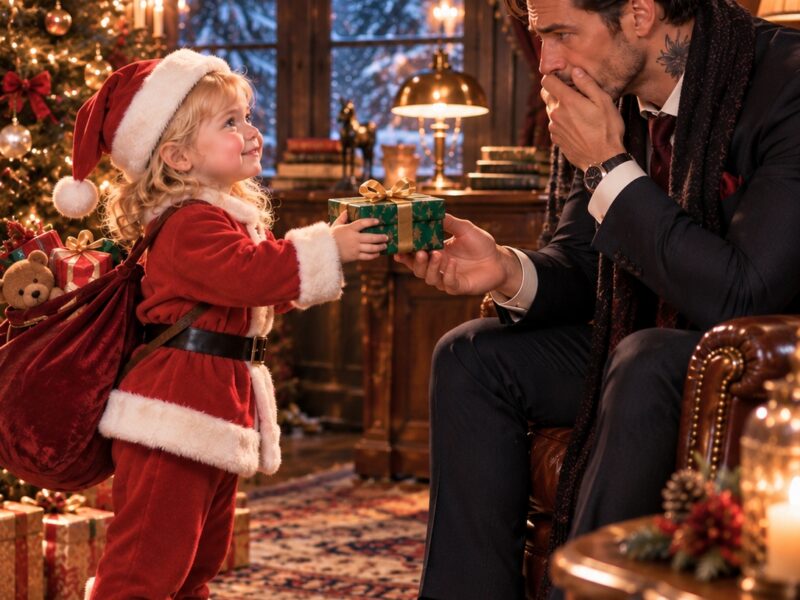
“I Have a Christmas Gift for You,” the Maid’s Little Girl Told the Mafia Boss—What He Found Inside Exposed the Betrayal That Had Haunted His Family for Four Years
“I have a Christmas gift for you.”
Gabriel Marchetti did not look up.
“Please don’t be sad anymore, mister.”
That made him.
The child standing in the doorway of his third-floor study could not have been older than four.
She wore a red felt Santa dress someone had sewn by hand, the hem slightly crooked and one white cuff wider than the other. A matching hat leaned over her left ear, half covering a tumble of dark curls.
In both hands she carried a small red box tied with gold ribbon.
Gabriel stared at her.
The room had frightened federal investigators.
It had frightened aldermen.
It had frightened men who carried their own guns and traveled with other men paid to carry more.
The child looked around as though she had wandered into a library.
Gabriel slowly lowered the file he had been reading.
“How did you get up here?”
She considered the question.
“Stairs.”
From the hallway behind her came absolute silence.
Gabriel almost smiled.
“I meant who let you come upstairs.”
“Nobody.”
That sounded more believable.
She padded across the Persian rug in red socks.
Gabriel watched.
“Your mother know where you are?”
The child hesitated.
“No.”
“Should she?”
Another hesitation.
“Probably.”
This time the corner of his mouth actually moved.
She reached his desk and stood on her toes.
The box landed beside his untouched whiskey.
“For you.”
Gabriel looked at it.
“Why?”
“Because it’s Christmas.”
“I’m aware.”
“And you’re sad.”
His expression changed.
Very little.
Enough.
“How do you know?”
The girl pointed at him with one tiny finger.
“You have a sad face.”
Gabriel glanced toward the dark window.
Snow fell beyond the glass over Chicago in slow white sheets.
“I’ve been told it’s just my face.”
“No.”
She shook her head seriously.
“My mama has a tired face.”
“Mr. Caleb has a grumpy face.”
“And you have a sad face.”
Gabriel leaned back.
“Who is Mr. Caleb?”
“The tall guard.”
“Caleb Stone?”
“Yes.”
Gabriel filed away the fact that his security chief had apparently become “Mr. Grumpy” without his knowledge.
The child pushed the box closer.
“My mama says little gifts make big hearts.”
Gabriel looked at her.
She smiled.
There was flour on her chin.
One front tooth was missing.
The other looked loose.
Something inside his chest shifted in a place that had not been disturbed in years.
“What’s your name?”
“Maisie.”
“Maisie what?”
“Hayes.”
A sound came from the hall.
Running footsteps.
The child turned.
“Oh.”
A woman appeared in the doorway.
She stopped so abruptly one hand struck the frame.
Early thirties.
Plain gray housekeeping dress.
Dark hair coming loose from a practical knot.
Her face drained of color.
“Maisie.”
The little girl smiled.
“Hi, Mommy.”
Nora Hayes looked from her daughter to Gabriel.
Then to the box on his desk.
Then back.
“Mr. Marchetti, I’m so sorry.”
Gabriel said nothing.
“I turned around for two minutes.”
“Eleven,” Maisie corrected.
Nora closed her eyes.
“Thank you.”
Maisie grinned.
Nora continued quickly.
“My sitter’s daughter has the flu, and I couldn’t miss tonight. Mrs. Porter said Maisie could stay in the staff kitchen if she stayed quiet.”
Gabriel looked at the little Santa dress.
“Quiet.”
Nora’s cheeks colored.
“I understand if—”
“You’re not fired.”
She stopped.
Gabriel looked toward Maisie.
“She brought me a Christmas gift.”
Nora stared.
Her daughter nodded proudly.
“I did.”
Gabriel asked:
“How many gifts were there?”
“Twenty.”
“For?”
“The guards.”
Gabriel looked toward the hallway.
Several men had apparently been bribed with children’s candy while his entire security structure looked the other way.
Interesting.
“What was in them?”
“Caramels.”
He looked at his box.
“And mine?”
Maisie smiled mysteriously.
“Special.”
Nora immediately looked more worried.
Gabriel almost laughed.
“Take her downstairs.”
Nora nodded.
“Of course.”
“And Mrs. Hayes.”
She stopped.
“Yes?”
“Let her finish Christmas.”
Nora did not answer for a moment.
Then:
“Thank you.”
She took Maisie’s hand.
At the door, Maisie twisted around.
“You have to open it.”
“I will.”
“Promise?”
Gabriel looked at the red box.
“I promise.”
Satisfied, she disappeared.
Nora followed.
The door closed.
Gabriel sat alone again.
Snow.
Whiskey.
Silence.
The house returned to what it had been.
Except now there was a badly wrapped Christmas present on his desk.
Gabriel had forbidden Christmas decorations in the Marchetti house four years earlier.
No tree.
No wreaths.
No lights.
No music.
No stockings.
The staff did not discuss December twenty-fifth anywhere near him.
Four years earlier, his younger brother Nathan had died two days before Christmas.
Nathan had been thirty.
Loud.
Reckless.
Generous.
The kind of man who remembered bartenders’ birthdays and never remembered meetings scheduled before ten.
Gabriel had been the disciplined brother.
Nathan had been the one people loved first.
The night he died, Nathan had gone to Pier Fourteen to meet someone he trusted.
He never came home.
Police officially called it gang violence.
The newspapers called it part of a waterfront power struggle.
Gabriel called it the night every room in his house became too large.
After the funeral, he removed the Christmas tree himself.
Carried the boxes upstairs.
Locked them in the attic.
Nobody challenged him.
Nobody ever did.
Gabriel stared at Maisie’s gift.
Finally he pulled the ribbon loose.
Opened the lid.
He expected caramel.
There was none.
A small copper key rested on folded red tissue paper.
Gabriel stopped breathing.
The key was barely two inches long.
Old.
Hand-filed.
A faint line had been scratched across one side.
Gabriel reached toward it.
Stopped.
Reached again.
Lifted it.
The room disappeared.
He was eleven.
Nathan was eight.
They were sitting beneath the kitchen table because their father had thrown a dinner and the boys were supposed to be upstairs.
Nathan held a piece of copper taken from their grandfather’s workshop.
“I made this.”
“That doesn’t open anything.”
“It will.”
“What?”
“Secrets.”
Gabriel had laughed.
Nathan tied the key to a leather cord.
“For us.”
“We don’t have secrets.”
“We will.”
Nathan wore it for twenty-two years.
School.
College.
His first arrest.
His first legitimate board meeting.
His wedding that lasted eighteen months.
His divorce.
Every photograph.
Every vacation.
Always the copper key somewhere beneath his shirt.
When Gabriel identified Nathan’s body, the leather cord remained.
The key did not.
Gabriel had assumed whoever killed him took it.
A trophy.
A warning.
Something.
Now it lay in his palm.
Delivered by a housekeeper’s four-year-old daughter.
Gabriel stood so quickly the chair rolled backward.
He opened the study door.
“Caleb.”
His security chief appeared from the far corridor almost immediately.
Forty.
Tall.
Broad.
Expression permanently carved into suspicion.
“What happened?”
Gabriel held up the key.
Caleb’s face changed.
“You found that where?”
“The child gave it to me.”
Caleb stared.
“What child?”
Gabriel’s eyes narrowed.
“The tiny Santa who apparently walked through half your security perimeter.”
Caleb looked mildly offended.
“She was three feet tall.”
“Four.”
“That makes it worse?”
“Yes.”
Gabriel showed him the key.
“You recognize it.”
“Yes.”
“Nathan’s.”
Caleb looked toward the hall.
“Where did she get it?”
“That’s what we’re going to find out.”
They found Nora in the staff kitchen.
Maisie sat at the wooden table surrounded by empty paper scraps and ribbon.
Three security guards stood nearby pretending they had important reasons to remain in the room.
One enormous man was eating caramel.
Gabriel entered.
Everyone straightened.
Maisie waved.
“Did you like it?”
Gabriel crouched beside her.
“Very much.”
Nora watched carefully.
“Maisie.”
“Yes?”
“Where did you find the key?”
“Upstairs.”
“Where upstairs?”
She frowned.
“By the black door.”
Gabriel looked at Caleb.
Caleb went still.
“What black door?” Nora asked.
Maisie pointed vaguely toward the ceiling.
“The quiet one.”
Gabriel said:
“Show me.”
Nora immediately stepped closer.
“She’s not going anywhere alone.”
Gabriel looked at her.
“That’s reasonable.”
The answer surprised her.
They went together.
Maisie climbed the back stairs holding Nora’s hand.
Gabriel followed.
Caleb behind him.
At the second-floor east corridor, Maisie stopped.
She pointed.
At the end stood a black walnut door.
Nathan’s old bedroom.
Locked since the funeral.
Gabriel rarely entered that corridor.
The staff never did.
Maisie walked halfway down.
“Here.”
She pointed at the carpet.
“I found it right there.”
Gabriel examined the runner.
Nothing.
Caleb looked at the baseboard.
Then the nearby wall.
“Camera?”
“No.”
“That wing’s been inactive since Nathan died.”
Nora looked at Gabriel.
“You shut off cameras?”
“He valued privacy.”
“He’s been gone four years.”
Gabriel’s eyes remained on the floor.
“Yes.”
That answer said more than he wanted.
Maisie tugged Nora’s hand.
“I thought the key was a present.”
Nora looked horrified.
“You put something you found in Mr. Marchetti’s gift?”
“I didn’t have enough caramel.”
Caleb coughed into his fist.
Gabriel looked at him.
Caleb turned toward the wall.
Maisie continued:
“And it was shiny.”
Gabriel stood.
“You did fine.”
Nora looked at him.
“Fine?”
“She returned something that belonged here.”
He looked at Maisie.
“Thank you.”
Maisie smiled.
They went downstairs.
Gabriel remained.
Caleb waited.
Then:
“Somebody placed it.”
Gabriel looked toward him.
“You think so.”
“That corridor was cleaned yesterday.”
Gabriel’s face hardened.
“By who?”
“Not staff.”
“We locked it after the old electrical inspection.”
“Only five people have keys.”
Gabriel looked at Nathan’s door.
“Then someone wanted this found.”
Caleb said nothing.
That was worse.
Midnight came.
Gabriel waited until the house quieted.
He unlocked Nathan’s room.
Dust.
Old cologne.
Books.
A leather jacket over a chair.
A pair of shoes beside the closet.
Nathan had always left one shoe turned sideways.
Gabriel hated that.
He would have given anything to complain about it again.
The copper key did not fit the bedroom door.
It fit something else.
Gabriel knew because Nathan had once called it the key to secrets.
He searched slowly.
Not drawers first.
Nathan hated obvious hiding places.
The painting above the desk was crooked.
Gabriel frowned.
Nathan had been irrational about straight frames.
He once stopped dinner at a restaurant to fix one.
Gabriel lifted the painting.
Behind it:
A recessed steel compartment.
One narrow keyhole.
Gabriel inserted the copper key.
Turned.
The compartment opened.
Inside lay a black notebook.
Three photographs.
And an old digital recorder.
Gabriel sat.
The notebook’s first page contained one sentence.
If Gabriel finds this, I didn’t make it home.
His vision blurred.
He closed his eyes.
Then opened them.
He turned on the recorder.
Static.
Nathan’s voice came through.
Older than Gabriel remembered.
Younger than he deserved to sound.
“Gabe.”
Gabriel gripped the desk.
“If you’re hearing this, somebody inside our family sold me out.”
A pause.
Paper moving.
“I don’t know how far it goes.”
“I know routes are being sold.”
“Shipping schedules.”
“Names.”
“Money.”
“Someone is helping the Bellamy group get inside our contracts.”
Gabriel’s jaw tightened.
The Bellamy organization controlled pieces of the Milwaukee-to-Chicago freight corridor.
Their war with the Marchettis had lasted years.
Nathan continued.
“I thought it was one person.”
“It isn’t.”
“Somebody is signing with someone else’s initials.”
“J.R.”
Gabriel stopped.
J.R.
Caleb’s legal name was Jonah Reed Stone.
Before taking the Marchetti name professionally, he had worked as Jonah Reed.
Nathan continued.
“I don’t know if J.R. is the man or the mask.”
“A door opened behind him on the recording.
Nathan stopped speaking.
Someone entered.
Then the recording ended.
Gabriel played it again.
Then again.
J.R.
Jonah Reed.
Caleb.
The man standing outside this room right now.
Gabriel opened the door.
Caleb looked up.
“Anything?”
Gabriel stared at him.
“Go sleep.”
Caleb’s brow tightened.
“Boss?”
“Tomorrow.”
Caleb left.
Gabriel did not sleep.
At six-thirty Christmas morning, he called Caleb back.
His security chief entered with coffee.
Gabriel motioned toward the chair.
“Sit.”
Caleb did.
Gabriel asked him to recount Nathan’s final night.
Every detail.
Caleb did.
Gate logs.
Route.
Driver.
Pier.
Time of the first attack.
Time emergency services arrived.
What Nathan wore.
Which pocket his phone was in.
What hospital.
Who notified Gabriel.
Caleb answered smoothly.
Too smoothly.
Gabriel watched his hands.
Steady.
Four years of repeating the same story could produce steadiness.
So could guilt.
Gabriel said:
“Where were you in August 2021?”
Caleb blinked.
“Which day?”
“Ninth.”
“Why?”
“Answer.”
Caleb thought.
“Miami.”
“With?”
“Your cousin Carlo.”
Gabriel knew.
Carlo nearly died after being attacked outside a nightclub.
Caleb remained there five weeks.
Gabriel said:
“November same year.”
“Still Miami until the seventeenth.”
Gabriel nodded.
“January 2019?”
Caleb frowned.
“I didn’t work for you.”
“No.”
“I was with Cook County corrections.”
Gabriel looked down.
Interesting.
Nathan’s notebook contained transactions marked J.R. dated before Caleb joined the organization.
Somebody wanted those initials to point toward him later.
Gabriel had spent the night almost accusing the wrong man.
Caleb leaned forward.
“What is this?”
Gabriel placed the notebook on the desk.
Caleb read.
His face went pale.
“That’s not me.”
“I know.”
“Do you?”
“I checked.”
Caleb stared.
“The signature dates.”
“Yes.”
He turned pages.
“Someone built this around me.”
“Yes.”
“Who?”
Gabriel looked at the photographs.
One showed Nathan standing beside a man whose face was outside the frame.
Charcoal coat.
White cuff.
Large signet ring.
Gabriel knew dozens of men who wore rings.
The other photographs showed cash and shipping documents.
The final page in the notebook had three names written in shorthand.
Two were dead.
One had no name.
Only:
T.
Caleb whispered:
“Thomas.”
Gabriel’s eyes lifted.
“Don’t.”
“Your uncle has access.”
“Caleb.”
“He knew Nathan better than anyone.”
“Enough.”
Silence.
Gabriel stood.
Caleb understood.
Not denial.
Pain.
There are accusations that hurt because they sound impossible.
Others hurt because some part of you has already begun arranging the evidence.
Gabriel’s uncle Thomas Bellini had helped raise both brothers.
Their father traveled.
Thomas remained.
Baseball games.
Hospital visits.
College.
Funerals.
He taught Gabriel to drive.
Taught Nathan cards.
Carried both boys on his shoulders through summers in Michigan.
After their father died, Thomas became family elder.
After Nathan died, he sat beside Gabriel through the entire funeral and cried without shame.
Gabriel refused to let grief become evidence.
“Paper first,” he said.
Caleb nodded.
Good.
Christmas lunch began at one.
Thomas arrived carrying gifts.
Sixty-three.
Silver hair.
Heavy shoulders.
A warm voice.
He hugged Gabriel hard.
“My boy.”
Gabriel hugged him back.
For one moment he wanted the embrace to mean what it always had.
Thomas sat.
Talked about Nathan.
“Would’ve been thirty-four.”
“I know.”
“Still impossible.”
“Yes.”
Thomas produced a pocket watch.
Old silver.
Heavy.
“Our grandfather’s.”
Gabriel opened it.
Tick.
Tick.
Slow.
Unusual.
Thomas smiled.
“He carried it from Sicily.”
Gabriel listened.
Something moved inside his memory.
The recorder.
Nathan’s voice.
The opening door.
And beneath it:
Tick.
Tick.
Tick.
Gabriel closed the watch.
Thomas asked:
“You all right?”
“Tired.”
“You’ve always been bad at Christmas.”
Gabriel looked toward the kitchen doorway.
Maisie ran past.
Thomas smiled.
“And who is that?”
“The housekeeper’s daughter.”
Maisie stopped.
Thomas crooked a finger.
“Come here.”
Nora appeared almost immediately.
Her body tightened.
Gabriel noticed.
Maisie approached carefully.
Thomas touched the top of her curls.
“You’re the little Santa.”
She nodded.
“You gave Gabriel a gift.”
“Yes.”
“What?”
Maisie looked at Gabriel.
Gabriel said:
“A caramel.”
Thomas smiled.
“Very generous.”
Maisie stepped backward.
Not frightened.
Uncomfortable.
Nora lifted her.
Thomas watched them leave.
Then took a sip of wine.
Gabriel watched Thomas.
The watch continued ticking inside the older man’s pocket.
That evening Gabriel replayed Nathan’s recording at maximum volume.
Tick.
Tick.
Tick.
Same depth.
Same interval.
Then something else.
When the door opened, Nathan whispered one sound.
Not a full name.
“Th—”
Gabriel closed his eyes.
Thomas.
The recorder went silent.
He sat for a long time.
Then opened his father’s archived corporate ledger.
Old signatures.
Thomas Bellini.
Initials:
T.B.
But years earlier, before Thomas legally changed his surname after immigration documents were corrected, he had signed:
Tomaso Rinaldi.
T.R.
Someone had reversed the order.
R.T.
Then used J.R. later.
Masks.
Always another man’s initials.
Gabriel spent three hours comparing handwriting.
Curved R.
Long downward hook.
Distinctive pressure mark at the top of M-shaped strokes.
Same hand.
Thomas.
The man who had held him after Nathan died.
The man who brought flowers every anniversary.
The man who called him son.
Caleb entered at ten.
Gabriel said:
“It’s him.”
Caleb did not ask who.
“What now?”
Gabriel looked toward the snow.
“Nothing.”
Caleb stared.
“Boss.”
“He doesn’t know we know.”
“Then we use that.”
“Yes.”
Gabriel took the red gift box from his desk.
The copper key lay beside it.
“We find out why Maisie found this.”
Caleb frowned.
“You think Thomas planted it?”
“Maybe.”
“Why expose himself?”
“Maybe he didn’t.”
Gabriel looked toward the east corridor.
“Someone else did.”
The answer came from Nora.
Not intentionally.
She approached Gabriel the next morning.
Maisie beside her.
“I need to tell you something.”
Gabriel gestured into the study.
Nora remained near the door.
“I’ve seen a car outside.”
“What car?”
“Black sedan.”
“For how long?”
“Three days.”
Caleb appeared behind Gabriel.
Nora continued.
“It moved after Christmas lunch.”
“Where?”
“Corner of Lincoln and Webster.”
“Plate?”
She recited it.
Caleb wrote it down.
Gabriel looked at her.
“You memorized the plate?”
“I ride the bus at night with a four-year-old.”
“Of course I memorize cars.”
Gabriel nodded.
Fair.
Nora continued.
“There’s something else.”
Maisie looked at her mother.
Nora said:
“Tell Mr. Gabriel.”
Maisie twisted her fingers.
“A man gave me the key.”
Gabriel went still.
“What?”
Nora looked shocked too.
“You said you found it.”
“I did.”
Maisie frowned.
“He put it there.”
“Who?”
“The man in the wall.”
Silence.
Gabriel crouched.
“What man?”
Maisie pointed toward the east corridor.
“He came out of the little door.”
A concealed service panel.
Old houses had them.
Staff passages.
Gabriel knew of several.
“He put the shiny key down.”
“Did he see you?”
Maisie shook her head.
“What did he look like?”
“Gray hair.”
Not enough.
“Tall?”
She shrugged.
“Old?”
“Like Mr. Caleb?”
Caleb looked insulted.
“I’m forty.”
Maisie thought.
“No.”
Gabriel almost smiled despite everything.
“Older.”
“Yes.”
“What did he wear?”
“Brown coat.”
“Anything else?”
She closed her eyes.
Then:
“He smelled like oranges.”
Nora looked confused.
Gabriel did not.
Thomas used bergamot cologne.
Since Gabriel was a child.
Caleb’s face hardened.
Thomas had planted Nathan’s key.
Why?
Not to help Gabriel.
To move him.
Toward the room.
Toward the fake evidence.
Toward Caleb.
Thomas wanted Gabriel to accuse or kill his own security chief.
Then stand weakened.
Isolated.
Perhaps ready to hand authority to the older man who would “help” him through another betrayal.
Gabriel felt cold.
Not rage.
Recognition.
The betrayal had not ended four years earlier.
It was still operating.
Gabriel said:
“Nora.”
“Yes?”
“Pack a bag for you and Maisie.”
Her face changed.
“No.”
“What?”
“You are about to say ‘for your safety.’”
Gabriel stared.
Nora continued.
“I have worked here six months.”
“I know what that means in this house.”
“You decide.”
“Everyone else obeys.”
“I will take Maisie somewhere if there is danger.”
“But you will tell me what the danger is before I walk out that door.”
Caleb looked at Gabriel.
Gabriel felt irritation rise.
Then remembered the copper key.
A child had handed him truth because adults around him had spent years deciding what he should not know.
He exhaled.
“My uncle killed my brother.”
Nora went pale.
Gabriel continued.
“He has been selling information to a rival organization.”
“He planted evidence to frame Caleb.”
“He placed the key where your daughter would find it because he wanted me to discover that evidence.”
Nora’s hand tightened around Maisie’s.
“Why use her?”
“Because nobody would suspect her.”
Nora’s face changed.
Fury.
Good.
Gabriel respected it.
“He used my child as a delivery system.”
“Yes.”
“And there’s a car outside.”
“Yes.”
“His?”
“Probably someone connected to him.”
Nora looked at Maisie.
Then back.
“Where do you want us to go?”
Gabriel said:
“I have a safe apartment near Evanston.”
Nora thought.
“Who knows about it?”
“Caleb.”
“Anyone else?”
“No.”
“Your uncle?”
“No.”
“You?”
“Yes.”
She nodded.
“We go.”
Gabriel paused.
“You’re agreeing?”
“You gave me the truth.”
“That makes agreement possible.”
The sentence stayed with him.
Nora and Maisie moved that afternoon.
No armed convoy.
Two cars.
Different routes.
Maisie thought it was an adventure.
Nora did not.
Gabriel returned to the estate.
Thomas called at seven.
“Dinner tomorrow?”
“Where?”
“Warehouse Eleven.”
Gabriel stared at the phone.
“Why a warehouse?”
“Old contracts.”
“Something I don’t want sent electronically.”
Gabriel almost laughed.
Of course.
Thomas continued.
“Bring Caleb.”
There it was.
The plan.
Two birds.
Gabriel and the man Thomas had framed.
Gabriel said:
“We’ll come.”
Caleb listened from the study.
After Gabriel hung up:
“He wants both.”
“Yes.”
“Then Nora and Maisie are safer away.”
“Yes.”
The house phone rang.
A guard answered downstairs.
Seconds later Caleb’s radio vibrated.
He listened.
His face changed.
“What?”
“Safe apartment lost contact.”
Gabriel stood.
“How?”
“Power cut.”
“Backup?”
“Dead.”
“Phone?”
“No answer.”
Gabriel was already moving.
The drive to Evanston took twenty-three minutes.
The apartment door stood open.
No Nora.
No Maisie.
No blood.
No struggle obvious.
A red Santa hat lay near the kitchen chair.
Gabriel stopped.
Caleb found a note.
Typed.
WAREHOUSE ELEVEN. COME ALONE.
Gabriel stared.
Thomas had known about the apartment.
Impossible.
Unless the leak was older than the plan.
Caleb said:
“Someone followed the move.”
Nora had noticed the black sedan.
Thomas had watchers already in place.
Gabriel’s attempt at protection had simply delivered them to a smaller location.
He closed his eyes.
Then:
“No more private solutions.”
Caleb looked at him.
“What?”
“Call Special Agent Harris.”
Caleb stared.
The federal organized-crime unit had been trying to build a case around Marchetti businesses for years.
“You’re serious.”
“Yes.”
“If we involve them—”
“They get the ledger.”
“The tapes.”
“Everything.”
“That includes us.”
“I know.”
Caleb said nothing.
Gabriel looked at the Santa hat.
“I’m done asking innocent people to pay for our secrecy.”
Agent Harris arrived ninety minutes later.
Forty-eight.
Tired.
Suspicious.
He looked at Gabriel’s evidence.
Then:
“You understand giving me this may expose you.”
“Yes.”
“Charges.”
“Yes.”
“Asset seizures.”
“Yes.”
“Prison.”
“Possible.”
Harris studied him.
“What changed?”
Gabriel placed Maisie’s red box on the table.
Harris frowned.
Gabriel said:
“A four-year-old.”
Harris did not ask.
Good.
The plan was simple because complicated plans fail under fear.
Gabriel would go to Warehouse Eleven.
Wear a wire.
Thomas believed he came alone.
Caleb would remain out of sight.
Federal teams would cover exits.
No dramatic assault unless Nora or Maisie were in immediate danger.
Gabriel wanted Thomas talking.
Truth before retaliation.
He had learned that too late.
Warehouse Eleven stood near the river.
Old brick.
High windows.
Snow gathering along loading docks.
Gabriel entered alone.
Thomas waited beneath hanging lights.
No twenty-man army.
Only six loyalists.
That was worse.
These were men who believed.
Nora sat in a chair near the wall.
Hands bound in front.
Maisie beside her.
Not tied.
Someone had given her a blanket.
She held the red Santa hat in both hands.
Gabriel looked at her once.
No more.
Thomas smiled.
“My boy.”
“Uncle.”
“You came.”
“You knew I would.”
Thomas opened his arms.
Gabriel did not move.
Thomas’s smile faded slightly.
“So.”
“You found Nathan’s little book.”
“Yes.”
“And Caleb?”
“Alive.”
Thomas’s eyes sharpened.
“Disappointing.”
There.
Recorded.
Gabriel said:
“You framed him.”
“I gave you an answer you could live with.”
“You expected me to kill him.”
Thomas shrugged.
“I expected you to become your father.”
Gabriel looked toward Nora.
Then Thomas.
“Why Nathan?”
Thomas’s face changed.
Not guilt.
Weariness.
“Your brother was sentimental.”
“So are you, apparently.”
“Careful.”
Gabriel almost smiled.
Thomas continued.
“Nathan discovered accounts.”
“Routes.”
“Old agreements with the Caravella group.”
“He wanted to expose everything.”
“He thought the family could become clean.”
Gabriel said:
“And you didn’t.”
“I thought clean families become dead families.”
“You killed him to prove it.”
Thomas’s eyes hardened.
“He forced a choice.”
“No.”
Gabriel’s voice remained level.
“You made one.”
Silence.
Nora watched.
Maisie watched too.
Thomas looked toward the child.
“She was useful.”
Nora’s face tightened.
Gabriel’s voice changed.
“Don’t.”
Thomas looked back.
“A child nobody watches can move through houses kings cannot.”
“You placed the key.”
“Yes.”
“Why now?”
Thomas smiled.
“Because you were changing.”
“Selling the South Pier.”
“Closing collections.”
“Using attorneys instead of favors.”
“Paying taxes like a banker.”
A few men around him shifted.
Thomas continued.
“I needed Caleb gone.”
“And me frightened.”
“I needed you reminded what family means.”
Gabriel said:
“You murdered family.”
Thomas’s jaw tightened.
“Nathan betrayed it.”
“That’s the lie you built your grief around.”
Thomas stepped closer.
“What would you know about grief?”
Gabriel almost laughed.
Then stopped.
Thomas had been with him at the funeral.
That still hurt.
“You cried.”
Thomas’s expression flickered.
“At Nathan’s funeral.”
“Yes.”
“Was any of it real?”
Thomas did not answer quickly.
Finally:
“I loved him.”
Nora’s eyes widened.
Gabriel felt something break.
“You loved him.”
“Yes.”
“And still ordered his death.”
Thomas looked tired.
“Love does not erase necessity.”
Gabriel stared.
There it was.
The sentence that had poisoned the family for generations.
Protection above choice.
Loyalty above truth.
Necessity above humanity.
Gabriel said:
“That’s where we end.”
Thomas frowned.
“You end nothing.”
Gabriel looked toward Maisie.
The little girl was staring at Thomas.
She asked:
“Are you sad too?”
Every adult in the room froze.
Thomas looked at her.
“What?”
“You have a sad face.”
Nora whispered:
“Maisie.”
But the child continued.
“Mr. Gabriel had one.”
“I gave him a present.”
Thomas stared.
Something in his expression moved.
Maisie reached beneath the blanket.
Pulled out a second red box.
Gabriel nearly stopped breathing.
She held it toward Thomas.
“For you.”
Nora looked shocked.
“When did you—”
Maisie whispered:
“I had one left.”
Thomas stared at the box.
Nobody moved.
For one absurd second, the entire architecture of organized crime in Chicago narrowed to an old man looking at a handmade paper gift.
Thomas reached.
Then stopped.
His face hardened.
“No.”
Maisie lowered it.
“You should take it.”
Thomas’s voice sharpened.
“I said no.”
Her lower lip trembled.
Gabriel’s hands curled.
Thomas looked toward him.
“This is what you have become.”
Gabriel answered:
“No.”
“This is what I finally stopped being afraid of.”
Thomas laughed.
“Soft.”
“Maybe.”
Gabriel took one step closer.
“My brother was soft enough to believe we could become something better.”
“You killed him.”
“A child was kind enough to return his key.”
“You used her.”
“A maid was brave enough to demand the truth before accepting protection.”
“You kidnapped her.”
Gabriel’s voice lowered.
“Everything you call weakness is simply something you cannot control.”
Thomas’s face changed.
Outside, federal teams listened.
Thomas reached inside his coat.
Gabriel did not.
“Uncle.”
Thomas stopped.
“You pull anything from that coat and six doors open.”
Silence.
Thomas’s eyes narrowed.
Then he understood.
Wire.
Federal agents.
Betrayal.
His face went white.
“You brought police.”
“Yes.”
“You brought them into family business.”
“No.”
Gabriel looked at Nora and Maisie.
“You did.”
Doors opened.
Federal agents entered.
Commands.
Weapons lowered.
No shots.
One of Thomas’s men immediately dropped his gun.
Then another.
Thomas remained still.
Agent Harris crossed the floor.
Thomas looked at Gabriel.
“You destroyed us.”
Gabriel shook his head.
“No.”
“We did that years ago.”
Thomas was handcuffed.
Maisie watched.
Nora covered her eyes only when the agents moved him past.
Not because the scene was graphic.
Because children deserve fewer images of adults being taken away than powerful adults often think.
Gabriel untied Nora.
His hands were careful.
“Are you hurt?”
“No.”
“Maisie?”
“No.”
Nora looked at him.
“You called authorities.”
“Yes.”
“That cost you.”
“Yes.”
She studied his face.
“Good.”
Gabriel almost laughed.
Fair.
The investigation took seventeen months.
Nothing ended overnight.
Thomas Bellini was charged with racketeering, conspiracy, financial fraud, obstruction, and Nathan Marchetti’s murder.
The recording from Warehouse Eleven mattered.
So did Nathan’s notebook.
So did old route data.
Payments.
Forged signatures.
The pocket watch.
Even Maisie’s discovery of the planted key became part of the chain explaining Thomas’s attempt to frame Caleb.
Thomas’s lawyers argued Gabriel manipulated the confrontation.
Maybe.
The evidence still stood.
Caleb was cleared.
Thomas was convicted.
Gabriel was charged too.
Not with Nathan.
With crimes he had committed before deciding truth was suddenly valuable.
Bribery.
Tax conspiracy.
Unlawful payments.
Financial crimes inherited and continued because they were profitable.
His attorneys wanted war.
Gabriel refused.
“What can they prove?”
“Enough.”
“What is true?”
His lawyer stared.
“That is not how this works.”
“It is now.”
He pleaded guilty to two counts.
Cooperated.
Transferred several businesses into independent management.
Sold waterfront assets connected to criminal operations.
Established restitution funds for employees and contractors harmed by old practices.
He received fourteen months.
Served eleven.
Nora did not visit for the first three months.
Gabriel did not ask.
Maisie wrote.
Mostly pictures.
One showed a black rectangle.
Gabriel asked in his reply:
What is this?
Maisie responded through Nora:
Your sad house.
Below it she had drawn a Christmas tree.
The next drawing:
Your happy house later.
Gabriel kept both.
Caleb visited monthly.
“You hate prison.”
“Yes.”
“Good.”
Gabriel looked at him.
“You enjoy this too much.”
“I spent twenty-four hours believing you might shoot me because somebody forged my initials.”
“Fair.”
“Therapy working?”
Gabriel stared.
Caleb smiled.
Court-required therapy had become the most humiliating element of his sentence.
Not prison.
Not headlines.
Talking.
The therapist asked questions nobody in Gabriel’s life had dared ask.
“What did silence do for you?”
“Kept people alive.”
“Did it?”
He hated that question.
Months later, he answered differently.
“Sometimes.”
“And the rest?”
“It kept me from knowing what they needed.”
Better.
Nora visited in month five.
No Maisie.
They sat across a table.
Gabriel looked at her.
“You came.”
“Yes.”
“How is she?”
“Good.”
“School?”
“She starts kindergarten next fall.”
He smiled faintly.
“Still giving gifts to security guards?”
“She has diversified.”
“Dangerous.”
Nora smiled.
Then became serious.
“I’m not here because I owe you.”
“I know.”
“Don’t say that automatically.”
He stopped.
She nodded.
Better.
Nora continued.
“I came because Maisie asks whether you’re still sad.”
Gabriel looked down.
“What do you tell her?”
“That sadness isn’t a weather report.”
“That people can be sad and still eat breakfast.”
“Still laugh.”
“Still come home.”
He swallowed.
“That sounds like you.”
“It is.”
Silence.
Gabriel said:
“I’m sorry I put you both in danger.”
Nora’s eyes stayed on him.
“Yes.”
“I’m sorry I thought protection meant choosing for you.”
“Yes.”
“I’m sorry it took a child handing me my brother’s key to understand that everyone around me had become afraid to tell me anything.”
Nora looked down.
Then:
“That one I believe.”
He breathed.
Not absolution.
Belief.
Enough.
Gabriel returned to Chicago eleven months after entering custody.
The Marchetti estate had changed.
Not because he ordered it.
Because Caleb did.
The first thing Gabriel saw was a Christmas wreath.
It was October.
He stared.
Caleb shrugged.
“Maisie made it.”
“It’s October.”
“She is five.”
“That is not an explanation.”
“It is all I have.”
Nora no longer worked as a maid.
Her choice.
She had taken a hotel-housekeeping supervisor position downtown while Gabriel was incarcerated.
Better pay.
Predictable hours.
Union benefits.
He had offered nothing.
Good.
The first time he saw Maisie again was at a bakery near Lincoln Square.
Nora chose public space.
Gabriel accepted.
Maisie ran toward him.
Then stopped halfway.
Children notice change before adults are ready.
“You look different.”
Gabriel touched his hair.
“I got older.”
“You’re skinnier.”
“Prison food.”
Nora closed her eyes.
“Gabriel.”
“What?”
Maisie stared.
“You were in prison?”
Nora had told her he was “away because he broke grown-up rules.”
Gabriel crouched.
“Yes.”
“Did you do something bad?”
“Yes.”
Nora watched.
No euphemism.
Good.
Maisie thought.
“Did you say sorry?”
“Yes.”
“Did that fix it?”
“No.”
She nodded as though this matched her understanding of justice.
“You have to do better too.”
Gabriel smiled.
“Yes.”
She hugged him.
He froze.
Then held her carefully.
Nora watched.
Something softened.
Not romance.
Not yet.
That would have been too easy.
Gabriel built a smaller life.
He sold the estate.
Everyone assumed grief made him do it.
Actually, the maintenance bills were ridiculous.
He bought a house in Evanston.
Four bedrooms.
Kitchen.
Backyard.
No gates.
One security system Nora helped choose when, much later, she actually wanted input.
Caleb ran the legitimate logistics company.
Gabriel remained on the board under compliance supervision.
He worked less.
Read more.
Cooked badly.
Maisie visited sometimes with Nora.
At six, she learned chess.
Called knights horses.
Gabriel corrected her twice.
Nora told him to stop.
He stopped.
At seven, Maisie asked about Nathan.
They sat at the kitchen table.
Gabriel showed her a photograph.
Nathan laughing on a boat.
“Is that the sad person from your gift?”
Gabriel frowned.
“What?”
“The key.”
“You said it belonged to your brother.”
“Yes.”
“Was he sad?”
Gabriel thought.
“Sometimes.”
“Was he funny?”
“Very.”
“Then why did the key make you sad?”
“Because I missed him.”
Maisie nodded.
“I miss Grandma when I’m happy too.”
Gabriel looked at Nora.
Nora looked back.
Children often understand grief without needing the vocabulary adults use to complicate it.
He said:
“That’s exactly it.”
The relationship between Gabriel and Nora changed slowly.
Years.
Not months.
He asked her to dinner once.
She said no.
He said:
“Okay.”
Then did not ask again for eight months.
She finally asked:
“Why haven’t you tried again?”
“You said no.”
“That was eight months ago.”
“Yes.”
“Circumstances change.”
“You could have told me.”
She stared.
He smiled.
“What?”
“You’re annoying.”
“I’m improving.”
Their first date happened because Nora asked.
Small Italian restaurant.
No private room.
No security sitting at the next table.
Caleb parked down the street and pretended he was not there.
Nora knew.
She had agreed.
Important.
They talked about normal things.
Schools.
Work.
Food.
Her childhood in Wisconsin.
Gabriel’s mother.
Maisie’s obsession with astronomy.
At dessert, Nora said:
“Do you think Nathan would like me?”
Gabriel looked up.
“Yes.”
“How do you know?”
“He liked anyone who disagreed with me.”
She laughed.
Gabriel watched.
He had spent years assuming quiet meant peace.
Nora’s laughter taught him otherwise.
They dated.
Slowly.
Maisie complained.
“Why don’t you just get married?”
Nora choked on coffee.
Gabriel said:
“Because adults make terrible decisions when rushed.”
Maisie nodded.
“That’s true.”
Nora stared.
“Where did you learn that?”
“Mom.”
Gabriel smiled.
Two years later, Gabriel proposed.
Not at Christmas.
Not because symbolism needed overfeeding.
Spring.
Back porch.
Maisie was playing with sidewalk chalk.
Gabriel asked Nora:
“Would you marry me?”
She looked at him.
“That’s very abrupt.”
“I’ve rehearsed seventeen versions.”
“Use the best one.”
He exhaled.
“All right.”
He took no ring out yet.
“I used to think being responsible for someone meant I had the right to make decisions for them.”
Nora listened.
“I know now responsibility means telling the truth early enough that they still have choices.”
Her eyes filled.
“I cannot promise the past won’t follow me.”
“I can promise I won’t hide it from you to make myself feel useful.”
She smiled.
“That’s better.”
“Is it enough?”
“For the question?”
“Yes.”
She held out her hand.
“Yes.”
Only then did he produce the ring.
Maisie screamed from the driveway.
“I knew it!”
Nora laughed.
“You were listening?”
“No.”
She had obviously been listening.
Their wedding was small.
Caleb stood beside Gabriel.
Maisie stood beside Nora.
A photograph of Nathan sat on one table.
No chair reserved theatrically.
No speeches claiming dead people had arranged anything.
He was simply remembered.
That was enough.
On their first Christmas married, Gabriel allowed Maisie to decorate the house.
This was a mistake.
There were lights everywhere.
Stairs.
Windows.
Kitchen.
One decorative reindeer somehow appeared in the downstairs bathroom.
Gabriel objected.
Maisie overruled him.
Nora supported management.
Christmas Eve, Gabriel sat in his home office.
Not working.
Reading.
Maisie entered.
Now nine.
No crooked Santa hat.
She had outgrown it.
She carried a red box.
Gabriel froze.
“No.”
She smiled.
“Yes.”
“What is this?”
“Christmas present.”
“I have trauma associated with these.”
Nora called from the hallway:
“You’ll survive.”
Maisie set it on the desk.
Gabriel looked at her.
“Anything stolen from a dead relative inside?”
“Probably not.”
“Probably?”
She grinned.
Gabriel opened it.
Inside lay the copper key.
Mounted in a small wooden frame.
Beneath it, engraved on a brass plate:
BROTHERS KEEP THE TRUTH FOR EACH OTHER.
Gabriel could not speak.
Maisie became nervous.
“Do you hate it?”
He shook his head.
“No.”
“You’re doing the sad face.”
“I know.”
“Bad sad?”
“No.”
He looked at the key.
“Good sad.”
She frowned.
“That’s weird.”
“Yes.”
Adults were exhausting.
He pulled her into a hug.
She tolerated it for seven seconds.
Then escaped.
At fifteen, Maisie learned the full story.
Not every violent detail.
Enough.
Thomas.
Nathan.
The key.
The false initials.
The kidnapping.
The prosecution.
Gabriel’s own crimes.
Prison.
She sat at the kitchen table.
Then asked:
“Did Uncle Thomas really love Nathan?”
Gabriel thought.
“Yes.”
“How can that be true?”
“Because people sometimes love someone and still believe their own fear matters more than that person’s life.”
Maisie looked down.
“That’s terrible.”
“Yes.”
“Did he love you?”
“I think so.”
“Then why try to destroy you?”
Gabriel looked at Nora.
Nora stayed quiet.
His answer.
“Because he wanted the version of me he could control.”
Maisie nodded slowly.
“So it wasn’t love.”
Gabriel said:
“It may have been love.”
“It just wasn’t safe love.”
Her eyes lifted.
He swallowed.
“That’s a very good way to say it.”
Maisie eventually studied psychology.
Gabriel found that threatening.
She laughed.
“Scared?”
“Yes.”
“Good.”
Nora became director of housekeeping operations for three hotels.
Not Gabriel’s.
Important.
She trained managers.
Raised wages.
Reduced turnover.
Once a CEO told her:
“You have strong opinions for someone who came from housekeeping.”
Nora replied:
“I have strong opinions because I came from housekeeping.”
Gabriel framed the quote.
She made him take it down.
Caleb retired at fifty-nine.
Failed retirement.
Returned as “consultant.”
Everyone ignored the title.
The Marchetti organization, as Chicago had once known it, faded.
Gabriel testified in two later federal cases.
Sold more assets.
Paid settlements.
Some old associates called him traitor.
He accepted the word.
Nathan’s murder had taught him what loyalty without ethics eventually became.
Another form of betrayal.
Twenty-five years after Maisie first entered his study in a crooked Santa hat, Gabriel attended a holiday fundraiser with Nora.
He was sixty-four.
Hair mostly silver.
Reading glasses he denied needing.
Maisie arrived late.
Now twenty-nine.
A therapist working with children who had experienced family violence.
She brought her daughter.
Four-year-old Sophie.
Nora objected to the name only because she said family nostalgia was becoming excessive.
Sophie wore a red dress.
Not Santa.
Thank God.
During dinner, Gabriel slipped away to a quiet side room.
Too many people.
Too much noise.
Old habits.
He stood at the window.
Snow beginning outside.
A tiny voice came from behind.
“Grandpa Gabe.”
He turned.
Sophie stood in the doorway.
Both hands behind her back.
“What are you doing?”
“Hiding.”
“Why?”
“Adults are exhausting.”
She nodded.
Reasonable.
Then:
“I have a Christmas gift for you.”
Gabriel stared.
No.
Sophie produced a tiny red paper box.
His chest tightened.
“Who gave you that?”
“I made it.”
“Your mother helped.”
“Little bit.”
She carried it over.
“For you.”
Gabriel took it.
“Why?”
Sophie looked confused by the question.
“Because Christmas.”
Of course.
He opened it.
One caramel.
And a paper key cut from gold construction paper.
Gabriel laughed.
Then cried.
Sophie stared.
“Are you sad?”
He wiped one eye.
“A little.”
“Why?”
Gabriel crouched.
“Because a long time ago, your mother gave me a box just like this.”
Sophie’s eyes widened.
“Mommy was little?”
“Very.”
“Did she have hair?”
Gabriel laughed harder.
“Yes.”
“Did she give you candy?”
“No.”
“A key.”
Sophie looked at the paper one.
“This key?”
“Almost.”
“What did it open?”
Gabriel looked across the room.
Nora stood in the doorway.
Maisie behind her.
Both watching.
Gabriel thought about Nathan.
Thomas.
Caleb.
A locked bedroom.
Prison.
A four-year-old girl who had wandered where she was forbidden.
A woman who insisted truth had to come before protection.
A family rebuilt not because the past became clean but because nobody was allowed to hide it anymore.
Gabriel looked at Sophie.
“It opened a door I should have opened years earlier.”
The child nodded as if this made perfect sense.
“Good.”
Then she pointed toward the ballroom.
“Come eat cake.”
“I’m not hungry.”
She took his hand.
“That’s not what I said.”
Gabriel looked at Nora.
Nora smiled.
Some things truly did run in families.
He followed.
The room was loud.
Children.
Friends.
People interrupting.
Nobody lowered their voice when Gabriel entered anymore.
Nobody waited for him to decide whether laughter was allowed.
That might have been the greatest sign his life had changed.
Years earlier, Gabriel Marchetti believed strength meant a house so controlled nobody could surprise him.
Then a child surprised him.
She entered wearing a crooked Santa hat, carrying a badly folded red box, and handed him something more dangerous than any weapon his enemies had ever brought through his gates.
The truth.
Not all of it.
Just enough to make him look.
The copper key had not healed him.
Maisie had not saved him.
Children should not be given responsibility for repairing adults.
She had simply placed a choice on his desk.
Open the box.
Follow the evidence.
Believe paper over fear.
Tell people what danger actually was.
Accept consequences.
Ask instead of command.
Stay when truth became expensive.
Gabriel spent the rest of his life learning how to make those choices without needing a four-year-old to remind him.
That was why the Christmas gift stunned him.
Not because of what was inside the box.
Because of everything that finally came out once he opened it.









