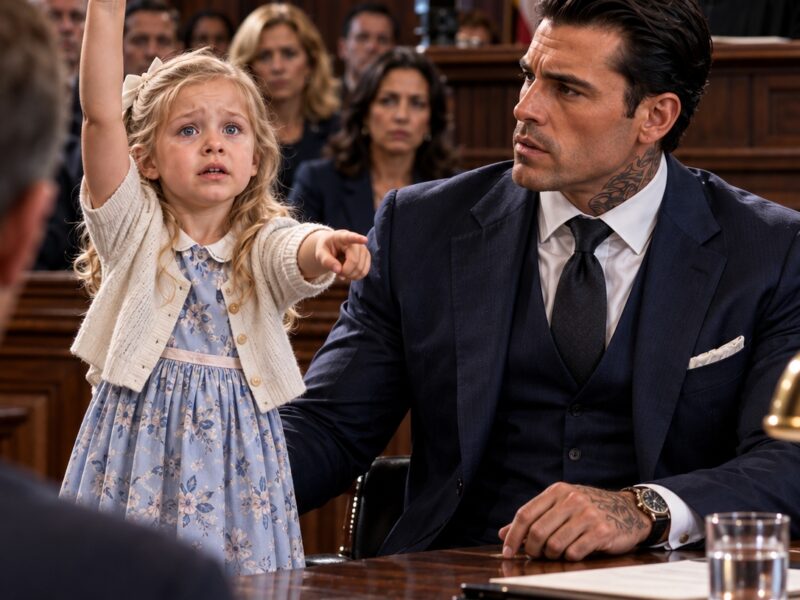
“I Know Who Stole It!” the Maid’s Four-Year-Old Said in Court—Then the Mafia Boss Saw the Silk in Her Hand and His Family Turned Pale
“I know who stole it.”
Four-year-old Emma Reed raised one small hand in a Manhattan courtroom where her mother was less than an hour away from being sent to jail.
The mafia boss whose family had accused her turned toward the child—and went completely still when he saw what she was clutching.
A torn piece of ivory silk.
One embroidered letter.
And a smell he recognized immediately.
Bitter orange.
The same cologne worn by his own cousin.
For several seconds, nobody inside Courtroom 8C moved.
Then the judge set down her pen.
The tiny click sounded louder than it should have.
“Sweetheart,” Judge Margaret Ellis said carefully, “do you understand where you are?”
Emma stood beside the defense table in a red dress that had been ironed twice that morning but still carried one stubborn wrinkle near the hem.
Her mother, Leah Reed, reached for her.
“Emma.”
The child looked up.
Leah’s face had already lost what little color it had left.
“Come sit down.”
Emma did not.
She hugged a worn stuffed rabbit beneath one arm and kept the silk trapped inside her other fist.
“I saw him.”
A murmur moved through the gallery.
Dominic Vescari did not react to the sound.
At forty-three, Dominic had survived long enough to understand that rooms became most dangerous precisely when everyone inside believed something dramatic had happened.
His father had taught him that before Dominic was old enough to understand what their family really did.
Never move because everyone else moves.
Never speak because silence makes you uncomfortable.
And never confuse a fact with the story someone wants the fact to tell.
Dominic sat at the prosecution-side table only because the missing object belonged to his family.
The Vescari Phoenix.
A ruby-and-diamond brooch commissioned for Dominic’s grandmother after she survived a nightclub fire in 1958.
Worth perhaps three hundred thousand dollars.
Worth more emotionally to Dominic’s aunt.
Worth far more politically to his cousin Anthony, who had spent the last six years trying to turn the Vescari name from something whispered in back rooms into something printed above legitimate waterfront development projects.
The prosecution said Leah Reed stole it.
Leah worked at Dominic’s Westchester estate.
Laundry.
Guest rooms.
Formal wardrobe storage.
She had been alone fourteen seconds in the corridor outside the dressing suite where the brooch was believed to have disappeared.
Fourteen seconds.
The prosecutor had repeated that number so often it had almost become proof.
Dominic looked at Emma’s fist.
“May I see that?”
Leah’s public defender, Michelle Park, immediately moved closer to the child.
“Mr. Vescari—”
“I’m not asking her to come near me.”
His voice remained low.
“I’m asking what she has.”
Emma looked at her mother.
Leah swallowed.
“It’s okay.”
The little girl walked three steps forward.
Dominic did not reach for the cloth.
He let her hold it.
Up close, the silk was unmistakably expensive.
Hand-rolled edge.
Custom weave.
Monogram stitching at one corner.
Most of the letter was covered by Emma’s thumb.
Dominic crouched slightly.
“Can you move your finger?”
Emma did.
The embroidered letter appeared.
V.
Dominic’s breathing slowed.
His family ordered formal handkerchiefs in private sets.
White for everyday dinner suits.
Ivory for black tie.
Navy for funeral wear.
The silk Emma held belonged to one of those sets.
His household staff did not carry them.
His laundry contractors did not handle them loosely.
And Leah Reed certainly did not own one.
Anthony Vescari gave a faint laugh from Dominic’s left.
He was thirty-six, clean-shaven, polished, and handsome in a way that looked expensive rather than natural.
“Dom.”
Dominic did not turn.
Anthony continued.
“It’s a handkerchief.”
“No.”
Dominic’s eyes stayed on the silk.
“It’s half of one.”
Anthony smiled.
“Even better.”
Judge Ellis leaned forward.
“Emma, where did you get that?”
The child looked toward the judge, then at the courtroom floor.
“By the little stairs.”
Michelle lowered herself beside her.
“What little stairs?”
“The cold ones.”
Leah closed her eyes.
Dominic looked at the police report.
Laundry corridor.
Main dressing suite.
Rear closet.
Service entrance.
Nothing about stairs.
He turned one page.
Then another.
No service staircase.
Judge Ellis noticed.
“Mr. Vescari?”
Dominic laid two fingers on the file.
“Your Honor, I’d like five minutes.”
“For?”
“To see whether the people investigating my house forgot to include part of my house.”
Anthony’s expression changed by perhaps one degree.
Most people would have missed it.
Dominic did not.
Judge Ellis nodded toward the clerk.
“Property diagram.”
A digital floor plan appeared on the courtroom monitor.
Dominic stood.
The Vescari estate had been built in 1927 and expanded badly by three generations of people who believed money was an acceptable substitute for architectural logic.
The west wing alone contained three staircases nobody used unless they worked there.
Dominic pointed.
“Laundry.”
“Yes,” said Daniel Price, the household manager from the second row.
“Rear dressing room.”
“Yes.”
“What’s behind that wall?”
Daniel hesitated.
Anthony looked at him.
That was the second thing Dominic noticed.
Daniel did not look at Dominic before answering.
He looked at Anthony.
“Old service stairs.”
The courtroom shifted.
Judge Ellis frowned.
“They connect where?”
“Laundry level to the west dressing landing.”
“The room where the brooch was stored?”
“Near it.”
“Near or at?”
Daniel swallowed.
“The landing opens behind the formal dressing suite.”
Michelle Park was already writing.
The prosecutor looked annoyed.
“This doesn’t change Mrs. Reed’s access to the corridor.”
“No,” Dominic said.
“It changes who else could reach it without using the corridor.”
Emma tugged Leah’s sleeve.
“Click shoes.”
Leah bent down.
“What, baby?”
“The man had click shoes.”
Anthony exhaled patiently.
“Your Honor.”
Judge Ellis looked at him.
Anthony smiled.
“The child is four.”
Emma stared at him.
“Four and a half.”
Several people almost smiled.
Anthony did not.
He continued.
“Click shoes. Cold stairs. A scrap of cloth. This is exactly how frightened children assemble unrelated details.”
Dominic finally looked at him.
Anthony stopped.
Dominic’s face had not changed.
That was the problem.
When Dominic became angry, other people expected violence.
What frightened those who knew him was restraint.
“What do click shoes mean?” Dominic asked Emma.
She tapped one finger twice against the wooden railing.
“Like church.”
Dress shoes.
Not boots.
Not sneakers.
Not the soft-soled shoes used by most household employees.
Judge Ellis looked at Leah.
“Mrs. Reed, was your daughter inside the laundry room that night?”
Leah took a breath.
“Yes.”
“Why?”
“My sitter canceled.”
Her voice carried embarrassment even now.
“I asked permission to bring her for the evening shift.”
“From whom?”
“Mr. Price.”
Daniel nodded quickly.
“I approved it.”
Leah continued.
“She stayed under the folding table with crayons and her rabbit.”
Emma hugged the toy.
“His name is Oliver.”
Judge Ellis nodded solemnly.
“Thank you.”
Emma seemed satisfied.
Michelle asked:
“Did Emma ever tell investigators she heard someone?”
Leah’s mouth tightened.
“I tried.”
Dominic looked at her.
Leah looked back.
“For two weeks I tried.”
“Who did you tell?”
“The detective.”
“Which one?”
“Detective Harper.”
The prosecutor shifted.
Leah continued.
“I said Emma heard someone on the stairs.”
“What happened?”
“He told me children hear things.”
Michelle’s jaw tightened.
“And the silk?”
Leah looked at Emma.
“She found it.”
“When?”
“The morning after the police questioned me.”
“That’s not what the evidence log says.”
The courtroom became quiet.
Leah gave a tired laugh.
“I know.”
“What does it say?”
“That it was produced today.”
Michelle turned toward the prosecutor.
The prosecutor frowned.
“That is what my file reflects.”
Leah looked at Judge Ellis.
“I brought it to the precinct six days ago.”
Anthony’s smile vanished.
Dominic’s eyes narrowed.
“You gave that cloth to police?”
“Yes.”
“And they returned it?”
“No.”
Leah shook her head.
“They put it in a brown paper bag.”
Emma raised the stuffed rabbit.
“I drawed a face.”
“What?” Michelle asked.
“On Mommy’s bag.”
A clerk began searching the evidence intake record.
Dominic watched Anthony.
Anthony adjusted his cuff.
Once.
His cousin had done that since childhood whenever he was irritated but did not want their grandfather to see it.
Dominic filed the movement away.
Judge Ellis said:
“Before we go further, Emma, may I ask one more question?”
The child nodded.
“What did you mean when you said you knew who stole it?”
Leah immediately tightened her arm around her daughter.
Dominic saw fear.
Not guilt.
Maternal fear.
She did not want the child becoming useful to powerful adults.
Emma pointed.
Not at Leah.
Not at Dominic.
Not even at Anthony.
She pointed toward the gallery.
A woman sitting in the third row froze.
Dominic recognized her.
Vanessa Cole.
Anthony’s executive assistant.
Thirty-two.
Worked at Vescari Harbor Development.
Always immaculate.
Today wearing a cream suit and glossy black heels.
Click shoes.
Vanessa’s eyes widened.
Emma said:
“She had the bird box.”
The courtroom erupted.
Judge Ellis struck her gavel.
“Order.”
Vanessa stood halfway.
“I did not—”
“Sit down,” the judge said.
She sat.
Anthony leaned toward Dominic.
“This is absurd.”
Dominic did not answer.
Emma had pointed at Vanessa.
But Dominic was looking at Anthony.
Because Anthony did not look surprised that Vanessa had been identified.
He looked angry.
Those were not the same thing.
Judge Ellis addressed Michelle.
“Proceed carefully.”
Michelle nodded.
She crouched beside Emma again.
“Did you see Ms. Cole take the shiny bird?”
Emma shook her head.
“No.”
“Did you see her carry something?”
“The box.”
“What box?”
“The little bed.”
Dominic understood first.
The jewelry case.
Dark velvet interior.
Bird-shaped impression.
Emma had apparently seen Vanessa carrying the case.
“Was the bird inside?” Michelle asked.
Emma frowned.
“No.”
Anthony spoke immediately.
“How could a four-year-old know whether—”
Judge Ellis lifted one hand.
Anthony stopped.
Emma looked at the photograph from the insurance file.
The Phoenix brooch rested inside its black velvet case.
She pointed.
“The bird bed.”
Michelle placed another photograph beside it.
Empty case.
“Did it look like this?”
Emma nodded.
“Empty?”
“Yes.”
Dominic went still.
The prosecution’s entire theory assumed the Phoenix disappeared while Leah worked the evening laundry shift.
But if Emma saw Vanessa carrying an empty jewelry box before Leah ever entered the corridor, there was another possibility.
The brooch was already gone.
Someone needed Leah to look like the person who took it later.
Judge Ellis called a recess.
Dominic walked into the private conference room.
Anthony followed.
The door closed.
“What the hell are you doing?” Anthony asked.
Dominic removed his jacket.
Set it over a chair.
“Listening.”
“To a child?”
“To evidence.”
“She pointed at Vanessa.”
“Yes.”
“Then why are you looking at me like that?”
Dominic turned.
“Because you knew she was coming today.”
Anthony stared.
“She works for me.”
“That does not answer the question.”
“Of course she came.”
“Why?”
“Family matter.”
“She is not family.”
“She handles Graves Harbor—”
“Vescari Harbor.”
Anthony blinked.
Dominic’s voice stayed quiet.
“You just called my company by the wrong family name.”
“Slip.”
“No.”
Dominic stepped closer.
“You’ve been doing something all morning.”
Anthony crossed his arms.
“What?”
“Correcting people before information becomes dangerous.”
“That’s paranoia.”
“Maybe.”
Dominic smiled faintly.
“You know what’s useful about paranoia?”
Anthony waited.
“Sometimes people call it that right before the documents arrive.”
The recess ended.
Judge Ellis returned.
So did the clerk.
A brown paper evidence bag sat on the table.
Leah saw it.
Her shoulders changed.
“That’s mine.”
The label read:
Submitted by Leah Reed. 8:12 a.m. Supplemental personal material. Nonresponsive.
Michelle stared.
“Nonresponsive?”
The clerk opened the chain-of-custody sheet.
“Originally reviewed as unrelated personal fabric.”
Leah laughed.
It was not amusement.
“I told them where Emma found it.”
Judge Ellis looked toward the prosecutor.
“Who classified it?”
The prosecutor looked miserable.
“The submission came through an internal supplemental review packet supplied by estate counsel.”
Dominic turned.
“Whose office?”
Silence.
The prosecutor checked.
“Vescari Harbor administrative liaison.”
Anthony shifted again.
Dominic saw it.
Michelle held up the paper bag.
A tiny purple smiley face appeared near one crease.
Emma brightened.
“I made that.”
“Why?” Judge Ellis asked.
“So Mommy knows it’s ours.”
The room changed.
This was no longer evidence created during the hearing.
Emma had marked the bag days earlier.
Before she raised her hand.
Before anyone considered her useful.
Before anyone knew a child might challenge the case.
Dominic said:
“Who reviewed the Vescari Harbor packet?”
Anthony answered too quickly.
“Probably legal.”
Dominic turned.
“Nobody asked you.”
Anthony stopped.
Judge Ellis heard that.
So did everyone else.
Dominic asked Daniel Price:
“Who can send supplemental evidence classifications through the Harbor office?”
Daniel looked terrified.
“Several people.”
“Names.”
“Legal compliance.”
“Executive administration.”
“Security liaison.”
“Who runs executive administration?”
Daniel looked at Anthony.
Nobody needed the answer spoken.
Anthony Vescari.
Dominic’s cousin.
The man Dominic had placed in charge of making the family respectable.
The irony was almost elegant.
Dominic had inherited violence.
Anthony had inherited spreadsheets.
Their grandfather used to say Anthony would save them from people like Dominic.
Dominic believed him.
That was why Anthony controlled the clean business.
Waterfront redevelopment.
Shipping contracts.
Hotels.
Restaurants.
Commercial leases.
Banking relationships.
Anthony wore tailored suits instead of carrying guns.
He attended charity dinners.
He shook hands with senators.
He spoke about governance.
He hated the old family reputation.
At least that was what Dominic had always believed.
Now an evidence bag from a maid’s theft case had been quietly dismissed through Anthony’s office.
Judge Ellis ordered full access logs produced.
Anthony objected.
“Your Honor, this proceeding concerns a brooch.”
“No,” the judge said.
“It concerns whether this court was given complete evidence.”
Dominic looked at her.
Something like respect entered his expression.
The rear service staircase camera had gone offline for eleven minutes the night the brooch supposedly disappeared.
Every other camera remained active.
Manual suspension.
Elevated credentials.
Then came the door log.
9:42 p.m.
Rear service access.
Master credential.
Dominic Vescari.
The courtroom stared at him.
Dominic did not.
He stared at the time.
At 9:42 p.m. he had been forty miles away at the Pier 16 development gala.
Three hundred guests.
Bankers.
City officials.
Press.
Video.
Photographers.
An impossible alibi to fake because half of Manhattan’s development community had watched him give a speech.
Judge Ellis said:
“Can you establish your location?”
“Yes.”
“How?”
Dominic looked toward Anthony.
“Very publicly.”
Anthony went pale.
For years, he had mocked Dominic for turning every event into a security problem.
Tonight that habit protected him.
Someone had used Dominic’s master credential.
Only three systems could generate it.
Dominic’s personal token.
Central digital security.
Anthony’s executive override.
The room became colder.
Anthony said:
“That proves nothing.”
Dominic looked at him.
“I agree.”
Anthony seemed startled.
Dominic continued.
“So we keep going.”
That was when fear finally appeared in Anthony’s face.
Not because Dominic accused him.
Because Dominic refused to.
An angry accusation could be attacked.
A methodical investigation was harder.
Judge Ellis ordered the silk examined by the Vescari family textile conservator.
Dr. Nora Bell arrived forty minutes later.
She identified the handkerchief immediately.
Private formal set.
Custom monogram.
Ivory silk.
She also identified the scent.
Bitter orange.
Cedar.
Ambergris substitute.
“Men’s cologne,” she said.
“Expensive.”
“Which one?” Michelle asked.
Dr. Bell named it.
Dominic knew it.
Anthony wore it.
So did perhaps a few hundred wealthy men in Manhattan.
Not proof.
Then Dr. Bell pointed to a faint tan residue near the torn edge.
“Cosmetic powder.”
“Women’s?”
“Most likely.”
Vanessa touched her face unconsciously.
Dominic saw.
He also saw Anthony see him seeing.
The case stopped being about one guilty person.
It began looking coordinated.
Michelle asked Leah:
“Do you wear perfume?”
“No.”
“Cologne?”
“No.”
“Scented spray?”
Leah shook her head.
“I can’t.”
“Why?”
“My throat closes.”
Her employment medical disclosure proved it.
Six months earlier.
Fragrance sensitivity.
Avoid perfume.
Citrus oils.
Strong fabric spray.
Bitter orange specifically listed after an urgent-care reaction.
The police file did not contain the page.
The employment archive did.
Judge Ellis looked toward the prosecutor.
“This was withheld?”
“I never received it.”
Dominic looked at Anthony.
Anthony looked at the table.
The heirloom’s insurance file produced another problem.
Two months before the alleged theft, someone requested a new valuation on the Phoenix.
Not from the family estate office.
From Vescari Harbor.
Three weeks before Leah was accused, the brooch appeared in a private consignment catalog under an anonymous client number.
Dominic stared at the photograph.
Same ruby eye.
Same diamond tail.
Same repair mark near the left wing from when his grandmother dropped it on marble in 1978.
The brooch had already left his house.
Leah could not have stolen something that was no longer there.
The prosecutor removed his glasses.
Michelle sat down slowly.
Leah did not react.
She had spent too many weeks being called guilty to trust innocence just because the room finally changed direction.
Emma leaned against her.
“Mommy?”
“Yes?”
“You didn’t take the bird?”
Leah’s face broke.
Before she could answer, Dominic did.
“No, sweetheart.”
Emma looked at him.
“She didn’t.”
Leah covered her mouth.
One sound escaped.
Then she lowered her hand.
“I told them.”
No one corrected her.
Nobody translated the sentence into legal language.
No one called her confused.
She simply stood there telling the truth she had been telling from the beginning.
Anthony pushed back his chair.
“This is ridiculous.”
Judge Ellis looked at him.
He continued.
“The heirloom may have been moved for valuation.”
“Without Dominic knowing?” Michelle asked.
Anthony ignored her.
“Vescari Harbor handles dozens of administrative matters.”
Dominic stood.
“Not my grandmother’s jewelry.”
“You delegate.”
“Not that.”
Anthony’s composure cracked slightly.
“Then somebody misused the system.”
First Leah had stolen it.
Then Emma was confused.
Then the camera malfunctioned.
Then security made an error.
Now somebody misused the system.
His explanation changed every time evidence removed the previous one.
Dominic began arranging documents across the table.
Not stacking them.
Timeline.
Valuation request.
Catalog date.
Camera outage.
Master access.
Evidence classification.
Employment medical record.
Private consignment.
Emma’s purple face on the paper bag.
Judge Ellis watched.
Dominic pointed.
“Two months before Leah’s shift, Vescari Harbor requested valuation.”
Another.
“Three weeks before the accusation, the Phoenix appears in a private catalog.”
Another.
“The night Leah worked, one hidden staircase camera goes dark.”
Another.
“My credential opens the door while I’m standing in front of three hundred witnesses.”
Another.
“The next morning, evidence pointing toward that staircase is labeled irrelevant through Vescari Harbor.”
Dominic looked at Anthony.
“You want me to call that coincidence?”
Anthony’s jaw tightened.
“You’re building a story.”
“No.”
Dominic’s voice stayed level.
“You did.”
Anthony stood.
For the first time, Judge Ellis did not immediately stop him.
Maybe she wanted to see where he would go.
“You will destroy everything.”
Dominic frowned.
“What exactly am I destroying?”
“Our work.”
“What work?”
“Graves Harbor.”
“Vescari.”
Anthony closed his eyes.
Another slip.
Dominic’s gaze sharpened.
Anthony continued.
“The clean side of this family.”
Something passed through Dominic’s face.
There.
Not denial.
Motive.
The legitimate empire.
The business Anthony believed belonged morally to him even if Dominic legally controlled it.
Michelle looked between them.
“What audit?”
Anthony turned toward her.
“What?”
“The broker’s email.”
She held it up.
“It says the client requested liquidation before the Vescari Harbor audit window.”
Dominic went still.
Anthony said nothing.
Dominic asked:
“What audit?”
Daniel Price lowered his eyes.
Dominic turned.
“Daniel.”
The household manager looked miserable.
“Annual internal review.”
“No.”
Dominic knew his own calendar.
“That starts January.”
Daniel swallowed.
“This was a special review.”
“Who ordered it?”
Silence.
Dominic already knew.
His independent accountant.
Six months earlier, several waterfront projects showed unusual consulting payments.
Dominic had asked outside auditors to review Harbor administration.
Quietly.
The audit was due to begin three weeks after the brooch vanished.
Anthony knew.
The Phoenix had not been stolen for greed.
It had been liquidated to fill something.
A hole.
Cash.
A temporary bridge in accounts somebody did not want reviewed.
And Leah had been selected as cover because she was poor, close enough to the room, and easy to make believable as a thief.
The thought changed Dominic’s anger.
Personal betrayal hurt.
This was worse.
Someone had calculated Leah’s social weight and decided it was light enough to carry the crime.
Dominic turned toward her.
She stood beside Emma.
Faded blouse.
Cheap shoes.
Hands rough from hot water and detergent.
He thought about how easily everyone had believed.
Even him.
Especially him.
When police told Dominic the brooch was gone, his first question had been:
“Who had access?”
He had not asked:
“Was it there?”
That failure belonged to him.
Anthony saw his silence.
“Dominic.”
Dominic lifted one hand.
“No.”
Anthony stopped.
“Don’t explain yet.”
His cousin’s face hardened.
“You’re choosing a maid over your family.”
The word landed.
Leah flinched.
Emma did not understand the insult.
Dominic did.
He turned completely toward Anthony.
“No.”
The entire room became still.
“I’m choosing facts over your last name.”
Anthony laughed bitterly.
“You think that makes you noble?”
“No.”
Dominic glanced at Leah.
“It makes me late.”
The judge looked down.
Perhaps because the sentence deserved privacy.
Dominic faced the bench.
“Your Honor.”
“Yes?”
“On behalf of the Vescari estate, I withdraw the complaint against Leah Reed.”
The prosecutor started to speak.
Dominic continued.
“I request the record reflect that material evidence was excluded, the heirloom appears to have left the estate before Mrs. Reed’s alleged theft, and all access logs and Harbor transactions tied to the Phoenix be preserved for criminal investigation.”
Anthony’s chair scraped.
“You cannot—”
Dominic turned.
“Sit.”
One word.
Anthony froze.
Old family instinct remained even when loyalty did not.
He sat.
Dominic looked at his independent counsel.
“Freeze Anthony’s access to Harbor administration.”
Anthony’s phone buzzed less than a minute later.
He looked down.
The screen reflected against his face.
ACCESS SUSPENDED.
The polished expression disappeared.
Not anger.
Fear.
Dominic had known Anthony since he was six.
He had seen him injured.
Drunk.
Grieving.
Humiliated.
He had never seen that fear.
It told Dominic more than the documents.
Not proof.
But direction.
Judge Ellis struck the gavel.
“Mr. Anthony Vescari will remain available for inquiry.”
Then she looked at Leah.
“Mrs. Reed.”
Leah straightened.
“This court will not proceed on the complaint as filed.”
For one second Leah did not understand.
Michelle touched her arm.
“It’s over.”
Leah looked at Emma.
Emma whispered:
“Home?”
Judge Ellis’s stern face softened.
“Yes.”
Emma smiled.
Then immediately asked:
“Can we get pancakes?”
Someone in the gallery laughed.
Leah did too.
A tiny exhausted sound.
Free.
Dominic stepped toward her.
“Mrs. Reed.”
Leah’s smile vanished.
She looked cautious again.
He respected that.
“My house put its weight on the wrong person.”
The courtroom listened.
Dominic continued.
“I did too.”
Leah’s eyes filled.
“I am sorry.”
She did not thank him.
Good.
Gratitude would have made him uncomfortable.
Forgiveness would have been obscene that quickly.
Leah nodded once.
Then took Emma’s hand.
Near the courtroom doors, two reporters lifted phones.
“Emma!”
The child froze.
“Did you know you saved your mom?”
Dominic stepped between them.
He did not threaten anyone.
He simply occupied enough space.
Questions stopped.
“She remembered something,” he said.
“That’s all.”
Then he moved aside.
Leah walked through first.
Three days later, Anthony’s name came off the glass office at Vescari Harbor.
Not because Dominic ordered theatrics.
Because the independent audit began.
The first discoveries were small.
Consulting invoices.
Duplicate payments.
Shell vendors.
Then larger.
Property companies controlled through intermediaries.
A waterfront maintenance contract billed twice.
Loans between entities never disclosed to the board.
Anthony had been moving money for nearly four years.
Not stealing everything.
That would have been easier to spot.
Borrowing from one project to cover another.
Hiding losses.
Inflating valuations.
Trying to maintain the appearance that Harbor remained profitable while privately financing expansions Dominic had refused.
The Phoenix sale covered one emergency gap.
The audit threatened to reveal it.
Anthony needed the jewelry gone before auditors inventoried family assets used as collateral.
Then he needed a thief.
Vanessa helped.
Why?
Money.
Promotion.
And something more human.
She loved Anthony.
Or believed she did.
She admitted moving the empty case down the service stairs.
She had worn Anthony’s handkerchief in her pocket because he gave it to her after spilling champagne on her sleeve during dinner.
It tore on a nail.
Emma found the fragment the next morning.
Vanessa used Dominic’s master access code from Anthony’s executive override.
Anthony ordered the stair camera shut down.
Daniel Price knew only that a service route was being used after hours.
He asked too few questions because Anthony outranked him.
Detective Harper received the ivory silk.
Before it reached evidence review, an estate supplemental memorandum arrived labeling it unrelated.
Harper accepted the classification because the family’s own office seemed to confirm it.
Failure by layers.
No single person needed to invent the entire lie.
Anthony only needed each person to do the easiest thing.
Trust authority.
Ignore the maid.
Dismiss the child.
Accept the file.
Move on.
That frightened Dominic more than the theft.
Systems did not become unjust only when cruel men controlled them.
Sometimes they became unjust because ordinary people kept believing the person above them had checked.
Anthony was charged months later with fraud, evidence tampering, theft, conspiracy, and several financial offenses tied to Vescari Harbor.
Dominic did not attend the arraignment.
Anthony requested a meeting.
Dominic refused twice.
Accepted the third.
They sat across from each other in a private attorney conference room.
No family.
No staff.
Anthony looked thinner.
Still elegant.
Still angry.
“You destroyed my life.”
Dominic leaned back.
“No.”
“You froze everything before I could explain.”
“I gave you years to explain the accounts.”
“You didn’t know.”
“Exactly.”
Anthony laughed.
“You think Leah Reed matters to you?”
Dominic’s expression changed.
Anthony continued.
“You’ll forget her.”
“That is not relevant.”
“It is.”
“You burned your family for a woman who washed your sheets.”
Dominic stared.
Anthony smiled bitterly.
“There. That face.”
“What face?”
“You still want to pretend this is about justice.”
Dominic’s voice became quieter.
“It is about the fact that you selected her because nobody would believe her.”
Anthony’s mouth tightened.
“You selected her child’s poverty.”
“You selected her job.”
“You selected her lack of lawyers.”
“You selected exactly how insignificant you believed she was.”
Silence.
Anthony looked away.
Dominic continued.
“That is the part I cannot forgive.”
“Not stealing from you?”
“No.”
“Not using your access?”
“No.”
Anthony looked back.
“Then what?”
Dominic leaned forward.
“You knew what the system would do to her.”
Anthony said nothing.
“You counted on it.”
That was the truth Anthony had avoided.
The brooch was only property.
The deeper crime required understanding power.
Anthony did.
Very well.
Perhaps too well.
Dominic stood.
Anthony said:
“You’re not innocent.”
Dominic stopped.
“No.”
That answer surprised him.
Dominic turned back.
“I never said I was.”
“You built the family name that frightened her.”
“Yes.”
“You built the house where employees knew better than to question us.”
“Yes.”
“You taught everyone that Graves—”
“Vescari.”
Anthony laughed.
Dominic almost did too.
Then the humor died.
“I taught people hierarchy.”
Dominic’s face hardened.
“You taught me what hierarchy becomes when nobody can challenge it.”
He left.
Leah never returned to the mansion laundry.
Dominic offered.
Once.
She declined.
“No.”
He nodded.
No persuasion.
No raise designed to turn refusal into gratitude.
She found work managing housekeeping operations at a boutique hotel in White Plains.
Better hours.
Benefits.
A small supervisory role.
Dominic’s attorney made sure her lost wages were repaid and the staffing agency corrected her record.
No confidentiality agreement.
No condition that she praise the Vescari family.
Six weeks after the hearing, Leah received a handwritten note.
Not from Dominic.
From Judge Ellis.
Only four lines.
Mrs. Reed,
Your daughter did not disrupt my courtroom. She reminded it what evidence looks like before adults decide whether it matters.
I hope both of you are well.
Leah framed it.
Emma wanted the frame beside her rabbit.
Leah said no.
“Oliver doesn’t read.”
“He can learn.”
The argument lasted three days.
Oliver won.
At the Vescari estate, Dominic changed policies.
Every accusation against household staff required independent review before outside authorities were contacted.
Employee evidence could not be screened by family business offices.
No family member had unilateral authority to alter camera retention.
Master access required two-person verification unless Dominic personally used his physical key.
Anthony’s old administrative division was dismantled.
Dominic separated family heirloom management from Harbor finances entirely.
His attorney told him some of the changes were excessive.
Dominic answered:
“Good.”
“Good?”
“We were insufficiently excessive before.”
The attorney stopped arguing.
The legitimate side of the Vescari organization changed too.
Independent accounting.
Outside compliance.
Real boards rather than cousins with titles.
Dominic hated much of it.
He also signed everything.
People whispered that Leah Reed had somehow made the mafia boss go legitimate.
That was nonsense.
One woman did not erase generations of criminal structure.
Dominic did not become harmless.
He did begin dismantling parts of the organization that depended on intimidation rather than business.
Slowly.
Not because Leah asked.
She never did.
Because Anthony’s betrayal forced Dominic to see something he disliked.
The system had made Anthony possible.
Family loyalty had functioned as immunity.
Dominic had called it strength.
It was not.
The most surprising change involved Emma.
Dominic saw her again two months after court.
Leah needed to sign final property-release forms because the ivory silk remained attached to the criminal case.
She brought Emma because school had closed early.
The little girl wore the same red dress.
Now with a syrup stain on one cuff.
Dominic noticed.
“You’ve damaged the evidence.”
Emma looked at her sleeve.
“Pancakes.”
“Clearly.”
Oliver sat beneath one arm.
His missing button eye had finally been replaced.
Wrong color.
Dominic pointed.
“He has two eyes.”
“Mommy fixed him.”
“One is blue.”
“Yes.”
“The other is brown.”
“Yes.”
Dominic waited.
Emma frowned.
“What?”
“Nothing.”
Leah looked at him.
“He expected symmetry.”
“I expected intention.”
Emma hugged Oliver.
“He sees different.”
Dominic considered.
“Fair.”
Leah signed.
Then paused.
“Can I ask something?”
Dominic looked up.
“Yes.”
“Why did you listen to her?”
The question surprised him.
Leah continued.
“Everyone else kept saying she was four.”
Dominic looked toward Emma, who was examining a paperweight.
“I didn’t believe her.”
Leah’s expression changed.
He continued.
“I believed she might be telling the truth.”
“That sounds like the same thing.”
“It isn’t.”
Dominic folded the form.
“If I had believed every detail automatically, I might have accused the wrong person again.”
Leah nodded slowly.
“So you checked.”
“Yes.”
“That’s all?”
Dominic looked at her.
“That should have been all anyone did the first time you spoke.”
Leah’s throat tightened.
She looked away.
Emma placed the paperweight back exactly where she found it.
“Mommy?”
“Yes?”
“Pancakes?”
“It’s four in the afternoon.”
“So dinner.”
Dominic almost smiled.
Leah gathered her bag.
At the doorway, Dominic said:
“Mrs. Reed.”
She turned.
“I’m sorry it took a courtroom.”
Leah looked at him for several seconds.
“Me too.”
Then she left.
No forgiveness speech.
No friendship.
No romance.
That was another thing people later changed when repeating the story.
They wanted Dominic to rescue Leah.
He had not.
Leah had saved herself repeatedly.
She kept the cloth.
Submitted it.
Told investigators about the stairs.
Protected Emma from pressure.
Refused Dominic’s job offer.
What Dominic eventually did was stop the machinery carrying her toward a false conviction after finally noticing the machinery was wrong.
Important.
Not heroic.
The distinction mattered.
One year later, Dominic testified at Anthony’s trial.
That shocked more people than the theft.
Family members did not testify against family.
Not in Dominic’s world.
Anthony’s attorney attacked him.
Called Dominic a criminal pretending to discover ethics.
Asked about old investigations.
Business arrangements.
Associates.
Dominic answered what his counsel permitted.
Then the attorney asked:
“Mr. Vescari, isn’t it true you turned on your cousin because his financial crimes threatened your control?”
Dominic looked at the jury.
“No.”
“Then why?”
“He framed an employee.”
“You expect this jury to believe you dismantled a family business over a maid?”
There it was again.
Dominic turned toward Anthony.
His cousin stared back.
Dominic answered:
“No.”
The attorney smiled.
Dominic continued.
“I dismantled a lie because my family name had become heavy enough to crush someone simply because we pointed at her.”
The smile vanished.
“That was useful to Anthony.”
“It was unacceptable to me.”
Anthony was convicted on several counts.
Not every one.
Evidence did not magically become perfect because the story needed closure.
Vanessa cooperated and received a reduced sentence.
Daniel Price was not charged.
He resigned anyway.
Detective Harper faced an internal review for accepting the estate classification without independent examination.
Leah testified once.
Briefly.
Emma did not.
By then no one needed her to.
That mattered to Leah more than almost anything.
Her child had opened the door.
Adults finally did the work afterward.
Three years passed.
Emma started second grade.
Oliver became nearly gray from use.
Leah married no mafia boss.
Dominic did not become a suburban uncle who attended birthday parties.
Life resisted neatness.
But one Saturday in October, Dominic walked into a diner in White Plains after a meeting and heard:
“Mr. Dominic!”
He turned.
Emma sat in a booth with Leah.
Seven now.
Missing a front tooth.
Oliver beside the syrup.
Leah looked surprised.
Dominic nodded.
“Mrs. Reed.”
“Mr. Vescari.”
Emma pointed at the empty side of their booth.
“You can sit.”
Leah immediately said:
“Emma.”
“What?”
Dominic almost declined.
Then looked at the child.
“Five minutes.”
He sat.
Emma pushed a plate toward him.
One pancake remained.
“You want it?”
“No.”
“You didn’t look.”
“I know what pancakes are.”
“This one has blueberries.”
Dominic looked at Leah.
She was trying not to laugh.
“I see your negotiation skills have improved.”
Emma frowned.
“What does that mean?”
“Nothing.”
She cut the pancake.
Pushed half toward him.
Dominic stared.
For some reason, the gesture reminded him of the silk.
A small thing in a child’s hand.
Ignored by adults until it rearranged everything.
He took the pancake.
Emma smiled.
Leah said:
“You don’t have to.”
“I know.”
That was why he did.
They spoke for twelve minutes.
School.
Math.
Oliver’s damaged ear.
Nothing important.
That was what made it pleasant.
When Dominic stood, Emma asked:
“Do you still have the bird?”
Leah’s face changed.
Dominic understood.
“The brooch?”
“Yes.”
“No.”
Emma looked surprised.
“You sold it?”
“No.”
“Where?”
“Museum.”
The Phoenix had been donated to the New-York Historical Society after Anthony’s trial.
Dominic had decided he no longer wanted an object used to destroy someone sitting inside a private safe.
Emma considered.
“So everybody can see?”
“Yes.”
“And nobody can steal?”
Dominic raised an eyebrow.
“I would not recommend trying.”
Leah laughed.
Emma nodded.
“Good.”
Years later, people would still tell the story of the mafia boss who froze when a maid’s daughter announced in court that she knew who stole his family treasure.
Some versions made Emma point directly at Anthony.
She never did.
Some said Dominic knew immediately.
He did not.
Some said the torn silk solved everything.
It solved nothing by itself.
That was the point.
One fragment of cloth led to a forgotten staircase.
The staircase led to one missing camera.
The camera led to a manual override.
The override led to Dominic’s stolen access.
The silk carried cologne.
The employment record proved Leah avoided the scent.
The brown bag proved she submitted the cloth before the hearing.
The purple smiley face proved Emma had touched it before anyone knew her memory mattered.
The valuation proved the brooch had entered another system.
The catalog proved it left the mansion before Leah supposedly stole it.
The audit revealed motive.
Each fact was small.
Together they became truth.
The lie had survived because everyone initially wanted one fact to be enough.
Poor employee.
Near jewelry.
Fourteen seconds.
Case closed.
Truth required more patience.
On the anniversary of the hearing, Dominic happened to be in the estate archive when he found the clear evidence photograph of Emma’s silk.
The original remained with prosecutors.
The photograph showed the torn edge.
Monogram.
Ivory weave.
At the bottom was a note written by the evidence technician after the trial:
Initial significance underestimated.
Dominic stared at the sentence.
Then crossed it out.
He wrote beneath:
Significance was not the problem. Attention was.
He closed the folder.
Outside his office, the estate was noisier than it had once been.
Staff no longer dropped their voices automatically when Dominic passed.
Some still did.
Old habits survived policy.
A housekeeper argued with a supplier over towels.
A chef shouted because someone moved knives.
Two employees laughed near the stairs.
Dominic passed them.
Nobody stopped.
That pleased him more than he would have admitted.
The study door stood open.
Not always.
But often.
On one wall hung no family heirlooms.
No Phoenix.
No framed newspaper articles about Vescari Harbor.
Only a small photograph.
Not of Dominic.
Not even of the estate.
A brown paper evidence bag.
Wrinkled.
Cheap.
A crooked purple smiley face near the crease.
Marco DeLuca had seen it once and asked:
“Why keep that?”
Dominic looked at him.
“To remember.”
“What?”
Dominic thought about Leah.
Emma.
Anthony.
The courtroom.
All the adults who believed importance announced itself through money, age, titles, or fear.
Then he answered:
“That small things do not become meaningless because powerful people fail to notice them.”
Marco nodded.
“Sounds almost wise.”
“Get out.”
Marco smiled and left.
Dominic looked at the photograph again.
Justice had not begun when he froze Anthony’s accounts.
It had not begun when auditors found the fraud.
It had not begun when prosecutors withdrew the case.
It had begun before any of them were paying attention.
A four-year-old girl had hidden beneath a laundry table with a one-eyed rabbit.
She heard dress shoes on a staircase no police report bothered mentioning.
She saw a woman carrying an empty jewelry case.
She found a torn piece of silk.
Her mother believed her enough to keep it.
The system ignored them both.
Then, in a courtroom full of adults who thought the important story had already been decided, Emma Reed lifted her hand.
“I know who stole it.”
She had not actually known everything.
Children rarely do.
Neither do adults.
But she knew one thing everyone else had overlooked.
And because one person finally stopped treating her age as a reason not to listen, the entire story had to begin again.









