I Overheard My Fiancé Tell His Parents He Felt Trapped—The Next Morning, I Left With Our Twins and Found Out What He’d Been Hiding for Years
The sentence that ended my engagement reached me through the living room wall at 10:17 on a Tuesday night.
“I love Natalie. I love the kids. But sometimes I feel trapped.”
I was standing in our kitchen holding a plastic cup of milk for my four-year-old son.
One hand was wrapped around the blue cup.
The other was still holding the refrigerator door open.
Cold air spilled against my bare feet.
For several seconds, I did not move.
I was not supposed to hear the conversation.
Mark’s parents had come over for dinner. I had cleared the plates, loaded half the dishwasher, and taken Lucy and Owen upstairs because Owen was rubbing his eyes and Lucy had already asked three times whether she could wear her sparkly socks to preschool.
I thought Mark’s parents had left.
They had not.
Their voices came from the living room, low enough that on any other night I probably would have closed the refrigerator and gone upstairs.
Then Mark’s mother said, “You’ve been engaged for two years. What are you waiting for?”
I stopped breathing.
There was a pause.
Mark sighed.
“Mom.”
“No, seriously,” Diane said. “Every time Natalie tries to choose a date, you move it.”
His father, Robert, spoke next.
“What’s complicated about picking a Saturday?”
“It’s not the Saturday.”
“Then what is it?”
Another silence.
I knew Mark’s silences.
There was the silence he used when he was tired.
The one he used when he was angry and trying not to say something cruel.
The one he used when he had already decided something but did not want to be blamed for it.
This silence was different.
Finally he said, “She keeps pushing.”
My fingers tightened against the refrigerator handle.
Diane’s voice softened.
“Natalie is not unreasonable for wanting to marry the man who proposed to her.”
“I know.”
“You have two children.”
“I know.”
“You bought a house together.”
“I know.”
“You’ve been together seven years.”
“I know, Mom.”
“Then explain it.”
Mark let out a breath.
“I don’t know if this is the life I would have chosen if everything hadn’t happened the way it did.”
The refrigerator motor clicked off.
Suddenly the kitchen became so quiet that I could hear the little plastic clock above the sink.
Robert said, “What does that mean?”
“It means I became a father before I was ready.”
Diane said nothing.
Mark continued.
“Then there was the house. Daycare. Work. Another baby at the same time because obviously twins don’t exactly wait their turn.”
A faint laugh.
Nobody joined him.
“And Natalie wants the wedding.”
His father said, “You proposed.”
“I know.”
“Then why are you talking like she cornered you?”
Mark’s answer came so quietly that I almost convinced myself I had misunderstood it.
“I feel trapped.”
I set Owen’s milk on the counter.
No tears.
Not yet.
Just a strange sensation in my chest, like something had opened quietly and let all the air out.
Diane said, “By Natalie?”
“No.”
“By the children?”
“No.”
“Then by what?”
“Everything.”
I should have walked into that room.
I should have asked him to repeat it while looking directly at me.
Instead I stood behind the kitchen wall listening to the man I had loved for seven years explain our life as if it were a hallway whose doors had closed behind him one by one.
Our children.
Our mortgage.
Our engagement.
Me.
He never used the word mistake.
He did not need to.
Robert said, “You need to tell her.”
Mark answered immediately.
“I can’t.”
“Why?”
“Because she’ll take it personally.”
I almost laughed.
Not because anything was funny.
Because there are few things more absurd than hearing somebody describe your life as a trap and then worry you might take it personally.
Diane said, “Maybe she deserves to know.”
“I’m trying to figure it out.”
“You’ve been figuring it out for years.”
“I know.”
“Does Natalie know you’re this unsure?”
“No.”
“Then that’s the first problem.”
Mark became irritated.
“Can we not turn this into a lecture?”
I picked up the milk.
Walked upstairs.
Lucy and Owen were already asleep.
Owen had his stuffed dinosaur pressed under his chin.
Lucy had somehow kicked off one sock but left the other perfectly in place.
I put the milk on the dresser even though Owen no longer needed it.
Then I sat on the floor between their beds.
Seven years.
That number kept circling my head.
Mark and I met when I was thirty-one.
He was thirty-three.
There was no movie beginning.
No dramatic coincidence.
We met at a diner outside Pittsburgh during a September thunderstorm.
I had stopped because visibility on I-376 was terrible.
Mark was at the counter trying to dry his phone with paper napkins after dropping it in the parking lot.
I told him rice worked better.
He told me he had no rice in his car.
I said that showed poor planning.
Ten minutes later, he made me laugh so hard I snorted coffee.
A year after that, we moved in together.
Then the twins came.
Unexpected.
Wanted.
Terrifying.
Beautiful.
When the ultrasound technician said there were two heartbeats, Mark stared at the screen and whispered, “You’re kidding.”
The technician laughed.
“I generally try not to joke about that.”
On the drive home, Mark kept one hand on the steering wheel and the other wrapped around mine.
“We’re going to need a bigger apartment.”
That was his first reaction.
Practical.
Then at a red light he started crying.
Lucy and Owen were born six weeks early.
Mark cried harder than I did then too.
I still remembered him standing beside my hospital bed holding Lucy against his chest while a nurse rolled Owen closer.
“We’re a family now,” he whispered.
I believed him.
For years, marriage came up the way weather does.
Eventually.
When things settled down.
When the twins slept.
When daycare cost less.
When Mark’s construction-management job became more predictable.
When we replaced the furnace.
When my job became more flexible.
I worked in payroll administration for a regional medical-services company. It was not glamorous, but I liked work that balanced. Hours entered. Taxes withheld. Totals reconciled.
Numbers made promises people could verify.
Mark used to tease me about that.
“You trust spreadsheets more than humans.”
“Spreadsheets show their formulas.”
He laughed the first time.
Years later, that sentence would hurt differently.
Two years before that Tuesday night, Mark proposed in our kitchen.
I was washing a roasting pan.
Lucy and Owen were watching cartoons.
He came behind me.
“Natalie.”
I turned with wet hands.
He held out a ring.
No speech prepared.
No photographer.
No restaurant.
I loved him for that.
“Oh my God.”
“Is that good?”
I laughed.
“Yes.”
He smiled.
“Then say it properly.”
“Yes.”
He slid the ring onto my finger.
Slightly loose.
“I’ll get it resized.”
I stared at it.
An oval diamond in an old-fashioned platinum setting.
Elegant.
Different from everything I had shown him online.
“I love it.”
“I wanted something that was just yours.”
I kissed him.
“I don’t need some huge wedding.”
“You’ll get your wedding.”
That was two years ago.
Every time I tried to pick a date, Mark had a reason.
Fall was bad for work.
Spring was too soon.
His brother Jason’s contracting company was struggling.
The twins were starting preschool.
We needed to build savings back up.
Once, I suggested city hall and dinner afterward.
Mark looked genuinely offended.
“You waited this long. You deserve a real wedding.”
So I waited for the real wedding.
Sitting between our sleeping children after hearing him say he felt trapped, I finally wondered whether the wedding itself had never been the thing he was postponing.
Maybe it was the choice.
Mark came upstairs around eleven.
I was in bed.
Eyes closed.
Breathing evenly.
He undressed quietly, brushed his teeth, plugged in his phone, and climbed beside me.
A few minutes later his breathing changed.
Asleep.
I opened my eyes.
Moonlight from the street filtered through the blinds.
His face looked peaceful.
That almost made me angry.
I wondered how long.
Had he felt trapped when he proposed?
When we signed the mortgage?
When he painted Owen’s bedroom blue because Owen had insisted the gray sample was “sad”?
When I held both children in the emergency room during their first stomach virus while Mark filled out paperwork?
When he kissed me goodbye that morning?
At 5:08, I gave up pretending I might sleep.
I got out of bed.
Did not turn on the light.
I packed quietly.
Not everything.
That mattered.
I was not staging an escape from danger.
Mark had never frightened me physically.
This was not that story.
I needed distance.
Thinking space.
And I needed our children with me because they were four and I was their primary morning caregiver and I could not imagine leaving before sunrise without them waking to find me gone.
I packed four changes of clothes each.
Toothbrushes.
Medications.
Insurance cards.
Birth certificates from the fireproof box.
My laptop.
Chargers.
Lucy’s stuffed rabbit.
Owen’s dinosaur.
Snacks.
Two coloring books.
The ridiculous green cup Owen refused to drink juice from because “green is for milk.”
I wrote Mark a note.
Then tore it up.
Wrote another.
The kids are safe with me. I need some space after what I heard last night. I’ll contact you this morning.
I put it on the kitchen counter.
My hands shook.
At 5:54, I stood in the hallway holding my keys.
Part of me wanted to wake him.
I wanted his face when he understood I knew.
I wanted an explanation before consequences.
I wanted him to say:
You misunderstood.
Then I remembered he had already said that I would take it personally.
He had planned my reaction before allowing me the truth.
If I woke him, I knew myself.
He would panic.
I would cry.
The twins would wake.
We would lower our voices for them.
Then breakfast would happen.
Then preschool.
Then work.
Then another evening.
And eventually would return to the room like it always did.
Eventually we would talk.
Eventually he would decide.
Eventually I would get married.
I was tired of eventually.
I carried Owen first.
He stirred against my shoulder.
“Mommy?”
“Shh. Go back to sleep.”
“Where we going?”
“To Aunt Claire’s.”
“Claire got waffles?”
Despite everything, I smiled.
“Probably.”
Lucy woke when I buckled her car seat.
“Is it morning?”
“Almost.”
“Daddy coming?”
“No.”
She frowned.
“Why?”
“He has work later.”
Not exactly a lie.
Still tasted like one.
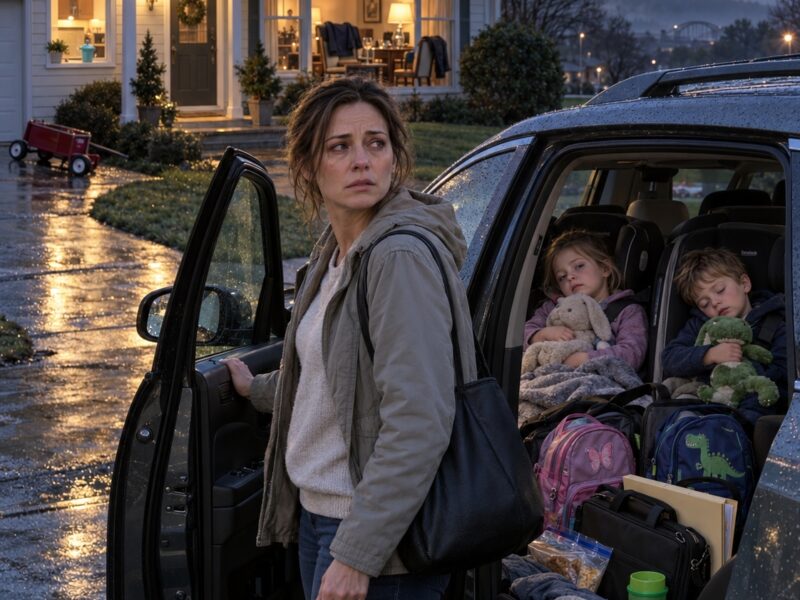
The driveway was wet from overnight rain.
I stood beside the car and looked back at our house.
White siding.
Gray shutters.
A crooked porch light Mark had promised to straighten for six months.
Seven years lived inside those walls.
Christmas wrapping paper.
Twin diapers.
Fever nights.
Burned dinners.
Arguments about money.
Saturday coffee.
Laundry on the stairs.
The place where I had once believed permanence was being built slowly enough to last.
I almost went back.
Then I remembered:
I feel trapped.
I got in the car.
Started the engine.
And left before Mark woke up.
Thirty minutes later, I stopped at a Sheetz.
Owen woke first.
“Daddy?”
“At home.”
“Are we going home?”
I looked at him in the rearview mirror.
“Not this morning.”
He accepted that faster than I did.
I bought coffee.
Two breakfast sandwiches.
Apple slices.
Chocolate milk Lucy persuaded me she needed because “today feels special.”
My phone started vibrating before six-thirty.
Mark.
Then again.
Then:
Where are you?
Natalie?
Where are the kids?
Call me now.
Are you okay?
Then:
What happened?
I stared at that one.
He did not know yet whether I had heard him.
The realization made my stomach turn.
At 6:42, I answered by text.
We are safe. I heard your conversation last night. I need space. The kids are with me. I will call later today.
Three dots appeared immediately.
Disappeared.
Returned.
Natalie, come home.
I put my phone face down.
For seven years, Mark had assumed home was the answer.
That morning, I wanted to find out who I was when it wasn’t.
My cousin Claire lived seventy-five minutes north of Pittsburgh.
Technically she was my cousin.
Emotionally she was the sister neither of us had.
She had two kids, a spare room, three dogs, and the ability to make an emergency feel like a scheduling inconvenience.
I had called her from the Sheetz parking lot.
“I need somewhere to go.”
“How many of you?”
“Three.”
“Are you safe?”
“Yes.”
“Kids safe?”
“Yes.”
“Then drive.”
No interrogation.
When I pulled into her driveway at 8:03, she was standing on the porch in sweatpants holding coffee.
She looked at my car.
Then the twins.
Then me.
“Oh boy.”
“That’s it?”
“I’m saving my speech until you’ve eaten.”
Owen ran past her asking about waffles.
Claire pointed inside.
“Freezer.”
He cheered as if his parents’ relationship had not cracked open before breakfast.
Children can break your heart by continuing to be children.
Claire hugged me.
Not too long.
Just enough.
Inside, Lucy and Owen joined Claire’s younger daughter on the living-room floor.
Within four minutes they were arguing over a toy horse.
Claire made coffee.
“Tell me.”
I did.
Not every memory.
Just the conversation.
The sentence.
The seven years.
When I finished, Claire stirred sugar into her cup although she normally drank coffee black.
“So you’re leaving him?”
“I left.”
“That wasn’t what I asked.”
I looked down.
“I don’t know.”
“Good.”
I stared at her.
“Good?”
“You don’t need to know today.”
My eyes filled immediately.
Of all the things anyone could have said, that was the one I needed.
My phone rang.
Mark.
Again.
Claire watched.
“You want me to take the kids outside?”
“No.”
“You want me to answer?”
“Absolutely not.”
She smiled slightly.
“Worth asking.”
At 9:26, I finally called him.
He answered before the first full ring.
“Where are you?”
“I’m safe.”
“Natalie, where are Lucy and Owen?”
“With me.”
“I know they’re with you.”
His voice tightened.
“Where?”
“I’m not giving you the address yet.”
“What the hell?”
“Don’t.”
“You took our children while I was asleep.”
“I took them somewhere familiar so I could think.”
“You could have woken me.”
“I almost did.”
“Then why didn’t you?”
I closed my eyes.
“Because I heard you.”
Silence.
Long enough that I could hear a clock in the background.
Finally:
“You heard that?”
“Yes.”
“Natalie.”
“I heard all of it.”
“That wasn’t meant for you.”
The sentence landed strangely.
Not:
It wasn’t true.
It wasn’t meant for you.
“What part?”
“What?”
“What part wasn’t meant for me?”
“I was talking privately.”
“To your parents about our marriage.”
“We’re not married.”
I stopped.
He did too.
I could feel him realizing.
“That came out wrong.”
“Did it?”
“Natalie, Jesus.”
“Tell me what I misunderstood.”
“I was stressed.”
“I heard that.”
“I feel pressure.”
“I heard that too.”
“It doesn’t mean I feel trapped by you.”
“Then what are you trapped by?”
Silence.
“The house?”
“No.”
“Our kids?”
“No.”
“The wedding?”
“I don’t know.”
That answer hurt more than the sentence itself.
I stood.
Walked into Claire’s laundry room so the children would not hear.
“Did you ever actually want to marry me?”
“Of course.”
“When?”
“What do you mean, when?”
“When did you feel certain?”
“Natalie—”
“When?”
“I don’t know.”
My eyes closed.
There are answers that destroy hope by being cruel.
And answers that destroy it by being empty.
“I’m hanging up.”
“Don’t.”
“I’ll contact you about the kids.”
“They’re my kids too.”
“I know.”
“You don’t get to disappear.”
“I’m not.”
“You are.”
“No.”
“For the first time, Mark, I am making you live inside uncertainty instead of making me do it for you.”
I ended the call.
Then I sat on the closed toilet lid in Claire’s downstairs bathroom and cried silently into a hand towel.
Not because I hated him.
That would have been easier.
I loved Mark.
I remembered him sleeping on the floor beside Lucy’s crib when she had pneumonia because he was afraid he would not hear her breathing change.
I remembered him buying six different bottles when Owen refused formula and testing the nipples on his own wrist like the pediatric nurse showed him.
I remembered him pulling my boots off when I was pregnant because I could no longer bend comfortably.
Heartbreak did not erase those things.
It made them harder.
At noon I opened my laptop.
I needed work.
My department processed payroll files every Wednesday.
My manager, Denise Carter, disliked surprises more than I did.
I called.
“I need to work remotely for a few days.”
Pause.
“Are you sick?”
“No.”
“Kids?”
“They’re fine.”
Another pause.
“You okay?”
“No.”
She did not ask more.
“Want PTO?”
“No.”
“I need something normal.”
“I’ll send the updated file.”
Numbers helped.
Hours.
Deductions.
Withholding.
Corrections.
At three, I opened our household accounts.
Mortgage.
Daycare.
Utilities.
Insurance.
Groceries.
Car.
Credit cards.
Savings.
Mark often talked about being the primary provider because his salary was higher.
That was technically true.
But as I went through twelve months of transactions, another truth appeared.
My income paid daycare.
Most groceries.
Health insurance through my employer.
Utilities.
Half the mortgage through automatic transfers.
Clothes.
Preschool deposits.
Medical copays.
Household supplies.
I had never kept score because I believed we were building the same life.
Now I realized Mark’s private story of responsibility did not include half the machinery that made his public story possible.
I did not empty anything.
Did not transfer joint savings.
Did not punish him financially.
I opened a new checking account for my next paycheck and kept careful records.
Then I scheduled a consultation with a family attorney.
Not to “take the kids.”
Not to destroy Mark.
Because love had stopped being enough protection against confusion.
That evening, I texted him:
I heard you last night. I need time. Please communicate about Lucy and Owen by text for now unless it is urgent.
His reply came immediately.
Please come home.
I did not answer.
The next morning:
I barely slept.
Then:
I love you.
Then:
I love the kids.
Then:
I said something stupid.
Claire walked into the kitchen carrying laundry.
“You’re getting popular.”
“Apparently.”
“You don’t have to respond because he’s uncomfortable.”
“I know.”
“But?”
I looked at my cold coffee.
“I still want to hear him explain.”
Claire sat across from me.
“That doesn’t make you weak.”
“I feel stupid.”
“For loving someone you loved yesterday?”
I looked away.
She continued.
“Leaving doesn’t turn off history.”
I called Mark at 9:02.
He answered instantly.
“Nat.”
“I want you to explain.”
“I was frustrated.”
“You said that.”
“I didn’t mean trapped by you.”
“Then what?”
“Everything.”
“That isn’t better.”
“I know.”
“Work?”
“Yes.”
“The mortgage?”
“Yes.”
“The kids?”
He hesitated.
“Responsibility.”
My stomach tightened.
“Your children?”
“No.”
“Don’t do that.”
“What?”
“Don’t change the noun because you don’t like hearing it.”
He became quiet.
“Do you regret them?”
“No.”
Immediate.
At least that.
“Do you regret me?”
“No.”
“Do you regret proposing?”
Too long.
“Mark.”
“No.”
“That pause was an answer.”
“It wasn’t.”
“Then give me one without a pause.”
“I love you.”
“That was not the question.”
He exhaled.
“I thought proposing would make things feel settled.”
The words slid under my ribs.
“For who?”
“For us.”
“No.”
“Try again.”
“For me.”
There it was.
I sat very still.
“You proposed because you thought the proposal would stop you feeling uncertain.”
“I thought once I did it, I’d feel ready.”
“And then?”
“I didn’t.”
My eyes burned.
“So for two years, every time I asked about a date, you gave me a practical reason.”
“Because I didn’t know how to say this.”
“You knew how to say it to your parents.”
He had no answer.
After we hung up, I opened photos.
First Christmas.
Twins’ first birthday.
Mortgage closing.
Pittsburgh Zoo.
Halloween.
Mark asleep with both children on his chest.
Thousands of ordinary moments.
I had spent years telling myself marriage was paperwork.
If so, why had his refusal hurt?
Because the wedding was never about a party.
It was about being chosen deliberately instead of retained by momentum.
At lunch, my friend Dana called.
She had known me before Mark.
“How are you?”
“I don’t know.”
“That bad?”
I laughed weakly.
“I left.”
Silence.
“You actually left?”
“Yes.”
“For good?”
“I don’t know.”
She breathed in.
“Natalie.”
“What?”
“I need to tell you something.”
My body went cold.
“What?”
“Mark said something at Eric’s barbecue in June.”
“What did he say?”
Dana hesitated.
“Somebody teased him about still not picking a wedding date.”
I waited.
“He laughed.”
“And?”
“He said, ‘Natalie isn’t going anywhere.’”
I said nothing.
Dana rushed to continue.
“I thought it was dumb guy talk.”
“I should’ve told you.”
“Did he say anything else?”
“He said you already had the house and kids.”
“That marriage was ‘mostly symbolic at this point.’”
I looked at Claire’s kitchen wall.
There it was.
Not indecision.
Comfort.
Mark had not been urgently wrestling with whether to choose me.
He thought the choice could remain unfinished because he believed I would remain available.
I had interpreted his lack of urgency as caution.
Maybe it had been certainty of a different kind.
Not certainty about marrying me.
Certainty that I would wait.
That afternoon, Lucy drew our family in sidewalk chalk.
Four stick figures.
Mommy.
Daddy.
Lucy.
Owen.
“Daddy is here,” she announced.
“I see.”
“Are we going home tomorrow?”
My throat tightened.
“I don’t know.”
“Why?”
Because Daddy feels trapped.
Because Mommy finally heard something she cannot unknow.
Because adults can love each other and still fail to build something honest.
Instead I said:
“Sometimes grown-ups need a little time to figure out where they’re going to live.”
She accepted that.
Then drew a purple dog taller than all of us.
That night I told Claire I felt guilty.
“For what?”
“Changing their lives.”
“You didn’t create this alone.”
“I know.”
“Do you?”
I looked at her.
She leaned back.
“Natalie, you didn’t wake up bored and blow up a family.”
“You heard something important.”
“What if I’m overreacting?”
“Then you can change your mind.”
“What if Mark changes?”
“Then you decide what you want.”
She paused.
“But do not go back just because he is finally scared of losing you.”
The following afternoon, Mark’s mother texted.
A good mother does not take children away from their father because she is angry.
I stared at it until my hands began to shake.
Then typed slowly.
I agree. That is why I am not taking them away from him. I am arranging time for him to see them and getting legal advice so we handle this correctly. Please do not accuse me of using my children when I am trying to keep adult conflict away from them.
No response.
Mark saw the twins the next day at a playground halfway between our house and Claire’s.
I stayed.
Public place.
Two hours.
When Lucy saw him, she ran.
Mark dropped to his knees and caught her.
Owen followed.
Mark’s face broke.
For one terrible second I wanted to run to him too.
Instead I stood by the picnic table.
He played with them.
Pushed swings.
Opened snacks.
Listened seriously to Owen explain why dinosaurs would beat sharks “on land only.”
He was their father.
He loved them.
That did not disappear because he had failed me.
When the children went to the restroom with Claire, Mark walked toward me.
“You look tired.”
“So do you.”
“Can we talk?”
“About the kids.”
“Natalie.”
“Not here.”
“I am trying.”
“I know.”
“Then what do you want?”
“The truth.”
“I’ve told you.”
“No.”
“You’ve told me the parts that became unavoidable.”
His jaw tightened.
“What else do you think there is?”
“I don’t know.”
That was the problem.
Three days later, I went back to the house.
Mark was working.
Claire drove.
“I’ll wait outside.”
“You don’t have to.”
“Yes, I do.”
“Why?”
“Because you’re emotionally attached to the problem.”
I laughed despite myself.
“And you’re attached to?”
“Common sense.”
The house looked exactly the same.
Dead mums beside the porch.
Owen’s wagon tipped over.
Amazon box.
For a second, I felt foolish.
How could something so normal contain a life that no longer felt safe to trust?
Inside, the silence hurt.
I gathered winter jackets.
Books.
Pajamas.
My work monitor.
Then household documents.
Mortgage papers.
Tax returns.
Insurance.
The folder I wanted was in the bottom drawer of our bedroom dresser.
Underneath it sat another folder.
Mark’s name.
I almost closed the drawer.
Then a bank statement stuck out.
The balance was large enough to catch my eye.
Personal loan.
$38,000.
My heart began beating hard.
Mark had never mentioned a personal loan.
I sat on the edge of the bed.
Read.
The loan had been taken eighteen months earlier.
Payments automatically deducted from Mark’s private account.
Transfers had gone to an LLC I recognized.
Keller Renovation Services.
His younger brother Jason’s company.
I kept reading.
$12,000.
$7,500.
$8,000.
Then smaller amounts.
Printed emails were clipped behind the statements.
Jason:
I swear I’ll repay you when the commercial job closes.
Another:
Mom knows. She said Natalie doesn’t need the stress right now.
I stopped.
Read it again.
Mark’s mother knew.
For eighteen months, Mark had repeatedly told me we could not set a wedding date because money was too tight.
I had suggested city hall.
He said no.
I suggested a backyard ceremony.
He said we deserved better.
I suggested waiting six months.
He said the twins needed new preschool tuition first.
Meanwhile, he had borrowed almost forty thousand dollars.
Not for gambling.
Not an affair.
Not something I could condemn cleanly.
He had helped his brother.
That was almost worse emotionally because it forced me to separate the act from the deception.
Families help families.
I would probably have agreed to help Jason.
What Mark removed was my right to participate in a financial reality that shaped decisions he told me were ours.
Then I noticed a small jewelry-store envelope.
Two years old.
Same month as our engagement.
Inside:
Ring resizing receipt.
A handwritten note.
Resize Eleanor Keller setting for Natalie — 5.75.
Eleanor Keller.
Mark’s grandmother.
I stared at my left hand.
The ring was still there.
Loose again because I had lost weight during a stressful quarter at work.
Mark had told me he spent weeks choosing it.
“I wanted something that was just yours.”
I remembered Diane once holding my hand at dinner.
“That old setting looks beautiful on you.”
I thought she meant the style.
I called Claire.
“You need to come inside.”
She came in fast.
“What happened?”
I handed her the papers.
She read silently.
“So he loaned Jason money.”
“Yes.”
“Thirty-eight thousand?”
“Some went to him.”
“And Diane knew.”
“Yes.”
She looked at me.
“Are you angry he helped his brother?”
“No.”
That answer came immediately.
“I’m angry he let the debt become my reason to keep waiting without telling me the debt existed.”
Claire nodded.
“The ring?”
I held out the receipt.
She read it.
“Oh.”
“Exactly.”
“Does that change anything?”
I thought.
“No.”
Then corrected myself.
“It changes what I understand.”
“But you’re not leaving because of the loan.”
“No.”
“Or the ring.”
“No.”
I looked around our bedroom.
“I’m leaving because he keeps deciding which truth I can handle.”
Before leaving, I photographed the household records that were relevant to our shared finances.
I did not search his phone.
Did not open personal correspondence unrelated to us.
Did not take the loan documents.
Anger already made me feel unfamiliar enough.
I did not want revenge to finish the transformation.
That afternoon I met family-law attorney Rebecca Sloan.
Her office was downtown in a narrow old building with a coffee machine that sounded like it was dying.
She listened.
Asked dates.
Asked who usually handled the children’s mornings, daycare, doctors, bedtime.
Asked whether Mark had ever threatened me.
“No.”
“Drugs?”
“No.”
“Violence?”
“No.”
“Then we keep this boring.”
I almost laughed.
“That sounds good.”
“Boring is excellent when children are involved.”
She explained that because we were unmarried, the house, custody, joint accounts, and shared debts each had different legal issues.
No dramatic speech.
No promise to destroy him.
“Do not hide money.”
“I won’t.”
“Do not deny reasonable contact with the children.”
“I’m not.”
“Document schedules.”
“Okay.”
“And do not negotiate major property issues while emotionally flooded.”
I nodded.
Then she asked:
“What do you actually want?”
I stared at my hands.
“I want Lucy and Owen to be okay.”
“And?”
“I want to stop living like Mark and I are practically married whenever responsibility is involved but suddenly unmarried whenever commitment is.”
Rebecca sat back.
“That is not a legal objective.”
“I know.”
“But it’s a useful emotional one.”
That evening, Mark called.
“I know you went to the house.”
“Yes.”
“You found the loan.”
I said nothing.
“I should have told you.”
“Yes.”
“Jason was going under.”
“I understand.”
“You do?”
“Yes.”
That surprised him.
“I’m not angry that you helped your brother.”
“Then—”
“I am angry you lied about why we couldn’t afford a wedding.”
“It wasn’t a lie.”
“Mark.”
“We really were tight.”
“Because you took out a thirty-eight-thousand-dollar loan.”
Silence.
“My parents thought you didn’t need more stress.”
“Your mother knew.”
“Yes.”
“Your father?”
“He knew I’d helped Jason.”
“Did he know the amount?”
“No.”
At least that repaired one contradiction.
“Why didn’t you tell me?”
“I knew you’d worry.”
“I worried anyway.”
“I didn’t want another fight.”
I closed my eyes.
Seven years.
And there it was again.
Avoid the difficult conversation.
Create a larger future problem.
Then call the future problem unfortunate.
I looked at my ring.
“Was this your grandmother’s?”
Silence.
“Natalie.”
“Was it?”
“Yes.”
I swallowed.
“Why did you tell me you chose it?”
“I did choose it.”
“Mark.”
“I chose to use it.”
I almost laughed.
“You know what I mean.”
“I thought you’d like the story better.”
That sentence hurt with surgical precision.
The story.
He had edited my life for emotional convenience.
“What was wrong with saying it was your grandmother’s?”
“Nothing.”
“Then why lie?”
“I wanted the proposal to feel like it was ours.”
“So you took something with history and removed the history.”
“I didn’t think it mattered.”
“That is the problem.”
“What?”
“You keep deciding what matters for both of us.”
He became quiet.
Later he texted:
My parents want dinner Sunday. Jason too. We should all talk.
I wanted to refuse.
Then I thought about Diane.
About the message saying I was punishing Mark.
About Jason’s company.
About Robert not knowing the amount.
About seven years of people receiving different versions of the same story.
I typed:
I’ll come.
Then added:
But I am not coming home.
I changed my mind six times before Sunday.
Claire drove.
“You can leave any time.”
“I know.”
“You don’t have to prove anything.”
“I know.”
“Do you want me inside?”
“No.”
“Call.”
“I will.”
Diane opened the door before I knocked.
For a moment, we stared at each other.
Then she moved aside.
The kitchen table was set.
Roast chicken.
Potatoes.
Green beans.
Rolls.
Normal food.
Normal plates.
Normal family.
I hated the table for looking ordinary.
Mark stood near the counter.
Unshaven.
Wrinkled shirt.
He stepped toward me.
“Natalie.”
I lifted one hand.
“Not yet.”
He stopped.
Robert sat at the head of the table.
Jason beside his wife, Erica.
Diane took the chair nearest Mark.
I sat across from him.
Nobody ate.
Finally Diane said:
“Seven years is a long time to throw away over one sentence.”
I looked at her.
“Which sentence?”
She flushed.
“You know.”
“The one where Mark said he feels trapped?”
“He was overwhelmed.”
“So was I.”
Mark rubbed his hands together.
“Can we not start like this?”
“That depends.”
“On what?”
“Whether we’re finally saying the same facts in the same room.”
He looked down.
I opened my bag.
Placed a copy of the loan summary on the table.
Jason immediately looked away.
Robert leaned forward.
“What’s that?”
Mark answered quietly.
“The loan.”
Robert frowned.
“What loan?”
Diane said:
“Robert.”
He looked at her.
“What loan?”
She closed her eyes.
I realized then he truly had not known the amount.
Mark told him.
Thirty-eight thousand.
Robert stared.
“Good Lord.”
Jason spoke.
“He helped me.”
“I can see that.”
“I was losing the company.”
Robert looked at Mark.
“You borrowed thirty-eight thousand dollars?”
“Not all at once.”
“That is not the comforting distinction you think it is.”
Erica looked down to hide a reaction.
Despite everything, I nearly smiled.
Diane said:
“We thought it would be temporary.”
I nodded.
“I believe you.”
She looked surprised.
“I am not angry that Mark helped Jason.”
Jason’s shoulders relaxed slightly.
I continued.
“I am angry that Mark told me money was why we couldn’t get married while hiding where a large part of the pressure came from.”
Mark interrupted.
“The wedding was not about the money.”
I looked at him.
“Then why did you make money the reason every time?”
He opened his mouth.
Closed it.
Jason said softly:
“I didn’t ask him to lie to you.”
“I know.”
“I thought you knew we were having trouble.”
“I knew the business was struggling.”
“I did not know Mark had borrowed money.”
Jason looked genuinely ashamed.
“I’m sorry.”
“Thank you.”
Diane leaned forward.
“We were protecting Jason.”
“No.”
Robert spoke before I could.
Everyone looked at him.
He looked at his wife.
“You were protecting Mark from Natalie’s reaction.”
Diane’s face tightened.
“That isn’t fair.”
“He is thirty-nine years old.”
“He can tell the woman raising his children where thirty-eight thousand dollars went.”
Silence.
Mark said:
“Dad.”
Robert turned.
“No.”
“You told me Tuesday you felt trapped.”
“You made choices.”
“You bought a house.”
“You proposed.”
“You had children.”
“Nobody tied you to a chair.”
Mark’s face went pale.
Robert continued.
“You cannot call responsibility a trap because people eventually ask you to stand behind decisions you volunteered to make.”
I did not feel victorious.
I felt tired.
Mark looked at me.
“I love you.”
“I know.”
“I never wanted you to leave.”
I held his gaze.
“You never thought I would.”
His face changed.
“That isn’t fair.”
I reached into my bag again.
A parenting schedule.
“Fair stopped being useful.”
I slid the paper toward him.
“I want Lucy and Owen to have both parents.”
His shoulders dropped.
“You’re not trying to keep them from me?”
“No.”
“I never said I was.”
“Mom said—”
I turned toward Diane.
She looked down.
“I’m not using our children as punishment.”
Diane whispered:
“I was angry.”
“So was I.”
“I shouldn’t have sent that.”
“No.”
She nodded.
An apology without explanation.
Unexpected.
Helpful.
Mark touched the schedule.
“So this is it?”
“No.”
“This is a starting proposal.”
“I want us to work with attorneys or a mediator.”
“I don’t want the children carrying uncertainty because we refuse to make adult arrangements.”
He looked at me.
“And us?”
I removed the engagement ring.
This time it came off easily.
I placed it on the table.
Diane’s eyes filled.
Mark stared at it.
“I don’t know what ‘us’ means anymore.”
“Natalie.”
“You told me this was something you chose for me.”
“It is.”
“It belonged to your grandmother.”
Diane whispered:
“Eleanor.”
I nodded.
“It is beautiful.”
“I’m not angry that it was hers.”
Mark looked confused.
“Then why—”
“Because you thought the truth needed improvement.”
No one spoke.
“You keep doing that.”
“The loan needed editing.”
“The ring needed editing.”
“Your uncertainty needed editing.”
“Even after I left, you told me I misunderstood what trapped meant.”
He wiped both hands over his face.
“I didn’t want to hurt you.”
“And every lie was supposed to help me.”
His eyes filled.
“Yes.”
“That is what scares me.”
He looked up.
“Why?”
“Because if you believe dishonesty can be kindness whenever truth is uncomfortable, I never know what else you’ll decide I don’t need to know.”
That landed.
Even Diane looked away.
I pushed the ring toward Mark.
He did not touch it.
“I’ll change.”
“I hope you do.”
“You don’t believe me.”
“I believe people can change.”
“Then why won’t you give me the chance?”
“I am.”
He looked confused.
“You have the rest of your life to change.”
“I just don’t have to stand still while you do it.”
Robert closed his eyes briefly.
Jason stared at the table.
Mark began crying.
Quietly.
Not dramatic.
That made it harder.
For once, nobody rushed to comfort him.
When I stood, Diane said:
“Natalie.”
I turned.
“I’m sorry.”
“For what?”
She swallowed.
“For helping him keep things from you.”
“I thought if you didn’t know about Jason, there would be less pressure.”
“There was still pressure.”
“I know that now.”
I nodded.
Robert walked me to the door.
On the porch he stopped.
“I owe you something too.”
“You didn’t know.”
“Not everything.”
He put his hands in his pockets.
“But I knew my son had been postponing his life.”
“I kept telling him there was no harm in waiting until he was sure.”
“That sounds reasonable.”
“It does.”
He looked back through the window.
“Except nobody asked how long you were expected to remain available while he searched for certainty.”
That sentence stayed with me.
Claire was waiting in the car.
“How bad?”
I buckled my seat belt.
“Not as bad as I expected.”
“Did anyone throw food?”
“No.”
“Disappointing.”
I laughed.
Really laughed.
First time in weeks.
But the story did not end at that dinner.
Because Mark still had one more truth to face.
Not the loan.
Not the ring.
The story he had built about why we were still together.
Tuesday morning he called.
We had kept communication focused on the twins.
Pickup.
Preschool.
Medication.
Owen waking at three.
Normal things.
“Natalie, can I ask something?”
“Yes.”
“Did you tell anyone about Jason’s loan?”
“No.”
“Are you sure?”
“Yes.”
“Why?”
“Jason’s business partner knows.”
“I don’t know anything about that.”
Long silence.
Then:
“My dad wants everybody together Friday.”
I sighed.
“Again?”
“Not dinner.”
“What?”
“The community center.”
That sounded ominous enough to almost be funny.
“Why?”
“He says everybody keeps telling different versions.”
“Of what?”
“Us.”
I stared at my coffee.
“I’ll come.”
Mark sounded relieved.
“I’m bringing Claire.”
Pause.
“Okay.”
Friday evening, we met in a small conference room at the community center near Mark’s parents’ neighborhood.
No food.
No plates.
No domestic props pretending we were a family having dinner.
Just folding chairs and a scratched table.
Robert stood.
“I asked everyone here because I’m tired of this family protecting people from facts.”
Diane stiffened.
“Robert.”
“No.”
He looked at Mark.
“Start.”
Mark stared at the floor.
“With what?”
“The truth.”
Mark looked at me.
I said nothing.
He swallowed.
“I told Mom and Dad I felt trapped.”
“Yes.”
“I didn’t know whether I wanted to marry Natalie.”
My chest tightened even though I already knew.
“I didn’t tell her because I was afraid she’d leave.”
Claire shifted beside me.
Mark continued.
“I didn’t tell her about Jason because I knew she would ask why I could borrow money for him but couldn’t plan the wedding.”
Jason whispered:
“You were protecting me.”
Mark shook his head.
“No.”
Everyone looked at him.
“I told myself that.”
He rubbed his hands together.
“But I was protecting myself.”
Something changed in the room.
Mark looked at his brother.
“If Natalie knew about the loan, I would have had to explain why money wasn’t really the reason.”
Then he looked at me.
“I kept saying I needed time.”
Robert nodded.
“You always do.”
Mark’s face tightened.
“I thought Natalie would always be there.”
There it was.
The sentence Dana had heard at the barbecue.
The missing piece.
Not whispered by a friend.
Not inferred.
Said directly.
I leaned back.
“For seven years, you weren’t deciding whether to choose me.”
“Natalie—”
“You were deciding how long you could postpone choosing.”
Tears filled his eyes.
“Yes.”
My throat hurt.
“Why?”
“I was scared.”
“Of me?”
“No.”
“Marriage?”
“Yes.”
“Why?”
He looked down.
“My parents divorced and got back together twice before I was twelve.”
Diane closed her eyes.
I knew they had separated once.
Not twice.
Mark continued.
“My dad moved out when I was eight.”
“Mom filed when I was eleven.”
“They reconciled.”
“Everybody acted like it meant commitment.”
“To me it meant nobody knew what they wanted.”
Robert’s face changed.
Mark had never told me that.
He looked at his parents.
“I decided when I was a teenager I would never marry unless I was completely sure.”
“And then life happened.”
He looked at me.
“I loved you.”
“We had Lucy and Owen.”
“We bought the house.”
“I kept telling myself certainty would arrive.”
“It never felt dramatic enough.”
“So I waited.”
I whispered:
“And let me wait with you without knowing what we were waiting for.”
“Yes.”
That was the most honest answer he had given me.
It hurt.
It also settled something.
Diane said:
“We should have gotten you help after the second separation.”
Mark laughed bitterly.
“You thought getting back together was the help.”
Robert stared at his hands.
For the first time, I saw Mark not as the man who had trapped me in uncertainty but as a boy who had built a private religion around certainty because adults had frightened him.
Understanding did not erase consequences.
That distinction became important.
I said:
“I wish you had told me.”
“So do I.”
“If you had told me five years ago that marriage terrified you because of your parents, we could have talked.”
“I know.”
“We could have chosen not to marry.”
“I know.”
“We could have gone to counseling.”
“Yes.”
“We could have made a life based on the truth.”
His tears fell.
“I know.”
Erica, Jason’s wife, spoke for the first time.
“I think everyone needs to stop saying they were going to tell Natalie eventually.”
Jason glanced at her.
She continued.
“I knew about the loan.”
“I told Jason I didn’t like hiding it.”
Diane said:
“We were keeping the family together.”
Erica shook her head.
“No.”
“You were keeping the peace.”
Robert looked at her.
Then nodded.
“Yes.”
I looked at Mark.
“Do you know what hurt most?”
He shook his head.
“It wasn’t the loan.”
“Not the ring.”
“Not even hearing you say trapped.”
He stared.
“What then?”
“That you were comfortable.”
Confusion crossed his face.
“You had a woman who loved you.”
“Two children.”
“A home.”
“Someone who paid bills, scheduled doctors, remembered school forms, bought birthday gifts, stayed up with sick kids, handled payroll at work and somehow handled the emotional payroll here too.”
His face dropped.
“You did not have to choose because I kept making the life function while you postponed deciding what it meant.”
Claire quietly took my hand.
I continued.
“I used to think you didn’t marry me because you were afraid I’d leave.”
“No.”
“You kept delaying because you were certain I wouldn’t.”
Mark covered his face.
Nobody moved.
Finally he said:
“I’m sorry.”
I believed him.
That did not mean I went home.
Months earlier, I would have thought those two statements contradicted each other.
They did not.
“I don’t want revenge.”
He lowered his hands.
“I want accountability.”
Robert nodded.
“You deserve that.”
I picked up the ring.
Then held it toward Diane.
She stared.
“It was your mother’s.”
Her hand shook slightly as she took it.
“You could keep it.”
“No.”
“It belongs to your family.”
Her eyes filled.
“I wish things were different.”
“So do I.”
Outside, Claire asked:
“You okay?”
I thought.
“No.”
She waited.
“But I’m getting there.”
My phone buzzed.
Mark.
I finally understand what I did.
Then:
Please don’t make Lucy and Owen pay for my mistakes.
I typed:
I won’t. But they also won’t grow up watching me teach them that love requires endless waiting.
I put the phone away.
For seven years, I had thought leaving Mark would be the hardest part.
It wasn’t.
The hardest part was admitting I had been lonely long before I left.
The first Monday after the family meeting, I woke before my alarm.
For a moment I did not know where I was.
Then I heard Owen talking in the next room.
Lucy laughed.
Claire had helped me rent a short-term furnished apartment twenty minutes from the twins’ preschool while Mark and I worked through the house and parenting arrangements.
Small.
Temporary.
Mine.
I made pancakes.
Owen appeared wearing two different socks.
“I picked these.”
“I can tell.”
Lucy entered behind him.
“Daddy’s getting us today.”
“Yes.”
“Are you coming?”
I knelt.
“No, sweetheart.”
“Why?”
“Daddy and I are going to live in separate homes.”
Her face tightened.
“Forever?”
I inhaled.
“I don’t know what forever looks like yet.”
She thought.
“Can my rabbit go to Daddy’s?”
“Yes.”
“Then I need two rabbits.”
I laughed.
Children do not always need adult theories.
They need consistency.
Truth sized for their shoulders.
Mark changed.
Not overnight.
And not conveniently enough to become a romantic reward.
He started counseling.
Used an actual parenting calendar.
Stopped calling after bedtime unless it was about the twins.
When he wanted to discuss us, he asked first.
Sometimes I said no.
He learned that no did not mean ask again in a different tone.
The first month, he missed one preschool pickup because of work.
Old Mark would have called me at the last minute.
New Mark called his father, arranged backup, then informed me.
I noticed.
Did not praise him.
Parenting his children was not extra credit.
Still, change deserved to be seen accurately.
Our attorney negotiations around the house were tedious.
We were both on the mortgage.
Neither could comfortably carry it alone.
We sold.
Not immediately.
Not at some magical profit.
There were repairs.
Inspection.
A leak under the upstairs bathroom nobody had known about.
We argued once about whether to replace carpet.
Then stopped.
The proceeds, after mortgage and expenses, were divided according to our ownership documents and legal advice.
Reality.
No revenge mansion.
No dramatic financial collapse.
Jason began repaying Mark slowly.
That debt remained Mark’s responsibility.
Because I had never signed for it.
The fact made me feel relieved and sad at once.
At work, Denise promoted me to senior payroll analyst.
She called me into her office.
“You caught three reconciliation errors last quarter.”
“Okay.”
“Most people would prefer congratulations.”
“Sorry.”
“Don’t apologize.”
She slid the salary letter across.
The raise was significant enough that I read it twice.
“You’re serious?”
“No.”
“I print fake compensation letters for morale.”
I smiled.
Then cried.
Denise panicked.
“Oh God.”
“No.”
“This is good.”
“I know.”
“Then why are you crying?”
“Long month.”
She nodded.
“Take five.”
I laughed.
The first thing I did with the higher paycheck was increase my retirement contribution.
The second was buy Lucy and Owen new winter coats.
The third was nothing.
That mattered.
I did not immediately convert income into proof that I could survive.
I let the money sit.
Three months later, I signed a lease on a townhouse.
Two bedrooms plus a tiny office.
Squeaky stairs.
Small kitchen.
A backyard barely large enough for two plastic chairs and a children’s slide.
When I handed Lucy the keys, she screamed like I had bought a castle.
Owen ran upstairs.
“This is my room!”
Lucy yelled:
“No, mine!”
“You each have one.”
They froze.
Then both ran again.
I stood in the empty living room and laughed.
I had never known how beautiful an empty room could look.
No unfinished promise.
No invisible deadline.
Possibility.
Mark helped move heavy boxes.
Not because we were reconciling.
Because we were co-parents and he had a truck.
After the last box, he looked around.
“You like it?”
“I love it.”
“You should.”
I raised an eyebrow.
“What does that mean?”
“It means you picked it.”
I laughed.
He smiled too.
Then his face changed.
“I really did lose something good.”
Old Natalie would have comforted him.
Told him he was not bad.
Said maybe someday.
I did none of that.
“I think we both lost something.”
He nodded.
“That’s fair.”
He left.
I sat on the back step with tea.
Upstairs, the twins argued about which stuffed animal was allowed in the middle of Lucy’s bed.
For the first time in years, I did not feel like my life was waiting for someone else to begin it.
It already had.
Six months after leaving, Mark asked if we could have coffee.
Not at my house.
Not at his.
A café.
“About the kids?”
“No.”
“Then what?”
“Us.”
I almost refused.
Then said yes.
He was already seated when I arrived.
No flowers.
Good.
No ring.
Better.
“I’m not asking you to come back.”
“Okay.”
“I wanted to tell you something.”
I waited.
“My therapist asked me when I first started thinking marriage meant being trapped.”
I stirred my coffee.
“And?”
“Thirteen.”
“That specific?”
“Yeah.”
He looked toward the window.
“My parents had their second separation.”
“Dad rented an apartment.”
“Mom told everybody they were working things out.”
“I kept asking where he lived.”
“She kept saying home was still home.”
His mouth tightened.
“I hated that.”
“I thought grown-ups used vague language because the truth was dangerous.”
I looked at him.
“That sounds familiar.”
He gave a sad smile.
“Exactly.”
He continued.
“When you asked for a wedding date, I felt thirteen.”
“Which is not fair to you.”
“No.”
“I should have told you.”
“Yes.”
“I thought if I delayed long enough, fear would disappear.”
“It didn’t.”
“No.”
He folded his hands.
“And the worst part is, every year you stayed made me more confident I could keep delaying.”
I looked down.
“That’s what hurt.”
“I know.”
He paused.
“I’m sorry.”
“I know.”
“You forgive me?”
I considered.
“For some things.”
His eyes lifted.
“And the rest?”
“I’m not working toward a score.”
“What does that mean?”
“It means forgiveness isn’t a project plan.”
“I don’t have to finish it by Friday.”
He laughed softly.
“Payroll joke?”
“Barely.”
We sat quietly.
Then he asked:
“Do you think there is any chance?”
I knew exactly what he meant.
I could have softened it.
Instead I remembered every conversation where clarity had been delayed to avoid pain.
“No.”
His face tightened.
I continued.
“I think you can become a healthier person.”
“I think you’re becoming a better father.”
“I believe you loved me.”
“But I do not want to rebuild our romantic relationship.”
He swallowed.
“Because you don’t trust me.”
“That’s part of it.”
“What’s the other part?”
“I don’t want my next chapter to be proving whether the old one can be repaired.”
He looked down.
After a moment:
“That hurts.”
“I know.”
“But thank you for saying it straight.”
That mattered.
A year after I left, our co-parenting became almost boring.
Which was success.
The children knew schedules.
Monday and Tuesday with me.
Every other weekend with Mark.
Midweek dinner.
Holidays divided.
Birthdays flexible when possible.
We attended preschool events without turning the room into a referendum on our relationship.
Lucy once asked:
“Why don’t you sit together?”
I answered:
“Because Daddy and I live separately.”
“But you like each other.”
Mark and I looked at one another.
He said:
“We care about each other.”
I added:
“And we both love you.”
Lucy accepted that.
Owen was busy licking frosting off his finger.
Our children did not need a fairy tale.
They needed adults who stopped making them interpret tension.
Diane changed too.
Slowly.
She apologized again one afternoon during pickup.
“You were right about me.”
“That sounds dangerous.”
She smiled faintly.
“I thought keeping hard things quiet kept people together.”
“It kept everyone comfortable.”
“Yes.”
She looked at the twins playing.
“I did that to Mark too.”
I did not rescue her from guilt.
But I did not weaponize it.
“We all teach things we don’t realize we’re teaching.”
She nodded.
“I hope I can do better.”
“So do I.”
That became enough.
Two years after leaving, I bought a small house.
Not the townhouse.
A real house.
Brick.
Three bedrooms.
Maple tree in front.
Not enormous.
Not cinematic.
The kitchen cabinets were outdated and one upstairs window stuck in humid weather.
I loved it immediately.
When I signed the closing papers, the title company employee slid me the keys.
I sat in my car afterward and cried.
Not because I had beaten Mark.
He was not the opponent anymore.
Because seven years earlier, I believed security came from being chosen by somebody else.
Now security looked like knowing where the documents were, understanding the payment, and signing my own name.
Mark brought the twins that evening.
Lucy ran inside.
Owen asked:
“Is this forever?”
I laughed.
“I hope for a long time.”
“Forever?”
“Nothing needs forever tonight.”
He seemed satisfied.
Mark stood in the doorway.
“You bought a house.”
“Yes.”
“I heard.”
“Small town.”
He smiled.
“Congratulations.”
“Thank you.”
Then he saw the old porch light.
Crooked.
“You know that needs fixing.”
I looked at him.
“You offering?”
“No.”
“Good answer.”
We both laughed.
That was when I knew we had crossed into something new.
Not friendship exactly.
Not yet.
But history without obligation.
Three years after the night I overheard him, Mark started seeing someone.
He told me because she would eventually meet the children.
Her name was Rachel Monroe.
Elementary-school counselor.
Divorced.
One son.
I listened.
“Are you okay?”
He asked carefully.
“Yes.”
“You sure?”
“No.”
Then I smiled.
“But I will be.”
He nodded.
“That seems fair.”
Rachel met Lucy and Owen slowly.
No forced family branding.
No immediate sleepovers.
No asking them to call her anything.
I respected that.
A year later, I met her at Lucy’s school concert.
She approached me.
“Natalie.”
“Rachel.”
“I wanted to say hello.”
“Hello.”
Awkward.
Human.
Then she said:
“Mark told me you prefer clear plans around the kids.”
I almost laughed.
“He learned.”
She smiled.
“He did.”
That was all.
I liked her more for not trying too hard.
I dated occasionally.
Nothing serious for a while.
The first man who said “I’m just not a labels person” caused such an immediate physical reaction that I laughed at the table.
“What?”
“Nothing.”
“No, what?”
“I’m too old for that sentence.”
We did not have a third date.
Two years later, I met Daniel Brooks at a payroll-software conference in Columbus.
He worked in benefits administration for a manufacturing company.
That sounds like the least romantic sentence ever written.
It suited me.
He was divorced.
One teenage daughter.
On our fourth date he asked:
“What are you looking for?”
My stomach tightened.
Old reflex.
I said:
“Clarity.”
He nodded.
“Fair.”
“What are you looking for?”
“A relationship.”
“Marriage?”
“Maybe.”
I almost left.
He noticed.
“That was the wrong answer?”
“No.”
“It was an honest one.”
He waited.
I said:
“I can handle maybe.”
“I cannot handle maybe disguised as yes for years.”
He asked what I meant.
I told him.
Not everything.
Enough.
He listened.
Then said:
“If my answer changes, I’ll tell you before it becomes your job to discover it.”
Simple.
Not romantic.
I almost cried anyway.
We dated slowly.
Daniel did not rescue me.
I did not need rescuing.
He met the children after eight months.
Mark met him first.
That conversation was awkward enough to make everyone humble.
Later Mark texted:
He seems decent.
I replied:
He is.
Then:
Thank you for telling me before the kids met him.
I stared at the message.
Years earlier, I would have read layers into it.
Now I simply wrote:
Of course.
Life became less interpretive.
That was one of freedom’s quieter gifts.
Five years after I overheard Mark say he felt trapped, Lucy and Owen were nine.
On a rainy Tuesday evening, Lucy needed poster board for a school project.
Owen had forgotten his soccer cleats at Mark’s.
I stopped by his house after work.
Rachel opened the door.
“Come in.”
Mark was in the kitchen making pasta.
The children were arguing over parmesan.
For a second, the scene hit me strangely.
A family.
Different configuration.
No tragedy.
Mark found the cleats.
Then said:
“Can you wait a minute?”
Rachel took the kids upstairs to find Owen’s jacket.
Mark leaned against the counter.
“You remember what night it is?”
I frowned.
Then realized.
Tuesday.
Five years.
He saw my expression.
“Yeah.”
“Apparently my brain enjoys anniversaries of terrible behavior.”
I smiled slightly.
“Useful skill.”
He looked toward the stairs.
“I used to think that night was when you abandoned me.”
The word did not hurt now.
“What do you think now?”
“That it was the first time you stopped protecting me from a decision I had already made.”
I stayed quiet.
He continued.
“I had decided not to choose.”
“I just didn’t call it that.”
That was well said.
“Yes.”
He nodded.
“I’m glad you left.”
I raised an eyebrow.
“That’s new.”
“I’m not glad we ended.”
“I’m glad you left that morning.”
“Because if you hadn’t…”
He looked around his kitchen.
“I think I would have kept making you smaller until your patience looked like consent.”
My throat tightened.
Mark looked at me.
“I loved you.”
“I know.”
“I still care about you.”
“I know.”
“But I loved you in a way that depended on you waiting.”
He swallowed.
“That wasn’t fair.”
“No.”
Footsteps upstairs.
He picked up the soccer bag.
I took it.
“Thank you.”
“For the cleats?”
“That too.”
He smiled.
Rachel called down:
“Found the jacket.”
Life resumed.
On the drive home, Lucy sat beside Owen arguing about music.
Daniel was at my house making dinner.
Not because I had asked.
Because he got off earlier.
We had been together three years.
Not engaged.
And for once that did not frighten me.
Why?
Because we talked.
Every year.
Every uncomfortable subject.
Money.
Marriage.
Children.
Aging parents.
His daughter.
My twins.
Our houses.
Our careers.
He did not ask me to wait without telling me what I was waiting for.
Eventually, on a Saturday morning, Daniel and I sat on my porch.
Coffee.
No audience.
He said:
“I think I want to marry you.”
I laughed.
“That sounds extremely romantic.”
“I practiced something better.”
“What happened?”
“You came outside early.”
I smiled.
He continued.
“I’m serious.”
“So am I.”
“I don’t want a wedding because we’ve been together long enough.”
“I don’t want one because the kids like each other.”
“I don’t want one because it’s the next step.”
He looked at me.
“I want to marry you because I understand what the promise means to me now.”
“And I want to know what it means to you.”
My eyes filled.
Not because of the proposal.
Because of the question.
What does it mean to you?
Nobody was defining my future before asking me.
I told him.
“Partnership.”
“Truth before comfort.”
“Being allowed to change your mind, but not secretly.”
“Choosing each other without pretending choice only happens once.”
Daniel nodded.
“That’s what I want too.”
He did not have a ring that morning.
I was grateful.
Six weeks later, we chose one together.
New.
Simple.
Mine because I knew its history from the beginning.
When Mark heard, he congratulated me.
No dramatic sadness.
No last-minute confession.
He had Rachel.
His own life.
Our past had finally stopped requiring an ending scene.
Diane heard through the children.
She sent:
I hope he knows how lucky he is.
I answered:
I think we both do.
Daniel and I married at the Allegheny County Courthouse the following spring.
Twelve people.
Lunch afterward.
Lucy wore blue.
Owen complained about his collar.
Daniel’s daughter cried.
Claire cried harder.
Mark kept the twins the night before because the schedule happened to fall that way.
He dropped them off that morning.
Before leaving, he handed me a small envelope.
“Not a gift.”
I looked suspicious.
“What?”
“Just read later.”
I put it in my purse.
After the ceremony, in the restaurant bathroom, I remembered it.
Inside was a card.
One paragraph.
Natalie, I once thought commitment meant losing freedom. You taught me that refusing to choose is also a choice, and sometimes the crueler one. I hope today feels peaceful. Thank you for never making our children choose between loving me and loving the life you built after me. —Mark
I stood there for a while.
Then folded it.
Put it away.
No tears.
Not because it meant nothing.
Because it arrived after I no longer needed it.
That may be the cleanest form of closure I know.
That evening Daniel and I returned home.
No hotel suite.
No dramatic honeymoon departure.
Our trip was scheduled for summer when custody calendars worked.
The kids ate leftover cake at the kitchen island.
Owen asked:
“So are you officially married now?”
“Yes.”
“Forever?”
Daniel looked at me.
I looked at him.
Then said:
“That’s what we intend.”
Owen frowned.
“That sounds lawyer-ish.”
Everybody laughed.
Later, after the house became quiet, I stood alone in the kitchen.
It was raining.
Not heavily.
Just enough against the windows to remind me of another rainy night years earlier.
10:17.
Milk cup.
Refrigerator door.
A sentence through a wall.
I feel trapped.
For a long time, I thought those words destroyed my family.
They didn’t.
They exposed a problem already living inside it.
Mark had loved me.
That was true.
He had loved our children.
True.
He had also been afraid.
True.
He lied.
True.
He postponed.
True.
I stayed longer than I should have without demanding clarity.
Also true.
Adults sometimes search for one villain because a villain makes the past easier to organize.
There wasn’t one.
There were simply choices.
His.
Mine.
His parents’.
All the little moments when comfort won over honesty.
The loan did not end us.
The ring did not end us.
Even the sentence did not end us.
What ended us was that Mark had spent years quietly asking me to build a permanent life around his temporary certainty.
And I had agreed because I thought patience was love.
I know better now.
Patience is giving someone space to become ready.
Disappearing is shrinking yourself so they never have to.
There is a difference.
The next morning after my wedding to Daniel, I woke before everyone else.
Old habit.
I walked downstairs.
Made coffee.
The house was silent.
My ring caught the kitchen light when I reached for a mug.
I looked at it.
Then smiled.
Not because marriage had finally validated me.
That was another lesson.
A ring could not prove I was chosen.
Only daily behavior could do that.
Truth.
Attention.
Accountability.
The freedom to say:
I am afraid.
I am unsure.
I changed my mind.
I need more.
I cannot promise this.
I can promise this.
Those sentences are harder than “forever.”
They are also what make forever possible.
Lucy came downstairs first.
Her hair wild.
She opened the refrigerator.
“Where’s the orange juice?”
“Door.”
She found it.
Then glanced at me.
“You look weird.”
“Thank you.”
“Happy weird.”
“That’s better.”
She poured juice.
“Were you scared yesterday?”
“Yes.”
“Why?”
“Big decisions can be scary even when you want them.”
She considered that.
“Daddy says brave doesn’t mean not scared.”
I looked at her.
“He’s right.”
That mattered too.
Mark had changed enough to teach our daughter something he had once needed to learn himself.
People can become better without returning to the people they hurt.
I think that is one of adulthood’s least cinematic truths.
Sometimes an apology repairs a relationship.
Sometimes it repairs the person who will enter the next one.
Sometimes love survives as parenting.
Respect.
Distance.
A card in a purse.
That was enough.
Years earlier, I had driven away at dawn with two sleeping four-year-olds because I believed I could not survive one more day inside a life where someone else kept postponing my right to know where I stood.
I did not leave with a perfect plan.
I left with car seats.
Snacks.
Important documents.
A stuffed rabbit.
A dinosaur.
And fear.
People later called it brave.
It did not feel brave.
It felt terrible.
Bravery often does.
The important part was not that I left.
The important part was what happened afterward.
I did not use the children to punish Mark.
I did not empty accounts.
I did not expose him online.
I did not make Jason’s failing business into evidence that their entire family was corrupt.
I did not need Mark ruined for my decision to be right.
I only stopped volunteering to carry the cost of his uncertainty.
That was enough to change everything.
If I could speak to the woman standing at the refrigerator at 10:17 that Tuesday night, I would not tell her to run faster.
I would not tell her Mark never loved her.
He did.
I would not tell her the next few years would be easy.
They weren’t.
I would tell her something quieter.
Listen.
Not only to the sentence.
Listen to the pattern beneath it.
Notice every time truth was delayed because somebody thought you would wait.
Notice every time “eventually” required nothing from the person saying it and everything from the person believing it.
Notice who gets to be uncertain and who is expected to remain available while they decide.
Then choose with your eyes open.
That morning, I thought I was taking my children away from the life we had built.
I understand it differently now.
I was taking all three of us toward a life where love and honesty had to occupy the same room.
Mark eventually found that life too.
So did I.
And years later, when my daughter asked me why her father and I never married, I did not tell her he was trapped.
I did not tell her he wasted seven years.
I said:
“Your dad and I loved each other, but we learned we needed different things from that love.”
She thought for a moment.
“Was it sad?”
“Yes.”
“Are you still mad?”
“Not anymore.”
“Did you wish you stayed?”
I looked at her.
“No.”
“Why?”
Because I remembered the wet driveway.
The car running.
Owen’s dinosaur.
Lucy half-asleep in her car seat.
My hands gripping the steering wheel while I had no idea whether I was making the bravest or worst decision of my life.
I smiled.
“Because sometimes leaving isn’t giving up on a family.”
“Sometimes it is the first honest thing that family has done in years.”
And this time, when I said it, there was nothing left inside me still waiting for someone else to decide whether it was true.









