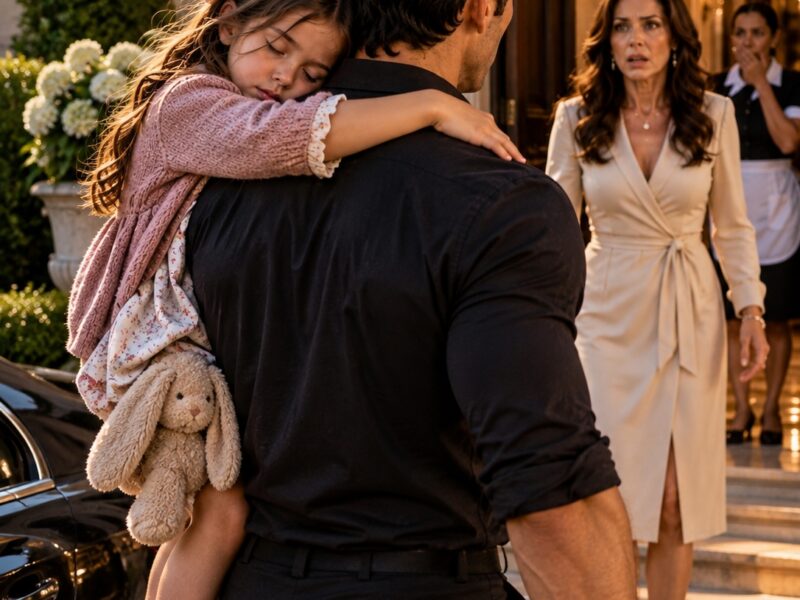
I Picked Up a Little Girl Walking Alone on a Kentucky Road—Then the Woman I Loved Eight Years Ago Opened the Door and Went Pale
The little girl was asleep on my shoulder when the woman I had loved eight years earlier opened her front door and went completely white.
Behind her, an older housekeeper pressed one hand to her mouth.
And Evelyn Whitaker looked at the child in my arms, then at me, and whispered, “Caleb, you need to sit down before I tell you who she is.”
I should probably start by saying I had no idea.
Not a suspicion.
Not some buried instinct I had ignored.
Nothing.
Forty minutes earlier, the seven-year-old asleep against my chest had been a stranger walking alone beside a two-lane Kentucky road with a purple backpack, muddy sneakers, and the kind of determination children usually reserve for getting around bedtime.
My name is Caleb Mercer.
I was thirty-five that fall, owned a small fencing and land-grading company outside Lexington, and had built my life around work that made sense.
Posts went into dirt.
Wire stretched from one corner to another.
Land either drained correctly or it did not.
A gate either hung straight or somebody had done it wrong.
People were harder.
For most of the previous eight years, I had preferred fences.
That Tuesday evening, I had finished repairing three paddocks on a horse farm near Midway and was driving home on Old Frankfort Pike a little after six.
September had started cooling at night, but the fields were still green enough to catch the last gold light.
My radio kept drifting between a country station and static.
A post driver rattled in the truck bed.
Then I saw the girl.
She was walking the shoulder in the same direction I was traveling.
Alone.
Not crying.
Not waving for help.
Just walking.
I slowed.
She looked seven, maybe eight at most.
Dark ponytail.
Purple backpack sliding off one shoulder.
One shoelace untied.
Cars passed on the opposite side fast enough to rock her clothes in their wake.
I rolled down the passenger window.
“Hey.”
She stopped.
“You lost?”
“No.”
The answer came so quickly I almost believed her.
“Where are your parents?”
She adjusted the backpack.
“I’m finding my dad.”
That was not the answer I expected.
“Out here?”
“I think.”
“You think your father is walking Old Frankfort Pike?”
“No.”
She frowned as though I were being intentionally difficult.
“I think he lives somewhere around here.”
A delivery truck came around the curve behind me.
I pulled farther onto the shoulder and stopped.
“Get away from the road for a second.”
She stayed where she was.
I stepped out.
That made her back up.
Smart.
I kept my hands visible.
“Good. You don’t know me.”
She studied me.
“No.”
“My name’s Caleb.”
Her expression changed.
Just slightly.
At the time, I did not understand why.
“Caleb what?”
“Mercer.”
Now she really stared.
I noticed.
“What?”
“Nothing.”
That should have bothered me more than it did.
Instead I pointed toward the truck.
“You can sit inside with the door open while we figure out who I need to call, or I can call the sheriff from here. But I’m not leaving you beside traffic.”
She looked at the truck.
Then at me.
“Are you weird?”
“I build fences.”
“That doesn’t answer it.”
Fair.
“I own a dog named Hank and voluntarily listen to baseball on the radio.”
She considered.
“That sounds a little weird.”
“I’m doing my best.”
Her mouth almost smiled.
Almost.
Finally she climbed into the passenger seat.
I stayed outside until she clicked her seat belt.
Then I got behind the wheel.
“What’s your name?”
“Sadie.”
“Last name?”
“Whitaker.”
My hand stopped on the gearshift.
There are names that belong to people.
Others belong to time.
Whitaker belonged to eight years of mine I had spent pretending did not matter anymore.
“You said Whitaker?”
She nodded.
“Sadie Rose Whitaker.”
“Where do you live?”
“Ashbourne Lane.”
My stomach tightened.
The Whitaker estate was on Ashbourne Lane.
Everybody around Lexington knew the place.
Old horse money.
White fencing.
Stone pillars.
A house large enough to look less built than inherited from some earlier century.
I had worked there once.
Eight years ago.
“Who’s your mom?”
Sadie looked toward the windshield.
“Why?”
“Because you’re seven and walking a highway shoulder looking for your father.”
“She’s going to be mad.”
“Probably.”
“You’re going to tell her?”
“Definitely.”
She crossed her arms.
“This is not going very well.”
“For either of us.”
She was quiet.
Then:
“Evelyn.”
The cab seemed to lose oxygen.
I looked at her.
“Evelyn Whitaker?”
Sadie’s eyes narrowed.
“You know her?”
I put the truck into drive.
“Used to.”
“How?”
“Long story.”
She looked out the window.
“Adults say that when they don’t want to tell you.”
She was not wrong.
I started toward Ashbourne Lane.
For the first two miles neither of us spoke.
Then I asked:
“Why were you looking for your dad?”
Sadie stared through the windshield.
“Today was Family Day.”
“Okay.”
“At school.”
I waited.
She picked at a loose thread on her backpack.
“They call it Family Day because they aren’t supposed to say Dad Day anymore.”
“That seems thoughtful.”
“It isn’t.”
I glanced over.
“Why?”
“Because everybody still brought their dads.”
There it was.
Her voice became flatter.
Not tearful.
Flat was worse.
“Lena’s dad drove from Cincinnati. Tyler’s dad came from Indiana and his parents are divorced. Hannah has two dads, so she got both.”
Sadie swallowed.
“I got Mom.”
“That sounds like somebody worth getting.”
“She is.”
The defense came immediately.
“I love Mom.”
“I didn’t say you didn’t.”
“She tries really hard.”
“I believe you.”
“But Tyler asked why my dad never comes.”
I gripped the wheel.
“What did you say?”
“That I don’t know him.”
She looked down.
“And he said maybe I didn’t have one.”
That quiet little statement did something sharp behind my ribs.
“So you left school to find him.”
“After.”
“After what?”
“I asked Mom where he lived.”
My pulse changed.
“What did she say?”
“That it was complicated.”
I almost laughed.
Not because anything was funny.
Because eight years earlier Evelyn Whitaker had used that same word when we talked about telling her father we were together.
Complicated.
Rich families seemed able to fit whole disasters inside that word.
Sadie continued.
“I found an old box in Mom’s closet.”
I looked at her.
“What box?”
“Pictures.”
My throat tightened.
“One picture had a truck in it with MERCER FENCE AND LAND on the side.”
I nearly missed the next curve.
She noticed.
“You okay?”
“Yeah.”
The old logo.
I had changed it six years ago.
Back then, every truck said MERCER FENCE & LAND CLEARING in yellow letters.
Evelyn had taken photographs of me working on her family’s property.
I had forgotten that.
Or convinced myself I had.
Sadie continued.
“There was a man by the truck.”
My mouth went dry.
“What did he look like?”
She finally turned toward me.
“Like you.”
The road stretched ahead.
Stone walls.
Horse farms.
Oak trees throwing long shadows.
My hands remained at ten and two because if I let either one move, I suspected it would shake.
“Did your mother tell you that man was your father?”
“No.”
“Then how did you know?”
“I didn’t.”
She shrugged.
“But there was something written on the back.”
“What?”
Sadie hesitated.
“Caleb.”
I stopped breathing normally.
“And a date.”
Eight years ago.
I did the math.
Did not want to.
Did it anyway.
“How old are you exactly?”
“Seven.”
She sighed.
“Seven and eight months.”
Eight years since Evelyn disappeared from my life.
Seven years and eight months.
Pregnancy.
The arithmetic fit too cleanly.
I stared at the road.
Sadie watched me.
“You’re doing a weird face.”
“I’m thinking.”
“My mom does that.”
“Poor woman.”
That got the smallest smile.
Then she yawned.
The day had caught up to her.
Within ten minutes, her head leaned against the window.
Five minutes later she was asleep.
I drove the last miles with a child I had known less than an hour sleeping beside me while an entire version of my life rearranged itself.
Eight years earlier, I had been twenty-seven.
My business had barely survived its second year.
I owned one truck outright and owed money on everything else.
The Whitaker family hired me to replace nearly four miles of fencing around one of their breeding farms.
That was how I met Evelyn.
She was twenty-five.
Beautiful, yes.
Everybody noticed that first.
Dark auburn hair.
Green eyes.
A face that belonged on the cover of whatever magazine rich Kentucky horse families read while pretending they were not rich.
But what I remembered was how funny she was when nobody from her family was around.
She used to bring lemonade to the crew and make fun of the ridiculous names people gave thoroughbreds.
We started talking over a broken gate hinge.
Then lunch.
Then dinner at a diner forty minutes away where nobody knew her last name.
Then eight months of trying to build a relationship inside a world that had already decided men like me were supposed to install fences around families like hers, not marry into them.
Her father, Charles Whitaker, found out.
He came to the farm one morning in a navy coat and stood beside my truck while my crew worked fifty yards away.
“You’re good at what you do.”
“Thank you.”
“I’d hate to see Lexington become difficult for you.”
I understood immediately.
“You threatening my contracts?”
“I’m explaining reality.”
“Evelyn isn’t property.”
His smile disappeared.
“No.”
Then:
“She is my daughter.”
As though that ended the conversation.
It did not end mine.
I called Evelyn.
No answer.
Again.
Nothing.
Her number disconnected two days later.
I wrote one letter.
Old-fashioned, stupid maybe, but I wrote it because I needed something to exist outside a phone Charles Whitaker could control.
I mailed it to the estate.
It came back three weeks later marked:
UNDELIVERABLE — ADDRESSEE NOT AT RESIDENCE
I believed it.
Why wouldn’t I?
A mutual acquaintance told me Evelyn had gone to Europe.
Another said she was engaged to somebody in finance.
I heard enough contradictory things to understand nobody actually knew.
Eventually I stopped asking.
That had taken longer than I admitted.
Now her seven-year-old daughter was asleep in my truck.
When I turned onto Ashbourne Lane, Sadie barely woke.
The Whitaker gates were open.
A black SUV sat near the drive.
Lights burned through the front windows.
I parked at the circular drive.
Sadie stirred.
“We’re home?”
“Looks like.”
She tried to sit up.
Then slumped.
“Carry me?”
The request was so ordinary it almost undid me.
“Sure.”
I lifted her.
She wrapped both arms around my neck immediately.
Trusted me.
Forty minutes.
Children either guarded everything or nothing.
I carried her up the stone steps.
Before I reached the bell, the door opened.
Evelyn stood there.
For a second neither of us spoke.
Time does strange things to faces.
You remember somebody at twenty-five, then see them at thirty-three and recognize both versions at once.
Evelyn looked older.
Not old.
Tired around the eyes.
Stronger somehow.
Her hair was shorter.
She wore black slacks and a cream sweater.
Then she saw Sadie.
Her face emptied of color.
“Caleb.”
Behind her stood Carmen Ruiz, the Whitakers’ longtime housekeeper.
Carmen saw me.
Saw Sadie.
Covered her mouth.
That reaction told me everything before Evelyn did.
“Where did you find her?”
“Old Frankfort Pike.”
Evelyn closed her eyes.
“Walking?”
“Yes.”
“Oh God.”
“She was looking for her father.”
Evelyn opened her eyes.
We stared at each other.
Something passed between us.
Recognition.
Fear.
Eight years.
“Come inside.”
“Evelyn.”
“Please.”
I shifted Sadie against my shoulder.
“No more complicated.”
Her jaw tightened.
“I know.”
“No half answers.”
“I know.”
Carmen stepped forward.
“I can take her.”
Sadie’s arms tightened around me in her sleep.
I felt it.
So did Evelyn.
“No.”
My voice came softer.
“I’ve got her.”
Evelyn nodded.
She led me into the front sitting room.
I laid Sadie on a sofa.
Carmen brought a blanket.
I took off Sadie’s sneakers.
One had gravel inside.
That bothered me irrationally.
A kid should not have gravel in her shoe from walking miles looking for a father who lived half an hour away without knowing she had already climbed into his truck.
Evelyn stood in the doorway.
“Caleb.”
I looked at her.
She glanced at Sadie.
Then back.
“She’s yours.”
I had already known.
My body did not care.
My knees actually weakened.
I sat on the edge of an armchair.
“How long have you known?”
“Since before she was born.”
The answer was worse than anything else she could have said.
“All seven years.”
“Yes.”
“Eight, counting pregnancy.”
Her eyes filled.
“Yes.”
I stood.
Not because I intended to intimidate her.
Because sitting felt impossible.
“You knew.”
“Yes.”
“You knew where I lived.”
“Not at first.”
“Evelyn.”
“I tried your old number.”
“My business existed.”
“I know.”
“You knew the company name.”
“Yes.”
“You knew my mother.”
“She moved.”
“To Georgetown. Not another continent.”
“I know.”
Every I know made me angrier.
I lowered my voice because Sadie slept thirty feet away.
“Then explain.”
Evelyn pressed her fingers together.
“My father found out I was pregnant before I could figure out how to contact you.”
“So?”
“He told me you had left.”
“I hadn’t.”
“I know that now.”
“He threatened you before.”
“Yes.”
“And you believed him when he said I disappeared voluntarily?”
She looked away.
“At first.”
“For how long?”
“Too long.”
“That’s not a number.”
“Months.”
I laughed once.
“Months became seven years.”
“Caleb—”
“No.”
My voice nearly rose.
I stopped it.
“You do not get to put my name into the soft part of that sentence.”
She flinched.
I continued.
“You had my daughter.”
“Our daughter.”
“Good correction.”
The anger in me became almost clean.
“And I didn’t know she existed.”
Evelyn’s face broke.
“I was scared.”
“So was I.”
“I had Charles Whitaker telling me he would destroy your business, fight me for custody if I embarrassed the family, cut me off financially while I was pregnant—”
“You had money.”
“That wasn’t the point.”
“Then what was?”
“My entire life was structured around believing he could decide what happened next.”
That stopped me for half a second.
Evelyn took it.
“I’m not telling you that because it excuses me.”
Tears filled her eyes.
“It doesn’t.”
“Good.”
“I know.”
She looked toward the sitting room.
“I kept telling myself I was protecting Sadie from conflict.”
“You were protecting yourself from conflict.”
“Yes.”
The honesty surprised me.
She continued.
“I can see that now.”
“Convenient.”
“I deserve that.”
“No.”
I shook my head.
“This isn’t about what you deserve.”
My voice cracked.
“That’s the whole problem.”
Evelyn stared.
“It’s about what I missed.”
I looked toward Sadie.
“First word.”
Evelyn closed her eyes.
“First step.”
“Caleb.”
“First birthday.”
Her hand covered her mouth.
“First day of kindergarten.”
I swallowed.
“Every time she was sick.”
“I know.”
“Every night she asked about me.”
Evelyn whispered:
“She did.”
That hurt worst.
“What did you tell her?”
“That you didn’t know.”
At least that.
“You didn’t tell her I abandoned her?”
“No.”
“Your father?”
Her face changed.
There.
Another layer.
“What?”
Evelyn looked toward the hallway.
“He told her things once.”
“What things?”
“That some men aren’t meant to be fathers.”
My hands curled.
Evelyn continued quickly.
“I stopped him.”
“When?”
“When she was five.”
“After he said it.”
“Yes.”
I turned away.
I wanted to break something.
Instead I stared at an antique lamp that probably cost more than my first truck.
Then a small voice behind me said:
“Are you mad because I found you?”
Both of us turned.
Sadie stood in the doorway.
Blanket around her shoulders.
Hair flattened on one side.
Evelyn went pale.
“Honey.”
Sadie ignored her.
She looked at me.
“Are you my dad?”
There are moments where every adult instinct tells you to prepare the perfect sentence.
Children rarely need perfect.
They need true.
I crouched.
“Looks like I am.”
Sadie stared.
“Really?”
“I think so.”
“You think?”
“I’m going to get a test because grown-ups like paperwork.”
She considered.
“But you think yes.”
I looked at her face.
The shape of the eyebrows.
The dimple beside her mouth I had not noticed in the truck.
My mother had that dimple.
So did I.
“Yes.”
Sadie’s chin trembled.
Then she whispered:
“I went looking because I thought if I found you myself, maybe you would want me.”
My heart broke so quickly it felt physical.
“Sadie.”
“Mom said you didn’t know.”
“I didn’t.”
“Grandpa said sometimes people stay gone because they want to.”
I closed my eyes.
Evelyn made a small sound.
Sadie continued.
“So I thought maybe if I found you and you saw me, you could decide.”
I reached for her.
Stopped.
She closed the distance herself.
Her arms went around my neck.
I held my daughter for the first time while fully knowing she was my daughter.
“I would have come.”
She pressed her face into my shoulder.
“If I had known you existed, I would have come to everything.”
She did not move.
“School things?”
“Every one they let me into.”
“Birthdays?”
“Yes.”
“Even princess parties?”
I almost laughed through whatever was happening to my throat.
“I would have survived.”
Sadie pulled back.
“You don’t look like you like princesses.”
“I’m flexible.”
That finally produced a smile.
Small.
Careful.
Then she looked at Evelyn.
“Mom, are you in trouble?”
Evelyn knelt.
“No.”
Sadie looked at me.
“Are you mad at Mom?”
“Yes.”
Evelyn flinched.
I continued.
“But that is an adult problem.”
Sadie watched me.
“It is not your job to fix it.”
Her shoulders lowered.
Evelyn began crying silently.
Sadie touched her cheek.
“Don’t cry.”
Evelyn kissed her hand.
“I’m okay.”
“No, you’re not.”
I looked away.
Like I said.
Children notice.
By midnight, Sadie was asleep upstairs.
I was still there.
Evelyn and I sat in the kitchen because neither of us wanted to argue near her bedroom.
“I want a paternity test.”
“Yes.”
“Legally supervised.”
“Whatever you want.”
“I want counsel.”
She nodded.
“I already have a family attorney.”
“Of course you do.”
“Caleb.”
“I’m not using yours.”
“I wasn’t suggesting that.”
“Good.”
Evelyn took a breath.
“What do you want with Sadie?”
That question offended me until I realized she genuinely needed the answer.
“Everything I’m entitled to that is good for her.”
She looked surprised.
“Not everything I can get.”
Her shoulders relaxed slightly.
“I am not taking her away from the only home she knows because I’m furious at you.”
Tears returned to Evelyn’s eyes.
“But I’m not being treated like an optional uncle either.”
“No.”
“And your father gets no vote.”
Her face hardened.
“No.”
That was new.
I noticed.
Evelyn saw me notice.
“He won’t control this.”
“You said that about your life once too.”
The words came out before I could stop them.
She absorbed the hit.
“You’re right.”
I regretted it.
Not enough to apologize for the truth.
Enough to realize there was no value in sharpening every fact into a weapon.
“I need time.”
“I know.”
“I don’t know what I feel about you.”
“I know.”
“Stop saying that.”
A tired laugh escaped her.
“Sorry.”
I stood.
At the kitchen door, Evelyn said:
“Caleb.”
I looked back.
“I did try more than once.”
I waited.
“After Sadie was born, I wrote you three letters.”
My pulse changed.
“What?”
“I mailed two.”
“I never got them.”
“I know.”
“How?”
“They came back.”
“Marked what?”
“Unknown.”
I stared.
“I have lived at the same address twelve years.”
Evelyn went still.
“So somebody intercepted them.”
We both knew who.
“My father handled household mail.”
She whispered it.
I remembered my own letter.
Returned.
Undeliverable.
Something ugly clicked into place.
“Evelyn.”
Her face changed.
“What?”
“I wrote you.”
She stopped breathing.
“One letter.”
“When?”
“Two weeks after your number went dead.”
“You never—”
“I did.”
“I never got it.”
“It came back.”
We stared at one another.
Eight years of silence shifted.
Not disappeared.
Changed shape.
Evelyn whispered:
“He intercepted both sides.”
“Maybe.”
“No.”
She stood.
Her chair scraped.
“I know where he keeps old papers.”
“What?”
“My mother’s desk.”
“Evelyn.”
But she was already moving.
I followed her through the house.
Up a curved staircase.
Past family portraits.
Into a wood-paneled office that had belonged to her mother before she died.
Evelyn opened cabinets.
Drawers.
Nothing.
Then she stopped before an old locked secretary desk.
“Dad used this after Mom died.”
“You have the key?”
“No.”
“Don’t break it.”
She looked at me.
“You build fences.”
“Not antique furniture.”
“I’m asking whether you know locks.”
“No.”
Then Carmen appeared in the doorway.
Neither of us had heard her.
She held a small brass key.
Evelyn stared.
“Carmen?”
The older woman looked frightened.
“I should have given you this years ago.”
The entire room went silent.
“What do you mean?”
Carmen looked at me.
Then Evelyn.
“Your father told me never to open that desk.”
Evelyn’s face went white.
Carmen’s eyes filled.
“I found envelopes once when cleaning.”
“How long ago?”
“Seven years.”
Evelyn whispered:
“And you said nothing.”
“I needed the job.”
Not excuse.
Fact.
Carmen looked ashamed anyway.
“My husband had just lost his insurance.”
Evelyn closed her eyes.
“I understand.”
I did too.
Power spreads responsibility unevenly.
That did not erase choices.
It explained some.
Carmen handed her the key.
Evelyn opened the desk.
Inside the lower drawer sat a bundle of mail tied with cotton string.
Her hands shook.
The first envelope carried my handwriting.
Evelyn Whitaker
Eight years old.
Never returned.
My stomach dropped.
“This isn’t the one that came back.”
“No.”
Meaning Charles had intercepted at least one.
Evelyn found another.
Her handwriting.
Addressed to me.
Postage attached.
Never mailed.
Another.
And another.
I stared at them.
“You wrote.”
“Yes.”
“But didn’t mail these.”
“I gave them to Dad’s assistant.”
“He said he mailed them?”
“Yes.”
She looked sick.
I picked up my unopened letter.
Charles Whitaker had not merely threatened us.
He had controlled information moving in both directions.
Then convinced each of us silence belonged to the other person.
The door behind us opened.
Charles stood there.
Seventy now.
Tall.
Silver hair.
The kind of posture old money teaches men to preserve after their bodies begin disagreeing.
He saw the desk.
The letters.
Me.
His expression barely changed.
“I wondered when Carmen would lose her nerve.”
Evelyn stared at him.
“You knew.”
“Of course.”
My hands tightened.
Evelyn moved before I did.
Not toward him.
Between us.
That told me she knew what my face looked like.
“You intercepted his letter.”
Charles looked at her.
“I prevented a mistake.”
“You intercepted mine.”
“I protected you.”
“From what?”
“A contractor with no resources, no family standing, and nothing resembling the life you had been raised for.”
I laughed once.
“Good to see you too.”
He ignored me.
Evelyn held up one envelope.
“You kept my daughter from her father.”
“I kept my granddaughter from instability.”
My anger became cold.
“You have no idea what kind of father I would have been.”
“I knew what kind of life you could offer.”
“That isn’t the same question.”
Charles looked at me then.
“You had one truck.”
“I have fourteen now.”
“Congratulations.”
“You missed the point.”
“No.”
His voice remained calm.
“I understand the point perfectly. You survived. You built something. Perhaps separation benefited you.”
I almost crossed the room.
Evelyn’s hand touched my arm.
Not restraining.
Reminding.
Sadie was upstairs.
I breathed.
Evelyn looked at her father.
“You told me he chose to disappear.”
“I told you what you needed to accept.”
“You lied.”
“I made a decision.”
“For me.”
“Yes.”
“For Caleb.”
“Yes.”
“For Sadie.”
His confidence faltered.
Only slightly.
Evelyn saw it.
“No.”
Her voice became quieter.
“You don’t get to include her.”
Charles stiffened.
“I have raised that child beside you for seven years.”
“And today she walked a county road alone because she thought nobody wanted to be her father.”
His face changed.
That landed.
Evelyn continued.
“She did that inside the life you call protected.”
Charles said nothing.
For the first time, the richest man in the room had no useful explanation.
I took my old letter.
“You keep the rest.”
Evelyn looked at me.
“No.”
She gathered every envelope.
“They’re evidence.”
Charles stared.
“Evidence of what?”
“Interference.”
His face hardened.
“You plan to drag this family through court?”
“I plan to make sure you cannot rewrite this again.”
There she was.
Not the twenty-five-year-old woman who disappeared because her father said disappear.
Someone else.
Or maybe finally herself.
I left at one in the morning.
Sadie slept upstairs.
I did not wake her.
Before I reached my truck, Evelyn came outside.
“Caleb.”
I stopped.
“I’m sorry.”
I looked at her.
Not just angry now.
That would have been easier.
“I believe you’re sorry.”
She cried silently.
“That’s not forgiveness.”
“I know.”
I nodded.
“But it’s something true.”
The next morning, I called Martin Shaw.
He had handled land contracts and one ugly dispute when a developer tried to run utilities through property I owned without an easement.
Family law was not his specialty.
He referred me to Dana Brooks.
Dana was forty-eight.
Sharp.
No patience for dramatic fathers.
She listened to my story without interrupting.
Then said:
“First, we establish paternity.”
“Yes.”
“Second, you do not threaten custody in anger.”
“I won’t.”
“Third, do not let anybody use the child as a messenger.”
“Agreed.”
“Fourth, courts care a lot less about your heartbreak than you do.”
I almost smiled.
“Good.”
“They care about the child’s stability.”
“Also good.”
Dana leaned back.
“If this child is yours, you begin behaving like a father before any judge tells you to.”
“What does that mean?”
“Show up.”
The same day, Evelyn called.
“She keeps asking whether you’re coming back.”
My throat tightened.
“Can I see her Saturday?”
“Yes.”
“No test result yet.”
“I know.”
“You’re okay with that?”
Evelyn paused.
“I have known who her father is for eight years.”
Saturday, Sadie waited on the front steps.
She had apparently been waiting twenty minutes because I was ten minutes early.
I parked.
She ran.
Stopped halfway.
Then walked.
As if she had remembered she was not sure what the rules were.
I got out.
“You can run.”
She looked at me.
“I didn’t want to look too excited.”
That broke me in a completely different way.
“You can look however you feel.”
She ran the rest.
I crouched.
She threw herself into me.
“You came.”
“Told you.”
“People say that.”
“I know.”
I stood with her in my arms.
“So I’m going to become extremely annoying about proving it.”
She laughed.
We spent the morning on my property.
Evelyn came too.
Not because I required supervision.
Because Sadie asked.
My dog Hank accepted her immediately.
That offended me because Hank usually required at least three meetings before respecting anybody.
Sadie threw a tennis ball.
Hank returned it.
“You said he’s better than people.”
“He is.”
“Even me?”
“You’re under review.”
She laughed.
Later we sat on the tailgate.
I showed her a fence tensioner.
She looked unimpressed.
“You said you build things.”
“I do.”
“This is wire.”
“It becomes a fence.”
“So if I stack cereal boxes, I build houses.”
“Structural standards differ.”
Evelyn laughed behind us.
The sound hit me unexpectedly.
Sadie looked between us.
“Did you used to know each other?”
“Yes,” I said.
“How much?”
Evelyn nearly choked on coffee.
“Enough.”
“That’s suspicious.”
She had my sense of timing.
I was doomed.
The paternity test came back eleven days later.
99.9998 percent.
I read the number three times.
Then sat at my kitchen table while Hank rested his head on my boot.
Official.
My daughter.
Not mathematically probable anymore.
Not emotionally obvious.
Legal fact.
Eight years compressed into one laboratory report.
I cried.
Quietly.
Then called Evelyn.
She answered immediately.
“Got it?”
“Yes.”
Silence.
“Caleb.”
“What?”
“I’m sorry you needed paper to tell you something I should have told you years ago.”
I stared at the result.
“The paper isn’t telling me.”
“What?”
“It’s making sure nobody gets to untell me later.”
She understood.
Charles hired lawyers.
Of course he did.
His attorney contacted Dana before Charles ever contacted me.
They proposed what the document called a “gradual integration framework.”
Dana read it.
Then looked at me.
“They want one supervised visit every other Saturday for ninety days.”
I laughed.
“No.”
“Correct.”
“Why supervised?”
“Because your involvement is new.”
“My knowledge is new.”
Dana nodded.
“Important distinction.”
We countered.
Regular weekends.
Midweek dinner.
School access.
Medical information.
Shared decision-making introduced gradually.
No overnight visits first month because Sadie had never slept away from Evelyn except with grandparents.
That made sense.
I agreed.
Charles hated that Dana and I sounded reasonable.
Reasonable people are harder to paint as threats.
He came to my property personally.
No lawyer.
Black Mercedes.
Navy coat.
Same man.
Older body.
Same assumption that arriving meant control.
I met him beside the workshop.
“What do you want?”
“To spare everyone unnecessary conflict.”
“Interesting opening.”
He ignored that.
“I am prepared to ensure your business receives preferred contracts across several properties.”
I stared.
“In exchange for?”
“You maintain a measured role.”
“A father role?”
“A practical role.”
“Define practical.”
“Regular contact.”
He paused.
“Without destabilizing Sadie’s home.”
I almost admired how beautifully wealthy men could wrap exclusion in considerate language.
“You mean I don’t seek shared custody.”
“I mean you consider what is best for her.”
“I have.”
“And?”
“I think knowing her father is best.”
“You can know her without transforming her entire life.”
I stepped closer.
Not threatening.
Enough that he had to look directly at me.
“You cost her seven years.”
His jaw tightened.
“I protected Evelyn.”
“You controlled Evelyn.”
“I kept your instability away.”
“My instability is currently fourteen employees, a paid-off house, and a company that turned down two Whitaker contracts last year because your project manager pays late.”
He stared.
I continued.
“But none of that matters.”
“What matters?”
“If I still had one truck, she would still deserve her father.”
His expression shifted.
Very slightly.
I had finally named the class judgment he preferred not to hear spoken.
“You think biology gives you unlimited rights.”
“No.”
“Then what?”
“Responsibility.”
I looked toward my house.
“Sadie was inside unpacking a bag Evelyn let her bring over for the afternoon.”
“I am not asking permission.”
Charles said nothing.
“I’m not disappearing because your family finds me inconvenient.”
“You may regret antagonizing me.”
There it was.
Old Charles.
I almost smiled.
“You said something like that eight years ago.”
He looked at me.
“Difference is, now I know what you can take.”
I paused.
“And what you can’t.”
He left.
I did not feel victorious.
I went inside.
Sadie was sitting on my floor with Hank, examining an old photograph album my mother had given me.
She held up a picture.
“Is that you?”
I looked.
Me at eight.
Missing front tooth.
Baseball uniform.
“Unfortunately.”
She stared.
“You look like me.”
My throat tightened.
“Yeah.”
She put the photograph beside her face.
“We have the same eyebrows.”
“We do.”
“Mom says I frown like you.”
“She has eight years of evidence.”
Sadie became quiet.
Then asked:
“Are you going to disappear?”
My body went still.
“No.”
She looked at the photo.
“Mom said you didn’t before.”
“I didn’t know.”
“That means you were gone without knowing.”
“Yes.”
“What if something happens again and you don’t know?”
There was no clean promise available.
Children who have experienced absence are not soothed by impossible certainty.
“I could tell you nothing will ever happen.”
She waited.
“But that would be a lie.”
Her eyes lifted.
“What I can do is make it very difficult for you not to know where I am.”
“How?”
“You’ll have my number.”
“You’ll know my house.”
“You’ll know my work.”
“You’ll know Dana.”
“Who is Dana?”
“My lawyer.”
Sadie frowned.
“Why do I need your lawyer?”
“You don’t.”
“Then why would I know her?”
“Fair question.”
That got half a smile.
I continued.
“And I’ll show up enough times that eventually you won’t have to wonder every time.”
Sadie leaned against Hank.
“How many times?”
“As many as it takes.”
She nodded.
Not convinced.
But listening.
That was the beginning.
Real fatherhood was less dramatic than finding your child on a highway.
It involved snacks.
Calendars.
School forms.
Knowing which yogurt she hated because it had “bits.”
Learning that Sadie became quiet before she became upset.
Discovering she read two grades above level but hated multiplication.
Knowing she slept with one foot outside the blanket.
Recognizing the difference between “I’m fine” meaning fine and “I’m fine” meaning she needed ten minutes before trying again.
My first overnight visit happened six weeks after the paternity result.
Sadie packed enough for a month.
Evelyn stood beside the truck.
“She has allergy medication.”
“Front pocket.”
“She sometimes wakes around two.”
“What helps?”
“Water first.”
“And?”
Evelyn hesitated.
“If she’s scared, sit in the doorway.”
“Why doorway?”
“She doesn’t like people disappearing when she closes her eyes.”
That sentence stayed with me.
At 2:17 a.m., Sadie called:
“Dad?”
First time.
I woke instantly.
She stood in the hallway.
Hair wild.
Eyes half closed.
I did not mention the word.
Not then.
“What’s up?”
“Bad dream.”
I sat in her doorway.
She climbed back into bed.
“Can Hank come?”
“Hank thinks every room is his.”
He entered before invited.
Sadie put one hand on his back.
“Are you staying?”
“I’m right here.”
“Until I sleep?”
“Yes.”
She closed her eyes.
Ten minutes later, her breathing slowed.
I remained another twenty.
Because I had seven years of absence to argue against.
And absence does not lose because of one promise.
It loses by getting outnumbered.
Evelyn changed too.
For years she had allowed Charles into every practical corner of her life.
Accounts.
School choices.
Property decisions.
Business.
Even Sadie’s activities.
Now she began removing him.
Slowly.
Painfully.
He called it rebellion.
She called it adulthood.
One evening I dropped Sadie home and heard them arguing inside before anyone noticed me.
“You are embarrassing this family.”
Charles.
Evelyn answered:
“No.”
“What?”
“I am embarrassing you.”
Silence.
“There’s a difference.”
I should have left.
Instead I waited on the porch because Sadie was beside me.
She looked up.
“Grandpa’s mad.”
“Sounds like.”
“Mom’s getting better at mad.”
I almost smiled.
The door opened.
Evelyn saw us.
Her face changed.
“Sorry.”
“No need.”
Charles appeared behind her.
Sadie ran past him.
“Grandpa!”
He softened immediately.
Human beings rarely divide cleanly into villains and good people.
Charles loved Sadie.
That was true.
He had also made decisions that harmed her because he believed love gave him authority.
Also true.
That contradiction became harder for everyone than simple hatred would have been.
Sadie loved him.
I refused to make her choose.
When Charles came to one of her soccer games, he sat twenty feet from me.
Neither of us spoke.
Sadie scored once.
We both stood.
For one second we cheered the same child.
Then remembered each other.
That was our relationship for months.
The first major custody hearing came in January.
Not a courtroom war.
A family-court conference room.
Dana beside me.
Evelyn and her attorney across the table.
Charles was not legally a party.
He came anyway.
The mediator, Judge Ellen Price, retired, seventy, with the facial expression of someone deeply unimpressed by wealthy families, opened with:
“This child has two parents.”
Charles moved.
Judge Price held up a finger.
“And one grandfather.”
He sat back.
She reviewed the reports.
Stable home.
Positive visits.
No safety concerns.
Sadie asking for more time with me.
School counselor reporting reduced anxiety since regular contact began.
Judge Price looked at Evelyn.
“Objection to shared parenting?”
Evelyn glanced at her father.
Then at me.
“No.”
Charles turned.
“Evelyn.”
She did not look at him.
“No.”
That single word changed the room.
Judge Price nodded.
We moved toward a shared schedule.
Not fifty-fifty immediately.
Three weekends each month.
One overnight midweek.
Holidays divided.
Gradual expansion during summer.
Medical and school decisions shared.
I signed.
Evelyn signed.
Charles did not have anything to sign.
I suspected that hurt him more than losing the argument.
Outside the courthouse, Evelyn stood beside me.
“Thank you.”
“For?”
“Not trying to punish me through her.”
I looked at her.
“I wanted to.”
She absorbed that.
“Sometimes.”
“I know.”
“But every time I pictured winning something by making Sadie lose you, it felt wrong.”
Evelyn nodded.
“That’s more grace than I gave you.”
“No.”
I shook my head.
“It’s not grace.”
“What is it?”
“Parenting.”
She cried in the courthouse parking lot.
I let her.
Spring brought another Family Day.
The school had changed the name again.
“Family Celebration.”
Sadie still called it Dad Day.
She gave me the invitation six weeks early.
“I put it in three places.”
“Why?”
“So you don’t forget.”
“I won’t.”
“Calendar too.”
“I saw.”
“And Mom texted.”
“She did.”
“And I told Hank.”
“Hank is unreliable.”
She stared.
“This is serious.”
“I know.”
The event started at nine.
I arrived at 8:23.
Sadie saw me through the gym doors.
She ran.
No hesitation this time.
I barely caught her.
“You’re early!”
“I’ve got seven years to make up.”
She squeezed my neck.
Across the gym, Evelyn watched.
Her eyes filled.
I nodded to her.
She smiled.
Tyler—the boy who once asked whether Sadie had a father—was there.
He stared at me.
Sadie noticed.
“This is my dad.”
Tyler shrugged.
“Okay.”
Children can build whole traumas around moments the other child forgets by Tuesday.
Sadie looked almost disappointed.
Then laughed.
We made a cardboard horse barn.
Mine was structurally sound.
Sadie covered the roof in glitter.
I objected.
She said architecture needed joy.
I had no answer.
At the end, the teacher asked each child to write one sentence about family.
Sadie wrote slowly.
Then handed me the paper.
MY DAD DIDN’T KNOW WHERE I WAS, SO I WENT AND FOUND HIM. NOW HE KNOWS.
I read it twice.
“Accurate.”
She leaned against me.
“You’re not going to get lost again.”
“No.”
“Good.”
Evelyn invited me to lunch afterward.
Just the three of us.
I almost declined.
Then Sadie said:
“Normal families eat after school things.”
There was nothing normal about us.
We went anyway.
At the restaurant, Sadie talked enough for all three.
Evelyn and I avoided dangerous subjects.
Until Sadie went to the bathroom with the waitress because she had somehow charmed the woman into showing her the dessert case.
Evelyn looked at me.
“She calls you Dad all the time now.”
“I know.”
“How does it feel?”
I thought.
“Like somebody handed me something I already lost and told me I’m allowed to keep it if I don’t drop it.”
Evelyn’s eyes filled.
“I’m sorry.”
“I know.”
There it was again.
But I did not hate hearing it anymore.
She continued.
“I found another letter.”
My body tightened.
“Where?”
“My father’s desk.”
“What letter?”
“One I wrote when Sadie was two.”
“Addressed to me?”
“Yes.”
“Why didn’t you mail it yourself?”
“I had.”
She placed a photocopy on the table.
A postal tracking receipt.
Delivered.
Signed for at my old shop.
My stomach dropped.
“I never got this.”
“I know.”
“Who signed?”
She pointed.
R. MERCER
My uncle Robert.
I had forgotten he sometimes collected mail when I was away on jobs.
Robert died four years ago.
I stared.
“What happened?”
“I don’t know.”
That uncertainty bothered me.
I searched old storage at the shop.
Two weeks later, I found the letter.
Unopened.
Behind a file cabinet.
Probably dropped.
Nothing sinister.
No Whitaker plot.
No deliberate betrayal.
An ordinary accident.
That mattered.
Not every missing message belonged to Charles.
Not every pain needed one villain.
I gave Evelyn the unopened letter.
“You want to read it?”
She shook her head.
“You wrote it.”
“That version of me wrote it.”
“You sure?”
“Yes.”
I opened it.
She had written:
Caleb,
Sadie walked today without holding furniture. I almost called you. I still don’t know whether calling you would make anything better or only destroy what Dad says is stable. I hate that I don’t know which decision is courage and which is selfishness.
I stopped.
Evelyn looked down.
The letter continued.
I think about you every time she frowns. She does it exactly like you.
My throat tightened.
I am sorry. I do not know how to fix what I already let happen.
It ended there.
No dramatic confession.
No plan.
Just fear.
I folded it.
“You should have called.”
“Yes.”
“I would have come.”
“I know.”
“Now.”
She looked at me.
“Yes.”
I hated that time changed the meaning of knowledge.
We could not rescue our younger selves by finally understanding them.
All we could do was stop repeating them.
That summer, Sadie spent half the week with me.
Her room became permanent.
Not guest-room permanent.
Her room.
Purple wall.
Books.
A bulletin board.
One shelf dedicated to rocks she insisted were individually meaningful.
I installed a small desk.
She complained it faced the wrong direction.
We moved it.
Fatherhood humbled efficiently.
One evening she sat on the kitchen counter eating strawberries.
“Were you in love with Mom?”
Direct.
“Yes.”
“Still?”
I almost dropped a plate.
“Eat your strawberries.”
“That’s not an answer.”
“No.”
“It is avoiding.”
She had learned vocabulary from Dana or Evelyn.
Dangerous.
“I care about your mom.”
“That sounds boring.”
“Good.”
“She likes you.”
“You have homework.”
“She does.”
“Math.”
“She looks different when you leave.”
“Multiplication.”
Sadie sighed.
“You adults are exhausting.”
Correct.
Evelyn and I did not rush toward reconciliation.
That would have been dishonest.
There were nights I looked at her and remembered the woman I loved.
Then remembered seven birthdays.
There were times she touched my arm and I wanted closeness before anger arrived behind it.
Both things could exist.
We started therapy.
Not couple’s therapy.
Co-parent counseling.
Important difference.
Dr. Lena Morris asked us once:
“What would reconciliation require?”
I answered first.
“Trust.”
Evelyn said:
“Choice.”
We looked at each other.
Dr. Morris smiled faintly.
“Those are related.”
Evelyn explained.
“My relationship with Caleb originally existed inside my father’s rules.”
She looked at me.
“Then our separation did too.”
I listened.
“If anything ever happened between us again, I would need to know I chose it without fear.”
I nodded.
“And I’d need to know you’re here because you want me, not because Sadie makes us look like a family.”
That hurt.
Because I had wondered the same thing.
Months passed.
Sadie turned eight.
I attended her birthday.
A horse-themed party.
Yes, there were actual ponies.
Whitakers.
Charles came.
He stood at the edge.
At one point Sadie grabbed both our hands.
“Picture.”
I looked at him.
He looked at me.
We complied.
The photographer took one photograph.
Sadie between her father and grandfather.
Two men who had spent months measuring each other as enemies.
She smiled.
Later Charles found me near the stable.
“I owe you an apology.”
I almost laughed because those words from him seemed medically improbable.
“For which decade?”
His jaw tightened.
Progress had limits.
He continued.
“I believed Evelyn would eventually thank me.”
“She didn’t.”
“No.”
He looked toward the party.
“I thought stability was something you could build for other people if you had enough control.”
“That sounds familiar.”
He noticed the barb.
Accepted it.
“She became weaker because I solved everything.”
“No.”
I shook my head.
“She became afraid of disappointing you.”
He looked at me.
“That’s different.”
“Yes.”
Charles watched Sadie.
“She adores you.”
“I adore her.”
“That frightens me.”
I did not expect honesty.
“Why?”
“Because people leave.”
I stared.
Charles rarely spoke about his wife, Margaret.
She died when Evelyn was nineteen.
Suddenly I understood something.
Not excuse.
Structure.
He had lost his wife unexpectedly.
Then spent the next twenty years trying to prevent uncertainty by controlling every person he loved.
“You can’t keep people by deciding for them.”
“I know.”
He almost smiled.
“Now.”
We stood quietly.
I did not forgive him that day.
But I stopped needing him to remain a monster.
That freed more space than forgiveness might have.
A year after I found Sadie, Evelyn sold part of her interest in the Whitaker family business.
Charles opposed it.
She did it anyway.
She bought a smaller house fifteen minutes from mine.
No gates.
No stone pillars.
A front porch.
Sadie loved it.
“You downgraded,” I told Evelyn.
“Upgraded.”
“How?”
“I can find the kitchen without a map.”
Fair.
The first evening I dropped Sadie there, we sat on the porch.
Sadie ran inside.
Evelyn stayed.
“Coffee?”
I hesitated.
“Is this co-parent coffee?”
“No.”
“What kind?”
“The kind where I’m asking you to sit with me because I want you here.”
That phrase mattered.
I sat.
We talked two hours.
Not about custody.
Not Charles.
Not what had happened.
Work.
Books.
My employees.
Her plans.
The person each of us had become while the other was absent.
At ten, I stood.
Evelyn walked me to the truck.
“Caleb.”
“Yeah?”
“I’m not asking for the old relationship back.”
“Good.”
“That sounded enthusiastic.”
“The old one ended badly.”
She laughed.
Then became serious.
“I’d like to know whether something new is possible.”
I looked at her.
“We go slow.”
“Yes.”
“Sadie does not get told anything until we know what it is.”
“Yes.”
“You don’t let your father decide.”
A faint smile.
“He would enjoy hearing how often that requirement appears.”
“Not my problem.”
Evelyn stepped closer.
“Anything else?”
“Yes.”
“What?”
“No disappearing.”
Her face softened.
“No disappearing.”
Our first date happened eight years and fourteen months after our last one.
A restaurant in Georgetown.
Nothing fancy.
Evelyn ordered pie before dinner because she said adulthood should have benefits.
I remembered why I had loved her.
That scared me.
She saw.
“You okay?”
“No.”
“Good.”
I stared.
She smiled.
“Means I’m not the only one.”
We did go slowly.
Very.
Sadie figured it out anyway.
Of course.
One morning she saw Evelyn’s car at my house before school.
She walked into the kitchen.
Looked at me.
Looked at Evelyn.
Then at two coffee mugs.
“You are extra friends.”
I nearly choked.
Evelyn laughed.
“That phrase again.”
Sadie climbed onto a stool.
“Are you getting married?”
“No,” both of us said.
She looked suspicious.
“Eventually?”
“Eat breakfast.”
“You adults still avoid.”
We did not remarry quickly.
There was no reason.
I had learned that love proved little without structure.
Evelyn had learned the same about fear.
Two years after Sadie found me, Evelyn and I bought nothing together.
That sounds unromantic.
It was deliberate.
We dated.
Co-parented.
Kept separate homes.
Made sure wanting one another did not become needing one another for stability.
Then, on a Saturday in June, Sadie and I were repairing a fence on my property.
She was nine.
Almost ten, according to her, because halves apparently remained important.
She held a level against a post.
“It’s crooked.”
“It is not.”
“It is.”
I checked.
Crooked.
“Do not become arrogant.”
“That’s your job.”
I laughed.
Evelyn drove up.
She carried lemonade.
The same way she had the first summer we met.
I watched her walk across the field.
Memory layered itself over present.
Twenty-seven-year-old Evelyn.
Thirty-five-year-old Evelyn.
The woman who loved me.
The woman who failed me.
The mother who raised Sadie.
The daughter who learned to stand up to Charles.
All true.
Sadie followed my gaze.
“You’re doing that face.”
“What face?”
“The Mom face.”
“There is no Mom face.”
“There is.”
Evelyn reached us.
“What are you discussing?”
“Dad loves you.”
I dropped the wrench.
Evelyn raised an eyebrow.
Sadie looked pleased.
“I’m going to check the other post.”
She walked away.
Coward.
Evelyn handed me lemonade.
“You want to answer the child’s accusation?”
“I have counsel.”
“You do.”
I took the cup.
“Yeah.”
Evelyn became still.
“I do.”
Her eyes filled.
“Okay.”
“Okay?”
She laughed.
“Your daughter does it too.”
“Our daughter.”
That correction no longer hurt.
It healed.
We married the following spring.
Small ceremony.
My property.
No ballroom.
No society page.
Charles attended.
Carmen attended.
Dana attended and warned me she billed extra for emotional events.
Sadie stood between us.
Before the ceremony she pulled me aside.
“Dad.”
“What?”
“You have to promise something.”
“I’m nervous already.”
“If you and Mom get mad, you can’t disappear.”
I crouched.
“Listen to me.”
She looked serious.
“Adults can stop being married.”
Her face tightened.
I continued quickly.
“But I will never stop being your father.”
“Even if Mom is terrible?”
Evelyn called from across the yard:
“I heard that.”
Sadie whispered:
“Answer.”
“Even then.”
“What if you’re terrible?”
“Then your mother will probably tell me efficiently.”
Sadie laughed.
Then hugged me.
“Okay.”
That word again.
A child closing the deal.
Years later, people occasionally called what happened fate.
I never liked that word.
Fate makes it sound like nothing depended on choices.
A seven-year-old chose to leave school.
Bad choice.
She chose to walk a county road.
Terrible choice.
I chose to slow my truck.
Good choice.
Evelyn eventually chose truth over fear.
Late choice.
Charles eventually chose to stop controlling what he could not bear to lose.
Very late choice.
None of those were fate.
They were people.
Messy.
Afraid.
Sometimes wrong for years.
Then right for one crucial minute.
Sadie is thirteen now.
She hates when I tell the story.
Not because she is embarrassed she ran away.
Because she thinks I exaggerate how far she walked.
“I had a plan.”
“You were seven.”
“I had snacks.”
“You had one granola bar.”
“Still.”
She spends alternating weeks between our place and the smaller house Evelyn kept and now rents out because, according to Sadie, owning two houses makes us “accidentally fancy.”
Charles is older.
Quieter.
He and I will never be close.
But he comes to Sadie’s school events and no longer assumes the best seat belongs to him.
That is something.
Carmen retired.
Sadie sends her birthday cards.
Dana remains the first person I call when Sadie asks questions about driving age because apparently lawyers are useful for saying no in expensive language.
Hank died last winter.
Sadie held him at the end.
That loss brought back old fears.
One night after his burial, she asked:
“Do you ever think about the day you found me?”
“Yes.”
“Every day?”
“No.”
She frowned.
“That’s rude.”
I smiled.
“Not forgetting isn’t the same as thinking about something every day.”
She leaned against me.
“Would you have driven past if I was on the other side?”
“No.”
“How do you know?”
“Because you were a kid alone near traffic.”
“That’s boring.”
“Most decent choices are.”
She was quiet.
Then:
“I think I found you.”
“I know.”
“You always say you picked me up.”
“You were on the road. I physically picked you up.”
“That is not what I mean.”
I did know.
She found an old picture.
Found a name.
Made a reckless decision.
Walked toward a father she did not know.
Then climbed into a truck without realizing the man driving was the person she had gone looking for.
At thirteen, she understands how unlikely that was.
So do I.
But the part that stays with me is not coincidence.
It is what happened after.
Finding someone is easy compared with building a life where they trust you will remain found.
The day I picked Sadie up, she was looking for evidence that her father wanted her.
I thought one sentence could answer that.
I would have come if I knew.
True.
Not enough.
What convinced her was Saturday.
Then Wednesday.
Then another Saturday.
Then a school event.
Then a bad dream.
Then birthdays.
Then sitting outside a bathroom with stomach flu at two in the morning.
Then teaching her to drive a tractor too early according to Evelyn.
Then apologizing when I lost my temper.
Then showing up after she slammed a door and said she hated me because I would not let her go to Louisville with seventeen-year-olds.
Fatherhood turned out to be a long argument against the one fear she carried out of childhood.
People disappear.
Some do.
Some die.
Some leave.
Some are forced out.
Some get scared.
Some make bad choices.
I cannot promise Sadie a world where nobody ever goes.
What I can give her is evidence.
Years of it.
I was cleaning the garage last month when I found the purple backpack.
Evelyn had kept it.
Mud stain still near the bottom.
One broken zipper.
Inside the smallest pocket was an old photograph.
I recognized it immediately.
Me beside the Mercer Fence truck.
Twenty-seven.
Tanned.
Too thin.
Evelyn had taken it.
On the back, in her handwriting:
Caleb — Ashworth Farm, June
Below that, newer handwriting.
A child’s.
MAYBE MY DAD
I sat on the garage floor holding it.
Sadie found me.
“What are you doing?”
I held up the photograph.
Her face went red.
“Oh.”
“You wrote this?”
“I was seven.”
“I gathered.”
She sat beside me.
For a while neither of us spoke.
Then she took the picture.
“I remember thinking you looked nice.”
“I did.”
“You looked dirty.”
“Fence work.”
“And Mom kept your picture.”
“Apparently.”
Sadie looked toward the house.
“She really loved you.”
I thought.
“Yes.”
“She messed up.”
“Yes.”
“Grandpa messed up more.”
“Yes.”
“You did too sometimes.”
I looked at her.
“Excuse me?”
She smiled.
“Not then.”
She handed the photograph back.
“After.”
Fair.
I slipped it into my wallet.
Sadie noticed.
“You keeping it?”
“Yes.”
“Why?”
I looked at the words.
MAYBE MY DAD
“Because you don’t have to write maybe anymore.”
Her face changed.
Teenager disappeared.
Seven-year-old came back for one second.
She leaned into me.
I put an arm around her.
Then she said:
“You know that is extremely cheesy.”
“I’m your father.”
“It’s contractual.”
“Actually biological.”
“Worse.”
We sat on the garage floor laughing.
Evelyn opened the door.
“What are you two doing?”
“Dad’s being emotional.”
“Again?”
I looked offended.
“There’s no respect in this family.”
Sadie stood.
She started inside.
Then turned back.
“Dad?”
“Yeah?”
“You would have come, right?”
Thirteen years old.
Still asking.
Less often.
But some questions live a long time.
I stood.
“Every time.”
She nodded.
This time there was no doubt on her face.
“Okay.”
Then she went inside.
I stayed in the garage another minute holding the old photograph.
Eight years had been taken from us.
Nothing ever gave them back.
No paternity test.
No court schedule.
No apology.
No marriage.
No forgiveness.
That is the part people sometimes miss when they want stories like mine to end with everything repaired.
Some losses remain losses.
The best you can do is stop paying interest on them forever.
I missed Sadie’s first seven birthdays.
I was there for eight through thirteen.
I missed first steps.
I taught her to ride a bicycle.
I missed her first word.
I heard the first time she called me Dad.
I missed kindergarten.
I will be there when she graduates.
If she lets me, I’ll be there when she goes to college.
If she marries, I’ll try not to threaten whoever she brings home.
Evelyn says nobody believes that promise.
Fair.
The purple backpack now hangs on a hook in my workshop.
Sadie says that is weird.
Maybe.
I keep it because it reminds me that sometimes the most important thing in your life does not arrive properly introduced.
Sometimes it is walking down the shoulder of a Kentucky road with one untied shoe.
You slow down because it is the decent thing to do.
You roll down the window.
You ask if she is lost.
And she tells you no.
She knows exactly what she is looking for.
You just do not know yet that it is you.









