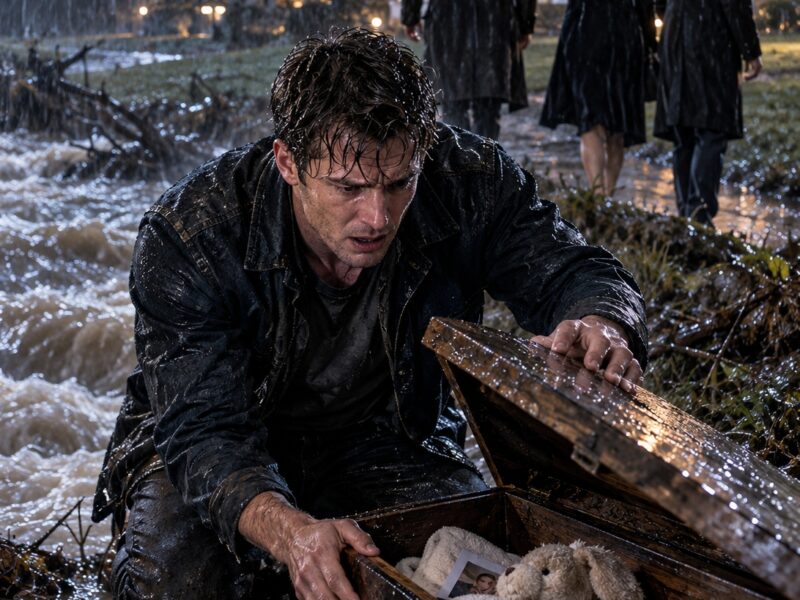
I Saw My Parents Dump a Small Casket Into the Flooded Creek—What I Found Inside Exposed the Secret They Had Buried With My Sister
The small wooden casket hit the flooded creek at 11:43 on a Thursday night.
My father watched it disappear beneath the brown water.
My mother turned her face away.
My older brother checked his shoes for mud.
And I stood behind an oak tree twenty yards away, understanding for the first time that there are moments when a family does not break.
It reveals what it has always been.
Rain came sideways across the Whitmore estate outside Franklin, Tennessee, hard enough to blur the white columns of the main house into pale streaks beyond the trees.
I had returned for a camera bag.
That was all.
An old Nikon body, two lenses, and a hard drive I had left in the converted carriage house after photographing some restoration work earlier that afternoon.
I parked near the service gate because I did not want to see my father.
At thirty-three, I had finally learned that avoiding Harrison Whitmore was sometimes the closest thing available to peace.
Then headlights moved behind the trees.
Not on the driveway.
Across the east field.
I stopped.
My father and my brother Grant appeared first.
Both wore dark raincoats.
Between them they carried a narrow wooden box.
Not a shipping crate.
Not quite a coffin.
Something in between.
About three feet long.
Heavy enough that Grant cursed when one boot sank into the mud.
My mother, Celeste, followed beneath a large black umbrella that kept turning inside out in the wind.
She was crying.
I almost stepped from the trees.
Then I heard my father.
“Careful.”
Grant adjusted his grip.
“This thing weighs nothing.”
“Then stop complaining.”
The creek roared fifteen feet below them.
It had flooded over its ordinary banks after three days of rain, churning around broken branches and fence posts before bending south toward the Harpeth River.
Celeste said:
“Harrison.”
My father did not look at her.
“We agreed.”
“I know.”
“Then don’t make this harder.”
A flash of lightning whitened the field.
For one second I saw all three faces clearly.
Grant looked irritated.
My mother looked sick.
My father looked calm.
That frightened me most.
They reached the bank.
Grant set his end down.
“What about the hospital?”
“Handled.”
“The death certificate?”
“Handled.”
“And Price?”
“Still incarcerated.”
Grant nodded.
My hands went cold.
Price.
Caleb Price.
My dead sister Audrey’s boyfriend.
The man my family had spent seven months pretending had ruined her life.
My father picked up his end again.
“The trust language is clean once the child is legally deceased.”
Grant looked toward the creek.
“And Audrey’s shares?”
“Revert to the surviving family beneficiaries.”
To Grant.
To me.
But mostly to Grant, because I had signed away my voting rights years earlier to escape the family company.
My stomach dropped.
Celeste whispered:
“Please don’t say it like that.”
My father finally looked at her.
“Like what?”
“Like this is paperwork.”
His face changed by almost nothing.
“You wanted the scandal contained.”
“I wanted my daughter alive.”
“Audrey is dead.”
My mother flinched.
“And this does not bring her back.”
The box moved.
Grant and Harrison swung it once.
Twice.
My father counted.
“Three.”
The casket left their hands.
It struck the water flat.
For one impossible second, it floated.
Then the current caught it.
Celeste made a sound.
Small.
Animal.
Grant wiped rain from his face.
My father said:
“It is better this way.”
My whole body went still.
“The trust stays intact.”
He turned toward the house.
“Let the creek take the rest.”
They walked away.
None of them looked back.
I waited perhaps two seconds.
Maybe less.
There are decisions you remember making.
There are others your body makes before your mind has been consulted.
I ran.
The bank dropped sharply.
My boots slipped.
I hit one knee, grabbed wet grass, got up again.
The box was already thirty yards downstream.
A fallen sycamore had caught it near the opposite bank.
I entered the water.
The cold punched the breath out of me.
The current took my legs sideways.
I grabbed a branch.
Moved.
Another.
The casket shifted.
“No.”
I do not remember shouting the word.
I remember hearing it.
I reached the box as the branch beneath it began bending.
One hand found a metal handle.
I wrapped my wrist through it.
The branch broke.
The current took both of us.
For perhaps ten yards I had no control.
Then my boots found rock.
I pushed.
Dragged.
Slid.
A second branch slowed us long enough for me to force the box toward the bank.
By the time I crawled onto mud, my hands could barely close.
The box had been nailed shut.
There was no latch.
No lock.
Just screws and finishing nails beneath a layer of dark sealant.
I stared.
Then I heard something.
Not crying.
Not movement.
A faint knock.
From inside.
My entire body changed.
I fell onto the lid.
“Hello?”
Nothing.
“Can you hear me?”
Another sound.
Small.
I grabbed a river stone and struck the corner of the lid.
Again.
Again.
The wood split.
I tore at it.
A nail caught my palm.
I barely felt it.
The corner opened enough for my fingers.
I pulled until the whole side lifted.
Inside was a wool blanket.
Clear plastic.
A small blue hospital cap.
Then a face.
A baby.
I stopped breathing.
He was tiny.
Premature.
Maybe five pounds.
His skin looked pale beneath the lightning.
His eyes were closed.
There was medical tape on one ankle.
A hospital identification band had been cut through.
I ripped the plastic away from his face.
“No, no, no.”
I placed two fingers against his neck because I had once taken a first-aid course and because some useless piece of memory told me babies had pulses in places adults forgot to check.
Nothing.
Then—
There.
A flutter.
So faint I thought I had imagined it.
I opened his blanket.
His chest moved.
Barely.
The child inside the casket was alive.
I pulled him against my body beneath my jacket.
His skin was cold.
I rubbed his back.
“Come on.”
Rain struck us.
“Come on, little man.”
He made no sound.
I bent close.
A breath touched my cheek.
Then another.
His mouth opened.
A weak cry came out.
Not loud.
Not cinematic.
A thin exhausted complaint against the world.
It was the most important sound I had ever heard.
I sat in the mud and cried.
Not beautifully.
Not quietly.
Because six months earlier my younger sister Audrey had disappeared.
Three days earlier I learned she had died.
And now I was holding her son.
The child my father had just tried to erase because, under the Whitmore family trust, his existence changed who controlled nearly a quarter of a billion dollars.
I looked toward the house.
Warm windows glowed beyond the rain.
My parents were already inside.
Grant too.
Maybe pouring whiskey.
Changing clothes.
Telling themselves the problem was finished.
I held the child closer.
“You’re not going back there.”
He made another weak sound.
“I don’t know how I’m going to do this.”
That was true.
“But you’re not going back.”
The promise came before the plan.
The plan had to come fast.
My name is Evan Whitmore.
At least it was then.
I was the second son of Harrison Whitmore, founder and chairman of Whitmore Communities, a commercial and residential real-estate company that had spent forty years turning farmland around Nashville into office parks, subdivisions, shopping centers and enough political influence to make local reporters use the phrase “regional institution” when they meant “company nobody wanted to offend.”
We were rich.
Not glamorous-tech-founder rich.
Older than that.
Land rich.
Trust rich.
The kind of rich that makes a family start confusing its balance sheet with its moral worth.
Grant loved it.
He was thirty-six then and had been preparing to succeed my father since his first internship at sixteen.
He understood leverage.
Debt.
Zoning.
Public image.
He could walk through a room of bankers and remember exactly whose child needed an internship and whose wife wanted a hospital-board seat.
I became a photographer.
My father considered this an act of aggression.
Audrey became a painter.
He considered that temporary.
She was six years younger than Grant and four younger than me.
Growing up, Audrey was the only person in that house who could make silence feel comfortable rather than strategic.
She painted everything.
The pond.
The gardener’s shed.
My mother at the piano.
Grant once sleeping with his mouth open on a flight to Aspen.
She painted people best when they did not know she was looking.
My father hated that.
“You make people look tired,” he told her once.
“They are tired,” she replied.
She was sixteen.
I loved her immediately for it.
By twenty-three she had become a problem the family did not know how to solve.
Not because she drank.
Not because she embarrassed herself.
Audrey’s rebellion was quieter.
She refused to become useful.
My father wanted her on charity boards.
She volunteered at an after-school art program.
My mother wanted her photographed beside the son of a banking family.
Audrey dated a mechanic.
His name was Caleb Price.
I discovered them accidentally.
I had gone to East Nashville to photograph a custom restoration shop for a magazine.
Caleb stood beneath a 1968 Mustang with oil to his elbows.
Audrey sat at a workbench painting on a scrap piece of sheet metal.
I almost left.
Then she saw me.
Her face changed.
Not guilt.
Fear.
Caleb stepped between us.
He did not know who I was.
“Can I help you?”
Audrey said:
“Caleb.”
He looked at her.
“My brother.”
His shoulders lowered.
Not much.
Enough.
I said:
“I’m Evan.”
He wiped his hand before offering it.
“Caleb.”
That told me more than the expensive men my father invited to dinner ever had.
He cared whether he put grease on my hand.
Over the next four months, I helped them lie.
I am not especially proud that lying became necessary.
I am proud I chose them when it did.
Audrey came to my apartment twice a week.
Caleb picked her up in an old Ford truck.
Sometimes they ate dinner with me.
Sometimes I went to his shop.
He never asked about Audrey’s trust.
He did not know its value for nearly three months.
When she finally told him, he became angry.
Not excited.
“You should’ve told me.”
“I thought you’d leave.”
“That is a terrible reason not to tell me.”
“I know.”
He walked outside.
Returned ten minutes later.
Then asked:
“Do you still want pizza?”
That was Caleb.
Not perfect.
Present.
By early November, Grant found out.
He hired someone to follow Audrey because she had missed two family dinners and once lied about where she was going.
Photographs appeared on my father’s desk.
Audrey kissing Caleb beside the shop.
Audrey laughing inside his truck.
Audrey carrying groceries into a small duplex he had rented.
My father summoned us.
I arrived halfway through the argument.
Audrey stood in the study.
Grant leaned against the bar.
My mother sat near the fireplace, hands folded too tightly.
My father held photographs.
“You have embarrassed this family.”
Audrey’s face was wet.
“No.”
“You have.”
“I fell in love.”
Grant laughed.
“Those are not opposites.”
Audrey looked at him.
“You wouldn’t recognize love unless it came with voting rights.”
His smile vanished.
My father said:
“That man is interested in what you represent.”
“He didn’t know who I was when we met.”
“He owns an auto shop.”
“Yes.”
“His father was a machinist.”
“Yes.”
“His mother works for the county.”
“Yes.”
“And you genuinely believe he entered your life without understanding your surname?”
Audrey’s hands shook.
“He loves me.”
Harrison leaned back.
“Children say that.”
“I’m twenty-three.”
“Then stop behaving like you’re thirteen.”
That was when she said it.
“I’m pregnant.”
The room changed.
My mother stood.
Grant’s glass stopped halfway to his mouth.
My father stared.
“How far?”
“Four months.”
I looked at Audrey.
She looked at me.
There was apology in her face.
Not for the child.
For not telling me.
Harrison asked:
“Does Price know?”
“Yes.”
“Have you discussed marriage?”
“Yes.”
Grant said:
“Oh, this is perfect.”
Audrey turned.
“Shut up.”
He looked at our father.
“The trust.”
That word entered before anything human did.
I understood later why.
Our grandfather’s estate plan divided controlling shares in Whitmore Communities among his grandchildren.
Grant held thirty-four percent.
I held twenty-two, though I had placed most voting control in a neutral trust after leaving the business.
Audrey held twenty-two.
The rest remained in charitable and family vehicles.
If Audrey died without descendants, most of her interest reverted to Grant’s line.
If she had a child, that child inherited.
Caleb, as surviving parent and eventual guardian, could influence those shares until adulthood.
My father did not see a grandson.
He saw a mechanic with access to a board seat.
Audrey saw it happen on his face.
“You’re doing math.”
He said nothing.
“You’re actually doing math right now.”
“Audrey.”
“You heard pregnant and you started calculating shares.”
My mother whispered:
“Please.”
Audrey stepped backward.
“No.”
She looked around the room.
“No, I’m done.”
My father’s voice sharpened.
“You are not leaving.”
She stared.
“Watch me.”
He took her phone.
Grant took her car keys.
I wish I could tell you I stopped them.
I didn’t.
That is one of the worst truths of my life.
My father looked at me.
“If you involve yourself, the studio lease I guaranteed disappears tomorrow.”
I said:
“I can manage.”
“I’ll make sure you cannot.”
He named two clients.
Then a gallery owner.
Then a bank.
People I depended on.
Not illegally.
Not explicitly.
Simply enough influence to make my small life difficult.
I stood there.
Afraid.
Audrey looked at me.
She did not ask for help.
That made it worse.
The next night I went to her room.
She was packing.
“I’m getting you out.”
“No.”
“Yes.”
“Caleb has a plan.”
“I can drive.”
“Evan.”
She grabbed my arm.
“If they see your car, they’ll know.”
“I don’t care.”
“I do.”
Her hand moved to her stomach.
“I need one person they don’t think is helping me.”
That sentence kept me still.
“Where will you go?”
“I can’t tell you.”
“Why?”
“Because Dad knows how to make people talk.”
I looked away.
Audrey softened.
“I trust you.”
“That’s why I’m not telling you.”
She hugged me.
Then whispered:
“If something happens, don’t believe the first story.”
I pulled back.
“What does that mean?”
She shook her head.
“Nothing.”
“Audrey.”
“Promise.”
“What?”
“Don’t believe the first story.”
I promised.
By morning, she was gone.
My father announced she had entered a European art program.
My mother told people she needed privacy.
Grant said she would return “once she was tired of pretending poverty was romantic.”
I did not believe them.
But I wanted to believe Audrey was safe badly enough that I accepted silence as evidence.
Six months passed.
Then Martha Bell called.
Martha had worked in the Whitmore house since I was thirteen.
She was the only employee my mother never quite managed to treat as furniture because Martha had once told her directly that money did not make a person interesting.
Blocked number.
Nine at night.
“Evan.”
Her voice broke.
“Where are you?”
“Studio.”
“Go to your truck.”
“What happened?”
“Your sister.”
Everything inside me stopped.
“Martha.”
“She never went to Europe.”
I sat down.
“Where is she?”
“County Memorial.”
“Why?”
“She’s dying.”
The drive took fifty-two minutes.
I remember none of it clearly.
I remember arriving.
Grant’s Bentley.
My father arguing with a hospital administrator about press access.
My mother holding her purse.
“Where is Audrey?”
Harrison looked at me.
“Gone.”
I heard the word.
Did not understand it.
“What?”
“She died forty minutes ago.”
My knees weakened.
“From what?”
“Complications.”
“What complications?”
He looked annoyed that grief required details.
“Preeclampsia.”
I stared.
“You knew she was here?”
Silence.
“How long?”
My mother looked away.
Grant answered.
“Two days.”
I turned.
“You knew for two days?”
“She refused treatment initially.”
“Then transfer her.”
“She refused.”
“Get a specialist here.”
Grant’s jaw tightened.
“You have no idea what was happening.”
“Then tell me.”
My father said:
“A transfer to Vanderbilt would have created attention.”
I stared.
“What?”
“The merger vote is next week.”
The sentence was so absurd my brain rejected it.
Grant continued because men like my brother mistake explanation for defense when the explanation sounds financially rational.
“Audrey was living under another name.”
“She had no insurance network.”
“Price was arrested.”
“The hospital called because they discovered her identity.”
“A helicopter transfer with our family name attached would have brought media.”
I grabbed the edge of a chair.
“You let her stay here because reporters might notice?”
“She was already critical.”
“That is not what I asked.”
Nobody answered.
“Where is Caleb?”
Grant’s mouth changed.
That smile.
Small.
Satisfied.
“County detention.”
“For what?”
“Auto theft conspiracy.”
I stared.
“He didn’t steal cars.”
“Apparently his shop stored parts connected to three stolen vehicles.”
“No.”
I knew instantly.
Not proof.
Knowledge.
My family had removed him.
Audrey had been alone.
I whispered:
“The baby.”
My mother began crying.
“A boy.”
“Alive?”
“Yes.”
“Where?”
“NICU.”
My father said:
“The state will handle placement.”
I looked at him.
“That’s your grandson.”
“He is a legal complication born from a relationship Audrey entered against advice.”
I do not remember crossing the space between us.
I remember Grant stepping in.
Martha appearing at the end of the hall.
I remember saying:
“Say that again.”
My father did.
“He is not coming into my house.”
The house.
Always the house.
The shares.
The name.
The story.
I went to the NICU window.
The boy was tiny.
A monitor beside him blinked.
He had Audrey’s nose.
I knew that immediately.
A nurse asked who I was.
“Uncle.”
She checked a chart.
Then hesitated.
“Mr. Whitmore?”
“Yes.”
“Your father’s attorney was here.”
I turned.
“Why?”
She looked uncomfortable.
“You need to speak with administration.”
The next twenty-four hours remain fragmented.
Audrey’s body.
A closed funeral plan.
My father’s lawyer, Preston Vale, telling me guardianship was “being handled.”
Caleb denied bail.
Grant taking calls about the merger from a hospital parking lot.
Then a text from Martha.
They’re moving the baby tonight. I heard your father say no paper trail. East service drive.
I called the sheriff.
Stopped.
My father had donated the sheriff’s campaign office.
That did not mean corruption automatically.
But I no longer had the luxury of guessing wrong.
I drove to the estate.
Parked near the service gate.
Took my camera.
Not because I planned anything.
Because I had spent fifteen years using a camera whenever I did not know what else to do with my hands.
Months earlier, I had installed two wildlife trail cameras near the creek for a photo series.
I had forgotten them.
That accident later saved us.
I hid among the trees.
Then saw my family carrying the box.
Now I held Audrey’s child against my chest in the rain.
I did not take him to anyone connected to the Whitmores.
I drove west until I found a twenty-four-hour emergency department attached to a small regional hospital.
I walked in soaked.
“Help.”
That was all.
They did.
The baby’s temperature was dangerously low.
He had been sedated.
Not with enough medication to kill him on its own.
Enough to keep him quiet and make an already premature infant dangerously unresponsive.
The physician asked how I found him.
I told the truth.
Almost all of it.
Then asked them to call state investigators outside Williamson County.
Within three hours, a Tennessee Bureau of Investigation agent arrived.
Her name was Dana Reeves.
Forties.
No-nonsense.
Hair twisted into a bun.
She listened once.
Then said:
“Do you have evidence?”
“Trail cameras.”
Her expression changed.
“Where?”
“My property.”
“Can anyone access them remotely?”
“No.”
“Then nobody goes there except us.”
For the first time that night, I felt someone else take the problem seriously without asking whether my father was important.
Dana contacted a prosecutor.
A juvenile-court judge authorized emergency protective custody before sunrise.
Because I was a biological uncle and because the immediate threat appeared to come from other relatives, I was not automatically given the baby.
Good.
At the time I hated that.
Later I understood it was exactly what made everything credible.
The child entered protective medical custody.
I submitted DNA.
Caleb’s DNA was collected through counsel.
Audrey’s medical tissue samples existed.
The results established parentage.
The boy was Audrey and Caleb’s son.
I was his uncle.
My parents were his grandparents.
And someone had forged a neonatal death entry twelve minutes before he was removed from the hospital.
That was our first real piece of the case.
The judge sealed the proceeding because investigators believed disclosure could endanger the child and compromise a criminal inquiry.
My father believed the creek had completed his plan.
Nobody corrected him.
Three weeks later, I received temporary kinship guardianship.
Six months later, after extensive review, permanent guardianship.
I named the baby Noah.
Audrey had once told me if she ever had a son, she liked the name.
I did not know whether Caleb agreed.
He was still in prison.
His case became another problem the Whitmore machine seemed able to keep buried.
I moved.
Not secretly.
Legally.
New address protected through court order.
No social media.
No photographs of Noah online.
Dana warned me:
“Do not become an amateur investigator.”
“I’m a photographer.”
“That’s amateur investigator with lenses.”
Fair.
I listened.
Mostly.
For eight years, I raised Noah.
He was difficult as a baby.
Not emotionally.
Medically.
Prematurity left him with reflux and respiratory issues.
I slept in a chair beside his crib more nights than I can count.
His first fever terrified me so badly the pediatrician eventually put her hand on my shoulder and said:
“Uncle Evan, babies get fevers.”
I said:
“This one isn’t allowed.”
She smiled.
“He didn’t sign that agreement.”
Noah grew.
At two, he loved trucks.
At three, paint.
At four, he asked why other children had mothers.
I told him:
“Yours loved you.”
“Where is she?”
“She died.”
“Why?”
“She got very sick.”
“Did I make her sick?”
“No.”
I answered too quickly.
He stared.
“Noah, listen to me.”
I knelt.
“You did not make your mother sick.”
“Not even a little?”
“Not even a little.”
He nodded.
Children can accept truth when adults do not decorate it.
At five, he found a photograph of Audrey.
She was twenty.
Paint on her cheek.
Laughing.
“That’s my mom?”
“Yes.”
“She looks like me.”
“You look like her.”
He liked that difference.
At six, he started painting.
Not coloring.
Painting.
The first real piece was an old stray cat sitting on our fence at dusk.
Noah mixed purple into the shadow under its body.
Audrey used to do that.
She said black shadows were lazy.
I went into the bathroom and cried.
Then bought him better brushes.
He never knew why.
Meanwhile, Dana Reeves kept calling every few months.
The attempted killing of Noah had evidence.
But not enough yet.
Trail footage showed Harrison and Grant carrying the box.
Celeste nearby.
It did not show what was inside.
The hospital records were corrupted.
The orderly who transported Noah disappeared.
The physician who signed the false death entry resigned and moved overseas.
My father’s attorney denied everything.
The Whitmores claimed the box contained private medical materials connected to Audrey’s burial.
Disgusting.
But legally possible without more.
The investigation widened.
Financial crimes.
Trust records.
Payments.
Caleb’s case.
That was where Miriam Cole entered our lives.
Miriam was a former federal prosecutor turned private attorney specializing in corporate fraud and wrongful convictions.
Dana introduced us carefully.
“You speak to her only about the civil side unless I’m present.”
Miriam smiled.
“She means I’m expensive.”
“I mean lawyers contaminate witnesses.”
“You see why we’re friends?”
Miriam reviewed Caleb’s conviction.
Then Audrey’s trust.
Then Whitmore Communities.
She found the first clean motive.
Audrey’s child inherited twenty-two percent of a family holding company.
Not immediately spendable.
But real voting power once the trust matured.
Until then, the child’s legal guardian appointed an independent fiduciary.
If Caleb regained custody, he could petition for influence over that fiduciary.
Grant’s succession plan depended on consolidating control before the company’s planned public offering.
If Audrey died childless, her shares reverted mostly to Grant’s branch.
No child.
No complication.
Miriam looked at me across her office.
“This isn’t about embarrassment.”
“Not mainly.”
“What is it?”
“Control.”
She tapped the trust.
“Your nephew was worth approximately two hundred and eighty million dollars in future equity the day he was born.”
I felt sick.
“He was four pounds.”
“Your father saw percentages.”
That sentence haunted me.
Three years before Noah’s eighth birthday, a break came.
The physician who signed the false neonatal death record returned to the United States because his own marriage collapsed and immigration on his second home became complicated.
Dana’s team interviewed him.
He asked for counsel.
Then cooperation.
His statement connected Preston Vale, my father’s attorney, to the forged record.
Money moved through a consulting entity.
The same entity had paid a witness in Caleb’s auto-theft case.
Miriam called me at midnight.
“They used the same shell company.”
“For Noah and Caleb?”
“Yes.”
“Can that reopen Caleb’s case?”
“Maybe.”
“Maybe?”
“Evan.”
She always used my name when I was trying to turn hope into a legal conclusion.
“We prove things in order.”
“I’m tired of order.”
“I know.”
“Order is why they keep winning.”
“No.”
She leaned toward the camera during the video call.
“Order is why when they finally lose, they stay lost.”
I wrote that down.
Caleb had served nearly seven years by then.
I visited once.
He refused a second visit.
The first was brutal.
Prison visitation room.
Plastic chair.
Thicker man than I remembered.
Hair shorter.
Face older.
He sat across from me.
“Where’s Audrey?”
I looked down.
He understood.
“No.”
“I’m sorry.”
“No.”
His hands closed.
“She died?”
“Yes.”
“When?”
“Seven years ago.”
Caleb stood.
The guard moved.
I said:
“There’s something else.”
He stared at me.
I could not tell him about Noah.
Not yet.
The protective order remained.
Investigators feared information could leak through prison monitoring.
I hated myself.
Caleb said:
“What else?”
I swallowed.
“We’re working to overturn your case.”
His face changed.
“That’s what you came to say?”
“I came to say I believe you.”
He laughed once.
“Seven years late.”
“Yes.”
He sat.
Then whispered:
“They planted those parts.”
“I know.”
“Grant.”
“We think so.”
“You think?”
His eyes sharpened.
“I watched his lawyer stand outside my shop the week before the raid.”
I filed that away for Dana.
Caleb leaned forward.
“Evan.”
“Yes?”
“If you find whoever did this…”
He stopped.
I waited.
“Don’t become them.”
I had expected anger.
He gave me a warning.
That was the moment I understood why Audrey loved him.
Noah’s eighth year began quietly.
School.
Soccer he disliked.
Art he loved.
A statewide youth competition accepted one of his paintings.
Title:
Creek at Dusk.
I almost asked him to submit something else.
The painting showed a dark river.
A house on a hill.
A woman holding a lantern near the bank.
“What is this?”
Noah shrugged.
“The story you tell me.”
“What story?”
“Mom.”
I sat.
“I never told you there was a creek.”
“You said she liked water.”
True.
“You said she painted storms.”
True.
He pointed to the woman.
“That’s her.”
“Why the house?”
He shrugged.
“It was in my head.”
Children inherit things besides eye color.
Not memories exactly.
Patterns.
Imagery.
Ways of making meaning.
I let him submit it.
He won.
The awards exhibition would be held in Nashville.
Miriam hated the idea.
Dana hated it more.
“It’s public.”
“Yes.”
“Your family sponsors half the arts infrastructure in middle Tennessee.”
“Yes.”
“You know they may attend.”
“Yes.”
Noah listened from the kitchen.
Then walked in.
“Who may attend?”
Silence.
I had always answered him honestly at the level he could hold.
Now he was eight.
Old enough to notice secrecy.
I said:
“Some relatives we don’t see.”
“Why?”
“Because they made dangerous choices.”
“About Mom?”
“Yes.”
“About me?”
I looked at Miriam on the laptop.
Then at Noah.
“Yes.”
He absorbed it.
“Are they why we don’t use my pictures online?”
“Yes.”
He thought.
“Do they know I’m alive?”
“No.”
“Would they hurt me?”
Miriam spoke gently.
“We are making sure they cannot.”
Noah looked at me.
“Do you want me to skip the show?”
Every protective instinct in my body said yes.
Instead:
“What do you want?”
“I won.”
“Yes.”
“I want my painting there.”
I closed my eyes.
Then nodded.
“Then it goes.”
The exhibition was held in a contemporary gallery near downtown Nashville.
Glass walls.
White concrete.
Champagne.
Donors.
Politicians.
Art patrons.
Parents taking photographs.
Noah wore a navy suit and red tie.
He hated the tie.
“Five minutes.”
“You said twenty.”
“I negotiated.”
“You’re eight.”
“That’s discrimination.”
I laughed.
Then saw the doors.
My father entered first.
Seventy now.
Still straight-backed.
Still silver-haired.
Grant beside him.
Forty-four.
Sharper.
Leaner.
My mother behind.
Pearls.
Black dress.
She looked smaller.
Not physically.
Something else.
Eight years of secrets weigh differently on people.
They had no idea I was there.
No idea Noah was there.
Then Celeste saw the painting.
She stopped.
Her champagne glass tilted.
Not enough to fall.
Her hand began trembling.
Grant followed her gaze.
My father frowned.
“What?”
My mother walked toward the canvas.
“No.”
Grant said:
“Mother.”
She ignored him.
Her face emptied.
She stared at the painted woman.
The lantern.
The water.
Then the white columns in the background.
“Audrey.”
My father’s jaw tightened.
“Stop.”
“She painted light like this.”
“Celeste.”
“She always put yellow under white.”
Grant looked around.
“People are watching.”
That sentence.
Even now.
The gallery director approached.
“Mr. Whitmore.”
My father smiled instantly.
Practice.
“Daniel.”
“We’re honored.”
“Beautiful event.”
The director gestured toward Noah’s painting.
“This is our junior grand-prize winner.”
My mother whispered:
“Who?”
Daniel smiled.
“Noah Mercer.”
My nephew stepped from behind a group of teachers.
Blue eyes.
Audrey’s nose.
Caleb’s jaw beginning to appear beneath childhood softness.
My mother made a sound.
Grant stepped backward.
My father did not move.
That was his gift.
Stillness.
Noah looked at them.
Polite.
Curious.
The director said:
“Noah, these are some of our major sponsors.”
Noah held out his hand.
My father looked at it.
Then at his face.
Then at the painting.
He knew.
The transformation took perhaps three seconds.
No courtroom would ever capture what I saw.
Recognition.
Disbelief.
Fear.
Calculation.
Then me.
I stepped from behind a column.
“Hello, Dad.”
My mother’s knees almost gave.
“Evan.”
Grant whispered:
“You.”
I walked to Noah.
Put one hand on his shoulder.
Not ownership.
Reassurance.
Noah looked up.
I said:
“This is my nephew.”
My father’s mouth tightened.
“You need to leave.”
“No.”
“Now.”
“No.”
Grant moved closer.
“You have no idea what you’re doing.”
I almost smiled.
“I’ve had eight years.”
His face changed.
There it was.
The first real fear.
My mother looked at Noah.
“He’s alive.”
Grant snapped:
“Mom.”
She covered her mouth.
Noah looked between us.
“Uncle Evan?”
“I’m right here.”
My father lowered his voice.
“Take the child and go.”
“The child.”
I repeated it.
“You tried very hard to make him one.”
Grant leaned closer.
“Five million.”
I stared.
“What?”
“Cash.”
“Tonight.”
“You disappear.”
“Custody remains uncontested.”
“You never mention any of this.”
My father said:
“Grant.”
But not because the offer offended him.
Because Grant had said it too publicly.
A reporter near us had turned.
So had two donors.
I looked at my brother.
“You still think the price is the problem.”
His eyes hardened.
“You are committing extortion.”
“I haven’t asked you for anything.”
“You stole a ward of the state.”
“No.”
I looked at my father.
“I pulled your grandson out of a casket.”
My mother began crying.
Grant went pale.
The room around us quieted.
My father whispered:
“Careful.”
I nodded.
“Yes.”
“I’ve been careful for eight years.”
Then Daniel, the gallery director, walked toward the projection wall.
Not bribed.
Not surprised.
Prepared.
Miriam stood beside him.
My father saw her.
He knew her reputation.
That was when the evening truly changed.
Miriam said:
“Mr. Whitmore.”
He stared.
“Ms. Cole.”
“You know why I’m here?”
“No.”
“You will.”
The projection changed.
Sponsor logos vanished.
A date appeared.
No dramatic soundtrack.
No commentary.
Just trail-camera footage.
Rain.
Trees.
Three figures.
My father.
Grant.
My mother.
Carrying a narrow wooden box toward the creek.
Gasps moved through the gallery.
My father turned gray.
Grant said:
“Deepfake.”
Too fast.
Miriam looked at him.
“The original storage card has remained in state evidence custody for eight years.”
Grant stopped.
The footage continued.
My father and Grant swung the casket.
Released it.
The box hit the water.
My mother turned away.
Noah stared at the screen.
I had not intended for him to watch.
I crouched.
“Daniel.”
The director killed the projection.
Noah looked at me.
“Was that me?”
Silence.
I did not lie.
“Yes.”
His eyes filled.
“Did they know?”
I looked at my father.
“Yes.”
The answer broke something in my mother.
“No.”
Everyone turned.
Celeste walked forward.
“No.”
My father said:
“Celeste.”
She shook her head.
“I knew they were moving him.”
Her voice trembled.
“I knew Harrison said the death record had to stand.”
“I knew Grant said the trust had to remain clean.”
“But I told myself the box…”
She stopped.
My father’s face hardened.
“Enough.”
Celeste looked at him.
For perhaps the first time in her life, she did not obey.
“I told myself he was already dead.”
Grant hissed:
“You were at the hospital.”
She turned.
“You told me the sedative would stop his breathing.”
The gallery became absolutely still.
Grant stared.
Miriam did too.
That sentence was not in any evidence file.
My father said:
“Celeste.”
She backed away from him.
“You said he wouldn’t feel anything.”
Grant’s expression collapsed.
Reporters raised phones.
My mother looked at Noah.
“I’m sorry.”
Noah moved closer to me.
Not her.
Good.
Miriam stepped between them.
“Mrs. Whitmore, you need counsel before you say anything else.”
My mother laughed through tears.
“I’ve had counsel for forty years.”
She looked at Preston Vale.
He stood near the entrance.
He had arrived with my father.
His face had gone blank.
Celeste pointed.
“Him.”
Vale turned.
The gallery doors opened.
Federal agents entered.
Not dramatically.
No running.
No rifles.
Dark suits.
Badges.
A state investigator beside them.
Dana Reeves.
Eight years older.
Same expression.
My father looked at me.
“You did this.”
I shook my head.
“No.”
“You did.”
“No.”
I looked at Noah.
“You did this the night you decided he was worth less than your company.”
Agents approached Grant first.
Then my father.
Preston Vale tried to leave.
An agent blocked him.
Noah whispered:
“Are they going to jail?”
“I don’t know.”
That was true.
“Are we safe?”
I looked at Dana.
Then Miriam.
Then my family.
“Yes.”
For the first time, I believed it.
The arrests did not destroy the Whitmore family.
The truth did.
That distinction matters.
Arrests are events.
Truth changes every room afterward.
My mother cooperated within forty-eight hours.
Not nobly.
Her attorney negotiated.
In exchange for consideration on obstruction and conspiracy charges, she surrendered records.
Trust documents.
Private ledgers.
Emails.
Payments.
The physician.
The hospital orderly.
The investigator hired to follow Audrey.
And the account used to pay the confidential informant in Caleb’s fabricated auto-theft case.
Grant had authorized that payment.
Preston Vale had arranged the evidence placement through a corrupt subcontractor.
Caleb’s conviction began collapsing.
My father blamed everyone.
Grant blamed my father.
Vale blamed Grant.
The physician blamed Vale.
Men who had called themselves loyal for decades suddenly became excellent historians.
Whitmore Communities entered emergency governance.
The board removed Harrison and Grant.
Lenders froze transactions.
The public offering disappeared.
Several development deals were investigated for unrelated fraud the federal records exposed.
The company did not become worthless overnight.
Reality is rarely that tidy.
It was broken apart.
Legitimate assets survived.
Corrupt contracts did not.
Shareholders sued.
Banks demanded restructuring.
The family trust went into court supervision.
Noah’s twenty-two percent interest, the interest they had tried to erase him to avoid, was confirmed.
I placed it immediately under an independent professional trustee.
Not me.
Not Caleb.
Noah would not become another child whose family called control protection.
My father was convicted on conspiracy, attempted murder, obstruction and financial crimes.
Grant too.
The sentences were long.
Not theatrical.
Long enough.
My mother pleaded to lesser offenses.
She served time.
She also lost almost everything she cared about.
Society invitations.
The house.
Status.
The ability to enter a room and assume everyone would agree with the version of herself she preferred.
I did not enjoy watching that happen.
That surprised me.
For years I imagined justice would feel warm.
It felt administrative.
Documents.
Hearings.
Dates.
Signatures.
People finally saying the correct thing under oath.
Caleb’s case took another four months.
The day the judge vacated his conviction, I stood outside the courthouse.
He walked out wearing clothes Miriam’s investigator had purchased for him.
Nothing dramatic.
Jeans.
Blue shirt.
A coat.
He looked older than forty.
Prison does that.
He saw me.
Stopped.
“Is it done?”
“The conviction?”
“Yes.”
“Done.”
He exhaled.
Then:
“Tell me about Audrey.”
I did.
Not everything at once.
We sat in my truck.
I told him she died after complications from preeclampsia.
That the family knew.
That they delayed transfer.
That she had asked about him.
A nurse remembered.
That mattered more to Caleb than any verdict.
“She asked?”
“Yes.”
“What did she say?”
“Where is Caleb?”
His face folded.
He turned toward the window.
I waited.
After several minutes:
“The baby?”
I looked at him.
He saw something.
“What?”
“Caleb.”
His hands went still.
“Evan.”
“He lived.”
Caleb stared.
“No.”
“Yes.”
“No.”
“He’s eight.”
The sound Caleb made was not loud.
That made it worse.
He covered his mouth.
Looked away.
Then back.
“You’re lying.”
“I’m not.”
“Why didn’t you tell me?”
“I couldn’t while the protective case was active.”
“Eight years?”
“I know.”
“You raised him?”
“Yes.”
Caleb opened the truck door.
Stepped out.
Walked ten feet.
Bent over with both hands on his knees.
I stayed where I was.
Eventually he stood.
“Where is he?”
“My house.”
“You brought me here and he’s…”
“Yes.”
Caleb turned.
“Does he know?”
“That you’re alive?”
“Yes.”
“How long?”
“Three days.”
Caleb closed his eyes.
“What did he say?”
“He asked whether you liked dogs.”
Caleb laughed and cried at once.
“Why dogs?”
“We have one.”
“Okay.”
“Her name is Juniper.”
“Okay.”
“He thinks this is relevant.”
“It is.”
We drove in silence.
Noah sat on the porch when we arrived.
Sketchbook on his knees.
Juniper beside him.
Caleb stopped inside the gate.
Noah looked up.
He had Audrey’s eyes.
Caleb saw them.
Then Caleb’s own jaw.
His own hands, scaled down.
The line of his eyebrows.
He dropped the small paper bag he carried.
Noah stood.
Neither moved.
I said:
“Noah.”
He looked at me.
“This is Caleb.”
The boy swallowed.
“My dad?”
Caleb’s face broke.
“Yes.”
Noah walked forward.
Slowly.
Not running.
Caleb knelt.
He did not grab him.
That mattered.
Noah stopped an arm’s length away.
“You knew Mom?”
Caleb laughed through tears.
“Yes.”
“A lot?”
“More than anyone.”
Noah nodded.
Then held out his sketchbook.
“I draw.”
“I know.”
“How?”
Caleb looked at me.
Then back.
“Your uncle told me.”
Noah studied him.
Then stepped forward.
Caleb waited.
The child put his arms around him.
Caleb closed his eyes.
Held him carefully.
I walked inside.
They deserved a moment without an audience.
Later that night, Caleb and I sat on the back steps.
Noah asleep.
Juniper somewhere in the yard.
Caleb held a beer he barely touched.
“You’re his father.”
I looked over.
“No.”
“Yes.”
“I’m his uncle.”
“Evan.”
“He has you now.”
“And he has you.”
“He should.”
Caleb’s voice hardened slightly.
“Don’t do that.”
“What?”
“Disappear because you think biology is some kind of courtroom order.”
I said nothing.
He continued.
“I missed first steps.”
“First word.”
“First school day.”
“You were there.”
“That doesn’t make me less his father.”
He looked at me.
“It makes you one too.”
My throat tightened.
“We’ll figure it out.”
“Yes.”
“Slowly.”
“Yes.”
“With Noah.”
“First.”
Always.
That became the rule.
Caleb did not move in.
He rented nearby.
Therapy.
Supervised reunification support.
Family counseling.
Noah decided how quickly things moved.
Some weeks fast.
Some slowly.
The first time Noah called Caleb “Dad,” it happened accidentally.
He asked for orange juice.
“Dad, can you—”
Then froze.
Caleb froze too.
Noah looked embarrassed.
Caleb said:
“Yes.”
Nothing else.
Good.
That night Caleb sat in his truck for twenty minutes before driving home.
I saw him from the window.
Did not interrupt.
Miriam helped Caleb pursue compensation for wrongful conviction.
He received a substantial settlement.
He reopened a restoration shop.
Smaller than the old one at first.
He hired two veterans and one young man recently released after a nonviolent conviction.
Noah spent Saturdays there.
Painted in the office.
Eventually designed logos for restored cars.
I returned to photography.
Real photography.
Not evidence.
That took time.
For years, every camera felt like a witness.
I had forgotten it could also simply be a way to notice beauty.
The Whitmore estate was foreclosed and later placed on the market through court-managed liquidation.
I wanted nothing to do with it.
Caleb disagreed.
“So someone else buys it.”
“Fine.”
“And the creek stays.”
“Yes.”
“And the room Audrey was locked in becomes someone’s guest suite.”
I looked at him.
“What are you suggesting?”
“Something else.”
Miriam found a structure.
A nonprofit partnership.
Public grants.
Settlement money.
Sale proceeds from some legitimate Whitmore shares I was entitled to receive.
We bought the property at market value through a charitable trust.
Not revenge pricing.
Not a secret deal.
Clean.
Then demolished the gates.
The house became the Audrey Whitmore Center for Arts and Trades.
Painting studios in the east wing.
Metalwork and automotive training in the old carriage house.
Legal-aid offices in my father’s library.
Counseling rooms upstairs.
The ballroom became a community gallery.
We left one wall untouched.
The section where Audrey, at fourteen, had painted a tiny blue bird behind a curtain because my mother said murals were tacky.
Noah found it.
“Mom did that?”
“Yes.”
“It’s crooked.”
“She was fourteen.”
“I’m better.”
“Probably.”
He smiled.
The creek remained fenced and monitored.
We built a walking path near it.
Not to romanticize what happened.
To refuse to let one night own the landscape forever.
At the opening ceremony, I did not give a speech about forgiveness.
I did not forgive my father.
Maybe I never will.
I talked about evidence.
Choice.
What happens when family becomes a word people use to demand silence.
Noah stood beside one of Audrey’s recovered paintings.
Caleb stood near the back.
Miriam near the door.
Dana Reeves retired the following year.
She came anyway.
Afterward she said:
“You finally became boring.”
I smiled.
“Thank you.”
“Highest compliment.”
My mother wrote from prison.
Several letters.
I ignored the first three.
Read the fourth.
It said:
I kept telling myself I was protecting the family because admitting I was protecting my life inside the family would have required me to see what that life cost Audrey.
I read that sentence twice.
Then continued.
She did not ask for access to Noah.
Good.
She did not call herself a victim.
Better.
She said she had known the hospital plan was wrong.
She knew the death record was false.
She did not know, she claimed, until the creek that Harrison intended to dispose of Noah physically.
I believe that.
It changes less than she hoped.
She followed anyway.
She watched.
She did not stop them.
Understanding the degree of someone’s guilt is not the same as reducing it.
I wrote one response.
I believe you loved Audrey. I also believe you repeatedly chose the life built around Harrison over the daughter standing inside it. Both things can be true. Noah will decide for himself when he is an adult whether he wants contact. Until then, do not ask.
She did not.
Grant wrote nothing.
My father wrote once.
Three sentences.
You have destroyed everything your grandfather built.
Audrey was never fit to carry responsibility for that company.
One day the boy will understand what you took from him.
I gave the letter to Miriam.
She asked:
“Response?”
“No.”
Then I changed my mind.
One line.
He inherited twenty-two percent and a choice. You never understood the second part.
Miriam sent it.
I never heard from Harrison again.
Noah grew.
Eleven.
Thirteen.
Fifteen.
His painting became less like Audrey’s as he developed his own style.
That pleased me more than I expected.
Inheritance should not become obligation.
At sixteen, he asked to see the trail footage.
I said no.
He became angry.
“It happened to me.”
“Yes.”
“So I get to know.”
“You know.”
“I want to see.”
Caleb stayed quiet.
His expression told me he agreed with Noah.
That irritated me.
Then humbled me.
We spoke with his therapist.
Set conditions.
Noah watched once.
No sound except rain.
My father.
Grant.
Celeste.
The box.
The water.
He stopped the video before I entered frame.
“That’s enough.”
I closed the laptop.
He sat.
For a long time.
Then:
“Were you scared?”
“Yes.”
“More than anything?”
“Yes.”
“Why did you jump in?”
I almost said because I knew he was inside.
I didn’t.
“I didn’t.”
He frowned.
“I didn’t know what was inside.”
That surprised him.
“You jumped anyway?”
“Yes.”
“Why?”
I thought about it.
“Because they wanted whatever was in that box to disappear.”
Noah looked down.
“And I knew enough about them by then to understand that was a reason to look.”
He nodded.
Then:
“I’m glad you did.”
“Me too.”
At eighteen, Noah inherited limited access to trust information.
Not control.
He asked the independent trustee questions for three hours.
Good questions.
Then told us he wanted most of future distributions directed into the center.
Caleb said:
“You don’t have to prove you’re good by giving away money.”
Noah looked offended.
“I know.”
“Then why?”
“Because I already have what I need.”
Caleb looked at me.
I looked away.
Noah continued.
“And because Mom’s shares shouldn’t become the thing everyone fought over.”
“They can become art scholarships.”
His decision.
Not mine.
At twenty-one he studied architecture and fine arts.
Caleb complained this was an inefficient combination.
Noah reminded him he rebuilt sixty-year-old cars for emotional reasons.
Argument ended.
I never married.
Not because the family ruined intimacy.
Life simply took a different shape.
There were relationships.
Some good.
One nearly became permanent.
It didn’t.
I learned not to treat every ending as failure.
Caleb eventually married a physical therapist named Maren who met him through a veterans’ rehabilitation program.
Noah liked her before Caleb admitted he did.
I liked her because the first time Caleb tried to decide something for Noah without asking, she said:
“He has a mouth.”
That was enough for me.
Years later, Harrison died in prison medical care.
I felt nothing for twelve hours.
Then grief came.
Not for the man who died.
For the father I had spent childhood believing existed somewhere underneath him.
I let myself grieve that person.
Imaginary people can still leave real absences.
Grant remained incarcerated.
Celeste was released earlier.
She lived quietly.
No society.
No estate.
No marriage.
Harrison had died.
She volunteered at a library, according to Miriam.
I did not visit.
Noah did when he was twenty-four.
His decision.
He told us after.
Caleb nearly objected.
Caught himself.
Good.
“How was it?” I asked.
Noah shrugged.
“She cried.”
“What did you do?”
“Sat there.”
“Did she apologize?”
“Yes.”
“Did you forgive her?”
He looked at me.
“I told her I wasn’t ready to use that word.”
I nodded.
“Good.”
“She showed me pictures of Mom.”
That got me.
“Pictures we don’t have?”
“Yes.”
He opened his phone.
Audrey at seven.
Audrey missing a tooth.
Audrey in pajamas painting on newspaper.
Audrey holding newborn me? No, impossible; me older. Audrey perched on Evan’s shoulders at maybe age six, me? Better.
Audrey at twelve sitting on my shoulders.
I stared.
Celeste had given him digital copies.
No requests attached.
That mattered.
Maybe people change.
Maybe they simply become less defended once the cost of refusing change has finally been collected.
Either way, change does not automatically restore access.
Noah saw her three more times.
I never did.
That was my boundary.
He respected it.
The Audrey Center expanded.
Trades wing.
Legal clinic.
Scholarship fund.
Emergency housing for young parents leaving coercive families.
Caleb insisted the auto shop teach paid apprenticeships rather than “volunteer experience.”
“Work gets wages.”
Noah painted that sentence on a wall.
At fifty-two, I curated a photography exhibition.
First major one in years.
Title:
What We Refused to Lose.
Not about the Whitmores exclusively.
Families.
Flooded towns.
Old homes.
Workers after plant closures.
Children holding drawings.
People carrying pieces of lives other people had decided were disposable.
The final photograph was the creek.
Calm.
Autumn.
No storm.
No casket.
Just light on water.
Noah stood beside me at the opening.
“You made it look nice.”
“It is nice.”
“That feels weird.”
“Places don’t commit crimes.”
“People do.”
He considered.
“Therapy sentence?”
“Dana Reeves.”
“Same energy.”
We laughed.
Then a little girl approached.
Maybe six.
One of the scholarship students.
She pointed at the creek photograph.
“Is that where something bad happened?”
Her mother looked embarrassed.
“I’m sorry.”
“It’s okay.”
I crouched.
“Yes.”
The girl studied the photograph.
“Why take a picture of it?”
Good question.
I looked at Noah.
Then back.
“Because something good happened there too.”
“What?”
“Someone was found.”
She nodded.
Children accept complexity better than adults.
She ran to another photograph.
Noah looked at me.
“You mean me.”
“Yes.”
“You could just say it.”
“I could.”
“Why didn’t you?”
“She’s six.”
He smiled.
Fair.
That night, after the gallery closed, Noah and I drove to the estate.
The center was quiet.
We walked toward the creek.
There was a bench now.
Audrey’s name engraved.
Not a monument to tragedy.
A place to sit.
Caleb joined us twenty minutes later.
He carried coffee.
Three cups.
Always practical.
We sat.
Water moved below.
Nothing like that night.
Noah said:
“Do you ever think about what would’ve happened if you hadn’t gone back for your camera bag?”
“Yes.”
“All the time?”
“Less now.”
Caleb stared at the creek.
“I do.”
I looked over.
He continued.
“I used to think about every impossible branch.”
“If Audrey hadn’t met me.”
“If she hadn’t gotten pregnant.”
“If Grant hadn’t followed her.”
“If I hadn’t been arrested.”
“If she’d gone to a different hospital.”
“If—”
Noah interrupted.
“Dad.”
Caleb stopped.
“You taught me this.”
“What?”
“You can’t build a life out of alternate timelines.”
Caleb smiled.
“That sounds annoyingly intelligent.”
“I had good parenting.”
I looked toward the water.
There it was.
Not redemption exactly.
Something better.
Continuation.
My family had spent decades treating legacy as property.
Land.
Shares.
Buildings.
A surname engraved in stone.
Audrey taught me legacy could be a way of seeing light.
Caleb taught me it could be showing up.
Dana taught me it could be evidence preserved correctly.
Miriam taught me it could be truth delivered in the right order.
Noah taught all of us the most important part.
Legacy is not what people leave you.
It is what you refuse to pass on.
The Whitmores left us secrecy.
We stopped keeping it.
They left us control disguised as protection.
We started asking.
They left us money people had hurt each other to possess.
Noah turned it into classrooms.
They left us a creek associated with one terrible night.
Children now painted beside it every spring.
That was enough.
More than enough.
I still have the small brass handle from the casket.
Dana returned it after the final appeals ended.
Evidence release.
For years it stayed in a box.
Then Noah asked for it.
“What are you going to do with that?”
“Make something.”
Of course.
He cast it into a sculpture for the center’s entrance.
Not a coffin.
Not a river.
Two hands.
One larger.
One small.
The metal handle ran between them.
The plaque beneath contained no family names.
Only one sentence:
WHAT IS THROWN AWAY CAN STILL BE FOUND.
The first time I saw it installed, I stood there longer than I meant to.
Noah found me.
“You hate it?”
“No.”
“Then why the face?”
“What face?”
“The sad one.”
I laughed.
Apparently every family has a child willing to say what adults politely avoid.
“No.”
I touched the edge of the sculpture.
“Not sad.”
“What then?”
I looked around.
The old Whitmore foyer had become a public entrance.
Children carried portfolios through it.
A girl practiced violin badly in the next room.
Someone laughed upstairs.
No security guards stopped anyone at the door.
Caleb was arguing with a contractor about electrical outlets.
Miriam had left legal papers on a reception desk.
Life.
Messy.
Loud.
Uncontrolled.
I said:
“I’m thinking about the night I found you.”
Noah’s expression softened.
“You didn’t find me.”
“No?”
“You went after the box.”
I looked at him.
He continued.
“You didn’t know I was there.”
“No.”
“So maybe you didn’t find me.”
“Maybe you refused to let something disappear before you knew what it was.”
He smiled.
Twenty-four years old.
Audrey’s eyes.
Caleb’s jaw.
Entirely himself.
“That sounds better.”
He walked away.
I remained beneath the sculpture.
And for the first time in years, when I remembered the casket hitting the flooded creek, I did not hear my father saying, Let the water take it.
I heard something else.
A baby crying beneath a storm.
A sound so small three powerful adults had believed the river could erase it.
They were wrong.
The water carried the box only thirty yards.
The truth took eight years.
But both eventually reached the bank.









