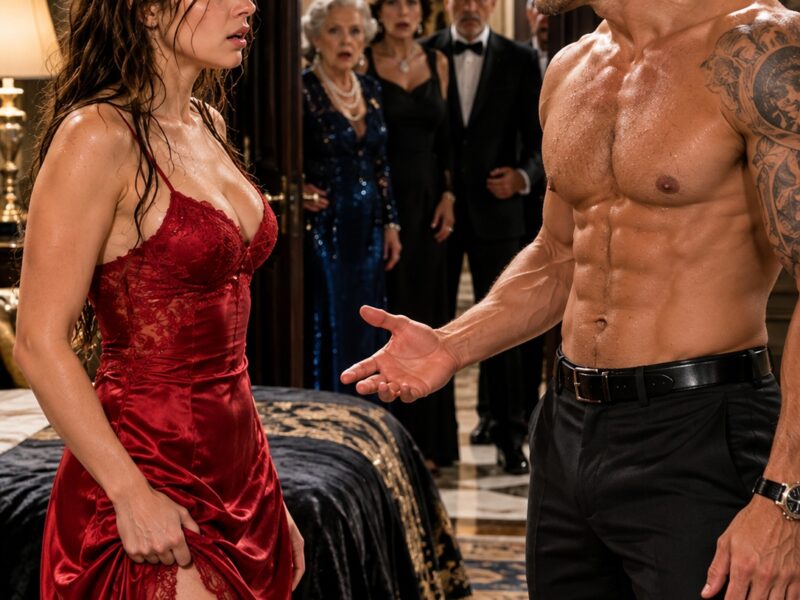
I Walked Into the Mafia Boss’s Bedroom by Mistake — Then His Family Opened the Door and Mistook Me for the Woman He Was Hiding
The first thing I noticed was the gun.
Not the enormous bed with its charcoal silk sheets. Not the marble bathroom still clouded with steam. Not even the half-dressed man standing beneath the warm bedroom lights, a black towel wrapped around his waist and water dripping from his dark hair.
The gun.
It appeared in his hand so quickly that my mind couldn’t connect the movement to the danger. One second, I was standing in what I believed was an empty guest bathroom, trying to rescue my ruined midnight-blue dress. The next, I was staring at a pistol held by a man whose photograph had appeared in more Chicago newspapers than some elected officials.
Massimo Romano.
I knew his face before he said a word.
Everybody in Chicago knew his face.
I slowly raised both hands, letting the wet fabric fall against my knees. Behind me, the bathroom faucet was still running, and somewhere beyond the enormous bedroom windows, thunder rolled across the lake.
“I think,” I whispered, “I’ve made a very serious mistake.”
Massimo didn’t move.
He was taller than I had expected, with broad shoulders, dark eyes, and an expression so calm it was more frightening than anger. A thin scar crossed his left eyebrow. Another, older scar disappeared beneath the towel at his ribs.
“That depends,” he said. “How did you get through that door?”
“I opened it.”
His eyes narrowed.
“I gathered that.”
“I was looking for a bathroom.”
“Inside my private bedroom?”
“I didn’t know it was your bedroom.”
He glanced at my dress, soaked along one side with brownish water, then toward the open bathroom door.
“Who sent you upstairs?”
“A housekeeper. Elena. She said there was another bathroom on the third floor, west corridor, last door before the staircase.”
Something changed in his expression.
It happened so quickly I almost missed it.
“Which staircase?”
I blinked.
“The staircase.”
“There are two.”
“Well, that’s a spectacularly unhelpful architectural decision.”
His eyebrows lifted.
For one impossible second, I thought the most feared man in Chicago might actually laugh.
Instead, he lowered the gun.
Then we both heard footsteps.
Several people were approaching from the hallway, their voices overlapping behind the heavy double doors.
Massimo looked toward the sound.
His entire posture changed.
“Don’t say anything yet.”
“Excuse me?”
“Just—”
The doors opened.
An elegant elderly woman stood in the doorway wearing a silver evening gown and an expression of absolute authority. Beside her was a beautiful middle-aged woman in pearls, followed by two distinguished gentlemen in expensive suits.
All four stopped.
Their eyes moved toward me.
Then toward Massimo.
Then toward his towel.
Then toward the enormous bed behind us.
The silence that followed was so complete I could hear the bathroom faucet dripping.
The woman in pearls brought one hand to her throat.
“Massimo!”
The elderly woman raised her eyebrows.
One of the gentlemen looked at the clock.
It was 12:17 a.m.
I wanted to disappear into the marble floor.
“This isn’t what it looks like,” I said.
But Massimo spoke over me.
“She’s with me.”
Four words.
That was all.
Four words that transformed an embarrassing misunderstanding into something infinitely worse.
I turned toward him.
“What?”
He didn’t look at me.
The elderly woman’s mouth slowly curved into a smile.
“Well,” she said. “That explains everything.”
I stared at her.
“Actually, it explains absolutely nothing.”
She ignored me.
Instead, she looked at Massimo with unmistakable satisfaction.
“So this is why you refused Adriana.”
I looked from her to him.
“Who’s Adriana?”
The woman in pearls closed her eyes.
Massimo sighed.
And I realized that whatever mistake I’d made by opening the wrong door, this man had just made it permanent.
Six hours earlier, my biggest concern had been white roses.
I would have given almost anything to have that problem back.
My name is Sophie Miller. I was twenty-nine years old, owned a small floral-event business in Chicago, and had spent most of my adult life learning that beautiful things could be surprisingly expensive to keep alive.
Miller Floral & Events operated out of a rented brick warehouse in the West Loop. I had three employees, two delivery vans, an aging refrigeration unit, and a business checking account that rarely held enough money to make me comfortable.
My father had been a mechanic. My mother had worked at a public elementary school until arthritis made the job too difficult.
Neither of them had ever owned a business.
When I opened mine, my father told me that if I wanted independence, I had to understand the difference between owning something and being owned by it.
I thought he meant invoices.
Five years later, I understood he meant everything.
The Romano contract was supposed to change my financial future.
Four thousand imported white garden roses, custom-built floral installations, twenty-eight dining centerpieces, an illuminated staircase arrangement, and an enormous birthday display for Isabella Romano’s eighty-fifth birthday celebration.
The event was being held at the Romano estate in Barrington Hills, outside Chicago.
The property looked less like a private home than a European embassy designed by someone who considered security more important than comfort.
There were stone gates, cameras, black SUVs, and enough guards in tailored suits to make me feel as if every delivery of hydrangeas required diplomatic approval.
I knew the rumors.
Everybody did.
The Romano family controlled shipping businesses, construction contracts, nightclubs, restaurants, private investment companies, and half a dozen enterprises that seemed perfectly legitimate until someone started asking why their competitors kept disappearing from the market.
Massimo Romano had inherited leadership of the organization after his father died.
He was thirty-eight.
Newspapers called him a suspected organized-crime figure.
Business magazines called him a private investor.
The people who worked for him simply called him Mr. Romano.
I had no intention of learning which description was most accurate.
My job was flowers.
And I was very good at flowers.
For three days, my team had transformed the estate into a white-and-gold dream. Thousands of roses curved around marble columns. Delicate arrangements decorated the grand staircase. A suspended installation of white blooms and tiny lights hovered above the ballroom like a cloud.
Everything had gone smoothly until 11:30 that night.
I was inspecting the final arrangements when a pipe burst above the staff changing room.
A terrible metallic crack echoed through the wall.
Then water began pouring through the ceiling.
Someone screamed.
My assistant Jasmine grabbed a box of linen napkins and ran.
I moved toward the flower-storage shelves, trying to protect several arrangements that had not yet been transferred into the ballroom.
I saved the flowers.
My dress was less fortunate.
Cold, rusty water soaked my left shoulder, ran down my waist, and turned the expensive midnight-blue fabric into something that looked like a child had dragged it through a flooded parking lot.
I stood beneath the leaking ceiling, dripping and furious.
“Perfect,” I muttered.
A housekeeper named Elena appeared carrying towels.
“Oh, Miss Miller. You can’t stay like that.”
“I was thinking of adding a few water lilies and calling it artistic.”
She gave a nervous smile.
“There’s another bathroom upstairs. The plumbing is fine there.”
“Where?”
“Third floor. West corridor. Last door before the staircase.”
“Are you sure guests won’t be using it?”
“It’s empty tonight.”
She hesitated.
Then added, “You can use the service elevator.”
I thanked her.
If I had paid closer attention, I might have noticed how carefully she watched me leave.
But I was tired.
My feet hurt.
And I wanted nothing more complicated than a towel, dry hair, and five minutes of privacy.
The service elevator opened onto the third floor.
I turned left.
Passed a long hallway lined with oil paintings.
Found the last door before a staircase.
And walked inside.
The bathroom lights were already on.
I remember thinking it was strange that an unused guest bathroom smelled faintly of expensive men’s cologne.
Then I saw a white towel folded beside the sink.
I stepped inside, shut the outer door behind me, and began blotting water from my dress.
A few seconds later, the shower turned off.
I froze.
Then a deep male voice spoke from somewhere beyond the partially open bathroom door.
“Who is there?”
I screamed.
A man appeared.
He reached for a towel.
I stumbled backward into the adjoining bedroom.
And Massimo Romano reached for his gun.
That was how I ended up standing in front of his family at twelve seventeen in the morning, looking like the world’s least convincing secret girlfriend.
Massimo’s mother recovered first.
“Caterina,” the elderly woman said mildly, “perhaps we should allow the young people some privacy.”
“Mother, this is not amusing.”
“I disagree.”
I stepped forward.
“Please, I can explain.”
Massimo’s grandmother looked at me.
“Of course you can, dear.”
“I work for the floral company.”
Her smile widened.
“How charming.”
“No, I mean I literally work for the floral company. I’m here because your flowers—”
“Sophie,” Massimo interrupted.
I turned.
“Don’t Sophie me.”
One of the older men coughed into his hand.
Massimo reached for a black robe hanging beside the wardrobe.
“We’ll discuss this tomorrow.”
“No, we absolutely will not discuss this tomorrow. We’re discussing it right now, because I’ve never met you before tonight, I don’t know who Adriana is, and I certainly haven’t been spending the night with your grandson.”
The elderly woman looked delighted.
Massimo looked toward the ceiling as if asking heaven for patience.
His mother did not smile.
“Massimo. Tomorrow morning. Before the guests arrive.”
“Mother.”
“You cannot simply introduce an unknown woman into your private rooms on the eve of an important family announcement.”
I raised my hand.
“I’m very known, actually. My name is Sophie Miller, and you hired my business.”
Nobody acknowledged this.
Massimo’s voice became colder.
“Leave us.”
One of the gentlemen started to object.
Massimo turned toward him.
“I said leave.”
Nobody argued again.
That frightened me more than the gun.
These were wealthy, powerful people who seemed perfectly comfortable telling everyone else what to do.
Yet one quiet sentence from Massimo Romano sent them toward the door.
His grandmother went last.
She stopped beside me.
“Breakfast is at nine.”
“I won’t be here at nine.”
She smiled.
“We’ll see.”
The doors closed.
I turned toward Massimo.
“What the hell was that?”
He finished tying his robe.
“An inconvenience.”
“An inconvenience? Your family thinks I’m sleeping with you.”
“Yes.”
“And you told them I was with you.”
“Yes.”
“Why?”
He crossed toward a cabinet and poured himself a glass of water.
Not whiskey.
Not bourbon.
Water.
For some reason, that irritated me.
“My family expects me to announce an engagement tomorrow.”
“To Adriana.”
“Adriana Vitali.”
“Congratulations. I hope you’re very happy together.”
“I don’t intend to marry her.”
“Then tell her.”
“It isn’t that simple.”
“Marriage generally requires two willing people. That seems pretty simple.”
He looked at me.
“You’re not familiar with my family.”
“I’m becoming familiar against my will.”
For the first time, I saw genuine amusement cross his face.
It lasted less than a second.
Then he placed the glass down.
“The engagement is tied to an agreement between two families. Shipping interests, property holdings, business partnerships.”
“That sounds romantic.”
“Six hours ago, I received information suggesting someone connected to the arrangement has been purchasing confidential information from one of my senior people.”
I stopped.
“What kind of information?”
“The kind that gets people killed when it reaches the wrong hands.”
The room seemed colder.
Massimo continued.
“If I publicly refuse the engagement without explanation, whoever is responsible may realize I know about the leak.”
“And if you accuse someone?”
“I risk exposing the person who warned me.”
I stared.
“So you decided to tell your family you were involved with the florist?”
“It provided an immediate explanation.”
“An immediate explanation for you. It creates a disaster for me.”
“I can compensate you.”
There it was.
Money.
The universal solution for people who had never been told no.
I took a step closer.
“I don’t care how rich you are. You don’t get to purchase my reputation because it’s convenient.”
He studied me.
“I wasn’t trying to insult you.”
“You succeeded accidentally. Congratulations.”
He folded his arms.
“What would you prefer?”
“For you to tell your family the truth.”
“Which truth?”
“That I walked into the wrong bathroom.”
“And why were you directed to an unused bathroom inside my private suite?”
“Because your house is the size of a shopping mall and somebody gave me terrible directions.”
He went still.
“What did you say?”
“Your house is enormous.”
“No. Who gave you the directions?”
“Elena. The housekeeper.”
He looked toward the hallway.
I remembered his expression when I first mentioned her.
“Is something wrong?”
He didn’t answer immediately.
Then he reached for his phone.
“Marco. Find Elena. Quietly. And have security review the west-wing corridor footage from eleven thirty onward.”
My stomach tightened.
“Why?”
Massimo looked at me.
“Because the bathroom you were supposed to use is on the opposite side of the house.”
I felt the blood drain from my face.
“Then Elena made a mistake.”
“Perhaps.”
“You’re acting like she deliberately sent me here.”
“I don’t know yet.”
He put his phone down.
Then he asked a question that changed everything.
“Did anyone know you were coming upstairs?”
I thought about Jasmine, the leaking pipe, Elena’s worried face.
“I don’t think so.”
Massimo’s expression hardened.
“Then somebody wanted you to be alone.”
I laughed nervously.
“That’s ridiculous.”
He didn’t laugh.
And suddenly I wanted very badly to leave.
“I need to go home.”
“I’ll have someone drive you.”
“I have a car.”
“It’s after midnight.”
“I’m aware.”
“The security gates are closed until my people verify what happened.”
I stared at him.
“You don’t get to keep me here.”
He stepped away from the door.
“You’re free to leave. I’ll ask security to escort you to your car.”
That should have reassured me.
It didn’t.
Because for the first time, I wondered whether my entrance into his bedroom had been an accident at all.
I left the estate at 1:06 a.m.
A guard escorted me to the parking area but did not follow me home.
Massimo had offered a driver.
I refused.
I wanted my independence, my apartment, my ordinary keys, and the comforting knowledge that the most dangerous man I had ever met was no longer within speaking distance.
By 1:45, I was standing in my kitchen eating cold leftover pasta directly from a plastic container.
My phone buzzed.
Jasmine.
ARE YOU OKAY? SOMEONE FROM THE ROMANO HOUSE ASKED FOR YOUR WORK SCHEDULE.
I stared at the message.
WHO?
DON’T KNOW. SECURITY GUY. SAID IT WAS FOR TOMORROW.
A second message arrived.
ALSO SOMEONE WENT THROUGH YOUR BAG IN THE PREP ROOM. I THOUGHT IT WAS YOU LOOKING FOR YOUR KEYS.
I stopped chewing.
My handbag had been hanging beneath the folding table all evening.
Inside were my wallet, keys, business phone, employee payroll notes, and a small envelope containing photographs of my parents.
I called Jasmine.
“Did they take anything?”
“I don’t think so.”
“Did you see their face?”
“No. Hood up. I thought it was one of the night crew.”
I looked toward my apartment window.
A black SUV was parked across the street.
Its engine was running.
My heart began beating faster.
“Jasmine, I’ll call you back.”
I hung up.
Then I called the number on Massimo’s business card, which his security chief had slipped into my hand before I left.
He answered on the second ring.
“Sophie.”
I hated that he knew it was me.
“There’s a car outside my apartment.”
“Describe it.”
“Black SUV.”
“What kind?”
“I don’t know. Expensive and threatening.”
“License plate?”
I leaned toward the window.
The SUV pulled away.
“Never mind. It’s leaving.”
“Step away from the window.”
His tone changed.
I obeyed before I realized I was obeying.
“What’s happening?”
“Someone searched your handbag at the estate.”
I froze.
“You know?”
“Security footage.”
“Who?”
“We couldn’t identify them.”
“Then why haven’t you called the police?”
A pause.
“Because I don’t yet know whether the person was acting for someone inside my household.”
“That sounds like an excellent reason to call the police.”
“You’re right.”
I hadn’t expected that answer.
“I’ve asked my attorney to contact a detective we can trust to handle the report without exposing your personal information unnecessarily.”
I sat down.
“Why would someone search my bag?”
“I don’t know.”
“Massimo.”
“Yes?”
“Did your family know I owned the floral company before tonight?”
“Yes.”
“Did they know my name?”
“Most likely.”
“Then somebody could have planned this.”
Silence.
“That’s what I’m trying to determine.”
My hands began shaking.
The man who had pointed a gun at me less than two hours earlier was now the only person speaking honestly about how frightened I should be.
That contradiction made me deeply uncomfortable.
“What do I do?”
“Lock your door. Call emergency services if anyone approaches or attempts to enter. I’ll send you the detective’s contact information.”
“And tomorrow?”
“Tomorrow we find out who wanted you in my bedroom.”
At 8:12 the next morning, Massimo Romano appeared outside my warehouse.
He arrived in a black Mercedes with a driver and one security officer.
He did not come inside immediately.
Instead, he waited beside the vehicle while Jasmine peered through the front window.
“Oh my God,” she whispered.
“Don’t.”
“That’s him.”
“I know.”
“Why is he here?”
“Complicated plumbing emergency.”
Jasmine looked at me.
“What?”
“Never mind.”
I walked outside.
Massimo was wearing a charcoal suit and a white shirt. His dark hair was neatly combed, his expression unreadable.
In daylight, he looked less like a dangerous criminal and more like an executive who had never encountered a parking ticket he couldn’t make disappear.
“Good morning,” he said.
“That depends.”
“I have some information.”
“Then start talking.”
He glanced toward Jasmine watching from the window.
“May we speak privately?”
“My employees know where I am. You can speak here.”
Something in his expression softened.
“Fair enough.”
He handed me a printed still from the estate’s security footage.
A hooded figure was standing beneath my worktable.
Their face was obscured.
“At 2:15 this morning, someone returned to the floral preparation room and searched your bag again.”
“After I left?”
“Yes.”
“Did they take anything?”
“Apparently not.”
I studied the image.
The figure wore dark shoes and a gray sweatshirt.
Nothing distinctive.
“Why would they come back?”
“We’re checking.”
“Are you going to tell me what you want?”
Massimo took a breath.
“My family has already heard what happened last night.”
My stomach dropped.
“How?”
“My grandmother.”
“Of course.”
“Adriana has heard too.”
I stared at him.
“You told your fiancée I was sleeping with you?”
“I’m not engaged.”
“You’re missing the important part of that sentence.”
He almost smiled.
Then his face became serious.
“I believe whoever arranged your visit to my room expected my family to discover us.”
I went cold.
“Why?”
“To create a public reason for me to reject Adriana.”
“But you already wanted to reject her.”
“Yes.”
“Then somebody is giving you exactly what you want.”
“Or forcing me to accept an explanation they’ve chosen.”
I looked at the photograph again.
The hooded figure.
My bag.
The empty hallway.
I understood just enough to feel sick.
“What do you need from me?”
“Nothing you aren’t willing to give.”
“That’s new.”
He accepted the criticism.
“My family will be at breakfast in forty minutes. Adriana is expected. I would like you there.”
I stared.
“Absolutely not.”
“You can tell them exactly what happened.”
“Why don’t you?”
“Because they won’t believe me now.”
“Wonderful.”
“And because I’d rather know who’s watching you before we contradict the story.”
I crossed my arms.
“You are asking me to play your girlfriend.”
“For breakfast.”
“No.”
“Then we tell the truth.”
I paused.
“Just like that?”
“Just like that.”
He looked toward the warehouse.
“But either way, I need to make sure you’re safe.”
His willingness to accept my refusal unsettled me more than another demand would have.
I considered the photographs, the strange SUV, the searched handbag, and the fact that someone inside his mansion had known exactly where to send me.
Then I thought of Jasmine.
My employees.
The business I’d spent five years building.
I wasn’t going to let powerful strangers turn me into an invisible piece on their chessboard.
“One breakfast,” I said.
Massimo studied me.
“One breakfast.”
“I decide what I say.”
“Agreed.”
“You don’t touch me without asking.”
“Agreed.”
“You don’t invent an entire romantic history.”
He hesitated.
“Massimo.”
“Agreed.”
“And afterward, you tell your family what really happened.”
He nodded.
“I’ll correct the story.”
I opened the warehouse door.
Jasmine looked between us.
“What’s happening?”
I sighed.
“Apparently I’m going to breakfast.”
She looked at Massimo.
“With him?”
“Unfortunately.”
Massimo inclined his head.
“Good morning, Jasmine.”
Her mouth fell open.
He knew her name.
I was beginning to understand that Massimo Romano knew far too much about people before they knew anything about him.
At nine sharp, I entered the Romano dining room.
The table could have seated twenty people.
Only six chairs were occupied.
Isabella Romano sat at the head, wearing a lavender silk blouse and enormous pearl earrings.
Caterina sat beside her.
Two older men occupied the far end.
Massimo pulled out a chair for me.
Every eye followed the movement.
I sat down.
Immediately, Isabella smiled.
“Sophie, dear. How lovely.”
“Good morning.”
“Coffee?”
“Please.”
“Milk?”
“Yes, thank you.”
“How long have you known my grandson?”
I nearly inhaled my coffee.
Massimo answered before I could stop him.
“We met at the Langford charity gala.”
That was technically true.
I had designed the floral arrangements.
He had apparently attended.
Isabella leaned forward.
“And you’ve been seeing each other since?”
I looked at Massimo.
He looked back.
“Not exactly,” I said.
Caterina’s eyes narrowed.
“What does that mean?”
“It means we met professionally, and last night was a misunderstanding.”
Isabella looked amused.
“A misunderstanding that involved his bedroom?”
“Yes.”
“At midnight?”
“Unfortunately.”
“While he was wearing a towel?”
I closed my eyes.
“That detail does seem to be making the rounds.”
Massimo lowered his espresso cup.
“Grandmother.”
“What? I’m eighty-five, not blind.”
One of the older gentlemen laughed.
Caterina didn’t.
She leaned toward me.
“Miss Miller, do you understand how embarrassing this is for our family?”
I felt my face heat.
“With respect, Mrs. Romano, I was directed to the wrong room while trying to clean water off a dress I’d ruined saving the flowers your family ordered.”
Silence.
I continued.
“I didn’t arrange this misunderstanding. I didn’t invite photographers. I didn’t ask anyone to assume anything about me.”
Caterina opened her mouth.
I looked directly at her.
“And I certainly don’t appreciate being treated like a scandal when I was doing my job.”
For several seconds, nobody spoke.
Then Isabella laughed.
Not a polite little chuckle.
A full, delighted laugh.
“Oh, I like her.”
Massimo stared into his coffee.
But I saw the corner of his mouth move.
Caterina looked furious.
Then the dining-room doors opened.
A tall blonde woman entered wearing an elegant cream dress and carrying a handbag that probably cost more than my first delivery van.
She was beautiful.
Not simply pretty.
Beautiful in the polished, effortless way that suggested she’d been trained since childhood never to look surprised.
Her eyes moved from Isabella to Caterina.
Then to Massimo.
Then to me.
The room changed.
“Adriana,” Massimo said.
“Massimo.”
She smiled.
“I heard an interesting story.”
I wanted to crawl beneath the table.
Adriana Vitali approached and extended her hand.
“Sophie Miller?”
I stood.
“Yes.”
“Adriana Vitali.”
Her handshake was cool and firm.
“I understand you had quite an evening.”
I forced a smile.
“That seems to be everyone’s favorite subject.”
She glanced at Massimo.
“Is the story true?”
Before he could answer, I said, “No.”
Adriana looked back at me.
I continued.
“I walked into the wrong room while looking for a bathroom. Your household staff can confirm there was a plumbing problem. Mr. Romano made an unfortunate assumption in front of his family.”
Massimo did not interrupt.
Adriana studied me carefully.
“Then there is nothing between you?”
I glanced at him.
“Nothing romantic.”
Her eyes narrowed slightly.
“And yet he brought you to breakfast.”
“Because someone searched my belongings after I left the estate.”
That changed her expression.
For the first time, she looked genuinely surprised.
“Someone searched your things?”
“Twice.”
Caterina turned toward Massimo.
“Why am I hearing this now?”
He put down his coffee.
“Because I’m trying to establish who had access to the service corridors.”
Adriana’s smile returned, but something in her eyes had cooled.
“How unfortunate.”
I sat down.
For the rest of breakfast, she barely looked at me.
That should have relieved me.
Instead, I had the unnerving feeling that I had disappointed someone by refusing to play a role I had never agreed to.
The birthday celebration began at seven that evening.
I returned to the estate in my own car, wearing black slacks and a cream blouse.
My employees were finishing the last floral installations.
I was determined to work, get paid, and leave.
But by eight, someone had placed a handwritten card inside my business bag.
It was folded once.
The message was brief.
YOU WERE SUPPOSED TO KEEP HIM DISTRACTED.
I stared at it.
Then read it again.
The handwriting was neat, almost feminine.
No signature.
I immediately called Massimo’s security chief, Marco.
He arrived within minutes.
His expression hardened when he saw the card.
“Where did you find this?”
“My bag.”
“Who had access?”
“Half the staff. I left it beneath the preparation table.”
He placed the note inside a clean envelope without touching the writing.
“Did you see anyone near it?”
“No.”
“Stay here.”
“Marco.”
He stopped.
“I’m not going to be locked in a room because somebody is playing games.”
He looked uncomfortable.
“Miss Miller, nobody wants that.”
“Then stop speaking to me as though I have no decisions.”
He nodded once.
“Understood.”
Massimo found me twenty minutes later on a balcony overlooking the estate gardens.
Music drifted from the ballroom.
Below us, guests moved through pools of warm light while servers carried champagne past enormous white-rose arrangements.
Massimo was wearing a black tuxedo.
He looked as though he belonged to the night.
I handed him a photograph of the note.
His face became unreadable.
“Marco has the original.”
“I know.”
“Then tell me who is doing this.”
“We’re investigating.”
“That’s what everyone keeps saying.”
“Sophie—”
“No. Somebody sent me into your bedroom. Somebody searched my bag. Now somebody is leaving threatening messages at my workplace.”
“You’re right.”
“And I don’t understand why.”
He rested his hands on the stone balcony.
“The note suggests whoever arranged this wanted you close to me.”
“Why?”
“I don’t know.”
“Do you think Adriana is involved?”
His silence lasted too long.
My stomach tightened.
“You do.”
“I think someone connected to her family may be.”
“Then why isn’t she being questioned?”
“Because accusing her without evidence could make things worse.”
“For whom?”
He looked at me.
I understood his hesitation.
“For your business?”
“For anyone connected to the situation.”
I took a breath.
“Massimo, I don’t want any part of your family agreements.”
“I know.”
“Then help me leave them.”
His gaze shifted toward the dark grounds.
For a moment, the controlled man disappeared, and I saw someone exhausted.
“I intend to.”
“How?”
“By finding out who arranged this and giving you the information you need to protect yourself.”
“Not by making more decisions for me?”
He looked back.
“Not by making more decisions for you.”
I wanted to believe him.
Then his phone rang.
He answered quietly.
Whatever he heard changed his face.
“Where?”
A pause.
“Don’t touch anything. Call the police.”
He ended the call.
“What happened?” I asked.
Massimo looked directly at me.
“Someone has been inside your warehouse.”
The next morning, I found the front door of Miller Floral & Events hanging crookedly from its frame.
Nothing valuable had been stolen.
The computers were still there.
The cash box remained untouched.
The expensive refrigeration unit was unharmed.
But someone had opened every filing cabinet, emptied my desk drawers, and scattered three years of client records across the floor.
My employees stood outside in stunned silence.
Jasmine was crying.
I walked through the wreckage, stepping around broken glass and crushed eucalyptus stems.
I felt something inside me harden.
This wasn’t romance.
It wasn’t family drama.
It wasn’t a misunderstanding.
Someone had decided that because I was a small business owner without armed guards or political friends, my life could be rearranged like furniture.
The police took photographs.
I gave a statement.
Massimo sent Marco to speak with the detective, but I refused to leave the warehouse.
I stayed until the door was repaired.
Then I stayed another six hours helping Jasmine reorganize the invoices.
At midnight, I discovered something unusual.
One of our old event files was missing.
The Langford charity gala.
The same event Massimo had mentioned at breakfast.
I sat cross-legged on the office floor, surrounded by folders.
“Jasmine?”
She looked up.
“Yeah?”
“Did you move the Langford file?”
“No.”
“Are you sure?”
“That was the fundraiser where you fought with the venue manager over the loading dock.”
I nodded.
She remembered because he’d charged us an unexpected unloading fee.
I remembered because the event had nearly ruined a weekend.
The file included vendor schedules, staff passes, floral delivery records, and photographs of the room before guests arrived.
Why would anyone want it?
I checked our digital archive.
The file was still there.
I opened the event photographs.
In the background of one picture, near a service entrance, stood a man in a gray suit speaking to Elena.
The housekeeper.
I enlarged the image.
Another man stood beside her.
Silver hair.
Dark blue tie.
A familiar face.
I’d seen him at the Romano estate, but couldn’t immediately remember where.
Then I recognized him.
Carlo Vitali.
Adriana’s uncle.
I’d seen his photograph in a newspaper article about shipping contracts.
The image was five months old.
I stared at it.
Five months.
Long before I walked into Massimo’s bedroom.
Long before I signed the Romano birthday contract.
I called Marco.
He answered immediately.
“Miss Miller?”
“I found something.”
Within thirty minutes, Massimo arrived himself.
He came without the usual entourage, carrying his coat over one arm.
I showed him the photograph.
He stared at the screen.
For the first time since I’d met him, I saw his composure crack.
“Where did you get this?”
“An event archive.”
“When was it taken?”
“March seventeenth.”
He leaned closer.
“That’s Carlo.”
“Yes.”
“And Elena.”
“Yes.”
He straightened slowly.
“She was working for another household then.”
I looked at him.
“Which one?”
“The Vitalis.”
The warehouse suddenly felt very quiet.
Massimo took out his phone.
Then stopped.
He looked toward me.
“Before I make any calls, I need you to understand something.”
“What?”
“This may have started before you ever entered my house.”
I folded my arms.
“I already understand that.”
“No.”
His voice lowered.
“I don’t think you do.”
He pointed toward the photograph.
“If Carlo arranged for Elena to work at my estate, and if your company was chosen deliberately, someone may have been watching your life for months.”
I stared at the screen.
The idea was so ugly that my mind resisted it.
My morning coffee.
My grocery trips.
Jasmine laughing outside the warehouse.
My mother calling during lunch.
Our ordinary lives.
All potentially watched by people who considered us useful.
I whispered, “Why me?”
Massimo didn’t answer.
And that frightened me more than any answer could have.
The next two weeks changed my life in ways I still struggle to explain.
I hired a lawyer named Rachel Bennett, a practical woman in her forties who had spent fifteen years handling business disputes and workplace harassment cases.
Rachel listened to everything.
Then she looked at Massimo across the conference table.
“Your family’s problems have exposed my client to serious danger.”
“Yes.”
“You understand her business has suffered losses.”
“Yes.”
“And you understand she is not obligated to participate in any private investigation you’re conducting.”
“Yes.”
Rachel seemed surprised.
I wasn’t.
Massimo had become increasingly careful around me.
He asked before sending anyone to my warehouse.
He stopped making assumptions about where I should go.
He listened when I told him no.
But listening was not the same as safety.
The police investigation continued.
My business insurance covered some of the damage.
Several clients canceled events after gossip sites published stories claiming I was secretly dating Massimo Romano.
One headline described me as “Chicago’s Most Unexpected Mafia Mistress.”
I wanted to throw my phone into Lake Michigan.
Another claimed I’d been caught inside his bedroom wearing nothing but a towel.
That was particularly offensive.
It had been his towel.
And I had been fully dressed.
My mother called after seeing the article.
“Sophie?”
“Mom.”
“Are you in trouble?”
The question nearly broke me.
She didn’t ask whether I was rich now.
Or famous.
Or dating a dangerous man.
She asked if I was in trouble.
“I don’t know.”
She was quiet.
Then she said, “Come home for dinner.”
I drove to her little house in Oak Park.
She made baked chicken, mashed potatoes, and green beans.
We ate at the same kitchen table where I’d done homework as a child.
Halfway through dinner, she reached across and took my hand.
“Whatever is happening, don’t let someone else’s money make your decisions.”
I thought of Massimo.
His enormous house.
His guards.
The way people stopped speaking when he entered a room.
“I’m trying not to.”
Mom squeezed my fingers.
“Then you’re doing better than most.”
Three days later, somebody damaged the braking system on one of my delivery vans while it was parked behind the warehouse.
Jasmine discovered the problem before driving it.
A mechanic confirmed that the damage was deliberate.
The police collected evidence.
Rachel advised us to stop using the van until the investigation was complete.
Massimo arrived that evening.
He looked exhausted.
“Did anyone get hurt?”
“No.”
His shoulders lowered.
“Good.”
I looked at him.
“Don’t say it.”
He paused.
“Say what?”
“That I need to move into your house.”
He didn’t answer.
I sighed.
“Of course.”
“I was going to ask whether you’d consider staying somewhere with better security.”
“Your house.”
“Or somewhere you choose.”
I looked away.
My apartment suddenly felt vulnerable.
My warehouse had been searched.
My van had been sabotaged.
And somebody had known where I worked months before I met him.
I hated that fear was making my decisions smaller.
Massimo seemed to understand.
“You can stay in a hotel. I can arrange a licensed security company, and Rachel can approve everything.”
I studied him.
“Why are you doing this?”
He looked almost offended.
“Because someone is threatening you.”
“That doesn’t answer my question.”
He was quiet.
Then he said, “Because I believe I made it worse.”
I had no answer.
We agreed that I would temporarily stay in a guest suite at the estate while Rachel and the detective arranged other accommodations.
The arrangement had rules.
My room was mine.
Massimo would not enter without permission.
I kept my own phone, car, money, and schedule.
I continued working.
A security officer accompanied deliveries only when the police considered the risk credible.
I made it very clear that I was a guest, not a prisoner.
Massimo agreed.
The first night, I sat on the enormous guest bed listening to rain against the windows.
The room was larger than my entire apartment.
There were fresh white roses on the dresser.
I recognized the arrangement.
My own work.
I laughed quietly.
Then I cried.
Not because of Massimo.
Because I missed being ordinary.
Over the following days, I learned things about him that no newspaper would ever print.
He drank his coffee black but forgot to finish it.
He worked too late.
He hated celery.
He had an old dog named Bruno who ignored commands from everybody except Isabella.
He kept photographs of his father in his office but never mentioned him.
He never sat with his back toward a door.
And he had a habit of checking his phone whenever he heard footsteps outside.
I learned those things because sometimes we ate dinner at the same table.
Not romantic dinners.
Not candlelight and whispered promises.
Usually cold leftovers at ten thirty at night.
One evening, I found him in the kitchen eating a sandwich while reading financial reports.
“You own this entire house,” I said, “and you’re eating standing up?”
He glanced at me.
“Is that prohibited?”
“Only by common sense.”
He lowered the report.
“You’re very critical of my habits.”
“You have terrible habits.”
“Such as?”
“Skipping meals. Drinking cold coffee. Scaring your employees into silence.”
“I don’t scare everyone.”
I stared at him.
He considered that.
“Fine. Most people.”
I sat opposite him.
“Why?”
He looked puzzled.
“Why what?”
“Why do you need everyone afraid of you?”
His face closed.
“Fear creates order.”
“No. Fear creates silence. Those aren’t the same thing.”
He studied me for a long time.
Then he returned to his report.
I thought the conversation was over.
But two days later, I watched him apologize to a young employee after snapping at him over a delayed delivery.
It was awkward.
The employee looked shocked.
Massimo looked uncomfortable.
I pretended not to notice.
That was the problem with getting to know him.
The more ordinary details I saw, the harder it became to hold on to the simple version of him.
He was dangerous.
That remained true.
He had done terrible things.
I did not pretend otherwise.
But he was also capable of sitting on the kitchen floor beside an elderly dog because Bruno’s joints hurt too much for the stairs.
People were inconveniently complicated.
One rainy evening, I found Massimo sitting outside my guest room.
He wore a dark jacket.
His hair was wet.
He looked as though he’d been awake for days.
“What are you doing?”
He looked up.
“Waiting.”
“For what?”
“Confirmation that the security issue has been resolved.”
I noticed a dark stain near his cuff.
My stomach tightened.
“Is that blood?”
He glanced down.
“Yes.”
“Are you hurt?”
“No.”
I took a step back.
“Whose blood is it?”
His expression changed.
“Sophie—”
“Don’t.”
He stood slowly.
“The person connected to your van has been identified. There was an altercation when police attempted to question him.”
“Did you hurt him?”
“I wasn’t there.”
I searched his face.
“Massimo.”
He looked away.
“Some of my people were.”
The hallway felt smaller.
“Is he alive?”
“Yes. He’s in the hospital under police guard.”
I exhaled.
“Did you order someone to attack him?”
“No.”
“Then why is there blood on your sleeve?”
He looked down.
“I helped one of my men after he was injured during the confrontation.”
I wanted to believe him.
But I knew enough about his world to understand that trust couldn’t simply be demanded.
“Then tell the police what you know.”
“I already have.”
I stared.
He looked almost irritated.
“You’re surprised.”
“Yes.”
“Fair.”
He stepped away from my door.
“I didn’t mean to frighten you.”
“You did.”
“I know.”
I waited.
Then I asked the question I’d been trying not to ask for days.
“Why were you sitting here?”
He looked toward the dark windows.
“Because the man connected to your van knew where you worked.”
“And?”
“For several hours, we didn’t know whether he had your current location.”
I folded my arms.
“You were worried.”
“Yes.”
“About me?”
He looked back.
There was no practiced answer in his face.
“Yes.”
Something moved in my chest.
I wished it hadn’t.
Because a worried man was not necessarily a safe man.
And I was beginning to like a person whose world had already endangered mine.
Two days later, investigators found the first real piece of evidence.
A former nightclub property owned by one of Massimo’s companies had been used as an unauthorized surveillance site.
The building had been closed for renovation.
Police obtained access after a maintenance contractor reported suspicious equipment inside.
Rachel called me when the detective recovered photographs.
She insisted on accompanying me to the station.
Massimo met us there.
The detective laid the photographs across a conference table.
My knees weakened.
There I was.
Leaving the warehouse.
Buying groceries.
Carrying coffee.
Locking my apartment.
Visiting my mother.
Walking to my car.
Dozens of photographs.
Some taken five months earlier.
Some six.
A few dated before my company had even submitted a proposal for Isabella’s birthday celebration.
I gripped the edge of the table.
“They were watching me.”
Rachel rested a hand near mine.
“Yes.”
I looked at Massimo.
His face had gone terrifyingly still.
“Before I knew you.”
“Yes.”
“Before I entered your bedroom.”
“Yes.”
“Why?”
He looked at the detective.
The detective placed another photograph on the table.
Elena, the housekeeper, meeting Carlo Vitali outside a bank.
Then another.
Carlo speaking to a man identified as Vincent D’Amato.
Massimo’s senior operations adviser.
The same man who had helped organize the proposed marriage agreement.
I stared.
“Elena worked for Carlo.”
The detective nodded.
“We believe she was recruited to gain access to the Romano household.”
“And me?”
The detective looked uncomfortable.
“Your company may have been selected as an avenue of access.”
I turned toward Massimo.
“Did you know?”
He looked at me.
“I suspected there was something wrong after the security footage.”
“That’s not what I asked.”
“No. I did not know about the surveillance before today.”
“Did you use the situation anyway?”
He was silent.
I felt my stomach drop.
“Massimo.”
“At first,” he said.
The answer hurt more than I expected.
He continued.
“When my family found you in my bedroom, I let them believe something that wasn’t true because it gave me a way to delay the engagement.”
I stared.
“I was terrified.”
“I know.”
“You pointed a gun at me.”
“I know.”
“And then you used me.”
His jaw tightened.
“Yes.”
Rachel shifted beside me.
The detective quietly gathered the photographs, giving us a moment.
I looked at Massimo.
“Did it ever occur to you that I was a person and not a convenient explanation?”
He looked as though I’d struck him.
“Yes.”
“When?”
His voice was low.
“Too late.”
I turned away.
He didn’t stop me.
That mattered.
Because for weeks, every powerful person involved had treated my choices like minor details.
Adriana’s family wanted to use me.
Massimo had initially allowed the misunderstanding to serve him.
His security people wanted to decide where I went.
The press wanted to decide what I was.
And I was exhausted from explaining that I belonged to myself.
I moved out of the estate the next morning.
Not because the danger had ended.
Because I needed distance.
Rachel arranged a short-term apartment through a security company not affiliated with the Romanos.
Jasmine helped me move.
I left the roses behind.
Three days later, a reporter approached me outside my warehouse.
“Miss Miller, were you romantically involved with Massimo Romano?”
“No comment.”
“Did his family pressure you to leave?”
“No comment.”
“Are you aware that financial records suggest your company made payments to a Romano household employee?”
I stopped.
“What records?”
The reporter held up a printout.
Three transfers.
Twenty-five thousand dollars each.
From a business account bearing my company’s name to an account allegedly controlled by Elena.
I felt cold.
“Those aren’t mine.”
“Would you care to explain?”
“I’ve never made those payments.”
“Then why are they appearing in financial documents provided to our newsroom?”
“I don’t know.”
I called Rachel before answering another question.
By afternoon, the story was everywhere.
FLORIST LINKED TO ROMANO HOUSEHOLD PAYMENTS.
SECRET GIRLFRIEND OR PAID INFORMANT?
My business phone wouldn’t stop ringing.
Two wedding clients canceled.
A third asked whether I was involved in organized crime.
Jasmine cried in the office.
I sat at my desk staring at numbers that appeared to have been fabricated using my company information.
Rachel contacted the bank.
The account number on the printout was not ours.
The routing number belonged to an institution we’d never used.
The transfers were fake.
But by the time the bank confirmed that, the damage had begun.
I called Massimo.
He answered immediately.
“Sophie.”
“Did you see the records?”
“Yes.”
“They’re fake.”
“I know.”
I froze.
“You know?”
“The numbers don’t match your company’s banking information.”
“Then why didn’t you say something publicly?”
“Because I wanted to confirm where they originated before releasing a statement.”
“Massimo.”
“I’m listening.”
“Do you believe I sold information about you?”
A pause.
Not long.
Maybe three seconds.
But I heard it.
And after everything we’d been through, it was enough.
“Sophie, I believe someone is trying to make me think that.”
“That’s not what I asked.”
“I need to understand why your company was selected months ago.”
I closed my eyes.
“You know why I was selected.”
“Not completely.”
I looked toward Jasmine.
She was wiping tears from her cheeks while answering a customer complaint.
I suddenly understood something.
Massimo could survive doubting everyone.
He had built his life around it.
I couldn’t.
Not when the consequences landed on ordinary people who depended on me.
“You were willing to put guards outside my door because you thought someone might hurt me,” I said.
“Yes.”
“But a fake bank transfer is enough to make you wonder whether I betrayed you.”
“Sophie—”
“No.”
My voice broke.
“You don’t get to call this protection when what you’re really protecting is your ability to trust nobody.”
He said nothing.
I took a breath.
“Congratulations, Massimo.”
“On what?”
“You survived me too.”
I ended the call.
For the next hour, I worked.
That sounds ridiculous given what happened next.
But I didn’t know what else to do.
I answered emails.
Approved payroll.
Called a bride whose wedding flowers had arrived late.
Reorganized invoices.
Ordinary tasks.
The only things I could still control.
At four thirty, Rachel called.
She had been contacted by federal investigators reviewing suspicious financial transfers connected to the Vitali businesses.
She wanted me to come to her office.
I agreed.
A licensed security driver picked me up outside the warehouse.
I climbed into the back of the SUV.
My phone was in my handbag.
My laptop sat beside me.
Rain streaked the windows.
We drove toward the expressway.
Then the driver received a call.
He glanced at the screen.
His face changed.
“Everything okay?” I asked.
“Traffic issue.”
He turned toward an industrial road.
I frowned.
“Rachel’s office is the other direction.”
“Alternate route.”
“Then tell me why we’re going south.”
He didn’t answer.
I reached for my phone.
The driver accelerated.
My stomach dropped.
“Pull over.”
He kept driving.
“Pull over now.”
His eyes met mine in the rearview mirror.
There was something terrible in them.
Not cruelty.
Fear.
“I’m sorry, Miss Miller.”
I grabbed my phone.
Before I could dial, a second vehicle appeared behind us.
Then a third.
The driver slowed near a warehouse gate.
Someone outside opened it.
We drove through.
The gate closed behind us.
I looked at the unfamiliar building.
Then at the driver.
“Who paid you?”
He didn’t answer.
He didn’t have to.
A woman stood beneath the warehouse awning, dressed in a cream coat, watching the SUV approach.
Adriana Vitali.
She smiled when I climbed out.
“Sophie.”
I stared at her.
“What are you doing?”
“Finishing something that should have been simple.”
The driver stood nearby, unable to meet my eyes.
Adriana gestured toward the building.
“Come inside.”
“No.”
Her smile disappeared.
“You don’t understand how serious this is.”
“I understand perfectly. You’re involved in stalking me, damaging my business, and fabricating financial records.”
Adriana looked almost amused.
“You think those were the worst things we could have done?”
I felt my heartbeat in my throat.
Then I noticed something beyond the loading doors.
Two workers were standing beside a table covered in papers.
One wore a gray suit.
Vincent D’Amato.
Massimo’s adviser.
He saw me.
And looked away.
Everything began connecting.
The false engagement.
The surveillance.
The bedroom.
The bank records.
The people who wanted Massimo distracted, suspicious, and emotionally compromised.
But there was one question I couldn’t answer.
Why had they gone to so much trouble instead of simply attacking him?
Adriana noticed my expression.
“You’re beginning to understand.”
“Explain it.”
She folded her arms.
“Massimo’s organization controls shipping interests my family has wanted for years.”
“So marry him.”
“He was already questioning the agreement. He suspected Vincent.”
I looked toward the man in the gray suit.
He remained silent.
Adriana continued.
“We needed to know how far his investigation had gone. We needed him distracted while certain records were transferred.”
“And you chose me?”
“You were convenient.”
The word hit harder than I expected.
Convenient.
A woman with a small business.
An ordinary life.
A mother in Oak Park.
Employees who depended on her.
All of it reduced to convenience.
“Elena deliberately sent me upstairs.”
“Yes.”
“You wanted his family to find me.”
“Yes.”
“And the photographs?”
“We needed to know whether you would be believable.”
I stared.
“You planned to make me his girlfriend?”
“Initially, we planned to make you a scandal.”
“Then?”
Adriana’s expression hardened.
“Then he developed feelings for you.”
I said nothing.
“We didn’t anticipate that.”
“You don’t know what he feels.”
She smiled without warmth.
“He moved you into his house. Put security around your business. Delayed meetings to see you. Refused to finalize agreements that would have benefited both families.”
I looked away.
Adriana stepped closer.
“You became useful in a different way.”
“As leverage.”
“Exactly.”
I took a slow breath.
“Then why invent the bank transfers?”
“To make him distrust you.”
“And why would you want that if you planned to use me?”
“Because suspicion makes people careless. Massimo becomes dangerous when he trusts someone. He becomes predictable when he thinks they’ve betrayed him.”
I looked toward Vincent.
“You’re helping her?”
He finally spoke.
“You don’t understand the pressures involved.”
I almost laughed.
“That’s what every coward says when he’s done something terrible for money.”
His face reddened.
Adriana raised a hand.
“Enough.”
She looked at me.
“You will call Massimo. You’ll tell him you need to see him alone.”
“No.”
“He’ll come.”
“No.”
“Sophie, this doesn’t have to become unpleasant.”
I looked directly at her.
“You’ve been making my life unpleasant for months.”
Her expression cooled.
“You really don’t understand what kind of people you’re dealing with.”
I thought of my father.
The garage.
The smell of motor oil.
The way he taught me to change a tire because he said independence wasn’t a feeling—it was knowing what to do when something broke.
I looked at Adriana.
“You’re right.”
She smiled faintly.
“Finally.”
“I don’t understand people who have everything and still need to ruin somebody else’s life to feel powerful.”
For a moment, her composure cracked.
Then she turned away.
“Put her in the office.”
The next twenty minutes felt longer than the previous twenty-nine years of my life.
I was taken into a small office overlooking the loading floor.
Nobody hurt me.
But the door was guarded.
My phone was taken.
My handbag disappeared.
I sat in a chair beside a dusty desk and listened to rain hammer the metal roof.
Every few minutes, someone walked past the office windows.
I tried to breathe normally.
I thought of Jasmine.
My mother.
The wedding flowers waiting in the refrigerator.
I wondered whether anyone had noticed I was missing.
Then I remembered Rachel.
She would be waiting for me.
The driver had been hired through the security company.
His route was logged.
His phone could be traced.
I clung to that thought.
Maybe someone would find me before Adriana decided what to do next.
I didn’t know that Massimo had already discovered the problem.
At 4:44 p.m., the security company reported that my SUV had failed to arrive at Rachel’s office.
At 4:46, Rachel called me.
No answer.
At 4:47, traffic footage showed the vehicle turning toward the industrial waterfront.
Massimo received the information at 4:49.
Marco later told me that Massimo listened without interrupting.
Then he asked one question.
“Where is she?”
When nobody could answer, he closed his eyes.
Not in anger.
In the terrible recognition that the last words I’d said to him were an accusation he deserved.
You survived me too.
He called the detective handling my case.
Then Rachel.
Then the security company.
He gave them everything his people had found about Vincent, Carlo, and the surveillance site.
For once, he did not order his men to settle the problem.
He ordered them to locate me and cooperate with the police response.
That decision mattered.
Because Adriana wasn’t simply planning to frighten Massimo.
She wanted to make him react violently.
A confrontation between rival organizations would create chaos while her family gained control of disputed shipping interests.
She needed him angry.
She needed him careless.
She needed him to become exactly the man everyone expected.
Massimo understood that now.
The police arrived first at the warehouse perimeter.
A tactical team secured the surrounding streets.
Massimo reached the area shortly afterward with Marco and his attorney.
The detective ordered him to remain behind the perimeter.
For several minutes, he argued.
Then he stopped.
Inside the office, I heard sirens.
Adriana heard them too.
Her expression changed.
She entered carrying my phone.
“Did you contact someone?”
“No.”
“Then how did they find us?”
“Maybe because kidnapping people is difficult to hide when you’re as arrogant as you are.”
She stared.
Outside, someone shouted through a loudspeaker.
Adriana moved toward the window.
Vincent appeared in the doorway.
“Police have the front entrance.”
She turned toward him.
“What about the rear?”
“Blocked.”
For the first time, I saw genuine fear.
Not mine.
Theirs.
Adriana looked toward me.
Then at the phone.
“Call Massimo.”
I shook my head.
“No.”
She stepped closer.
“Tell him to come inside.”
“No.”
Her voice sharpened.
“Do you understand what’s at stake?”
“Yes.”
I looked at her.
“My life.”
She stopped.
I continued.
“You keep talking about shipping contracts, family alliances, territory, influence. You think those things are more important than the people you use to get them.”
Adriana’s jaw tightened.
“Spare me the morality lecture.”
“Then stop giving me reasons to deliver one.”
Outside, the police loudspeaker sounded again.
The warehouse was surrounded.
Adriana looked toward Vincent.
He had already begun backing away.
She understood too late that her own ally was preparing to abandon her.
“Vincent.”
He stopped.
“You said you had everything under control.”
He looked at the floor.
“I did.”
Then he ran.
A police officer shouted outside.
Footsteps echoed.
Adriana turned toward the rear window.
I saw the calculation in her face.
Escape.
Evidence.
Blame.
She looked at me.
For one terrible second, I thought she might try to use me as a shield.
Instead, the office door opened.
A uniformed officer stepped inside, followed by two others.
“Hands where we can see them.”
Adriana froze.
I raised my hands.
The officer looked at me.
“Sophie Miller?”
“Yes.”
“Are you injured?”
“No.”
“Come with me.”
I stood.
My knees nearly gave way.
The officer guided me toward the door.
As we crossed the loading floor, I saw Vincent being taken into custody.
Adriana was being questioned behind us.
My phone lay on the office desk.
My handbag was on the floor beside a filing cabinet.
Ordinary objects.
The kinds of things that become precious when you’ve spent an hour wondering whether you’ll ever see your life again.
Outside, cold rain hit my face.
An officer wrapped a blanket around my shoulders.
I took three steps toward an ambulance.
Then I saw Massimo.
He stood behind the police line, his dark coat soaked through.
Marco was beside him.
A detective was speaking.
Massimo wasn’t listening.
He was staring at me.
For the first time since I met him, his face held no calculation at all.
Just fear.
When the officer allowed him to approach, Massimo stopped several feet away.
He didn’t touch me.
Didn’t pull me into his arms.
Didn’t tell me everything was fine.
He simply asked, “Are you hurt?”
I shook my head.
“No.”
He exhaled.
Then looked away.
His hands were trembling.
I had never seen that before.
“Massimo.”
He looked back.
“You didn’t come inside.”
“No.”
“Why?”
He swallowed.
“Because the police had a plan.”
I stared at him.
He continued.
“And because what I wanted to do was not necessarily what would keep you safe.”
Something in my chest loosened.
I looked at the warehouse behind us.
“Adriana wanted you to react.”
“I know.”
“She wanted a war.”
“I know.”
“And Vincent was helping her.”
“Yes.”
I looked at his face.
“Did you believe those bank transfers?”
His expression changed.
“No.”
“Then why did you hesitate?”
He looked down.
For several seconds, he said nothing.
Then he answered.
“Because I have spent my life believing that anyone close to me might eventually betray me.”
I waited.
“And because when you asked me to believe you, I wanted proof before I gave you something as simple as trust.”
My eyes burned.
“That hurt me.”
“I know.”
“You can’t protect someone with guards and cameras while making them feel disposable.”
His jaw tightened.
“I know that now.”
I looked away.
He took a breath.
“I’m sorry, Sophie.”
No excuses.
No promises.
No grand declaration.
Just an apology.
For the first time, I believed he understood why he owed me one.
The investigation lasted months.
Elena eventually admitted that Carlo Vitali had pressured her into helping arrange the staged bedroom encounter.
Her brother had been threatened after refusing to cooperate in an unrelated business dispute.
That did not excuse what she had done.
But it explained why she’d looked so frightened when she sent me upstairs.
Vincent’s financial records linked him to unauthorized payments and confidential shipping information.
The false bank transfers had been created using documents taken from my warehouse.
Carlo had arranged the surveillance.
Adriana had directed the attempt to use me as leverage.
The case moved through the courts slowly, with hearings, motions, and evidence that had to be examined rather than simply declared true because powerful people believed it.
My lawyer helped me pursue compensation for the damage to my business.
Some clients returned.
Others didn’t.
Jasmine stayed.
So did my other employees.
We rebuilt.
I replaced the warehouse door.
Installed better cameras.
Updated our banking procedures.
Started requiring written identification for anyone who requested staff information.
And for a while, I refused to accept any event contract connected to a family whose last name made people lower their voices.
Massimo did not argue.
He gave investigators the records they requested.
He also began separating himself from some of the people who had operated under his authority for years.
I did not pretend those changes erased his past.
They didn’t.
I didn’t know whether he would ever be able to leave his entire world behind.
And I refused to build my future on a promise nobody could honestly guarantee.
We spoke occasionally.
Usually by phone.
Sometimes he asked about the business.
Sometimes I asked about Isabella.
He never offered me money again.
He learned that the fastest way to irritate me was to suggest I needed rescuing from an invoice.
Once, when my refrigeration unit broke, he offered to recommend a repair company.
I asked whether the technicians were licensed.
He sounded offended.
“They’re excellent.”
“That wasn’t my question.”
“They’re licensed.”
“Then send the number.”
I hired them.
Paid the invoice.
And made certain he knew.
He laughed when I told him.
I liked that sound more than I wanted to admit.
Three months after the warehouse incident, Isabella Romano called my office.
“Sophie, darling.”
“Mrs. Romano.”
“Isabella.”
“Isabella.”
“I’m eighty-five, and I never properly celebrated.”
I closed my eyes.
“Oh no.”
“Oh yes.”
She wanted a second birthday gala.
The first event had been somewhat disrupted by the engagement scandal, security investigation, and subsequent criminal charges.
She considered those inadequate excuses for missing cake.
I laughed despite myself.
“Isabella, I don’t think that’s a good idea.”
“Why?”
“Your family is complicated.”
“My family has always been complicated. The flowers don’t need to be.”
That was difficult to argue with.
She offered a normal contract.
Full deposit.
Independent event coordinator.
My own team.
No special treatment.
No publicity.
And one request.
“White roses.”
I smiled.
“How many?”
“Ten thousand.”
I sat up.
“Ten thousand?”
“I’m making up for lost time.”
I accepted.
Not because Massimo asked me.
He didn’t.
Because the contract was good, the arrangements were clear, and I had finally stopped allowing fear to make every choice.
The second gala was held on a warm September evening.
The Romano ballroom glowed beneath crystal chandeliers.
Ten thousand white roses filled the room.
They climbed the staircase, surrounded the dance floor, and formed a breathtaking floral canopy above the birthday table.
My team had worked for weeks.
Everything was perfect.
At nine thirty, Isabella approached me wearing a silver gown.
She examined the central arrangement.
Then took my hand.
“You did this beautifully.”
“Thank you.”
“My grandson says you’re the only person who ever tells him when he’s being unreasonable.”
I laughed.
“That sounds exhausting.”
“It is.”
She smiled.
“But necessary.”
Her expression softened.
“Sophie, can I ask you something?”
“Of course.”
“Are you happy?”
The question surprised me.
I thought about my business.
My mother.
Jasmine.
The warehouse we’d rebuilt.
The fear I’d survived.
The mistakes I’d made.
And the man standing near the ballroom doors, watching me with an expression I had learned to recognize.
“Most days,” I answered.
Isabella squeezed my hand.
“That’s a very good answer.”
Near midnight, I escaped upstairs.
Not because I was hiding.
Because I needed five minutes away from the music.
I walked along the third-floor west corridor.
Passed the paintings.
Passed the staircase.
Then stopped before a familiar door.
I stared at it.
The same dark wooden door I’d opened months earlier while wearing a soaked blue dress and carrying a handful of paper towels.
The door that had changed my life.
“You’re lost.”
I turned.
Massimo stood several feet away wearing a black tuxedo.
One hand rested in his pocket.
His expression was almost amused.
I folded my arms.
“No. This time I know exactly where I am.”
“That’s disappointing.”
“Why?”
“The first mistake worked out rather well for me.”
I raised an eyebrow.
“Your grandmother still tells people she caught us together.”
“She did.”
“You were wearing a towel.”
“You screamed.”
“You pointed a gun at me.”
“You entered my bedroom after midnight.”
“I was looking for a bathroom.”
“A historically weak defense.”
I laughed.
He smiled.
A real smile.
Not the brief movement I’d noticed during our first breakfast.
Not the controlled expression he used in meetings.
A smile that reached his eyes.
For a moment, I saw the man he might have been if his life had been different.
Then I remembered something.
“Massimo.”
“Yes?”
“Do you ever wish none of it happened?”
He considered the question.
“The surveillance? The threats? What happened to your business?”
“All of it.”
He looked toward the door.
“I wish you hadn’t been hurt.”
“That’s not exactly an answer.”
“No.”
He turned back.
“I don’t wish I’d never met you.”
My throat tightened.
I looked away.
For months, I’d been afraid of what it might mean to care about him.
Not because I found him frightening anymore.
Because I understood him better.
And understanding someone did not automatically make loving them wise.
“You know I can’t be part of your old life,” I said.
“I know.”
“I won’t live in a house where people are frightened to speak.”
“I know.”
“And I won’t spend my future waiting for you to decide whether you trust me.”
Massimo nodded.
“You shouldn’t.”
I studied his face.
“Then what are we doing?”
He was silent for a long moment.
Then he said, “Trying to find out whether there’s something worth building outside the things I’ve already broken.”
I felt my eyes sting.
“That’s a difficult project.”
“I’ve noticed.”
He stepped toward the door but didn’t open it.
“I’ve been seeing someone.”
My stomach dropped.
“Oh.”
His eyebrows rose.
“You sound surprised.”
“I wasn’t aware.”
“A counselor.”
I stared.
Then I laughed so suddenly that he looked offended.
“Massimo Romano is going to therapy?”
“Apparently.”
“Voluntarily?”
“Yes.”
“Does the therapist survive the sessions?”
He sighed.
“You’re enjoying this.”
“Immensely.”
His expression softened.
“I don’t know how to do this, Sophie.”
“Do what?”
“Be someone a woman can trust without making trust another thing I try to control.”
The honesty caught me off guard.
For several seconds, I couldn’t speak.
Then I stepped closer.
“Maybe you start by asking her what she wants.”
Massimo looked at me.
“What do you want?”
I thought about the first time I had stood in this hallway.
Terrified.
Confused.
A stranger inside a stranger’s world.
Everyone deciding what my mistake meant.
Everyone making plans around me.
For months, people had tried to write my story without asking permission.
I was tired of that.
“I want to keep my business.”
“Of course.”
“I want Sunday dinners with my mother.”
“Good.”
“I want to argue with you when you’re being impossible.”
“That may happen frequently.”
“I want you to tell me the truth, even when it’s ugly.”
He nodded.
“And I want to be able to walk away if this stops being right for me.”
His face grew serious.
“You always can.”
I searched his eyes.
“And what do you want?”
He took a breath.
“A chance to know you without pretending.”
The answer was so simple that it nearly undid me.
I looked toward the bedroom door.
“Do you remember what happened the first time I opened this?”
“Very clearly.”
“I was terrified.”
“I know.”
“You didn’t know who I was.”
“I knew your name.”
“That’s not the same thing.”
“No.”
I smiled faintly.
“Now I know exactly who you are.”
Massimo said nothing.
“And I know that doesn’t make everything easy.”
“No.”
“But I also know who I am.”
His expression softened.
I reached for the door handle.
Then stopped.
“You’re not going to make some dramatic statement about destiny, are you?”
“I wasn’t planning to.”
“Good.”
“Although—”
“Massimo.”
He smiled.
I opened the door.
The room looked almost unchanged.
The same enormous bed.
The same marble bathroom.
The same windows overlooking the gardens.
But the feeling was different.
Because I wasn’t lost.
I wasn’t frightened.
And nobody had sent me there.
I turned toward him.
“Are you coming?”
For a man who commanded rooms full of powerful people without raising his voice, Massimo Romano suddenly looked incapable of answering.
He stepped inside.
Then stopped at a respectful distance.
“Sophie.”
“Yes?”
“I love you.”
The words were quiet.
No performance.
No audience.
No assumption that I owed him the same answer.
I looked at him.
For months, I’d imagined what it might feel like to hear those words.
I had expected fear.
Instead, I felt something steadier.
I walked toward him.
“I know.”
He gave me a look.
“That’s your answer?”
I laughed.
“You’re very impatient.”
“Only about certain things.”
I reached for his hand.
“I love you too.”
His fingers closed around mine.
Gently.
As though he still couldn’t quite believe I had chosen to stay.
Then he lowered his forehead toward mine.
I closed my eyes.
For one quiet moment, there was no ballroom downstairs.
No family alliance.
No enemy waiting beyond the gates.
No misunderstanding.
Only two people who had made mistakes and were trying, carefully, to build something more honest than the circumstances that brought them together.
Then footsteps approached outside.
Massimo closed his eyes.
I knew those footsteps.
We both did.
A familiar elderly voice came through the door.
“I knew it.”
I buried my face against his chest.
“Oh my God.”
Massimo sighed.
“My grandmother.”
Outside, Isabella continued.
“Massimo, darling, if Sophie is in there, tell her I expect her at breakfast.”
I started laughing.
Massimo stared at the ceiling.
“Grandmother, please.”
“And tell her she may finally choose the guest room herself.”
I laughed harder.
For a moment, Massimo looked at me as though he couldn’t decide whether to be offended or amused.
Then he laughed too.
The sound was unexpected.
Warm.
Almost boyish.
And I realized something.
The first time I entered that room, everyone else decided what it meant.
His family.
His enemies.
The newspapers.
Even Massimo himself.
This time, I had opened the door.
This time, I had chosen to walk inside.
The difference was everything.
Months earlier, I had believed the most dangerous thing about Massimo Romano was the power he held over other people.
Now I understood that the greater danger was allowing that power to become the only thing either of us knew how to trust.
I wasn’t going to save him simply by loving him.
He wasn’t going to erase his past by loving me.
There would be consequences.
Difficult conversations.
Days when his world felt too close.
Days when my independence mattered more than his desire to protect me.
And perhaps one day, we would discover that love wasn’t enough.
But we would discover it honestly.
Not through a story somebody else had written for us.
I looked up at him.
“Massimo?”
“Yes?”
“Next time your family opens the door without knocking, I’m charging them an interruption fee.”
He smiled.
“How much?”
I pretended to calculate.
“Ten thousand dollars.”
“That’s outrageous.”
“Then they can learn to knock.”
He laughed again.
Outside, Isabella called, “I heard that!”
I smiled.
And for the first time since I’d accidentally walked into the mafia boss’s bedroom, I wasn’t wishing I could disappear.
I was exactly where I had chosen to be.









