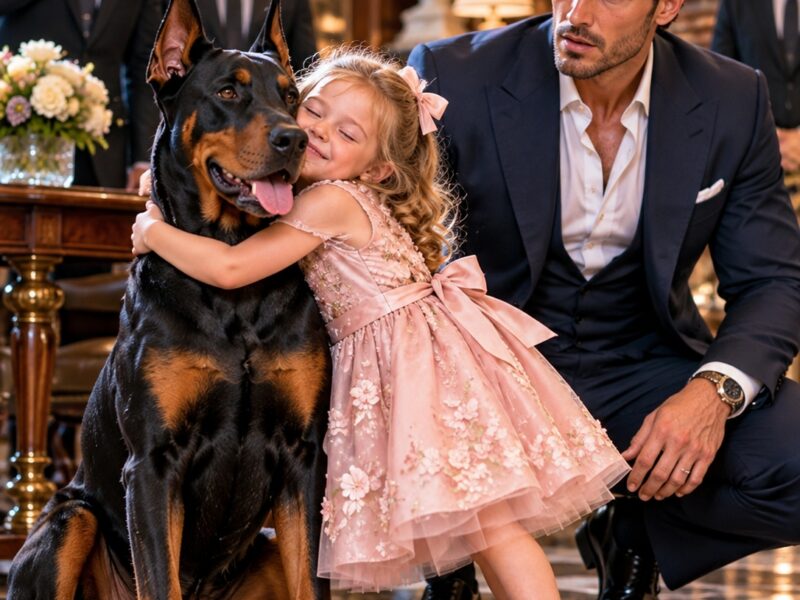
“I Want to Be Best Friends with Your Dog!” the Maid’s Little Girl Told the Mafia Boss—But the Dog’s Unexpected Reaction Exposed a Secret Hidden for Six Years
“I want to be best friends with your dog, Mister!”
My five-year-old daughter said those words in a room full of men who were afraid to look directly at its owner.
Three seconds later, the enormous black Doberman stood up, and the man everyone in Brooklyn called Dante Moretti ordered the entire room not to move.
I was still running down the hallway when I heard my daughter say something that would eventually destroy the life Dante thought he knew.
“Don’t be scared, Bruno. I know why you don’t like the pretty lady.”
The first thing I remember is the sound of a chair scraping across the floor.
Not my daughter’s voice. Not the dog’s growl. The chair.
It was heavy walnut furniture, the kind you couldn’t move without leaving marks on the hardwood, and when Dante Moretti pushed it backward, the noise echoed through the entire first floor of his Long Island estate.
I was halfway down the service hallway with a basket of folded linens when I heard him say, “Everyone stay where you are.”
His voice wasn’t loud.
It didn’t need to be.
I had worked in that house for eight months, and I knew the difference between the voice Dante used when he was irritated and the one he used when something genuinely frightened him.
I’d never heard the second one before.
Then I heard Sophie.
“It’s okay, Mister. I’m good at making friends.”
The basket slipped from my hands.
Freshly folded towels spilled across the marble floor as I ran toward the study, my housekeeping shoes sliding slightly on the polished surface.
I turned the corner and stopped so abruptly that my shoulder struck the doorframe.
My daughter stood six feet from a ninety-pound Doberman.
His name was Bruno.
He was black with rust-colored markings, powerful shoulders, and an enormous head that made him look larger than he actually was. He stood beside Dante’s desk, his eyes fixed on Sophie, his body rigid beneath the dark leather collar.
She wore her favorite yellow dress, white socks, and one pink sneaker. The other sneaker was missing, as usual. In her left hand she held a battered teddy bear named Buttons, whose right ear had disappeared somewhere during our first week at the estate.
Six grown men stood around Dante’s desk.
None of them moved.
One man’s glass remained suspended halfway to his mouth.
Beside the fireplace, Isabella Russo, Dante’s beautiful girlfriend, pressed her fingers against the stem of a crystal wineglass.
And Dante himself stood between Sophie and Bruno, one hand extended toward the dog.
“Bruno. Stay.”
The Doberman remained standing.
My heart was beating so hard I could feel it in my teeth.
“Sophie,” I whispered.
She turned toward me.
“Mommy! Bruno’s sad.”
I wanted to grab her and carry her as far away from that house as possible.
But I had learned something about Bruno during my months there.
Sudden movements upset him.
Unfamiliar voices upset him.
Men carrying tools could barely enter a room without the dog barking from behind a secured gate.
Six weeks earlier, an experienced veterinary professional had advised that Bruno needed a structured behavioral assessment before anyone unfamiliar should approach him.
And now my little girl was standing within arm’s reach.
“Sophie, sweetheart,” I said carefully, “come toward Mommy.”
She frowned.
“But I didn’t get to ask him.”
“Ask him what?”
She pointed toward Dante.
“If Bruno can be my best friend.”
Nobody answered.
Dante kept his eyes on the dog.
“Anna,” he said, “stay calm.”
I wanted to laugh at the absurdity of that instruction.
Stay calm.
My five-year-old daughter had wandered into a private meeting in a mansion belonging to one of the most feared men in New York.
She was standing beside a dog whose behavior even professional handlers approached cautiously.
And the man signing my paychecks was telling me to remain calm.
I swallowed.
“Sophie, listen to me. Take two steps backward.”
She did.
For once in her life, she obeyed without asking why.
Dante kept his hand near Bruno’s collar, then gave a quiet command.
“Place.”
The Doberman looked at Sophie for another moment.
Then he turned, walked to a thick padded mat beside Dante’s desk, and lay down.
Nobody breathed until his chest settled against the cushion.
I crossed the room and pulled Sophie into my arms.
She protested immediately.
“Mommy, I wasn’t touching!”
“I know.”
“I was going to ask first!”
“I know, baby.”
Her small arms closed around my neck.
Over her shoulder, I saw Dante watching us.
He was thirty-nine, with dark hair beginning to silver at the temples and an expression that seemed permanently carved from the same stone as the mansion’s front entrance.
He wore a charcoal suit, a white shirt, and a watch that probably cost more than I’d earned in the previous five years.
People called him a businessman.
The newspapers occasionally called him an alleged organized-crime figure.
His employees simply called him Mr. Moretti.
I had learned not to ask questions about the men who came through his study.
Now I wondered whether not asking questions had been my greatest mistake.
“Mr. Moretti,” I said, struggling to steady my voice, “I’m terribly sorry. She was supposed to be with Mrs. Bell in the kitchen.”
Dante looked at Sophie.
“Did you come looking for Bruno?”
She nodded.
“He was crying.”
A man beside the window shifted.
The Doberman lifted his head.
Everyone froze again.
Dante spoke softly.
“Bruno wasn’t crying, sweetheart.”
“Yes, he was.”
She pointed toward the dog.
“He was making the sad noise.”
I looked at her.
Sophie had always been unusually attentive to animals.
She could tell when the neighborhood cat wanted to be left alone. She noticed when pigeons limped or when a dog at the park tucked its tail between its legs.
She also believed every unhappy creature needed a friend.
That belief was lovely.
It was not always safe.
Dante’s expression changed slightly.
“What sad noise?”
Sophie demonstrated a small, breathy whimper.
Bruno raised his head again.
The sound she made wasn’t far from one I’d heard through the study door at night.
A low, restless whining.
Not the warning growl his security staff knew.
Something quieter.
Dante looked toward the dog.
Then he asked, “When did you hear that?”
“This morning.”
“Where?”
“By the garden door.”
Isabella set down her wineglass.
“Oh, for heaven’s sake,” she said lightly. “It’s a dog, Dante. Sometimes dogs make noises.”
Her tone was perfectly pleasant.
But Bruno stood so quickly that the woman stopped smiling.
Dante glanced at him.
“Place.”
The dog returned to his mat.
Sophie leaned toward my ear.
Then she whispered loudly enough for everyone to hear.
“See, Mommy? He doesn’t like the pretty lady.”
The room went silent.
I felt every eye turn toward Isabella.
Her smile remained.
But the color had vanished from her face.
I carried Sophie straight to our room in the staff wing.
She talked the whole way.
“Bruno has big paws.”
“Yes.”
“And he knows his name.”
“Yes.”
“And Mr. Moretti is not mean like people say.”
I stopped walking.
“Who told you people say he’s mean?”
She considered the question.
“Mr. Vince in the kitchen.”
I closed my eyes.
Vince was a young driver who’d been working at the estate for less than three months and hadn’t yet learned that children repeated everything they heard.
“What exactly did he say?”
“That the boss can make people disappear.”
I felt my stomach turn.
“Sophie, don’t repeat that.”
“Why?”
“Because it’s not something children need to talk about.”
She frowned.
“But I don’t disappear.”
“No, sweetheart.”
“Buttons disappeared under my bed once.”
I hugged her closer.
“That was different.”
At our door, she looked back down the corridor.
“Can Bruno visit?”
“No.”
“Tomorrow?”
“No.”
“On my birthday?”
“Sophie.”
She sighed.
Then she rested her cheek against my shoulder.
“He just needs someone to be nice to him.”
I said nothing.
Because that morning, with the dog lying beside Dante’s desk, I had seen something strange.
Bruno hadn’t been looking at Sophie like an animal preparing to defend itself.
He had seemed confused.
Interested.
Almost relieved.
But I wasn’t foolish enough to mistake one calm moment for permission to let my daughter near an unpredictable dog.
I set Sophie on the bed.
Then I knelt in front of her.
“Listen to me carefully. Bruno is a big dog, and big dogs can accidentally hurt little girls even when they don’t mean to. You’re not allowed to go near him unless Mommy says it’s safe.”
She studied my face.
“Even if he’s sad?”
“Especially then. You come find me.”
She nodded reluctantly.
“Okay.”
I helped her into her pajamas.
Outside the window, the formal gardens stretched toward a row of dark maple trees.
Beyond them stood a tall iron fence.
And beyond that, a life I kept telling myself we’d return to once I’d saved enough money.
At the time, I didn’t know how soon we might need to leave.
I hadn’t planned to become a housekeeper in a mansion.
Two years earlier, I was working as an assistant manager at a small hotel near Boston, taking evening classes in hospitality administration, and living in a rented apartment with my husband, Daniel, and our little girl.
We weren’t wealthy.
We weren’t even particularly comfortable.
But we had plans.
Daniel repaired heating and ventilation systems for commercial buildings. He had a laugh that carried through walls and a habit of buying flowers from the grocery store whenever they were marked down.
He said discounted flowers needed love too.
Sophie adored him.
Then one rainy November morning, a highway accident changed everything.
Daniel never came home.
I was twenty-nine.
Sophie was three.
For several months, I moved through life as though someone had placed a thick sheet of glass between me and the rest of the world.
I worked.
I cooked.
I paid bills.
I answered questions.
At night, after Sophie fell asleep, I sat on the bathroom floor because it was the only place in our apartment where she couldn’t hear me crying.
Then my mother became seriously ill.
She lived outside Boston and needed help paying for transportation and expenses associated with her treatment.
I had already used most of our savings after Daniel died.
The hotel couldn’t give me enough hours.
And every childcare arrangement I found seemed to cost more than the shifts it would allow me to work.
An employment agency eventually contacted me about a live-in position on Long Island.
The salary was generous.
Housing was included.
The estate was willing to accommodate my daughter.
There were strict rules, the recruiter explained, but the employer valued discretion and reliability.
I asked what kind of family owned the property.
The recruiter paused.
“Mr. Dante Moretti is a private businessman.”
I’d heard the name.
Everyone around New York had heard the name.
But desperation has a way of making danger look like a problem you can manage.
I accepted the position.
For eight months, I cleaned guest rooms, organized linen inventories, supervised occasional events, and tried to remain invisible.
I sent money to my mother’s household whenever I could.
I put a little into savings.
And I told myself that none of the strange things happening inside the mansion were any of my business.
Until my daughter decided she wanted to be friends with the dog.
At six the following morning, I walked to Dante’s study carrying my resignation letter.
I had written it after Sophie fell asleep.
The paper was folded into three sections, and I’d rewritten the first paragraph twice because I couldn’t decide whether to apologize for leaving without proper notice.
The study door stood open.
Dante sat behind the desk beneath a green banker’s lamp.
Bruno lay on his mat near the fireplace.
A silver pin shaped like a laurel branch rested beside an open ledger.
“Mr. Moretti?”
He looked up.
“Anna.”
I didn’t sit.
“I need to resign.”
He set down his pen.
For a moment, he said nothing.
Then he looked at the folded paper in my hand.
“Because of yesterday?”
“Yes.”
“I understand.”
The answer surprised me.
I’d prepared myself for an argument.
For an offer of money.
Possibly for anger.
Instead, he leaned back.
“You’re frightened for your daughter.”
“Very.”
“You should be.”
I looked at him.
He glanced toward Bruno.
“That dog has problems I should have dealt with properly a long time ago.”
I swallowed.
“I can’t risk another incident.”
“You shouldn’t.”
The quiet agreement almost made me cry.
I needed the money.
My mother’s medical bills hadn’t stopped arriving.
Our savings would last perhaps six weeks if I was careful.
But I’d spent most of the previous night imagining what might have happened if Sophie had ignored my instructions and reached toward Bruno.
I couldn’t stay simply because leaving would be difficult.
Dante folded his hands.
“I’d like to offer you something different, if you’re willing to hear it.”
I hesitated.
“What?”
“Four weeks of paid notice, whether you work them or not. A written reference covering your actual responsibilities here. And help from the staffing office identifying other positions.”
I stared at him.
“That isn’t necessary.”
“It seems reasonable.”
I looked toward Bruno.
The dog was watching me.
His gaze didn’t seem friendly.
But he wasn’t growling.
Dante followed my eyes.
“I’m also arranging for an independent veterinary behavior specialist. Until we’ve had a proper assessment and management plan, Sophie won’t have access to him.”
I nodded.
“Thank you.”
He looked at the resignation letter.
“Take two days before you decide. You may still leave. The terms won’t change.”
I was about to answer when something small appeared in the doorway.
A yellow sleeve.
Then a mop of blonde curls.
“Sophie,” I whispered.
She stopped.
I stared at her.
“Why are you here?”
She held up Buttons.
“I came to say sorry.”
Dante looked at her.
“For what?”
“For making everybody scared.”
He considered the question.
“That’s thoughtful.”
Sophie looked at Bruno.
“Is he in trouble?”
“No,” Dante said. “He’s going to get some help learning how to feel comfortable.”
She nodded solemnly.
“Like when I was scared of thunder?”
“Something like that.”
She stepped closer to me but kept her distance from the dog.
Then she looked at Dante.
“Can I still be his friend if I don’t touch him?”
For the first time since I’d met him, Dante Moretti smiled.
A small smile.
Almost uncertain.
“I think that would be a good place to start.”
Sophie grinned.
Then she ran back toward the kitchen.
I watched her go.
When I turned around, Dante was still looking at the empty doorway.
And there was something in his expression I hadn’t seen before.
Loneliness.
Bruno had belonged to a man named Thomas Delaney.
I learned that from Mrs. Hilda Bell, the estate’s longtime cook, while we were peeling potatoes that afternoon.
Hilda was sixty-two, broad-shouldered, practical, and blessed with a talent for saying uncomfortable things while pretending to discuss vegetables.
She had worked for the Moretti family for twenty-three years.
She knew which cupboard contained emergency candles, which staircase creaked, and which guests should never be given access to the staff wing.
“Thomas raised that dog,” she said, dropping a potato into a bowl of water. “Bruno was still a puppy when Mr. Moretti brought him here.”
“What happened to Thomas?”
Hilda’s knife slowed.
“He died.”
I waited.
She looked toward the door.
“Long time ago. Six years. There was trouble at a warehouse in Brooklyn.”
“Was he family?”
“Not by blood.”
She peeled another strip of skin.
“Thomas was the nearest thing Mr. Moretti ever had to a father who listened.”
I looked up.
“His own father?”
“Dead before I came here. Mean man, according to people who knew him.”
She lowered her voice.
“Thomas taught Dante how to run things. More importantly, he tried to teach him when not to.”
“And Bruno?”
“Thomas gave him the puppy shortly before he died.”
I remembered the silver pin on Dante’s desk.
The way he had touched it when I entered.
“Why does Bruno behave that way?”
Hilda sighed.
“That’s a question for somebody qualified to assess him. But I think the household has made him worse. Too many strangers. Too much tension. People reacting to every little sound he makes.”
She looked directly at me.
“Grief isn’t training, Anna. A man can love an animal and still fail to give it what it needs.”
I thought about Dante’s study.
The heavy curtains.
The men who lowered their voices.
The dog who spent much of his time shut inside the same rooms.
“Does Mr. Moretti know?”
Hilda gave me a sad smile.
“I think he’s beginning to.”
Three days later, a veterinary behavior specialist arrived.
Her name was Dr. Leah Mercer, and she had the calm, slightly impatient manner of someone accustomed to explaining the same basic principles to wealthy clients who thought expensive equipment could solve every problem.
She spent nearly two hours observing Bruno from a safe distance.
She reviewed his medical history and previous incidents.
She asked about his daily routine, exercise, sleep, handling, and interactions with staff.
Then she met with Dante and the senior household team.
I was included because Sophie lived on the property and because I’d witnessed the incident in the study.
“Bruno isn’t a monster,” Dr. Mercer explained. “But he has a history that makes unsupervised interaction with unfamiliar people inappropriate.”
Dante listened without interrupting.
She continued.
“He needs a consistent management plan, a thorough medical workup, and gradual behavior modification. That includes secure separation when visitors or children are present.”
“Will he ever be safe around Sophie?” Dante asked.
“That’s not a promise I can make. We can improve his welfare and reduce risk. Friendship doesn’t require physical contact.”
I felt myself breathe more easily.
Someone was finally saying what I needed to hear.
Dr. Mercer looked at me.
“Your daughter should never be expected to calm him or interpret his behavior. That’s an adult responsibility.”
“Agreed,” I said.
Dante nodded.
“Agreed.”
Later, after the specialist left, he approached me beside the terrace.
“You were right to be afraid.”
I looked at him.
“I know.”
“I should have handled this before yesterday.”
“Yes.”
The directness seemed to surprise him.
Then he smiled faintly.
“People usually try to make me feel better after I admit something.”
I folded my arms.
“Would that help Bruno?”
“No.”
“Then I don’t see the point.”
For a second, I wondered whether I’d gone too far.
But Dante only nodded.
“Fair enough.”
Behind the glass doors, Sophie sat drawing pictures of dogs with purple ears.
Bruno rested in a separate secured area with a trained handler.
The arrangement was safer.
Less dramatic.
And more useful than all the whispered stories about his terrifying reputation.
I decided to stay for the remainder of my notice period.
It was not because I trusted the house.
I didn’t.
But I had begun to trust that somebody inside it might finally be willing to change.
Isabella Russo hated the new arrangements.
She didn’t say so openly.
She rarely said anything openly when a pleasant smile would serve her better.
But I noticed.
She complained that the new gates were unattractive.
She said Bruno’s training sessions disrupted the household schedule.
She asked why a veterinarian needed detailed access to the property when the dog had been difficult for years.
And whenever Sophie passed through a room, Isabella watched her with an expression that disappeared the moment someone else looked.
Isabella was twenty-eight, a former fashion model who had appeared in magazines I’d once stacked beside the hotel reception desk.
She was beautiful in a way that made people turn their heads before they realized they were looking.
She wore expensive perfume, immaculate silk blouses, and jewelry that caught the light when she lifted a glass.
She had lived at the estate for almost two years.
Everyone treated her as though she might eventually become Mrs. Moretti.
But Bruno never relaxed around her.
Even from behind his gate, he stiffened when she passed.
I had assumed the problem was unfamiliarity.
Then one afternoon, while I was arranging flowers in the downstairs sitting room, I heard Isabella speaking to Marcus Vitali.
Marcus was Dante’s longtime security director.
He was forty-two, broad through the shoulders, with dark hair cut close and a small scar beside his eyebrow. He had the confident, easy manner of someone who knew the house almost as well as its owner.
I didn’t mean to listen.
I was replacing water in a vase when their voices reached me through the partly open terrace door.
“The dog needs to go,” Isabella said.
Marcus answered quietly.
“Dante won’t allow that.”
“Then find a reason.”
“Isabella.”
“I am tired of that animal watching me every time I enter a room.”
Marcus made a sound I couldn’t interpret.
Then he said, “You’re letting a dog get under your skin.”
“You weren’t there when the little girl spoke.”
“I heard about it.”
“She looked right at me.”
“She’s five.”
“That doesn’t mean she didn’t notice something.”
A pause.
Then Marcus said, “Keep your distance from the child.”
I froze.
A moment later, the terrace door opened.
Isabella stepped inside.
She saw me beside the flowers.
Her smile appeared instantly.
“Anna. Those lilies are beautiful.”
“Thank you, Miss Russo.”
She glanced at the vase.
“How long have you been here?”
“About fifteen minutes.”
“Did you hear us?”
The question came so casually I almost answered without thinking.
“I heard voices. I was working.”
Her smile remained.
“Of course.”
She walked past.
Her perfume lingered long after she disappeared upstairs.
I stood beside the flowers, feeling something cold settle beneath my ribs.
I had heard enough to understand that Isabella was afraid of the dog.
But I couldn’t understand why she was beginning to fear my daughter too.
The next Sunday, Sophie drew Bruno a birthday card.
It wasn’t his birthday.
According to Sophie, animals shouldn’t have to wait an entire year to receive something nice.
She sat at the kitchen table with crayons spread around her, tongue pressed between her teeth as she worked.
The drawing showed a black dog standing beneath an enormous yellow sun.
Beside him stood a little girl wearing a purple crown.
“Who’s the princess?” I asked.
“Me.”
“And who’s that?”
“Bruno.”
“Why does he have five legs?”
“That’s his tail, Mommy.”
“Of course. Silly me.”
She continued coloring.
After a while, she looked up.
“Do you think Bruno misses his first daddy?”
I stopped wiping the counter.
“What makes you ask?”
“Miss Hilda said he used to have another person.”
I glanced toward the kitchen doorway.
Hilda was kneading dough on the other side of the room.
She didn’t look up.
“Yes,” I told Sophie. “There was a man named Thomas who loved him very much.”
“Where did Thomas go?”
“He died, sweetheart.”
Sophie lowered her crayon.
“Like Daddy?”
My throat tightened.
“Yes.”
She considered that quietly.
Then she looked at her drawing.
“Maybe Bruno thinks everybody leaves.”
I set down the cloth.
For several seconds, I couldn’t speak.
When Daniel died, Sophie had stopped asking when he was coming home after about six months.
She hadn’t stopped looking for him.
Sometimes, in grocery stores, she’d turn toward a man with the same sandy-colored hair and reach for my hand.
Sometimes, when I laughed at something on television, she’d look startled, as though she’d heard a familiar sound coming from the wrong person.
Children don’t always tell you what grief looks like.
Sometimes they put it in a drawing.
Sometimes they ask whether a dog misses someone.
I pulled out a chair and sat beside her.
“What do you think we should do?”
“Tell Bruno he can miss Thomas.”
She looked serious.
“And he doesn’t have to stop just because he has Mr. Dante.”
I brushed her hair behind her ear.
“That sounds like a good thing to tell him.”
She nodded.
Then she added a purple heart above the dog.
That afternoon, with Dr. Mercer’s permission, Sophie placed the drawing on a board outside Bruno’s secured area.
She stood well behind the barrier while the handler worked with him.
“Happy not-your-birthday, Bruno!”
The dog glanced toward her voice.
His tail moved once.
Sophie beamed.
Dante stood beside the handler, watching.
When she finished explaining the drawing, she looked at him.
“Does he miss Thomas?”
Dante didn’t answer immediately.
His hand rested on the edge of the gate.
“Yes,” he said eventually. “I think he does.”
Sophie nodded.
“You can miss him too.”
Something changed in Dante’s face.
He turned toward the garden.
For a moment, I thought he was going to leave.
Instead, he crouched so he could speak to her without looking down.
“Thank you, Sophie.”
She smiled.
“That’s what best friends are for.”
Later, after I’d taken her inside, I saw Dante standing alone beside the drawing.
He remained there long after Bruno had been led away for his afternoon walk.
The first genuinely personal conversation I had with Dante happened during a thunderstorm.
It was a Thursday evening in October.
Rain struck the windows so hard that the gardens beyond them disappeared behind sheets of water.
Sophie was in our room with Hilda, making a paper crown for Buttons.
I’d been asked to finish preparing the guest suite because two visitors were expected the following morning.
When I came downstairs, I found Dante sitting alone in the breakfast room.
A mug of coffee stood before him.
His jacket hung over the back of a chair.
He wasn’t reading anything.
He was looking toward the dark windows.
“Mr. Moretti?”
He turned.
“Anna.”
“Would you like the curtains closed?”
“No. Leave them.”
I nodded.
I was about to go when he asked, “How’s your mother?”
The question surprised me.
I’d told the household administrator about her treatment when negotiating my leave schedule, but I’d never discussed it with Dante.
“She’s doing all right. Some days are better than others.”
“Does she still live near Boston?”
“Yes. My sister helps with appointments.”
He looked down at his coffee.
“I’m sorry it’s been difficult.”
“Thank you.”
I turned toward the door.
Then he spoke again.
“Did your husband like dogs?”
I stopped.
“Daniel?”
“Yes.”
“He loved them.”
I smiled despite myself.
“He wanted one. A rescue dog. Something scruffy that would shed everywhere and steal food from the kitchen counter.”
Dante looked at me.
“You didn’t?”
“I wanted a dog once we had a backyard.”
“Practical.”
“Somebody had to be.”
He smiled faintly.
For a moment, the rain filled the silence.
Then he asked, “Does Sophie remember him?”
“Pieces.”
I folded my hands.
“She remembers his laugh. She remembers that he used to make pancakes shaped like animals. She remembers one pair of ridiculous green socks he wore every Christmas.”
Dante looked toward the window.
“Small things.”
“They’re never small to the person who remembers them.”
He nodded.
The thunder rolled again.
I thought about leaving.
Instead, I asked the question I’d been carrying since Hilda told me about Thomas.
“Was Mr. Delaney like a father to you?”
Dante’s expression closed slightly.
I immediately regretted asking.
“I’m sorry. That was too personal.”
“No.”
He looked at the silver pin attached to the inside of his jacket.
“Thomas was the first man I knew who could tell me I was wrong without trying to humiliate me.”
I waited.
“My father believed fear was useful. Thomas believed fear made people unpredictable.”
He turned the pin between his fingers.
“He used to say that a man who has to frighten everyone into staying beside him isn’t powerful. He’s just alone.”
The words stayed between us.
Then Dante gave a humorless smile.
“I used to think he was sentimental.”
“And now?”
“Now I think he understood something I didn’t.”
The rain eased slightly.
He looked at me.
“You can go home to Boston whenever you need to, Anna. You don’t have to wait for a crisis to ask.”
I nodded.
“Thank you.”
As I reached the doorway, he added, “And you can call me Dante when we’re not discussing work.”
I turned.
He looked almost embarrassed by the suggestion.
I considered it.
“Maybe eventually, Mr. Moretti.”
He laughed.
It was brief.
But it was real.
And somewhere down the hallway, I heard Sophie announce that Buttons was now king of the laundry basket.
For a moment, the enormous house seemed almost ordinary.
That feeling lasted eleven days.
Then Bruno stopped eating.
At first, nobody was particularly alarmed.
The behavior specialist had recommended a change in feeding routines, and Bruno had never been enthusiastic about unfamiliar food.
But when he refused breakfast twice and became unusually withdrawn, the handler notified Dante.
An appointment was arranged with the veterinary team.
I learned about the problem from Hilda while helping prepare lunch.
“He barely touched his dinner last night,” she said.
“Is he sick?”
“Don’t know yet.”
“Could he have eaten something outside?”
“Possible. The vet’s coming.”
I looked through the window.
Bruno was resting in the secured garden enclosure.
His head lay between his front paws.
He looked tired.
Sophie came into the kitchen carrying Buttons.
“Why isn’t Bruno playing?”
“He’s not feeling well,” I told her.
She studied the dog through the glass.
“Did he drink the bad water?”
I froze.
“What?”
She looked at me.
“The water the pretty lady made.”
I set down the plate in my hand.
“Sophie, what water?”
She frowned.
“The storm night.”
I felt my pulse quicken.
“What happened on the storm night?”
She shifted Buttons into her other arm.
“I woke up because of thunder. I went to look for my teddy’s blanket, and I saw the pretty lady in the little kitchen.”
I crouched in front of her.
“Which pretty lady?”
“The one with the shiny shoes.”
“Miss Isabella?”
Sophie nodded.
“She was putting drops in Bruno’s bowl.”
My stomach turned.
“Drops of what?”
“I don’t know.”
“Did you touch the bowl?”
“No.”
“Did you drink anything?”
She gave me an offended look.
“Mommy, I’m not a dog.”
I nearly laughed from nerves.
“Of course not.”
I took a breath.
“Did you tell anyone?”
“I told Bruno not to drink it.”
I stared at her.
She looked worried now.
“Was that wrong?”
“No, sweetheart.”
I pulled her close.
“You did the right thing by telling me.”
I sat with her for another moment, forcing myself to stay calm.
Then I stood and looked toward the service hallway.
I could have dismissed her story.
She was five.
She sometimes confused the days of the week.
She once insisted the gardener had brought an actual dinosaur through the front gate because she’d seen a large green lawn mower.
But she’d described a specific person doing a specific thing.
And an animal was now unwell.
I couldn’t ignore that.
I asked Hilda to stay with Sophie.
Then I went to Dante’s study.
Dante was on the phone when I knocked.
He looked up and gestured for me to enter.
“I’ll call you back,” he said into the receiver.
Then he turned toward me.
“Something wrong?”
“Yes.”
I closed the door.
“It’s about Bruno.”
His expression changed.
“What about him?”
I took a breath.
“Sophie says she saw Miss Russo put something into his water bowl during the thunderstorm.”
For several seconds, Dante didn’t move.
Then he asked, “What exactly did she say?”
I repeated Sophie’s account.
The kitchen.
The small bottle.
The drops.
The bowl.
I tried not to embellish anything.
I didn’t claim Sophie had identified the substance.
I didn’t claim she had witnessed a crime.
I only explained what she’d told me.
Dante listened without interrupting.
When I finished, he looked toward the door.
“Did she tell anyone else?”
“Hilda was in the kitchen when she mentioned it.”
“Anyone beyond Hilda?”
“Not that I know of.”
He nodded.
Then he picked up the house phone.
“Enzo.”
A man’s voice answered.
“Sir?”
“Come to my study. And ask the veterinary team to examine Bruno as soon as possible. Tell them there may have been an unknown substance introduced into his water.”
He put down the receiver.
Then he looked at me.
“Thank you for telling me.”
I folded my arms.
“What are you going to do?”
“Find out whether he’s been exposed to something harmful.”
“And Sophie?”
“She isn’t in trouble.”
“I know that.”
My voice came out sharper than I’d intended.
“I need to know she’s safe.”
Dante looked at me for a long moment.
Then he nodded.
“You’re right.”
He rose.
“Keep her with you or Hilda. I’ll have the household administrator arrange for you to stay somewhere separate from the main residence while this is reviewed.”
My stomach tightened.
“You think she’s in danger?”
“I don’t know.”
He didn’t try to soften the answer.
“And I won’t pretend I do.”
I appreciated the honesty.
But I was still frightened.
When I turned toward the door, he said, “Anna.”
I stopped.
“I’m sorry this has become part of your daughter’s life.”
I looked back.
“She wanted a friend, Mr. Moretti.”
His expression shifted.
“I know.”
“She didn’t ask to become a witness to whatever is happening here.”
“No.”
I held his gaze.
“Please remember that.”
Then I left.
The veterinary team took Bruno to a specialty clinic for evaluation.
Enzo Baron, the estate’s operations and security manager, preserved the water container and arranged for the available kitchen camera footage to be secured.
Enzo was in his late fifties, compactly built, with gray hair and a habit of listening to an entire explanation before offering an opinion.
Unlike Marcus, he had never seemed interested in being the loudest man in a room.
Hilda trusted him.
That mattered to me.
A preliminary review of the camera footage showed Isabella entering the service kitchen late at night on more than one occasion.
On one recording, she appeared to handle Bruno’s water bowl while holding a small object.
The image didn’t establish what the object contained.
But it was enough to warrant further examination.
Dante contacted his attorney and requested that the footage and physical evidence be properly preserved for possible reporting to the authorities.
I learned those details the following evening.
By then, Sophie and I were staying in a modest guest apartment above the detached garage.
It had a separate entrance.
A small kitchen.
Two bedrooms.
And windows that overlooked the orchard rather than the main courtyard.
Sophie loved it.
She announced that it was our secret castle.
I felt more like a woman hiding from something she didn’t understand.
At eight-thirty, Enzo knocked on the door.
“Mrs. Bennett?”
I opened it cautiously.
“Mr. Moretti would like to speak with you downstairs. Only if you’re comfortable.”
“About Sophie?”
“About the evidence.”
I glanced toward the living room.
Hilda sat on the couch reading Sophie a story.
I took my cardigan.
“Five minutes.”
Enzo nodded.
“I’ll wait outside.”
We walked toward the main residence through cold October air.
The lawn smelled of damp leaves.
A light burned in Dante’s study.
When I entered, he was standing beside the window.
He looked as though he hadn’t slept.
“Anna.”
“Has Bruno been examined?”
“Yes.”
“Is he going to be okay?”
“The veterinary team is treating him. They’ve found signs that warrant further testing. They won’t speculate about the cause before the results are complete.”
I nodded.
“Good.”
Dante indicated a chair.
I remained standing.
He didn’t insist.
“There’s something else,” he said.
My stomach tightened.
“The security review showed that somebody altered access permissions on several service-area cameras during the past month.”
I frowned.
“Why?”
“We don’t know yet.”
He looked toward the desk.
“The changes were made through an account associated with Marcus’s department.”
I stared at him.
“Mr. Vitali?”
“Yes.”
I remembered the conversation on the terrace.
Isabella.
Marcus.
The dog needs to go.
Keep your distance from the child.
I felt the blood drain from my face.
Dante noticed.
“What is it?”
I looked at him.
Then I told him what I’d heard.
Every word I could remember.
When I finished, Dante remained completely still.
I had expected surprise.
Anger.
Perhaps disbelief.
Instead, he looked tired.
As though some part of him had been expecting exactly that answer.
“Thank you,” he said quietly.
I stared at him.
“Is that all?”
“What else would you like me to say?”
“That my daughter isn’t going to be caught in the middle of something dangerous.”
He looked away.
For a moment, I regretted the words.
Then he met my eyes again.
“I can’t guarantee that nothing dangerous will happen. I can make sure you aren’t required to stay here while we address it.”
I swallowed.
“And Bruno?”
His expression changed.
“He’s being cared for.”
I nodded.
Then I looked toward the photograph on his desk.
It showed a younger Dante standing beside an older Black man wearing a gray coat. Between them sat a Doberman puppy with oversized paws.
Thomas Delaney.
And Bruno.
The photograph looked almost impossibly peaceful.
I pointed toward it.
“Was that the last picture of them together?”
Dante followed my gaze.
“One of the last.”
He picked it up.
“Thomas took Bruno to a training field that afternoon. He sent me this picture because I was away on business.”
His thumb moved along the frame.
“I told him I’d come the following week.”
He stopped.
I waited.
“The following week never happened.”
I looked at the dog in the photograph.
For the first time, I understood that Bruno wasn’t simply a difficult animal kept by a dangerous man.
He was one of the last living connections Dante had to someone he’d loved.
And someone inside the house might have been trying to take that connection away too.
Two days later, Dante asked me to visit the clinic with him.
I almost refused.
The situation had become too complicated.
I had a daughter to care for, a mother in Boston who still needed help, and a resignation letter waiting in my desk drawer.
But Bruno mattered to Sophie.
And, if I was honest, he mattered to me now too.
We drove in separate cars to the veterinary specialty center.
Dante arrived without his usual entourage.
Enzo accompanied him.
Bruno was resting in a quiet treatment area, receiving supportive care.
He lifted his head when Dante entered.
The change in Dante’s face was immediate.
The hard lines softened.
He crouched beside the enclosure and spoke so quietly I couldn’t hear the words.
The veterinarian explained that Bruno’s condition had stabilized.
Further testing was ongoing, including analysis of any potential contaminants.
When Dante asked whether the dog could return home soon, she said they would determine that based on his recovery and safety.
No promises.
No special exceptions because he was wealthy.
For once, Dante looked relieved to be told what he couldn’t control.
Afterward, we sat in the clinic’s waiting room beneath a television showing the afternoon weather.
I was holding a paper cup of coffee.
He held nothing.
“Can I ask you something?” I said.
He turned.
“Yes.”
“Why did Bruno react so strongly to Isabella before any of this happened?”
He considered the question.
“I don’t know.”
“Did she ever mistreat him?”
“Not that I saw.”
I nodded.
He looked down at his hands.
“Thomas trained Bruno when he was a puppy. There were people Bruno learned to distrust early on. Maybe he associated her with something unpleasant.”
“That sounds possible.”
“But I can’t know.”
He sighed.
“I spent two years telling everyone he was jealous.”
I looked at him.
“People do that.”
“Do what?”
“Explain away things that don’t fit the story they want to believe.”
He smiled without humor.
“You’ve met my girlfriend.”
I almost laughed.
Then I stopped.
“I’m sorry.”
“Don’t be.”
He looked toward the examination rooms.
“I knew there were things about Isabella that didn’t make sense. I kept telling myself they weren’t important.”
“Why?”
He thought about that for a long time.
Then he answered honestly.
“Because I was tired of being alone.”
I looked at him.
There was no self-pity in his voice.
Only embarrassment.
As though loneliness were something a man like him wasn’t permitted to admit.
I understood that feeling more than he knew.
But I also understood that wanting someone beside you could make it dangerously easy to overlook who they really were.
The next discovery had nothing to do with the dog.
It began with a missing folder.
Enzo was reviewing internal security records when he noticed repeated access to a restricted archive used for business contracts.
The access logs pointed toward Marcus’s department.
At first, Dante assumed the records were related to routine operations.
Then the estate’s accountant, Paul Finelli, identified discrepancies in internal authorization reports.
Several documents had been copied or exported outside normal procedures.
Some concerned freight companies.
Others concerned the Brooklyn waterfront properties that had made Dante’s family wealthy.
I didn’t know the contents.
I didn’t want to.
But I could see the effect they had on Dante.
He became quieter.
His meetings grew shorter.
He stopped allowing Marcus to coordinate every visitor.
And Isabella began spending more time away from the estate.
One afternoon, she returned from Manhattan carrying expensive shopping bags and found me organizing linens beside the main staircase.
“Anna.”
I looked up.
“Miss Russo.”
She smiled.
“Is your daughter enjoying her new apartment?”
“Yes. Thank you.”
“Children can be so imaginative, can’t they?”
I felt my stomach tighten.
“Sometimes.”
She placed one shopping bag on the console table.
“I heard she told Dante a story about Bruno’s water.”
I stood very still.
“She told me something she saw.”
“Of course.”
Isabella moved closer.
“Children misunderstand things. They see a bottle or a medicine dropper and decide something terrible must be happening.”
I said nothing.
She continued.
“I would hate for Sophie to become confused about who her friends are.”
The words were gentle.
Her smile was perfect.
But my hands had gone cold.
“She’s five,” I said. “She needs adults to tell her the truth.”
Isabella’s expression changed almost imperceptibly.
“Children also need mothers who know when to stop asking questions.”
Then she picked up her bag and walked upstairs.
I watched her disappear.
For several seconds, I couldn’t move.
Then I took out my phone and called Enzo.
That evening, I asked Dante for a meeting.
He arrived at the garage apartment ten minutes later.
He knocked rather than letting himself in.
That small courtesy mattered more than he probably realized.
Sophie was in her bedroom with Hilda.
I invited him into the kitchen.
The apartment smelled of tomato soup and the cinnamon muffins we’d baked that afternoon.
Dante looked around.
There were drawings taped to the refrigerator.
A pair of pink sneakers beneath the table.
Buttons sitting upright on the couch, wearing a paper crown.
He seemed almost uncomfortable in such an ordinary room.
“Would you like tea?” I asked.
“No, thank you.”
I folded my arms.
“Isabella spoke to me today.”
His expression sharpened.
“What did she say?”
I repeated the conversation.
When I finished, he closed his eyes briefly.
Then he looked toward the bedroom hallway.
“Did Sophie hear any of it?”
“No.”
“Good.”
I shook my head.
“No, Dante. It isn’t good.”
He looked at me.
I had never used his first name before.
“I came here to work,” I said. “I accepted this job because I needed to support my daughter and help my mother. I did not agree to live inside somebody else’s secrets.”
“I know.”
“You keep telling me you’ll handle it.”
“Yes.”
“But I’m still getting warnings from the woman who lives in your house.”
He was silent.
I continued.
“I’m leaving.”
The words frightened me as soon as I said them.
But they also felt necessary.
Dante nodded.
“All right.”
I stared at him.
“That’s it?”
“What would you prefer?”
“I don’t know. An argument, maybe.”
He gave a small, sad smile.
“You’ve had enough of those.”
I looked down.
“Yes.”
He leaned against the counter.
“Enzo can arrange secure transportation to wherever you choose. Your final wages and accrued benefits will be handled through payroll. You’ll receive the notice payment we discussed.”
“I don’t want special favors.”
“They aren’t favors. They’re terms I offered when you first said you wanted to leave.”
I looked at him.
He wasn’t trying to trap me with gratitude.
He wasn’t asking me to stay because Sophie made Bruno happy.
He was allowing me to choose.
That made the decision harder, not easier.
“Thank you,” I said.
He nodded.
From the bedroom, Sophie’s voice floated toward us.
“Mommy! Buttons needs another blanket!”
I started toward her.
Then stopped.
“Dante?”
He looked up.
“Please don’t let whatever happened to Thomas happen again.”
His face changed.
For a moment, I thought I’d crossed a line.
Then he answered.
“I’m trying not to.”
I nodded.
And went to help my daughter.
We were supposed to leave that Saturday.
Instead, the police arrived on Friday morning.
Two investigators from a regional law enforcement task force came to the estate with a detective who had been working on a separate inquiry involving suspicious freight records.
Dante’s attorney met them.
Enzo directed them to a conference room.
I knew only that the investigators wanted to speak with several household employees, including me.
My first instinct was terror.
I had never been questioned by police about anything more serious than a parking accident.
Now I was sitting in a formal drawing room, describing a conversation I’d overheard on a terrace and a statement my five-year-old daughter had made about a water bowl.
The detective, a woman named Rachel Moreno, listened carefully.
She didn’t ask me to speculate.
She didn’t ask me whether Isabella was evil or whether Dante deserved his reputation.
She asked dates.
Times.
Who was present.
What I’d seen personally.
What Sophie had reported.
She made a clear distinction between those categories.
I appreciated that.
At the end, she said, “You made the right decision reporting your concerns.”
I looked at her.
“Is my daughter safe?”
“We take any concern involving a child seriously. We can discuss practical safety planning, but I can’t promise you how this investigation will develop.”
It wasn’t comforting.
It was honest.
And after months inside a house where people smiled while hiding things, honesty felt like something solid beneath my feet.
When I left the room, Dante stood near the window.
He looked at me.
I looked back.
Neither of us spoke.
We both understood that the house had crossed a line it could never uncross.
The investigation widened.
Some of the business records pointed toward a rival group associated with a man named Vincent Romano.
Some raised questions about Marcus’s use of his security position.
Others concerned transactions that Dante’s own companies would have to explain.
That last part mattered.
Dante couldn’t simply tell the authorities he had been betrayed and expect them to ignore everything else.
He had built his reputation inside an organization where some operations had crossed legal lines.
There was no clean way to separate his personal hurt from the consequences of the system he’d helped maintain.
I think that realization changed him more than the discovery about Isabella.
For years, he’d believed loyalty was something he could purchase with money, protect through fear, and test through obedience.
Now the people closest to him were under investigation.
And the only witnesses he seemed able to trust completely were a child, a dog, and a handful of employees who had never been given much power.
He hired independent counsel to review the companies’ records and cooperated with lawful requests for information.
He also stepped away from certain operational decisions while the review proceeded.
Marcus was suspended from his security role.
Isabella moved out of the estate after investigators questioned her.
Neither departure brought the dramatic confrontation the household had expected.
No screaming.
No broken furniture.
No midnight parade of men summoned to settle a score.
There were lawyers.
Documents.
Interviews.
And long stretches of silence.
Sometimes, I think silence is the sound consequences make before anybody knows what shape they’ll take.
On the morning we were due to leave, Sophie sat on her suitcase.
It was pink with yellow stars and had a broken wheel.
She wore a striped sweater, jeans, and the expression of a child who had been told something unfair.
“I don’t want to go.”
I knelt in front of her.
“I know.”
“Bruno’s going to be lonely.”
“Bruno has people taking care of him.”
“But I’m his best friend.”
I brushed her hair behind her ear.
“You can still care about him even when you don’t live here.”
She looked unconvinced.
“Will he forget me?”
“I don’t think so.”
She studied Buttons.
“Daddy didn’t forget me, right?”
The question nearly undid me.
I drew her close.
“No, sweetheart. Your daddy loved you every day he was here.”
She rested her cheek against my shoulder.
After a moment, she whispered, “Then Bruno can love me from far away.”
I kissed her hair.
“Yes.”
There was a knock at the door.
Dante stood outside carrying an envelope.
He wasn’t wearing a suit.
Just a dark sweater and trousers.
He looked tired.
But not defeated.
“I wanted to say goodbye,” he said.
Sophie slid off her suitcase.
“Mister Dante!”
She ran toward him.
He crouched and allowed her to hug him.
Then she stepped back.
“Can I ask something?”
“Of course.”
“Can Bruno come say goodbye?”
Dante looked at me.
I shook my head slightly.
He understood.
“Bruno is still recovering,” he told her gently. “And we’re following the specialist’s rules.”
Sophie sighed.
“Grown-ups have so many rules.”
“They do.”
“Can I send him drawings?”
“I think he’d like that.”
She considered the arrangement.
Then nodded.
“Okay.”
Dante handed me the envelope.
“Your employment documents. Final payroll information and the reference letter.”
I took it.
“Thank you.”
He looked toward Sophie’s suitcase.
“Are you going to Boston?”
“For a while. My sister has room for us until I find another position.”
He nodded.
“And your mother?”
“Stable. The new treatment seems to be helping.”
“I’m glad.”
We stood in the doorway.
There were so many things I could have said.
About Bruno.
About Isabella.
About Thomas.
About the strange way two people from entirely different worlds had found themselves sharing the same worries.
Instead, I said, “Take care of yourself.”
Dante smiled faintly.
“I’m learning how.”
Sophie held up Buttons.
“Bruno says bye!”
Dante laughed.
Then he looked at me.
For a moment, the expression on his face was almost unbearably gentle.
“Goodbye, Anna.”
“Goodbye, Dante.”
We left ten minutes later.
As Enzo drove us through the iron gates, Sophie pressed her face against the rear window.
“Bye, Bruno!”
I looked back toward the house.
Dante stood on the front steps.
He didn’t wave.
He simply watched until the car turned onto the road.
I thought that was the end of our story.
I was wrong.
Boston in late October smelled of wet leaves, coffee, and cold Atlantic air.
My sister Rachel lived in a modest two-family house outside the city with her husband and two sons. She had offered to let us stay as long as we needed, although I could tell from the way she reorganized the spare bedroom that three extra people in a small house would require some adjustment.
The room had yellow curtains and a view of the neighbor’s maple tree.
Sophie immediately declared it perfect.
I unpacked our clothes, set Buttons on the pillow, and taped her drawing of Bruno beside the bed.
For the first time in months, I slept without wondering who might be walking through the hallway outside my door.
But peace didn’t arrive all at once.
I still checked the locks twice.
I still startled when unfamiliar cars slowed near the house.
And every time my phone rang, I expected news from Long Island.
The first week, I applied for six jobs.
Two hotels declined to interview me.
Another offered a front-desk position at wages barely sufficient to cover childcare.
A fourth invited me to meet its general manager.
I put on my navy blazer, borrowed Rachel’s car, and drove across town in the rain.
The interview lasted forty minutes.
The manager, a woman named Patricia Ellis, asked about my experience coordinating housekeeping staff, managing inventory, and handling difficult guests.
I answered honestly.
I had spent years assuming that cleaning rooms in a wealthy household was something I needed to explain away.
But at the Moretti estate, I’d coordinated an enormous property, worked with vendors, handled sensitive schedules, and supervised cleaning standards across dozens of rooms.
Those were professional skills.
They belonged to me regardless of whose house I’d learned them in.
At the end of the interview, Patricia looked at my résumé.
“Your reference from Moretti House is unusually detailed.”
I smiled cautiously.
“Is that good?”
“Very. It describes someone who knows how to keep a large operation functioning without creating unnecessary drama.”
I almost laughed.
If only she knew.
Three days later, she offered me an assistant housekeeping manager position at a downtown hotel.
It wasn’t glamorous.
But the pay was fair, the benefits were good, and the schedule would allow me to pick Sophie up from kindergarten most afternoons.
I accepted.
Then I sat in Rachel’s kitchen and cried into a cup of coffee.
Not because I’d escaped a terrible place.
Because I’d finally found something that felt like mine.
The first update about Bruno arrived by mail.
Not email.
Not a text message.
A real envelope.
My name was written neatly across the front.
Inside was a photograph of the Doberman resting on a green lawn.
He wore a simple collar, and a tennis ball lay between his front paws.
Behind him stood a woman in a blue jacket whom I recognized as one of the specialists working with his rehabilitation program.
A short note accompanied the picture.
Anna,
Bruno is recovering well. The veterinary team says he is responding to the new routine, and the behavioral program is progressing. His appetite has returned.
Please tell Sophie that her friend received the drawing. We keep it near his training room.
I hope the new job is going well.
Dante
I read the note twice.
It was the first communication I’d received from him since leaving Long Island.
There was no mention of the investigations.
No attempt to draw me back into the household’s problems.
Just a photograph, a few sentences, and a small acknowledgment that my daughter still cared about his dog.
Sophie examined the picture for almost ten minutes.
“His ears are happy.”
I smiled.
“Are they?”
“Yes.”
She pointed at the tennis ball.
“He wants me to throw that.”
“Maybe someday.”
She looked up.
“Can I write him back?”
“Of course.”
She spent the afternoon drawing.
This time, she gave Bruno exactly four legs.
She also included two purple butterflies, one enormous sun, and a girl with long yellow hair.
At the bottom, she asked me to write:
Dear Bruno,
I have a new school. My teacher is nice. I miss you. Don’t be scared. You are still my best friend.
Love, Sophie.
I folded the drawing carefully.
Then I placed it in an envelope.
When I wrote the address, I realized I was smiling.
The next phone call came in November.
Dante’s name appeared on my screen while I was closing the inventory office at the hotel.
For a moment, I considered letting it go to voicemail.
Then I answered.
“Hello?”
“Anna?”
“Dante.”
“Is this a bad time?”
“No. I’m finishing work.”
A pause.
“I’m glad.”
I sat down.
“Is Bruno okay?”
“Yes. He’s doing better than I expected.”
“Good.”
He hesitated.
“I wanted to tell you something before you hear it elsewhere.”
My stomach tightened.
“What happened?”
“The investigators have identified evidence connecting Isabella and Marcus to the unauthorized access of company records.”
I closed my eyes.
He continued.
“The financial inquiry also uncovered communications involving Vincent Romano’s organization. Some of those transactions may be connected to events that happened years ago.”
I thought of the photograph on Dante’s desk.
Thomas Delaney.
Bruno as a puppy.
The gray coat.
“Does this have something to do with Thomas?”
For several seconds, Dante didn’t answer.
Then he said, “Possibly.”
His voice sounded strained.
“The investigation into his death was never resolved. Some of the people now under scrutiny were associated with individuals who were questioned back then.”
I sat very still.
“Dante.”
“Yes?”
“Please don’t try to settle this yourself.”
A long silence followed.
Then he said, “I know what you’re asking.”
“I don’t think you do.”
He breathed out slowly.
“I’m listening.”
I stared at the telephone.
The words sounded different coming from him now.
Not like an order.
Not like a promise designed to end a conversation.
Like someone trying to learn a language he’d never needed before.
“You can’t change what happened to Thomas,” I said. “But you can decide what happens next.”
“I know.”
“And Bruno needs you.”
His voice softened.
“Yes.”
I looked through the hotel office window.
A housekeeper pushed a cart down the hallway, humming quietly to herself.
“Take care of him,” I said.
“I will.”
Then, after a pause, Dante added, “I’m glad you answered.”
I smiled faintly.
“So am I.”
The truth about Thomas came gradually.
There was no single dramatic confession that solved everything.
There were old witness statements, recovered business communications, financial transactions, and records that investigators compared with evidence from the original case.
One of the people questioned in the earlier investigation had been connected to a former associate of Vincent Romano.
That didn’t prove Isabella had been present when Thomas died.
But further evidence placed her in the same social network before she ever met Dante.
A photograph from an old charity event became relevant.
Then a financial record.
Then a former employee’s statement.
The investigators began examining whether Isabella’s relationship with Dante had been deliberately arranged to obtain access to his business interests.
What Bruno had recognized, if anything, remained unknowable.
Perhaps he’d encountered her years earlier.
Perhaps he reacted to her body language.
Perhaps their first introduction had simply gone badly, and the tense relationship had continued ever since.
Dante stopped insisting that the dog had somehow known the entire truth.
That distinction mattered.
Animals could warn us that something was wrong.
They couldn’t explain a criminal conspiracy.
People had to do the difficult work of finding evidence.
Several weeks later, Isabella and Marcus were formally charged in connection with offenses supported by the investigation, including allegations involving unauthorized access and a conspiracy to obtain restricted business information.
Both had attorneys.
Both were entitled to challenge the allegations.
Their cases would take time.
The inquiry into Thomas’s death continued separately.
There were also serious questions about some of Dante’s own companies.
Regulators and investigators examined records involving freight contracts, payments, and relationships inherited from earlier leadership.
Dante’s attorneys advised him that he could not expect cooperation in one investigation to erase responsibility for unrelated misconduct.
He didn’t argue.
That surprised almost everyone who knew him.
Including me.
In early December, Dante called again.
This time, he asked whether he could visit Boston.
I was sitting at Rachel’s kitchen table, sorting Sophie’s school papers.
“Why?” I asked.
“Because I’d like to see you.”
The directness startled me.
He continued.
“And because Sophie sent Bruno something I want to give her in person.”
I looked toward the living room.
My daughter sat on the carpet building a tower from wooden blocks.
“Dante, I don’t want you coming here because you feel responsible for us.”
“I know.”
“And I don’t want Sophie confused about what you are to her.”
“I understand.”
I hesitated.
He waited.
“Can we meet somewhere public?” I asked.
“Of course.”
“And no expensive gifts.”
He gave a small laugh.
“Define expensive.”
“Dante.”
“All right. No expensive gifts.”
I looked at the calendar.
“Saturday afternoon. There’s a café near the Common.”
“I know the area.”
“Two o’clock.”
“I’ll be there.”
After we hung up, I sat for a moment with the phone in my hand.
Rachel appeared in the doorway.
“Was that him?”
I looked up.
“Yes.”
She folded her arms.
“Are you sure about this?”
“No.”
Rachel considered that.
Then she sat opposite me.
“Do you like him?”
I looked toward Sophie.
“I think I do.”
Rachel nodded slowly.
“Do you trust him?”
I thought about the estate.
The secret meetings.
The frightening reputation.
The way he’d listened when I said I needed to leave.
The way he’d stopped trying to solve every problem by giving instructions.
“Not completely.”
Rachel smiled sadly.
“Then don’t pretend you do.”
I looked at her.
She reached across and squeezed my hand.
“You can care about someone without giving them every part of your life.”
That was precisely what I needed to hear.
Dante arrived at the café wearing a dark wool coat and carrying a small paper bag.
He looked almost ordinary.
Almost.
The waitress recognized him from somewhere, though I couldn’t tell whether it was a newspaper or a television report.
She brought our coffee without asking unnecessary questions.
Sophie sat beside me wearing a red sweater and clutching Buttons.
When Dante approached, she grinned.
“Mister Dante!”
He smiled.
“Hello, Sophie.”
“Where’s Bruno?”
“Back in New York. He’s working with his trainer today.”
She looked disappointed.
Dante placed the bag on the table.
“But he sent something.”
Sophie opened it.
Inside was a small framed photograph.
Bruno stood on the lawn beside his trainer, looking toward the camera.
Around the frame, someone had drawn four little purple hearts.
Sophie gasped.
“He remembered!”
Dante smiled.
“I think so.”
She held the photograph close.
Then she looked up.
“Does he still have my picture?”
“Yes.”
“Good.”
She returned to examining the frame.
Dante looked at me.
“How’s work?”
“Busy.”
“Good busy?”
“Mostly.”
I told him about the hotel.
The new staff schedules.
The broken industrial dryer we’d been waiting three weeks to replace.
The guest who complained that her room smelled too much like cleaning products, then complained again when we used a different product.
He listened.
He laughed at the appropriate moments.
And he didn’t offer to purchase a new dryer for the hotel.
That last part almost made me smile.
After Sophie finished her hot chocolate, Rachel met us and took her to visit a nearby bookstore.
Dante and I remained at the table.
The café had grown quieter.
Outside, people hurried along the sidewalk beneath heavy winter coats.
“I’ve missed talking to you,” he said.
I looked down at my coffee.
“I’ve missed it too.”
He didn’t reach for my hand.
I appreciated that.
Then he said, “I need to tell you something.”
I looked up.
“I’ve begun separating myself from the parts of the business that depended on personal loyalty instead of accountable management.”
“What does that mean?”
“Some holdings are being placed under independent oversight. Others may be sold after legal review. I’m cooperating with investigators where I’m required to, and the consequences may affect my finances and my position.”
I studied him.
“Is that what you want?”
He considered the question.
“Not all of it.”
I nodded.
He continued.
“I spent most of my life believing I had to keep everything my family built. Even the parts that were wrong.”
“And now?”
“Now I think keeping something simply because it belonged to my father isn’t always loyalty.”
I looked out the window.
For a moment, I thought of Daniel.
The life we’d planned.
The things I’d kept after he died because I was afraid moving them would feel like forgetting him.
I understood more than I expected.
“You can’t become a different person in a few months,” I said.
“I know.”
“And you can’t do it for me.”
“I know that too.”
I looked back at him.
He was watching me carefully.
Not demanding an answer.
Not waiting for praise.
Just listening.
For the first time, I wondered whether there might be a future in which I could know him without living inside his power.
We didn’t begin dating immediately.
That would have been easier to write into a fairy tale.
It wasn’t how real life worked.
I had a job.
A daughter.
A mother whose health still worried me.
Dante had legal obligations, business problems, and a complicated history that couldn’t be erased by several kind conversations.
We spoke occasionally.
Sometimes about Sophie.
Sometimes about Bruno.
Sometimes about ordinary things.
One evening, he called because he’d burned pasta.
I laughed so hard Rachel came into the kitchen to ask what was happening.
“You burned pasta?” I repeated.
“The water disappeared.”
“You’re supposed to watch it.”
“I was.”
“Apparently not.”
He sighed.
“Bruno seems disappointed.”
“Then give him his proper dinner and order yourself something.”
“You’re enjoying this.”
“Very much.”
A week later, he sent me a photograph of a perfectly ordinary bowl of spaghetti.
No expensive restaurant.
No silver serving dish.
Just pasta, tomato sauce, and an uneven amount of grated cheese.
Improvement, the message said.
I smiled for the rest of the evening.
Small things.
That was how trust began.
Not with grand promises.
With someone saying they’d call and actually calling.
With someone admitting a mistake without demanding forgiveness.
With someone respecting a boundary even when it disappointed them.
In January, Sophie received an invitation.
It came from Dr. Mercer, through Dante, for a supervised educational visit to the training facility where Bruno was continuing his rehabilitation.
The visit would take place only if the professionals responsible for Bruno determined it could be done safely, with controlled barriers and no direct contact.
I read the invitation carefully.
Then I called Dr. Mercer myself.
She explained the plan.
Sophie would observe from a safe area with me beside her.
She could see Bruno working with his trainer.
She could ask questions.
But she would not handle him, approach him, or enter his enclosure.
I agreed.
We traveled to New York on a bright Saturday morning.
The training facility sat outside the city, surrounded by trees and low wooden buildings.
When Sophie spotted Bruno through the viewing window, she pressed both palms against the glass.
“Bruno!”
The Doberman lifted his head.
His trainer gave a quiet cue.
He remained calmly in place.
Sophie smiled so widely that her eyes nearly disappeared.
“Mommy, look!”
“I see.”
For the next twenty minutes, we watched Bruno perform simple exercises.
He walked beside his trainer.
Waited.
Returned to a mat.
Received praise.
There was nothing magical about it.
Nothing supernatural.
Just patient work, consistency, and an animal gradually learning that he didn’t have to be on alert every moment.
Dr. Mercer stood beside us.
“He’s making progress,” she said.
Sophie nodded solemnly.
“Because he’s learning to trust.”
The veterinarian smiled.
“That’s part of it.”
Dante stood a few feet away.
He was watching Bruno with an expression I’d never seen before.
Pride.
Not the pride of a man who owned an impressive animal.
The pride of someone watching a friend become comfortable in the world again.
When the session ended, Sophie pressed her drawing against the glass.
This one showed Bruno beneath a blue sky.
Beside him stood a little girl.
Both were smiling.
“I told you,” she whispered.
Dante looked at me.
I smiled.
For the first time, neither of us seemed to be wondering what we owed the other.
We were simply happy to see Bruno doing well.
By spring, the legal proceedings involving Isabella and Marcus had advanced, although their final outcomes were still unresolved.
Some allegations were supported by additional witness testimony and documented communications.
Other claims remained contested.
The review of Thomas Delaney’s death uncovered credible new leads, but investigators were careful not to describe an open case as solved.
Dante learned to live with that uncertainty.
He had wanted one name to blame.
One explanation that would make six years of grief understandable.
Instead, he received something less satisfying and more valuable.
A clearer understanding of how easily he’d surrendered his judgment to people who told him what he wanted to hear.
He had ignored Bruno’s discomfort because it embarrassed him.
He had ignored employees’ concerns because he assumed loyalty meant obedience.
He had ignored warning signs in his businesses because confronting them might threaten the empire he’d inherited.
The people around him had learned to protect themselves by remaining silent.
And somewhere in that silence, the truth had become almost impossible to hear.
He couldn’t repair every consequence.
But he could stop insisting that nothing needed repair.
That spring, he began meeting with an independent counselor.
He told me about it one evening while we walked along the waterfront in Boston.
I didn’t ask what they discussed.
Some things deserved privacy.
But I noticed that he spoke more easily about Thomas now.
He could tell stories about the man’s terrible jokes.
His love of jazz.
His habit of feeding stray cats even though he claimed to dislike them.
He could remember the good years without making the final night the only memory that mattered.
That change was quiet.
But it was real.
On Sophie’s sixth birthday, we held a party in Rachel’s backyard.
There were paper balloons.
A chocolate cake with strawberries.
Six children from kindergarten.
And a ridiculous number of plastic dinosaurs.
Dante came as a guest.
He asked first.
I told him yes.
He arrived carrying a modest gift wrapped in yellow paper.
Inside was a children’s book about animals learning to understand one another.
Sophie loved it immediately.
She made him read the first three pages before anyone was allowed to cut the cake.
He obeyed.
Halfway through, she corrected his pronunciation of a character’s name.
He accepted the correction without argument.
Rachel watched from the kitchen doorway, smiling into her coffee.
Later, after the children had gone home and Sophie was building a fort from couch cushions, Dante helped me gather paper plates from the lawn.
He wore a white shirt with the sleeves rolled up.
There was a smear of chocolate frosting near his cuff.
I pointed at it.
“You missed a spot.”
He looked down.
“Occupational hazard.”
“Being a billionaire?”
“Being assigned cake duty.”
I laughed.
He smiled.
Then he grew serious.
“Anna.”
I looked up.
“Yes?”
“Would you have dinner with me?”
I blinked.
“We’ve had dinner.”
“Not like that.”
I studied him.
He looked almost nervous.
For a man who’d spent years making other people uncomfortable, it was a remarkable sight.
“You mean a date?”
“Yes.”
I considered the question.
There were reasons to say no.
Real reasons.
His past.
His reputation.
The unfinished legal proceedings.
The distance between our lives.
But there were also reasons I wanted to say yes.
He’d respected my decision to leave.
He’d listened when I was frightened.
He’d taken responsibility for the ways he’d failed Bruno.
And he had begun making changes without asking me to become his reward.
I smiled.
“One dinner.”
His expression softened.
“At a place you choose.”
“And no private dining room.”
“Understood.”
“No grand gestures.”
“I’ll do my best.”
I raised an eyebrow.
“Dante.”
He laughed.
“All right. No grand gestures.”
We stood beside the empty birthday table while a warm breeze moved through the paper decorations.
For the first time in a long time, the thought of a new relationship didn’t feel like betraying the life I’d lost.
It felt like making room for one I hadn’t expected.
We took our time.
Dinner became another dinner.
Then a walk.
Then a quiet evening watching an old movie after Sophie had gone to bed.
Dante met my mother when she felt well enough to visit.
She was cautious at first.
Not because she was impressed by his name.
Because she was concerned about my daughter and me.
After dinner, she asked to speak with him alone.
I protested.
She waved me away.
“Anna, I raised you. I can have a conversation with a man.”
I waited in the kitchen.
They spoke for fifteen minutes.
When Dante returned, he looked thoughtful.
“What did she say?” I asked.
He smiled faintly.
“She asked whether I understood that you’re not someone who needs rescuing.”
I closed my eyes.
“Of course she did.”
“She also asked whether I knew how to make breakfast.”
I laughed.
“And?”
“I told her I’m learning.”
My mother emerged behind him.
“He’d better keep learning.”
Then she kissed my cheek and went to find Sophie.
That night, after everyone left, Dante and I stood on the porch beneath the yellow glow of the light beside the door.
He looked at me.
“May I kiss you?”
I smiled.
“Yes.”
The kiss was gentle.
Unhurried.
When he stepped back, he rested his forehead briefly against mine.
Neither of us spoke.
There was nothing we needed to promise that evening.
We had already learned that the important things were better demonstrated over time.
The following autumn, Sophie and I visited Bruno again.
By then, the dog was living in a quieter part of the estate under a consistent care plan.
He had grown older.
There were silver hairs around his muzzle.
He moved more slowly when the weather turned cold.
But he seemed comfortable.
His trainers reported that he was managing his routines well.
Sophie was now seven, tall for her age, with a gap between her front teeth and an endless supply of questions.
She understood that Bruno wasn’t a dog she could run toward or hug.
She also understood that friendship could involve giving another creature space.
That afternoon, she sat on a bench beside me while Bruno rested beyond the barrier in the garden.
Dante joined us carrying three cups of hot chocolate.
He handed one to Sophie.
She looked at the dog.
“Do you think Bruno knows I’m still his best friend?”
Dante sat beside us.
“I think he knows your voice.”
She considered that.
“That’s good.”
For a while, we watched the sunlight move across the grass.
Then Sophie turned toward Dante.
“Mister Dante?”
“Yes, sweetheart?”
“Why did everybody used to be scared of Bruno?”
Dante looked at the dog.
Then at me.
He took his time answering.
“Because he was having a difficult time, and the grown-ups didn’t always understand how to help him.”
Sophie nodded.
“Like when people are sad?”
“Sometimes.”
She thought about that.
Then she looked toward the big house.
“Were you sad too?”
Dante smiled faintly.
“Yes.”
“Are you still?”
“Sometimes.”
She slipped her small hand into his.
“That’s okay.”
He looked down.
Sophie continued.
“Mommy says you can be happy and still miss somebody.”
Dante’s expression softened.
“Your mommy is very wise.”
“I know.”
Then she smiled.
“Bruno knew too.”
I looked toward the dog.
He lay quietly beneath a maple tree, his head resting against his front paws.
Once, I had imagined him as an animal whose fear could never change.
Now I saw something different.
A living creature who had needed time, patient care, and people willing to stop calling his distress a problem with his character.
Sophie watched him for another moment.
Then she stood.
“Bye, Bruno!”
The dog’s head lifted at the familiar voice.
His tail moved once against the grass.
Sophie grinned.
She didn’t cross the barrier.
She didn’t reach for him.
She simply waved.
And somehow, that was enough.
That evening, after Sophie fell asleep, Dante and I sat on the back terrace.
The air smelled of fallen leaves.
Beyond the orchard, the sky had turned the deep blue of early night.
He held a mug of coffee between his hands.
I leaned against the wooden railing.
“Do you ever think about the day she walked into your study?” I asked.
He smiled.
“More often than you’d imagine.”
“I thought I was going to lose my job.”
“I thought Bruno was going to frighten everyone.”
“He did.”
Dante laughed softly.
Then his expression became thoughtful.
“I didn’t understand what was happening.”
“Neither did I.”
He looked toward the gardens.
“For years, I thought Thomas had left me a dog that nobody else could love.”
I waited.
“Then Sophie asked to be his friend. And I realized I’d spent so much time treating Bruno as a reminder of what I’d lost that I’d forgotten he was still here, needing a life of his own.”
I looked at him.
He continued.
“I didn’t listen to the people who warned me. I didn’t listen to the professionals. I barely listened to myself.”
His eyes moved toward the quiet garden.
“And when Sophie noticed something was wrong, I finally had to stop pretending that my house was safe simply because everyone was afraid to disagree with me.”
I reached for his hand.
“You listened eventually.”
He looked at me.
“I had help.”
We sat together while the wind moved through the trees.
Inside the house, Sophie was asleep with Buttons beside her.
Bruno rested in his own quiet room, cared for by people who understood him.
The investigations had not erased the past.
Dante still had responsibilities to face, and neither of us knew exactly what the coming years would bring.
But the house no longer depended on everyone keeping silent.
And I no longer felt the need to disappear inside someone else’s life.
After a while, Dante turned toward me.
“Anna?”
“Yes?”
“Do you think Sophie really understood Bruno that first day?”
I thought about the little girl in the yellow dress.
The missing sneaker.
The teddy bear with one ear.
The way she’d asked a frightening man whether his dog could be her friend.
“I think she noticed he was unhappy,” I said. “And she wanted to help.”
Dante nodded.
“That sounds like her.”
I smiled.
“She didn’t know your reputation.”
“No.”
“She didn’t know Thomas’s story.”
“No.”
“She just saw a dog who seemed lonely.”
Dante looked toward the garden.
For a long time, he said nothing.
Then he smiled.
“Funny, isn’t it?”
“What?”
“She thought she was asking me for something.”
I squeezed his hand.
“And?”
He looked toward the window where my daughter slept.
“She was offering something instead.”
We sat quietly together as the last light faded from the sky.
Years earlier, I’d entered that estate believing survival meant staying invisible, keeping my opinions to myself, and leaving as little trace as possible.
Dante had believed power meant controlling every voice in the room.
Bruno had been surrounded by people who were frightened of him.
None of us had known how badly things needed to change.
Then a five-year-old girl walked into a study carrying a broken teddy bear and asked one simple question.
She didn’t rescue a powerful man.
She didn’t solve a criminal investigation.
She didn’t possess a magical ability to understand dangerous animals.
She simply reminded the adults around her that fear wasn’t the only way to respond to someone who was struggling.
And when we finally listened, we found the courage to make choices that were ours.
Dante rose and offered me his hand.
“Ready to go inside?”
I looked toward the warm light spilling from the kitchen windows.
For once, the answer came easily.
“Yes.”
We walked back together.
Behind us, the garden was quiet.
And beyond the glass, Bruno slept peacefully.
He had always deserved a friend.









