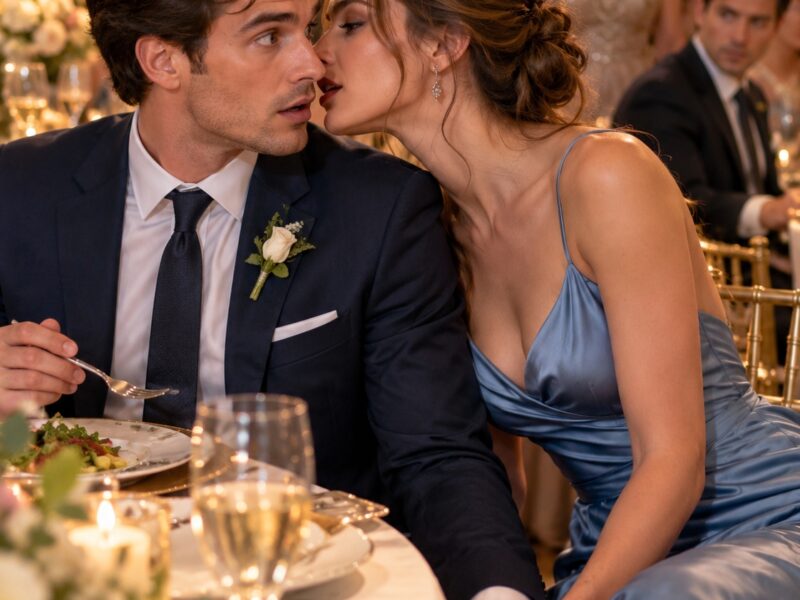
I Went to My Best Friend’s Wedding Alone—Until My Beautiful Neighbor Sat Beside Me, Took My Hand, and Whispered, “You’re My Boyfriend Tonight!”
The first time Tessa Brooks called me her boyfriend, I was halfway through a forkful of wedding salad and seriously considering whether the centerpiece could conceal me from an approaching stranger.
“You’re my boyfriend tonight.”
I turned so quickly that a cherry tomato escaped my fork and landed on the white tablecloth.
Tessa slid into the empty chair beside me, smoothed the skirt of her blue dress, and smiled as though she had just made a perfectly ordinary announcement.
“Excuse me?”
“Boyfriend,” she repeated under her breath. “You. Me. Tonight.”
I stared at her.
We had been neighbors for ten months. In that time, I had fixed her mailbox, borrowed her garden hose, and once helped rescue a particularly angry possum from beneath her porch.
None of those activities, as far as I knew, constituted a romantic relationship.
“Tessa, did I miss an important conversation?”
“Probably several.”
She glanced toward the opposite side of the reception hall.
I followed her gaze.
A woman in a champagne-colored dress was waving enthusiastically in our direction.
“My mother,” Tessa whispered.
“Ah.”
“She’s coming over.”
“Should I be concerned?”
“Only if she asks how long we’ve been together.”
“How long have we been together?”
“Graham.”
“I’m trying to prepare.”
Tessa reached beneath the table and slipped her hand into mine.
I forgot every intelligent thing I had ever considered saying.
Her fingers were warm.
They were also trembling.
That was when I understood this wasn’t simply one of Tessa’s elaborate jokes.
Something had frightened her.
The woman approaching us had the determined expression of someone who could organize a church fundraiser, locate a missing suitcase, and identify the person responsible for bringing store-bought potato salad to a family reunion.
“Tessa, sweetheart!”
“Hi, Mom.”
Her mother’s gaze moved to our joined hands.
Then to my face.
Then back to our hands.
“Oh.”
There was a short silence.
Not an unpleasant one.
A dangerous one.
“Tessa,” she said slowly, “is there something you’d like to tell me?”
Tessa smiled brightly.
“Mom, you know Graham. Graham, this is my mother, Patricia.”
Patricia Brooks looked directly at me.
“The neighbor?”
“Yes, ma’am.”
“The one who builds furniture?”
“Among other things.”
“And fixes things?”
“When they cooperate.”
She turned toward her daughter.
“Tessa?”
Tessa squeezed my hand.
“Mom, Graham and I are seeing each other.”
I could have corrected her.
Probably should have.
Instead, I looked at the woman beside me.
Tessa’s smile remained steady, but her eyes were asking for help.
And I had been quietly falling in love with her for most of the past year.
So I did the most foolish thing a sensible man could do.
I smiled at her mother.
“It’s nice to finally meet you properly.”
Patricia’s face lit up.
“Oh, honey!”
Then she asked the question I had been dreading.
“How long have you two been in love?”
Tessa looked at me.
I looked at Tessa.
And in that moment, with an entire wedding reception moving around us, I realized that whatever answer I gave might change far more than one evening.
My name is Graham Avery.
I was twenty-nine that spring, lived in a modest blue house outside Wilmington, North Carolina, and made custom furniture in a workshop behind my garage.
I was not particularly mysterious.
I liked strong coffee, old country music, and projects with instructions that didn’t begin with the phrase some assembly required.
I had attended Nate Dalton’s wedding because he had been my best friend since we were fourteen.
Nate was the sort of person who would help you hide a dent in your father’s truck and then insist you confess before dinner.
I knew because that was exactly how our friendship began.
Twenty-five years of embarrassment, friendship, and questionable decisions had taught me that Nate would always stand beside me when it mattered.
So when he asked me to attend his wedding, I said yes.
I even arrived early.
That was my first mistake.
The wedding took place at Riverside Hall, a restored event venue overlooking the Cape Fear River.
The building had enormous windows, exposed wooden beams, polished floors, and enough white flowers to convince me the florist had personally emptied three counties.
Nate was marrying Lucy Brooks.
I knew Lucy from group dinners, summer cookouts, and the afternoon Nate called me six times because he couldn’t decide whether a diamond ring should be oval or round.
I had helped him choose the round one.
He later proposed during a picnic and accidentally placed his sandwich directly on an anthill.
Lucy said yes anyway.
I considered that a promising sign for their marriage.
I had attended alone because it seemed easier.
My last serious relationship had ended almost two years earlier.
There had been no dramatic betrayal, no shouting in the street, no broken dishes.
Aaron and I had simply stopped being honest about what we wanted.
By the time we admitted it, we’d spent months pretending that being comfortable was the same as being happy.
After that, I devoted most of my attention to my work.
I built dining tables, bookcases, porch swings, and occasionally wooden toys for a children’s charity.
It was a good life.
Quiet.
Predictable.
I had become comfortable with the idea that romance might happen again eventually, preferably after somebody invented a way to make dating less like a job interview.
Then Tessa Brooks moved into the pale green house beside mine.
I first saw her on a Tuesday morning.
She was standing on her porch in slippers, attempting to push an enormous cardboard box through a doorway that was clearly too narrow.
I was carrying a bag of groceries when she noticed me.
“Don’t say it,” she warned.
I stopped.
“Say what?”
“That I should turn it sideways.”
I looked at the box.
Then at the doorway.
“Would that be unreasonable advice?”
She considered me.
“You look like a man who owns seventeen screwdrivers.”
“Twenty-three.”
“I’m not sure whether that makes you more trustworthy or less.”
I laughed.
She smiled.
And something about that smile stayed with me longer than it had any right to.
Tessa was twenty-five and owned a small stationery shop downtown called Paper Lantern.
She designed invitations, restored old handwritten letters, and taught occasional workshops for people who wanted to write something more meaningful than a text message.
I learned that she took her work seriously.
I also learned she had a remarkable ability to make ordinary conversations interesting.
She could tell me why one paper stock felt different from another.
I could explain why oak behaved differently from walnut.
We were, by most reasonable standards, two people capable of making an otherwise enjoyable dinner party unbearably specific.
But with Tessa, those conversations never felt boring.
They felt like home.
Our friendship grew in small increments.
I fixed her leaning mailbox after a storm.
She left blueberry muffins on my porch when I worked late.
When her gate latch began sticking, I repaired it.
She paid me twenty-four dollars.
I objected.
She insisted.
“Friendly neighbors are not free labor.”
“That’s a suspiciously precise amount.”
“I researched the average hourly rate.”
“You researched how much to pay your neighbor for tightening two screws?”
“Of course.”
I liked her more every time she argued with me.
Sometimes we talked over the fence until the porch lights came on.
Sometimes she brought lemonade into my workshop and watched me sand a table while telling me about customers who wanted wedding invitations that were elegant, affordable, handmade, gold-embossed, and somehow finished by Thursday.
She had a laugh that involved her entire face.
I began looking forward to it.
That should have told me something.
Instead, I reminded myself that Tessa was my neighbor.
She deserved to feel comfortable in her own home.
I had no intention of turning every friendly conversation into an opportunity to ask whether she wanted to date me.
So I said nothing.
For ten months.
Which brings us back to the wedding, the escaped cherry tomato, and the moment her mother asked how long we had been in love.
“We’ve known each other almost a year,” I said.
It wasn’t the answer Patricia had requested.
But it was true.
“And I’ve enjoyed every minute I’ve spent with your daughter.”
That was also true.
Tessa turned toward me.
Something flickered across her face.
Patricia smiled.
“Well, I’m delighted.”
“Mom,” Tessa warned.
“What?”
“Don’t start planning anything.”
“I haven’t said a word.”
“You’re thinking very loudly.”
Patricia laughed.
Then she placed a hand on her daughter’s shoulder.
“I’m happy for you, sweetheart. That’s all.”
She looked at me.
“Graham, I hope you’ll come by the house sometime.”
“I’d like that.”
“Good.”
Then she disappeared into the crowd, apparently taking several years off her life expectancy through sheer relief.
Tessa released my hand.
She exhaled.
Then she covered her face.
“Oh, my goodness.”
I picked up my fork.
“Should I be congratulating you or asking for legal representation?”
She laughed.
“I’m so sorry.”
“Did I just become a boyfriend without filling out an application?”
“A temporary boyfriend.”
“Do I get benefits?”
“You said you floss.”
“That’s not dental insurance, Tessa.”
She laughed harder.
Then the laughter faded.
“I really am sorry, Graham.”
I put down my fork.
“Okay. Tell me what happened.”
She glanced toward a table across the room.
A tall man in a charcoal suit was speaking with an older woman wearing a lilac jacket.
He looked our way, smiled politely at Tessa, and returned to his conversation.
“That’s Adrian,” she said.
“Should I know Adrian?”
“We dated for three years.”
“Oh.”
“We broke up eight months ago.”
I looked at the man again.
He seemed pleasant enough.
Naturally.
Life would have been much easier if he had been wearing a villainous expression and twirling an imaginary mustache.
“My family still thinks we should get back together,” Tessa continued. “Mostly because neither of us did anything terrible.”
“That sounds inconvenient.”
“You have no idea.”
She folded her napkin carefully.
“My aunt Robin changed the seating chart so Adrian and I would sit together. She called it a romantic second chance.”
I glanced toward the empty chair beside me.
“And you decided to create a new relationship?”
“Two weeks ago, I told Mom I was seeing someone.”
I stared at her.
“You were?”
“No.”
“Ah.”
“I panicked. She kept asking about Adrian, and I was tired of explaining why we weren’t together.”
“So you invented a boyfriend.”
“Yes.”
“And then you arrived at a wedding without him.”
“Also yes.”
“That’s poor logistical planning for someone who designs event stationery.”
Tessa groaned.
“I know.”
I let the silence settle.
Then I asked, “Do you want to make Adrian jealous?”
She shook her head immediately.
“No.”
“Good.”
“He’s a decent man. We just weren’t right together.”
“Then what do you want?”
She looked down at her hands.
“I want my family to believe me when I say no.”
The answer was so quiet I almost missed it.
I studied her for a moment.
Then held out my hand.
“Okay.”
She blinked.
“Okay?”
“I can stay for dinner.”
“Graham—”
“But we need rules.”
She straightened.
“Rules?”
“Three.”
“Of course a furniture maker has rules.”
“No invented romantic vacations. No promises about the future. And if somebody asks something too personal, we get to say it’s private.”
Tessa studied me.
Then she lifted one finger.
“Fourth rule.”
“I’m listening.”
“Any affection requires an actual invitation. Even if we’re pretending.”
I smiled.
“Agreed.”
She placed her hand in mine.
This time deliberately.
And I discovered that pretending to date someone you genuinely wanted to date was going to be much more complicated than I had expected.
Dinner began shortly afterward.
The servers brought salmon to our table.
I looked down.
I had ordered chicken.
Tessa examined her plate.
Then mine.
“We have our first couple’s crisis,” I announced.
She laughed.
“I’ll trade you half.”
“You don’t even know whether I like salmon.”
“Do you?”
“Yes.”
“Then we’re already communicating better than most couples.”
The meal became unexpectedly enjoyable.
We talked about Nate and Lucy, the wedding decorations, and the peculiar decisions people made when planning events.
Tessa showed me the invitations she had designed.
The paper was thick, warm white, with gold lettering.
I ran my thumb gently along the edge.
“You cut these yourself.”
She looked surprised.
“How can you tell?”
“The edges aren’t machine-perfect.”
“Is that a compliment?”
“Absolutely.”
She smiled.
“I like that you notice.”
I wanted to tell her I noticed far more than she realized.
That I knew when she was tired because she twisted her hair into a higher bun.
That I could recognize the sound of her car before it turned into our street.
That she always saved the corner piece of brownies because she liked the crispy edge.
Instead, I ate my salmon.
It seemed safer.
The first dance began.
Nate and Lucy moved into the center of the floor.
He looked nervous.
She looked delighted.
I watched my best friend whisper something that made his new wife laugh.
Tessa leaned closer.
“They’re good together.”
“They are.”
“Lucy told me she knew Nate was the one when he helped her mother move furniture during a thunderstorm.”
I smiled.
“That sounds like him.”
“Was he always this dependable?”
“Mostly. Except when we were teenagers and he convinced me we could repair a truck bumper with a hair dryer.”
Tessa laughed.
“Did it work?”
“No.”
“What happened?”
“We confessed.”
“That’s unexpectedly mature.”
“Only because my father found the dent before we finished.”
She shook her head.
Then something in her expression softened as she watched the couple dance.
“I hope they’re happy.”
“Me too.”
“I think they will be.”
“Why?”
“Because neither of them has to become somebody else to be loved.”
I looked at her.
The sentence carried more weight than she seemed to realize.
Before I could ask what she meant, a cheerful voice interrupted us.
“Tessa!”
An older woman approached wearing a lilac jacket.
Behind her came Adrian.
Tessa’s shoulders tightened.
“Aunt Robin.”
Robin looked at me.
Her smile became intensely curious.
“And who is this?”
Tessa stood.
For a second I thought she might reach for my hand.
She didn’t.
Instead, she gave me room to decide.
I appreciated that.
I stood beside her.
“I’m Graham Avery.”
Robin’s eyebrows rose.
“Oh.”
Adrian looked amused.
“Congratulations,” he said quietly.
I frowned.
“For what?”
“Surviving the seating chart.”
I laughed before I could stop myself.
He offered his hand.
“Adrian.”
“Graham.”
We shook.
Robin looked between us.
“Well, isn’t this a surprise?”
Adrian spoke before Tessa could.
“Robin, I told you earlier that the seating arrangement wasn’t necessary.”
She looked wounded.
“I only thought—”
“I know,” he said kindly. “But Tessa and I have both moved on.”
The conversation became awkward for exactly three seconds.
Then Adrian turned to me.
“You’ve been given the family emergency briefing, right?”
“Not yet.”
“Ask for a map. There are several exits, but only two lead to freedom.”
Tessa laughed so hard she had to lean against the table.
Even Robin smiled.
After they left, Tessa watched Adrian cross the room.
“He didn’t deserve that.”
“Neither did you.”
She looked at me.
I shrugged.
“Sometimes nobody’s the villain. Things just don’t work.”
Her expression softened.
“Thank you.”
“For what?”
“Not turning him into a bad guy to make me feel better.”
I considered that.
“I’d rather make you feel better by being reasonably entertaining.”
“You’re succeeding.”
That pleased me far more than it should have.
The first time Tessa asked me to dance, I considered refusing for the sake of public safety.
“You realize I’m built for woodworking, not graceful movement.”
She held out her hand.
“I’m willing to risk my toes.”
“That’s reckless.”
“I’ve made worse decisions tonight.”
“Fair point.”
I took her hand.
We joined the other guests beneath the warm lights.
The band was playing an upbeat old song.
Nobody seemed concerned about whether our movements were elegant.
Least of all Tessa.
She laughed whenever I misjudged a turn.
I laughed because she was laughing.
For several minutes, the evening stopped feeling like an elaborate misunderstanding.
I wasn’t pretending to be her boyfriend.
I was dancing with a woman whose laughter I had learned to recognize through an open kitchen window.
When the music slowed, I loosened my hold.
“We can sit down.”
“I know.”
She rested her hand lightly on my shoulder.
“I’d like to stay.”
So we stayed.
An older couple danced nearby.
They moved slowly, comfortably, with the practiced rhythm of people who had spent decades learning each other’s habits.
The man kissed the woman’s forehead.
Tessa watched them.
“My grandparents used to dance in their kitchen,” she said.
“Really?”
“Every Sunday after dinner.”
“Were they good?”
“My grandfather was terrible.”
I laughed.
“Then I feel represented.”
“Grandma said it didn’t matter. He always held on when the music stopped.”
Her voice changed slightly.
I glanced at her.
“Do you miss him?”
She nodded.
“Every day.”
We moved quietly for a moment.
Then she asked, “Have you ever been in love, Graham?”
The question surprised me.
It wasn’t something we needed to discuss to maintain our invented relationship.
Which made me want to answer honestly.
“I thought so.”
She waited.
“Aaron and I were together for two years.”
“What happened?”
“We became very good at being the people we thought the other person needed.”
“That sounds exhausting.”
“It was.”
“Why didn’t you stop?”
I considered the question.
“Because neither of us wanted to admit that being good people didn’t automatically make us right for each other.”
Tessa nodded slowly.
“That sounds familiar.”
I looked at her.
“You don’t owe me the story.”
“I know.”
She smiled faintly.
“That’s why I might tell you.”
The song ended.
She stepped back and gave me a ridiculous little bow.
I returned it badly.
She laughed again.
Then we walked toward the veranda for air.
Outside, the Cape Fear River reflected the last copper light of evening.
A few guests stood near the railing.
We found a quieter corner beneath a string of lanterns.
Tessa leaned against the wooden rail.
“Adrian wasn’t cruel,” she began.
I said nothing.
“He liked having things decided. Restaurants. Vacations. Holidays. Where we’d live eventually.”
“Sounds organized.”
“He was.”
She looked toward the water.
“At first, I thought it was romantic that he handled everything.”
“What changed?”
“I realized I couldn’t remember the last time I’d made a decision without explaining why it mattered.”
The words settled between us.
“He didn’t mean to make me feel small,” she continued. “But he was always so certain. And I became good at agreeing because it was easier than disappointing him.”
I leaned against the railing.
“Did you tell him?”
“Eventually.”
“And?”
“He was surprised.”
She gave a sad smile.
“He honestly thought I was happy.”
I considered that.
“People outside a relationship can see the gifts. They don’t always see what it costs someone to accept them.”
Tessa turned toward me.
For a moment, she said nothing.
Then she whispered, “Exactly.”
The breeze moved a loose strand of hair across her cheek.
I had the ridiculous urge to brush it away.
Instead, I kept my hands on the railing.
She looked toward the lights inside.
“My mother loved Adrian. He drove her to appointments, remembered birthdays, bought flowers. She saw those things.”
“And you?”
“I saw a future where I was constantly adjusting myself to make everybody comfortable.”
I nodded.
“She worries about me,” Tessa continued. “I understand that. But every time she asks whether I’ve found someone new, it feels as though she’s asking whether I’ve finally corrected my mistake.”
“Have you told her?”
“Not like that.”
“Maybe you should.”
Tessa looked down.
“I know.”
For a while, we listened to the river.
Then she turned back.
“You’ve discovered I can dance.”
“Yes.”
“And I’ve discovered you count steps under your breath.”
I stared.
“You heard that?”
“I felt the arithmetic.”
I laughed.
She smiled.
And for one brief moment, I thought about asking whether I could kiss her.
Not because her mother might see.
Not because we were pretending.
Because I wanted to.
Then the veranda door opened.
Lucy appeared, gathering her wedding dress in both hands.
“There you are!”
Tessa straightened.
“What’s wrong?”
“Grandma’s letter.”
Her expression changed instantly.
“What happened?”
“The remembrance display fell. The frame broke.”
Tessa was already moving.
“Show me.”
Near the entrance, a table held photographs of family members who had died before the wedding.
At the center was a handwritten letter from Lucy and Tessa’s grandmother, June Brooks.
She had written it years earlier when Lucy graduated from high school.
The frame containing it had fallen.
One wooden corner was split.
The glass had been removed, but a shallow crease now crossed the old page.
Lucy looked close to tears.
“I know it’s just paper.”
Tessa shook her head.
“It’s not just paper.”
“She should have been here tonight.”
“I know.”
Tessa gently examined the letter without touching the ink.
“We can protect it.”
She looked at me.
“Graham, can you repair the frame?”
I crouched.
“Probably. I need a clamp and something to stabilize the corner. But I wouldn’t put the letter back inside tonight.”
“Agreed.”
Tessa opened her small emergency kit.
I stared.
“You brought an archival sleeve to a wedding?”
“I bring them everywhere.”
“Of course you do.”
She looked at the small screwdriver I had produced from my pocket.
“You carry that everywhere?”
“Almost.”
She smiled.
“Maybe our peculiar habits are compatible.”
Ten minutes later, the letter rested safely inside a protective sleeve.
I repaired the wooden frame well enough for it to stand again.
Tessa placed the protected letter beside it.
Then she wrote a small card.
Grandma June, still here in every story we tell.
Lucy read the words.
Her face crumpled.
She hugged Tessa.
Then she hugged me.
I was so surprised I nearly dropped the clamp.
“Thank you,” Lucy whispered.
“Both of you.”
After she returned to the reception, Tessa and I stood beside the repaired display.
She looked at the frame.
Then at me.
“You did that beautifully.”
“You saved the important part.”
“So did you.”
I shrugged.
“I just fixed a corner.”
“No.”
She studied me.
“You knew exactly what mattered.”
The way she said it made my chest feel strangely full.
I had spent much of my last relationship being praised for fixing things.
But Tessa wasn’t praising me because I had solved a problem for her.
She was recognizing the reason I cared about solving it.
That difference mattered.
Back at our table, dessert had arrived.
I was halfway through a slice of cake when Tessa asked the question that changed the entire evening.
“Graham?”
“Yes?”
“Why have you never asked me out?”
I put down my fork.
For several seconds, I considered pretending not to understand.
That would have been easier.
But Tessa had trusted me with something personal on the veranda.
It seemed unfair to hide behind a joke.
“Because you’re my neighbor,” I said.
She frowned.
“That’s your reason?”
“Part of it.”
“What’s the other part?”
“I really like having you next door.”
She waited.
“And if I asked you out and you didn’t want that, I was worried I’d make your home feel uncomfortable.”
Tessa stared at me.
Then she smiled slowly.
“That might be the most thoughtful, foolish thing I’ve ever heard.”
“Both words seem accurate.”
“Graham.”
“Yes?”
“You could have asked.”
I looked at her.
“I’m getting that impression.”
She folded her napkin.
Then lifted her eyes.
“Would you like to now?”
The band began playing another song.
Somewhere behind us, a child laughed.
Chairs scraped across the floor.
I was aware of every sound because I wanted to get the next sentence right.
“Tessa Brooks, would you have coffee with me on Saturday morning?”
She smiled.
“As what?”
“Two people who like each other.”
“No audience?”
“No audience.”
“No invented relationship history?”
“Absolutely none.”
She considered that.
“Saturday at ten?”
“Ten.”
“You’re paying.”
I laughed.
“Of course.”
“I’ve been carrying this entire fake romance.”
“I repaired a family heirloom.”
“Very attractive, by the way.”
I stared at her.
She grinned.
“But the coffee is still on you.”
I couldn’t remember the last time I’d felt so relieved.
Or so nervous.
Because somewhere between the salad and the cake, our invented relationship had begun turning into something real.
And that meant we could actually hurt each other.
Before I could decide what to say next, Patricia appeared holding her phone.
“One picture!”
Tessa looked up.
“Mom.”
“Please. You two look lovely together.”
Tessa glanced at me.
I gave a small shrug.
She nodded.
“One picture.”
We stood beneath the lanterns near the reception entrance.
I placed my arm lightly around her waist after she indicated she was comfortable.
She rested her hand against my jacket.
Patricia took the photograph.
Then looked at the screen.
“Oh, beautiful.”
She smiled at Tessa.
“Your grandmother would have been so happy to see you smiling like this.”
The words were affectionate.
Harmless.
Probably meant kindly.
But I felt Tessa stiffen.
“I was smiling before tonight, Mom.”
Patricia lowered the phone.
For a moment, she seemed confused.
Then regret crossed her face.
“Of course you were, honey.”
“I know you didn’t mean anything by it.”
“Tessa—”
“We’ll talk later.”
Patricia nodded and stepped away.
I waited until we were alone.
“Are you okay?”
Tessa nodded.
But she didn’t reach for my hand.
I didn’t try to take hers.
After a moment, she looked toward the ballroom.
“That’s what I’m afraid of.”
“What?”
“That everyone will look at a picture of me with a man and decide this is the first time I’ve been happy in eight months.”
I considered her words.
Then said, “I’ve seen you dance around your porch holding a grocery bag because your radio played your favorite song.”
She turned.
“You saw that?”
“Mrs. Alvarez across the street gave you a standing ovation from behind her curtains.”
Tessa laughed despite herself.
“Oh, I’m moving.”
“You’d have to return the twenty-four dollars first.”
She covered her smile.
For a moment, the tension eased.
Then she looked at me seriously.
“Promise me something.”
“Okay.”
“Don’t let this relationship become the thing that defines whether my life is good.”
I held her gaze.
“I won’t.”
She searched my face.
Then nodded.
“Thank you.”
The evening ended beneath soft music and warm lights.
I walked her to her car.
Our vehicles were parked beside each other beneath a tall lamp.
The air smelled of river water and jasmine.
“Thank you for tonight,” she said.
“You’re welcome.”
“And for not treating me like a problem that needed fixing.”
“You’re not a problem.”
“I made you pretend to be my boyfriend in front of half my family.”
“A questionable decision isn’t a personality.”
She laughed.
Then opened her car door.
“Saturday. Ten.”
“I’ll come to your front door.”
“Not the fence?”
“No. I intend to behave like a man taking you on an actual date.”
“Ambitious.”
I stepped back to let her leave.
She reached for my hand.
“Graham.”
“Yes?”
“Can I kiss you?”
Every reasonable thought I had carefully organized over ten months disappeared.
“You absolutely can.”
She kissed me beneath the parking lot light.
It was gentle.
Brief.
But there was nothing pretend about the way she looked at me afterward.
“Good night,” she whispered.
“Good night, Tessa.”
I watched her drive away.
Then stood beside my truck for several minutes longer than necessary.
I had gone to a wedding expecting chicken, cake, and an early exit.
Instead, I had kissed the woman next door.
And made plans for Saturday.
I should have been delighted.
I was.
But I also knew something important.
Tessa’s mother still believed we’d been dating for weeks.
Her aunt believed our relationship had solved a problem.
And somewhere in a family group chat, a photograph was probably already making its way toward relatives who had opinions about everything.
The borrowed story had been useful for one evening.
Now we needed to decide what to do with it.
Saturday morning arrived bright and windy.
At 9:58, I stood on Tessa’s porch holding two drinks.
One black coffee.
One cinnamon tea.
I knocked.
She opened the door wearing jeans and a green sweater.
Her hair was loose around her shoulders.
For a moment, I forgot the speech I’d prepared.
“You’re early,” she said.
“Two minutes.”
“Trying to establish an impressive record?”
“Yes.”
She pointed toward the cup.
“Is that cinnamon?”
“It is.”
“Then the record stands.”
We walked downtown instead of driving.
The streets were filled with families, bicycles, and people walking dogs.
Tessa kept her hands in her pockets until we reached a crosswalk.
Then she held one out toward me.
“Still accepting applications?”
I smiled.
“For this position?”
“Only one.”
“Excellent. I hate competition.”
I took her hand.
It felt natural enough to frighten me.
At a small café near the bookstore, we sat outside beneath a striped awning.
Tessa told me about a project she’d started at Paper Lantern.
She called it the Letter Table.
Once a month, she opened her shop after hours and provided paper, envelopes, pens, and assistance for anyone who wanted to write a letter.
Some people wrote to grandchildren.
Others wrote apologies they’d been postponing.
One woman came every month to write to her husband who had died six years earlier.
Tessa never mailed those letters.
She simply gave the woman a safe place to say what she needed to say.
“Sometimes people just need someone to remind them their words matter,” Tessa said.
I watched her face while she spoke.
She became animated when describing the project.
More confident.
More herself.
“I want to expand it,” she continued. “Maybe run sessions at the library or retirement center.”
“That’s a good idea.”
“Adrian thought it was charming.”
I looked at her.
“Charming?”
“He meant it kindly.”
She stirred her tea.
“But whenever I talked about expanding, he’d suggest hiring someone else to manage the workshops so I could spend more time with him.”
“And you wanted to run them yourself.”
“Yes.”
“Then you should.”
She smiled.
“You say that like it’s obvious.”
“It is.”
We talked for nearly two hours.
About work.
Family.
The small decisions that make a life feel like your own.
I told her about my father teaching me to sand wood with the grain.
She told me about her grandmother saving handwritten letters in a biscuit tin.
At a used bookstore, Tessa bought a cookbook older than either of us.
I bought a collection of woodworking essays.
We spent fifteen minutes arguing about whether that counted as a romantic bookstore date.
She insisted it did.
I said it depended on whether she intended to share the cookbook.
She said she’d consider it.
When we reached our street, we stopped at the narrow strip of lawn between our houses.
“Well,” she said.
“Well.”
“Was that a date?”
“I brought you coffee, held your hand, and spent an hour pretending I understood the difference between ivory and cream paper.”
“You understood eventually.”
“Then yes.”
She stepped closer.
“Good. I’d like another one.”
My chest warmed.
“Wednesday dinner?”
“Wednesday dinner.”
I kissed her.
She laughed against my mouth when Mrs. Alvarez called from across the street.
“It’s about time!”
Tessa buried her face against my shoulder.
I waved.
Mrs. Alvarez waved back enthusiastically.
And I realized something that should have been obvious.
The neighborhood had probably known how I felt about Tessa long before I admitted it to myself.
The next few days were surprisingly easy.
I made three wooden writing boards for Tessa’s workshops.
She insisted on paying me.
We negotiated.
One cinnamon roll per board.
She delivered four.
“Your math is wrong,” I told her.
“I made an executive decision.”
“Should I be concerned?”
“Only if you dislike cinnamon.”
On Wednesday, we had dinner at a small Italian restaurant where the owner remembered everyone’s order but never their name.
Afterward, we sat on my porch bench drinking iced tea.
Tessa told me she hated the word networking.
I confessed that I sometimes built small wooden toys for a children’s charity without putting my name on them.
She didn’t ask why I kept it private.
That surprised me.
My last partner would have encouraged me to turn it into a business opportunity.
Tessa simply smiled.
“That’s lovely.”
We talked until moths gathered around the porch light.
When she finally stood to leave, I wished there were another hour in the evening.
There wasn’t.
She kissed my cheek and crossed the lawn.
I watched her kitchen light come on.
Then went inside smiling like an idiot.
Everything felt wonderfully uncomplicated.
Until Thursday evening.
Tessa came over carrying a container of soup.
We were eating at my kitchen counter when her phone vibrated.
She looked at the screen.
Her expression changed.
“Oh, no.”
“What?”
“Mom posted the wedding photograph.”
I swallowed.
“Where?”
“The extended family group chat.”
She showed me.
There we were.
Standing beneath the lanterns.
Smiling.
Looking remarkably convincing.
Below the photograph, Patricia had written:
So happy Tessa has found her person.
A dozen relatives had added hearts.
Aunt Robin wanted to know when the next wedding would be.
Someone had invited us to Sunday family lunch.
Tessa set the phone down.
“I should have told her the truth before she posted that.”
“Yes.”
She blinked.
“You don’t even pretend to disagree.”
“I promised not to pretend with you after Friday.”
She smiled briefly.
Then looked down.
“But what is the truth now?”
I considered the question.
“You invented a boyfriend for one wedding.”
“And now we’re actually dating.”
“Yes.”
“She’ll think I tricked her.”
“You did trick her.”
Tessa winced.
“Graham.”
“Not maliciously. But you did.”
She pushed the soup away.
“I know.”
For a moment, neither spoke.
Then she said, “What bothers me is how relieved everybody seems.”
I waited.
“As though the only thing wrong with my life was the empty chair beside me.”
I moved closer.
“Then tell them about your life.”
She looked up.
“Tell them you love your shop. That you’re happy in your house. That you were already doing meaningful things before we kissed.”
“That’s easy for you to say.”
“I know.”
“My mother calls three times if I decline dinner.”
I smiled faintly.
“I believe you.”
“She means well.”
“I know.”
Tessa looked down again.
“I just need a little time.”
“Okay.”
She studied me.
“Would you come to lunch on Sunday? Just once more? I’ll explain afterward.”
The request unsettled me.
Not because I didn’t want to meet her family.
I did.
But something about continuing the invented relationship now that we were genuinely dating felt wrong.
I’d spent two years recovering from a relationship where both people had become whatever the other expected.
I didn’t want to begin something meaningful by doing the same thing again.
“I’d like to meet your family as the man who’s dating you,” I said carefully. “But I don’t want to spend Sunday helping everyone believe a story we both know isn’t true.”
Her expression tightened.
“I’m asking you to eat chicken with my parents.”
“I know.”
“Not sign a marriage contract.”
“I understand.”
“Then why does this feel like an ultimatum?”
“It’s not.”
I took a breath.
“I’m telling you what I’m comfortable with. You have every right to decide when to speak with your family. I just don’t want to keep playing a part.”
Tessa looked away.
The distance that opened between us felt enormous.
Especially because the last week had been so easy.
“Maybe we rushed this,” she said finally.
My chest tightened.
“Maybe.”
She stood.
I followed her to the door.
For a moment, she looked as though she wanted to say something.
Then she whispered, “The dates weren’t fake.”
“I know.”
“Neither was the kiss.”
“I know that too.”
Her eyes filled.
“Then why does this feel so complicated?”
I looked at her.
“Because I think you’re worth more than a simple answer.”
She left without another word.
I watched her cross the lawn toward the pale green house.
Her kitchen light came on.
For months, that light had been one of the most comforting parts of my evenings.
That night, it felt farther away than any house on the other side of town.
The next morning, I considered walking over to apologize.
Then I stopped.
I wasn’t sure what I would apologize for.
My timing, perhaps.
The fact that I hadn’t understood how overwhelmed Tessa felt.
But not the boundary itself.
If I rushed across the lawn and withdrew it simply because she was upset, I would be repeating the exact pattern that had ended my previous relationship.
Still, something bothered me.
Had I made her problem about my old fear?
Maybe.
Tessa wasn’t Aaron.
She had never asked me to change who I was.
She’d asked for help navigating one uncomfortable family lunch.
I had a right to say no.
But I also had a responsibility not to turn that decision into a judgment of her character.
So I stayed in my workshop and sanded a walnut bench I’d promised Mrs. Alvarez.
Sanding wood gives a person time to think.
Sometimes far too much time.
At four that afternoon, someone knocked on the workshop door.
Tessa stood outside.
Her eyes were tired.
But her shoulders were straight.
“I came to tell you something.”
I set down my sanding block.
“Okay.”
“You were right.”
I raised an eyebrow.
“That’s a dangerous sentence to say to a carpenter.”
She almost smiled.
“Not about everything.”
“Understood.”
“About telling my family the truth.”
I waited.
“I’ve been asking you to help me avoid a conversation I need to have myself.”
“Tessa—”
“No, let me finish.”
I nodded.
She took a breath.
“I don’t want to keep borrowing a boyfriend to make my mother comfortable.”
The words were difficult for her.
I could see that.
“So I’m going to talk to her tonight.”
“Do you want me there?”
She shook her head.
“No.”
Then she looked at me.
“Thank you for offering.”
I stepped closer.
“Are we okay?”
She hesitated.
“I think we will be.”
I nodded.
She reached for my hand.
“But I need a little space until I’ve done this.”
“Okay.”
“Not because I don’t want you.”
“I know.”
“Because I need to prove to myself that I can have one hard conversation without asking somebody to stand in front of me like a shield.”
I squeezed her hand.
“You can.”
She looked relieved.
Then she walked away.
I let her.
That evening, I finished Mrs. Alvarez’s bench.
I made a sandwich.
I watched a baseball game without remembering the score.
And for once, I didn’t try to fix anything.
On Sunday morning, there was a knock at my front door.
Tessa stood on the porch holding a paper bag.
Two cinnamon rolls.
Her hair was loose.
Her smile was nervous.
“I told them,” she said.
I stepped aside.
“How did it go?”
She entered.
“Mom was hurt.”
I nodded.
“I told her the truth about the wedding. The seating chart. Adrian. The whole thing.”
“And?”
“She asked why I hadn’t trusted her enough to tell her before.”
Tessa sat on the couch.
“I told her that every time I said I was happy, she’d answer that I’d be happier with a good man.”
I sat beside her.
“She cried.”
Tessa looked down.
“Then I cried.”
“What did your dad do?”
“He brought tissues and didn’t interrupt once.”
I smiled.
“That sounds useful.”
“Possibly a family record.”
We sat quietly.
Then she continued.
“I told Mom about the Letter Table. About wanting to expand it. About how I love my work.”
“What did she say?”
“She asked if she could come to the next workshop.”
I smiled.
“That’s good.”
“It’s a start.”
Tessa looked at me.
“I also told her the dates with you were real.”
My heart gave an unexpected thump.
“What did she say?”
“She asked whether I loved you.”
I stopped breathing for half a second.
Tessa watched me.
“I told her I’m still finding out.”
I nodded.
“That’s allowed.”
“She asked if that bothered me.”
“And?”
“I said no.”
We looked at each other.
Then Tessa reached for my hand.
“Would you come to the library Thursday?”
“What’s Thursday?”
“My biggest Letter Table event yet.”
I smiled.
“Of course.”
“Not as my pretend boyfriend.”
“Good.”
“Not to impress anybody.”
“Even better.”
She took a breath.
“Just because I want you there.”
I looked at her.
“I wouldn’t miss it.”
Thursday evening, the library meeting room filled with folding tables, paper, envelopes, and people carrying memories they hadn’t known what to do with.
Tessa moved through the room greeting everyone.
She wore a green blouse and had ink on two fingers.
Her hair was tied back loosely.
She looked completely at home.
I had brought the wooden writing boards.
She introduced them to everyone and insisted on explaining that I had made them.
I protested.
She ignored me.
Apparently, that was going to be a recurring feature of our relationship.
Mrs. Alvarez wrote a letter to her youngest son.
A teenage boy wrote a thank-you note to the teacher who had encouraged him to apply for college.
Patricia sat at a table near the window.
She was writing a letter to Grandma June.
At one point, she called Tessa over.
“Sweetheart, where do I put the address if I’m not actually mailing this?”
Tessa pulled up a chair.
“Wherever you like, Mom.”
Patricia looked embarrassed.
“I know that sounds silly.”
“No.”
Tessa smiled.
“Letters don’t have to travel to matter.”
I watched them bend over the paper.
Their shoulders touched.
Something about the sight made me feel unexpectedly grateful.
Not because their relationship had magically become perfect.
But because they were trying.
Near the back of the room, a retired bus driver named Mr. Harris sat in front of a blank sheet of paper.
His hands were stiff.
He kept insisting he had nothing interesting to say.
Tessa pulled up a chair.
“Who are you writing to?”
“My daughter.”
“Tell me about her.”
“She calls every Sunday.”
“That’s nice.”
He nodded.
“I always tell her everything’s fine.”
“Is it?”
He looked down.
“Mostly.”
Tessa waited.
After a while, Mr. Harris said, “The house is quiet now.”
She leaned forward.
“Tell her that.”
He frowned.
“That sounds silly.”
“Only if you think being missed is silly.”
He looked at her.
Then slowly began writing.
He told his daughter about the radio she used to turn up while washing dishes.
About the way she sang badly and laughed when he complained.
About how the kitchen still seemed to be waiting for her favorite song.
When he finished, he asked Tessa to read the letter aloud.
She did.
Her voice remained steady.
But I saw Patricia stop sorting envelopes to listen.
Mr. Harris folded the page carefully.
“I thought I came here to learn how to write.”
Tessa smiled.
“Did you?”
He nodded.
“Turns out I came because I finally had something worth saying.”
I stood near the doorway watching her.
And I understood something I should have known from the beginning.
Tessa wasn’t waiting for a relationship to make her life meaningful.
She was already making room for other people’s lives to matter.
That was the woman I wanted beside me.
Not because she needed someone to rescue her.
Because I loved the way she moved through the world.
After the guests left, I helped stack chairs.
Tessa collected pens and leftover stationery.
Patricia hugged her before leaving.
“I loved seeing what you do,” she whispered.
Tessa looked surprised.
Then she hugged her mother back.
“Thanks for coming.”
When the room was finally empty, Tessa handed me a folded card.
I looked at it.
“What is this?”
“Open it.”
On the front she’d written:
Graham Avery.
Inside was a question.
Would you like to be my boyfriend? Not just tonight. On boring Tuesdays, too. I promise to ask instead of assume.
I looked up.
Tessa was watching me with the same brave, uncertain expression she’d worn in the wedding parking lot.
I smiled.
“Yes.”
Her shoulders relaxed.
“But I have one condition.”
She raised an eyebrow.
“I knew there’d be paperwork.”
“When you need space, tell me.”
“I can do that.”
“When I get something wrong, tell me.”
“Definitely.”
“And when you’re happy, I want to know that too.”
Tessa stepped closer.
“I can do that.”
I kissed her.
No relatives watching.
No invented story to maintain.
No reason to pretend.
She laughed softly afterward.
“You realize I’ll still charge you for borrowing my pruning shears.”
“I’m counting on it.”
A year later, the photograph from Nate and Lucy’s wedding sat on a narrow shelf between our two porches.
Beside it stood a jar of pencils and a stack of blank note cards.
We still lived in separate houses.
Tessa still ran Paper Lantern.
I still worked in my furniture shop.
We still disagreed about whether garden furniture should be painted.
She believed color made things cheerful.
I believed good wood deserved to be seen.
Neither of us had won the argument.
Probably neither of us ever would.
But most evenings ended with one of us crossing the lawn to find the other.
Sometimes she brought dinner.
Sometimes I made coffee.
Sometimes we sat together without talking at all.
On the anniversary of Nate and Lucy’s wedding, I found Tessa standing beside the shelf, studying the photograph.
She smiled when she saw me.
“Remember that night?”
“Unfortunately.”
She laughed.
“You were very convincing.”
“I was terrified.”
“Of my mother?”
“Of your mother, your aunt, and the possibility that you might discover how much I liked you.”
Tessa stepped closer.
“I already knew.”
I stared.
“What?”
She grinned.
“Graham, you built me a new mailbox post because the old one leaned two inches.”
“That was a structural concern.”
“You brought me soup when I had a cold.”
“Public health.”
“You learned which tea I liked.”
“Neighborhood research.”
She laughed.
Then reached for my hand.
“You were a very obvious man.”
I shook my head.
“Ten months, Tessa.”
“I know.”
“We wasted ten months.”
She looked thoughtful.
“Maybe.”
“Maybe?”
“We became friends first.”
I considered that.
She squeezed my hand.
“And when I needed someone to trust, you were already there.”
I looked at the photograph.
The nervous man in the navy suit.
The woman in the blue dress.
Two people standing close enough to look like a couple, neither fully understanding how much the other already mattered.
Tessa turned the frame around.
On the back she’d written:
My boyfriend tonight. My favorite person tomorrow.
I took a pen from the jar.
Beneath her words, I added:
And on every ordinary Tuesday after that.
Tessa read it.
Then she kissed me.
Across the street, Mrs. Alvarez called from her porch.
“Finally admitting it in writing?”
We laughed.
And as Tessa leaned against me, I thought about the evening that had begun with a dropped cherry tomato and one impossible request.
I’d gone to my best friend’s wedding alone because I believed being alone was easier.
I’d expected dinner, a little music, and an early trip home.
Instead, a beautiful woman had sat beside me, taken my hand, and asked me to become somebody I had secretly wanted to be for months.
At first, we’d borrowed the appearance of love to make other people comfortable.
But the real thing had required something different.
Honesty.
Patience.
The willingness to listen.
And enough courage to let each other remain fully ourselves.
I looked at Tessa.
She smiled.
“Still accepting applications?”
I pretended to consider it.
“Actually, the position has been filled.”
“Permanently?”
I kissed her forehead.
“Subject to an annual performance review.”
She laughed and swatted my arm.
Then she took my hand and led me across the lawn toward her house.
The porch light was already on.
Dinner was waiting.
And for the first time in my life, I understood that the best kind of love wasn’t always the kind that arrived with fireworks or grand declarations.
Sometimes it was the kind that walked over from next door.
Sat beside you when you least expected it.
And kept choosing you on ordinary Tuesdays.









