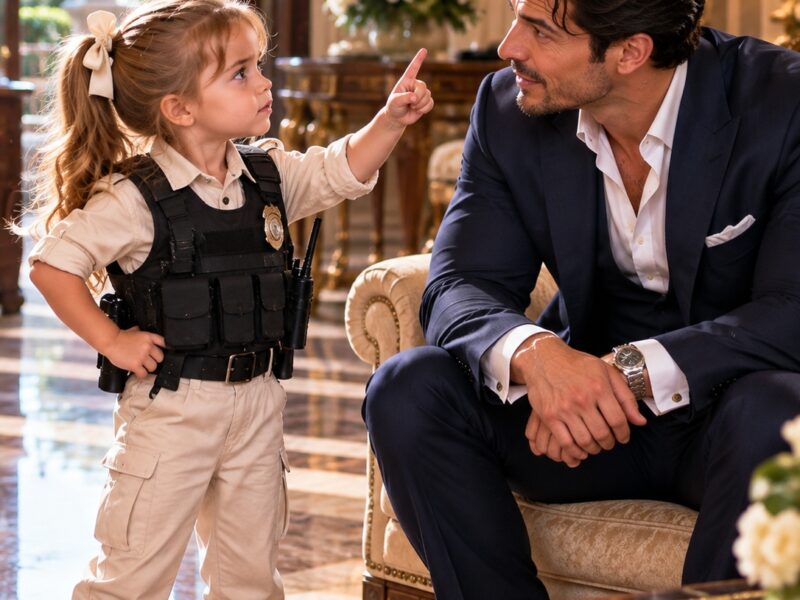
“I’m Your Bodyguard Now, Mister!” When the Maid’s Toddler Declared Herself His Bodyguard, the Sleepless Mafia Boss Laughed—Then Her Yellow Flashlight Revealed Who Had Been Haunting His House for Three Years
“Go to sleep, mister. I’m your bodyguard now,” three-year-old Ellie Bennett announced, sitting beside Chicago’s most feared man with a yellow flashlight almost as long as her arm.
Dante Vescari had not slept peacefully since his wife died in a fire three winters earlier, because every night at exactly 4:10, her music box played by itself somewhere inside the locked house.
Then Ellie whispered that she had already seen his ghost—and that ghosts, apparently, did not float at all; this one wore soft black shoes and carried a key.
Dante Vescari had not intended to fall asleep.
He had spent three years becoming very good at not doing it.
At 2:17 on a Wednesday morning, every lamp in his study still burned, as they always did. The chandelier remained dimmed but awake. Two brass desk lamps cut warm circles into the leather surface. A narrow light above the bookcase illuminated a row of legal volumes nobody in the house had opened since his father died.
Dante sat in a high-backed chair beside the window overlooking Lake Michigan.
Dark suit trousers.
White shirt open at the collar.
No jacket.
No tie.
A cup of coffee had gone cold beside him.
Across the room, the small walnut music box that had belonged to his late wife sat beneath a glass cover.
He did not look at it.
That was another skill he had learned.
On the carpet near his right shoe, a very small girl lowered herself cross-legged onto the floor.
Three years old.
Bare feet.
Cotton nightgown printed with yellow stars.
Brown hair loose from sleep.
A plastic flashlight rested across her knees.
It was oversized, bright yellow, and covered in two peeling stickers: a rabbit and a moon.
Dante looked down.
The child looked up.
“Go to sleep, mister.”
Dante stared.
“I beg your pardon?”
“I’m your bodyguard now.”
Her voice carried the solemn authority of someone who had never filed taxes and therefore believed every problem could be solved by appointment.
Dante leaned back.
“You are.”
“Yes.”
“And what exactly are you guarding me from?”
Ellie raised the flashlight.
“Monsters.”
Dante almost smiled.
Almost.
For twenty years, grown men had entered his rooms rehearsing what they would say.
Judges.
Union bosses.
Councilmen.
Executives.
Men with expensive lawyers.
Men without lawyers because they believed needing one suggested weakness.
None had ever sat on his floor and offered monster protection.
“You should be asleep.”
“You should too.”
“That is different.”
She frowned.
“Why?”
Because my wife died thirty feet from this room.
Because every night since, something in this house reminds me she is gone.
Because at exactly 4:10 a.m., a music box with no one touching it sometimes plays four notes.
Because I have woken smelling the perfume she wore on our wedding day.
Because her gray shawl has appeared on the back of this chair after I locked it inside the guest wardrobe myself.
Because three physicians called it grief.
Because my younger brother called it guilt.
Because I no longer know which explanation frightens me more.
Dante said:
“I’m busy.”
Ellie studied the papers on his desk.
“You are sitting.”
“That can still be work.”
“My mama says people who say they are busy at night are usually sad.”
Dante’s expression changed.
“Your mother talks too much.”
“No.”
Ellie adjusted the flashlight.
“My mama talks medium.”
Dante looked toward the open study door.
“Hannah knows you’re here?”
Ellie shook her head.
That answer arrived much too quickly.
“Does anyone?”
“No.”
“You crossed the entire second floor alone.”
“Yes.”
“At two in the morning.”
“Yes.”
“Why?”
Ellie pointed toward him.
“You looked tired at dinner.”
Dante went still.
He had not eaten with the staff.
But Ellie had apparently watched him through the half-open kitchen door when he crossed the dining hall.
“You saw me?”
“You had angry eyes.”
“I always have angry eyes.”
“I know.”
There was no insult in it.
Only observation.
Dante rubbed his forehead.
“Ellie.”
“Yes?”
“Your mother will panic.”
“She’s sleeping.”
“She will stop.”
“Only if I wake her.”
That logic was difficult to challenge.
Dante stood.
Ellie lifted the flashlight instantly.
“Where are you going?”
“To return you.”
“No.”
He stopped.
“No?”
“I’m working.”
“You have been employed for approximately four minutes.”
“I’m very good.”
Dante looked down at her.
She lifted the flashlight toward the open hall.
“Monsters zero.”
Something moved unexpectedly in Dante’s chest.
Not laughter.
Not yet.
He sat again.
“Five minutes.”
Ellie nodded, as though she had negotiated successfully with a hostile government.
“Good.”
She settled beside the chair.
For several minutes, the room became strangely quiet.
No questions.
No fuss.
Ellie simply held the flashlight across her lap and watched the doorway.
Dante returned to a shipping ledger.
Then another.
The numbers blurred.
His eyes closed for perhaps one second.
Then two.
His head touched the leather chair.
His breathing slowed.
It was the first unmedicated sleep his body had allowed him in more than six months.
He did not know it had happened.
Ellie did.
She looked up.
Satisfied.
Then the grandfather clock outside the study clicked toward three.
Ellie whispered:
“I already saw your ghost.”
Dante’s eyes opened.
Not gradually.
Immediately.
The room sharpened.
His head remained against the chair.
“What?”
Ellie kept looking at the doorway.
“The ghost.”
Dante did not move.
“What ghost?”
“The one you don’t like.”
His throat tightened.
“You’ve seen someone?”
“Yes.”
“Where?”
“Hallway.”
“When?”
“Yesterday.”
“What did it look like?”
Ellie thought carefully.
Then:
“It doesn’t float.”
Dante waited.
“It wears shoes.”
Something cold moved through him.
“What kind?”
“Black.”
“Anything else?”
“Soft.”
He leaned forward.
“How do you know they were soft?”
“They didn’t go click.”
Dante’s wife, Aurora, had worn leather slippers inside the house.
They had made almost no sound.
Dante hated himself for thinking of that.
Ellie continued:
“And it had red.”
“What had red?”
She pointed vaguely toward the hallway.
“The key.”
Dante froze.
“What key?”
“Red string.”
Before he could ask another question, footsteps hurried outside.
Bare feet.
Hannah Bennett appeared in the doorway with a cardigan thrown over her nightgown.
One side of her hair remained braided.
The other had come loose.
Her face lost all color.
“Ellie.”
The child looked up.
“Mama.”
Hannah crossed the room.
“I am so sorry, sir.”
Dante kept his eyes on Ellie.
“How did she get upstairs?”
“I don’t know.”
Hannah bent.
“Come here.”
Ellie tightened her grip on the flashlight.
“I’m working.”
“You are not working.”
“I’m bodyguard.”
“You are three.”
“I am three and bodyguard.”
Dante almost smiled again.
Hannah lifted her.
“Sir, I apologize.”
“Don’t scold her.”
Hannah stopped.
Ellie half-raised in her arms.
In eight months working inside the Vescari estate, Hannah had heard Dante speak in many tones.
Cold.
Formal.
Impatient.
Quiet enough to make a room stop breathing.
She had never heard this one.
Tired.
Almost gentle.
“She knows she isn’t allowed on this floor.”
“She did nothing wrong.”
Hannah looked at him.
Ellie rested her cheek on her mother’s shoulder.
Then raised the flashlight.
Pointed it directly at Dante.
Clicked it once.
“You are watched, sir.”
Dante did not answer.
Hannah carried her away.
The hallway swallowed the sound of their steps.
Dante remained seated.
At the far end of the corridor, a door opened.
Nathan Vescari stepped into the light.
Dante’s younger brother wore a gray silk robe and soft indoor shoes.
In his right hand:
A white porcelain cup.
“Awake again?”
Nathan’s voice had always sounded reassuring.
That was one of his talents.
Dante looked at the shoes.
Then at the cup.
“Apparently.”
Nathan glanced down the corridor where Hannah had disappeared.
“The girl?”
“Lost her way.”
“Of course.”
Nathan smiled.
“You should rest.”
“I was.”
Nathan’s smile changed by less than a degree.
“Were you?”
“Yes.”
“That’s good.”
He lifted the cup toward his mouth.
Did not drink.
Dante noticed.
Nathan turned.
Walked toward the west wing.
Soft shoes.
No click.
Dante watched until he disappeared.
Then looked toward the bottom drawer of his desk.
Three years earlier, after Aurora’s funeral, Dante had thrown the east-wing key inside that drawer.
Heavy brass.
Red ribbon.
He had never touched it again.
He opened the drawer.
Receipts.
Old fountain pen.
A canceled checkbook.
No key.
Dante searched twice.
Then a third time.
The drawer was empty of it.
He sat back.
At 4:10, the music box behind him played four notes.
Dante did not turn around.
By sunrise, he had written his first entry in a new black notebook.
Wednesday — 2:47. Ellie saw person in hallway. Soft black shoes. Red key ribbon. East-wing key missing.
Below it:
Not a ghost.
He stared at those three words until morning.
The Vescari name meant two different things in Chicago.
In daylight, it belonged to Vescari Freight, three hotels, a commercial construction company, restaurants, warehousing, and a lakefront logistics network employing almost four thousand people across Illinois and Indiana.
After dark, the same name was spoken more carefully.
Dante had inherited both versions.
He disliked the second one more every year.
His father believed fear was infrastructure.
Dante believed fear was debt.
Useful at first.
Expensive later.
He had spent most of his thirties pulling the family toward legitimate business without announcing that transformation loudly enough for rivals to mistake it for weakness.
Nathan handled internal operations.
Accounts.
Properties.
Staffing.
Family relationships.
He was charming where Dante was severe.
Warm where Dante was suspicious.
He remembered birthdays.
Knew which aunt needed cataract surgery.
Sent flowers before anyone died instead of after.
Dante trusted him.
Or had.
The morning after Ellie’s visit, Nathan brought coffee to the study.
He had done it nearly every morning since Aurora died.
Cup.
Sugar.
Milk.
Sometimes breakfast.
Dante once asked why.
Nathan said:
“Because I am your brother.”
Simple.
Today, Dante watched him arrange the tray.
“You look better.”
“I slept.”
Nathan paused.
“How long?”
“Forty minutes.”
“That is progress.”
Dante looked at the soft slippers.
“Nathan.”
“Yes?”
“Have you seen the east-wing key?”
Nathan’s hands remained still.
“Which key?”
Dante looked directly at him.
“The only key in this house tied with red ribbon.”
Nathan smiled.
“No.”
“Sure?”
“Why would I have it?”
“I don’t know.”
Nathan studied him.
“Did you lose it?”
“Apparently.”
Nathan folded his hands.
“You haven’t opened that wing in three years.”
“No.”
“Then perhaps losing the key is mercy.”
Dante said nothing.
Nathan lowered his voice.
“You should leave that room closed.”
“Why?”
“For your own peace.”
He walked out.
Dante wrote:
Thursday — Nathan denied key. Asked why before asking where.
Then stopped.
He disliked the person he became when suspicion entered a family.
Everything turned into evidence.
A pause.
A glance.
A misplaced cup.
By afternoon, he deliberately left the study.
Not for business.
For the kitchen.
He found Hannah at a long butcher-block table cutting carrots.
Mrs. Delia Russo, seventy-three and ruling the kitchen since Dante was twelve, shelled peas into a bowl.
Neither saw him at first.
Hannah said:
“She was born during a blackout.”
Delia grunted.
“Ellie?”
“Yes.”
“The father?”
“Gone.”
Dante stopped outside the doorway.
Hannah continued.
“He took the rent money and left when I was seven months pregnant.”
“Charming.”
“Very.”
“Did he come back?”
“No.”
Hannah’s knife slowed.
“The lights were shut off a week before Ellie came.”
Delia’s hands stopped.
“I delivered her behind the bakery where my sister worked.”
“In darkness?”
“Candles and matches.”
“That why the child hates it?”
“Yes.”
Hannah breathed.
“She would scream whenever I put her down at night.”
“So?”
“I bought the yellow flashlight.”
Delia smiled faintly.
“With what?”
“First paycheck here.”
“You told her monsters were scared of it.”
“I told her she was in charge of watching them.”
Dante looked toward the pantry.
Ellie walked in a slow circle.
Yellow flashlight on.
She opened a lower cupboard.
Swept the beam inside.
“Monsters zero.”
Closed it.
Moved to the broom closet.
Opened.
Inspected.
“Monsters zero.”
Delia’s mouth twitched.
The old house had been quiet for three years.
Not peaceful.
Quiet.
There was a difference.
Dante left without entering.
That afternoon, for the first time, he switched off one study lamp.
The next morning, a folded paper appeared beneath his door.
A drawing.
Square house.
Many windows.
One enormous yellow circle.
Underneath, clearly copied from an adult’s handwriting:
MONSTERS ZERO.
E.
Dante placed it under the paperweight.
The following morning:
another.
A black dog that did not exist.
Then:
a man in a chair beneath five enormous lamps.
Dante kept all three.
On Saturday, Lucio Marino came to report on a hijacked freight convoy.
“Casualties?”
“None.”
“Cargo?”
“Gone.”
“Route known by?”
Lucio paused.
“Myself. Ethan. Nathan.”
Dante looked up.
“Only?”
“Yes.”
Third convoy in six weeks.
Same pattern.
No injuries.
Only high-value cargo.
Rival operator Victor Salvatore kept making aggressive offers to buy the Lakeshore warehouse.
Nathan had advised selling.
Dante refused.
Coincidence accumulated.
That evening, Nathan suggested again:
“You should let me handle Lakeshore.”
“No.”
“Why?”
“Because I said no.”
Nathan smiled gently.
“You have not slept in years, brother.”
Dante’s expression cooled.
“That does not make you CEO.”
“I didn’t say it did.”
“No.”
“But you thought it.”
Nathan’s jaw tightened.
Only briefly.
Then softened.
“I’m worried.”
Dante watched him leave.
At eleven that night, Ellie knocked at knee height.
Dante opened the door.
Nightgown.
Blanket.
Flashlight.
“What?”
“You have too many lights.”
“So?”
“You still don’t sleep.”
“That is not your concern.”
“It is bodyguard concern.”
Dante leaned against the doorframe.
“You’re persistent.”
“What is that?”
“Annoying with stamina.”
She nodded.
“Okay.”
Then lifted the flashlight.
“You can borrow.”
“No.”
“Why?”
“I have lamps.”
Ellie frowned.
“You have many lamps and don’t sleep.”
There was no answer.
She looked pleased.
Dante shut the door gently.
Then reopened it.
Ellie had already turned away.
“Ellie.”
She turned.
“What?”
“Thank you.”
She considered.
“You can borrow tomorrow.”
Fair.
Saturday night, she fell asleep on his study carpet.
Hannah was helping downstairs during a dinner involving four city contractors.
Dante found Ellie curled near his chair.
The flashlight glowed beside her cheek.
He stood.
Across the room lay Aurora’s gray wool shawl.
Untouched for three years.
No one moved it.
No one cleaned beneath it.
Dante crossed.
Lifted it.
Lavender.
Cedar.
Memory.
His hands trembled.
Then steadied.
He carried the shawl back.
Covered Ellie.
For the first time since Aurora died, something that had belonged to his wife became useful instead of sacred.
Dante picked up the flashlight.
Sat.
Pointed it toward the door.
Ten minutes later, Hannah appeared.
Stopped.
Her daughter slept beneath Aurora’s shawl.
Dante sat awake holding a plastic flashlight like a night watchman.
Neither spoke.
Hannah lifted Ellie.
Folded the shawl carefully.
Returned it to the chair.
Then left.
Dante remained.
On the back of Ellie’s newest drawing was another picture he did not notice.
A tall man.
Soft black shoes exaggerated into giant shapes.
A red-ribbon key in one hand.
Nathan found it the next morning.
He entered with coffee while Dante showered.
Moved the paperweight.
Saw the drawing.
Turned it over.
His face changed.
Mrs. Delia saw from the hallway.
Nathan folded the paper.
Slipped it into his robe.
Took the old coffee cup.
Left.
Delia said nothing.
But at lunch she asked Dante:
“Where is the little drawing?”
“What drawing?”
“The one under your paperweight.”
He looked.
Gone.
“Did you move it?”
“No.”
Delia’s mouth flattened.
“Then someone did.”
Dante wrote another line.
Sunday — drawing missing.
Monday night, Ellie came to the study again.
Hannah had placed her on a stool and ordered:
“No wandering.”
Ellie obeyed.
Mostly.
Dante closed his eyes.
Not sleep.
Rest.
At 1:12 a.m., Ellie whispered:
“Ghost.”
Dante opened his eyes.
She pointed toward the hallway.
A shadow crossed the doorway.
Long robe.
Soft shoes.
Something with red ribbon swinging at thigh level.
Dante stood instantly.
He reached the corridor.
Empty.
East-wing chain untouched.
Padlock secured.
He returned.
Ellie still sat on the floor.
“Tell me.”
“Tall.”
“Taller than Ethan?”
“Yes.”
“Clothes?”
“Long.”
“Color?”
“Dark.”
“Face?”
“No.”
“Hands?”
“One had key.”
“Red?”
“Yes.”
Dante went to the desk.
Opened the bottom drawer.
Nothing.
Then sat on the floor beside Ellie.
Not the chair.
“Did you hear him?”
“No.”
“Nothing?”
“Shoes were quiet.”
Dante looked toward the hallway.
“You’re sure you saw someone.”
Ellie frowned.
“Mr. Light.”
“What?”
“That’s your name.”
“My name is Dante.”
“No.”
She pointed at the lamps.
“Mr. Light.”
Dante almost laughed.
“Why?”
“You have all lights.”
Of course.
He opened the black notebook.
Monday — 1:12. Person crossed hall. Red ribbon key. Soft shoes. Ellie awake. I was not asleep.
Then:
Not a hallucination.
He closed it.
Ellie had already fallen asleep.
The next afternoon, Nathan took her yellow flashlight.
He crouched in the service sitting room.
“Battery inspection.”
Ellie hugged it.
“No.”
“Temporary.”
“I need it.”
Nathan offered a keychain light.
Tiny.
Weak.
“This one.”
Ellie looked offended.
“That is baby light.”
Nathan’s smile tightened.
“You are a baby.”
“I am bodyguard.”
He took the flashlight anyway.
Gently.
Ellie did not cry.
That bothered Hannah more than if she had.
Nathan stood.
Then told Mrs. Teresa, head housekeeper:
“Move Hannah and the child to the block room.”
Teresa’s face hardened.
“The north room?”
“Yes.”
“It’s cold.”
“Extra blanket.”
“Why?”
“The girl is upstairs too often.”
Nathan lowered his voice.
“Children who see too much make houses complicated.”
Hannah heard from the laundry doorway.
That evening, she packed.
Dante returned early from Lakeshore.
The kitchen felt wrong.
No yellow beam under cabinets.
“Delia.”
“Back block room.”
Dante stopped.
“What?”
“Your brother moved them.”
“And flashlight?”
“Engine room, allegedly.”
Dante entered the engine room.
Yellow flashlight sat on a metal shelf.
Worked perfectly.
He carried it across the courtyard.
The block room was cold.
Unfinished plaster.
One narrow window.
Hannah stood immediately when he entered.
“Sir.”
Ellie sat on the iron bed with Nathan’s tiny keychain light aimed at the ceiling.
Dante crouched.
“Hand.”
Ellie held out her hand.
He placed the yellow flashlight in it.
Her face changed.
Dante looked at Hannah.
“You move back tonight.”
“Mr. Nathan—”
“Does not decide where you live.”
“Sir, I don’t want trouble.”
“This is not trouble.”
He looked at Ellie.
“In this house, she decides the light.”
Ellie clicked it on.
Aimed directly into his face.
“You are watched.”
He almost smiled.
Then became serious.
“Ellie.”
She lowered it.
“If you are ever somewhere dark and you cannot find me, blink this three times.”
He demonstrated.
On.
Off.
Pause.
On.
Off.
Pause.
On.
Off.
“Three.”
Ellie repeated it.
“Why?”
“So I find you.”
“Anywhere?”
“Anywhere.”
“Even very dark?”
“Especially very dark.”
She stored the promise with the absolute seriousness only children possess.
That night, at 4:10, the music box did not play.
Dante wrote:
Saturday — 4:10. Nothing.
Then underlined nothing twice.
On Monday morning, Ethan Cole brought a folder.
Ethan ran security and legitimate risk operations.
Unlike Nathan, he never softened bad news.
“Camera system.”
Dante opened the folder.
“What?”
“Second-floor hallway units restart every night.”
“When?”
“4:10.”
Dante looked up.
“How long?”
“Since installation.”
“Three years.”
“Yes.”
“Restart duration?”
“Ninety seconds.”
“Who configured it?”
“Administrator.”
“Name.”
Ethan hesitated.
“Nathan.”
Silence.
“Anything else?”
“Convoy four.”
Dante’s jaw tightened.
“Same?”
“Same.”
“Who knew route?”
“Myself. Lucio. Nathan.”
“Anything else?”
“Attorney Bates visited twice.”
“For me?”
“No.”
Dante looked up.
“For Nathan.”
Ethan remained standing.
Dante closed the folder.
“Thank you.”
When Ethan left, Dante laid facts across the desk.
Music box at 4:10.
Cameras off at 4:10.
Missing red-ribbon key.
Soft-shoe figure.
Nathan taking Ellie’s flashlight.
Nathan moving Hannah.
Nathan receiving attorney visits.
Nathan knowing convoy routes.
Dante did not want the pattern.
The pattern did not care.
At nine, Nathan brought coffee.
“You look pale.”
“I saw Aurora last night.”
Nathan stopped.
Barely.
Then crossed quickly.
Placed a hand over Dante’s.
“This has gone too far.”
“What has?”
“The grief.”
Dante watched him.
“You need help.”
“Maybe.”
Nathan squeezed.
“There are legal protections.”
“For what?”
“Yourself.”
Dante looked at his hand.
Nathan continued.
“If you become unable to manage affairs temporarily, someone can carry the burden.”
There.
Not proof.
Direction.
Dante nodded.
“I’ll think about it.”
Nathan smiled.
“Quickly.”
He left.
Dante opened his notebook.
One line:
Nathan never asked what Aurora looked like.
Thursday, Dr. Harold Reeves arrived.
He had been the family physician twenty years.
He did not take Dante’s blood pressure.
He closed the door.
“Your brother asked me for an incapacity statement.”
Dante went still.
“When?”
“Sunday.”
“What exactly?”
“That chronic insomnia and possible visual hallucinations impair your judgment.”
“Did you sign?”
“No.”
“Why?”
“Because you are exhausted, not incompetent.”
Dante looked toward the music box.
“Has he asked another doctor?”
“Not yet.”
“Will he?”
“Yes.”
Reeves leaned forward.
“Dante, he is building a record.”
Dante nodded.
“Thank you.”
The doctor left.
Ethan entered fifteen minutes later.
“Debt.”
“What debt?”
“Nathan owes Victor Salvatore approximately twenty-eight million.”
Dante looked at him.
“Gambling?”
“Mostly.”
“How long?”
“Three years.”
Exactly three.
Ethan added:
“Salvatore purchased the notes through shell companies.”
Dante leaned back.
Now motive existed.
Not greed alone.
Fear.
Debt.
Control.
Lakeshore.
Nathan did not need Dante dead.
Only legally incapacitated.
Then he could manage assets, sell Lakeshore cheaply, clear the debt, and preserve public appearance.
Dante almost admired the restraint.
Almost.
Tuesday afternoon, Nathan returned in an overcoat.
Ellie stood on the second stair.
“Inspection.”
Nathan sighed.
“Not now.”
“All grown-ups.”
“Ellie.”
Dante’s voice came from the landing.
“Let her.”
Nathan looked up.
Dante held a folder.
Watched.
Nathan opened the coat reluctantly.
Ellie searched with yellow light.
Phone.
Coins.
Lighter.
Then she noticed the inner breast pocket.
Reached.
Nathan stepped backward.
Dante came down one stair.
“House rule.”
Nathan froze.
Ellie pulled out a tiny brass key.
Butterfly shaped.
She looked at it.
“And this.”
Dante’s blood went cold.
He knew that key.
Aurora’s music box.
She wound it every evening with exactly four turns.
The key had vanished after the funeral.
Ellie held it up.
“This belongs to Mr. Light box.”
Nathan’s smile remained.
“It’s an old watch key.”
Dante reached.
Took it.
“Thank you.”
He looked at Nathan.
“I have been looking for this for three years.”
Nathan’s smile stayed in place after his eyes stopped participating.
Dante walked upstairs.
That night he inserted the key into Aurora’s music box.
Perfect fit.
One.
Two.
Three.
Four turns.
Four notes.
He closed his eyes.
Then wrote:
Tuesday — Music-box key found inside Nathan’s coat.
Below:
Aurora, forgive me for believing it was you.
Friday night, Nathan met attorney Charles Bates in a cigar lounge.
They did not know Ethan’s investigator had lawfully followed Bates because of the suspicious incapacity filing.
No illegal wiretap.
No hidden criminal surveillance.
The investigator photographed the meeting publicly and later obtained billing records through corporate review showing Bates had been paid from a Vescari operational account without authorization.
Enough to justify further audit.
Nathan grew nervous.
The annual winter garden dinner approached Saturday.
Sixty guests.
Family.
Business partners.
Candles everywhere.
Dante considered canceling.
Didn’t.
Instead, he changed one thing.
Security.
Ethan placed staff through the estate.
Fire department inspector checked exits.
East-wing alarms tested.
Nathan noticed.
“You’re cautious.”
“I’m learning.”
Saturday evening, Ellie wore red.
Yellow flashlight on a cord.
She inspected tablecloths.
Chairs.
Flower arrangements.
“Monsters zero.”
Guests laughed.
Dante watched Nathan.
At 8:40, Nathan told Hannah Delia had burned her hand in the kitchen.
“Could you help?”
Hannah looked at Dante.
He nodded only because Delia had genuinely been working with hot punch.
He regretted that nod later.
At 8:50, Ethan received a security call about a suspicious vehicle at the rear gate.
He took two men.
False alarm.
Perfectly timed.
At 8:52, Ellie saw Nathan cross the garden.
Different shoes.
Soft black cloth.
Red-ribbon key in his hand.
She whispered:
“Ghost.”
Then followed.
Because three-year-old logic was terrible and faithful.
Nathan entered the service stairwell.
Second floor.
East wing.
He unlocked the chain.
Ellie hid between sconces.
Then slipped after him.
The burned room smelled of old smoke.
Half-charred floor.
Blackened curtain fragment.
Nathan placed a dinner plate beneath it.
On the plate:
one white candle.
Already burning.
He left.
Relocked the door.
Never saw Ellie.
Inside, she pushed the door.
Chain held.
The candle flame leaned.
Touched old fabric.
Caught.
Smoke rose.
Downstairs, garden guests shouted as children broke a candy-filled holiday decoration hanging from the oak.
Noise covered everything.
Ellie turned.
The curtain burned upward.
She lifted the flashlight.
At the garden, Dante scanned instinctively.
Bench.
Empty.
Teresa.
Distracted.
Hannah came from the kitchen.
Looked at the bench.
Dropped the punch pot.
Dante’s body moved before thought.
Study.
Empty.
Blanket on floor.
Hallway.
Smoke.
East wing.
Chain locked.
His hands began shaking.
Not because of fire.
Memory.
Three winters earlier, four men held him on the front drive while Aurora died behind these doors.
His body remembered being powerless.
Then a yellow light flashed through the courtyard-facing window.
Once.
Pause.
Twice.
Pause.
Three times.
Dante stopped breathing.
Promise.
He grabbed the chain.
Pulled.
Nothing.
A forged-iron candlestick stood on the console.
He struck the padlock.
Once.
Twice.
Third.
The lock broke.
He entered.
Smoke chest-high.
No theatrical inferno.
But enough.
“Ellie!”
Cough.
Then:
“Here!”
Dante crouched.
Found her behind a wooden chest.
She held the flashlight.
“I blinked.”
“I saw.”
“You said you find me.”
“I know.”
He lifted her.
Main hall smoke thickened.
He turned toward Aurora’s old chapel passage.
Door swollen.
Dante pushed.
Once.
Again.
Wood gave.
He carried Ellie down stone steps.
Out into courtyard.
Hannah reached them first.
She took Ellie.
Then grabbed Dante’s face with both hands.
“You found her.”
He nodded.
His palms had been burned on the hot door.
Not severely.
Enough to need treatment.
Ellie wrapped one arm around Hannah.
Pointed with the other.
Across the garden stood Nathan.
Leather shoes back on.
He took one step backward.
Dante saw.
So did Ethan.
Neither moved toward him.
Not yet.
Police and fire investigators arrived.
The east wing was contained.
No one died.
The candle plate survived.
So did hallway-camera logs.
A camera outside the service stairwell captured Nathan entering the staircase at 8:51 wearing soft black shoes.
Then returning twelve minutes later in dress shoes.
It was enough to change the game.
Sunday morning, Bates arrived carrying incapacity papers and a court officer.
He expected Dante disoriented.
Instead, he found twenty-eight witnesses in the inner courtyard.
Dr. Reeves.
Ethan.
Teresa.
Delia.
Hannah.
Ellie.
Several guests.
Dante stood with both hands bandaged.
“Mr. Bates.”
The attorney stopped.
Dante nodded toward a table.
Evidence arranged.
Black notebook.
Camera logs.
Butterfly key.
Red-ribbon east-wing key recovered from Nathan’s bedroom by police under warrant.
Soft black shoes bagged by investigators.
Candle plate.
Unauthorized legal invoices.
Debt records.
Nathan’s draft incapacity affidavit.
Ethan spoke.
“Your filing should be withdrawn.”
Bates swallowed.
Nathan stood.
“This is absurd.”
Dante looked at him.
“Is it?”
“You wrote a notebook while sleep-deprived.”
“Yes.”
“A child sees ghosts.”
“No.”
Ellie slid from Hannah’s lap.
She raised her flashlight.
Pointed at Nathan.
“The ghost is you.”
Nathan stared.
“You close the chain.”
Silence.
“I was behind the trunk.”
His face changed.
No smile.
No patience.
Just exhaustion.
“You got everything.”
Dante said nothing.
Nathan laughed once.
“Father left you everything.”
There.
The first truth.
“Business.”
“House.”
“Name.”
“Respect.”
Nathan’s voice rose.
“I kept books while you played king.”
Dante remained still.
“Twenty-eight million.”
Nathan flinched.
“You know.”
“Yes.”
“Salvatore owned me.”
“Because you let him.”
“Yes.”
Nathan looked away.
“I thought I could fix it.”
“How?”
“Lakeshore.”
“Sell it for half value.”
“Clear debt.”
“And incapacitate me.”
“Temporarily.”
Hannah stared.
Nathan turned toward Dante.
“I did not want you dead.”
“No.”
“I wanted you resting somewhere harmless.”
Dante’s voice became almost quiet.
“The music box.”
Nathan looked at the ground.
“Yes.”
“The shawl.”
“Yes.”
“Perfume.”
“Yes.”
“Photograph.”
“Yes.”
Three years of grief manipulated into evidence of madness.
Dante closed his eyes.
Then:
“The fire that killed Aurora.”
Nathan looked up.
“No.”
Dante’s face changed.
“No?”
“I did not start that one.”
Silence.
Nathan continued.
“I found out later.”
“Who?”
Nathan looked toward the police officer.
Then at Dante.
“Salvatore’s people.”
The courtyard froze.
“He wanted pressure on Father.”
“Not a death.”
Nathan swallowed.
“The electrical system was tampered with.”
“The candle became the explanation.”
“You knew.”
“Later.”
“And stayed quiet.”
Nathan nodded.
“Because?”
“Because your grief made my plan easier.”
That confession hurt more than Dante expected.
Not because Nathan caused Aurora’s death.
Because he lived beside Dante’s grief for three years and weaponized it.
Dante could have reacted the way his father taught him.
Instead:
“Ethan.”
“Yes.”
“Send everything regarding Salvatore to federal prosecutors and Chicago police.”
Nathan looked shocked.
Dante continued.
“Everything.”
“What about me?”
Dante looked at him.
“You will have counsel.”
Nathan’s face hardened.
“You’re giving your brother to courts?”
“Yes.”
“Father would—”
“Father is dead.”
Silence.
Dante stepped closer.
“And I am done letting dead men govern this house.”
Nathan was arrested later that afternoon on fraud, attempted financial exploitation, arson-related charges, and obstruction allegations developed through evidence and investigation.
Bates withdrew the incapacity petition and later faced bar scrutiny over his involvement.
Victor Salvatore became the focus of separate investigations involving loan-sharking, extortion, financial fraud, and the older case connected to Aurora’s death.
Dante did not chase him.
He cooperated.
That was harder.
Weeks passed.
The east wing reopened gradually.
Walls cleaned.
Burned curtain removed.
Electrical system rebuilt.
The chained doors came off.
Dante insisted.
“No more chains.”
Mrs. Teresa kept the keys.
Hannah refused them when offered.
“I don’t want to run your house.”
Dante almost smiled.
“I didn’t ask you to.”
“You were about to.”
Fair.
“Then what do you want?”
Hannah looked toward Ellie.
“Never close a door on her because she noticed something inconvenient.”
Dante nodded.
“Agreed.”
Ellie gained a small room overlooking the courtyard.
Not a gift of ownership.
A safe place when Hannah worked late.
Low bed.
Bookshelf.
Hook for yellow flashlight.
Embroidered pillow from Delia.
FLASHLIGHT stitched across it.
Ellie called it headquarters.
Dante pretended not to.
Twenty-three nights after the fire, Dante slept seven uninterrupted hours.
No medication.
No whiskey.
No lamps.
He woke after sunrise.
Confused.
Then saw a folded paper under the study door.
MR. LIGHT ASLEEP. MONSTERS ZERO.
He laughed.
Hannah heard from the hallway.
Stopped.
The sound was unfamiliar enough to make her smile.
Their relationship did not become romantic immediately.
That would have been easy.
Easy was suspicious now.
Dante began by apologizing.
Not grandly.
One evening in the kitchen after Ellie slept:
“I let Nathan move you.”
Hannah looked up from peeling apples.
“You didn’t know.”
“I should have.”
“You are not responsible for knowing everything.”
“I behaved as if I was.”
“Different problem.”
He almost smiled.
“You’re blunt.”
“I’m tired.”
“Same thing?”
“Often.”
First close scene.
Coffee at midnight.
No touching.
Hannah told him about Ellie’s father.
Not dead.
Gone.
Cowardice instead of tragedy.
Dante listened.
Did not offer money.
That mattered.
Second close scene.
Dante had nightmares after Nathan’s arrest.
He woke at 3:50.
Walked to kitchen.
Hannah found him.
“You okay?”
“No.”
That was the first time he answered honestly.
She made cinnamon milk.
He looked at it.
“This again?”
“Ellie says it works.”
“It didn’t.”
“You slept forty minutes.”
“Point.”
They sat.
Hannah asked:
“Do you miss Aurora?”
“Yes.”
“Do you still love her?”
“Yes.”
Hannah nodded.
No jealousy.
No discomfort.
“She does not disappear because you survive her.”
Dante looked at her.
That sentence stayed.
Third close scene.
Spring rain.
Ellie got a fever.
Mild.
Hannah panicked more than necessary because single mothers are allowed to.
Dante drove them to urgent care himself.
No convoy.
No private physician.
He waited outside the exam room.
Hannah noticed.
“You could come in.”
“Do you want me to?”
“Yes.”
He entered.
Ellie lay on paper-covered table.
“Bodyguard sick,” she announced.
Dante sat.
“Unacceptable.”
“Your turn.”
“What?”
“You guard.”
He looked at Hannah.
She smiled.
“Apparently.”
Ellie recovered within days.
The emotional shift happened slowly.
Dante stopped calling Hannah “Miss Bennett.”
She stopped calling him “sir.”
Mostly.
He ate in the kitchen.
Not every night.
Enough.
He learned Ellie hated peas, loved yellow socks, and believed dogs could understand English but pretended not to for tax reasons.
He learned Hannah baked terrible bread but excellent apple pie.
Hannah learned Dante hated thunder but loved rain.
That contradiction made sense after Aurora.
She learned he read contracts when anxious.
Cleaned his desk when angry.
Forgot meals when ashamed.
One summer evening, Hannah asked:
“Are you still in the mafia?”
Dante nearly choked on coffee.
“You ask direct questions.”
“You give evasive answers.”
He looked toward the courtyard.
“My family built criminal businesses.”
“That is not what I asked.”
“No.”
He breathed.
“I have spent years separating legitimate companies from everything else.”
“Everything else still exists.”
“Less every month.”
“Why?”
“My father died.”
“That didn’t make you moral.”
“No.”
He looked at her.
“Aurora did.”
“How?”
“She hated what fear did to people around us.”
“Then why didn’t you leave?”
“Because I told myself I was protecting family.”
Hannah nodded.
“The sentence men use before they control everybody.”
That landed.
Dante did not argue.
Over the next year, Vescari Holdings completed restructuring.
Independent boards.
External audits.
Divestiture of businesses tied to illegal activity.
Cooperation agreements with investigators.
Some associates left.
Some threatened.
Most simply found other employers.
Dante retained hotels, construction, and legitimate freight interests.
The shadow empire shrank.
His public reputation changed slowly.
That was fine.
Nathan’s criminal case continued.
He eventually pleaded guilty to financial fraud, attempted exploitation, and conspiracy-related charges.
The arson count depended on evidence and was resolved through plea negotiation.
He received prison time.
Not life.
Not freedom.
Consequence.
One letter arrived from Nathan six months later.
Dante almost threw it away.
Hannah said:
“Read it or don’t. Just don’t make the envelope responsible.”
He read.
Nathan did not ask forgiveness.
That helped.
He wrote:
I hated that Father trusted you more. Then I made choices that proved why.
Dante stopped.
Later:
I told myself frightening you was kinder than removing you. There is no kind version of what I did.
Finally:
The child was right. Monsters wear shoes.
Dante folded the letter.
Kept it.
Not on display.
Not destroyed.
In the black notebook.
Months later, Victor Salvatore was indicted on financial and organized-crime charges, along with evidence tied to the old sabotage that preceded Aurora’s fire.
Investigators could not prove anyone intended her death.
The electrical tampering had been designed to damage property.
The fire spread unpredictably.
That mattered legally.
Emotionally, Dante still lost her.
He attended the hearing.
Did not speak to Salvatore.
No revenge.
The court did what courts do.
Slowly.
Imperfectly.
Publicly.
That was enough.
Christmas arrived.
The estate tree stood in the main hall.
Smaller than previous years.
Ellie decorated the lowest four feet.
Everything above remained elegant.
Everything below looked like a craft store collision.
Dante preferred the bottom.
After dinner, Hannah found him beneath the oak near the drive.
No coat.
Snow beginning.
“You’ll freeze.”
“I own coats.”
“Useful if worn.”
She handed him one.
He accepted.
Then:
“Hannah.”
She looked.
“I don’t want to make a dramatic speech.”
“Good.”
“I’m bad at them.”
“True.”
He smiled.
“I love you.”
Hannah became still.
No orchestra.
No ring.
No wealth.
Just snow.
Dante continued.
“I don’t know what that obligates you to do.”
“Nothing.”
“Yes.”
He nodded.
“That is what I wanted to say correctly.”
Hannah looked at him for a long moment.
“I love you too.”
He exhaled.
Then she added:
“But I’m not moving into your bedroom tomorrow.”
Dante laughed.
“Romance.”
“I have standards.”
Their first kiss happened under the oak.
Slow.
Short.
No spectacle.
Ellie saw from a window.
Told Delia:
“Mr. Light is kissing Mama.”
Delia dropped a spoon.
The next morning Ellie marched into Dante’s study.
“Are you marrying?”
Dante stared.
“Good morning to you too.”
“Are you?”
“Not today.”
“Tomorrow?”
“No.”
“Why?”
“Because adults usually wait.”
“You are old.”
Dante almost choked.
Hannah laughed from the hall.
They waited another year.
That mattered.
Hannah took classes in hospitality administration.
Moved from maid work into estate operations under Teresa’s mentorship.
Not because she was dating Dante.
Because she was excellent.
She eventually became facilities coordinator for the hotel division.
Separate reporting structure.
Independent salary.
Dante did not supervise her directly.
She insisted.
Good.
Ellie began preschool.
Then kindergarten.
The yellow flashlight went everywhere.
Less from fear.
More from identity.
When she was five, she told her teacher:
“My job is security.”
The teacher called Hannah.
Hannah apologized.
Dante did not.
Their wedding happened in spring.
Thirty chairs.
Garden.
No political celebrities.
No business spectacle.
Dr. Reeves cried.
Delia cooked.
Teresa adjusted Hannah’s veil nineteen times.
Ellie carried no flowers.
She carried the yellow flashlight.
Dante had argued.
Hannah sided with Ellie.
Dante lost.
Good practice for marriage.
Before walking Hannah down the garden path, Ellie pointed the flashlight at Dante.
“Inspection.”
Guests laughed.
Dante opened his jacket.
“What are we checking?”
“Monsters.”
“And?”
Ellie scanned him.
Paused.
Then:
“Zero.”
That became the only blessing he needed.
Years later, the east wing became the least frightening part of the estate.
Bright windows.
Library.
Children’s reading room for employees’ families during late shifts.
Dante insisted licensed childcare be used when appropriate.
Ellie argued she was old enough to supervise herself.
She was eight.
She was not.
The music box returned to a shelf.
Not under glass.
Sometimes Ellie wound it.
Sometimes Hannah.
Sometimes Dante.
Four turns.
Four notes.
No ghosts.
One night in March, Dante entered Ellie’s room.
She was seven.
Yellow flashlight hung on brass hook.
Off.
“You sleep,” he said.
“I keep watch.”
Ellie opened one eye.
“There are no monsters anymore.”
“I know.”
“Then why?”
He pulled the blanket up.
“Now it’s my turn.”
She considered.
Then:
“Okay, Papa.”
The word stopped him.
First time.
She had called him Dante.
Mr. Light.
Mister.
Bodyguard Client, once.
Never Papa.
Dante sat on the bed.
His throat tightened.
Ellie closed her eyes.
He remained until she slept.
Outside the room, Hannah leaned against the wall.
Crying quietly.
Dante came out.
She wiped her face.
“Don’t say anything.”
“I wasn’t.”
“You were.”
“No.”
“Your face was.”
Fair.
Years continued.
Ellie grew taller.
Flashlight became scratched.
Sticker rabbit disappeared.
Moon remained.
Nathan left prison after serving his sentence.
He did not return to the estate.
Dante met him once at a public café.
Nathan looked older.
Smaller somehow.
“I heard Ellie calls you Papa.”
Dante’s face tightened.
“How?”
“Teresa writes.”
Dante almost smiled.
“Of course.”
Nathan looked at his coffee.
“I’m glad.”
Silence.
“I don’t expect to come back.”
“No.”
“I know.”
Dante looked at him.
“But you can write her.”
Nathan’s head lifted.
“What?”
“If Hannah approves.”
Nathan swallowed.
“Why?”
“Because forgiveness is not access.”
He paused.
“But consequence is not erasure either.”
Nathan nodded.
Letters began.
Rare.
Supervised by Hannah when Ellie was still young.
Nathan apologized directly once.
No excuses.
Ellie answered:
I remember your shoes.
Children.
Dante laughed when he read it.
Nathan apparently did too.
At twelve, Ellie asked for the full story.
No fairy tale.
No ghost.
No softened betrayal.
Hannah and Dante told her together.
Nathan’s debt.
The manipulation.
Aurora.
The fire.
The flashlight.
Ellie listened.
Then:
“So I followed him into a burning room.”
“Yes.”
“That was dumb.”
“Yes.”
“Why did nobody tell me?”
“Because you were three.”
“Fair.”
She looked at Dante.
“You really promised you would find me anywhere?”
“Yes.”
“Still?”
“Yes.”
She rolled her eyes like teenagers do when moved.
“Okay.”
At sixteen, she found the black notebook.
Not snooping.
Dante left it on the study shelf.
She opened to first page.
Wednesday — Ellie saw person in hallway.
She read.
Every entry.
The lines documenting his return to reason.
At the bottom of one page:
Not a ghost.
Below that:
The child was right.
Ellie closed the notebook.
Dante stood in the doorway.
“You could ask before reading.”
“You could hide important things better.”
He smiled.
She held up the book.
“You believed me.”
“Yes.”
“Even when I was three.”
“Eventually.”
“That’s not the same.”
“No.”
She looked at him.
“Why?”
Dante considered.
“Because you described details you should not have known.”
“That’s boring.”
“You asked.”
“What’s emotional answer?”
He sat.
“Because you looked at me like I was still worth protecting.”
Ellie became quiet.
That answer she accepted.
She went to college in Boston.
Studied criminal justice first.
Changed to forensic accounting after one semester because she discovered police paperwork involved too much standing around.
Hannah laughed for a week.
Dante pretended to be neutral.
He was proud.
At twenty-two, Ellie interned at a compliance firm.
Not Vescari Holdings.
Her choice.
Good.
She later became an investigator specializing in financial elder abuse and guardianship fraud.
When asked why, she said:
“Because powerful families hide ugly things behind words like care.”
Nathan would have understood.
Dante did.
The yellow flashlight remained at the estate.
On its brass hook.
Years passed around it.
Dr. Reeves retired.
Teresa did too.
Delia died at ninety-two after threatening three nurses for overcooking pasta in the hospital.
Dante cried openly at her funeral.
Growth.
Hannah squeezed his hand.
No one found it surprising anymore.
On Dante’s sixtieth birthday, Ellie came home.
She brought her husband.
And their two-year-old son, Mateo.
Dante pretended the child did not terrify him.
He failed.
Mateo discovered the flashlight.
Of course.
He carried it through the hall.
Too large for his arm.
Exactly as Ellie once had.
At 10:14 that night, Dante sat in the same leather chair.
Older.
Gray at the temples.
One lamp on.
Not five.
Aurora’s music box nearby.
Hannah upstairs.
Mateo appeared in the doorway.
Yellow flashlight.
Pajamas.
He walked in.
Sat on floor.
Dante looked down.
The world folded.
“What are you doing?”
Mateo pointed the flashlight toward hallway.
“Guard.”
Dante closed his eyes.
Laughing.
Almost crying.
“Of course.”
The child raised the beam.
“Monsters?”
Dante looked around the room.
Open doors.
Dark hallway.
Quiet house.
No chains.
No false ghosts.
No brother waiting in soft shoes.
No music box playing without a hand.
Just a home.
“Zero.”
Mateo nodded.
Satisfied.
He set the flashlight across his lap.
Dante leaned back.
“You going to tell me to sleep?”
“Yes.”
“That figures.”
Mateo pointed toward the chair.
“Sleep, Grandpa.”
Dante smiled.
Closed his eyes.
For several minutes, neither moved.
Then Hannah appeared quietly in the hall.
Ellie beside her.
Both stopped.
Neither entered.
Mateo sat guard.
Dante slept.
The yellow flashlight stayed off.
No monster needed finding.
No ghost needed naming.
And in a house where fear had once kept every lamp burning until morning, darkness finally meant only night.









