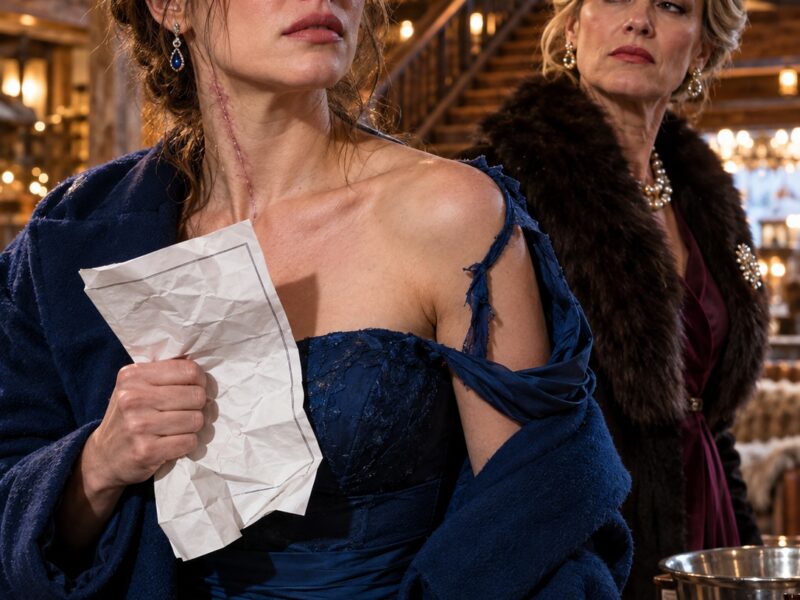
She Crossed 2,000 Miles to Hide Her Scar—Then a Rancher Saw It the Night the Whole Town Came to Destroy Her
Eleanor Bell’s dress slipped from her shoulder in the hayloft at exactly the wrong moment.
The old scar she had crossed two thousand miles to hide caught the orange light from the stove—a pale, jagged line beginning beneath her left ear and disappearing toward her collarbone.
Colt Maddox saw it.
And then footsteps sounded on the stairs below.
Not one person.
Three.
A woman’s voice rose through the floorboards.
“I know she’s up there.”
Eleanor recognized Martha Pritchard immediately.
Her stomach dropped.
Colt’s hand stopped inches from Eleanor’s shoulder. On the table beside them sat a first-aid basin, bloody gauze, and the torn button from Eleanor’s dress. Downstairs, a newborn foal was struggling to stand after a brutal delivery that had nearly killed its mother.
None of that would matter once Martha reached the top of those stairs.
People rarely saw what happened.
They saw the version they had already decided to believe.
Eleanor pulled instinctively at the torn fabric.
Too late.
Her scar remained exposed.
For one terrible second, she was no longer in Wyoming.
She was back in a hospital room in New York, watching her fiancé look at her newly stitched face and trying not to react.
She remembered Jonathan Ashford’s eyes.
That tiny pause.
That involuntary grief.
The expression of a man realizing the woman he planned to photograph beside him for the rest of his life would no longer look exactly the way he had expected.
Eleanor closed her eyes.
Then Colt spoke quietly.
“Don’t close your eyes yet.”
She opened them.
He wasn’t looking at the scar.
He was looking at her.
Below them, Martha shouted again.
“The whole town deserves to know what kind of woman she is.”
And Eleanor understood that the secret she had spent years protecting was about to become the least dangerous thing in the room.
Three weeks earlier, she had arrived in Silver Hollow, Wyoming, with forty-three dollars, one suitcase, and a job that did not exist.
The last bus from Denver left her beneath a depot awning on a December afternoon while dry snow swept sideways across Main Street.
In her gloved hand was a letter she had reread so many times that the fold had begun to tear.
Position confirmed. Housing assistance available. Report January 3. — Reverend Harold Hartley, Library Board Chair.
She had built an entire future around those two sentences.
Then she looked across the street.
Plywood covered two windows of the Silver Hollow Public Library.
A notice had been taped crookedly to the door.
CLOSED UNTIL FURTHER NOTICE — MUNICIPAL BUDGET ACTION.
For several seconds Eleanor simply stood there.
A teenage boy carrying grocery bags noticed her.
“You waiting for somebody?”
“Reverend Hartley.”
Something changed in the boy’s expression.
“Reverend Hartley’s in Denver.”
“For the day?”
“No, ma’am. Hospital.”
Her fingers tightened around the letter.
“How long?”
“Month, maybe.”
“And the library?”
“Council shut it down in October.”
He shrugged with the accidental cruelty of the young.
“Mayor said books don’t pay heating bills.”
Then he walked away.
Eleanor remained beneath the awning as snow gathered on her suitcase.
The bus that had brought her west was already disappearing beyond town.
Going back would cost almost everything she had.
And there was nothing waiting for her back east anyway.
No apartment.
No job.
No parents.
No wedding.
No Jonathan.
Especially no Jonathan.
Four years earlier, Eleanor had been sitting in the back seat of a taxi when a delivery truck ran a red light.
Glass had exploded inward.
The surgeons saved her life.
They could not erase what the window had left behind.
Jonathan tried.
For two months after the accident, he kissed her forehead instead of her mouth. He told her she was beautiful too quickly, too often, as if repetition could turn reassurance into truth.
Then one evening he finally said what both of them had been avoiding.
“You deserve someone who doesn’t have to work this hard not to notice.”
Eleanor remembered staring at him.
“Not to notice what?”
He had no answer that didn’t make everything worse.
So she gave him one.
“The scar.”
Jonathan looked down.
That was enough.
He called what happened next honesty.
Eleanor called off the wedding before he could.
Now, beneath the depot awning in Silver Hollow, she touched the high collar of her coat.
Still covered.
Still safe.
She lifted her suitcase and began walking.
Silver Hollow was smaller than she had imagined.
A diner.
A bank.
A hardware store.
A church.
A feed store.
A bar whose red beer signs glowed in the windows despite it being barely afternoon.
Near the edge of Main Street stood a cedar barn with warm yellow light spilling through its windows.
Eleanor stopped there because the wind made the decision for her.
The barn door opened.
A man emerged carrying a western saddle.
He looked about thirty-six.
Tall.
Dark hair beneath a worn felt hat.
Broad shoulders, except his right side hung slightly lower than his left.
He stopped when he saw Eleanor dragging a suitcase through six inches of snow.
“You lost?”
“I was promised employment.”
“That’s not the same question.”
Eleanor raised her chin.
“No.”
“It isn’t.”
He put the saddle down.
“Where?”
“Silver Hollow Library.”
His expression changed.
“That closed months ago.”
“I have recently been informed.”
“Who hired you?”
“Reverend Hartley.”
“That sounds like Harold.”
“What does?”
“Promising something because he intends it to exist.”
Despite herself, Eleanor almost smiled.
“Do you know where he is?”
“Denver Presbyterian. Lung infection.”
“So there is no job.”
“Not today.”
Snow blew between them.
His gaze moved toward her suitcase.
“You have somewhere to stay?”
“Yes.”
The lie came too quickly.
His eyes narrowed.
“Where?”
“That is not your concern.”
“No.”
He glanced at the darkening sky.
“But the county will close the highway soon, and the motel’s been full since hunting season.”
Eleanor disliked the fact that he sounded practical rather than predatory.
“What are you suggesting?”
“I own the feed store.”
He pointed.
“There’s an apartment above it. Bed, bathroom, heat. You can use it tonight.”
“I do not stay in strange men’s apartments.”
“It’s not my apartment.”
“That distinction does very little for me.”
The corner of his mouth moved.
“You can freeze somewhere respectable if you prefer.”
Another gust struck her suitcase.
It tipped.
The man caught it.
He did not catch her.
He did not use the moment as an excuse to put his hands on her.
For reasons Eleanor did not want to examine, that mattered.
“My name’s Colt Maddox,” he said. “I live at the ranch three miles north. You’ll have a deadbolt. I’ll bring firewood and leave.”
Eleanor studied him.
Gray eyes.
Weathered face.
And just above his shirt collar, a narrow white scar.
“Eleanor Bell.”
He carried her suitcase upstairs.
The apartment was exactly as promised.
One room.
An iron bed.
A small stove.
A bathroom with unreliable hot water.
A clean quilt.
Colt brought firewood and a covered bowl.
“Beef stew.”
“I can pay you.”
“Tomorrow.”
“I can pay you now.”
“Tomorrow will make you feel less like charity.”
Eleanor stared at him.
He understood too much.
At the door, Colt stopped.
“There’s a charger on the dresser. Wi-Fi reaches from the barn.”
“Password?”
“MADDOX7.”
“Impressive security.”
“Nobody in Silver Hollow wants my Wi-Fi.”
Then his expression became serious.
“Lock the door.”
“I intended to.”
“If anybody bothers you, there are two numbers beside the stove.”
“Yours?”
“One is mine. One is my foreman.”
“Why two?”
“Because a woman alone at night shouldn’t have to depend on one man answering his phone.”
That surprised her more than the offer of shelter had.
He left.
Eleanor locked the deadbolt.
Only then did she remove her coat.
Her dress had shifted during the walk.
In the mirror, the top of the scar showed.
Pale.
Uneven.
Permanent.
Her hand rose automatically.
She covered it.
As if Jonathan were still standing behind her.
As if Silver Hollow were already watching.
By breakfast the next morning, it was.
Eleanor crossed to the barn at seven.
Colt was brushing a bay mare while an old radio muttered weather warnings.
He looked over.
“Sleep?”
“Eventually.”
“Heat work?”
“Yes.”
“Then my hospitality record remains perfect.”
Eleanor put five dollars on the workbench.
Colt stared at it.
“What’s that?”
“Room and dinner.”
“Too much.”
“Then the remainder is payment for sarcasm.”
That almost earned a smile.
She noticed the stiffness in his injured shoulder.
“Do you know anyone who needs bookkeeping?”
“Maybe.”
“Teaching?”
“Probably not.”
“Library work?”
“You’re committed to the books.”
“I crossed two thousand miles for the books.”
“Fair.”
He poured coffee.
“What can you do with horses?”
“I rode when I was younger.”
“That wasn’t my question.”
“What was?”
“Can you learn?”
Eleanor looked at him.
“Yes.”
“I need help through calving season. Feeding. Records. Stalls. Medication logs. Fifteen dollars an hour. Apartment included for a month.”
She stared at him.
“You don’t know whether I’m useful.”
“I know you discovered yesterday that your job disappeared, and you still showed up at seven this morning asking for another one.”
He handed her the coffee.
“That tells me something.”
“What?”
“You don’t sit around waiting for somebody to rescue you.”
Her expression hardened.
“I didn’t ask to be rescued.”
“I know.”
That was why she accepted.
The work was brutal.
By noon her shoulders burned.
Her palms blistered.
A gelding refused to move and looked at Eleanor as if her existence personally offended him.
“Stop pulling,” Colt said.
“I’m not pulling.”
“You’re trying to win.”
“Isn’t that generally the objective?”
“Not against twelve hundred pounds.”
He took the rope and relaxed his hand.
The horse walked.
Eleanor frowned.
“Horses feel pressure,” Colt said. “Usually they fight it before they understand it.”
“That sounds suspiciously philosophical.”
“I spend winters talking to livestock.”
“That explains a great deal.”
He laughed.
It was the first time she saw his whole face change.
That afternoon, Eleanor learned the first rule of Silver Hollow.
Nothing remained private for long.
She was stacking feed bags when she heard two women outside the partially open barn door.
One was Martha Pritchard, owner of the dress shop.
“She came alone,” Martha said.
“So?”
“She moved directly into Maddox’s building.”
“You don’t know that.”
“I know where the apartment is.”
Then Martha lowered her voice.
“A respectable woman doesn’t cross half the country alone unless she’s running from something.”
Eleanor froze.
For one second, Wyoming disappeared.
She was back among hospital corridors and expensive New York drawing rooms.
Jonathan’s mother pretending not to look at her neck.
Friends asking whether the wedding postponement was “really about recovery.”
Different landscape.
Same instinct.
Find the defect.
Find the shame.
Find the thing that explains why a woman’s life went wrong.
Twenty minutes later, Colt found Eleanor removing her gloves.
“You leaving?”
“Yes.”
“Why?”
“Your town has apparently reached a verdict.”
“You’ve been here twenty-four hours.”
“Apparently sufficient.”
“Where are you going?”
“Denver.”
“With forty dollars?”
She hated him for remembering.
“That is my problem.”
Colt closed the barn door against the wind.
“I heard Martha.”
“Then you understand.”
“I understand Martha has opinions.”
“She isn’t alone.”
“No.”
Eleanor looked at him sharply.
“At least you’re honest.”
Colt leaned against the stall.
“If you leave every place where somebody misunderstands you, you’ll spend your whole life moving.”
“You have the luxury of saying that.”
His face changed.
“What luxury?”
“This town knows you. Respects you. Nobody sees you walk into the diner and wonders what defect you’re hiding.”
Colt went silent.
Then he unbuttoned his shirt.
Eleanor stiffened.
He stopped after the second button and pulled the collar aside.
A thick white scar crossed his throat.
“Iraq,” he said.
He shifted.
The damage to his right shoulder became more obvious.
“Vehicle rollover outside Mosul. Shoulder crushed. Shrapnel here.”
His fingers touched the scar.
“I came home at twenty-seven.”
Eleanor said nothing.
“I was engaged.”
“What happened?”
“She tried.”
His voice had no anger in it.
That made it sadder.
“Six weeks. Then one night she said she missed the man who left for Iraq.”
Colt buttoned his shirt.
“I told her I missed him too.”
Eleanor’s fingers moved toward her own collar.
Colt noticed.
Then deliberately looked away.
He gave her the choice.
That was what made her take it.
Eleanor loosened one button.
Then another.
She lowered the fabric enough to expose the scar.
“Car accident.”
Colt looked at her face first.
“Jonathan was my fiancé. He said nothing would change.”
“And?”
“He saw me after surgery.”
Eleanor swallowed.
“That was when everything changed.”
Colt remained quiet.
Finally he said, “The scar isn’t the worst part.”
Her throat tightened.
“No.”
“The worst part is remembering how people looked at you before.”
Eleanor stared at him.
There it was.
Not pity.
Recognition.
Before she could answer, a mare kicked violently inside the last stall.
Once.
Twice.
Then dropped.
Colt moved instantly.
“Colic.”
For the next two hours, neither of them had time to be damaged.
They walked the mare.
Called Dr. Olivia Chen.
Checked her gums.
Kept her moving.
Eleanor held the rope until her arms shook.
When Dr. Chen finally arrived, the mare survived.
Afterward Colt looked at Eleanor differently.
“You could’ve gone upstairs.”
“So could you.”
“She’s my horse.”
“She was attached to my rope.”
He smiled.
“Fair.”
That evening they sat near the tack-room stove drying wet gloves.
Eleanor noticed a Robert Frost collection wedged between veterinary manuals.
She picked it up.
“Robert Frost?”
Colt looked almost embarrassed.
“You’re allowed one comment.”
“I wasn’t going to mock you.”
“Most people do.”
“Most people are foolish.”
She opened the book.
“Did you always read?”
“I wanted to teach English.”
“What happened?”
Colt moved his damaged shoulder.
“Life revised the plan.”
Eleanor looked toward the boarded library.
“My plan got boarded shut.”
“Plans can reopen.”
“Libraries do not reopen themselves.”
“No.”
Colt watched her.
“But people can.”
That was the first night Eleanor considered staying.
One day became four.
Four became ten.
The return bus came and went without her.
Colt never asked for a decision.
He simply put her on payroll.
Correctly.
Officially.
That mattered.
She was not his guest anymore.
She was an employee.
Eleanor learned the horses.
Colt learned Eleanor could organize forty years of ranch records in two afternoons.
She discovered duplicate feed invoices.
He stared at her.
“You’re terrifying.”
“You paid the same supplier twice.”
“Exactly.”
A blue ceramic mug appeared beside the barn thermos one morning.
Painted flowers curled around its sides.
Eleanor lifted it.
“What is this?”
Colt kept working on a saddle.
“Cup.”
“I recognize the category.”
“You keep burning your hands on the metal one.”
“You bought me a flowered mug?”
“The flowers were not deliberate.”
She smiled.
The following morning she left biscuits on his workbench.
No note.
Two days later, she repaired a torn seam in his work shirt.
No note.
Their intimacy grew through objects neither of them discussed.
Then Colt showed her the workshop.
Six handmade bookshelves stood beneath canvas covers.
Eleanor stopped.
“Colt.”
“Thompson has an unused room above his general store.”
She looked at him.
“What?”
“He’ll give it rent-free for six months if somebody manages it.”
She touched the smooth pine.
“You built these?”
“I had lumber.”
“You built six bookshelves because you had lumber?”
“Couldn’t sleep.”
“That is an alarming coping mechanism.”
He smiled.
She didn’t.
“Why?”
His smile faded.
“Because you crossed two thousand miles for a door somebody closed before you got here.”
“And?”
“Maybe another door exists.”
Something painful tightened behind Eleanor’s ribs.
“No one has ever done anything like this for me.”
Colt stepped closer.
“I’m not buying anything.”
“I know.”
“You don’t owe me staying.”
“I know.”
“You don’t owe me—”
“Colt.”
He stopped.
Eleanor put her hand over his.
His palm was rough and warm.
His fingers slowly turned beneath hers.
For one suspended moment, neither moved.
Then Colt stepped backward.
Not rejection.
Restraint.
“It’s late,” he said.
“I’ll walk you upstairs.”
The lending library opened two weeks later.
Twenty-three children came the first Saturday.
Adults claimed they were only accompanying them.
Then stayed.
Thompson donated coal.
Dr. Chen brought veterinary books.
Someone from the bar donated poetry and refused to admit it.
Eleanor created loan cards, catalog numbers, donor records, schedules and rules.
Silver Hollow slowly began accepting the woman who had arrived with forty-three dollars.
Martha Pritchard did not.
“That woman came here with nothing,” Eleanor heard her say one morning. “Now Maddox builds her furniture and Thompson gives her rooms. We all know what men expect eventually.”
Eleanor’s hands shook.
She opened the library anyway.
That evening she told Colt.
“Want me to talk to her?”
“No.”
“You sure?”
“She wants me ashamed. If you fight her for me, she still controls the story.”
Colt considered that.
“What do you want?”
“To open tomorrow.”
“Then open tomorrow.”
That was the thing about Colt.
At his best, he made complicated things sound simple without pretending they were easy.
Weeks later, during a difficult foaling, Eleanor discovered how dangerous that simplicity could become.
A black mare went into labor.
The foal was badly positioned.
Dr. Chen was forty minutes away.
Colt worked while Eleanor held the mare’s head.
“Stay with me,” Eleanor whispered.
The mare trembled.
“Come on. Neither of us came this far to quit scared.”
Colt looked at Eleanor.
He knew she wasn’t only talking to the horse.
After nearly an hour, the foal came.
Still.
Colt cleared its airway.
Rubbed.
Waited.
Then—
a gasp.
Tiny.
Sharp.
Alive.
Eleanor laughed.
Colt collapsed against the stall wall in relief.
Then his expression changed.
Eleanor’s dress had torn at the shoulder against a broken board.
Blood from a shallow scrape ran across her skin.
And beneath the torn fabric was the upper edge of the old scar.
She grabbed her coat.
“You’re hurt,” Colt said.
“It’s nothing.”
“Let me clean it.”
“No.”
“Eleanor.”
“I said I’m fine.”
He stopped.
Dr. Chen arrived and confirmed the scrape was superficial.
By then the snow had become too heavy for Eleanor to cross safely to her apartment.
Colt lit the stove in the hayloft office.
He put the first-aid kit on the desk.
“You can clean it yourself.”
She tried.
The scrape was too far behind her shoulder.
Her hand shook.
Colt noticed.
Not pain.
Fear.
“Tell me what you need.”
Eleanor looked at him.
“Help.”
Colt knelt beside the chair.
“May I move the fabric?”
She nodded.
One damaged button came loose.
The dress slipped from Eleanor’s shoulder.
Her scar appeared fully in the firelight.
She closed her eyes.
Immediately, New York returned.
Jonathan at the foot of the hospital bed.
The tiny involuntary change in his face.
Not disgust.
Something worse.
Loss.
As if beauty had been a clause in a contract and Eleanor had violated it.
She waited for Colt’s breathing to change.
Waited for the distance.
Instead she heard:
“Don’t close your eyes yet.”
Eleanor opened them.
Colt was looking at her.
“You think this makes you less beautiful.”
“You don’t have to be kind.”
“I’m not being kind.”
His hand hovered.
“May I?”
She nodded.
His fingertips touched the edge of the scar only enough to avoid irritating it while cleaning the fresh scrape.
Careful.
Respectful.
Eleanor’s breath caught anyway.
“Jonathan looked at me like I became someone else.”
Colt met her eyes.
“Then he never knew who you were.”
Eleanor caught his hand before he withdrew.
Colt froze.
“Why do you come upstairs at night?”
His face changed.
“You noticed?”
“I’m a librarian. We notice patterns.”
He looked at their joined hands.
“Sometimes I walk up the stairs.”
“And?”
“I stop.”
“Why?”
His mouth tightened.
“Darkness makes cowards believe they’re almost brave.”
Eleanor’s heart beat harder.
“What would a brave man do?”
Colt leaned closer.
Not enough to kiss her.
Enough that she felt his breath.
“He’d tell you he’s wanted to kiss you since the day you stood outside his barn arguing with a blizzard.”
Then footsteps sounded downstairs.
Several people.
Martha’s voice rose through the barn.
“I know she’s up there.”
Eleanor jerked her dress toward her shoulder.
Colt stood.
“The whole town deserves to know what kind of woman she is.”
Footsteps struck the stairs.
Colt moved toward the entrance.
Eleanor stood too.
“No.”
He turned.
“What?”
“I’m not hiding behind you.”
“I’m not asking you to.”
“It becomes that if you stand in front of me.”
The trapdoor opened.
Martha appeared.
Behind her stood Councilmen Ross Hill and Dean Mercer.
Their eyes moved across the room.
Eleanor’s torn dress.
Bare shoulder.
Colt standing close.
The cot used during foaling nights.
The basin.
The first-aid supplies.
They saw exactly the story they had expected to see.
Martha smiled.
“By tomorrow,” she said, “that little library will be closed.”
At eight the next morning, an official notice was nailed to the library door.
TEMPORARY CLOSURE PENDING MUNICIPAL REVIEW.
Someone had added another message in black marker.
LEAVE MADDOX OR LEAVE SILVER HOLLOW.
Three children stood behind Eleanor holding books.
Sadie, the youngest, whispered:
“Is the library gone?”
Eleanor stared at the words.
Four years earlier, she had left New York.
Weeks earlier, she had nearly left Silver Hollow because two women were gossiping outside a barn.
Running had always disguised itself as dignity.
Not this time.
She ripped the handwritten threat down.
Then unlocked the door.
“No,” she told Sadie. “Not today.”
At noon, Eleanor stood before a packed town council.
Martha accused her of improper conduct.
“You were half-dressed in an unmarried man’s barn.”
“My dress tore while I was helping deliver a foal.”
“You expect us to believe—”
“My shoulder was bleeding. Dr. Chen treated it.”
Olivia stood from the back.
“She’s telling the truth.”
Martha stiffened.
“That doesn’t explain her relationship with Mr. Maddox.”
Colt began to rise.
Eleanor touched his arm.
No.
Then she faced Martha herself.
“My relationship with Colt Maddox is none of this council’s business unless it affects children, my lease, or operation of the library.”
“You teach children,” Martha replied. “Character matters.”
“It does.”
Eleanor held her gaze.
“So does fairness.”
Colt stood anyway.
But when he spoke, he did not explain Eleanor.
He explained himself.
“I offered her a room because she had nowhere to sleep. Work because she asked for it. She earned every dollar. She helped save my animals. She built that library’s catalog. She got your children reading.”
Then he looked directly at Martha.
“The only shame I’ve seen is a town that let a woman arrive alone in winter and gave her gossip before it gave her directions.”
Martha’s eyes flashed.
“You are hardly impartial.”
“No.”
Colt looked at Eleanor.
“I love her.”
The room disappeared around her.
He had never said it.
Not privately.
Not once.
“And if she ever agrees to marry me,” Colt continued, “that will not make her respectable. She was respectable before she knew my name. It’ll only mean I got lucky enough that she chose me.”
Eleanor’s eyes burned.
Then Mayor Whitman cleared his throat.
“Mr. Maddox, moving as that was, it doesn’t solve the licensing issue.”
And absurdly, Eleanor almost laughed.
Because he was right.
Love did not solve zoning.
Then the rear door opened.
Reverend Harold Hartley entered carrying a cane and portable oxygen.
Pale.
Thin.
Furious.
“Actually,” he said, “the licensing problem may be mine.”
The room turned.
He raised Eleanor’s employment letter.
“I hired Miss Bell.”
The municipal fight did not end that day.
But the library remained open because its lease was private and Hartley’s church foundation legally owned part of the donated collection.
More importantly, Martha’s sixteen-year-old daughter Sarah stood up and admitted she had been visiting Eleanor’s library every day.
“She helped me with my college essays,” Sarah told her mother. “She told me I’m allowed to leave Wyoming if I want. She also told me I’m allowed to stay.”
Martha looked wounded.
“I was protecting you.”
“I know, Mom.”
Sarah squeezed her hand.
“But sometimes you protect me from things that aren’t dangerous.”
Eleanor watched Martha sit down.
She felt no victory.
Only recognition.
Fear could become cruelty when people mistook the two for responsibility.
Outside the courthouse, Colt followed Eleanor into the snow.
“What I said inside—”
“You said many things.”
“I said I love you.”
Eleanor looked at him.
“Say it again when nobody is watching.”
That evening, in Colt’s kitchen, he did.
“I love you.”
And this time Eleanor believed him.
Then Colt ruined it.
“There’s something else you should know.”
Her stomach tightened.
“That is an extremely poor sentence to follow ‘I love you.’”
“I know.”
He looked toward the dark window.
“Martha didn’t come to the barn by accident.”
Eleanor went still.
“What?”
“She received an anonymous note telling her you were upstairs with me.”
“Who sent it?”
“I don’t know.”
“Why?”
“Because somebody wanted that scene.”
Colt put a document on the table.
A purchase offer.
A regional development group wanted Thompson’s Main Street block.
Boutique hotel.
Restaurants.
Parking.
Thompson had refused to sell.
The lending library had increased pedestrian traffic and strengthened local resistance to demolition.
Eleanor read the paperwork twice.
“Who represents the developer?”
Colt’s jaw tightened.
“My brother.”
She looked up.
“You have a brother?”
“Half brother. Evan Maddox. Denver attorney.”
“He knew about me?”
“He knew Thompson had rented the room to you.”
“Do you think he sent Martha the note?”
“Yes.”
Eleanor stood.
“So we document everything.”
“I can talk to Evan.”
“No.”
“Eleanor—”
“No confrontation. No threats. Copies of every offer. Council records. Communications. Martha’s note.”
Colt stared at her.
“What?”
“You’re terrifying.”
“Apparently it’s one of my stronger qualities.”
They worked for days.
Then Eleanor found the detail that changed the entire scandal.
The municipal closure notice had been drafted hours before Martha climbed the barn stairs.
Before anyone supposedly knew about Eleanor and Colt.
The scandal had not caused the attempted closure.
It had been prepared as justification for one.
Then Colt admitted something worse.
“Evan called me before you arrived.”
Eleanor slowly looked at him.
“What did you say?”
“He knew Hartley had hired a librarian. He asked whether reopening the library might complicate redevelopment.”
“You knew the library was closed before I arrived?”
“Yes.”
The room became very quiet.
“When I stood outside your barn and told you I’d been promised a job…”
“I knew it didn’t exist.”
“You let me explain it anyway.”
“I didn’t want to humiliate you.”
Eleanor laughed once.
There was no humor in it.
“You men are addicted to deciding which truths women can survive.”
Colt flinched.
“You’re right.”
“Stop saying that like it repairs something.”
“It doesn’t.”
She took her coat.
“Eleanor.”
She stopped.
“I love you.”
“I know.”
That made it worse.
She looked back.
“Love is not permission to curate reality for me.”
Then she left.
For five days, Eleanor spoke to Colt only about ranch work.
Then she resigned.
She moved into Ruthie Thompson’s spare bedroom.
The library continued.
Until the fire marshal arrived.
This time there was no conspiracy.
The upstairs room genuinely violated occupancy regulations.
One staircase.
No secondary emergency exit.
Too many people.
Public access was closed immediately.
Sadie stood outside again holding a book.
“Now is it gone?”
Eleanor looked at the red notice.
“Yes.”
Her voice nearly broke.
“For now.”
That night she sat alone among boxes of books and finally cried.
Colt appeared at the bottom of the stairs.
“Can I come up?”
“No.”
He nodded.
He stayed downstairs.
Then said, “I found something.”
Eleanor wiped her face.
“What?”
“Original library deed. 1914.”
She stood.
Colt explained.
The property contained a reversion clause.
If Silver Hollow stopped using the old building as a free public reading room for eighteen consecutive months, ownership reverted to the church foundation.
The council had closed it fourteen months earlier.
Four months remained.
The developer wanted demolition before the deadline complicated title to the property.
Suddenly the entire timeline made sense.
“Where did you find this?”
“County archive.”
“You went looking for me?”
Colt paused.
“For the library.”
That answer mattered.
“What else?”
“The old veterinary clinic behind my feed store. One story. Two exits. Ramp. Vacant.”
“You own it.”
“Yes.”
“No.”
“I expected that.”
“The library cannot depend on whether you love me.”
“Agreed.”
That surprised her.
Colt continued.
“I lease it to the nonprofit. Published rate. Independent board. No control for me. No naming rights.”
Eleanor stared.
“You’ve been talking to lawyers.”
“Ruthie.”
“Worse.”
The corner of her mouth betrayed her.
Within three weeks, they incorporated a nonprofit.
Ruthie.
Hartley.
Dr. Chen.
Parents.
A student advisory seat.
Eleanor as paid director.
Colt as landlord under documented terms, not savior.
The distinction changed everything.
Then Eleanor began examining the redevelopment proposal.
What she found was more complicated than the villain she wanted.
Silver Hollow desperately needed tax revenue.
Young people were leaving.
Businesses were failing.
The developer promised jobs.
Councilman Mercer’s hardware store was months from bankruptcy.
Martha was not secretly being paid.
She was a frightened woman whose husband had humiliated her years earlier and who had turned respectability into both armor and weapon.
Evan had acted aggressively.
But the development itself was not evil.
That made the problem harder.
And more real.
Then Eleanor found the leverage.
The developer’s economic analysis classified the old library as “functionally abandoned.”
But Eleanor’s records showed seventy-three registered borrowers.
Forty-one children.
Planned adult-literacy classes.
Employment-search computers.
Community use.
The building was not abandoned.
People had simply been told it was unnecessary.
Eleanor scheduled a town meeting.
Two hundred people filled the Silver Hollow High gymnasium.
Evan Maddox came.
So did Martha.
Mercer.
Mayor Whitman.
Colt sat in the third row.
Eleanor had given him one instruction.
“Sit.”
“That’s all?”
“And don’t give speeches.”
“My last speech was excellent.”
“That’s precisely why you’re prohibited.”
The night before the meeting, Eleanor received a call from Jonathan Ashford.
Four years after he left.
“I saw an article about you.”
“Congratulations.”
“I deserved that.”
“What do you want, Jonathan?”
“To apologize.”
Eleanor sat beside the window.
He told her the truth he had been too cowardly to tell years earlier.
He had cared about wedding photographs.
Other people staring.
Questions.
Appearances.
He had blamed Eleanor’s scar because admitting his own shallowness would have required looking at himself.
Eleanor listened.
Strangely, it barely hurt.
“Do you forgive me?” Jonathan finally asked.
Eleanor looked at her reflection.
Her blouse collar was open.
The scar visible.
“I don’t carry you heavily enough anymore to need to forgive you every day.”
Silence.
“That sounds worse.”
“It isn’t.”
She smiled faintly.
“It means I’m okay.”
After they hung up, Eleanor called Colt.
Her first personal call to him in weeks.
“What happened?” he asked immediately.
“How do you know something happened?”
“You called after nine.”
She told him.
Jonathan.
The apology.
The photographs.
Colt listened.
“You okay?”
“Yes.”
“Want me to say something ugly about him?”
“No.”
“I prepared several possibilities.”
She laughed.
Then the laughter faded.
“I miss you.”
Silence.
Half a breath.
“I miss you too.”
“That doesn’t mean we’re fixed.”
“I know.”
“I still don’t trust you completely.”
“I know.”
“But I want to.”
Colt’s voice softened.
“That’s enough.”
The next evening, Eleanor stood before Silver Hollow.
She did not hide the scar.
She did not deliberately display it either.
She simply stopped organizing her clothing around whether someone might notice.
She began with facts.
Borrowers.
Children.
Budgets.
Programs.
Safety.
Funding.
Then she addressed development.
“I’m not here to say Silver Hollow should never change.”
Evan looked up.
“A town that cannot create work for young people eventually becomes a town they leave.”
The room quieted.
“But change that requires destroying something people already use should have to prove that destruction is necessary.”
Then she invited Evan forward.
He presented the hotel plan.
Thirty-five jobs.
Restaurant leases.
Tax revenue.
Infrastructure improvements.
He did not lie.
Eleanor respected that.
“Does your project require demolition of the old library?”
“Yes.”
“Could you preserve it?”
“Technically.”
“At what additional cost?”
“Approximately six hundred thousand dollars.”
A murmur moved through the gym.
Eleanor nodded.
“So preservation is possible.”
“At a cost.”
“Yes.”
She turned toward the town.
“Then that is the question. Not whether we can save it.”
She looked around the room.
“Whether we believe saving it is worth six hundred thousand dollars.”
For the first time, the argument became concrete.
Not good versus evil.
Choice versus consequence.
People stood.
A retired teacher.
A diner owner.
Parents.
Business owners.
Some supported development.
Others preservation.
Then Martha Pritchard rose.
The room went silent.
She looked at Eleanor.
“I owe you something.”
Eleanor waited.
“My husband embarrassed me publicly eighteen years ago.”
Martha’s voice trembled.
“After that, I built my entire life around making sure nobody could ever accuse me of failing to recognize wrongdoing again.”
She looked at Sarah.
“I started seeing wrongdoing everywhere.”
Sarah took her hand.
Martha looked back at Eleanor.
“I was wrong about the barn.”
A long silence.
“I’m sorry.”
Eleanor nodded.
“Thank you.”
No humiliation.
No revenge.
Then Councilman Mercer stood.
“My hardware store is four months from closing.”
Heads turned.
“The developer offered me commercial space at reduced rent.”
Mayor Whitman’s expression hardened.
“I should have disclosed it before participating in discussions.”
“Were you bribed?” someone shouted.
“No.”
Mercer swallowed.
“I was scared.”
That answer was somehow harder to dismiss.
“I’m recusing myself from the redevelopment vote.”
Then Evan Maddox stood.
Colt moved slightly in his chair.
Eleanor looked at him.
Sit.
He sat.
Evan faced the room.
“I sent Martha the anonymous note.”
The gymnasium erupted.
Eleanor raised a hand.
Slowly, people quieted.
“Why?” she asked.
Evan looked toward Colt.
“I believed controversy surrounding the library would weaken opposition to redevelopment.”
“You used my private life.”
“Yes.”
“You didn’t know what was happening in the loft.”
“No.”
“Yet you sent her.”
“Yes.”
“Why admit it now?”
Evan took a breath.
“Because I spent twenty years believing Colt’s problem was that he cared too much about individual people to make rational decisions.”
His eyes moved to Eleanor.
“Tonight I watched you make a rational case against something I’m paid to achieve.”
He looked around the gym.
“I still believe development is necessary.”
Then back to her.
“But what I did was wrong.”
It was not redemption.
It was truth.
Eleanor asked the only question that mattered.
“Will your client redesign?”
Evan hesitated.
“If the town shares preservation costs and grants a density adjustment on the western parcel…”
Everyone waited.
“Yes.”
Four hours later, there was no cinematic victory.
No unanimous vote.
No defeated villain storming from the room.
There was a compromise.
The old library would remain as a community reading and education center.
The hotel would proceed on adjacent parcels.
Silver Hollow would seek historic-preservation funding.
The nonprofit would raise private money.
Parking and traffic plans would change.
Eleanor’s temporary library would remain open during construction.
Nobody got everything.
Nobody lost everything.
For the first time since Eleanor stepped from that bus, Silver Hollow had chosen something difficult together.
Afterward, Colt waited while volunteers stacked folding chairs.
Eleanor approached him.
“You behaved.”
“It was painful.”
“I’m proud of you.”
“Dangerous encouragement.”
She smiled.
“Walk me home.”
Snow fell lightly.
At Ruthie’s porch, Eleanor turned.
“Colt.”
“Yes?”
“I love you.”
His entire face changed.
She held up a finger.
“That does not erase the lying.”
“I know.”
“I need you to understand that before you become too happy.”
“I understand.”
“Good.”
Colt waited.
Then smiled.
“Can I be a little happy?”
“A little.”
He laughed.
Eleanor reached for his coat.
And kissed him.
Not because Jonathan apologized.
Not because Martha changed.
Not because Silver Hollow approved.
Not because Colt defended her.
She kissed him because he had finally begun learning the difference between standing beside a woman and standing in for her.
They did not marry immediately.
Silver Hollow found this deeply confusing.
Eleanor rented her own apartment above the bakery.
Colt complained about the stairs because of his shoulder.
He climbed them anyway.
They dated.
Actually dated.
Dinner.
Movies in Laramie.
Grocery shopping.
Arguments about coffee.
Once Colt repaired a cabinet hinge without asking.
Eleanor made him remove it.
“What?”
“You didn’t ask.”
“It was broken.”
“Remove it.”
“This is insane.”
He removed it.
Eleanor looked at the cabinet.
“Would you fix that hinge?”
Colt stared at her.
“Yes.”
“Thank you.”
He reinstalled it.
“This is psychological warfare.”
“It’s training.”
The library grew.
Eleanor became executive director.
A real salary.
Modest.
Independent.
Hartley recovered enough to attend board meetings and sleep through budget presentations.
Martha anonymously donated two boxes of books.
Everyone knew.
Nobody embarrassed her.
Sarah left Wyoming to study education in Montana.
Mercer sold his hardware store to two employees under seller financing.
He survived smaller.
Evan remained the developer’s attorney.
He and Colt began speaking again.
Slowly.
Their first Thanksgiving together lasted forty-eight minutes before an argument.
Progress.
One year after Eleanor arrived on the last bus, the original library reopened.
Restored brick.
Historic windows.
A new ramp.
Sprinklers.
Heat.
Children’s room.
Community computers.
Colt’s company had won the restoration work through competitive bidding.
His name was not prominently displayed.
Eleanor had insisted on conflict rules.
Colt secretly loved that she insisted.
Two months after the reopening, he asked Eleanor to meet him in the barn loft.
The same place Martha had once climbed the stairs expecting scandal.
No crowd waited this time.
No councilmen.
No torn dress.
No blood.
No shame.
Eleanor wore jeans and a sweater.
Colt stood near the window holding a simple silver ring that had belonged to his mother.
“I had a speech.”
“Of course you did.”
“I forgot most of it.”
“Excellent beginning.”
He smiled nervously.
“I loved you before I understood how to tell you the truth properly.”
“That is not yet romantic.”
“I know. I’m getting there.”
Eleanor folded her arms.
“Continue.”
“You taught me kindness without respect can become control.”
Her expression softened.
“You taught me that protecting somebody from information is still taking their choice away.”
He breathed.
“And you taught me libraries are apparently more complicated than cattle.”
“Considerably.”
“I don’t want to rescue you.”
“I don’t want you to.”
“Good.”
Colt stepped closer.
“I want to build a life where neither of us has to become smaller so the other can feel useful.”
Eleanor’s eyes filled.
“That was good.”
“I practiced.”
“How long?”
“Months.”
“Continue.”
He laughed.
Then became serious.
“Will you marry me?”
Eleanor looked at him.
Fear was still there.
Perhaps some part of it always would be.
But fear was no longer making her decisions.
“Yes.”
They married the following summer in the ranch meadow.
Reverend Hartley performed the ceremony with his oxygen concentrator badly hidden behind flowers.
Martha cried.
Ruthie insisted she did not.
Evan stood beside Colt.
Sarah read.
Eleanor wore ivory.
The neckline did not hide the scar.
It did not showcase it either.
That was the point.
During photographs, the photographer said, “Chin slightly left?”
Eleanor froze.
Left would hide the scar.
An old instinct rose inside her.
Colt noticed.
He said nothing.
He did not tell her she was beautiful.
He did not tell her to be brave.
He did not decide for her.
Eleanor turned slightly right.
Scar toward the camera.
Her choice.
Click.
Years later, that photograph hung inside the library office.
Children rarely noticed the scar.
Adults occasionally did.
Eventually Eleanor stopped noticing who noticed.
Marriage did not heal Colt’s shoulder.
Winter still hurt him.
Some nights he woke from dreams he could not explain.
Eleanor learned that love did not require asking every time.
Sometimes presence was enough.
Her scar remained numb in places.
Some fabrics irritated it.
Colt stopped trying to cure those moments by telling her she was beautiful.
Beauty was not medicine.
Sometimes he simply changed the laundry detergent.
Practical love.
The ranch eventually partnered with Dr. Chen and county mental-health services to create a therapeutic riding program for veterans.
Colt participated before he donated.
That mattered.
Eleanor created a mobile library route serving remote ranches.
Martha volunteered once a month and became terrifyingly effective at collecting overdue books.
Ruthie became board chair.
Nobody successfully opposed her.
Five years after the scandal, Eleanor received a wedding announcement from Jonathan.
He had remarried.
She looked at it for a few seconds.
Smiled.
Dropped it into recycling.
No tears.
No speech.
No dramatic closure.
Finished.
Eight years after Eleanor stepped off the last bus, a young woman entered the library on a February evening.
She looked twenty-two.
Her coat was buttoned to her throat despite the warm room.
When she turned, Eleanor saw a scar along her jaw.
The young woman stood close to the entrance.
Ready to escape.
Eleanor knew that posture.
“Can I help you?”
“I heard you hire part-time.”
“We do.”
“I don’t have much experience.”
Eleanor looked at her.
“Can you learn?”
The woman seemed surprised.
Someone had once asked Eleanor exactly the same question inside a barn while snow buried Silver Hollow.
“Yes.”
Eleanor handed her an application.
“Then fill this out.”
Later that evening, Colt arrived carrying takeout.
He watched the young woman leave.
“Another stray?”
Eleanor raised an eyebrow.
“That is a terrible word for human beings.”
“You married me.”
“Evidence of occasional poor judgment.”
He kissed her forehead.
Eleanor removed her cardigan.
The neckline of her blouse slipped slightly from her shoulder.
Her scar caught the warm library light.
Once, her hand would have risen automatically.
Cover.
Hide.
Protect.
This time it remained at her side.
Colt touched the scar gently.
Eleanor closed her eyes from old habit.
His voice came near her ear.
Older now.
Softer.
“Don’t close your eyes yet.”
Eleanor opened them.
He was looking at her exactly as he had in the hayloft years earlier.
Not pretending the scar did not exist.
Not heroically looking past it.
Seeing it.
Seeing her.
Seeing all of it.
Behind Colt, shelves stretched across the room.
Children’s drawings hung from the ceiling.
Snow drifted beyond the windows.
The institution Silver Hollow once called unnecessary was warm, crowded, funded, imperfect—and real.
Eleanor looked toward the framed wedding photograph in her office.
Scar facing the camera.
Eyes open.
“I’m not hiding,” she said.
Colt nodded.
“I know.”
And that was why his old words meant something entirely different now.
Once, don’t close your eyes had meant:
Stay long enough to find out whether he recoils.
Now it meant:
Stay here.
Stay present.
Look at what survived.
Look at what changed.
Look at what you built after other people decided your life had become smaller.
Eleanor switched off the circulation-desk lamp.
Colt held out her coat.
She slipped it on.
No high collar.
No armor.
At the front door, Eleanor stopped and looked back.
The library was empty now.
Still warm.
Tomorrow morning, children would come through those doors.
Books would open.
Questions would be asked.
People would disagree.
Someone lonely might find a chair.
Someone frightened might discover a second chance.
And nobody would have to prove they were respectable, beautiful, undamaged, or worthy before being allowed inside.
Outside, Colt waited beneath falling snow.
He did not call for her.
He did not reach back and pull her forward.
He simply waited.
Eleanor locked the library door.
Then she stepped into the snow.
Colt held out his hand.
She looked at it.
Eight years earlier, she had arrived in Silver Hollow believing survival meant hiding whatever gave people permission to hurt her.
She knew better now.
Survival had never been the final destination.
Choice was.
Eleanor took Colt’s hand.
And this time, she kept her eyes open.









