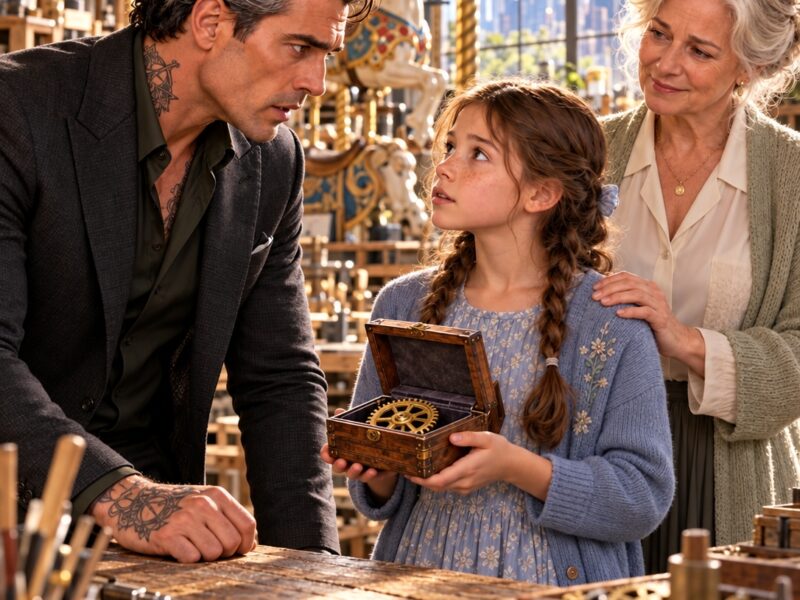
Mafia Boss Froze When a 9-Year-Old Girl Came to His Job Interview Instead of Her Sick Mom—But the Small Wooden Box She Carried Revealed a Secret He Had Buried for 28 Years
“My mommy is in the hospital, sir. So I came to her job interview instead.”
The little girl’s voice was barely louder than the rain tapping against the warehouse windows, but it brought the entire restoration workshop to a standstill.
A man holding a polishing cloth stopped halfway through cleaning a brass railing. Two security guards exchanged glances. Near the far wall, an elderly craftsman slowly removed his reading glasses.
And behind a large oak worktable, Enzo Valente—the forty-three-year-old man whose name could make powerful businessmen abandon negotiations halfway through a sentence—stared at the child as though she had stepped out of a memory he had spent nearly three decades trying to forget.
She wore a faded blue dress, white sneakers with fraying laces, and a small yellow cardigan that was missing one button. Her dark hair was gathered into two uneven braids, and she held a wooden box against her chest with both arms.
The box looked heavy for her.
So did the responsibility she had apparently decided to carry.
Enzo glanced toward Dante Russo, his security chief.
“Who let her in?”
Before Dante could answer, an elderly woman standing beside the girl stepped forward.
“I did, Mr. Valente. My name is Rosa Bennett. I’m her neighbor. I brought her here because she insisted, but I stayed with her the whole time.”
Enzo looked back at the child.
“What’s your name?”
“Ivy Collins, sir.”
“How old are you, Ivy?”
“Nine.”
“And your mother?”
“Mara Collins.”
The name struck a faint chord.
Enzo looked toward the folder on his desk.
He had been scheduled to interview Mara Collins at ten that morning for a position restoring antique mechanical equipment at Marigold Grounds, an abandoned amusement park along the Lake Michigan waterfront.
She was fifteen minutes late.
He had already considered moving on to the next candidate.
“Your mother is supposed to be here,” he said.
Ivy’s fingers tightened around the box.
“I know.”
“Where is she?”
The little girl’s lower lip trembled.
“At St. Mary’s Hospital.”
Enzo straightened.
“What happened?”
“She got really sick yesterday. They took her in an ambulance, and the doctors had to do an operation.”
Rosa gently touched the child’s shoulder.
“She had emergency abdominal surgery last night. She’s recovering, but she won’t be able to come today.”
Enzo looked at the box.
“And what’s that?”
Ivy glanced down as though remembering why she had come.
“Mommy’s work.”
She carefully placed it on the visitors’ counter.
“She finished it before she got sick. She said if she could show you what she made, maybe you’d give her a chance.”
The little girl swallowed.
“I know I’m not supposed to do grown-up things. But she worked so hard, and she was scared she’d miss the interview.”
For several seconds, Enzo said nothing.
His expression remained unreadable.
Then he walked around the worktable.
He stopped several feet from Ivy and lowered himself until they were nearly eye to eye.
“Listen to me carefully,” he said.
Ivy nodded.
“You can’t interview for your mother.”
“I know.”
“You can’t promise me she can do a job.”
“I know that too.”
“Then why did you come?”
Ivy looked at the wooden box.
“Because someone should see what she made.”
The answer landed somewhere Enzo wasn’t prepared for.
He looked toward Rosa.
The older woman nodded.
“She’s been carrying that box around the apartment since six this morning. I told her we could call, but she kept saying her mother had already lost too many chances.”
Enzo looked at Ivy again.
“May I open it?”
She nodded quickly.
“Yes, sir.”
He lifted the lid.
Inside, wrapped carefully in an old cotton dish towel, lay a small brass gear.
One tooth had been broken and rebuilt so precisely that the repair was nearly invisible.
There was nothing particularly extraordinary about the object at first glance.
Except for two tiny letters scratched into the metal near its center.
A.V.
And beneath them, a small five-pointed star.
Enzo went completely still.
He knew those marks.
He had watched his father make them when Enzo was a boy.
The gear belonged to the original music mechanism from the Marigold carousel.
The carousel that had stood silent for twenty-eight years.
The carousel Enzo had spent millions trying to restore.
And the carousel that had been the last place he remembered seeing his father truly happy.
“Where did your mother get this?”
His voice had changed.
Ivy blinked.
“From Mr. Bell.”
“Who’s Mr. Bell?”
“He lets Mommy use his workshop when she gets off work. He’s old, but he’s really nice. He makes coffee that tastes like burnt tires.”
A quiet chuckle came from somewhere behind them.
Enzo didn’t smile.
He was staring at the gear.
At the little star.
At the workmanship.
“Joe.”
The elderly craftsman near the back wall approached immediately.
“Yes, boss?”
“Look at this.”
Joe Moretti, who had spent forty-six years repairing mechanical equipment, placed his glasses back on and examined the brass wheel.
He turned it carefully between his fingers.
Then he looked up.
“Where did this come from?”
“It’s Mara Collins’s test piece.”
Joe’s eyebrows rose.
“The one I assigned last week?”
“Yes.”
Joe carried it to a small testing assembly on his bench.
He checked the measurements, examined the reconstructed tooth, and fitted the gear into a disconnected decorative music mechanism.
Then he turned a hand crank.
Three soft notes sounded.
Nothing dramatic.
Just three delicate musical tones.
But Enzo felt his chest tighten so suddenly that he had to brace one hand against the table.
He hadn’t heard those notes since he was fifteen.
For a moment, he was no longer standing in a workshop surrounded by employees who feared him.
He was sitting beside his father at an old wooden bench.
He could smell sawdust.
Machine oil.
Fresh paint.
He could hear Antonio Valente laughing as he held up a brass gear.
“See this, Enzo? Anybody can throw away something broken. It takes patience to make it useful again.”
The memory vanished.
Enzo looked toward the little girl.
“Did your mother repair this herself?”
Ivy nodded.
“She worked on it after dinner. Sometimes she stayed up really late.”
“How late?”
“Until she got tired enough that she put her tools away.”
Joe smiled.
“Your mother sounds sensible.”
Ivy shook her head solemnly.
“Not always. Sometimes she talks to broken machines.”
Enzo finally smiled.
“What does she say?”
Ivy thought about it.
Then she straightened her shoulders, imitating her mother.
“Well, you haven’t beaten me yet.”
Joe laughed.
Enzo lowered his gaze.
His father had used almost those exact words.
Not about machines.
About life.
He looked back at Ivy.
“Why does your mother want this job?”
The question seemed to surprise her.
She glanced at Rosa.
The older woman nodded encouragingly.
Ivy stared at the little gear on the bench.
“Because when Mommy works at the warehouse, she comes home and her feet hurt, and sometimes she falls asleep before we finish our movie.”
Her voice became softer.
“But when she works at Mr. Bell’s shop, she comes home smiling.”
Enzo listened.
“She says broken things aren’t always useless. Sometimes they just need somebody who knows what they’re looking at.”
The workshop became very quiet.
Ivy looked up.
“Did she do a good job?”
Joe examined the gear one final time.
“Yes, sweetheart.”
Ivy’s shoulders relaxed slightly.
“A very good job,” he added.
She smiled.
Then looked at Enzo.
“Does that mean Mommy can work here?”
Enzo could have said yes.
He owned the restoration company.
He controlled the project.
A single word from him could have changed Mara Collins’s life immediately.
And years earlier, that was exactly what he would have done.
He would have offered the job, enjoyed the gratitude, and moved on believing he had performed an act of generosity.
But something about the little girl’s serious face made him pause.
Her mother had sent work to be judged.
Not a request for charity.
Enzo looked toward Joe.
“Document the evaluation. Every measurement.”
Joe nodded.
“Then call human resources. Tell them Mara Collins can reschedule her practical assessment after her doctor clears her to return.”
Ivy’s eyes widened.
“So she still gets a chance?”
“Yes.”
“A real chance?”
Enzo nodded.
“The same chance every qualified applicant gets.”
Ivy stared at him.
Then whispered, “Mommy would like that.”
He suspected she would.
At the door, Ivy turned back.
“Mr. Valente?”
“Yes?”
“Will you tell Mommy the music worked?”
Enzo looked toward the brass gear.
The little star caught the workshop light.
“Yes, Ivy. I’ll tell her.”
The girl smiled.
Then Rosa took her hand, and the two visitors walked out into the pale morning sunshine.
Enzo remained beside the testing bench.
He did not know it yet, but the little girl had arrived at the exact moment when he was about to make the greatest mistake of his life.
And the small gear her mother repaired would become the first warning that the project he was desperate to save had been built on a dangerous shortcut.
Mara Collins woke the next afternoon to the sound of somebody arguing with a toaster.
“It’s not broken,” Ivy insisted from the kitchen.
Rosa answered, “Then why is smoke coming out of it?”
“Because the bread is dramatic.”
Mara smiled before opening her eyes.
She was home.
That was the first good thing.
The second was that her daughter sounded happy.
The third was that she had survived an emergency operation after a sudden abdominal infection that had frightened her more than she wanted to admit.
Her doctor had explained the recovery instructions twice.
No lifting heavy equipment.
No returning to warehouse work immediately.
Plenty of rest.
Follow-up appointments.
Mara had nodded through all of it while privately calculating how many shifts she would miss and how much money would disappear from the next paycheck.
At thirty-four, she had become very good at arithmetic she wished she didn’t need.
Rent.
Utilities.
School lunches.
Car insurance.
Groceries.
Every month began with possibilities and ended with subtraction.
She sat carefully on the couch, holding a pillow against her abdomen.
Rosa appeared in the doorway.
“Well, look who’s awake.”
“Something burning?”
“Only your daughter’s confidence in my toaster.”
Ivy ran in carrying a plate.
“Mommy!”
“Careful, sweetheart.”
The girl stopped immediately, remembering the doctor’s instructions.
Then she leaned forward and kissed Mara’s cheek.
“I made toast.”
Mara examined the blackened square.
“I can see that.”
“Rosa says we should make more.”
“That sounds wise.”
Ivy smiled.
Then became unusually quiet.
Mara noticed immediately.
“What happened?”
“Nothing.”
Mara raised an eyebrow.
Rosa sighed from the kitchen.
“We should tell her.”
Mara looked between them.
“Tell me what?”
Ivy folded her hands.
“Please don’t be mad.”
Mara’s stomach tightened.
“About what?”
“I went to your interview.”
For a moment, Mara simply stared.
Then she looked at Rosa.
“You did what?”
Rosa came into the room.
“I went with her. We stayed in the public visitors’ area. Security checked us in. She only wanted to deliver the test piece.”
Mara looked back at Ivy.
“The interview at Marigold Grounds?”
The little girl nodded.
“You were supposed to be in bed recovering,” Ivy whispered. “I knew you couldn’t go, but you finished the gear, and you said it might be our only chance.”
Mara closed her eyes.
She remembered saying those words.
It had been Thursday evening.
She was sitting at the kitchen table, examining the repaired brass wheel under a cheap desk lamp.
Her feet were swollen from a twelve-hour warehouse shift.
Ivy had been doing homework beside her.
Mara had looked at the calendar and said, mostly to herself, “If this doesn’t work, I don’t know when I’ll get another chance.”
She had not realized her daughter was listening.
Or perhaps she had forgotten that children always listen.
“Ivy,” she said softly, “come sit with me.”
The little girl approached.
Mara made room beside her.
“Finding a job is my responsibility.”
“I know.”
“Taking care of the bills is my responsibility.”
Ivy nodded.
“And worrying about whether we have enough money is not your responsibility.”
The girl’s eyes filled.
“But I wanted to help.”
Mara brushed a curl from her cheek.
“I know, sweetheart.”
She swallowed.
“And I love that you wanted to help. But I don’t want you spending your childhood carrying my fears around.”
Ivy leaned against her uninjured side.
“I only carried a little box.”
Mara laughed despite the ache in her abdomen.
“I know.”
Rosa brought an envelope from the coffee table.
“They sent this.”
Mara opened it.
Inside was a letter from Marigold Grounds.
It confirmed that her brass gear had passed the initial technical evaluation.
Her in-person assessment had been postponed.
She was invited to contact the company when medically cleared for light workshop activity.
There was no job offer.
No promise.
No photograph of her daughter shaking hands with a wealthy businessman.
Only a fair opportunity to continue.
Mara read the letter twice.
Then she looked at Ivy.
“Did Mr. Valente say anything else?”
“He asked me why you like fixing things.”
Mara smiled faintly.
“What did you tell him?”
“That you’re happier when machines are broken than when people are mean.”
Rosa burst out laughing.
Mara covered her face.
“Oh, Ivy.”
“And I told him you sometimes get mad at gears.”
“Wonderful.”
“And that you say they haven’t beaten you yet.”
Mara shook her head.
“Apparently he got the full family history.”
Ivy smiled.
Then hesitated.
“Was it okay?”
Mara looked at the letter.
It was a chance.
Not a rescue.
Not charity.
A chance to have her work judged by people who understood it.
“Yes,” she said softly. “It was okay.”
Then she kissed her daughter’s forehead.
“But next time, you let the grown-ups handle the interview.”
Ivy nodded solemnly.
“Even if you’re in the hospital?”
“Especially then.”
Before becoming a warehouse employee, Mara had been a restoration machinist.
It was the work she loved.
Her father had repaired agricultural equipment in a small shop outside Rockford, Illinois. She grew up watching him turn worn metal into useful parts, learning the difference between a piece that needed replacement and one that could be saved.
He taught her to use calipers before she learned to drive.
He taught her that a measurement written down was worth more than one remembered.
And he taught her never to conceal damage beneath fresh paint.
“Paint doesn’t make a weak part strong,” he used to say. “It only makes the mistake prettier.”
Mara carried that lesson into trade school.
She completed a precision machining program and worked for several years restoring historic equipment.
She repaired clock mechanisms.
Decorative machinery.
Antique mechanical displays.
Old factory components destined for museums.
Then the restoration company where she worked closed.
Two major clients canceled contracts, and the owner sold the building.
Mara had recently lost her husband.
Ivy was four.
There was no time to search for the perfect job.
A distribution warehouse offered immediate work.
She accepted.
The pay was lower than she had earned in restoration, but the hours were steady, and steady mattered.
For two years, she scanned shipments, checked inventory, and spent long nights on concrete floors while her hands slowly forgot what it felt like to create something beautiful.
Walter Bell changed that.
He owned a tiny machine shop near their apartment.
At seventy-three, he was semi-retired, though Mara suspected retirement was something he discussed without intending to practice.
One afternoon, she noticed him struggling to align an old gear assembly.
She stopped outside his open garage door.
“Your shaft is slightly off-center.”
Walter looked up.
“Excuse me?”
“The mounting. It’s pulling the gear out of alignment.”
He frowned.
“You know machinery?”
“A little.”
Twenty minutes later, she was helping him measure the assembly.
By the following week, Walter had offered her access to his workshop during evenings when it wasn’t being used.
He charged her nothing.
In return, she organized his old drawings and occasionally repaired small pieces for his customers.
It was the first time in years Mara felt like herself.
When Marigold Grounds advertised a restoration position, Walter insisted she apply.
“You’re wasting good hands at that warehouse,” he told her.
“Those hands pay rent.”
“Then let’s find them work they deserve.”
She applied.
Two weeks later, she received a call inviting her to an interview and practical assessment.
The position paid nearly twice her warehouse wages and included benefits.
More importantly, it involved restoring antique mechanical equipment.
For the first time since Daniel died, Mara allowed herself to imagine a future that contained something besides survival.
Then she became sick.
And her daughter carried the brass gear to the interview.
Enzo Valente had inherited more money than he had ever wanted and more trouble than he could reasonably explain.
His father, Antonio Valente, had begun with a small freight company and expanded into shipping warehouses, trucking routes, commercial properties, and the kind of private arrangements that powerful men preferred not to discuss in public.
Antonio was feared.
But there had been another side to him.
He loved old machines.
Especially mechanical attractions from the early twentieth century.
When Enzo was twelve, Antonio purchased a neglected amusement park on the Chicago waterfront.
He called it Marigold Grounds.
For several summers, the park became a neighborhood favorite.
There was a small Ferris wheel.
A miniature train.
A popcorn stand.
And a carousel with twenty-four carved horses painted in cream, gold, green, and blue.
Antonio spent countless weekends repairing the carousel himself.
Enzo remembered sitting on a wooden stool beside him while the older man polished brass fittings.
He remembered the smell of fresh paint.
The sound of the music mechanism.
The way his father seemed less intimidating when he held a screwdriver instead of a telephone.
Then Antonio became seriously ill.
The park closed.
He died before reopening it.
Enzo was fifteen.
For years, Marigold Grounds sat abandoned behind rusting gates.
The rides were dismantled.
The buildings deteriorated.
Vandals broke windows.
Weeds swallowed the pathways.
Enzo grew older.
He inherited the family organization.
He became successful.
Then powerful.
Then feared.
But every time he drove past the locked park, he remembered his father’s final promise.
“Next summer, we’ll have it running again.”
For twenty-eight years, Enzo had carried that unfinished sentence.
Three years earlier, he began buying back the land and restoring the buildings.
He told investors it was a waterfront redevelopment project.
He told city officials it would create jobs.
He told newspapers it was an opportunity to preserve Chicago history.
All of those things were true.
But none explained why he personally inspected old carousel parts or why he insisted the blue horse remain in its original position.
That horse had been his favorite.
Antonio had painted it for him.
And Enzo intended to see it move again.
The problem was that restoring the park required more than money.
It required time.
Qualified workers.
Independent inspections.
Permits.
And the willingness to admit when old equipment could not safely be returned to service without extensive repairs.
Enzo had money.
He had influence.
He had learned to make other people move quickly.
But ancient machinery did not respond to threats.
That frustrated him more than he wanted to admit.
It also created an opening for Silas Crane.
Silas Crane was a wealthy property investor with a reputation for turning distressed assets into profitable developments.
He had admired Marigold Grounds for years.
Not the carousel.
Not the history.
The land.
A waterfront hotel and luxury residential complex could make him considerably more money than a restored family attraction.
When Enzo’s redevelopment financing became strained, Silas offered capital.
The agreement was complicated.
He would take a thirty-percent interest in the project company.
Enzo would retain seventy percent.
But if Enzo failed to deliver a complete package of operating documents by August fourteenth, Silas could exercise an option to purchase Enzo’s remaining interest at a predetermined price.
That price was far below what the land might eventually be worth.
Enzo’s attorney, Laura Mason, warned him repeatedly.
“The deadline is dangerous.”
“We’ll finish.”
“Construction always takes longer than people expect.”
“I know how to manage a schedule.”
“Managing people isn’t the same as controlling an inspection.”
Enzo signed anyway.
He believed he could force the restoration to move faster.
Now the deadline was approaching.
And several critical components remained incomplete.
The morning after Ivy delivered the brass gear, Enzo stood beside the carousel with Dante Russo.
The enormous wooden platform was still.
Rows of painted horses waited beneath the partially restored canopy.
Some had polished saddles.
Others still showed bare patches where damaged paint had been removed.
The blue horse stood near the outer edge.
Enzo looked at it for a long time.
Dante remained beside him.
“Something on your mind?”
“The girl.”
Dante glanced over.
“Collins’s daughter?”
“Yes.”
“What about her?”
“She reminded me of something.”
Dante waited.
Enzo looked at the old mechanism.
“My father used to say people were too quick to throw away things they didn’t understand.”
Dante nodded.
“He said that about you once.”
Enzo turned sharply.
“What?”
Dante smiled faintly.
“You were fourteen. You broke a clock trying to repair it. Antonio told me you weren’t careless. You were impatient.”
Enzo looked away.
“I don’t remember that.”
“I do.”
A silence passed.
Then Dante said, “We still have a problem with Crane.”
Enzo’s expression hardened.
“I know.”
“He wants the documentation.”
“He’ll get what he’s entitled to.”
“And the carousel?”
Enzo looked toward the blue horse.
“It opens this summer.”
Dante said nothing.
That silence irritated Enzo.
“What?”
“Nothing.”
“Say it.”
Dante sighed.
“You can order a crew to work overtime. You can’t order a machine to be safe.”
Enzo stared at him.
Dante continued.
“That’s all.”
Enzo looked back at the carousel.
For the first time that morning, he heard something other than the clock ticking toward August.
He heard his father’s voice.
You can’t force old things to forgive careless hands.
Mara’s in-person assessment took place two and a half weeks later.
She arrived alone.
Ivy remained with Rosa, making paper horses at the kitchen table.
Mara wore clean work trousers, a simple gray shirt, and the old steel-toed shoes she had kept from her restoration days.
Her surgical recovery was progressing, but she was still limited to light activity.
She had obtained medical clearance for the assessment under those restrictions.
Walter had helped her prepare her tools.
Before she left, he handed her a small notebook.
“Don’t try to impress anybody.”
Mara smiled nervously.
“That’s terrible interview advice.”
“Show them what you know. Ask what you don’t. Don’t pretend a bad measurement is good.”
She nodded.
“Anything else?”
“Yes.”
“What?”
“Stop acting like you have to apologize for being qualified.”
Mara laughed.
Then hugged him carefully.
At Marigold Grounds, Joe Moretti greeted her at the workshop entrance.
He was smaller than Mara expected, with a gray beard and thick glasses that hung from a cord around his neck.
“Miss Collins.”
“Mr. Moretti.”
“Joe.”
“Mara.”
He smiled.
“Good. Let’s work.”
The assessment was conducted at a safe bench assembly unrelated to the carousel’s main drive.
An independent mechanical consultant named Evelyn Park observed.
Mara was given an old component, maintenance records, and several drawings.
She had two hours to assess the condition and propose a restoration plan.
Before touching a tool, she studied the paperwork.
Then frowned.
“Who repaired this last?”
Joe looked up.
“Why?”
“The tool marks don’t match the most recent maintenance entry.”
Evelyn leaned closer.
“Explain.”
Mara pointed toward a narrow groove.
“This surface was machined after the last recorded restoration. The finish is newer here, but the wear pattern beside it is older.”
Joe’s expression sharpened.
“Continue.”
“I’d want photographs, measurements, and the original fitting notes before removing anything. If we grind away the old surface just to make it look uniform, we lose evidence of how the mechanism was assembled.”
Evelyn nodded.
“And if the records don’t exist?”
“Then we document what we can establish and identify what remains uncertain.”
Joe smiled faintly.
Mara continued working.
She measured.
Sketched.
Compared.
Asked questions.
When a part was too heavy for her recovery restrictions, Joe handled it while she directed the examination.
Nobody rushed her.
Nobody praised her simply for trying.
They treated her like a professional whose decisions needed to withstand scrutiny.
That was exactly what Mara had missed.
At noon, Joe placed his pen down.
“You passed.”
Mara blinked.
“I’m sorry?”
“The assessment.”
He turned the scoring sheet toward her.
“You passed.”
For a moment, Mara couldn’t speak.
Then she laughed softly.
Not because it was funny.
Because for years she had imagined hearing those words again.
Enzo approached from the far side of the workshop.
He had watched quietly without interfering.
“Joe?”
“She passed on her score.”
“Then HR can make the offer.”
Mara looked at Enzo.
There was no dramatic speech.
No promise that her life was about to change forever.
He simply nodded.
“Congratulations, Miss Collins.”
She swallowed.
“Thank you.”
Later that afternoon, she received a written offer.
The salary matched the advertisement.
The benefits were clearly listed.
Her responsibilities involved documentation, bench restoration, and component evaluation.
Joe would supervise her technical work.
Human resources would handle employment terms.
Mara accepted.
Then she walked outside, sat on a low brick wall, and called Rosa.
“They offered it.”
Rosa went silent.
“For real?”
“For real.”
A moment passed.
Then Rosa said, “Well, honey, I’m buying a cake.”
Mara laughed.
And cried.
At the same time.
The first weeks at Marigold Grounds felt like returning to a language Mara had nearly forgotten.
There were drawings spread across worktables.
Calipers.
Polished brass.
Old wood.
Paint samples.
The quiet concentration of people who knew that a mistake smaller than a fingernail could matter.
Joe taught her the history of the carousel.
Each horse had a name.
Each decorative panel had been restored at least once.
Some components were original.
Others had been replaced decades earlier.
The challenge was not simply to make everything look new.
It was to preserve what mattered while ensuring the machine met modern requirements.
Mara loved that distinction.
She also learned that Enzo was not an easy employer.
He demanded updates.
Asked uncomfortable questions.
Expected deadlines to be met.
And sometimes forgot that his signature on a purchase order did not make a technical problem disappear.
One afternoon, Mara found him standing before an old photograph of the park.
A younger Antonio Valente held the hand of a dark-haired boy beside the carousel.
“That’s you,” she said.
Enzo turned.
“Yes.”
“You look unhappy.”
“I wanted to ride.”
“Why didn’t you?”
“My father kept stopping to talk to people.”
Mara smiled.
“He sounds friendly.”
Enzo gave a quiet laugh.
“He could be.”
They stood together looking at the photograph.
“Did he open the park to everyone?” Mara asked.
“On certain days. Free admission for neighborhood families.”
She nodded.
“That’s nice.”
“He thought a place like this shouldn’t belong only to people who could afford a good day.”
Mara looked toward the carousel.
“My daughter would have liked him.”
Enzo’s expression softened.
“I think he would have liked her.”
A brief silence passed.
Then Mara said, “Ivy thinks the blue horse is the most important one.”
Enzo looked at her.
“That was my horse.”
Mara smiled.
“Then I hope you don’t mind sharing it.”
For a moment, something in his face changed.
Then he smiled.
“Perhaps I can manage.”
The trouble began with a measurement.
Mara discovered that the recently installed replacement support beneath the carousel platform did not match the dimensions in an older drawing.
At first, she assumed the drawing was outdated.
That happened frequently with historic equipment.
Over the decades, parts were replaced, altered, and repaired without perfect documentation.
She brought the discrepancy to Evelyn Park.
Evelyn studied the records.
“Don’t assume the part is wrong yet.”
Mara nodded.
“We need the latest design calculations.”
“Exactly.”
They requested the installation records.
The contractor provided several documents, but the compatibility verification remained incomplete.
Mara read the purchase authorization.
Enzo’s signature appeared at the bottom.
The installation had been approved before the verification process was finished.
She stared at the date.
June eighth.
A business authorization.
Not a technical certification.
But work had proceeded.
She brought the file to Evelyn.
The consultant examined it.
Then looked up.
“This needs review before operation.”
Mara nodded.
“I thought so.”
Evelyn sighed.
“The difficulty is the deadline.”
Mara looked toward the carousel.
The blue horse stood motionless beneath the half-painted canopy.
“I know.”
A week later, Evelyn authorized a tightly controlled diagnostic test.
The area was closed to visitors.
No passengers were allowed.
The operating crew followed a written procedure with conservative stop limits.
Mara stood beside Evelyn with her notebook.
Joe monitored the mechanical assembly.
Enzo watched from beyond the marked boundary.
When the test began, the empty carousel platform moved slowly.
The motion was almost graceful.
For several seconds, everything appeared normal.
Then the monitoring display changed.
A reading climbed unexpectedly.
Evelyn reached for the stop command.
The system shut down as designed.
The platform coasted to a controlled halt.
Nothing collapsed.
Nobody was injured.
But the silence afterward felt enormous.
Enzo approached only after the test area was cleared.
“How bad?”
Evelyn looked at him.
“We don’t know yet.”
“Could it be the sensor?”
“It could. We’ll check. But the recorded response exceeded the limits we set.”
“So we test again.”
“No.”
Enzo stared.
Evelyn remained calm.
“Not until we understand what happened.”
Mara stood nearby.
She could feel the tension.
Enzo looked toward her.
“You documented it?”
“Yes.”
“What did you see?”
She explained.
Simply.
Without exaggeration.
The observed response was outside the expected range.
The support required investigation.
The machine had not met the conditions for the diagnostic run.
Enzo looked toward the silent carousel.
For the first time, the August deadline seemed less like a challenge and more like a threat.
The following morning, the technical team met in the conference room.
Drawings covered the table.
The contractor’s representative looked uncomfortable.
Evelyn explained that the replacement support had been selected before its compatibility with the carousel’s altered historical structure was fully established.
Further examination suggested alignment problems.
Additional damage might be hidden.
The assembly would need to be dismantled.
Enzo stared at the report.
“I approved the replacement because I was told it would fit.”
Evelyn opened the project file.
“The authorization was issued before the compatibility review was complete.”
Enzo looked down.
His signature.
June eighth.
He remembered that meeting.
He had been angry about delays.
He had demanded progress.
He had told the contractor he wasn’t paying people to stand around waiting for perfect conditions.
Now those words sat in front of him as a recorded decision.
The project manager slid another document across the table.
“We need a progress acknowledgement to keep the investor satisfied.”
Mara read it.
Her expression tightened.
The statement described the carousel as nearly ready for operation.
She looked up.
“I can’t sign this.”
The project manager frowned.
“Why?”
“Because it could be read as a statement about readiness.”
“It’s only a progress report.”
“Then it should say exactly what progress has been completed.”
Enzo looked at her.
“You understand what’s at stake?”
“Yes.”
“Do you understand we could lose the entire park?”
“Yes.”
“Then why are you making this difficult?”
Mara took a breath.
Her hands were steady.
“Because someday children will ride this machine.”
The room became quiet.
She continued.
“My daughter wants the blue horse. Other children will want the others. Their parents will assume every part has been checked properly.”
Enzo said nothing.
Mara looked directly at him.
“I won’t put my name on a statement that suggests we’re closer to safe operation than the evidence supports.”
The project manager shifted.
Enzo stared at the paper.
Then pushed it back across the table.
“Rewrite it.”
The manager blinked.
“Sir?”
“State what we know. Include what failed. Include what remains unresolved.”
Mara looked down at her notebook.
She felt no triumph.
The carousel was still broken.
The deadline was still approaching.
And she had just challenged the man who signed her paycheck.
But she had not lied.
That mattered more than she could explain.
Silas Crane received the official progress report three days later.
He read it in his glass office overlooking downtown Chicago.
The document described the unsuccessful diagnostic test and the unresolved support issue.
He smiled faintly.
His attorney sat across from him.
“This could delay the required operating documentation.”
“How long?”
“Unknown.”
Silas tapped the report.
“And the August deadline?”
“If the required package isn’t delivered, your purchase option becomes available.”
Silas leaned back.
He imagined the waterfront.
A hotel.
Restaurants.
Private residences.
The old carousel gone.
He smiled again.
“Then we’ll let them keep working.”
Meanwhile, Enzo’s lieutenant Vito Carbone had a different idea.
Vito had been with the Valente organization for nearly twenty years.
He was loyal in the way men sometimes are when loyalty and personal ambition have become impossible to separate.
He believed fear was more reliable than contracts.
When he heard about Silas’s growing leverage, he came directly to Enzo.
“Crane’s enjoying this.”
“I know.”
“He thinks he can take the park.”
“He has a contract.”
“Contracts can be renegotiated.”
Enzo looked up.
“What are you suggesting?”
Vito spread his hands.
“A conversation.”
“With whom?”
“Crane.”
“What kind of conversation?”
Vito smiled.
“The kind that reminds people not to become unreasonable.”
Enzo stared at him.
For a few seconds, the old answer tempted him.
He knew how to apply pressure.
He knew which men could make investors nervous.
He knew how to turn a business dispute into a problem someone wanted to escape.
It would be easy.
Too easy.
Then he remembered Mara standing in the conference room.
Someday children will ride this machine.
Enzo looked at Vito.
“No.”
Vito frowned.
“Boss—”
“No visits. No messages. No intimidation.”
“Crane’s taking advantage of you.”
“Then we’ll handle the contract.”
Vito stared.
“You’re letting a paper agreement make you look weak.”
Enzo leaned forward.
“Do you know what makes a man weak?”
Vito said nothing.
“Being so afraid of losing that he can’t make an honest decision.”
The words surprised even Enzo.
Vito looked at him for a long moment.
Then stood.
“Your father wouldn’t have handled it this way.”
Enzo felt the familiar sting.
He had spent his entire adult life hearing that sentence.
Sometimes as praise.
Sometimes as accusation.
He looked toward the photograph of Antonio beside the carousel.
“Maybe,” he said quietly, “that’s why I’m still trying to understand what he actually wanted.”
Vito left without another word.
That evening, Enzo returned to the park after dark.
The buildings were quiet.
Work lights glowed through the windows.
Beyond the locked fence, Lake Michigan reflected the last colors of sunset.
He stood before the carousel.
The blue horse faced him.
For years, he had imagined the reopening.
Children laughing.
Music playing.
Parents taking photographs.
He had pictured his father watching from somewhere beyond the crowd, finally satisfied.
Now he wondered whether he had misunderstood the promise.
Perhaps Antonio had not wanted the carousel reopened at any cost.
Perhaps he had wanted it cared for.
The distinction seemed obvious now.
It had not seemed obvious when Enzo was writing checks and ordering faster progress.
Dante approached quietly.
“Boss.”
Enzo nodded.
“Any news?”
“Evelyn says the support will need a different mounting component.”
“How long?”
“She’s working with the contractor.”
Enzo looked at the silent horses.
“Tell her to take the time she needs.”
Dante studied him.
“You know what that could cost.”
“Yes.”
“And Crane?”
“He’ll do whatever the contract allows.”
Dante waited.
Enzo continued.
“We’ll do the work correctly.”
For a long moment, neither spoke.
Then Dante said, “Your father would have liked that answer.”
Enzo looked away.
He hoped so.
Mara’s daughter was less troubled by the delay than the adults.
When Mara came home and explained that the carousel needed another repair, Ivy considered the news carefully.
“Did the blue horse break?”
“No.”
“Then what?”
“A part underneath the platform wasn’t right.”
“Did anyone get hurt?”
“No. It was a controlled test. Nobody was riding.”
Ivy nodded.
“Good.”
Mara smiled faintly.
“Good.”
“Will it still open in August?”
“I hope so.”
Ivy thought about it.
Then said, “The blue horse can wait.”
Mara looked at her.
“Can it?”
“Yes.”
The little girl picked up her drawing pad.
“I haven’t finished its tail anyway.”
Mara laughed.
Then kissed the top of her head.
For weeks, everyone at the park had been treating August fourteenth like the edge of the world.
Ivy treated it like a date.
A date that might change.
Mara wished adults could learn that distinction more easily.
The repair process grew complicated.
The original support assembly had been altered several times over the decades.
Some modifications were documented.
Others were not.
Joe spent hours comparing old photographs and handwritten notes.
Evelyn required the contractor to provide revised calculations.
Mara recorded measurements, photographed worn surfaces, and organized the history of every component being removed.
Nobody could honestly promise the repair would be completed before the investment deadline.
Enzo stopped asking for guarantees.
Instead, he asked what the team needed.
Sometimes the answer was money.
Sometimes materials.
Sometimes time.
And sometimes the answer was simply to stop interrupting people who were trying to think.
One afternoon, he entered the workshop and found Mara examining a new part.
She was frowning.
“Problem?”
“Possibly.”
“What kind?”
“The receiving dimensions don’t match the approved specification.”
Enzo looked at the part.
“Can it be adjusted?”
“I need Evelyn to review it.”
“Would that take long?”
“I don’t know.”
He stared.
A month earlier, he would have demanded a timetable.
Now he nodded.
“Then don’t install it.”
Mara looked up.
He continued.
“If it doesn’t meet the requirements, it doesn’t go in.”
The workshop became quiet.
The site manager looked relieved and worried at the same time.
“Sir, rejecting it could cost us the outside inspection appointment.”
Enzo nodded.
“I understand.”
“Then—”
“Arrange a compliant replacement. Tell Laura the schedule may change.”
The manager left to make the calls.
Mara remained beside the table.
“You know that could cost you the deadline.”
“Yes.”
“And you’re accepting it?”
Enzo looked at the rejected component.
“I should have accepted that possibility before I signed the original installation order.”
Mara studied him.
Then nodded.
It was a small exchange.
No dramatic apology.
No applause.
But later, while reviewing the work log, Mara realized that Enzo had finally done what she had been asking from the beginning.
He had allowed the evidence to matter more than his fear.
Silas Crane made his next move quietly.
He approached Mara after her shift with a written employment offer.
The position was with Lakefront Heritage Works, a restoration company in Milwaukee where Silas held a minority investment.
The salary was nearly twice what Mara earned.
The benefits were excellent.
Relocation assistance was included.
The offer was real.
Mara verified that later.
But the proposed start date was suspiciously convenient.
July twenty-fourth.
The same week the replacement component was expected at Marigold Grounds.
Silas smiled pleasantly.
“Your work has attracted attention.”
Mara studied the letter.
“Why the rush?”
“The company has an immediate opening.”
“And you happen to be an investor in both businesses?”
He chuckled.
“Good workers change employers every day.”
Mara looked at the salary again.
The amount could change her life.
Savings.
A better apartment.
A reliable car.
Money for Ivy’s future.
She owed Enzo Valente no personal loyalty.
He was her employer.
Not her savior.
And she was entitled to choose whatever opportunity served her family best.
But the timing troubled her.
That evening, she sat at Rosa’s kitchen table with the offer spread before her.
Rosa read it carefully.
“That’s a lot of money.”
“I know.”
“Would you like the work?”
“Yes.”
“Then what’s bothering you?”
Mara sighed.
“Crane wants me to leave just when the team needs the old measurements and documentation.”
Rosa folded her hands.
“You don’t owe Enzo your future.”
“I know.”
“Don’t stay because you’re trying to prove something to him.”
Mara looked toward Ivy, who was working on a summer reading worksheet.
The little girl had drawn a blue horse in the margin.
“I don’t want to make a decision just because Crane picked the perfect moment to pressure me.”
Rosa nodded.
“Then take your time.”
Mara called the Milwaukee company the next morning.
She asked questions about the role.
The supervisor.
The actual restoration projects.
The relocation timeline.
Everything was legitimate.
But the hiring manager admitted Silas had urged them to accelerate the start date.
Mara thanked her.
Then declined.
It was not an easy decision.
For several minutes afterward, she sat staring at the phone.
Then she went to work.
When she told Enzo about the offer, he listened without interrupting.
“You should know,” she said, “the company is real.”
“I assumed it was.”
“The salary was better.”
“I understand.”
“I turned it down.”
Enzo looked at her.
“Why?”
“Because I want any new job to be my decision, not part of Crane’s strategy.”
He nodded.
“Fair.”
Mara hesitated.
“You aren’t going to thank me?”
“For what?”
“Staying.”
Enzo looked toward the workshop.
“You didn’t stay for me.”
“No.”
“Then I won’t insult you by pretending you did.”
She smiled faintly.
He continued.
“If you ever decide to leave, Joe will give you a proper reference. So will I.”
Mara looked surprised.
“Even now?”
“Especially now.”
For the first time, she wondered whether Enzo Valente might be capable of becoming something other than the man his reputation described.
The weeks passed.
The replacement component arrived.
It was inspected.
Installed.
Tested under controlled conditions.
Further corrections followed.
The team updated the insurance records, maintenance procedures, and operator training documents.
An independent review firm examined the completed work.
The state inspection process continued on its own schedule.
Nobody could force the final approvals.
Silas refused to extend the deadline.
Laura Mason warned Enzo that missing even one required document could trigger the purchase option.
Enzo listened.
Then asked, “What do we still need?”
Laura looked surprised.
“The operating permit and independent verification.”
“Can we guarantee them?”
“No.”
“Then we’ll finish what we can and let the reviewers do their jobs.”
Laura studied him.
“That may be the most sensible thing you’ve said about this project.”
Enzo almost laughed.
“Don’t tell Vito.”
She smiled.
“I’m your lawyer, not your public relations department.”
On August eleventh, the inspector requested a clarification to the revised support drawing.
Three days remained.
Enzo stared at the calendar.
His hand moved toward the phone.
He knew people.
People who could make calls.
People who could apply pressure.
People who would consider it a favor.
He stopped.
Then placed his hand flat on the desk.
He called Evelyn instead.
“What do you need?”
“Time to prepare the corrected drawing and submit it through the proper process.”
“How much?”
“I can’t promise.”
Enzo closed his eyes.
Then answered, “Do it correctly.”
That evening, he visited the workshop.
Mara and Evelyn were still reviewing documents.
Joe stood nearby checking the component history.
Enzo watched them work.
For years, he had believed leadership meant being the person who could force a decision.
Now he understood it sometimes meant being the person willing to let qualified people decide.
Mara looked up.
“You’re still here.”
“So are you.”
“We’re nearly finished.”
“Then finish. Don’t stay because you think I’m counting the minutes.”
She smiled faintly.
“That’s new.”
“What?”
“You not counting.”
Enzo looked toward the carousel.
“I’ve been counting for twenty-eight years.”
Mara’s expression softened.
“Your father isn’t here to judge whether you meet a date.”
“No.”
Enzo looked at her.
“But the people who ride it will be here to live with the decisions.”
Mara nodded.
“Then you know which decisions matter.”
On August thirteenth, the operating permit was issued.
The independent verification arrived that afternoon.
The report documented the failed test, the rejected component, the corrective work, and the successful evaluations that followed.
Laura reviewed the entire package.
Every signature.
Every attachment.
Every delivery requirement.
At four twenty the following afternoon, the completed documents were transmitted through the contractually specified channel.
The delivery confirmation arrived.
Laura called Enzo immediately.
“It’s received.”
Enzo sat down.
“All of it?”
“All of it.”
“The permit?”
“Yes.”
“The independent report?”
“Yes.”
“And the supporting records?”
“Complete.”
Enzo closed his eyes.
For several seconds, he did not speak.
Then he asked, “What about the opening?”
Laura smiled faintly.
“Sunday. Provided the required daily checks are completed.”
“Good.”
He looked toward the photograph of Antonio on his desk.
For twenty-eight years, that man’s unfinished promise had lived inside him.
Now the carousel was ready.
Not because Enzo had frightened people into agreement.
Not because he had forced a deadline.
Because a team of skilled workers had refused to pretend the machine was safer than the evidence showed.
He exhaled slowly.
“Thank everyone.”
Laura laughed.
“I already have.”
Sunday, August sixteenth, arrived beneath a clear blue sky.
Lake Michigan glittered beyond the park.
Families gathered outside the gates before ten.
Some had visited Marigold Grounds as children.
Others knew it only from photographs.
Parents brought toddlers.
Grandparents carried folding chairs.
Children pressed their faces against the fence, trying to count the painted horses.
Inside, the trained operators completed their morning inspections.
Every required check was recorded.
Only then did the gates open.
The first music rose softly across the courtyard.
Three familiar notes.
Joe had restored the small brass gear Ivy delivered months earlier and returned it to the decorative music assembly.
It played perfectly.
Enzo stood near the ticket booth.
He wore a dark shirt and carried his jacket over one arm.
For once, he looked uncertain about what to do with his hands.
Then he saw Mara approaching.
She wore a simple blue blouse.
Beside her walked Rosa.
And between them, in the same faded blue dress she had worn to the interview, was Ivy.
Her shoes were new.
Her braids were still uneven.
She looked toward the carousel with enormous eyes.
“MOMMY!”
Mara laughed.
“I see it.”
“THE BLUE HORSE!”
“I see that too.”
Ivy tugged at her hand.
“It’s really there!”
Enzo approached.
“Good morning.”
Ivy looked up.
“Mr. Valente!”
“Hello, Ivy.”
She stared at him for a moment.
Then asked, “Did Mommy fix everything?”
Mara started to answer.
Enzo shook his head gently.
“Not everything.”
Ivy frowned.
“Then who did?”
“Your mother helped. Joe helped. Evelyn helped. A lot of people did.”
The girl considered.
“That’s a lot of helping.”
“Yes,” Enzo said. “It is.”
He held out three tickets.
One for Ivy.
One for Mara.
One for Rosa.
Their names were written on the backs.
Ivy examined them.
“Where’s yours?”
Enzo smiled.
“I haven’t bought one.”
“But you own the park.”
“The company owns the park.”
Ivy looked confused.
Enzo glanced toward Mara.
Then back at the child.
“Today, I’d rather be a customer.”
He walked to the ticket booth.
Bought a fourth ticket.
And returned to stand in line with them.
Several people recognized him.
One man offered his place.
Enzo declined politely.
Rosa leaned toward Mara.
“That man looks like he’s learning something most people learn in kindergarten.”
Mara smiled.
“Some lessons take longer.”
When their turn came, Ivy chose the bright blue horse near the outside edge.
Mara stood beside her, following the operator’s instructions.
Rosa selected a carriage seat.
Enzo took a separate place nearby.
The music began.
The carousel moved.
Slowly.
Smoothly.
Cream and gold horses passed beneath the painted canopy.
Children laughed.
Parents waved.
Ivy’s face transformed.
For months, she had drawn that blue horse.
Imagined its movement.
Asked whether it was ready.
Now she was riding it.
And she looked happier than Mara had seen her in years.
When the ride ended, Ivy ran to Rosa.
“DID YOU SEE?”
Rosa laughed.
“I saw everything.”
Ivy tugged her toward the popcorn stand.
Mara watched them go.
Then turned toward Enzo.
He stood beside the carousel, looking at the blue horse.
“Your father would have liked this,” Mara said.
Enzo was quiet.
“I hope so.”
“He would have liked how you finished it.”
Enzo looked at her.
“Not how I started.”
“No.”
Mara smiled faintly.
“But people aren’t only the mistakes they make before they learn better.”
He considered her words.
Then nodded.
The carousel music began again.
Another group of children climbed aboard.
Enzo watched them.
For the first time, he did not feel the need to control the moment.
He simply let it happen.
After a while, he turned toward Mara.
“Would you have coffee with me sometime?”
She looked surprised.
“Coffee?”
“Yes.”
“Not a project meeting?”
“No.”
“Not a performance review?”
“No.”
“An actual invitation?”
He smiled.
“Yes.”
Mara studied him.
“Joe still supervises my work.”
“Of course.”
“And my job doesn’t change if I say no.”
“It doesn’t.”
She looked toward Ivy, who was holding her carousel ticket up to the sun.
The little girl was laughing with Rosa.
For years, Mara had made choices because she had to.
To pay rent.
To survive.
To keep her daughter safe.
Now, for once, she could make one simply because she wanted to.
She looked back at Enzo.
“After my shift.”
He smiled.
“After your shift.”
They stood together as the carousel continued turning.
Somewhere above them, inside the restored decorative music box, a small brass gear helped play three familiar notes.
It had never been strong enough to turn the enormous platform.
It had never been designed to carry the weight of twenty-four wooden horses.
But it had been enough to bring a nine-year-old girl into a workshop on the morning her mother could not come.
Enough to remind a powerful man of a promise he had forgotten how to keep.
And enough to begin something neither of them could have imagined.
Months later, Ivy would remember that day differently from everyone else.
She would not remember the legal documents.
The inspections.
The deadlines.
The investor who wanted the land.
She would remember carrying a wooden box into a room full of serious adults.
She would remember being afraid.
And she would remember that the large man in the dark suit had knelt so she wouldn’t have to look up so far.
One evening, while Mara was helping her with homework, Ivy asked a question.
“Mommy?”
“Yes, sweetheart?”
“Did I get you the job?”
Mara set down her pencil.
She looked at her daughter for a long moment.
Then smiled.
“No.”
Ivy seemed disappointed.
“I didn’t?”
“You brought my work to the interview.”
The girl nodded.
“That was brave.”
Ivy smiled slightly.
“But I earned the job by showing them what I could do.”
The little girl considered this.
“So I helped open the door?”
Mara felt her throat tighten.
“Yes.”
She reached across the table and brushed a curl from Ivy’s forehead.
“You helped open the door.”
Ivy grinned.
“Then you did the walking.”
Mara laughed.
“Exactly.”
The girl returned to her homework.
Mara watched her for a moment.
Then looked toward the window.
Outside, the first autumn leaves were falling across the sidewalk.
For years, she had believed her life would remain a series of necessary choices.
Work.
Bills.
Sleep.
Repeat.
Now she had a job she loved.
A daughter who no longer worried about whether their next meal was affordable.
Friends who treated her like a skilled professional rather than a charity case.
And a man learning, slowly and imperfectly, that power meant little if it could not make room for honesty.
Mara looked down at Ivy’s homework.
The girl had drawn a tiny blue horse in the corner.
Its mane was crooked.
Its legs were too long.
And beneath it she had written:
Broken things can be beautiful again.
Mara smiled.
Then she picked up her pencil.
Because sometimes the smallest hands do not need to carry the weight of a family’s future.
Sometimes all they have to do is open a door.
And sometimes, if the right people are waiting on the other side, that is enough.
THE END









