Mafia Boss Saw His Maid’s Toddler Hiding Torn Shoes—Then His Quiet Act of Kindness Exposed a Debt, a Betrayal, and the Secret Behind Her Husband’s Death
Four-year-old Lucia crossed Antonio Marchetti’s marble hallway with one torn shoe tucked behind the other, hoping nobody in the mansion would notice the sole flapping against the floor.
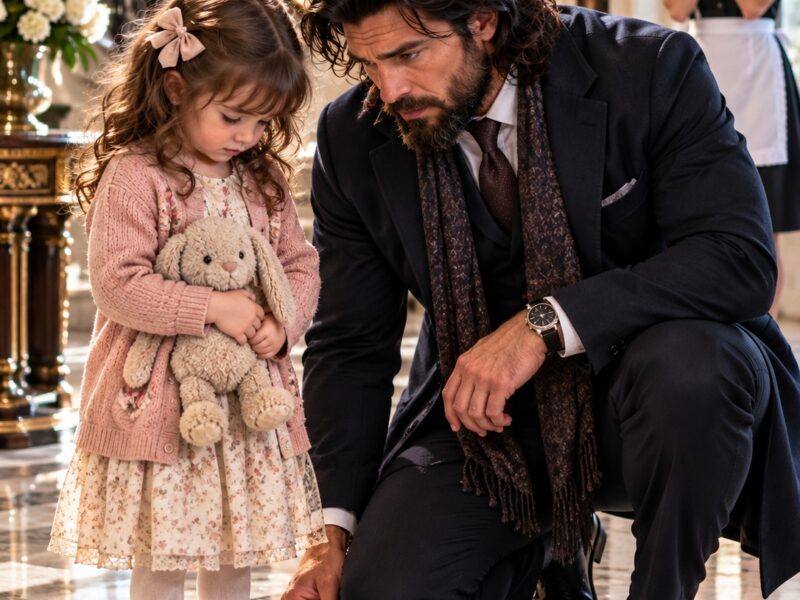
The feared man at the top of the staircase noticed everything—and by the next morning, forty employees were summoned to watch him kneel before a maid’s child for a reason no one understood.
But the shoes were only the first secret: Maria had been hiding a hospital bill, a crushing debt, and eight months of messages from someone who already knew exactly how to use her daughter against Antonio.
The first thing Maria Alvarez taught her daughter inside Antonio Marchetti’s house was how not to be noticed.
“Straight to the bathroom, Lucia. Straight back. Don’t touch anything, and don’t run.”
Lucia nodded with the solemn concentration only a four-year-old could bring to instructions she considered important. Her dark curls had been tied with a faded yellow ribbon, and beneath the hem of her inexpensive blue dress were the brown shoes Maria had spent three weeks pretending could survive another payday.
The left sole had separated from the leather at the toe.
Maria had glued it twice.
Then taped it.
Then pressed it flat beneath two cookbooks overnight and prayed pressure might accomplish what money could not.
It had not.
Every few steps, the sole lifted and slapped softly against the marble.
Lucia knew.
That was the part that hurt Maria most.
Instead of walking normally, the child curled her toes inside the shoe and shortened her steps. Whenever an adult approached, she tucked the damaged foot behind the good one as if poverty were a mistake she could hide by standing at the proper angle.
“Go on,” Maria whispered.
Lucia started down the corridor.
The Marchetti mansion occupied three acres outside Westchester, less a house than a private world behind iron gates and old cypress trees. Marble floors ran beneath ceilings painted before Maria’s grandparents were born. Cars with dark windows arrived after midnight, men in tailored coats waited outside Antonio’s study, and nobody on staff asked why meetings sometimes lasted until dawn.
Maria had worked there almost two years.
She had learned the rules quickly.
Do excellent work.
Speak only when necessary.
Never repeat what you overhear.
Never stare at visitors.
And when Don Antonio Marchetti entered a room, move aside before anyone had to ask.
Maria did not know precisely what he controlled.
Restaurants, freight companies, construction firms, warehouses, and properties carried names that never mentioned Marchetti. Newspapers sometimes called him a businessman. Other people lowered their voices and used less respectable words.
Maria needed the paycheck too badly to care which description was closer.
That morning she had another problem.
The neighborhood daycare had closed without warning at five-thirty. Its owner’s sister had suffered a medical emergency, leaving Maria in a kitchen apartment in the Bronx with a four-year-old, no backup sitter, and a shift beginning at seven.
Mrs. Pellegrino, the mansion’s cook, saved her.
“Bring the baby.”
“Antonio will fire me.”
“He will not know.”
“Everybody knows everything in that house.”
“Then everybody will know I told you to bring her.”
Lucia could be quiet.
Too quiet, sometimes.
Hospital waiting rooms had taught her that.
She sat beside the pantry for three hours coloring horses purple and houses green while Maria polished silver and helped prepare lunch.
At ten-fifteen Lucia whispered that she needed the bathroom.
Maria was stirring a stockpot she could not leave.
So she sent her alone.
The child passed two guards.
One barely glanced down.
A visitor in a gray suit crossed toward her, and Lucia flattened herself against the wall, hiding the damaged shoe behind her ankle.
Maria watched from the kitchen doorway.
Four years old.
Already embarrassed by something she had done nothing to cause.
Maria looked away before the feeling in her chest became visible.
That was why she did not see Antonio Marchetti standing at the top of the staircase.
He had been speaking quietly on his phone.
He stopped in the middle of a sentence.
Rocco Morelli, who had served as his security director for eleven years, later said Antonio simply lowered the phone and stared at the little girl crossing the marble floor.
Lucia disappeared into the bathroom.
Antonio remained.
The phone call ended.
When Lucia came back out, Antonio was waiting at the bottom of the stairs.
She froze.
Maria rounded the kitchen doorway and saw them.
Her entire body went cold.
Lucia looked up at a man who could make grown executives lose their place in prepared speeches.
Antonio was fifty-six, tall, silver beginning at his temples, his dark suit cut with the kind of simplicity that cost more than ornament. He had the stillness of somebody who rarely needed to repeat himself.
Lucia straightened.
“I’m sorry, sir.”
Antonio said nothing.
“I’m going back to the kitchen.”
His eyes lowered.
The loose sole hung from her shoe.
Lucia noticed where he was looking.
Slowly, almost instinctively, she slid the damaged foot behind the other one.
Something changed in Antonio’s face.
Not enough for Maria to name.
“What is your name?”
he asked.
“Lucia.”
“Lucia.”
He repeated it carefully.
Then:
“Go finish your coloring.”
She hurried past Maria.
Flap.
Flap.
Flap.
Each sound seemed louder now.
Maria remained beside the doorway.
“Mr. Marchetti, I’m sorry. The daycare closed and Mrs. Pellegrino said—”
Antonio walked past her.
No anger.
No warning.
No acknowledgment.
That frightened her more.
By six that evening Maria had convinced herself she was about to lose the best-paying job she had ever had.
She put on her coat.
Rocco appeared at the kitchen entrance.
“The boss wants you in the study.”
Maria’s stomach dropped.
“Now?”
“He said now.”
Rocco was six-foot-four and built like somebody had stacked two ordinary men together. He frightened strangers and slipped peppermints to Lucia whenever he thought Maria was not looking.
Tonight his face gave her nothing.
“What did I do?”
“I don’t know.”
“That’s not reassuring.”
“It wasn’t supposed to be.”
Maria walked through the west hall.
The mansion sounded different after the staff began leaving.
Rain tapped the tall windows.
A grandfather clock counted seconds.
She reached Antonio’s study.
Knocked.
“Come.”
He stood facing the window.
On his desk lay a folder.
Maria saw her name across the front.
MARIA ALVAREZ.
Her breath caught.
“Sit.”
She obeyed.
Antonio did not turn immediately.
The study smelled of leather, old paper, and cold cigar smoke even though Maria had never once seen him smoke.
Finally he faced her.
“Your daughter.”
Maria gripped her hands together.
“Yes, sir.”
“How old?”
“Four. Five in March.”
“Her father?”
The question startled her.
“Dead.”
“How long?”
“Almost four years.”
Antonio’s expression did not change.
“Is Lucia healthy?”
“Yes.”
The lie came too quickly.
Antonio heard it.
His eyes narrowed almost imperceptibly.
Maria looked down.
He could have asked again.
He did not.
“Thank you for bringing her today.”
Maria looked up.
“What?”
“You may go.”
“That’s all?”
“Yes.”
He never opened the folder.
Never mentioned the shoes.
Maria left more confused than when she entered.
The next morning, she did not know Rocco was parked across from her apartment building in an ordinary gray sedan.
She did not know Antonio had given him one instruction.
“Find out why the child’s shoes look like that.”
Rocco frowned.
“You want financial records?”
“No.”
“Then what?”
“Watch.”
“What am I watching for?”
Antonio looked at him.
“The thing she won’t tell me.”
Rocco discovered it in three days.
At six every morning Maria walked Lucia to Mrs. Vega, a widow downstairs who watched the child for twelve dollars a day.
Then Maria took two buses to the mansion.
Her shift ended at six.
But Maria did not go home.
She took another bus downtown to a commercial office building where she cleaned insurance offices until midnight.
The supervisor paid cash.
No employment paperwork.
No questions.
On the second night the final bus stopped running before Maria finished.
A cab would have cost eighteen dollars.
Maria walked six miles.
Rocco followed slowly from several blocks away.
She stopped twice.
Once on a bench.
Once beneath a streetlight because her shoe had rubbed her heel raw.
Dinner consisted of a piece of bread from her coat pocket.
Rocco called Antonio at one in the morning.
“She’s working sixteen hours.”
Silence.
“Every day?”
“Looks like.”
“What is she spending it on?”
“I’ll know.”
Thursday answered the question.
Maria left the mansion early with permission from Mrs. Pellegrino.
Rocco followed her to St. Agnes Children’s Hospital.
Pediatric cardiology.
Maria checked in at the billing office before seeing the doctor.
She pulled a white envelope from her purse.
The clerk counted the bills.
Wrote a receipt.
Maria asked something.
The woman shook her head.
Maria’s shoulders fell.
Then straightened again.
She walked upstairs.
Rocco did not follow.
He had learned enough.
He waited outside until Maria emerged ninety minutes later holding Lucia’s hand.
The child looked perfectly ordinary.
That somehow made it worse.
Rocco drove directly to the mansion.
Antonio listened without interrupting.
“Congenital heart defect.”
Rocco said.
“Small hole between two chambers. According to the billing clerk, surgery before six is strongly recommended.”
“How much?”
“Thirty-eight thousand.”
“How much has Maria paid?”
“Just over nine thousand.”
Antonio looked toward the window.
“Where did she get nine?”
“Second job.”
“Sold some things.”
“What things?”
Rocco hesitated.
“She went to a pawnshop after the hospital.”
Antonio turned.
“She sold her wedding ring.”
The room went quiet.
Rocco had seen Antonio hear bad news before.
Businesses collapsing.
Longtime employees betraying him.
Court orders.
Deaths.
His reactions rarely changed.
Now Antonio placed both hands on his desk.
Looked down.
When he finally spoke:
“What size shoe?”
Rocco blinked.
“What?”
“The girl.”
“I don’t know.”
Antonio looked up.
“Find out.”
Friday morning the mansion felt wrong the moment Maria entered.
Nobody was cooking.
Nobody was vacuuming.
Every staff member had been called to the great hall.
Gardeners.
Drivers.
Kitchen workers.
Housekeepers.
Security.
Forty-two people stood beneath the chandelier whispering.
Mrs. Pellegrino caught Maria’s eye.
“I know nothing.”
“What happened?”
“If I knew something, I would tell you I knew nothing.”
Antonio stood at the base of the staircase.
Beside him was an elderly Italian cobbler named Salvatore Greco, whose shop in Little Italy had made shoes for the Marchetti family for forty years.
Salvatore held three boxes.
And beside him—
Lucia.
Maria stopped breathing.
“Mama?”
Lucia whispered.
She wore her winter coat.
Her torn brown shoes.
Mrs. Vega must have allowed one of Antonio’s drivers to bring her.
Maria stepped forward.
“Mr. Marchetti, what is happening?”
Antonio raised one hand.
Not threatening.
Simply asking for patience.
He looked around the room.
“Everyone here?”
Rocco nodded.
Antonio walked toward Lucia.
Then did something nobody in that house had ever seen him do.
He lowered himself to one knee.
The room went silent.
“Lucia.”
“Yes, sir?”
“May I see your shoes?”
Lucia looked at Maria.
Maria could not speak.
The child slowly lifted one foot.
Antonio took it gently.
The loose sole opened.
Tape crossed the toe.
Old glue hardened along the seam.
The leather had been worn so thin that Lucia’s sock showed through one corner.
Antonio touched the patch with his thumb.
His voice changed.
“Someone worked very hard to keep these together.”
Lucia nodded.
“My mama.”
Antonio looked at Maria.
Only for a second.
Then back at the child.
“She did good work.”
Lucia smiled shyly.
“May I take them off?”
Another glance toward Maria.
Maria nodded.
Antonio removed the broken shoes.
Salvatore opened the first box.
Soft brown leather.
Practical.
Thick sole.
A little room for growing feet.
Lucia’s face brightened.
Antonio fitted them himself.
One foot.
Then the other.
He pressed gently at the toe.
“Too tight?”
“No.”
“Walk.”
Lucia crossed the marble.
No flap.
She turned.
Walked back.
Her smile grew.
Everyone watched.
Antonio stood.
“There will be a new rule in this house.”
His voice carried easily.
“No employee working under my roof will be afraid to tell the office their child needs shoes.”
Several people looked down.
“And no child will be ashamed of what her mother cannot buy while that mother is working sixteen hours to keep her alive.”
Maria’s face went cold.
How did he know?
Antonio turned toward her.
“The balance at St. Agnes has been paid.”
Maria stared.
“All of it.”
She shook her head.
“No.”
It came out automatically.
Antonio’s brows rose.
“No?”
“I can’t take thirty thousand dollars from you.”
“It is not thirty thousand.”
“That isn’t the point.”
“You work for me.”
“For wages.”
“Yes.”
“I did not ask you to pay my daughter’s surgery.”
“I know.”
“That makes it worse.”
A murmur moved through the staff.
Antonio’s expression remained controlled.
Maria could barely breathe.
“I’ve spent four years paying what I can.”
“I sold my ring yesterday.”
“You know that too?”
“Yes.”
Humiliation surged through her.
“You had someone follow me?”
Antonio did not lie.
“Yes.”
“Why?”
“I saw a child hide her foot.”
Maria looked at him.
He continued.
“I wanted to know what kind of problem makes a mother glue shoes together instead of replacing them.”
“That was not your business.”
“No.”
The answer surprised her.
Antonio glanced around the hall.
“Everyone back to work.”
Nobody moved quickly enough.
“Now.”
The hall emptied.
Rocco remained.
Salvatore quietly took Lucia toward the kitchen to show her the other pair.
Maria stood facing Antonio.
Angry.
Relieved.
Ashamed of being relieved.
“You should not have followed me.”
“No.”
“You should not have called the hospital.”
“No.”
“You should not have paid it.”
“That one I disagree with.”
“Why?”
Antonio looked toward the staircase.
For a moment he seemed to be seeing something else.
“When I was seven, my mother cleaned houses.”
Maria said nothing.
“I had one pair of shoes.”
“Cardboard inside because the soles were gone.”
“Every morning she replaced the newspaper before work.”
“One day a woman saw them and laughed.”
Maria’s anger faltered.
“She was not even cruel.”
Antonio continued.
“That was the part I remember.”
“She thought it was charming.”
“Something funny poor people did.”
He looked back at Maria.
“My mother kept scrubbing the floor.”
“But her hands stopped moving for several seconds.”
Antonio’s voice lowered.
“I promised myself no child near me would ever hide a shoe again.”
Maria swallowed.
“That still doesn’t make Lucia your responsibility.”
“No.”
“Then why?”
Antonio met her eyes.
“Because I can.”
“That is not always a good reason.”
A faint expression crossed his face.
Almost approval.
“No.”
“It isn’t.”
He stepped closer, though not enough to crowd her.
“So tell me a better arrangement.”
Maria was startled.
“What?”
“The hospital bill.”
“I won’t pretend it didn’t happen.”
“You will not repay me at sixteen-hour-day wages.”
“Then what?”
Maria thought.
“Take the amount out of whatever extra you have been paying me every month.”
Antonio went still.
She saw it.
“The envelope.”
Maria said.
“You know I noticed.”
“It is more than everybody else gets.”
“Why?”
Antonio looked toward Rocco.
Rocco looked at the floor.
Maria’s heartbeat changed.
“What aren’t you telling me?”
Antonio’s answer was careful.
“That conversation belongs to another day.”
“I’m asking today.”
“And I am saying not today.”
It was the first time she heard grief beneath his authority.
Before Maria could push further, Lucia ran back into the hall wearing her new brown shoes.
“Mama, look!”
Maria bent.
Lucia spun once.
Nearly fell.
Laughed.
Maria laughed too despite everything.
Antonio watched.
His face softened only when he believed nobody noticed.
Maria noticed.
That evening Lucia refused to remove the shoes until bedtime.
She placed them neatly beside the radiator.
Maria sat at the kitchen table in their apartment, looking at them.
Thirty-eight thousand dollars.
Paid.
Surgery possible.
For the first time since Lucia’s diagnosis, the number did not sit on Maria’s chest.
She should have felt free.
Instead her phone vibrated.
Unknown number.
She knew it anyway.
Heard Marchetti bought your girl shoes.
Second message.
Good. Means he trusts you.
Maria’s hand went cold.
Third.
Thursday. I need his route.
She turned the phone facedown.
There were secrets people kept from shame.
Others from fear.
Maria’s belonged to both.
Eight months earlier, the first message had seemed almost harmless.
Before Antonio Marchetti’s house, before the mansion paychecks, before Lucia’s surgery fund began growing, Maria had owed money to a man named Carlo DeLuca.
She had borrowed after her husband Paolo died.
Not from a bank.
Banks did not lend easily to a twenty-seven-year-old widow with an infant and no credit history.
DeLuca called himself a private lender.
He dressed well.
Spoke softly.
Never raised his voice.
That made his threats harder to explain.
The original loan had been seven thousand dollars.
Hospital expenses.
Rent.
Funeral.
Formula.
By the time Maria understood the terms, penalties had doubled it.
Then doubled parts of it again.
She worked.
Paid.
The number barely changed.
One afternoon DeLuca came to her apartment.
Lucia was two.
He sat politely at the kitchen table.
“There are other ways.”
Maria knew what that usually meant.
“No.”
He smiled.
“You misunderstand.”
“You work at the Marchetti house now.”
Maria stared.
“How do you know?”
“We know many things.”
“I need nothing important.”
“Just schedules.”
“Which nights there is dinner.”
“Which car leaves first.”
“When Mr. Marchetti travels.”
“Nothing dangerous.”
“No.”
DeLuca placed his phone on the table.
Photograph.
Lucia leaving Mrs. Vega’s building.
Maria stopped breathing.
DeLuca did not threaten the child.
He did not need to.
After that, Maria answered small questions.
Tuesday dinner.
Three cars Thursday.
Antonio in Boston until Saturday.
Rocco out sick.
The wine supplier arrived at four.
She told herself none of it mattered.
Nothing confidential.
Nothing that could hurt anyone.
Each message made the next easier to rationalize.
Until now.
Thursday. I need his route.
Maria looked at Lucia’s new shoes.
She remembered Antonio kneeling.
His fingers buckling each strap.
The slight tremor in his left hand he probably believed nobody had seen.
She looked at the phone.
Then typed:
No.
She did not send it.
Fear stopped her.
At six the next morning Maria left Lucia with Mrs. Vega.
Then went directly to Antonio’s mansion.
She bypassed the kitchen.
Walked toward the study.
Rocco stepped in front of her.
“Maria?”
“I need to see him.”
“He’s busy.”
“Please.”
Rocco studied her face.
Then opened the door.
Antonio stood at the window holding black coffee.
He turned.
Maria did not wait.
“I have been giving information about this house to a man named DeLuca for eight months.”
Rocco moved.
Antonio raised one hand.
Rocco stopped.
Maria continued before courage failed.
She told everything.
The loan.
The interest.
The photograph of Lucia.
The harmless questions.
The schedules.
Her excuses.
Last night’s message.
Thursday’s route.
When she finished, she was crying.
“I have not answered him.”
Antonio had not moved.
“I understand if I am fired.”
Nothing.
“If you want the police, call them.”
Still nothing.
“If there are consequences, I’ll take them.”
She wiped her face.
“But please keep them away from Lucia.”
Antonio placed his coffee down.
Walked to the desk.
Picked up the folder Maria had seen days earlier.
“Sit.”
She did.
He opened it.
First page.
Photocopy of the private loan agreement.
Her name.
Original amount.
Interest.
Second page.
Payment ledger.
Third.
Photographs of DeLuca.
Maria’s blood chilled.
“You knew.”
“Five months.”
She stared.
“You knew I was talking to him.”
“I knew he contacted you.”
“Rocco wanted you removed.”
Rocco did not deny it.
“Enzo wanted the same.”
Antonio continued.
“They were correct from a security perspective.”
“Why didn’t you?”
Antonio did not answer.
Maria looked at the folder.
“You watched me for five months.”
“Yes.”
“Why?”
“I wanted to know whether you were selling me or surviving.”
Maria recoiled.
“And what did you decide?”
“That survival can still hurt other people.”
His voice remained calm.
“What you did was wrong.”
Maria nodded.
“I know.”
“And you came here before giving him Thursday.”
“Yes.”
“That matters.”
“Not enough to erase it.”
“No.”
Antonio closed the folder.
“It does not erase it.”
Maria realized she preferred this answer to easy forgiveness.
“What happens now?”
Antonio walked toward a shelf.
Removed a framed photograph.
He set it before her.
Five men stood beside a black sedan.
One of them was young.
Smiling.
Maria stopped breathing.
Paolo.
Her husband.
The man she had buried four years earlier.
“No.”
Antonio remained silent.
“Where did you get this?”
“He worked for me.”
Maria stared.
“He drove for a transport company.”
“One of mine.”
“No.”
Her voice rose.
“He would have told me.”
“Paolo did not discuss work because I required discretion.”
“You knew him?”
Antonio’s face changed.
“For four years.”
Maria looked at her husband’s smile.
The room tilted.
“You knew him and you let me work here for two years without telling me?”
“Yes.”
“Why?”
Antonio drew a slow breath.
“Because I am a coward in very specific ways.”
Maria stared.
“I’m going to tell you how Paolo died.”
The rain began against the windows.
“And after I tell you, you decide whether you ever want to walk into this house again.”
Three years and eleven months earlier, Antonio had left a private meeting near the Hudson with Paolo driving.
Nobody outside a small inner circle knew the route.
An abandoned delivery truck blocked the roadway around a curve.
Not an accident.
A setup.
Paolo saw it first.
He reacted quickly.
Instead of driving into the blockage, he turned into a retaining barrier at an angle designed to absorb the impact away from Antonio’s side.
The car overturned.
Paolo was critically injured.
Antonio survived with a broken collarbone and concussion.
Maria had been told rain caused the crash.
“Why?”
she whispered.
“Why lie?”
“Because whoever arranged it was still inside my organization.”
Antonio said.
“Because police were already investigating my businesses.”
“Because telling you the truth would have placed you in danger.”
“And because I could not stand in front of a pregnant widow and say your husband died saving me.”
Maria covered her face.
“I attended the funeral.”
Antonio continued.
“Back row.”
“I saw you.”
“You had your hand on your stomach.”
“I did not know until then.”
Maria’s shoulders shook.
“When Lucia was born, I had Mrs. Pellegrino’s cousin recommend you for this job.”
“The cousin said she heard from a church woman.”
“No.”
“I told payroll to increase your salary quietly.”
“The monthly envelopes.”
“Yes.”
“You’ve been paying me because Paolo died for you.”
Antonio looked away.
“Yes.”
Rage arrived through grief.
Maria stood.
“You let me think I earned that.”
“You did earn your wages.”
“Not the extra.”
“No.”
“You watched me work sixteen-hour days while you hid money in envelopes like I was too stupid to know.”
“I did not know about the second job.”
“You knew my husband.”
“Yes.”
“You knew how he died.”
“Yes.”
“You knew Lucia was his daughter.”
“Yes.”
“And every morning you walked past me.”
Antonio absorbed each sentence.
“Yes.”
Maria slapped both palms onto the desk.
“I had the right to know.”
“Yes.”
“Stop agreeing!”
He flinched.
Barely.
But he did.
Maria stepped back.
Antonio’s voice became rough.
“I do not have a defense that makes it better.”
“I told myself secrecy protected you.”
“It also protected me from having to look at what Paolo gave up.”
Maria cried openly now.
“He had sweets in his coat the night before he died.”
Antonio closed his eyes.
“He always carried them.”
“For you?”
“For everybody.”
Maria laughed through tears.
“That sounds like him.”
Silence held them.
Finally:
“Who arranged the crash?”
Antonio looked at her.
“I don’t know.”
“After four years?”
“I know it was someone close.”
“Route changed twenty minutes before departure.”
“Six people knew.”
“Two are dead.”
“One left the country.”
“Rocco was with me the whole evening.”
“Enzo arranged the meeting but did not know the final route until afterward.”
“And the last?”
Antonio said nothing.
Maria knew the name before he spoke it.
“Carmine Bellandi.”
Antonio’s second-in-command.
Warm smile.
Sweets for the kitchen staff.
A man who had once crouched beside Lucia and called her princess.
Maria remembered DeLuca’s message timings.
Something clicked.
“Whenever Carmine comes here…”
Antonio looked up.
“What?”
“DeLuca contacts me.”
Maria’s pulse accelerated.
“The first time, Carmine had just left dinner.”
“Then the wine order.”
“Then when you traveled to Philadelphia.”
“Carmine had been in your study the afternoon before.”
Antonio went completely still.
“Every time?”
“Not every message.”
“But the important ones.”
Rocco swore softly.
Antonio looked toward the window.
He had suspected Bellandi.
Maria could see that.
Suspicion hurt differently once another person said it aloud.
“What do we do?”
she asked.
Antonio turned.
“You do nothing.”
“No.”
He looked at her.
“I helped create this.”
“You were coerced.”
“I still did it.”
“You have Lucia.”
“That is exactly why.”
Maria’s voice strengthened.
“I am tired of men making choices because they think mothers can only be protected.”
Antonio stared.
The sentence found its target.
Maria continued.
“If Carmine is using DeLuca, he already sees me as weak.”
“Let him.”
Rocco shook his head.
“Boss—”
Antonio looked at Maria.
“You understand what you are asking?”
“Yes.”
“No.”
He stepped closer.
“You understand that if he suspects you told me, he may increase pressure.”
Maria swallowed.
“Yes.”
“And you still want to help?”
“I want it finished.”
Antonio studied her for a long time.
Then:
“Tomorrow night Carmine comes for dinner.”
Maria’s stomach tightened.
“You will serve him exactly as always.”
“If he asks whether DeLuca received Thursday’s route…”
Antonio paused.
“Tell him yes.”
Carmine arrived at seven.
Dark overcoat.
Easy smile.
Box of pastries for Mrs. Pellegrino.
He greeted Rocco.
Kissed Antonio on both cheeks.
Asked Maria whether Lucia liked her new shoes.
The dining room glowed with warm light.
Rain traced silver down the windows.
Maria poured wine.
Her hands did not shake.
That frightened her.
Antonio and Carmine discussed football.
A warehouse lease.
Someone’s daughter’s engagement.
Nothing dangerous.
Nothing revealing.
Then dessert arrived.
Carmine looked at Maria.
“How is the little princess?”
“Good, sir.”
“I hear she received a fine present.”
Maria smiled carefully.
“She loves them.”
“And Thursday?”
The question was casual.
Antonio continued cutting his pastry.
Maria looked at Carmine.
“I sent what was requested.”
A pause.
Less than a second.
Then Carmine smiled.
“Good girl.”
Antonio’s fork stopped.
Maria felt something cold in her chest.
Her phone vibrated inside her apron.
Once.
Twice.
Three times.
Mrs. Vega.
Maria excused herself.
Hallway.
Answered.
“Maria?”
Mrs. Vega sounded breathless.
“A man came.”
Maria’s body went numb.
“What man?”
“He had paperwork.”
“Said you sent him.”
“He knew Lucia’s full name.”
“He said the hospital moved her pre-surgical appointment.”
Maria gripped the wall.
“Where is she?”
Silence.
“Oh God.”
Mrs. Vega whispered.
“I let her go.”
Maria could not breathe.
Behind her, a chair scraped.
Carmine stood inside the dining room.
Phone in hand.
On its screen was a photograph.
Lucia.
Sitting in the backseat of a sedan.
White shoes visible.
Holding a juice box.
Maria crossed the room before she understood she was moving.
“Where is my daughter?”
Rocco caught her shoulders—not hurting, simply stopping her from reaching Carmine.
Antonio stood.
No shouting.
No visible panic.
That was more frightening than rage.
Carmine sighed.
“I did not want things to become unpleasant.”
Antonio’s voice was flat.
“You took a child.”
“Borrowed.”
“She is comfortable.”
“She is not your child.”
“No.”
Carmine looked almost regretful.
“But she is useful.”
Maria made a sound.
Antonio raised one hand toward her.
“Maria.”
She looked at him.
His face told her one thing.
Stay with me.
She forced herself still.
Carmine sat again.
“Fifteen years.”
he said.
“I ran your docks for fifteen years.”
“I negotiated strikes.”
“I fixed customs disasters.”
“I kept half this city moving when your father died.”
“And I remain the man who waits outside while you make the final decisions.”
Antonio looked at him.
“You wanted the port.”
“I earned the port.”
“Then why not ask?”
Carmine laughed.
“I did.”
“For eight years.”
“You said someday.”
“Someday is how powerful men say never.”
There it was.
Not simple greed.
Humiliation fermented into entitlement.
Carmine continued.
“The council thinks the port needs new leadership.”
“You are too cautious.”
“Too sentimental.”
He glanced at Maria.
“Clearly.”
Antonio’s eyes hardened.
“What are your terms?”
“Transfer controlling interest in the dock company, Pier Nine warehouses, and routing contracts.”
“You sign tomorrow.”
“Neutral attorney.”
“Council witness.”
“Once filings are submitted, Lucia comes home.”
Maria stared at him.
“And my debt?”
“Gone.”
“You arranged DeLuca.”
Carmine smiled faintly.
“He finds vulnerable people.”
“You were convenient.”
Maria felt physically sick.
Antonio spoke.
“Did you arrange Route Nine?”
Carmine’s smile disappeared.
“That is not tonight’s conversation.”
Antonio’s silence answered more than words.
Carmine stood.
“Tomorrow.”
He adjusted his coat.
“No tricks.”
“No disappearing to another city.”
“No games.”
“If you refuse, Lucia remains somewhere you cannot reach before her surgery.”
He looked at Maria.
“I am not cruel.”
“She has food.”
“Warm room.”
“Someone watching her.”
Maria shook with fury.
“You took a four-year-old from her home.”
“And your eight months of information helped me understand exactly how.”
Carmine left.
Nobody stopped him.
The front door closed.
Rocco turned on Antonio.
“Let me find her.”
“No.”
“We can search every property he has.”
“He knows you will.”
“We have people.”
“He planned for our people.”
Rocco paced.
Antonio looked at Maria.
“Sit.”
“I cannot sit.”
“You will fall.”
“I don’t care.”
“I do.”
She looked at him.
He seemed suddenly older.
“I’m bringing her home.”
“You don’t know where she is.”
“No.”
“Then how?”
“I sign.”
The room froze.
Rocco turned.
“Boss.”
Antonio ignored him.
Maria stared.
“The port?”
“Yes.”
“The warehouses?”
“Yes.”
“Your father built those.”
“Yes.”
“You’ll lose half your business.”
“More.”
“Then no.”
Antonio’s expression sharpened.
“Maria.”
“No.”
“I will not let Lucia grow up knowing you gave away your life because of mine.”
Antonio’s voice softened.
“She will grow up.”
The words stopped her.
“That is enough.”
Enzo Ferrara, Antonio’s oldest adviser, had been silent near the doorway.
Now he stepped forward.
“Antonio, if you surrender the port, the council will see weakness.”
“I know.”
“Other partners may leave.”
“I know.”
“Banks may freeze lines.”
“I know.”
“Then you may lose the legitimate side too.”
Antonio looked at him.
“For thirty years I have built things I was terrified to lose.”
“Last week I watched a four-year-old hide her shoe because she was ashamed.”
He looked toward Maria.
“Paolo gave up his life to save mine.”
“I can surrender property to protect his daughter.”
Maria’s throat tightened.
“Do not call it repayment.”
Antonio looked at her.
“Why?”
“Because then Lucia becomes another debt.”
Silence.
Maria stepped closer.
“Save her because she matters.”
“Not because Paolo died.”
“Not because you feel guilty.”
“Not because I owe you.”
“Because she matters.”
Antonio held her eyes.
Then nodded once.
“Because she matters.”
Enzo looked between them.
Then sighed.
“If you are both finished becoming moral philosophers while a child is missing…”
Antonio almost smiled.
Enzo continued.
“Carmine requested a council witness.”
“Yes.”
“Good.”
Antonio turned.
“Why good?”
“Because he wants legitimacy.”
Enzo’s eyes sharpened.
“He wants the transfer blessed by the elders.”
“If we refuse the transfer, we lose Lucia.”
“If we accept, he must justify why the council should recognize it.”
Antonio understood.
“You think he will talk.”
“Men like Carmine always talk when they believe they have won.”
Maria looked between them.
“What does that mean?”
Enzo answered.
“We let him win.”
Antonio signed the transfer papers the next evening at an abandoned cannery office on Pier Nine.
There were no weapons.
No armed standoff.
Carmine wanted something more valuable than violence.
Legitimacy.
A council-recognized corporate transfer.
His attorney sat at one end of the metal table.
A notary at the other.
Two council representatives attended by secure audio connection, their presence known only to Enzo and Antonio.
Carmine believed one elder had joined solely to witness the paperwork.
He did not know five were listening.
Lucia sat in an office behind a glass partition.
Blanket around her shoulders.
Juice box in both hands.
One white shoe swinging.
Maria watched remotely from a car at the far end of the pier with Rocco.
She hated every second.
Antonio read every page.
Initialed every required box.
Signed his name.
The dock company.
Warehouses.
Two routing corporations.
Twenty-eight years of expansion reduced to ink.
Carmine smiled.
“You actually did it.”
Antonio capped the pen.
“Where is the child?”
Carmine leaned back.
“You never understood your weakness.”
Antonio looked at him.
“What weakness?”
“Loyalty.”
“You reward people long after they’re useful.”
“You kept Paolo’s widow on your payroll.”
“You protected her after she betrayed you.”
“You paid for a child’s surgery.”
“Your father would have called that softness.”
Antonio’s face did not change.
“Maybe.”
Carmine laughed.
“That is why I should run the docks.”
“You tried to replace me four years ago.”
Silence.
Antonio continued.
“Route Nine.”
Carmine’s eyes shifted.
“Paolo’s death.”
The smile disappeared.
Antonio leaned back.
“Was it you?”
Carmine could have denied it.
Instead victory betrayed him.
“It was supposed to be you.”
Maria heard the words through the live audio feed.
Her hand flew to her mouth.
Rocco looked down.
Carmine continued.
“Paolo changed direction.”
“Nobody expected that.”
“He was loyal to a fault.”
Antonio’s voice lowered.
“And DeLuca?”
“My idea.”
“Widow in debt.”
“Employee in your house.”
“Perfect pressure point.”
Carmine shrugged.
“Everyone has a price.”
Maria’s eyes closed.
Antonio said:
“You’re wrong.”
Carmine smiled.
“Look at the signed papers.”
Antonio looked toward the small conference phone sitting among the documents.
Then:
“Don Salvador?”
Carmine’s expression changed.
A voice came from the speaker.
Old.
Measured.
“Enough.”
Carmine went pale.
Another voice joined.
Then another.
Five elders.
All listening.
Salvador Greco spoke.
“You asked the council to recognize this transfer.”
“Yes.”
Carmine swallowed.
“Then the council must understand how you obtained it.”
“This is not—”
“You exploited the widow of a man who served the organization.”
“You threatened her child.”
“No.”
“I never threatened—”
“You removed a four-year-old through deception to force corporate transfer.”
Carmine looked toward Antonio.
Realization settled.
The victory had been bait.
The documents were signed but not yet filed.
The council had authority under the companies’ shareholder agreements to refuse recognition where coercion invalidated consent.
Antonio had surrendered enough to prove he would.
Enzo had built the legal trap around Carmine’s need to brag.
Salvador continued.
“The transfer is rejected.”
Carmine stood.
“You cannot—”
“We can.”
“Your executive authority is suspended pending review.”
“Company counsel has already been notified.”
“The evidence goes to civil counsel and law enforcement concerning the child.”
Carmine’s voice changed.
“You would hand internal business to police?”
Salvador answered.
“You involved a child.”
“That stopped being internal.”
Carmine looked at Antonio.
“You planned this.”
“No.”
Antonio’s voice was quiet.
“I planned to lose.”
“Enzo planned the rest.”
That truth mattered.
Antonio had not gambled Lucia’s safety on a clever trick.
He had signed genuinely.
Prepared to surrender genuinely.
The trap came afterward.
Carmine looked through the partition.
At Lucia.
For the first time, his certainty failed.
Antonio stood.
“Is she free to leave?”
Carmine said nothing.
His attorney answered.
“Yes.”
Antonio opened the office door.
Lucia looked up.
“Mr. Antonio?”
He crouched.
“Your mama is waiting.”
She stood.
Then looked down.
One white shoe was missing.
“What happened?”
Lucia pointed under the desk.
“It fell.”
Antonio reached beneath.
Found it.
He placed the shoe before her.
“May I?”
She nodded.
He fitted it.
Fastened the small strap.
The same way he had in the great hall.
Then took her hand.
Outside, Maria saw them through the rain.
She ran.
Lucia let go of Antonio and ran toward her.
“Mama!”
Maria dropped to her knees.
Caught her.
Held her so tightly Lucia complained.
“You’re squishing me.”
“I know.”
“Can I keep the juice?”
Maria laughed and cried.
“Yes.”
Antonio stood several yards away.
Rain soaked his coat.
Maria looked at him.
Then at Lucia.
Then back.
“You signed everything.”
“Yes.”
“You were really going to give it up.”
“Yes.”
“Even if Enzo’s plan failed.”
“Yes.”
Maria stood.
“I don’t know what I owe you.”
Antonio shook his head.
“Nothing.”
“Paolo—”
“Nothing.”
“Lucia—”
“Nothing.”
He looked at the little girl in white shoes.
“The debt was mine.”
Maria wiped her face.
“No.”
Antonio frowned.
She stepped closer.
“If you keep calling love a debt, you will spend your whole life trying to pay people instead of letting them matter.”
Antonio went still.
Perhaps nobody had ever spoken to him that way.
Maria continued.
“Paolo chose what he did.”
“You chose tonight.”
“I chose to confess.”
“We are done with debts.”
A long silence.
Then Antonio nodded.
“Done.”
Carmine’s consequences arrived without spectacle.
His authority within the companies was terminated.
The attempted transfer was voided under counsel’s coercion finding and board vote.
Corporate records, loan ledgers, communications with DeLuca, and evidence connected to Lucia’s deceptive removal went to attorneys and investigators.
DeLuca’s lending operation was shut down after several borrowers produced similar contracts.
Civil claims followed.
Maria’s debt was declared unenforceable under state lending laws because the effective interest and coercive collection practices violated multiple regulations.
She insisted Antonio’s lawyers explain every page before she signed anything.
They did.
Carmine’s name disappeared from the mansion not because anybody mysteriously erased him, but because there was nothing left there that belonged to him.
Office emptied.
Company access revoked.
Portrait removed from a charity board.
Men who once laughed at his jokes stopped calling.
The council offered Antonio his original dock control back in full.
He surprised them.
“No.”
Enzo stared.
“You fought to keep it.”
“I fought to keep Carmine from taking it through a child.”
“That is different.”
Antonio retained a minority stake long enough to secure employee contracts and pension obligations, then sold most operational control to a legitimate logistics group.
He kept restaurants.
Commercial properties.
A construction firm his mother had once helped clean before he owned it.
Fewer dark cars arrived at night.
Fewer meetings ended at dawn.
The house changed.
Rocco complained that peace was ruining his professional reputation.
Mrs. Pellegrino told him to wash dishes.
Lucia’s heart surgery took place twelve days later.
Maria spent nine hours inside a waiting room she knew too well.
Antonio came at noon.
Plain coat.
No entourage.
He carried lemon cookies.
Maria looked up.
“You don’t have to stay.”
“I know.”
He sat.
That answer mattered.
For six hours he stayed.
Sometimes Maria talked.
Sometimes neither did.
At four, Maria realized Antonio was rubbing his thumb along one knuckle repeatedly.
“You’re nervous.”
“No.”
“You’re terrible at lying.”
“I employ people for that.”
She laughed for the first time that day.
The surgeon appeared after six.
Green scrubs.
Tired eyes.
Smile.
“The repair went beautifully.”
Maria stood.
Then sat immediately because her knees failed.
The doctor continued.
“Closure is clean.”
“Her pressures look good.”
“She’ll spend tonight in pediatric intensive care.”
“But her heart is strong.”
Maria covered her face.
Antonio looked away.
Giving grief privacy had once been how he lived.
Now he stayed close enough that when Maria reached blindly for somebody’s hand, his was there.
Lucia woke the next morning.
First question:
“Where are my shoes?”
Maria laughed.
“In the closet.”
Second:
“Where’s Mr. Antonio?”
Maria looked toward the doorway.
Antonio stood there holding the lemon-cookie bag.
Lucia smiled.
“You came.”
“Yes.”
“Why?”
Antonio seemed genuinely confused.
“You asked.”
Lucia considered that sufficient.
He visited every afternoon for a week.
No expensive gifts.
No flowers that filled the room.
Cookies.
A coloring book once.
Mostly time.
Lucia explained cartoon characters he did not understand.
She drew him with purple hair.
Antonio kept the drawing in his study.
Maria returned to work after Lucia recovered, but not under the same arrangement.
Before her first day back, she entered Antonio’s study carrying a typed page.
He looked at it.
“What is this?”
“My terms.”
His eyebrows rose.
Maria sat without being told.
“No more secret salary.”
“Fine.”
“Same rate as senior household staff.”
“No.”
She frowned.
“Why no?”
“You supervise three rooms now and handle vendor accounts.”
“That job pays more.”
Maria stopped.
“Then put that in writing.”
He almost smiled.
“Done.”
“No more following me without telling me unless you have actual evidence of danger.”
“That one is difficult.”
“Then be difficult somewhere else.”
Rocco coughed outside the door.
Antonio looked toward him.
“You enjoying this?”
“Very much.”
Antonio returned to Maria.
“Agreed.”
“Lucia can come if childcare fails.”
Antonio nodded.
“Mrs. Pellegrino already created a drawer of crayons.”
“Of course she did.”
“One more thing.”
Maria looked at him.
“Stop asking accountants to create accounts in Lucia’s name.”
Antonio went still.
“How did you—”
“The hospital clerk mentioned somebody asked about an education trust.”
“It was meant for later.”
“No.”
“Paolo would have—”
“Paolo is not here to tell you.”
Antonio leaned back.
Maria held his eyes.
“If you want to help her someday, ask me first.”
Silence.
Then:
“You are exhausting.”
“So I have been told.”
“Agreed.”
That was the beginning of trust rather than gratitude.
Months passed.
Antonio did not become a different man overnight.
He still ran businesses with intimidating efficiency.
People still straightened when he entered rooms.
He still sometimes confused providing with caring.
Maria corrected him.
Once he sent a car for her because snow was expected.
She called.
“Did I ask for a driver?”
“No.”
“Then why is Rocco outside my apartment?”
“Because weather reports predict six inches.”
“I own boots.”
“Maria.”
“Antonio.”
He sent Rocco home.
Thirty minutes later Maria called again.
“The buses stopped.”
Antonio waited.
“Yes?”
“Can you send Rocco back?”
A pause.
Then Antonio said:
“I’m going to enjoy this.”
“Do not.”
“I already am.”
The first time Maria saw Antonio somewhere ordinary was Lucia’s preschool spring performance.
He sat in the last row.
No suit.
Dark sweater.
One security man outside, at Maria’s insistence.
Lucia wore paper butterfly wings.
Forgot half her line.
Waved directly at Antonio from the stage.
He looked behind himself, genuinely believing she meant somebody else.
Maria laughed.
“She means you.”
Antonio raised one hand awkwardly.
Lucia beamed.
Afterward he gave her one flower from a bouquet Mrs. Pellegrino had purchased.
Not the whole bouquet.
One.
He was learning.
The second intimate moment came months later in the mansion kitchen after midnight.
Maria had stayed to help Mrs. Pellegrino prepare food for a charity event.
Antonio came downstairs.
Tie loosened.
Sleeves rolled.
He opened the refrigerator.
Maria stared.
“What are you doing?”
“Looking for food.”
“You own the house.”
“Yes.”
“You don’t know where food is?”
“I know conceptually.”
She laughed.
Antonio looked offended.
Maria made him a grilled cheese sandwich.
He sat at the kitchen table.
No marble hall.
No guards.
No hierarchy except habit.
Antonio ate.
“Good.”
“It’s bread and cheese.”
“Still good.”
Maria poured coffee.
“You really grew up poor?”
He nodded.
“Brooklyn.”
“Two rooms.”
“Mother cleaned houses.”
“Father gone before I remember him.”
“How did this happen?”
Maria gestured toward the mansion.
Antonio looked around.
“Slowly.”
“That is not an answer.”
“Restaurants first.”
“Distribution.”
“Construction.”
“People who were impressed by competence.”
“People who were frightened by reputation.”
“And eventually I stopped asking which one was doing more work.”
Maria studied him.
“Do you regret it?”
“Parts.”
“Which parts?”
Antonio looked at her.
“The parts that made good people afraid to tell me the truth.”
The words carried more than business.
Maria felt it.
She changed the subject because neither was ready for what sat underneath.
The third quiet moment came near Paolo’s grave.
Maria visited every year on the anniversary.
She had never told Antonio.
That year she found him standing several rows away.
No flowers.
Just a dark coat.
Maria stopped.
“You come here?”
“Every year.”
“For four years?”
“Yes.”
“Why didn’t I see you?”
“I stayed far away.”
Maria looked toward Paolo’s stone.
“That sounds like you.”
“Yes.”
They stood together.
After several minutes Maria said:
“I was angry at him for months after he died.”
Antonio looked surprised.
“For dying?”
“For working a job he wouldn’t explain.”
“For leaving me with bills.”
“For making me miss him.”
She smiled sadly.
“Grief isn’t noble.”
“No.”
Antonio looked at the stone.
“I was angry too.”
“At him?”
“At myself.”
“At whoever arranged it.”
“At Paolo for choosing me over himself.”
“That one took years to admit.”
Maria looked at him.
“You know he would hate that.”
“What?”
“You treating his choice like a debt.”
Antonio nodded.
“I know now.”
They left together.
No declarations.
No touch.
But something had shifted.
A year after Lucia’s surgery, Antonio asked Maria to dinner.
Not at the mansion.
Not at one of his restaurants.
A small Italian place in Queens where nobody recognized him for almost twenty minutes.
Maria sat across from him.
“You look uncomfortable.”
“There is a man at the next table who keeps bumping my chair.”
“That’s called a restaurant.”
“I own restaurants with appropriate spacing.”
“Tonight you own nothing.”
Antonio looked at her.
Maria realized what she said.
He smiled.
“Apparently.”
Dinner went well.
Then badly.
Then well again.
They argued about Lucia’s school because Antonio suggested a private academy.
Maria accused him of trying to buy solutions.
Antonio accused her of rejecting good options simply because he could afford them.
Both were partly right.
They walked two blocks in cold air afterward.
Maria said:
“I don’t want her growing up believing expensive automatically means better.”
Antonio nodded.
“I don’t want her options limited because you’re afraid of owing me.”
Maria stopped.
“That was unfair.”
“Yes.”
“But true.”
“Also yes.”
He turned.
“Can we be wrong in alternating shifts?”
Maria laughed.
“Maybe.”
Antonio looked at her for a long time.
Then:
“I care about you.”
Maria’s smile faded.
“I know.”
“That was not a confession designed to require an answer.”
“Good.”
“I would like to see where this goes.”
Maria looked toward traffic.
“I don’t want Lucia confused.”
“Neither do I.”
“I don’t want gratitude mistaken for love.”
“Neither do I.”
“I don’t want Paolo turned into a bridge between us.”
Antonio’s face softened.
“Neither do I.”
Maria finally looked at him.
“Then slowly.”
“Slowly.”
Six months later she kissed him first.
That mattered.
It happened in the kitchen.
Not under chandeliers.
Antonio had repaired a loose cabinet hinge badly.
Maria told him so.
He claimed woodworking was beneath his expertise.
She told him arrogance did not tighten screws.
They laughed.
Then silence.
Maria stepped closer.
Kissed him.
Briefly.
Antonio did not touch her until she reached for his hand.
“Slowly.”
he murmured.
“Very.”
Years passed differently after that.
Not fairy-tale differently.
Lucia occasionally resented Antonio’s presence.
At eight she asked Maria:
“Is he trying to be my dad?”
Maria answered:
“No.”
Antonio, who overheard from the doorway, added:
“I am trying to be Antonio.”
Lucia considered.
“You’re good at that.”
“Thank you.”
“Sometimes too good.”
Rocco nearly fell over laughing.
Antonio never adopted Lucia legally.
She had a father.
Paolo Alvarez.
They kept photographs.
Stories.
His name.
But Antonio attended school meetings.
Waited outside dance practice.
Learned enough about pediatric cardiology to annoy doctors with informed questions.
When Lucia was twelve, she discovered the truth about her father’s death.
Maria told her.
Not Antonio.
No secrets disguised as protection.
Lucia cried.
Then refused to speak to Antonio for three days.
He accepted it.
On the fourth, she found him in the library.
“You knew him.”
“Yes.”
“You lied to Mama.”
“Yes.”
“He died because of you.”
Antonio looked at her.
“He died protecting me from people who intended to hurt me.”
“That is not the same sentence.”
“No.”
Lucia’s eyes filled.
“Do you wish it had been you?”
Maria, standing outside the partly open door, stopped breathing.
Antonio answered without hesitation.
“Many times.”
Lucia looked shocked.
Antonio continued.
“But wishing that would make your father’s choice meaningless.”
“I don’t get to insult what he chose because living with it hurt me.”
Lucia cried then.
Antonio did not approach.
She came to him.
Sat beside him.
Not forgiveness completed.
Beginning.
By sixteen Lucia wanted to become a physician.
Cardiology.
Maria blamed the hospital years.
Antonio blamed stubborn genetics.
Lucia blamed both of them.
She worked hard.
Not because Antonio could buy tuition.
He could.
But Lucia applied for scholarships anyway.
When she received one, Antonio pretended not to be proud enough to frame the email.
Maria caught him printing it.
“I thought we stopped secretly solving things.”
“I am documenting.”
“You are ridiculous.”
“Yes.”
On Lucia’s first day of university, Antonio was seventy-one.
Hair white.
Step slower.
Still capable of silencing a room by entering it, though fewer rooms needed silencing now.
The mansion had changed.
Less business.
More sunlight.
Half the west wing converted into offices for a legitimate family foundation that funded pediatric medical care and debt counseling.
Maria insisted the foundation operate independently.
Antonio agreed.
Mostly.
They argued about budgets.
That seemed healthier.
Lucia came downstairs carrying two bags.
“I’m late.”
Maria kissed her.
“Eat.”
“No time.”
“Apple.”
Lucia took it.
Antonio waited near the front door holding a small brown box.
“What is that?”
Lucia asked.
“A gift.”
Maria gave him a look.
“A small one.”
he clarified.
Lucia opened it.
Inside was a single brown shoe.
Tiny.
Old.
Leather cracked.
Cardboard patch beneath the sole.
Lucia frowned.
“This isn’t mine.”
“No.”
Antonio said.
“It was mine.”
Maria understood immediately.
Antonio had kept almost nothing from childhood.
He took the shoe gently.
“When I was your age—smaller—I used to walk along the outside edges of my feet so people wouldn’t hear the holes.”
Lucia stared.
“That is why you noticed mine?”
“Yes.”
He handed it back.
“I almost didn’t give this to you.”
“Why now?”
“Because hospitals will bring you people who look fine.”
“Some will speak loudly.”
“Some will hide.”
“Some will wear good clothes and still be terrified.”
“Some will have broken shoes.”
He looked at her.
“Look closely.”
Lucia held the shoe against her chest.
Then hugged him.
Antonio froze the way he always did for the first second of unexpected affection.
Then his arms closed around her.
Maria watched.
Paolo’s daughter.
Antonio’s grief.
Her own terrible debt.
A pair of torn shoes.
All the things that once seemed like evidence of failure had become something else.
Not destiny.
Choices.
Lucia pulled away.
“You’re crying.”
Antonio straightened.
“No.”
“You absolutely are.”
“Your mother makes the same accusation.”
“Because we have eyes.”
“Go to school.”
Lucia laughed.
Then ran down the marble corridor.
Full speed.
Her footsteps echoed.
Years earlier, Maria had taught her daughter to move quietly in that house.
Do not run.
Do not attract attention.
Do not let powerful people notice what is broken.
Now Lucia’s shoes struck the marble loudly enough to be heard from the kitchen.
Rocco, retired but visiting for breakfast, called:
“Slow down!”
Lucia shouted back:
“I’m late!”
Nobody hushed her.
Maria stood beneath the staircase.
Antonio beside her.
The morning sun crossed the floor in long gold bars.
She remembered a four-year-old hiding one torn shoe behind the other.
Remembered the feared man above the stairs noticing.
Remembered believing attention was always dangerous.
Antonio looked toward the open door.
“She forgot her coat.”
Maria smiled.
“She’ll come back.”
“How do you know?”
“Because now she knows she can.”
Outside, Lucia’s laughter carried up the drive.
And this time, she never tried to walk quietly.









