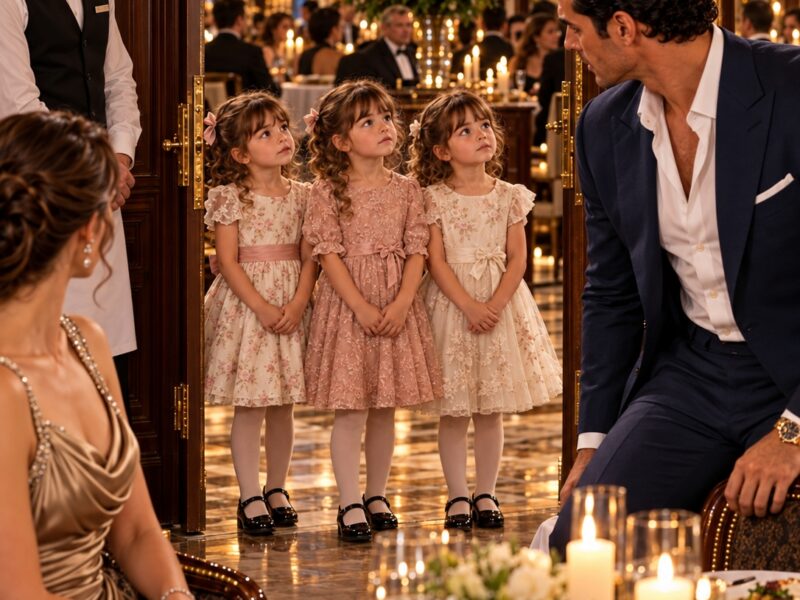
Mafia Boss Was About to Leave His Date… When Triplet Girls Walked In: “Our Mom Is Sorry She’s Late.”
Nico Valente was already reaching for the door when three little girls appeared beside his car carrying cookies, a handwritten questionnaire, and an apology from the woman who had stood him up.
They were not lost, and they were not asking for money—they had come to decide whether the feared Philadelphia businessman waiting for their mother was safe enough to let into their lives.
Then the youngest girl asked him one question about truth, and Nico gave an answer he would later have to risk everything to keep.
The Three Girls at the Window
Nico Valente had spent most of his adult life making other people wait.
That was why twenty-three minutes alone in the back of a black sedan felt less like inconvenience and more like an insult the universe had arranged specifically for him. Winter had settled hard over Philadelphia, crusting the curb beside the Schuylkill with old snow while headlights dragged pale ribbons across wet asphalt. Beyond the tinted glass, the Riverside Conservatory glowed against the darkness, its greenhouse windows reflecting the city in fractured gold.
Inside, a restaurant table for two waited beneath climbing vines and warm pendant lights.
The woman who had agreed to meet him did not.
Nico checked his watch.
Again.
His friend Elise Carter had spent a month insisting he meet Mara Bennett.
“She’s smart,” Elise had said.
“So are my attorneys.”
“She’s funny.”
“I pay people not to be.”
“She owns a floral studio.”
“That is not an argument.”
“She has three daughters.”
That had ended the conversation for two days.
Nico was forty-one, unmarried, childless, and entirely comfortable telling himself those facts reflected preference rather than design. He owned legitimate warehouses, trucking companies, commercial buildings, and restaurants. He also controlled a quieter structure inherited from his father—one built on old loyalties, protection agreements, influence, and men who understood that certain requests were not really requests.
Dating did not fit easily inside that structure.
Neither did children.
His phone lit.
Rafe Mercer.
Bellini’s people had been seen near Pier Twenty-Seven.
A second message followed.
Cancel dinner. We need you.
Nico’s thumb hovered above the screen.
Yes would be sensible.
Yes was familiar.
Yes was the answer the man he had been for twenty years gave before anybody could expect something personal from him.
He reached for the door handle.
Then three small knocks tapped against the rear passenger window.
Nico turned.
Three girls stood beside the sedan.
The oldest looked eight.
Navy coat buttoned to her chin.
Dark hair pulled into two practical braids.
Serious brown eyes.
Beside her stood a girl perhaps six, wearing a red knit hat with one pom-pom leaning sideways and holding a paper bag against her stomach.
The youngest could not have been more than five.
One mitten.
One bare hand.
She stared through the glass at Nico with the solemn concentration of a child examining something potentially dangerous at a zoo.
For several seconds, Nico stared back.
The oldest knocked again.
He lowered the window two inches.
Cold air slipped inside.
“Are you Nico?”
Her voice was cautious but remarkably authoritative.
Nico looked at the other two.
“Who’s asking?”
The middle girl leaned toward the opening.
“That means yes.”
The oldest frowned at her.
“Lucy.”
“What?”
“You’re supposed to let me talk first.”
Nico’s mouth nearly moved.
He stopped it.
The oldest returned her attention to him.
“Are you Nico Valente?”
There were men twice her size who avoided saying his full name without permission.
“Yes.”
The girl released a breath.
Turned to her sisters.
“Okay.”
“We found him.”
The middle girl—Lucy—lifted the paper bag.
“We brought cookies.”
Nico looked past them.
No frantic parent.
No adult running toward the curb.
No one appeared remotely concerned that three children were interrogating a stranger through a car window.
“Where is your mother?”
The oldest straightened.
“That’s complicated.”
“Grace,” Lucy whispered loudly, “you said we weren’t supposed to start with the complicated part.”
“I know what I said.”
The youngest remained silent.
Nico lowered the window completely.
“Start with the uncomplicated part.”
Grace nodded.
“Our mom is Mara Bennett.”
Nico became very still.
His blind date.
Lucy looked triumphant.
“He knows her.”
“I do not know her.”
“Not yet.”
Grace corrected.
“But you were supposed to meet her tonight.”
Nico checked his watch.
“And Miss Bennett is where?”
Grace’s expression shifted from official to apologetic.
“At work.”
“Still,” Lucy added.
“A flower arch broke.”
“It was very expensive.”
“It fell on a cake table.”
“There wasn’t a cake yet.”
“There was almost a cake.”
Grace closed her eyes briefly.
Nico suspected she did that often.
“Our mom owns a flower studio.”
Grace continued.
“She was decorating a wedding.”
“The arch collapsed.”
“She had to stay and rebuild it.”
Nico looked toward the conservatory.
“And she sent the three of you here to explain that?”
All three girls looked offended.
“No.”
Grace said.
“No.”
Lucy echoed.
The youngest shook her head emphatically.
“Then why are you here?”
Lucy answered before Grace could stop her.
“Because if Mom is going to waste her good dress on a man, we need to know if he’s worth wasting it on.”
Grace turned crimson.
“That is not what we agreed to say.”
“That is what you wrote first.”
“I wrote something polite.”
“You crossed out the polite part.”
Nico looked down at his phone.
Rafe was waiting.
Bellini was moving men near the river.
And somehow three girls were standing outside his car conducting due diligence on behalf of a mother who was currently rebuilding a wedding arch.
“Where is the adult watching you?”
Grace pointed.
Half a block away, a compact car sat near the curb.
A woman inside spoke urgently into a phone, facing the conservatory doors.
“Our sitter.”
Grace said.
“She thinks we’re waiting by the entrance.”
Nico stared at them.
“You walked away without telling her.”
Lucy shrugged.
“Technically—”
“No.”
Grace said.
“There is no technically.”
“That sounds like something you say.”
Grace reached inside her coat and produced a folded piece of notebook paper.
She opened it carefully.
Across the top, written in purple marker:
SEVEN QUESTIONS BEFORE MOM WASTES A DRESS
Nico read the title twice.
Lucy pushed the cookie bag through the window.
“You can eat one while we interview you.”
“I’m being interviewed.”
“Yes.”
Grace said.
“By all three of us.”
Nico looked toward the restaurant.
Then at the message on his phone.
Then at the girls.
For reasons he could not have explained even to himself, he turned the phone face down.
“All right.”
Grace raised the paper.
“Question one.”
The Interview Nobody Had Ever Survived
“Can you make pancakes?”
Nico considered the question.
“No.”
Lucy produced a green crayon and made a mark.
“What did you write?”
“Bad start.”
“It was an honest answer.”
“Still bad.”
Grace ignored them.
“Question two.”
“If somebody spills milk at breakfast, do you yell?”
“That depends.”
Three faces hardened.
“On what?”
Grace asked.
“Whether it was an accident.”
Lucy narrowed her eyes.
“What if it was on purpose?”
“Then I would be less interested in the milk than in why someone deliberately poured it on the table.”
The youngest girl’s mouth twitched.
Lucy marked the page.
“Not terrible.”
“High praise.”
“Question three.”
Grace continued.
“Do you like dogs?”
“I’ve never owned one.”
“That was not the question.”
Nico studied her.
“You’re very precise.”
“My teacher says that too.”
“Yes.”
“I like dogs.”
Green crayon.
“Question four.”
“Are you scared of thunderstorms?”
“No.”
Lucy leaned closer.
“Not even big ones?”
“No.”
“What are you scared of?”
Grace lowered the paper.
“That’s not on the list.”
Nico looked at Lucy.
“Your sister is correct.”
Lucy frowned.
“That means there is something.”
There was.
Nico had simply spent twenty years making certain nobody knew where to look.
Grace continued.
“Question five.”
“If Mom keeps working, would you make her stop because you have more money?”
That question was different.
Nico’s gaze moved between the three girls.
“Why would I make her stop?”
“Some men think moms should stay home.”
Grace said.
“Mom says she’d go crazy.”
“Grace,” Lucy whispered, “she says she’d lose her mind.”
“That means crazy.”
“No, it doesn’t.”
Nico interrupted before the argument grew.
“If your mother loves her work, her work belongs to her.”
“Not me.”
Grace looked at the page.
Lucy made a large mark.
“What was that?”
“One whole point.”
“I was unaware previous answers were fractional.”
“They were.”
Nico exhaled.
“Question six.”
Grace said.
“Do you like children?”
The polite answer arrived automatically.
Of course.
Everybody liked children during first dates.
Children were wonderful.
Children were the future.
Nico had sat through enough charity dinners to know the language.
He looked at Grace’s serious face.
Lucy’s crooked hat.
The youngest girl’s missing mitten.
“I don’t know.”
Lucy stopped moving the crayon.
Grace blinked.
“I haven’t spent enough time around children to know.”
Nico said.
“If I said yes immediately, I’d probably be pretending.”
Silence.
Then the youngest spoke for the first time.
“That’s better.”
Her voice was quiet.
Nico looked at her.
“Better than what?”
“Pretending.”
Grace looked toward her sister.
“Nell.”
Nell nodded once.
Lucy marked the page.
Nico had negotiated eight-figure contracts with less concern about a final score.
Grace turned the paper over.
“One more.”
The tone changed.
Lucy became quiet.
Nell reached for the sheet.
Grace hesitated, then handed it over.
Nell held the paper though she did not appear to read from it.
“If somebody trusts you,” she asked, “do you tell them the truth before they have to find it by themselves?”
The traffic noise seemed to recede.
Nico did not answer.
Nell’s fingers tightened.
Grace explained quietly.
“Our dad said he was staying.”
“Before Nell was born.”
Lucy looked down at her boots.
“He had a blue suitcase.”
Grace continued.
“He told Mom everything was fine.”
“Then she came home and his clothes were gone.”
“He stopped answering.”
Nell watched Nico.
“Mom thinks we don’t remember.”
Grace said.
“But we do.”
Nico had heard betrayal described in courtrooms, bars, hospitals, funeral homes, and locked offices.
Adults buried pain inside complex language.
Children rarely bothered.
Nell asked again:
“Would you tell the truth?”
“Yes.”
Nico said.
“Even if the truth made them leave?”
He felt his father’s voice rise from memory.
Truth is leverage. Give people the amount they can safely hold.
Nico looked at a five-year-old with one mitten.
“Especially then.”
Nell studied him.
Then returned the paper to Grace.
Lucy made one final mark.
Before Nico could ask his score, a woman’s voice cut across the sidewalk.
“Grace!”
Every girl froze.
“Lucy!”
Closer.
“Nell!”
A woman hurried toward them from the conservatory entrance.
Camel coat buttoned wrong.
Dark hair falling from a low twist.
Green florist tape around one wrist.
Tool roll beneath one arm.
One earring missing.
Her face carried the particular fury of a mother who had been terrified for thirty seconds and needed anger because terror was too vulnerable to show publicly.
Mara Bennett reached the girls and dropped immediately to one knee.
“Are you okay?”
“Yes.”
Grace answered.
“Did anyone touch you?”
“No.”
“Did you go into the street?”
“No.”
Lucy held up the cookies.
“We conducted the interview.”
Mara closed her eyes.
Slowly.
Then turned toward Nico.
For the first time that night, Nico understood why Elise had refused to stop bothering him.
Mara was not polished.
She looked exhausted.
Cold.
Embarrassed.
Beautiful in a way that had nothing to do with effort.
“I am so sorry.”
she said.
Nico opened the car door.
“You should probably ask how the interview went first.”
Mara stared.
Lucy announced:
“Five and a half.”
“Out of seven?”
Mara looked horrified.
“That sounds terrible.”
“It was.”
Lucy said.
Grace elbowed her.
Nico stood.
“The reservation is gone.”
Mara closed her eyes again.
“Of course.”
“There’s a diner three blocks away.”
Lucy brightened.
“Pancakes.”
Grace sighed.
“We already asked about pancakes.”
Nell took Mara’s hand.
Twenty minutes later, Nico Valente sat beneath a buzzing neon sign in a booth intended for four people while five somehow occupied it.
Mara apologized twice before the food came.
Once when Lucy dropped a fork.
Again when Nell spilled cocoa.
At the fifth apology, Nico said:
“If you apologize again, I’m leaving.”
Mara stared.
Then noticed the faint movement at the corner of his mouth.
She laughed.
The sound changed something.
They talked.
Mara owned a floral studio called June & Ivy, named for her mother and grandmother.
The broken arch had been designed for a hotel wedding.
A support pin slipped.
No conspiracy.
No dramatic disaster.
Just bad hardware and a bride who had not yet discovered it.
“What do you do?”
Mara asked eventually.
“Logistics.”
Nico said.
“Warehouses.”
“Commercial real estate.”
All true.
Not enough.
Across the table, Nell lifted her eyes.
Question seven.
Nico felt the folded interview paper inside his coat where Grace had insisted he keep it.
Mara told him she had not been on a real date in nearly six years.
Lucy supplied that fact.
Grace apologized for Lucy.
Lucy refused.
Their grandmother had helped until she died two winters earlier.
The girls’ father had not returned.
Near ten, Mara packed everyone into an aging minivan.
“Thank you.”
she said.
“For dinner?”
“For not making them feel stupid.”
Nico looked through the window.
“They didn’t give me much opportunity.”
Mara smiled.
“May I call you?”
Nico asked.
Her answer surprised them both.
“Yes.”
Then:
“As long as you understand interviews may continue.”
“I assumed there would be appeals.”
“Lucy does not believe in appeals.”
“That seems consistent.”
Mara drove away.
Nico remained on the curb until the taillights disappeared.
His phone vibrated.
The warmth left his face before he read the message.
Bellini activity confirmed near Pier Twenty-Seven. Need you here.
He reached inside his coat.
His fingers touched the interview paper.
Nico pulled it out beneath the streetlight.
At the bottom, beneath the final score, Nell had added four words in faint pencil.
DO NOT LEAVE LATER.
Nico stared.
Then folded the paper carefully.
That night he went to the river.
But for the first time in his adult life, the warehouse was not the place he most wanted to be.
Basil on the Windowsill
Nico made his first mistake with Mara exactly twelve days later.
He brought a dollhouse.
Not a toy.
An architectural event.
Handmade wood.
Three stories.
Miniature lighting.
Tiny furniture.
A kitchen table with six chairs.
Mara stared at the box occupying half her apartment doorway.
“Nico.”
“Yes.”
“What is that?”
“For the girls.”
“I know who it is for.”
Lucy was already reading the shipping label upside down.
Grace stood still.
Nell watched Mara.
“You cannot buy them things like this.”
Nico looked at the box.
“Why?”
The question was genuine.
Mara’s irritation softened slightly.
“Because this costs more than my rent.”
“That is not relevant.”
“It is extremely relevant.”
“To whom?”
“To people who don’t solve discomfort with money.”
Nico absorbed that.
In his world, gifts repaired insults.
Cars rewarded loyalty.
Cash ended inconvenience.
He had never considered that generosity could create obligation in the person receiving it.
“Too much?”
“Way too much.”
Nico nodded.
No argument.
He carried the dollhouse back down three flights of stairs.
Lucy looked devastated.
Grace whispered:
“That was probably the correct decision.”
The following Saturday, Nico returned holding a basil plant in a small clay pot.
Nell opened the door.
“Why basil?”
Nico looked at Mara.
“Someone said your mother kills supermarket basil.”
Lucy pointed at Nell.
“She said it.”
Nell frowned.
“She does kill it.”
Mara covered her face.
Nico held out the pot.
“I thought this one could have a better chance.”
Mara accepted.
That was how the garden began.
Saturday:
Rosemary.
Next:
Mint.
Then thyme.
Parsley.
Nothing expensive.
Nothing wrapped.
Within a month, the narrow ledge above Mara’s kitchen sink had turned green.
Nell watered with a plastic measuring cup.
Grace labeled everything.
Lucy named the rosemary Frederick and became offended when nobody used the name.
Nico learned the Bennett apartment had laws.
Shoes off.
Grace’s school binder required permission.
Lucy was prohibited from pouring orange juice because she filled glasses until surface tension became a structural challenge.
Nell’s bedtime rabbit slept under the blanket.
“Rabbits get cold.”
Nico once moved it onto the pillow.
Nell stared.
He put it back.
The man who could redirect six trucks with one phone call began asking permission before moving stuffed animals six inches.
Mara noticed.
Nico stopped arriving in suits.
First dark sweaters.
Then jeans.
One rainy Saturday, he appeared wearing an old gray shirt with sleeves pushed up.
Lucy opened the door.
“You look less expensive.”
“Thank you.”
“That wasn’t a compliment.”
“Then I withdraw my gratitude.”
Dinner became routine accidentally.
Mara made pasta.
Nico stayed because Nell asked.
Then plates appeared.
Nico answered emails while Mara washed.
After the third week, he stood.
“I can do that.”
Mara handed him the sponge.
He used enough dish soap to produce foam to his wrists.
Lucy watched from a stool.
“That is too much.”
“I noticed.”
“Then why did you do it?”
“I miscalculated.”
Grace looked up from homework.
“You said you work in logistics.”
“I do.”
“Isn’t that calculations?”
Nico turned slowly.
Mara bit her cheek.
“Different calculations.”
Lucy shook her head.
“Bad answer.”
By the fourth Saturday, they had a scoring system.
One point for correct dishwasher loading.
Half point for remembering mugs.
Minus one for using a metal spoon in Mara’s good saucepan.
Nico accepted rulings like federal orders.
Without anyone naming the moment, he began belonging to the apartment.
Mara stopped asking if he wanted coffee.
She poured two cups.
Grace left her backpack beside him.
Nell climbed onto the couch and fell asleep against his chest.
The first time, Nico froze.
Arms suspended.
Mara looked up from laundry.
“You can breathe.”
“I am breathing.”
“Not normally.”
Nell shifted.
Nico lowered one arm around her.
Nothing exploded.
No alarm sounded.
Yet Nico sat more carefully than he had ever sat across from a loaded gun.
The next week Grace came home furious about the science fair.
She dropped instructions onto the table.
“I hate bridges.”
“Why?”
Mara asked.
“Because everyone is doing it with their dads.”
Silence.
Grace immediately regretted the sentence.
“I can do it myself.”
Mara touched her wrist.
“You don’t have to do everything yourself because you can.”
“You have the Martin wedding.”
Mara did.
Nico, cutting basil because Nell believed his pieces were most even, picked up the instructions.
“I can help.”
Grace narrowed her eyes.
“Do you know science fairs?”
“No.”
“Bridges?”
“Real ones.”
Lucy looked impressed.
“Did you build a bridge?”
“No.”
“Did you buy one?”
Mara laughed.
Nico ignored her.
“I understand load distribution.”
Grace considered.
“You don’t do it for me.”
“I wasn’t offering to.”
“I choose the design.”
“Yes.”
“If it breaks, I fix it.”
“Yes.”
Grace looked at Mara.
“He can stay.”
The bridge took two Saturdays.
Nico showed her triangles.
Did not fix mistakes.
Asked questions.
When the bridge failed under four textbooks, Grace stared at the collapsed side.
“Tell me.”
Nico said.
“No.”
She looked irritated.
“Why?”
“You already know.”
Grace studied the failure.
“Too much pressure on one joint.”
“Then?”
She rebuilt it.
Fourteen textbooks before a support cracked.
The night before the fair, Rafe called.
“Nico.”
“What?”
“Bellini meeting in forty minutes.”
Nico looked through the apartment doorway.
Grace testing a dictionary.
Lucy under the table for unexplained reasons.
Mara brushing Nell’s hair.
“You know what to say.”
Rafe said.
“Six months ago you would miss a funeral before you missed this meeting.”
“This isn’t a funeral.”
Pause.
“That’s my point.”
Nico ended the call.
At the school gym next afternoon, Grace stood beside her bridge wearing blue and pretending not to care whether Nico appeared.
Mara arrived first.
Nico ten minutes later.
Grace saw him and lifted one hand before remembering she was supposed to be mature.
Her teacher smiled.
“You must be Grace’s father.”
The sentence landed gently.
Grace looked down.
Mara became still.
Nico should have corrected immediately.
For one strange second, none of them did.
Then Grace lifted her chin.
“He’s Nico.”
The teacher smiled.
“Well, Nico, she did excellent work.”
“She did.”
Nico looked at the bridge.
Grace looked at him.
He was not her father.
He was not pretending.
But apparently there was a place in her life requiring only his first name.
That night Mara opened wine after the girls slept.
They sat at the kitchen table.
“Their father left when I was pregnant with Nell.”
she said.
Nico did not move.
“Daniel wasn’t cruel.”
“That almost made it worse.”
“No affair I knew about.”
“No violence.”
“No giant betrayal I could hate cleanly.”
“He got scared.”
“Money was tight.”
“Grace and Lucy were little.”
“I was pregnant.”
“One morning he said he needed air.”
“Two days later, clothes disappeared.”
“Then the phone stopped working.”
Mara rotated the glass.
“People think the worst thing is hurting someone.”
“Sometimes it’s teaching them to expect you.”
“Then disappearing.”
Nico looked into the dark window.
“I understand.”
“Do you?”
He hesitated.
Then told her about his father.
Died when Nico was twenty-one.
He inherited responsibilities.
People.
Debts.
“Some families inherit houses.”
Nico said.
“Mine inherited obligations.”
Mara watched.
“What obligations?”
Truth reached his tongue.
Then instinct closed.
“Complicated ones.”
Mara waited.
Nothing.
She eventually nodded.
Not because she believed him.
Because the evening was fragile and she chose not to break it.
That was the first time Nico betrayed the promise he gave Nell.
It would not be the last.
The Life He Would Not Name
Their first kiss happened beside the river.
The girls ran ahead chasing pigeons.
Lucy carried a stick she insisted was a sword.
Grace explained public safety laws.
Nell held hot chocolate.
Mara walked beside Nico.
“Do you know what’s strange?”
“Several things.”
“You’re learning jokes.”
“I always understood jokes.”
“No.”
“You recognized them.”
“Now you make them.”
Nico looked toward the girls.
“Your household is lowering my standards.”
Mara bumped his shoulder.
Small contact.
Nico noticed.
“When was your last useless afternoon?”
she asked.
He thought about warehouses.
Contracts.
Rafe.
Bellini.
Men waiting for decisions.
“I don’t remember.”
“You need more.”
“This doesn’t feel useless.”
Mara’s smile changed.
Nico raised a hand slowly.
Gave her time.
She did not move away.
Their kiss was brief.
Cautious.
Two adults who understood beginnings could become expensive.
Then Lucy screamed from thirty feet away.
“GRACE, THEY KISSED.”
Grace covered her face.
“Why are you telling me? I have eyes.”
Nell grinned.
Nico laughed.
Actually laughed.
Mara buried her face against his shoulder.
That evening, Nell fell asleep in the car.
Nico carried her upstairs.
At the doorway, she woke slightly.
“Dad.”
Everything stopped.
“My shoe.”
Nell blinked.
Looked directly at Nico.
“Nico.”
she corrected quickly.
Mara froze beside the lock.
Nico looked at Nell’s loose shoe.
Fixed the strap.
“Got it.”
Nothing more.
No claim.
No response.
Twenty minutes later, he stood outside after leaving.
For the first time in years, somewhere in Philadelphia contained people he wanted to return to for no business reason.
Half a block away, a dark SUV idled.
A man lowered a camera.
Nico under the apartment light.
Mara visible behind him.
Nell in her arms.
The photograph traveled to Renato Bellini before midnight.
Bellini studied it.
Silver hair.
Fifty-six.
Patient.
Dangerous in ways younger men often misunderstood.
“For twenty years,” he said, “Valente made one thing difficult.”
The man across the table waited.
“Finding something he feared losing.”
Bellini stacked photographs.
Grace at school.
Lucy outside June & Ivy.
Nell beside the river.
Mara entering the apartment.
“He doesn’t have one weakness.”
Bellini tapped the stack.
“He has four.”
By March, Nico belonged enough that the mystery around him became harder for Mara to ignore.
Three phones.
One normal.
One business.
One he called security.
A sedan window cracked in a spiderweb.
“Road debris.”
Mara examined it.
“Aggressive road debris.”
Nico smiled too late.
One evening a stranger stepped quickly from an alley.
Only asking for a light.
But Nico moved Mara behind him before either knew the situation.
One hand disappeared behind his back.
Later:
“What were you reaching for?”
“My wallet.”
“No one keeps a wallet behind their spine.”
Nico paused.
“Old habit.”
“What kind?”
“The kind I do not bring into your apartment.”
That frightened Mara more than a smooth lie.
Still, he kept coming.
Grace had a bad math test.
Nico sat outside her closed bedroom door until she let him in.
Snow trapped him overnight.
Lucy found him sleeping on the couch and crawled under the blanket.
He woke with one arm trapped beneath her and did not move.
Mara watched.
Every tenderness made the unanswered question more dangerous.
Who was he when he was not there?
The answer arrived in a white envelope.
No return address.
Mara opened June & Ivy early.
A photograph slid onto the worktable.
Nico outside a courthouse five years earlier.
Three men beside him.
Two Mara recognized from organized crime reports.
One later convicted.
One missing.
Nico stood at the center.
On the back:
ASK YOUR BOYFRIEND WHAT VALENTE REALLY MEANS IN THIS CITY.
Mara searched.
She hated herself.
Did it anyway.
Valente Philadelphia.
Organized crime.
Federal inquiry.
Old articles.
Companies connected to companies.
Names at edges.
Nico rarely accused directly.
Always near.
Never charged.
His father’s history was worse.
By noon Mara stopped pretending there was a harmless explanation.
She drove to a Valente warehouse near the Delaware River.
Black SUVs.
Men watching roads.
A gate.
She entered behind a delivery truck before it closed.
Terrible decision.
She knew.
But Nell’s question lived inside her.
Do you tell them the truth before they have to find it?
A guard tried to stop her.
“I’m looking for Nico Valente.”
His expression answered before words.
He touched an earpiece.
Mara heard voices through a metal door.
She pushed inside.
Huge warehouse.
Freight.
Forklifts.
Men moving quickly.
Glass office above the loading floor.
Nico stood inside.
Rafe beside him.
Another man sat with an injured arm being bandaged.
Maps.
Photographs.
Three handguns on the table.
Mara stopped.
Someone said:
“Bellini crossed the line.”
Another:
“Boss, two vehicles confirmed near South Street.”
Nico turned.
Saw Mara.
Everything changed.
He crossed the office.
Opened the door.
“Mara.”
She stepped backward.
Nico stopped.
That was when she knew.
Not the weapons.
Not the word boss.
The moment he saw fear on her face and knew exactly why it was there.
“What is this?”
Nico looked behind.
“Clear the room.”
Nobody questioned.
Rafe gave Mara a brief sympathetic look.
Door closed.
Mara placed the photograph on the table.
Nico recognized it.
“Where did you get this?”
“Does that matter?”
“Yes.”
“No.”
“Not yet.”
She pulled out a recreated copy of the seven questions.
Placed it beside the photograph.
Pointed.
“Question seven.”
Nico’s jaw tightened.
“You promised a five-year-old.”
“Mara—”
“No.”
“Do not begin by saying my name.”
“Tell me.”
Nico stared at the paper.
“My family is not only a business family.”
Mara laughed once.
Broken.
“That’s your opening?”
“It’s true.”
“Keep going.”
Nico placed both palms on the table.
“My father ran an organization.”
“Some companies are legitimate.”
“Some supported things that were not.”
“When he died, control came to me.”
“What organization?”
“You know.”
“I want you to say it.”
“Organized crime.”
Quiet words.
Huge consequence.
Mara closed her eyes.
“You were twenty-one?”
“Yes.”
“And you’re still there?”
“Yes.”
“People call you boss?”
“Yes.”
“You carry a gun?”
Silence.
Mara nodded.
“Have you hurt people?”
Nico did not answer fast enough.
“My world is violent.”
“There is no ‘your world.’”
Mara snapped.
“You are one person.”
“I tried to keep distance between what I do and what I am with you.”
“There is no distance.”
“You washed dishes in my kitchen and then came here and did whatever happens in this place.”
“You thought those two men didn’t have to meet.”
“They weren’t supposed to.”
That sentence damaged more than the confession.
“You promised Nell truth.”
Nico looked down.
“I remember.”
“You lied.”
“Yes.”
No excuse.
That almost made it worse.
“I told myself I was waiting for a safe time.”
“There is no safe time to explain you run a crime family.”
“I know.”
“You knew then.”
Yes.
Silence.
Mara turned away.
Nico took one step.
She raised her palm.
He stopped instantly.
“Do you know what is worst?”
Nico said nothing.
“I believe the man who helped Grace build the bridge is real.”
Her voice cracked.
“The man who lets Lucy sleep on his arm even when it’s numb.”
“The man Nell almost called Dad.”
“That man is real.”
Nico lowered his eyes.
“And this man is real too.”
Mara pointed toward the warehouse.
“Yes.”
Nico said.
“That’s the problem.”
“I won’t pretend I’m innocent.”
“Good.”
“I also can’t tell you everything without putting you in danger.”
Mara laughed without humor.
“You think I’m not in danger now?”
Nico froze.
She saw the answer.
Her face whitened.
“Are we?”
“I have people watching your building.”
“You what?”
“Only since Bellini noticed.”
“Bellini?”
“A rival.”
“A man who looks for leverage.”
The word landed.
“Leverage.”
Mara whispered.
“My children are leverage.”
“I will never let anyone touch them.”
“You are why they need protecting.”
Nico had survived threats without blinking.
That sentence cut cleaner.
“I spent years making sure those girls never trusted another man who could disappear.”
Mara said.
“Grace watches for you on Saturdays.”
“Lucy tells teachers about you.”
“Nell almost called you Dad.”
“If something happens to you because of this, what do I tell them?”
“I’m not their father.”
Nico said quietly.
“Not yet.”
Mara swallowed.
“That is exactly why I have to stop this before you become one.”
Nico’s face changed.
“I need you to stay away.”
“No calls.”
“No apartment.”
“No school.”
“No Saturday breakfast.”
Tears finally reached her eyes.
“Not because I don’t care.”
That destroyed every argument.
“I’m asking because I do.”
Nico looked at the space between them.
There were limits even powerful men could not buy through.
Mara had found his.
“All right.”
She looked hurt by the ease.
“You’re not arguing?”
“I could.”
“Then why aren’t you?”
“Because you’re right.”
Mara cried in her car after leaving.
Across the street, Bellini’s man photographed her.
The distance she demanded arrived.
And it hurt everybody.
Friday pizza had four plates instead of five.
Nell stared at the basil.
“Did he forget?”
Mara’s heart broke.
“No.”
Grace asked two weeks later:
“Did he lie?”
Mara stopped folding laundry.
“He didn’t tell me something important.”
“Bad?”
“Serious.”
“Did he hurt somebody?”
Mara stared.
“Why would you ask that?”
Grace shrugged.
“Sometimes Nico looks like people are scared of him.”
Children saw things adults edited.
Across town, Nico returned to work.
Cold.
Exact.
Efficient.
Rafe watched him check the phone eleven times.
“Did she end it?”
“Yes.”
“And you agreed.”
“She has children.”
“I noticed.”
“She was right.”
Rafe nodded.
“That doesn’t mean you’re fine.”
Nico pulled the seven questions from his wallet.
The folds were soft now.
Rafe read the final line.
“You gave them the truth too late.”
“I know.”
Bellini watched for two weeks.
Then he acted.
The Road That Wasn’t Safe
Mara decided to leave Philadelphia temporarily.
Not because she expected Nico to violate her boundary.
He had obeyed completely.
That hurt more than anger.
Philadelphia itself had become memory.
Diner.
River path.
Hardware store.
Basil plant.
Grace quiet.
Lucy restless.
Nell carrying the interview page.
Mara called her late mother’s cousin Ruth outside Lancaster.
“Come.”
Ruth said.
“Bring the girls.”
Mara packed.
Nell stood on a chair looking at the basil.
“It’s dying.”
“It needs water.”
“It has water.”
“Sunlight.”
Nell shook her head.
Then cut a healthy stem.
“Nell.”
“I’m saving this part.”
“If the big one dies, we grow another.”
Mara crouched.
“Plants do that?”
“My teacher says sometimes they make new roots.”
“Yes.”
Mara whispered.
“Sometimes.”
Nell carried the cutting in a plastic cup.
Nico learned Mara had left an hour after she entered the turnpike.
Rafe came into his office.
“She left.”
Nico stood.
“When?”
“Ten.”
“Direction?”
“West.”
“Lancaster County.”
“Who authorized our route change?”
“Nobody.”
“She’s traveling alone.”
Nico grabbed his coat.
“Teams?”
“They were following.”
“Were?”
Rafe’s expression tightened.
“Primary lost her during construction.”
“Secondary?”
“No check-in.”
The room went silent.
“Bellini?”
“We don’t know.”
“Find out.”
Mara noticed the dark SUV forty-seven minutes later.
Three lane changes.
Still there.
Gas station.
It stopped across the road.
She waited.
Bought things she did not need.
Rejoined highway.
SUV followed.
Grace noticed mirrors.
“What’s wrong?”
“Traffic.”
Lucy turned.
“What traffic?”
Winter farmland stretched empty.
Mara took an unnecessary exit.
SUV followed.
Her phone had one bar.
Then none.
She tried emergency services.
Connection failed.
“Mara.”
Grace said.
Not Mom.
Mara.
Fear stripped titles.
“Listen.”
Mara said.
“Everyone stay buckled.”
“Lucy, don’t look backward.”
“Nell, put the plant on the floor.”
Nell obeyed without argument.
That scared Mara.
A pickup appeared ahead.
Turned sideways across both lanes.
Mara braked.
The minivan stopped.
SUV blocked behind.
Men stepped out.
Dark coats.
Gloves.
Calm.
No shouting.
One approached the window.
Tapped twice.
“Miss Bennett.”
Hearing her name ended doubt.
“We need you to come with us.”
Grace breathed too fast.
Lucy grabbed her hand.
Nell watched.
“No.”
Mara said.
The man looked at the girls.
“Nobody needs to be frightened.”
The gentleness made the sentence monstrous.
Mara searched options.
Ditch.
Reverse.
Run.
Three children.
No safe version.
She remembered something Nico would have understood immediately.
Sometimes resistance was courage.
Sometimes it merely endangered people you were trying to protect.
Mara unlocked the door.
The man stepped back.
“Slowly.”
“Nobody touches my girls.”
No answer.
Mara climbed out.
Grace exited first.
Always first into frightening places.
Lucy.
Then Nell, holding the basil.
A man reached for the cup.
Nell pulled it away.
“Leave it.”
Mara snapped.
The man stopped.
“Fine.”
That frightened Mara.
Instructions.
Planning.
They were placed into the SUV.
Phones taken.
Windows covered.
Mara’s mind moved.
Count turns.
Sounds.
Road.
Smells.
Grace counted stops.
Lucy counted turns.
Nell watched people.
Mara found green florist tape in her coat.
At a security gate, she dropped one piece.
Later another.
Tiny.
Maybe useless.
But Mara built structures with wire, tape, pins, and patience.
Small things mattered when they were all you had.
The destination smelled of damp concrete, oil, paper, rust.
Abandoned printing plant.
They were placed inside an old office.
Bottled water.
Sandwiches.
Blankets.
Prepared.
A man said:
“You’ll be comfortable.”
Mara stared.
“You kidnapped children.”
He looked away.
The door closed.
Mara knelt.
“We do not panic.”
Lucy’s eyes filled.
“I already am.”
“Then panic quietly and think.”
Lucy laughed once despite fear.
Good.
Mara asked:
“What did you notice?”
Grace:
“Train tracks.”
“Security gate.”
“Metal under tires.”
“River smell.”
Lucy:
“Two train whistles.”
“Last road rough.”
Nell:
“Gray coat has key on right side.”
“Tall man limps.”
“And they didn’t take the basil.”
Mara nearly cried.
“Good.”
An hour later Renato Bellini entered.
Elegant.
No visible weapon.
Almost courteous.
“Mara Bennett.”
“You know my name.”
“Yes.”
“I don’t know yours.”
“Renato Bellini.”
Mara knew.
“You’re the man Nico is afraid of.”
Bellini smiled faintly.
“He would dislike that description.”
“Let us go and tell him.”
Bellini looked toward the girls.
“You have instincts.”
“You said nobody would hurt them.”
“Nobody will.”
“You already did.”
His smile vanished.
“I did not bring you here to debate definitions.”
“I brought you because Mr. Valente has never understood compromise.”
“We are not part of his business.”
“That is why you are useful.”
Grace stiffened.
Mara stepped forward.
“Not another word in front of them.”
Bellini studied her.
Then nodded.
“Fair.”
He took Mara into another office.
“Nico controls river freight.”
“Warehouses.”
“Partnerships.”
“I have tried negotiation.”
“He treats every offer as challenge.”
“So you steal children.”
“I create a question he cannot ignore.”
“You think he’ll surrender for me?”
“Not you.”
Bellini looked through glass.
“All four.”
Across Philadelphia, Nico became motion.
Traffic cameras.
License plates.
Toll roads.
Rail lines.
Abandoned Bellini properties.
Hospitals.
Scanners.
Rafe said:
“Inside leak.”
Nico did not shout.
“Lock the network.”
“Everybody stays.”
Three hours later, green florist tape appeared in a photograph.
Rafe showed him.
Nico stared.
He knew the exact shade.
First night.
Green tape around Mara’s wrist.
“She’s marking the route.”
Direction returned to his eyes.
Inside the plant, Grace counted footsteps.
Lucy counted trains.
Nell sat with the seven-question page.
“Is Nico coming?”
Mara could not lie.
“I don’t know.”
“Does he know?”
“I think so.”
“Then he’s coming.”
Nell folded the page.
Faith, at five, could be terribly simple.
Bellini called Nico at 6:13.
“You sound tired.”
“Let me hear Mara.”
“No.”
“The girls.”
“They are unharmed.”
“If any are touched—”
“Do not waste time with threats.”
Bellini said.
“I took them because I know what they are worth.”
Nico closed his eyes.
“What do you want?”
Two freight corridors.
Warehouses.
Partnership withdrawals.
Bellini’s demands would make every observer believe Valente had yielded.
“Done.”
Rafe stared.
Bellini paused.
“That quickly?”
“You took the wrong people if you wanted negotiation.”
“Release them.”
“Not yet.”
“Bring signed transfers.”
“Alone.”
Nico agreed.
After the call, Rafe grabbed his arm.
“You cannot walk in.”
“I can.”
“He’ll kill you after signing.”
“Probably.”
“Then what happens to them?”
Nico looked at the map.
“That’s why you find them before.”
“Bellini wants me south.”
“They are not south.”
“Use train intervals.”
“River smell.”
“Old industrial sites.”
Rafe stared.
“How do you know Grace reported anything?”
Nico looked at him.
“Because Mara taught those girls to notice.”
Later, Nico opened the seven questions.
For the first time, he noticed faint pencil writing on the back.
Nell.
YOU CAN DO BETTER.
He sat down.
The most feared man in half the city could not move.
Rafe entered.
“Probable location.”
“Old Bellini printing plant.”
“Rail line half a mile.”
“Security power came online today.”
“Confidence?”
“Seventy percent.”
Nico stood.
“That’s enough.”
“If you go early—”
“I’m not waiting.”
“Nico.”
Rafe had known him nearly twenty years.
“If you see them, do not forget the plan.”
Nico looked at the dark road.
“I’ve spent my life following plans.”
“Tonight I’m bringing them home.”
Question Seven
The printing plant doors opened.
Nico walked inside alone.
No visible weapon.
No body armor.
Hands empty.
Bellini waited beneath the skeleton of a dead printing press.
Mara stood near an office.
Grace held one hand.
Lucy the other.
Nell stood slightly ahead with the interview paper against her chest.
She saw him.
Her lip trembled.
“You came.”
Nico looked at the four people Bellini believed were weakness.
“No.”
he said quietly.
“I came to take you home.”
Every step echoed.
Bellini smiled.
“You came alone.”
“You asked me to.”
“You’re bad at instructions.”
“You wanted signatures.”
“Straight to business.”
“You kidnapped children.”
“We’re beyond small talk.”
Mara watched Nico.
This was not the man ruining dish soap.
Not the man pinned beneath sleeping Nell.
Colder.
Precise.
He looked at exits.
Distances.
Positions.
Then his eyes reached Nell.
Softened.
Bellini noticed.
“That.”
he said.
“I spent years wondering what made you disciplined.”
“No wife.”
“No children.”
“No permanent attachments.”
“I assumed strength.”
“My father taught me plenty.”
Bellini gestured toward Mara.
“Then look what happened when you allowed yourself something ordinary.”
“You became predictable.”
“You skipped meetings.”
“Turned down opportunities.”
“You sat on floors with craft sticks.”
“You braided hair.”
Nico’s face did not change.
“You think that made me weaker?”
“I know it.”
“No.”
Nico looked toward the girls.
“It taught me what I should have been afraid to lose.”
Mara felt the words.
Bellini pointed toward the desk.
Nico placed signed documents down.
Freight.
Warehouses.
Contracts.
Bellini checked.
“Everything.”
“You didn’t negotiate.”
“You still misunderstand.”
Nico looked at Mara.
“These papers aren’t valuable to me.”
Bellini looked surprised.
“Take the routes.”
“Warehouses.”
“Every contract.”
“All four leave.”
“You think you can buy a family?”
“No.”
Nico’s gaze touched Mara.
“That was one of the first things she taught me.”
Bellini laughed once.
“So this is love.”
“No.”
Nico said.
“This is responsibility.”
The smile disappeared.
“Love is why I came.”
“Responsibility is why you let them go.”
Bellini shook his head.
“You still don’t understand leverage.”
Nico expected it.
He knew men built on fear rarely surrendered leverage voluntarily.
Bellini signaled.
One man moved behind Mara.
Nico’s eyes hardened.
“Don’t.”
One word.
The man stopped.
Bellini smiled.
“There he is.”
“Touch her and these documents become your smallest problem.”
“You are alone.”
Nico looked at Bellini.
“Am I?”
A fraction changed in Bellini’s face.
Mara saw.
Nico had a plan.
So did she.
She leaned toward Grace.
“Remember?”
Grace looked toward the fire alarm.
Lucy whispered:
“Side door.”
They had watched.
Counted.
Learned.
Nell:
“Tall one limps.”
Mara squeezed hands.
“Not yet.”
Across the floor, Bellini said:
“You should’ve stayed what you were.”
“What was that?”
“A man with nothing to threaten.”
Nico looked at Nell.
“I was a man with nothing worth keeping.”
A vibration pulsed once inside his coat.
Rafe.
Position confirmed.
Nico shifted his gaze toward the red fire alarm.
Grace saw.
Children learned languages without lessons.
A mother’s face.
A dangerous room.
A single glance.
Grace released Mara.
Ran.
The nearest guard reacted late.
Grace reached the alarm.
Pulled.
A mechanical bell exploded.
Everything moved.
Lucy grabbed Nell.
Mara pushed them toward the office.
Bellini shouted.
Rear metal doors crashed open.
Rafe’s team entered.
Mara did not look back.
“Go!”
Grace reached the office.
Lucy.
Nell.
Mara followed.
They ran toward the service corridor.
Tall limping guard appeared.
Nell pointed.
“Him.”
Lucy pulled the side door.
Stuck.
Grace grabbed.
Mara pulled.
It opened.
Cold air rushed.
They ran into the alley.
Behind:
Crash.
Then the sound Mara had feared.
A gunshot.
Another.
She turned.
“Nico.”
Rafe emerged.
“Keep moving.”
“Where is he?”
“Move.”
Nico appeared through flashing emergency light.
Relief broke across Mara’s face.
Then she saw a man behind him.
Weapon raised.
Aimed beyond Nico.
Toward the doorway.
Toward Nell.
Nico saw Mara’s expression.
Turned.
No calculation.
The man whose survival depended on thinking first moved without thinking.
He stepped between them.
The shot cracked.
Nico struck the wall.
Hand to his side.
Mara screamed.
Rafe forced the attacker back.
“Nico.”
“I’m fine.”
“You’re bleeding.”
“I know.”
His voice weakened.
Nell stood outside.
“Nico.”
He looked.
“Take them.”
he told Rafe.
“No.”
Mara said.
“Mara—”
“We are not leaving you.”
“You need to get them out.”
“We are not leaving you.”
Months earlier, Mara told him the worst thing was becoming someone children trusted and then disappearing.
Now she knelt beside him in a cold alley refusing to let him disappear alone.
Nico tried standing.
Failed.
Nell made a small sound.
Not scream.
“Dad.”
Nobody corrected her.
At the hospital, everything fractured into pieces.
Paramedics.
White light.
Questions.
Rafe on the phone.
Grace crying silently.
Lucy repeating:
“Is he alive?”
Nell holding the interview page until the fold tore.
Someone asked Mara:
“Family?”
“Yes.”
She answered before thinking.
The surgeon came after midnight.
Bullet passed through Nico’s side.
No spinal injury.
No major organ damage.
Significant blood loss.
Stable.
Mara repeated the word silently.
Stable.
The girls entered the next afternoon.
Grace first.
Lucy.
Nell last.
Nico opened his eyes.
Lucy immediately cried.
“You look terrible.”
“I’ve had better days.”
Grace stood by the bed.
“You got shot.”
“So I’ve been told.”
“That was stupid.”
“Probably.”
“You could’ve died.”
Nico stopped joking.
“Yes.”
Grace’s face broke.
She hugged him carefully.
Lucy joined.
Nell remained at the foot.
Seven-question page in her hand.
“Nell.”
She approached.
Opened it.
Wrinkled.
Torn.
Green marks faded.
“Number seven.”
Nico looked.
“I remember.”
“You said truth.”
“Yes.”
“You didn’t.”
“No.”
“Why?”
Mara stood by the window.
Nico breathed slowly.
“Because I was afraid.”
Nell frowned.
“You said you’re not scared of storms.”
Lucy laughed through tears.
“Not storms.”
“What?”
Nico looked at Mara.
Grace.
Lucy.
Nell.
“If I told your mother who I really was, I thought all of you would leave.”
Nell considered.
“We did.”
Pain crossed him.
“Yes.”
“But then you came.”
“I did.”
“Why?”
His eyes became wet.
“Because being afraid to lose you wasn’t a good enough reason to lie.”
Nell stared.
Then folded the paper.
Climbed carefully onto the bed.
Rested her head against his uninjured side.
Nico closed his eyes.
Mara turned toward the window because her face could not be trusted.
Later, after Rafe took the girls for food, Mara remained.
Nico woke.
“I’m leaving.”
Mara stared.
“The hospital?”
“Philadelphia.”
“The organization.”
She went still.
“I started before the factory.”
“Because of me?”
“No.”
Immediate.
“Because of me.”
Nico looked at the blanket.
“I spent years saying people depended on me.”
“Some did.”
“Some still do.”
“But responsibility became an excuse for never choosing another life.”
“I cannot erase what I did.”
“I cannot promise no consequences.”
“I can separate legitimate companies.”
“Transfer operations.”
“Close things.”
“Cooperate where I have to.”
“It takes time.”
“And then?”
Mara asked.
Nico looked at her.
“I don’t know.”
Most honest answer he had ever given.
“I want a life where Grace doesn’t count exits because of me.”
“Where Lucy doesn’t know armed men.”
“Where Nell doesn’t hear gunshots because someone wants my name.”
Mara sat.
“I’m not coming back because you were shot.”
“I know.”
“I’m not pretending lies disappeared because you saved us.”
“I know.”
“I can’t promise I’ll trust you again.”
“I know.”
Mara reached for his hand.
Rested fingers lightly.
“Show me.”
Nico looked at her.
“Do not promise.”
She tightened her fingers.
“Show me.”
Hope entered his face.
“I will.”
Outside the room, Nell held the basil cutting.
Tiny white roots had appeared.
“Mom.”
“It has roots.”
Mara looked.
“Can it live?”
Nell asked.
“If we take care of it.”
Mara said.
“And if we give it time.”
Nell nodded.
“Especially time.”
The Boring Days
Nico did not return to their lives when he left the hospital.
He returned in pieces.
That mattered.
No flowers.
No gifts.
No dramatic apology.
No bullet wound offered as evidence that he deserved forgiveness.
He showed Mara.
Lawyers separated Valente Logistics from illegal operations.
Properties moved.
Accounts closed.
Old agreements ended.
Some men became angry.
Some relieved.
Several disappeared.
Rafe handled transitions.
One afternoon, he told Nico:
“I preferred you when problems could be solved with intimidation.”
“That’s disturbing.”
“It was simpler.”
“Nothing important is simple.”
Rafe looked at him.
Eight months earlier Nico would have answered differently.
He said nothing.
The legitimate companies survived.
Warehouses stayed open.
Trucks crossed states.
Construction continued.
The chair Nico inherited at twenty-one stopped being his.
He stepped away publicly enough that everyone who mattered understood.
Freedom frightened him.
Then became ordinary.
Ordinary was harder.
Danger had rules.
Watch exits.
Know routes.
Never sit with back exposed.
Ordinary required remembering Grace’s presentation started at 2:30.
Lucy changed cereal preferences weekly.
Nell lost hair ties.
Mara hated being asked if she was tired when she clearly was.
Nico learned.
Slowly.
He moved from the penthouse into a brick townhouse near Rittenhouse Square.
Still expensive.
Far smaller.
The girls visited.
Lucy walked through.
“This is smaller.”
“Yes.”
“Did you lose your money?”
“No.”
“Then why?”
“I don’t need that much space.”
“Good.”
“Why?”
“Big houses are creepy.”
Grace sighed.
“That is an opinion.”
“It is mine.”
Nell went to the windows.
“Can basil live here?”
Nico checked sunlight.
“Yes.”
First thing added to the house was not art.
Not furniture.
Basil.
Mara did not forgive quickly.
Coffee in public.
Walks.
School pickups.
Then Sunday breakfast.
The first time Nico returned to the apartment, he stood just inside.
Lucy noticed.
“You can take your shoes off.”
“I remember.”
“Then why are you standing?”
“Lucy,” Grace said, “people have feelings.”
“I have feelings.”
“Yes, you announce all of them.”
Mara smiled as Nico removed his shoes.
Trust returned like roots.
Thin.
Gradual.
There were bad nights.
Mara dreamed of blocked roads.
Nico froze when cars followed too long.
Grace disliked rooms without exits.
Lucy hated black SUVs.
Nell kept the torn interview page.
They talked.
That was different.
Nico stopped answering fear with comforting lies.
Grace once asked:
“Can you promise nothing bad ever happens again?”
“No.”
Disappointment.
“But I can promise I won’t lie to make you feel safer.”
Grace thought.
“Better answer.”
The scoring continued.
Grace’s next science fair.
Water filtration.
Nico offered help once.
“I can do it.”
“I know.”
“You’re not going to keep asking?”
“No.”
Grace frowned.
“That is annoying.”
“I thought respect was correct.”
“It is.”
“Then?”
“Now I can’t complain.”
“I apologize.”
She laughed.
Lucy deducted points constantly.
Late six minutes.
Wrong mushrooms.
Sounded smug while saying “actually.”
Nico stopped asking maximum score.
Nell never scored.
Sometimes tired, she nearly called him Dad.
Always corrected.
Nico never reacted.
Mara noticed.
One night Nell fell asleep against him.
“You can tell her it’s okay.”
Mara said.
“No.”
“Why?”
“That word belongs to her.”
Nico looked down.
“If she uses it, I want it because she decided it was true.”
Mara stared.
Then kissed him.
First kiss since warehouse.
It did not erase anything.
That was why it mattered.
One year to the day after their first almost-date, Nico invited all four to dinner.
He drove to the neon diner.
Mara recognized it.
“You remembered.”
“I remember most things involving you.”
“Dangerous answer.”
Inside, same booths.
Coffee smell.
Five places set.
A year earlier Nico had waited for one woman.
Now five glasses made him stop.
Lucy slid in.
“Pancakes.”
“At seven?”
Mara asked.
“That is how this started.”
Grace sat.
Nell beside Nico.
The waitress approached.
Nico ordered without asking.
“Grace—grilled cheese, no tomato.”
“Lucy—pancakes, syrup separate because apparently civilization depends on that.”
“Nell—hot chocolate, no whipped cream.”
Nell nodded.
Mara looked at him.
“And you?”
“Coffee.”
“No.”
Mara said.
“You’re not working.”
Lucy pointed.
“Pancakes.”
Nico surrendered.
“Pancakes.”
Dinner moved like family meals.
Grace complained about homework.
Lucy spilled water.
Nico did not yell.
Nell stole his bacon.
Mara caught him watching.
“What?”
“Nothing.”
“That face is never nothing.”
“I was thinking about the first night.”
Lucy sat straighter.
“We need to discuss your original score.”
Nico became suspicious.
Grace opened her backpack.
Mara stared.
“You brought paperwork?”
Purple marker:
FINAL INTERVIEW
Nico leaned back.
“I thought I was provisionally admitted.”
“Very provisionally.”
Lucy said.
Grace cleared her throat.
“Question one.”
“Can you make pancakes?”
Nico looked at his plate.
“Now yes.”
Mark.
“Question two.”
“Do you yell about spilled milk?”
“No.”
“What if it’s on important paperwork?”
Nico paused.
Grace raised an eyebrow.
“No.”
Point.
Dogs.
Thunderstorms.
Mara’s work.
Children.
Each answer had become evidence collected through a year.
Then Grace became quiet.
Nell took the page.
“Question seven.”
The table changed.
“If somebody trusts you, do you tell the truth before they have to find it?”
“Yes.”
“Even if they leave?”
“Yes.”
Grace watched.
Lucy stopped moving.
Mara said nothing.
Nico continued.
“Especially then.”
Nell marked.
Nico exhaled.
“Seven questions.”
Grace looked at Lucy.
“Not anymore.”
Nico frowned.
“There were seven.”
“We added one.”
Nell turned the page.
Large letters.
“Question eight.”
Nico waited.
“If nothing scary happens.”
“If nobody needs saving.”
“If there are no bad guys.”
“Do you still want to be our family on boring days?”
Nico stared.
There it was.
Question under every question.
Not whether he could take a bullet.
Not whether he could protect.
Not whether he could sacrifice an empire.
Could he stay when staying required nothing dramatic?
His voice came low.
“Especially on boring days.”
Nell smiled.
Lucy made a huge green check.
Grace looked.
“Eight out of eight.”
“I passed.”
“Barely.”
Mara laughed.
Nico reached inside his jacket.
Her breath caught.
He did not remove a ring.
First:
The original seven-question page.
Worn.
Folded.
Repaired with clear tape.
He placed it down.
“You gave me this before I knew any of you.”
Grace corrected:
“I technically gave it.”
“Correct.”
Nico looked at Mara.
“I spent most of my life believing promises mattered because other people believed them.”
“I did not understand they only matter if you become somebody who can keep them.”
Mara’s eyes filled.
Nico reached into his pocket again.
Ring box.
Lucy gasped loudly.
Grace whispered:
“Lucy.”
“What? It’s happening.”
Nell covered her mouth.
The ring was simple.
Elegant.
Something Mara could actually wear while cutting stems and carrying buckets.
“I cannot change who I was before you.”
Nico said.
“I cannot promise nothing ever goes wrong.”
“But I can promise truth.”
“Ordinary mornings.”
“School pickups.”
“Ruined dinners.”
“Science fairs.”
“Spilled milk.”
“Basil plants.”
“And every boring day you’ll let me have.”
Mara cried.
“I choose you.”
Nico looked at the girls.
“All four.”
Then Mara.
“For as long as you choose me too.”
He knelt.
Not performance.
Because the question deserved it.
“Mara Bennett.”
“Will you marry me?”
Mara laughed through tears.
“Yes.”
Lucy screamed.
Grace cried and became angry about crying.
Nell launched herself around Nico’s neck.
Mara held out her hand.
The ring slipped on.
Nico’s hand was not entirely steady.
Nobody mentioned it.
Then Nell stepped back.
Looked at Grace.
Grace at Lucy.
Lucy nodded.
Some private sister decision occurred.
“There’s another thing.”
Nell said.
Nico smiled.
“Nine questions seems excessive.”
“It’s not a question.”
She became nervous.
“Does passing mean we can call you something different?”
Nico understood.
His face changed.
He did not answer quickly.
He had promised himself he never would.
“You can call me whatever feels true.”
Nell looked at him.
“Dad feels true.”
Nico stopped breathing.
Grace wiped her cheeks.
“It feels true to me too.”
Lucy sniffed.
“I was going to say it first.”
Nico laughed.
The laugh broke.
He pulled all three girls close.
Grace under one arm.
Lucy against shoulder.
Nell against chest.
Mara watched the man who once believed attachment created weakness close his eyes because three children had given him the title he never knew he wanted.
“Dad.”
Nell said again.
Nobody corrected her.
Much later, their townhouse was quiet.
Five coats by the door.
Grace’s science certificate crooked on a shelf.
Lucy’s shoe in the hallway.
Nell’s rabbit upside down on the couch.
Mara watered basil.
Nico came behind her.
“Too much.”
“You killed the first plant.”
“I brought it.”
“You nearly killed it.”
“It survived.”
Mara looked at the leaves.
The cutting Nell carried through the kidnapping had grown enormous.
Roots.
Branches.
New leaves.
Mara leaned against Nico.
From the hallway came Lucy’s sleepy voice.
“Dad?”
Nico froze for half a second.
Mara smiled.
“You should answer.”
Nico looked toward the hallway.
“I’m coming.”
And he went.
Because Nico Valente did not prove he could stay on the night he walked into a warehouse.
He proved it afterward.
On the nights nobody needed rescuing.
When no enemy waited.
When there was no gunfire, no bargain, no empire to surrender.
Only homework.
Missing blankets.
Spilled milk.
Basil needing water.
And children who expected him to answer when they called.
Those were the promises that mattered most.









