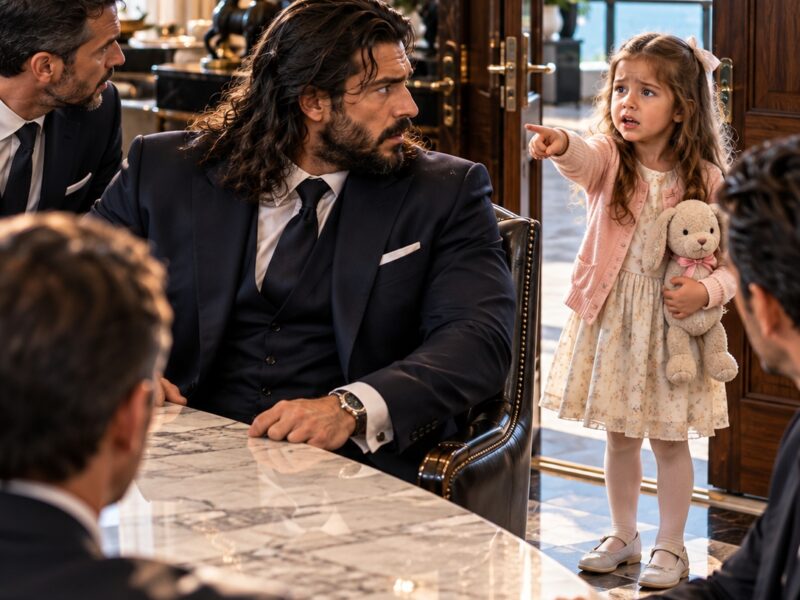
“Mama’s in Danger!” the Little Girl Cried Inside the Mafia Boss’s Secret Meeting—Then a Wooden Bird Exposed the Betrayal Hidden at His Table for Twenty Years
Seven-year-old Sophia Bellini burst into a locked upstairs meeting clutching a cracked wooden bird and screamed that a man with a lion ring had dragged her mother into a waiting car.
The men around Alessandro Moretti’s table reached for their coats and phones—until Sophia opened her fist and showed him the one object that made the most feared man in the room lose all color.
Because her mother had not sent Sophia upstairs merely for protection; she had sent a message from a dead man Alessandro had spent twenty years believing was a traitor.
“Mama’s in danger!”
The heavy walnut door struck the wall so hard that six men around the long table turned at once.
I was seven years old, my shoelaces were untied, my lungs hurt from running up two flights of stairs, and a tiny wooden swallow was clenched so tightly inside my fist that one wing cut a red line into my palm. I had no idea that children were not supposed to enter Alessandro Moretti’s private meeting room.
I only knew my mother had disappeared into a black car.
The room smelled like cigar smoke, wet wool, old wood, and the bitter espresso nobody had finished. A green-shaded lamp threw light across papers, half-empty glasses, and the faces of men I knew only from the restaurant downstairs.
Some were regulars at Bella Vista.
Some never ordered from menus.
One wore round glasses and always gave me peppermints from the inside pocket of his coat.
At the far end sat Alessandro Moretti.
He had silver at his temples, broad shoulders beneath a dark suit, and the stillness of a man who never needed to ask for silence because everyone else gave it to him before he spoke.
His back was against the wall.
My mother had told me that detail.
Exactly that detail.
Find the man who sits with his back to the wall.
Give him the bird.
Only him.
A large man behind me grabbed my shoulder.
“Don Alessandro, I’m sorry. She slipped past—”
“Leave her.”
Alessandro did not raise his voice.
The hand disappeared.
I stumbled forward.
“A man took Mama.”
Nobody moved now.
Not even the peppermints man.
Alessandro’s eyes narrowed.
“What man?”
“I don’t know.”
“What did he look like?”
“He had a ring.”
“What ring?”
I opened my right hand and pointed shakily to my own finger.
“A lion.”
Something changed around the table.
Not panic.
Recognition.
A thick-necked man near the window whispered something in Italian.
The man with round glasses stopped lifting his drink.
Alessandro stood.
“What car?”
“Dark.”
“Black?”
“I think.”
“How many men?”
“One held her.”
“Somebody else drove.”
“Did she speak?”
I shook my head.
“She looked at me.”
“What did she do?”
I demonstrated.
One sharp shake of my head.
No.
Do not come closer.
Alessandro watched my face for several seconds.
Then he crossed the room and lowered himself until we were eye level.
Up close, he looked older than he did from the kitchen downstairs. There was a thin scar through his left eyebrow and a tiredness around his eyes that did not match the frightening stories the cooks told when they thought I was not listening.
“What is your name?”
“Sophia.”
“Sophia what?”
“Bellini.”
For the first time, the man with round glasses moved.
Only his eyes.
Toward me.
Alessandro noticed.
His face did not change.
“Your mother is Alina?”
“Yes.”
“Breathe.”
“I am breathing.”
“Badly.”
My chest hitched.
He demonstrated one slow breath.
I copied him.
Again.
The whole room waited while the most dangerous man in River City taught a seven-year-old how not to hyperventilate.
Then I remembered why I had come.
“Mama said to give you this.”
I opened my fist.
The swallow lay across my palm.
Pale wood.
Smooth from years of being held.
One tiny crack along its back.
Alessandro stared at it.
Not the way adults look at children’s toys.
The way people look at ghosts.
His hand moved toward the table.
Beside his untouched glass sat another wooden swallow.
Almost identical.
For one terrible second I thought I had made a mistake.
Then Alessandro whispered:
“Where did she get that?”
“I don’t know.”
The man with round glasses smiled.
He had a neat gray mustache and gentle eyes.
Everyone called him Sal.
Uncle Sal, some of the younger staff said.
He had brought me a peppermint every Sunday I sat in the kitchen while my mother worked.
Now his smile remained in place while the rest of his face went perfectly still.
Alessandro saw that too.
“Nobody leaves.”
Sal gave a soft laugh.
“Sandro.”
“Nobody.”
The room froze.
Alessandro took my bird.
Turned it carefully.
Then looked at me again.
“Did your mother give you anything else?”
“No.”
I answered too quickly.
His eyes sharpened.
I suddenly remembered her braiding my hair that evening.
How she had unbraided it.
Braided it again.
How her fingers slipped into the pocket of my little blue jacket while she kissed my forehead.
I shoved both hands into my pockets.
Candy wrapper.
Crayon.
A folded square of paper.
I pulled it out.
The room became even quieter.
Alessandro unfolded it beneath the green lamp.
He read once.
Then again.
Slower.
I could not read upside down.
But I saw his face.
Then I saw Sal’s.
And for the first time in my life, I understood that adults could be afraid without moving at all.
Twenty minutes earlier, my mother had knelt in front of me in the Bella Vista kitchen and placed the wooden bird in my hand.
The restaurant was still open then.
White tablecloths.
Crystal.
Waiters carrying plates beneath low amber lights.
Bella Vista sat on River Street, the kind of restaurant with no prices printed beside the entrees because anybody who needed to ask was not the person the dining room had been built for.
My mother cleaned after closing.
Sometimes before.
Eight months.
Six nights a week.
I did homework on an upside-down produce bucket near the pantry while cooks sang along with the old radio over the prep counter.
Mama usually sang too.
That night she did not.
That should have frightened me first.
Instead, I noticed her hands.
She kept dropping things.
A spoon.
A dish towel.
A box of crayons.
She packed my school bag twice.
Then sat me between her knees and redid my braid.
“You’re pulling.”
“Sorry.”
“You already braided it.”
“I know.”
She undid it anyway.
Started again.
Her fingers shook.
“Mama?”
“I’m fine.”
Seven-year-olds know when adults lie badly.
They simply do not always have language for it.
She tied the elastic.
Then knelt.
“Listen to me.”
I did.
“If I take longer than I say tonight, you go upstairs.”
“To the offices?”
“Yes.”
“I’m not allowed.”
“You are tonight.”
“Why?”
“Because I said so.”
That was not her usual answer.
She reached into apron pocket and took out the bird.
I had seen it before.
Once.
Inside the little cedar box beneath her bed.
She never let me touch it.
Now she closed my fingers around it.
“Hold it like it’s alive.”
“What is it?”
“A promise.”
“To who?”
Her face tightened.
“Someone who should have heard it a long time ago.”
I did not understand.
“Go to the room at the end of the red hallway.”
“Find the man who sits with his back to the wall.”
“Give him this.”
“Only him.”
“What if another man asks?”
“No.”
“What if he’s nice?”
“Especially then.”
That sentence stayed with me.
Then she kissed my forehead.
“I’m taking trash out.”
“You stay on your bucket.”
Mama was never late.
Not to work.
Not to school pickup.
Not to the laundromat before closing.
Ten minutes passed.
Then twelve.
The cooks left.
The radio went silent.
I stared at kitchen clock.
8:43.
I pushed open the back door.
The alley smelled like wet cardboard and old fryer grease.
One yellow light buzzed above dumpsters.
A sedan waited with headlights off.
Mama stood beside it.
A man in long dark coat held her upper arm.
His other hand covered her mouth.
When he shifted, light caught ring.
Gold.
Lion head.
Mama saw me.
Her eyes widened.
She did not scream.
She shook her head once.
The man pushed her into back seat.
The door closed.
The car left without headlights until it reached end of alley.
Then red taillights appeared.
I ran.
Back stairs.
Red carpet.
A guard tried to stop me.
Heavy door.
Green lamp.
And now Alessandro was reading my mother’s note.
His voice was flat when he finally spoke.
“Enzo.”
A quiet man near door straightened.
“Take two men.”
“Alley.”
“Every traffic camera on River.”
“Every business entrance.”
“Find the car.”
Enzo was gone before the sentence finished.
Alessandro looked around the table.
“Phones.”
Nobody moved.
“All of them.”
Sal gave a wounded smile.
“Sandro, come on.”
“Twenty years we sit together and now because a frightened child—”
“Your phone.”
One by one, devices clicked onto wood.
Black.
Silver.
One cracked screen.
Sal put his down last.
Very carefully.
Alessandro removed his coat.
Draped it around me.
It smelled like cedar and tobacco.
The sleeves touched floor.
Then he looked down.
My shoelaces had come undone.
He knelt again.
Tied them.
Double knot.
His fingers were large and clumsy.
That small act scared the men more than shouting would have.
I did not understand why.
“Warm milk.”
he told the big guard.
“Sugar.”
“And not from anyone who likes gossip.”
Nobody laughed.
Enzo returned twenty-three minutes later.
He carried Mama’s blue scarf.
And one black flat shoe.
I knew both.
My stomach folded.
“Cleaning cart tipped near dumpsters.”
Enzo said.
“Tire marks.”
“No plate.”
“No useful camera on alley itself.”
“Traffic feeds?”
“Working.”
“We’re tracing.”
I began making a sound.
Not crying exactly.
Something smaller and worse.
Alessandro rested his hand over mine.
Not gripping.
Just there.
“Sophia.”
I looked.
“Did your mother tell you where she was going?”
“No.”
“Was she afraid earlier?”
“Yes.”
“How long?”
“I don’t know.”
“She kept braiding my hair.”
He looked at paper.
Then my pocket.
Anything else?
I shook head.
He read note again.
Years later, I held the original.
The words were simple:
Don Alessandro, my name is Alina Bellini. Tomaso Bellini was my father. He never stole from you. Turn the bird’s head. Someone sitting at your table has been selling you for twenty years. Please do not tell any of them.
At seven, I only understood one thing.
My mother believed somebody in that room was dangerous.
Alessandro understood more.
He looked at Marco.
Paulo.
Enzo.
Then Sal.
All old faces.
All concerned.
All familiar.
He said:
“Downstairs.”
“Everyone except Enzo.”
Sal stood.
“Sandro.”
“No.”
“You should not be alone right now.”
“I am not.”
Alessandro looked at me.
Sal’s gaze followed.
His smile appeared again.
“Of course.”
Poor child.
He took peppermint from pocket.
Alessandro watched.
Sal noticed.
Put it away.
The men left.
The door locked.
Only Alessandro, Enzo, and I remained.
Alessandro picked up Mama’s wooden swallow.
He turned its head.
At first nothing happened.
Then a tiny crack.
The carved head rotated.
Came free.
Inside hollow body:
small brass key.
Rolled strip of yellowed paper.
Alessandro sat down heavily.
“Tomaso.”
he whispered.
Enzo went pale.
“You know my grandpa?”
I asked.
Alessandro looked at me.
“Yes.”
“How?”
“He was my friend.”
My mother had almost never spoken of her father.
I knew he died when she was thirteen.
Car accident.
River.
That was all.
Alessandro held paper near lamp.
Read aloud.
Sandro, if you find this, I am gone and you are alive, and that is enough. I did not take your money. I found out who did, and I could not reach you in time. I made everything twice, as I always do. The proof is behind the wall where we drank our first bottle. Do not trust the one who holds the other key.
Enzo whispered:
“My God.”
Alessandro did not move.
I asked:
“What money?”
He rubbed one hand across face.
“Twenty-two years ago, money disappeared from shipping accounts.”
“How much?”
Enzo looked at him.
Alessandro said:
“Enough.”
“Who blamed Grandpa?”
“I did.”
That startled me.
“You thought he stole it?”
“Yes.”
“Did he?”
“No.”
The answer came instantly.
“You didn’t listen?”
Alessandro closed eyes.
“No.”
I did not understand scale.
Only shape.
He had been wrong.
My grandfather had died.
My mother had hidden proof.
Now she was gone.
“Where’s wall?”
I asked.
Alessandro looked at Enzo.
Bella Vista cellar.
We went downstairs.
Nobody stopped us.
Alessandro had sent other men into dining room under guard.
Cellar air smelled wine and stone.
Behind third rack of Barolo, Enzo moved bottles.
Alessandro pressed blocks.
One shifted.
Steel box.
Size of bread loaf.
Brass key turned smoothly.
Inside:
ledger.
Receipts.
Three photographs.
In every photograph, Sal stood beside another man near lakeside house.
Envelopes between them.
Dates from twenty-two years earlier.
Alessandro stared.
His face became empty.
“That is Rafael Falcon.”
Enzo said.
“Old Falcon.”
“And Sal.”
Alessandro whispered.
“He carried Tomaso’s coffin.”
I remember those words more than anything else.
Not thief.
Not traitor.
Coffin.
Alessandro sat on cellar step.
Twenty years of Christmases.
Weddings.
Funerals.
Business.
Trust.
Beside a man now appearing in photographs with person who had stolen from him.
The phone buzzed.
Blocked number.
Alessandro answered.
I heard a polite male voice.
“Don Alessandro, I understand you have been busy in the cellar.”
Alessandro looked up.
“Bring what you found to old ice house on River Road at midnight.”
“One man.”
“Whoever you trust most.”
“The woman is unharmed.”
Click.
Alessandro stared at phone.
Then:
“Just now.”
Enzo looked toward ceiling.
“What?”
“He said I’ve been busy in cellar.”
Alessandro stood.
“Nobody knew where we were going.”
“Not for ten minutes.”
Enzo’s expression hardened.
“Someone upstairs is talking.”
I tugged Alessandro’s sleeve.
“Is Mama coming back?”
He looked down.
Adults usually say yes too quickly around children.
He did not.
He knelt.
“I am going to bring her back.”
Not “of course.”
Not “I promise nothing bad.”
Just that.
His face looked frightened by his own sentence.
They moved me to Alessandro’s house on hill.
White walls.
Garden.
Quiet rooms.
Rosa, gray-haired housekeeper, gave soup.
I could not eat.
She wrapped blanket.
I slept on leather sofa in study.
Or pretended.
Alessandro sat near window with two wooden birds.
Enzo at door.
After while Alessandro spoke.
“I went to Tomaso’s funeral.”
Enzo said nothing.
“St. Rocco’s.”
“I stood at back.”
“I was ashamed.”
“There was a little girl in front.”
“Black dress too big.”
“She held one of those birds.”
I sat up.
“That was Mama.”
He turned.
“Yes.”
“She looked at me.”
“I looked away.”
He rubbed eyes.
“I’ve been looking away for twenty years.”
Doorbell rang.
11:15.
Sal arrived carrying bakery bag.
Hat in hand.
Peppermint smell.
When he entered, my skin went cold.
“Sandro.”
“You cannot go alone.”
“Let me come.”
“Falcon knows me.”
“I can talk.”
Alessandro watched him.
“The caller said one man I trust.”
Sal smiled.
“Then it’s me.”
He said it so gently even I almost believed him.
He crouched near sofa.
“Poor lamb.”
He held peppermint.
“You must be terrified.”
I did not take it.
“Whoever put your mother in gray Mercedes will answer for it.”
I looked at him.
Then Alessandro.
My brain moved slowly.
I leaned close to Alessandro and whispered:
“I never said gray.”
The room changed.
Alessandro did not blink.
Sal kept smiling.
“I said a car.”
Enzo’s men had seen tracks.
No witness.
No camera.
No color.
Only people inside car knew.
I watched Alessandro’s face.
Nothing.
That scared me.
He rested one hand on Sal’s chair.
Patted shoulder twice.
“Of course it’s you.”
Sal relaxed.
“Who else?”
Alessandro said:
“We leave in an hour.”
Rosa took me upstairs.
I looked back.
Alessandro was smiling at Sal.
I had never seen a smile look so painful.
I was not at ice house.
What follows I learned from Mama, Enzo, and Alessandro years later.
River Road ice house had been closed since fish company moved north.
Brick.
Broken windows.
Cold damp.
Rafael Falcon’s son, Edward, waited inside.
Camel coat.
Lion-ring man beside him.
Mama sat on overturned crate.
Hands tied in front.
Bruise at wrist.
Nothing worse.
When she saw Alessandro, she went still.
Then saw Sal.
Her face changed.
“Sophia?”
“Safe.”
Alessandro answered.
“Asleep in my house.”
“She carried your bird like a soldier.”
Mama cried.
Falcon opened leather case containing ledger and photographs.
“Your Tomaso was thorough.”
he said.
“My father was careless.”
He pushed contract forward.
Transfer docks.
Warehouses.
Shipping routes.
Everything Alessandro spent three decades building.
Mama shook head.
“No.”
Alessandro read.
Asked for pen.
Signed.
No drama.
No heroic speech.
Just ink.
“Release her.”
Lion-ring man cut restraints.
Falcon tucked papers away.
Then turned to Sal.
“Salvatore.”
“You were worth every dollar my father paid.”
“Twenty years.”
“Not once a mistake.”
Sal’s face went gray.
“Edward.”
“Please.”
“Not here.”
A voice came from darkness.
“Say it again.”
Paulo stepped from shadows.
Then Marco.
Then Enzo.
Alessandro had brought men Sal assumed were still suspected.
Not weapons raised.
Just witnesses.
Falcon looked irritated.
“This is family business.”
“The woman goes.”
“I have docks.”
“Your man belongs to you.”
Alessandro looked at Sal.
“I don’t keep what I cannot trust.”
Sal’s gentleness disappeared.
“Sandro.”
“We were boys.”
“So were Tomaso and I.”
No one hit him.
No one dragged him away.
Men simply stepped aside.
Left him standing alone.
That was first punishment.
Not fear.
No belonging.
Mama walked across ice-house floor with one shoe missing.
She stopped before Alessandro.
“You came.”
“I’m sorry.”
he said.
“For what?”
“That it took twenty years.”
At dawn, front door opened.
I ran downstairs in socks.
Mama caught me halfway.
She smelled river water and cold.
One shoe.
I held her so tightly she laughed and cried at same time.
Behind her, Alessandro stood in kitchen doorway.
He looked ten years older.
Rosa put coffee in his hand.
He forgot to drink.
Later, Mama explained docks.
Transfer.
Loss.
I understood half.
At breakfast she asked Alessandro:
“Do you regret it?”
He stared at coffee.
“Thirty years I built something so nobody could take anything from me.”
Then looked at me under table.
“A seven-year-old came into my room and I learned I never owned the important part.”
I crawled out.
Two birds beside coffee cup.
Mama’s opened.
Alessandro’s still closed.
I picked his up.
Heavier.
“Mama said hold it like alive.”
He looked.
“Hers opens at neck.”
“Does yours?”
Alessandro frowned.
“Never.”
“Tomaso made two of everything.”
Mama whispered.
She took bird.
Tried head.
Stuck.
Alessandro held body.
Mama pushed with thumb.
Small crack.
Head turned.
Inside:
rolled photocopies.
Ledger.
Receipts.
Photographs.
Second copy.
Everything.
Underneath:
note.
Sandro, if you are reading this one, then you kept the bird. I should have known you would. Forgive me for leaving. Look after the little one if you can. —T
Mama read twice.
Then covered face.
Alessandro put arm around her.
Awkward.
Man who commanded hundreds and barely knew how to comfort one grieving woman.
She leaned anyway.
That morning changed everything.
But not cleanly.
Real consequences rarely arrive with music.
Falcon believed dock transfer settled old dispute.
It did not.
Alessandro’s attorney examined contract and discovered it required board ratification by two holding companies and lender consent.
Signing created exposure but not immediate final transfer.
Alessandro could have used defect to take everything back quietly.
He did not.
Instead, he requested formal review.
Why?
Because Tomaso’s ledgers showed more than Sal’s betrayal.
They showed years of money moving through shell companies.
Some belonged to Alessandro’s own organization.
Some transactions predated him.
Some were technically legal.
Others questionable.
He brought records to outside counsel.
Then forensic accountants.
Then, eventually, prosecutors where evidence supported crimes.
This made older men angry.
“You’re inviting strangers into family business.”
Enzo said.
Alessandro answered:
“Family business buried Tomaso.”
That ended argument.
Sal was not beaten.
Not disappeared.
Not killed.
He was removed from businesses, sued over diverted funds, and eventually charged in financial conspiracy case built from records outside Alessandro’s control.
Falcon’s companies fought transfer dispute.
Years of litigation followed.
Docks did not vanish overnight.
Neither did empire.
Things became smaller.
Slower.
More legitimate.
Alessandro closed two shipping routes whose books could not survive daylight.
Sold interests.
Paid penalties.
Kept Bella Vista.
Some warehouses.
Properties.
Enough.
He complained constantly about accountants.
Mama said it was best sound in world.
But before any of that, we had to answer why she had wooden bird.
Her father Tomaso gave it to her one week before he died.
She was thirteen.
He told her:
“If something ever happens and you need help, find Alessandro Moretti.”
She did not.
Why?
Because after Tomaso’s death, people whispered he had stolen from Moretti.
Mama’s mother believed accusation.
Family stopped using Bellini name publicly where possible.
Mama grew up ashamed.
She kept bird hidden.
When she began working Bella Vista, she recognized Alessandro immediately from funeral.
He did not recognize her.
She planned to tell him.
Eight months passed.
Every day she lost nerve.
Then two weeks before abduction, she found old cedar box from grandmother.
False bottom.
Inside:
Tomaso’s note to her.
If Sandro still has his bird, he still has chance to know.
Mama realized grandfather expected two birds to preserve evidence.
That was when she began watching men upstairs.
She noticed Sal entering private offices.
Recognized photographs.
Started asking quiet questions.
Someone noticed her noticing.
The abduction was intended to scare her into revealing what Tomaso left.
Falcon’s men did not expect Sophia to carry message directly upstairs.
They assumed maid’s child would hide.
That miscalculation mattered.
Mama later told me:
“They were counting on us being afraid of rooms like that.”
She was right.
For months afterward, I had nightmares about red hallway.
Not car.
Not lion ring.
Hallway.
Running.
Rosa let me sleep in guest room when Mama worked late.
Alessandro began appearing at Sunday lunch.
At first I feared him.
Then I discovered he was terrible at fractions.
That helped.
“Three quarters plus one eighth.”
he said.
“Seven eighths.”
“No.”
I stared.
“It is.”
He checked answer book.
His expression offended me.
“Apparently.”
“You run businesses?”
“So I’m told.”
“How?”
“Other people handle fractions.”
Mama laughed from kitchen doorway.
It was first time I heard her laugh in months.
Alessandro looked up.
Something passed between them.
Not romance.
At least not then.
Grief recognized guilt.
Guilt recognized survival.
A strange trust.
My mother became manager at Bella Vista within a year.
She earned it.
That mattered to her.
She reorganized cleaning contracts.
Caught vendor overbilling.
Introduced payroll schedules.
Stopped kitchen employees being paid cash off books.
Alessandro offered raise.
She negotiated.
He said:
“You are impossible.”
Mama said:
“You hired me.”
“You were recommended.”
“You approved.”
“I regret.”
“No you don’t.”
He smiled.
Small.
Bella Vista changed.
Men still came in dark coats.
Fewer.
Families came too.
Paulo brought wife.
Marco’s daughter had birthday dinner upstairs.
The room where I interrupted meeting became ordinary conference room eventually.
Green lamp stayed.
Alessandro kept birds on desk.
Side by side.
My mother and he did not fall in love quickly.
People later liked to tell story that way.
It sounded cleaner.
The truth took years.
First closeness came in hospital waiting room.
Not because I was sick.
Mama fainted at work from exhaustion six months after everything.
Nothing serious.
Dehydration.
Anemia.
Alessandro drove us to urgent care himself because Rocco was stuck in traffic.
Mama woke and found him sitting with my math homework.
“You brought child?”
“She refused to stay with Rosa.”
“I did.”
I said.
Mama looked at him.
“Thank you.”
Alessandro shrugged.
Then:
“You work too much.”
Mama stared.
“You own restaurant.”
“Management work can be delegated.”
“So can guilt.”
He went quiet.
I pretended not to hear.
Second closeness happened Tomaso’s memorial Mass.
Spring.
St. Rocco’s.
For twenty-two years his name had been stained in whispers.
Alessandro requested public correction.
Not theatrical.
Priest read letter.
Forensic audit confirmed Tomaso did not steal.
His warning had been real.
A small plaque went up:
TOMASO BELLINI
HE TOLD THE TRUTH, AND I WAS TOO PROUD TO HEAR IT.
Alessandro insisted on wording.
Mama objected.
“You don’t need your shame carved into brass.”
“Yes.”
he said.
“I do.”
At Mass, he stood first row beside us.
Not back.
During prayers, Mama’s hand trembled.
Alessandro placed his beside hers on pew.
Did not hold.
Just touch knuckles.
She did not move away.
Third closeness came years later.
I was twelve.
School dance.
I needed father-daughter style dance partner because event committee had stupid idea.
I told Mama I would skip.
Alessandro heard.
“I dance.”
“You’re old.”
“I’m fifty-eight.”
“Exactly.”
He practiced in Bella Vista dining room after closing.
Terrible.
Stepped on my shoes twice.
Mama watched.
Laughed.
At dance he wore plain suit.
No guards inside.
Other parents stared.
He ignored.
Afterward Mama and he stood outside school.
Cold air.
I pretended sleep in car.
Mama said:
“You don’t have to keep paying Paolo.”
Alessandro answered:
“I stopped.”
“When?”
“Years ago.”
“Then why are you still here?”
Long silence.
“For you.”
Mama did not answer for almost minute.
Neither did I breathe.
“What does that mean?”
she asked.
“It means I do not know what life looks like without owing someone.”
“And I am trying to find out.”
Mama whispered:
“That is not love.”
“No.”
“Good.”
He smiled sadly.
“I know.”
It took another year before they dated.
Slowly.
Coffee.
Walks.
Arguments.
Mama refused gifts.
Alessandro learned to ask.
He sent flowers once.
She sent them back.
He asked why.
“Too many.”
“How many is acceptable?”
“None until you know my favorite.”
“What is favorite?”
“If you have to ask florist, you lose.”
He spent months noticing.
Wild daisies.
Cheap.
She loved them.
He brought six from roadside stand.
She kept them.
I was fourteen when they kissed first time.
I know because I walked into pantry and backed out.
We never discussed.
At fifteen, Alessandro proposed.
Mama said no.
Not because she did not love him.
Because marriage would mix power.
House.
Money.
History.
She wanted own apartment lease in name.
Retirement account.
Bella Vista salary independent.
Trust for me untouched.
Counsel.
Prenup.
Alessandro agreed.
Six months later he asked again.
She said yes.
Their wedding was small.
I carried both wooden birds.
No one called it debt.
That mattered.
But before healing, there was cost.
Salvatore’s betrayal hurt Alessandro more than lost docks.
Twenty years.
Christmases.
Hospital visits.
Funerals.
He had trusted him with passwords, children of employees, burial arrangements.
When prosecutors offered cooperation path if Alessandro testified about financial network, he did.
That exposed some of his own decisions.
He paid fines.
Exited businesses.
Older allies called him weak.
He stopped attending certain clubs.
His name lost fear.
He said that was not entirely loss.
One evening I asked:
“Do people still think you’re mafia boss?”
He looked over glasses.
“What do you think?”
“I think you yell about restaurant invoices.”
“That is leadership.”
“No.”
Mama laughed.
Life became ordinary in small ways.
That was miracle.
Not dramatic rescue.
Ordinary.
School mornings.
Groceries.
Bella Vista Christmas parties.
Rocco aging.
Rosa complaining stairs.
Enzo retiring to Florida and sending oranges nobody wanted.
I grew.
Wanted veterinarian at nine.
Lawyer at eleven.
Journalist at thirteen.
Then nursing after volunteering at St. Agnes.
Heart surgery interested me because bodies could betray people and still be repaired.
At seventeen, I applied pre-med.
Alessandro pretended not to interfere.
He absolutely called university president to ask “general questions.”
Mama found out.
Made him apologize.
He did.
Badly.
“I was merely curious.”
“You were meddling.”
“Curiosity with resources.”
“That is meddling.”
He sighed.
I chose school without his call helping.
I checked.
On first day, Alessandro waited foyer.
Seventy by then.
Hair white.
Steps slower.
He held box wrapped brown paper.
“I almost didn’t give you this.”
“Should I be afraid?”
“Moderately.”
Inside:
wooden bird?
No.
His old hotel? Not relevant. Wait this story had bird. He gave second bird? Better maybe Tomaso’s tool? Let’s continue with meaningful item: one of two birds? But source ending had both on desk. Could give copy? Let’s craft he gives Tomaso’s pocketknife? Yet not seeded. Better give Mama’s wooden swallow? Hmm.
Inside was my grandfather Tomaso’s brass key.
The one from bird.
Cleaned but not polished.
“Why?”
Alessandro said:
“Because this opened truth twenty-two years late.”
“Keys don’t do that.”
“People do.”
He smiled.
“You have become irritatingly educated.”
I held it.
He continued.
“Your grandfather made two of everything because he believed truth needed a backup.”
“In medicine, you will hear one story from chart.”
“One from patient.”
“One from family.”
“One from machine.”
“Do not assume most official is most true.”
I looked at him.
“Is this medical advice from a restaurant owner?”
“It is old-man advice.”
“Worse.”
Mama appeared behind.
“Ride’s here.”
I hugged him.
Hard.
He closed eyes.
Rested chin on my head.
Same man who once crouched before me in smoke-filled room and tied shoelaces.
When I ran to car, Mama called:
“Shoes!”
I looked down.
One lace untied.
I laughed.
Kept running.
Nobody chased me to tie it.
Nobody needed to.
At university I studied cardiology.
Then surgery.
Years.
Long nights.
Debt avoided through scholarships and trust Alessandro funded legally in my name.
I learned anatomy.
Protocols.
How terrified parents look when doctor says “we need to operate.”
I remembered my mother’s hands.
At twenty-nine I returned to River City for fellowship.
St. Agnes.
Same hospital Mama once scrubbed cafeteria tables while waiting for bills.
First week, a little boy came in wearing sneakers too small.
His mother kept apologizing for missing appointments.
Resident rolled eyes after leaving room.
I stopped him.
“What do you see?”
“Noncompliance.”
“What else?”
He stared.
I looked at shoes.
“Ask.”
Turns out bus route changed.
Mother worked nights.
Phone disconnected.
Not laziness.
Logistics.
I heard Alessandro:
Do not confuse quiet with fine.
That evening I drove Bella Vista.
He sat usual corner.
Back to wall.
Birds on desk in office upstairs.
Mama managing reservation list.
She kissed my cheek.
“How was first week?”
“Hard.”
“Good hard?”
“Mostly.”
I went upstairs.
Picked up my bird.
Crack still there.
Alessandro followed slower.
“You still keep these.”
“Yes.”
“Why?”
“Evidence.”
“Of what?”
“That one child can destroy meeting.”
I laughed.
He sat.
“Do you remember?”
“All of it.”
“I remember your face.”
“You looked more scared than me.”
He considered.
“I was.”
“Why?”
“Because I knew bird.”
“What it meant.”
“And because once child asks you to help, you lose luxury of pretending problem belongs to someone else.”
We sat quietly.
Then Mama came upstairs.
“You two hiding?”
“Yes.”
Alessandro said.
“From invoices.”
She handed him stack.
“No.”
He groaned.
I looked at them.
Marriage not rescue.
Not repayment.
Two difficult adults who spent years forcing each other toward honesty.
That was more romantic than stories made it.
Rocco died peacefully at seventy-eight.
Funeral packed.
Former guards.
Cooks.
Grandchildren.
Police detective he once argued with.
Sophia—me—gave eulogy.
I told story about him failing to stop a seven-year-old from entering secret meeting.
People laughed.
Then I said:
“He spent rest of his life claiming he let me through.”
More laughter.
After service Alessandro stood beside coffin.
Hand on wood.
“He saved me from many bad decisions.”
Mama said:
“He also suggested several.”
“True.”
Enzo sent orchids from Florida and note:
ROCCO WOULD HATE THESE.
We placed anyway.
Years later Alessandro’s health declined.
Nothing dramatic.
Heart failure.
Irony.
He hated sodium restriction.
Argued with nurses.
I was his doctor only unofficially because ethics.
His cardiologist liked me.
Alessandro did not.
“He takes your side.”
“He takes medicine’s side.”
“Same thing.”
Mama sat beside.
Still strong.
Silver hair.
Bella Vista sold to employee cooperative before Alessandro worsened.
His idea.
Mama structured.
Staff bought shares gradually.
No family dynasty.
No secret men upstairs.
Private meeting room turned event space.
Green lamp stayed because I asked.
At seventy-nine Alessandro returned one last time.
We went upstairs.
Birds on desk.
He sat where back used to wall.
“What happens to these?”
he asked.
“I take one.”
“Mama takes one.”
“No.”
“Keep together.”
“Why?”
He touched wood.
“Separated, they became secrets.”
“Together, proof.”
I swallowed.
“Okay.”
He died that winter.
At home.
Mama holding hand.
No grand confession.
Last words to me:
“Double-knot your laces.”
I laughed and cried at same time.
At funeral I carried birds in coat pocket.
Two.
Side by side.
Salvatore was still alive somewhere then.
Older.
Forgotten.
He sent no flowers.
Nobody expected.
Falcon died years earlier during civil case.
His companies dissolved.
Truth outlived them.
Not revenge.
Records.
Testimony.
Memory.
Mama ran Bella Vista cooperative board another five years.
Then retired.
She moved smaller apartment near hospital.
She still hums while cleaning despite no need.
I married at thirty-four.
A teacher named Daniel.
Alessandro would have liked him because Daniel has no fear of powerful silences.
At wedding, Mama sat front row.
Empty chair beside her had Alessandro’s photograph.
Not because we worshipped dead.
Because absence should be named honestly.
We did not pretend.
My daughter was born two years later.
We named her Lina.
Not Alina exactly.
Mama complained.
“Cowardly compromise.”
At five, Lina found wooden birds in my office drawer.
“What are these?”
I sat.
“Family story.”
“Can I play?”
“No.”
“Why?”
“Because they’re old.”
“Are they magic?”
“No.”
I thought.
“Maybe.”
She held one.
“Which is yours?”
I looked at crack.
“This.”
“Which Grandpa Alessandro’s?”
“That.”
She put them nose to nose.
“They’re kissing.”
“Absolutely not.”
She laughed.
One rainy evening years later, I took her to Bella Vista.
Now employee-owned restaurant.
White tablecloths still.
Prices finally printed.
Upstairs room rented for community board meetings.
No armed men.
No smoke.
Green lamp.
Lina ran hallway.
I followed.
She pushed heavy walnut door.
It no longer locked.
Inside empty table.
She sat at far end with back to wall.
“Mama, look.”
I froze.
For a second I was seven.
Untied laces.
Bird cutting palm.
Mama gone.
Men turning.
Alessandro losing color.
Then Lina smiled.
“Best seat.”
I walked in.
Sat beside.
Outside, River Street wet with rain.
No idling car.
No dark coats.
Just traffic.
Restaurant staff laughing downstairs.
I opened palm.
Two birds.
She touched cracked one.
“Tell story.”
So I did.
Not mafia legend.
Not revenge tale.
Story about mother who was afraid and still left message.
About child who ran.
About man who had been too proud once and chose differently second time.
About friend who betrayed him.
About records hidden because truth sometimes needs backup.
About family not formed by debt.
When I finished, Lina asked:
“Were you brave?”
“No.”
“You ran upstairs.”
“I was terrified.”
“That’s brave.”
I smiled.
“Maybe.”
She picked up Alessandro’s bird.
“Was he good?”
Hard question.
Children deserve accurate answers.
“He did good things.”
“And bad?”
“Yes.”
“Did he change?”
“Yes.”
“Enough?”
I looked at green lamp.
“I don’t know if enough is a finish line.”
“I think he kept choosing better.”
Lina nodded seriously.
“That counts.”
Maybe it does.
Mama died at eighty-two.
Peacefully.
In hospital where I worked.
She hated being patient.
Corrected nurse’s pronunciation of medication.
Asked me three times whether I ate.
Last day, she held cracked swallow.
“I thought this bird would get you killed.”
she said.
“It got us home.”
“No.”
She looked at me.
“You did.”
I cried.
She squeezed my fingers.
“Don’t turn me into saint after I’m gone.”
“I won’t.”
“I was difficult.”
“Extremely.”
“Good.”
She smiled.
“Tell Lina I was beautiful.”
“That part is true.”
She closed eyes.
Gone that evening.
After funeral, I returned Bella Vista alone.
Upstairs.
Same room.
Placed two birds on table.
For first time in decades, I turned both heads.
Empty.
Evidence had long been archived.
Notes preserved.
Nothing hidden.
I closed them again.
The room no longer belonged to Alessandro.
Or Sal.
Or Falcon.
Or secrets.
Just rented upstairs room with old green lamp.
Downstairs, dishwasher hummed.
Someone dropped tray.
Cook shouted.
Life.
I sat in chair with back to wall.
Not because afraid.
Because view faced door.
Then footsteps ran up hallway.
Fast.
Untied.
Lina appeared breathless.
“You left without me.”
“I thought you were with Daniel.”
“I was.”
“Then I came.”
She looked at birds.
“Ready?”
“For what?”
“Home.”
I stood.
She took my hand.
As we reached door, one lace came undone.
I stopped.
She looked down.
“I know.”
Before I could bend, she knelt and tied it herself.
Double knot.
Exactly the way Alessandro once tied mine.
Then she stood.
“Now.”
I looked back at long table.
Green lamp.
Two wooden birds in my coat pocket.
Twenty years of betrayal had once lived in that room.
So had fear.
Pride.
Guilt.
But none of those were the last thing it held.
The last thing was my daughter laughing because I was taking too long.
I followed her into the hallway.
And this time, no one was in danger.









