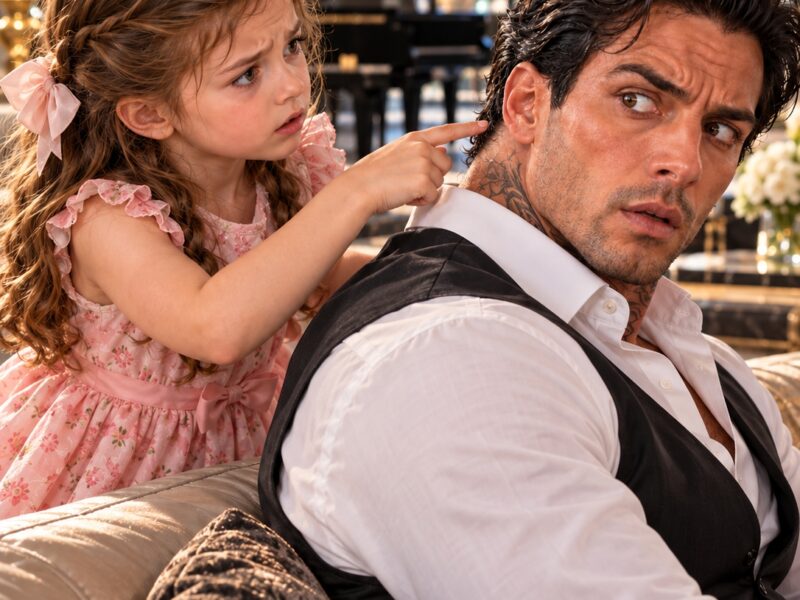
“Mister… Why Does the Scar on Your Neck Shine?”—A Little Girl’s Innocent Question Exposed the Secret That Had Kept a Feared Mafia Boss Under Someone Else’s Control for Three Years
“Mister… why does the scar on your neck shine?”
Gabriel Voss stopped turning the page.
For a moment, he thought the little girl had spoken to someone else. Children weren’t supposed to be in the west wing of his house, and nobody who worked there would have allowed one within arm’s reach of him without permission. Yet a child in a faded blue dress stood beside his leather sofa, looking intently at the back of his neck.
“What did you say?”
The girl took half a step backward. She was six, perhaps seven, with brown curls gathered into a crooked ponytail and serious gray eyes that made her look older than she was.
“Your scar,” she whispered. “The little shiny part behind your ear. It looks like a silver star when the sunshine touches it.”
Gabriel’s hand rose slowly toward his neck.
He knew the scars across his shoulder and chest. He knew the jagged one beneath his collarbone and the thin pale line running into the tattoo on his right arm. Three years earlier, an explosion had left him with enough reminders that he rarely bothered looking at them anymore.
But a silver mark behind his left ear?
He couldn’t remember one.
“Show me.”
The girl hesitated.
“Can I point?”
Gabriel turned farther.
She raised one finger, stopping short of touching him.
“Right there. Under your hair.”
Before Gabriel could answer, the double doors opened.
“Ellie!”
A woman’s frightened voice broke the quiet.
Mara Bennett hurried into the room wearing the blue-gray uniform of the housekeeping staff. Her dark hair had escaped its bun, and a damp cleaning cloth was still tucked beneath one arm.
She reached for the child.
“I’m so sorry, Mr. Voss. She was supposed to wait downstairs.”
Behind Mara came Julian Mercer, Gabriel’s chief adviser.
Julian took one look at the girl and stopped.
His eyes moved toward Gabriel’s neck.
It was a small movement.
Almost nothing.
But Gabriel had spent thirty years learning to notice the things people tried not to show him.
And Julian Mercer looked frightened.
“Children are not permitted in this wing,” Julian said sharply. “Mrs. Bennett was informed of the rules.”
Mara tightened her grip on Ellie’s hand.
“Our sitter canceled this morning. Mrs. Ward said Ellie could stay in the staff sitting room until my shift ended.”
“Permission to wait downstairs is not permission to approach Mr. Voss.”
“She didn’t mean any harm.”
“That isn’t the point.”
Ellie’s face crumpled.
“Please don’t fire Mommy.”
The room went still.
Gabriel looked at the child.
Her lower lip trembled, but she wasn’t crying. She seemed determined to remain brave for her mother.
“I was only asking about the shiny thing,” she said.
Gabriel slowly lowered his hand.
“What shiny thing?” Julian asked.
Gabriel watched him.
“The scar on my neck.”
Julian’s expression became carefully neutral.
“An old surgical mark. Nothing unusual.”
“Which surgery?”
Julian blinked.
“The procedures after your accident.”
“Which one?”
A pause.
“Gabriel, you underwent several operations. You know that.”
Gabriel knew what he had been told.
He had never known much more.
He looked toward Mara.
“Mrs. Bennett, did the child touch me?”
“No, sir.”
“Did she damage anything?”
“No.”
“Did she threaten anyone?”
Mara looked bewildered.
“Of course not.”
Gabriel turned toward Julian.
“Then we have a child who asked a question.”
“Household rules exist for your protection.”
“From a six-year-old?”
Julian’s jaw tightened.
Gabriel looked at Mara again.
“Take your daughter downstairs and finish your shift.”
Mara swallowed.
“Yes, sir.”
“And Mrs. Bennett?”
She stopped.
“No one is losing their job because your daughter noticed something.”
For the first time, Mara met his eyes directly.
There was relief there, but not trust.
“Thank you,” she said carefully.
Ellie lingered.
“Are you mad?”
Gabriel looked at her.
“No.”
“You look mad.”
“I’ve been told that.”
She considered.
“Mommy says sometimes people look mad when their heads hurt.”
A strange pressure formed behind Gabriel’s eyes.
He almost smiled.
“Your mother may be right.”
Ellie gave him a small, uncertain wave before Mara led her from the room.
Julian closed the doors.
The moment they were alone, he said, “That woman needs to understand boundaries.”
Gabriel stood.
At forty-two, he was still a large man, broad through the shoulders, with dark tattoos extending beneath the cuffs of an expensive black shirt. People had described him as handsome, dangerous, cold, and impossible to read.
Recently they had begun adding another word.
Damaged.
He walked toward the mirror near the bookshelves.
“Bring me another mirror.”
Julian remained still.
“Gabriel—”
“Another mirror.”
Julian fetched a small framed mirror from the adjoining washroom.
Gabriel angled it behind his head.
The mark was difficult to find.
Then sunlight shifted across the floor.
A tiny silver-white oval appeared beneath his hairline, smaller than a pea.
Not an ordinary scratch.
Not quite like the other scars.
Its surface reflected the light.
Gabriel stared.
“Who operated there?”
Julian adjusted his cuff.
“Dr. Vale oversaw your treatment.”
“That wasn’t my question.”
“You had extensive injuries.”
“Then the records should be extensive.”
Julian gave a thin smile.
“Of course.”
Gabriel lowered the mirror.
“I want them.”
“All of them?”
“Every page.”
Julian hesitated just long enough.
Then nodded.
“Certainly.”
He left.
Gabriel remained standing before the mirror.
For three years, people had explained his own body to him.
The headaches.
The missing hours.
The strange exhaustion that came without warning.
They told him which meetings he had attended, which papers he had signed, what medication he had taken, and which decisions he was too tired to make.
He had accepted it because the alternative was admitting that the man once feared across half of Chicago could no longer trust his own memory.
Now a child had noticed a mark nobody had mentioned.
And the man Gabriel trusted most had looked at it as though it might ruin him.
Mara Bennett had worked in the Voss household for eleven months.
She had never intended to remain that long.
The position was supposed to be temporary, a way to catch up on bills after losing her job at a hotel in downtown Chicago. The pay was good, the hours predictable, and accommodation was available in a small apartment above the old carriage house.
For a single mother with no savings and a six-year-old daughter, that last detail mattered more than anything.
Mara had been raising Ellie alone since her husband, Daniel, died in a workplace accident four years earlier.
He had been a maintenance technician at a distribution center outside Joliet. A piece of equipment failed during an overnight shift, and Daniel never came home.
There was an investigation.
There were interviews.
There was paperwork.
There was a modest settlement that looked substantial until the medical bills and funeral expenses arrived.
Mara learned quickly that grief did not stop automatic payments.
The rent still came due.
The refrigerator still broke.
Children still needed shoes.
For a long time, she lived by a rule so simple it became almost sacred: keep Ellie safe, keep the bills paid, and never depend on promises from people who had more power than you.
That was how she ended up working for Gabriel Voss.
She knew his reputation before applying.
Everyone in certain Chicago neighborhoods did.
The Voss family controlled transportation companies, warehouse properties, import businesses, and a collection of operations that did not appear on tax returns in any recognizable form.
Gabriel’s father had built the organization through intimidation and violence. When Gabriel inherited it, he expanded the legitimate freight businesses while retaining enough of the old machinery to keep police investigators interested.
Newspapers occasionally called him an alleged organized-crime figure.
People who knew him did not bother with the word alleged.
Mara had nearly refused the job.
But Helen Ward, the senior housekeeper, promised that housekeeping staff were kept separate from his business affairs.
“You clean rooms, not secrets,” Helen told her during the interview.
Mara remembered that line.
She also remembered standing outside the carriage-house apartment with Ellie on their first evening, looking at the small kitchen, the clean bathroom, and the bedroom with a window overlooking the garden.
“Is this ours?” Ellie had asked.
“For now.”
“Can I put my stars on the ceiling?”
Mara looked at the little packet of glow-in-the-dark stars her daughter carried everywhere.
“Yes.”
Ellie grinned.
It had been the first time Mara had seen her excited about a home in nearly two years.
Now, standing in the staff kitchen after the incident in the library, Mara feared that home might disappear because of one innocent question.
Helen poured her tea.
“Mr. Voss said you’re fine.”
Mara stared at the cup.
“He said that today.”
Helen understood.
Powerful men’s moods could change.
Julian Mercer had been managing the household for years, and his displeasure could end someone’s employment long before Gabriel learned there was a problem.
Ellie sat at the small table drawing with colored pencils.
She had drawn a man in a black shirt standing beneath an enormous yellow sun.
His mouth was a straight line.
Mara glanced at it.
“Is that Mr. Voss?”
Ellie nodded.
“Why does he look so unhappy?”
“Because his head hurts.”
“How do you know?”
“He rubs his neck when he thinks nobody’s watching.”
Mara studied her daughter.
Ellie noticed things.
She always had.
When she was four, she had noticed a loose stair tread outside their previous apartment before any adult did. At five, she found a missing earring beneath a grocery shelf because she remembered seeing it fall from the cashier’s ear.
Her teacher said Ellie had unusual visual attention and a strong memory for shapes.
Mara simply thought her daughter spent more time watching the world than most adults did.
“Sweetheart,” Mara said gently, “we can’t go into Mr. Voss’s rooms without permission.”
“I know.”
“Then why did you?”
Ellie looked down.
“The sun made the shiny thing look pretty.”
“That isn’t a reason.”
“I thought maybe he didn’t know.”
Mara opened her mouth.
Then closed it.
Because perhaps that was the strangest part.
Gabriel had looked surprised.
Not irritated.
Not impatient.
Surprised.
As though he genuinely had not known.
Gabriel had not slept properly since the explosion.
Some nights he managed four hours. Others, two.
On bad nights he woke convinced he was still trapped inside the burning vehicle, his ears ringing, his mouth full of smoke.
He remembered the explosion itself.
A wet Tuesday morning.
The leather seat of his car.
A half-finished phone call.
A flash.
Then nothing.
Eleven days vanished.
When he woke, Celeste Arden sat beside his hospital bed.
She had been his companion for five years.
Beautiful, composed, patient Celeste.
She was the one who explained what had happened when Gabriel could not remember.
An attack on his car.
Several operations.
A transfer to a private rehabilitation center.
A difficult recovery.
She had stayed through everything.
Julian had managed the businesses.
Dr. Marcus Vale had supervised his care.
Together, they kept the world moving while Gabriel struggled to remember the names of men he had known for decades.
At first, he was grateful.
Later, gratitude became dependence.
Sometimes he forgot entire conversations.
Sometimes he woke exhausted after twelve hours of sleep.
Sometimes pain gathered behind his eyes so intensely that sunlight seemed to scrape across his skull.
Dr. Vale called it a complicated post-traumatic recovery.
Celeste reminded him to take his medication.
Julian scheduled his meetings around his symptoms.
Gabriel began signing documents without reading every page because concentrating for long periods made him nauseated.
He told himself this was temporary.
Then three years passed.
The morning after Ellie’s question, Gabriel sat alone in his study with a folder Julian had delivered.
It contained medical summaries.
Appointment dates.
Medication lists.
A handful of consent forms.
He read every page.
Twice.
Something bothered him.
The reports were too neat.
They described treatments, but several referenced outside specialists without attaching those specialists’ original notes.
One page contained two words he did not recognize.
Cervical intervention.
Another mentioned a postoperative implant assessment.
But there was no operative report.
No device identification.
No explanation of why anything had been placed near the back of his neck.
Gabriel picked up the phone.
“Julian.”
“Good morning.”
“Who performed the cervical procedure?”
A pause.
“Dr. Vale coordinated it.”
“That’s not who performed it.”
“I would have to check.”
“Then check.”
“Gabriel, I worry that revisiting these details will—”
“Make me uncomfortable?”
Julian sighed.
“You know what I mean.”
“I know what you keep telling me.”
Silence.
Gabriel continued.
“I want an appointment with a specialist who doesn’t work for Dr. Vale.”
Julian answered too quickly.
“That isn’t necessary.”
Gabriel stared at the phone.
“Why?”
“Your case is complicated. Outside physicians may not understand your history.”
“Then give them the history.”
“You’ve been making unusual decisions lately.”
Gabriel’s eyes narrowed.
“Such as?”
“Questioning people who have protected you.”
Gabriel ended the call.
He remained seated for several minutes.
Then he called Noah Brooks.
Noah was his head of security.
Fifty-six years old, broad-shouldered, with a graying beard and a permanently unimpressed expression, he had known Gabriel’s father and survived enough conflicts to stop pretending powerful men were always right.
“Boss?”
“I need a physician.”
Noah paused.
“Dr. Vale?”
“No.”
Another pause.
“All right.”
“Someone independent. A neurologist. Someone who can examine a scar and tell me what the hell happened to my neck.”
Noah was silent for a moment.
Then said, “I’ve been hoping you’d ask.”
Gabriel sat straighter.
“What does that mean?”
“There’s something I’ve been trying to show you for months.”
“Then show me.”
“Julian wouldn’t let me through.”
Gabriel looked toward his closed office door.
For the first time, he wondered how many people in his own house had been trying to reach him.
And how many had been turned away in the name of protecting him.
On Sunday afternoon, Ellie returned to the main house with her mother.
Mara had agreed to help Helen prepare the dining room for a charity reception. Because the event was outside her regular schedule, Helen allowed Ellie to sit in the staff lounge with coloring books.
Gabriel found the little girl near the kitchen doorway, carefully arranging crayons by color.
She stood when she saw him.
“Hello, mister.”
“Hello, Ellie.”
She looked relieved that he remembered her name.
Gabriel held up a folded sheet of paper.
“Mrs. Ward says you made this.”
It was the drawing of the man beneath the enormous sun.
Ellie’s eyes widened.
“You kept it?”
“Yes.”
“Why?”
Gabriel looked at the crooked black figure.
“I haven’t decided.”
Ellie considered that.
Then nodded solemnly.
“That’s okay.”
He crouched to her level.
“Can I ask you something?”
She nodded.
“When you saw the scar, what made it look shiny?”
“The sunshine.”
“Yes, but did it look like metal?”
Ellie thought carefully.
“Not like a spoon.”
“What then?”
“Like the silver stickers my teacher puts on good work.”
Gabriel smiled faintly.
“Was it sticking out?”
“No. It was flat.”
“Did it move?”
“No.”
“Did you touch it?”
She shook her head.
“Mommy says we ask before touching people.”
Gabriel glanced toward Mara, who stood near the doorway holding a stack of folded linen.
“Good rule.”
Ellie smiled.
Then she pointed toward his forehead.
“Does your head still hurt?”
“Sometimes.”
“My daddy used to get headaches.”
Mara’s expression changed.
“Ellie—”
“It’s all right,” Gabriel said.
The child continued.
“Before he went away, he would sit in the dark with a towel over his eyes.”
Gabriel looked at her.
“Did that help?”
“Sometimes.”
She reached into the pocket of her dress.
Then hesitated.
“I have something.”
She took out a small tarnished silver teaspoon.
Its handle was slightly bent.
“This was Daddy’s.”
Mara stepped forward.
“Sweetheart, you don’t have to—”
“I know.”
Ellie held it out.
“He used it when he drank tea. Mommy says he always stirred too much sugar.”
Gabriel stared at the spoon.
“Why are you showing me?”
“Because it’s shiny too.”
He almost laughed.
Ellie looked serious.
“Maybe shiny things aren’t always bad.”
Gabriel accepted the spoon only long enough to look at it.
Then he returned it.
“That’s something worth remembering.”
Ellie smiled.
Mara looked down, blinking rapidly.
Later, when they left, Gabriel found a second drawing on his desk.
This one showed the side of his head with a small gray oval beneath the hairline.
On the back, in uncertain handwriting, Ellie had written:
This is where the sunshine was.
He placed it beside his medical file.
Then he called Noah again.
“I don’t care what it costs. Get me that appointment.”
Dr. Evelyn Carter’s office was located in a modest medical building on Chicago’s South Side.
Gabriel had expected marble floors and private elevators.
Instead he found a crowded waiting room, faded chairs, and a receptionist who asked him to confirm his date of birth twice.
He found it strangely reassuring.
Nobody called him boss.
Nobody asked whether Julian had approved the appointment.
Nobody handed the doctor answers before he could speak.
Dr. Carter was in her late fifties, with short gray hair and a calm, direct manner.
She examined Gabriel’s neck.
The silver mark was real.
But she refused to guess what it meant.
“Scar tissue can reflect light differently from surrounding skin,” she explained. “That doesn’t tell us what’s beneath it.”
Gabriel showed her the records.
She read them slowly.
Then asked, “Who authorized this procedure?”
“Julian says Dr. Vale.”
“That isn’t what the paperwork says.”
Gabriel leaned forward.
“What does it say?”
“It references an intervention performed at a private facility approximately ten days after your accident. The authorization is incomplete.”
“Can you tell me what was done?”
“Not from these documents.”
Gabriel felt anger rising.
He was accustomed to getting answers.
Dr. Carter remained calm.
“I know that’s frustrating. But a responsible answer requires more information.”
He looked down.
“Everyone else always seems to know what happened to me.”
“Then let’s begin with what you know.”
She asked about his symptoms.
The headaches.
The confusion.
The exhaustion.
His medications.
Gabriel realized how many of his answers began with the words Celeste says or Julian told me.
Dr. Carter noticed.
She did not comment immediately.
Instead she wrote down the medication names and requested copies of the original prescriptions.
Then she examined the scar again.
“I’d like to obtain your complete hospital and rehabilitation records. We may need imaging, but we should identify any implanted material first so we choose appropriate tests.”
Gabriel stared.
“Implanted material?”
“The summary suggests something may have been placed beneath the skin. I can’t confirm that yet.”
He felt cold.
“Something inside my neck?”
“Possibly.”
He looked toward the window.
For three years, he had believed his body was recovering from an accident.
Now there might be a procedure he did not remember.
A procedure nobody had properly explained.
He returned his gaze to Dr. Carter.
“Find out.”
She nodded.
“We will. But you’ll be involved in every decision.”
Gabriel looked at her.
It was such an ordinary promise.
Yet it struck him harder than anything else she had said.
For years, people had treated his confusion as permission to decide for him.
This woman was treating it as a reason to explain more carefully.
While Gabriel waited for medical records, Julian began asking unusual questions.
He wanted to know which employees had entered Gabriel’s dressing room.
Who handled his clothing.
Who cleaned the west-wing bathrooms.
Which staff members had access to the private study.
Mara noticed because Julian rarely paid attention to housekeeping schedules unless something expensive had been damaged.
One afternoon, he stopped her near the service corridor.
“Mrs. Bennett.”
She turned.
“Yes, sir?”
“You were cleaning Mr. Voss’s rooms on Monday?”
“Yes.”
“Did you enter his dressing room?”
“No. Helen assigned me the library and sitting room.”
Julian smiled.
“Are you certain?”
Mara felt uneasy.
“Yes.”
“Very well.”
He glanced toward her coat hanging beside the staff lockers.
“Do you normally leave your belongings here during your shift?”
“Yes.”
“And your daughter?”
“At school.”
Julian nodded.
“Good.”
He walked away.
Mara watched him go.
She had learned not to mistake politeness for kindness.
Two hours later, she found Celeste speaking quietly with Julian near the private staircase.
Mara caught only one sentence.
“We can’t let that child keep coming here.”
Julian noticed her.
The conversation stopped.
Mara lowered her eyes and continued walking.
That evening, she photographed the receiving label on a small medical delivery that had been placed among ordinary household supplies.
It bore a code that did not match the inventory sheet.
She reported it to Helen.
Helen frowned.
“That’s strange.”
“Should I return it?”
“No. Leave it sealed. I’ll ask the supplier.”
Mara nodded.
She kept the photograph because she had learned that unexplained discrepancies could become problems for whoever handled the delivery.
She didn’t know the photograph would later become important.
At the time, it was simply part of doing her job carefully.
On Tuesday afternoon, Gabriel was called to the staff room.
Julian stood beside a table covered with white linen.
On it lay a rose-gold watch.
Gabriel recognized it immediately.
His father’s watch.
A vintage piece he rarely wore because the clasp was damaged.
Several employees stood against the wall.
Mara was among them.
Her face was pale.
Julian cleared his throat.
“This was discovered in Mrs. Bennett’s coat pocket during the inventory.”
Gabriel looked at Mara.
She stood very straight.
“I didn’t take it.”
Julian nodded sympathetically.
“Of course, everyone deserves an opportunity to explain.”
Mara’s eyes flashed.
“Then please explain why anyone was searching my coat.”
“A valuable item was missing.”
“Who reported it missing?”
Julian hesitated.
“During the dressing-room inventory.”
“Who conducted the inventory?”
“Staff members.”
“Which staff members?”
“Mrs. Bennett, you’re not in a position to interrogate this household.”
Mara took a breath.
“I’m not interrogating anyone. I’m being accused of stealing something worth more than I earn in a year. I think I’m allowed to ask how it got into my pocket.”
A young maid near the wall shifted uncomfortably.
Gabriel noticed.
Julian continued.
“Regardless of how it happened, the situation is serious.”
Celeste entered the room.
She looked at the watch.
Then at Mara.
“Oh, how dreadful.”
Her voice was full of concern.
“She has a little girl.”
Julian nodded.
“Which is why we would prefer to resolve this quietly.”
Gabriel understood the pressure immediately.
They wanted him to fire Mara.
Publicly.
Without investigation.
It would demonstrate that he remained capable of decisive action.
It would also remove the mother of the child who had noticed his scar.
Gabriel looked at the watch.
Then at Julian.
The timing was too convenient.
But he also understood that openly challenging Julian might reveal how suspicious he had become.
An old instinct rose.
Send Mara away.
Keep her out of danger.
Investigate privately.
Make things right afterward.
He had solved countless problems that way.
By deciding what was safest and informing everyone else after the decision was made.
Gabriel looked at Mara.
“Mrs. Bennett.”
She straightened.
“Your employment ends today.”
Silence.
Mara blinked.
For a moment, she seemed unable to understand the words.
“What?”
“You’ll receive your wages and the appropriate paperwork.”
“I didn’t take anything.”
“I haven’t said you did.”
“But you’re firing me.”
Gabriel’s jaw tightened.
“Yes.”
Mara stared at him.
“Because you think I stole your watch?”
“No.”
“Then why?”
He did not answer.
Julian looked satisfied.
Mara’s eyes filled.
She blinked the tears away fiercely.
“Saturday,” she said quietly, “you promised nobody would lose their home because my daughter asked a question.”
Gabriel felt something twist inside him.
“This is a different matter.”
“No.”
Her voice became steadier.
“It isn’t.”
She looked at the employees standing around them.
“Everyone here will remember that you found your watch in my coat and fired me.”
Gabriel remained silent.
Mara nodded slowly.
“That’s what my next employer will hear too.”
She turned toward Helen.
“I want a copy of my employment record. And I won’t sign anything admitting theft.”
Helen nodded, crying.
Mara left the room.
Gabriel watched her go.
He had convinced himself he was protecting her.
But the look on her face told him what he had actually done.
He had made her powerless.
In front of everyone.
Ellie waited outside the staff corridor.
She saw her mother’s expression and immediately stopped swinging her schoolbag.
“Mommy?”
Mara knelt carefully.
“We have to pack.”
“Why?”
“We’re leaving.”
Ellie looked confused.
“Going where?”
“To Aunt Rebecca’s for a little while.”
“But my stars are on the ceiling.”
Mara swallowed.
“We’ll take them down.”
Ellie’s eyes filled.
“Did I do something wrong?”
“No.”
“Was it because I talked to the mister?”
Mara pulled her close.
“No, sweetheart.”
But children often hear more in a hesitation than in an answer.
Ellie looked toward the hallway.
Gabriel stood several feet away.
She approached him slowly.
He crouched.
“Ellie.”
She looked at him with those serious gray eyes.
“You said Mommy wouldn’t lose her job.”
Gabriel’s throat tightened.
“I know.”
“You promised.”
“Yes.”
“Then why didn’t you do it?”
He had faced men holding guns.
He had watched enemies threaten him across polished tables.
He had stood in court while prosecutors described his family’s businesses in language designed to make juries hate him.
None of those moments had made him feel as ashamed as this small child asking him why he had broken his word.
“I’m sorry.”
Ellie looked down.
Then reached into her pocket.
She took out the tarnished silver teaspoon.
The one that had belonged to her father.
She placed it beside Gabriel on the arm of a chair.
“You can keep this for a little while.”
He stared.
“Why?”
“Because your head still hurts.”
Her voice trembled.
“Mommy says sometimes people make bad choices when they’re hurting.”
Gabriel could not speak.
Ellie stepped backward.
“Maybe it’ll help you remember.”
Then Mara called her.
The little girl turned and walked away.
Gabriel watched them leave the house carrying two suitcases and a schoolbag.
At the gate, Noah Brooks offered Mara the contact information for a local housing service and an independent employment attorney.
Mara accepted the attorney’s number.
She refused Gabriel’s offer to pay for a hotel.
She said she and Ellie would stay with a friend.
She would not give the address.
Gabriel did not ask Noah to obtain it.
For the first time in years, he was beginning to understand that not every problem could be solved by knowing where somebody was.
That evening, he placed Ellie’s spoon on his desk.
The metal caught the light.
He stared at it for a long time.
A little girl had noticed a scar nobody wanted him to examine.
And he had repaid her by taking away the only home she knew.
Noah arrived after midnight.
He carried a laptop and a folder.
“Boss.”
Gabriel looked up.
“Tell me.”
“The household camera system has gaps.”
“Convenient.”
“Very.”
Noah opened the laptop.
“Julian controls access to the house’s security archive. But after several recordings disappeared last winter, I arranged for the outside vendor to retain independent audit copies.”
Gabriel stared.
“You did that without telling me?”
“I tried to tell you.”
“Julian?”
Noah nodded.
“He said you were too ill to deal with security changes.”
Gabriel looked away.
Noah continued.
“The vendor records show Julian’s access card opened the staff corridor before the watch was discovered.”
“Was he supposed to be there?”
“He told the staff he was at a meeting downtown.”
“Can we see him put the watch in her coat?”
“Not yet. The camera angle doesn’t show the pocket.”
Gabriel nodded.
“Then don’t claim it does.”
Noah looked surprised.
Gabriel continued.
“Preserve everything. Original files. Timestamps. Access logs.”
“Yes, sir.”
“And find out who else saw him.”
Noah hesitated.
“Do you believe Mara?”
“Yes.”
“Then why did you fire her?”
Gabriel looked at the silver spoon.
For a long moment, he said nothing.
Then he answered.
“Because I thought I knew how to protect her better than she did.”
Noah waited.
Gabriel rubbed his eyes.
“And because I wanted Julian to believe he was still in control.”
“That cost her a lot.”
“I know.”
Noah closed the laptop.
“Then make it right.”
Gabriel looked toward the window.
“I intend to.”
Noah shook his head.
“Don’t intend. Do.”
By Wednesday, Gabriel had obtained more medical records.
Dr. Carter arranged consultations with specialists after reviewing the available information.
The findings were unsettling.
A small component remained deep in the tissue near his upper neck.
It appeared connected to an experimental nerve-stimulation procedure conducted during his rehabilitation.
There was no reliable documentation showing Gabriel had provided informed consent.
The original paperwork was incomplete.
Some signatures were questionable.
The doctors did not claim the component controlled his memory or caused every symptom.
The headaches could have several contributing factors.
His original brain injury mattered.
So did his medication schedule.
Further review found discrepancies between what Gabriel had been prescribed and what he had actually been taking.
Some medications carried significant sedating effects.
Dr. Carter insisted that changes be made only under appropriate medical supervision.
Gabriel listened.
For once, he did not demand an instant cure.
He wanted facts.
He wanted to understand what had been done.
Most of all, he wanted to stop living inside a life other people explained to him.
His attorney, Rachel Kim, began reviewing the medical records and corporate documents.
Rachel had represented several of Gabriel’s legitimate businesses years earlier, but Julian had gradually pushed her out of major decisions.
She was a precise woman in her forties who never appeared impressed by his reputation.
When Gabriel told her he believed someone had been exploiting his illness, she did not immediately agree.
“Belief isn’t evidence.”
“Then find evidence.”
“I will examine what you authorize me to examine. But you need to understand something.”
“What?”
“If these records lead investigators into your companies, they may uncover more than what was done to you.”
Gabriel looked at her.
“I know.”
“Your family’s older business practices are part of that risk.”
He was silent.
Rachel continued.
“Being a victim of fraud doesn’t erase your responsibility for anything you’ve done.”
Gabriel nodded slowly.
“Then we deal with all of it.”
Rachel studied him.
“That’s a serious statement.”
“I know.”
“Good. Because I intend to hold you to it.”
The first corporate discrepancy involved a company called Lakefront Transit Partners.
Rachel discovered that Lakefront was attempting to acquire operating rights at two Voss-controlled freight terminals.
The proposed price was significantly below independent valuations.
Documents suggested that Lakefront planned to use the acquired rights as collateral for outside financing.
The money would then be redirected toward debts connected to Romano Freight, a company facing serious financial pressure.
Gabriel stared at the documents.
“Who owns Lakefront?”
“On paper, several investment entities.”
“And behind them?”
Rachel turned another page.
“Julian has an indirect interest.”
Gabriel went still.
Rachel continued.
“So does Celeste.”
For several seconds, Gabriel heard nothing.
Celeste.
The woman who had held him while he woke from nightmares.
The woman who brought medication to his bedside.
The woman who kissed his forehead when he forgot where he was.
He looked at Rachel.
“Are you certain?”
“About the ownership connections, yes. About who authorized every action, not yet.”
Gabriel rubbed his face.
Rachel pointed to another document.
“There’s an expanded proxy authorization allowing Julian to vote your controlling shares on strategic asset transfers.”
“I never signed that.”
“Then we’ll dispute it.”
“The signature looks like mine.”
“That doesn’t make it yours.”
Gabriel stared.
The handwriting was close.
Almost perfect.
But the date was wrong.
On the day the document claimed he had signed it, Gabriel remembered being in Milwaukee for a funeral.
His cousin had refused to shake his hand.
He remembered the smell of lilies.
He remembered rain against the church windows.
The memory was unusually clear.
Rachel listened.
Then said, “We’ll need independent records confirming where you were.”
Gabriel nodded.
“Get them.”
She placed another page before him.
“There’s also a board meeting listed here.”
He read the date.
Then froze.
“At eleven forty?”
“Yes.”
“I was at the hospital.”
Rachel looked up.
“The hospital appointment with Dr. Carter?”
“Yes.”
He checked his notebook.
The appointment was there.
So was the parking receipt.
Rachel sat back.
“That gives us something concrete.”
Gabriel looked at the documents spread across the desk.
Three years of confusion.
Three years of allowing Julian to manage his access to information.
Three years of trusting Celeste to explain what had happened while he was unconscious.
And now there were signatures he did not recognize, meetings he could not have attended, and financial transactions designed to move valuable assets away from his control.
He looked toward Ellie’s drawing beneath the desk lamp.
A little gray oval behind a man’s ear.
Such a small thing.
Yet it had made him ask the first question nobody around him wanted to answer.
Celeste found him in the study that evening.
She carried his medication tray.
Gabriel looked at it.
“I’ve already spoken with my doctor.”
She stopped.
“Marcus?”
“No.”
Her expression changed.
“Gabriel, you can’t simply replace your medical team.”
“I can ask for an independent opinion.”
“Of course. But you need continuity.”
He stood.
“Which is why I asked for all my records.”
Celeste placed the tray on the desk.
“Julian says you’ve become suspicious.”
“Julian says a lot of things.”
She looked hurt.
“I stayed with you when you couldn’t remember your own birthday.”
“I know.”
“I held you through nights when you woke up screaming.”
“I know.”
“I didn’t do that for money.”
Gabriel looked at her.
For a moment, he saw the woman he had loved.
Or the woman he believed he had loved.
He remembered her sitting beside his hospital bed.
Reading to him.
Smoothing the sheets.
Whispering that everything would be all right.
Some of those moments had been real.
That made what came next harder.
“Do you own part of Lakefront Transit Partners?”
Celeste went still.
“Why?”
“Answer.”
She looked away.
“I have investments.”
“Through which companies?”
“Gabriel—”
“Did you know Julian planned to transfer my terminal rights?”
She folded her arms.
“You’ve been ill for three years. Someone had to make decisions.”
“Decisions I authorized?”
“Decisions necessary to protect the business.”
He stared.
“Did you know about the procedure near my neck?”
Her face changed.
There it was.
The same brief flicker Julian had shown when Ellie mentioned the scar.
Gabriel felt something inside him settle.
“You knew.”
Celeste sat slowly.
“Marcus believed it could help.”
“Did I agree?”
“You were unconscious.”
“Then who did?”
She looked down.
“Julian handled the paperwork.”
Gabriel closed his eyes.
When he opened them, Celeste was crying.
“Gabriel, I thought we were protecting you.”
“From what?”
“From losing everything.”
He looked around the enormous study.
The expensive furniture.
The paintings.
The photographs of his father.
The contracts.
The men who still obeyed when he spoke.
“What exactly were you protecting?”
Celeste wiped her eyes.
“The company. The people who depend on us.”
“And your investments?”
She flinched.
Gabriel stepped back.
For three years, he had feared his own mind.
Now he feared how easily that fear had been used.
He did not shout.
He did not threaten.
He asked her to leave.
After she was gone, he sat alone in the dark until Noah came to check on him.
“Boss?”
Gabriel looked up.
“Have you ever realized the person you trusted to hold you up was also the one keeping you from standing?”
Noah remained quiet.
Then answered honestly.
“Yes.”
Gabriel looked toward the door.
“It’s a terrible feeling.”
“I know.”
Mara met her attorney in a small office overlooking a parking lot.
Dana Price was practical, direct, and unimpressed by wealthy employers.
She listened while Mara described the watch accusation.
Then asked for dates.
Names.
Documents.
Mara showed her the photograph of the mislabeled medical delivery.
Dana studied it.
“This may matter, but we need to be precise.”
“I know.”
“You saw a package with a label that didn’t match the receiving record.”
“Yes.”
“You did not open it.”
“No.”
“You don’t know what was inside.”
“No.”
“Then that’s what we’ll say.”
Mara nodded.
Dana continued.
“Your credibility is strongest when you describe exactly what happened without guessing.”
Mara looked down.
“I just want people to know I didn’t steal his watch.”
“I understand.”
“And I want my daughter to stop thinking she caused us to lose our home.”
Dana’s expression softened.
“That matters too.”
The next day, Mara received a message through Dana.
Gabriel wanted to apologize.
Mara refused initially.
Then agreed to a brief meeting in a public café, with Dana nearby.
Gabriel arrived without a security entourage.
He wore a plain dark sweater.
Without the mansion around him, he seemed less imposing.
Still powerful.
Still dangerous.
But also tired.
Mara sat across from him.
He did not order anything.
“I was wrong.”
She stared.
“About what?”
“Firing you.”
Her expression hardened.
“You believed I stole the watch?”
“No.”
“Then why did you fire me?”
Gabriel looked down.
“Because I thought getting you out of the house would protect you while I investigated Julian.”
Mara laughed once.
There was no humor in it.
“You protected me by taking away my job and my daughter’s home?”
He accepted the question.
“Yes.”
“Did you ask whether I wanted that?”
“No.”
“Did you tell me what was happening?”
“No.”
“Then you didn’t protect me. You made a decision about my life because you thought you had the right.”
Gabriel looked at her.
She was not shouting.
That made her words harder to escape.
“I know.”
Mara shook her head.
“No. You understand it now. There’s a difference.”
He nodded slowly.
She continued.
“Ellie asked me why the man who promised we were safe sent us away.”
Gabriel closed his eyes briefly.
“I don’t have an answer that would make sense to her.”
“Neither did I.”
A silence followed.
Then Gabriel asked, “What do you need from me?”
Mara stared.
It was the first question he had asked that did not sound like an instruction.
She considered.
“Facts. A corrected employment record. A public statement to the people who heard the accusation.”
He nodded.
“And no visits to Ellie unless I agree.”
“Of course.”
“And I don’t want my old job back.”
He looked surprised.
She continued.
“I’ve already found temporary work at a community center.”
Gabriel nodded.
“I’m glad.”
She studied him.
“Don’t promise me anything else today.”
He almost smiled.
“Fair.”
Mara lifted her tea.
Then paused.
“There is one more thing.”
He waited.
“The day before the watch was found, Julian asked me when I left my coat in the staff room.”
Gabriel’s expression sharpened.
“And a young maid saw him near the coat rack.”
“Who?”
Mara gave the name.
“Please don’t put her in danger.”
Gabriel nodded.
“Your attorney can contact her. She should decide whether to make a statement.”
Mara stared.
That answer surprised her.
For once, Gabriel had not immediately ordered someone to act.
He had allowed another person a choice.
It was small.
But Mara noticed.
The investigation moved forward slowly.
The independent camera records showed Julian entering the staff corridor while Mara was elsewhere.
A housemaid confirmed seeing him near Mara’s coat.
The evidence did not capture the exact moment the watch was placed in the pocket, but it directly contradicted Julian’s account.
Dana prepared a statement.
The housemaid initially refused to sign.
She had two children.
A mortgage.
A husband recovering from surgery.
Mara understood.
She met the woman at the café with Dana present.
“You don’t have to do this for me,” Mara said.
The housemaid twisted a napkin between her fingers.
“I saw him bend near your coat.”
“Then say that.”
“But I didn’t see his hand go inside.”
“Then don’t say you did.”
The woman looked up.
Mara continued.
“I know what losing a job can do. I won’t ask you to risk yours by making something up.”
Dana explained the available protections and the risks that remained.
The woman asked for a day to think.
The following morning, she signed a statement describing exactly what she had seen.
Mara cried in her car after leaving the office.
Not because the matter was solved.
It wasn’t.
But because someone had chosen to tell the truth even when silence would have been easier.
On September twenty-third, Gabriel attended a formal verification meeting with Rachel.
Julian appeared remotely with Celeste seated behind him.
Representatives from the proposed buyer, financing company, and relevant corporate administrators joined the call.
Julian presented the expanded proxy authorization.
“The transaction was approved when Mr. Voss was medically stable,” he said. “His recent confusion does not invalidate prior decisions.”
Gabriel felt the familiar shame rise.
The fear of being treated as unreliable.
The fear that any mistake he made would become proof he could no longer control his own life.
Rachel looked at him.
She did not speak for him.
She waited.
Gabriel straightened.
“I dispute that signature.”
Julian sighed.
“Gabriel, we’ve discussed this.”
“No. You discussed it.”
The room became quiet.
Gabriel continued.
“The documents say I chaired a meeting in person at eleven forty on September sixteenth.”
Julian nodded.
“Yes.”
Gabriel looked toward Rachel.
She shared the hospital confirmation.
It showed Gabriel had been registered for a medical appointment across the city at that time.
The independent attendance records supported it.
Rachel spoke calmly.
“These minutes describe Mr. Voss physically attending a meeting he could not have attended.”
Julian’s face tightened.
“That could be an administrative mistake.”
“Then the underlying authorization requires independent verification.”
The lender’s attorney asked several questions.
The corporate administrator reviewed the objections.
Eventually the decision came.
The transfer would not proceed until the disputed approvals were resolved.
The financing conditions had not been satisfied.
No funds would be released.
Gabriel sat very still.
It was not a courtroom victory.
Nobody had been arrested.
Nobody had confessed.
The entire scheme had not been proven.
But for the first time in three years, a decision had been made based on documents he had examined himself.
He looked at Julian’s face on the screen.
The man who once controlled every appointment and every paper now had no simple way to silence him.
Gabriel spoke quietly.
“For three years, I was afraid people would discover how ill I had been.”
He paused.
“I let that fear make decisions for me.”
Julian stared.
Gabriel continued.
“It won’t sign my name today.”
The consequences came gradually.
Julian’s authority over strategic transactions was suspended.
Independent investigators reviewed the medical records, financial arrangements, and disputed signatures.
Celeste faced questions about her interests in Lakefront and her role in Gabriel’s care.
Dr. Vale’s records became part of the inquiry.
The retained component in Gabriel’s neck remained under specialist supervision. Its removal required careful risk assessment, and nobody promised a miracle.
His medications were reviewed and adjusted under medical care.
The headaches improved somewhat.
The confusion became less frequent.
But some memory gaps remained.
Gabriel learned to write things down without feeling ashamed.
He learned to ask physicians questions.
He learned to read every page before signing.
And he began confronting parts of his own business history that he had spent years avoiding.
Older protection payments.
Businesses pressured into unfair agreements.
People who had lost money because refusing the Voss family once carried consequences.
Rachel warned him that cooperating with investigations could expose him to liability.
Gabriel agreed to face it.
He did not pretend that being deceived erased the harm he had caused others.
For the first time, his effort to change was not merely about taking control back.
It was about accepting responsibility for how he had used that control.
A week after the corporate meeting, Mara returned to the Voss house.
Not as an employee.
She arrived with Dana Price.
The housekeeping staff gathered in the same room where Julian had displayed the watch.
Gabriel stood before them.
Mara remained near the door.
He described the evidence.
The contradictory access records.
The preserved footage.
The witness statement.
The absence of reliable evidence that Mara had taken the watch.
Then he looked directly at her.
“Mrs. Bennett was accused publicly in this room.”
Silence.
“I dismissed her before the facts were established.”
He paused.
“That was wrong.”
Mara’s hands tightened.
Gabriel continued.
“The accusation is withdrawn. Her employment record will be corrected. No statement suggesting she committed theft will remain in her personnel file.”
He looked around the room.
“I owe her an apology in front of the same people who heard the accusation.”
Then he faced Mara.
“I’m sorry.”
Nobody applauded.
Nobody cheered.
Mara had not wanted a performance.
She had wanted the truth spoken where the lie had been allowed to stand.
That mattered.
Afterward, Gabriel approached.
“Is there anything else I can do?”
Mara looked at him.
“My lawyer will handle the remaining employment issues.”
He nodded.
“I understand.”
She hesitated.
Then said, “You should understand something else.”
“Yes?”
“Correcting what happened doesn’t make us friends.”
Gabriel accepted the words.
“I know.”
“And it doesn’t erase what Ellie went through.”
“No.”
Mara studied him.
For once, he did not offer money.
He did not promise to fix everything.
He simply listened.
That was new.
Several days later, Mara agreed to let Gabriel see Ellie.
They met in a public garden near the girl’s new school.
Ellie stood beside her mother wearing a yellow sweater and carrying a small backpack shaped like a rabbit.
Gabriel approached slowly.
“Hello, Ellie.”
She watched him carefully.
“Hello.”
He crouched.
“Your mother said I could come talk to you.”
Ellie nodded.
“Does your neck still hurt?”
“Sometimes.”
“Did the shiny thing go away?”
“No.”
She frowned.
“Why?”
“The doctors say the scar is healed tissue. They also found something under it that they’re watching carefully.”
Ellie considered.
“Like when the dentist watches my crooked tooth?”
Gabriel smiled.
“Something like that.”
She nodded.
Then looked at him.
“Did you find out why it was there?”
“Not everything yet.”
She appeared satisfied with the honesty.
Gabriel reached into his coat.
He took out the tarnished silver teaspoon.
“I brought this back.”
Ellie’s eyes widened.
“My daddy’s spoon.”
“Yes.”
He held it out.
“Thank you for lending it to me.”
She accepted it.
Gabriel took a breath.
“Ellie, I also came to apologize.”
She watched him.
“I told you your mother wouldn’t lose her job because you asked a question.”
She nodded.
“Then I sent you both away.”
Her eyes grew serious.
“Yes.”
“I was wrong.”
She looked toward Mara.
Her mother nodded gently.
Gabriel continued.
“I thought I was making the safest decision. But I didn’t ask what your mother wanted, and I broke my promise.”
Ellie considered this for a long moment.
Then said, “Mommy says sorry is the first part.”
Gabriel smiled sadly.
“She’s right.”
“You have to do better after.”
“Yes.”
She looked down at the spoon.
Then back at him.
“Are you going to?”
Gabriel did not answer immediately.
He thought about all the promises he had made in his life.
Some kept.
Many broken.
Finally, he said, “I’m trying.”
Ellie nodded.
“That sounds okay.”
She slipped the spoon into her pocket.
She did not hug him.
Gabriel did not ask.
As they walked toward the gate, Mara glanced at him.
“You handled that better than I expected.”
He smiled faintly.
“Low expectations?”
“Very.”
He laughed.
It surprised both of them.
Then Mara said, “Maybe we could have coffee sometime.”
Gabriel looked at her.
“Coffee?”
“Somewhere ordinary. Without a convoy of cars.”
He nodded.
“I think I can manage that.”
She raised an eyebrow.
“Don’t promise until you know.”
Gabriel smiled.
“Fair.”
One year later, Gabriel Voss lived in a smaller house.
He had sold the mansion.
The remaining legitimate transportation businesses operated under independent oversight.
Investigations into older activities continued.
Some partnerships ended.
Some former associates refused to speak to him.
He lost money.
Influence.
Certain friendships he had once believed would last forever.
He also lost the constant fear of appearing weak.
His headaches never disappeared completely.
On difficult mornings, he still needed rest.
Sometimes he forgot an appointment and checked his notebook.
Sometimes he asked someone to repeat a detail.
But he no longer allowed other people to treat those needs as permission to control him.
Mara worked at a community service center managing supplies and facilities.
She and Ellie lived in a sunny two-bedroom apartment with a crooked bookshelf, a small balcony, and a refrigerator covered with drawings.
She paid her own bills.
She made her own decisions.
Gabriel’s invitations could be accepted or declined without affecting her job or home.
Their friendship grew slowly.
Coffee became lunch.
Lunch became an occasional walk.
They talked about ordinary things.
School.
Work.
Bad weather.
The ridiculous price of groceries.
Ellie’s fascination with insects.
Mara learned that Gabriel disliked elevators after the accident.
Gabriel learned that Mara used to sing while washing dishes but stopped during the hardest years after Daniel died.
One evening, he helped clean up after a children’s art event at the community center.
The room smelled of washable paint.
Chairs were stacked against the wall.
Mara carried a box of brushes toward the supply closet.
Gabriel reached for it.
She shifted it away.
“I’ve got it.”
He immediately lowered his hands.
“Sorry.”
Mara looked at him.
“For what?”
“I still confuse helping with taking over.”
She studied him.
Then smiled faintly.
“You do.”
He nodded.
“But you’re learning.”
He smiled.
“Slowly.”
Mara set down the box.
“Gabriel?”
“Yes?”
“You don’t have to rescue every room you walk into.”
He looked at her.
“Sometimes I just want you in it.”
The words landed softly.
For several seconds, he could not speak.
Then he asked, “Would you like me to stay?”
She smiled.
“Yes.”
He stayed.
There was no dramatic kiss that night.
No promise of forever.
Only two adults finishing a job, walking to the parking lot together, and discovering that neither wanted the conversation to end.
Ellie’s trust returned more slowly.
She remembered promises.
Gabriel learned that if he said he would come to her school art show at four, he needed to be there at four.
When traffic once delayed him, he apologized without making excuses.
When she was disappointed, he listened.
He stopped trying to buy her things.
Instead he read the books she recommended.
He learned which insects she liked and which ones frightened her.
He helped assemble a model solar system and admitted he had put Saturn’s rings on backward.
Ellie laughed until she hiccupped.
One Sunday, she invited him to look at a drawing.
It showed three people beneath a tree.
A tall man in a dark shirt.
A woman with brown hair.
A little girl holding a silver spoon.
Gabriel studied it.
“Is that me?”
Ellie nodded.
“Your hair is wrong.”
“I noticed.”
“I couldn’t find the black pencil.”
“Understandable.”
She grinned.
Mara watched from the doorway.
Gabriel looked toward her.
For a brief moment, happiness arrived without fear following it.
He had once believed happiness meant winning.
Keeping what belonged to him.
Having the final word.
Now it meant sitting on the floor beside a child’s drawing and being allowed to laugh at himself.
A month later, he asked Mara whether she wanted their friendship to become something more.
He did not offer a house.
A ring.
A guarantee that nobody would ever hurt her.
He asked whether she would like to try building a relationship, slowly, at a pace that felt right to both of them.
Mara looked at him for a long time.
Then smiled.
“I’ve been hoping you’d ask.”
Gabriel laughed softly.
“But I still need my own space,” she added.
“Of course.”
“And time.”
“Yes.”
“And you have to keep asking instead of deciding.”
He nodded.
“I can do that.”
She kissed his cheek.
He stood there looking stunned.
Then she walked away smiling.
It was another Sunday morning when the silver spoon returned to Gabriel’s life.
Mara’s kitchen smelled of toast and oranges.
Rain had cleared during the night, leaving a broad stripe of sunlight across the table.
Gabriel had come over to repair a loose shelf.
The task had taken longer than expected because Ellie insisted on handing him the wrong tools and explaining how shelves were supposed to behave.
Mara stood at the stove preparing breakfast.
Ellie entered carrying plates.
She placed one at her usual seat.
One at her mother’s.
Then she reached into the cupboard and took a third.
She placed it at the empty chair Gabriel used whenever he visited.
He watched from the doorway.
“Why three places?”
Ellie looked up as though the answer were obvious.
“Because nobody has to eat alone anymore.”
Gabriel felt something tighten in his chest.
Ellie reached into her pocket.
She took out the old tarnished teaspoon.
The handle was bent slightly.
Its surface was scratched.
She laid it beside his plate.
“For you.”
Gabriel stared.
“Ellie…”
“You can use it today.”
He looked at the spoon.
Sunlight touched the worn metal.
For a moment, it shone.
He remembered the first day he met her.
A little girl in a faded blue dress, standing beside his leather sofa, asking why a scar on his neck reflected the sun.
He had been a man who controlled businesses, frightened enemies, and lived inside a house where nobody dared question him.
Yet he had not understood his own medical history.
He had not known who controlled his decisions.
He had not recognized the difference between protection and possession.
A child had noticed something small.
And because she spoke honestly, he began asking questions.
The spoon had never cured his headaches.
The girl had not solved a medical mystery by magic.
She had simply told him what she saw.
Then, when he failed her, she had told him that too.
Mara carried the toast to the table.
She saw where Ellie had placed the spoon.
Then she looked at Gabriel.
“Are you coming to breakfast?”
He smiled.
“Yes.”
“Or are you planning to supervise us from the doorway?”
He laughed.
Then crossed the room.
Ellie passed him the jam.
Mara asked him to move his elbow so she could set down the orange slices.
He moved it without thinking.
Behind him, the shelf he had repaired gave a small settling creak.
Ellie giggled.
Mara laughed.
Gabriel looked at them.
There had been a time when every table in his mansion was set precisely for him.
Every chair aligned.
Every glass polished.
Every meal prepared exactly as requested.
And still, he had eaten alone.
Now he sat at a small kitchen table with mismatched plates, crooked shelves, and a six-year-old girl who believed silver spoons could make bad days better.
He picked up the little spoon.
The morning sun flashed across it.
Ellie noticed.
“See?” she said proudly. “It shines just like your scar.”
Gabriel smiled.
“Yes, sweetheart.”
Mara placed a cup of coffee beside him.
And this time, when Gabriel looked at the sunlight, he did not think about what had been done to him.
He thought about what he could still choose to become.
Then he reached for the toast.
Because someone had saved him a seat.
THE END









