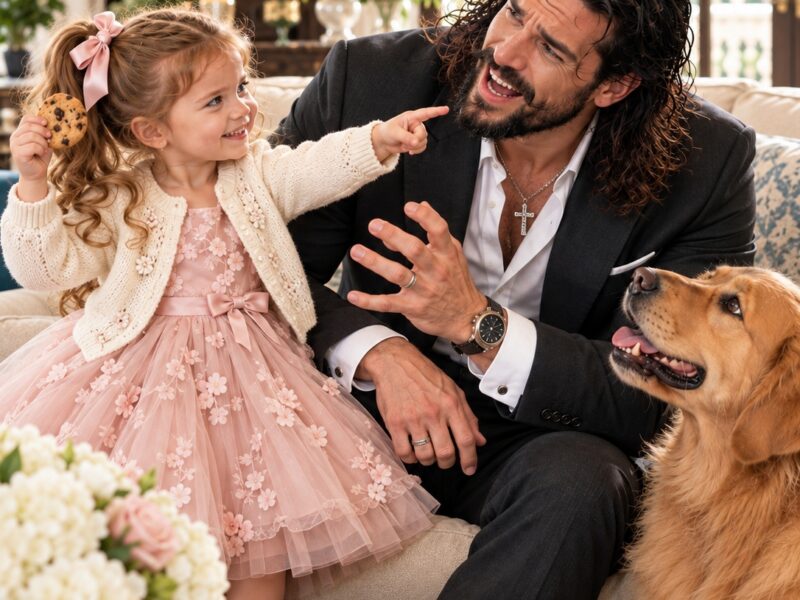
“Mister, Your Dog Stole My Cookie!” a Maid’s Little Girl Told the Mafia Boss—What He Did Next Made His Entire Household Laugh for the First Time in Six Years
“Mister, your dog stole my cookie, and I want him arrested.”
That was the first sentence three-year-old Bianca Bianchi ever spoke to Alessandro Romano, and I was standing six feet away when she said it.
I had worked for the Romano family for twenty-two years. In that time, I had witnessed negotiations that made powerful businessmen lose their composure, family arguments that ended decades of friendship, and occasions when a single quiet instruction from Alessandro could empty a room.
But I had never seen anyone march across his living room, plant two tiny hands on their hips, and accuse his dog of committing a crime.
Especially not a little girl wearing a yellow dress with grass stains on the hem and one pink sneaker tied so badly that its lace trailed across the marble.
Bianca was crying.
Not quietly.
Her cheeks were wet, her dark curls were sticking to her forehead, and her small chest rose and fell with the terrible indignation of someone who had suffered an injustice beyond adult comprehension.
Alessandro lowered the shipping report he’d been reading.
“I’m sorry, young lady?”
Bianca pointed at the enormous black dog sleeping beside the fireplace.
“Your dog.”
Alessandro glanced toward the animal.
“Cesare?”
“Yes. Him.”
Cesare opened one amber eye.
Then closed it again.
“He took my cookie.”
Alessandro leaned back in his leather chair.
“I see.”
“And he didn’t say sorry.”
Beside me, Nico, the youngest member of the household security staff, made a strangled noise.
I pressed my lips together.
Alessandro regarded the child for several seconds.
Then, with the seriousness of a judge hearing an important case, he asked, “Was it a good cookie?”
Bianca’s mouth fell open.
“It was the best cookie.”
“That’s serious.”
“It had chocolate.”
“Very serious.”
“And little colored dots.”
“Sprinkles?”
She nodded vigorously.
“And I was saving the middle because the middle was the best part, but he came and went—”
She made a dramatic grabbing motion with both hands.
“WHOOSH!”
Cesare raised his head.
Bianca pointed at him again.
“See? He knows.”
For one astonishing moment, Alessandro’s expression wavered.
The corner of his mouth moved.
His eyes narrowed as though he were trying very hard not to smile.
Then a sound escaped him.
A low, unfamiliar rumble.
Nico stared.
I stared.
The dog stared.
And Alessandro Romano, a man whose reputation had made half the Hudson Valley afraid to contradict him, began laughing.
Not the controlled smile he offered guests.
Not the brief chuckle he used to acknowledge a polite joke.
Real laughter.
It rolled out of him so unexpectedly that he bent forward, one hand over his eyes.
His shoulders shook.
He tried to stop.
Failed.
And laughed harder.
Bianca watched him with wounded disbelief.
“Mister!”
Alessandro looked up, wiping his eyes.
“Yes, sweetheart?”
“This is not funny.”
That finished him.
He laughed so loudly that Rosa appeared in the doorway from the kitchen, holding a wooden spoon.
“What happened?”
Nico turned toward her.
“The dog,” he managed.
“What about him?”
“Apparently, he’s a criminal.”
Rosa stared.
Then saw Bianca standing before Alessandro’s chair.
The little girl’s expression was so offended that Rosa began laughing too.
I hadn’t heard that much laughter in the Romano house in six years.
Not since Giulia died.
And if anyone had told me that the silence surrounding our employer would finally be broken by a toddler demanding justice over a stolen cookie, I would have thought they’d lost their minds.
But the strangest part of that afternoon wasn’t Alessandro’s laughter.
It was what happened after Bianca stopped crying.
Because when she explained where the cookie had come from, I watched the smile disappear from his face.
And the question of who had stolen a little girl’s afternoon snack became something none of us could laugh about.
My name is Enzo Bellini.
I am sixty-one years old, and for most of my adult life I worked as a driver, household coordinator, and eventually personal security adviser to Alessandro Romano.
I knew his father before him.
I knew his wife, Giulia.
I knew the estate when its gardens were full of summer parties and before the music stopped.
The Romano property stood outside Tarrytown, New York, on a hillside overlooking the Hudson River.
It was a beautiful place.
White stone walls.
Tall cypress trees.
A long gravel driveway winding past ornamental gardens.
A greenhouse where Giulia grew roses, basil, and lemon trees in enormous ceramic pots.
The main house contained twelve bedrooms, a library, two dining rooms, a conservatory, and a ballroom large enough to accommodate a wedding.
During Giulia’s lifetime, the place was rarely quiet.
She hosted charity lunches.
Invited neighbors for dinner.
Filled the guest rooms with relatives who stayed too long.
She had a laugh that carried down hallways and a habit of leaving books open on tables wherever she happened to be reading.
Alessandro complained about the books.
Then quietly collected them every evening and placed them in neat stacks beside her chair.
Giulia was the only person I ever knew who could tell him he was being impossible and make him smile while she said it.
When she died six years earlier, that smile disappeared.
She had been ill for nearly eighteen months.
At first, everyone believed she would recover.
Then the treatments became harder.
The hospital visits longer.
And finally, there came a winter morning when the doctors told Alessandro there was nothing more they could do.
He stayed beside her.
When Giulia died, he returned to the estate and walked straight into his study.
He remained there until morning.
Afterward, the house changed.
Flowers still arrived.
Meals were still served.
The gardens were still maintained.
But Alessandro stopped hosting dinners.
The ballroom remained closed.
He had Giulia’s piano covered.
And whenever someone mentioned her name, he became so still that the conversation usually ended.
He continued managing the businesses he’d inherited from his father.
Some were legitimate.
Freight companies.
Warehouses.
Commercial properties.
Others operated in the gray and criminal territory that had sustained the Romano family for generations.
Alessandro was feared for good reasons.
He had made difficult decisions, enforced unlawful arrangements, and remained surrounded by men whose loyalty often depended on the consequences of disobedience.
I won’t pretend he was innocent.
But grief did something to him that power never had.
It made him unreachable.
For six years, he lived inside an enormous house as though it were a place he was merely waiting to leave.
The only creature who remained consistently beside him was Cesare.
Giulia’s dog.
A black Cane Corso with a broad chest, enormous paws, and an expression that made visitors reconsider how badly they needed to enter a room.
Cesare weighed nearly one hundred and twenty pounds.
He was gentle with people he knew and wary of strangers.
Giulia had worked with a professional trainer to teach him careful boundaries.
He wasn’t permitted to approach visitors without invitation.
He wasn’t allowed food from tables.
He had been taught to leave dropped objects alone and to alert his handler when something unfamiliar appeared in the garden.
He was not a trained detection dog, despite what people later claimed.
But he was observant.
And remarkably disciplined around food.
I had watched him ignore roast chicken, cheese, and freshly baked bread placed within inches of his nose.
So when Bianca accused him of taking her cookie, I found it funny.
For about thirty seconds.
Then I remembered what kind of dog Cesare was.
And why Giulia had insisted on training him so carefully.
Bianca arrived at the estate two months before the cookie incident.
Her mother, Lucia Bianchi, had been hired as an assistant housekeeper.
She was twenty-eight, with dark brown hair, tired eyes, and the habit of apologizing before asking even the smallest question.
I noticed that immediately.
She apologized when I offered to carry her suitcase.
Apologized when Rosa gave her an extra blanket.
Apologized because Bianca spoke loudly during their first meal in the staff kitchen.
Once, she apologized because her daughter laughed.
Rosa put down the spoon she’d been holding.
“Lucia, children are allowed to laugh.”
Lucia looked embarrassed.
“I know.”
“Then stop apologizing.”
Bianca, who was sitting on a chair much too large for her, looked up.
“Mama says sorry lots.”
Rosa laughed.
“I can tell.”
The little girl had enormous brown eyes and dark curls that refused to stay in any hairstyle for more than an hour.
She carried a stuffed rabbit named Mr. Button.
One of his eyes had been replaced with blue thread.
The original plastic eye had disappeared sometime during Bianca’s second year, and the replacement gave him an expression of permanent surprise.
Bianca spoke to him constantly.
She explained what they were eating.
Told him when it was raining.
Warned him not to be rude.
And occasionally blamed him for small household accidents.
When Rosa found a spoon beneath the refrigerator, Bianca explained that Mr. Button had dropped it.
We all understood.
Nobody argued.
Lucia and Bianca lived in a comfortable staff apartment near the garden wing.
Lucia’s schedule was arranged so she could care for her daughter in the evenings.
During work hours, Bianca attended a nearby preschool three days a week.
On the other two days, she stayed with a family friend or played in the staff sitting room under adult supervision.
Lucia seemed grateful for the arrangement.
Almost too grateful.
I learned later that she’d spent the previous year moving between temporary jobs while trying to support Bianca alone.
Her husband, Marco, had disappeared nearly two years earlier.
Lucia told people he had died.
Sometimes she said it had been an accident.
Sometimes she simply changed the subject.
I didn’t pry.
People who came to work for the Romano family often had reasons for wanting a quiet job in a place with high walls.
Still, there was something familiar about the name Marco Bianchi.
I’d heard it before.
I just couldn’t remember where.
Not until the afternoon Cesare stole the cookie.
Alessandro was still laughing when Bianca demanded that he arrest the dog.
He wiped his eyes and straightened in his chair.
“Very well.”
Bianca stopped crying.
“Very well what?”
“We’ll investigate.”
She blinked.
“Investigate?”
“Yes.”
He looked toward me.
“Enzo.”
I immediately straightened.
“Yes, sir?”
“Bring me a notebook.”
I stared.
“A notebook?”
“We have a suspected theft.”
I glanced at Nico.
He looked equally bewildered.
Alessandro raised an eyebrow.
“Do you have somewhere more important to be?”
“No, sir.”
“Then a notebook, please.”
I went into the study and returned with a yellow legal pad.
By the time I came back, Alessandro had moved from his chair to the rug in front of the fireplace.
He was sitting cross-legged.
I had never seen him sit on the floor.
Not once in twenty-two years.
Bianca stood before him with her hands folded solemnly.
Cesare lay nearby, apparently unconcerned about the investigation.
Alessandro took the legal pad.
“Name of the complainant?”
Bianca frowned.
“What?”
“Your name, sweetheart.”
“Bianca.”
“Bianca what?”
“Bianca Bianchi.”
He wrote it down.
“Age?”
She held up three fingers.
“Three and a half.”
“Important distinction.”
“Yes.”
He nodded.
“Now, describe the cookie.”
Bianca took a deep breath.
“It was round.”
“Excellent.”
“And brown.”
He wrote.
“And it had chocolate.”
“Noted.”
“And little colored dots.”
“Sprinkles.”
“Yes.”
He looked at me.
“Enzo, make sure you include the sprinkles.”
I stared at my employer.
“Yes, sir.”
Bianca looked satisfied.
Alessandro continued.
“Where were you when the alleged theft occurred?”
“On the back step.”
“What were you doing?”
“Eating my cookie.”
“Reasonable.”
“I was saving the middle.”
“Because it was the best part?”
She nodded enthusiastically.
“Yes!”
Alessandro wrote another sentence.
“Then what happened?”
Bianca pointed at Cesare.
“He came.”
The dog opened one eye.
“And?”
“He took it.”
“Did you see him take it?”
“Yes!”
“Did he ask permission?”
“No!”
“Did he apologize?”
“NO!”
Alessandro looked toward the dog.
“Cesare.”
The dog lifted his head.
“I am disappointed in you.”
Cesare sighed.
Bianca nodded grimly.
“He knows.”
Alessandro pressed his lips together.
I could see he was fighting another laugh.
He looked at me.
“Bring the accused forward.”
Nico approached Cesare.
The dog stood and walked calmly to the center of the rug.
He sat.
Alessandro leaned forward.
“Cesare, were you present in the garden at approximately three o’clock this afternoon?”
Cesare looked at him.
Then yawned.
Bianca gasped.
“He’s being rude.”
That was when Nico lost his composure.
He turned toward the wall, shoulders shaking.
Rosa laughed openly from the kitchen doorway.
And Alessandro began smiling so broadly that I barely recognized him.
Then Bianca said something that changed the entire afternoon.
“The man gave it to me.”
Alessandro’s smile faded.
“What man?”
Bianca looked up.
“The man by the fence.”
I stopped writing.
Alessandro remained very still.
“Which fence, sweetheart?”
“The one near the roses.”
He glanced toward me.
I knew the place.
A narrow garden path ran along the rear boundary of the estate.
Beyond the stone wall stood an iron service gate used by gardeners and delivery staff.
It was normally locked.
Alessandro turned back to Bianca.
“Did the man work here?”
She shook her head.
“No.”
“Did you know him?”
“No.”
He nodded slowly.
“What did he say?”
Bianca considered the question with the seriousness of someone trying to remember every detail.
“He said it was a present.”
“From whom?”
She looked down at Mr. Button.
Then whispered, “From Daddy’s friend.”
The room became silent.
Alessandro looked at me.
I looked toward the kitchen.
Rosa had stopped smiling.
Bianca continued, unaware of the change.
“He said Daddy would want me to have a cookie.”
Alessandro took a slow breath.
“And did you eat it?”
Bianca shook her head.
“I was going to.”
“Then Cesare took it?”
“Yes.”
She pointed toward the dog.
“He ran away and did a digging.”
Alessandro’s gaze moved to Cesare.
The dog was sitting calmly beside his knee.
For several seconds, nobody spoke.
Then Alessandro looked toward the hallway.
“Enzo.”
“Yes, sir?”
“Ask Paulo to check the rear gate. Quietly.”
I nodded.
“Of course.”
“And make sure the garden remains closed until we’ve spoken with Bianca’s mother.”
He turned back toward the child.
His expression softened.
“You’ve been very helpful, sweetheart.”
Bianca frowned.
“But my cookie—”
“We haven’t forgotten the cookie.”
She looked relieved.
“Good.”
He smiled faintly.
“Justice takes time.”
Lucia arrived less than two minutes later.
She had heard that Bianca had entered the main house and interrupted Alessandro.
Her face was pale.
Her apron was crooked.
She looked as though she’d been running.
“Mr. Romano, I’m so sorry.”
Alessandro stood.
“Lucia.”
She reached for Bianca.
“Come here, sweetheart.”
Bianca looked offended.
“Mama, I’m telling him about the cookie.”
“I know, darling.”
Lucia looked toward Alessandro.
“She wasn’t supposed to come into the living room.”
“She’s not in trouble.”
Lucia stopped.
He gestured toward the sofa.
“Would you sit down for a moment?”
Her expression tightened.
“Sir?”
“I’d like to ask about something Bianca told us.”
Lucia glanced at her daughter.
“What?”
Alessandro spoke carefully.
“Bianca says a stranger gave her a cookie near the rear garden fence.”
The color left Lucia’s face.
She turned toward Bianca.
“What stranger?”
Bianca hugged Mr. Button.
“The man with the hat.”
Lucia’s hands began trembling.
“What man, baby?”
“He said Daddy’s friend.”
For a moment, Lucia looked as though the floor had disappeared beneath her.
She sat down.
Alessandro approached slowly.
“Lucia.”
She looked up.
“Has someone been contacting you?”
She shook her head too quickly.
“No.”
He waited.
Then said quietly, “Your daughter isn’t in trouble. Neither are you.”
Lucia looked toward the door.
I recognized the expression.
She was calculating whether she could leave.
Alessandro noticed too.
He stepped backward, giving her space.
“Would you like to speak privately?”
Lucia swallowed.
Then nodded.
Rosa offered to take Bianca into the kitchen for a snack.
Bianca immediately objected.
“I want my cookie.”
Rosa smiled.
“I have fresh oatmeal cookies.”
“With sprinkles?”
“Not today.”
Bianca considered that.
Then nodded reluctantly.
“Okay.”
She climbed down from Alessandro’s chair.
Cesare followed her toward the kitchen.
Bianca stopped.
Turned.
And pointed at him.
“You’re still in trouble.”
The dog blinked.
Alessandro almost smiled.
But when the child disappeared, the room became very quiet.
Lucia sat at the edge of the sofa holding a glass of water.
Alessandro remained in a chair opposite her.
I stood near the doorway.
He had asked me to stay because I managed the household security records and knew most of the staff.
“Tell me about Bianca’s father,” Alessandro said.
Lucia looked down.
“His name was Marco.”
“Marco Bianchi?”
She nodded.
Something moved in Alessandro’s expression.
I felt a cold sensation in my stomach.
Marco Bianchi.
Of course.
He had worked for the Romano freight business.
A quiet bookkeeper with dark hair and thick glasses.
He had disappeared two years earlier after allegations that money had been stolen from several company accounts.
At the time, Alessandro was barely functioning following Giulia’s death.
The investigation had been handled by Vittorio Greco, his longtime adviser.
Vittorio reported that Marco had taken nearly two million dollars and vanished.
A vehicle registered to Marco was later found abandoned near a ravine.
There was no body.
The family concluded he’d fled with the money.
I remembered the case.
Mostly because Marco hadn’t seemed like the kind of man who would steal that much.
He was nervous.
Methodical.
Always carried two pens.
And once spent half an hour explaining a three-dollar accounting discrepancy because he couldn’t bear leaving a balance sheet incomplete.
Alessandro looked toward me.
“Enzo.”
“Yes?”
“Bring the Marco Bianchi file.”
I nodded.
Then left.
When I returned, Lucia was crying quietly.
Alessandro sat beside her.
Not behind his desk.
Not looking down at her.
Beside her.
I placed the file on the table.
He didn’t open it immediately.
Instead, he looked at Lucia.
“Tell me what happened.”
She took a shaky breath.
“Marco wasn’t a thief.”
Alessandro remained silent.
“He was frightened of everything,” she continued. “Even arguments. He hated confrontation.”
She wiped her eyes.
“But he loved numbers. He said numbers were honest because they didn’t change their stories depending on who was listening.”
Alessandro looked down.
Lucia continued.
“A month before he disappeared, he came home from work looking terrified.”
“What did he say?”
“That something was wrong with the harbor accounts.”
Alessandro became still.
“He’d found payments that didn’t match the invoices,” Lucia explained. “Money moving between companies that shouldn’t have been connected.”
“Did he identify the accounts?”
She nodded.
“He wrote them down.”
“Where?”
Lucia hesitated.
Then looked toward the kitchen.
For a moment, I thought she wasn’t going to answer.
Finally, she whispered, “He left me a notebook.”
Alessandro looked at her.
“Do you still have it?”
She nodded.
“Where?”
Lucia swallowed.
“Somewhere safe.”
He studied her.
Then said quietly, “I understand why you wouldn’t trust me.”
Her eyes filled.
“Mr. Romano—”
“No.”
He shook his head.
“Your husband disappeared. My organization accused him of theft. You had every reason to be afraid.”
Lucia looked down.
“I thought you knew.”
“Knew what?”
“That he hadn’t stolen anything.”
Alessandro’s jaw tightened.
For a long moment, he said nothing.
Then he looked toward the portrait of Giulia hanging above the fireplace.
“I should have asked more questions.”
His voice was barely audible.
“I should have looked at the evidence myself.”
Lucia began crying harder.
He offered her a clean handkerchief.
Then said, “Whatever happened to Marco, we will examine it properly. But first I need to know who approached Bianca.”
She looked up.
“I don’t know.”
“Has anyone recently asked you about your husband?”
She hesitated.
Then nodded.
“Someone called last week.”
“Who?”
“A man who said he worked for an insurance company.”
Alessandro remained still.
“What did he want?”
“He asked whether Marco had left any personal records.”
“What did you tell him?”
“Nothing.”
Her voice cracked.
“I hung up.”
Alessandro looked toward me.
I understood.
This was no longer a question about a missing cookie.
Someone had learned that Marco’s widow still possessed information.
And now that person had approached her three-year-old daughter.
By evening, the rear garden had been searched.
Paulo, the guard assigned to the service gate, reported that an unfamiliar delivery van arrived shortly before three.
The driver wore a gray cap.
He claimed to be delivering bread for a household employee.
Paulo inspected the cargo and found ordinary bakery boxes.
He had no reason to suspect a problem.
The van left after several minutes.
But a second camera positioned near the garden wall recorded a man walking along the outer path.
He paused near the iron fence.
The image was grainy.
His face was partly hidden by the cap.
But there was enough to show him bending toward someone on the garden side.
Bianca.
Then he walked away.
The footage also showed Cesare moving quickly across the grass.
A few seconds later, the dog ran toward the rose beds.
He stopped.
Lowered his head.
And began pawing at the soil.
I watched the recording twice.
Then looked toward Alessandro.
He remained silent.
Finally, he said, “Let’s find the cookie.”
We went into the garden after dark.
A cold mist had begun rising from the river.
The cypress trees stood black against the sky.
Alessandro wore a dark sweater beneath his coat.
Cesare walked beside him.
I carried a flashlight.
At the rose beds, Alessandro stopped.
“Cesare.”
The dog looked up.
“Show me.”
Cesare lowered his nose.
He moved along the garden border.
Then stopped near a patch of disturbed soil.
He sat.
Alessandro looked at me.
I knelt.
The earth was soft from rain.
I moved it aside carefully.
Two inches beneath the surface was a chocolate cookie.
Or most of one.
A small corner had been broken away.
The rest was covered in soil and bits of leaf.
Colored sprinkles remained visible along the edge.
I looked up.
Alessandro was staring at it.
He didn’t speak.
I placed the cookie in a clean evidence bag.
Then stood.
Cesare remained seated.
Alessandro crouched beside him.
For a moment, he rested one hand against the dog’s broad head.
“Good boy,” he whispered.
The dog leaned into his touch.
We returned to the house.
A veterinarian was contacted to assess Cesare, and the authorities were asked to arrange appropriate testing of the recovered food.
Nobody told Bianca what we suspected.
She was asleep by then.
Mr. Button rested beneath her chin.
And the dog she’d accused of theft lay outside her bedroom door, listening to every sound in the hallway.
At 6:10 the following morning, Alessandro called me into his study.
He had not slept.
His shirt was the same one he’d worn the previous evening, and an untouched cup of coffee sat beside his desk.
The veterinarian had examined Cesare and found no sign that he’d swallowed any of the cookie. For once, the dog’s habit of carrying strange objects away without eating them had worked in our favor.
The preliminary laboratory findings about the cookie, however, were troubling.
Alessandro handed me a note from the veterinarian coordinating the testing.
“Read it.”
The examination had identified an unidentified substance in the recovered food, and a toxicology laboratory was conducting confirmatory analysis.
I looked up.
“Are they certain?”
“Not yet about the substance,” Alessandro said. “But they’re certain enough to tell us not to treat this as an ordinary cookie.”
My stomach tightened.
I thought of Bianca standing on the back step.
Her little yellow dress.
The chocolate sprinkles.
The stranger telling her the cookie came from her father’s friend.
“What are we doing?”
Alessandro looked toward the garden.
“The police have the footage. Elena Marquez is coordinating with them.”
“Do you think somebody intended to hurt the child?”
“I don’t know.”
He said it without pretending.
Then his expression hardened.
“But someone approached her through a locked garden boundary and gave her food while using the name of her dead father. That’s more than enough reason to take this seriously.”
I nodded.
Alessandro reached for a photograph on his desk.
Giulia.
She stood beside Cesare when he was a puppy, his oversized paws planted awkwardly on the lawn.
Her face was bright with laughter.
Alessandro touched the edge of the frame.
“She used to tell me we were fools to think walls could make a house safe.”
I waited.
“She said safety was about people. About knowing who could be trusted.”
He looked toward the door.
“For six years, I’ve been living in a house full of people who depend on my name.”
His voice became quieter.
“And yesterday, a three-year-old child had to come into my living room to tell me something wasn’t right.”
I didn’t know what to say.
Then he looked at me.
“Enzo, bring Lucia here when she’s ready. And ask Margaret to arrange temporary leave for her with full pay.”
I nodded.
He continued.
“Not because she’s done anything wrong. Because she needs time to think without worrying about her job.”
There was something different in the way he spoke.
Years earlier, he might have ordered everyone moved to another property, closed the estate, and taken control of every decision.
Now he seemed determined to do something he had rarely done.
Ask.
Lucia arrived at the study shortly after eight.
She wore a pale blue cardigan and carried Bianca’s stuffed rabbit beneath one arm.
Her daughter was with Rosa in the staff sitting room.
Alessandro rose when Lucia entered.
“Good morning.”
“Morning, sir.”
“Please sit.”
She looked toward me.
I offered a reassuring nod.
She sat.
Alessandro took the chair opposite her.
“I wanted to tell you what we know.”
He explained the recovered cookie, the ongoing testing, and the investigation into the unknown visitor.
Lucia listened without interrupting.
Then she pressed the rabbit against her chest.
“Oh, God.”
Alessandro leaned forward.
“Bianca appears well, and a clinician has checked her. We don’t have evidence she ingested anything harmful.”
Lucia closed her eyes.
For several seconds, she breathed unevenly.
Then she whispered, “I should never have let her play outside.”
Alessandro shook his head.
“Lucia, she was playing in a garden with household security nearby. Someone deliberately crossed a boundary to approach her.”
Tears slipped down her cheeks.
“She could have eaten it.”
“Yes.”
The honesty made her flinch.
Alessandro continued gently.
“And that’s why we’re going to find out who gave it to her.”
She looked down at Mr. Button.
The rabbit’s repaired eye stared back.
For a while, the room was quiet.
Then Alessandro asked, “May I ask about Marco’s notebook again?”
Lucia’s fingers tightened around the toy.
She hesitated.
Then nodded.
“Yes.”
“Where is it?”
She looked toward the rabbit.
I noticed.
So did Alessandro.
Lucia drew a slow breath.
“Marco gave it to me the evening before he disappeared.”
Her voice trembled.
“He said somebody might come looking. He wanted me to keep it where nobody would think to search.”
She turned the rabbit over.
Its faded fabric was stitched along the back.
There was a small section where the thread was slightly darker.
“I sewed it inside.”
I stared.
Alessandro didn’t speak.
Lucia reached into her cardigan pocket and removed a small pair of sewing scissors.
She carefully opened a few stitches.
Then reached into the rabbit.
From a narrow pocket hidden inside the stuffing, she withdrew a black notebook wrapped in plastic.
It was no larger than a paperback.
The cover was worn.
A rubber band held it closed.
Lucia placed it on the table.
“Marco wrote everything by hand,” she whispered.
Alessandro looked at the notebook.
He didn’t touch it.
Instead, he glanced at me.
“Enzo, ask Elena to come immediately. And tell her we need to document how this was preserved.”
I nodded.
Lucia stared at him.
“You’re not going to open it?”
“I want to,” Alessandro admitted. “But if this is evidence of what happened to Marco, we need to handle it properly.”
For the first time, Lucia looked at him with something other than fear.
It wasn’t trust.
Not yet.
But perhaps the beginning of it.
She nodded.
“All right.”
Then her eyes returned to the rabbit.
“Bianca sleeps with that every night.”
Alessandro looked at the toy.
Its seam was open.
A small amount of stuffing had escaped onto the table.
He almost smiled.
“I think Mr. Button deserves a trip to the sewing room.”
Lucia blinked.
Then a small, broken laugh escaped her.
“He really does.”
By noon, Elena Marquez had arrived with an investigator authorized to review the records.
The notebook was photographed, its history documented, and its pages examined.
I remained near the doorway.
Lucia sat beside Alessandro.
Most of the entries were financial.
Account numbers.
Dates.
Company names.
Transfers from the Romano freight operations into smaller businesses that appeared legitimate on paper.
Marco had written brief notes in the margins.
Invoice doesn’t match.
Duplicate payment.
Vendor not registered.
Ask V.G. Monday.
The initials appeared repeatedly.
V.G.
I knew the initials before anyone spoke them.
Vittorio Greco.
Alessandro’s oldest adviser.
Vittorio had been part of the family organization for nearly thirty years.
He was sixty-four, silver-haired, soft-spoken, and exceptionally good at making unpleasant decisions sound reasonable.
He managed sensitive negotiations with other business groups.
He had organized several of the financial arrangements the Romano family relied upon.
And he had been the person who first reported Marco’s disappearance.
Alessandro stared at the notebook.
For a long moment, nobody moved.
Then he asked, “Does this establish where the money went?”
Elena examined the pages.
“It gives us a trail. We need independent bank and corporate records to corroborate it.”
Alessandro nodded.
He looked toward Lucia.
She was staring at the table.
“Did Marco ever mention Vittorio directly?”
Her expression changed.
“Yes.”
“What did he say?”
“That Mr. Greco had become angry when he questioned several invoices.”
She swallowed.
“Marco said he was told to stop worrying about details.”
Alessandro leaned back slowly.
I watched his face.
For years, he had trusted Vittorio with matters he no longer wanted to handle.
After Giulia died, that reliance became almost complete.
He let Vittorio supervise personnel changes, financial reviews, supplier relationships, and disputes between the businesses.
It had seemed efficient.
Loyal.
Necessary.
Now he was looking at evidence that the man he’d trusted most might have used his grief as cover for something much worse.
“Who recommended Lucia for the household position?” Elena asked.
I answered before I could stop myself.
“Vittorio.”
Everyone looked at me.
I swallowed.
“He said she’d worked for a family friend. That she needed a stable position.”
Lucia nodded.
“He approached me after church.”
Alessandro turned toward her.
“When?”
“About three months before I started here.”
“Did he know you were Marco’s wife?”
“Yes.”
The answer settled over the room.
Vittorio had placed Marco’s widow inside the estate.
At first, I’d assumed it was kindness.
Now another possibility emerged.
He might have wanted her somewhere he could watch.
Somewhere he controlled the household arrangements.
Somewhere a young woman with limited money would be reluctant to challenge the powerful people employing her.
Alessandro looked toward the investigator.
“I want every relevant record preserved.”
Then he looked at Elena.
“And nobody confronts Vittorio until the authorities have what they need.”
I stared.
The words surprised me.
Alessandro noticed.
He gave me a tired smile.
“Enzo, I’ve made enough decisions in anger to last several lifetimes.”
He looked at Marco’s notebook.
“This one needs to survive a courtroom.”
That afternoon, Vittorio came to the estate.
He arrived in his usual silver sedan shortly after three.
I saw him from the front hall.
He stepped out wearing a dark overcoat and carrying a leather briefcase.
The sky was gray.
Rain had stopped, leaving the driveway wet.
Cesare stood beside the main entrance.
When Vittorio approached, the dog became still.
He didn’t bark.
Didn’t growl.
He simply watched.
Vittorio reached toward his head.
“Hello, old boy.”
Cesare moved away.
Vittorio laughed softly.
“Still no affection for me?”
I smiled politely.
Inside, Alessandro was waiting in his study.
Elena had already left with the evidence and had advised him not to discuss the investigation with anyone potentially involved.
Vittorio entered.
“Alessandro.”
“Vittorio.”
They shook hands.
The older man glanced toward the window.
“Beautiful afternoon.”
“Cold.”
“Good for the garden.”
They sat.
For several minutes, they discussed an ordinary freight contract.
Vittorio seemed relaxed.
Then he asked, “I heard there was some trouble with a child yesterday.”
I stood near the bookcase.
My stomach tightened.
Alessandro looked up.
“What trouble?”
“Something in the garden.”
“Who told you?”
Vittorio shrugged.
“People talk.”
Alessandro studied him.
Then nodded.
“A small misunderstanding. The housekeeper’s daughter was upset about a cookie.”
Vittorio smiled.
“Children.”
“Yes.”
“Was she hurt?”
“No.”
“Good.”
He took a sip of coffee.
“Very good.”
Alessandro watched him carefully.
Then returned to the contract.
I stood beside the door and tried not to move.
There were hundreds of things I wanted to say.
About Marco’s notebook.
About Bianca.
About the unexplained visitor.
But Alessandro had made his decision.
The evidence would be handled properly.
Not through a confrontation that allowed Vittorio to destroy records or disappear before investigators could act.
For nearly an hour, they discussed business.
Then Vittorio stood.
“I’ll see you Friday.”
Alessandro nodded.
“Of course.”
At the doorway, Vittorio paused.
“Alessandro.”
“Yes?”
“You look better.”
Alessandro raised an eyebrow.
“Do I?”
“There’s something different about you.”
He gave a faint smile.
“Maybe I’ve been sleeping.”
Vittorio laughed.
“About time.”
Then he left.
The front door closed.
Alessandro remained seated until the sound of Vittorio’s car faded down the driveway.
Then he looked at me.
“Enzo.”
“Yes, sir?”
“Have we ever let ourselves believe loyalty was the same as honesty?”
I considered the question.
Then answered carefully.
“Sometimes, sir.”
He nodded.
“So have I.”
The investigation did not end quickly.
Over the following weeks, investigators obtained records connecting Vittorio-controlled companies to unexplained transfers from the Romano freight businesses.
They interviewed former employees.
Reviewed old contracts.
Located a former accounts supervisor who had resigned shortly after Marco disappeared.
She remembered Marco asking questions about missing invoices.
She also remembered Vittorio’s reaction.
“He was furious,” she told investigators.
“He said Marco was creating trouble for everyone.”
The information was corroborated by archived emails.
Another former employee recalled being instructed to revise records after Marco’s disappearance.
Then investigators discovered something that changed the case entirely.
Marco’s car had been found near a ravine, but the original investigation had never established that he was driving it when it was abandoned.
A man who once serviced the vehicle reported seeing someone else collect it from the parking garage that evening.
The report had been dismissed as unreliable.
Now investigators revisited it.
They found additional evidence suggesting the scene had been staged.
The family had been told Marco stole money and fled.
But the records told a different story.
Marco had discovered financial wrongdoing.
He had attempted to report it.
Then he disappeared.
And the people responsible for explaining his disappearance had been among those who benefited from it.
Lucia spent those weeks in a state of constant uncertainty.
Some mornings she hoped Marco might still be alive.
Other mornings she was frightened of what the investigation would reveal.
She had spent nearly two years grieving a man without knowing whether she was allowed to call herself a widow.
I watched her struggle.
She continued working part-time after the immediate danger eased, though Alessandro made it clear she could take leave whenever she needed.
Bianca attended preschool.
Played with Mr. Button.
Asked every morning whether Cesare had been forgiven.
The adults tried to maintain normal routines around her.
Children need breakfast.
Clean clothes.
Stories before bed.
Their lives cannot remain suspended while grown-ups wait for legal answers.
But sometimes, after Bianca fell asleep, Lucia sat alone in the staff sitting room holding Marco’s photograph.
And the uncertainty became almost unbearable.
One evening, I found her there.
She looked up quickly.
“I’m sorry.”
I sat opposite her.
“Lucia, you don’t need to apologize for being sad.”
Her eyes filled.
“I thought I was prepared.”
“For what?”
“To find out the truth.”
She looked down.
“But now that people are actually looking, I’m terrified.”
I considered that.
Then said, “The truth can be frightening even when it doesn’t change what’s already happened.”
She looked at me.
I continued.
“But it can change what happens next.”
Lucia wiped her eyes.
For a while, neither spoke.
Then she smiled faintly.
“Bianca says Cesare should go to court.”
I laughed.
“She does?”
“She wants a judge to decide whether he owes her another cookie.”
I shook my head.
“That child is going to be a lawyer.”
Lucia laughed through tears.
It was the first time I’d heard her laugh without immediately seeming embarrassed.
The final breakthrough came in January.
Investigators identified a former driver connected to Vittorio who had been involved in moving Marco’s vehicle.
Faced with evidence of his involvement in the wider financial conspiracy, the man agreed to cooperate.
His testimony led investigators to an abandoned property outside the city.
There, they recovered evidence establishing that Marco had died shortly after his disappearance.
I won’t describe the details.
Lucia deserved privacy.
So did Bianca.
What mattered was that Marco had not stolen the money.
He had tried to expose the people who did.
And those people had worked to destroy his reputation after he was gone.
When Alessandro learned the truth, he sat alone in his study for nearly an hour.
I found him beside the fireplace.
Giulia’s photograph rested on his desk.
Marco’s notebook lay before him in a transparent evidence sleeve.
He looked older than he had weeks earlier.
Not physically.
In the way grief sometimes seems to add years to a person’s eyes.
“Enzo,” he said.
I stopped.
“Yes, sir?”
“Marco worked for this family nine years.”
“Yes.”
“He was honest.”
“Yes.”
“And I allowed a man I trusted to tell me he was a thief.”
I didn’t answer.
Alessandro stared at the fire.
“Lucia believed I was responsible.”
I looked down.
He continued.
“I can’t blame her.”
For a moment, his voice faltered.
Then he said, “When Giulia died, I stopped paying attention to anything that didn’t require my signature.”
He looked toward the notebook.
“And people suffered because of that.”
I stepped closer.
“Sir, you couldn’t have known everything.”
He shook his head.
“No.”
Then looked at me.
“But I was responsible for asking questions.”
The room grew quiet.
Finally, he stood.
“Bring Lucia here tomorrow if she’s willing.”
I nodded.
He looked toward the window.
“And ask Elena to prepare the documents needed to correct the company records publicly.”
“Of course.”
He paused.
“Marco Bianchi’s name will not remain attached to a theft he didn’t commit.”
Lucia came to the study the following morning.
Bianca was at preschool.
Alessandro stood when she entered.
He looked at her for a long moment.
Then said, “I have news.”
Lucia’s hands tightened around her handbag.
She sat.
He didn’t sit behind his desk.
He took the chair opposite her.
Then told her the truth.
Carefully.
Without unnecessary detail.
When he finished, Lucia remained very still.
She stared at the floor.
For several seconds, she didn’t seem to hear him.
Then she whispered, “He’s really gone.”
Alessandro nodded.
“Yes.”
Her face crumpled.
She covered her mouth.
And cried.
I stood near the door, unsure whether to leave.
Alessandro remained beside her.
He didn’t try to stop her tears.
Didn’t offer easy reassurances.
He simply waited.
After a long time, Lucia looked up.
“He didn’t steal.”
“No.”
Her voice shook.
“He was frightened, but he still tried to do the right thing.”
“Yes.”
She wiped her face.
“People called him a thief.”
Alessandro’s expression tightened.
“I know.”
She looked directly at him.
“You believed them.”
The words were not loud.
They were worse than anger.
They were true.
Alessandro lowered his eyes.
“Yes.”
Lucia stared at him.
For a moment, I thought she would leave.
Then she asked, “Why?”
He took a long breath.
“Because I was grieving Giulia. Because Vittorio had been with me for decades. Because I accepted his explanation rather than examining the evidence myself.”
He looked at her.
“Those are explanations, Lucia. Not excuses.”
Her eyes filled again.
He continued.
“I’m sorry.”
She looked away.
For a long time, neither spoke.
Then she whispered, “I wanted to hate you.”
Alessandro nodded.
“I understand.”
“I thought you took my husband from me.”
His jaw tightened.
“I know.”
She looked back.
“But Bianca likes you.”
A faint, painful smile crossed his face.
“I like her.”
“She says you listen better than most grown-ups.”
He closed his eyes briefly.
Lucia continued.
“She’s right.”
For a moment, her expression softened.
Then she looked down again.
“I don’t know what to do now.”
Alessandro considered that.
“You don’t have to decide today.”
She nodded slowly.
Then asked, “What happens to the men responsible?”
“The authorities have the evidence. There will be charges and court proceedings.”
Lucia looked up.
“You’re not going to handle it your way?”
The question hung between them.
Alessandro’s face grew still.
For years, a question like that would have sounded almost insulting.
Now he answered without hesitation.
“No.”
“Why?”
He looked toward Giulia’s photograph.
“Because this has already cost too many people their futures.”
He turned back.
“Marco deserves the truth to be established somewhere people cannot simply change it when I am gone.”
Lucia stared at him.
Then slowly nodded.
It wasn’t forgiveness.
Not yet.
But it was something.
And sometimes, something is where healing begins.
Vittorio Greco was arrested three days later.
I remember that morning clearly.
The sky was pale.
Frost covered the edges of the driveway.
Cesare stood beside Alessandro at the front entrance, watching as investigators escorted Vittorio toward a waiting vehicle.
The older man looked smaller than I remembered.
His expensive overcoat hung loosely around his shoulders.
For the first time in decades, he did not seem entirely certain of himself.
He stopped near Alessandro.
“After everything I’ve done for you?”
Alessandro regarded him quietly.
Vittorio shook his head.
“Thirty years. I kept your father’s business alive. I carried the organization when you could barely get out of bed.”
Alessandro didn’t answer.
Vittorio continued.
“And now you let them take me because some housekeeper found a notebook?”
Something changed in Alessandro’s expression.
Not anger.
Disappointment.
He stepped closer.
“You still don’t understand.”
Vittorio stared.
“Marco Bianchi was an honest man,” Alessandro said. “His wife spent two years believing she’d never know what happened to him. And a three-year-old child was approached by a stranger because somebody wanted to frighten her mother.”
Vittorio looked away.
Alessandro continued.
“You call that protecting the family?”
Silence.
Then Vittorio said bitterly, “You’re becoming sentimental.”
Alessandro looked toward Cesare.
The dog stood calmly beside him.
“No,” he answered.
“I think I’m finally becoming responsible.”
Vittorio was taken away.
The gates closed.
For a long moment, nobody moved.
Then Alessandro turned toward me.
“Enzo.”
“Yes?”
“See that the staff are informed. No rumors. No unnecessary details.”
I nodded.
“And make sure Lucia receives the information from her attorney, not from gossip.”
“Yes, sir.”
He glanced toward the house.
“And tell Rosa I’m coming to breakfast.”
That surprised me.
Alessandro had eaten breakfast alone for six years.
I looked at him.
“With the household, sir?”
He considered.
Then nodded.
“With whoever wants to join me.”
I smiled.
For a moment, I thought of Giulia.
She would have loved that.
The trial began several months later.
Vittorio faced charges involving financial fraud, conspiracy, and offenses connected to Marco’s disappearance.
Other people involved in the scheme were also prosecuted.
The evidence took time to examine.
Witnesses testified.
Bank records were reviewed.
Marco’s notebook became one part of a much larger case, supported by independent documents and testimony.
The proceedings were painful for Lucia.
She had to hear details about her husband’s final days that she’d spent years imagining and dreading.
But she also heard witnesses describe his honesty.
His persistence.
His determination to report what he had discovered.
The public record finally reflected the man she remembered.
Not a thief.
Not someone who abandoned his family.
A careful bookkeeper who tried to do the right thing when he realized something was wrong.
After Vittorio’s conviction, Alessandro issued a formal statement correcting the accusations that had been made against Marco.
The company arranged outstanding employment benefits and financial restitution through legal channels.
At the harbor office where Marco once worked, a small plaque was installed.
It read:
In Memory of Marco Bianchi — For His Integrity, His Courage, and His Commitment to the Truth.
Lucia stood before it holding Bianca’s hand.
The little girl was four by then.
She stared at the letters.
“Mama?”
“Yes, sweetheart?”
“Is that Daddy?”
Lucia nodded.
“It’s his name.”
Bianca looked up.
“Was he nice?”
Lucia’s eyes filled.
“Yes.”
“Did he like cookies?”
A laugh escaped her.
“Oh, sweetheart.”
She knelt.
“Your daddy loved cookies.”
Bianca smiled.
“Like me.”
“Just like you.”
The little girl looked toward the plaque again.
Then held up Mr. Button.
“Rabbit says hello, Daddy.”
Lucia covered her mouth.
For a moment, she couldn’t speak.
Then she wrapped her arms around her daughter.
I stood nearby with Alessandro.
He watched them quietly.
His expression carried an ache I recognized.
He was thinking about Giulia.
About years lost.
About how much of life disappeared before people understood what mattered.
He looked toward me.
“Enzo.”
“Yes?”
“Do you think there’s anything more we should do?”
I considered the question.
Then shook my head.
“Not today, sir.”
He looked back toward Lucia and Bianca.
For once, he seemed willing to accept that answer.
When Lucia returned to the estate, Alessandro asked to speak with her in the garden.
It was a cold afternoon in early spring.
The roses had not yet bloomed.
Cesare slept beneath a bench near the greenhouse.
Bianca was inside with Rosa, helping arrange flowers in a vase.
I watched from a distance as Alessandro and Lucia walked slowly along the gravel path.
He carried no documents.
No briefcase.
No elaborate gift.
Only a folded letter.
Later, Lucia told me what they discussed.
Alessandro apologized again.
Not because he expected forgiveness.
Because the earlier apology had been made before the investigation established everything that happened.
He wanted her to hear him say plainly that Marco had been wronged, that Alessandro’s negligence had contributed to the false accusations, and that the family’s influence had allowed the truth to remain buried.
Lucia listened.
Then said, “I don’t know whether I can forgive all of it.”
Alessandro nodded.
“I understand.”
She looked toward the greenhouse.
“I don’t want Bianca to grow up believing she owes anyone gratitude for something that should have been done in the first place.”
“Neither do I.”
She studied him.
“Then what happens now?”
He handed her the letter.
It was an offer.
Not of a house.
Not of money in exchange for silence.
A professional opportunity.
The estate’s household accounts had recently been separated from the wider business organization and placed under independent management.
Alessandro wanted Lucia to consider a position as administrative coordinator.
The role came with formal responsibilities, a higher salary, training, and a clear reporting structure.
There was no requirement that she accept.
And no condition that she remain at the estate.
Lucia read the letter.
Then looked up.
“Why me?”
Alessandro smiled faintly.
“Because you’re organized. Because you know the household. And because you asked more questions about our accounts than several people I used to pay considerably more.”
She almost laughed.
Then became serious.
“I don’t have formal accounting qualifications.”
“Then the training is included.”
She looked at the offer again.
“And if I decline?”
“Nothing changes about the support Bianca is legally entitled to receive.”
Lucia studied him.
For a moment, the wind moved through the trees.
Then she folded the letter.
“I’ll think about it.”
Alessandro nodded.
“Good.”
She began walking toward the house.
Then stopped.
“Mr. Romano.”
He turned.
“Yes?”
“Why did you give investigators the notebook instead of keeping it?”
He considered the question.
“Because it was evidence.”
“That isn’t what I meant.”
He looked toward the greenhouse.
Then answered quietly.
“Because when I learned what happened to Marco, I understood that he’d spent the last days of his life trying to make sure someone heard the truth.”
He turned back.
“I wasn’t going to silence him a second time.”
Lucia’s eyes filled.
She nodded.
Then continued toward the house.
Two weeks later, she accepted the position.
Something changed in the Romano estate that spring.
It wasn’t dramatic.
There was no announcement.
No formal celebration.
Just small differences that accumulated until the house felt unfamiliar in the best possible way.
Alessandro began eating breakfast with the staff on Saturday mornings.
At first, everyone was uncomfortable.
Rosa insisted on setting a separate place at the head of the table.
He moved his chair.
Nico nearly dropped a cup when Alessandro asked him to pass the jam.
I watched the confusion with considerable amusement.
Alessandro seemed to enjoy it too.
He asked questions.
About people’s families.
Their work.
What needed repairing around the estate.
He discovered that the greenhouse heater had been unreliable for months because the gardener was afraid to request an expensive replacement.
He approved the repair.
Then asked why nobody had mentioned it.
The gardener looked embarrassed.
Alessandro sighed.
“I suppose I know.”
One afternoon, he asked Rosa whether she preferred continuing to work at the estate or retiring.
She stared at him.
“Don Alessandro.”
“Yes?”
“Are you trying to get rid of me?”
“No.”
“Then stop asking foolish questions.”
He laughed.
Rosa smiled.
“I’ll retire when I decide to.”
“Fair enough.”
She returned to the stove.
Then added, “And you’ll eat your vegetables.”
Alessandro laughed again.
It was becoming a familiar sound.
The first time he’d laughed in front of Bianca, everyone had looked alarmed.
Now it no longer surprised us.
At least not as much.
The greatest change, however, concerned Cesare.
The old dog had become Bianca’s devoted companion.
She followed him everywhere.
He tolerated being decorated with ribbons.
Accepted gentle hugs.
And occasionally allowed Mr. Button to ride on his back for approximately three seconds before standing up and ending the arrangement.
Bianca considered him her best friend.
But she had not forgotten the cookie.
Not for a moment.
One bright Sunday morning, exactly six weeks after Vittorio’s arrest, Bianca marched into the living room wearing her yellow dress.
Her shoes were tied correctly this time.
Her hair had been brushed into two neat pigtails.
She carried a small notebook that Rosa had given her.
Alessandro sat in his leather chair reading the newspaper.
Cesare slept beside the fireplace.
I was near the doorway discussing the garden schedule with Nico.
Bianca approached.
“Mister.”
Alessandro looked up.
“Yes, sweetheart?”
“We have unfinished business.”
I stopped talking.
Nico turned away immediately.
I could see his shoulders beginning to shake.
Alessandro lowered the newspaper.
“Do we?”
Bianca nodded.
“The cookie case.”
Alessandro’s face became solemn.
“Ah.”
She opened the notebook.
Inside were several drawings.
One looked like a dog.
One resembled a cookie.
The third was mostly blue scribbles.
She pointed at the first picture.
“This is Cesare.”
“I recognize him.”
She pointed at the second.
“This is the cookie.”
“Excellent likeness.”
“And this is me being sad.”
Alessandro examined the blue scribbles.
“Very expressive.”
Bianca nodded.
“Thank you.”
He folded the newspaper.
“Very well. Shall we continue the hearing?”
“Yes.”
He looked toward me.
“Enzo.”
I straightened.
“Yes, sir?”
“Please bring the accused.”
Nico made a choking sound.
I walked toward Cesare.
The dog opened one eye.
“Come on, old friend.”
He stood.
Stretched.
Then walked into the center of the carpet.
Bianca planted her hands on her hips.
Alessandro leaned forward.
“Cesare Romano.”
The dog looked at him.
“You stand accused of stealing one chocolate cookie with sprinkles from Miss Bianca Bianchi.”
Cesare sighed.
Bianca nodded fiercely.
“Correct.”
“Do you have anything to say in your defense?”
The dog yawned.
Nico burst out laughing.
Bianca looked offended.
“He’s doing it again.”
Alessandro raised one finger.
“Order in the court.”
I pressed my lips together.
He turned toward Bianca.
“During our investigation, we learned that the cookie was not safe to eat.”
Bianca frowned.
“Why?”
“Because someone who shouldn’t have given you food had put something in it that didn’t belong there.”
She looked toward Cesare.
“Like broccoli?”
Alessandro paused.
I saw the laughter threatening to return.
“Not broccoli.”
“Because I don’t like broccoli.”
“An understandable opinion.”
She considered that.
Then asked, “Was it a bad cookie?”
“Yes.”
“A very bad cookie?”
“Very.”
Bianca looked toward Cesare.
The dog sat calmly.
Alessandro continued.
“And we’ve established that Cesare took the cookie away from you.”
She nodded.
“Yes.”
“But he didn’t eat it.”
“No.”
“He carried it away and left it where it could be found.”
Bianca looked confused.
Alessandro leaned forward.
“Sweetheart, I think Cesare knew something wasn’t right.”
She stared at the dog.
“Really?”
“Yes.”
For a moment, nobody spoke.
Then Bianca approached Cesare.
She crouched.
Looked into his enormous face.
And whispered, “You were helping me?”
Cesare leaned forward and gently touched his nose against her hand.
Bianca gasped.
Then looked at Alessandro.
“He said yes.”
Alessandro smiled.
“I believe he did.”
She stood.
“What happens now?”
Alessandro straightened.
He folded his hands.
Then announced in his best courtroom voice, “After a careful investigation, the court finds that the accused did remove the cookie.”
Bianca nodded seriously.
“However,” he continued, “the court also finds that the cookie was unsafe, and the accused acted to protect the complainant.”
He looked toward Cesare.
“Therefore, Cesare is found not guilty.”
Bianca frowned.
“Not guilty?”
“Not guilty.”
She considered that.
Then asked, “Does he still have to say sorry?”
Alessandro smiled.
“I think perhaps someone else owes him an apology.”
Bianca looked toward the dog.
For several seconds, she seemed to be thinking very hard.
Then she walked over and wrapped both arms around Cesare’s thick neck.
“I’m sorry, Cesare.”
The dog closed his eyes.
She pressed her cheek against his fur.
“You’re a good boy.”
Then she added, “But you should still ask next time.”
That was when Alessandro began laughing.
The sound filled the room.
Nico laughed.
I laughed.
Rosa appeared in the doorway with a dish towel over her shoulder and immediately joined us.
Lucia came down the hallway carrying a folder.
She stopped.
Saw Bianca hugging Cesare.
Saw Alessandro laughing.
And began laughing too.
For several minutes, the Romano living room was full of a sound we had nearly forgotten.
Joy.
Not because something terrible had never happened.
Not because grief had disappeared.
But because the people in that room had survived enough to recognize how precious an ordinary, ridiculous moment could be.
Later that afternoon, Alessandro asked me to walk with him through the garden.
The sky was clear.
The first roses had begun appearing.
Cesare followed at a comfortable distance.
Alessandro walked slowly along the gravel path.
For a while, neither of us spoke.
Then he said, “Giulia would have loved Bianca.”
I smiled.
“She would.”
He looked toward the greenhouse.
“She used to say the house was too quiet even before she became ill.”
I nodded.
“She did.”
He paused near the rose beds.
“After she died, I thought keeping everything exactly as she’d left it would somehow keep her close.”
I waited.
“Her chair. Her piano. The garden.”
He looked down at Cesare.
“Even this old fellow.”
The dog wagged his tail.
Alessandro smiled faintly.
“But I think she would have been furious with me for turning the house into a museum.”
I laughed softly.
“She would have had a few words.”
“Several hundred.”
We smiled.
Then Alessandro became quiet.
He looked toward the section of garden where we’d recovered the cookie.
“I spent years believing strength meant never allowing anyone to see me afraid.”
He shook his head.
“And then a three-year-old came into my house, accused my dog of theft, and reminded me I had forgotten how to laugh.”
I looked at him.
He continued.
“I used to think laughter was something people did when life was easy.”
He looked toward the house.
“Now I think it’s something we need most when life has been difficult.”
I nodded.
For a moment, we listened to the birds in the trees.
Then Cesare barked once.
Alessandro looked down.
“What?”
The dog wagged his tail.
I smiled.
“Perhaps he wants his legal fees.”
Alessandro laughed.
“After that performance, he’s earned them.”
A year later, Bianca turned four.
Rosa baked a chocolate cake with strawberries.
Lucia invited several children from preschool.
There were balloons in the garden, paper decorations along the terrace, and a little table where the children painted wooden animals.
Alessandro attended.
Not as the owner of the estate.
Not as a man whose presence required everyone else to become quiet.
As a guest at a child’s birthday party.
He wore a pale blue shirt without a tie.
For nearly an hour, Bianca insisted he help her build a tower from wooden blocks.
He followed her instructions with surprising patience.
The tower fell three times.
Each collapse made Bianca laugh harder.
Finally, she looked at him.
“Mister, you’re not very good at this.”
Alessandro smiled.
“I’ve been told.”
She placed a block in his hand.
“Try again.”
He did.
At lunchtime, Lucia brought out the birthday cake.
Bianca blew out her candles.
Everyone applauded.
Then Alessandro handed her a small box wrapped in yellow paper.
She opened it carefully.
Inside was a beautiful cookie.
Chocolate.
Round.
Decorated with colorful sprinkles.
Bianca stared.
Then looked suspiciously toward Cesare.
The dog lay beneath the table.
His head rested on his paws.
He looked innocent.
Too innocent.
Bianca narrowed her eyes.
“Mister.”
Alessandro looked up.
“Yes?”
“Is there a guard?”
He nodded gravely.
“Two.”
She looked around.
“Where?”
Alessandro pointed toward Nico and me.
We immediately straightened.
Bianca considered us.
Then nodded.
“Good.”
She took a bite.
Cesare didn’t move.
Not even when a crumb fell.
Alessandro watched the dog.
Then whispered, “Good boy.”
The Cane Corso wagged his tail once.
And I could have sworn he looked pleased with himself.
Five years after the cookie incident, the Romano estate had changed in ways I never expected.
Alessandro had separated himself from much of the criminal activity that once defined his family’s influence.
It wasn’t a simple process.
There were investigations, financial restructuring, and relationships that ended painfully.
He accepted legal scrutiny of his businesses and transferred day-to-day operations of the legitimate companies to independent managers.
Some former associates resented the changes.
Others welcomed them.
But Alessandro seemed less interested in how powerful he appeared than in whether the people around him felt safe enough to speak honestly.
Lucia became the estate’s administrative manager.
She was excellent at the work.
Marco’s love of numbers had influenced her more than she’d realized.
She introduced better accounting systems, improved household procedures, and helped create a scholarship in his memory for young people studying accounting or business administration.
Bianca grew into a bright, stubborn little girl who loved animals, books, and arguing about rules.
She remained devoted to Cesare.
The dog became slower with age.
He spent more time sleeping in sunny places.
He no longer raced through the garden.
But whenever Bianca came home from school, he raised his head and wagged his tail.
She sat beside him.
Told him about her day.
Read stories aloud.
Sometimes she brought him his favorite toy, a worn rope ball he had no interest in chasing anymore.
He always accepted it.
Alessandro watched their friendship with quiet affection.
One evening, I found him sitting on the terrace with an old photograph of Giulia.
He looked up when I approached.
“Enzo.”
“Yes, sir?”
“Do you think she’d be happy with the house now?”
I looked toward the garden.
Bianca was laughing.
Lucia was carrying a tray of lemonade toward a group of guests.
Rosa was arguing with the gardener about where to plant lavender.
Cesare slept beneath the old oak tree.
I smiled.
“I think she’d be delighted.”
Alessandro looked at the photograph.
Then nodded.
“So do I.”
Cesare died peacefully several years later, old and surrounded by the people who loved him.
Bianca was eleven.
She cried for days.
Alessandro cried too.
He didn’t hide it.
They buried the dog’s ashes beneath a rosebush near the greenhouse, where Giulia had spent so many happy afternoons.
Bianca made a small wooden marker.
She painted a black dog.
Then wrote beneath it:
Cesare — The Best Cookie Detective.
Alessandro stood beside her.
For a long time, neither spoke.
Then Bianca looked up.
“Mister Alessandro?”
“Yes, sweetheart?”
“Do dogs go to heaven?”
He considered.
“I hope so.”
She nodded.
“Because Daddy’s there.”
Alessandro’s eyes filled.
“Yes.”
“And Giulia.”
“Yes.”
Bianca looked toward the rosebush.
“Then Cesare won’t be lonely.”
Alessandro swallowed.
“No.”
She reached for his hand.
He took it.
Then she whispered, “He’ll have people who love him.”
Alessandro closed his eyes briefly.
“Yes, Bianca.”
His voice roughened.
“He will.”
I’m retired now.
My knees aren’t what they used to be.
I live in a small house not far from the old Romano estate, and I visit occasionally for Sunday lunch.
Alessandro is older.
His hair has gone completely white.
He walks more slowly.
He complains about the weather, dislikes his doctor’s advice, and remains convinced nobody can make espresso properly except himself.
Bianca is seventeen.
Tall.
Dark curls.
The same serious brown eyes.
She has begun applying to colleges and wants to study veterinary medicine.
When I asked why, she smiled.
“Because of Cesare.”
I laughed.
“The accused?”
“The innocent defendant,” she corrected.
Alessandro, sitting nearby, smiled over his coffee.
“An important distinction.”
Bianca laughed.
Then she looked toward the old rosebush.
“He saved me.”
The room became quiet.
Alessandro nodded.
“Yes.”
She looked back at him.
“And you listened.”
He studied her.
For a moment, he seemed unable to speak.
Then he smiled gently.
“I was lucky enough to.”
Bianca walked over and kissed his cheek.
He closed his eyes.
I looked away.
Some moments are too private to watch directly, even after you’ve spent most of your life standing beside the people involved.
Later that afternoon, I found Alessandro in the living room.
He sat in his old leather chair beside the fireplace.
The same chair where Bianca first accused Cesare of theft.
He was holding a photograph.
Giulia and Cesare in the garden.
The dog was still a puppy.
Giulia’s hair was blowing across her face.
She looked happy.
Alessandro smiled when he saw me.
“Enzo.”
“Yes, sir?”
“Do you remember that Tuesday?”
I laughed.
“How could I forget?”
He looked toward the fireplace.
“She was so angry.”
“Bianca?”
“Yes.”
I smiled.
“She wanted justice.”
Alessandro chuckled.
“And I thought the greatest trouble we had that afternoon was a stolen cookie.”
I sat opposite him.
For a while, we remembered.
The yellow dress.
The untied shoe.
The dramatic accusation.
The dog sitting before his judge as though he were awaiting a verdict.
Then Alessandro looked at the photograph.
“Sometimes I wonder what would have happened if Bianca hadn’t come into the room.”
I considered that.
The notebook might have remained hidden.
Marco’s name might never have been cleared.
Vittorio might have continued exploiting the organization.
Lucia and Bianca might have remained frightened.
And Alessandro might have spent the rest of his life sitting alone in an enormous house where laughter had become a distant memory.
I looked toward the garden.
“It’s a good thing she did.”
He nodded.
“Yes.”
For a moment, neither spoke.
Then he smiled.
“Enzo, do you know what I remember most?”
“The cookie?”
“No.”
“The investigation?”
He shook his head.
“The first time Bianca made me laugh.”
I looked at him.
He continued quietly.
“I thought I’d forgotten how.”
His eyes moved toward Giulia’s photograph.
“For six years, I believed that laughing again would somehow mean I’d stopped missing her.”
He smiled sadly.
“But I never stopped missing her.”
I nodded.
He looked toward the hallway, where Bianca was telling Lucia about a college application.
“And now I understand that remembering someone doesn’t require the rest of the house to remain silent.”
I felt my throat tighten.
Alessandro set down the photograph.
Then smiled.
“The girl accused my dog of stealing a cookie.”
He chuckled.
“And somehow, she gave me back a home.”
A few minutes later, Bianca appeared in the doorway.
“Mister Alessandro?”
He looked up.
“Yes, sweetheart?”
“There’s something I need to tell you.”
He raised an eyebrow.
“What have you done?”
“Nothing!”
I laughed.
Alessandro narrowed his eyes playfully.
“That’s exactly what you said when you broke the greenhouse thermometer.”
“That was an accident.”
“Of course.”
“And the time the garden hose came through the kitchen window,” I added.
Bianca pointed at me.
“Enzo, you promised not to tell that story anymore.”
I raised my hands.
“My apologies.”
She turned back toward Alessandro.
“Anyway, I have a question.”
He smiled.
“Go ahead.”
She hesitated.
Then said, “When I go to college, can I take a picture of Cesare with me?”
Alessandro’s expression softened.
“Of course.”
“The one from the garden?”
“Yes.”
She smiled.
“Good.”
Then she looked at the leather chair.
The one he’d occupied for decades.
The one where she’d once demanded that a dog be arrested.
She walked over and sat on the armrest, just as she’d done when she was little.
Alessandro pretended to protest.
“That’s not a chair.”
She grinned.
“It is now.”
He laughed.
And I realized that the sound no longer surprised me.
It belonged in the house.
Just like the photographs.
The roses.
The voices from the kitchen.
And the memories of everyone who had helped make the estate a place where people felt loved.
I have served wealthy men, powerful men, and men whose names could silence entire rooms.
But I have never seen anyone look richer than Alessandro Romano did that afternoon.
Sitting in his old leather chair, laughing at a girl who had once demanded justice over a missing cookie.
Because for all the money and influence he’d possessed, the thing that finally changed his life was something no empire could buy.
A little girl’s trust.
A dog’s quiet loyalty.
And the unexpected return of laughter to a house that had forgotten how to welcome it.
And whenever someone asks me what happened the day Bianca marched into Alessandro Romano’s living room, I tell them the truth.
The dog really did steal her cookie.
But it turned out he was saving something far more precious than a snack.
And the little girl who came looking for justice gave a grieving man a reason to smile again.









