“Mister, Your Mommy Is Crying!” the Maid’s Toddler Told the Mafia Boss—What He Saw Shocked Him
“Mister, your mommy is crying.”
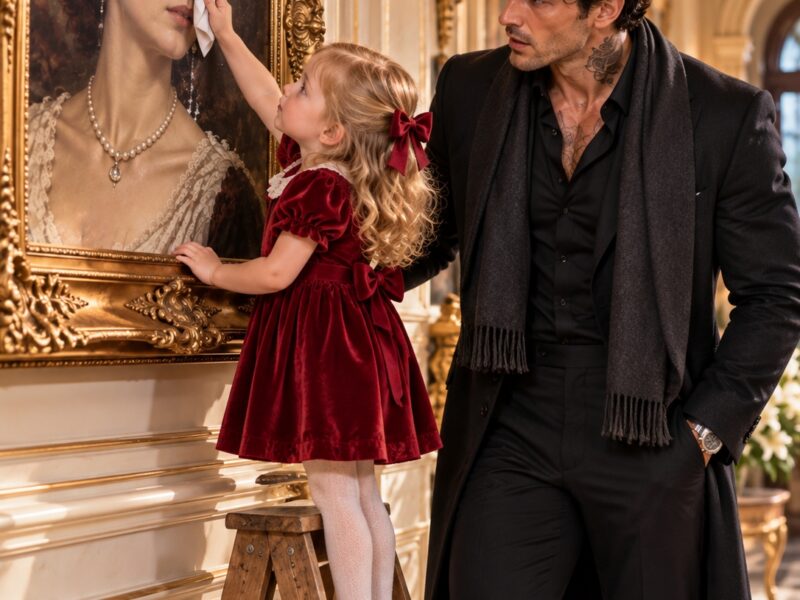
The words came from a little girl standing on a wooden chair in the east hallway of the Moretti mansion, holding a crumpled tissue against the face of a woman in an oil painting.
Gabriel Moretti stopped so suddenly that the two men walking behind him nearly collided with his back. In thirty years of running one of Chicago’s most feared criminal organizations, he had heard threats, confessions, pleas for mercy, and promises from men who knew perfectly well they were lying. But nothing had prepared him for the sight of a three-year-old child trying to comfort his dead mother.
“What did you say?” he asked.
The girl looked over her shoulder. She wore a faded yellow dress, white socks that had slipped around her ankles, and a pink plastic bracelet decorated with tiny strawberries. Her light brown curls had escaped their braid, and one cheek bore a faint smudge of chocolate.
“Your mommy,” she repeated, pointing at the portrait. “She’s sad. Look.”
Gabriel raised his eyes.
Katarina Moretti had been dead for twenty-two years.
Her portrait had hung in that hallway since the week after her funeral. It showed her at forty-six, sitting beside a window in a dark green silk dress, one hand resting on the arm of an antique chair. Her black hair was swept into a loose knot, and her expression held the patient amusement of a woman watching someone she loved make a harmless mistake.
Gabriel had passed the painting thousands of times without looking at it.
That morning, however, there were two narrow wet streaks running down the painted woman’s cheeks.
He stepped closer.
The child pressed the tissue gently against one streak.
“See? I tried to dry her eyes, but more keeps coming.”
Gabriel stared.
The moisture was real. It had collected just below the portrait’s eyes and traveled down the varnished surface, leaving darkened tracks across the face.
For one absurd instant, he remembered his mother’s voice calling him inside from the garden when he was six years old.
Then he noticed something that made the back of his neck tighten.
The portrait wasn’t hanging straight.
It leaned forward by perhaps an eighth of an inch, barely enough for anyone to notice.
But Gabriel knew that frame.
His father had commissioned it from an Italian craftsman, and the heavy oak had been secured to the wall with four concealed brackets. It had not moved in more than two decades.
“Who brought you here?” he asked the girl.
“Nobody.”
“What’s your name?”
“Lily.”
“Lily what?”
“Lily Carter.” She considered him carefully. “Are you mad?”
Gabriel looked at the chair beneath her feet. It was a small service chair from the adjoining linen room.
“Why would I be mad?”
“Because Mama says I’m not supposed to come here.”
“Your mother is right. This hallway isn’t a place for children to play.”
Lily frowned.
“I wasn’t playing.”
He glanced toward the portrait again.
“What were you doing?”
“Helping.”
There was no hesitation in her answer.
Gabriel felt something unfamiliar move behind his ribs.
He had spent most of his adult life surrounded by people who wanted something from him. Money. Protection. Influence. The chance to be forgiven for mistakes that could never really be forgiven.
This child had entered a forbidden hallway because she thought a woman in a painting needed a tissue.
He reached toward her.
“Come down, little one.”
Lily lifted both arms without hesitation.
He picked her up carefully, feeling the astonishing lightness of her small body, and set her on the marble floor.
He had not held a child in twenty-two years.
Not since his younger sister’s little boy had been brought to the funeral, too small to understand why everybody was wearing black.
“Mister,” Lily asked, “does she miss you?”
Gabriel looked down at her.
He could have answered a hundred different ways.
Instead, he said, “I don’t know.”
Before she could ask anything else, hurried footsteps sounded from the service corridor.
“Lily? Lily, sweetheart, where are you?”
A young woman appeared around the corner.
She stopped dead when she saw Gabriel.
Olivia Carter was twenty-nine, a live-in housekeeper who had joined the Moretti household eight weeks earlier. She wore a plain gray work dress and a white apron, and her dark blond hair had been pinned so hastily that loose strands brushed her forehead.
Her face drained of color.
“Mr. Moretti.”
She hurried forward and reached for her daughter.
“I’m so sorry. I was changing the sheets upstairs, and I thought she was with Mrs. Donnelly in the kitchen. I didn’t know she had come down this hallway.”
Gabriel looked from the frightened mother to the little girl.
Lily immediately took Olivia’s hand.
“I was helping the lady,” she explained.
“Baby, I told you—”
“She’s crying, Mama.”
Olivia looked toward the painting.
Her eyes widened.
For a moment, she forgot to look frightened.
Then she looked back at Gabriel, and something crossed her face that he couldn’t identify.
Not surprise.
Recognition.
It vanished almost immediately.
“I’ll take her downstairs,” she said quickly. “It won’t happen again.”
Gabriel studied her.
Most people in his house were afraid of him. He had never encouraged familiarity, and he knew perfectly well that his reputation made ordinary conversations difficult.
Still, the way Olivia held her daughter’s hand bothered him.
She wasn’t merely embarrassed.
She looked as though she believed a terrible consequence was coming.
“Mrs. Carter.”
“Yes, sir?”
“Your daughter isn’t in trouble.”
Olivia blinked.
“Neither are you.”
“Thank you, Mr. Moretti.”
“Give her something warm to eat. She’s been standing in a cold hallway.”
Lily looked up.
“Can I have pancakes?”
Olivia gave a nervous laugh.
“You’ve already had breakfast.”
“Little pancakes?”
Gabriel almost smiled.
“Ask the cook.”
Lily looked pleased with this compromise.
As Olivia led her away, the child turned and waved the damp tissue.
“Bye, Mister Gabriel. Tell your mommy I hope she feels better.”
When they disappeared around the corner, the hallway seemed to grow colder.
Gabriel waited until he could no longer hear their footsteps.
Then he took out his phone.
“Daniel,” he said when the call connected. “Come to the east hallway. Alone.”
Daniel Foster had worked for the Moretti family for twelve years.
He was forty-four, broad-shouldered, and unusually quiet for a man whose responsibilities included overseeing security for an estate containing twenty-seven rooms, three garages, a private chapel, and nearly forty acres of secluded property north of Chicago.
He had once taken two bullets while protecting Gabriel during an attack outside a restaurant in Little Italy.
Since then, Gabriel had trusted him with nearly everything.
Everything except the truth about his childhood.
When Daniel arrived, he found his employer standing inches from the portrait.
“Boss?”
“Look at her face.”
Daniel approached.
His expression changed when he saw the moisture.
He touched the wall beside the painting, checked the ceiling, and examined the floor.
“Could be condensation,” he said.
“From where?”
“Let me find out.”
Daniel retrieved a flashlight from his jacket and directed its beam along the upper edge of the frame.
He paused.
“Gabriel.”
“What?”
“Look at this.”
He pointed to the brass mounting screws.
The heads were scratched.
Not badly. Just enough to expose brighter metal beneath the old finish.
Daniel moved the light downward.
“And here.”
A narrow line of disturbed dust ran along the lower corner.
“Someone’s taken this painting down.”
Gabriel said nothing.
“Recently,” Daniel continued. “Maybe yesterday. Possibly the night before.”
“Are you certain?”
“I’m certain somebody loosened the frame. I can’t tell you why.”
Gabriel looked at his mother’s face.
The little girl had been right about one thing.
Something was coming through the painting.
But it wasn’t a miracle.
It was a message.
“Take it down,” he said.
Daniel hesitated.
“Should I call maintenance?”
“No.”
“Boss, the thing weighs close to eighty pounds.”
“Then I’ll help you.”
Together, they released the mounting hardware and lifted the enormous portrait away from the wall.
Behind it, a narrow rectangular opening had been cut into the plaster.
A thin plastic tube emerged from the opening and disappeared behind the upper edge of the canvas.
Daniel followed it with his flashlight.
At the end was a small felt pad pressed against the back of the painted surface, positioned directly behind the woman’s eyes. Moisture had seeped through two tiny imperfections in the old canvas and traveled over the varnish.
A compact reservoir lay inside the wall.
“Somebody wanted the painting to look like it was crying,” Daniel said.
Gabriel stared at the little device.
The reservoir was nearly empty.
A battery-powered mechanism had been attached to it, simple enough that anyone with basic mechanical knowledge could have assembled it.
“Why?”
Daniel did not answer.
Instead, he reached into the opening.
“There is something else.”
He withdrew a narrow metal box wrapped in oilcloth.
Gabriel recognized the wrapping immediately.
His mother had used the same kind of cloth to protect her gardening tools from moisture.
Daniel set the box on the floor.
Inside were five folded letters, a brass key, and a family photograph whose right corner had been torn away.
Gabriel knelt.
He picked up the first letter.
The paper was yellowed and fragile, but the handwriting was unmistakable.
His mother’s.
My beloved Gabriel,
He stopped breathing for a moment.
The last letter he had received from Katarina Moretti had arrived during his second year of college. It was a brief note reminding him to eat something besides pizza and asking whether he had remembered to buy a winter coat.
He had kept it in his wallet until the paper became too worn to unfold.
Now, twenty-two years after burying her, he was holding words he had never been allowed to read.
He unfolded the letter completely.
There are things happening in this family that your father does not understand. I have tried to correct them quietly, but I fear I have waited too long.
If these letters reach you, please remember something I taught you when you were small: loving your family does not mean protecting every terrible thing they do.
Gabriel read the sentence twice.
The second letter described missing money from businesses his family owned.
The third mentioned shipping records.
The fourth was more personal.
I am frightened, Gabriel. Not because I am afraid of dying, but because I am afraid you will grow up believing that power and goodness are the same thing.
He swallowed.
The fifth letter had been cut in half.
Only the top portion remained.
Across the bottom, in his mother’s careful script, were thirteen words.
Never trust the man who wears the silver ring with the serpent.
Gabriel slowly lowered the page.
Daniel watched him.
“Boss?”
Gabriel turned the brass key between his fingers.
A tiny emblem was engraved into its rounded head: a single olive leaf wrapped around a cursive letter K.
“There’s only one man I know who wears a ring like that.”
Daniel’s expression darkened.
“Richard Bellini.”
Gabriel closed his eyes.
Richard Bellini had been his father’s closest adviser.
He had attended every family celebration Gabriel could remember.
He had taught Gabriel to drive when his father was too busy.
After Katarina died, Richard had sat beside the coffin through the final night of the wake, silently holding Gabriel’s father’s hand.
And when Gabriel inherited the organization, Richard had been the man who explained which alliances were stable, which businesses were failing, and which people could be trusted.
Gabriel stood.
“Get me everything we have on my mother’s death.”
Daniel nodded.
“Hospital records?”
“Everything.”
“And Richard?”
Gabriel folded the letter carefully.
“Don’t tell him anything.”
Gabriel Moretti had been born into a family that treated loyalty as both a virtue and a debt.
His father, Vittorio, had built a business empire out of trucking companies, construction firms, warehouses, restaurants, and several enterprises that nobody described plainly at the dinner table.
By the time Gabriel was a teenager, he understood that the family name carried consequences.
People stood when his father entered a room.
Police officers sometimes looked the other way.
Businessmen who had shouted during negotiations became strangely polite when Vittorio’s name was mentioned.
His mother had hated it.
Not the legitimate businesses, which she had helped organize and manage.
But the intimidation.
The secrecy.
The casual way men spoke about other people’s suffering while eating food she had cooked.
“You don’t become a good man by frightening bad people,” she once told Gabriel. “You become a good man by deciding what you won’t do, even when you could.”
He had been sixteen.
At the time, he’d thought she was being naïve.
Twenty-two years later, he could still remember how she had looked at him across the kitchen table.
Not angry.
Disappointed that he thought kindness was weakness.
After she died, Gabriel had become exactly the kind of man she feared he might become.
He had taken over the family organization at thirty-two, after Vittorio suffered a stroke.
Gabriel was disciplined, intelligent, and patient.
He preferred negotiation to open conflict, but he had never pretended that his position was harmless.
People had suffered because of decisions he made.
Some directly.
Others because he had allowed an ugly system to continue operating so long as it remained profitable.
He lived alone in a house large enough for three families.
He ate dinner at a table built for fourteen people.
And he had forbidden anyone from touching his mother’s garden.
It stood beyond the eastern courtyard, enclosed by a low stone wall and a wrought-iron gate.
Katarina had filled it with white flowers.
Gardenias, jasmine, lilies, and roses.
She used to rise before sunrise, put on an old straw hat, and work among the flowerbeds while humming an Italian song her grandmother had taught her.
Gabriel had not opened the gate since her funeral.
He had convinced himself that leaving the garden untouched was a way of preserving her memory.
But standing in his study with five newly discovered letters on his desk, he wondered whether he had spent two decades preserving his grief instead.
A knock interrupted him.
“Come in.”
Olivia Carter stood in the doorway carrying a tray.
“Mrs. Donnelly said you hadn’t eaten lunch.”
Gabriel glanced at the clock.
It was nearly three.
He hadn’t noticed.
“Leave it there.”
Olivia entered carefully.
The tray held tomato soup, a chicken sandwich, and a small pot of coffee.
As she set it down, her eyes moved toward the letters.
Only briefly.
But Gabriel noticed.
“You’ve worked here two months,” he said.
“Yes, sir.”
“Where were you employed before this?”
“A hotel in Evanston. Before that, I cleaned offices downtown.”
“And before that?”
She hesitated.
“I was caring for my mother.”
“Is she still living?”
“No, sir.”
Gabriel nodded.
“How did you hear about this position?”
“Through an employment agency.”
“Did someone recommend you?”
Olivia’s fingers tightened around the tray.
“No one who works here.”
That wasn’t an answer.
Gabriel leaned back.
“Mrs. Carter, are you afraid of me?”
She looked at him.
“Yes.”
The honesty surprised him.
“Why?”
“Because people who work in houses like this don’t always get to explain themselves when something goes wrong.”
He studied her face.
“Has something gone wrong?”
“No, sir.”
“Then why are you looking at my mother’s letters?”
Olivia went still.
For several seconds, neither spoke.
Then she lowered her eyes.
“I recognized the handwriting.”
Gabriel felt his pulse change.
“Explain.”
“My mother used to keep a photograph of Mrs. Moretti. There was writing on the back.”
“Your mother knew mine?”
Olivia looked toward the door.
“My mother worked at a clinic your family used to own.”
“Cedar Lane Medical?”
She nodded.
Gabriel stood.
“What’s your mother’s name?”
“Margaret Carter. Before she married, Margaret Reed.”
“Reed?”
“Yes.”
“Is she related to Thomas Reed?”
Olivia looked at him sharply.
“He’s my uncle.”
Gabriel was suddenly very aware of the silence in the room.
Thomas Reed had been an orderly at Cedar Lane Medical when his mother died.
His name appeared on an old employee list Gabriel had seen only once, years earlier.
“Where is he now?”
Olivia stepped backward.
“I don’t know.”
“Olivia.”
“I haven’t seen him in years.”
“Then why did your face change when I said his name?”
Her eyes filled.
“Because he told me that if anyone in this house started asking about him, I should take Lily and leave.”
Gabriel stared at her.
Before he could respond, a small voice came from the hallway.
“Mama?”
Lily appeared holding a stuffed rabbit by one ear.
Olivia turned immediately.
“Sweetheart, I told you to stay with Mrs. Donnelly.”
“I wanted you.”
Gabriel watched the little girl hurry into her mother’s arms.
Olivia lifted her without thinking.
For a moment, the frightened woman disappeared, replaced by a mother checking whether her child’s socks were warm.
Lily looked past Olivia’s shoulder.
“Hi, Mister Gabriel.”
He nodded.
“Hello, Lily.”
The child spotted the letters.
“Are those from your mommy?”
Gabriel looked at the papers.
“Yes.”
“Did she write your name?”
“Yes, she did.”
Lily thought about that.
Then she held out her stuffed rabbit.
“You can borrow Bunny if you miss her.”
Gabriel said nothing.
Olivia quickly lowered Lily’s arm.
“Thank you, sweetheart. Mr. Moretti is busy.”
But Gabriel found himself looking at the worn toy.
One ear had been repaired with uneven blue thread.
The rabbit had clearly been loved for years.
“That’s a generous offer,” he told the little girl.
Lily nodded solemnly.
“Mama says everybody needs somebody.”
When Olivia carried her out, Gabriel remained standing beside his desk.
The letters were still there.
So was the key.
And for the first time in twenty-two years, he wondered how many people had known something about his mother’s death that he did not.
Daniel returned that evening with a folder containing copies of the available medical records.
He looked tired.
Gabriel knew that expression.
It meant his security chief had found something he wished he hadn’t.
“Sit down,” Gabriel said.
Daniel remained standing.
“Your mother was admitted to Mercy General at 11:42 p.m. on October seventeenth, 2004.”
Gabriel nodded.
“I know.”
“Her death certificate lists sudden cardiac arrest associated with an underlying heart condition.”
“I know that too.”
“There’s no corresponding medical chart in the archive.”
Gabriel looked up.
“What do you mean?”
“The hospital has an admission entry, but no complete treatment notes. The paper chart was reportedly destroyed during an archive transfer, and the digital index points to a file that doesn’t exist.”
“People lose records.”
“One record, maybe. But the county also has only a scanned copy of the certificate. The original filing is missing.”
Gabriel leaned forward.
“Who signed it?”
“Dr. Harold Grant.”
“Where is he?”
“Retired. Wisconsin.”
“Call him.”
“I tried.”
“And?”
“He wouldn’t speak to me.”
Gabriel sat back.
Daniel continued.
“There is something else. I reviewed the hallway security footage from the last thirty days.”
Gabriel waited.
“Three times, the east hallway cameras stopped recording for exactly ten minutes. Each time, it happened after midnight.”
“Power failure?”
“No. Someone used a maintenance login.”
“Whose?”
“The account belongs to our outside security contractor, but the access came from inside the house.”
Gabriel glanced toward the door.
“Who has the password?”
“Seven people. Richard Bellini is one of them.”
For a while, neither man spoke.
Then Gabriel asked, “Can we identify who tampered with the portrait?”
“Not yet.”
“Find out.”
Daniel closed the folder.
“What about Olivia Carter?”
Gabriel looked at him.
“What about her?”
“She knew the name Thomas Reed. She reacted to the letters.”
“I know.”
“Do you trust her?”
Gabriel thought of the child in the hallway, trying to dry painted tears.
“I don’t know,” he said. “But I think she’s frightened of someone who knows this house.”
The next morning, Lily knocked on Gabriel’s study door.
Three small taps.
He was reviewing financial documents when he heard them.
“Come in.”
The door opened slowly.
Lily appeared wearing a blue pinafore and carrying a coloring book.
“Mama says I can ask if you’re busy.”
Gabriel looked at the stack of papers on his desk.
He had canceled two meetings, postponed a discussion with his attorneys, and ignored seventeen calls since breakfast.
“Apparently not.”
Lily smiled.
She walked to the chair opposite him.
It was too high.
Gabriel stood and helped her climb onto it.
“What would you like?”
“To color.”
“Here?”
She nodded.
He considered telling her to use the sitting room.
Instead, he cleared one corner of the desk.
Lily arranged her coloring book carefully and began filling the outline of a fish with a bright orange crayon.
For several minutes, there was no sound except the scratch of wax against paper.
Gabriel continued reading.
Then Lily asked, “Where does your mommy sleep?”
His pen stopped.
“What?”
“If she’s in the picture, where does she sleep?”
Gabriel folded his hands.
“My mother died a long time ago.”
Lily looked up.
“Like Grandma Margaret?”
Gabriel remembered what Olivia had told him.
“Yes.”
Lily lowered her crayon.
“Mama says Grandma isn’t hurting anymore.”
Gabriel watched her.
“That’s a nice thing to believe.”
“Do you miss your mommy?”
“Yes.”
“Every day?”
He hesitated.
“Most days.”
Lily considered this.
“Maybe she misses you too.”
Gabriel looked toward the window.
Beyond the courtyard wall, he could just see the top of the old garden gate.
“She loved flowers,” he said, surprising himself.
Lily brightened.
“My mama likes flowers!”
“She used to grow white roses. And jasmine. And gardenias.”
“Where?”
“Behind the house.”
“Can I see?”
“No one has been in that garden for a long time.”
“Why?”
Gabriel looked at the child.
The truthful answer sounded unreasonable even to him.
“Because it reminds me of her.”
Lily frowned.
“But if you miss her, why don’t you go where she was happy?”
The question struck him with such force that he looked away.
He had stood before judges, hostile businessmen, and men who had threatened his life without losing his composure.
Now a three-year-old girl had asked him something he couldn’t answer.
“Maybe I should,” he said.
Lily returned to coloring.
After a moment, she added, “Flowers get lonely too.”
Gabriel almost laughed.
“Do they?”
“Mama says they need somebody to take care of them.”
He looked at the garden gate again.
That afternoon, he ordered the lock removed.
Olivia watched from the kitchen window as two maintenance workers opened the old wrought-iron gate.
It took nearly twenty minutes.
The hinges had rusted.
Vines had grown around the lower bars.
When the gate finally swung inward, the workers revealed a narrow stone path almost completely hidden beneath weeds.
Gabriel stood on the courtyard steps.
He did not enter.
Daniel came to his side.
“Do you want me to bring in the gardeners?”
“Not yet.”
“Some of those old plants might still be alive.”
Gabriel nodded.
The air smelled faintly of wet leaves.
He remembered his mother kneeling beside a row of roses, telling him that difficult things could still grow beautifully if someone cared enough to give them time.
He had laughed at her.
Now he couldn’t remember what had seemed funny.
Behind him, Lily appeared holding Olivia’s hand.
“That’s a lot of weeds,” she announced.
Gabriel glanced down.
“Yes.”
“Your mommy would be mad.”
Olivia closed her eyes.
“Lily.”
But Gabriel smiled.
“She probably would.”
The child looked pleased.
“Can we fix it?”
“Maybe.”
Lily moved toward the gate.
Olivia gently stopped her.
“Stay where I can see you.”
Gabriel nodded.
“Your mother’s right. Some of the stones are loose.”
Lily accepted this without argument.
Then she pointed toward a small marble fountain.
“There’s a bird!”
A brown sparrow had landed beside the empty basin.
Gabriel watched it hop between the weeds.
For a few moments, the garden felt less like a memorial and more like a place someone might want to visit.
He remained there after Olivia took Lily inside.
He had almost forgotten how quiet the courtyard could be.
That evening, something happened Olivia had been afraid of since the day she accepted the job.
At six fifteen, while she was folding laundry in the service room, Lily came running in with a square of white cloth in her hand.
“Mama, look!”
Olivia glanced up.
“What is that?”
“A man dropped it.”
Her hands stopped.
“What man?”
“The grandpa man.”
Olivia set down the towel.
“Where?”
“By the flower garden. He was outside the fence.”
Olivia felt her stomach tighten.
“What did he say?”
Lily looked serious.
“He said Thomas waited a very long time.”
For a moment, Olivia couldn’t hear the washing machine humming behind her.
“Did he say anything else?”
Lily nodded.
“He said the crying picture was important.”
Olivia reached for the handkerchief.
It had a pale blue stitched border.
In one corner was a small olive leaf surrounding the letter K.
She recognized it immediately.
Her mother had kept an identical handkerchief in a cedar box beneath her bed.
Olivia sat down.
Lily climbed onto her lap.
“Are you sad, Mama?”
“No, sweetheart.”
“Your eyes look sad.”
Olivia kissed her forehead.
“I’m just thinking.”
But she wasn’t thinking.
She was remembering the last conversation she had with her uncle Thomas.
It had happened three months earlier, in a small diner near Pilsen.
He had been wearing an old gray coat and carrying a cane.
He had ordered coffee but barely touched it.
“Your mother died protecting something she believed mattered,” he told Olivia. “I should have helped her sooner.”
Olivia had never fully understood what he meant.
Her mother, Margaret, had spent years avoiding questions about the Moretti family.
She had worked as a receptionist at Cedar Lane Medical in the 1990s and early 2000s.
Then, shortly after Katarina Moretti’s death, she left Chicago without explanation.
She returned years later, a quieter woman who checked the locks twice before bed.
After Margaret died, Olivia found a photograph of Katarina in her belongings.
On the back, in Margaret’s handwriting, were the words:
She tried to stop them.
That photograph was the reason Olivia had agreed to meet Thomas.
And Thomas was the reason she had taken a housekeeping job at the Moretti estate.
“Somebody has been moving things behind Katarina’s portrait,” he had told her. “I need to know whether the old hiding place is still there.”
Olivia had been horrified.
“You want me to spy on a mafia boss?”
“I want you to work, observe what you can without taking risks, and tell me if anything unusual happens. Nothing more.”
“I have a daughter.”
“I know.”
“Then you should understand why I can’t.”
Thomas had lowered his eyes.
“Your mother asked me to help Katarina’s son someday. I’ve spent twenty-two years being afraid. I’m running out of time.”
Olivia had refused at first.
Then a rent increase forced her out of her apartment.
The hotel reduced her hours.
Lily developed recurring ear infections, and the medical bills accumulated.
When the household agency offered her a live-in position at the Moretti estate, it seemed like the only practical choice.
She told herself she would earn enough to get back on her feet.
And if she happened to notice something relevant to her mother’s past, she would tell Thomas.
She had never intended for Lily to become involved.
Now her little girl had found the one man Olivia hoped would stay away.
“Mama?”
Olivia looked down.
“Yes, baby?”
“Was that grandpa man your friend?”
Olivia swallowed.
“Yes.”
“Then why are you scared?”
She hugged Lily tighter.
“Because sometimes grown-ups make things more complicated than they need to be.”
Lily frowned.
“Like when you can’t find the car keys?”
Olivia almost laughed.
“Something like that.”
She folded the handkerchief and placed it in her apron pocket.
“Listen to me, sweetheart. If you ever see that man again, you come straight to me. Don’t talk to him by yourself. Okay?”
Lily nodded.
“Okay.”
“And don’t tell anyone else about him just yet.”
“Not even Mister Gabriel?”
Olivia hesitated.
“Not yet.”
Lily looked disappointed.
“But Mister Gabriel is nice.”
Olivia brushed a curl from her daughter’s forehead.
“I know he has been kind to you.”
“Then why can’t I tell him?”
Olivia had no answer that would make sense to a child.
“Because Mama needs to understand something first.”
Lily accepted that for the moment.
But later that night, when Olivia left her apron hanging over a chair, the little girl took the handkerchief.
She carried it down the hallway, climbed the back stairs, and knocked on Gabriel Moretti’s study door.
Gabriel opened the door himself.
Lily stood in her nightgown, holding the folded cloth with both hands.
“Mr. Gabriel?”
He looked down.
“Little one, does your mother know you’re here?”
“No.”
“Then we should take you back.”
“But I have something.”
She lifted the handkerchief.
“A grandpa dropped it in the garden.”
Gabriel took it.
He unfolded one corner.
His expression changed.
The olive-leaf emblem was identical to the engraving on his mother’s brass key.
“Where did you find this?”
“By the fence.”
“Did the man give it to you?”
“No. It fell out of his pocket.”
“What did he look like?”
Lily thought carefully.
“He had a stick. And a hat. His face was wrinkly.”
Gabriel crouched.
“Did he tell you his name?”
“No.”
“Did he say anything?”
“He said Thomas waited a long time.”
Gabriel felt his pulse quicken.
“What else?”
Lily looked toward the hallway.
“Mama said not to tell.”
He studied her.
Then he gently folded the handkerchief.
“You haven’t done anything wrong.”
“Is Mama in trouble?”
“No.”
“Promise?”
Gabriel looked into her worried eyes.
“I promise I won’t punish your mother for this.”
Lily seemed satisfied.
“Okay.”
He held out his hand.
“Come on. Let’s get you back to bed.”
She took it without hesitation.
They walked down the quiet corridor together.
At the service room, Olivia appeared carrying a basket of ironing.
Her face went white.
“Lily!”
The child ran toward her.
Olivia gathered her up.
“I’m so sorry, Mr. Moretti. I didn’t know she’d left the room.”
Gabriel held up the handkerchief.
“We need to talk.”
Olivia stared at the cloth.
She knew then that there was no more time for hiding.
Gabriel didn’t question Olivia in front of her daughter.
Instead, he asked Mrs. Donnelly, the senior housekeeper, to sit with Lily while he and Olivia spoke in the library.
Daniel was present.
The door remained open.
Gabriel sat opposite Olivia rather than behind his desk.
“Start with Thomas Reed,” he said.
Olivia clasped her hands.
“He’s my mother’s brother.”
“Where is he?”
“I know how to contact him.”
“Why didn’t you tell me that earlier?”
“Because he was afraid someone in this house would kill him.”
Daniel glanced at Gabriel.
“Who?”
Olivia shook her head.
“He never gave me a name.”
“Why did he send you here?”
She told them.
About Margaret.
About Cedar Lane.
About the photograph with the handwritten message.
About the meeting in Pilsen.
And about the strange feeling she had carried ever since she entered a house where a dead woman’s portrait hung in a forbidden hallway.
Gabriel listened without interrupting.
When she finished, he asked, “Did Thomas put the device behind the portrait?”
Olivia hesitated.
“I don’t know. But he told me he had a way to get your attention.”
“Why didn’t he come to me directly?”
“He said somebody close to you was watching everything.”
Daniel looked toward the hallway.
Gabriel felt a familiar pressure behind his eyes.
“Can you arrange a meeting?”
Olivia nodded.
“He goes to St. Procopius Church on Thursday evenings.”
“When?”
“Seven.”
Gabriel looked at Daniel.
“Find out whether he still goes there.”
Daniel nodded.
Olivia stood.
“Mr. Moretti?”
Gabriel looked at her.
“What?”
“I know I should have told you sooner. But please don’t send Lily away.”
The words came out quickly.
“She doesn’t understand any of this. She thinks she made your mother feel better. That’s all.”
Gabriel watched her struggle to remain composed.
Then he said, “Your daughter has done more honest work in this house in two days than some people have done in twenty years.”
Olivia looked startled.
“I’m not sending her away.”
She pressed her lips together.
“Thank you.”
Gabriel looked toward the open door.
“But until we understand what’s happening, I don’t want either of you going near that garden without someone you trust.”
Olivia nodded.
For the first time since arriving at the estate, she believed him.
St. Procopius Church was nearly empty when Gabriel arrived on Thursday evening.
Rain had begun falling over Chicago, turning the sidewalks dark and shining.
Gabriel entered through a side door and stood for a moment beneath the vaulted ceiling.
A few votive candles burned near a statue of the Virgin Mary.
The church smelled of old wood, wax, and damp coats.
An elderly man sat in the third pew from the front.
He wore a gray overcoat and rested both hands on a wooden cane.
Gabriel approached.
“Thomas Reed?”
The man did not turn immediately.
“You look like your father.”
Gabriel sat one pew behind him.
“People tell me that.”
“Your mother used to say you had his face and her eyes.”
Gabriel looked toward the altar.
“Tell me what happened to her.”
Thomas closed his eyes.
For a moment, Gabriel thought he might refuse.
Then the old man spoke.
“Before I tell you anything, I need your word that Olivia and her daughter will be safe.”
“They’re under my protection.”
“I’ve heard men like you say that before.”
Gabriel looked at him.
“I can’t promise nothing bad will ever happen. But I can promise I’ll take the threat seriously and do everything I can to protect them.”
Thomas nodded slowly.
“That is more honest than most promises I’ve heard.”
He reached into his coat.
From an inside pocket, he withdrew a worn envelope.
“Your mother came to Cedar Lane in the spring of 2004. She was worried about money missing from the family businesses.”
Gabriel listened.
“She brought copies of invoices and shipping documents. At first, I thought she was helping your father with some accounting dispute.”
“Was she?”
“No.”
Thomas looked down at his hands.
“She discovered someone had been using legitimate Moretti businesses to move money and illegal cargo through the port. The records were being altered, and funds were disappearing into accounts overseas.”
Gabriel’s face hardened.
“Who?”
“She didn’t tell me.”
“Why?”
“Because she was trying to keep me alive.”
Thomas opened the envelope.
Inside were photocopies of documents and a handwritten note.
“She planned to speak to a federal prosecutor. Someone she knew from college. She had an appointment for Friday morning, October eighteenth.”
Gabriel frowned.
“My mother died the night before.”
“Yes.”
The church grew very quiet.
Thomas continued.
“Just after eleven that Thursday night, someone came to my apartment. He said Mrs. Moretti needed medical help and that I was supposed to come immediately.”
“Who sent him?”
“I never learned.”
“What happened when you arrived?”
Thomas gripped his cane.
“Your mother was already unconscious. I checked her pulse. I couldn’t find one. The physician I expected to see wasn’t there.”
Gabriel leaned forward.
“Who was?”
“Two men.”
“Names.”
“I couldn’t see one of them clearly. The other stood near the foot of the bed.”
Thomas swallowed.
“He told me Dr. Grant had already examined her. He gave me a prepared death certificate and ordered me to write that she’d suffered an acute cardiac event.”
Gabriel stared at him.
“You signed a death certificate?”
“No. I wasn’t authorized to certify a death. I copied information onto a form he gave me, and he made me write Dr. Grant’s name. The official certificate was filed later.”
“Why would you do that?”
Thomas turned.
For the first time, Gabriel saw the full weight of the old man’s fear.
“Because he knew where my seven-year-old son went to school.”
Gabriel said nothing.
“He knew the name of his teacher. He knew what color lunchbox my wife packed for him. He told me that if I refused, my boy wouldn’t come home the next afternoon.”
Thomas’s hands trembled.
“I was a coward, Mr. Moretti.”
Gabriel looked at him.
“You were a father.”
Thomas’s expression tightened.
“Your mother deserved better.”
“Yes,” Gabriel said quietly. “She did.”
The old man looked back toward the altar.
“I left Chicago within a week. My wife and I moved three times over the next ten years. I never saw your mother again. But I kept copies of what she’d given me.”
“Why come back now?”
Thomas looked at the candles.
“Because the man who frightened me has started looking for those documents again.”
“How do you know?”
“Someone broke into my house in Wisconsin last month. They took an old filing cabinet apart. They didn’t touch the television or the money in the kitchen drawer.”
Gabriel’s eyes narrowed.
“What were they searching for?”
“Records. Letters. Anything Katarina left.”
He opened the envelope further.
“At first, I thought Richard Bellini was responsible.”
Gabriel felt his chest tighten.
“Why?”
“Because of the ring.”
“The silver serpent.”
Thomas nodded.
“I saw it on the hand of the man who threatened my son.”
Gabriel leaned forward.
“Richard wears that ring every day.”
“I know.”
“Then why do you think it wasn’t him?”
“Because Richard was in Rome the night your mother died. There are photographs from a wedding reception. I found them years later.”
Gabriel frowned.
“Rings can be taken off.”
“Yes. But this one wasn’t unique.”
Thomas looked directly at him.
“Your grandfather commissioned two identical silver rings. Your father gave one to Richard Bellini and one to his younger brother.”
Gabriel stopped moving.
“Anthony?”
Thomas nodded.
The name seemed to hang between them.
Anthony Moretti had supposedly drowned in Lake Michigan when Gabriel was fourteen.
His boat caught fire during a storm.
The Coast Guard recovered wreckage.
No body was found.
For years, Gabriel’s father had kept a framed photograph of his brother on the mantel.
“He’s dead,” Gabriel said.
Thomas did not answer immediately.
Then he asked, “Did anyone ever prove that?”
Gabriel felt the blood drain from his face.
Gabriel drove home through the rain without turning on the radio.
He remembered his uncle Anthony clearly.
The loud laughter.
The expensive watches.
The way he gave children twenty-dollar bills when their parents weren’t looking.
Anthony had been eleven years younger than Vittorio, handsome and reckless, with a habit of speaking as though every room belonged to him.
Gabriel had adored him as a boy.
Then came the boat accident.
The funeral.
His father’s grief.
And a closed casket containing Anthony’s favorite suit because there had been no body to bury.
Gabriel had never questioned it.
Why would he?
He had been fourteen.
Now he was forty-two, and a dying woman’s hidden letters had forced him to reconsider everything he thought he knew.
When he reached the mansion, Richard Bellini’s black sedan was parked near the front entrance.
Daniel met him inside.
“He arrived twenty minutes ago.”
“Where is he?”
“Your study.”
Gabriel nodded.
“Stay nearby.”
He climbed the stairs.
Richard was standing beside the fireplace, holding a glass of water.
The silver ring glinted on his right hand.
“Gabriel,” Richard said. “I’ve been trying to reach you.”
“I know.”
“You’ve canceled important meetings. People are asking questions.”
“Let them.”
Richard studied him.
“You look exhausted.”
Gabriel closed the door.
“I have a question.”
“Ask.”
“How many serpent rings did my grandfather commission?”
Richard’s expression changed.
It was slight.
But unmistakable.
“Why?”
“Answer me.”
Richard lowered his glass.
“Two.”
Gabriel felt his stomach tighten.
“One for you.”
“Yes.”
“And one for Anthony.”
Richard looked away.
Gabriel took a step forward.
“Did you know he survived the boat accident?”
Richard’s silence was enough.
Gabriel stared at him.
“How long?”
“Gabriel—”
“How long have you known?”
Richard placed the glass on the mantel.
“Twelve years.”
Gabriel laughed once.
It was an empty, disbelieving sound.
“Twelve years.”
“I had reasons.”
“My mother died twenty-two years ago. My uncle disappeared six years before that. And you’ve known for twelve years that he was alive.”
“Yes.”
“Did he kill my mother?”
Richard closed his eyes.
“I don’t know what happened in that room.”
“That’s not what I asked.”
“I suspect he was responsible.”
Gabriel stood motionless.
For thirty years, he had treated this man like a second father.
Now he was watching him struggle to meet his eyes.
“Why didn’t you tell me?”
Richard swallowed.
“Because Anthony found my granddaughter.”
Gabriel frowned.
“What?”
“She was five years old. She was walking into kindergarten when a man approached her mother and handed over a photograph of my daughter’s house.”
Richard’s voice broke.
“He called me that evening. He said if I ever spoke his name to you, my granddaughter would disappear.”
Gabriel looked away.
He wanted to be furious.
He was furious.
But he also remembered Thomas in the church, talking about his seven-year-old son.
“How many people have been living under his threats?” Gabriel asked.
Richard shook his head.
“I don’t know.”
“Who else knows he’s alive?”
“Some of the old associates. Men who worked the Montreal routes. A few people who were loyal to him long before your father died.”
“Is he still operating?”
“Yes.”
“Through our businesses?”
Richard hesitated.
“Not directly anymore. But he has people inside the shipping companies. He knows where the records are kept.”
Gabriel looked at the silver ring.
“And he’s been watching my house.”
Richard’s face darkened.
“I believe so.”
Gabriel went to his desk.
He opened the drawer and removed the photograph found behind his mother’s portrait.
The right corner had been torn away.
“Was Anthony in this picture?”
Richard glanced at it.
“Yes.”
Gabriel held it closer.
“Someone removed his face recently.”
Richard stared.
“Then Anthony knows you’ve found something.”
Gabriel slowly set the photograph down.
Richard stepped forward.
“Listen to me. Whatever you’re planning, stop long enough to think. He has spent decades building protection around himself. He’s not the reckless young man you remember.”
Gabriel looked up.
“And I’m not fourteen anymore.”
Richard’s shoulders sagged.
“No,” he said. “You’re not.”
Gabriel walked toward the door.
“Go home, Richard.”
“Gabriel—”
“Go home. Stay with your family. Tell your attorney what you’ve told me, and don’t contact anyone connected to Anthony.”
Richard watched him.
“Will you forgive me?”
Gabriel paused with his hand on the door.
“I don’t know.”
It was the only answer he could give.
That night, Gabriel couldn’t sleep.
He sat in the darkened study while the mansion settled around him.
At midnight, he reread his mother’s letters.
At one, he examined the brass key.
At two, he found himself staring at Lily’s abandoned drawing.
She had left it on the corner of his desk earlier that day.
The picture showed three stick figures standing beside a large white flower.
One was labeled MAMA.
One was labeled LILY.
The third was taller, wearing what appeared to be an enormous black coat.
Above it, in Olivia’s handwriting, were the words:
Mr. Gabriel.
He stared at the childish drawing for a long time.
Then he folded it carefully and placed it inside his mother’s first letter.
At 2:17 a.m., the security alarm flashed red.
Gabriel stood.
His phone vibrated.
Daniel.
“Three unauthorized people inside the east wing,” Daniel said quietly. “They entered through the library terrace.”
“Where are they?”
“Moving toward the portrait.”
Gabriel looked at the letters.
“Have the police been called?”
“Yes. They’re on their way.”
“Keep them away from the family rooms.”
Daniel paused.
“Boss, I think they’re looking for the key.”
Gabriel opened his desk drawer and placed the brass key inside a small evidence envelope.
“Then they’re going to be disappointed.”
He remained upstairs.
Security officers intercepted the intruders in the east hallway.
Two were detained.
A third fled into the garden and was stopped near the outer gate.
No one in the service wing was harmed.
But Gabriel knew the situation had changed.
The threat was no longer limited to old documents.
Someone had entered his home while a young mother and her three-year-old child were sleeping upstairs.
By sunrise, Gabriel had arranged for Olivia and Lily to stay at a secured lakeside property in Wisconsin.
He told Olivia what had happened.
Not everything.
Enough.
“Someone broke into the house last night,” he explained. “I don’t want you and Lily here while the police investigate.”
Olivia stood in his study wearing a coat over her pajamas.
She looked exhausted.
“Were they after us?”
“I don’t know.”
“Mr. Moretti, please don’t give me the answer you think will make me calm.”
Gabriel respected her for that.
“They may have been after the documents your uncle helped preserve. And because you’re connected to him, I can’t rule out a threat to you.”
Olivia closed her eyes.
For a moment, Gabriel thought she might cry.
Instead, she asked, “Will Lily be able to bring her rabbit?”
“Of course.”
“And her coloring book?”
“Yes.”
“Can I call my sister?”
“Once you’re safe, yes. We can also arrange somewhere else for you to stay if you’d prefer.”
Olivia studied him.
“You’re not ordering me to go?”
“No. I’m telling you what I think is safest.”
She nodded slowly.
“Then we’ll go.”
Gabriel stood.
“Daniel will travel with you.”
Olivia looked toward the door.
“Can Lily say goodbye?”
He hesitated.
Then nodded.
Fifteen minutes later, Lily entered the study wearing her coat over her nightgown.
Her boots were on the wrong feet.
Gabriel noticed but said nothing.
She carried her stuffed rabbit under one arm.
“Mr. Gabriel?”
He knelt.
“Yes, little one?”
“Mama says we’re going to a lake.”
“That’s right.”
“Are you coming?”
“Not today.”
Her mouth turned down.
“Why?”
“Because I have some things to finish here.”
She considered this.
“Are you sad?”
Gabriel smiled faintly.
“A little.”
Lily reached into her pocket.
She produced a small round adhesive bandage decorated with a yellow star.
“This is my brave sticker.”
Gabriel looked at it.
“Your what?”
“Mama gives me one when I have to get a shot.”
She peeled back the paper carefully.
“You can have it.”
Gabriel held out his hand.
Lily placed the bandage against the inside of his wrist.
It was crooked.
She pressed it down with both thumbs.
“There.”
Gabriel looked at the yellow star.
“Thank you.”
“If you’re scared, you can look at it.”
He swallowed.
“I’ll remember.”
Lily stepped forward and hugged him.
It lasted only a few seconds.
But Gabriel closed his eyes.
He could not remember the last time anyone had embraced him without asking for something afterward.
When Olivia led her daughter toward the door, Lily turned.
“Mr. Gabriel?”
“Yes?”
“Don’t forget to give your mommy flowers.”
Gabriel nodded.
“I won’t.”
The convoy left just after sunrise.
Daniel drove the lead vehicle.
Olivia and Lily rode with a licensed security driver in the second car, with another vehicle following at a distance.
The sky was pale gray.
Low clouds hung over the road.
Lily fell asleep twenty minutes into the journey, her rabbit tucked beneath her chin.
Olivia watched the trees pass outside the window.
She had barely slept.
Every mile away from the mansion should have made her feel safer.
Instead, she kept thinking about Gabriel standing in his study with a child’s yellow bandage on his wrist.
For all the frightening things she had heard about him, he had never once treated Lily as a nuisance.
He had listened to her.
He had let her ask questions.
And he had believed Olivia when she finally told him the truth.
She wondered whether Katarina Moretti would have recognized her son.
Perhaps more importantly, she wondered what he would do when he found the man who had taken his mother away.
The answer came sooner than anyone expected.
At 7:42 a.m., two vehicles blocked the narrow road ahead of the convoy.
The lead driver braked.
Olivia looked up.
“What happened?”
The security driver reached for his radio.
Then another vehicle appeared behind them.
For a moment, the road seemed impossibly quiet.
“Stay down,” the driver instructed.
Olivia turned toward Lily.
Her daughter was awake now.
“Mama?”
Olivia pulled her close.
“It’s okay, baby. Stay with me.”
Outside, men were shouting.
There was a sharp crash as a vehicle struck the rear bumper.
The driver tried to maneuver toward the shoulder.
A second collision jolted the car.
Olivia held Lily tightly.
Then the rear door was pulled open.
A man in a dark jacket reached inside.
“Olivia Carter?”
She stared at him.
He repeated her name.
“Come out.”
The driver shouted for him to back away.
The man ignored him.
Olivia looked at Lily.
For one terrible moment, she had to make a decision no mother should ever face.
The stranger grabbed her arm.
“Now.”
She turned to her daughter.
“Lily, listen to me. Stay with the driver. Do exactly what he says.”
“Mama?”
Olivia tried to keep her voice steady.
“I love you.”
“Mama, don’t go!”
The man pulled her out.
The door slammed.
Lily screamed.
The security driver immediately secured the door and moved the car away as soon as the roadway cleared.
Daniel, who had been injured during the collision, remained with the convoy until emergency services arrived.
Olivia was gone.
Gabriel was in a downtown conference room when the call came.
He listened without interrupting.
Then he stood.
The men sitting across from him fell silent.
“Gentlemen,” he said, “we’ll continue another day.”
He walked out.
In the elevator, he rolled back his sleeve.
The yellow star was still attached to his wrist.
For a long time, he stared at it.
Then he pressed the edge down where it had begun to curl.
By the time he reached the estate, Daniel had been treated at a nearby hospital and returned under medical supervision.
He had a bruised shoulder, a deep cut above his knee, and the expression of a man who believed he had failed.
Gabriel found him in the service sitting room.
“Where’s Lily?”
“With Mrs. Donnelly.”
“Is she hurt?”
“No.”
Gabriel exhaled.
“And Olivia?”
Daniel shook his head.
“Nothing yet.”
Gabriel closed his eyes briefly.
Then his private phone vibrated.
An unknown number.
The message contained eleven words.
Bring the key and the letters. Twenty-four hours. Or Olivia dies.
Gabriel read it twice.
Daniel watched his face.
“Boss?”
Gabriel set the phone down.
“Get my attorney.”
Daniel looked confused.
“Your attorney?”
“And the federal investigator who’s been asking about our shipping companies.”
“Gabriel—”
“Do it.”
Daniel hesitated.
“We can find another way.”
Gabriel looked toward the hallway where Lily was sleeping.
“No,” he said. “We do this with evidence, witnesses, and people who can put Anthony in prison.”
Daniel stared at him.
Gabriel’s voice softened.
“My mother tried to do the right thing. I’m not going to destroy what she left behind by turning this into another family war.”
That afternoon, Gabriel drove to the old Moretti residence in Ravenswood.
The house had been closed for twenty-two years.
It stood on a quiet street beneath towering oak trees, its brick walls darkened by age and its front steps covered with fallen leaves.
Gabriel had lived there until he was seven.
His mother had loved the house.
He remembered watching her make bread in the kitchen.
He remembered the sound of rain against the upstairs windows.
He remembered her perfume, something floral and light, lingering in the hallway after she left for work.
His father’s attorney had preserved the property after her death, paying taxes and arranging basic maintenance.
Gabriel had never returned.
Now he entered with a key from a sealed envelope.
The air smelled of dust and old wood.
Sheets covered the furniture.
In the upstairs bedroom, his mother’s silver hairbrush still rested on the dressing table.
Gabriel stood beside it.
He felt something painful tighten in his throat.
She had been a real person.
Not a portrait.
Not a memory.
A woman who misplaced her keys and laughed at terrible jokes.
A woman who worried about her son.
A woman who had apparently spent the final months of her life trying to protect people who would never know what she had done.
He crossed to the far side of the bed.
Daniel had remembered something that morning.
When he first began working for the family, Vittorio had shown him an old floor safe beneath the bedroom boards.
The lock bore the same olive-leaf symbol as the brass key.
Gabriel knelt.
After several minutes, he found a small wooden panel that lifted beneath the edge of the rug.
Under it was an iron compartment.
The brass key slid into the lock.
It turned.
Inside were three objects.
A folder tied with green ribbon.
A cassette tape.
And a photograph.
Gabriel picked up the photograph first.
It showed his father and uncle standing beside the Chicago River in 1997.
Anthony wore a pale suit and held a glass in his right hand.
On his little finger was a silver serpent ring.
Gabriel stared at the smiling man.
The face was unmistakable.
Then he opened the folder.
There were financial records, account summaries, copies of shipping manifests, and handwritten notes in his mother’s precise script.
The documents described years of money diverted from legitimate family companies into foreign accounts.
They also included records of cargo routed through businesses that had never been authorized to handle it.
At the bottom was a handwritten statement.
Anthony is using the family’s name to conceal operations Vittorio would never approve. I have given him an opportunity to stop. If he refuses, I will take these records to the authorities.
Gabriel read the statement twice.
Then he took the cassette tape.
A small player sat on a shelf beside the window.
He pressed Play.
Static filled the room.
Then came his mother’s voice.
Clear.
Firm.
Alive in a way memory could never quite reproduce.
“Anthony, I know about the accounts.”
Gabriel closed his eyes.
“I’ve seen the shipping records. I’ve seen the payments. You are putting people in danger, and you’re stealing from your own brother.”
A man’s voice answered.
“Katarina, you don’t understand what you’re looking at.”
“I understand enough.”
“You’re making a mistake.”
“No. The mistake was believing you would stop when I asked.”
A pause followed.
Then Katarina spoke again.
“You have until Friday to tell Vittorio what you’ve done. Otherwise, I’m going to the federal prosecutor myself.”
The man’s reply was quiet.
“I’m sorry you feel that way.”
The recording ended.
Gabriel sat on the edge of the bed.
For twenty-two years, he had been told his mother died suddenly of a heart condition.
Now he was holding evidence that she had threatened to expose a criminal enterprise shortly before her death.
It did not prove exactly how she had died.
But it gave investigators a reason to reopen the case.
And it gave Gabriel something he had never possessed before.
His mother’s own voice telling the truth.
The following hours were the longest of Gabriel’s life.
His attorney, Michael Brennan, met privately with federal investigators.
Copies of the financial records were secured.
The cassette recording was transferred for forensic examination.
Thomas Reed agreed to give a formal statement.
Richard Bellini, after speaking with his own attorney, provided information about Anthony’s aliases and financial contacts.
The authorities made no promises.
There were questions about the old medical records.
Questions about whether Thomas’s account could be corroborated.
Questions about the authenticity of the tape.
And questions about Gabriel’s own involvement in the businesses described in his mother’s files.
Gabriel answered what he could.
He understood that helping investigators did not erase his past.
But Olivia was missing, and he had no intention of allowing another frightened woman to disappear into the silence surrounding his family.
By late evening, investigators had identified a probable location connected to the kidnappers.
An abandoned industrial property on Chicago’s South Side.
Anthony had used companies associated with the site for years.
A recent security camera image from a neighboring business showed a vehicle matching the one involved in Olivia’s abduction entering the property.
Gabriel received a second message.
Come alone. No police.
Attached was a photograph of Olivia.
She sat in a chair beneath a bright industrial light.
Her face was pale.
Her hair had come loose.
She was alive.
Gabriel stared at the picture.
Then he called Brennan.
“Tell them I’ll cooperate with whatever plan they approve. But I need to know she’s coming home.”
His attorney was silent for a moment.
“Gabriel, there are things we can do. But you cannot control every part of this.”
“I know.”
“Then listen carefully.”
For the first time in many years, Gabriel Moretti did exactly that.
Olivia had spent most of the afternoon in a cold office inside the warehouse.
No one had explained what they wanted from her.
An older man with white hair entered twice.
The first time, he brought water.
The second time, he asked about Lily.
Olivia looked at him with hatred.
“She’s three years old.”
“I know.”
“Then why are you doing this?”
The man set the bottle on a table.
“Because your uncle should have kept his mouth shut.”
Olivia stared.
“Thomas?”
The man smiled.
“Your family has always had a problem with loyalty.”
“My family?”
“Your mother kept records that didn’t belong to her. Your uncle kept copies. Now you’ve brought those secrets back into the Moretti house.”
Olivia felt cold.
“You’re Anthony.”
He did not deny it.
She had seen an old photograph of him in Margaret’s belongings.
The face had aged, but the eyes were the same.
“You killed Katarina,” Olivia whispered.
Anthony’s expression hardened.
“You know nothing about that.”
“I know she was going to expose you.”
He looked away.
For several seconds, Olivia thought he might strike her.
Instead, he moved toward the door.
“She could have left well enough alone.”
Olivia’s voice shook.
“She was trying to stop you.”
Anthony paused.
Then he said something she would never forget.
“People who think they’re saving the world usually don’t understand what it costs.”
The door closed behind him.
Olivia sat alone, trembling.
She thought about Lily.
About her daughter’s pink bracelet.
About the way the little girl insisted on taking Bunny everywhere, even when the stuffed rabbit was filthy.
She remembered teaching Lily how to count to twenty while waiting for a bus.
She remembered tiny fingers wrapped around her own during thunderstorms.
And she wondered whether her daughter was asking for her.
That thought nearly broke her.
She pressed her eyes shut.
“Please,” she whispered. “Just let me get back to my baby.”
At 10:18 p.m., Gabriel entered the warehouse under an arrangement coordinated with investigators.
He had been searched before entering.
His coat hung open.
He carried an envelope containing copies of some of the letters.
The original evidence was already secure.
Anthony stood beneath an overhead lamp.
For one moment, Gabriel saw his father.
The same long face.
The same high cheekbones.
The same dark, watchful eyes, although Anthony’s had faded with age.
Then he saw the ring.
The silver serpent.
“Hello, nephew.”
Gabriel stopped several feet away.
“Where’s Olivia?”
Anthony smiled.
“You always were impatient.”
“Where is she?”
“In the office.”
“Bring her out.”
Anthony studied him.
“Your father would have handled this differently.”
“My father believed you were dead.”
“Vittorio believed a great many things.”
Gabriel looked at him.
“Did you kill my mother?”
The question seemed to please Anthony.
“Straight to the point.”
“Answer.”
Anthony walked toward a table.
“Your mother was clever. Too clever for her own safety.”
Gabriel did not move.
“She found the accounts,” Anthony continued. “She thought she could frighten me by threatening to tell your father.”
“And you had her killed.”
Anthony looked away.
For the first time, his confidence faltered.
“I told people to stop her from going to the prosecutor.”
Gabriel felt the room become very still.
“What people?”
“You wouldn’t know their names.”
“What did you tell them to do?”
Anthony’s jaw tightened.
“I told them to make sure she didn’t leave the house.”
Gabriel took a breath.
“And when she died?”
Anthony looked at him.
“I didn’t order her death.”
“Then why was a false medical certificate prepared?”
Silence.
Gabriel stepped closer.
“Why did Thomas Reed have to leave Chicago? Why did you threaten his son? Why did you disappear?”
Anthony’s face changed.
“Because your mother was going to destroy everything.”
Gabriel stared.
“No,” he said quietly. “She was trying to stop what you were doing.”
Anthony laughed bitterly.
“You think the Moretti name was built by people who followed rules?”
Gabriel thought of his father.
Of Richard.
Of the men who had stood beside him for years.
Then he thought of Lily wiping tears from a painting.
“My mother believed there were things worth more than the family name.”
Anthony shook his head.
“She filled your head with nonsense.”
“She taught me that someone had to be willing to say no.”
Anthony’s expression hardened.
“You sound just like her.”
“Good.”
For a moment, the older man stared at him.
Then a voice came from the doorway.
“Gabriel?”
Olivia stood between two men.
Her wrists were free, but she looked exhausted.
Gabriel turned.
“Olivia.”
She looked at him.
“Where’s Lily?”
“Safe.”
Her face crumpled.
“Are you sure?”
“Yes.”
She covered her mouth.
Anthony stepped toward them.
“Enough. Give me the originals.”
“They aren’t here,” Gabriel said.
Anthony stopped.
“What?”
“The records are with federal investigators.”
The older man’s expression changed.
Outside, vehicles approached.
Anthony looked toward the high windows.
Then back at Gabriel.
“You brought the police?”
“I brought people who can put the evidence in front of a court.”
Anthony’s face twisted.
“You would turn against your own blood?”
Gabriel looked at Olivia.
She was standing very still, terrified but refusing to look away.
Then he turned back to his uncle.
“You turned against our family long before I did.”
The next moments happened quickly.
Officers entered after the situation escalated, ordering everyone to remain still.
Anthony attempted to retreat through a side exit.
He was stopped.
One of the men holding Olivia stepped away and raised his hands.
Another tried to run.
Gabriel remained where he was.
He did not reach for a weapon.
He did not threaten anyone.
He simply waited until an officer escorted Olivia toward him.
She was shaking.
“Lily?” she asked again.
Gabriel looked directly into her eyes.
“She’s waiting for you.”
Olivia began to cry.
Not quietly.
Not gracefully.
She cried with the desperate exhaustion of someone who had spent hours believing she might never see her child again.
Gabriel stood beside her without touching her.
After a moment, she reached for his hand.
He took it.
The reunion happened shortly before dawn.
Olivia entered the Moretti mansion wearing a borrowed coat and carrying a small overnight bag.
Mrs. Donnelly was waiting in the entrance hall.
So was Lily.
The little girl had refused to return to bed after being told her mother was coming home.
She stood on the marble floor in pink pajamas, clutching Bunny so tightly that one repaired ear had folded against its head.
When the front door opened, Lily froze.
For one second, she seemed unable to believe what she was seeing.
Then she ran.
“Mama!”
Olivia dropped her bag.
She knelt in the middle of the hallway and caught her daughter in both arms.
Lily wrapped her legs around her mother’s waist.
For a long time, neither moved.
Olivia buried her face in Lily’s hair.
“I love you,” she whispered. “I love you so much.”
Lily began crying.
“Where did you go?”
Olivia closed her eyes.
“I had to be away for a little while.”
“I was scared.”
“I know, baby.”
“Don’t go again.”
Olivia held her tighter.
“I’m here now.”
Gabriel stood several feet away.
Daniel was beside him, leaning on a cane because his knee still hurt from the road collision.
Neither spoke.
Eventually, Lily lifted her head.
She saw Gabriel.
“Mr. Gabriel!”
He smiled faintly.
“Hello, little one.”
She looked at his face.
Then at his wrist.
The yellow star bandage was still there.
“You kept it!”
Gabriel looked down.
“I did.”
Lily slipped from her mother’s arms and approached him.
“Did it make you brave?”
He knelt.
“It helped.”
She seemed pleased.
Then she noticed a small bandage above his eyebrow, where he had accidentally struck a metal shelf while moving away from the officers entering the warehouse.
Her face became serious.
“You got hurt.”
“Just a scratch.”
Lily frowned.
“Mama says scratches need stickers.”
Gabriel glanced at Olivia.
For the first time in days, she laughed.
It was a tired, fragile sound.
But it was real.
Lily ran toward the service hallway.
She returned carrying a small box of adhesive bandages decorated with yellow stars.
She climbed onto a chair beside Gabriel and carefully chose one.
“This is for your head.”
Gabriel lowered himself so she could reach.
She pressed the bandage crookedly beside the medical dressing.
Then another.
And another.
By the time she finished, four yellow stars formed an uneven line above his eyebrow.
Olivia covered her mouth.
Daniel looked toward the ceiling.
Gabriel laughed.
It startled everyone.
Not because the sound was loud.
Because none of them could remember hearing it before.
Lily stepped back to admire her work.
“There,” she declared. “Now you’re better.”
Gabriel looked at her.
He wished healing were that simple.
But he didn’t tell her.
Instead, he said, “Thank you, Doctor Lily.”
She grinned.
“You’re welcome.”
Anthony Moretti’s arrest did not bring an immediate end to the investigation.
There were hearings, financial audits, interviews, and difficult questions about records that had been concealed for decades.
The authorities examined the circumstances of Katarina’s death.
Thomas Reed gave a statement.
Richard Bellini admitted that he had concealed Anthony’s survival because of threats against his family.
The recovered financial documents became part of a broader investigation into the organization Anthony had operated under an assumed identity.
Gabriel also had to face the consequences of his own choices.
Cooperating with investigators did not make him innocent of the business practices he had allowed throughout his adult life.
His attorneys warned him that there could be serious legal and financial consequences.
He listened.
Then he began separating the legitimate companies from the criminal operations.
He placed independent management over the businesses that could continue lawfully and supplied investigators with records relevant to the others.
Some employees lost jobs when operations were shut down.
Several longtime associates refused to speak to him.
Others accused him of betraying his father’s legacy.
Gabriel did not pretend the transition was noble or painless.
He had spent years convincing himself that keeping the organization stable was the same thing as protecting everyone who depended on it.
Now he understood that stability built on fear was only another kind of danger.
One evening, Michael Brennan came to his study with a folder.
“There may be a way to limit some of the financial damage,” the attorney said.
Gabriel glanced at the proposal.
It involved delaying disclosures while several companies completed transfers.
He closed the folder.
“No.”
Brennan looked surprised.
“Gabriel, this is entirely—”
“No more moving things into the dark.”
The attorney studied him.
Then slowly nodded.
“Your mother would have liked that answer.”
Gabriel looked toward the letters on his desk.
“I hope so.”
Olivia and Lily stayed at the estate for several weeks after the kidnapping while investigators helped assess their safety.
Gabriel insisted that Olivia take paid leave.
She refused at first.
“I don’t want charity.”
“It isn’t charity,” he said. “You were harmed because of something connected to this house.”
“That doesn’t mean you owe me a lifetime.”
“No,” Gabriel agreed. “But I owe you a fair choice.”
She studied him.
“What does that mean?”
“It means you can leave with enough money to secure another apartment and continue working somewhere safer. Or you can remain here under a revised employment agreement with proper hours, benefits, and a room that’s actually suitable for raising a child.”
Olivia smiled faintly.
“You sound like an attorney.”
“I’ve been spending too much time with one.”
She laughed.
Then her expression softened.
“Can I ask you something?”
“Of course.”
“Why did you believe Lily?”
Gabriel frowned.
“What do you mean?”
“That first morning. When she said the painting was crying. You could have told her she was imagining things.”
He looked toward the window.
“Because she wasn’t imagining it.”
“You didn’t know that until you checked.”
Gabriel considered her question.
Then he answered quietly.
“My mother used to tell me that people who think they already know everything stop noticing what’s right in front of them.”
Olivia nodded.
“She sounds like she was a remarkable woman.”
“She was.”
Gabriel looked at his hands.
“I spent most of my life thinking I had honored her by keeping her portrait on the wall.”
He paused.
“But I didn’t listen to the things she actually tried to teach me.”
Olivia said nothing.
“She was trying to prevent something terrible. And when she died, I inherited the very system she wanted me to question.”
Gabriel let out a slow breath.
“I can’t change what happened to her. But I can stop pretending it doesn’t matter.”
Olivia watched him for a moment.
Then she said, “Lily thinks your mother sent her to the hallway.”
Gabriel smiled.
“Does she?”
“She says the lady needed somebody to notice.”
He looked toward the portrait.
“Maybe she did.”
The white garden reopened that spring.
It took months to restore.
The gardeners removed dead vines, repaired the stone paths, and rebuilt the fountain.
Some of Katarina’s old rosebushes had survived beneath the weeds.
Their roots were stubborn.
Their branches were twisted.
But when the gardeners pruned them carefully, new growth appeared.
Gabriel visited the garden almost every morning.
Sometimes he walked alone.
Sometimes Olivia joined him before beginning her day.
And sometimes Lily followed, wearing a straw hat three sizes too large.
She insisted on carrying a tiny watering can.
Most of the water ended up on her shoes.
Gabriel never complained.
One Sunday afternoon, he found Lily kneeling beside a row of newly planted gardenias.
“Careful,” he said. “The soil is wet.”
“I know.”
“What are you doing?”
“Helping them grow.”
He sat on the wooden bench beneath the old walnut tree.
Lily looked up.
“Mr. Gabriel?”
“Yes?”
“Was your mommy nice?”
He smiled.
“Very.”
“Did she make pancakes?”
“Sometimes.”
“Were they good?”
He laughed.
“Not especially.”
Lily looked shocked.
“Why?”
“She burned them.”
“Every time?”
“Almost.”
Lily considered this tragedy.
Then she said, “My mama burns toast.”
Gabriel glanced toward the house.
“Does she?”
“Sometimes. But she says it’s still good if you scrape the black off.”
Gabriel laughed again.
Lily beamed.
Then she went back to watering the flowers.
He watched her for a while.
At the far end of the garden, Olivia appeared carrying a tray with lemonade.
She stopped beside the bench.
“She’s been asking questions about your mother all morning.”
“I noticed.”
“I hope it doesn’t upset you.”
Gabriel shook his head.
“No.”
He watched Lily straighten a small garden marker.
“Actually, I think I’d forgotten how much I liked talking about her.”
Olivia sat beside him.
They watched the little girl work.
For several minutes, the only sounds were birdsong and the soft trickle of water from the repaired fountain.
Then Olivia asked, “Have you spoken to Richard?”
Gabriel nodded.
“He sent a letter.”
“What did he say?”
“He apologized.”
“Will you forgive him?”
Gabriel looked toward the garden wall.
“I don’t know yet.”
Olivia waited.
“He kept a terrible secret,” Gabriel continued. “But he was frightened for his granddaughter. I understand that fear better now.”
“Understanding isn’t the same as forgiving.”
“No.”
Gabriel smiled sadly.
“My mother was better at forgiveness than I am.”
Olivia looked at Lily.
“Maybe that’s something you can learn.”
He nodded.
“Maybe.”
In early June, Gabriel had his mother’s portrait moved.
For twenty-two years, it had hung in a shadowed hallway where most visitors were forbidden to walk.
Now he chose the morning room.
It was a bright space overlooking the restored garden, with tall windows and pale walls.
The painting looked different in natural light.
The varnish had been professionally cleaned and the small damage caused by the hidden moisture device repaired by a conservator.
Katarina’s green dress appeared richer.
Her eyes seemed warmer.
And the slight smile the artist had captured looked almost mischievous.
Gabriel stood before it for a long time.
Olivia entered quietly.
“It’s beautiful here.”
He nodded.
“She used to sit in this room after breakfast.”
“Did she?”
“She’d read the newspaper and complain that nobody put the sections back in the right order.”
Olivia smiled.
“My mother used to complain about the same thing.”
Gabriel glanced at her.
For a moment, they shared the easy understanding of two people who had lost someone important and were learning how to remember without turning every memory into pain.
Then Lily appeared.
She carried a single white gardenia.
“Mr. Gabriel!”
He turned.
“What have you got there?”
“A flower.”
“I can see that.”
“For your mommy.”
She walked toward the small table beneath the portrait.
Gabriel helped her place the flower in a glass of water.
Lily stepped back.
She studied the arrangement critically.
Then she moved the glass half an inch to the left.
“Perfect,” she whispered.
Gabriel smiled.
“Very.”
She looked up at the painting.
“She’s not crying anymore.”
Gabriel followed her gaze.
The painted cheeks were dry.
The hidden device was gone.
The damaged frame had been repaired.
There was nothing supernatural about the change.
And yet, standing beside that little girl, Gabriel felt something inside him loosen.
For decades, he had associated his mother with the moment he lost her.
The funeral.
The dark clothing.
The silent house.
The garden gate closing.
Now he was remembering other things.
The smell of bread.
Her voice singing in Italian.
The way she brushed dirt from her hands before hugging him.
Her terrible pancakes.
Her stubborn belief that people could choose to be better than the world expected them to be.
Lily tugged at his sleeve.
“Mr. Gabriel?”
“Yes, sweetheart?”
“Do you think she’s happy now?”
Gabriel looked at the portrait.
Then at Olivia standing in the doorway.
Then back at the child who had changed everything by noticing something nobody else had bothered to see.
“I think,” he said slowly, “she’d be happy that someone finally listened.”
Lily nodded.
“That means she’s better.”
Gabriel knelt beside her.
“Thank you for helping my mother.”
She smiled.
“Everybody needs help sometimes.”
He felt his eyes burn.
“That they do.”
Lily reached up and touched his cheek.
“Are you crying now?”
Gabriel laughed softly.
“A little.”
She looked around.
Then her face brightened.
“I know!”
She ran toward the doorway.
Olivia stepped aside as Lily hurried past her.
A minute later, she returned holding a clean tissue.
She offered it with both hands.
Gabriel took it.
“Thank you, little one.”
Lily leaned against his shoulder.
“You’re welcome.”
He gently put an arm around her.
For a long time, they remained there beneath the portrait.
Olivia stood near the window, watching the afternoon sun move across the restored garden.
Outside, white flowers lifted their faces toward the light.
And for the first time in twenty-two years, the Moretti mansion no longer felt like a house built to preserve the memory of someone who had died.
It felt like a place where people were beginning to live again.
A year later, Gabriel received an invitation to speak at the opening of a community center in Pilsen.
The building had once been a neglected medical office.
It had been renovated through a charitable foundation established in Katarina Moretti’s name, using money from the lawful sale of several family assets.
The center provided affordable after-school programs, family counseling, and practical assistance to working parents.
Olivia had helped shape the programs.
She knew what it meant to choose between paying rent and buying medicine.
She knew how difficult it could be to work irregular hours while raising a child alone.
And she understood that kindness meant very little unless it translated into something useful.
At the opening ceremony, Gabriel stood in the back of the room.
He had agreed to attend but refused to give the main speech.
That responsibility belonged to the center’s director, a woman who had spent twenty years working with struggling families.
When the director thanked him publicly, Gabriel shook his head.
“Thank the people who actually do the work.”
Olivia smiled from the second row.
Lily sat beside her wearing a yellow dress.
She was four now.
Her curls had grown longer.
She had lost none of her confidence.
When the ceremony ended, she hurried toward Gabriel carrying a folded sheet of paper.
“Mr. Gabriel!”
He turned.
“Hello, Lily.”
“I made something.”
She held out the drawing.
It showed a white garden.
A woman in a green dress stood beneath a tree.
Beside her was a tall man in a dark suit.
And next to him stood a small girl holding a yellow flower.
Gabriel studied it.
“Who’s this?” he asked, pointing to the woman.
“Your mommy.”
“And this?”
“You.”
“And the little girl?”
Lily looked astonished.
“Me!”
Gabriel smiled.
“I should have known.”
She pointed toward the sky in the drawing.
There was a large yellow sun.
“That’s because it’s a happy day.”
Gabriel swallowed.
“Yes,” he said. “It is.”
Lily looked at him thoughtfully.
Then she asked, “Do you still miss her?”
Gabriel looked down at the drawing.
“Every day.”
“Does it still hurt?”
He considered the question.
“Sometimes.”
Lily nodded as though this made perfect sense.
“Mama says missing somebody means you loved them a lot.”
Gabriel smiled.
“Your mama is right.”
The little girl reached for his hand.
“Then it’s okay.”
He looked at her.
“What’s okay?”
“To miss her.”
Gabriel felt the old familiar ache in his chest.
But this time, it wasn’t unbearable.
He looked toward Olivia, who was speaking with the center’s director.
He thought of Thomas Reed, now living quietly near his grown son.
He thought of Richard, whose apologies he had not yet fully accepted but no longer refused to read.
He thought of his mother, whose final act of courage had survived in documents, letters, and a voice recorded on an aging cassette.
And he thought of a little girl standing on a chair, trying to wipe tears from a painting.
For years, Gabriel had believed that power meant never allowing anyone to see you afraid.
Now he understood how much courage it had taken his mother to speak when silence would have been safer.
How much courage it had taken Olivia to protect her daughter while telling the truth.
And how much courage ordinary people needed simply to trust one another after being hurt.
He folded Lily’s drawing carefully.
“Can I keep this?”
“Of course.”
He placed it inside his jacket.
Then Lily looked up with sudden excitement.
“Mr. Gabriel?”
“Yes?”
“Can we get pancakes?”
Gabriel laughed.
“Pancakes?”
“With strawberries.”
He glanced toward Olivia.
She had heard the request and was already shaking her head with amusement.
“You had breakfast an hour ago,” she told her daughter.
Lily considered this objection.
Then she turned back to Gabriel.
“Little pancakes?”
Gabriel remembered the first morning in the east hallway.
The yellow dress.
The crumpled tissue.
The impossible question.
He smiled.
“Little pancakes,” he agreed.
Olivia laughed.
And the three of them walked toward the door together.
Outside, Chicago was moving through another ordinary morning.
Cars stopped at traffic lights.
Parents hurried children toward school.
Workers carried coffee into offices.
The world had not become kinder overnight.
Gabriel knew that better than most.
There were still difficult decisions ahead, consequences he couldn’t escape, and people whose trust he would have to earn slowly.
But as Lily slipped her hand into his, he understood something his mother had tried to teach him decades earlier.
A person could spend a lifetime becoming powerful without ever learning how to make another human being feel safe.
And sometimes, changing that began with something small.
Not a grand promise.
Not a fortune.
Not a victory over an enemy.
Sometimes it began with listening when a child said someone was crying.
Gabriel looked down at Lily.
Her small hand was warm inside his.
He held it gently.
And for once in his life, he wasn’t thinking about the men who feared him.
He was thinking about the people who trusted him.
Because those were the people he finally understood he had a responsibility not to disappoint.









