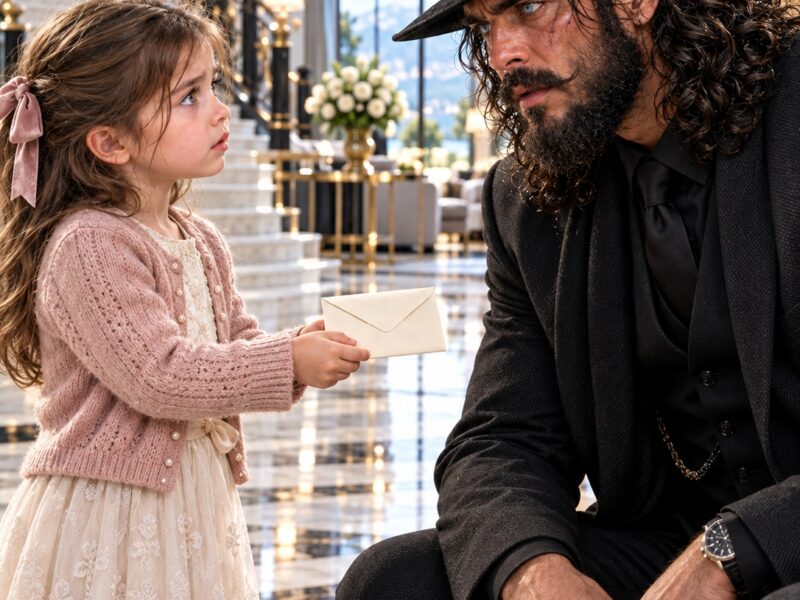
“Mommy Said to Give You This If She Ever Disappeared,” the Little Girl Told the Mafia Boss—Then He Opened the Envelope and Saw His Dead Brother
Adrian DeLuca had spent twenty years teaching grown men not to arrive at his house unannounced.
Then, on a rain-soaked Thursday afternoon, a six-year-old girl walked through his side gate alone.
And before sunset, she handed him proof that the brother Adrian had buried six years earlier had never died in the fire.
He was cutting an orange at the kitchen island when the security monitor flickered.
At first, Adrian barely looked.
The estate cameras caught deer, delivery trucks, landscapers, county utility workers, teenagers who occasionally drove too far up the private road before realizing whose property they had entered. Marco usually handled it before Adrian ever needed to ask.
Then the figure on the screen moved closer.
Small.
Yellow raincoat.
Purple backpack.
Alone.
Adrian stopped cutting.
The girl walked steadily up the long stone drive, rain sliding from the hood of her coat. Her boots were muddy to the ankle. A stuffed rabbit stuck halfway out of her backpack, one ear bouncing each time she took a step.
Marco appeared from the guardhouse.
Even through the grainy camera, Adrian could see the uncertainty on his face.
Marco had spent twelve years in military security and another nine protecting the DeLuca family. He had faced armed men without raising his voice.
A first-grader had apparently defeated his training.
The radio on the kitchen counter crackled.
“Boss.”
Adrian picked it up.
“What?”
“There’s a kid.”
“I can see that.”
“She says she’s here for you.”
Adrian’s eyes narrowed.
“Who brought her?”
“No one I can find.”
“Check the road.”
“Already did.”
Adrian set the knife down.
“Does she have a phone?”
“No.”
“Anything else?”
Marco hesitated.
“She said she’ll only talk to the man with the black ring.”
Adrian looked down at his right hand.
Heavy gold.
Black onyx.
His father’s ring.
Almost nobody outside the DeLuca organization knew it meant anything.
Something cold moved beneath Adrian’s ribs.
“Bring her to the front steps.”
“I don’t like it.”
“Neither do I.”
He disconnected.
His housekeeper, Teresa Moreno, appeared in the doorway carrying a dish towel.
“What happened?”
“A child.”
Teresa frowned.
“In the driveway?”
“Yes.”
“In this weather?”
“Yes.”
Her expression changed.
“Then why are you still standing here?”
That was Teresa.
She had worked for Adrian eleven years and was one of three people alive who could make him feel twelve without trying.
He walked toward the foyer.
Two security men followed from the west hall.
“Stay back.”
Neither argued.
The front door opened onto gray afternoon light.
Rain whispered across the stone courtyard.
The little girl stood at the foot of the steps.
She was smaller up close.
Six, perhaps.
Thin legs inside pink leggings. Yellow raincoat two sizes too large. Dark brown hair escaping a pair of braids that someone had made carefully that morning.
She looked at Adrian.
Then at the men behind him.
Then at Adrian again.
Not frightened exactly.
Evaluating.
“Are you Mr. DeLuca?”
Her voice was barely louder than the rain.
“I am.”
“The one with the ring?”
Adrian lifted his hand slightly.
“Yes.”
She released a breath.
Relief.
That bothered him more than fear would have.
She unzipped the front of her coat and removed a white envelope tucked against her sweater.
The corners had softened from being handled.
She held it toward him with both hands.
“Mommy said to give you this if she ever disappeared.”
Nobody behind Adrian moved.
Rain struck the stone.
A gutter overflowed somewhere along the east wing.
Adrian did not take the envelope immediately.
“What’s your name?”
“Emily.”
“Emily what?”
“Emily Hale.”
“How old are you?”
“Six and three months.”
The precision nearly made Teresa smile.
Emily noticed.
“My mommy says if grown-ups know exactly how old you are, they listen better.”
Adrian crouched.
His men shifted behind him.
He ignored them.
“Where is your mother, Emily?”
The girl looked at the envelope.
“She didn’t come home.”
“When?”
“She was supposed to get me from Mrs. Callahan’s before dinner yesterday.”
Adrian’s stomach tightened.
“And she didn’t?”
Emily shook her head.
“Mrs. Callahan called the police.”
“And?”
“They said Mommy is an adult and sometimes adults leave.”
She lowered her voice.
“But Mommy doesn’t leave me.”
Adrian believed her.
He did not yet know why.
“How did you get here?”
“I took the bus.”
“By yourself?”
Emily nodded.
“Mrs. Callahan fell asleep after her medicine. Mommy showed me before. Two buses, then the one that stops by the church.”
Adrian stared at her.
A six-year-old had crossed half the city because someone had trained her to do it.
Someone had expected this day.
“Your mother told you my address?”
“She made me memorize it.”
The cold beneath Adrian’s ribs deepened.
Emily extended the envelope again.
“She said not to give it to anyone else.”
Adrian took it.
“And she said if somebody says he’s your friend, I should still wait for you.”
One of the guards behind him inhaled.
Adrian heard it.
So did Emily.
She turned slightly.
Adrian’s eyes hardened.
The guard looked away.
“Teresa.”
“I have her.”
Teresa stepped forward, wrapped the child in the towel she had brought, then lowered herself to Emily’s height.
“Hot chocolate?”
Emily glanced at Adrian.
He nodded.
“Okay.”
“With marshmallows?”
Emily’s face brightened for the first time.
“Three.”
Teresa smiled.
“That sounds medically responsible.”
Emily followed her inside.
At the threshold, she turned.
“You won’t lose it?”
Adrian looked at the envelope.
“No.”
“You promise?”
He rarely made promises.
“Promise.”
Only then did she go.
Adrian carried the envelope into his study and locked the door.
The room had belonged to his father before him.
Dark wood.
Leather.
Three generations of family photographs arranged as though history could be organized into frames.
Adrian sat behind the desk.
His hands were steady.
They had been steady when federal agents searched three warehouses.
Steady when a rival crew burned two trucks.
Steady when his father died during heart surgery and thirty-six men waited outside the hospital to find out who would inherit his authority.
Now his fingers shook opening paper.
Inside was a silver medal on a broken chain.
Adrian stopped breathing.
Saint Christopher.
Patron saint of travelers.
Dent along the lower left edge.
He had made that dent when he was sixteen.
His younger brother, Nathan, had been thirteen and following him through the back corridor of St. Michael’s Church after their mother told Nathan to stop bothering him.
Nathan did not stop.
Adrian grabbed the medal from his neck and threw it against the marble wall.
Their mother made Adrian apologize for two weeks.
Nathan wore it anyway.
Every day.
Even the night of the Harbor Point fire.
Adrian picked it up carefully.
Six years, seven months, nineteen days.
That was how long Nathan had been dead.
Or how long Adrian had believed it.
The fire had destroyed an old boathouse the family sometimes used for private meetings near Lake Michigan.
Nathan’s car was outside.
His watch was recovered inside.
Investigators found biological remains consistent with the number of people believed to have been present.
There was no body to view.
Adrian had buried a closed casket.
He remembered his father standing beside it.
Remembered the way old Vittorio DeLuca had stared at the polished wood and whispered, “A father should not bury a son.”
Vittorio died eleven months later.
Adrian had always believed grief killed him before the heart attack did.
Beneath the medal lay a photograph.
A man sat in a cheap hospital chair.
His hands were scarred badly enough that several fingers bent inward.
One side of his neck showed burn damage climbing beneath the collar of his shirt.
A toddler in a green sweater sat laughing on his lap.
The man’s face was thinner.
Older.
But the smile—
Adrian dropped the photograph.
Nathan smiled crookedly.
Always had.
One corner of his mouth rose first, especially when he was about to say something irritating.
Adrian picked the picture up again.
Turned it over.
Four words.
Emily’s first birthday. Love, Nate.
A date followed.
Five years ago.
More than a year after Nathan’s funeral.
Adrian sat motionless.
The house disappeared around him.
There are shocks that produce panic.
Others create silence.
This one emptied him.
For six years Adrian had remembered their final argument more clearly than anything else.
Nathan had stood in this very study.
Twenty-eight years old.
Angry.
“I don’t want this.”
“You think anyone asked me what I wanted?”
“That’s your excuse for everything.”
“You enjoy the house. The money. The protection.”
“I enjoy having a brother.”
Adrian had stared at him.
Nathan continued.
“But lately I only have a boss.”
The insult had landed because it was true.
Nathan wanted out.
Graduate school.
Architecture.
A woman Adrian had never met.
A normal life somewhere nobody knew DeLuca.
Adrian had responded the way their father taught him.
“Nobody walks away clean.”
Nathan laughed bitterly.
“Listen to yourself.”
“I’m trying to keep you alive.”
“No. You’re trying to keep me obedient.”
Nathan turned toward the door.
Adrian’s temper broke.
“If you walk out tonight, don’t come back.”
Nathan stopped.
For one second Adrian believed he would turn around.
He did not.
Three hours later, Harbor Point burned.
Adrian carried those final words for six years.
Now Nathan was smiling in a photograph two years after his own burial.
A knock sounded.
“Boss?”
Tom Reynolds.
Adrian’s driver.
One of the only men he trusted outside blood.
“Come in.”
Tom entered.
Big man.
Fifty-six.
Gray at the temples.
He looked at the objects on the desk.
“What happened?”
Adrian pushed the photograph toward him.
Tom stared.
His face emptied.
“No.”
Adrian said nothing.
Tom picked it up.
“Jesus Christ.”
“He lived.”
Tom sat without being invited.
Nobody did that in Adrian’s study.
Adrian did not care.
“He lived.”
Tom looked at the handwriting.
“Where did this come from?”
“The kid.”
“What kid?”
“His daughter.”
Tom looked toward the ceiling as though the answer might be written there.
“Nathan had a daughter?”
“Apparently.”
“And where is he?”
Adrian rubbed both hands over his face.
“The girl says he died when she was four.”
Tom lowered the photograph.
“That was two years ago.”
“Yes.”
“So he survived the fire four years.”
“Yes.”
“And never called you.”
The words hurt worse when spoken by someone else.
Adrian looked at the medal.
“Find the mother.”
“Name?”
“Rebecca Hale.”
“Address?”
“Emily hasn’t told me yet.”
Adrian stood.
“And Tom?”
“Yes?”
“No one knows about this.”
Tom looked toward the photograph.
“Not even Vincent?”
Adrian hesitated.
Vincent Santoro.
His father’s closest friend.
The family’s adviser for twenty-four years.
Godfather at Adrian’s confirmation.
The man who had stood beside Vittorio when Nathan was buried.
The hesitation lasted less than a second.
“Not yet.”
Tom noticed.
He said nothing.
Emily was eating grilled cheese in the kitchen.
Teresa had changed her into a sweatshirt and sweatpants that belonged to a housekeeper’s granddaughter.
The stuffed rabbit sat upright on the counter beside her like a dinner guest.
Adrian took the stool across from her.
Emily looked up.
“Did you open it?”
“Yes.”
“Was the necklace there?”
“Yes.”
She relaxed.
“Daddy said you’d know it.”
Adrian gripped the edge of the counter.
“Your father gave that envelope to your mother?”
Emily nodded.
“A long time ago.”
“When?”
“I don’t know.”
“Did he talk about me?”
“All the time.”
Adrian was not prepared for that.
Emily took another bite.
“He said you were bossy.”
Teresa turned away.
Adrian looked at her back.
Her shoulders were shaking.
“You can laugh.”
Teresa laughed into the sink.
Emily continued.
“He said you were strong.”
“Did he?”
“He said you broke your arm falling out of a tree because you told everybody you could jump farther than Uncle Leo.”
Adrian stared.
Nobody outside his family knew that story.
Nathan had been there.
Eight years old.
Laughing so hard he nearly fell from the tree too.
“What else?”
Emily thought.
“He said you always peeled oranges in one long piece.”
Adrian looked toward the orange peel still lying on the kitchen island.
One continuous spiral.
Something tightened behind his eyes.
He looked down.
“Where do you live?”
“West Briar Street.”
“Number?”
“Four eighteen. The apartment over the laundromat with the blue door.”
Tom was already typing it into his phone.
“Who is your mother?”
“She’s a nurse.”
“Where?”
“St. Vincent’s.”
Adrian looked at Tom.
He nodded and stepped away.
Emily ate another bite.
“Daddy couldn’t open jars.”
Adrian looked back.
“What?”
“His hands.”
She lifted both of hers.
“They hurt.”
The fire.
“He had medicine.”
“What kind?”
“I don’t know.”
“Was he sick?”
Emily nodded.
“He coughed a lot.”
Adrian swallowed.
“When did he die?”
“After Christmas.”
“How?”
“Mommy said his lungs got tired.”
Simple.
Child language.
More devastating than medical terminology.
“Were you with him?”
“No. Mommy took him to the hospital.”
Emily dipped the corner of grilled cheese into tomato soup.
“He told me goodbye before.”
Adrian’s throat tightened.
“What did he say?”
She shrugged.
“That I had his stubborn face.”
Teresa stopped moving.
Adrian almost laughed.
Nathan would have said that.
“He told me Mommy might need help someday.”
Emily’s eyes lifted.
“And if she couldn’t come home, I had to find you.”
Adrian leaned forward.
“Did he tell you why?”
“No.”
“Did your mother?”
“She said some people were dangerous.”
“Which people?”
“She wouldn’t tell me.”
Emily’s thumb began rubbing against the seam of her sleeve.
Nervous.
Adrian lowered his voice.
“Did anyone come to your apartment before she disappeared?”
The thumb stopped.
“A man.”
Adrian went still.
“What man?”
“I didn’t see him.”
“When?”
“Tuesday night.”
“What happened?”
“Mommy told me to stay in my room.”
“Did you hear anything?”
Emily looked toward Teresa.
Teresa placed a warm hand against the girl’s back.
“You’re safe here.”
Emily nodded.
“The man had a nice voice.”
Adrian felt the phrase settle.
Nice voice.
“Did you know him?”
“No.”
“What did he say?”
“I only heard Mommy say, ‘Nathan trusted you.’”
Adrian looked at Tom.
Tom was already moving toward the hall.
“Go.”
Emily’s hand shot out.
She caught Adrian’s sleeve.
“Don’t let him take Mommy.”
The fear in her face was the first real fear she had shown.
Adrian covered her hand with his.
“I won’t.”
Another promise.
This one arrived before he could stop it.
Tom returned three hours later.
Adrian knew the news was bad before the front door closed.
Tom walked into the study with rain on his shoulders.
“Apartment’s been searched.”
“Police?”
“No.”
“Messy?”
“Professional enough to look messy.”
Adrian stood.
“The mother?”
“Neighbor saw two men escorting a woman into a gray sedan around four yesterday.”
“Force?”
Tom shook his head.
“She walked.”
“Voluntarily?”
“Neighbor said she looked terrified but wasn’t fighting.”
“Anything missing?”
“Hard to tell.”
“Police report?”
“She works in a hospital. Coworkers reported her missing this morning.”
Adrian looked out the window.
“And the cops?”
“Treating it as a missing adult.”
“For now.”
Tom nodded.
“There’s something else.”
Of course there was.
“Say it.”
“The downstairs neighbor said the gray sedan had been around before.”
“How long?”
“Weeks.”
Adrian turned.
“Did you get cameras?”
“Convenience store across the street. Owner is pulling footage.”
The study door opened.
Vincent Santoro entered without waiting.
Camel coat.
Silver hair.
Perfect tie.
At sixty-seven, Vincent still moved with the controlled ease of a man who believed rooms improved when he entered them.
He smiled.
“Am I interrupting?”
Adrian looked at Tom.
Then at the photograph facedown on the desk.
“No.”
Vincent removed his coat.
“I heard there was a child here.”
Adrian kept his expression neutral.
“Teresa’s niece.”
Vincent’s eyes rested on him.
One second.
Two.
“Teresa has no niece that age.”
Adrian almost smiled.
“Grandniece.”
“Ah.”
Vincent crossed the room.
“You look terrible.”
“Thank you.”
“You sleeping?”
“Never.”
Vincent poured himself water from the sideboard.
He had done it thousands of times.
Familiarity was a dangerous camouflage.
“Your meeting with Calder Logistics is tomorrow.”
“Move it.”
“Why?”
“Personal issue.”
Vincent turned.
“You don’t have personal issues.”
“I discovered one.”
The older man smiled faintly.
“Should I be worried?”
Adrian looked directly at him.
“Not yet.”
Vincent studied him.
Then nodded.
“Tell me if that changes.”
He left twenty minutes later.
Only after the front door closed did Tom breathe normally.
“What?”
Tom rubbed his jaw.
“You lied to him.”
“Yes.”
“You never lie to Vincent.”
“I do now.”
“Why?”
Adrian picked up Nathan’s photograph.
“Because Emily said her mother told her not to give the envelope to anyone who claimed to be my friend.”
“That could mean anyone.”
“Yes.”
“And?”
Adrian looked toward the door Vincent had used.
“Vincent knew Teresa doesn’t have a niece.”
Tom frowned.
“He knows everyone in this house.”
“Exactly.”
That night, Adrian put Emily in a guest room across from Teresa.
He checked the windows himself.
Checked the closet.
The bathroom.
The lock.
Emily sat beneath the blanket holding her rabbit.
“You don’t have to do that.”
“I know.”
“My daddy checked windows.”
Adrian stopped.
“Did he?”
“He said locks make people sleep better.”
Adrian touched the window latch again.
Nathan had always checked them twice.
Their mother mocked him for it.
Adrian sat at the edge of the bed.
“Emily.”
“Yes?”
“Did your father ever tell you about the fire?”
Her face changed.
Not much.
Enough.
“Mommy said I wasn’t supposed to talk about that.”
“Your mother isn’t here.”
“That’s why I shouldn’t.”
Adrian almost smiled despite himself.
“She taught you well.”
Emily hugged the rabbit.
After a moment she whispered, “Daddy said somebody tried to make him disappear.”
Adrian did not move.
“Who?”
“He didn’t know at first.”
“At first?”
Emily nodded.
“He said the fire wasn’t an accident.”
Adrian’s blood went cold.
“What else?”
“He said somebody locked the doors.”
Adrian stared.
Official reports said a structural beam collapse had trapped the victims.
“Did he say who?”
Emily shook her head.
“Just that the person had a friendly voice.”
Adrian did not sleep.
Near three in the morning, he returned to his study.
The envelope sat beneath a desk lamp.
He turned it over.
Again.
Again.
Nathan had always hidden things.
As a child he taped spare money beneath drawers, wrote notes inside book jackets, built false bottoms in cigar boxes because he believed privacy was a form of architecture.
Adrian ran his thumb along the envelope.
Bottom edge.
Too stiff.
He took a letter opener and carefully slit the interior seam.
A tiny brass key fell onto the desk.
Number 214.
No label.
Tom arrived fifteen minutes after Adrian called.
He looked at the key.
“You recognize it?”
“No.”
Adrian did.
Years earlier, the DeLuca family rented long-term private lockers at the old North Shore Ferry Terminal, a building mostly used now for storage companies and charter services.
Vittorio kept emergency documents there.
Few people remembered.
Nathan would.
At four twelve, Adrian and Tom entered the terminal.
A night custodian watched them pass without asking questions.
Locker 214 was at the end of a narrow concrete corridor.
The key turned.
Inside sat a steel document case.
Nothing else.
Tom carried it to the car.
They parked beneath an elevated train line where rainwater dripped steadily from rusted beams.
Adrian broke the seal.
On top lay a letter.
His name.
Nathan’s handwriting.
Adrian,
If you’re reading this, Rebecca did what I asked, which means I’m gone and something happened to her. Before you get angry, read everything. For once in your life, finish listening before you decide what you believe.
Adrian almost laughed.
Dead six years and still irritating him.
He continued.
I did not die in the Harbor Point fire.
The words were simple.
Still impossible.
Someone locked the east and south exits from outside. I remember smoke. I remember breaking the bathroom window. I remember falling into the lake. After that I woke up in Mercy General under a false name with burns over thirty percent of my body. Rebecca Hale was the night nurse who kept me alive.
Adrian stopped reading.
Tom said nothing.
I didn’t call you. That is the part I need you to forgive if you can.
Before I lost consciousness at Harbor Point, I heard somebody outside the window. He said, “Your brother should have listened.”
Adrian’s hand tightened.
Their final argument.
Someone knew exactly what Adrian had said.
Someone had used it.
I believed you ordered it.
Adrian closed his eyes.
Tom looked away.
The letter continued.
I believed it for almost three years. Burn scars make anger easy. Pain makes bad explanations feel true if they match what you already fear. Rebecca helped me recover. We moved. Emily was born. I stayed hidden because I thought the safest place for my family was far away from you.
I was wrong about you.
Adrian swallowed.
It took me years to figure out the voice at Harbor Point. I followed payments, legal retainers, federal case numbers, shell companies. The evidence is beneath this letter. Somebody inside our family has been selling names, routes and information to investigators and rival crews for more than a decade. He used my argument with you to make my death look like the predictable end of two brothers fighting.
He has been beside you the entire time.
Adrian looked at Tom.
Neither spoke.
He turned the page.
Vincent Santoro.
The rain seemed louder.
Tom whispered, “Jesus.”
Adrian read the name again.
Vincent.
His father’s closest friend.
The man who taught Adrian chess.
The man who took Nathan fishing.
The man who stood with Adrian beside the closed casket.
The letter continued.
He knew I would be at Harbor Point because I told him. I was going there to cool off before coming back to apologize. He arranged the fire.
Adrian stopped.
His vision narrowed.
Tom reached toward him, then stopped.
Adrian kept reading.
I confronted him four years later. I recorded part of it, but he never saw me clearly and I got away. After that, I knew I had limited time. My lungs never recovered. I gave Rebecca everything. If she disappears, Vincent found her or somebody working for him did.
Do not make my mistake. Do not react before you think.
And Adrian—
His handwriting changed there.
Less controlled.
I was wrong to believe you could do that to me. You were angry. You were cruel that night. But you were my brother, not my executioner. I should have known the difference.
Adrian pressed the letter against his knee.
For six years he had hated himself for Nathan’s death.
Nathan had spent years believing Adrian ordered it.
Two brothers separated by the same lie.
Tom looked through the windshield.
“There’s more.”
Beneath the letter lay a black ledger.
Payments.
Dates.
Initials.
Route numbers.
Federal case references.
Confidential informant codes.
Adrian recognized his father’s handwriting in old notes.
Then Vincent’s.
Years.
Millions.
Names of men convicted after sealed evidence surfaced unexpectedly.
Businesses raided days after meetings only four people knew about.
Adrian turned pages faster.
“You see that?”
Tom leaned closer.
Payment from a federal intermediary.
Three weeks before Harbor Point.
Then another from a shell company tied to the rival Bellini organization.
“Both sides,” Tom whispered.
Adrian nodded.
Vincent sold information to law enforcement.
Then sold vulnerable positions to competitors.
He made money from every conflict he helped create.
Beneath the ledger lay a memory card.
Nothing else.
Tom looked at him.
“Play it?”
“Not here.”
They drove back before dawn.
Vincent’s car was already in Adrian’s driveway.
Adrian stared through the windshield.
Tom looked at him.
“You want him removed?”
“No.”
“Adrian.”
“He cannot know we know.”
“You’re going to walk in there?”
“Yes.”
“With him?”
“Yes.”
Tom’s jaw tightened.
“And the child?”
The question mattered.
More than Adrian expected.
“Teresa stays with her. Marco locks down the east wing.”
“And Vincent?”
Adrian looked at the house.
“We smile.”
They entered through the side hall.
Laughter came from the sunroom.
Child laughter.
Adrian stopped.
Emily.
He walked faster.
Vincent sat beside the windows.
Emily perched on the arm of the chair while he made her stuffed rabbit hop along the table.
She laughed.
Vincent looked up.
“There he is.”
Warm voice.
Easy smile.
Adrian had never hated anyone more.
“We were waiting.”
Emily slid down.
“Mr. Adrian, Mr. Vincent knows magic.”
“Does he?”
“Coin magic.”
Vincent smiled.
“Your uncle used to love the same trick.”
Adrian’s pulse stopped.
Emily looked up.
“My uncle?”
Vincent recovered instantly.
“I mean an uncle. Children usually do.”
Adrian stared.
The mistake was tiny.
Deadly.
Emily did not notice.
Adrian did.
Vincent stood.
“You look exhausted.”
“Long night.”
“I’ve had people asking around about Rebecca.”
Adrian’s face remained calm.
“Rebecca?”
Vincent paused.
One fraction too long.
“The mother.”
Adrian had never told him her name.
Vincent smiled again.
“You mentioned it last night.”
“No.”
Silence.
Then Adrian deliberately rubbed his eyes.
“Maybe I did.”
Vincent relaxed.
Only slightly.
“I’ll find her.”
“I appreciate it.”
“Of course.”
He squeezed Adrian’s shoulder.
The same hand he placed there at Vittorio’s funeral.
Same warmth.
Same false loyalty.
Emily looked between them.
Something in the child’s face changed.
Not understanding.
Instinct.
When Vincent left, Adrian watched his car disappear beyond the gate.
Tom entered.
“He said her name.”
“Yes.”
“You never gave it.”
“No.”
Tom looked toward the driveway.
“You okay?”
“No.”
It was the first truthful answer Adrian had given all morning.
He went upstairs.
Emily stood outside the study door in oversized pajamas.
“Uncle Adrian?”
He stopped.
She had never called him that.
His throat tightened.
“Who told you to call me that?”
“Daddy.”
“When?”
“Before he died.”
She hugged the rabbit.
“He said if I ever found you, you were Uncle Adrian even if you were grumpy.”
Adrian crouched.
“That sounds like him.”
Emily held out the rabbit.
“Mommy said I give this to you when you say you’ll bring her home.”
Adrian looked at it.
“I don’t make promises I can’t keep.”
Emily frowned.
“Mommy said you’d say that.”
Of course she had.
“What else did she say?”
“That you’re afraid promises make people own you.”
Adrian stared.
Rebecca Hale had never met him.
Nathan knew him very well.
Emily extended the rabbit.
Adrian felt every rule he had lived by pressing against him.
Never promise.
Never reveal need.
Never let fear determine terms.
Yet the child had crossed a city because adults she trusted told her he would be there.
“I’ll bring her home.”
His voice nearly failed.
“I promise.”
Emily handed him the rabbit.
She looked satisfied.
Transaction complete.
Tom took the toy.
“What?”
“The back.”
Blue thread.
A seam recently resewn.
Teresa brought scissors.
Inside the stuffing lay another memory card.
They played it in the study.
Wind.
Water.
The knock of waves against pilings.
Nathan’s breathing.
Then Nathan’s voice.
Weak.
Angry.
“You burned me alive.”
Vincent answered.
Calm.
“You survived.”
“You wanted me dead.”
“You were going to ruin your brother.”
“You sold him.”
“I protected the family.”
“You sell information to the government.”
“I sell certainty.”
Nathan coughed violently.
Vincent continued.
“Your father would have given everything to Adrian. Adrian is strong, but predictable. Fear makes him rigid. He would eventually get all of us buried.”
“You’re a traitor.”
“I am the reason there is still something left to betray.”
The recording crackled.
Nathan said, “Emily will never know your name.”
Vincent laughed softly.
“You have a daughter?”
The sound stopped.
Adrian stood so abruptly the chair fell backward.
Tom stared at the speaker.
“He learned about her that night.”
“Yes.”
“He’s been looking ever since.”
Adrian’s phone vibrated.
Not his regular phone.
A black burner lay inside the steel document case.
Neither man had noticed it because the battery was nearly dead.
Now its screen glowed.
One photograph.
Rebecca Hale.
Sitting on a concrete floor.
Dark hair loose around her face.
Hospital scrubs dirty at one knee.
She held that morning’s newspaper.
Alive.
Beneath the photograph:
MIDNIGHT. NAVY PIER SERVICE DOCK 7. BRING THE LEDGER AND EVERYTHING NATHAN LEFT. COME ALONE.
A second message arrived.
OR EMILY GROWS UP WITHOUT A MOTHER.
Tom swore.
Adrian stared at Rebecca’s face.
He had never met her.
Yet she had kept Nathan alive.
Loved him.
Raised his child.
Trusted Adrian enough to send that child to him.
Tom said quietly, “We can bring twenty men.”
“No.”
“He wants you alone.”
“He expects me to bring twenty men.”
“Then what?”
Adrian looked at the ledger.
Every crime.
Every payoff.
Every illegal shipment his father built and Adrian inherited.
The ledger did not only destroy Vincent.
It destroyed Adrian.
Tom understood.
“If you hand it over, he owns you.”
“Yes.”
“If you burn it, Rebecca dies.”
“Yes.”
“There’s a third option.”
Adrian looked at him.
Tom did not say the name.
He did not have to.
Detective Laura Bennett had spent ten years trying to put Adrian DeLuca in prison.
Chicago Organized Crime Division.
Patient.
Unimpressed.
Incorruptible.
She once returned a Christmas bottle from one of Adrian’s attorneys with a handwritten note:
Try again when hell freezes.
Adrian respected her more than he liked admitting.
He picked up his phone.
Tom stared.
“You’re serious.”
“Yes.”
“You give Bennett that ledger and you go down too.”
Adrian looked toward the ceiling.
Emily slept upstairs.
Nathan had spent years hidden because he wanted his daughter outside this world.
Then Nathan wrote one instruction in the final paragraph of his letter.
Take care of them. And don’t make Emily inherit what Father gave us.
Adrian dialed.
Bennett answered on the third ring.
“DeLuca.”
“You sound disappointed.”
“I was hoping never to hear your voice without a warrant.”
“I have something you’ve wanted ten years.”
“Your confession?”
“Close.”
Silence.
“What?”
“A ledger.”
Her voice changed.
“What ledger?”
“Everything.”
Another silence.
“You’re lying.”
“I’ll give it to you at twelve thirty tonight.”
“Where?”
“Navy Pier.”
“What do you want?”
“Your people in position by midnight.”
“For what?”
“A hostage.”
“Who?”
“Rebecca Hale. Nurse. Thirty-four.”
Bennett paused.
“And why do you care?”
Adrian looked at Nathan’s photograph.
“My brother left me a niece.”
Bennett did not speak.
Adrian continued.
“I want her to have at least one adult who isn’t lying to her.”
“You understand if this ledger contains what I think it contains, you don’t walk away.”
“Yes.”
“You could go to prison.”
“Yes.”
“Years.”
“I know.”
“What changed?”
Adrian looked toward the door.
A child’s yellow raincoat hung from a hook in the hallway.
“I found out what everything costs.”
At eleven forty-eight, Adrian left the estate alone.
He kissed nobody goodbye.
Did not know how.
Teresa stood in the foyer.
Emily appeared behind her holding the rabbitless backpack.
Adrian stopped.
“You should be sleeping.”
“I was.”
“Go back.”
She walked toward him.
“Are you getting Mommy?”
“Yes.”
She looked at his face.
“Are you scared?”
Adrian almost lied.
“Yes.”
Emily nodded.
“Daddy said brave people are scared and go anyway.”
Adrian smiled faintly.
“He stole that from someone.”
“Still true.”
Adrian touched her hair.
“If I’m late—”
She shook her head.
“You promised.”
That ended the conversation.
Navy Pier at midnight looked almost abandoned.
Cold wind off the lake.
Service lights reflecting in black water.
Adrian walked toward Dock 7 carrying the black ledger beneath one arm.
Vincent stood at the far end.
Six men behind him.
Rebecca sat on an overturned equipment crate.
Hands bound.
No gag.
Vincent had always preferred civility.
“Adrian.”
“Vincent.”
Rebecca looked at him.
She knew immediately.
Nathan’s brother.
Her eyes filled, but she remained still.
Vincent smiled.
“You came alone.”
“You asked.”
“You never listen.”
“Trying something new.”
“Where is the ledger?”
Adrian raised it.
“Rebecca first.”
Vincent laughed.
“Still sentimental.”
“You burned my brother.”
Vincent’s expression barely changed.
“He survived.”
“For four years.”
“He created complications.”
“You mean evidence.”
“I mean weakness.”
Adrian stepped closer.
“You were his godfather.”
“I was yours too.”
“Apparently the title requires less character than I thought.”
Vincent sighed.
“You still don’t understand.”
“Explain.”
“I kept your father out of federal prison for eleven years.”
“By selling his men.”
“By controlling losses.”
“You took money.”
“Of course.”
Rebecca watched them.
Vincent continued.
“Your father built an empire with emotion. Loyalty. Family. Pride. All expensive weaknesses.”
“And what did you build?”
“Survival.”
Adrian almost smiled.
“Funny.”
“What?”
“You’re the only one here about to lose everything.”
Vincent’s eyes narrowed.
“Give me the ledger.”
Adrian held it out.
Vincent stepped forward.
Then Adrian removed his phone.
Pressed play.
Nathan’s voice spread across the dock.
You burned me alive.
Vincent froze.
His men looked at him.
The recording continued.
You sell information to the government.
Then Vincent.
I sell certainty.
One man behind him slowly lowered his hand from inside his coat.
Another looked toward the lake.
Vincent’s face changed.
“Turn it off.”
Adrian raised the volume.
You’re a traitor.
I am the reason there is still something left to betray.
“Turn it off!”
Adrian stopped the recording.
Silence.
He looked at the men.
“Twenty-three names in this ledger.”
Vincent’s jaw tightened.
“Don’t.”
“Men arrested after private meetings.”
A large man named Carlo shifted backward.
His brother was one of them.
Adrian continued.
“Three companies raided forty-eight hours after Vincent reviewed their books.”
Another man looked at Vincent.
“And Harbor Point.”
Vincent moved toward Rebecca.
Adrian saw it.
So did Rebecca.
Vincent seized her by the shoulder and pulled her against him.
A handgun appeared.
Everything slowed.
“Ledger.”
Adrian placed it on the wet boards.
“Take it.”
“Kick it.”
Adrian did.
The book slid halfway.
Vincent stared.
Adrian looked past him.
Blue light flashed faintly against the far warehouses.
Vincent saw it in Adrian’s eyes.
“You.”
His face twisted.
“You called police.”
“Yes.”
“You gave them the ledger?”
“The copy.”
Vincent’s expression broke.
For the first time Adrian saw him afraid.
“You stupid bastard.”
“Probably.”
“You go down with me.”
“I know.”
“You lose everything.”
Adrian looked at Rebecca.
Then at the lake.
“I already learned what that word means.”
Vincent raised the gun.
Rebecca moved.
Not dramatically.
One hard step backward against his knee.
His balance shifted.
Adrian lunged.
The gun fired.
Heat ripped across Adrian’s left shoulder.
He hit the boards.
For half a second there was no pain.
Only surprise.
Then Rebecca was on her knees beside him.
Vincent shouted.
His own men backed away.
Police lights exploded across the pier.
Commands.
Boots.
Weapons lowered.
Adrian heard Bennett’s voice.
“Gun down!”
Vincent held Rebecca tighter.
Carlo stepped forward.
“Enough, Vince.”
Vincent stared at him.
“You work for me.”
Carlo shook his head.
“My brother did too.”
The gun dropped.
Rebecca tore free.
Bennett’s officers rushed in.
Adrian remained on the dock.
Rainwater beneath his cheek.
Rebecca pressed both hands against his shoulder.
“You’re bleeding.”
“So I’ve been told.”
“You joke badly.”
“Nathan said the same.”
Her face crumpled.
The pain finally arrived.
Adrian closed his eyes.
Bennett crouched beside him.
Badge swinging from her neck.
“You called me.”
“I noticed.”
“You know what happens after the hospital.”
“Yes.”
“You’re under arrest.”
Rebecca looked at Adrian.
He managed a tired smile.
“Apparently I’ve had better Thursdays.”
Adrian woke to afternoon light and a police officer outside the hospital room.
His shoulder was wrapped heavily.
His mouth tasted like metal.
Rebecca sat beside the window.
For several seconds he only looked at her.
Nathan’s woman.
Emily’s mother.
The person who had existed at the edge of his life for six years without him knowing.
“You look like him.”
She smiled.
“That’s what he said about you.”
Adrian tried to sit.
Pain stopped him.
“Emily?”
“With Teresa.”
“Safe?”
“Yes.”
He relaxed.
Rebecca watched him.
“You really didn’t know.”
“No.”
“Nathan spent years believing you did.”
“I know.”
“He hated himself for it at the end.”
Adrian stared at the blanket.
“He shouldn’t.”
“He loved you.”
The words hurt.
“I told him not to come back.”
Rebecca looked at him.
“He did come back.”
Adrian glanced up.
“In every way except the one you wanted.”
She placed a folded paper on his tray.
Nathan’s final note.
Not the long letter.
Something smaller.
Adrian opened it.
Ade—
Nathan had always called him that when he wanted forgiveness.
If Emily makes it to you, don’t waste time punishing yourself. You are excellent at that and always have been.
Adrian laughed once.
Pain shot through his shoulder.
Rebecca smiled through tears.
He continued.
I made my choices too. I believed the wrong man because I was angry at the right one.
Rebecca will pretend she doesn’t need anybody. She does. Emily will pretend she’s brave. She is, but that isn’t the same thing.
Give them something we never had.
A door they can walk out of without wondering if they’re allowed to come back.
Adrian stopped.
For years, the DeLuca family’s rules had been about doors.
Who entered.
Who left.
Who was protected.
Who was excluded.
Nathan’s last request was simply to remove one.
“What happens now?” Rebecca asked.
Adrian folded the note.
“Bennett arrests me.”
“She already did.”
“Efficient.”
“You gave her everything.”
“Yes.”
“Why?”
Adrian looked at her.
“Because Nathan spent the last years of his life trying to keep Emily from becoming part of mine.”
Rebecca’s expression softened.
“I thought the least I could do was stop defending it.”
The criminal case took nine months.
Vincent Santoro pleaded guilty after three of his own men testified.
The recording destroyed what remained of his leverage.
The ledger destroyed everything else.
Federal investigators discovered payments going back thirteen years.
Information sold to organized-crime units.
Routes sold to rival organizations.
Cash moved through consulting companies.
Twenty-three people betrayed.
Three dead.
Dozens imprisoned.
The Harbor Point fire became one count among many.
Adrian pleaded guilty too.
Illegal gambling.
Financial conspiracy.
Obstruction.
His attorney called the agreement brutal.
Detective Bennett called it fair.
The judge called Adrian’s cooperation extraordinary and his prior conduct serious.
He received eighteen months.
Adrian did not appeal.
His legitimate companies moved into a trust operated by Tom.
Everything illegal closed.
Several men left angrily.
Others seemed relieved.
The hilltop estate was sold.
The cars disappeared.
The black ring went into an evidence box.
Adrian discovered he did not miss it.
Prison was less dramatic than men outside imagined.
Mostly noise.
Routine.
Bad coffee.
Locked doors.
That last part bothered him most.
Emily visited every second Sunday.
Rebecca brought her.
The first visit, Emily sat across the scratched plastic table and stared at his gray uniform.
“Do you sleep here?”
“Yes.”
“Is your bed bad?”
“Terrible.”
“Teresa said you complained about your mattress at home.”
“Teresa talks too much.”
Emily nodded.
“She does.”
Then she opened a folder containing twenty-seven drawings.
Adrian looked through every one.
School.
A dog she wanted.
A purple house.
A rabbit that looked like a potato.
In the fourth drawing, there were four people.
Emily.
Rebecca.
Nathan with wings.
Adrian standing beside them.
He looked too long.
Emily noticed.
“That’s you.”
“I assumed.”
“You look grumpy.”
“Accurate.”
She smiled.
“I put Daddy there because Mommy says he’s still family.”
Adrian looked at Nathan’s stick figure.
“Your mother is right.”
Emily leaned forward.
“Are you still my uncle in here?”
Adrian’s chest tightened.
“Yes.”
“Okay.”
That was all she needed.
Children, Adrian learned, could forgive distance if adults stopped lying about why it existed.
Rebecca took longer.
She visited less often at first.
Not because she disliked him.
Because Adrian reminded her of Nathan.
That grief had edges.
They spoke carefully.
Then more honestly.
One Sunday Rebecca told him about the last year of Nathan’s life.
His lungs had deteriorated badly.
Scar tissue.
Repeated infections.
Oxygen at night.
Still, Nathan worked part-time drawing renovation plans for a contractor who never knew his real name.
“He designed Emily’s bedroom,” Rebecca said.
Adrian smiled.
“He couldn’t draw a straight line at fourteen.”
“He learned.”
“He cheated in geometry.”
“He told me.”
Adrian laughed.
Rebecca watched him.
“He missed you.”
Adrian looked down.
“I know.”
“He almost called several times.”
“Why didn’t he?”
“Fear.”
Adrian nodded.
The family inheritance.
Not money.
Not businesses.
Fear.
On another visit, Rebecca brought a photograph Adrian had never seen.
Nathan standing on a beach with Emily on his shoulders.
Scarred arms visible.
Thin.
Happy.
“Keep it,” Rebecca said.
Adrian touched the edge.
“You sure?”
“You lost six years.”
“So did you.”
“I had him.”
That answer ended the argument.
After eleven months, Bennett visited.
Adrian sat across from her.
“This social?”
“No.”
“Disappointing.”
“You’re being released early.”
He stared.
“Why?”
“Cooperation. Conduct. Overcrowding. Pick whichever version helps you sleep.”
“When?”
“Six weeks.”
Adrian looked toward the visiting-room window.
Bennett studied him.
“You don’t look happy.”
“I don’t know where I’m going.”
She raised an eyebrow.
“Man who once owned twelve properties has nowhere to go.”
“Owned.”
“Fair.”
She stood.
“For what it’s worth, DeLuca, the evidence you turned over ended a lot of things that needed ending.”
Adrian looked up.
“That supposed to make me feel better?”
“No.”
“Good.”
She almost smiled.
“You’re less annoying in prison.”
“I’ll try to correct that.”
Six weeks later, the sky was pale gray.
Adrian walked out carrying a paper bag.
Two shirts.
A wallet.
Nathan’s photograph.
The St. Christopher medal.
No ring.
He expected Tom.
Maybe Teresa.
Instead the parking lot was nearly empty.
Then he saw yellow.
Emily stood beside a dark blue sedan.
Her raincoat fit properly now.
Rebecca leaned against the hood wearing jeans and a long gray coat.
Emily held something with both hands.
An envelope.
White.
Soft at the corners.
Adrian stopped.
Emily walked toward him.
Slowly.
Solemnly.
Exactly as she had walked up the hill more than a year earlier.
“Mommy said to give you this if you ever came home.”
Adrian laughed.
It surprised him.
He crouched.
His knees complained.
“Apparently your mother enjoys envelopes.”
“She says men in your family don’t listen unless things are dramatic.”
Rebecca called from the car.
“Accurate.”
Adrian opened it.
Inside was a drawing.
Green crayon house.
Blue door.
Three windows.
Four figures on the steps.
One figure had wings.
Taped beneath the drawing was a brass key.
Adrian stared.
Emily pointed.
“That’s our house.”
“Your house?”
“Mommy got a new one.”
Rebecca walked closer.
“Rental.”
Emily ignored her.
“You get the room by the back door.”
Adrian looked at Rebecca.
She shoved both hands into her coat pockets.
“Nathan said you hate sleeping far from exits.”
Adrian swallowed.
“Rebecca.”
“You can stay until you decide what you’re doing.”
“I don’t want to—”
She raised one hand.
“Don’t.”
He stopped.
“I spent six years watching Nathan refuse help because he believed accepting it made him dangerous to other people.”
Her eyes filled.
“I am not doing that with his brother.”
Adrian looked at the key.
“I don’t know how long.”
“Good.”
“What?”
“Neither do I.”
Emily tugged his sleeve.
“There’s a basement.”
“That is useful information.”
“And Teresa says your boxes are already there.”
Adrian stared at Rebecca.
She smiled faintly.
“You thought she would wait for permission?”
“No.”
“Then apparently prison didn’t make you smarter.”
He laughed again.
Emily suddenly threw both arms around his neck.
Adrian froze.
Not because he did not want it.
Because nobody had prepared him.
She smelled like crayons and strawberry shampoo.
For a moment he could not move.
Then he wrapped both arms around her.
His eyes closed.
Something inside him that had been held rigid for decades finally loosened.
Not broke.
Loosened.
There was a difference.
Rebecca looked away to give him privacy.
Emily whispered into his collar.
“Daddy said you’d come if I found you.”
Adrian’s throat tightened.
“He said that?”
“Yes.”
“He was very confident.”
“He said you were slow but eventually smart.”
Adrian laughed against her hair.
“That sounds exactly like your father.”
They drove north.
Not toward the estate.
That belonged to another life.
Rebecca’s house stood on a quiet street lined with maples.
Brick.
Small yard.
Blue front door.
Nathan would have liked it.
Teresa had already occupied the kitchen and was insulting Rebecca’s frying pans.
Tom sat at the table drinking coffee.
Adrian stopped inside the doorway.
“You people planned this.”
Teresa looked offended.
“Of course.”
Tom stood.
For a second neither man moved.
Then Tom hugged him.
Brief.
Hard.
“No boss,” Tom said.
Adrian nodded.
“No boss.”
Emily grabbed his hand.
“Come see your room.”
She dragged him upstairs.
The room was small.
One bed.
One dresser.
Window overlooking the backyard.
Another door beside the closet leading to a narrow exterior staircase.
Nathan had known him.
Adrian touched the doorknob.
“He told you.”
Rebecca stood behind him.
“Every night.”
“What?”
“He told stories about you.”
Adrian looked back.
“Even when he thought I tried to kill him?”
“Especially then.”
“Why?”
Rebecca smiled sadly.
“Because hate takes effort when love was there first.”
Adrian sat on the edge of the bed.
That sentence stayed with him.
Weeks passed.
He learned small things.
Emily liked pancakes shaped like animals but rejected any animal she could not identify.
Rebecca drank coffee after nine at night and claimed it had no effect on her.
Teresa invaded every Wednesday.
Tom brought paperwork from the legitimate freight company and pretended not to be asking whether Adrian wanted a job.
Adrian resisted for a month.
Then accepted.
Not as boss.
Operations consultant.
Normal salary.
Taxes deducted.
A humiliating amount of paperwork.
He loved it.
People still recognized his name.
Some avoided him.
Others stared.
A few wanted the old Adrian back because fear had once benefited them.
He learned to let them want.
On Sundays, he took Emily to the lake.
The first time they passed Harbor Point, Adrian almost turned the car around.
Emily noticed.
“Daddy died near here?”
“Yes.”
She looked through the window.
“Mommy says places don’t get to keep people.”
Adrian glanced at her.
“What does that mean?”
“I don’t know.”
She shrugged.
“She says lots of things.”
He smiled.
They parked.
Walked along the water.
The old boathouse was gone.
A public pavilion stood there now.
Children rode bicycles.
A dog chased a ball.
Nothing in the landscape remembered smoke.
Adrian stood near the railing.
Emily took the Saint Christopher medal from her pocket.
He stared.
“Where did you get that?”
“Mommy.”
“She shouldn’t have given it to you outside.”
“Why?”
“It’s important.”
Emily frowned.
“So?”
He almost corrected her.
Then stopped.
Objects had controlled enough DeLuca men.
She held it toward the sunlight.
“Daddy said Grandma gave it to him.”
“She did.”
“Then you broke it.”
Adrian sighed.
“He told you everything.”
“Yes.”
“He enjoyed making me look bad.”
Emily smiled.
“Did you say sorry?”
“Eventually.”
“Before he died?”
Adrian looked at the water.
“No.”
Emily became quiet.
Adrian continued.
“But I think he knew.”
“How?”
“He wrote me a letter.”
She considered.
“Letters help.”
“They caused quite a few problems in this family.”
“But they helped too.”
Adrian looked at her.
Children were irritatingly efficient philosophers.
“Yes.”
“They helped too.”
That winter, Rebecca finally unpacked Nathan’s last box.
It had followed her through three apartments.
She had never managed it.
Adrian sat on the living room floor beside her.
Emily slept upstairs.
Inside were shirts.
Architecture books.
An old baseball glove.
Receipts.
A broken wristwatch.
Then Rebecca found a notebook.
Nathan’s handwriting filled half the pages.
Most were ordinary.
Measurements.
Sketches.
Shopping lists.
One page had Adrian’s name.
Rebecca handed it over.
If I get better enough, I’m going to see Ade.
Below it, weeks later:
Not yet.
Then:
Emily asked today if I have a brother. I said yes. Funny how saying it out loud makes hiding feel stupid.
Then:
Maybe spring.
Next page:
Lungs worse.
Then:
If I don’t make spring, Rebecca knows what to do.
Adrian closed the notebook.
He could not continue.
Rebecca sat beside him.
“He wanted to come.”
“I know.”
“I should have pushed him.”
“No.”
“He wasted years.”
“So did I.”
Neither spoke.
The clock ticked.
Finally Adrian said, “I kept thinking forgiveness required a moment.”
Rebecca looked at him.
“What?”
“A conversation. A chance to say the correct thing.”
He touched the notebook.
“Maybe sometimes you don’t get one.”
Rebecca leaned her head against the sofa.
“No.”
“What do you do then?”
“Live like the apology mattered anyway.”
Adrian looked at her.
That became the closest thing to an answer he ever found.
The following spring, Adrian returned to St. Michael’s Church.
Not for Mass.
He had avoided the building for decades because too many family memories lived inside.
His mother’s funeral.
His father’s.
Nathan’s memorial.
The wall where he damaged the medal.
Emily came with him.
She carried the stuffed rabbit.
Rebecca waited outside.
Adrian stood beneath the old stained glass.
The hallway marble had been replaced.
No dent.
No evidence.
Emily whispered, “Was it here?”
“Yes.”
“You threw it hard?”
“Very.”
“Why?”
“He was annoying.”
“That’s not a good reason.”
“No.”
She considered.
“Did Grandma yell?”
“For forty minutes.”
“Good.”
Adrian smiled.
They entered the chapel.
He lit two candles.
One for Nathan.
One for Vittorio.
Then unexpectedly a third.
“For who?” Emily asked.
Adrian stared at the flame.
“Me.”
She did not ask why.
He liked that.
Vincent Santoro died in federal prison three years later.
Adrian learned through Detective Bennett.
She called him.
“You want details?”
“No.”
“You sure?”
“Yes.”
Pause.
“He asked for you.”
Adrian closed his eyes.
“What did he say?”
“He wanted you to know he still believed he protected the family.”
Adrian looked through his office window.
Emily, now nine, waited outside with a soccer ball beneath one arm.
“Did you answer?”
“I told him dead men don’t need me to deliver excuses.”
Adrian smiled faintly.
“Thank you.”
“Didn’t do it for you.”
“Of course.”
Bennett hesitated.
“You doing okay?”
“Is that concern?”
“Don’t ruin it.”
She hung up.
Adrian never visited Vincent’s grave.
He also never celebrated his death.
Hatred had already taken enough years from the DeLuca family.
Emily grew.
The rabbit lost another ear.
Rebecca returned to nursing.
Tom retired from driving and discovered golf, which made him angrier than organized crime ever had.
Teresa refused retirement on moral grounds.
Adrian continued working.
Smaller world.
Better sleep.
Some nights not perfect.
He still woke from dreams about fire.
Locked doors.
Nathan calling from the other side.
But now there was usually a light beneath Emily’s door across the hall.
A house sound.
Pipes.
Rebecca opening the refrigerator.
Normal things.
They anchored him.
On Emily’s tenth birthday, she asked to visit Nathan’s grave.
Adrian had avoided it since learning the casket was empty.
They drove to the cemetery.
The stone still read:
NATHAN MICHAEL DELUCA
BELOVED SON AND BROTHER
Wrong.
Incomplete.
Emily touched the stone.
“Can we change it?”
“To what?”
She thought.
“Dad.”
Adrian’s throat tightened.
“Yes.”
“And maybe stubborn.”
Rebecca laughed behind them.
Adrian nodded.
“Definitely stubborn.”
They changed the marker that summer.
BELOVED SON, BROTHER, FATHER.
Nothing about the fire.
Nothing about the family.
Nothing about secrets.
A life reduced to the roles that had actually mattered.
When the new stone was installed, Emily left the old white envelope beneath it.
The first one.
Soft corners.
Empty.
Adrian noticed.
“You keeping the medal?”
She nodded.
“Why leave the envelope?”
Emily shrugged.
“We don’t need it anymore.”
Adrian looked at Rebecca.
Her eyes filled.
Emily walked back toward the car.
Adrian remained at the grave.
For a long moment he said nothing.
Then softly:
“You were right.”
Rebecca waited.
Adrian looked at Nathan’s name.
“I was stubborn.”
Wind moved through the trees.
Nothing answered.
For once, he did not need it to.
Ten years after the little girl walked up Adrian’s driveway, Emily graduated from high school.
She stood in the kitchen wearing a blue gown and complaining that the cap looked stupid.
Adrian peeled an orange.
One long spiral.
Emily noticed.
“You still do that.”
“Do what?”
“The orange thing.”
He looked down.
“Apparently.”
“Dad used to talk about it.”
“I know.”
Rebecca entered carrying car keys.
“We’re late.”
“We are not late.”
“We need parking.”
“We have twenty-eight minutes.”
“Exactly. Late.”
Emily grabbed her diploma folder.
At the door, she stopped.
“Uncle Adrian.”
“Yes?”
She held out a small white envelope.
He stared.
“No.”
She laughed.
“Open it.”
“I’ve developed reasonable anxiety around envelopes.”
“Open it.”
He did.
Inside was a photocopy of a college acceptance letter.
Architecture program.
Boston.
Adrian read it twice.
Emily watched.
“Well?”
“You’re leaving.”
“That is generally how college works.”
“Boston is far.”
“Two hours by plane.”
“Flights are unreliable.”
“Cars exist.”
“Eight hundred miles.”
Rebecca walked past.
“Do not help him.”
Emily smiled.
Adrian looked back at the letter.
Architecture.
Nathan.
He swallowed.
“You’re really going.”
“Yes.”
He felt the old reflex.
Protection.
Distance means danger.
Control means safety.
Keep family close.
The inheritance waiting beneath every good intention.
Emily seemed to see it happen.
She stepped closer.
“Mom says you’re doing the face.”
“What face?”
“The one where you think being worried is the same thing as making decisions for everybody.”
Rebecca pointed at her.
“That is exactly the face.”
Adrian sighed.
He folded the letter.
Then handed it back.
“When do we visit?”
Emily smiled.
“October.”
“September.”
“October.”
“Late September.”
“Fine.”
He kissed her forehead.
Emily hugged him.
Years earlier, Nathan’s last request had asked Adrian to give Emily a door she could walk out of without wondering whether she was allowed to come back.
Standing there, Adrian finally understood how difficult that gift actually was.
Opening doors was easy.
Not blocking them when somebody you loved walked through—
That required everything.
At graduation, Adrian sat between Rebecca and Teresa.
Tom snored through two speeches.
Detective Bennett appeared three rows back without invitation and pretended she was there for somebody else.
When Emily’s name was called, Adrian stood before anyone.
Rebecca grabbed his jacket.
“Sit down.”
“No.”
“You’re blocking people.”
“They can stand.”
Emily crossed the stage.
Diploma in hand.
She looked toward them.
Then did something small.
Tapped her thumb once against her finger.
Nathan’s old nervous habit.
Adrian’s too.
She smiled.
Adrian remembered rain.
A yellow coat.
Mud on little boots.
A white envelope held in two hands.
Mommy said to give you this if she ever disappeared.
At the time, Adrian believed the girl had come asking him to rescue her mother.
He understood now that the envelope had carried a different purpose too.
Nathan had spent six years hiding from Adrian because fear convinced him his brother was dangerous.
Rebecca had spent years preparing for the day fear might reach their daughter.
Emily walked through a gate because every adult she loved had finally run out of safer options.
And somehow, in searching for the one powerful man who might protect her, she had done something nobody else managed.
She found Adrian DeLuca beneath the boss.
Not the ring.
Not the house.
Not the organization.
A brother who had been grieving the wrong death.
An uncle who did not know he had family left.
A man so obsessed with keeping people from leaving that he had forgotten love meant letting them choose to stay.
After graduation, they returned home.
Home.
Not estate.
Not safe house.
Not headquarters.
Just home.
A brick house with a blue door.
Rebecca ordered pizza.
Teresa complained that graduation food should be homemade.
Tom opened a bottle of champagne.
Bennett stayed for one glass despite insisting she would not.
Emily changed out of her gown and came downstairs barefoot.
Late that evening, Adrian stepped onto the back porch.
Rain had begun.
Light.
Warm.
Emily joined him.
“You okay?”
“Yes.”
“You’re lying.”
“Apparently the women in this family have become disrespectful.”
“We learned from Aunt Teresa.”
“Tragic.”
Emily leaned against the railing.
“You’re going to miss me.”
“I haven’t agreed you’re leaving.”
She laughed.
Adrian looked into the yard.
“When you were six, you walked into my house and handed me an envelope.”
“I remember.”
“You were scared.”
“A lot.”
“You didn’t look it.”
“Daddy said sometimes you do the scary thing first and shake later.”
Adrian smiled.
“He had excellent advice when he wasn’t following it.”
Emily looked at the rain.
“Do you ever wish he came to you sooner?”
“Every day.”
“Do you think he knew you forgave him?”
Adrian considered.
“I think he knew before I did.”
“For thinking you hurt him?”
“Yes.”
Emily nodded.
“Do you think he forgave you?”
Adrian’s chest tightened.
“For what?”
“For telling him not to come back.”
Rain tapped the porch roof.
Adrian had asked himself that question for sixteen years.
He looked toward the kitchen window.
Rebecca laughing with Teresa.
Tom opening another box.
Ordinary life glowing behind glass.
“Yes.”
Emily looked at him.
“What changed?”
Adrian smiled faintly.
“I stopped thinking forgiveness was something dead people had to personally deliver.”
Emily rested her head against his shoulder.
He put an arm around her.
Neither spoke for several minutes.
Then Emily said, “Mom kept the key.”
“What key?”
“The first house key.”
“Why?”
“She says it reminds her.”
“Of what?”
Emily looked at him.
“That doors work both ways.”
Adrian closed his eyes.
Nathan would have liked that.
Behind them, Rebecca opened the door.
“You two planning to stand in the rain all night?”
Emily turned.
“He’s being emotional.”
“I am standing.”
“Very emotionally.”
Rebecca smiled.
“Pizza is getting cold.”
Emily went inside.
Adrian lingered another second.
The rain was almost identical to the afternoon she had appeared.
He could picture every detail.
The oversized yellow coat.
The muddy boots.
The rabbit ears.
Marco’s bewildered face.
The small envelope.
Back then, Adrian’s life had been enormous.
Money.
Men.
Businesses.
Fear.
A house built on a hill behind gates high enough to make everyone outside understand exactly where they belonged.
Ten years later, his world was smaller.
A freight office.
A blue door.
A woman his brother loved.
A niece who called him when her car made strange noises.
Sunday dinners.
Hospital memories.
A medal with a dent.
Letters he could not answer and promises he had somehow kept.
Adrian looked at the rain.
For most of his life, he believed power meant making sure nothing reached the people you loved.
Nathan taught him what that belief cost.
Emily taught him something better.
You cannot protect people by building walls so high they cannot find you.
Sometimes protection is simpler.
Leave the door unlocked.
Tell the truth before fear tells it for you.
And when a frightened child arrives carrying everything that remains of somebody you failed to understand—
open the envelope.
Then open the door.
Adrian stepped inside.
Rebecca locked the deadbolt behind him.
Emily shouted from the kitchen that Teresa was stealing her pizza.
Tom denied opening the second bottle.
Bennett threatened to arrest all of them for noise.
Adrian stood in the hallway and listened.
For once, nobody lowered their voice when they said his name.
He smiled.
Then he went home.









