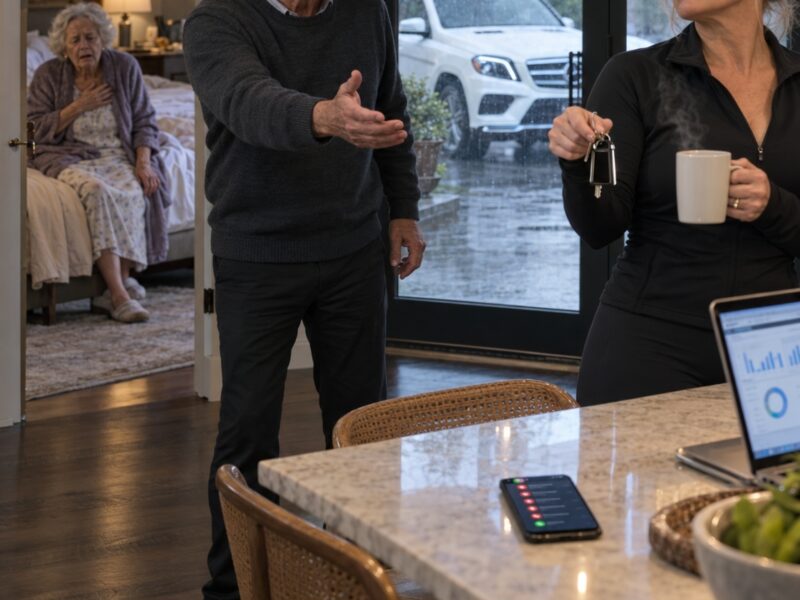
My 82-Year-Old Mother Couldn’t Breathe, but My Wife Refused Me Her Car—The Thirty-One Calls the Next Day Exposed What She Had Been Hiding
My eighty-two-year-old mother was struggling to breathe while my wife’s nearly new SUV sat ten feet from our front door, warm, fueled, and untouched.
Laura looked over the rim of her coffee and said, “Not my problem. Figure it out,” as if I had asked for a favor instead of help getting my mother to a hospital.
I answered with one quiet word—“Okay”—and by the next morning, she had called me thirty-one times because she finally understood what that word meant.
The first thing I noticed was my mother’s hands.
They were cold.
Not winter cold. Not the harmless chill of an older woman who refused to wear socks around the house because she said socks made her feel “institutional.” Her fingers were pale and stiff against the quilt as she sat on the edge of the guest-room bed, breathing through parted lips.
“David,” she whispered. “I think we should go in.”
That sentence scared me more than the cough.
My mother, Evelyn Thompson, was eighty-two years old and had spent most of her life treating doctors as people you visited only after every home remedy had failed. She had two coronary stents, mild congestive heart failure, arthritis in both knees, and a weekly pill organizer large enough to qualify as furniture.
If Evelyn said hospital, we were going to the hospital.
I picked up my phone and called her cardiologist’s answering service while helping her into a robe. The nurse on duty listened to the symptoms—shortness of breath, gray color around the lips, swelling in her ankles—and told me not to wait for the office to open.
“Emergency department,” she said. “Now.”
It was 6:42 on a gray Tuesday morning in northern New Jersey. Rain pressed softly against the windows, and somewhere downstairs the coffee machine gave its final hiss.
I reached for my car keys.
Then remembered.
My Toyota had been at the transmission shop for four days.
Parts delay.
The mechanic had called the evening before to tell me it would probably be Friday.
Laura’s SUV sat in the driveway.
Nearly new.
Less than nine thousand miles.
I walked into the kitchen.
My wife was at the island wearing black leggings, white sneakers, and a pale blue pullover. Her Pilates bag rested on the stool beside her. One hand held a mug. The other scrolled through her phone.
“Laura.”
She did not look up immediately.
“Mom needs to get to the hospital. My car’s still in the shop. I need your SUV.”
She swiped once more.
“I have Pilates at nine.”
“I’ll bring it back if they release her quickly. If they admit her, Frank can pick you up, or I’ll pay for a ride.”
That was when she looked at me.
No anger.
No confusion.
No fear for the old woman coughing twenty feet away.
Just inconvenience.
“Not my problem,” she said.
She lifted her coffee.
“Figure it out.”
For several seconds, I thought I had misunderstood.
“My mother can’t breathe.”
Laura shrugged.
“Then call an Uber.”
I stood there longer than I am proud of.
Twenty-eight years of marriage trains you to wait for the correction. The softening around the eyes. The small laugh that tells you a sentence came out wrong. The apology that returns a person to the version you recognize.
Nothing came.
Laura looked back at her phone.
My mother coughed again down the hall.
Something inside me became very quiet.
Not angry.
Quiet.
I had spent thirty-five years as a certified public accountant. I had sat across from executives who hid seven-figure losses behind confident voices and clients who could explain away almost anything if you let them talk long enough.
Eventually, I learned that the most important moment in any conversation was the one after the explanation stopped.
Silence told you what remained.
Laura’s silence told me everything I needed for that morning.
I picked up my phone.
“Okay,” I said.
That was all.
No shouting.
No slammed cabinet.
No demand that she choose between Pilates and basic decency.
Just one word.
“Okay.”
Then I walked away.
Our neighbor Frank Delaney answered on the second ring.
Frank was seventy-one, retired from the fire department, widowed for six years, and constitutionally incapable of asking a short question when a long one would do.
“What happened?”
“Mom’s breathing is bad. I need to get her to St. Joseph’s.”
“I’ll be there in three minutes.”
He arrived in two.
He did not ask why Laura’s white SUV remained in the driveway.
That was one of the things I liked about Frank.
Emergencies first.
Judgment later.
We helped Evelyn into the back seat of his old Subaru. She rested her head against the seat, eyes closed, one hand pressed lightly against her chest.
As Frank backed out, I looked toward the kitchen window.
Laura was standing there.
Coffee in one hand.
Phone in the other.
Our eyes met.
She looked away first.
Halfway to the hospital, Evelyn opened her eyes.
“Was Laura home?”
I stared through the windshield.
“She had something scheduled.”
My mother said nothing.
Frank looked at me once in the rearview mirror, then returned his eyes to the road.
That silence weighed more than criticism.
At the emergency department, everything accelerated.
A nurse clipped an oxygen sensor onto Evelyn’s finger while another attached leads to her chest. Blood was drawn. An EKG printed in quick black lines. A portable X-ray unit rolled through the curtain.
I stood beside the bed holding her purse because there was nothing else useful I could do.
At 8:17, Laura texted.
Everything okay?
I stared at the words.
Not How is she?
Not Do you need me?
Not I’m sorry.
Just two words and a question mark.
She’s being evaluated.
Three minutes later, a thumbs-up emoji appeared.
I turned the phone facedown.
Evelyn noticed.
“You have that face.”
“What face?”
“The one you used when your father tried to deduct a fishing boat as a business expense.”
Despite everything, I laughed.
“He almost got away with it.”
“He absolutely did not.”
The cardiologist came in shortly after ten-thirty.
It was not a heart attack.
Fluid retention.
Likely connected to a medication adjustment made the week before.
They gave her a diuretic, watched her oxygen improve, repeated labs, and decided she could go home if her numbers stayed stable.
“Close call,” the doctor said. “You brought her in when you should have.”
I nodded.
That sentence stayed with me.
You brought her in when you should have.
Timing.
For thirty-five years, timing had been part of my work.
When to refinance.
When to sell.
When to recognize a loss.
When to stop pretending an asset was worth what the books said it was worth.
It had never occurred to me that denial had a timing problem too.
Frank returned around noon with two turkey sandwiches and coffee.
“Laura coming?”
“No.”
He handed me the sandwich.
“Want me to say something?”
“No.”
“Good.”
“I wasn’t going to.”
He unwrapped half the sandwich for me like I was twelve.
We brought Evelyn home shortly after four.
Laura was sitting at the kitchen island with her laptop open.
Different clothes.
Same seat.
“How is she?”
“Stable.”
“Good.”
Evelyn walked slowly toward the guest room.
Laura did not stand.
I carried my mother’s bag down the hallway, helped her onto the bed, arranged the water and medication schedule on the nightstand, and waited until she was comfortable.
When I came back, Laura was closing her laptop.
“Did they say what happened?”
“Fluid buildup.”
“She okay?”
“For now.”
Laura nodded.
Then reached for her phone.
I stood there.
After a few seconds, she looked up.
“What?”
That was the moment I realized I was no longer trying to understand one cruel sentence.
I was trying to understand the woman who had said it.
That night, after Evelyn fell asleep watching an old detective show, I went downstairs.
The house was quiet except for the refrigerator and rain tapping the deck door.
I made coffee I did not need and opened my laptop.
Numbers had always calmed me.
They did not care about tone.
They did not care about charm.
They did not care how long you had been married.
A number was where it belonged or it was not.
I logged into our joint checking account.
For months, I had looked only at balances.
Retirement does that if you let it. You spend decades auditing everyone else, then convince yourself peace means no longer examining your own details.
The first transfer I did not recognize was four months old.
$8,500.
Recipient:
LWB Consulting LLC.
I leaned closer.
The next month:
$12,000.
Then four cash withdrawals totaling $6,200.
Then another electronic transfer.
$15,000.
My heart did not race.
It slowed.
That was the accountant in me taking over.
Fear became columns.
I opened our joint credit-card statements.
Fourteen thousand dollars in purchases I had not questioned closely over the previous year.
Designer clothing.
Two spa weekends.
A boutique travel agency.
A business conference in Scottsdale.
I remembered Laura saying Scottsdale was a trip with friends.
Maybe it had been.
Maybe not.
I opened a new spreadsheet.
Date.
Amount.
Description.
Account.
I kept going.
Then I found the SUV.
Laura had told me it was paid off.
It was not.
It had been financed through a separate line tied to our home equity.
I stared at the screen.
The home-equity line had been opened eight months earlier.
Both our electronic signatures were on the agreement.
I remembered signing something.
Laura had been sitting beside me on the sofa during a Yankees game.
“Insurance updates,” she had said. “They need both of us.”
I signed from her tablet without reading beyond the first screen.
Trust was not an excuse.
But it explained the mistake.
Forty-two thousand dollars had been drawn.
The money had not gone into our house.
I checked state business records.
Laura W. Bennett Consulting LLC.
Her maiden name.
Registered three months earlier.
A downtown co-working suite.
I found three recent business-credit inquiries under her name.
Then a website under construction.
Event strategy.
Nonprofit consulting.
Private corporate retreats.
Laura had organized fundraisers for years.
She was good at it.
I had always treated those events as something between volunteering and social life.
Now they had a logo.
A bank account.
A line of credit.
A plan.
The transfers were not random.
They were building something.
Maybe a business.
Maybe an exit.
Maybe both.
I sat at the table until after two.
The money hurt.
The secrecy hurt more.
The thing that hurt most was realizing I had not noticed.
Laura had started taking calls in other rooms.
Joined a new group of friends I never met.
Talked more about “having something of her own.”
I had interpreted it as healthy independence.
Now, staring at the numbers, it looked like preparation.
At 1:37, footsteps moved down the hallway.
Laura appeared in a robe.
“Why are you up?”
“Couldn’t sleep.”
Her eyes moved toward the laptop.
“What are you doing?”
“Reviewing things.”
“What things?”
“Numbers.”
She smiled faintly.
“You’re retired.”
“So I’ve been told.”
She opened the refrigerator.
“You seem distant.”
“I had a strange day.”
“If this is still about the car—”
“It isn’t.”
That was true now.
The car was only the flashlight.
It had illuminated the room.
Laura closed the refrigerator.
“What is it about?”
I shut the laptop.
“Responsibility.”
She frowned.
“What does that mean?”
“Nothing we need to discuss at two in the morning.”
She studied me.
Then shrugged.
The same shrug from the kitchen.
The same movement she had made when my mother could not breathe.
She went upstairs.
I stayed at the table.
That shrug no longer felt like a single bad moment.
It felt like punctuation.
The next morning, I called Daniel Cho.
Daniel had worked beside me for nineteen years before I retired and still managed parts of my retirement portfolio. He was sixty-three, wore the same rimless glasses he had worn since 2008, and claimed golf was “an expensive way to feel unemployed.”
“David?”
“I need a full account review.”
“When?”
“Today.”
Silence.
“You sound bad.”
“My numbers look worse.”
“Ten o’clock.”
Laura left for Pilates at 8:40.
I watched the SUV back down the driveway.
I did not touch the accounts.
Not yet.
Instead, I called the bank and asked questions.
Ownership.
Authorization.
How home-equity freezes worked.
What I could legally change.
What required both signatures.
What would constitute improper restriction of joint funds.
I wrote everything down.
At ten, Daniel closed his office door and took the statements from me.
He flipped through them slowly at first.
Then faster.
“How long since you reviewed these line by line?”
“Six months.”
He looked at me.
“Maybe eight.”
“That sounds more believable.”
He opened the bank portal.
Within fifteen minutes, his mouth tightened.
“She’s moving liquidity.”
“In English.”
“Cash.”
“Available credit.”
“Short-term access.”
“She’s increasing funds she can control independently while avoiding assets that would take time or mutual consent to unwind.”
I stared at him.
“Preparing to leave?”
Daniel shook his head.
“Preparing to have the option.”
That distinction mattered.
He opened the LLC registration.
“It’s real.”
“Business type?”
“Event consulting.”
“She has two pending contracts listed in an insurance application.”
“You knew?”
“No.”
Daniel glanced at me.
“Did she ever talk about this?”
I almost said no.
Then remembered.
Five years earlier.
Dinner.
Laura had described an idea for destination-event planning.
I had laughed and told her, “At our age, the smartest business is no business.”
Everyone at the table laughed.
Including Laura.
Apparently not because it was funny.
Daniel saw something on my face.
“What?”
“Nothing.”
“David.”
“She talked about doing this before.”
“And?”
“I told her it was risky.”
“Was it?”
“Yes.”
“Was that only thing you said?”
I looked at him.
“I told her there was no reason for both of us to work.”
Daniel leaned back.
“You were proud to provide.”
“Yes.”
“She may have heard something else.”
“That does not excuse moving forty-two thousand dollars without telling me.”
“No.”
“But both things can be true.”
That sentence would follow me for months.
Both things can be true.
Laura could have deceived me.
I could have helped create the marriage in which she stopped believing direct conversation would work.
One did not erase the other.
Daniel pointed to the home-equity line.
“Forty-two thousand drawn. Thirty-eight remaining.”
“I want further draws suspended.”
“You can request a review because you’re co-borrower.”
“Will she know?”
“Yes.”
“Good.”
He raised an eyebrow.
“Good?”
“I’m done treating silence as peace.”
Before I left, Daniel made one call.
Susan Meyers.
Family-law attorney.
Twenty-two years in practice.
She had an opening at one.
Susan listened without interrupting.
Dark green suit.
Fountain pen.
No dramatic reaction.
When I finished, she asked:
“Do you want a divorce?”
“I don’t know.”
“Excellent.”
That surprised me.
“You expected me to decide today?”
“I expected you to tell me not to decide while upset.”
“You don’t seem upset.”
“That concerns me more.”
She reviewed the documents.
“Do not drain accounts.”
“I wouldn’t.”
“Do not conceal assets.”
“No.”
“Do not stop ordinary household expenses.”
“Understood.”
“Do not transfer joint money into your own name merely because you can access it.”
“I won’t.”
“You can redirect income that belongs solely to you going forward.”
“My Social Security.”
“Yes.”
“Your pension depends on plan terms.”
“Daniel will check.”
She tapped the home-equity statement.
“You can request suspension pending review.”
“What about the LLC?”
“If marital funds went in, it is disclosed.”
“Do not sabotage it.”
“I wasn’t planning to.”
“Good.”
Susan leaned back.
“Why today?”
I thought about Evelyn’s gray face.
Laura’s coffee mug.
That shrug.
“She said something.”
“What?”
“My mother needed the hospital.”
“My car was in shop.”
“I asked for Laura’s.”
“She said, ‘Not my problem. Figure it out.’”
Susan’s expression changed.
Not shock.
Recognition.
“That was the moment?”
“No.”
“It made me look.”
Susan nodded.
“Those are usually different things.”
At three, I opened an individual checking account.
At four, I redirected my Social Security deposit.
At four-thirty, I called the bank and requested suspension of new home-equity advances pending joint review.
At five, I removed Laura as authorized user from two cards issued solely in my name.
I left all joint cards alone.
I left the household account funded.
Every action was documented.
Protection.
Not punishment.
At 6:07, Laura came home carrying a shopping bag.
“You’re early.”
“Yes.”
“How is your mother?”
“Better.”
“Good.”
She put the bag on the counter.
“I was thinking pasta tonight.”
“Fine.”
At 6:23, her phone buzzed.
She read the screen.
Stopped.
Read again.
“What is this?”
I poured water.
“What?”
“The home-equity line is suspended.”
“Yes.”
Her eyes lifted.
“Why?”
“I requested a review.”
“Without talking to me?”
“Yes.”
“You cannot freeze joint credit without discussing it.”
“I can request suspension.”
“That affects me.”
“I know.”
“What is going on?”
I looked at her.
“What is LWB Consulting?”
Her face changed.
Not much.
Enough.
“How do you know that name?”
“I read the accounts.”
Laura placed her phone down carefully.
“It’s my company.”
“I know.”
“I was going to tell you.”
“When?”
“When it was ready.”
“You moved tens of thousands of dollars.”
“Into a business.”
“Using joint funds.”
“Our funds.”
“Without discussion.”
Her arms folded.
“You controlled the finances for twenty-eight years.”
“I managed them.”
“That’s what you called it.”
“What did you call it?”
Her eyes sharpened.
“You never needed permission to move money.”
“I did not move forty-two thousand dollars into something you didn’t know existed.”
“I needed capital.”
“You needed a conversation.”
Laura laughed once.
“Conversation?”
“Yes.”
“With you?”
The contempt was small.
It hurt more because it was practiced.
“You mean the man who told me five years ago my business idea was unnecessary?”
I remembered dinner.
“I didn’t say unnecessary.”
“You said, ‘Why turn something you enjoy into work when we don’t need more income?’”
“That is not the same thing.”
“It is if you’re the one hearing it.”
I stared.
Laura continued.
“Every idea I had became a risk assessment.”
“Every plan became a spreadsheet.”
“You loved being provider, David.”
“You loved it so much you never noticed what it turned me into.”
“What?”
“Dependent.”
“You had full access to everything.”
“That isn’t same as having something that is mine.”
“You could have built something.”
“I tried to tell you.”
“And when I disagreed, you opened credit line behind my back.”
She looked away.
That was answer enough.
I asked:
“Are you planning to leave me?”
Her eyes came back too fast.
“No.”
“Are you preparing to?”
“I’m preparing not to be trapped.”
“By me?”
“By dependence.”
That sentence changed the room.
Laura’s first husband had left her at thirty-two with two children and almost no money. She had worked in a medical office by day and waited tables three nights a week for almost two years.
When we married, she still kept emergency cash in an envelope behind the flour canister.
I knew that.
I had assumed time and comfort had healed it.
Maybe fear did not care how many years passed.
“I would never leave you without resources.”
Laura’s mouth twisted.
“Mark said same.”
“I am not Mark.”
“I know.”
“Fear doesn’t.”
For the first time that evening, she looked less defensive than scared.
I let that be true.
Then remembered my mother coughing.
“Does fear explain yesterday?”
Laura stiffened.
“What?”
“My mother.”
“You wouldn’t lend me car.”
“That is separate.”
“No.”
“It isn’t.”
“I had something scheduled.”
“She could not breathe.”
“I told you to get a ride.”
“You chose Pilates over a medical emergency.”
Her eyes flashed.
“You make it sound like I left her on sidewalk.”
“You heard her coughing.”
“I have heard coughing for three years.”
The sentence escaped before she could stop it.
Silence.
There was the other thing.
Not money.
Resentment.
Laura sat down.
“I’m tired, David.”
“Of my mother?”
“Of disappearing.”
I stared.
“She has lived here three years.”
“Every meal changes.”
“Every trip changes.”
“Every plan depends on her appointments.”
“You cancel dinner if her blood pressure is weird.”
“You rearrange weekends for cardiology.”
“I’m not allowed to say I’m tired because then I’m selfish.”
“You are allowed to say you’re tired.”
“When?”
“When did you listen?”
I opened my mouth.
Closed it.
Laura continued.
“I asked about home health help.”
“You said family takes care of family.”
“I suggested senior community.”
“You acted like I wanted to throw her away.”
“I wanted one day every week where this house wasn’t organized around someone else’s needs.”
“That morning was not the day to teach me that.”
Her face crumpled slightly.
“I know.”
Barely audible.
“What?”
“I know.”
She looked down at the counter.
“I was angry before you came into kitchen.”
“I had gotten an email that a client might cancel.”
“I was worried about business.”
“Then you asked for car.”
“And for one ugly second, I thought, ‘Of course. Another emergency.’”
She swallowed.
“So I said it.”
“Not my problem.”
“Yes.”
“Figure it out.”
“Yes.”
She did not defend it.
That mattered.
“I’m sorry.”
The apology did not repair anything.
But it stopped her from becoming a villain in my mind.
People are easier to hate when they never tell truth.
I sat across from her.
“I met a lawyer today.”
Laura looked up.
Fear returned.
“Divorce?”
“Legal separation first.”
Her face hardened again.
“You already decided?”
“I decided we need financial boundaries.”
“You’re punishing me.”
“No.”
“It feels like punishment.”
“Consequences often do.”
She stood.
“You always do this.”
“Do what?”
“Turn everything into structure.”
“What would you prefer?”
“A husband.”
The words landed hard.
“I have been your husband for twenty-eight years.”
“You have been provider.”
“Fixer.”
“Accountant.”
“Son.”
“Stepfather.”
“I don’t know when you stopped being my husband.”
I stared.
“Maybe when you stopped being my wife.”
We both regretted it immediately.
But neither took it back.
Laura picked up her phone.
“I need space.”
“So do I.”
She went upstairs.
The door closed.
I sat at the same island where she had told me to figure it out.
No victory.
Only exhaustion.
Two days later, a process server delivered the legal-separation filing.
I was at Daniel’s office.
Laura texted at 10:19.
What did you do?
At 10:22, the first call came.
I let it ring.
Then call two.
Then three.
By eleven, I had eleven missed calls.
The first voicemail was angry.
“David, call me. This is ridiculous.”
The next was controlled.
“We can resolve this without attorneys.”
By call fifteen, her voice had changed.
“You cannot file separation without discussing it.”
By call twenty-three, fear entered.
“What exactly did you freeze?”
At call twenty-seven:
“Please answer.”
Daniel looked at my phone vibrating against the table.
“You going to pick up?”
“Eventually.”
“Why not now?”
“For twenty-eight years, I answered before I knew what question was.”
He considered.
“That sounds unhealthy in both directions.”
“Probably.”
At 2:11, the phone rang for thirty-first time.
I answered.
Laura was breathing unevenly.
“David.”
“Yes.”
“What is happening?”
“You were served.”
“I know I was served.”
“Why is my vendor payment bouncing?”
“What account?”
“The LLC.”
“Was payment funded from new home-equity draw?”
Silence.
“Yes.”
“The line is suspended.”
“You knew I had payment due.”
“No.”
“Because you never told me.”
“You are destroying my business.”
“No.”
“I am stopping our home from automatically financing it.”
“This is financial abuse.”
“That is why I filed through court.”
Another silence.
Laura understood distinction.
“You don’t trust me.”
“I did.”
“That is how the line got opened.”
Her breathing steadied.
“So that’s it?”
“No.”
“That would be easier.”
“What does that mean?”
“It means we have to look at everything.”
“Money.”
“Marriage.”
“My mother.”
“Your business.”
“Everything we stopped saying.”
She went quiet.
Then:
“You’re dismantling twenty-eight years because of one morning.”
“No.”
“One morning made me stop looking away.”
“This is about your mother.”
“It started there.”
“So because I told you to handle one thing yourself—”
“My mother could not breathe.”
“You still got her there.”
“With Frank.”
“That’s what neighbors are for.”
“No.”
“That is what partners are for.”
Laura inhaled.
Then I heard something break in her voice.
“I cannot disappear inside someone else’s family again.”
I leaned back.
“What are you talking about?”
“Mark.”
Her first husband.
“Everything was his emergencies.”
“His mother.”
“His brother.”
“His debt.”
“His plans.”
“I spent eleven years waiting for my turn.”
“Then he left anyway.”
I said nothing.
Laura kept going.
“When your mother moved in, I told myself it was different.”
“She’s kind.”
“You’re kind.”
“But gradually every week became medications, pharmacy runs, cardiology, dinner at six because Evelyn eats early, no long trips because you worry something might happen.”
“I started feeling like the guest.”
“You could have told me.”
“I did.”
“When?”
“I said I was tired.”
“I said we needed help.”
“You said family takes care of family.”
Memory came back.
I had said it.
More than once.
Laura continued.
“I said I wanted to work again.”
“You said we didn’t need money.”
“I said I wanted something mine.”
“You said we already had everything.”
I closed my eyes.
Different meanings.
Same words.
“That still doesn’t excuse lying about money.”
“No.”
“It doesn’t.”
“And it doesn’t excuse what you said to my mother.”
“No.”
“I know.”
The second apology sounded different.
Not defensive.
Tired.
“What happens now?” she asked.
“Mediation.”
“And us?”
“I don’t know.”
For first time, that answer felt more respectful than false certainty.
Our first mediation session took place three weeks later on a cold Thursday.
Laura arrived ten minutes late in the navy blazer she wore to charity boards. I wore a gray suit I had not touched since my retirement dinner.
Richard Kaplan, the mediator, was sixty-one, neutral to point of irritation, and had a habit of removing his glasses whenever either of us tried to turn facts into character judgments.
Susan sat beside me.
Laura’s attorney, Andrea Bell, sat beside her.
Richard opened with the financial summary.
House.
Mortgage.
Retirement.
Checking.
Brokerage.
Equity line.
SUV financing.
LLC.
He looked at Laura.
“What is intended business activity?”
“Event and nonprofit consulting.”
“Current clients?”
“Two signed.”
“Expected revenue?”
“Twenty-eight thousand over next six months.”
I turned toward her.
That was more than I expected.
Laura noticed.
“What?”
“Nothing.”
Richard said, “Mr. Thompson?”
“I didn’t know she had clients.”
“That is part of problem,” Laura said.
Andrea touched her wrist.
Richard continued.
“Startup expenditures?”
Laura had records.
Website design.
Insurance.
Software.
Office membership.
Marketing.
Travel.
Vendor deposits.
Some expenses were mixed.
A spa weekend had been partially personal.
Designer clothing unquestionably was.
But there was no offshore account.
No secret boyfriend.
No plan to empty retirement.
The truth was simpler.
And more complicated.
Laura had not been secretly preparing to steal my life.
She had been secretly preparing to have one she believed I could not veto.
That did not make home-equity deception acceptable.
But it changed what I thought I was fighting.
Richard asked:
“Why did you not disclose business plan?”
Laura looked at me.
“Because I expected him to say no.”
I answered before Susan could stop me.
“I probably would have.”
Laura blinked.
Richard looked at me.
“Why?”
“Risk.”
“At our age.”
“Home equity.”
“Startup failure rates.”
“Everything I’ve said for decades.”
“That is another way of saying no.”
“Yes.”
I admitted it.
“That is exactly what it is.”
Laura looked down.
For first time in mediation, some of anger left her shoulders.
Richard turned to me.
“And why suspend credit without first confronting?”
“Because money had already moved without a conversation.”
“That may feel symmetrical to Mrs. Thompson.”
“Emotionally, maybe.”
Susan added:
“Legally, transparency and access are distinct issues.”
Richard nodded.
“Both matter.”
By end of four hours, we had temporary rules.
No new equity draws.
Separate checking accounts.
Agreed household account.
Laura’s LLC continued but no additional marital funding without consent.
Existing forty-two thousand classified pending final division.
SUV became Laura’s sole responsibility.
My retirement distributions remained separate pending court approval.
No one left happy.
That seemed like progress.
In parking lot, Laura stood beside her SUV.
“So now we’re a contract.”
“We were always a contract.”
“I just stopped reading the fine print.”
Her face tightened.
“You make everything sound like an audit.”
“I know.”
“That is part of why we got here.”
“I know that too.”
She looked at me.
“You’ve changed.”
“No.”
“I’ve stopped absorbing.”
“Same thing.”
Maybe she was right.
The next major turn came from my mother.
Evelyn fell in the hallway.
Not dramatic.
Her slipper caught the edge of a rug.
She bruised her hip.
X-rays showed no fracture.
But at the hospital, a social worker asked:
“What is long-term living plan?”
I began answering.
Evelyn interrupted.
“I’m moving.”
I stared.
“What?”
“Assisted living.”
“Near St. Matthew’s.”
“Joan moved there.”
“They have bridge.”
I almost laughed.
Then saw she was serious.
“You toured?”
“Last month.”
“With whom?”
“Frank’s daughter.”
I felt betrayed before realizing irony.
“Why didn’t you tell me?”
Evelyn smiled.
“Because you’d say no.”
The exact sentence hit me.
Laura sat in corner.
Our eyes met.
I heard myself from months earlier.
You could have told me.
Evelyn continued.
“I love you.”
“I love Laura.”
“I don’t want your retirement to become my old age.”
“I can afford help.”
“There.”
She pointed at me.
“You’re solving.”
I stopped.
“What do you want?”
“Own room.”
“Near church.”
“Bridge.”
“Someone else remembering my pills so you can go fishing once before you die.”
I laughed despite tears.
“I don’t fish.”
“You should start.”
On drive home, Laura sat beside me because her SUV had brought us that time.
Interesting, the difference one morning can make.
“You okay?” she asked.
“No.”
“Want me to say something?”
“No.”
She nodded.
And let silence stay.
That was perhaps the first generous thing either of us had done correctly in months.
Evelyn moved six weeks later.
The first night, I walked into empty guest room and stood beside window.
Her lamp was gone.
Her slippers.
Her detective novels.
Even faint smell of cold cream.
Laura appeared at door.
“I miss her.”
I looked at her.
“You resented her.”
“I did.”
“You miss her.”
“Yes.”
Both things.
Again.
Laura stepped inside.
“I owe you another apology.”
“You already apologized.”
“I want one without fear about accounts attached.”
I waited.
“That morning was cruel.”
“Yes.”
“I knew she was sick.”
“Yes.”
“I chose resentment over decency.”
“Yes.”
Her eyes filled.
“I’m ashamed.”
I did not rescue her from it.
But I did not use it to punish either.
“Thank you.”
She sat edge bed.
“What are we doing?”
“I don’t know.”
“Do you want divorce?”
“Some days.”
She nodded.
“Me too.”
That honesty would once have terrified us.
Now it sounded like oxygen.
Financial discovery continued.
Daniel called one morning.
“Need to see you.”
“What now?”
“Not disaster.”
“From an accountant, that means something.”
One $15,000 LLC payment went to company owned by Laura’s daughter, Megan.
Megan did marketing.
I knew she helped with website.
I did not know she had been paid that much.
I asked if improper.
Daniel said, “Need invoice.”
Laura produced one.
Brand strategy.
Website development.
Client acquisition.
Expensive but defensible.
Then Megan asked to meet me alone.
We sat in coffee shop.
She looked nervous.
“I knew about Mom’s business.”
“I assumed.”
“She asked me not to tell you.”
“That bothers me.”
“I know.”
“She thought you’d laugh.”
“I wouldn’t.”
Megan looked at me.
“You did.”
I stared.
“When?”
“Five years ago.”
“She talked about destination events.”
“You made joke about ‘retirement business.’”
The dinner came back.
Everyone laughing.
Laura too.
Megan stirred coffee.
“She never forgot.”
“Why didn’t she tell me it hurt?”
“Because Mom doesn’t fight when she feels small.”
“She plans.”
That sentence explained more than Megan intended.
Then she said:
“She toured an apartment before hospital thing.”
My stomach tightened.
“What?”
“Downtown.”
“She didn’t sign.”
“Was she leaving?”
“I don’t know.”
“Neither did she.”
“She wanted to know she could.”
Option.
Again.
I thanked Megan.
Did not ask her to choose sides.
When I told Laura, she became angry.
“You dragged Megan into this?”
“She asked to speak to me.”
“She shouldn’t be involved.”
“She already was.”
Laura looked away.
“You paid her from marital money.”
“For work.”
“I know.”
“Daniel verified.”
Her eyes came back.
“You believe that?”
“Yes.”
She looked almost disappointed.
As if accusation would have been easier.
“I’m trying not to turn every fact into evidence against you.”
Laura sat down.
“I toured one condo.”
“I know.”
“I didn’t sign.”
“I know.”
“I thought about it.”
“I know.”
“You’re not angry?”
“I’m hurt.”
“That is different.”
“Yes.”
“Did you want to leave?”
She took time.
“I wanted a place where nobody needed anything from me.”
“That sounds like leaving.”
“Maybe.”
Her face softened.
“I don’t know.”
I believed her.
That was frightening too.
Not every secret contains a finished plan.
Sometimes people build exits before deciding whether to use them.
A month later, Laura’s business landed a major client.
A regional hospital network hired her to coordinate donor events across three locations.
The irony was not lost on either of us.
She came to house—she was mostly staying at a short-term rental by then—with contract.
“Want to see?”
I hesitated.
Then nodded.
She handed it over.
I read.
Not as auditor.
As husband who might soon not be husband.
“Fee structure good.”
“You sound disappointed.”
“I’m impressed.”
Laura stared.
“You are?”
“Yes.”
“Do you think I can do it?”
There was old wound.
I answered carefully.
“Yes.”
Her eyes filled.
“That’s all I wanted five years ago.”
I felt guilt settle.
“You also needed me to tell you when numbers were bad.”
“Probably.”
“We both wanted praise without friction.”
“That sounds like marriage.”
“Bad version.”
She smiled.
Then said:
“I wish I’d built it honestly.”
“So do I.”
That was our first conversation in months where nobody defended.
Then came low point.
My retirement account took a hit.
Not because Laura touched it.
Markets dropped sharply after a banking scare.
Temporary.
But enough to make house buyout numbers tight.
At same time, Evelyn had another hospitalization for dehydration.
Laura’s biggest client delayed payment.
Everything arrived in one week.
Stress does not create character.
It reveals unfinished work.
I reverted.
Spreadsheets everywhere.
Contingency models.
Calls.
I began telling Laura what she should cut.
Office.
Contractor.
SUV.
She lasted three days.
Then snapped.
“You’re doing it again.”
“What?”
“Managing me.”
“I’m helping.”
“No.”
“You’re scared.”
“So you’re turning fear into control.”
The sentence stopped me.
Exactly what she had done in kitchen.
Different tool.
Same instinct.
I closed laptop.
“You’re right.”
Laura stared.
“That’s it?”
“That’s it.”
“You’re not going to explain why I’m wrong about being right?”
I almost laughed.
“No.”
She sat across from me.
“Thank you.”
We were learning.
Too late to save old marriage.
Maybe in time to save ourselves.
Evelyn recovered.
Markets stabilized.
Client paid Laura.
Nothing magical.
Just life refusing to stay at maximum tension forever.
Our final mediation was scheduled for early spring.
House appraisal came back high.
I could buy Laura’s share through combination of brokerage assets and refinance without touching retirement principal more than Daniel considered prudent.
Laura wanted downtown.
We agreed.
The equity-line debt was allocated largely to her because most draws funded business, though a portion had covered joint household expenses.
No courtroom fight.
No judge assigning moral winners.
Paperwork.
Appraisals.
Tax projections.
Signatures.
Before final session, Susan asked:
“You sure?”
“About divorce?”
“Yes.”
I looked out her office window.
“I don’t want old marriage back.”
“Do you want a new one with same person?”
That question hurt.
“I don’t know how to answer without nostalgia.”
“That usually is answer.”
I nodded.
Laura reached same conclusion separately.
At final mediation, Richard looked almost relieved.
“You two have reached comprehensive agreement.”
Laura said:
“We’re very efficient at ending things.”
Richard smiled carefully.
“Sometimes efficiency is mercy.”
We signed property agreement.
House to me after buyout.
LLC to Laura.
SUV to Laura.
Separate retirement.
Tax obligations allocated.
Future support waived by both after counsel confirmed fairness.
Then divorce papers.
Laura held pen.
“Last chance.”
“For what?”
“Terrible romantic speech.”
“I didn’t prepare one.”
“You always prepare.”
“I’m trying something new.”
She smiled.
Then signed.
I signed after her.
Twenty-eight years ended under fluorescent office lights while HVAC hummed above us.
Not with affair.
Not with shouting.
Not with courtroom.
Two names.
Two signatures.
Outside, wind pushed dry leaves across parking lot.
Laura stopped beside SUV.
“David.”
“Yes?”
“I did love you.”
Past tense can be cruel.
This wasn’t.
“I know.”
“You were good to Megan and Chris.”
“They’re my kids too, where it matters.”
She nodded.
“I’m sorry I made you feel like your only value was providing.”
Laura looked down.
“I let you.”
“No.”
“We built that together.”
Maybe.
“I’m sorry I treated your ambitions like optional.”
“Thank you.”
“And I forgive morning.”
She looked up quickly.
“Really?”
“Yes.”
“That doesn’t make it okay.”
“I know.”
“It means I don’t want to carry it forever.”
Laura’s eyes closed briefly.
“I’m still working on forgiving myself.”
“That takes longer.”
She smiled.
“You sound like therapist.”
“Don’t insult me.”
She laughed.
Then hugged me.
Not romantic.
Not desperate.
A goodbye to something that had once been real.
She drove away.
Six months passed.
The house felt larger.
Not emptier.
Quieter.
I visited Evelyn twice a week.
She joined bridge club.
Developed rivalry with a retired dentist named Miriam.
Started growing basil on balcony and somehow killing it despite staff help.
“You lonely?” she asked one afternoon.
“No.”
“Good.”
“Frank’s sister is single.”
“Mom.”
“She likes accountants.”
“I’m leaving.”
She laughed.
I still stood reflexively when she coughed.
She pointed at chair.
“Sit.”
I sat.
Progress.
Laura’s company grew.
I knew because public filings were public, not because I monitored her.
Daniel occasionally mentioned numbers if relevant to settlement.
Eventually I told him:
“Stop.”
“Stop what?”
“Updating me.”
He looked surprised.
“You asked.”
“I don’t anymore.”
“That sounds healthy.”
“Don’t make it weird.”
Her business was hers.
Mine was mine.
One evening in August, Laura called.
Once.
I answered.
“Hi.”
“Hi.”
“I got final tax notice.”
“So did I.”
Silence.
Then she said:
“I was scared.”
“Of what?”
“Being dependent again.”
I thought about Mark.
The flour-canister cash.
The condo tour.
The LLC.
“You weren’t dependent.”
“I know that now.”
“You just didn’t trust I would stand beside you if you asked.”
“And you didn’t trust that independence didn’t mean abandonment.”
“No.”
She exhaled.
“We really did a number on each other.”
“Accountant humor?”
“Accidental.”
I smiled.
“How’s business?”
“Busy.”
“Good.”
“You mean that?”
“Yes.”
“How’s Evelyn?”
“Playing bridge for money.”
Laura laughed.
“Of course she is.”
“She asked about your stuffing.”
“That woman knows quality.”
We did not promise friendship.
No monthly dinners.
No reconciliation.
Just two people finally speaking without trying to win.
A year after hospital morning, I woke at 6:40.
Same gray light.
Rain against windows.
For half second I expected cough from guest room.
Instead house was quiet.
My phone buzzed.
Evelyn.
I answered immediately.
“You okay?”
“Good morning to you too.”
“You called at six-forty.”
“I need a ride.”
My chest tightened automatically.
“What happened?”
“Nothing.”
“Joan and I have cardiology appointments same morning.”
“We want breakfast after.”
I laughed.
“Okay.”
There it was.
That word.
She noticed too.
“What?”
“Nothing.”
“I’ll pick you up at eight.”
“Eight-ten.”
“Why?”
“I’m eighty-three.”
“I need time for lipstick.”
“Yes, ma’am.”
I showered.
Made coffee.
Sat at kitchen island.
Same seat.
Same countertop.
Morning light spread across wood.
There was no anger left in room.
That surprised me most.
For months I had thought story was about financial boundaries.
Then about marriage.
Then about Laura’s secrecy.
Then about my mother.
Eventually I understood it was about all of those things and none by themselves.
Laura’s five words did not destroy our marriage.
They removed cover.
The thirty-one calls did not prove she cared more about money than me.
They showed how loud fear becomes when control disappears.
And freezing credit did not make me winner.
It created enough stillness to see what had been happening.
I had mistaken providing for partnership.
Laura had mistaken independence for secrecy.
I had used solutions to avoid listening.
She had used silence to avoid disagreement.
We had both spent years preserving a structure after we stopped asking whether it still served both people inside it.
The mortgage got paid.
Thanksgiving happened.
Birthdays happened.
From outside, that looked stable.
Inside, resentment accumulated like interest.
No one notices compounding until number gets large.
I finished coffee.
Picked up keys.
My Toyota sat in driveway.
Transmission replaced.
Mine.
No permission needed.
I drove to assisted-living residence.
Evelyn waited under awning in red coat, handbag looped over one arm.
“You’re early.”
“Four minutes.”
“They have clocks here.”
“I know.”
“Then respect them.”
I opened passenger door.
She climbed in slowly.
Before I closed it, she looked at car.
“Laura’s was nicer.”
“Thank you.”
“Just saying.”
I laughed and walked around.
As we pulled away, Evelyn said:
“Laura called me yesterday.”
I looked over.
“She did?”
“Yes.”
“What about?”
“Stuffing.”
“Of course.”
“She sounds good.”
“I think she is.”
“Are you?”
I looked at road.
“Yes.”
Evelyn nodded as if checking box.
At first red light, she placed hand over mine.
One year earlier, I had needed somebody else’s keys to take care of person I loved.
Now there was nothing dramatic left to prove.
No frozen accounts.
No missed calls.
No lawyers.
No revenge.
Just road ahead.
My mother beside me.
And a life whose terms I had finally learned to read.
Sometimes “figure it out” is an insult.
Sometimes it becomes permission.









